





Introduction
In 2019, Hong Kong experienced the largest social movement in its history. The direct cause of the movement was the public opposition to the proposed amendments to the Fugitive Offenders Ordinance, which the Hong Kong government intended to pass in the Legislative Council. As a result, this movement came to be known as the Anti-Extradition Law Amendment Bill Movement (Anti-ELAB Movement). To date, numerous studies have explored this social movement, including its causes, continuity, consequences, and characteristics (Lee et al. Reference Lee, Yuen, Tang and Cheng2019, Reference Lee, Tang, Yuen and Cheng2020; Ng Reference Ng2020; Lee Reference Lee2020a; Lee et al. Reference Lee, Cheng, Liang, Tang and Yuen2022a, Reference Lee, Liang, Cheng, Tang and Yuen2022b; Cheng et al. Reference Cheng, Lee, Yuen and Tang2022; Hu Reference Hu2022; Tang Reference Tang2023; Tsang Reference Tsang2023; Chan Reference Chan2024a, Reference Chan2024b).
Some of these studies mention that the experiences of Hong Kong residents during the Anti-ELAB Movement were traumatic (Tang Reference Tang2023), or that the movement caused psychological harm to the people of Hong Kong (Chan Reference Chan2024a, Reference Chan2024b), with such psychological harm being a manifestation of trauma. However, there is currently no literature that systematically examines the Anti-ELAB Movement as a form of trauma across the Hong Kong population.
Although some studies have found that the people of Hong Kong experienced post-traumatic stress disorder (PTSD) or severe psychological distress during and after the protests (Lee Reference Lee2019b; Ni et al. Reference Ni, Yao, Leung, Yau, Leung, Lun, Flores, Chang, Cowling and Leung2020; Tang Reference Tang2023; Chan Reference Chan2024a, Reference Chan2024b), these works largely treat trauma as an individual and medicalized byproduct of political turmoil. In contrast, this article departs from existing research by conceptualizing the Anti-ELAB Movement not merely as an event that produces trauma, but as an ongoing form of collective trauma that both drives and sustains political mobilization. Drawing on Craps’s (Reference Craps2013) critique of conventional event-based trauma theory, this study introduces the perspective of insidious trauma, understood as the cumulative psychological burden generated by long-term continuous structural oppression, to reinterpret the movement. By placing trauma studies in dialogue with the sociology of emotions in social movements (Goodwin et al. Reference Goodwin, Jasper, Polletta, Goodwin, Jasper and Polletta2001; Gould Reference Gould2009), this article argues that trauma should not be understood solely as a passive condition of victimhood, but also as a dynamic political force. Such a force can transform collective grief and moral shocks into radical political will, anger, and sustained action.
Furthermore, existing studies on the emotional and psychological dynamics of the movement have focused almost exclusively on protesters, leaving a significant gap in understanding the polarized confrontation that defined the movement. To fully understand the movement as a form of collective trauma, it is necessary to incorporate the perspective of pro-establishment supporters. In the Anti-ELAB Movement, trauma was mutually constituted. On the one hand, protesters experienced trauma due to structural oppression and police violence. On the other hand, pro-government citizens, despite occupying a position of institutional advantage, also developed their own competitive trauma narratives, centered on the perceived loss of social order and prosperity, as well as fear of protester violence. Examining both sides reveals how trauma formed an interactive cycle, in which reciprocal perceptions of victimhood created an emotional feedback loop that, through mechanisms of dehumanization and moral disengagement (Bandura et al. Reference Bandura, Barbaranelli, Caprara and Pastorelli1996), reinforced and deepened incompatible political identities.
Therefore, the central claim of this article is that the Anti-ELAB Movement was defined and sustained by competing and mobilized forms of collective trauma, which entrapped both protesters and pro-government supporters in an escalating cycle of mutual dehumanization. By shifting the analytical focus from individual psychological harm to the relational and affective dimensions of trauma between divided groups, this article offers a new perspective for understanding the roots of the movement’s intense polarization. Ultimately, re-examining the movement through the dual lenses of trauma studies and the sociology of emotions helps illuminate the deep and unresolved fractures within contemporary Hong Kong civil society and provides important implications for the future of education in post-conflict and authoritarian contexts.
This study uses official documents, newspaper articles, and existing academic literature to revisit the Anti-ELAB Movement and conduct an analysis of the movement in conjunction with trauma studies and the study of the emotional politics of social movements. This article first reviews the processes within the Anti-ELAB Movement, pointing out the formation of victim identity therein, and how both camps competed with each other for a victim identity. It then attempts to interpret some of the dehumanizing and infra-humanizing labels widely used during the movement, revealing the mechanism through which victim identity further develops into trauma. Both camps not only competed with each other for a victim identity, but also mutually justified their own use of force, causing the movement to evolve into an indelible trauma. Through the perspectives of trauma studies and the emotional politics of social movements, this study not only describes and summarizes the Anti-ELAB Movement. It further explains why the movement lasted for as long as a year, and how, in the post-conflict era, it continues to affect Hong Kong. As a result, the Anti-ELAB Movement has become a trauma that the people of Hong Kong have yet to erase.
Victim identity as the starting point
Previous studies have shown that during the Anti-ELAB movement, those residing in Hong Kong experienced less sleeping time (Lee et al. Reference Lee, Marek and Nálevka2024a), a rise in the number of individuals potentially suffering from depression (Lee Reference Lee2019; Ni et al. Reference Ni, Yao, Leung, Yau, Leung, Lun, Flores, Chang, Cowling and Leung2020), and a rise in suspected cases of PTSD (Ni et al. Reference Ni, Yao, Leung, Yau, Leung, Lun, Flores, Chang, Cowling and Leung2020). These findings indirectly reflect that, for most Hong Kong people, the experience of the Anti-ELAB movement was traumatic.
During the Anti-ELAB movement, tear-gas rounds in Hong Kong, mass arrests, and the later National Security Law (NSL), threatened bodily and legal security. Many protesters recast themselves as victims; pro-government citizens, citing vandalism and street clashes with protesters, did the same. At the personal level, it matches how Caruth (Reference Caruth1996, 11) describes trauma as “an overwhelming experience of sudden or catastrophic events in which the response to the event occurs in the often delayed, uncontrolled repetitive appearance of hallucinations and other intrusive phenomena.” However, to fully understand this movement, relying solely on an event-based model of trauma is insufficient. The concept of insidious trauma proposed by Craps (Reference Craps2013), which refers to the psychological burden produced by ongoing, structural oppression rather than a single catastrophic event, effectively addresses this limitation.
More importantly, victimhood is not merely a passive condition of trauma and powerlessness. In the context of this movement, it functioned as a resource that was actively mobilized. As Gould (2009) demonstrates in her analysis of the AIDS movement, movements are sustained precisely through profound emotion work, which transforms paralyzing fear and collective grief into righteous anger. In the Anti-ELAB Movement, protesters did not succumb entirely to despair. Instead, by transforming the traumatic experience of victim identity into the passionate politics of active resistance, they generated resilience and sustained momentum in their struggle against authoritarianism. At the same time, pro-government supporters also experienced fear and grief, and these emotions fueled their aversion to and confrontational stance toward the protesters.
Moreover, trauma can be more than an individual pathology. Erikson indicates that trauma can be “a blow to the basic tissues of social life that damages the bonds attaching people together” (Erikson Reference Erikson1976: 154). Anti-ELAB illustrates how political violence translates private shock into collective identity. Trauma “changes the subject’s perception of well-being…distorting its identity and transforming it into the victim” (Perrotta Reference Perrotta2019: 1). Once this victim identity surfaced, social media livestreams, street memorials, and nightly chants turned scattered emotions into a shared grievance narrative: “black police brutality” versus “black-clad rioters.”Footnote 1 Because the state monopolizes coercive force, the cycle worked asymmetrically; fresh police actions supplied new episodes of political trauma, continually renewing protesters’ sense of injustice while furnishing government supporters with images of chaos. Individual distress thus fed a self-reinforcing collective story that hardened group boundaries and prolonged the conflict well beyond the street battles themselves.
The victim identity of protester camp
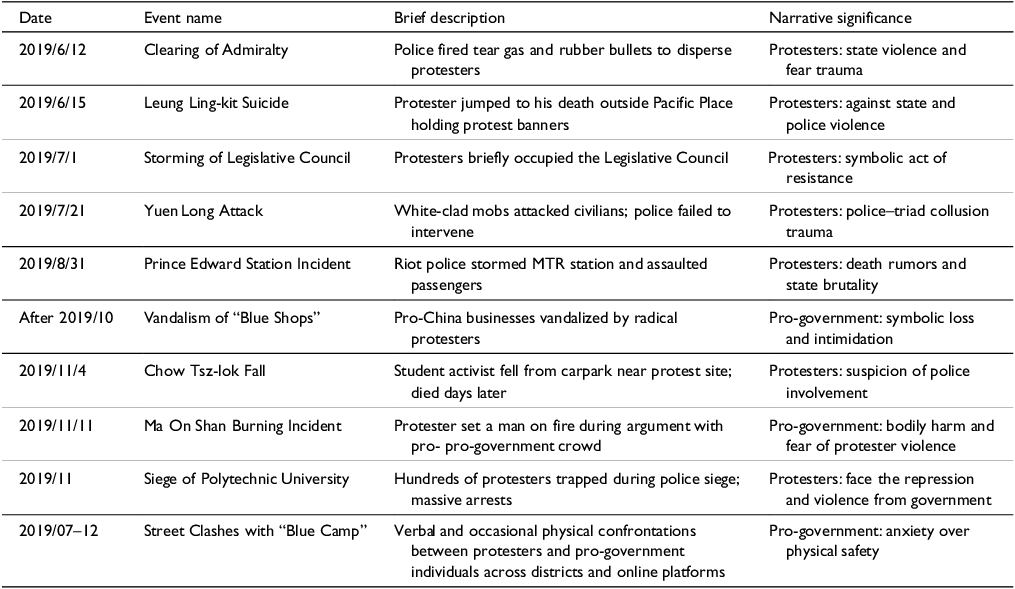
The Anti-ELAB Movement began with its first large-scale protest in June 2019 and lasted for a year, gradually subsiding by June 2020 as protests and demonstrations waned. During this period, numerous significant events occurred, including instances of alleged fake news. Through the discussion, portrayal, and documentation of these events and rumors, the division between the protesters and the government, along with the pro-government camp, became increasingly stark.Footnote 2
However, the victim identity of the protester camp emerged not merely as a passive state of suffering, but as a politically mobilized resource. Rather than succumbing to the powerlessness typically associated with trauma, protesters engaged in emotion work (Gould 2009), actively transforming experiences of state-sanctioned violence into militant defiance and resilience.
Leung Ling-kit, widely regarded as the first person to die as a result of the movement, left a banner before his death that read: “No extradition to China, total withdrawal of the extradition bill, we are not rioters, release the students and injured, Carrie Lam step down, help Hong Kong” (Grundy Reference Grundy2019). His death deeply resonated with the people of Hong Kong, leading to another massive protest organized by the Civil Human Rights Front on June 16. The organization described the turnout as “two million plus one,” with the “plus one” referring to Leung Ling-kit himself. Beyond Leung Ling-kit, several other cases of suicide or suspected killings occurred throughout the movement. These cases were widely reported by the media, making the names and faces of the victims visible, along with their reasons for suicide and aspects of their personal lives, sometimes even revealed by netizens. From the perspective of the sociology of emotions, these tragedies functioned as moral shocks (Goodwin et al. Reference Goodwin, Jasper, Polletta, Goodwin, Jasper and Polletta2001), which are unexpected events that provoke intense outrage and propel individuals toward political action. Psychological studies have shown that these personalized cases elicit stronger public empathy than mere statistics (Slovic Reference Slovic2007). For protesters, witnessing these real-life cases allowed them to connect their emotions with the victims. Instead of yielding to paralyzing despair, the movement actively channeled this collective grief into righteous anger (Gould 2009). By translating traumatic loss into a powerful passionate politics, protesters strengthened their resolve to persist in their demands.
Besides as a victim of police violence, protesters also identified themselves as victims of violence perpetrated by the pro-government camp. From the protesters’ perspective, this violence was also linked to the police. Protesters believed that while the pro-government camp attacked them, the police responded with indifference and failed to enforce the law as rigorously as they did against the protesters (Lee et al. Reference Lee, Cheng, Liang, Tang and Yuen2022a). The most notable example of this perception was the July 21 Yuen Long attack. During this incident, the individuals who assaulted protesters were believed to have connections with triad organizations (Barron Reference Barron2019; Cheung and Giles Reference Cheung and Giles2019). The police’s lack of immediate action further fueled the belief among protesters that there was collusion between the police, the pro-government camp, and the triads (Lee Reference Lee2019). By late July, the demand for an investigation into police violence and abuse of power had become the greatest point of consensus among protesters and their most pressing demand (Lee et al. Reference Lee, Yuen, Tang and Cheng2019; Lee et al. Reference Lee, Cheng, Liang, Tang and Yuen2022a). Protesters not only feared threats to their freedom but also felt oppressed by the government, subjected to violence by both the police and pro-government individuals, and believed that law enforcement was being applied unfairly. However, this multifaceted sense of victimhood did not lead to submissive surrender. Drawing on the emotional mechanisms of social movements, this institutional betrayal was mobilized to foster an enduring collective solidarity. The movement successfully harnessed the trauma of structural victimization, turning scattered feelings of vulnerability into a combative stance against authoritarianism. These experiences solidified their sense of victimhood within the movement, yet it was a victimhood infused with defiance rather than defeat.
The victim identity of government and pro-government camp
Pro-government supportersFootnote 3 similarly framed themselves as victims of social disorder and symbolic or direct attacks, albeit from a position of institutional advantage. As Ahmed (Reference Ahmed2004) suggests, emotions do not reside merely within individuals but circulate within affective economies, binding groups together while delineating sharp boundaries between “us” and “them”. For the pro-government camp, victimhood was not a passive reaction but an actively constructed emotional narrative used to legitimize repression and consolidate in-group solidarity.
First, the government and the pro-government camp viewed the protesters as those responsible for undermining Hong Kong’s prosperity, stability, and social order. This narrative was repeatedly emphasized in official press releases issued by the Hong Kong government during the Anti-ELAB Movement. For instance, the “Transcript of remarks by Chief Executive at media session” on August 5 (HKSAR 2019b) and “Heads of disciplinary forces condemn violence and strongly support HKSAR Government’s administration” on July 24 (HKSAR 2019a) both accused protesters of disrupting social stability and economic prosperity. This strategy was not unique to the Anti-ELAB Movement. As Wong (Reference Wong2022) notes, since Hong Kong’s handover, the government has consistently responded to social demands for democracy and freedom by invoking the need to maintain prosperity and stability.
For government supporters, their reactions were also driven by a perceived threat from protesters to Hong Kong’s social order, prosperity, and stability. The July 21 Yuen Long attack serves as a notable example of this dynamic. According to investigations by Hong Kong media, the reason why a large number of pro-government individuals gathered and attacked protesters that night appears to have stemmed from a decision to “defend their homeland” (Cheng and Choi Reference Cheng and Choi2021).Footnote 4 Based on information circulating within the pro-government camp, they believed that on the night of July 21, 2019, a large group of protesters would enter Yuen Long. This prompted them to mobilize supporters to protect their community and retaliate (Cheng and Choi Reference Cheng and Choi2021). Driven by the fear of losing their established social order, pro-government supporters engaged in their own emotion work (Gould 2009), actively transforming their anxiety into defensive rage and justifying non-normative, violent action against protesters.
While this belief might have been based on rumors or imagined threats within the pro-government camp, the protesters’ actual attacks on pro-government institutions and individuals were perceived as real threats. These incidents reinforced the pro-government supporters’ sense of victimhood. As protesters began targeting businesses and institutions perceived as pro-government, online discussions emerged around a slogan: “Vandalizing the black [shops run by gangsters], decorating the red [shops owned by mainland Chinese capital], boycotting the blue [shops supporting the government], and purchasing at the yellow [shops supporting the movement]” (Lee et al. Reference Lee, Cheng, Liang, Tang and Yuen2022a).
In addition to property damage, there were instances where pro-government individuals were physically attacked by protesters. One notable case involved a man who was seriously injured after being set on fire by a protester during an argument (Cheng Reference Cheng2019b; Lo Reference Lo2019). These events further solidified the pro-government camp’s belief that they were victims of protester violence.
These violent episodes also functioned as powerful moral shocks (Goodwin et al. Reference Goodwin, Jasper, Polletta, Goodwin, Jasper and Polletta2001) that anchored the pro-government camp’s collective trauma. Driven by their unhealed sense of victimization and fear, pro-government supporters engaged in severe moral disengagement (Bandura et al. Reference Bandura, Barbaranelli, Caprara and Pastorelli1996). By amplifying these traumatic narratives, they stripped the protesters of their moral standing, thereby rationalizing the state’s excessive use of force and their own proxy violence without experiencing guilt.
These narratives intensified their perception of the protesters as a direct threat to both themselves and Hong Kong’s broader stability. Fearing that they might become the next targets of such attacks, many pro-government supporters increasingly viewed themselves as victims of protester violence. From their perspective, the destruction of Hong Kong’s social order and prosperity, combined with the perceived threat to their personal safety, solidified their sense of victimhood in the context of the Anti-ELAB Movement.
However, the two sides’ experiences of harm were situated within an asymmetric power structure. Protesters faced direct police violence, arrest, and prosecution, while the government retained legal authority and access to state-controlled media. Few government supporters were physically harmed, and many of their victim narratives were rooted in reputational or psychological damage rather than personal danger. This imbalance in coercive power and exposure to risk highlights that, although both camps invoked victimhood, the consequences and stakes were far from equal.
The extension of victimhood: dehumanization and infra-humanization
The shared sense of victimhood led to an intractable deadlock, as neither side was willing to compromise or make concessions. Each camp viewed the other as the aggressor and believed that it was the opposing side that should yield. In this context, dehumanization and infra-humanization further intensified the conflict. Both camps engaged in these processes, amplifying emotions such as anger and hatred, deepening the divide, and making the conflict increasingly difficult to resolve.
While both dehumanization and infra-humanization involve labeling, prejudice, and discrimination aimed at diminishing the opposing group, there are important distinctions between the two. Dehumanization refers to perceiving others or groups as entirely non-human or lacking basic human qualities (Leyens et al. Reference Leyens, Demoulin, Vaes, Gaunt and Paola Paladino2007; Haslam and Loughnan Reference Haslam and Loughnan2014; Haslam and Stratemeyer Reference Haslam and Stratemeyer2016). Infra-humanization involves viewing the out-group as lacking certain uniquely human emotions or traits, while perceiving the in-group as fully human (Leyens et al. Reference Leyens, Demoulin, Vaes, Gaunt and Paola Paladino2007; Haslam and Loughnan Reference Haslam and Loughnan2014). This process operates through two mechanisms: on the one hand, it involves praising the in-group and fostering pride in belonging to it; on the other hand, it involves subtly diminishing the out-group (Leyens et al. Reference Leyens, Demoulin, Vaes, Gaunt and Paola Paladino2007; Rodríguez-Pérez and Betancor Reference Rodríguez-Pérez and Betancor2023). In other words, dehumanization entails seeing the opposing side as completely non-human, while infra-humanization acknowledges the other as human but considers them deficient in certain human qualities.
Dehumanization and infra-humanization of protester camp
On the protesters’ side, signs of dehumanization and infra-humanization began to emerge as early as June. After the June 12 protest and the subsequent police crackdown near the Legislative Council, the nature of the movement began to shift. For the protesters, the struggle was no longer solely about demanding the withdrawal of the amendment of extradition bill; it also became about holding the police accountable for their violence.
Following the July 21 Yuen Long attack, this demand became a consensus among protesters and their most pressing issue. The July 21 Yuen Long attack served as a moral shock that shattered public assumptions about safety and justice. This shift in focus was accompanied by a transformation in the protesters’ emotions and attitudes, particularly their growing distrust of the Hong Kong police. According to a survey by the Centre for Communication and Public Opinion Survey, public trust in the police sharply declined from 5.60 (on a scale from 0 to 10) in early June 2019 to 2.60 in October (CCPOS 2020).
At the same time, the frequency of terms like “dog” and “black cops” used to refer to the police began increasing across online platforms. According to Lee (Reference Lee2020a), on forums primarily used by protesters during the movement, mentions of “dog” or “black cops” surged after mid-June. This trend indicates that as protesters either witnessed or personally experienced police violence, they began to dehumanize or infra-humanize police officers. Lee’s research also revealed spikes in the usage of these terms during or immediately following major protest events. These labels were not merely expressions of emotional venting. As Liao (Reference Liao2022) points out in her study of the Anti-ELAB Movement, protesters used exchanges on Lennon Walls to circulate their emotions through affective contagion, creating connections and boundaries between us and them by imitating and reproducing others’ bodily and emotional responses. During the movement, protesters repeatedly disseminated terms laden with strong feelings of disgust and betrayal on digital platforms, thereby constructing firm affective boundaries between themselves and others.
Lee (Reference Lee2020a) argues that the term “dog” is a typical dehumanizing label, stripping the police of their humanity by equating them with animals. In contrast, “black cops” implies similarities between the police and triad members, hinting at possible collusion or shared characteristics. Interestingly, Lee’s research shows that the term “black cops” was already being used by protesters as early as June, even before major events such as the July 21 Yuen Long attack, an incident often cited as evidence of suspected police–triad collusion. At this earlier stage, the police had already begun using force to suppress protesters, suggesting that the label “black cops” might carry at least two interpretations. First, as Lee suggests, it could imply a perceived connection between the police and organized crime. Second, it could reflect protesters’ perception of police as abusers of power and excessive force, lacking emotional control and certain human qualities. In this second interpretation, “black cops” functions as an infra-humanizing label, suggesting that while police officers are still seen as human, they are perceived as deficient in specific human characteristics such as empathy, restraint, or moral integrity.
Lee (Reference Lee2020a) argues that the increase in hate speech among protesters was largely driven by heightened emotions within the protester camp.Footnote 5 As protesters perceived themselves as victims who were subjected to unjust treatment and overwhelming violence, they not only escalated their own violent actions during protests but also expressed their frustration online through the use of hate speech. Crucially, dehumanizing the opponent served a profound psychological function. It shielded protesters from moral self-condemnation. According to Bandura et al. (Reference Bandura, Barbaranelli, Caprara and Pastorelli1996), dehumanization operates as a critical mechanism of moral disengagement, allowing individuals to rationalize harmful actions against dehumanized targets without experiencing guilt or moral conflict. Furthermore, as Walker et al. (Reference Walker, Zhang and Cheng2024) observe in the context of post Anti-ELAB Movement, in environments characterized by prolonged ideological and affective polarization, holding extreme positions often becomes a socially and psychologically realistic adaptation
So that, radical protesters did not perceive their violent actions against the police as excessive, nor did they feel remorse for the harm inflicted on officers. Even moderate protesters, although not directly involved in violent confrontations, largely accepted the use of force by their more radical counterparts. This acceptance was also reflected in online discussions. On LIHKG (https://lihkg.com/), a forum widely used by protesters, posts discussing how to confront the police rarely questioned the level of force used by protesters. Instead, the focus was often on how to effectively resist or counter police actions, indicating a broader normalization of violence within the protester camp.
Dehumanization and infra-humanization of government and pro-government camp
On the side of the government and pro-government camp, signs of dehumanization and infra-humanization also began to appear as early as June. From the perspective of the Hong Kong government and its supporters, once protesters escalated their use of force, the Anti-ELAB Movement was no longer seen as a peaceful protest but rather as a violent riot that threatened social prosperity and stability. Throughout the movement, government supporters and officials commonly referred to protesters as “cockroaches” (蟑螂) and “rioters” (暴徒). The term “cockroach” is a clear example of dehumanization, while “rioter” serves as an infra-humanizing label.
Although the Hong Kong government did not officially use the term “cockroaches,” it was widely employed by police (Hui Reference Hui2019) and later adopted by pro-government actors and some media (Greene Reference Greene2019). Despite claims that the term praised protesters’ resilience (Cheng Reference Cheng2019c), it was broadly understood as derogatory and dehumanizing, explicitly denying protesters’ humanity (Mahtani Reference Mahtani2019). In contrast, the government’s use of “rioter,” first introduced on June 13,Footnote 6 reflects infra-humanization rather than dehumanization, emphasizing protesters’ violence while framing them as irrational and incapable of legitimate political expression.
Just as protesters dehumanized and infra-humanized the police, the government and police similarly used these mechanisms to justify and legitimize their own acts of violence against protesters. According to Haslam and Stratemeyer (Reference Haslam and Stratemeyer2016), in their review of recent research on dehumanization, this psychological process is linked to various forms of harm, including the justification of harsh punishment for certain offenders and the severe treatment of specific groups. Research by Zlobina and Andújar (Reference Zlobina and Andujar2021) on the Catalan independence movement found a positive correlation between Spanish police officers’ justification of their own violent actions and their hostile attitudes toward protesters, which was closely related to the dehumanization of protesters. In other words, the more police officers viewed protesters as less than human, the higher their hostility became, and the less likely they were to experience guilt or moral restraint when committing acts of violence against them.
Similarly, infra-humanization can have comparable effects. It offers moral justification for in-group violence against out-groups and prevents accountability for harm inflicted on the out-group (Rodríguez-Pérez and Betancor Reference Rodríguez-Pérez and Betancor2023). In the case of the Anti-ELAB Movement in Hong Kong, when police officers no longer perceived protesters as fully human, they felt less guilt and moral responsibility for using excessive force. By divesting the protesters of human sensitivities, the authorities constructed them as subjects who could only be influenced by harsh, punitive means, thereby insulating the police and state apparatus from empathetic distress.
On the government’s official stance, while it did not go as far as completely denying protesters’ humanity, it consistently maintained that the police were using appropriate force and denied allegations of power abuse or excessive violence. This narrative was reflected in official press releases, where the government repeatedly described police actions as “restrained” and “tolerant,” claiming that the use of force was only applied in response to protesters’ violence (HKSAR 2019c; HKSAR 2019d). This mode of governance is similar to the People’s Republic of China’s use of extensive official discourse to manage the crisis of civic activism that emerged after the Sichuan earthquake (Xu Reference Xu2020). In the case of the Sichuan earthquake, the state sought to suppress grassroots memory through an overwhelming volume of official narratives. During the Anti-ELAB Movement in Hong Kong, however, the government’s objective was to deploy official discourse to undermine the legitimacy of protesters and reduce public support for their actions. Under these conditions, pro-government supporters also tended to endorse what they perceived as appropriate uses of force. This public support, in turn, reinforced the police and government’s belief that their use of force was justified and legitimate, further entrenching their stance and contributing to the persistence and escalation of the conflict.
The cycle of violence under dehumanization and infra-humanization of both camps
For both radical protesters and police officers, the processes of dehumanization and infra-humanization were not only apparent but also mutually perceived. In other words, both sides were aware that they were being viewed by the opposing group as either non-human or less than fully human. This perception of being dehumanized by an out-group is known as metadehumanization (Hodson et al. Reference Hodson, Kteily and Hoffarth2014; Kteily et al. Reference Kteily, Hodson and Bruneau2016). When a group experiences metadehumanization, it can significantly influence its behavior and attitudes. Such perceptions often drive the group to retaliate by dehumanizing or infra-humanizing the out-group in return, thereby sustaining and intensifying intergroup conflict and hostility (Kteily et al. Reference Kteily, Hodson and Bruneau2016). This creates a cycle of hostility (Hodson et al. Reference Hodson, Kteily and Hoffarth2014), where each group continuously justifies its actions based on the perceived mistreatment by the other. In the context of the Anti-ELAB Movement, Hu (Reference Hu2022) and Lee et al. (Reference Lee, Cheng, Liang, Tang and Yuen2022a) both observed that as protesters escalated their violence, the police responded with an increase in force, creating a cycle of violence.
While this escalation can be explained through the lens of actions, with each side reacting to the other’s intensified violence, it can also be understood from an emotional perspective. On the one hand, both sides engaged in dehumanization and infra-humanization to justify and legitimize their use of force. On the other hand, when each group perceived itself as being dehumanized or infra-humanized by the opposing side (i.e., experiencing metadehumanization), this perception deepened feelings of hostility and fueled further acts of dehumanization in retaliation. This created a powerful emotional foundation for the ongoing cycle of violence. To a certain extent, this movement was closely tied to issues of Hong Kong people identity. Protesters were primarily aligned with the pro-democracy camp and tended to identify more strongly as Hongkongers, whereas pro-government supporters were more inclined toward a Chinese identity. However, when a dual identity, such as identifying simultaneously as both Hongkonger and Chinese, is perceived as irreconcilable, it generates a strong potential for radicalization (Reichert Reference Reichert2025).
Moreover, deep-seated identity conflict helps explain why cycles of dehumanization are so difficult to break. As Walker et al. (Reference Walker, Zhang and Cheng2024) point out, in environments characterized by prolonged ideological and affective polarization, adopting extreme positions often becomes a socially and psychologically realistic adaptation that aligns with individuals’ socio-psychological needs. In such highly divided contexts, attempts to reduce political extremism or out-group hostility through rational and cognitive interventions are often limited in effectiveness. As a result, protesters and pro-government supporters were rooted in fundamentally different identity orientations. Combined with the various forms of violence that occurred during the movement, both sides became more radicalized and increasingly inclined to justify extreme actions. Ultimately, as both camps became trapped in a self-reinforcing cycle shaped by identity conflict and emotional antagonism, their competing trauma narratives foreclosed the possibility of reconciliation, both during and after the movement.
Hong Kong after Anti-ELAB Movement
The Anti-ELAB Movement ultimately came to an end with the implementation of the Hong Kong NSL and the outbreak of COVID-19. However, the conclusion of the social movement did not resolve the underlying issues that had fueled it. Instead, the NSL and the pandemic served as external factors that forced the movement to an end rather than addressing its root causes. Following the implementation of the NSL, the Hong Kong government significantly tightened its control over various aspects of society, including news reporting, education, and online spaces. Ironically, these heightened restrictions seemed to serve as constant reminders to the protesters of the movement’s core issues, reinforcing the memories and emotions tied to the Anti-ELAB Movement. At the same time, the sense of victimhood, along with the patterns of dehumanization and infra-humanization, has persisted beneath the surface. Although overt expressions of dehumanization and infra-humanization, particularly from the protesters’ side, have become less visible in the public sphere, this does not necessarily mean that Hong Kong society has returned to the state of harmony it experienced before the movement.
Trauma as the result of Anti-ELAB Movement in Hong Kong
The Hong Kong government has used various legal measures, including the NSL, legislation of Article 23 of the Basic Law, and existing legal provisions, to strengthen its control over the city. These measures have led to the arrest and prosecution of numerous prominent figures from the pro-democracy and localist camps. As a result, press freedom in Hong Kong has been significantly threatened. The government has effectively legitimized media control through legal channels (Lee and Chan Reference Lee and Chan2023). Following the arrests of senior figures from Apple Daily and Stand News, journalists have grown increasingly concerned about crossing the government’s “red lines.” This fear has led to a reduction in politically sensitive reporting and an increase in self-censorship. For instance, compared to 2018, news coverage related to the Tiananmen Square Massacre declined by 50% in 2022 (Lee Reference Lee2023). These legal measures have not been limited to high-profile figures or media organizations. Ordinary citizens and even overseas Hongkongers have faced prosecution under charges such as sedition or threats to national security for their online comments, with many convicted and sentenced to prison (Leung Reference Leung2023, Reference Leung2024; Ho Reference Ho2024a, Reference Ho2024b). This suggests that the Hong Kong government has expanded its surveillance and control to target not just key figures from the Anti-ELAB Movement but the entire population of Hong Kong. In light of these repressive measures, the question remains: Have Hongkongers genuinely moved past the divisions created by the movement and healed from its trauma?
As the Anti-ELAB Movement has already ended, Hong Kong has, at least on the surface, entered a post-conflict era. However, from the series of events mentioned above, it can be seen that the protester camp still faces systemic oppression in the post-conflict era. For marginalized groups that experience systemic oppression, trauma is hidden, chronic, and cumulative. The legislation of NSL, Article 23 and ongoing prosecutions are forming a continuous, oppression-based structural and insidious trauma. According to data from the Hong Kong Public Opinion Research Institute, public confidence in the Hong Kong government, the Beijing government, and the Hong Kong police has shown signs of recovery. Trust in these institutions, which saw a significant decline during the movement, has since improved. For example, the net trust rating for the Hong Kong government rose from a low of –61.7% in February 2022 to 17.7% by September 2024 (HKPORI 2024a). Also, rating of the police, who played a central role in suppressing the protests, increased from 35.3 points in November 2019 to 56.4 points in November 2022 (HKPORI 2024b). At first glance, these figures suggest that the Anti-ELAB Movement has faded into the past and that Hongkongers are no longer as opposed to the government and related institutions as they were during the protests. However, under authoritarian rule, whether these numbers reflect genuine public sentiment remains highly questionable. Research by Kobayashi and Chan (Reference Kobayashi and Chan2022) highlights the phenomenon of preference falsification among Hong Kong’s pro-democracy supporters,Footnote 7 meaning that individuals might conceal their true opinions during public opinion surveys due to fear of repercussions. In other words, these statistics might not accurately represent the views of all Hong Kong citizens, especially those from the protester camp. Even if some individuals have adapted to the new political order, distrust toward the Hong Kong government, Beijing authorities, and the police persists among those who actively participated in the movement (Lee et al. Reference Lee, Yuen and Tang2024b). Moreover, although former protesters may now rarely express their views openly, many continue to engage in economic resistance by supporting or boycotting businesses based on their political stance (Lee et al. Reference Lee, Yuen and Tang2024). This suggests that, beneath the surface of apparent harmony, the divisions and distrust exacerbated by the movement and the government’s response to it remain deeply ingrained in Hong Kong society.
In terms of its immediate effects, the implementation of the NSL did not succeed in regaining the protesters’ past support and trust in the government, nor did it foster social reconciliation. Instead, it may have intensified social divisions. Under the pressure of harsh political repression, protesters found it increasingly difficult to openly express their views or resist the government. According to Kwong (Reference Kwong2023), within the first 10 days after the NSL was enacted, discussions on the protesters’ main online forums focused on topics such as “mutual destruction” (攬炒) and emigration. This suggests that rather than surrendering in the face of the new law, protesters shifted toward more subtle forms of resistance, including withdrawal from public dissent and the consideration of leaving Hong Kong altogether. Moreover, the NSL primarily increased trust in the government among the pro-government camp, while significantly deepening the distrust of the pro-democracy camp (Tung et al. Reference Tung, Lin and Lin2021). Instead of facilitating social reconciliation, the law effectively perpetuated societal divisions and reinforced the enduring sense of victimhood among protesters, turning the Anti-ELAB Movement into a lingering trauma for many Hongkongers.
Two studies by Chan (Reference Chan2024a, Reference Chan2024b) highlight the complex emotions experienced by protesters after the movement. For those who participated, the Hong Kong they once knew was perceived as lost, leading to feelings of grief and helplessness (Chan Reference Chan2024a). Protesters mourned the loss of values such as democracy, freedom, and justice, and felt a profound sense of disappointment and absurdity in response to the government’s treatment of protesters (Chan Reference Chan2024a, Reference Chan2024b). These emotions, disappointment, sadness, and powerlessness, reflect the persistence of the protesters’ victimhood. The perceived threats to freedom and democracy that initially fueled the movement were not alleviated; instead, they became further entrenched after the movement’s conclusion. The protesters’ expectations for fair treatment after the end of the movement remained unmet, deepening their disillusionment with the Hong Kong government. Thus, while the protests may have ended under the force of repression, the emotional and psychological impacts of the movement and the unresolved grievances continue to resonate among many Hongkongers.
The sense of victimhood persists not only among protesters but also within the Hong Kong government and its supporters, despite their repeated claims that Hong Kong has transitioned from chaos to stability. The government’s increasing control over Hong Kong appears to be driven by this underlying sense of victimhood. It is precisely because the Hong Kong government perceives protesters as a threat to Hong Kong that various legal measures are used to punish them. These forms of control and suppression continually reopen wounds that have not fully healed, reminding both protesters and pro-government supporters that, although the Anti-ELAB Movement has officially ended, its consequences remain unresolved. For protesters, these incidents reaffirm their sense of victimhood and prolong their trauma. Meanwhile, supporters of the government continue to back punitive actions against protesters, believing they are victims who deserve retribution. Even though the movement has ended, the trauma still persists for both sides.
Terms such as “rioter,” “cockroach,” “black cop,” and “dog” remain present in Hong Kong society and online discussions. Past research has shown that dehumanization reduces people’s willingness to help dehumanized groups (Haslam and Stratemeyer Reference Haslam and Stratemeyer2016). Infra-humanization has a similar effect; it not only decreases the willingness of the in-group to help the out-group (Rodríguez-Pérez and Betancor Reference Rodríguez-Pérez and Betancor2023) but also deepens hostility by preventing the in-group from acknowledging its own past mistakes, thereby obstructing the possibility of reconciliation (Leyens et al. Reference Leyens, Demoulin, Vaes, Gaunt and Paola Paladino2007). The less infra-humanization occurs, the more likely people are to forgive those they previously dehumanized. More importantly, when there is more positive and harmonious interaction between groups, people become more willing to see the out-group as fully human and extend forgiveness (Leyens et al. Reference Leyens, Demoulin, Vaes, Gaunt and Paola Paladino2007). In Hong Kong’s case, this means that as long as the Hong Kong government and its supporters continue to punish protesters from the Anti-ELAB Movement and those who remain politically active after the movement, protesters will continue to harbor resentment toward the government and the pro-government camp, which will obstruct reconciliation. Furthermore, because the government continues to target protesters, and both camps still use dehumanizing and infra-humanizing language to describe each other, genuine, harmonious interaction becomes nearly impossible. Although the direct violence of police enforcement has diminished, the implementation of the NSL, electoral reforms, and legislation of Article 23 of the Basic Law are still seen by protesters as symbols of authoritarian repression rather than signs of peaceful interaction. As the sense of victimhood endures and hostility continues to spread, the Anti-ELAB Movement remains unresolved, becoming an ongoing trauma for protesters, the Hong Kong government, and its supporters.
What will this trauma bring to Hong Kong education?
Both the Hong Kong government and some key figures within the pro-government camp have asserted that Hong Kong has moved beyond the Anti-ELAB Movement and is gradually transitioning into a period of stability and prosperity. However, as the movement has become a deep-seated trauma for many Hongkongers, it raises a critical question: What impact will this trauma have on the future of education in Hong Kong?
While the effects of the movement and the government’s subsequent responses are not limited to the education sector alone, education remains a vital domain. It is widely recognized as a crucial site for transmitting ideologies, shaping the values and identities of future generations. At the same time, trauma can be transmitted across generations (LaCapra Reference LaCapra2016), much like an enduring shadow passed down from one generation to the next until it either fades away or heals. Currently, there is no empirical research specifically exploring how the trauma of the Anti-ELAB Movement might be transmitted through education. However, two hypothetical scenarios can help us anticipate its potential effects.
The first hypothesis assumes that the Hong Kong government is unable to exert complete control over the educational landscape. According to Lui (Reference Lui2023), despite the government’s efforts to implement national security education and reform the Liberal Studies curriculum, some Hong Kong parents continue to teach their children values outside of the official ideological framework and to encourage their children’s critical thinking at home. Meanwhile, in schools, teachers with pro-democracy leanings may outwardly comply with official directives while engaging in covert resistance. This resistance could manifest in various subtle ways, such as: using metaphors, jokes, or prayers to convey hidden messages in class; encouraging students to question the narratives presented in history textbooks, which in turn prompt reflections on ideological manipulation; and minimally complying with national security education requirements by strictly following the curriculum without engaging students, leading to disinterest and disengagement (Lui Reference Lui2024). In this scenario, students are still exposed to values and interpretations of events that fall outside the official narrative, including alternative perspectives on the Anti-ELAB Movement. This could lead to differing understandings of the movement across generations. The next generation of protesters’ families may inherit the view that the movement was a legitimate struggle for freedom and democracy. The next generation of pro-government families may continue to perceive the movement as a violent disruption of social stability. In this case, the divisions between the two camps would persist, with each side maintaining its sense of victimhood. Thus, the Anti-ELAB Movement would continue to be an unresolved trauma for both camps, passed down through generations as each side clings to its own narrative and grievances.
Another hypothesis assumes that the Hong Kong government will eventually gain complete control over the city’s educational landscape. Although Lui (Reference Lui2023, Reference Lui2024) highlights how some parents and teachers in Hong Kong continue to resist the official ideology encouraging critical thinking and questioning government narratives, sustaining this resistance will become increasingly challenging as government crackdowns on dissent intensify. Since the implementation of the NSL, the Hong Kong government has actively encouraged citizens to report individuals suspected of violating national security regulations. If this culture of surveillance becomes widespread, it will become even more difficult for parents and teachers to educate children using values and narratives that diverge from the government’s official stance. In contrast, overseas Hongkongers will have access to a broader range of information from different perspectives, including alternative interpretations of the Anti-ELAB Movement. These future generations, exposed to narratives that challenge the official account, may begin to question the legitimacy of the Hong Kong government’s version of events. As a result, they may also inherit narratives from their parents that emphasize a sense of victimhood and highlight the loss of freedom and democracy in Hong Kong. As a result, the gap between Hongkongers living abroad and those who remain in Hong Kong is likely to widen. The trauma of the movement will continue to be passed down through generations, with each family’s transmission shaped by their own experiences and perceptions of victimhood. For those in Hong Kong, education under government control may reinforce the official narrative, framing the protests as a threat to national security and stability. For those overseas, alternative narratives will likely preserve the view of the movement as a legitimate struggle for freedom and justice. Such unresolved trauma may continue to shape social divisions and become the basis for future conflict, whether locally or in diasporic spaces.
Conclusion
Driven by their respective sense of victimhood, both the protester camp and the pro-government camp view themselves as victims of the Anti-ELAB Movement. Protesters believe that they were denied fair treatment, accusing the police of using excessive force, abusing power, and even colluding with triads. Pro-government supporters, on the other hand, believe that the protesters disrupted Hong Kong’s prosperity and stability and posed a threat to personal safety.
Labels of dehumanization and infra-humanization such as “dogs,” “black cop,” “cockroaches,” and “rioters” were weaponized by both sides to legitimize hostility and justify the use of force. Although the cycle of overt violence ultimately ended under the combined effects of the Hong Kong NSL and the COVID-19 pandemic, the cessation of street clashes merely pushed trauma underground. Beneath the surface harmony, many protesters still see themselves as victims of political persecution, while the pro-government camp continues to harbor resentment toward those they believe are responsible for the city’s turmoil. The Anti-ELAB Movement continues to appear as an unresolved collective trauma.
To break this deadlock, Hong Kong’s experience must be situated within a broader comparative framework of trauma and transitional justice. Historical cases from other deeply divided societies highlight the crucial role of government acknowledgment in addressing collective trauma and promoting social healing. In Northern Ireland, the reconciliation process shows that all institutions involved in the conflict must honestly and openly acknowledge their responsibility for past political violence as a necessary first step toward truth-seeking (Hamber Reference Hamber2002). Similarly, in Canada, efforts to address the trauma of Indian residential schools and reconcile with Indigenous communities emphasize that healing cannot be achieved if the state and mainstream settler society separate specific atrocities from the broader structural violence of colonialism. Overcoming settler denial requires government acknowledgment of marginalized histories and concrete measures to rectify structural injustice (Nagy Reference Nagy2012). Moreover, the ongoing tensions between Japan and South Korea demonstrate that ambiguous apologies and the state’s failure to explicitly assume moral responsibility for historical atrocities (such as the comfort women issue) perpetuate intergenerational trauma and hinder genuine bilateral reconciliation (Kim Reference Kim2013). These examples from different societies all illustrate that between two severely divided groups, trauma cannot be resolved solely through individual psychological adjustment but requires institutional and structural acknowledgment.
However, in the current context of Hong Kong, recognizing the necessity of state-led healing is difficult. Critics may point out that a government actively suppressing dissent is unlikely to become a genuine driver of recovery, and expecting the perpetrator of state violence to lead reconciliation may result in enforced historical amnesia. From this perspective, the ethical priority should be to bypass the government and amplify the voices of marginalized groups through grassroots civic engagement and social movements. However, judging from the political developments in Hong Kong after the NSL, relying solely on civil society for social healing has severe limitations. With the implementation of the NSL and Article 23 of the Basic Law, the space for civil society has been significantly compressed, effectively suppressing counter-memory.
In such a highly constrained environment, expecting civil society to initiate and sustain large scale dialogue between the pro-democracy camp and the pro-government camp is, in practice, nearly impossible. Furthermore, although newly formed overseas Hong Kong diaspora communities preserve alternative narratives and sustain voices of resistance, these diaspora networks primarily serve Hong Kong people abroad or those who already share similar political positions. While empowering and recognizing the voices of marginalized groups such as protesters is undoubtedly important, it remains far from sufficient for achieving overall social healing. If the gap in understanding between marginalized groups and the mainstream pro-government camp is not addressed, these separate emotional echo chambers will only nurture resentment and plant the seeds for future conflict. The preservation of counter-memory within diaspora communities cannot bridge the emotional polarization among the millions of citizens still living in Hong Kong.
Therefore, despite inherent contradictions, government action remains crucial. If the Hong Kong government genuinely intends to move the city from turmoil to long-term stability, it should assume responsibility for reconciliation. It should initiate top-down dismantling of hatred, acknowledge collective trauma, treat citizens from different camps equally, and promote educational reform so that people can develop a balanced and contextualized understanding of the Anti-ELAB Movement. Only through institutional acknowledgment and state-led facilitation of dialogue can rigid victim boundaries be broken, allowing Hong Kong to truly emerge from the shadow of its collective trauma.
Acknowledgements
The author used AI tools for translation and language editing. All content has been reviewed and verified by the author.
Financial support
This research received no specific grant from any funding agency, commercial, or not-for-profit sectors.
Competing interests
The authors report there are no competing interests to declare.
Appendix I
Key events in the Anti-ELAB movement (June 2019 to June 2020)

Author Biography
Wing Yip Law is a PhD student in the Graduate Institute of Education at National Chung Cheng University, Taiwan. His research interests include identity politics, political socialization and education, social movement, history education, and textbook study.

 Open access

