





1. Peer Disagreement and Intellectual Virtue
One of the most prominent debates in contemporary epistemology concerns the epistemic significance of disagreement. This debate centers on the question of what effect, if any, learning that someone disagrees with you should have on your beliefs. In paradigm cases of disagreement, one party believes a proposition, and another party disbelieves that very proposition. Disagreement can also occur when one party believes a proposition and the other suspends judgment toward that same proposition. In addition, the literature on disagreement has included ‘disagreements’ where the two parties adopt differing degrees of belief toward the same proposition (i.e., one has a .8 degree of belief that p and the other a .6 degree of belief that p). The cases of disagreement that concern us here are all paradigm cases of disagreement between someone who believes p and someone who disbelieves p.
Disagreements differ in terms of their epistemic significance. Learning that a small child disagrees with you about which city is the capital of France will likely not give you much of a reason, if any, to revise your belief that the capital is Paris. However, learning that a botanist disagrees with you that the tree in your backyard is a hickory tree seems to call for more than just a slight reduction of confidence on your part. In this case, it seems you should defer to the botanist on the matter.
The disagreements that have held center stage in the literature on the epistemic significance of disagreement are unlike either of these disagreements and concern disagreements between epistemic peers. Two individuals are epistemic peers regarding some proposition at some time just in case they are in an equally good epistemic position regarding that proposition at that time. This is a broad conception of epistemic peers. Narrower conceptions of peerhood require the parties to have identical (or equally good) evidence, the same (or equally good) reasoning powers, etc. (see Frances and Matheson Reference Frances and Matheson2018 and Matheson Reference Matheson2015a).
Peerhood is relativized to both a proposition and a time because two individuals can be peers on one matter and yet fail to be peers on another matter. For example, they may be peers about the U.S. Civil War but not peers about Russian literature. In addition, one's peerhood status can change over time. Since one's epistemic position regarding a matter can always improve (or worsen), the peerhood relation is not fixed across times. So, people who were peers at one time need not be peers at a later time. While this account of epistemic peers leaves open which factors are relevant to one's epistemic position, plausible candidates here include the quality and quantity of one's evidence, the intellectual virtues one possesses, one's intelligence and skill at evaluating the relevant evidence, the amount of time one has devoted to thinking about the matter, and the presence or absence of bias. In general, epistemic peers regarding a claim are equally likely to be correct about the matter at hand; they are equally set up to get at the truth of the matter.
While the epistemic significance of disagreement with epistemic inferiors (those in a worse epistemic position than oneself) or superiors (those in a better epistemic position) may be more straightforward, the significance of disagreement between epistemic peers has been quite contentious. The positions on the epistemic significance of peer disagreement can be partitioned into two broad camps: conciliatory views and steadfast views. According to conciliatory views, discovering that an epistemic peer disagrees with you calls for some doxastic revision on your part. Conciliatory views can differ in terms of how much conciliation peer disagreement calls for, as well as under what circumstances the call to conciliate is defeated. Mild conciliatory views call for only a slight reduction of confidence on your part regarding the disputed proposition, whereas strong conciliatory views call for much more drastic doxastic revision such as giving up entirely on your belief and adopting an agnostic attitude toward the disputed claim. A prominent example of a strong conciliatory view is the equal weight view. According to the equal weight view, you should afford your peer's opinion equal weight to your own, and ‘split the difference’ by adopting the doxastic attitude that is the ideal compromise between the two initial disagreeing attitudes (see Christensen Reference Christensen2007; Elga Reference Elga2007; Feldman Reference Feldman and Antony2007; and Matheson Reference Matheson2015b). Thus, according to the equal weight view, if you believe p and you discover that your epistemic peer disbelieves p, rationality calls for you to ‘meet in the middle’ and suspend judgment regarding p. In cases of ‘disagreement’ between differing degrees of belief, the equal weight view calls for adopting the degree of belief that is the mean between the two originals. For example, if S1 has a .8 degree of belief that p and S2 has a .6 degree of belief that p, the equal weight view prescribes that each adopt a .7 degree of belief that p upon learning of their peer disagreement.
In contrast to conciliatory views, steadfast views of disagreement maintain that peer disagreement need not call for any doxastic revision on your part. In other words, according to steadfast views, rationality can permit you to ‘stick to your guns’ and remain unmoved upon learning that your peer disagrees. Steadfast views of disagreement need not agree on why doxastic revision is not always called for. It could be that peer disagreement never provides a reason for doxastic revision, peer disagreement only sometimes provides a reason for doxastic revision, or while peer disagreement always provides a reason for doxastic revision, in at least some cases this reason is fully defeated (see Enoch Reference Enoch2010; Kelly Reference Kelly, Gendler and Hawthorne2005; van Inwagen Reference van Inwagen, Jordan and Howard-Snyder1996; and Wedgwood Reference Wedgwood, Feldman and Warfield2010).
It is important to note that the point of contention between conciliatory views and steadfast views is solely about what it is rational for the disagreeing parties to believe upon discovering their disagreement. The debate over the epistemic significance of disagreement is not about what the disagreeing parties should do or how they should conduct themselves upon discovering their disagreement. Rational responses to disagreement plausibly include double-checking your evidence, being open-minded, and continued respectful dialogue, but what is at issue in the debate central to the epistemology of disagreement concerns what the disagreeing parties are rational in believing in the meantime—what they should believe while they conduct themselves in the appropriate ways. In other words, even if everyone agrees that discovery of disagreement calls for certain actions, the question that divides our two camps is a doxastic question—it is about what doxastic attitude(s) can be rationally maintained toward the disputed proposition in the face of peer disagreement.
With this understanding of peer disagreement in hand, let us turn to a consideration of the kinds of virtues that might be associated with conciliatory or steadfast responses to peer disagreement. The virtue that has been most widely discussed in this vein is intellectual humility. Although virtue epistemologists and psychologists working on intellectual humility do not always characterize this intellectual virtue in the same way, the common core of their definitions is an awareness of the fallibility and limitations of one's reasoning, beliefs, and cognitive abilities and a commitment to respond to this awareness in virtuous ways—e.g., by being willing to revise one's beliefs in light of new information and to learn from those with whom one may disagree (for alternative views of intellectual humility, see Lynch Reference Lynch2019; Tanesini Reference Tanesini2018; and Alfano Reference Alfano2013). Intellectual humility is contrasted primarily with intellectual arrogance, understood as the tendency to overestimate and overvalue one's capabilities or achievements in the intellectual domain and to be unwilling to respond to one's actual limitations in virtuous ways.
While a number of different considerations have been used to motivate conciliatory views of disagreement, defenders of such views often note that their recommended responses to peer disagreement embody a kind of intellectual humility. For example, in addressing the agnostic consequences of his conciliatory view, Richard Feldman (Reference Feldman and Antony2007) claims the following:
It calls for a kind of humility in response to the hard questions about which people so often find themselves in disagreement. It requires us to admit that we really do not know what the truth is in these cases. (213)
Feldman finds this humble alternative ‘refreshing’ when compared to dogmatic or intolerant views. Along these same lines, David Christensen (Reference Christensen, Christensen and Lackey2013) makes the following claims:
[T]he disagreement of others who have assessed the same evidence differently provides at least some reason to suspect that we have in fact made such a mistake; and that reason to suspect that we've made a mistake in assessing the evidence is often also reason to be less confident in the conclusion we initially came to. The rationale for revision, then, expresses a certain kind of epistemic modesty. (77)
Elsewhere, Christensen (Reference Christensen2010: 206) states that steadfast responses ‘can seem dogmatic’. Both Feldman and Christensen note that disagreement serves to highlight our fallibility and our intellectual limitations, and once appreciated, this calls for doxastic revision in the face of peer disagreement.
J. Adam Carter and Duncan Pritchard (Reference Carter, Pritchard, Mi, Slote and Sosa2016) take stock of this connection in the literature by noting the following:
A widely shared insight in the disagreement literature is that, in the face of a disagreement with a recognised epistemic peer . . . the epistemically virtuous agent should adopt a stance of intellectual humility—that is, a stance where one exhibits some measure of epistemic deference by reducing one's initial confidence in the matter of contention. (51)
The connection between intellectual humility and conciliationism is made for good reason. Epistemic symmetry is central to cases of peer disagreement. When two parties disagree about some factual matter, at least one of them is mistaken. Yet, in cases of peer disagreement it is not more rational to locate the error in the thinking of either party. In cases of peer disagreement, the disagreement is not better explained by either party having made the mistake because epistemic peers are in equally good epistemic positions on the disputed matter. Remaining steadfast in the face of peer disagreement seemingly requires believing that it is the other party who is in error. However, given that the other party is one's peer, such an assessment requires placing excessive confidence in one's own thinking on the disputed matter. A steadfast response to peer disagreement thus may amount to a type of intellectual arrogance or problematic dogmatism (see Christensen Reference Christensen2010: 206). Put differently, remaining steadfast in the face of disagreement appears to require that one has not adequately appreciated one's own intellectual limitations and has instead placed excessive trust in one's own reasoning (for alternative views see Lasonen-Aarnio Reference Lasonen-Aarnio2014; Titelbaum Reference Titelbaum, Gendler and Hawthorne2015; and Weatherson Reference Weatherson2019). Since the intellectually humble person appreciates their intellectual limitations and does not think more highly of themselves than they should, it appears that the intellectually humble individual would be conciliatory in the face of peer disagreement.
While there is often presumed to be a close connection between conciliatory responses to peer disagreement and intellectual humility, some philosophers have argued that intellectual humility can manifest itself in ways that are consistent with a steadfast response to peer disagreement. Pritchard (Reference Pritchard2021), for example, has argued that an intellectually humble individual who encounters a peer disagreement will reflect on their evidence, consider their peer's evidence, and be willing to both discuss things further and potentially change their mind. However, he claims that each of these dispositions can be manifested while the individual remains just as confident in the disputed proposition as they were before becoming aware of the disagreement. Thus, on Pritchard's account, intellectual humility is manifested in other dispositions that an individual has, dispositions that are consistent with remaining steadfast in the face of peer disagreement. Allan Hazlett (Reference Hazlett2012) has also argued that intellectual humility is consistent with a steadfast response to peer disagreement. According to Hazlett, intellectual humility manifests itself not in revising your doxastic attitude toward a disputed proposition, but in the higher-order doxastic attitude(s) you adopt about the rationality of the relevant first-order attitude. On his account, in discovering that a peer disagrees with you about p, intellectual humility requires that you reduce confidence that your belief that p is rational (perhaps even requiring that you abandon that belief), but it need not call for you to abandon your belief that p. Such a response requires abandoning the thought that you know p, but it need not require abandoning your belief that p.
The three most widely utilized measures of intellectual humility are the Comprehensive Intellectual Humility Scale (Krumrei-Mancuso and Rouse Reference Krumrei-Mancuso and Rouse2016), the General Intellectual Humility Scale (Leary et al. Reference Leary, Diebels, Davisson, Jongman-Sereno, Isherwood, Raimi, Deffler and Hoyle2017), and the Limitations-Owning Intellectual Humility Scale (Haggard et al. Reference Haggard, Rowatt, Leman, Meagher, Moore, Fergus, Whitcomb, Battaly, Baehr and Howard-Snyder2018).Footnote 1 The 22-item Comprehensive Intellectual Humility Scale (CIHS) asks individuals about their attitudes toward interpersonal disagreement, how much they think they can learn from people with whom they disagree, and how willing they are to revise their beliefs when disagreeing parties present them with new information. Representative items from the CIHS include the following:
(CIHS3) When someone disagrees with ideas that are important to me, it feels as though I'm being attacked.RFootnote 2
(CIHS6) I am open to revising my important beliefs in the face of new information.
(CIHS13) Even when I disagree with others, I can recognize that they have sound points.
(CIHS18) For the most part, others have more to learn from me than I have to learn from them.R
Individuals are asked to indicate the extent to which they agree or disagree with statements like these, and numeric values assigned to their responses are summed or averaged to calculate an overall measure of intellectual humility.
The 6-item General Intellectual Humility Scale (GIHS) includes statements such as the following:
(GIHS1) I question my own opinions, positions, and viewpoints because they could be wrong.
(GIHS3) I recognize the value in opinions that are different from my own.
(GIHS6) I like finding out new information that differs from what I already think is true.
The 12-item Limitations-Owning Intellectual Humility Scale (LOIHS), which has been rather widely discussed in the philosophical literature, includes statements such as the following:
(LOIHS2) When I don't understand something, I try hard to figure it out.
(LOIHS8) I tend to get defensive about my intellectual limitations and weaknesses.R
(LOIHS10) When someone points out a mistake in my thinking, I am quick to admit that I was wrong.
Despite the fact that some philosophers claim that conciliationism embodies a kind of intellectual humility, the fact remains that the particular ways intellectual humility has been operationalized by the foregoing scales render these measures logically independent of philosophical positions such as conciliationism and steadfastness. Proponents of steadfastness can agree that it is bad to react defensively to disagreement (CIHS3) and to think that others have more to learn from you than you have to learn from them (CIHS18) and can agree that it is good to revise one's belief in light of new evidence (CIHS6), to question one's opinions because they could be wrong (GIHS1), to recognize the value in opinions that are different from one's own (GIHS3), and to be quick to admit error when someone points out a mistake (LOIHS10). Steadfasters and conciliationists both agree that one should revise one's beliefs in light of new evidence, but they disagree about whether the discovery of peer disagreement provides one with higher-order evidence that one's beliefs are mistaken. Importantly, none of the items on the three intellectual humility scales reviewed above attempts to probe participants’ intuitions about higher-order evidence directly. The only belief revision items on these measures concern first-order evidence. Thus, the leading operationalizations of intellectual humility in the psychological literature are conceptually distinct from each of the leading positions in the epistemology of peer disagreement.
Nevertheless, even if conciliationism and intellectual humility are logically or theoretically independent, the philosophical considerations described above suggest that they might in fact be found together more often than steadfastness and intellectual humility, on the one hand, or conciliationism and intellectual arrogance, on the other. Indeed, some of the teams who have constructed measures of intellectual humility agree that they should be observed to be positively correlated. Leary et al. (Reference Leary, Diebels, Davisson, Jongman-Sereno, Isherwood, Raimi, Deffler and Hoyle2017), for example, write: ‘Presumably, intellectual humility has implications for how people handle differences of opinion, negotiate with others, and compromise versus stand their ground when disagreements arise’ (810). Therefore, we thought it would be fruitful to investigate what empirical connections there might be between conciliationism and intellectual humility in the wild.
On the other side of the debate about peer disagreement and intellectual virtue are philosophers who suggest that conciliationism might be associated with vices such as a lack of courage, resolution, conviction, or internal fortitude and that steadfastness might be associated with the virtues corresponding to these vices. For example, Thomas Kelly (Reference Kelly, Gendler and Hawthorne2005: 171, 193) suggests that a strong tendency toward conciliationism might be viewed ‘perhaps as symptomatic of a somewhat craven desire to adhere to orthodoxy for orthodoxy's sake’ or ‘a craven (if understandable and all too predictable) capitulation to brute psychological pressure’ from one's peers. In a similar vein, Adam Elga (Reference Elga2007) considers what he calls the ‘problem of spinelessness’ for equal weight versions of conciliationism: ‘Do you have any convictions on controversial political, philosophical, or scientific matters? The equal weight view seems to say: kiss them goodbye. It is implausible that rationality requires such spinelessness’ (484). Elga (Reference Elga2007) argues that the equal weight view does not in fact lead to spinelessness by arguing that, properly understood, the view does not require one to suspend judgment on all controversial matters. However, he grants that any form of conciliationism that does require this would be objectionable.
Philip Pettit (Reference Pettit2006: 181) argues more forcefully against strong forms of conciliationism, maintaining that in many cases of disagreement a conciliatory response would be ‘objectionably self-abasing’ and ‘would, by intuitive lights, reveal an inappropriate degree of epistemic timidity, even servility’.
In order to test the foregoing ideas about the possible relationships between conciliationism and intellectual humility, on the one hand, and steadfastness and courage or firmness, on the other, we performed two empirical studies that looked for correlations between participants’ agreement or disagreement with measures of conciliationism and steadfastness and their responses to measures of intellectual humility, courage, and grit (a kind of perseverance).
2. Study 1, Part 1: Conciliationism and Intellectual Humility
Materials and procedure:
Because many of the original and most influential articles in the peer disagreement literature utilized cases or thought experiments as focal points in their discussions of conciliationism and steadfastness, we reviewed the most prominent cases from this literature and selected some that we thought would best probe individuals’ judgments about peer disagreement. We also constructed a few additional cases that shared important features with these cases. The cases we selected include the following:
Art Experts. Suppose that an art collector is planning on purchasing a new piece of art. The collector has a particular painting in mind, but he wants to verify that it is not a fraudulent work. In an effort to do so, he brings in two equally qualified art experts to examine the piece. Each of the experts examines the work carefully and has access to all the same information. The first art expert concludes that the painting is authentic. The second art expert concludes that it is a fake. The two art experts then discover that they disagree about whether the painting is authentic or fraudulent. Neither expert has any reason to think their own level of expertise is greater than that of the other, and neither has any reason to doubt the honesty of the other (see Matheson Reference Matheson2015b: 69).
Horse Race. Suppose that you and your friend are at a racetrack watching horse races. Having enjoyed a number of races, you both witness a particularly close race. You confidently conclude that Horse A won the race, but your friend confidently declares that Horse B won. You know that you and your friend are equally good at judging such matters, and neither of you has a better vantage point for judging the winner (see Elga Reference Elga2007: 486).
The three remaining cases (Restaurant, Sports Trivia, and Religion) can be found in the appendix below. Three of the cases (Sports Trivia, Art Experts, and Religion) were written from a third-person perspective, while two of them were written in the second-person (Restaurant and Horse Race). All cases feature agents who form beliefs but then discover that epistemic peers disagree with them.
Participants were asked two questions about each case. For the third-person cases, participants were first asked how the protagonist in the story should respond to the relevant disagreement. In second-person cases, participants were asked how they would respond to a disagreement. After reading Art Experts, participants were asked the following question:
(Q1) How should the first art expert respond to the discovery that the second art expert disagrees with them about whether the painting is authentic or fraudulent?
• The first art expert should continue believing that the painting is authentic and should believe this just as strongly as they did before.
• The first art expert should continue believing that the painting is authentic but should believe this less strongly than they did before.
• The first art expert should become agnostic about whether the painting is authentic or fraudulent.
• The first art expert should stop believing that the painting is authentic and start believing that the painting is fraudulent.
The first answer choice represents a steadfast response to the discovery of peer disagreement, and the remaining choices represent conciliationist responses in increasing order of strength.
Participants were then asked a question about higher-order evidence. For Art Experts, participants were asked to indicate the extent to which they agreed or disagreed with the following statement:
(Q2) Discovering that the second art expert disagrees with them about whether the painting is authentic or fraudulent gives the first art expert reason to question the reliability of their original judgment.
Participants responded by selecting one of seven answer choices that ranged from ‘Strongly disagree’ to ‘Strongly agree’.
Each participant read and responded to all five cases. The cases were presented in counterbalanced order, and the answer choices to Q1 were presented in counterbalanced order as well. Participants then completed the CIHS, GIHS, and LOIHS scales, together with measures of courage and grit that will be discussed in section 3 below.
Participants
Participants were 200 undergraduates (average age = 20, 49 percent female, predominantly Caucasian) at a large public university in the northeastern United States. Participants were paid to complete a set of pencil and paper questionnaires in a laboratory setting. Data from six participants were excluded from analysis due to a failure to complete the questionnaires properly.
Results
Participants’ responses to Q1 were assigned scores that ranged from 1 ([The agent] should/would continue believing [the proposition in question] and should believe this just as strongly as they did before) to 4 ([The agent] should/would stop believing [the proposition in question] and start believing [the contrary proposition]). Responses to Q2 were scored from 1 (‘Strongly disagree’) to 7 (‘Strongly agree’). In each, higher scores represented stronger conciliationist responses.
The most commonly selected response to Q1 on all vignettes except Religion was the second one—viz., ‘[The agent] should continue believing [the proposition in question] but should believe this less strongly than they did before’. This option represents a weak form of conciliationism. For Religion, the most commonly chosen response was the first one—‘[The agent] should continue believing [the proposition in question] and should believe this just as strongly as [they] did before’—which was the steadfast response. The median response for all five vignettes was the second (weak conciliationist) one.Footnote 3 In response to Q2, participants strongly agreed that the discovery of peer disagreement provides agents with higher-order evidence that should lead them to question the reliability of their original beliefs (cf. table 1).
Agreement and disagreement with Q2

Agreement and disagreement with Q2 for each peer disagreement case, setting aside participants who were neutral or undecided.
In order to determine whether participants’ preferences for conciliationist responses over steadfast ones represented statistically significant tendencies, we conducted a series of one-sample Wilcoxon signed-rank tests on participant responses to Q1 and Q2. Each test indicated a significant overall inclination toward conciliationism on each question for each vignette (all p's < .001). On the basis of these test statistics, we calculated effect sizes to represent the strength of participants’ conciliationist inclinations and found that the majority of them were medium in size (cf. table 2).Footnote 4 In other words, participants’ preference for conciliationism over steadfastness was moderately strong.
Effect sizes

Note: Effect sizes (in the form of r values) from one-sample Wilcoxon signed-rank tests indicating how strongly participant responses inclined toward conciliationism.
A peer disagreement (PD) score for each participant's approach to each case was calculated by summing their scores on Q1 and Q2. Mean PD scores across the five vignettes are depicted in figure 1. The higher the bar, the more strongly inclined participants were to give a conciliationist response to the vignette in question.
Mean PD scores across the five peer disagreement vignettes. Min. possible score: 2. Max. possible score: 11. Errors bars represent 95% confidence intervals.
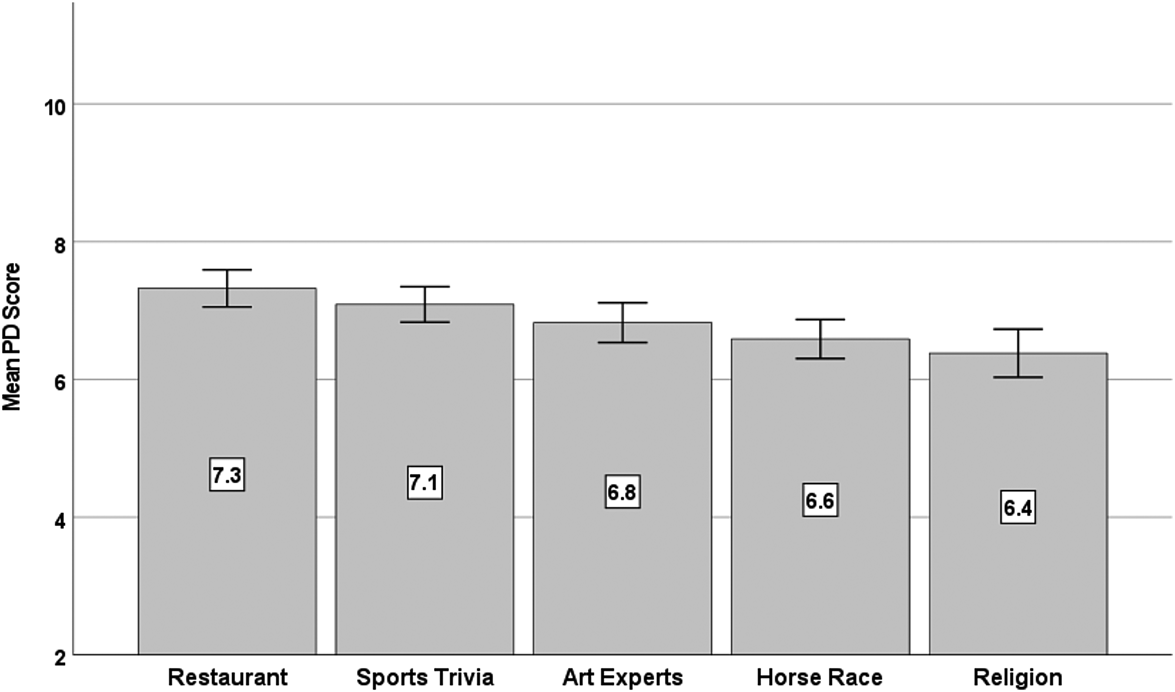
A Friedman's ANOVA revealed that the type of vignette participants considered had a small but statistically significant impact on PD scores (χ 2F(4) = 29.87, p < .001). Participants were least inclined to offer conciliationist responses in the Religion case, which is unsurprising given all of the differing views people have about the relation between faith and reason. To the extent that one sees faith as an enterprise apart from reason, there is less reason to expect to see any evidence coming from another individual's opinion as relevant to the beliefs associated with one's own faith. Accordingly, the impact of religious disagreement is at least complicated by this further fact. Note, however, that the mean PD score in Religion is not massively lower than in the other cases. This difference is less than we expected. The standard deviation for Q2 judgments in Religion was also substantially larger than in the other cases, indicating greater diversity of opinion about the role that higher-order evidence should play in the case of religious disagreements (cf. the supplementary materials document for further details).
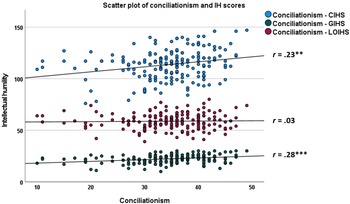
Overall conciliationism scores for each participant were calculated by summing their PD scores across all five vignettes. Conciliationism scores were then plotted against participants’ intellectual humility scores on the CIHS, the GIHS, and the LOIHS. Significant correlations were found between participants’ conciliationism scores and their CIHS and GIHS scores (cf. figure 2). In other words, the higher an individual's intellectual humility score on these two measures, the more likely they were to make conciliationist judgments about the five peer disagreement cases.
Scatterplot of participants’ conciliationism scores and intellectual humility scale scores, together with observed correlations. In all figures and tables, ‘*’ indicates that the test statistic is significant at the .05 level, ‘**’ that it is significant at the .01 level, and ‘***’ that it is significant at the .001 level.
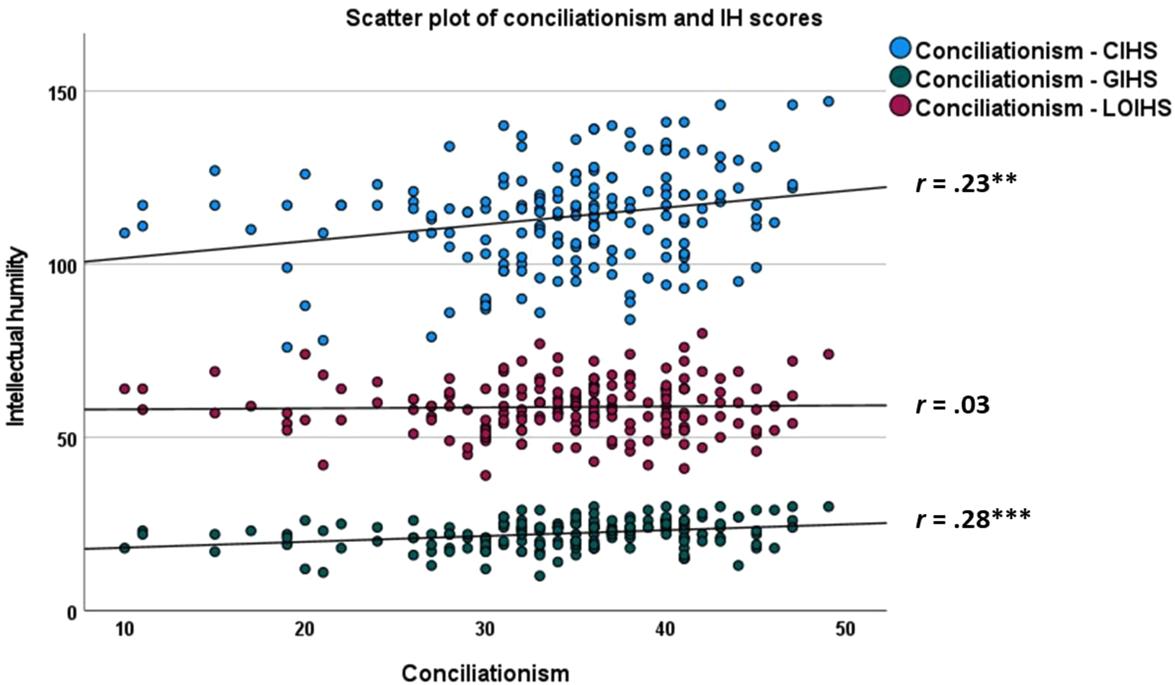
In order to examine the relationship between conciliationism and the traits measured by intellectual humility scales further, we conducted additional correlational analyses. For the CIHS, we calculated correlations between participants’ conciliationism scores and PD scores, on the one hand, and their scores on each CIHS item and each subscale of the CIHS, on the other. The subscales or factors of the CIHS are independence of intellect and ego, openness to revising one's viewpoint, respect for others’ viewpoints, and lack of intellectual overconfidence, cf. supplementary materials document for additional details. Conciliationism correlated significantly with the ‘Openness to revising one's viewpoint’ subscale (r = .31) but not with the other subscales. Conciliationism correlated significantly with participants’ responses to 10 of the 22 CIHS items, but none were greater than .3 (cf. the supplementary materials document for further details). For the GIHS, we found that conciliationism scores correlated significantly with four of the six GIHS items (r's .20 to .41) and that PD scores correlated significantly with 5 of the items—particularly (GIHS1) (r's .20 to .37). For the LOIHS, we calculated correlations between participants’ conciliationism scores and PD scores, on the one hand, and their scores on each LOIHS item and each subscale of the LOIHS, on the other. Overall LOIHS scores did not correlate with conciliationism scores or PD scores. Only two LOIHS items correlated significantly with conciliationism and PD scores, and one of these—to our surprise—correlated negatively (r's −.15 to −.27) with all conciliationism and PD scores. This item was the following:
(LOIHS6) When I know that I have an intellectual weakness in one area, I tend to doubt my intellectual abilities in other areas as well.R
Participant responses to this item were reverse scored, meaning that disagreement with this statement was negatively correlated with conciliationism and PD scores. More straightforwardly, this means that agreement with LOIHS6 positively correlated with conciliationism and PD scores. The creators of the LOIHS think that agreement with LOIHS is a bad thing because they think that the attitudes we adopt toward our intellectual capacities should not be overly negative. However, it is not clear that the doubt described by LOIHS6 is inappropriately strong or broad. It may simply represent a proper awareness of one's fallibility across all cognitive domains. Further investigation of what this kind of statement measures seems warranted. Two of the three LOIHS subscales correlated significantly with conciliationism or PD scores but did so only weakly (r's .14 to .17). Correlations between scores on each of the intellectual humility scales were fairly strong (CIHS × GIHS = .56, GIHS × LOIHS = .34, CIHS × LOIHS = .59).
Thus, we observed significant, moderately strong associations between conciliationism scores and PD scores, on the one hand, and intellectual humility as measured by CIHS and GIHS, on the other. These findings confirm the hypothesis suggested by Feldman (Reference Feldman and Antony2007), Christensen (Reference Christensen2010, Reference Christensen, Christensen and Lackey2013), Leary et al. (Reference Leary, Diebels, Davisson, Jongman-Sereno, Isherwood, Raimi, Deffler and Hoyle2017), and others that the set of traits or dispositions that constitute intellectual humility (at least when it is understood along the lines of CIHS and GIHS) incline individuals toward conciliatory responses to peer disagreement and away from steadfast ones. Importantly, these findings are consistent with—and indeed support—Pritchard's (Reference Pritchard2021: S1711) arguments against the view that ‘non-conciliatory alternatives are incompatible with the demands of intellectual character, and incompatible with the virtue of intellectual humility in particular’ and Hazlett's (Reference Hazlett2012) arguments for the compatibility of steadfastness and intellectual humility. The arguments of Pritchard and Hazlett aim to show that there are no necessary, conceptual, or logical connections between conciliationism and intellectual humility. If such connections did obtain, we would expect the observed correlations to be much stronger. Furthermore, our findings support the idea that humble conciliationism is nevertheless more common than arrogant conciliationism or humble steadfastness and thus that it may be difficult for individuals to remain steadfast in the face of peer disagreement while possessing and manifesting the virtue of intellectual humility.
To confirm that the operationalizations of conciliationism and steadfastness used in Study 1 and the published measures of intellectual humility are in accord with the various arguments concerning the distinctness of conciliationism and intellectual humility surveyed above, we performed a series of factor analyses on our data. Factor analysis is the primary statistical tool for determining how many latent variables are responsible for patterns of observed associations in a dataset. On the basis of the observed correlations between participants’ responses to our five vignettes and their responses to the various intellectual humility items, the factor analyses are able to determine (i) what the correlations between observed scores and one or more underlying variables would have to be if the latent variables were causally responsible for our observations, (ii) how much of the variability in participants’ responses to our peer disagreement and intellectual humility materials any such model explains, and (iii) how many underlying variables are needed to explain the most variability in the data. In figure 3, the hypothesis that the psychological dispositions underlying conciliationist and intellectually humble responses to questionnaire items are not in fact distinct is represented by the single factor on the left, while the competing hypothesis that conciliationism and intellectual humility are distinct is represented by the two-factor model on the right.
A representation of a one-factor model featuring a single underlying (set of) psychological disposition(s) determining participants’ responses to peer disagreement vignettes and IH scale items and a competing two-factor model featuring two, possibly correlated, factors determining independent sets of scores. Error terms have been omitted for the sake of simplicity.
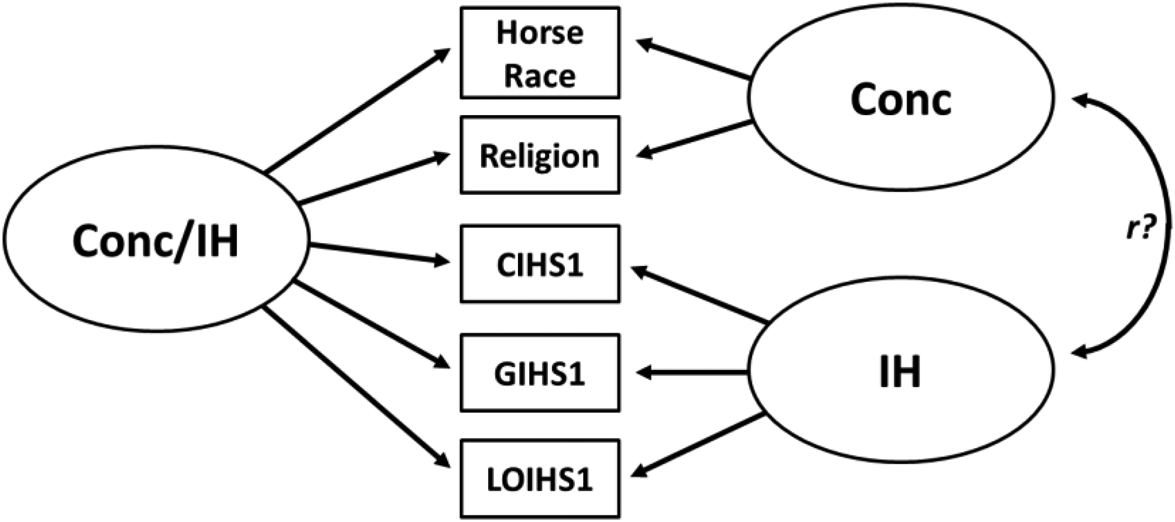
We performed exploratory factor analyses on each of the following subsets of our data: (i) PD scores and CIHS item scores, (ii) PD scores and GIHS item scores, (iii) PD scores and LOIHS item scores, and (iv) PD scores and individual item scores from all three intellectual humility scales taken together.Footnote 5 The factor analyses all returned the same, clear verdict: conciliationism and intellectual humility scores are associated with distinct underlying variables. This is precisely what we should expect if conciliationism and intellectual humility are conceptually distinct.
The pattern matrix for the factor analysis of PD scores and GIHS items can be found in table 3. As can be seen from table 3, a two-factor model fits the data better than either a one-factor solution or any model with more than two factors. The numbers on the right-hand side of the table (known as factor loadings) represent the strength of association between each item and the underlying factor in question. Thus, we can see that the PD scores of our participants are strongly associated with one factor and are not strongly associated with the other factor. We can also see that the GIHS items—with one exception—are strongly associated with a factor that is distinct from the one underlying the PD scores. GIHS1 stands out from other GIHS items by being moderately associated with both factors.
Pattern matrix for an exploratory factor analysis of PD scores and GIHS item scores
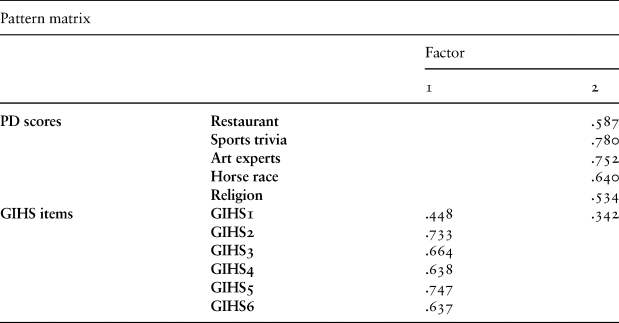
Note: In accord with common practice, factor loadings below .3 are suppressed for the sake of clarity and simplicity.
The remaining factor analyses all yielded similar findings (cf. the supplementary materials document for further details). In each case, conciliationism and intellectual humility scores were shown to be associated with distinct latent variables, demonstrating that the operationalizations of these notions used in Study 1 accord with the philosophical claims surveyed above concerning the logical or theoretical independence of the two notions.
The upshot of the correlational and factor analyses of our data is that the attitudes associated with conciliationism and the CIHS and GIHS operationalizations of intellectual humility are logically or conceptually distinct but empirically associated to a moderately strong degree and that conciliationism and the LOIHS operationalization of intellectual humility are both conceptually and empirically distinct. Study 1 suggests that the relationship between conciliationism and intellectual humility (as measured by the CIHS and GIHS) is analogous to that between depression and anxiety; the distinct mental health conditions can be found independently but are most commonly found together (American Psychiatric Association 2013). Importantly, these findings also mean that there is a moderately strong association between steadfastness and the vice of intellectual arrogance (as measured by the CIHS and GIHS).
3. Study 1, Part 2: Steadfastness, Courage, and Grit
Materials and procedure
In section 1, we noted that some philosophers have suggested that conciliationism might be associated with a vicious lack of resolution or courage and that steadfastness might be associated with a virtuous kind of internal fortitude. Indeed, the ordinary meaning of the term ‘steadfastness’ connotes an admirable kind of perseverance or constancy. Elga (Reference Elga2007: 484) called the relevant vice ‘spinelessness’, and Pettit (Reference Pettit2006: 181) called it ‘epistemic timidity’ or ‘servility’. In order to test these ideas, participants in Study 1 were asked to respond not only to the five peer disagreement vignettes and three intellectual humility scales described above but also to items on the Woodard Pury Courage Scale-23 (Woodard and Pury Reference Woodard and Pury2007) and the Grit Scale (Duckworth et al. Reference Duckworth, Peterson, Matthews and Kelly2007). The Woodard Pury Courage Scale is the most widely cited self-report measure of courage, and the Grit Scale is a measure of perseverance.
Woodard and Pury (Reference Woodard and Pury2007: 136) understand courage to be ‘the voluntary willingness to act, with or without varying levels of fear, in response to a threat to achieve an important, perhaps moral, outcome or goal’. Their scale examines individuals’ reported willingness to act in response to threats or risks in a number of different domains. Some items, for example, concern physical threats:
(WPCS2) If it looked like someone would get badly hurt, I would intervene directly in a dangerous domestic dispute.
(WPCS5) If called upon during times of national emergency, I would give my life for my country.
(WPCS15) I would endure physical pain for my religious or moral beliefs.
Other items involve interpersonal or social threats:
(WPCS1) I would accept an important project at my place of employment even though it would bring intense public criticism and publicity.
(WPCS10) Intense social pressure would not stop me from doing the right thing.
Participants were asked to consider whether they would face these kinds of threats in order to achieve positive outcomes associated with the beliefs and values that are central to their political, religious, familial, or social commitments and identities. (The full scale can be found in the supplementary materials document.) Their willingness to face these threats was measured by the extent to which they agreed or disagreed with scale items, and an overall measure of courage was calculated by averaging numeric values assigned to their responses.
Angela Duckworth and her collaborators (Duckworth et al. Reference Duckworth, Peterson, Matthews and Kelly2007) describe grit as ‘perseverance and passion for long-term goals’:
Grit entails working strenuously toward challenges, maintaining effort and interest over years despite failure, adversity, and plateaus in progress. The gritty individual approaches achievement as a marathon; his or her advantage is stamina. Whereas disappointment or boredom signals to others that it is time to change trajectory and cut losses, the gritty individual stays the course. (2007: 1087–88)
The Grit Scale includes the following items:
(G1) I have overcome setbacks to conquer an important challenge.
(G4) Setbacks don't discourage me.
(G9) I finish whatever I begin.
Duckworth et al. (Reference Duckworth, Peterson, Matthews and Kelly2007) found grit to be associated with higher levels of success outcomes, including level of educational attainment, grade point average, class retention, and national spelling bee ranking. (The full scale can be found in the supplementary materials document.) Participants in Study 1 were asked to indicate the extent to which items on the Grit Scale described them by selecting one of five answer choices that ranged from ‘Not like me at all’ to ‘Very much like me’. An overall grit score was calculated for each participant by averaging numeric values assigned to each item response.
We hypothesized that individuals who are higher in courage or grit would be less likely to exhibit the ‘craven (if understandable and all too predictable) capitulation to brute psychological pressure’ from one's peers’ that Kelly (Reference Kelly, Gendler and Hawthorne2005: 193) worried might characterize conciliatory responses to peer disagreement—if in fact ‘craven capitulation’ is something that leads individuals to endorse conciliationism. Spinelessness, epistemic timidity, and craven capitulation are the very things whose absence defines the courageous person—and perhaps also characterizes the gritty person to some degree as well. Thus, sticking to one's guns or staying the course in the face of peer disagreement might require courage or grit.
Results
We found that participants’ tendency to endorse steadfast judgments about cases of peer disagreement (i.e., their tendency to have low conciliationism scores) failed to correlate with self-reported courage (r = −.09, p = .25) but did correlate with self-reported grit to a small degree (r = .16, p < .05). Steadfastness, then, may involve a potentially admirable kind of internal fortitude. A number of significant correlations were observed between participants’ courage and grit scores and their scores on the three scales (and some subscales) of intellectual humility (cf. table 4).
Correlations between courage, grit, and intellectual humility scores
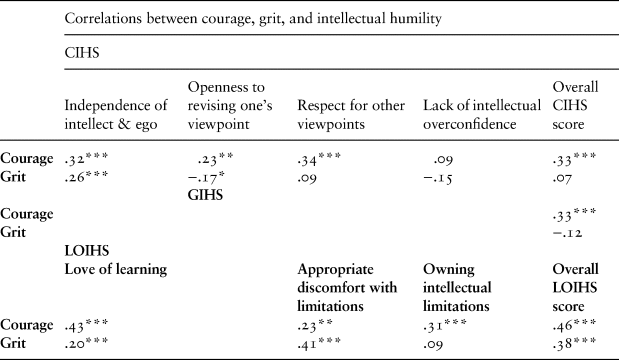
Courage correlated positively to a moderate degree with participants’ overall scores on each of the intellectual humility scales and with six of seven intellectual humility subscales. Thus, although courage did not correlate with steadfastness or conciliationism, it did positively correlate with something (viz., intellectual humility) that positively correlated with conciliationism. Contrary to one hypothesis suggested by Kelly, Elga, and Pettit, then, a greater tendency to endorse steadfast responses to peer disagreement was not associated with greater overall courage.Footnote 6
We found that participants’ grit scores positively correlated with their LOIHS scores but failed to correlate with their CIHS or GIHS scores. Thus, grit correlated with steadfastness and LOIHS scores (but not with CIHS or GIHS scores), while intellectual humility correlated with conciliationism and CIHS and GIHS scores (but not with LOIHS scores). This suggests that conciliationism and steadfastness might each be associated with a unique set of virtues. Instead of only one of the perspectives on peer disagreement being associated with every kind of intellectual virtue, conciliationism and steadfastness might be differently virtued.
However, one reason for doubting that the correlation between grit and steadfastness is virtuous is that grit correlated negatively with the ‘Openness to revising one's viewpoint’ subscale of the CIHS, which includes items such as (CIHS6) above and the following:
(CIHS7) I am willing to change my position on an important issue in the face of good reasons.
(CIHS9) I have at times changed opinions that were important to me, when someone showed me I was wrong.
Furthermore, a negative correlation between grit and the ‘Lack of intellectual overconfidence’ subscale of the CIHS was almost significant (r = −.15, p = .06). Thus, grit may represent a kind of perseverance or determination that is insensitive to epistemic considerations, and thus the association between grit and steadfastness may fail to be a virtuous one.
In order to investigate this matter further, we ran a second study (described in the following section) in which we examined individuals’ self-reported steadfastness, grit, and actively open-minded thinking. We selected a measure of actively open-minded thinking because of its close association with myside bias, which occurs when people marshal evidence, evaluate evidence, and test hypotheses in ways that are biased toward their prior opinions and attitudes. Given the observed associations between steadfastness, grit, and a lack of openness to revising one's viewpoint, we hypothesized that if steadfast responses to peer disagreement were intellectually vicious, the central vice at the heart of steadfastness might well be a form of myside bias.
4. Study 2: Steadfastness, Grit, and Actively Open-Minded Thinking
Materials and procedure
Jonathan Baron (Reference Baron, Voss, Perkins and Segal1991, Reference Baron1993, Reference Baron2007) has characterized actively open-minded thinking as any conscious response to doubt or ignorance that involves (i) a search for possible answers that is sufficiently thorough for the question at hand, (ii) a search for evidence that can be used to decide among the possibilities that is sufficiently thorough and fair to all possibilities under consideration, and (iii) the fair use of evidence and inference to weigh or evaluate possible answers and decide between them. Baron (Reference Baron1993: 195) contends that the ‘most general and pervasive departure’ from actively open-minded thinking involves ‘myside bias’, in which the favoring of an initial conclusion or possibility leads one to ignore alternative answers or counterevidence and to evaluate available answers and evidence in an unfair manner. The most influential attempt to measure actively open-minded thinking and myside bias is Keith Stanovich and Richard West's (Reference Stanovich and West1997, Reference Stanovich and West2007) Actively Open-Minded Thinking (AOT) Scale, which includes 41 items drawn from the heuristics and biases literature (Kahneman, Slovic, and Tversky Reference Kahneman, Slovic and Tversky1982). For Study 2, we selected a shortened, seven-item version of this scale created by Haran, Ritov, and Mellers (Reference Haran, Ritov and Mellers2013). The shortened scale includes the following items:
(AOT2) People should take into consideration evidence that goes against their beliefs.
(AOT4) Changing your mind is a sign of weakness.R
(AOT6) It is important to persevere in your beliefs even when evidence is brought to bear against them.R
(AOT7) One should disregard evidence that conflicts with one's established beliefs.R
Participants were asked to indicate the extent to which they agreed or disagreed with statements on the AOT scale by selecting answers that ranged from ‘Strongly disagree’ (coded as 1) to ‘Strongly agree’ (coded as 5). An overall AOT score was calculated for each individual by averaging their responses to all scale items.
Participants in Study 2 were also asked to complete the GIHS and the Grit Scale and to respond to the same five peer disagreement cases used in Study 1. In Study 1, Q1 asked participants ‘How should/would [the agent] respond to the discovery that [the other agent] disagrees with them about [the proposition in question]?’ and offered them four answer choices that represented steadfast and conciliationist perspectives on the case. In Study 2, Q1 was replaced with two questions that had the following forms:
(Q3) When [the agent] discovers that [the other agent] disagrees with them about [the proposition in question], it's OK for [the agent] to continue believing [the proposition] just as strongly as [the agent] did before.
(Q4) When [the agent] discovers that [the other agent] disagrees with them about [the proposition in question], [the agent] should become less confident in believing [the proposition].
Q3 thus asked participants whether they agreed with the steadfast perspective on each case, and Q4 asked whether they agreed with the conciliationist perspective. Q2 from Study 1 was also slightly modified. Instead of asking whether the discovery of disagreement gave the relevant agent reason to question the reliability of their original judgment, participants were asked whether the discovery gave them reason to doubt its reliability. Participants were asked to indicate the extent to which they agreed or disagreed with each of these statements on a 5-point Likert scale that ranged from ‘Strongly disagree’ (coded as 1) to ‘Strongly agree’ (coded as 5). Responses to Q3 were reverse-scored, and responses to all three questions for all five peer disagreement cases were averaged to calculate an overall conciliationism score for each participant.
The set of peer disagreement cases, GIHS, Grit Scale, and AOT scale were presented in random order. The order of the peer disagreement cases within the block of cases was randomized, and the three questions after each case were also randomized.
Participants
Participants were 202 workers (ave. age = 24, 78% female, predominantly Caucasian) from Prolific Academic (https://prolific.co/), one of the world's largest and most reliable crowdsourcing sites. All participants resided in the United States and were fluent in English. Participants were paid a small sum to complete study materials that were hosted on Qualtrics (https://www.qualtrics.com/).
Results
Participants’ conciliationism and GIHS scores were again found to be positively correlated although to a weaker extent than in Study 1 (cf. table 5). And although grit again failed to correlate with GIHS scores, grit did not correlate with steadfastness (i.e., low conciliationism scores), as in Study 1. Thus, the association between steadfastness and grit does not appear to be very robust or reliable.
Correlation matrix for participants’ conciliationism, GIHS, Grit, and AOT scores in Study 2
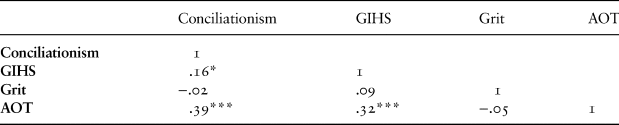
Importantly, AOT scores correlated positively with both conciliationism and GIHS scores. To the extent that low AOT scores reflect myside bias, this means that steadfastness correlated positively with myside bias. Grit also failed to correlate with AOT scores.
The aim of Study 2 was to shed additional light on the relationship between steadfastness, grit, and resistance to revising one's belief in light of new evidence. In Study 1, we observed positive associations between these traits and speculated that the kind of grit associated with steadfastness might be one that was epistemically insensitive. Although we did not find an association between steadfastness and grit or between grit and myside bias in Study 2, we did uncover a negative correlation between steadfastness and actively open-minded thinking that is intellectually vicious. If proponents of steadfastness are tempted to respond that there may yet be some other kind of virtuous internal strength, firmness, or fortitude that is manifest in steadfast responses to peer disagreement, the negative correlations we observed between steadfastness, on the one hand, and intellectual humility and actively open-minded thinking, on the other, make such a response seem less than promising.
5. Conciliationism as an Intellectually Virtuous Response to Peer Disagreement
We began this paper by sketching some brief philosophical considerations for thinking that intellectual humility and conciliationism go hand in hand. We then reported evidence from two empirical studies showing that individuals who are intellectually humble or engage in actively open-minded thinking are much more likely to be conciliatory in the face of peer disagreement. Alternatively, these results show that individuals who are intellectually arrogant or more prone to myside bias are more likely to endorse steadfast responses to peer disagreement. While there may be other intellectual vices associated with conciliationism and virtues associated with steadfastness, our findings shed new light on both the epistemic goodness of the conciliationist perspective and the broader question of what an intellectually virtuous response to peer disagreement looks like.
Supplementary material
The supplementary material for this article can be found at https://doi.org/10.1017/apa.2022.8.
Appendix
Restaurant. Suppose that you and five friends go out to dinner. After a lovely meal, the group gets the bill. Everyone agrees that they should give a 20% tip and divide up the check evenly, regardless of who ordered what. You and one of your friends examine the bill to calculate the shares. You do the math in your head and become confident that the shares are $21 each. You then hear your friend confidently declare that the shares are $23 each. Neither of you has any reason to think you are better at such calculations than the other, and neither of you has any reason to doubt the honesty of the other (see Christensen Reference Christensen2007: 193).
Sports trivia. Jim and John are both sports trivia buffs. One night they are watching a game and discussing the ‘good old days’ of their favorite team. Jim confidently claims that Jackson was selected as an all-star player from their team in 1968. John disagrees, claiming that Jackson was selected as an all-star player from their team in 1969. Jim and John both recognize that they are equally reliable about recalling facts about sports trivia, and neither has had a chance to look up the correct answer.
Religion. Gillian grew up in a small town where everyone belonged to the same religion. As a child, she thought that everyone in every town belonged to this religion. When Gillian was in ninth grade, her family moved to a new city where she encountered other kids who did not belong to same religion as her family. These kids seemed to be just as intelligent and open-minded as she was.




 Open access

