Introduction
Tracheostomy formation is increasingly carried out whilst patients are in critical care to assist in weaning from artificial ventilation and improve their comfort. Better equipment and skills mean that many tracheostomies are formed percutaneously at the bedside, thus avoiding the trip to the operating theatre with a high-risk patient. However, there is now evidence to suggest that early tracheostomy in this situation does not necessarily improve outcome.Reference Young, Harrison, Cuthbertson and Rowan1 Patients with head and neck conditions including cancer continue to have tracheostomies formed surgically and this is generally (as with percutaneous formation) a temporary measure to ensure airway patency until treatment is completed.
A recent survey from the National Confidential Enquiry into Patient Outcome and Death (‘NCEPOD’) highlights many of the current issues relevant to the care of patients with a tracheostomy. It presents a current review of the organisation of care and practice within the UK.2 In addition, the data collected provide a clearer picture of the (total) numbers and types of procedures carried out annually. Full details of the report are available on the National Confidential Enquiry into Patient Outcome and Death website.3
Coinciding with the publication of the National Confidential Enquiry into Patient Outcome and Death report, there has been a revision of two important guidelines for tracheostomy care4, 5 and the UK launch of a multidisciplinary worldwide initiative to improve practice.6
This article concentrates on aspects of the report that may be of particular interest and relevance to surgical specialists.
Organisational overview and review methods
In 2012, the National Confidential Enquiry into Patient Outcome and Death distributed a comprehensive organisational questionnaire to UK hospitals (excluding Scotland). This identified wards where patients with a newly formed tracheostomy were cared for and provided data on the approximate number of procedures being undertaken. Thirty-two out of 219 hospitals (14.6 per cent) were unable to provide data on the number of tracheostomy procedures undertaken, and in 101 sites this figure was an estimate.
One of the principal recommendations of the report is that tracheostomy formations be recorded and coded, as for other operative procedures. This one measure would vastly improve our ability to study the care of patients with a tracheostomy and enable institutions to assure the quality of their programme of care. Based on the data collected, the National Confidential Enquiry into Patient Outcome and Death estimates that about 12 000 tracheostomies are formed annually in the UK (with the exception of Scotland, which has an independent body that collects surgical data).
In 161 out of 237 participating hospitals, tracheostomies were formed as part of a planned procedure, and in 194 they were formed as an emergency. In 50 hospitals, a tracheostomy procedure was only undertaken as an emergency. Just 68 hospitals reported that they also performed laryngectomy. Most hospitals had three wards (including critical care) caring for tracheostomy patients. However, there were 15 hospitals where there were more than 10 wards caring for patients with a tracheostomy, 11 of which were university teaching hospitals.
In addition to the number of cases, the number of wards delivering care has a significant effect on the training, maintenance of competencies and equipment required. The differences in approach may be reflective not just of the size of a centre but also the attitude to risk in the care of a tracheostomy, with some centres deliberately grouping patients in a smaller number of wards to maintain skills.
Over the 11-week period of the survey (February to May 2013), the National Confidential Enquiry into Patient Outcome and Death identified 2546 tracheostomies performed in adults (aged 16 years and over), and data from 2199 patients were returned (86.4 per cent). This revealed that 1530 patients (69.6 per cent) had a tracheostomy formed percutaneously, and 669 (30.3 per cent) surgically. Patients were followed through their stay in critical care (when applicable), and then for up to 30 days in a ward area if they remained tracheostomy-dependent.
Almost 400 cases were peer reviewed in detail by advisors drawn from all specialties, including nursing, surgery, intensive care, anaesthesia, physiotherapy, and speech and language therapy. There was a particular focus in the questionnaires on the transition of care between wards and their receiving teams.
Other findings and recommendations
Although most of the findings and recommendations of this National Confidential Enquiry into Patient Outcome and Death report apply to both surgical and percutaneously formed tracheostomies, there were some differences between the two patient groups.
Tracheostomy formation
Almost 40 per cent of surgically formed tracheostomies were in the context of a planned head and neck procedure, and 22.4 per cent were formed for reasons that included upper airway obstruction (as compared with 1.6 per cent of percutaneously formed tracheostomies).
Overall, 29.6 per cent of patients in the survey were obese or morbidly obese, and a further 32.5 per cent were overweight. In those patients where body mass index (BMI) could be determined, 31 per cent of patients with a BMI greater than 30 underwent surgical tracheostomy formation, as opposed to 68.6 per cent who underwent percutaneous formation. Of those who underwent surgical formation, 44.8 per cent were judged to have had a neck that posed difficulties in terms of access to the airway.
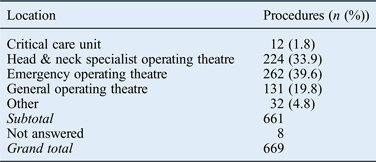
Surgical tracheostomy formation was most likely to be performed by an ENT or maxillofacial surgeon (56.7 and 29.9 per cent respectively), with 8.3 per cent performed by cardiac or thoracic surgeons. Delays were reported in about 10 per cent of surgical tracheostomies, the most common reasons being the lack of availability of a surgeon and/or an operating theatre. In those patients experiencing a delay, the most common indication for tracheostomy was weaning from ventilation. Most surgical formation procedures occurred in the context of an operating theatre, the majority in either emergency or specialist head and neck operating theatres; one in four occurred in general or ‘other’ operating theatres (Table I).
Location of surgical tracheostomy procedure

The World Health Organization surgical safety checklist was implemented prior to tracheostomy in the vast majority of surgically formed tracheostomy cases (97.6 per cent). In 95.8 per cent of these cases, a consent form was completed, mainly by senior staff. In contrast, only 16 per cent of formal documented safety checks were conducted in percutaneously formed tracheostomy cases, and a written record of consent was obtained in 48.8 per cent. This report recommends that safety check lists are completed whenever a tracheostomy is performed and documented consent is obtained wherever possible, accepting that many intensive care patients will be unconscious at the point when this decision is made.
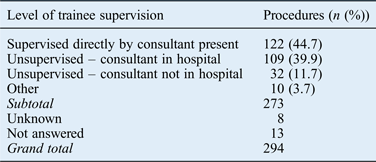
Consultants and senior specialist trainees were the most likely to perform open surgical tracheostomies in this study (47.1 and 41.3 per cent respectively). When a consultant was operating, a senior trainee was present in the majority of cases (83.6 per cent). When a surgical trainee was operating, a consultant was generally available in the operating theatre or in the hospital (85 per cent of cases; Table II). When advisors peer reviewed a sample of cases (both surgical and percutaneous tracheostomy cases), they considered that the supervision of trainees forming a tracheostomy was appropriate in most cases (91 out of 99). However, the information was not clearly documented in the notes.
Level of trainee supervision of surgical tracheostomy procedure
In most cases (56.8 per cent), the surgical incision involved creating a tracheal window; in 13.7 per cent of cases a vertical incision was made, and in 7.7 per cent a Bjork flap technique was utilised. Stay sutures were rarely employed (in only about 1 per cent of cases in total).
The majority of the tubes inserted surgically (93 per cent) were sutured in place. In contrast, in those placed percutaneously, the most common method of fixation was neck tapes (73 per cent). No firm evidence was found that either method was superior in terms of accidental decannulation. However, when case notes were reviewed, there was often no record of how the tube was secured (38 per cent of cases).
Tubes
The majority of patients who underwent a surgically formed tracheostomy initially had a cuffed, non-fenestrated tube of standard length, with an inner cannula, and just 37.1 per cent of the obese or morbidly obese patients had an adjustable flanged tube inserted.
Most patients in this study underwent a stay in critical care even if this was relatively short, such as occurred after planned head and neck surgery. The vast majority of patients (95 per cent) were discharged from critical care with a cuffed tube in place. However, cuff pressure was not measured on the ward in 25 per cent of cases, and equipment to measure pressure was not available in nearly one in five cases. The National Confidential Enquiry into Patient Outcome and Death was concerned that even when the cuff was continuously inflated (28 per cent of cases), pressure was not routinely measured because of the unavailability of equipment in 12.3 per cent of cases. Documentation of cuff pressure and other essential pieces of information that need to be readily available to the multidisciplinary team (MDT) were often not available (when notes were reviewed by the National Confidential Enquiry into Patient Outcome and Death); the report recommends that a ‘passport’ containing relevant tube information be provided at the bedside so that this information is readily accessible.
Complications
Immediate complications at tracheostomy formation were relatively uncommon (occurring in 33 out of 624 surgical procedures (5.3 per cent) and in 81 out of 1482 percutaneous procedures (5.5 per cent)). The most common complications cited were haemorrhage and tube misplacement.
Post-tracheostomy complications were common in both the critical care and ward environment, with just over 21 per cent of patients experiencing complications whilst in critical care and 24.3 per cent experiencing complications during a ward stay. The National Confidential Enquiry into Patient Outcome and Death classed serious complications as pneumothorax, tube obstruction, major bleeding and accidental displacement. In both critical care and on a ward, accidental decannulation was the most frequent serious complication (4.1 per cent in critical care and 6.3 per cent in ward areas). Of the 400 cases peer reviewed by advisors, 12 patients were felt to have had their long-term outcome severely affected by a tracheostomy-related complication. In three of these cases, this was a result of hypoxic brain damage. Whilst serious incidents have been previously reported by other authors,7, Reference McGrath and Thomas8 the National Confidential Enquiry into Patient Outcome and Death provides additional brief anonymised case scenarios within the report that make salutary reading.
The National Confidential Enquiry into Patient Outcome and Death also reports that only 174 out of 216 hospitals (80.6 per cent) stated that they had a policy for the emergency management of blocked or displaced tubes. Just 54 per cent of hospitals had a resuscitation policy covering the patient with a tracheostomy and a patent upper airway, and 45.3 per cent had a policy which included patients totally dependent on a neck stoma. Taken together, these data indicate that there is considerable room for improvement.
Less immediately life-threatening sequelae in patients with a tracheostomy were also common. For example, dysphagia was reported in 51.6 per cent of patients cared for in the ward after tracheostomy. Whilst about half of these patients had an early referral to speech and language therapy (within 48 hours), 25 per cent waited longer, and some were not referred or information about referral was unknown. After a detailed review of cases, advisors reported that they considered insufficient attention had been given to the patient's ability to swallow in 14.3 per cent of the cases, with the reasons given being poor speech and language therapy involvement and/or continuous cuff inflation.
Transition of care
The data, where available, revealed that 165 out of 348 admissions to a ward (47.4 per cent) occurred after 18.00 and before 08.00 in the morning (‘out of hours’). It was clear that whilst the majority of these patients went to specialist head and neck wards, some went to more general areas. A total of 73 patients went to a ward after 21.00 and before 06.00. These out of hours’ admissions were from both critical care and operating theatres.
Whilst critical care and operating theatres may be relatively well staffed at night and run a more or less around-the-clock service, general ward areas are not staffed to the same level for a significant portion of this time period. A key recommendation of the National Confidential Enquiry into Patient Outcome and Death report was that unplanned critical care discharges at night of patients with a newly formed tracheostomy or those recently weaned from respiratory support should not occur. It also recommends that wards should be in a state of readiness in terms of competences and equipment.
Even when patients were cared for in a specialist head and neck hospital (defined as hospitals with onsite head and neck surgery conducted around-the-clock, and with a head and neck ward), only 68.8 per cent of patients were discussed on the ward at a MDT meeting. When an MDT existed, the composition was not always complete, with participation of physiotherapists in only 88 per cent of cases and dietetics in only 58.8 per cent. Although patients may have had a very short stay in critical care, their ongoing emergency needs may well have fallen to the critical care outreach team, and therefore it is surprising that critical care outreach is listed as being part of the MDT for just 42.7 per cent of cases.
Decannulation
Most patients in both critical care and on a ward were decannulated successfully (48.6 per cent of critical care patients and 61 per cent of ward patients). In the ward, almost one-quarter of patients underwent decannulation within 7 days of tube insertion (52 per cent within 7 days of admission). Surgical cases were more likely to be decannulated early, with 40 per cent occurring in the first 7 days. Most decannulations were carried out by nurses or physiotherapists (71.2 per cent in total), and 11.5 per cent were carried out by consultants.
Discharge from hospital
A total of 82 patients in this survey left a ward other than critical care within 30 days of admission with a tracheostomy tube still in place, most moving to a different ward (including critical care) and/or hospital. Twenty-seven out of 82 patients were discharged home and 5 to community care. Two out of 11 patients leaving the ward between 18:00 and 08:00 were discharged home when general practitioner and community nursing services may not have been readily available.
In 30 out of 91 patients remaining on the ward with a tracheostomy still in place at day 30, there were difficulties securing community care or rehabilitation. It is well known to health professionals working in this area that major delays occur at this point in the care pathway. This is because of shortages in terms of competency and equipment in community settings for the care of highly complex patients who require close attention for tracheostomy care.
This National Confidential Enquiry into Patient Outcome and Death study adds to a relative shortage of national data on this subject.
Conclusion
There has been a large and, for the most part, uncharted expansion of case numbers associated with the ability to perform tracheostomy as a bedside procedure. Whilst the incidence of complications at tracheostomy formation is low, many patients experience complications thereafter. Although most patients are ultimately successfully decannulated, there is a growing population where this cannot be achieved and safe discharge to community care proves problematic. Patients require a concerted multidisciplinary approach, with meticulous attention to detail throughout the whole care pathway. Review by senior clinicians at key points of transition and good communication is necessary throughout to achieve a satisfactory outcome.
Acknowledgements
This study, conducted by the National Confidential Enquiry into Patient Outcome and Death (which is a company limited by guarantee and a registered charity), was proposed by the Association of Anaesthetists of Great Britain and Ireland. It could not have been achieved without a wide range of advisors and experts recruited from the range of disciplines caring for patients with a tracheostomy. The project was undertaken as part of the Clinical Outcome Review Programme into Medical and Surgical Care, and was commissioned by the Healthcare Quality Improvement Partnership on behalf of: the National Health Service in England and Wales; the Northern Ireland Department of Health, Social Services and Public Safety; and the States of Jersey, Guernsey and the Isle of Man.