

1. Introduction
After the Second World War ended in 1945, in addition to the well-known International Military Tribunal for the Far East (Tokyo Trial), national military tribunals held by Allied states adjudicated approximately 5,700 Japanese B/C class war criminals.Footnote 1 Instead of implementing summary execution, Nationalist China stayed in line with Western powers to punish war criminals following legal procedures.Footnote 2
In his victory speech, Chiang Kai-shek announced that China would hold Japanese military personnel responsible but would not take revenge on them.Footnote 3 As a rising power that had just abolished extraterritoriality, China was eager to demonstrate its ‘civilized’ legal system to the world by adjudicating war criminals pursuant to international legal tenets. Nationalist China’s War Criminal Trial Act (WCTA) of 24 October 1946 thus incorporated international law as one of its sources of law, providing legal grounds for holding war crimes trials.Footnote 4
Nationalist China’s war crime trial policy appears to chime with that of Henry L. Stimson, the U.S. Secretary of War, who argued that the Nuremberg Trial was ‘a landmark in the history of international law’ because the law was used to ‘insure fair judgment’, which was ‘in no sense an instrument of vengeance’.Footnote 5 Existing scholarly works have emphasized Nationalist China’s internationalist and legalist approach to post-war policies.Footnote 6 In contrast, this article suggests that the Second Bureau of the Ministry of National Defense (MND), which was responsible for intelligence affairs and war crime trial law drafting,Footnote 7 appropriated international law to serve its political ends of taking revenge on Japanese soldiers, claiming extraterritoriality for overseas Chinese, and promoting Chinese nationalism.
Compared with the Nuremberg Charter, the Hague Conventions, and legislation from Allied states, the WCTA has four major features. First, it has an expansive scope. The WCTA set a broader timeline that allowed China to prosecute actions that occurred as early as 18 September 1931, ten years before China formally declared war against Japan in 1941. It also specified a wider variety of war crimes, including malicious insults. Second, the WCTA adopted a stricter liability. While the Nuremberg Charter and other national jurisdictions in Asia (Australia, the Philippines, the Netherlands Indies in Indonesia, and British, French, and US military tribunals in their colonies) allowed judges to decide any just punishment, including short-term imprisonment, the WCTA limited judges’ discretion to the death penalty, life imprisonment, and imprisonment over seven years. It also intentionally omitted a mitigation clause when considering superior order pleas. Third, the WCTA intended to claim extraterritorial rights for Chinese in Hong Kong and Southeast Asia, aiming to obtain jurisdiction over foreigners committing crimes against Chinese nationals. Fourth, the MND intended to promote Chinese nationalism by using the term ‘Chinese race’ (Zhonghua Minzu) when defining the victims of crimes against humanity, which was the first time Zhonghua Minzu became a legal term.Footnote 8 In addition, archives documenting the drafting process also show that the MND had animosity towards the Taiwanese, who were subjects of the Japanese Empire due to colonial rule from 1895 to 1945.Footnote 9
The MND’s approach towards war crime policies is revealed by the discrepancies between the WCTA, international law, and the war crime trial laws of Allied states. When drafting the WCTA in 1946, the MND requested the Ministry of Foreign Affairs (MOFA) for assistance in collecting and translating ‘1) the Nuremberg Charter, Tokyo Charter, and laws and regulations for the trials of war criminals in Southeast Asia, 2) international treaties regarding war crimes, and 3) international case laws on war criminal trials’.Footnote 10 As a result, documents related to the Nuremberg Charter, Tokyo Charter, Hague Conventions, Geneva Conventions, lists of war crimes from the United Nations War Crimes Commission (UNWCC),Footnote 11 and war crime laws of Allied states, can all be found in the files of the drafters of the WCTA.Footnote 12
Despite acknowledging these international and national norms, the drafters of the WCTA consciously departed from them. In addition, the Chinese legislature did not revise the WCTA draft submitted by the administration.Footnote 13 As the legislative archives from 1944 to 1947 have been lost,Footnote 14 we can infer the political agenda of the MND by analysing the legal nuances between the WCTA, international law, and the war crime trial laws of Allied states.
The intention of the Second Bureau of MND is also revealed in its interaction with other ministries. Kawashima Shin finds that, when dealing with the case of Sakai Takashi, the first Governor of Hong Kong under Japanese Occupation, the MOFA wanted to follow international standards, which was to execute him after all tribunals from involved countries had delivered verdicts on him. Nevertheless, the MND executed Sakai regardless of MOFA’s request.Footnote 15 Section 2.2 will show more cases to demonstrate that the MND intended to depart from international law to punish Japanese war criminals more severely, including Taiwanese under colonial rule.
That said, the judiciary’s interpretation of the WCTA is a different story. In response to the MND, the judiciary limited the scope of the WCTA, hindered the MND’s agenda to promote Chinese nationalism, and restrained the MND’s revenge on the Taiwanese people by interpreting the WCTA according to international law. In essence, the MND and the judiciary were competing interpreters of international law.
The Judicial Yuan’s interpretation represents the views of the top legal professionals in China. From 1928 to 1947, when government authorities were uncertain about a law, they could request the Judicial Yuan to hold a meeting, during which senior Supreme Court judges would unify legal interpretation. Between 1945 and 1947, the Judicial Yuan made 17 interpretations regarding war crime trial matters. According to these decisions, Chinese judicial elites believed that war crime trials should adhere to international law; hence, the WCTA needed to be interpreted according to international law.
The rationale underlying the legal interpretations of the Judicial Yuan is the belief in pursuing a ‘civilized’ state since the late nineteenth century. From 1840 to 1943, Westerners justified their extraterritorial rights in China on the grounds that Chinese law was brutal and the judiciary was not independent of the other branches.Footnote 16 In response to these accusations, China started a series of legal reforms, making Western-style codes and listing international law as a compulsory subject at all colleges and a mandatory subject in bar and diplomatic exams in the early twentieth century.Footnote 17 Chinese lawyers were thus eager to prove that they met the standard of a ‘civilized’ state to justify their endeavour to participate in making international norms.Footnote 18 While the standard of ‘civilization’ as a legal concept was ambiguous and Eurocentric, Chinese lawyers clearly acknowledged that protecting basic legal rights, maintaining an independent judiciary, and adhering to international law and customs would contribute to China’s progression towards a ‘civilized’ state.Footnote 19 While existing historiography on China and international law focuses mainly on Chinese international lawyers in the MOFA,Footnote 20 this article further examines how international norms shaped China’s policy-making across ministries and courts.
Section 2 reviews the scholarship of war crime trials, international law, imperialism, and China, arguing that China used international law to support its hegemonic status in post-war Asia. Simply put, existing historiography on China’s magnanimous policies does not explain the MND’s approach to war crime trials and WCTA stipulations. Section 3 compares the WCTA with international law and war crime laws of Allied states, and Section 4 investigates how senior Supreme Court judges substantially altered the application of the WCTA by interpretations based on international legal tenets. Section 5 concludes.
2. Nationalist China’s war crimes trials in context
2.1 International law, war crime trials, imperialism, and China
Although national military courts adjudicated most war criminals after the Second World War, international law played a role in these domestic trials. As both Allied states and Japan were signatories to the Hague Conventions, most Geneva Conventions, and the 1928 Kellogg-Briand Pact, the Allied states argued that in prosecuting Japanese war criminals, they were enforcing existing international laws that Japan had already agreed to, rather than creating new ex post facto laws. This subsection will show how the use of international law in war crimes trials in Asia provided Euro-American powers and China chances to reassert their regional authority.
Although international law fundamentally changed in the twentieth century, Ruti Teitel argues that after a great war, ‘international law offers a degree of continuity in law and, in particular, in standards of accountability’.Footnote 21 Liu Daqun posits that ‘the law that the Hong Kong tribunals would apply was not an arbitrary exercise of power on the part of the victorious nations, but rather an expression of the principles of International Law prevailing when the courts were created’.Footnote 22 Cheah W. L. and Moritz Vormbaum find the same rationale under British trials in Singapore while noticing the legal challenges, including that Japan had signed but not ratified the 1929 Geneva Convention relative to the Treatment of Prisoners of War.Footnote 23
On the other hand, international law has been proven to be a tool supporting imperialism,Footnote 24 as well as post-world-war international arrangements, including war crime trials. Mark Mazower argues that the United Nations was initially an imperial project through which empires attempted to reestablish their imperial authority after the Second World War.Footnote 25 Barak Kushner points out that, except for China and the Philippines, war crimes ‘[t]rials in all other venues throughout Asia … were conducted by colonial empires reasserting their authority’.Footnote 26 Kerstin von Lingen and Robert Cribb also find that ‘Western officials involved in the investigation and prosecution of war crimes … believed the trials would contribute to upholding colonial prestige’.Footnote 27
While China was not a Euro-American type colonizer, this article suggests that in three aspects, China intended to use war crime laws to bolster its hegemonic status in post-war Asia. First, since prosecution and adjudication are embodiments of state authority, China aspired to undermine the colonial sovereignty of Western empires in Asia by expanding war criminal jurisdiction. Historians have learned that, in the 1940s, China desired to reclaim the sovereignty of Hong Kong and supported the independence of Vietnam and other Southeast Asian colonies.Footnote 28 In an attempt to claim territorial jurisdiction over Hong Kong, Chinese prosecutors argued that Sakai Takashi, the first Governor of Hong Kong under Japanese Occupation, committed 22 offences against both foreigners and Chinese.Footnote 29 In addition, China denied the legitimacy of French colonial rule and France’s authority to try war criminals in Indochina.Footnote 30 Chinese military authorities thus transported 185 Japanese war criminals and POWs in North Vietnam to Guangzhou in 1946 and prosecuted them in China’s war crime trial court in Guangzhou.Footnote 31
Second, China wanted to uphold criminal justice for overseas Chinese nationals by claiming extraterritoriality via the WCTA. As Section 3.1 will demonstrate, WCTA Article 2 sub-paragraph 4 stipulated that any foreigner who committed offences defined in Chinese Criminal Law against any Chinese citizens shall fall within the jurisdiction of China’s war crime court.Footnote 32 In terms of criminal law, this clause was precisely claiming extraterritorial rights for Chinese citizens overseas.Footnote 33 The Chinese government took action in collecting evidence and witnesses from overseas Chinese living in Indonesia, Burma, Malaya, the Philippines, Singapore, Vietnam, and Hong Kong.Footnote 34 It was an attempt to increase the influence of China in these countries because, as Melissa Macauley suggests, Chinese nationals had ‘dominate[d] the process of resource extraction and commerce in food, lumber, rubber, tin, gold, and other commodities’ in Southeast Asia since the nineteenth century.Footnote 35
Third, the WCTA embodied Chinese imperialism in relation to Taiwan. Emma Teng regards the Qing dynasty’s conquest of Taiwan in 1683 as an imperial expansion and argues that ‘because contemporary China claims sovereignty over virtually all the territory acquired by the last dynasty, the impact of Qing expansionism continues to be felt by the people of Tibet, Xinjiang, Taiwan, and other former frontier regions’.Footnote 36 In the same way, China saw Japanese colonial rule in Taiwan as an illegitimate occupation and thus wanted to ‘remold Taiwanese into patriotic Chinese citizens’ after the war, which Seiji Shirane coins China’s ‘recolonization of Taiwan’.Footnote 37 WCTA Article 6 provided that ‘even if war criminals regained citizenship of the Republic of China after 25 October 1945, this Act shall apply mutatis mutandis’.Footnote 38 This clause was designed for Taiwanese people because all Taiwanese automatically ‘regained’, not obtained, Chinese citizenship on 25 October 1945, according to the Ministry of Interior.Footnote 39 Although Taiwanese were of Japanese nationality, and they were either conscripted or recruited by Japan to take part in the Second World War, the WCTA could only apply mutatis mutandis.
To sum up, while Western empires resorted to international law to reclaim authority in Asian colonies, China used war crime trial laws to claim its hegemonic status in post-war Hong Kong, Taiwan, and Southeast Asia.
2.2 The MND’s approach to war crime trials and Chiang Kai-shek’s magnanimous policy
This article challenges the current scholarly consensus that post-war China implemented a ‘magnanimous policy’ concerning war criminals. This subsection will demonstrate that the ‘magnanimous speech’ of Chinese politicians was at odds with the MND’s approach to war crimes. In addition, although high-level military officers urged to end the investigation and repatriate guilty defendants back to Japan at the end of 1946, it was due to the catalytic Chinese Civil War, not because of their magnanimity.
From 1937 to 1945, China was defending itself from Japan. During this period, it is estimated that 15 to 20 million Chinese people died, while 80 to 100 million became refugees.Footnote 40 Despite these losses, Chiang Kai-shek, in his victory speech, expressed magnanimity towards Japan, stating that the Chinese people shall not ‘hold any grudge against old wrongs’ and shall ‘be kind to others’. China ‘does not intend to revenge and shall not humiliate innocent [Japanese] people’.Footnote 41 Barak Kushner, Huang Tzu-chin, and Wada Hideo have indicated that China had no choice but to be magnanimous because the Chinese military could not control the Japanese troops remaining in China and needed Japan’s support to fight against the Chinese Communist Party.Footnote 42 Regarding war criminals, Kushner and Wada stated that, to be magnanimous, China adopted ‘leniency and promptness’ as the guiding principle on Japanese war crime trials, except for the most heinous ones.Footnote 43
Although the literature above supported the view that the Chinese administration did not want to take punitive measures on Japanese war criminals, that is not the case. Chiang did not deny the adjudication of Japanese war criminals. In his victory speech, Chiang also stated that China ‘shall strictly enjoin Japan to obey all the surrender terms faithfully’.Footnote 44 The Potsdam Declaration Article 10, one of the surrender terms, explicitly stated that ‘stern justice shall be meted out to all war criminals’.Footnote 45 Liu Ping thus argues that current scholarly works mainly emphasize the aspect of leniency while neglecting the aspect of punishment.Footnote 46 In addition, Huang Tzu-chin finds that Chiang’s ‘magnanimity was the declaration of philosophy rather than a framework for specific policies’.Footnote 47
After eight years of fighting against Japan since the 1937 Marco Polo Bridge Incident, the MND desired to punish war criminals as harshly as possible. The MND’s attitude can be drawn from the War Criminals Treatment Commission (Zhanzheng Zuifan Chuli Weiyuanhui) records. Chiang Kai-shek ordered to establish the Commission on 6 November 1945, of which the goal was to convey regular meetings to co-ordinate among military authorities, the MOFA, the Ministry of Judicial Administration (MOJA), and any administrations involved in war criminal affairs. The Commission did not have any formal power or jurisdiction over war criminals.Footnote 48 Before the MND sent the WCTA draft to the legislation on 28 August 1946,Footnote 49 Navy General Tang Jinghai proposed to the Commission that ‘the [Japanese] Military Police Corps (Kempeitai) did all kinds of evil in China; every one of them shall be listed as war criminals’.Footnote 50 In May 1946, Department of Command Military Staff Deng Shiliang conveyed a firm request from local elites in the Provinces of Hunan and Guangxi ‘to severely punish war criminals’ because Japanese soldiers had ‘killed people and destroyed resources, villages, and farms, resulting in famine in central and southern China’.Footnote 51 When dealing with the Taiwan Reconstruction Association in Shanghai’s petition for ‘leniency toward Taiwanese war criminals’, the MND Second Bureau replied ‘impossible’ on 20 August 1946.Footnote 52 In addition, in June 1946, the MND wrote a letter in the name of Minister Bai Chongxi to Premier Soong Tse-ven, requesting to set up a permanent war criminal investigation institution while mentioning ‘severely punishing war criminals’ three times.Footnote 53
When it comes to the principle of ‘leniency and promptness’, English, Chinese, and Japanese scholars all refer to Minister of Defence Bai Chongxi’s announcement on 25 October 1946.Footnote 54 Bai stated that China’s war crime policy should follow Chiang Kai-shek’s magnanimous approach mentioned in his victory speech, which was consistent with ‘the United Nations’ treatment of major war criminals in Nuremberg … and General MacArthur’s emphasis on winning the hearts of Japanese people when occupying Japan’. In the same meeting, the War Criminals Treatment Commission made three resolutions: 1) Investigations for war criminals under detention shall be finished by the end of 1946. If no substantial evidence could be found by then, the defendants should not be prosecuted and should be released and repatriated to Japan; 2) regarding those who had been sentenced to jail, the Chinese government should repatriate them to Japan and request the Japanese government to implement the verdicts; 3) for the other cases, all translation and review processes shall end by June 1947.Footnote 55
Bai’s announcement does not change this article’s analysis. First, the three resolutions did not affect the legal substance of the trials. In fact, as the subsequent sections will show, they were irrelevant to legislation, legal interpretation, and court proceedings.
Second, the impact of the principle of leniency and promptness on the MND bureaucracy is questionable. In December 1947, the MND wrote a letter to the MOFA to reiterate that even though the ‘reporting war criminal’ policy was suspended, it only meant that the authorities should not accept reports from citizens; it shall not affect the state’s power to prosecute war criminals.Footnote 56 In January 1948, the MND still requested the MOJA to assist in extraditing 79 Japanese war criminals from overseas.Footnote 57 These cases show that the principle of ‘leniency and promptness’ might not be fully applicable to the whole ministry.
Lastly, the WCTA was submitted by the administration to the legislature on 28 August, passed on 15 October, and promulgated on 24 October 1946,Footnote 58 which was earlier than Bai’s announcement. There is no evidence showing that the drafters knew of the principle of ‘leniency and promptness’ when drafting the WCTA.Footnote 59
In summary, the fact that Chiang championed a magnanimous policy does not mean that the MND adopted a more lenient position when drafting and implementing the WCTA. In the following section, we will look at the details of the WCTA to show how the MND attempted to judge Japanese war criminals more harshly than international law and jurisdictions from the Allies.
3. The normative features of the WCTA
3.1 Broader timeline and broader definition of war crimes
Compared with international law, the WCTA set a broader timeline and broader definition of war crimes. WCTA Article 4 stipulated that war crimes would be prosecuted if they were committed between 18 September 1931 and 2 September 1945. The time scope sheds light on the legal definition of war from WCTA drafters because war crimes can only be committed in a state of war. Accordingly, for China, the war started with the Japanese invasion of Manchuria on 18 September 1931 and ended on 2 September 1945, when Japan signed the Instrument of Surrender.
The Chinese government strategically circumvented international law in defining the time scope of the WCTA. Article 1 of the Hague Convention Relative to the Opening of Hostilities (Hague III) of 1907 indicated that a state of war does not begin without ‘a reasoned declaration of war or of an ultimatum with conditional declaration of war’.Footnote 60 China had not declared war and had retained a formal diplomatic relationship with Japan until 9 December 1941. WCTA drafters had known the law. At the UNWCC, the Chinese representative and diplomat King Wunz proposed that the war crimes investigation should start on 18 September 1931, but it was opposed by other member states.Footnote 61 MOFA’s internal report on war crime matters, including the time scope issue, also provided that ‘although we should have our own attitude and stance, we should keep in close contact with other Allied states and follow majority opinion if necessary’.Footnote 62
In addition, the WCTA defined war crimes in broader categories. The Nuremberg Charter identified three broadly defined war crimes: 1) crimes against peace, 2) conventional war crimes, and 3) crimes against humanity. Article 2 of the WCTA expanded the scope of conventional war crimes, as well as defined a fourth type of war criminal:
Alien combatants or non-combatants who during the war with or a period of hostilities against the Republic of China, commit acts other than those mentioned in the three previous subparagraphs [i.e., crimes against peace, conventional war crimes, and crimes against humanity] but punishable according to Chinese Criminal Law against the Republic of China or its nationals.Footnote 63
It is similar to Article 229, paragraph 1 of the Treaty of Versailles: ‘Persons guilty of criminal acts against the nationals of one of the Allied and Associated Powers will be brought before the military tribunals of that Power’.Footnote 64
From a legal perspective, it was a stipulation claiming extraterritoriality for criminal cases in essence, aiming to obtain jurisdiction over foreigners if the victim was a Chinese national. It echoed modern China’s long pursuit of forming alliances with overseas Chinese. Albert Chen has indicated that the Chinese nationality law adopted the jus sanguinis principle, according to which any person whose father is Chinese (Zhongguo ren) has a Chinese nationality. Such law ‘would enable the regime to continue to claim the allegiance of the large population of overseas Chinese’.Footnote 65 Taomo Zhou further characterizes the law as ‘[the] Chinese Nationalist government’s effort to prolong the ROC’s jurisdiction over the ethnic Chinese’.Footnote 66
The Enemy War Crime Investigation Regulation of 29 July 1944 Article 7 stipulated that Chinese officials should investigate Japanese war crimes against Chinese victims in Hong Kong and Southeast Asia (Nanyang).Footnote 67 As mentioned in Section 2.1, China had collected evidence and witnesses of Japanese war crimes from overseas Chinese living in Burma, Hong Kong, Indonesia, Malaya, the Philippines, Singapore, and Vietnam. This fourth type of war crime manifests China’s post-war intention to reestablish itself as a regional hegemon in Asia.
In its definition of conventional war crimes, the WCTA stipulated that ‘alien combatants or non-combatants’ – in other words, all foreigners – could be prosecuted for this offence. In contrast, the Convention with Respect to the Laws and Customs of War on Land (Hague II) limited the prosecution of conventional war crimes to foreigners who are nationals of enemy states.Footnote 68
WCTA Article 3 further provided 38 types of conventional war crimes,Footnote 69 of which 33 were roughly the same as the list made by the Commission on the Responsibility of the Authors of the War and the Enforcement of Penalties at the Paris Peace Conference in 1919,Footnote 70 which was also adopted by the UNWCC in 1943.Footnote 71 The five additional types of war crimes stipulated by the WCTA were: 1) kidnapping children; 2) making indiscriminate mass arrests; 3) malicious insult; 4) taking money or property by force or extortion; and 5) plundering of historical, artistic or other cultural treasures.
The expanded crime list invited judges to decide cases beyond international law. On 25 October 1946, the meeting minutes of the War Criminals Treatment Commission explicitly stated that ‘this is the first time for China to deal with war criminals, but very few [military] judges know international law well. Therefore, most of them are not familiar with the process and all treatment of war criminal matters’.Footnote 72 This list helped judges apply international law conveniently because judges could cite the WCTA without needing to search for legal bases from other treaties.
However, it is clear that WCTA drafters did not merely cite international law but created their own stipulations. For instance, defining insult as a type of war crime was a dramatic broadening of international law. In April 1947, a military prosecutor in Taiwan accused defendants of malicious insult during the war because they ‘celebrated a victory by parading around the city in the disguise of our head of state and his wife, displaying grotesqueness of the highest order’.Footnote 73
It is thus not surprising that the UNWCC Law Report commented that ‘the Chinese legislation has adopted the concept of war crimes in a wider, non-technical sense, as a common denominator for types of offences which are, otherwise, distinct one from the other within the body of international law’.Footnote 74
3.2 Stricter liability
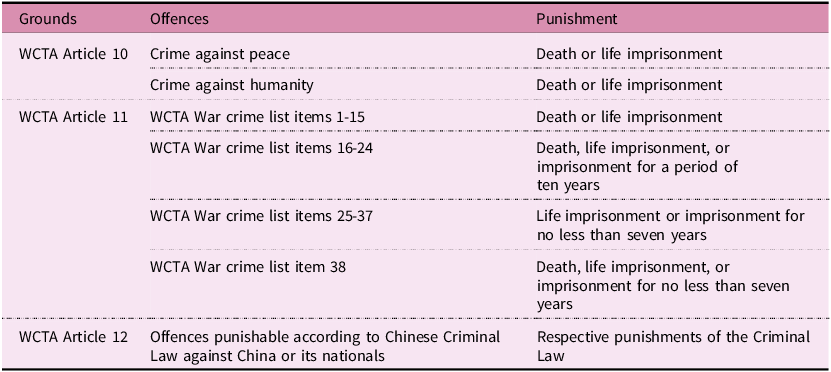
The WCTA adopted stricter criminal liability with respect to penalties. As Table 1 below shows, WCTA Articles 10, 11, and 12 gave adjudicators narrow discretion to determine punishment.
Punishment prescribed by the WCTA

In other words, except for the extraterritoriality clause, every war criminal, including those who insulted the Chinese leader, would be sentenced to at least seven years of imprisonment.
In contrast, the Nuremberg Charter, Tokyo Charter, and other Allied legislation on war crimes gave judges full discretion to determine punishment. Nuremberg Charter Article 27 provided that ‘The Tribunal shall have the right to impose upon a Defendant, on conviction, death or such other punishment as shall be determined by it to be just’.Footnote 75 Tokyo Charter Article 16 had the same stipulation.Footnote 76 The British Royal Warrant and its annexed Regulations for the Trial of War Criminals, promulgated on 18 June 1945, Article 9 provided that:
A person found guilty … of a war crime may be sentenced to … any one or more of the following punishment, namely: (i) Death (either by hanging or by shooting); (ii) Imprisonment for life or for any less term; (iii) Confiscation; (iv) A fine.Footnote 77
The Statute Book of the Netherlands Indies, no. 45 of 1946 Article 4, provided that war criminals ‘shall be sentenced to death, life imprisonment, or imprisonment for not less than one day but not more than twenty years’.Footnote 78 The US Regulation Governing the Trial of War Criminals, promulgated 24 September 1945, Article 20 also stated that ‘The commission may sentence an accused, upon conviction, to death by hanging or shooting, imprisonment for life or for any less term, fine, or such other punishment as the commission shall determine to be proper’.Footnote 79 The Philippines’ Establishing a National War Crimes Office and Prescribing Rules and Regulations Governing the Trial of Accused War Criminals Article V paragraph gFootnote 80 and the Australian War Crimes Act 1945 Article 11Footnote 81 have the same stipulation.
In addition, the WCTA intentionally omitted a mitigation clause for war criminals obeying superior orders. Article 8 of the WCTA stipulated that:
A war criminal would not be exempted from his responsibility due to any of the following reasons: 1) that their crimes were committed by obeying the orders of superior officers; 2) that crimes were committed as a result of official duty; 3) that crimes were committed in pursuance of the policy of the offender’s government; 4) that crimes were committed out of political necessity.
Article 8 of the Nuremberg Charter and Article 6 of the Tokyo Charter likewise provided that these situations shall not free the accused person from legal responsibilities. However, the two charters state that the accused ‘may be considered in mitigation of the punishment if the Tribunal determines the justice so requires’. Since the WCTA drafters had the two charters on file, their omission must have been intentional. Although the WCTA did not prohibit judges from considering mitigation if a defendant was performing his duty, this omission implied that the WCTA drafters did not want to make an impression of leniency.
In short, the WCTA prescribed harsher punishments.
3.3 Promoting Chinese Nationalism
The crimes against humanity defined by the WCTA reinforced the distinction between the Chinese race (Zhonghua Minzu) and aliens, manifesting China’s intention to promote Chinese nationalism through war crime trials. Nuremberg Charter Article 6 defines crimes against humanity as:
murder, extermination, enslavement, deportation, and other inhumane acts committed against any civilian population, before or during the war; or persecutions on political, racial or religious grounds in execution of or in connection with any crime within the jurisdiction of the Tribunal, whether or not in violation of the domestic law of the country where perpetrated.
The Holocaust in Nazi Germany was covered by this article, where offenders and victims might be of the same nationality.
The WCTA defined crimes against humanity differently. It provided that an ‘alien combatant or non-combatant’ would constitute this offence if he:
nourishes intentions of enslaving, crippling, or annihilating the Chinese Race and endeavours to carry out their intentions by such methods as (a) killing, starving, massacring, enslaving, or mass deportation of its nationals; (b) stupefying the mind and controlling the thought of its nationals, (c) distributing, spreading, or forcing people to consume, narcotic drugs or forcing them to cultivate plants for making such drugs; (d) forcing people to consume or be innoculated with poison, or destroying their power of procreation, or oppressing and tyrannising them under racial or religious pretext, or treating them inhumanly.Footnote 82
Compared with the Nuremberg Charter, the WCTA’s definition ignored the nationalities of victims. Simply put, from the Chinese government’s perspective, this clause applies as long as the offender is a foreigner and the victim is racially Chinese, regardless of the latter’s nationality. The concept of the Chinese race in WCTA was intended by the legislators to be applied regardless of the presence of Chinese citizenship.
It should be noted that in sub-paragraph 3 of Article 2, the WCTA used the term ‘the Chinese race’ in its attempt to define the scope of victims who suffered from crimes against humanity. Subsequently, in sub-paragraph 4 of Article 2, the WCTA used the term ‘the Republic of China and its citizens’ when it was defining the scope of extraterritoriality. For example, the War Criminals Treatment Commission had once decided to include ‘Japanese officials, military police, and police officers who committed inhumane acts against Taiwanese people during the Japanese colonial era’ as war criminals, just as ‘German [war criminals] committed crimes against Jewish people with a German nationality’.Footnote 83 Even though Taiwanese people were of Japanese nationality during the colonial period (1895-1945), Chinese war crime tribunals still claimed jurisdiction in cases where a Taiwanese was a victim because the Taiwanese people belonged to the Chinese race.
The Chinese race has been a highly politicized concept associated with modern Chinese nationalism. China is a polyethnic regime. However, Chinese intellectuals invented the encompassing concept of the ‘Chinese race’ to claim the polyethnic empire as a nation-state. They asserted that the ‘Chinese race’ included various ethnic groups such as Han, Manchus, Mongols, Hui, and Tibetans, because these peoples allegedly shared the same ancestor, the Yellow Emperor. As a result, the territory of the Chinese state should cover not only China proper but also the borderlands. Any attempt to colonize, exploit, or control any portion of the territory was regarded as an attempt to humiliate the Chinese race.Footnote 84
The Second World War gave rise to the modern concept of the ‘Chinese race’ and consolidated Chinese nationalism. In contrast, to dismantle China, the Japanese Empire emphasized China’s poly-ethnicity by advocating self-determination and independence in Xinjiang, Mongolia, Manchuria, and Southwestern China.Footnote 85 In response, Chinese historians reiterated the concept of the ‘Chinese race’. In 1939, Gu Jiegang published an article, ‘The Chinese Race Is One’, calling for all Chinese people to unite.Footnote 86 Ma Yi responded to Gu in the same year, stating that ‘the perspective of “The Chinese Races Are Always One” not only helps China fight against Japan but is also consistent with historical facts in China’.Footnote 87
The WCTA’s reinforcement of the concept of the ‘Chinese race’ could help China to reaffirm its sovereignty in borderlands and colonies. As discussed in Section 2.1, while Euro-American empires used war crime trials to claim colonial prestige, the Chinese government extended its definition of crimes against humanity to facilitate Chinese imperialism in relation to Taiwan and, in theory, Mongolia, Tibet, and Xinjiang.
In sum, the WCTA departed from international law by stipulating a broader scope, adopting a stricter liability, and intending to promote Chinese nationalism. The legal analysis above shows that the MND, the drafter of the WCTA, intended to punish Japanese war criminals more severely in the disguise of adherence to international law.
4. The Judicial Yuan’s unifying interpretation of the WCTA
4.1 The institution and implication of Judicial Yuan interpretations
The Judicial Yuan, or ‘the grand institution of the judicial authority’, has been responsible for unifying legal interpretations in China since 1928. It is a unique institution without an exact equivalent in Western court systems. When administrations or courts encounter legal interpretation problems, such as when the wording of a law is not clear or there are multiple ways to explain the same law, they can request the Judicial Yuan to unify the interpretation. Nonetheless, the Judicial Yuan was only able to explain the law abstractly: it could not decide on concrete cases based on specific facts.Footnote 88
Regarding the process of unifying legal interpretations, upon receiving a request, the President of the Judicial Yuan would chair a meeting consisting of the chief judges of each chamber of the Supreme Court. Only when at least two-thirds of the judges in the meeting agreed could a Judicial Yuan Interpretation (JYI) be adopted.Footnote 89
The Chinese legal professional community had a strong belief in building China into a modern state with ‘civilized’ laws and courts. China’s judicial sovereignty suffered from extraterritoriality from 1842 to 1943. Eighteen countries once exempted their citizens from Chinese jurisdiction according to the unequal treaties due to China’s ‘uncivilized’ legal system that failed to protect basic legal rights of foreigners by impartial courts.Footnote 90 Inspired by the fact that Japan managed to abolish extraterritoriality in 1899, Chinese lawyers endeavoured to prove that China, having established Western-styled legal and court systems, was also ready to abolish extraterritoriality.Footnote 91
In addition to reforming domestic law, adhering to international law was seen as another indication of a ‘civilized’ state.Footnote 92 The fourth edition of Henry Wheaton’s The Elements of International Law recognized Japan as a ‘civilized’ state because it signed the 1866 Geneva Convention and the Hague Convention and complied with the laws of war in the First Sino-Japanese War in 1894 and the 1900 Boxer uprising in China.Footnote 93 In contrast, the same book, citing Professor Holland’s words, suggested that ‘The Chinese adopted only the rudimentary and inevitable conceptions of international law … To a respect for the laws of war they have not yet attained’.Footnote 94 The war crimes trials after the Second World War provided Chinese courts a perfect moment to demonstrate its ‘civilization’ to the world.Footnote 95
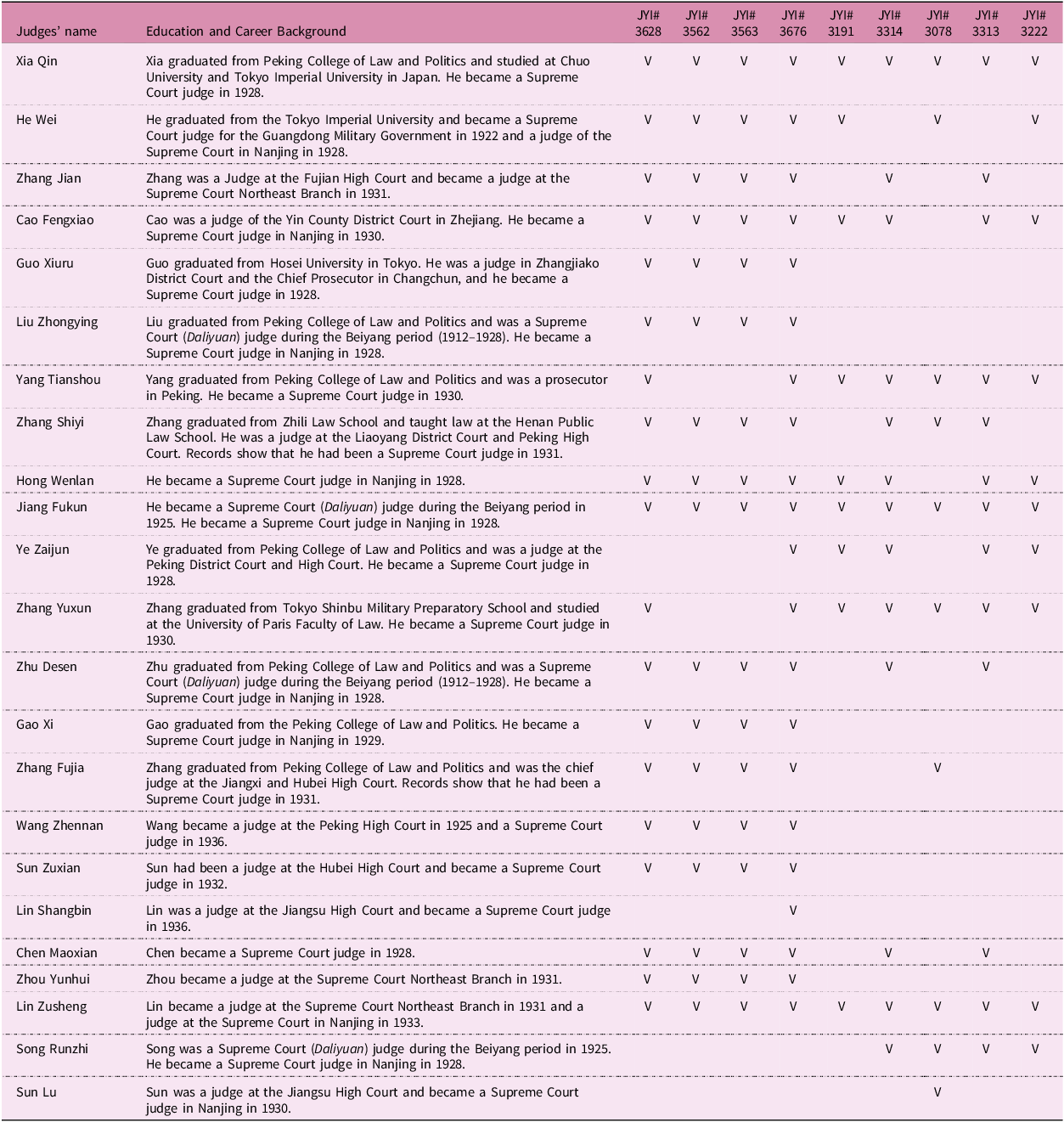
Because the Supreme Court was at the top of the court system, JYIs manifested the opinions of judicial elites in China. Table 2 below lists the education and career backgrounds of Supreme Court judges participating in the JYIs discussed in this article. All of them had an abundance of practical experience despite regime changes. They had also served on the Supreme Court for at least ten years. Because public international law has been a compulsory subject in law schools and bar exams in China since the 1910s, we can assume that these judges had at least basic knowledge of international law.Footnote 96
Backgrounds of Supreme Court Judges and the JYI decisions they participated in (marked by V)
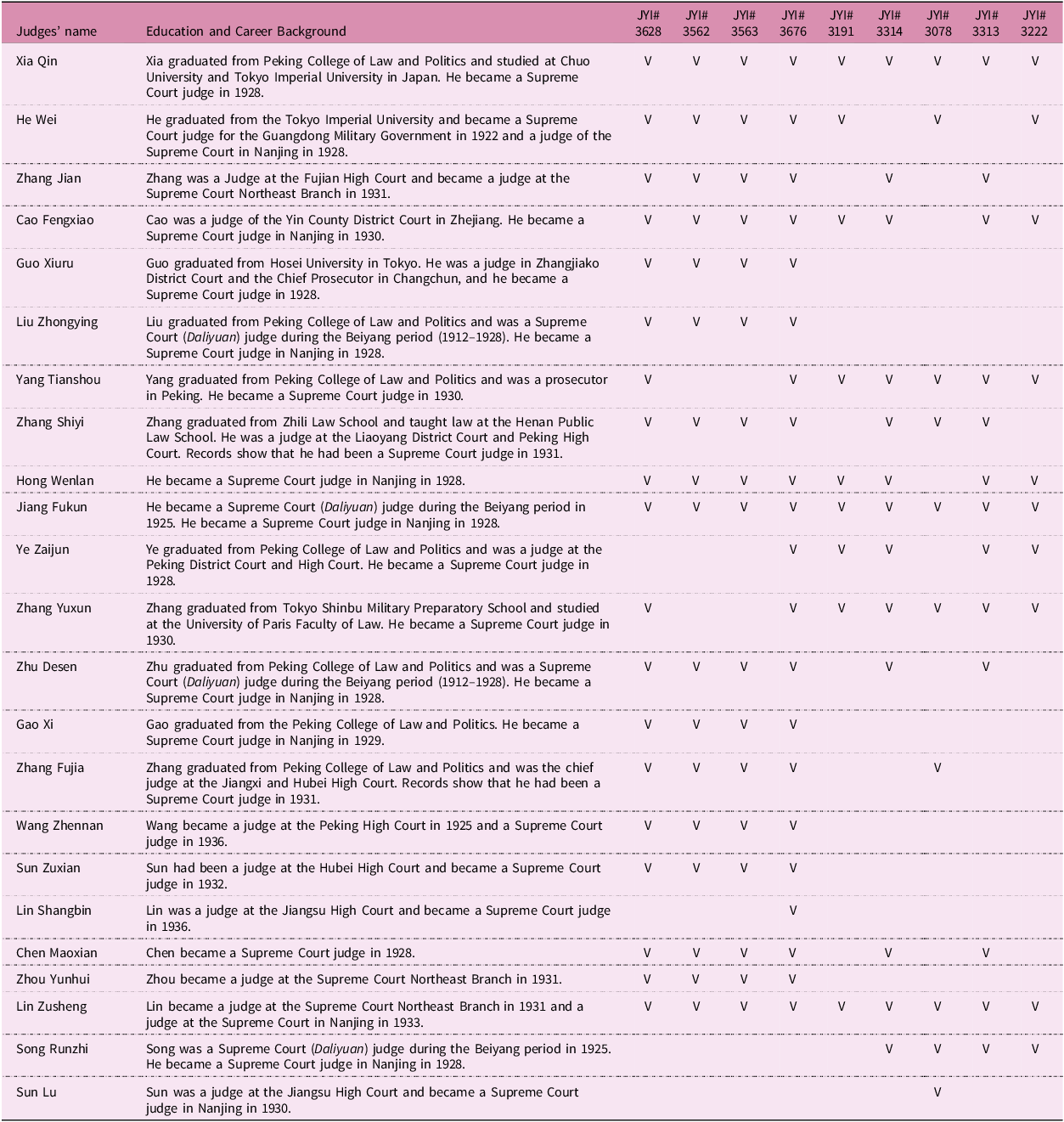
Sources: Y. N. Fan, Dangdai Zhongguo Mingren Lu (1931); Sifa Gongbao [The Judicial Gazette] (1936); MOJA, ‘Zuigao fayuan faguan ce’ [Name list of the Supreme Court judges], Shifaxingzhengbu Dangan [MOJA archive], National Archives (Taiwan) No. A311000000F/0017/609.1/0001 (1944).
The cases in the next sub-sections are those involved in interpretation disputes related to international law. They demonstrate that senior judges limited the application of the WCTA by citing international law. More importantly, they also demonstrate how Chinese legal professionals, in their attempt to make China a ‘civilized’ state, prevailed over the ruling party, which sought to exact revenge.
Some archives cited below show that the MND was the one that requested the Judicial Yuan to offer legal interpretations regarding war crime trials. One might argue that if the MND intended to depart from international law, the MND would never have submitted interpretation requests to the Judicial Yuan, which gave senior judges opportunities to interpret the WCTA per international law. However, the MND and the MOJA requested the Judicial Yuan to unify the interpretation because Chinese prosecutors and judges in the war crime trials were uncertain whether they should apply a law that might depart from international law or not. According to the WCTA, all war criminal courts were affiliated with the MND because they were military tribunals. If war criminal courts intended to request the Judicial Yuan to unify the interpretation of the WCTA, their requests must be under the name of the MND. In addition, the MOJA, responsible for the administrative matters of prosecutors and judges in districts and high courts since 1943, needed to select high court judges and prosecutors to work with MND judge advocates to try war criminals. As a result, the MOJA was also eligible to file interpretation requests to the Judicial Yuan.
4.2 Constraining the definition of foreigners
As mentioned above, the WCTA expanded the application of war crimes to all aliens, while international law limited the scope of war crimes to foreigners from warring states. On 7 April 1947, the MOJA considered the wording ‘alien combatant or non-combatant’ ambiguous and requested the Judicial Yuan to provide a unified interpretation of the wording. The MOJA argued that there were three ways to understand ‘alien combatant or non-combatant’ in practice:Footnote 97
The first opinion suggested that ‘alien combatant or non-combatant’ should be limited to foreigners from a state at war with China: since war crime trials originated from concepts of international law, foreigners from states not at war with China were not liable to be considered war criminals.Footnote 98
The second opinion suggested that the ordinary meaning of the wording: ‘alien combatant or non-combatant’, should encompass all aliens. It was unreasonable that an alien could be exempted from accusations of war crimes if he was not a national of one of the states at war. In addition, it was not uncommon for a foreigner from a third party to commit war crimes.Footnote 99
The last opinion was that the definition of ‘alien’ varied in different situations: all foreigners could be charged with crimes against peace, conventional war crimes, and crimes against humanity because they were universal crimes recognized internationally and because people from third-party states could also commit these crimes. Thus, the application of laws should not differ by nationality. However, because the fourth war crime or crimes against citizens of China was a special stipulation under the WCTA, not a war crime in a strict sense, the fourth war crime could only apply to foreigners from states at war with China. The MOJA noticed that the wording, ‘alien combatant or non-combatant’, in sub-paragraphs 1–4 was identical, raising the question of whether it was possible to interpret them differently or not.Footnote 100
The legal interpretation of ‘alien combatant or non-combatant’ is significant because some war crimes against Chinese people were committed by local collaborators working with Japan. For example, the MOJA had sought the MOFA’s assistance in investigating cases in which Malay (wuren) collaborators tortured and killed overseas Chinese.Footnote 101 Malay people, however, were British subjects. Britain was an ally of China and did not adjudicate collaborators as war criminals.Footnote 102 Encompassing all aliens would expand Chinese war crime jurisdiction to include these cases and would potentially infringe the sovereignty of other Allied states.
On 28 October 1947, the Judicial Yuan delivered JYI No. 3628, defining the wording ‘alien combatant or non-combatant’ as ‘limited to foreigners from the state in war or hostilities against our nation’. In other words, the judiciary adopted the first opinion in keeping with international law.Footnote 103
4.3 Constraining the definition of conventional war crimes
Six JYIs addressed questions of whether a specific act constituted a conventional war crime or not. Three of the cases elaborated on the international law they cited. These three cases are significant because they narrowed the scope of war crimes, leaving fewer Japanese people to be prosecuted in Chinese military courts.
The first case was requested by the MND regarding the definition of ‘forcing people to do things beyond their obligations’ (WCTA Article 3, sub-paragraph 38). The MND asked whether a foreigner who forced a citizen to move wounded soldiers in a military-occupied zone would violate the laws of war. The MND stated that there were two possible interpretations. According to the Regulations Respecting the Laws and Customs of War on Land (the Annex of Hague Convention IV, hereafter ‘the Hague War Regulation’) Article 52, it is legal if the requisitions in kind or service did not oblige the inhabitants to take part in military operations against their own country. The MND further cited a work of Lassa Oppenheim to support this opinion. In this case, the foreigner did not commit the offence. The second interpretation suggested that if the requisitions in kind or service occurred without any regulations, orders, or command in advance, it constituted the stated offence.Footnote 104 JYI No. 3562 adopted the first opinion, which was in accordance with the Hague War Regulation.Footnote 105
The second case was about ‘forcing non-combatants to engage in military activities with the enemy’ (WCTA, Article 3, sub-paragraph 20). The MND asked whether a foreigner was guilty of this crime if he requested the citizens of an occupied territory to fell trees for the army to build an air-raid shelter or other military facilities. Again, the MND stated that there were two possible interpretations: 1) ‘military activities’ are limited to directly enforcing civilians to attend to frontline affairs, e.g., carrying bullets. One international law scholar argued that requiring supporting actions behind the lines does not fall within the scope of this crime; on the contrary, others argued that 2) according to the wording of the conventions, all acts connected with military operations, whether directly or indirectly, constitute crimes.Footnote 106
The scope of military activities is a debatable topic in war crimes courts. In the well-known Burma-Siam Railway case at the British military court in Singapore, the Japanese defendants argued that the railway initially built for commercial purposes happened to have some military uses. It was, therefore, legal to involve POWs in construction. However, the court found that the construction of the railroad was a military operation to begin with because it was built to meet ‘the need for a supply line to the Japanese fighting forces in Burma’.Footnote 107
JYI No. 3563 adopted the first opinion ‘to be in accordance with the laws and customs of war’, which was more limited and consistent with international law.Footnote 108
The last case was about the legality of economic control in Manchuria. The MND stated that during the war, Japan implemented economic control in Manchuria, such as prohibiting people from hoarding goods and spiking prices. The MND asked two questions: 1) Did this economic control violate the Hague War Regulation Article 43 (the occupant ‘shall take all the measures in his power to restore, and ensure, as far as possible, public order and safety’)? And 2) did the person (whether Japanese, Taiwanese, or Korean) who conducted the seizure of these goods and presented them to the court for confiscation violate Article 3, item 33 of the WCTA (confiscation of property)?Footnote 109 JYI No. 3676 ruled that the stated policy had nothing to do with Article 43 of the Hague War Regulations. In addition, the scenario did not constitute a confiscation of property under the WCTA.Footnote 110 Once again, the JYI did not expand the definition of war crimes.
From the three cases above, it is clear that when dealing with conventional war crimes, the Judicial Yuan considered not only the stipulation of the WCTA but also the counter-stipulations in international law. More importantly, when there was a dispute on legal interpretations, the Judicial Yuan tended to choose the ones endorsed by international law and international legal scholars.
4.4 Hindering the WCTA’s intention to promote Chinese nationalism
As demonstrated in Section 3.3, the WCTA’s definition of crimes against humanity disregards the Nuremberg and Tokyo Charters concerning the nationality of victims. As long as victims were racially Chinese, regardless of their citizenship, the WCTA could consider hurting them a crime against humanity. In this way, the government incorporated the concept of the ‘Chinese race’ in WCTA to promote Chinese nationalism.
The drafters of the WCTA also intended to apply this law to cases involving Taiwanese victims. China ceded Taiwan to Japan in 1895 after the First Sino-Japanese War. During the Second World War, Taiwanese people were of Japanese nationality. China’s intention, however, was to claim its motherland status over the Taiwanese, even under Japanese colonial rule.
The JYIs emphasized the importance of nationality before and after the promulgation of the WCTA. Before the WCTA took effect on 24 October 1946, there were cases of ethnically Japanese nationals torturing ethnically Japanese citizens or Taiwanese people with Japanese nationality. The MND requested the Judicial Yuan to interpret whether these cases would fall under the jurisdiction of war crimes trials or the normal criminal court or not.Footnote 111 On 20 August 1946, JYI No. 3191 ruled that in such situations, these cases should be tried in ordinary criminal courts according to the Criminal Procedure Code instead of under war crime jurisdictions.Footnote 112 In other words, the law should treat Japanese and Taiwanese in the same way. On 7 December 1946, regardless of the promulgation of the WCTA, JYI No. 3314 ruled again that if a Japanese citizen tortured a citizen from his country or a Taiwanese person, it should not fall into the jurisdiction of war crime courts. JYI No. 3314 also reiterated that JYI No. 3191 was still a binding interpretation.Footnote 113
These two cases show that senior Chinese judges recognize the legality of the Japanese nationality of Taiwanese persons. After all, in 1895, Japan acquired Taiwan according to the Treaty of Shimonoseki, which was signed and ratified by both China and Japan. Despite the fact that the MND attempted to include Taiwanese people in the Chinese race, it could not ignore the legal fact that the Taiwanese people were of Japanese nationality during the war.
4.5 JYIs restrained the MND’s revenge on Taiwanese people
After the war, China claimed that all Taiwanese people ‘regained’ Chinese nationality.Footnote 114 This situation provoked a controversy in post-war China: were Taiwanese people domestic traitors (hanjian) or war criminals?Footnote 115 These two were mutually exclusive dichotomies. Only Chinese citizens could be traitors, while war criminals were confined to ‘alien combatants and non-combatants’. An MND report to the Executive Yuan in 1948 gave two examples. First, although Chen Xingcun donated a significant amount of money to the Japanese Navy and a few fighter aircraft for them to bomb China, he was not guilty as a traitor because he had Japanese nationality. Second, Xie Luxi manipulated the financial market in Tianjin in co-operation with the Japanese and purchased a great amount of food for the Japanese, but he was not prosecuted as a traitor because he was not with Chinese citizenship.Footnote 116
The Chinese government officials clearly acknowledged the distinction. In August 1942, when negotiating the establishment of the UNWCC, the UK suggested that the treatment of domestic traitors should be distinguished from that of enemy war criminals: the former should be tried by domestic criminal law – international treaties or agreements should not apply.Footnote 117 In 1944, Liang Yuen-li, a Chinese representative, defined traitors as:
Persons, nationals, or former nationals, of the requesting State who is charged with or convicted of giving aid or comfort to the enemy or of an offense committed with the intent to further the cause of the enemy or of an offense committed by means of the power or opportunity afforded by a state of war or armed hostilities or by the hostile occupation of the territory of the requesting State.Footnote 118
This definition was adopted by the UNWCC on 29 August.Footnote 119
The legal consequences of traitors and war criminals were different. In 1938, the Nationalist government ordained the Traitor Punishment Act. This act defined a traitor as a person who communicates with a foreign enemy state, induces a person in the armed services to surrender, or works as supporting staff for an enemy. The Judicial Yuan once held that the Traitor Punishment Act was the lex specialis of treason under Chinese Criminal Law.Footnote 120 In addition to the possibility of the death penalty or a lengthy prison sentence, if a person was sentenced as a traitor, the government was entitled to confiscate all of his property. Furthermore, the Traitor Punishment Act stipulated that a person who worked for the Japanese military or Japanese political organizations would be barred from running for office or public service in China. If the traitor was an attorney, his bar admission would be suspended. In other words, a guilty traitor would not only be executed or sent to jail but also be deprived of property and some rights to work. The MND 1948 Report also pointed out that the punishment prescribed in the WCTA was ‘much milder’ than the Traitor Punishment Act.Footnote 121
Many Taiwanese men would be traitors under the Traitor Punishment Act because they were conscripted by Japan and were more likely to have assisted the Japanese army. The MND 1948 Report indicated that, right after the end of the war, it received many private reports accusing Taiwanese people of being traitors. These reports did not end until the Judicial Yuan delivered JYI. 3078 on 25 January 1946,Footnote 122 which established that since Taiwanese people were Japanese nationals and thus were conscripted to join the Japanese armed forces, they should be treated in accordance with international law rather than the Traitor Punishment Act;Footnote 123 the WCTA of 24 October 1946 also followed the JYI’s decision on this issue.Footnote 124
Despite JYI 3078, the Shanghai High Prosecutor’s Office vehemently argued in July 1946 that some Taiwanese should be treated as traitors rather than war criminals, assuming that the Taiwanese had been Chinese citizens working for the enemy. Shanghai High Prosecutors argued in a submission to the Judicial Yuan that during the war, some Taiwanese people bullied Chinese people by relying on the power of the enemy. Some Taiwanese were even crueller than the Japanese. Furthermore, Chiang Kai-shek had once indicated that ‘during the war, if Taiwanese people committed crimes harming the citizens, they should be accused as traitors and should not be magnanimously treated’.Footnote 125
Even with Chiang Kai-shek’s guidelines, the Judicial Yuan rejected the prosecutors’ submission twice. In JYI No. 3313, the Judicial Yuan once again emphasized that if Taiwanese people were Japanese citizens, they should be treated pursuant to international law.Footnote 126
In addition, the MND requested the Judicial Yuan to interpret whether the war crimes tribunal had the authority to impose ancillary punishment, which includes depriving the defendants of the right to vote, the right to be a candidate in an election, and the right to be a public servant. JYI No. 3222 ruled that ancillary punishment did not apply to war criminals.Footnote 127 Given that Taiwanese people could not be treated as traitors, but only as war criminals, they were not subject to ancillary punishment. As a result, the Taiwanese people retained a chance to serve the government. In short, the Judicial Yuan invoked international law to prevent Taiwanese people from being declared traitors.
In most cases, the Judicial Yuan limited the scope of the WCTA, hindered the intent to promote Chinese nationalism, and restrained the MND’s revenge on Taiwanese people by interpreting the WCTA per international law. Since Judicial Yuan meetings comprised senior Supreme Court judges, their interpretations embodied the endeavours of judicial elites to comply with international law.
5. Conclusion
International law played a prominent role in providing a modern legal basis to the Republic of China for trying foreigners, as well as shaping the politics of war crime trials. While existing historiography suggests that the political leaders of Republican China adopted a lenient approach to war crime trials, this article reveals that the MND intended to punish Japanese war criminals and Taiwanese defendants more severely, as well as use war crime trial laws to support China’s hegemonic status in post-war Asia. Invoking international law to provide the basis for the trials, the drafters of the WCTA attempted to claim extraterritorial rights for overseas Chinese and attempted to extend Chinese imperialism to Taiwan, Hong Kong, and potentially other borderlands. The WCTA also departed from international law in stipulating a broader scope, adopting stricter liability, and promoting Chinese nationalism. However, the Judicial Yuan limited the scope of the WCTA, hindered the government’s intent to promote Chinese nationalism, and restrained the MND’s revenge on Taiwanese people by interpreting the WCTA per international law.
In contrast, Communist China adopted a less legalist approach to war criminal trials. The new government established in 1949 detained 1,109 Japanese citizens.Footnote 128 In April 1956, the National People’s Congress passed the ‘Decision on Dealing with Japanese War Criminals Who Invaded China’, which served as the legal ground for war criminal trials in Communist China. The Decision, comprised of only six points within one page, had no stipulations on the definition of war crimes, no source of law, nor any punishments the court could select from.Footnote 129 In the end, only 45 defendants were sentenced to eight to 18 years of imprisonment with no death penalty verdict at all. The others were all pardoned.Footnote 130
Kirsten Sellars argues that ‘the trials in Asia have operated as laboratories for international law. Under their auspices, legal cultures – both local and imported – have cross-fertilised and mutated’.Footnote 131 Although, as of today, Asia has relatively fewer states parties to the Rome Statute of the International Criminal Court, Nationalist China, which adopted the legalist approach and where legal elites resorted to international law to prevent the regime from seeking revenge, serves as a case in which international law shaped national laws, policies, and court decisions, thereby contributing to the broader field of international criminal jurisprudence.

 Open access

