




Introduction
We begin this article with two vignettes which reveal the agentic power of Wild Pedagogies guided by the Mosaic Approach (Clark, Reference Clark2017). The young children, who self-selected their names (in italics), and participated in this study developed a special kind of shared and reciprocal agency alongside fallen tree parts, sticks, that the children chose to engage with in a forest clearing (or “secret forest spot”) where the children’s activities took place. The children, their sticks, and the forest became co-teachers and co-learners as they engaged with and experienced Wild Pedagogies:
We Care About Nature reaches up to a stick growing on a tree and begins to peel the bark, slowly and deliberately. As the green-brown shavings spiral, curl, and fall to the forest floor, her classmate Earth Saver quickly grasps and moves We Care About Nature’s hand away from the stick, saying, “Don’t, it’s alive, you know that!”
Coyote Beaver 1 organised Coyote Footprints, The Bald Eagle of the History of the Coyotes/Wolfy, Great Big Coyote, Coyote 2, and Earth Saver to construct a “second side” to a partially built structure. Drawing upon their knowledge developed over many days throughout the school year exploring and investigating their “secret forest spot,” the children quickly assessed the size, shape, and quantity of sticks required. Working together, they discussed the task at hand and agreed stacking more sticks would make the roof “more stable.” Upon finding a uniquely bent stick, Coyote Beaver called to his friends, “I found the perfect stick,” and explained, the stick was “the perfect shape for the doorway.”
These encounters took place during a doctoral study (Beattie, Reference Beattie2023) that explored young children’s (ages 5 to 7 years) relationships with sticks during self-guided school-based outdoor learning experiences. For many of the children, sticks became a uniquely contextual member of the community due to the profound agentic effect their stick-based experiences had on their understandings of Place through Wild Pedagogies.
Sticks offered rootedness for Wild Pedagogies to unfold and provided affordance for imaginative, creative, and reciprocal agency to be developed and shared among children, sticks, and Place. The relationships between and among the children, their chosen sticks, and the forest spot revealed the contextual, individual, and collective, as well as the physical and disruptive nature of Wild Pedagogies. The children engaged in Wild Pedagogies alongside sticks and the forest spot as co-teachers and co-learners (Jickling et al., Reference Jickling, Blenkinsop, Timmerman and De Danann Sitka-Sage2018), and together they developed a shared and reciprocal agentic power. Thus, the study examines Wild Pedagogies through the novel lens of the Mosaic approach (Clark, Reference Clark2017), and offers new insights into the importance of Wild Pedagogies’ emphasis on tactile, local experiences to promote children’s agency as co-learners, in relationship with Place.
Problem statement and study overview
Young children, particularly those living in urban areas, are experiencing rapid infrastructure development and the loss of green and natural backyard places (Beattie, Reference Beattie2014, Reference Beattie2015; Statistics Canada, Reference Canada2021). The result is many children interact, engage, and learn in outdoor settings differently than their counterparts did a decade ago, due to challenges related to safety, accessibility, and affordability (Beattie, Reference Beattie2014, Reference Beattie2015). One way to address the problem of children’s lack of connection to the natural world is to explore and identify outdoor experiences that children value and choose for themselves.
This study was guided by the following research questions:
-
1. What do young children’s documentation of their experiences of chosen outdoor activities reveal about the nature of their outdoor learning?
-
2. What do young children’s experiences of chosen outdoor activities reveal about their perspectives on outdoor learning?
To answer the research questions, the study employed phenomenographic principles (Marton, Reference Marton1981, Reference Marton1986) and drew upon a Mosaic and case study approach (Clark, Reference Clark2017; Stake, Reference Stake1995; Yin, Reference Yin1994, Reference Yin2003, Reference Yin2009, Reference Yin2014) with selected aspects of ethnography (Creswell, Reference Creswell2014; Ritchie, Reference Ritchie2019). In this article, we focus specifically on the children’s, sticks, and Place’s agentic power of Wild Pedagogies as guided and articulated by the Mosaic approach. The Mosaic approach is particularly well suited to Wild Pedagogies due to the complex, expressive, and imaginative nature of the processes involved and the outcomes in terms of children’s agency.
Study context
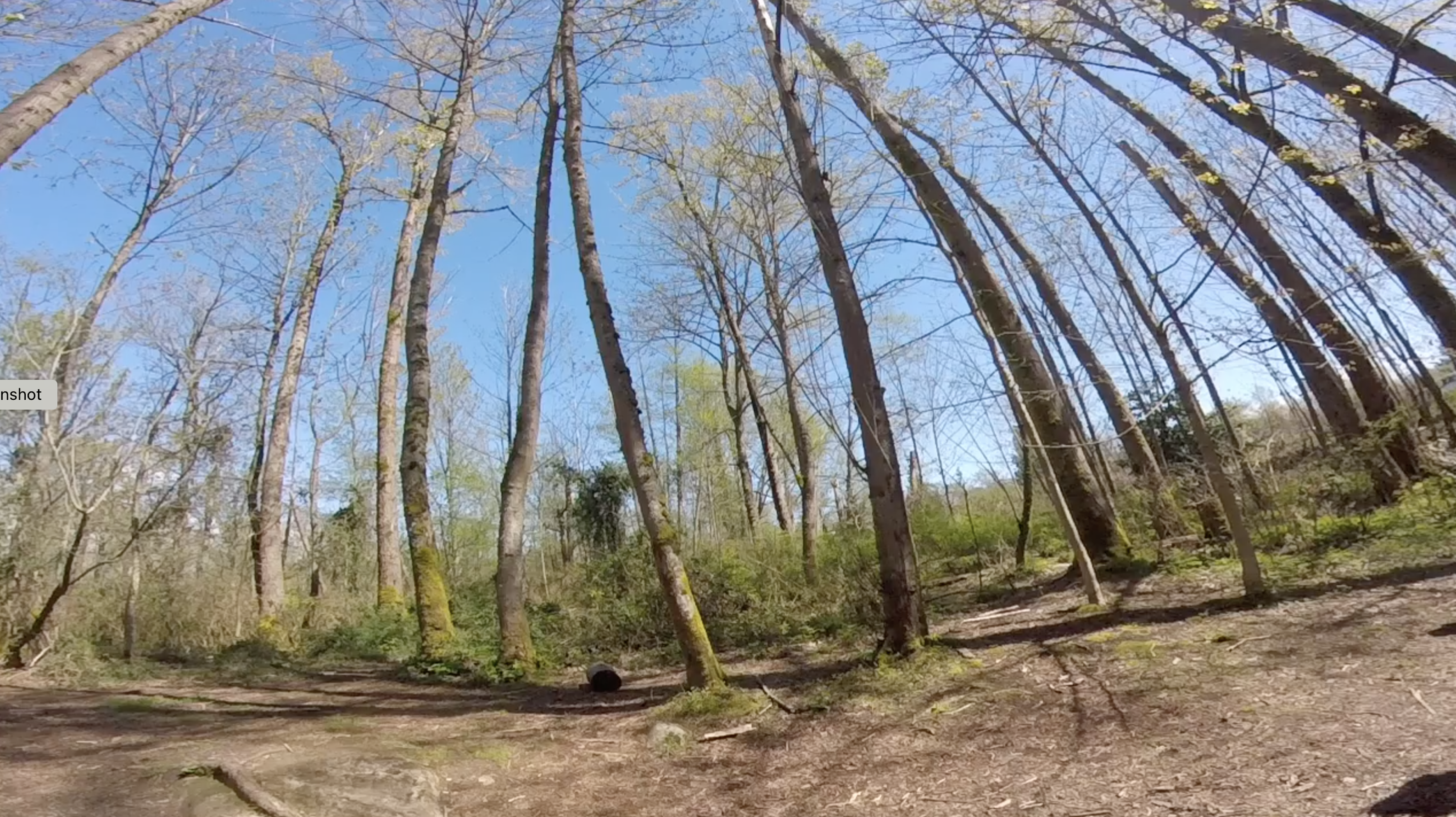
Twenty Grade 1 students (aged 5 to 7 years) from an urban public school located in Vancouver, British Columbia took part in this study. Data were collected while the children engaged in chosen outdoor activities in their “secret forest spot,” a small clearing located within a five-minute walk of the school where the children engaged in their outdoor learning experiences (See Figure 1). The Mosaic approach attempts to study children’s activities in their everyday contexts (Clark, Reference Clark2017); hence it was appropriate to investigate the children’s outdoor activities in this familiar backyard place. Through Wild Pedagogies, the children spent prolonged time in the secret forest spot over the course of the school year. While engaging in stick-based experiences, the children assumed ownership of their experiences and their learning.
The secret forest spot.
Mosaic approach
The Mosaic approach is based on combining multiple pieces of data to generate findings (Clark, Reference Clark2017) and supports participants as co-researchers, encouraging them to self-select their method of communicating experiences (Clark, Reference Clark2017). The children themselves create and discuss the research material or data, leading to co-constructed meanings, understandings, and results (Clark, Reference Clark2017). The participants in this study chose to wear and operate GoPro cameras and engage in serendipitous observed conversations. This degree of autonomy aligns with the Mosaic approach which acknowledges children as “competent meaning makers and explorers of their environment” (Clark & Moss, Reference Clark and Moss2005, p. 29) in their role as co researchers.
The use of multiple methods is justified by the study’s grounding in the Mosaic approach, which requires more than one method be used to create the data Mosaic (Clark, Reference Clark2017). This study employed four methods and included observations, observed conversations, field notes, and GoPro video documentation created by the research participants. Observed conversations involved listening, with permission, to the participants as they engaged in their stick based and other forest activities. Our intent was to achieve “naturalistic and realistic data” (Swain & King, Reference Swain and King2022, p. 2), which involved “including the voice of the child” (Clark & Moss, Reference Clark and Moss2005, p. 29) and being
The objective of this study’s methods was to observe and document the range of outdoor activities the children chose to participate in, record the children’s engagement and responses, and to identify and record their experiences over time. As suggested by Hatch (Reference Hatch2002), written notes of observations were kept in a research journal to maintain an “on the spot record” (p. 88) and snapshots (Pinksky, Reference Pinksky2015) of the children’s experiences. The journal data documented the children’s behaviour, engagement, and their responses to their experiences by detailing their conversations and interactions. Contextual details were also recorded in the field notes, such as names (pseudonyms) of participants, materials used by the children, as well as the time, duration, and location of activities.
The GoPro video data provided a holistic and first-person perspective on the children’s forest experiences and provided the opportunity for participants to engage as “competent meaning makers and explorers of their environment” (Clark & Moss, Reference Clark and Moss2005, p. 29). The participants decided when, where, and how long to wear a GoPro. They also chose the location of and the kind of subject matter to be recorded.
Stages of the mosaic approach
There are three stages involved in the Mosaic approach (Clark, Reference Clark2017). Stage One is the data collection phase (Clark, Reference Clark2017), which in this study involved the children collecting their own data using the GoPros and during observed conversations. Stage Two is the analysis and interpretation phase (Clark, Reference Clark2017), which involved identifying emergent themes. Stage Three is the application of results and action phase (Clark, Reference Clark2017). This final stage is participatory, active, and reflexive (Clark, Reference Clark2017) and is articulated in this article through the lens of Wild Pedagogies.
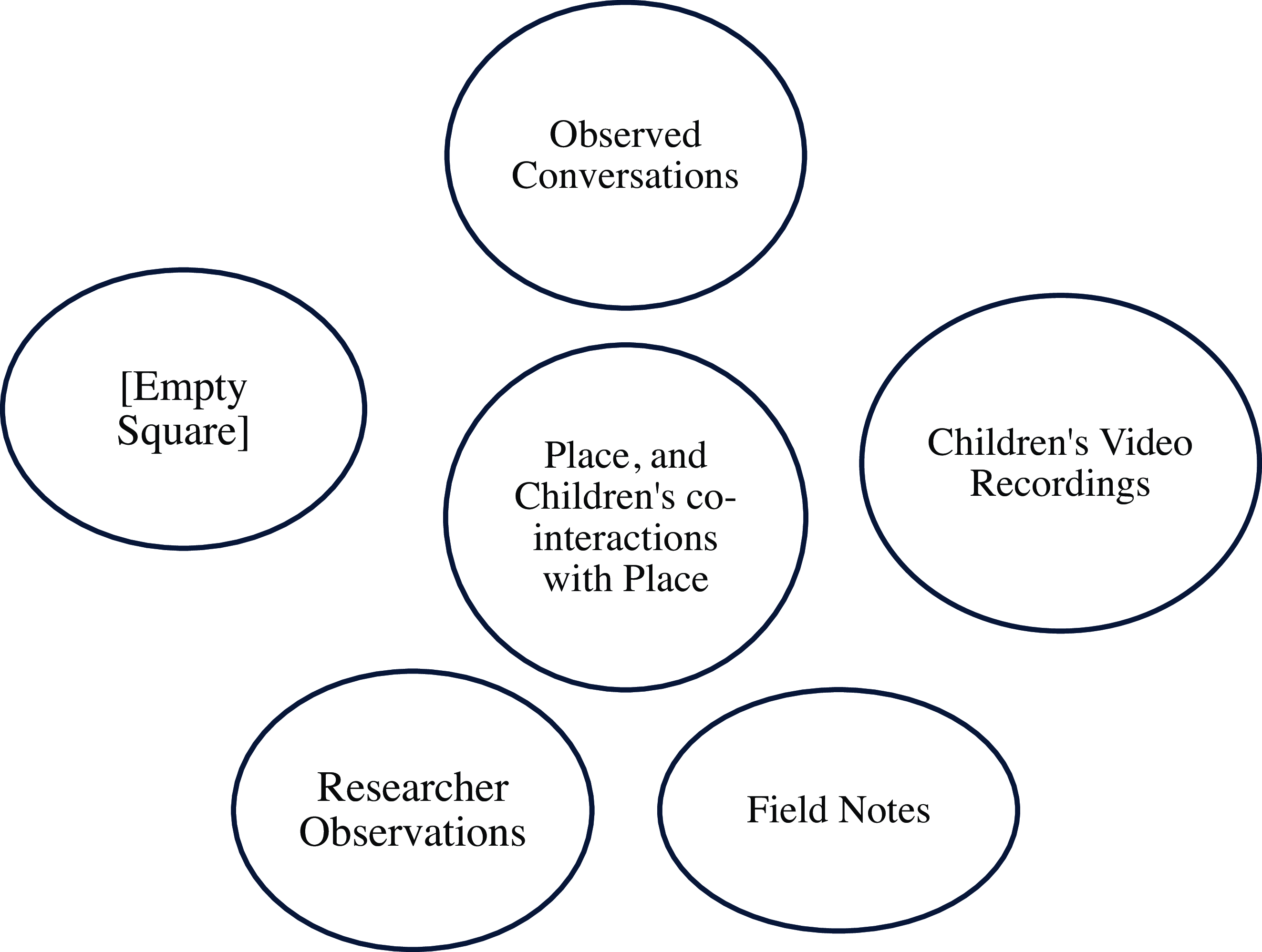
A key feature of the Mosaic approach is the empty square (Clark, Reference Clark2017), shown in Figure 2. The empty square is a visual reminder of the open process that welcomes new modes of listening to young children, which can be then added to the data Mosaic (Clark, Reference Clark2017). In this study, the empty square offered possibilities for data collection methods which listened to Place, recognised and valued the more-than-human, specifically sticks and the forest spot, and understood nature as teacher providing affordances to develop shared and reciprocal agency. As a researcher, this openness to possibility and emergence is manifested by remaining curious and humble, and alert to new ideas put forward by the children and Place. In particular, approaching the data analysis without pre-formed notions of what the emergent themes might be is crucial.
Mosaic methods for data collection. created by author 1, based on mosaics in Clark (Reference Clark2017).
The Mosaic approach values young children’s rights and recognises them as active agents with meaningful knowledge and the ability to create meaning (Clark, Reference Clark2017). This perspective aligns with Wild Pedagogies’ openness to diverse ways of being and understanding the world (Jickling et al., Reference Jickling, Blenkinsop, Timmerman and De Danann Sitka-Sage2018). By viewing children as competent participants in their own lives, the Mosaic approach rejects pedagogies that treat them as passive learners or empty vessels to be filled (Clark, Reference Clark2017). This aligns with Wild Pedagogies’ critique of traditional Euro-American educational models (Jickling et al., Reference Jickling, Blenkinsop, Timmerman and De Danann Sitka-Sage2018). Here, Place and children became co-teachers, shaping a reciprocal agency that informed a rich, agentic Mosaic (Jickling et al., Reference Jickling, Blenkinsop, Timmerman and De Danann Sitka-Sage2018).
Wild Pedagogies
The term Wild Pedagogies was offered by Jickling et al., (Reference Jickling, Blenkinsop, Timmerman and De Danann Sitka-Sage2018) as a “lens for [understanding] converging stories” (p. viii) of education which is physically active and interconnected with the Place in which it takes place, and of the educative potential therein; similarly, Wild Pedagogies are suggested as a “guide to enable our experiments in practice” (p. viii) as educators attempt to write new stories of change in education, toward an eco-social praxis which is different from and challenges traditional educational norms in order to prepare learners and educators alike to face the challenges of living in the Anthropocene. Thus, Wild Pedagogies are pedagogies which “aim[] to re-examine relationships with places, landscapes, nature, more-than-human beings, and the wild” (Jickling et al., Reference Jickling, Blenkinsop, Timmerman and De Danann Sitka-Sage2018, p. 1) and seek to “trouble the dominant versions of education” (Jickling et al., Reference Jickling, Blenkinsop, Timmerman and De Danann Sitka-Sage2018, p. 1) which assert rigid control over educators, learners, the curriculum, and the Earth. As a form of anti-colonial activism (Beavington, Beeman, Blenkinsop, Heggen & Kazi Reference Beavington, Beeman, Blenkinsop, Heggen and Kazi2022), wild pedagogies attempt to teach us to dwell differently within Place (Jickling et al., Reference Jickling, Blenkinsop, Timmerman and De Danann Sitka-Sage2018).
Wild Pedagogical experiences are not confined to pristine wilderness (Schmidt, Reference Schmidt2022). They can be practiced in the ruins of nuclear sites (Schmidt, Reference Schmidt2022); around a campfire (MacEachren, Reference MacEachren2022); or in a managed second growth forest, as is evident through this paper. It is the pedagogical attitude that must become in some way wild — meaning disruptive, prioritising connection with and listening to place, full of wonder (Beavington et al., Reference Beavington, Beeman, Blenkinsop, Heggen and Kazi2022; Green, Reference Green2022) — for wild pedagogies to flourish.
Wild Pedagogies are inherently pluralistic. Six key touchstones are outlined in Jickling et al., (Reference Jickling, Blenkinsop, Timmerman and De Danann Sitka-Sage2018). The touchstones “are not intended to be dogmatic, but simply a best gathering of ideas and practices at this time” (Jickling et al., Reference Jickling, Blenkinsop, Timmerman and De Danann Sitka-Sage2018, p. 78). A listing of these touchstones is provided here; for further elaboration, see Jickling et al., Reference Jickling, Blenkinsop, Timmerman and De Danann Sitka-Sage2018, pp. 77–107:
-
• Nature As (Co-)Teacher
-
• Complexity, the Unknown, and Spontaneity
-
• Locating the Wild
-
• Time and Practice
-
• Socio-Cultural Change
-
• Building Alliances and the Human Community
In this paper, the themes of Nature as (Co-)Teacher; Complexity, the Unknown, and Spontaneity; and Time and Practice are explored through the telling of young children’s Wild Pedagogical experiences.
Finally, Wild Pedagogies re-cede agency to those who traditional education has disenfranchised, including the more-than-human elements of Place (Nerland & Aadland, Reference Nerland and Aadland2022), and students, particularly young children (Green, Reference Green2022). This demarginalising is evident in Wild Pedagogical praxes and research, as Place and students become both Wild Pedagogues and contributors to research projects (Green, Reference Green2022; Nerland & Aadland, Reference Nerland and Aadland2022). This paper picks up both of these threads in its elaboration of young children’s Wild Pedagogical experiences as understood through the Mosaic approach.
Findings: stick-based Wild Pedagogies
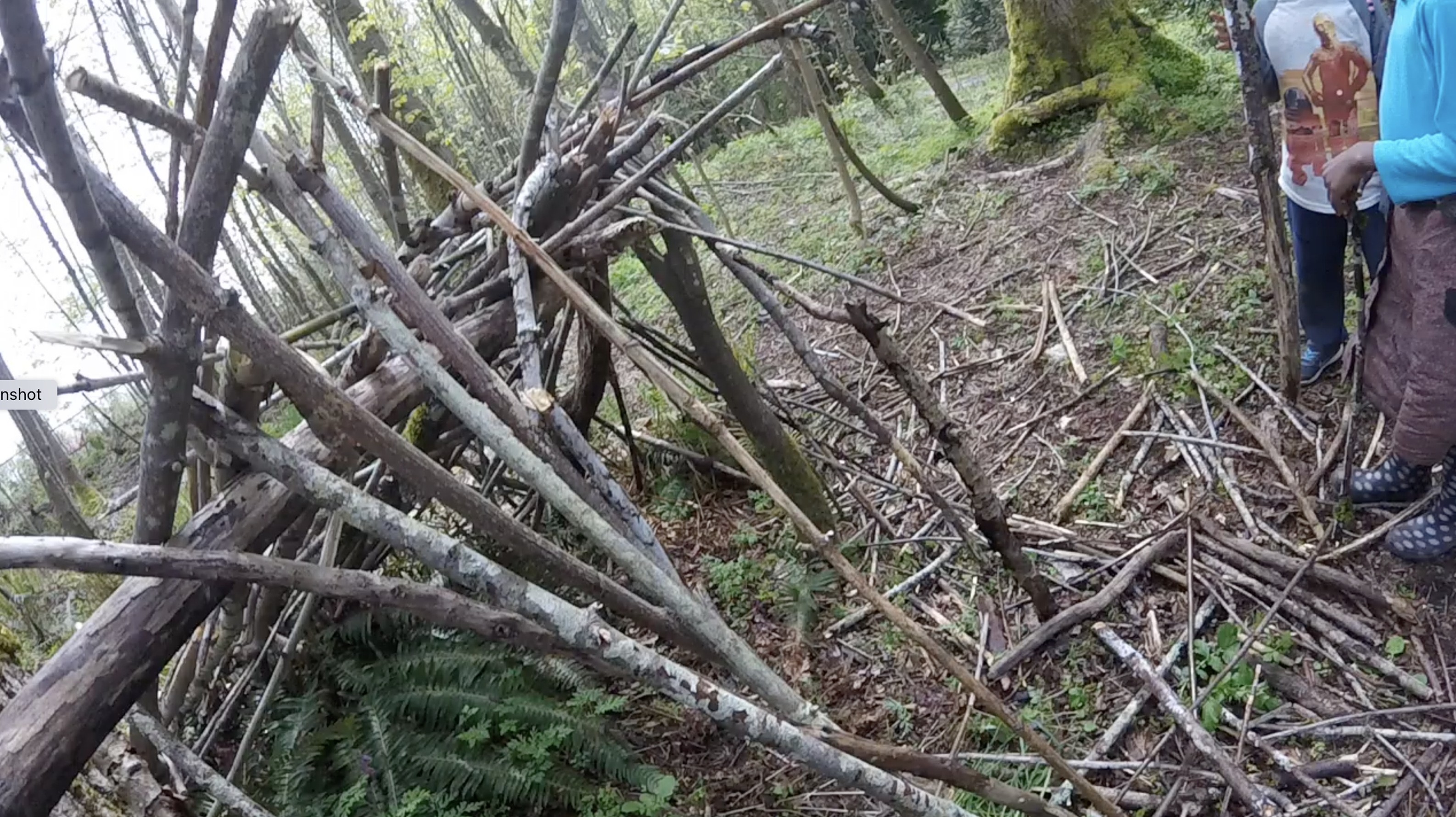
The young children in this study made use of sticks during their chosen outdoor learning activities in both physical and symbolic ways. They employed sticks physically when they used long sticks and branches to build structures, dwellings, and other creations (see Figure 3); they engaged with them symbolically when smaller sticks represented microphones, currency or brooms. The difference between physical and symbolic use is subtle; during physical use, sticks are used as sticks, whereas in symbolic use they represent, or symbolise, other objects. The inherent variety and freedom within these stick-based environmental education experiences opened opportunities for Wild Pedagogies. The children exercised their agency in terms of choosing the topic and type of learning experience and activity they wished to pursue. Opportunities arose for the children to listen to the sticks and the secret forest spot; sticks and Place acted as agentic, more-than-human teachers. The human use of sticks is not novel; however, sticks are generally considered either toys or tools (Langlands, Reference Langlands2018; Portis, Reference Portis2008). The significance of the use of sticks in this study is the understanding of their agency as teachers, which has grown from the perspectives of young children, the sticks’ co-learners.
Co-created stick structure.
The children’s experiences using sticks revealed the physical, hands-on, and tactile nature of Wild Pedagogies.
In this study, young children’s learning experiences were diverse and immersive, incorporating collaboration and individual inquiry by using sticks both physically and symbolically as they built large structures, such as houses and stages, and used smaller sticks as tools, currency, or props like microphones and brooms. These open-ended experiences fostered Wild Pedagogies, allowing children to choose their learning activities and engaging with their environment as an active participant. This approach not only cultivated a robust sense of agency but also solidified their connection to Place, demonstrating how individual, tactile, and experiential learning in nature can profoundly shape one’s understanding of and relationship with the environment. By embracing Wild Pedagogies, educators can create opportunities for children to engage meaningfully with their environment, fostering a more profound understanding of the natural world.
The children’s experiences as shown through their chosen outdoor activities revealed that Wild Pedagogies-informed environmental education was agentic.
Engaging in tactile, multi-sensory outdoor learning allowed children to deeply explore and interpret their world. This hands-on approach, central to Wild Pedagogy, enabled genuine connections with nature through physical, corporeal, and sensory experiences. Repeatedly running, touching, walking, holding, carrying, and sharing in nature reinforced the value of physical engagement in environmental learning. Children used sticks in diverse ways — constructing structures, building houses, crafting tools, and making weapons, brooms, musical instruments, and even currency. Such activities were self-initiated and self-directed, free from adult structuring, and demonstrated a clear sense of agency.
Young children have agency when they are capable of exercising some degree of control over what happens in their lives (Ärlemalm-Hagsér & Davis, Reference Ärlemalm-Hagsér and Davis2014; Niemi et al., Reference Niemi, Kumpulainen, Lipponen and Hilppö2015). This control may take the form of young children competently making choices about their learning (Buzzelli, Reference Buzzelli2015), their social behaviours (Gyogi, Reference Gyogi2014), and/or their leisure activities (Aguirre-Bielschowsky et al., Reference Aguirre-Bielschowsky, Lawson, Stephenson and Todd2015). Further, when young children have agency, they are able to make suggestions about community issues which should be seriously considered (Ärlemalm-Hagsér & Davis, Reference Ärlemalm-Hagsér and Davis2014; Davis, Reference Davis2009; Mitchell, Reference Mitchell2010). Agentic young children can affect not only their own lives, but the lives of those around them as well.
Education for young children can construct the development and agency of children in very specific ways from preschool onwards, by following a Piagetian understanding of how young children develop (Piaget & Inhelder, Reference Piaget and Inhelder2000). Piaget held a constructivist understanding of children’s development; he believed children went through a specific sequence of developmental stages, and that the later stages required the social, emotional, intellectual and environmental experiences of the earlier stages in order to develop (Piaget & Inhelder, Reference Piaget and Inhelder2000). However, Piaget also linked the developmental stages of childhood to specific ages (Piaget & Inhelder, Reference Piaget and Inhelder2000). In this way, Piaget created a standard for childhood development which normalises the experiences of middle-class, Euro-American children, and suggests that children who develop at different rates, due to living in different socio-cultural contexts, are not developing correctly (Piaget & Inhelder, Reference Piaget and Inhelder2000; Robbins, Reference Robbins2005; Rogoff, Reference Rogoff2003).
Piaget’s assertion that children follow these biologically and chronologically predetermined stages of development (Piaget & Inhelder, Reference Piaget and Inhelder2000) has been challenged by other researchers and practitioners. Bronfenbrenner (Reference Bronfenbrenner1994) proposed an ecological model of childhood development, which considered how multiple external systems, such as a child’s family, friends, school, neighbourhood, community, socioeconomic situation, culture, and government policies, interact with and influence children’s development and their capabilities as learners (Ali, Reference Ali2008; Dockett & Perry, Reference Dockett and Perry2005; Fenech, Reference Fenech2011; Harrison et al., Reference Harrison, van Vliet and Anderson2012; Niles & Byers, Reference Niles and Byers2008). Drawing on Vygotsky’s work (Reference Vygotsky, Cole, John-Steiner, Scribner and Souberman1978), John-Steiner and Mahn (Reference John-Steiner and Mahn2006) and Rogoff (Reference Rogoff2003) state that children’s development and learning is contextual, and that sociocultural factors play extremely important roles. This sociocultural understanding of children’s development and learning is widely embraced by contemporary Early Childhood Education (ECE) researchers and practitioners (Plowman et al., Reference Plowman, McPake and Stephen2008; Alcock, Reference Alcock2013; Edwards, Reference Edwards2003; Kendrick & McKay, Reference Kendrick and McKay2004; McEvilly, Reference McEvilly2014; Mcnamara & Conteh, Reference Mcnamara and Conteh2008; Mitchell, Reference Mitchell2010; Robbins, Reference Robbins2005), although others argue that ECE practice and research has yet to fully abandon its positivist, biologically based, universalist, and colonialist roots (Pence & Pacini-Ketchabaw, Reference Pence and Pacini-Ketchabaw2008).
Despite this change in how children’s development is constructed and understood, the Piagetian construct of predetermined, age-related stages of development (Piaget & Inhelder, Reference Piaget and Inhelder2000) still dominates the British Columbian educational system, as seen by the way children are separated into grades by age. The belief in childhood development as constructed by Piaget (Piaget & Inhelder, Reference Piaget and Inhelder2000) has led Early Childhood Education to construct young children’s agency in specific ways as well. By saying that there are certain things pre-operatory children can and cannot understand, certain ways they will and will not be able to learn, and certain things they should and should not be able to do, the Piagetian-based ECE system has largely removed agency from young children (McEvilly, Reference McEvilly2014). Therefore, young children do not have meaningful choices about their learning (McEvilly, Reference McEvilly2014), knowledge they have learned from their own social or cultural contexts is devalued (Pence & Pacini-Ketchabaw, Reference Pence and Pacini-Ketchabaw2008), they are not seen as responsible for themselves or their futures, and they are rendered powerless (Millei & Lee, Reference Millei and Lee2007). Wild Pedagogies as understood through the Mosaic approach allow children to exercise their agency, in concert with the agency of Place and sticks, and offer an antidote to this troubling situation.
In addition, Wild Pedagogies and their outdoor setting increase children’s opportunities to exercise agency. The specific outdoor environment in which young children play directly impacts how much agency they can have. Young children find traditional playgrounds, with standard playground equipment that is designed to be used in one way only, as less challenging or enjoyable than play areas that have natural elements (Prince et al., Reference Prince, Allin, Sandseter and Ärlemalm-Hagsér2013). We believe this is because traditional playgrounds limit young children’s freedom and agency by reducing their playing and learning choices. Traditional playgrounds are usually designed to be safer than natural play areas (Wyver et al., Reference Wyver, Tranter, Naughton, Little, Sandseter and Bundy2010), which also leads to the loss of young children’s agency when they are playing in traditional playgrounds. This emphasis on safety in playgrounds is based on a construction of young children as needing protection, unable to be responsible for their own safety, and unable to make appropriate decisions about their health and well-being. Constructing young children in this way severely limits their agency.
Natural outdoor play areas also offer young children more scope for agentic learning when they are engaged in free play. Natural play areas offer an ever-changing array of props or loose parts, such as leaves, seeds, rocks, rain, and more (Chawla, Reference Chawla2007; Dennis, Wells & Bishop, Reference Dennis, Wells and Bishop2014; Kernan, Reference Kernan2010). Young children are also able to find, manipulate, and (re)create their own special places, such as nests, forts, or dens (Dennis et al., Reference Dennis, Wells and Bishop2014; Green, Reference Green2013). Thus, in natural outdoor play spaces, young children can involve their imaginations while engaging meaningfully with the place they are in, which leads to sense of autonomy and agency as learners (Green, Reference Green2013; Sobel, Reference Sobel2015). We believe that natural play spaces give young children the chance to construct themselves, as learners, and as people.
Documented experiences revealed that the children confidently made independent choices and incorporated sticks into their play, drawing on prior knowledge to deepen their exploration. The secret forest spot, along with the natural affordances of sticks, acted as a catalyst for extended tactile and corporeal investigations. For instance, some children used sticks to dig for invertebrates, while others explored sound-making, enriching their sensory connections to the environment. As they interacted with sticks — feeling the bark, cambium, and pith — and engaged in both structured and spontaneous activities, children forged strong bonds with nature. Their experiences incorporated scientific, aesthetic, ethical, and historical ways of knowing and being. Wild Pedagogical environmental education, therefore, is highly personal, unique to each child, and rooted in agentic, self-directed exploration.
The children’s experiences with Wild Pedagogies revealed emotional and ethical care, and atheistic perspectives.
In this study, sticks and the forest emerged as essential elements in children’s Wild Pedagogies, serving as dynamic settings for connecting with Place. The secret forest spot and the versatile use of sticks created a natural classroom where children learned with, in, from, and alongside nature — embracing nature as their teacher. This reciprocal relationship allowed them to form emotional and ethical care, and atheistic perspectives with the environment.
Moreover, the children’s ethical connections to the environment were evident in their careful observations of shrubs, trees, and flowers. They demonstrated emotion by relocating a slug “to somewhere safe” and re-evaluating the value of invertebrates, acknowledging that every living creature has intrinsic worth and a right to live. This ethical awareness highlighted their understanding that their interactions with the natural world could be both beneficial and potentially harmful, underscoring the delicate balance required in environmental stewardship.
The children’s experiences revealed their aesthetic perspectives. When sorting and giving value to objects for trade in the woodshop, Coyote Footprints indicated that a salmonberry flower was very aesthetically pleasing. Other children used sticks to create musical instruments with unique sounds, rhythm, and cadence as they found them. Overall, the study emphasises that integrating hands-on, tactile experiences with nature through Wild Pedagogies fosters meaningful connections with Place.
Implications for Wild Pedagogies
This study’s methodological approach and findings on agency inform Wild Pedagogies in unique and meaningful ways. Particularly significant is the discussion that defines agency as embracing the learner, Place, and the sticks themselves. The affordances provided by Wild Pedagogies with the sticks and the forest spot and the children’s actions, inspire, support, and further articulate and confirm the power of collective agency in effective environmental education. In short, the children’s shared agency with the sticks, forest, and Place underscores the importance and power of Wild Pedagogies.
This study also revealed an inclusive, multifaceted, and multimodal understanding of reciprocal agency, which enhanced the role and broadened the scope of the setting in environmental education. The natural environment where this study took place, the secret forest spot, and the children’s sticks are recognised and realised as teachers, where children learn in, from, and alongside nature. Hence in addition to the children having agency, the sticks and forest spot were revealed to have agentic power which was developed and disseminated in reciprocal ways. This understanding is fundamental to Wild Pedagogical praxis.
The agentic child together with the agentic stick and forest spot have implications for environmental education within the context of Wild Pedagogy. This study unfolded as a special kind of Wild, slow pedagogy of Place (Jickling et al., Reference Jickling, Blenkinsop, Timmerman and De Danann Sitka-Sage2018; Payne & Wattchow, Reference Payne and Wattchow2009) with the children making cognitive and affective connections during long term engagement over the school year, within a local and familiar spot, and through tactile and corporeal stick-based experiences. The sticks provided affordances for the children to experience rootedness, a personal, relevant, and meaningful knowing of, and grounding within, Place. This interplay of agency became a collective and shared lived experience, foundational to the children’s Wild Pedagogical learning.
This study stresses the importance of young children connecting with familiar and personal places and the power of getting to know the flora and fauna in their own local places. Through their stick based experiences, the children took action in individual, personal, and meaningful ways such as building, tinkering, collaborating, sharing, saving, creating, storytelling, tending, and designing. These connections emphasise the power of known, memorable, and recognisable contextualised learning experiences in Wild Pedagogies.
Conclusion
This study highlights how Wild Pedagogies combined with the Mosaic approach foster young children’s engagement in relational and agentic pedagogy during outdoor environmental education. Children, sticks, and a “secret forest spot” became co-teachers, collaboratively creating learning experiences that encouraged shared and reciprocal agency. Drawing from Clark (Reference Clark2017), we emphasise the importance of staying curious about children’s communications, exploring together with humans and non-humans, using diverse methods to capture children’s voices, and respecting children’s autonomy. The study underscores the value of tactile, immersive, and bioregional experiences in helping children connect with nature, build knowledge, develop and share collective agency, and cultivate an ethic of care for the environment in Wild Pedagogical ways.
Acknowledgements
Dr Elizabeth Beattie is indebted to her research supervisors and committee for their ongoing support. This research was conducted on the traditional, ancestral, and unceded territory of the xʷməθkʷəy̓əm (Musqueam) People. We are grateful for the opportunity to work in this territory, and thank the xʷməθkʷəy̓əm People for being care-takers, knowledge-keepers, and educators in community with their land and waters for thousands of years (Musqueam Indian Band, 2022).
Financial support
The study presented in this article was funded by SSHRC (Social Studies and Humanities Research Council of Canada), file number 767-2016-2314 (AEB) and the University of British Columbia (AEB).
Ethical Standards
The ethical approval for the research was granted by the University of British Columbia, number H16-01656, and by the Vancouver School Board.
Author Biographies
Elizabeth Beattie is a recent doctoral graduate from the Department of Curriculum and Pedagogy at the University of British Columbia, and is currently working as a sessional instructor. Her research lies at the intersection of young children’s agency and place-based environmental education, with a focus on integrating science education and Indigenous perspectives, and preparing teachers and learners for living in the Anthropocene.
Sandra Scott was a classroom teacher before joining UBC, and also worked as a marine educator and park naturalist. She teaches elementary science methods as well as courses in communications, environmental learning, and research methods. Her research focuses on elementary science, environmental education, and teacher education. She views herself as a naturalist, scientist, and educator of, for, and in the environment; she is a passionate advocate for learning experiences that nurture our sense of wonder for the human and more than human world.
Douglas Adler graduated from the University of British Columbia (UBC) two-year elementary programme. His experiences both within and outside the classroom prompted him to pursue a MA and PhD in Science Education at UBC. Dr. Adler’s expertise is in K-12 teacher education, and he teaches elementary science methods and secondary science Inquiry seminars. Dr. Adler teaches a number of graduate courses with a focus on research methodologies and methods. While he is in science education he does not see the label as a border not to be crossed.


 Open access

