





Mood disorders account for the largest proportion of mental health-related disease burden worldwide, contributing to 40.5% of all disability-adjusted life years (DALYs) due to mental and substance use disorders. Reference Whiteford, Degenhardt, Rehm, Baxter, Ferrari and Erskine1,Reference Ferrari, Herrera, Shadid, Ashbaugh, Erskine and Charlson2 These include major depressive disorder (MDD), bipolar disorders (BPDs) (including bipolar I and II), persistent depressive disorder and cyclothymic disorder – among which, MDD and BPDs together contribute to 12% of DALYs globally. Reference Prince, Patel, Saxena, Maj, Maselko and Phillips3 Rates of MDD are twice as high in women as in men during reproductive years, indicating a female-specific risk that poses a significant health concern. Reference Kessler4–Reference Weissman, Bland, Joyce, Newman, Wells and Wittchen6 This increased risk emerges at puberty, and may be partly attributable to hormonal fluctuations across the female life cycle that occur particularly during reproductive transitions such as the pubertal, premenstrual, postpartum and perimenopausal periods. Reference Dubey, Hoffman, Schuebel, Yuan, Martinez and Nieman7,Reference McEvoy and Osborne8 While each of these phases involves hormonal variability, the menstrual cycle is characterised by regular, cyclical fluctuations in oestrogen and progesterone, Reference Rubinow and Schmidt9 whereas pregnancy and menopause involve more pronounced hormonal shifts. Reference Amiel Castro, Pataky and Ehlert10–Reference Burger, Hale, Robertson and Dennerstein12
Premenstrual dysphoric disorder (PMDD) is a sex-specific reproductive mood disorder, thought to be triggered by sensitivity to hormonal fluctuations across the menstrual cycle. Reference Hantsoo and Epperson13–Reference Perkins and Newport16 Notably, while absolute hormone levels in PMDD are not abnormal, individuals with PMDD exhibit heightened sensitivity to these normal hormonal fluctuations that occur during the luteal phase of the menstrual cycle, when progesterone (P4) and neurosteroids such as allopregnanolone (ALLO) decline. Reference Epperson, Haga, Mason, Sellers, Gueorguieva and Zhang17 PMDD is characterised by significant psychological impairment during this phase and has been linked to high rates of psychiatric comorbidity, up to 70%. Reference Kim, Gyulai, Freeman, Morrison, Baldassano and Dubé18–Reference Yonkers23
Compared with other mood disorders, PMDD remains relatively understudied, which can hinder efforts to create evidence-based treatment strategies. This research gap is partly due to definitional ambiguities surrounding premenstrual syndrome (PMS) and PMDD and the relatively recent formalisation of PMDD as a psychiatric diagnosis in DSM-5. Reference Hartlage and Gehlert24,Reference Rubinow and Roy-Byrne25 Nevertheless, clinically significant premenstrual symptoms have long been recognised. Reference Frank26,Reference Greene and Dalton27 Both PMDD and PMS are characterised by affective, cognitive and somatic symptoms that are temporally entrained to the week prior to menses-onset, as confirmed through prospective symptom diaries. 28,29 However, PMS lacks a specified symptom threshold or requirement for mood symptoms, meaning that it can be diagnosed based solely on cognitive and somatic symptoms and, in some cases, can be primarily driven by these non-mood symptoms. 28,29 In contrast, PMDD requires at least five symptoms, including one mood and one cognitive or somatic symptom (e.g. difficulty concentrating, appetite and sleep changes), that interfere with day-to-day functioning. 30 Consequently, PMDD is less prevalent than PMS (3–8% Reference Reilly, Patel, Unachukwu, Knox, Wilson and Craig31 v. 43–48% Reference Dutta and Sharma32,Reference Direkvand-Moghadam, Sayehmiri, Delpisheh and Kaikhavandi33 ), with prospectively confirmed community-based estimates suggesting a pooled point prevalence of 1.6%. Reference Reilly, Patel, Unachukwu, Knox, Wilson and Craig31 Broadly, up to 75% of menstruating individuals report premenstrual symptoms, Reference Steiner and Pearlstein34 although many do not seek treatment or experience significant functional impairment. Reference Funnell, Martin-Key, Spadaro and Bahn35 A key clinical challenge is distinguishing PMDD from premenstrual exacerbation (PME) of a pre-existing psychiatric condition. Reference Hantsoo and Epperson13 While both involve premenstrual worsening of mood symptoms, PMDD symptoms must resolve or become mild postmenstrually, whereas PME represents a worsening of a pre-existing mood disorder that persists across the cycle. Reference Hartlage and Gehlert24 Given the absence of established biomarkers, symptom-based evaluation remains the primary diagnostic method, highlighting the need for further research on the clinical and neurobiological characteristics of PMDD and PMS.
Reproductive and non-reproductive mood disorders share an array of underlying biopsychological factors including neurosteroid dysregulation, Reference McEvoy and Osborne8,Reference Perkins and Newport16,Reference Teatero, Mazmanian and Sharma22,Reference Bäckström, Bixo, Johansson, Nyberg, Ossewaarde and Ragagnin36,Reference Schüle, Nothdurfter and Rupprecht37 chronic stress exposure, Reference Yonkers23,Reference Kendler, Karkowski, Corey and Neale38–Reference Paddison, Gise, Lebovits, Strain, Cirasole and Levine40 abnormalities in prefrontal, limbic and subcortical regions Reference Baller, Wei, Kohn, Rubinow, Alarcón and Schmidt41–Reference Yüksel and Öngür52 and genetic susceptibility. Reference Jaholkowski, Shadrin, Jangmo, Frei, Tesfaye and Hindley53,Reference Graae, Karlsson and Paddock54 Such alterations have also been observed in individuals with comorbid BPDs or MDD with premenstrually occurring mood symptoms. Reference Teatero, Mazmanian and Sharma22 Co-occurring psychiatric disorders compound disease burden, corresponding to decreased quality of life Reference Baumeister, Hutter, Bengel and Härter55 and various other adverse outcomes apparent at both the individual (e.g. higher suicide rates) and societal (e.g. economic burden) level. Reference Whiteford, Degenhardt, Rehm, Baxter, Ferrari and Erskine1,Reference Drancourt, Etain, Lajnef, Henry, Raust and Cochet56,Reference Nock, Hwang, Sampson and Kessler57
Despite the significant illness burden and shared aetiology of PMDD/PMS and mood disorders, no prior systematic review or meta-analysis has synthesised evidence on their comorbidity across the full spectrum of mood disorders. Three systematic reviews on this topic have reported an increased risk of bipolar I (BDI) and II (BDII) disorders in females with PMDD/PMS, with worse outcomes such as higher relapse rates and poorer therapeutic responses in those with comorbid BPDs and PMDD/PMS compared with BPDs alone; Reference Cirillo, Passos, Bevilaqua, López and Nardi58 a higher prevalence of PMDD in females with BPDs and vice versa compared with the general population; Reference Sharma, Mazmanian and Eccles59 and a positive association between PMDD and lifetime MDD. Reference Eccles and Sharma60 While these studies have examined individual mood disorders (BPDs or MDD) in relation to PMDD/PMS, none have investigated comorbid PMDD with mood disorders more broadly or conducted a pooled prevalence analysis. Our systematic review and meta-analysis aimed to address this gap by comprehensively synthesising findings across multiple mood disorders, offering insights into the clinical trajectory of comorbid PMDD/PMS and mood disorders and presenting a novel pooled-prevalence meta-analysis.
Here, our primary aim was to determine the pooled prevalence of PMDD/PMS and adult mood disorders bidirectionally through statistical analysis. Our secondary aims were to qualitatively assess whether the co-occurrence of PMDD/PMS with other adult mood disorders predicts poor prognosis or associates with increased illness burden, including whether the order of diagnoses constitutes a risk factor. Notably, in this review, ‘poor prognosis’ refers to clinical indicators such as greater severity or frequency of mood, cognitive or somatic symptoms; higher relapse rates; shorter time spent in remission; increased risk of developing psychiatric or medical comorbidities; and rapid cycling in bipolar disorders. Markers of increased illness burden included earlier age at onset of PMDD/PMS or mood disorders, greater number of psychiatric or medical comorbidities and more extensive psychiatric medication use. Finally, our tertiary aim was to systematically summarise available neurobiological findings associated with these comorbidities. Given that the included studies primarily examined biological sex, we use the term ‘female(s)’ throughout this manuscript to reflect this focus. However, we acknowledge that gender identity may also influence vulnerability to PMDD/PMS and mood disorders, warranting further investigation.
Method
This systematic review was conducted according to Preferred Reporting Items for Systematic Reviews and Meta-Analyses (PRISMA, 2020) guidelines and pre-registered on PROSPERO (no. CRD42021246796).
Search strategy
Relevant studies were identified through the Ovid MEDLINE (1946 to 22 January 2024), EMBASE (1974 to 22 January 2024) and APA PsychINFO (1806 to 22 January 2024) databases with the search string (‘pmdd’ OR ‘premenstrual dysphoric disorder’ OR ‘late luteal phase dysphoric disorder’ OR ‘llpdd’ OR ‘premenstrual’ OR ‘premenstrual syndrome’ OR ‘pms’) AND (‘mani*’ OR ‘bipolar’ OR ‘depres*’ OR ‘dysthymi*’ OR ‘cyclothymi*’ OR ‘mood’). Reference lists of eligible studies and review articles were manually screened for additional studies by D.B. Title and abstract screening (n = 5343) and full-text review (n = 223) were carried out by D.B. Whenever a decision could not be made, these studies were reviewed with N.Y. and B.N.F. independently to reach a consensus.
Study selection
Inclusion criteria
-
(a) Studies published in English
-
(b) Studies on females diagnosed with both PMDD/PMS and another adult mood disorder
-
(c) Studies including individuals with mood disorders diagnosed through structured clinical interviews (ICD, DSM), clinician-administered diagnostic tools or studies that establish mood disorder diagnoses via clinical records:
-
(i) individuals diagnosed with MDD, BPDs, BDI, BDII, persistent depressive disorder (or dysthymia), cyclothymic disorder (or cyclothymia), BPDs – not otherwise specified (BPD-NOS) and depressive disorder – not otherwise specified (DD-NOS) were included
-
-
(d) Studies including individuals with PMDD/PMS with either:
-
(i) provisional diagnosis based on retrospective reports (including self-report and medical records), or
-
(ii) prospectively confirmed diagnosis based on the inclusion of 2 months’ of daily symptom tracking.
-
Exclusion criteria
-
(a) Non-human studies, case-reports, reviews, conference abstracts, or dissertations
-
(b) Studies focusing exclusively on pregnant, menopausal, or postpartum participants
-
(c) Research on disruptive mood dysregulation disorder
-
(d) Studies including individuals with mood disorders diagnosed via self-report only.
All titles/abstracts were screened for eligibility based on inclusion/exclusion criteria. Studies meeting the above criteria underwent a full-text review.
Outcomes and data extraction
The primary (i.e. meta-analytical) outcomes of this review were to determine the pooled prevalence of the following:
-
(a) Lifetime PMDD/PMS in individuals diagnosed with mood disorders
-
(b) Lifetime mood disorders in individuals diagnosed with PMDD/PMS
-
(c) Concurrently diagnosed PMDD/PMS with mood disorders (lifetime).
Subgroup analyses were conducted for individual mood disorders (BPDs, BDI, BDII, MDD) and PMDD where data were available. Secondary outcomes included illness course comparisons between individuals with comorbid PMDD/PMS and mood disorders versus those with either disorder alone or healthy controls. A narrative synthesis assessed illness characteristics, including symptom severity, illness duration and age at onset. The tertiary outcome summarised neurobiological findings related to comorbid PMDD/PMS and mood disorders, including neuroendocrine markers (e.g. allopregnanolone pathway) and neuroimaging findings.
Data extraction (22 January 2024) was performed by D.B. In cases of uncertainty, discussions were held with a senior author (N.Y. or B.N.F.) for clarification and resolution. Extracted data included study design, number of participants, sample description and setting, diagnosis of psychiatric comorbidity, order of diagnosis, diagnostic tools/criteria utilised and clinical/neurobiological findings. Numbers of comorbid cases among those with mood disorders and PMDD/PMS, and total sample counts, were recorded for meta-analysis.
Risk of bias assessment
Risk of bias was evaluated using National Institute of Health (NIH) quality assessment tools for observational studies (cohort, cross-sectional and case-control designs). Two raters (D.B. and M.D./N.Y.) independently rated each study as either ‘Yes’ (low risk), ‘No’ (high risk) or ‘NA’ (not applicable), reaching consensus where necessary. The proportion of ‘Yes’ responses was computed to determine a percentage quality rating for each study; NA questions and responses were excluded from marking due to the guidance indicated by the selected NIH tool.
Data analysis and synthesis
Pooled-prevalence meta-analyses were conducted using Comprehensive Meta-Analysis (CMA) version 4, with forest plots generated in GraphPad Prism version 10.4. Analyses were stratified by diagnostic sampling strategy: (a) PMDD/PMS first, (b) mood disorders first or (c) both disorders screened simultaneously. Event counts of comorbid cases and total sample sizes were entered into CMA, using a random-effects model to estimate prevalence rates with 95% confidence intervals. Heterogeneity was assessed via the I 2 index, Reference Higgins and Thompson61 with values of 25, 50, 75 and 90% indicating low, moderate, high and very high heterogeneity, respectively. Reference Higgins, Thompson and Deeks62–Reference Schroll, Moustgaard and Gøtzsche64 Subgroup analyses were performed by mood disorder type. Secondary and tertiary outcomes were synthesised narratively, following guidance on systematic review synthesis. Reference Popay, Roberts, Sowden, Petticrew, Arai and Rodgers65
Sensitivity and publication bias analyses
To assess the robustness of our results, we conducted three sensitivity analyses using CMA.
-
(a) The first analysis excluded studies with provisional PMDD/PMS diagnoses (i.e. without 2-month prospective charting; 6 studies; Table 1) to minimise potential bias from retrospective symptom reports, which may overestimate prevalence rates. This analysis was conducted only for the PMDD/PMS diagnosed first group because it was the only group with sufficient data.
-
(b) The second analysis excluded studies rated as having a high risk of bias (‘Poor’; 4 studies; Supplementary Table 4) to ensure that lower-quality research did not unduly influence results. This exclusion was applied across all primary and subgroup meta-analyses.
-
(c) The third analysis excluded studies with prospective designs (7 studies; Supplementary Table 5) to explore potential methodological differences between cross-sectional and longitudinal study designs. This exclusion was also applied across all primary and subgroup meta-analyses.
Results of random-effects, pooled-prevalence meta-analysis

BPD, bipolar disorder; BDI, bipolar I disorder; BDII, bipolar II disorder; MD, mood disorder; MDD, major depressive disorder; PMDD, premenstrual dysphoric disorder; PMS, premenstrual syndrome; PMDD/PMS, premenstrual dysphoric disorder or premenstrual syndrome. One study Reference Halbreich, Borenstein, Pearlstein and Kahn109 employed multiple recruitment methods (MD in-patients, female first-degree relatives, females recruited based on menstrual cycle mood symptoms), and its sample was allocated across all three groups accordingly.
Publication bias for the main meta-analytical findings (i.e. the primary outcomes and the first sensitivity analysis) was assessed using funnel plots, Egger’s regression tests and Trim-and-Fill analyses in CMA.
Results
Study selection
As shown in Fig. 1, 5343 of 8426 studies remained after duplicate removal, with 233 passing title/abstract screening. Following a full-text review, 39 studies were included in this systematic review.
Flow diagram of study selection process. PMDD, premenstrual dysphoric disorder; PMS, premenstrual syndrome; MD, mood disorder.

Overall study characteristics
The characteristics of selected studies are detailed in Supplementary Table 1. All were observational, with 11 case-control studies (28%), 18 cross-sectional (46%), 3 retrospective cohort (8%) and 7 prospective cohort studies (18%).
In terms of mood disorder diagnostic categorisation, 14 studies investigated the comorbidity of any mood disorder with PMDD/PMS in mixed samples including MDD and BPDs. Of these, 13 studies relied on DSM-III-R, IV, 5 on diagnostic tools with moderate-to-high reliability and validity in assessing PMDD/PMS and mood disorders Reference Adewuya, Loto and Adewumi66–Reference Wittchen, Becker, Lieb and Krause78 while 1 study used history of psychiatric hospitalisations alone. Reference Diamond, Rubinstein, Dunner and Fieve79 Three studies applied a prospective approach for PMDD/PMS diagnosis via daily symptom recordings over at least 2 months, Reference Christensen and Oei70–Reference Frey, Allega, Eltayebani, Syan, Mendes-Ribeiro and Minuzzi72 while the remaining studies used retrospective assessments. One Reference Payne, Klein, Zamoiski, Zandi, Bienvenu and Mackinnon77 study was excluded from meta-analysis due to sample overlap, with the larger data-set prioritised. Reference Payne, Roy, Murphy-Eberenz, Weismann, Swartz and McInnis76
Eighteen studies specifically focused on PMDD/PMS and unipolar depressive disorders (UDD). All employed DSM-IV or -5, or diagnostic tools with moderate-to-high reliability and validity, to assess diagnoses of UDD and PMDD/PMS. Eleven assessed PMDD/PMS through prospective daily recordings over at least 2 months, Reference Critchlow, Bond and Wingrove80–Reference Stiernman, Dubol, Comasco, Sundström-Poromaa, Boraxbekk and Johansson90 3 employed 1-month prospective ratings Reference Cohen, Soares, Otto, Sweeney, Liberman and Harlow91–Reference Soares, Cohen, Otto and Harlow93 and 3 relied on retrospective assessments. Reference Accortt, Kogan and Allen94–Reference Miyaoka, Akimoto, Ueda, Ujiie, Kametani and Uchiide96 One study used mixed diagnostic strategies, with most participants diagnosed with PMS based on retrospective report, while one subgroup underwent prospective ratings across one menstrual cycle. Reference Halbreich and Endicott97 Two studies were excluded from meta-analysis due to either insufficient prevalence data Reference Śliwerski and Koszałkowska88 or being a preliminary report Reference Soares, Cohen, Otto and Harlow93 for another included data-set. Reference Cohen, Soares, Otto, Sweeney, Liberman and Harlow91
Lastly, 7 studies investigated the comorbidity of BPDs with PMDD/PMS, all utilising DSM-IV or -5 or psychometric tools with moderate to high reliability. Reference de Azevedo Marques and Zuardi98–Reference Steiner, Macdougall and Brown100 Five assessed PMDD/PMS retrospectively, Reference Choi, Baek, Noh, Kim, Choi and Ha101–Reference Liang, Yang, Liao, Yang, Lin and Wu105 while 2 used prospective daily recordings over 2 months. Reference Karadag, Akdeniz, Erten, Pirildar, Yucel and Polat106,Reference Syan, Minuzzi, Smith, Costescu, Allega and Hall107 For detailed information on diagnostic assessments used to measure PMDD/PMS and mood disorders, see Supplementary Table 2.
Risk of bias assessment
The quality assessment results are presented in Supplemetary Table 3. Of 39 studies, 6 (15.4%) were rated ‘Good’, 29 (74.4%) ‘Fair’ and 4 (10.3%) ‘Poor’. The most common sources of bias were unclear diagnostic sampling methods (whether PMDD/PMS or mood disorders were diagnosed first), lack of blinding for outcome assessors, failure to measure or control for confounding variables and missing sample size justifications. However, research questions, independent and dependent variables and study populations were consistently well defined across studies.
Meta-analysis
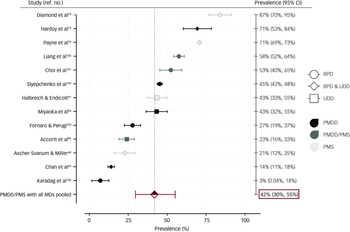
Thirty-six studies (n = 3646 participants: 2609 mood disorders diagnosed first; 764 PMDD/PMS diagnosed first; 273 concurrent diagnostic sampling) provided sufficient data for pooled-prevalence meta-analysis. Random-effects models estimated PMDD/PMS and mood disorder comorbidity rates between 42% (95% CI: 30%, 55%; I 2 = 98%) and 49% (95% CI: 38%, 60%; I 2 = 75%), depending on sampling strategy. Among these, 16 studies screened for PMDD/PMS first, 12 for mood disorders first and 7 applied concurrent diagnostic sampling. One study Reference Halbreich and Endicott97 employed multiple recruitment methods (mood disorder in-patients, female first-degree relatives, females recruited based on menstrual cycle mood symptoms), and its sample was allocated across all three groups accordingly. Subgroup analyses were conducted for MDD, BPDs, BDI and BDII based on data availability. Full results are presented in Table 1, and forest plots illustrating PMDD/PMS comorbidity in mood disorder populations (mood disorder diagnosed first) and mood disorder comorbidity in PMDD/PMS populations (PMDD/PMS diagnosed first) in Figs 2 and 3, respectively.
The prevalence of lifetime PMDD/PMS comorbidity in the MD population (MD diagnosed first). BPD, bipolar disorder; BPD & UDD, mixed samples of individuals with bipolar or unipolar depressive disorder; MD, mood disorder; PMDD, premenstrual dysphoric disorder; PMDD/PMS, premenstrual dysphoric disorder or premenstrual syndrome; PMS, premenstrual syndrome; UDD, unipolar depressive disorder.

The prevalence of lifetime MD comorbidity in the PMDD/PMS population (PMDD/PMS diagnosed first). BPD, bipolar disorder; BPD & UDD, mixed samples of individuals with bipolar or unipolar depressive disorders; MD, mood disorder; PMDD, premenstrual dysphoric disorder; PMDD/PMS, premenstrual dysphoric disorder or premenstrual syndrome; PMS, premenstrual syndrome.

Sensitivity analyses
A sensitivity analysis was conducted for studies that diagnosed PMDD/PMS using gold-standard 2-month prospective charting (Table 1). As these studies primarily screened for PMDD/PMS first, the secondary meta-analysis was restricted to this subgroup. This resulted in a slight increase in overall pooled prevalence, from 45% (95% CI: 26%, 65%; Table 1) to 49% (95% CI: 38%, 60%), with more notable increases for PMDD with mood disorders (42 to 53%) and PMDD with MDD (39 to 53%). Importantly, heterogeneity (I 2) decreased substantially, from 99 to 75% overall, particularly for PMDD with mood disorders (98 to 75%) and PMDD/PMS with MDD (98 to 67%), indicating reduced variability when restricting to studies using prospective diagnosis.
Two additional sensitivity analyses were performed to further assess robustness. The first excluded studies rated as ‘Poor’ in the risk of bias assessment (Supplementary Table 4), leading to a slight increase in pooled prevalence for PMDD/PMS with BPDs from 49% (95% CI: 37%, 61%) to 54% (95% CI: 41%, 65%), while other prevalence rates remained largely stable. High heterogeneity persisted across analyses. The second excluded prospective studies (Supplementary Table 5), which resulted in minor prevalence shifts, particularly for PMDD/PMS with BPDs (mood disorder diagnosed first), increasing from 49% (95% CI: 37%, 61%) to 53% (95% CI: 41%, 64%). Heterogeneity (I 2) remained high across analyses, although slight reductions were observed, such as PMDD/PMS with mood disorders (PMDD/PMS diagnosed first) decreasing from 99 to 93%. These findings confirm that high comorbidity estimates persist even after excluding studies with greater methodological limitations or more heterogeneous study designs, reinforcing the robustness of the results.
Statistical analysis for publication bias
Lifetime PMDD/PMS comorbidity in mood disorders population (mood disorder diagnosed first)
The funnel plot showed slight left-sided asymmetry (Supplementary Fig. 1), suggesting small-study effects. Egger’s test was borderline significant (−4.72, P = 0.045, one-tailed; P = 0.089, two-tailed), but Trim-and-Fill found no missing studies (Supplementary Table 6). Pooled prevalence remained at 42% (95% CI: 30%, 55%), indicating no notable publication bias. High heterogeneity (I 2 = 98%) probably explains the observed asymmetry.
Lifetime mood disorders comorbidity in PMDD/PMS population (PMDD/PMS diagnosed first)
The funnel plot showed significant left-sided asymmetry (Supplementary Fig. 2), suggesting under-reporting of lower prevalence studies. Egger’s test confirmed bias (Intercept 9.59, P < 0.00003; Supplementary Table 7). Trim-and-Fill detected 2 missing studies, reducing pooled prevalence from 45% (95% CI: 26%, 65%) to 39% (95% CI: 23%, 60%; Supplementary Table 7). High heterogeneity (I 2 = 99%) also contributed to variation. These findings suggest probable publication bias, but the adjusted prevalence remains within a similar range, meaning that the conclusions are not fundamentally altered.
Comorbidity between PMDD/PMS and mood disorders in concurrent diagnostic sampling
The funnel plot (Supplementary Fig. 3) and Egger’s test showed no significant asymmetry (intercept −4.02, P = 0.37; Supplementary Table 8). However, Trim-and-Fill detected 2 missing studies, slightly reducing pooled prevalence from 42% (95% CI: 25%, 61%) to 35% (95% CI: 20%, 54%; Supplementary Table 8). Adjusted confidence intervals overlap with the original, indicating only minor bias. High heterogeneity (I 2 = 94%) suggests additional study variability.
Sensitivity analysis: mood disorders comorbidity in PMDD/PMS population (diagnosed first, 2-month prospective charting)
The funnel plot (Supplementary Fig. 4) and Egger’s test showed no asymmetry (Intercept −0.19, P = 0.94), and Trim-and-Fill detected no missing studies (Supplementary Table 9). Pooled prevalence remained at 49% (95% CI: 38%, 60%), suggesting no publication bias. Moderate heterogeneity (I 2 = 75%) indicates that study differences are probably due to methodology rather than selective reporting.
Narrative synthesis
Studies on mood disorders (mixed samples including BPDs and UDD)
Of 14 studies that included females with PMDD/PMS and mood disorder comorbidity, 1 investigated biomarkers Reference Hardoy, Serra, Carta, Contu, Pisu and Biggio73 and 7 explored clinical course Reference Ascher-Svanum and Miller68–Reference Christensen and Oei70,Reference Li, Tsai, Bai, Su, Chen and Liang75–Reference Payne, Klein, Zamoiski, Zandi, Bienvenu and Mackinnon77,Reference Diamond, Rubinstein, Dunner and Fieve79 alongside prevalence. Among these, 2 studies enrolled euthymic individuals with BPDs or MDD, Reference Chan, Lo, Hsu, Chiu, Huang and Liao69,Reference Hardoy, Serra, Carta, Contu, Pisu and Biggio73 2 compared depressed and euthymic individuals among those with BPDs or MDD, Reference Angst, Sellaro, Merikangas and Endicott67,Reference Payne, Klein, Zamoiski, Zandi, Bienvenu and Mackinnon77 while the remaining 10 did not specify the mood state of individuals with BPDs or MDD at enrollment. Reference Adewuya, Loto and Adewumi66,Reference Ascher-Svanum and Miller68,Reference Christensen and Oei70–Reference Frey, Allega, Eltayebani, Syan, Mendes-Ribeiro and Minuzzi72,Reference Hong, Park, Wang, Chang, Sohn and Jeon74–Reference Payne, Roy, Murphy-Eberenz, Weismann, Swartz and McInnis76,Reference Wittchen, Becker, Lieb and Krause78,Reference Diamond, Rubinstein, Dunner and Fieve79 Of the 14 studies, 4 also included individuals with dysthymia or persistent depressive disorder. Reference Adewuya, Loto and Adewumi66,Reference Angst, Sellaro, Merikangas and Endicott67,Reference Christensen and Oei70,Reference Wittchen, Becker, Lieb and Krause78
Across 7 studies on clinical course, females with comorbid PMDD/PMS and mood disorders exhibited higher illness burden compared to those with mood disorders alone. For instance, Payne et al Reference Payne, Roy, Murphy-Eberenz, Weismann, Swartz and McInnis76 found that PMS symptoms significantly predicted the onset of postpartum or perimenopausal mood symptoms in MDD females, but not in BDI females. Payne’s subsequent study Reference Payne, Klein, Zamoiski, Zandi, Bienvenu and Mackinnon77 reported that, while PMS was not familial in MDD or BPD families, MDD females with PMS had more past depressive episodes than MDD females without PMS. However, this pattern was not observed in BPDs, except that BDI females with PMS had a significantly earlier age at onset of BPDs compared to those without PMS. Reference Payne, Klein, Zamoiski, Zandi, Bienvenu and Mackinnon77 Similarly, a longitudinal study found that females with PMDD who later developed mood disorders had an earlier age at onset for both BPDs and MDD, and a shorter interval between study enrollment and mood disorder diagnosis. Reference Li, Tsai, Bai, Su, Chen and Liang75
The greater illness burden associated with comorbid PMDD/PMS with mood disorders was further corroborated by findings on suicidality, metabolic health and psychiatric hospitalisations. PMDD was independently correlated with higher lifetime suicide attempt rates, even after controlling for depressive and anxiety symptoms. Reference Chan, Lo, Hsu, Chiu, Huang and Liao69 Moreover, females with both mood disorders and PMS had significantly higher rates of obesity and greater overall weight than those with mood disorders alone. Reference Ascher-Svanum and Miller68 Psychiatric hospitalisations were notably more frequent for females with mood disorders during the premenstrual phase compared with other menstrual-cycle phases, despite no significant differences in treatment-seeking behaviour, social impairment or premenstrual somatic/cognitive symptoms. Reference Diamond, Rubinstein, Dunner and Fieve79 In a related study, females seeking PMS treatment exhibited greater premenstrual mood severity, regardless of whether PMS was prospectively confirmed, although no major differences in mood disorder history were noted between confirmed and unconfirmed PMS cases. Reference Christensen and Oei70
In terms of findings related to biomarkers, Hardoy et al Reference Hardoy, Serra, Carta, Contu, Pisu and Biggio73 assessed plasma concentrations of neuroactive steroids, specifically progesterone and 3α,5α-tetrahydroprogesterone (3α,5α-THPROG), females with BPD and MDD with and without PMDD, and found no significant differences in neurosteroid levels between PMDD and non-PMDD groups after adjusting for psychiatric diagnosis.
Studies on bipolar disorders
Seven studies investigated the comorbidity between PMDD/PMS and BPDs, including 1 study on biomarkers, Reference Syan, Minuzzi, Smith, Costescu, Allega and Hall107 5 on clinical course alongside prevalence Reference Choi, Baek, Noh, Kim, Choi and Ha101–Reference Liang, Yang, Liao, Yang, Lin and Wu105 and 1 focused solely on prevalence. Reference Karadag, Akdeniz, Erten, Pirildar, Yucel and Polat106 Among these, 3 studies enrolled euthymic individuals with BPD Reference Choi, Baek, Noh, Kim, Choi and Ha101,Reference Karadag, Akdeniz, Erten, Pirildar, Yucel and Polat106,Reference Syan, Minuzzi, Smith, Costescu, Allega and Hall107 1 included people in different states including depression, hypo/mania, mixed and euthymia Reference Liang, Yang, Liao, Yang, Lin and Wu105 and 3 did not specify the mood state of individuals with BPDs at enrollment. Reference El Dahr, de Azevedo Cardoso, Syan, Caropreso, Minuzzi and Smith102–Reference Slyepchenko, Frey, Lafer, Nierenberg, Sachs and Dias104
Of the 5 studies examining clinical correlates, all found increased illness burden in the presence of comorbidity. Slyepchenko et al Reference Slyepchenko, Frey, Lafer, Nierenberg, Sachs and Dias104 reported that BPD females with PMDD had an earlier age at menarche and BPD onset, higher rates of rapid cycling and increased numbers of both lifetime and past-year depressive episodes compared to BPD females without PMDD. Another study identified a significant association between PMS and greater seasonal variation in mood, behaviour and bodily functions, with the BPD group showing a stronger association. Reference Choi, Baek, Noh, Kim, Choi and Ha101 Additionally, BDII females had higher rates of PMDD/PMS than BDI females. Reference Choi, Baek, Noh, Kim, Choi and Ha101 Another study found higher rates of cyclothymia and BDII in females with PMDD compared to those without PMDD, while females without PMDD were more likely to have BDI. Reference Fornaro and Perugi103
One recent study found that PMDD and BPD females had lower rates of traumatic life events but higher rates of inflammatory or autoimmune disease, sleep deprivation and family history of mental disorders compared to BPD females without PMDD. Reference Liang, Yang, Liao, Yang, Lin and Wu105 Furthermore, the groups with PMS with BPD and PMDD with BPD both demonstrated significantly higher depressive symptom severity, anxiety/somatisation, cognitive impairment, psychomotor retardation, increased appetite and leaden paralysis compared with the BPD-only group. Reference Liang, Yang, Liao, Yang, Lin and Wu105
A study investigating biological rhythm disruptions found that only PMDD, only BPD and PMDD with BPD groups exhibited greater overall biological and sleep disruption compared with healthy controls, with the BPD group having greater sleep disruption than the PMDD group. Reference El Dahr, de Azevedo Cardoso, Syan, Caropreso, Minuzzi and Smith102 Moreover, females with PMDD and BPD had greater social impairment and depressive symptom severity compared with the PMDD-only and healthy control groups. Reference El Dahr, de Azevedo Cardoso, Syan, Caropreso, Minuzzi and Smith102
Syan et al Reference Syan, Minuzzi, Smith, Costescu, Allega and Hall107 assessed brain structure, resting-state functional connectivity and clinical characteristics in females with comorbid BPDs and PMDD, PMDD only, BPDs only and healthy controls. They observed decreased functional connectivity between the hippocampus and premotor cortex, and increased functional connectivity between the hippocampus and frontal cortex in the PMDD and BPD group compared with the BPD-only group. Reference Syan, Minuzzi, Smith, Costescu, Allega and Hall107 Additionally, they noted increased grey matter volume in the caudate and decreased cortical thickness in the pericalcarine, superior parietal, middle temporal, rostral middle frontal and superior frontal cortices, but increased cortical thickness in the superior temporal cortex in the PMDD and BPD group compared with the BPD-only group. Reference Syan, Minuzzi, Smith, Costescu, Allega and Hall107 PMDD and BPD females had significantly higher body mass index than the other groups, but no differences were found between the BPD-only and PMDD comorbid with BPD groups regarding several BPD severity markers, including age at onset, number of psychiatric comorbidities and psychiatric medications. Reference Syan, Minuzzi, Smith, Costescu, Allega and Hall107 During the follicular phase, the PMDD and BPD group exhibited higher depressive symptom severity and disruptions in sleep, physical and social activity compared with healthy controls, with these disturbances being sustained through the premenstrual phase. Reference Syan, Minuzzi, Smith, Costescu, Allega and Hall107 Despite being clinically euthymic for at least 2 months before study entry, all diagnostic groups demonstrated significantly greater subclinical depressive symptoms compared with healthy controls, with the PMDD and BPD group reporting greater severity than the BPD-only group. Reference Syan, Minuzzi, Smith, Costescu, Allega and Hall107
Studies on unipolar depressive disorders (including dysthymia)
Of the 18 studies investigating comorbid PMDD/PMS with unipolar depressive disorders (UDD), 4 examined both biomarkers and clinical course Reference Klatzkin, Morrow, Light, Pedersen and Girdler83,Reference Klatzkin, Lindgren, Forneris and Girdler84,Reference Stiernman, Dubol, Comasco, Sundström-Poromaa, Boraxbekk and Johansson90,Reference Klatzkin, Morrow, Light, Pedersen and Girdler92 while 9 focused on clinical course Reference Hartlage, Arduino and Gehlert82,Reference Klatzkin, Bunevicius, Forneris and Girdler85,Reference Roca, Schmidt and Rubinow87–Reference Śliwerski, Koszałkowska, Mrowicka and Szafran89,Reference Soares, Cohen, Otto and Harlow93,Reference Forrester-Knauss, Zemp Stutz, Weiss and Tschudin95–Reference Halbreich and Endicott97 alongside prevalence. Among these, 11 studies enrolled individuals who were currently euthymic with a lifetime diagnosis of MDD, Reference Critchlow, Bond and Wingrove80,Reference Hartlage, Arduino and Gehlert82–Reference Klatzkin, Bunevicius, Forneris and Girdler85,Reference Roca, Schmidt and Rubinow87,Reference Cohen, Soares, Otto, Sweeney, Liberman and Harlow91–Reference Accortt, Kogan and Allen94,Reference Miyaoka, Akimoto, Ueda, Ujiie, Kametani and Uchiide96,Reference Halbreich and Endicott97 3 compared individuals who were either currently depressed or euthymic Reference Śliwerski and Koszałkowska88,Reference Śliwerski, Koszałkowska, Mrowicka and Szafran89,Reference Accortt, Kogan and Allen94 and 1 involved individuals with dysthymia/persistent depressive disorder. Reference Accortt, Kogan and Allen94 The remaining 4 studies did not specify the mood state at enrollment, Reference Roca, Schmidt and Rubinow87,Reference Forrester-Knauss, Zemp Stutz, Weiss and Tschudin95–Reference Halbreich and Endicott97 with 2 of these including individuals diagnosed with dysthymia. Reference Roca, Schmidt and Rubinow87,Reference Miyaoka, Akimoto, Ueda, Ujiie, Kametani and Uchiide96
Several studies highlighted the clinical impact of comorbid PMDD/PMS and UDD. Specifically, 8 studies found that comorbidity was significantly associated with increased mood symptom severity, greater frequency and longer duration of mood episodes and a higher likelihood of lifetime mood episodes. Reference Hartlage, Arduino and Gehlert82,Reference Klatzkin, Lindgren, Forneris and Girdler84,Reference Klatzkin, Bunevicius, Forneris and Girdler85,Reference Roca, Schmidt and Rubinow87,Reference Śliwerski, Koszałkowska, Mrowicka and Szafran89,Reference Forrester-Knauss, Zemp Stutz, Weiss and Tschudin95–Reference Halbreich and Endicott97 For example, a prospective cohort study spanning 2 years reported that females with PMDD were significantly more likely to develop MDD (odds ratio: 14) compared to those with a history of MDD (odds ratio: 6), or with those with MDD developing PMDD (odds ratio: 3.5). Reference Hartlage, Arduino and Gehlert82 In a 5- to 12-year follow-up, Roca et al Reference Roca, Schmidt and Rubinow87 found that females with PMS had higher rates of subsequent psychiatric episodes, including MDD, compared to those without PMS. Similarly, Śliwerski et al Reference Śliwerski, Koszałkowska, Mrowicka and Szafran89 compared four groups – PMS with MDD, MDD only, PMS only and healthy controls – and found that females with both PMS and MDD reported a higher frequency of depressive symptoms in the past week compared to those with PMS alone. Although the PMS and MDD group exhibited greater severity in negative beliefs and maladaptive metacognitions, and lower functioning in the cognitive triad, the presence of depression (with or without PMS) was the strongest predictor of cognitive distortions across the groups. Reference Śliwerski, Koszałkowska, Mrowicka and Szafran89 Furthermore, 1 study found that females with both PMS and MDD were more likely to report symptoms of anger, irritability, anxiety, insomnia, hypersomnia and increased sensitivity compared to those with PMS alone. Reference Śliwerski and Koszałkowska88 Another study identified a higher prevalence of current smokers among females with PMDD and a history of MDD, although this difference disappeared when combining current and past smokers in the analysis. Reference Soares, Cohen, Otto and Harlow93
Among studies focused on biomarkers, ALLO and/or P4 were evaluated in 2 studies investigating PMDD with a history of MDD. Reference Klatzkin, Morrow, Light, Pedersen and Girdler83,Reference Klatzkin, Morrow, Light, Pedersen and Girdler92 Klatzkin et al Reference Klatzkin, Morrow, Light, Pedersen and Girdler83 found blunted ALLO response to stress in PMDD females with an MDD history compared to those without. Furthermore, ALLO levels at baseline and blunted ALLO reactivity to stress predicted more severe symptoms in females with PMDD and a history of MDD. Reference Klatzkin, Morrow, Light, Pedersen and Girdler83 Another study found ALLO levels to be significantly higher in the PMDD-only group than in the comorbid and healthy controls groups. Reference Klatzkin, Morrow, Light, Pedersen and Girdler92 They also found an interaction effect such that the comorbid group had a reduced ALLO/P4 ratio compared to females with PMDD only, while the same effect was not observed in females without PMDD who had prior depression. Reference Klatzkin, Morrow, Light, Pedersen and Girdler92 One study investigated pain-related phenotypes in females with PMDD and prior depression, and found that the comorbid group had significantly lower cortisol levels but higher scores of unpleasant pain compared to females without PMDD. Reference Klatzkin, Lindgren, Forneris and Girdler84 In addition, a recent study examined brain activity in response to emotional stimuli in PMDD females and healthy controls, where both groups included females with a psychiatric history of depression. Reference Stiernman, Dubol, Comasco, Sundström-Poromaa, Boraxbekk and Johansson90 Findings showed that females with PMDD had increased brain activity in emotion-processing brain networks, including the insula and frontal and cingulate cortices, during the premenstrual phase compared with controls, and the results were unaffected by history of depression among participants. Reference Stiernman, Dubol, Comasco, Sundström-Poromaa, Boraxbekk and Johansson90
Across studies investigating clinical course, the co-occurrence of PMDD/PMS with mood disorders was consistently associated with markers of increased illness burden and poor prognosis. Reference Chan, Lo, Hsu, Chiu, Huang and Liao69,Reference Li, Tsai, Bai, Su, Chen and Liang75–Reference Payne, Klein, Zamoiski, Zandi, Bienvenu and Mackinnon77,Reference Hartlage, Arduino and Gehlert82,Reference Klatzkin, Lindgren, Forneris and Girdler84,Reference Klatzkin, Bunevicius, Forneris and Girdler85,Reference Roca, Schmidt and Rubinow87,Reference Śliwerski, Koszałkowska, Mrowicka and Szafran89,Reference Forrester-Knauss, Zemp Stutz, Weiss and Tschudin95–Reference Halbreich and Endicott97,Reference Choi, Baek, Noh, Kim, Choi and Ha101,Reference El Dahr, de Azevedo Cardoso, Syan, Caropreso, Minuzzi and Smith102,Reference Slyepchenko, Frey, Lafer, Nierenberg, Sachs and Dias104,Reference Liang, Yang, Liao, Yang, Lin and Wu105,Reference Syan, Minuzzi, Smith, Costescu, Allega and Hall107 These included earlier age at onset of mood disorders or PMDD/PMS, more frequent and severe mood symptoms, higher rates of rapid cycling, psychiatric hospitalisations and suicidality. Notably, comorbidity was also linked to increased cognitive and functional impairment, regardless of diagnostic order. While most studies did not explicitly assess the temporal sequence of diagnoses over an extended period of time, those that did so suggested that PMDD/PMS may precede and predict the onset or worsening of mood disorders. Reference Li, Tsai, Bai, Su, Chen and Liang75,Reference Hartlage, Arduino and Gehlert82,Reference Roca, Schmidt and Rubinow87 Collectively, these findings underscore the fact that comorbidity is not merely additive but may represent a distinct and more severe illness trajectory requiring targeted clinical attention.
Discussion
We found high rates of PMDD/PMS and mood disorder comorbidity across diagnostic sampling strategies, with nearly one in two females with PMDD/PMS having mood disorders, one in two females with mood disorders having PMDD/PMS and one in two females screened concurrently showing PMDD/PMS comorbid with mood disorders. These rates exceeded general population estimates of PMDD (3.2% prospectively diagnosed, 7.7% provisional), Reference Reilly, Patel, Unachukwu, Knox, Wilson and Craig31 PMS (47.8%) Reference Direkvand-Moghadam, Sayehmiri, Delpisheh and Kaikhavandi33 and mood disorders (7.3% of females with mood disorders). Reference Steel, Marnane, Iranpour, Chey, Jackson and Patel108 Pooled-prevalence estimates were 42% (95% CI: 30%, 55%) for PMDD/PMS in mood disorder populations (mood disorder diagnosed first), 45% (95% CI: 26%, 65%) for mood disorder comorbidity in PMDD/PMS populations (PMDD/PMS diagnosed first, including both retrospective and 2-month prospective charting) and 42% (95% CI: 25%, 61%) for concurrently diagnosed PMDD/PMS and mood disorders.
Subgroup analyses showed that PMDD was 5.3 times more common in females with BPDs (29%, 95% CI: 16%, 45%) and 4.5 times more common in females with mood disorders (25%, 95% CI: 16%, 36%) than in population-based samples (3–8%, around 5.5% of females). Reference Halbreich, Borenstein, Pearlstein and Kahn109–Reference Tschudin, Bertea and Zemp112 While data for PMDD rates in MDD were insufficient, our findings suggest that individuals with mood disorders might be at greater risk of developing PMDD. Mood disorders were 5.8 times more prevalent in PMDD (42%, 95% CI: 18%, 71%), and MDD was 6.5 times more common in PMDD (39%, 95% CI: 16%, 69%) than in the general population (mood disorders: 7.3% of females; Reference Steel, Marnane, Iranpour, Chey, Jackson and Patel108 MDD: 6% of females Reference Ferrari, Somerville, Baxter, Norman, Patten and Vos113,114 ). Insufficient data prevented subgroup analysis for BPDs in PMDD populations. These findings suggest a bidirectional relationship between PMDD and mood disorders.
PMDD/PMS with mood disorders was more prevalent than PMDD alone across diagnostic sampling strategies. In the mood disorder diagnosed first group, the pooled prevalence of PMDD/PMS with mood disorders was 42% (95% CI: 30%, 55%) compared with 25% (95% CI: 16%, 36%) for PMDD with mood disorders (Table 1). A similar pattern emerged in studies using concurrent diagnostic sampling, where the pooled prevalence of PMDD/PMS with mood disorders was 42% (95% CI: 25%, 61%) compared with 32% (95% CI: 15%, 56%) for PMDD with mood disorders (Table 1). In contrast, for the PMDD/PMS diagnosed first group, the pooled prevalence of PMDD/PMS with mood disorders was 45% (95% CI: 26%, 65%) while PMDD with mood disorders was 42% (95% CI: 18%, 71%) (Table 1). PMDD’s more restrictive diagnostic criteria compared with PMS probably contributes to its relatively lower prevalence. Differences may also stem from greater recognition of PMS in clinical practice, Reference Mahmoud, Frere, Zaitoun, Zaitoun and Elshamy115 leading to higher reported comorbidity rates. Conversely, PMDD is less well recognised, which may result in underdiagnosis or misdiagnosis as another psychiatric condition, Reference Freeman and Sondheimer116 particularly due to overlapping symptoms with mood disorders. Reference Schroll and Lauritsen117 These findings highlight the need for improved diagnostic accuracy and greater clinician awareness, particularly through standardised 2-month prospective symptom tracking, which provides a more reliable estimate of PMDD/PMS prevalence. Reference Reilly, Patel, Unachukwu, Knox, Wilson and Craig31
Among PMDD/PMS diagnosed first studies using prospective 2-month charting, mood disorder comorbidity was 49% (95% CI: 38%, 60%), slightly exceeding the 45% (95% CI: 26%, 65%) estimate from retrospective and prospective assessments combined. While a recent meta-analysis indicates lower prevalence for prospectively confirmed PMDD versus retrospective cases, Reference Reilly, Patel, Unachukwu, Knox, Wilson and Craig31 our findings suggest that PMDD/PMS comorbid with mood disorders is at least as prevalent when diagnosed prospectively, reinforcing confidence in high comorbidity rates.
BDII had the highest comorbidity with PMDD/PMS (57%, 95% CI: 41%, 72%) in the mood disorder diagnosed first group – the only sampling group with sufficient BPD subtype data. Furthermore, PMDD/PMS was more prevalent in BDII (57%) than in BDI (39%, 95% CI: 24%, 57%), with individual study prevalence varying widely (BDI: 10–65%; BDII: 37–74%). Research suggests a closer link between PMDD/PMS and BDII relative to other mood disorders. While BPD prevalence shows no significant sex differences, Reference Ferrari, Herrera, Shadid, Ashbaugh, Erskine and Charlson2,Reference Kessler, Petukhova, Sampson, Zaslavsky and Wittchen118–Reference Zhang, Cao, Wang, Zheng, Ungvari and Ng120 BDII is more common in females Reference Arnold121–Reference Schneck, Miklowitz, Miyahara, Araga, Wisniewski and Gyulai124 whereas BDI is more prevalent in men. Reference Grant, Stinson, Hasin, Dawson, Chou and Ruan125–Reference Negash, Alem, Kebede, Deyessa, Shibre and Kullgren127 Despite mixed findings, Reference Kupka, Luckenbaugh, Post, Suppes, Altshuler and Keck128,Reference Schneck, Miklowitz, Calabrese, Allen, Thomas and Wisniewski129 BDII appears to carry a greater risk of rapid cycling than BDI, Reference Erol, Winham, McElroy, Frye, Prieto and Cuellar-Barboza130–Reference Miola, Tondo, Pinna, Contu and Baldessarini133 which may have influenced comorbidity rates due to the similar cyclical clinical presentation of PMDD/PMS and rapid cycling. While the higher comorbidity between BDII and PMDD/PMS is compelling, independent longitudinal studies using 2-month prospective charting across BPDs (or mood disorders more broadly) are warranted.
A recent review on comorbid PMDD with BPDs corroborates the pattern of high clinical severity and psychiatric multimorbidity. Reference Slyepchenko, Minuzzi and Frey134 This underscores the importance of careful clinical management, in particular monitoring for emerging comorbidity in females diagnosed with PMDD or BPD alone. Similarly, a systematic review on PMDD and depression found a bidirectional relationship such that PMDD increases depression risk, and depression history raises PMDD susceptibility. Reference Eccles and Sharma60 Our findings further suggest that PMDD/PMS with UDD (i.e. MDD, dysthymia) is associated with a severe illness course. These findings underscore the need for improved clinical recognition of PMDD/PMS, particularly in individuals with mood disorders. Clinicians should first be aware of the high comorbidity between mood disorders and PMDD/PMS. Those managing PMDD/PMS should incorporate validated diagnostic scales for mood disorders, while clinicians treating mood disorders should use prospective symptom-tracking tools, such as the McMaster Premenstrual and Mood Symptom Scale (MAC-PMSS), Reference Frey, Allega, Eltayebani, Syan, Mendes-Ribeiro and Minuzzi72 as part of their routine assessments. This would help clinicians detect the comorbidity in a timely manner and distinguish overlapping symptoms to address them efficiently. Additionally, interdisciplinary collaboration between psychiatrists, gynaecologists and mental health professionals may facilitate more comprehensive care, ensuring appropriate diagnosis and tailored treatment strategies for affected individuals.
Preliminary evidence suggests neurobiological correlates specific to PMDD comorbid with BPDs, including distinct patterns of resting-state functional connectivity in brain regions involved in emotional processing Reference Syan, Minuzzi, Smith, Costescu, Allega and Hall107 and elevated luteal-phase neurosteroids in BPD females, compared to those with MDD or health controls. Reference Hardoy, Serra, Carta, Contu, Pisu and Biggio73 Despite limited research on biomarkers, these findings suggest that females with comorbid PMDD/PMS and BPDs may exhibit a distinct neurobiological phenotype, with sensitivity to ALLO fluctuations potentially driving this vulnerability, because increased ALLO levels during the luteal phase have been linked to adverse mood symptoms in females. Reference Bäckström, Bixo, Johansson, Nyberg, Ossewaarde and Ragagnin36,Reference Hardoy, Serra, Carta, Contu, Pisu and Biggio73 Fluctuations in progesterone (P4), oestrogen (E2) and ALLO have been implicated in PMDD/PMS, BPDs and MDD. Reference McEvoy and Osborne8,Reference Perkins and Newport16,Reference Bäckström, Bixo, Johansson, Nyberg, Ossewaarde and Ragagnin36,Reference Carta, Bhat and Preti135–Reference Payne138 Both P4 and E2 influence the serotonergic system, which is crucial for mood regulation; Reference Barth, Villringer and Sacher139 P4 modulates serotonergic neurotransmission Reference Barth, Villringer and Sacher139 while E2 affects serotonin synthesis and receptor density. Reference Borrow and Cameron140 Low E2 levels have been associated with mood destabilisation and increased susceptibility to depressive episodes, particularly in hormonally sensitive individuals. Reference Borrow and Cameron140 Additionally, genetic polymorphisms affecting E2 receptors have been linked to increased susceptibility to mood disorders, potentially contributing to the high comorbidity between PMDD/PMS and mood disorders. Reference Graae, Karlsson and Paddock54 These findings highlight shared neurobiological mechanisms – such as neurosteroid dysregulation and oestrogen-related genetic variation – that may contribute to increased vulnerability to mood disorders in individuals with PMDD/PMS.
Strengths and limitations
This is the first systematic review and meta-analysis evaluating the comorbidity of PMDD/PMS with multiple mood disorders while structuring findings by population sampling strategy. Addressing a key gap in psychiatric literature, these results have clinical implications for individuals with PMDD/PMS and mood disorders comorbidity. However, study heterogeneity, diagnostic challenges, symptom overlap and methodological differences among selected studies pose limitations. As the database search was completed on 22 January 2024, researchers and clinicians should remain updated on emerging evidence to guide future research directions and inform patient care. Further, screening and data extraction were done by a single individual (D.B.), although studies that appeared eligible upon full-text screening were independently discussed with N.Y. and B.N.F. to reach consensus.
Heterogeneity indices (I 2) ranged from 67 to 99%, varying across analyses. Despite this, pooled prevalence estimates aligned with prior research, Reference Kim, Gyulai, Freeman, Morrison, Baldassano and Dubé18,Reference Teatero, Mazmanian and Sharma22,Reference Yonkers23 reinforcing the high co-occurrence of PMDD/PMS with mood disorders. Egger’s test detected publication bias in one analysis (see the previous ‘Statistical analyses for publication bias’ section), while Trim-and-Fill adjustments slightly reduced prevalence estimates for two analyses, yet remained within the original confidence intervals, preserving conclusions. High heterogeneity (I 2 = 75–99%) suggests study variability rather than selective reporting as the primary factor affecting results.
Most studies used standardised criteria for mood disorder diagnoses. Of 14 studies examining mixed mood disorder samples, 13 relied on DSM-III-R, DSM-IV, DSM-5 or validated diagnostic tools with moderate to high reliability. Reference Adewuya, Loto and Adewumi66–Reference Wittchen, Becker, Lieb and Krause78 One study, however, used psychiatric hospitalisation history alone, which differs from standardised diagnostic methods. Reference Diamond, Rubinstein, Dunner and Fieve79 Among 18 studies investigating UDDs, all used DSM-IV/5 or validated tools, although assessment approaches varied. Reference Critchlow, Bond and Wingrove80–Reference Halbreich and Endicott97 Similarly, BPD diagnoses were consistently based on DSM-IV/5 or psychometric tools with established reliability. Reference de Azevedo Marques and Zuardi98–Reference Steiner, Macdougall and Brown100 However, inconsistencies – such as retrospective assessments, clinical versus community-based samples and variability in symptom severity cut-offs or criteria used to define mood disorders – may contribute to heterogeneity in prevalence estimates.
The diagnostic ambiguity surrounding PMDD/PMS presents a fundamental challenge, particularly in distinguishing comorbid PMDD/PMS from PME of an existing mood disorder. There is no established method to ascertain whether cases diagnosed as PMDD/PMS with comorbid mood disorders truly reflect a distinct comorbid condition or, instead, represent PME of an underlying mood disorder. This distinction is particularly difficult given that psychiatric diagnoses rely primarily on symptom-based evaluation rather than objective biomarkers. However, longitudinal studies showing that individuals with PMDD/PMS later develop mood disorders support the validity of PMDD/PMS as a distinct diagnosis rather than merely PME of an existing psychiatric disorder. Reference Li, Tsai, Bai, Su, Chen and Liang75,Reference Wittchen, Becker, Lieb and Krause78,Reference Hartlage, Arduino and Gehlert82,Reference Roca, Schmidt and Rubinow87
Diagnostic methodologies for PMDD/PMS also varied across studies. According to Criterion F of DSM-5 PMDD criteria, 30 Criterion D of DSM-IV PMDD criteria 141 and Criterion E of DSM-III-R late luteal phase dysphoric disorder criteria, 142 prospective daily ratings over two menstrual cycles are required for a PMDD diagnosis. Studies using these diagnostic tools demonstrated methodological rigour, while those relying on retrospective assessment could establish only provisional diagnoses, potentially skewing prevalence estimates. Although PMS diagnosis does not universally require two-cycle confirmation, 28,143 some studies applied this criterion. Reference Angst, Sellaro, Merikangas and Endicott67,Reference Ascher-Svanum and Miller68,Reference Payne, Roy, Murphy-Eberenz, Weismann, Swartz and McInnis76,Reference Payne, Klein, Zamoiski, Zandi, Bienvenu and Mackinnon77,Reference Diamond, Rubinstein, Dunner and Fieve79,Reference DeJong, Rubinow, Roy-Byrne, Hoban, Grover and Post81,Reference Forrester-Knauss, Zemp Stutz, Weiss and Tschudin95,Reference Halbreich and Endicott97 To ensure consistency, this criterion was also evaluated in PMS studies. Despite differences in diagnostic criteria, PMS and PMDD both require mood symptoms to be strictly entrained to the menstrual cycle, which can only be confirmed prospectively.
Additionally, a limitation of our review is the lack of a dedicated analysis of PMS independent of PMDD. While we distinguished PMDD from PMDD/PMS in subgroup analyses, we did not conduct a separate meta-analysis for PMS alone. Given the diagnostic and prevalence differences between these conditions, future research should investigate PMS-specific psychiatric comorbidity to clarify its distinct associations with mood disorders.
Study samples varied, with some including currently depressed individuals, Reference Angst, Sellaro, Merikangas and Endicott67,Reference Śliwerski, Koszałkowska, Mrowicka and Szafran89,Reference Accortt, Kogan and Allen94,Reference Liang, Yang, Liao, Yang, Lin and Wu105 potentially inflating comorbidity estimates, while others sampled euthymic patients. Reference Chan, Lo, Hsu, Chiu, Huang and Liao69,Reference Hardoy, Serra, Carta, Contu, Pisu and Biggio73,Reference DeJong, Rubinow, Roy-Byrne, Hoban, Grover and Post81–Reference Pearlstein, Frank, Rivera-Tovar, Thoft, Jacobs and Mieczkowski86,Reference Stiernman, Dubol, Comasco, Sundström-Poromaa, Boraxbekk and Johansson90–Reference Klatzkin, Morrow, Light, Pedersen and Girdler92,Reference Choi, Baek, Noh, Kim, Choi and Ha101,Reference Karadag, Akdeniz, Erten, Pirildar, Yucel and Polat106,Reference Syan, Minuzzi, Smith, Costescu, Allega and Hall107 Moreover, the predominance of cross-sectional and case-control designs limited causal interpretations, because assessments occurred at single time points or retrospectively.
To further assess the impact of study quality and design on our findings, we conducted two additional sensitivity analyses – one excluding studies rated as having ‘Poor’ quality and another excluding prospective studies. These analyses confirmed that prevalence estimates remained largely stable, strengthening confidence in our findings. Persisting heterogeneity in certain subgroups suggests that methodological variability – rather than study quality alone – may contribute to differences in prevalence rates. Future research should standardise diagnostic criteria and enhance methodological consistency for comparability across studies.
Of note, we did not find any studies on gender that were relevant to our analysis; therefore we focused on biological sex, and used the term ‘females’ to describe participants in the included studies. Future studies should explore how gender diversity may impact female sex-specific vulnerability to PMDD/PMS.
Despite these challenges, our findings underscore the urgent need for rigorous diagnostic methodologies and longitudinal studies to better understand this complex comorbidity.
Future directions
More prospective longitudinal studies are needed to elucidate clinical and neurobiological characteristics specific to comorbid PMDD/PMS with mood disorders. As PMDD/PMS may be more strongly associated with BDII, investigating potential correlates of this relationship is encouraged. Further, researchers should focus on aetiological factors shared among reproductive and non-reproductive mood disorders to help explain their association and establish effective treatment strategies for individuals suffering from both. Additionally, a future systematic review and meta-analysis exploring other areas of hormonal sensitivity – such as the intersection of PMDD/PMS with perinatal mental health, including perinatal depression Reference Pereira, Pessoa, Madeira, Macedo and Pereira144 and the symptomatic menopause transition – would address another gap in the literature and further clarify connections among reproductive mood disorders.
Altogether, the current review highlights high comorbidity rates between PMDD/PMS and mood disorders, regardless of which diagnoses came first. Prospective studies investigating clinical and neurobiological correlates specific to this prevalent comorbidity are needed to inform new therapeutic pathways tailored to this population.
Supplementary material
The supplementary material can be found online at https://doi.org/10.1192/bjp.2025.133
Data availability
All extracted data from the reviewed studies, including prevalence estimates, event counts and total sample sizes used in the meta-analysis, are provided in Supplementary Table 10 (Excel document). Additional details are available upon request.
Author contributions
D.B. and N.Y. conceived the idea behind the current study. R.S. aided in all aspects concerning the meta-analysis and critically reviewed the content and structure of the article. N.Y. and B.N.F. conceived the strategy for splitting the meta-analysis according to diagnostic sampling. D.B., M.D. and N.Y. acted as raters for the risk of bias assessment. A.Y. and M.F.J. critically reviewed the content and structure of the article. N.Y. and B.N.F. supervised the project and critically reviewed and edited multiple drafts until the final conception. D.B. performed the meta-analysis and systematic narrative review and worked on all aspects of the paper. All authors discussed the results and contributed to the final manuscript.
Funding
No financial support was received for the research, authorship and/or publication of this systematic review and meta-analysis.
Declaration of interest
R.S. declares honoraria from Janssen. She is a guest editor for BJPsych but did not take part in the review or decision-making of this paper.
M.F.J. is supported by the National Institute for Health Research (NIHR) Biomedical Research Centre (BRC) at the South London and Maudsley NHS Foundation Trust (SLaM) and King’s College London (KCL); has received honoraria for lectures and advisory boards from most of the major pharmaceutical companies with drugs used in affective and related disorders; and receives copyrights from Nature/Springer Books, Cambridge Press and Elsevier Press. The views expressed are those of the authors and not necessarily those of the NHS, NIHR or Department of Health.
A.Y. declares the following interests. Employed by King’s College London; honorary consultant South London and Maudsley NHS Foundation Trust (NHS UK); editor of Journal of Psychopharmacology, deputy editor of BJPsych Open and member of the editorial board. A.Y. did not take part in the review or decision-making of this paper’s publication. Paid lectures and advisory boards for the following companies with drugs used in affective and related disorders: Flow Neuroscience, Novartis, Roche, Janssen, Takeda, Noema Pharma, Compass, Astrazenaca, Boehringer Ingelheim, Eli Lilly, LivaNova, Lundbeck, Sunovion, Servier, Livanova, Janssen, Allegan, Bionomics, Sumitomo Dainippon Pharma, Sage, Neurocentrx; principal investigator in the Restore-Life VNS registry study funded by LivaNova; principal Investigator on ESKETINTRD3004: ‘An Open-label, Long-term, Safety and Efficacy Study of Intranasal Esketamine in Treatment-resistant Depression’; principal investigator on ‘The Effects of Psilocybin on Cognitive Function in Healthy Participants’; principal investigator on ‘The Safety and Efficacy of Psilocybin in Participants with Treatment-Resistant Depression (P-TRD)’; principal investigator on ‘A Double-Blind, Randomized, Parallel-Group Study with Quetiapine Extended Release as Comparator to Evaluate the Efficacy and Safety of Seltorexant 20 mg as Adjunctive Therapy to Antidepressants in Adult and Elderly Patients with Major Depressive Disorder with Insomnia Symptoms Who Have Responded Inadequately to Antidepressant Therapy’’ (Janssen); principal investigator on ‘An Open-label, Long-term, Safety and Efficacy Study of Aticaprant as Adjunctive Therapy in Adult and Elderly Participants with Major Depressive Disorder (MDD)’ (Janssen); principal investigator on ‘A Randomized, Double-blind, Multicentre, Parallel-group, Placebo-controlled Study to Evaluate the Efficacy, Safety, and Tolerability of Aticaprant 10 mg as Adjunctive Therapy in Adult Participants with Major Depressive Disorder (MDD) with Moderate-to-severe Anhedonia and Inadequate Response to Current Antidepressant Therapy’; principal investigator on ‘A Study of Disease Characteristics and Real-life Standard of Care Effectiveness in Patients with Major Depressive Disorder (MDD) with Anhedonia and Inadequate Response to Current Antidepressant Therapy Including an SSRI or SNR’ (Janssen); UK chief investigator for Compass; COMP006 & COMP007 studies; UK chief investigator for Novartis MDD study no. MIJ821A12201. Grant funding (past and present): NIMH (USA), CIHR (Canada), NARSAD (USA), Stanley Medical Research Institute (USA), MRC (UK), Wellcome Trust (UK), Royal College of Physicians (Edin), BMA (UK), UBC-VGH Foundation (Canada), WEDC (Canada), CCS Depression Research Fund (Canada), MSFHR (Canada), NIHR (UK), Janssen (UK), EU Horizon 2020. No shareholdings in pharmaceutical companies.
N.Y. has worked as a researcher in clinical studies conducted with Janssen-Cilag, Corcept Therapeutics, COMPASS Pathways, H. Lundbeck A/S, Sosei Heptares and Neurocentrx in the past 5 years. All other authors report no conflicts of interest.
Transparency declaration
The current manuscript is an honest, accurate and transparent account of the study being reported; no important aspects of the study have been omitted, and protocol amendments are indicated on page 6 of the Supplementary Appendix.




 Open access


eLetters
No eLetters have been published for this article.