





1. Introduction
1.1. Derived functors in abelian categories
In classical homological algebra, such as for modules over a ring or within the broader context of abelian categories, we can define left derived functors for any additive functor $F:\; {\mathscr {C}} \to {\mathscr {E}}$
, where
$F:\; {\mathscr {C}} \to {\mathscr {E}}$
, where $\mathscr {C}$
and
$\mathscr {C}$
and $\mathscr {E}$
are abelian categories and
$\mathscr {E}$
are abelian categories and $\mathscr {C}$
has enough projectives. This condition allows us to construct a projective resolution
$\mathscr {C}$
has enough projectives. This condition allows us to construct a projective resolution $C(X)$
for any
$C(X)$
for any $X \in {\mathscr {C}}$
, as illustrated in Figure 1.
$X \in {\mathscr {C}}$
, as illustrated in Figure 1.
For $n \in \mathbb {Z}$
, we define
$n \in \mathbb {Z}$
, we define
 \begin{equation*} \textrm {L}_n(F)(X)\; :\!= \textrm {H}_n(F(C(X))). \end{equation*}
The functor $\textrm {L}_n(F):\; {\mathscr {C}} \to {\mathscr {E}}\ $
is called the
$\textrm {L}_n(F):\; {\mathscr {C}} \to {\mathscr {E}}\ $
is called the $n$
th left derived functor of
$n$
th left derived functor of $F$
. Its value at
$F$
. Its value at $X$
is sometimes referred to as the
$X$
is sometimes referred to as the $n$
th homology of
$n$
th homology of $X$
with coefficients in
$X$
with coefficients in $F$
.
$F$
.
In addition to encompassing well-known examples such as the Tor and Ext functors, this concept is powerful due to the relationships between the derived functors of different dimensions of a given functor, as expressed via a long exact homology sequence (see, for instance, [Reference Cartan and Eilenberg22, Reference Lane54, Reference Weibel78]). The construction of this long exact sequence in homology—see, for example the proof in [Reference Cartan and Eilenberg22]—is partially based on the Simultaneous Resolution Theorem [Reference Cartan and Eilenberg22, Proposition 5.2.2], also known as the Horseshoe Lemma [Reference Weibel78, Lemma 2.2.8].
A projective resolution $C(X)$
of an object
$C(X)$
of an object $X$
in a normal category: the horizontal sequence is exact in all
$X$
in a normal category: the horizontal sequence is exact in all $C_n$
for
$C_n$
for $n \geq 1$
and
$n \geq 1$
and $\textrm {H}_0(C) = X$
.
$\textrm {H}_0(C) = X$
.

The lowest degrees of a chain homotopy.

The abelianness of both categories $\mathscr {C}$
and
$\mathscr {C}$
and $\mathscr {E}$
, along with the additivity of the functor
$\mathscr {E}$
, along with the additivity of the functor $F$
, are crucial in proving that the derived functors of
$F$
, are crucial in proving that the derived functors of $F$
are well defined. This proof relies on the concept of a chain homotopy. Recall that for a pair of parallel morphisms
$F$
are well defined. This proof relies on the concept of a chain homotopy. Recall that for a pair of parallel morphisms $f$
,
$f$
, $g:\; (C,d^C) \to (E,d^E)$
of positively graded chain complexes in an abelian category, a chain homotopy from
$g:\; (C,d^C) \to (E,d^E)$
of positively graded chain complexes in an abelian category, a chain homotopy from $f$
to
$f$
to $g$
(illustrated in Figure 2) is a morphism of graded objects
$g$
(illustrated in Figure 2) is a morphism of graded objects $h:\; (C,d^C) \to (E,d^E)$
of degree
$h:\; (C,d^C) \to (E,d^E)$
of degree $1$
such that
$1$
such that
 \begin{equation} f - g = d^{E} h + h d^{C} \end{equation}
holds. Let us outline some key properties of this concept [Reference Cartan and Eilenberg22, Reference Lane54].
Theorem 1.1.1. In the abelian setting:
-
(1) Homotopic chain morphisms have the same homology, so chain homotopically equivalent complexes have isomorphic homologies.
-
(2) Any two projective resolutions of an object are homotopically equivalent.
-
(3) Additive functors preserve chain homotopies.
When $\mathscr {C}$
has enough projectives, these properties ensure that the left derived functors of an additive functor
$\mathscr {C}$
has enough projectives, these properties ensure that the left derived functors of an additive functor $F:\; {\mathscr {C}} \to {\mathscr {E}}$
are well defined.
$F:\; {\mathscr {C}} \to {\mathscr {E}}$
are well defined.
1.2. Toward a non-additive setting
The context of semi-abelian categories, as defined by Janelidze–Márki–Tholen [Reference Janelidze, Márki and Tholen46], and the more general homological categories,Footnote 1 as defined by Borceux–Bourn [Reference Borceux and Bourn5], provide a highly suitable non-additive framework for homological algebra. Besides the validity of classical homological diagram lemmas [Reference Borceux and Bourn5], these categories support a well-established homology theory based on simplicially derived functors à la Tierney–Vogel [Reference Tierney and Vogel72] and Barr–Beck [Reference Barr and Beck2]. This has led to extensive literature on general versions of the Hopf formulae [Reference Everaert, Gran and Van der Linden33, Reference Janelidze45] and interpretations of cohomology groups [Reference Peschke and Van der Linden60, Reference Rodelo and Van der Linden65], linked with commutator theory [Reference Rodelo and Van der Linden63, Reference Rodelo and Van der Linden64], which becomes non-trivial in this non-abelian setting.
Chain complexes and their homology behave as expected [Reference Everaert and Van der Linden34], but chain resolutions have been largely avoided in the literature. This is despite the fact that they are indeed available in this context, provided the category has enough (regular) projectives. The primary reason for using simplicial techniques in this non-additive context is that the traditional procedure for deriving functors does not work. Our goal here is to explore the conditions under which chain resolutions can be effectively used.
The key problem is that projective resolutions for a given object are not unique, and the definition of a chain homotopy involves the additive structure on hom-sets, making it unsuitable for proving uniqueness up to homotopy in a non-additive context. The primary challenge we face in extending the above definition to a non-additive setting is how to express Equation (1). For instance, the semi-abelian category $\mathsf {Gp}$
of (non-abelian) groups is non-additive precisely because the pointwise sum (or product, depending on the notation used) of two group homomorphisms, although defined as a function, is no longer a homomorphism. Consequently, Equation (1) does not make sense as such in the category
$\mathsf {Gp}$
of (non-abelian) groups is non-additive precisely because the pointwise sum (or product, depending on the notation used) of two group homomorphisms, although defined as a function, is no longer a homomorphism. Consequently, Equation (1) does not make sense as such in the category $\mathsf {Gp}$
.
$\mathsf {Gp}$
.
We may, however, view this condition differently, in a way that eventually allows us to use the so-called subtractive structure with which each homological category with binary coproducts is naturally equipped. Still in the abelian setting, we can rewrite Equation (1) using only a single operation, namely the difference:Footnote 2
 \begin{equation} d^{E} h = (\,f-g) - h d^{C}. \end{equation}
This still does not make sense as such in a homological category with binary coproducts, since, like the sum of group homomorphisms, the difference of group homomorphisms need not be a homomorphism. However, this viewpoint opens the way to an interpretation inspired by the theory of so-called approximate subtractions [Reference Bourn and Janelidze15, Reference Bourn and Janelidze16]. Originally developed in the context of subtractive categories [Reference Janelidze47, Reference Janelidze48], this theory allows the use of (in some suitable sense) imaginary or approximate differences even when the hom-sets lack an abelian group structure.
Observe that the difference of two morphisms $ f$
,
$ f$
, $ g :\; X \to Y$
in an abelian category can be rewritten as:
$ g :\; X \to Y$
in an abelian category can be rewritten as:

where the horizontal sequence is exact and where $ f - g = \langle f, g\rangle (1_X, -1_X)$
(see for instance [Reference Freyd35] for further explanation). We can mimic this procedure in the context of a pointed category: given any object
$ f - g = \langle f, g\rangle (1_X, -1_X)$
(see for instance [Reference Freyd35] for further explanation). We can mimic this procedure in the context of a pointed category: given any object $ X$
for which the needed (co)limits exist, we let
$ X$
for which the needed (co)limits exist, we let $ (D(X), \delta _X)$
be the kernel of
$ (D(X), \delta _X)$
be the kernel of $ \nabla _X = \langle 1_X, 1_X\rangle :\; X + X \to X$
and call it the difference object of
$ \nabla _X = \langle 1_X, 1_X\rangle :\; X + X \to X$
and call it the difference object of $ X$
.
$ X$
.

If now $ f$
,
$ f$
, $ g :\; X \to Y$
, we view the composite
$ g :\; X \to Y$
, we view the composite $ \langle f, g\rangle \circ \delta _X$
as a kind of approximate difference of
$ \langle f, g\rangle \circ \delta _X$
as a kind of approximate difference of $ f$
and
$ f$
and $ g$
and write it as
$ g$
and write it as $ f - g :\; D(X) \to Y$
. Note that even though this definition requires very little from the category in which it is made, its usefulness depends strongly on the category’s properties. For our purposes, it will be convenient to work in a homological category with coproducts, which encompasses the subtractive setting of [Reference Bourn and Janelidze16]—see Section 7.
$ f - g :\; D(X) \to Y$
. Note that even though this definition requires very little from the category in which it is made, its usefulness depends strongly on the category’s properties. For our purposes, it will be convenient to work in a homological category with coproducts, which encompasses the subtractive setting of [Reference Bourn and Janelidze16]—see Section 7.
In Section 8, we will explain how Equation (2), interpreted in terms of approximate differences, naturally leads to the concept of approximate chain homotopy. For these chain homotopies, a general version of item (1) in Theorem 1.1.1 holds. Specifically, in a homological category $\mathscr {C}$
with binary coproducts, two chain morphisms that are homotopic will always have the same homology. Furthermore, a simplicial homotopy between two simplicial morphisms will be shown to induce a chain homotopy, in our sense, between the corresponding chain morphisms of Moore chain complexes (Proposition 11.2.1).
$\mathscr {C}$
with binary coproducts, two chain morphisms that are homotopic will always have the same homology. Furthermore, a simplicial homotopy between two simplicial morphisms will be shown to induce a chain homotopy, in our sense, between the corresponding chain morphisms of Moore chain complexes (Proposition 11.2.1).
Unfortunately, this does not suffice for item (2) of Theorem 1.1.1 to be valid in general. For this, we need projective objects to interact well with the split short exact sequences in the category $\mathscr {C}$
. Note that in an additive category with finite limits, whenever we have a split short exact sequence
$\mathscr {C}$
. Note that in an additive category with finite limits, whenever we have a split short exact sequence

if the middle object $X$
is projective, then so are
$X$
is projective, then so are $K$
and
$K$
and $Y$
. Indeed, both are retracts of
$Y$
. Indeed, both are retracts of $X$
, because
$X$
, because $X$
is the biproduct
$X$
is the biproduct $K \oplus Y$
. In a homological category,
$K \oplus Y$
. In a homological category, $Y$
will remain a retract of
$Y$
will remain a retract of $X$
, so it is still projective if
$X$
, so it is still projective if $X$
is projective. However, for
$X$
is projective. However, for $K$
to be projective is a non-trivial condition, which may or may not hold depending on the situation. We say that the class of projectives in
$K$
to be projective is a non-trivial condition, which may or may not hold depending on the situation. We say that the class of projectives in $\mathscr {C}$
is closed under protosplit subobjects or that
$\mathscr {C}$
is closed under protosplit subobjects or that $\mathscr {C}$
satisfies Condition (P). As it turns out, a homological category with enough regular projectives satisfies Condition (P) if and only if a variation on the Horseshoe Lemma holds (see Section 6). Note that a version of the Horseshoe Lemma is needed anyway if we wish to obtain a long exact homology sequence relating the derived functors of the objects in a given short exact sequence. Such a long exact sequence is indeed available—see Section 10.1.
$\mathscr {C}$
satisfies Condition (P). As it turns out, a homological category with enough regular projectives satisfies Condition (P) if and only if a variation on the Horseshoe Lemma holds (see Section 6). Note that a version of the Horseshoe Lemma is needed anyway if we wish to obtain a long exact homology sequence relating the derived functors of the objects in a given short exact sequence. Such a long exact sequence is indeed available—see Section 10.1.
Item (3) in Theorem 1.1.1—preservation of chain homotopies—requires $F$
to have certain properties that, in the abelian case, correspond to
$F$
to have certain properties that, in the abelian case, correspond to $F$
being an additive functor. Specifically,
$F$
being an additive functor. Specifically, $F$
must preserve binary coproducts, proper morphisms (those morphisms whose image is a normal subobject, i.e., a kernel of some morphism), and split short exact sequences. This is sufficient for compatibility with the simplicial approach (Theorem 11.3.2). When
$F$
must preserve binary coproducts, proper morphisms (those morphisms whose image is a normal subobject, i.e., a kernel of some morphism), and split short exact sequences. This is sufficient for compatibility with the simplicial approach (Theorem 11.3.2). When $\mathscr {E}$
is an abelian category, preservation of proper morphisms is automatic; and when
$\mathscr {E}$
is an abelian category, preservation of proper morphisms is automatic; and when $\mathscr {C}$
is also abelian, these conditions are equivalent to
$\mathscr {C}$
is also abelian, these conditions are equivalent to $F$
being additive.
$F$
being additive.
The condition that $F$
is a right exact functor, common in the abelian setting, can be captured in our more general framework by requiring it to be sequentially right exact—sending short exact sequences to right exact sequences—while also preserving binary coproducts and protosplit monomorphisms (i.e., the kernel of a retraction is sent to a monomorphism). Under these conditions, we obtain results such as the long exact homology sequence (Theorem 10.1.4), the Syzygy Lemma (Theorem 10.1.5).
$F$
is a right exact functor, common in the abelian setting, can be captured in our more general framework by requiring it to be sequentially right exact—sending short exact sequences to right exact sequences—while also preserving binary coproducts and protosplit monomorphisms (i.e., the kernel of a retraction is sent to a monomorphism). Under these conditions, we obtain results such as the long exact homology sequence (Theorem 10.1.4), the Syzygy Lemma (Theorem 10.1.5).
2. Self-contained statement of the main results
This article extends the notion of a derived functor, typically defined for an additive functor between abelian categories, to a non-additive context. Our objective is to derive functors between (Janelidze–Márki–Tholen [Reference Janelidze, Márki and Tholen46]) semi-abelian categories in the same manner as in the abelian setting: by applying the functor to a projective resolution and then taking homology.
However, the absence of an additive structure on the categories complicates this process, since the conventional arguments ensuring that these functors are well defined do not hold in this setting. Consequently, simplicial methods are traditionally employed instead of chain resolutions [Reference Everaert, Gran and Van der Linden33, Reference Everaert and Van der Linden34, Reference Rodelo and Van der Linden65]. This article shows that, under certain conditions, chain resolutions do work after all.
Our aim in the current section is to present the main theorems of the article in a clear and essentially self-contained manner. These theorems can be understood without prior knowledge of approximate homotopies or expertise in the semi-abelian context. Any less familiar terminology used here is explained in Subsection 2.2.
2.1. Three main results
The first result extends the definition of the left derived functors of an additive functor between abelian categories to a non-additive setting:
Theorem. Let $\mathscr {C}$
be a pointed regular category with binary coproducts and with enough projectives which satisfies Condition (P). Let
$\mathscr {C}$
be a pointed regular category with binary coproducts and with enough projectives which satisfies Condition (P). Let $\mathscr {E}$
be a homological category with binary coproducts. Let
$\mathscr {E}$
be a homological category with binary coproducts. Let $F:\; {\mathscr {C}}\to {\mathscr {E}}$
be a protoadditive functor that preserves proper morphisms and binary coproducts. Then the formula
$F:\; {\mathscr {C}}\to {\mathscr {E}}$
be a protoadditive functor that preserves proper morphisms and binary coproducts. Then the formula
 \begin{equation*} \textrm {L}_n(F)(X)\; :\!= \textrm {H}_n(F(C(X))) \end{equation*}
where $X$
is an object of
$X$
is an object of $\mathscr {C}$
and
$\mathscr {C}$
and $C(X)$
is a chosen projective chain resolution of
$C(X)$
is a chosen projective chain resolution of $X$
, defines a functor
$X$
, defines a functor $\textrm {L}_n(F):\; {\mathscr {C}}\to {\mathscr {E}}$
for each
$\textrm {L}_n(F):\; {\mathscr {C}}\to {\mathscr {E}}$
for each $n\in \mathbb {Z}$
.
$n\in \mathbb {Z}$
.
In other words, the left derived functors of $F$
are defined as in the abelian context. The proof follows steps (1)–(3) of Theorem 1.1.1, adapted for the notion of chain homotopy developed in this article. This is an application of Theorem 10.0.1.
$F$
are defined as in the abelian context. The proof follows steps (1)–(3) of Theorem 1.1.1, adapted for the notion of chain homotopy developed in this article. This is an application of Theorem 10.0.1.
In fact, when moreover $\mathscr {C}$
is protomodular (so that now both
$\mathscr {C}$
is protomodular (so that now both $\mathscr {C}$
and
$\mathscr {C}$
and $\mathscr {E}$
are homological categories), the condition that
$\mathscr {E}$
are homological categories), the condition that $F$
is protoadditive is strong enough for the
$F$
is protoadditive is strong enough for the $\textrm {L}_n(F)$
to coincide with the derived functors obtained via projective simplicial resolutions, once those exist. In particular, we find the following result, which in the text occurs as Theorem 11.3.2:
$\textrm {L}_n(F)$
to coincide with the derived functors obtained via projective simplicial resolutions, once those exist. In particular, we find the following result, which in the text occurs as Theorem 11.3.2:
Theorem. Let $\mathscr {C}$
be a semi-abelian variety (in the sense of universal algebra, as in [Reference Bourn and Janelidze14]) for which Condition (P) holds, with comonad
$\mathscr {C}$
be a semi-abelian variety (in the sense of universal algebra, as in [Reference Bourn and Janelidze14]) for which Condition (P) holds, with comonad $\mathbb {G}$
induced by the forgetful adjunction to
$\mathbb {G}$
induced by the forgetful adjunction to $\mathsf {Set}$
. Let
$\mathsf {Set}$
. Let $\mathscr {E}$
be a semi-abelian category and
$\mathscr {E}$
be a semi-abelian category and $F:\; {\mathscr {C}}\to {\mathscr {E}}$
a protoadditive functor which preserves proper morphisms and binary coproducts. Then
$F:\; {\mathscr {C}}\to {\mathscr {E}}$
a protoadditive functor which preserves proper morphisms and binary coproducts. Then $\textrm {L}_n(F)$
is naturally isomorphic to
$\textrm {L}_n(F)$
is naturally isomorphic to $\textrm {H}_{n+1}({-},F)_{\mathbb {G}}$
, the
$\textrm {H}_{n+1}({-},F)_{\mathbb {G}}$
, the $(n+1)$
th simplicially derived functor of
$(n+1)$
th simplicially derived functor of $F$
in the sense of Barr–Beck [Reference Barr and Beck2, Reference Everaert and Van der Linden34].
$F$
in the sense of Barr–Beck [Reference Barr and Beck2, Reference Everaert and Van der Linden34].
The reason for this is two-fold: first of all, any two simplicially homotopic morphisms of simplicial objects induce homotopic chain morphisms between the Moore normalizations—this is Theorem 11.2.1. Note that this works despite the fact that the Dold–Kan equivalence (between the categories of simplicial objects and positively graded chain complexes) is not available here. Second, the normalization of a simplicial resolution is always a projective chain resolution, by closedness of the class of projectives under protosplit subobjects (Condition (P)) and the fact that in a homological category, exactness of a simplicial object agrees with exactness of its normalization [Reference Goedecke37, Reference Goedecke and Van der Linden38, Reference Tierney and Vogel72]. We require Barr exactness of the category $\mathscr {E}$
to guarantee that the normalization of any simplicial object is a proper chain complex, which is essential for the homology objects to detect exactness [Reference Van der Linden75].
$\mathscr {E}$
to guarantee that the normalization of any simplicial object is a proper chain complex, which is essential for the homology objects to detect exactness [Reference Van der Linden75].
A third key result mimics what happens for a right exact functor between abelian categories, Theorem 10.1.4 in the text:
Theorem. Let $\mathscr {C}$
be a homological category with binary coproducts and with enough projectives which satisfies Condition (P). Let
$\mathscr {C}$
be a homological category with binary coproducts and with enough projectives which satisfies Condition (P). Let $\mathscr {E}$
be a homological category with binary coproducts. Let
$\mathscr {E}$
be a homological category with binary coproducts. Let $F:\; {\mathscr {C}}\to {\mathscr {E}}$
be a sequentially right exact functor which preserves protosplit monomorphisms and binary coproducts. Any short exact sequence
$F:\; {\mathscr {C}}\to {\mathscr {E}}$
be a sequentially right exact functor which preserves protosplit monomorphisms and binary coproducts. Any short exact sequence

in $\mathscr {C}$
gives rise to a long exact sequence in
$\mathscr {C}$
gives rise to a long exact sequence in $\mathscr {E}$
as in Figure
3
which depends naturally on the given short exact sequence.
$\mathscr {E}$
as in Figure
3
which depends naturally on the given short exact sequence.
Long exact sequence involving the derived functors of $F$
.
$F$
.

The conditions on $\mathscr {C}$
are satisfied, for instance, by the variety of Lie algebras over any commutative unitary ring (4.2.2), by crossed modules (12.0.1) and more generally by
$\mathscr {C}$
are satisfied, for instance, by the variety of Lie algebras over any commutative unitary ring (4.2.2), by crossed modules (12.0.1) and more generally by $n$
-cat-groups.
$n$
-cat-groups.
If the derived functors $\textrm {L}_n(F)$
of a functor
$\textrm {L}_n(F)$
of a functor $F$
are not additive, like the title of this article indicates, then what properties do they have? We prove in Section 10 that they are protoadditive functors, which means that they preserve semidirect products, provided
$F$
are not additive, like the title of this article indicates, then what properties do they have? We prove in Section 10 that they are protoadditive functors, which means that they preserve semidirect products, provided $F$
is a functor between semi-abelian categories which is itself protoadditive and preserves binary coproducts and proper morphisms (Corollary 10.0.6).
$F$
is a functor between semi-abelian categories which is itself protoadditive and preserves binary coproducts and proper morphisms (Corollary 10.0.6).
2.2. The context
We now explain the terminology in the statements of those results.
A category is pointed when it has an object that is initial and terminal at the same time. In such categories, we can define protosplit subobjects: such is a subobject $K\leq X$
which is represented by a kernel of a split epimorphism with domain
$K\leq X$
which is represented by a kernel of a split epimorphism with domain $X$
.
$X$
.
A normal category in the sense of [Reference Janelidze47] is a pointed regular [Reference Barr, Grillet and van Osdol3] category where every regular epimorphism is a normal epimorphism, that is, a cokernel of some morphism.
We mainly work in the context of homological categories. A category $\mathscr {C}$
is called (Borceux–Bourn) homological [Reference Borceux and Bourn5] if it is pointed, regular and (Bourn) protomodular [Reference Bourn, Carboni, Pedicchio and Rosolini8]. The protomodularity condition says that the Split Short Five Lemma holds in
$\mathscr {C}$
is called (Borceux–Bourn) homological [Reference Borceux and Bourn5] if it is pointed, regular and (Bourn) protomodular [Reference Bourn, Carboni, Pedicchio and Rosolini8]. The protomodularity condition says that the Split Short Five Lemma holds in $\mathscr {C}$
, or equivalently, that whenever we have a split epimorphism with its kernel as in
$\mathscr {C}$
, or equivalently, that whenever we have a split epimorphism with its kernel as in

the object $X$
is “covered” or “generated” by the outer objects
$X$
is “covered” or “generated” by the outer objects $K$
and
$K$
and $Y$
in the sense that the inclusions
$Y$
in the sense that the inclusions $k$
and
$k$
and $s$
(where
$s$
(where $k=\textrm {ker}(\,f)$
and
$k=\textrm {ker}(\,f)$
and $s$
splits
$s$
splits $f$
) are jointly extremally epimorphic, which means that they do not both factor through a proper subobject of
$f$
) are jointly extremally epimorphic, which means that they do not both factor through a proper subobject of $X$
. It implies, for instance, that each regular epimorphism is a normal epimorphism. In other words, the category in question is normal.
$X$
. It implies, for instance, that each regular epimorphism is a normal epimorphism. In other words, the category in question is normal.
A (Janelidze–Márki–Tholen) semi-abelian category [Reference Janelidze, Márki and Tholen46] is a category which is pointed, (Barr) exact and (Bourn) protomodular, and which has binary coproducts. This stricter definition ensures, for instance, good behavior of simplicial objects. (In particular, the normalization of any simplicial object is a proper chain complex, which means that the images of the differentials are normal subobjects.)
Examples include any abelian category, the category of groups $\mathsf {Gp}$
, and more generally any variety of
$\mathsf {Gp}$
, and more generally any variety of $\Omega$
-groups [Reference Higgins40], of which by definition the signature admits a group operation and a unique constant—such as any variety
$\Omega$
-groups [Reference Higgins40], of which by definition the signature admits a group operation and a unique constant—such as any variety $\mathsf {Lie}_{\mathbb {K}}$
of Lie algebras over a ring
$\mathsf {Lie}_{\mathbb {K}}$
of Lie algebras over a ring $\mathbb {K}$
or any variety of non-associative algebras over
$\mathbb {K}$
or any variety of non-associative algebras over $\mathbb {K}$
[Reference Van der Linden77]. An important example of a homological category which is not semi-abelian is the category of topological groups. The category
$\mathbb {K}$
[Reference Van der Linden77]. An important example of a homological category which is not semi-abelian is the category of topological groups. The category $\mathsf {OrdGp}$
of preordered groups is known to be normal but not homological [Reference Clementino, Martins-Ferreira and Montoli24]: a preordered group being a group equipped with a preorder (a reflexive and transitive relation) for which the group operation is monotone; arrows are monotone group homomorphisms.
$\mathsf {OrdGp}$
of preordered groups is known to be normal but not homological [Reference Clementino, Martins-Ferreira and Montoli24]: a preordered group being a group equipped with a preorder (a reflexive and transitive relation) for which the group operation is monotone; arrows are monotone group homomorphisms.
Some of the above examples satisfy Condition (P). Indeed, it will be automatic for abelian categories; it will hold for $\mathsf {Gp}$
by the Nielsen–Schreier theorem; for
$\mathsf {Gp}$
by the Nielsen–Schreier theorem; for $\mathsf {Lie}_{\mathbb {K}}$
(where
$\mathsf {Lie}_{\mathbb {K}}$
(where $\mathbb {K}$
is a commutative ring) it is a non-trivial result (see Section 4); while in the category of associative algebras over a field, for instance, it is still an open question Figure 4, 5, 6.
$\mathbb {K}$
is a commutative ring) it is a non-trivial result (see Section 4); while in the category of associative algebras over a field, for instance, it is still an open question Figure 4, 5, 6.
A key concept when we are dealing with derived functors is the notion of a projective chain resolution. Let $\mathscr {C}$
be a pointed category with kernels and let
$\mathscr {C}$
be a pointed category with kernels and let $X$
be an object of
$X$
be an object of $\mathscr {C}$
. A projective chain resolution of
$\mathscr {C}$
. A projective chain resolution of $X$
consists of a positively graded chain complex
$X$
consists of a positively graded chain complex $(C,d)$
as in Figure 6, all of whose objects
$(C,d)$
as in Figure 6, all of whose objects $C_i$
are projective (with respect to the class of regular epimorphisms) together with a regular epimorphism
$C_i$
are projective (with respect to the class of regular epimorphisms) together with a regular epimorphism $d_0:\; C_0\to X$
such that for each
$d_0:\; C_0\to X$
such that for each $n\geq 0$
, the lifting
$n\geq 0$
, the lifting $\bar {d}_{n+1}:\; {C_{n+1}\to \textrm {Ker}(d_n)}$
of
$\bar {d}_{n+1}:\; {C_{n+1}\to \textrm {Ker}(d_n)}$
of $d_{n+1}$
over the kernel
$d_{n+1}$
over the kernel $\textrm {Ker}(d_n)$
of
$\textrm {Ker}(d_n)$
of $d_n$
is a regular epimorphism. Once we assume that the category
$d_n$
is a regular epimorphism. Once we assume that the category $\mathscr {C}$
has enough projectives, recursively constructed projective chain resolutions exist for any object of the category.
$\mathscr {C}$
has enough projectives, recursively constructed projective chain resolutions exist for any object of the category.
In the context of a normal category, a resolution of $X$
is an exact sequence as in Figure 1. Exactness in
$X$
is an exact sequence as in Figure 1. Exactness in $C_n$
, for instance, means that the morphism
$C_n$
, for instance, means that the morphism $\bar {d}_{n+1}$
induced by the kernel of
$\bar {d}_{n+1}$
induced by the kernel of $d_n$
is a normal epimorphism, which is equivalent to saying that the image of
$d_n$
is a normal epimorphism, which is equivalent to saying that the image of $d_{n+1}$
is the kernel of
$d_{n+1}$
is the kernel of $d_n$
. Here, the interpretation in terms of homology as in the figure’s caption makes sense.
$d_n$
. Here, the interpretation in terms of homology as in the figure’s caption makes sense.
In a pointed category, a morphism is proper if it can be factorized as a regular epimorphism followed by a normal monomorphism. In a normal category, this means that the monic part of the image factorization is a kernel, while the epic part is a cokernel. A functor $F:\; {{\mathscr {C}} \to {\mathscr {E}}}\ \ $
between between pointed categories with kernels and cokernels
$F:\; {{\mathscr {C}} \to {\mathscr {E}}}\ \ $
between between pointed categories with kernels and cokernels $\mathscr {C}$
and
$\mathscr {C}$
and $\mathscr {E}$
will be called a sequentially right exact functor, as in [Reference Peschke and Van der Linden60], if it sends an exact sequence
$\mathscr {E}$
will be called a sequentially right exact functor, as in [Reference Peschke and Van der Linden60], if it sends an exact sequence

so a proper morphism $k$
with its cokernel
$k$
with its cokernel $f$
, to the exact sequence
$f$
, to the exact sequence

These functors are meant to replace the right exact functors from the abelian context.
If we want to mimic additive functors outside the context of additive categories, we can use protoadditive functors [Reference Everaert and Gran31, Reference Everaert and Gran32]. A functor $F:\; {\mathscr {C}} \to {\mathscr {E}}$
between pointed categories
$F:\; {\mathscr {C}} \to {\mathscr {E}}$
between pointed categories $\mathscr {C}$
and
$\mathscr {C}$
and $\mathscr {E}$
is protoadditive if it preserves kernels of split epimorphisms.
$\mathscr {E}$
is protoadditive if it preserves kernels of split epimorphisms.
2.3. The abelian setting
Coming back to the above theorems, we see that the categories $\mathscr {C}$
and
$\mathscr {C}$
and $\mathscr {E}$
satisfy conditions which are weaker than abelianness. On the other hand, we impose seemingly stronger conditions on the functors to compensate for the weaker context. In the first theorem, any functor between abelian categories which preserves binary coproducts is additive. Therefore, the assumption of being protoadditive is redundant in the abelian setting. And in the third one, in the abelian setting, we only require right exactness of the functor. Here we have to impose two non-trivial assumptions—preservation of protosplit monomorphisms and the preservation of binary coproducts—which are redundant in the abelian case, but just like protoadditivity turn out to be relatively strong in the non-additive setting.
$\mathscr {E}$
satisfy conditions which are weaker than abelianness. On the other hand, we impose seemingly stronger conditions on the functors to compensate for the weaker context. In the first theorem, any functor between abelian categories which preserves binary coproducts is additive. Therefore, the assumption of being protoadditive is redundant in the abelian setting. And in the third one, in the abelian setting, we only require right exactness of the functor. Here we have to impose two non-trivial assumptions—preservation of protosplit monomorphisms and the preservation of binary coproducts—which are redundant in the abelian case, but just like protoadditivity turn out to be relatively strong in the non-additive setting.
3. Closedness of projectives under protosplit subobjects
As recalled in the introduction, the first step in the definition of the derived functors of a functor is the construction of a projective resolution for any given object. We need to prove that any two such resolutions are chain homotopically equivalent. Crucial for the existence of such a chain homotopy equivalence is Condition (P) that the class of projective objects is closed under protosplit subobjects. The aim of the present section is to explain the details, necessary to understand what this condition means. The actual proof that under Condition (P), a chain homotopy equivalence can indeed always be constructed is the subject of Section 8.
3.1. Projective and free objects
We start by recalling what are projective objects (relative to the regular epimorphisms) in a category.
Definition 3.1.1.
An object $P$
of a category
$P$
of a category $\mathscr {C}$
is said to be
(regular) projective
when, given a regular epimorphism
$\mathscr {C}$
is said to be
(regular) projective
when, given a regular epimorphism $p:\; X\twoheadrightarrow Y$
and a morphism
$p:\; X\twoheadrightarrow Y$
and a morphism $f:\; P\to Y$
there exists a lifting
$f:\; P\to Y$
there exists a lifting $g:\; P\to X$
of
$g:\; P\to X$
of $f$
over
$f$
over $p$
:
$p$
:

a morphism $g$
such that
$g$
such that $pg=f$
.
$pg=f$
.
A category has
enough (regular) projectives
when each object $A$
is a regular quotient of a projective object: there exists a projective object
$A$
is a regular quotient of a projective object: there exists a projective object $P$
together with a regular epimorphism
$P$
together with a regular epimorphism $p:\; P \twoheadrightarrow A$
.
$p:\; P \twoheadrightarrow A$
.
Remarks 3.1.2.
-
(1) Outside the abelian setting, the classes of epimorphisms and regular epimorphisms often do not coincide. For instance, in the variety of unitary rings, the inclusion $i:\; \mathbb {Z}\to \mathbb {Q}$
is an epimorphism and not a surjection. However, in any variety of algebras, the regular epimorphisms are precisely the surjective morphisms of algebras.
$i:\; \mathbb {Z}\to \mathbb {Q}$
is an epimorphism and not a surjection. However, in any variety of algebras, the regular epimorphisms are precisely the surjective morphisms of algebras.
-
(2) It is easy to see that in any category, the class of projectives is closed under coproducts and under retracts.
-
(3) Recall that a category with finite limits and coequalizers of kernel pairs is regular when its regular epimorphisms are pullback-stable. It is known that existence of enough projectives in
$\mathscr {C}$
implies regularity of
$\mathscr {C}$
, as soon as the needed (co)limits exist [Reference Quillen61, Reference Van der Linden76]. -
(4) It is easy to see that an object
$P$
in a regular category is projective if and only if each regular epimorphism
$X\twoheadrightarrow P$
is a split epimorphism.


In a variety of algebras, a convenient class of projective objects is the class of free objects: objects which belong to the image of the left adjoint $T$
to the forgetful functor
$T$
to the forgetful functor $U$
to
$U$
to $\mathsf {Set}$
. This follows easily from the definition. In certain varieties—see Example 3.2.6 below—the two classes coincide, but in general, the converse does not hold. However, in a variety of algebras, an object is a projective object if and only it is a retract of a free object.
$\mathsf {Set}$
. This follows easily from the definition. In certain varieties—see Example 3.2.6 below—the two classes coincide, but in general, the converse does not hold. However, in a variety of algebras, an object is a projective object if and only it is a retract of a free object.
3.2. On condition (P)
The proof of the “classical” Horseshoe Lemma in abelian categories ([Reference Cartan and Eilenberg22, Proposition V.2.2], [Reference Weibel78, Lemma 2.2.8]) depends on the class of projective objects being closed under biproducts (see for instance [Reference Borceux4, Proposition 4.6.3]). In our present context (where biproducts are not available) this is replaced by closedness under coproducts combined with the following condition, which in the context of a homological category we will show to be equivalent to a non-additive version of the Horseshoe Lemma—see Section 6.
Definition 3.2.1.
In a pointed category, a subobject $K\leq X$
is called a
protosplit subobject
when it is represented by a kernel of a split epimorphism: there exist
$K\leq X$
is called a
protosplit subobject
when it is represented by a kernel of a split epimorphism: there exist $f:\; X\to Y$
,
$f:\; X\to Y$
, $s:\; Y\to X$
and a representing monomorphism
$s:\; Y\to X$
and a representing monomorphism $k:\; K\to X$
such that
$k:\; K\to X$
such that $f s=1_Y$
and
$f s=1_Y$
and $k=\textrm {ker}(\,f)$
.
$k=\textrm {ker}(\,f)$
.
Remark 3.2.2. In the setting of a normal category (where every regular epimorphism is normal), this means there exists a split short exact sequence

whose kernel part is the representing monomorphism $k:\; K\to X$
.
$k:\; K\to X$
.
Definition 3.2.3.
We say that a pointed category satisfies
Condition (P)
when the class of projective objects is closed under protosplit subobjects: given a protosplit subobject $K\leq X$
, if
$K\leq X$
, if $X$
is projective, then
$X$
is projective, then $K$
is projective.
$K$
is projective.
Remark 3.2.4.
By the closedness under retracts of the class of projectives, we know that the object $Y$
that occurs in Definition 3.2.1 is projective as well, as a retract of the projective object
$Y$
that occurs in Definition 3.2.1 is projective as well, as a retract of the projective object $X$
.
$X$
.
Example 3.2.5.
Each additive category with finite limits, and thus also each abelian category, satisfies Condition (P). It is indeed well known that here, the object $K$
in
(3)
is a retract of
$K$
in
(3)
is a retract of $X$
, via the isomorphism of split short exact sequences involving
$X$
, via the isomorphism of split short exact sequences involving $X\cong K\oplus Y$
. So the claim follows from the closedness of the class of projective objects under retracts.
$X\cong K\oplus Y$
. So the claim follows from the closedness of the class of projective objects under retracts.
Example 3.2.6. A variety of algebras is called a Schreier variety when a subobject of a free object is again free. Clearly, all Schreier varieties satisfy Condition (P). Indeed, any projective object is a subobject of a free object and so “projective = free” in this context.
Many examples are known; here are some selected references: groups [Reference Johnsson49, Reference Schreier66, Reference Nielsen59], Lie algebras over a field [Reference Shirshov68, Reference Witt80, Reference Umirbaev73], non-associative algebras over a field [Reference Kurosh50, Reference Umirbaev73], commutative and anti-commutative algebras over a field [Reference Shirshov69, Reference Umirbaev73], Lie $p$
-algebras over a field [Reference Umirbaev73, Reference Witt80], Lie superalgebras over a field [Reference Umirbaev73, Reference Mikhalev58, Reference Shtern70], pre-Lie algebras over a field of characteristic zero [Reference Dotsenko and Umirbaev29], Akivis algebras over a field [Reference Shestakov and Umirbaev67], modules over a principal ideal domain [Reference Hilton and Stammbach41
, Chapter 1, Theorem 5.1], so in particular abelian groups [Reference Nielsen49
, Section 1.2], which are modules over the ring of integers.
$p$
-algebras over a field [Reference Umirbaev73, Reference Witt80], Lie superalgebras over a field [Reference Umirbaev73, Reference Mikhalev58, Reference Shtern70], pre-Lie algebras over a field of characteristic zero [Reference Dotsenko and Umirbaev29], Akivis algebras over a field [Reference Shestakov and Umirbaev67], modules over a principal ideal domain [Reference Hilton and Stammbach41
, Chapter 1, Theorem 5.1], so in particular abelian groups [Reference Nielsen49
, Section 1.2], which are modules over the ring of integers.
Note that a variety of modules need not be Schreier in general, even through by Example 3.2.5 , it always satisfies Condition (P).
We shall later see that, just as in the abelian case, if the domain of a functor $F$
is a Schreier variety, then each of its derived functors
$F$
is a Schreier variety, then each of its derived functors $\textrm {L}_n(F)$
for
$\textrm {L}_n(F)$
for $n\geq 2$
is trivial (Corollary 10.1.6). So while Schreier varieties do satisfy Condition (P), they are not very interesting from a homological-algebraic point of view. This means we have to focus on non-Schreier varieties satisfying (P). It seems, however, that Condition (P) has not yet been studied at all in the literature, so currently examples are scarce. We present a non-trivial one in Section 4, and another one in Section 12.
$n\geq 2$
is trivial (Corollary 10.1.6). So while Schreier varieties do satisfy Condition (P), they are not very interesting from a homological-algebraic point of view. This means we have to focus on non-Schreier varieties satisfying (P). It seems, however, that Condition (P) has not yet been studied at all in the literature, so currently examples are scarce. We present a non-trivial one in Section 4, and another one in Section 12.
Varieties of non-associative algebras over a field need not be Schreier:
Example 3.2.7. Kurosh proved in [Reference Kurosh50] that the free associative algebra with one generator already contains subalgebras which are not free. His construction also shows that other types of algebras over a field are not Schreier: alternative, right- or left-alternative, or Jordan algebras over a field.
3.3. Characterization in terms of free objects
We now investigate what happens with Condition (P), if we assume that the middle object $X$
in (4) is free rather than just projective. A priori, what we find is a weaker condition. However, it turns out that in any pointed Mal’tsev variety—which [Reference Mal’cev57] admits a ternary operation
$X$
in (4) is free rather than just projective. A priori, what we find is a weaker condition. However, it turns out that in any pointed Mal’tsev variety—which [Reference Mal’cev57] admits a ternary operation $p$
such that
$p$
such that $p(x,x,z)=z$
and
$p(x,x,z)=z$
and $p(x,z,z)=x$
—hence a fortiori in any homological variety, the two are equivalent.
$p(x,z,z)=x$
—hence a fortiori in any homological variety, the two are equivalent.
Proposition 3.3.1. Let $\mathscr {V}$
be a pointed Mal’tsev variety of algebras, with forgetful functor
$\mathscr {V}$
be a pointed Mal’tsev variety of algebras, with forgetful functor $U:\; \mathscr {V}\to \mathsf {Set}$
and its left adjoint
$U:\; \mathscr {V}\to \mathsf {Set}$
and its left adjoint $T:\; \mathsf {Set}\to \mathscr {V}$
. The following conditions are equivalent:
$T:\; \mathsf {Set}\to \mathscr {V}$
. The following conditions are equivalent:
-
(i) for any protosplit subobject
$K\leq X$
as in Definition 3.2.1
, if
$X$
is projective then
$K$
is projective;
-
(ii) for any protosplit subobject
$K\leq X$
, if
$X$
is free then
$K$
is projective;
-
(iii) for any split epimorphism
$g: \ A \to B$
in
$\mathsf {Set}$
, the kernel of
$T (g)$
is projective.


Proof. Since, in a variety of algebras, any free object is projective, (i) implies (ii). The split epimorphism of sets $g$
in the statement of (ii) induces a diagram
$g$
in the statement of (ii) induces a diagram

as in Definition 3.2.1, where $X=T (A)$
and
$X=T (A)$
and $Y=T (B)$
. Since
$Y=T (B)$
. Since $T (A)$
is a free object on
$T (A)$
is a free object on $A$
, we have that (ii) implies (iii).
$A$
, we have that (ii) implies (iii).
We now focus on the proof that (iii) implies (i). So consider a split epimorphism $f$
with section
$f$
with section $s$
and kernel
$s$
and kernel $k$
as in (4). Covering each object with a free object, we obtain the diagram in Figure 4, where the horizontal sequences are split epimorphisms with their kernel,
$k$
as in (4). Covering each object with a free object, we obtain the diagram in Figure 4, where the horizontal sequences are split epimorphisms with their kernel, $T U (X)$
and
$T U (X)$
and $T U (Y)$
are free objects and
$T U (Y)$
are free objects and $\varepsilon _X$
and
$\varepsilon _X$
and $\varepsilon _Y$
are regular epimorphisms.
$\varepsilon _Y$
are regular epimorphisms.
The implication (iii) $\Rightarrow$
(i).
$\Rightarrow$
(i).

The naturality of $\varepsilon$
implies that
$\varepsilon$
implies that $f \varepsilon _X=\varepsilon _Y T U (\,f)$
and hence we have the morphism
$f \varepsilon _X=\varepsilon _Y T U (\,f)$
and hence we have the morphism $\beta$
determined by the universal property of the kernel of
$\beta$
determined by the universal property of the kernel of $f$
. We claim that
$f$
. We claim that $\beta$
is a split epimorphism. Then
$\beta$
is a split epimorphism. Then $K$
will be a retract of
$K$
will be a retract of $K'$
, which is a projective object by (iii) applied to the split epimorphism of sets
$K'$
, which is a projective object by (iii) applied to the split epimorphism of sets $U(\,f):\; U(X)\to U(Y)$
.
$U(\,f):\; U(X)\to U(Y)$
.
Let us prove our claim. Since the codomains of $\varepsilon _X$
and
$\varepsilon _X$
and $\varepsilon _Y$
are projective objects, they are split epimorphisms. Since
$\varepsilon _Y$
are projective objects, they are split epimorphisms. Since $\mathscr {V}$
is a regular Mal’tsev category, the right-hand square is a regular pushout [Reference Bourn11, Proposition 3.2], which means that the comparison
$\mathscr {V}$
is a regular Mal’tsev category, the right-hand square is a regular pushout [Reference Bourn11, Proposition 3.2], which means that the comparison $(\varepsilon _X, TU(\,f))$
from
$(\varepsilon _X, TU(\,f))$
from $TU(X)$
to the pullback
$TU(X)$
to the pullback $X\times _UTU(Y)$
in Figure 5 is a regular epimorphism.
$X\times _UTU(Y)$
in Figure 5 is a regular epimorphism.
Constructing a splitting for $\beta$
.
$\beta$
.

Let $j_Y:\; Y\to T U(Y)$
be a section of
$j_Y:\; Y\to T U(Y)$
be a section of $\varepsilon _Y$
. By the pullback property we obtain a section
$\varepsilon _Y$
. By the pullback property we obtain a section $j^{\prime}_Y$
of
$j^{\prime}_Y$
of $\varepsilon^{\prime} _Y$
such that
$\varepsilon^{\prime} _Y$
such that $j_Y f = f^{\prime} j^{\prime}_Y$
.
$j_Y f = f^{\prime} j^{\prime}_Y$
.
Since $X$
is projective, we can define a section of
$X$
is projective, we can define a section of $\varepsilon _X$
as a lifting of
$\varepsilon _X$
as a lifting of $j^{\prime}_Y$
over the regular epimorphism
$j^{\prime}_Y$
over the regular epimorphism $(\varepsilon _X, TU(\,f))$
, so that
$(\varepsilon _X, TU(\,f))$
, so that $(\varepsilon _X, TU(\,f)) j_X= j^{\prime}_Y$
. This morphism
$(\varepsilon _X, TU(\,f)) j_X= j^{\prime}_Y$
. This morphism $j_ X:\; X\to T U(X)$
is indeed a section of
$j_ X:\; X\to T U(X)$
is indeed a section of $\varepsilon _X$
, since
$\varepsilon _X$
, since $\varepsilon _X j_X=\varepsilon^{\prime} _Y (\varepsilon _X, TU(\,f)) j_X=\varepsilon^{\prime} _Y j^{\prime}_Y = 1_X$
. We see that
$\varepsilon _X j_X=\varepsilon^{\prime} _Y (\varepsilon _X, TU(\,f)) j_X=\varepsilon^{\prime} _Y j^{\prime}_Y = 1_X$
. We see that
 \begin{equation*}T U(\,f) j_X=f^{\prime} (\varepsilon _X, TU(\,f)) j_X=f^{\prime} j^{\prime}_Y = j_Y f.\end{equation*}
By the universal property of $\textrm {ker} (T U (\,f))$
, there exists a morphism
$\textrm {ker} (T U (\,f))$
, there exists a morphism $j_K:\; {K\to K'}$
such that
$j_K:\; {K\to K'}$
such that $\textrm {ker} (T U(\,f)) j_K = j_X k$
. Now by definition of
$\textrm {ker} (T U(\,f)) j_K = j_X k$
. Now by definition of $\beta$
and
$\beta$
and $j_K$
we have
$j_K$
we have
 \begin{equation*}k 1_K = 1_X k = \varepsilon _X j_X k = \varepsilon _X k' j_K=k \beta j_K \end{equation*}
and since $k$
is monic this implies that
$k$
is monic this implies that $\beta j_K = 1_K$
, proving
$\beta j_K = 1_K$
, proving $\beta$
to be a split epimorphism.
$\beta$
to be a split epimorphism.
Proposition 3.3.1 will help us in the next section, where we give a class of examples of semi-abelian varieties which need not be Schreier but do satisfy (P).
4. Example: Lie algebras
Our aim here is to prove that the semi-abelian variety $\mathsf {Lie}_{\mathbb {K}}$
of Lie algebras over any commutative unitary ring
$\mathsf {Lie}_{\mathbb {K}}$
of Lie algebras over any commutative unitary ring $\mathbb {K}$
satisfies Condition (P).
$\mathbb {K}$
satisfies Condition (P).
4.1. Free Lie algebras
It is well known—see for instance [Reference Reutenauer62, Section 0.2]—how to construct the free Lie algebra $T(X)$
for a given set
$T(X)$
for a given set $X$
: the elements of
$X$
: the elements of $T(X)$
are the (non-commutative, non-associative) polynomials with no constant term and variables in
$T(X)$
are the (non-commutative, non-associative) polynomials with no constant term and variables in $X$
such that the binary product, which is simply a linear extension of the concatenation of monomials with variables in
$X$
such that the binary product, which is simply a linear extension of the concatenation of monomials with variables in $X$
, satisfies the axioms of a Lie bracket.
$X$
, satisfies the axioms of a Lie bracket.
Lie algebras over a field form a Schreier variety. The original proof due to Shirshov [Reference Shirshov68] uses the following strategy. First find a set which generates the given subalgebra of a given free Lie algebra; then prove that this subalgebra is freely generated—see for instance [Reference Reutenauer62, Theorem 2.5] for a proof written in English. The assumption that the coefficients ring is a field is a key assumption in the first step of the proof. Indeed, we need the modules involved in this construction to always admit a base—which is false when the ring is not a field. For this reason, the proof does not work for unital commutative rings, as was already noticed by Shirshov in [Reference Shirshov68]. Using an idea of Bahturin in [Reference Bahturin1], whenever $\mathbb {K}$
is not a field we can build an example of a subalgebra of a free
$\mathbb {K}$
is not a field we can build an example of a subalgebra of a free $\mathbb {K}$
-Lie algebra which is no longer free.
$\mathbb {K}$
-Lie algebra which is no longer free.
Example 4.1.1 (An explicit construction of a non-free subalgebra). Let us consider a unital commutative ring $\mathbb {K}$
and a set
$\mathbb {K}$
and a set $X$
with
$X$
with $m$
elements, where
$m$
elements, where $m\gt 1$
. Consider the free Lie algebra
$m\gt 1$
. Consider the free Lie algebra $T(X)$
and its subalgebra
$T(X)$
and its subalgebra $H\; :\!= \alpha T(X)$
, where
$H\; :\!= \alpha T(X)$
, where $\alpha \in \mathbb {K}$
is a non-invertible element of
$\alpha \in \mathbb {K}$
is a non-invertible element of $\mathbb {K}$
, different from
$\mathbb {K}$
, different from $0$
. By definition of
$0$
. By definition of $H$
, the subalgebra admits a natural grading decomposition
$H$
, the subalgebra admits a natural grading decomposition $H=\alpha T(X)_1\oplus \alpha T(X)_2\oplus \cdots$
inherited from the grading of
$H=\alpha T(X)_1\oplus \alpha T(X)_2\oplus \cdots$
inherited from the grading of $T(X)$
.
$T(X)$
.
Let us assume that $H$
is a free Lie algebra on a set
$H$
is a free Lie algebra on a set $Y$
. Then its abelianization
$Y$
. Then its abelianization $H^{\textrm {ab}}\; :\!= H/[H,H]$
is isomorphic to the free
$H^{\textrm {ab}}\; :\!= H/[H,H]$
is isomorphic to the free $\mathbb {K}$
-module
$\mathbb {K}$
-module $\bigoplus _{y\in Y}\mathbb {K} y$
, by composition of left adjoints. However, by the grading decomposition of
$\bigoplus _{y\in Y}\mathbb {K} y$
, by composition of left adjoints. However, by the grading decomposition of $H$
, its abelianization
$H$
, its abelianization $H^{\textrm {ab}}$
contains
$H^{\textrm {ab}}$
contains
 \begin{align*} \alpha T_2(X)/[\alpha T_1(X),\alpha T_1(X)] \cong \begin{cases} T_2(X)/\alpha T_2(X) & \text {if $\alpha ^2\neq 0$,} \\ \alpha T_2(X) & \text {otherwise.} \end{cases} \end{align*}
In both situations, there are non-trivial torsion elements in the module $H^{\textrm {ab}}$
—which contradicts the fact that it is a free module. This explains why
$H^{\textrm {ab}}$
—which contradicts the fact that it is a free module. This explains why $H$
cannot be free.
$H$
cannot be free.
4.2. Lazard’s elimination theorem
We fix a commutative unital ring $\mathbb {K}$
and work toward a proof that Condition (P) holds in the category
$\mathbb {K}$
and work toward a proof that Condition (P) holds in the category $\mathsf {Lie}_{\mathbb {K}}$
. We can consider the split short exact sequence
$\mathsf {Lie}_{\mathbb {K}}$
. We can consider the split short exact sequence

where $(\,f,s)$
is any split epimorphism
$(\,f,s)$
is any split epimorphism $f$
with a section
$f$
with a section $s$
in
$s$
in $\mathsf {Set}$
. We claim that, in this situation, we can prove that
$\mathsf {Set}$
. We claim that, in this situation, we can prove that $K$
is a retract of a free Lie algebra and so a projective object. Thanks to Proposition 3.3.1, we may then conclude that
$K$
is a retract of a free Lie algebra and so a projective object. Thanks to Proposition 3.3.1, we may then conclude that $\mathsf {Lie}_{\mathbb {K}}$
satisfies Condition (P). The proof of this claim is based on the next result called Lazard’s elimination theorem.
$\mathsf {Lie}_{\mathbb {K}}$
satisfies Condition (P). The proof of this claim is based on the next result called Lazard’s elimination theorem.
Theorem 4.2.1. [51] Let $T(X)$
be the free Lie algebra over a commutative unital ring
$T(X)$
be the free Lie algebra over a commutative unital ring $\mathbb {K}$
and let
$\mathbb {K}$
and let $A$
and
$A$
and $B$
two disjoint sets such that
$B$
two disjoint sets such that $X=A \ \cdot{\kern-.9pt\!\!\!\cup} \ B$
. Then we have an isomorphism
$X=A \ \cdot{\kern-.9pt\!\!\!\cup} \ B$
. Then we have an isomorphism
 \begin{equation*} T(X)\cong T(M(B) \times A) \rtimes _{\phi } T(B) \end{equation*}
where $M(B)$
is the free monoid over
$M(B)$
is the free monoid over $B$
and
$B$
and $\phi$
is an appropriate action of
$\phi$
is an appropriate action of $T(B)$
on
$T(B)$
on $T(M(B) \times A)$
.
$T(M(B) \times A)$
.
Proof. See for instance Proposition 10 in Section 2.9 of [Reference Bourbaki7] for a proof.
The action $\phi$
may be codified as a Lie algebra homomorphism
$\phi$
may be codified as a Lie algebra homomorphism
 \begin{equation*} \phi :\; T(B)\to \textrm {Der}(T(M(B)\times A)) \end{equation*}
whose codomain is the Lie algebra of all derivations of the free algebra $T(M(B)\times A)$
.
$T(M(B)\times A)$
.
The main idea behind the proof of this theorem is to consider the split short exact sequence

where $g$
is such that
$g$
is such that $a\in A\mapsto 0$
and
$a\in A\mapsto 0$
and $b\in B\mapsto b$
and
$b\in B\mapsto b$
and $t$
its canonical splitting (
$t$
its canonical splitting ( $b\in B\mapsto b$
). We then notice that
$b\in B\mapsto b$
). We then notice that $K$
, as a kernel of
$K$
, as a kernel of $g$
, not only contains the element
$g$
, not only contains the element $a$
, as well as its image through (composites of) all inner derivations induced by elements of
$a$
, as well as its image through (composites of) all inner derivations induced by elements of $B$
(so
$B$
(so $\textrm {ad}_b(a)\; :\!=[b,a]$
and
$\textrm {ad}_b(a)\; :\!=[b,a]$
and $\textrm {ad}_{b_1}\cdots \textrm {ad}_{b_n}(a) = [b_1,\ldots, [b_n,a]\cdots ]$
where
$\textrm {ad}_{b_1}\cdots \textrm {ad}_{b_n}(a) = [b_1,\ldots, [b_n,a]\cdots ]$
where $b\in B$
and
$b\in B$
and $b_i\in B$
for all
$b_i\in B$
for all $1\leq i\leq n$
); but in fact, those elements generate
$1\leq i\leq n$
); but in fact, those elements generate $K$
. It is, however, not clear at first whether
$K$
. It is, however, not clear at first whether $K$
is freely generated by those elements. The theorem tell us that this is indeed the case. The proof depends on finding a suitable action
$K$
is freely generated by those elements. The theorem tell us that this is indeed the case. The proof depends on finding a suitable action $\phi$
of
$\phi$
of $T(B)$
on
$T(B)$
on $\textrm {Der}(T(M(B) \times A))$
, taking into account that
$\textrm {Der}(T(M(B) \times A))$
, taking into account that $K$
is closed under inner derivations induced by the elements of
$K$
is closed under inner derivations induced by the elements of $B$
.
$B$
.
We translate the semidirect product of Theorem 4.2.1 into the split short exact sequence

Theorem 4.2.2. For $\mathbb {K}$
any commutative ring with unit, the semi-abelian variety
$\mathbb {K}$
any commutative ring with unit, the semi-abelian variety $\mathsf {Lie}_{\mathbb {K}}$
satisfies Condition (P).
$\mathsf {Lie}_{\mathbb {K}}$
satisfies Condition (P).
Proof. Let $f:\; X \to Y$
be a split epimorphism in
$f:\; X \to Y$
be a split epimorphism in $\mathsf {Set}$
and
$\mathsf {Set}$
and $s$
one of its sections. In order to use Lazard’s elimination theorem, we define
$s$
one of its sections. In order to use Lazard’s elimination theorem, we define
 \begin{equation*} A\; :\!= \{x-sf(x)\mid x\in X\}\subseteq T(X) \qquad \text {and}\qquad B\; :\!= \{s(y)\mid y\in Y\}\subseteq T(X). \end{equation*}
In the diagram

the morphism $g$
sends generators in
$g$
sends generators in $A$
to zero and generators in
$A$
to zero and generators in $B$
to themselves, while
$B$
to themselves, while $\phi$
and
$\phi$
and $\psi$
are defined as:
$\psi$
are defined as:
 \begin{equation*} \phi (x)=(x-sf(x))+sf(x) \end{equation*}
and
 \begin{equation*} \psi (x-sf(x))=x-sf(x),\qquad \psi (s(y))=s(y) \end{equation*}
for $x\in X$
and
$x\in X$
and $y\in Y$
. It represents a vertical, upward-pointing split epimorphism with downward-pointing section. Taking kernels, via Theorem 4.2.1 we find a vertical, upward-pointing split epimorphism of short exact sequences as in
$y\in Y$
. It represents a vertical, upward-pointing split epimorphism with downward-pointing section. Taking kernels, via Theorem 4.2.1 we find a vertical, upward-pointing split epimorphism of short exact sequences as in

This proves that $\textrm {Ker}(T(\,f))$
is a projective object, as a retract of the free Lie algebra
$\textrm {Ker}(T(\,f))$
is a projective object, as a retract of the free Lie algebra $T(M(B)\times A)$
. The result now follows from Proposition 3.3.1.
$T(M(B)\times A)$
. The result now follows from Proposition 3.3.1.
5. Chain complexes and homology
We return to the main subject of our article and start working toward a non-additive approach to derived functors. For the sake of clarity, we recall some straightforward non-abelian versions of well-established basic definitions of (abelian) homological algebra—see, for instance, [Reference Van der Linden75] or [Reference Goedecke36] for further details.
5.1. Graded objects
Let $\mathscr {C}$
be any category. A graded object in
$\mathscr {C}$
be any category. A graded object in $\mathscr {C}$
is a sequence of objects
$\mathscr {C}$
is a sequence of objects $(C_{n})_{n\in \mathbb {Z}}$
or, equivalently, a functor
$(C_{n})_{n\in \mathbb {Z}}$
or, equivalently, a functor $C:\; {\mathbb {Z}\to {\mathscr {C}}}$
where the set of integers
$C:\; {\mathbb {Z}\to {\mathscr {C}}}$
where the set of integers $\mathbb {Z}$
is considered as a discrete category. Consider
$\mathbb {Z}$
is considered as a discrete category. Consider $k\in \mathbb {Z}$
. A morphism
$k\in \mathbb {Z}$
. A morphism $f:\; {A\to B}$
of degree
$f:\; {A\to B}$
of degree $k$
between graded objects
$k$
between graded objects $A$
and
$A$
and $B$
is a collection of morphisms
$B$
is a collection of morphisms $(\,f_{n}:\; A_{n}\to B_{n+k})_{n \in \mathbb {Z}}$
in
$(\,f_{n}:\; A_{n}\to B_{n+k})_{n \in \mathbb {Z}}$
in $\mathscr {C}$
. That is to say,
$\mathscr {C}$
. That is to say, $f$
is a natural transformation from
$f$
is a natural transformation from $A$
to
$A$
to $B s^{k}$
where the map
$B s^{k}$
where the map $s^{k}:\;\mathbb {Z}\to \mathbb {Z}$
sends
$s^{k}:\;\mathbb {Z}\to \mathbb {Z}$
sends $n$
to
$n$
to $n+k$
. Of course, a morphism
$n+k$
. Of course, a morphism $f:\; {A\to B}$
of degree
$f:\; {A\to B}$
of degree $k$
composes with a morphism
$k$
composes with a morphism $g:\; {B\to C}$
of degree
$g:\; {B\to C}$
of degree $l$
to a morphism
$l$
to a morphism $g f:\; {A\to C}$
of degree
$g f:\; {A\to C}$
of degree $k+l$
.
$k+l$
.
5.2. Chain complexes
Now let $\mathscr {C}$
be pointed, and let
$\mathscr {C}$
be pointed, and let $0$
denote the constant graded object
$0$
denote the constant graded object $(0)_{n\in \mathbb {Z}}$
. We shall also write
$(0)_{n\in \mathbb {Z}}$
. We shall also write $0$
for any morphism (of whichever degree) that factors over
$0$
for any morphism (of whichever degree) that factors over $0$
.
$0$
.
A chain complex $(C,d)$
in
$(C,d)$
in $\mathscr {C}$
is a graded object
$\mathscr {C}$
is a graded object $C$
together with a morphism
$C$
together with a morphism $d :\; {C\to C}$
of degree
$d :\; {C\to C}$
of degree $-1$
(its differential) such that
$-1$
(its differential) such that $d d =0$
. So
$d d =0$
. So $d$
is a sequence
$d$
is a sequence

in which the composite of any two successive morphisms is trivial. A chain complex $(C,d)$
is bounded below when there exists
$(C,d)$
is bounded below when there exists $i\in \mathbb {Z}$
such that
$i\in \mathbb {Z}$
such that $C_{n}=0$
for all
$C_{n}=0$
for all $n\lt i$
and positively graded when this
$n\lt i$
and positively graded when this $i$
is
$i$
is $0$
. Sometimes, we omit the differential
$0$
. Sometimes, we omit the differential $d$
in our notation and write
$d$
in our notation and write $C$
for a chain complex
$C$
for a chain complex $(C,d)$
.
$(C,d)$
.
A chain morphism $f:\; {(C,d^{C})\to (E,d^{E})}$
from a chain complex
$f:\; {(C,d^{C})\to (E,d^{E})}$
from a chain complex $(C,d^{C})$
to a chain complex
$(C,d^{C})$
to a chain complex $(E,d^{E})$
is a morphism
$(E,d^{E})$
is a morphism $f:\; {C\to E}$
of degree
$f:\; {C\to E}$
of degree $0$
such that
$0$
such that $d^{E} f=f d^{C}$
. Chain complexes in
$d^{E} f=f d^{C}$
. Chain complexes in $\mathscr {C}$
and chain morphisms between them form a category which we write
$\mathscr {C}$
and chain morphisms between them form a category which we write ${\mathsf {Ch}} ({\mathscr {C}})$
.
${\mathsf {Ch}} ({\mathscr {C}})$
.
Any zero-preserving functor $F :\; {{\mathscr {C}} \to {\mathscr {E}}}$
between pointed categories
$F :\; {{\mathscr {C}} \to {\mathscr {E}}}$
between pointed categories $\mathscr {C}$
and
$\mathscr {C}$
and $\mathscr {E}$
induces a functor
$\mathscr {E}$
induces a functor $F :\; {{\mathsf {Ch}}({\mathscr {C}}) \to {\mathsf {Ch}}({\mathscr {E}})}$
between the respective categories of chain complexes.
$F :\; {{\mathsf {Ch}}({\mathscr {C}}) \to {\mathsf {Ch}}({\mathscr {E}})}$
between the respective categories of chain complexes.
5.3. Exact complexes, proper complexes, and homology
We assume that $\mathscr {C}$
is pointed with kernels and cokernels. We say that a chain complex
$\mathscr {C}$
is pointed with kernels and cokernels. We say that a chain complex $(C,d)$
is exact at
$(C,d)$
is exact at $C_{n}$
or exact in degree
$C_{n}$
or exact in degree $n$
when the lifting
$n$
when the lifting $\bar {d}_{n+1}:\; {C_{n+1} \to \textrm {Z}_n(C)}$
of
$\bar {d}_{n+1}:\; {C_{n+1} \to \textrm {Z}_n(C)}$
of $d_{n+1}$
over the kernel
$d_{n+1}$
over the kernel $\textrm {Z}_n(C)$
of
$\textrm {Z}_n(C)$
of $d_{n}$
is a regular epimorphism.
$d_{n}$
is a regular epimorphism.

The complex $C$
is exact when it is exact in all degrees: the lifting
$C$
is exact when it is exact in all degrees: the lifting $\bar {d}$
of
$\bar {d}$
of $d$
over
$d$
over $\textrm {ker} (d):\; {\textrm {Z}(d)\to C}$
is a regular epimorphism. In the context of a normal category, this is equivalent to saying that it consists of short exact sequences spliced together.
$\textrm {ker} (d):\; {\textrm {Z}(d)\to C}$
is a regular epimorphism. In the context of a normal category, this is equivalent to saying that it consists of short exact sequences spliced together.
A chain complex $(C,d)$
is proper when
$(C,d)$
is proper when $d$
admits a factorization as a regular epimorphism
$d$
admits a factorization as a regular epimorphism $e$
followed by a normal monomorphism
$e$
followed by a normal monomorphism $m$
.
$m$
.

This means that each $d_{n+1}$
is a proper morphism. Clearly, every exact complex is proper.
$d_{n+1}$
is a proper morphism. Clearly, every exact complex is proper.
Given a proper chain complex $(C,d)$
in a normal category
$(C,d)$
in a normal category $\mathscr {C}$
and
$\mathscr {C}$
and $n\in \mathbb {Z}$
, the
$n\in \mathbb {Z}$
, the $n$
th homology object
$n$
th homology object $\textrm {H}_{n}(C)$
of
$\textrm {H}_{n}(C)$
of $C$
is the cokernel of
$C$
is the cokernel of $\bar {d}_{n+1}:\; {C_{n+1} \to \textrm {Z}_n(C)}$
.
$\bar {d}_{n+1}:\; {C_{n+1} \to \textrm {Z}_n(C)}$
.

All homology objects together form a graded object $\textrm {H} (C)=\textrm {Coker}(\bar {d})$
, in fact, a chain complex with zero differentials. For each
$\textrm {H} (C)=\textrm {Coker}(\bar {d})$
, in fact, a chain complex with zero differentials. For each $n\in \mathbb {Z}$
, the operations
$n\in \mathbb {Z}$
, the operations $\textrm {Z}_n$
and
$\textrm {Z}_n$
and $\textrm {H}_n$
define functors from
$\textrm {H}_n$
define functors from ${\mathsf {Ch}}({\mathscr {C}})$
to
${\mathsf {Ch}}({\mathscr {C}})$
to $\mathscr {C}$
such that if
$\mathscr {C}$
such that if $f :\; {C \to E}$
is chain morphism, then
$f :\; {C \to E}$
is chain morphism, then
 \begin{equation*} \textrm {ker}(d^E_n) \textrm {Z}_n(\,f) = f_n \textrm {ker}(d^C_n) \end{equation*}
and
 \begin{equation*} \textrm {H}_n(\,f) \textrm {coker}(\bar {d}^C_{n+1}) = \textrm {coker}(\bar {d}^E_{n+1}) \textrm {Z}_n(\,f) . \end{equation*}
In a normal category, proper chain complexes are precisely those in which homology may detect exactness so that a proper complex $C$
is exact if and only if
$C$
is exact if and only if $\textrm {H} (C)=0$
; see [Reference Van der Linden75] for further details.
$\textrm {H} (C)=0$
; see [Reference Van der Linden75] for further details.
6. A non-additive Horseshoe Lemma
6.1. Projective resolutions
As recalled in Section 1.1, a particular type of chain complex which plays a central role in the construction of the additive left derived functors are the projective resolutions of an object. We first consider this notion in the context of a pointed category with kernels and then specialize to pointed regular categories and homological categories.
A projective resolution of $X$
.
$X$
.

Definition 6.1.1.
Consider an object $X$
in a pointed category with kernels. A
(regular) projective resolution of
$X$
in a pointed category with kernels. A
(regular) projective resolution of $X$
consists of a positively graded chain complex
$X$
consists of a positively graded chain complex $(C,d)$
as in Figure
6
, all of whose objects
$(C,d)$
as in Figure
6
, all of whose objects $C_i$
are projective, together with a regular epimorphism
$C_i$
are projective, together with a regular epimorphism $d_0:\; C_0\to X$
such that for each
$d_0:\; C_0\to X$
such that for each $n\geq 0$
, the lifting
$n\geq 0$
, the lifting $\bar {d}_{n+1}:\; {C_{n+1}\to \textrm {Ker}(d_n)}$
of
$\bar {d}_{n+1}:\; {C_{n+1}\to \textrm {Ker}(d_n)}$
of $d_{n+1}$
over the kernel
$d_{n+1}$
over the kernel $\textrm {Ker}(d_n)$
of
$\textrm {Ker}(d_n)$
of $d_n$
is a regular epimorphism.
$d_n$
is a regular epimorphism.
As in the abelian setting, the existence of projective resolutions is guaranteed when enough projective objects are available; see for instance [Reference Cartan and Eilenberg22] for a full proof. The idea is to take a projective cover $d_0:\; C_0\to X$
of
$d_0:\; C_0\to X$
of $X$
: the object
$X$
: the object $C_0$
is the first object of the resolution. We then take the kernel
$C_0$
is the first object of the resolution. We then take the kernel $\textrm {ker}(d_0):\;\textrm {Ker}(d_0)\to C_0$
of
$\textrm {ker}(d_0):\;\textrm {Ker}(d_0)\to C_0$
of $d_0$
and cover this object with a projective object
$d_0$
and cover this object with a projective object $C_1$
. The induced composite is
$C_1$
. The induced composite is $d_1:\; C_1\to C_0$
. The procedure continues by recursion, and we find:
$d_1:\; C_1\to C_0$
. The procedure continues by recursion, and we find:
Proposition 6.1.2. A pointed category with kernels has enough projectives if and only if each object admits a projective resolution.
For this reason, we will assume that our categories have enough projectives. Since this implies regularity of the category as soon as it has finite limits and coequalizers of kernel pairs, we will assume this condition as well.
Remark 6.1.3 (Trivial resolution for a projective object). If $X$
is projective, then it admits the chain complex
$X$
is projective, then it admits the chain complex $C$
where
$C$
where $C_0=X$
and
$C_0=X$
and $C_n=0$
for all
$C_n=0$
for all $n\neq 0$
as a projective resolution.
$n\neq 0$
as a projective resolution.
Example 6.1.4 (Projective resolutions in varieties of algebras). We consider a pointed variety $\mathscr {V}$
, and as in Proposition 3.3.1 denote the counit of the adjunction
$\mathscr {V}$
, and as in Proposition 3.3.1 denote the counit of the adjunction $T\dashv U$
by
$T\dashv U$
by $\varepsilon$
. Since its components are regular epimorphisms, any object admits a projective resolution.
$\varepsilon$
. Since its components are regular epimorphisms, any object admits a projective resolution.
In the case of a pointed Schreier variety, we can find a “short” projective resolution which is trivial in degrees greater than $1$
. Indeed, as mentioned in Example 3.2.6
, in such a category, any projective object is a free object, and any subobject of a free object is again free. So if
$1$
. Indeed, as mentioned in Example 3.2.6
, in such a category, any projective object is a free object, and any subobject of a free object is again free. So if $X$
is an object and
$X$
is an object and $d_0:\; C_0\to X$
a surjective algebra morphism where
$d_0:\; C_0\to X$
a surjective algebra morphism where $C_0$
is free object, then its kernel
$C_0$
is free object, then its kernel $C_1$
is again free, and the construction stops: we may take all other
$C_1$
is again free, and the construction stops: we may take all other $C_n$
equal to zero.
$C_n$
equal to zero.
A lifting of a morphism $x$
.
$x$
.

In order to define the left derived functors of a functor, we first of all need that any morphism $x:\; X\to Y$
in the domain category induces a morphism of projective resolutions
$x:\; X\to Y$
in the domain category induces a morphism of projective resolutions $f:\; {C(X)\to E(Y)}$
over
$f:\; {C(X)\to E(Y)}$
over $x$
, also called a lifting of
$x$
, also called a lifting of $x$
, which means that
$x$
, which means that $x d_0^C=d_0^E f_0$
as in Figure 7. This is possible thanks to the next result, of which the proof is straightforward, as in the abelian context—see for instance [Reference Lane54].
$x d_0^C=d_0^E f_0$
as in Figure 7. This is possible thanks to the next result, of which the proof is straightforward, as in the abelian context—see for instance [Reference Lane54].
Lemma 6.1.5.
In a pointed category with kernels, suppose projective resolutions $C(X)$
and
$C(X)$
and $E(Y)$
of objects
$E(Y)$
of objects $X$
and
$X$
and $Y$
are given. Then any morphism
$Y$
are given. Then any morphism $x:\; {X\to Y}$
lifts to a morphism of projective resolutions
$x:\; {X\to Y}$
lifts to a morphism of projective resolutions $f:\; {C(X)\to E(Y)}$
.
$f:\; {C(X)\to E(Y)}$
.
Note that an object $X$
may admit several non-isomorphic projective resolutions. However, thanks to the above, we know that between them, we can always find a morphism of projective resolutions over
$X$
may admit several non-isomorphic projective resolutions. However, thanks to the above, we know that between them, we can always find a morphism of projective resolutions over $1_X$
. In the abelian case, such an
$1_X$
. In the abelian case, such an $f$
happens to be a chain homotopy equivalence. In order to recover this result, we need an appropriate notion of chain homotopy, valid in a non-additive context. This will be the subject of Section 8.
$f$
happens to be a chain homotopy equivalence. In order to recover this result, we need an appropriate notion of chain homotopy, valid in a non-additive context. This will be the subject of Section 8.
In a normal category, the concept of a projective resolution considered above may be characterized in terms of homology objects as in the abelian case.
Remark 6.1.6.
Consider an object $X$
in a normal category. A chain complex
$X$
in a normal category. A chain complex $C$
$C$

is a projective resolution of $X$
if it is projective in all degrees, while
$X$
if it is projective in all degrees, while $\textrm {H}_0(C)=X$
and
$\textrm {H}_0(C)=X$
and $\textrm {H}_n(C)=0$
for all
$\textrm {H}_n(C)=0$
for all $n\neq 0$
. Here, the morphism
$n\neq 0$
. Here, the morphism $d_0:\; C_0\to X$
is nothing but
$d_0:\; C_0\to X$
is nothing but $\textrm {coker}(d_1):\; C_0\to X=\textrm {H}_0(C)$
. This is the viewpoint of Figure
1
.
$\textrm {coker}(d_1):\; C_0\to X=\textrm {H}_0(C)$
. This is the viewpoint of Figure
1
.
We now restrict our attention to the context of a homological category, where a version of the Horseshoe Lemma is available.
The diagram to be filled with resolutions of $X$
and of
$X$
and of $Y$
.
$Y$
.

6.2. The Horseshoe Lemma in homological categories
The remainder of the present section is dedicated to obtaining a non-additive version of the so-called Horseshoe Lemma, which is essential in the construction of the long exact sequence of derived functors (Section 10.1, [Reference Cartan and Eilenberg22, Reference Lane54]). We will see that the availability of this result is related to Condition (P). Given a diagram such as the one in Figure 8 where the vertical sequence is exact and the bottom exact sequence represents a projective resolution $E$
such that
$E$
such that $\textrm {H}_0(E)=Z$
, we would like to find projective resolutions of
$\textrm {H}_0(E)=Z$
, we would like to find projective resolutions of $X$
and
$X$
and $Y$
and morphisms such as in Figure 9 where all vertical sequences are exact. In a homological category, this is indeed possible—as soon as Condition (P) holds; note that since in this context, biproducts are not available, the classical abelian proof strategy cannot work here.
$Y$
and morphisms such as in Figure 9 where all vertical sequences are exact. In a homological category, this is indeed possible—as soon as Condition (P) holds; note that since in this context, biproducts are not available, the classical abelian proof strategy cannot work here.
Proposition 6.2.1 (Half Horseshoe Lemma in homological categories). In a homological category with enough projectives which satisfies Condition (P), consider a diagram as in Figure
8
where the vertical sequence is exact and the horizontal sequence is a projective resolution of $Z$
. Then there exist projective resolutions of
$Z$
. Then there exist projective resolutions of $X$
and
$X$
and $Y$
, respectively, which complete the diagram in Figure
9
depicting a vertical short exact sequence of horizontal exact sequences.
$Y$
, respectively, which complete the diagram in Figure
9
depicting a vertical short exact sequence of horizontal exact sequences.
We say “half” because unlike the abelian case we only start with an arbitrary resolution of $Z$
, not of
$Z$
, not of $Z$
and
$Z$
and $X$
, as one does in the abelian case.
$X$
, as one does in the abelian case.
The diagram of Figure 8 filled.

Take the pullback $P$
and a projective cover of it.
$P$
and a projective cover of it.

Proof. The proof is by recursion on $n\in \mathbb {N}$
. Let us start with the first step,
$n\in \mathbb {N}$
. Let us start with the first step, $n=0$
.
$n=0$
.
We consider Figure 10 where the bottom square is a pullback. Being pullbacks of normal epimorphisms, $p_0$
and
$p_0$
and $p_1$
are normal epimorphisms as well. The morphism between the kernels
$p_1$
are normal epimorphisms as well. The morphism between the kernels $K_{p_0}$
and
$K_{p_0}$
and $X$
is an isomorphism by [Reference Bourn9, Lemma 1]. Notice that the normal epimorphism
$X$
is an isomorphism by [Reference Bourn9, Lemma 1]. Notice that the normal epimorphism $p_0$
is split, by some section
$p_0$
is split, by some section $i$
, since
$i$
, since $E_0$
is a projective object. Since by assumption the category has enough projectives,
$E_0$
is a projective object. Since by assumption the category has enough projectives, $P$
is the quotient, via a normal epimorphism
$P$
is the quotient, via a normal epimorphism $\varepsilon _0$
, of a projective object
$\varepsilon _0$
, of a projective object $P_0$
. The composite
$P_0$
. The composite $\beta _0=p_0 \varepsilon _0$
, as a normal epimorphism with codomain
$\beta _0=p_0 \varepsilon _0$
, as a normal epimorphism with codomain $E_0$
, is a split epimorphism with a section we denote
$E_0$
, is a split epimorphism with a section we denote $i_0$
. Taking the kernel of this split epimorphism
$i_0$
. Taking the kernel of this split epimorphism $\beta _0$
will show us that
$\beta _0$
will show us that $X$
is a quotient of a projective object, namely
$X$
is a quotient of a projective object, namely $K_{\beta _0}$
via
$K_{\beta _0}$
via $\overline {\varepsilon _0}$
.
$\overline {\varepsilon _0}$
.
Since the vertical sequence on the left is a split short exact sequence where $P_0$
is a projective object, Condition (P) implies that the kernel object
$P_0$
is a projective object, Condition (P) implies that the kernel object $K_{\beta _0}$
is a projective object as well. Finally, since the top left square is a pullback,
$K_{\beta _0}$
is a projective object as well. Finally, since the top left square is a pullback, $\varepsilon _0$
being a normal epimorphism implies that the induced morphism
$\varepsilon _0$
being a normal epimorphism implies that the induced morphism $\overline {\varepsilon _0}$
is a normal epimorphism as well. If we set
$\overline {\varepsilon _0}$
is a normal epimorphism as well. If we set $C_0=K_{\beta _0}$
, then
$C_0=K_{\beta _0}$
, then $X$
is a quotient of
$X$
is a quotient of $K_{\beta _0}$
via
$K_{\beta _0}$
via $\eta _0^C=\overline {\varepsilon _0}$
and if we set
$\eta _0^C=\overline {\varepsilon _0}$
and if we set $A_0=P_0$
, then
$A_0=P_0$
, then $Y$
is a quotient of
$Y$
is a quotient of $P_0$
via
$P_0$
via $\eta _0^A=p_1\varepsilon _0$
.
$\eta _0^A=p_1\varepsilon _0$
.
Construction of $d_n^C$
and
$d_n^C$
and $d_n^D$
.
$d_n^D$
.

Part of Figure 11 on which the $(3\times 3)$
-lemma is applied.
$(3\times 3)$
-lemma is applied.

For the recursion step, let us consider Figure 11 where we suppose that partial projective resolutions $X$
and
$X$
and $Y$
are defined respectively until the projective objects
$Y$
are defined respectively until the projective objects $C_n$
and
$C_n$
and $A_n$
. On the one hand, notice that we defined
$A_n$
. On the one hand, notice that we defined $d_n^C= \textrm {ker} ( \eta _{n-1}^C) \eta _n^C$
where
$d_n^C= \textrm {ker} ( \eta _{n-1}^C) \eta _n^C$
where $\eta _n^C$
is a normal epimorphism by assumption. We defined
$\eta _n^C$
is a normal epimorphism by assumption. We defined $d_n^A$
in an analogous way. On the other hand, we have
$d_n^A$
in an analogous way. On the other hand, we have $d_n^E=\textrm {ker} (\eta _{n-1}^E) \eta _n ^ E$
by exactness of the projective resolution
$d_n^E=\textrm {ker} (\eta _{n-1}^E) \eta _n ^ E$
by exactness of the projective resolution $E$
of
$E$
of $Z$
at the level
$Z$
at the level $n-1$
. Hence, the sequences are projective resolutions up to level
$n-1$
. Hence, the sequences are projective resolutions up to level $n-1$
.
$n-1$
.
Figure 12 shows a $(3\times 3)$
-diagram where we have three horizontal short exact sequences (by definition) and two vertical short exact sequences on the right (by assumption). By the
$(3\times 3)$
-diagram where we have three horizontal short exact sequences (by definition) and two vertical short exact sequences on the right (by assumption). By the $(3\times 3)$
-Lemma [Reference Bourn9, Theorem 12], the vertical sequence with the dashed arrow is a short exact sequence as well. We return to the situation of the the base step, with
$(3\times 3)$
-Lemma [Reference Bourn9, Theorem 12], the vertical sequence with the dashed arrow is a short exact sequence as well. We return to the situation of the the base step, with $K_{\eta _n^C}$
,
$K_{\eta _n^C}$
, $K_{\eta _n^A}$
and
$K_{\eta _n^A}$
and $K_{\eta _n^E}$
playing, respectively, the roles of
$K_{\eta _n^E}$
playing, respectively, the roles of $X$
,
$X$
, $Y$
, and
$Y$
, and $Z$
, and the normal epimorphism
$Z$
, and the normal epimorphism $\eta _{n+1}^E :\; E_{n+1}\to K_{\eta _{n}^E}$
playing the role of
$\eta _{n+1}^E :\; E_{n+1}\to K_{\eta _{n}^E}$
playing the role of $\textrm {coker}(d_1^E)$
.
$\textrm {coker}(d_1^E)$
.
Remark 6.2.2 (Degreewise split short exact sequence). Like in the abelian context, the previous proof leads us to a short exact sequence of chain complexes

where for each $n\geq 0$
we have a split short exact sequence
$n\geq 0$
we have a split short exact sequence

However, in the current context, $A_n$
need not be a product of
$A_n$
need not be a product of $C_n$
and
$C_n$
and $E_n$
.
$E_n$
.
Remark 6.2.3.
Suppose the vertical sequence in Figure
8
is split exact, and that a splitting $\gamma _{-1}:\; Z\to Y$
is given. Then the morphism
$\gamma _{-1}:\; Z\to Y$
is given. Then the morphism $i$
in Figure
10
can be chosen to be induced by
$i$
in Figure
10
can be chosen to be induced by $\gamma _{-1}$
in such a way that
$\gamma _{-1}$
in such a way that $\gamma _{-1}\textrm {coker}(d_1^E)=p_1i$
. Now
$\gamma _{-1}\textrm {coker}(d_1^E)=p_1i$
. Now $i_0$
is any lifting of
$i_0$
is any lifting of $i$
over
$i$
over $\varepsilon _0$
. Repeating this procedure, we see that the sequence
(6)
is split exact. In other words, the procedure of Proposition 6.2.1
, applied to a split short exact sequence in
$\varepsilon _0$
. Repeating this procedure, we see that the sequence
(6)
is split exact. In other words, the procedure of Proposition 6.2.1
, applied to a split short exact sequence in $\mathscr {C}$
, yields a split short exact sequence of chain complexes.
$\mathscr {C}$
, yields a split short exact sequence of chain complexes.
Condition (P) plays a key role in the previous proof. Actually, it is not only sufficient, but also necessary:
Proposition 6.2.4. If, in a homological category with enough projectives $\mathscr {C}$
, whenever we consider the diagram of Figure
8
as in Proposition 6.2.1
, it can be completed into a short exact sequence of resolutions as in the conclusion of that result, then Condition (P) holds for
$\mathscr {C}$
, whenever we consider the diagram of Figure
8
as in Proposition 6.2.1
, it can be completed into a short exact sequence of resolutions as in the conclusion of that result, then Condition (P) holds for $\mathscr {C}$
.
$\mathscr {C}$
.
Proof. Consider a split short exact sequence

where $X$
is a projective object. Then
$X$
is a projective object. Then $Y$
is a projective object as well. We prove that
$Y$
is a projective object as well. We prove that $K$
is also projective.
$K$
is also projective.
Since $\mathscr {C}$
has enough projectives, by Proposition 6.1.2 we may consider a projective resolution of
$\mathscr {C}$
has enough projectives, by Proposition 6.1.2 we may consider a projective resolution of $Y$
. By assumption, we can construct suitable projective resolutions of
$Y$
. By assumption, we can construct suitable projective resolutions of $K$
and
$K$
and $X$
; in particular, we obtain the diagram
$X$
; in particular, we obtain the diagram

whose horizontal sequences are short exact. Since $X$
and
$X$
and $Y$
are projective objects, the normal epimorphisms
$Y$
are projective objects, the normal epimorphisms $\textrm {coker}(d_1^A)$
and
$\textrm {coker}(d_1^A)$
and $\textrm {coker}(d_1^E)$
are split. As a result, and since a homological category is always regular Mal’tsev [Reference Borceux and Bourn5], we are in a similar situation as in the proof for (ii)
$\textrm {coker}(d_1^E)$
are split. As a result, and since a homological category is always regular Mal’tsev [Reference Borceux and Bourn5], we are in a similar situation as in the proof for (ii) $\Rightarrow$
(i) of Proposition 3.3.1. We may thus choose suitable sections of
$\Rightarrow$
(i) of Proposition 3.3.1. We may thus choose suitable sections of $\textrm {coker}(d_1^A)$
and
$\textrm {coker}(d_1^A)$
and $\textrm {coker}(d_1^E)$
which restrict to a section of
$\textrm {coker}(d_1^E)$
which restrict to a section of $\textrm {coker}(d_1^C)$
. This shows that
$\textrm {coker}(d_1^C)$
. This shows that $K$
is a retract of the projective object
$K$
is a retract of the projective object $C_0$
. Hence,
$C_0$
. Hence, $K$
is projective as well, and (P) holds in the category
$K$
is projective as well, and (P) holds in the category $\mathscr {C}$
.
$\mathscr {C}$
.
7. Approximate differences
As mentioned in Subsection 1.2, the non-additive context does not allow us to properly define an addition between parallel arrows—certainly not one which forms a group structure. However, we can define a notion of approximate difference, which may still be available in a non-additive context. This section explains what we need to make this work: it is inspired by the theory of so-called approximate subtractions [Reference Bourn and Janelidze15, Reference Bourn and Janelidze16]. Originally developed in the context of subtractive categories [Reference Janelidze47, Reference Janelidze48], this theory allows the use of (in some suitable sense imaginary or approximate) differences even when the hom-sets have no abelian group structure on them.
Observe that the difference of two morphisms $f$
,
$f$
, $g:\; {X\to Y}$
in an abelian category may be rewritten as
$g:\; {X\to Y}$
in an abelian category may be rewritten as

where the horizontal sequence is exact and where $f-g = \langle f, g\rangle ( 1_X, -1_X )$
(see for instance [Reference Freyd35] for further explanation). We can mimic this procedure in the context of a pointed category: given any object
$f-g = \langle f, g\rangle ( 1_X, -1_X )$
(see for instance [Reference Freyd35] for further explanation). We can mimic this procedure in the context of a pointed category: given any object $X$
for which the needed (co)limits exist, we set
$X$
for which the needed (co)limits exist, we set $(D(X),\delta _{X})$
be the kernel of
$(D(X),\delta _{X})$
be the kernel of $\nabla _X=\langle 1_{X}, 1_{X}\rangle :\; {X+X\to X}$
and call it the difference object of
$\nabla _X=\langle 1_{X}, 1_{X}\rangle :\; {X+X\to X}$
and call it the difference object of $X$
.
$X$
.

If now $f$
,
$f$
, $g:\; {X\to Y}$
, then we view the composite
$g:\; {X\to Y}$
, then we view the composite $\langle f, g\rangle \delta _X$
as a kind of approximate difference of
$\langle f, g\rangle \delta _X$
as a kind of approximate difference of $f$
and
$f$
and $g$
and write it
$g$
and write it $f-g:\; D(X)\to Y$
. Note that even though this definition needs very little from the category where it is made, whether it is useful depends strongly on the category’s properties. For our purposes, it will be convenient to work in a homological category with coproducts, which encompasses the subtractive setting of [Reference Bourn and Janelidze16].
$f-g:\; D(X)\to Y$
. Note that even though this definition needs very little from the category where it is made, whether it is useful depends strongly on the category’s properties. For our purposes, it will be convenient to work in a homological category with coproducts, which encompasses the subtractive setting of [Reference Bourn and Janelidze16].
Example 7.0.1 (Groups). For any group $X$
, the kernel
$X$
, the kernel $D(X)$
is a subgroup of the free group
$D(X)$
is a subgroup of the free group $X+X$
. We can prove that it is generated by elements of the shape
$X+X$
. We can prove that it is generated by elements of the shape
 \begin{equation*} \overline {x}\underline {x}^{-1} \quad \text {and}\quad \underline {y}\overline {y}^{-1} \end{equation*}
for $x$
,
$x$
, $y\in X$
and where we write
$y\in X$
and where we write $\overline {(\cdot )}$
and
$\overline {(\cdot )}$
and $\underline {(\cdot )}$
for the elements which belong, respectively, to the first or second copy of
$\underline {(\cdot )}$
for the elements which belong, respectively, to the first or second copy of $X$
inside the coproduct
$X$
inside the coproduct $X+X$
.
$X+X$
.
Example 7.0.2 (Lie algebras). In the category $\mathsf {Lie}_{\mathbb {K}}$
, it is easy to see that for two algebras
$\mathsf {Lie}_{\mathbb {K}}$
, it is easy to see that for two algebras $X$
and
$X$
and $Y$
, the coproduct
$Y$
, the coproduct $X+Y$
is the set of (equivalence classes, with respect to anticommutativity and the Jacobi identity, as well as the relations that hold in
$X+Y$
is the set of (equivalence classes, with respect to anticommutativity and the Jacobi identity, as well as the relations that hold in $X$
and in
$X$
and in $Y$
) of all (non-commutative, non-associative) polynomials with variables in
$Y$
) of all (non-commutative, non-associative) polynomials with variables in $X$
and
$X$
and $Y$
(see for instance [Reference Van der Linden77
, Section 10] for a more detailed explanation).
$Y$
(see for instance [Reference Van der Linden77
, Section 10] for a more detailed explanation).
The elements of $D(X)$
“are” polynomials generated by monomials of three distinct types: a first one, coming from the vector space structure, where we have
$D(X)$
“are” polynomials generated by monomials of three distinct types: a first one, coming from the vector space structure, where we have $\overline {z}-\underline {z}$
and
$\overline {z}-\underline {z}$
and $\underline {z}-\overline {z}$
for
$\underline {z}-\overline {z}$
for $z$
any (non-associative) word with letters in
$z$
any (non-associative) word with letters in $X$
; a second, coming from the anticommutativity of the Lie bracket, where we have
$X$
; a second, coming from the anticommutativity of the Lie bracket, where we have $\overline {z}\underline {z}$
and
$\overline {z}\underline {z}$
and $\underline {z}\overline {z}$
; and a third type induced by the Jacobi identity, where we find monomials of the shape
$\underline {z}\overline {z}$
; and a third type induced by the Jacobi identity, where we find monomials of the shape $z_1(z_2 z_3)+z_2(z_3 z_1)+z_3(z_1 z_2)$
, for words with letters in
$z_1(z_2 z_3)+z_2(z_3 z_1)+z_3(z_1 z_2)$
, for words with letters in $X$
—here we need to exclude the situation where the
$X$
—here we need to exclude the situation where the $z_i$
belong to the same copy of
$z_i$
belong to the same copy of $X$
.
$X$
.
7.1. Calculus of subtraction
For now, we assume that $\mathscr {C}$
is a pointed category with functorially chosen kernels and binary coproducts. This allows us to define the difference object functor
$\mathscr {C}$
is a pointed category with functorially chosen kernels and binary coproducts. This allows us to define the difference object functor $D:\; {\mathscr {C}}\to {\mathscr {C}}$
. Given a morphism
$D:\; {\mathscr {C}}\to {\mathscr {C}}$
. Given a morphism $h:\; {X \to Y}$
, we let
$h:\; {X \to Y}$
, we let $D(h)$
be the unique induced arrow in the diagram
$D(h)$
be the unique induced arrow in the diagram

We will also need the natural transformation $\varsigma :\; D \Rightarrow 1_{{\mathscr {C}}}$
defined for
$\varsigma :\; D \Rightarrow 1_{{\mathscr {C}}}$
defined for $X$
in
$X$
in $\mathscr {C}$
by
$\mathscr {C}$
by
 \begin{equation*} \varsigma _X\; :\!= \langle 1_{X}, 0\rangle \delta _{X}:\; D(X)\to X. \end{equation*}
To see that $\varsigma$
is indeed natural, so that
$\varsigma$
is indeed natural, so that $f\varsigma _X=\varsigma _Y D(\,f)$
for any arrow
$f\varsigma _X=\varsigma _Y D(\,f)$
for any arrow $f:\; X\to Y$
, it suffices to take a look at the diagram
$f:\; X\to Y$
, it suffices to take a look at the diagram

Lemma 7.1.1.
Under the above assumptions on $\mathscr {C}$
, the functor
$\mathscr {C}$
, the functor $D:\; {\mathscr {C}}\to {\mathscr {C}}$
preserves the zero morphism.
$D:\; {\mathscr {C}}\to {\mathscr {C}}$
preserves the zero morphism.
Approximate differences are compatible with composition:
Lemma 7.1.2.
Under the above assumptions on $\mathscr {C}$
, we have
$\mathscr {C}$
, we have
 \begin{equation*} l (\,f-g)=lf-lg\qquad \text {and} \qquad (\,f-g)D(h)=fh-gh \end{equation*}
whenever these equalities make sense.
Proof. The second equality is a consequence of the commutativity of (8), while the first follows immediately from the universal property of the coproduct.
Remark 7.1.3.
For future use, we take note of the equality $f-0= f\varsigma _{\textrm {dom}(\,f)}$
which holds for any morphism
$f-0= f\varsigma _{\textrm {dom}(\,f)}$
which holds for any morphism $f$
.
$f$
.
For the moment it is not so clear whether the definition of $f-g$
encodes a “difference” as in the abelian context, in the sense that
$f-g$
encodes a “difference” as in the abelian context, in the sense that $f=g$
if and only if
$f=g$
if and only if $f-g=0$
. Under certain conditions on the surrounding category, this does indeed happen.
$f-g=0$
. Under certain conditions on the surrounding category, this does indeed happen.
Lemma 7.1.4.
Under the above assumptions on $\mathscr {C}$
, we have
$\mathscr {C}$
, we have
 \begin{equation*} f=g\quad \Rightarrow \quad f-g=0. \end{equation*}
If, in addition, $\mathscr {C}$
is a normal category, then
$\mathscr {C}$
is a normal category, then $f-g=0$
implies
$f-g=0$
implies $f=g$
.
$f=g$
.
Proof. For the first implication, as mentioned in [Reference Bourn and Janelidze15, Section 3.1], this follows from the fact that $\langle f, f\rangle =f\langle 1_X, 1_X\rangle$
while
$\langle f, f\rangle =f\langle 1_X, 1_X\rangle$
while $\delta _X$
is the kernel of
$\delta _X$
is the kernel of $\langle 1_X, 1_X\rangle$
, so that
$\langle 1_X, 1_X\rangle$
, so that
 \begin{equation*} f-g=\langle f, f\rangle \delta _X=f\langle 1_X, 1_X\rangle \delta _X=0. \end{equation*}
If $\mathscr {C}$
is a normal category, then as already mentioned in [Reference Bourn and Janelidze15, Introduction], the codiagonal
$\mathscr {C}$
is a normal category, then as already mentioned in [Reference Bourn and Janelidze15, Introduction], the codiagonal $\langle 1_X, 1_X\rangle$
is the cokernel of
$\langle 1_X, 1_X\rangle$
is the cokernel of $\delta _X$
. By assumption, we have that
$\delta _X$
. By assumption, we have that $\langle f, g\rangle \delta _X=0$
. Hence,
$\langle f, g\rangle \delta _X=0$
. Hence, $\langle f, g\rangle$
factors through
$\langle f, g\rangle$
factors through $\langle 1_X, 1_X\rangle$
via a morphism
$\langle 1_X, 1_X\rangle$
via a morphism $h$
so that
$h$
so that $\langle f, g\rangle =h\langle 1_X, 1_X\rangle =\langle h, h\rangle$
and
$\langle f, g\rangle =h\langle 1_X, 1_X\rangle =\langle h, h\rangle$
and $f=h=g$
.
$f=h=g$
.
As a consequence, normality can be characterized in terms of approximate differences.
Proposition 7.1.5. A pointed regular finitely cocomplete category is normal if and only if for any two given morphisms $f$
,
$f$
, $g:\; {X\to Y}$
,
$g:\; {X\to Y}$
,
 \begin{equation*} f-g = 0\quad \Rightarrow \quad f=g. \end{equation*}
Proof. Lemma 7.1.4 shows that the implication holds under the given assumptions. For the converse, it suffices to prove that the coequalizer of $f$
,
$f$
, $g:\; X\to Y$
is a cokernel of
$g:\; X\to Y$
is a cokernel of $f-g:\; D(X)\to Y$
. This implies that all regular epimorphisms are normal. If indeed
$f-g:\; D(X)\to Y$
. This implies that all regular epimorphisms are normal. If indeed $h(\,f-g)=hf-hg=0$
, then
$h(\,f-g)=hf-hg=0$
, then $hf=hg$
by assumption, so that the universal property of the coequalizer implies the universal property of the cokernel.
$hf=hg$
by assumption, so that the universal property of the coequalizer implies the universal property of the cokernel.
7.2. Subtractive categories
Next to the above property, we will also need that
 \begin{equation*} f-0=g-0\qquad \Rightarrow \qquad f=g. \end{equation*}
Since $f\varsigma _X=f-0=g-0=g\varsigma _X$
by Remark 7.1.3, this happens as soon as
$f\varsigma _X=f-0=g-0=g\varsigma _X$
by Remark 7.1.3, this happens as soon as $\varsigma _X$
is an epimorphism. We ask slightly more, because then we find ourselves in a known situation: the context of subtractive categories. We will not use the original definition of subtractivity here, but rather an equivalent formulation [Reference Bourn and Janelidze16, Theorem 5.1], valid for pointed regular categories with binary coproducts:
$\varsigma _X$
is an epimorphism. We ask slightly more, because then we find ourselves in a known situation: the context of subtractive categories. We will not use the original definition of subtractivity here, but rather an equivalent formulation [Reference Bourn and Janelidze16, Theorem 5.1], valid for pointed regular categories with binary coproducts:
Definition 7.2.1.
A pointed regular category with binary coproducts is called
subtractive
when for each object $X$
, the composite
$X$
, the composite
 \begin{equation*} 1_X - 0 =\langle 1_{X}, 0\rangle \delta _{X}=\varsigma _X :\; {D(X)\to X} \end{equation*}
is a regular epimorphism.
We see that the natural transformation $\varsigma$
is a (component-wise) regular epimorphism if and only if we have a subtractive category. Via this short observation it is easy to see that any abelian category is subtractive. Indeed, in this setting,
$\varsigma$
is a (component-wise) regular epimorphism if and only if we have a subtractive category. Via this short observation it is easy to see that any abelian category is subtractive. Indeed, in this setting, $\delta _X=( 1_X, -1_X)$
, and the domain of the difference is
$\delta _X=( 1_X, -1_X)$
, and the domain of the difference is $D(X)=X$
.
$D(X)=X$
.
Almost by definition, subtractive categories form a context in which a difference of two morphisms may be expressed as an approximate difference. The disadvantage of Definition 7.2.1 is that it does not immediately show the relationships with other categorical-algebraic conditions. Subtractive categories were introduced in [Reference Janelidze47] as a categorical characterization of subtractive varieties of universal algebras, studied earlier in [Reference Ursini74], in a context which is not necessarily regular and where binary coproducts need not exist. A relation $r=( r_{1}, r_{2}):\; {R\to X\times Y}$
in a pointed category is said to be left (right) punctual [Reference Bourn10] if
$r=( r_{1}, r_{2}):\; {R\to X\times Y}$
in a pointed category is said to be left (right) punctual [Reference Bourn10] if $(1_X, 0):\; {X\to X\times Y}$
(respectively
$(1_X, 0):\; {X\to X\times Y}$
(respectively $(0, 1_Y):\; {Y\to X\times Y}$
) factors through
$(0, 1_Y):\; {Y\to X\times Y}$
) factors through $r$
. A pointed finitely complete category
$r$
. A pointed finitely complete category $\mathscr {C}$
is said to be subtractive, if every left punctual reflexive relation on any object
$\mathscr {C}$
is said to be subtractive, if every left punctual reflexive relation on any object $X$
in
$X$
in $\mathscr {C}$
is right punctual.
$\mathscr {C}$
is right punctual.
By [Reference Bourn and Janelidze16, Theorem 5.1], in a pointed regular category with binary coproducts, this agrees with Definition 7.2.1. The arguments in [Reference Janelidze47] further show that any pointed protomodular category is subtractive so that any additive category with finite limits, any homological category in the sense of [Reference Borceux and Bourn5], and in particular any semi-abelian category [Reference Janelidze, Márki and Tholen46] is subtractive.
It is explained in [Reference Janelidze47] that a variety of algebras is subtractive when the corresponding theory contains a unique constant $0$
and a binary operation
$0$
and a binary operation $-$
, called a subtraction, subject to the equations
$-$
, called a subtraction, subject to the equations $x-0 = x$
and
$x-0 = x$
and $x-x = 0$
. So, for instance, any pointed variety of algebras whose theory contains a group operation is an example.
$x-x = 0$
. So, for instance, any pointed variety of algebras whose theory contains a group operation is an example.
7.3. A stronger context for subtraction
Since we are eventually taking homology in the codomain of a functor $F:\; {\mathscr {C}} \to {\mathscr {E}}$
, we shall be working with minimal assumptions on
$F:\; {\mathscr {C}} \to {\mathscr {E}}$
, we shall be working with minimal assumptions on $\mathscr {C}$
(a pointed regular category with binary coproducts, with enough projectives that satisfies Condition (P)) and use the stronger but natural context of a homological category for
$\mathscr {C}$
(a pointed regular category with binary coproducts, with enough projectives that satisfies Condition (P)) and use the stronger but natural context of a homological category for $\mathscr {E}$
. Homological categories are a suitable framework for our calculus of differences for four reasons:
$\mathscr {E}$
. Homological categories are a suitable framework for our calculus of differences for four reasons:
-
(1) they admit kernels and cokernels of proper morphisms;
-
(2) they are subtractive;
-
(3) they are normal;
-
(4) the functor
$D:\; {\mathscr {E}}\to {\mathscr {E}}$
preserves normal epimorphisms.

Our aim is now to prove that the fourth point does indeed hold. Here, we again use that a homological category is always regular Mal’tsev. Recall [Reference Bourn11, Reference Carboni, Kelly and Pedicchio19, Reference Everaert, Goedecke and Van der Linden30] that a regular category is Mal’tsev if and only if any split epimorphism of regular epimorphisms is a regular pushout—see the proof of Proposition 3.3.1 which recalls what this means.
Lemma 7.3.1.
If $\mathscr {C}$
is a pointed regular Mal’tsev category with binary coproducts, then the functor
$\mathscr {C}$
is a pointed regular Mal’tsev category with binary coproducts, then the functor $D:\; {\mathscr {C}}\to {\mathscr {C}}$
preserves regular epimorphisms.
$D:\; {\mathscr {C}}\to {\mathscr {C}}$
preserves regular epimorphisms.
Proof. If $h$
is a regular epimorphism, then
$h$
is a regular epimorphism, then $h+h$
is a regular epimorphism as well. Hence if
$h+h$
is a regular epimorphism as well. Hence if $\mathscr {C}$
is regular Mal’tsev, then in the diagram (8) defining
$\mathscr {C}$
is regular Mal’tsev, then in the diagram (8) defining $D(h)$
, the square on the right is a regular pushout. Let
$D(h)$
, the square on the right is a regular pushout. Let $P$
denote the pullback of
$P$
denote the pullback of $\nabla _Y$
and
$\nabla _Y$
and $h$
and write
$h$
and write $h^*(\nabla _Y):\; {P\to X}$
for the induced arrow. It is then easy to see that on the one hand, the kernel of
$h^*(\nabla _Y):\; {P\to X}$
for the induced arrow. It is then easy to see that on the one hand, the kernel of $h^*(\nabla _Y)$
is
$h^*(\nabla _Y)$
is $D(Y)$
, while, on the other hand, the square
$D(Y)$
, while, on the other hand, the square

is a pullback. It follows that the arrow $D(h)$
is a regular epimorphism.
$D(h)$
is a regular epimorphism.
Remark 7.3.2.
The functor $D$
need not be exact, not even in the context of a semi-abelian category. We consider the alternating group
$D$
need not be exact, not even in the context of a semi-abelian category. We consider the alternating group $A_3$
as a normal subgroup of the symmetric group
$A_3$
as a normal subgroup of the symmetric group $S_3$
. In the notation of Example 7.0.5
, we have that for
$S_3$
. In the notation of Example 7.0.5
, we have that for $\overline {(12)}\underline {(12)}\in D(S_3)$
and
$\overline {(12)}\underline {(12)}\in D(S_3)$
and $\underline {(123)}\overline {(132)}\in D(A_3)$
the conjugate
$\underline {(123)}\overline {(132)}\in D(A_3)$
the conjugate
 \begin{equation*} \overline {(12)}\underline {(12)}\underline {(123)}\overline {(132)}\underline {(12)}\overline {(12)}=\overline {(12)}\underline {(13)}\overline {(132)}\underline {(12)}\overline {(12)} \end{equation*}
in $D(S_3)$
is not in
$D(S_3)$
is not in $A_3+A_3$
and therefore not in
$A_3+A_3$
and therefore not in $D(A_3)$
.
$D(A_3)$
.
7.4. Differences and the functor
$D$

Even though the functor $D$
is engaged in the construction of the approximate difference, outside of the additive context it need not interact well with those differences. It is indeed not true that
$D$
is engaged in the construction of the approximate difference, outside of the additive context it need not interact well with those differences. It is indeed not true that $D(\,f-g)$
is equal to
$D(\,f-g)$
is equal to $D(\,f)-D(g)$
in general. If this were the case, then by Lemma 7.1.1 we should have
$D(\,f)-D(g)$
in general. If this were the case, then by Lemma 7.1.1 we should have $D(\varsigma _X)=D(1_X-0)=D(1_X)-D(0)=\varsigma _{D(X)}$
. However, in
$D(\varsigma _X)=D(1_X-0)=D(1_X)-D(0)=\varsigma _{D(X)}$
. However, in $\mathsf {Gp}$
,
$\mathsf {Gp}$
,
 \begin{equation*} D(\varsigma _X)\bigl (\overline {(\underline {x}\overline {x}^{-1})} \underline {(\overline {x}\underline {x}^{-1})} \bigr )=\overline {x}^{-1}\underline {x}\neq \underline {x}\overline {x}^{-1}=\varsigma _{D(X)}\bigl (\overline {(\underline {x}\overline {x}^{-1})}\underline {(\overline {x}\underline {x}^{-1})} \bigr ) \end{equation*}
holds for all $x\in X$
by Example 7.0.5.
$x\in X$
by Example 7.0.5.
Remark 7.4.1 (Compositions of $\varsigma _X$
). We know that in general,
$\varsigma _X$
). We know that in general, $\varsigma _{D(X)}\neq D(\varsigma _X)$
. However, thanks to the naturality of
$\varsigma _{D(X)}\neq D(\varsigma _X)$
. However, thanks to the naturality of $\varsigma$
, for any object
$\varsigma$
, for any object $X$
we have
$X$
we have
 \begin{equation*} \varsigma _X \varsigma _{D(X)}=\varsigma _X D(\varsigma _X):\; D^2(X)\to X. \end{equation*}
We will also write this composition $\varsigma _X^2$
since its domain is
$\varsigma _X^2$
since its domain is $D^2(X)$
. By induction, for all
$D^2(X)$
. By induction, for all $n\geq 2$
we find the equality
$n\geq 2$
we find the equality
 \begin{equation} \varsigma _X \varsigma _{D(X)}\cdots \varsigma _{D^{n-1}(X)}=\varsigma _X D(\varsigma _X)\cdots D^{n-1}(\varsigma _X):\; D^n(X)\to X \end{equation}
and we will denote this morphism $\varsigma _X^n$
.
$\varsigma _X^n$
.
By convention, we will extend the notation $\varsigma _X^n$
to all natural numbers by letting
$\varsigma _X^n$
to all natural numbers by letting $\varsigma _X^0=1_X$
(since its domain will be
$\varsigma _X^0=1_X$
(since its domain will be $D^0(X)=X$
) and
$D^0(X)=X$
) and $\varsigma _X^1=\varsigma _X$
(since its domain will be
$\varsigma _X^1=\varsigma _X$
(since its domain will be $D(X)$
). Note that in a subtractive category, all the morphisms
$D(X)$
). Note that in a subtractive category, all the morphisms $\varsigma _X^n$
are regular epimorphisms (as composites of such).
$\varsigma _X^n$
are regular epimorphisms (as composites of such).
For any $f:\; X\to Y$
and all
$f:\; X\to Y$
and all $n\in \mathbb {N}$
, we have
$n\in \mathbb {N}$
, we have
 \begin{equation} f \varsigma ^n_X=\varsigma ^n_Y D^n(\,f) \end{equation}
so that the $\varsigma ^n_X$
form a natural transformation
$\varsigma ^n_X$
form a natural transformation $\varsigma ^n:\; D^n\Rightarrow 1_{\mathscr {C}}$
.
$\varsigma ^n:\; D^n\Rightarrow 1_{\mathscr {C}}$
.
8. Approximate homotopies
Recall that given a pair $f$
,
$f$
, $g:\; {(C,d^C)\to (E,d^E)}$
of parallel morphisms of positively graded chain complexes in an abelian category—see Figure 13—a chain homotopy from
$g:\; {(C,d^C)\to (E,d^E)}$
of parallel morphisms of positively graded chain complexes in an abelian category—see Figure 13—a chain homotopy from $f$
to
$f$
to $g$
is a morphism of graded objects
$g$
is a morphism of graded objects $h:\; {(C,d^C)\to (E,d^E)}$
of degree
$h:\; {(C,d^C)\to (E,d^E)}$
of degree $1$
such that
$1$
such that
 \begin{equation*} f - g = d^{E} h + h d^{C} \end{equation*}
holds.
The lowest degrees of a chain homotopy.

Two liftings of a morphism $x$
.
$x$
.

In an abelian category, the lifting of a morphism $x:\; X\to Y$
to a morphism of resolutions of
$x:\; X\to Y$
to a morphism of resolutions of $X$
and
$X$
and $Y$
given in Lemma 6.1.5 is unique up to a chain homotopy (see for instance [Reference Lane54] for a full proof). Given two such liftings as in Figure 14, a homotopy is obtained through a recursive construction, which depends on projectivity of the objects of
$Y$
given in Lemma 6.1.5 is unique up to a chain homotopy (see for instance [Reference Lane54] for a full proof). Given two such liftings as in Figure 14, a homotopy is obtained through a recursive construction, which depends on projectivity of the objects of $C$
and the exactness of the bottom sequence—any projective resolution having both features. In the first step, for instance,
$C$
and the exactness of the bottom sequence—any projective resolution having both features. In the first step, for instance, $h_0$
is obtained as a lifting over the epimorphism
$h_0$
is obtained as a lifting over the epimorphism $\bar {d}_1^E$
of the lifting of
$\bar {d}_1^E$
of the lifting of $f_0-g_0$
through the image of
$f_0-g_0$
through the image of $d_1^E$
. That lifting does indeed exist, because by the exactness of the bottom sequence, the image of
$d_1^E$
. That lifting does indeed exist, because by the exactness of the bottom sequence, the image of $d_1^E$
is the kernel of its cokernel, while
$d_1^E$
is the kernel of its cokernel, while
 \begin{equation*} \textrm {coker}(d_1^E)(\,f_0-g_0)=(x-x) \textrm {coker}(d_1^C)=0. \end{equation*}
This argument uses that the domain of a difference of two morphisms with a projective domain (in this case, the domain of $f_0-g_0$
) is still a projective object, which is true in all abelian categories, because there the domain of a difference of two parallel morphisms is just the domain of those morphisms themselves. In a semi-abelian category, this is not automatic. For the difference object
$f_0-g_0$
) is still a projective object, which is true in all abelian categories, because there the domain of a difference of two parallel morphisms is just the domain of those morphisms themselves. In a semi-abelian category, this is not automatic. For the difference object $D(X)$
to be projective as soon as
$D(X)$
to be projective as soon as $X$
is, we are led to assuming that the category satisfies Condition (P).
$X$
is, we are led to assuming that the category satisfies Condition (P).
8.1. Towards a definition
We let $\mathscr {C}$
be a normal category with binary coproducts and enough projectives which satisfies Condition (P). Let
$\mathscr {C}$
be a normal category with binary coproducts and enough projectives which satisfies Condition (P). Let $C(X)$
and
$C(X)$
and $E(Y)$
be projective resolutions of, respectively,
$E(Y)$
be projective resolutions of, respectively, $X$
and
$X$
and $Y$
, two objects of
$Y$
, two objects of $\mathscr {C}$
. Given a morphism
$\mathscr {C}$
. Given a morphism $x:\; X\to Y$
, we know from Lemma 6.1.5 that a morphism of projective resolutions
$x:\; X\to Y$
, we know from Lemma 6.1.5 that a morphism of projective resolutions $f:\; {C(X)\to E(Y)}$
exists such that
$f:\; {C(X)\to E(Y)}$
exists such that $\textrm {H}_0(\,f)=x$
. Let us now assume that
$\textrm {H}_0(\,f)=x$
. Let us now assume that $g:\; {C(X)\to E(Y)}$
is another such morphism (Figure 14 again). We follow the example of the abelian context, to recursively construct what should amount to a chain homotopy from
$g:\; {C(X)\to E(Y)}$
is another such morphism (Figure 14 again). We follow the example of the abelian context, to recursively construct what should amount to a chain homotopy from $f$
to
$f$
to $g$
. Since the standard definition does not immediately make sense here, we shall simply proceed with the construction itself and take what comes out as a starting point for a non-additive definition.
$g$
. Since the standard definition does not immediately make sense here, we shall simply proceed with the construction itself and take what comes out as a starting point for a non-additive definition.
Construction of
$h_0$
.

From Lemma 7.1.4 and Lemma 7.1.2, it follows that the composite $\textrm {coker}(d_1^E)(\,f_0-g_0)$
is zero. Hence,
$\textrm {coker}(d_1^E)(\,f_0-g_0)$
is zero. Hence, $f_0-g_0$
lifts over the image of
$f_0-g_0$
lifts over the image of $d_1^E$
via a morphism
$d_1^E$
via a morphism $\alpha _0$
as in Figure 15. By the assumption that the class of projective objects is closed under protosplit subobjects, the difference object
$\alpha _0$
as in Figure 15. By the assumption that the class of projective objects is closed under protosplit subobjects, the difference object $D(C_0)$
is projective. Hence, since the bottom chain complex is exact at each level, there exists a lifting
$D(C_0)$
is projective. Hence, since the bottom chain complex is exact at each level, there exists a lifting $h_0$
of
$h_0$
of $\alpha _0$
over
$\alpha _0$
over $\bar {d}_1^E$
. The construction ensures that
$\bar {d}_1^E$
. The construction ensures that
 \begin{equation*} d_1^E h_0=f_0-g_0. \end{equation*}
We remark that this equality is the same in the abelian context. The only novelty here is the domain $D(C_0)$
shared by
$D(C_0)$
shared by $h_0$
and the difference
$h_0$
and the difference $f_0-g_0$
.
$f_0-g_0$
.
Construction of $h_0$
.
$h_0$
.

Construction of $h_1$
.
$h_1$
.

Construction of
$h_1$
.

The construction of $h_1$
, the second morphism in the homotopy, depends on the same strategy and the same preliminary results about differences of morphisms: see Figure 16. Since
$h_1$
, the second morphism in the homotopy, depends on the same strategy and the same preliminary results about differences of morphisms: see Figure 16. Since
 \begin{align*} d_1^E((\,f_1-g_1)-h_0 D(d_1^C)) & = d_1^E(\,f_1-g_1)-d_1^Eh_0 D(d_1^C) \\ & = (\,f_0-g_0)D(d_1^C) - (\,f_0-g_0)D(d_1^C) = 0, \end{align*}
there exists a unique morphism $\alpha _1$
such that
$\alpha _1$
such that
 \begin{equation*} \textrm {ker}(d_1^E) \alpha _1 = (\,f_1-g_1) - h_0 D(d_1^C). \end{equation*}
Using the exactness of the bottom chain complex and the fact that $D^2(C_1)$
is projective, we obtain a lifting
$D^2(C_1)$
is projective, we obtain a lifting $h_1$
of
$h_1$
of $\alpha _1$
over
$\alpha _1$
over $\bar {d}_2^E$
. We find
$\bar {d}_2^E$
. We find
 \begin{equation*} d_2^E h_1 = (\,f_1-g_1)-h_0 D(d_1 ^C). \end{equation*}
Construction of
$h_2$
.

We repeat the same strategy once again: we have
 \begin{align*} & d_2^E \left ((\,f_2-g_2)\varsigma _{D(C_2)}-h_1D^2(d_2^C) \right ) \\ & \overset {7.1.2}{\phantom {\quad }=\phantom {\quad }} d_2^E(\,f_2-g_2)\varsigma _{D(C_2)}-d_2^Eh_1D^2(d_2^C) \\ & \overset {\text {def. $h_{1}$}}{\phantom {\quad }=\phantom {\quad }} d_2^E(\,f_2-g_2)\varsigma _{D(C_2)}-\left ( (\,f_1-g_1)-h_0D(d_1^C)\right ) D^2(d_2^C) \\ & \overset {7.1.2}{\phantom {\quad }=\phantom {\quad }} d_2^E(\,f_2-g_2)\varsigma _{D(C_2)}-\left ( (\,f_1-g_1)D(d_2^C)-h_0D(d_1^C)D(d_2^C)\right ) \\ & \overset {}{\phantom {\quad }=\phantom {\quad }} d_2^E(\,f_2-g_2)\varsigma _{D(C_2)}-\left ( (\,f_1-g_1)D(d_2^C)-h_0D(d_1^C d_2^C)\right ) \\ & \overset {}{\phantom {\quad }=\phantom {\quad }} d_2^E(\,f_2-g_2)\varsigma _{D(C_2)}-\left ( (\,f_1-g_1)D(d_2^C)-h_0D(0)\right ) \\ & \overset {7.1.1}{\phantom {\quad }=\phantom {\quad }} d_2^E(\,f_2-g_2)\varsigma _{D(C_2)}-\left ( (\,f_1-g_1)D(d_2^C)-0\right ) \\& \overset {7.1.3}{\phantom {\quad }=\phantom {\quad }} d_2^E(\,f_2-g_2)\varsigma _{D(C_2)}-(\,f_1-g_1)D(d_2^C)\left ( 1_{D(C_2)}-0\right ) \\ \end{align*}
 \begin{align*}& \overset {7.1.3}{\phantom {\quad }=\phantom {\quad }} d_2^E(\,f_2-g_2)\varsigma _{D(C_2)}-(\,f_1-g_1)D(d_2^C)\varsigma _{D(C_2)} \\[3pt]& \overset {7.1.2}{\phantom {\quad }=\phantom {\quad }} d_2^E(\,f_2-g_2)\varsigma _{D(C_2)}-(\,f_1d_2^C-g_1d_2^C)\varsigma _{D(C_2)} \\[3pt] & \overset {}{\phantom {\quad }=\phantom {\quad }} d_2^E(\,f_2-g_2)\varsigma _{D(C_2)}-(d_2^E f_2-d_2^Eg_2)\varsigma _{D(C_2)} \\[3pt]& \overset {7.1.2}{\phantom {\quad }=\phantom {\quad }} d_2^E(\,f_2-g_2)\varsigma _{D(C_2)}-d_2^E(\,f_2-g_2)\varsigma _{D(C_2)} \\[3pt] & \overset {7.1.4}{\phantom {\quad }=\phantom {\quad }}0. \end{align*}
Therefore, by the exactness of the bottom chain complex and by the fact that $D^3(C_2)$
is projective, we obtain a lifting
$D^3(C_2)$
is projective, we obtain a lifting $h_3$
of the unique morphism induced by the kernel of
$h_3$
of the unique morphism induced by the kernel of $d_2^E$
over
$d_2^E$
over $\bar {d}_3^E$
. In summary,
$\bar {d}_3^E$
. In summary, $d_3^E h_2 = (\,f_2-g_2)\varsigma _{D(C_2)}-h_1 D^2(d_2^C)$
.
$d_3^E h_2 = (\,f_2-g_2)\varsigma _{D(C_2)}-h_1 D^2(d_2^C)$
.
General case.
The construction of $h_2$
already gives us all the tools for defining
$h_2$
already gives us all the tools for defining $h_n$
when
$h_n$
when $n\geq 3$
. Following essentially the same strategy (which now involves Equation (10) as well), we find a lifting
$n\geq 3$
. Following essentially the same strategy (which now involves Equation (10) as well), we find a lifting $h_n$
that satisfies
$h_n$
that satisfies
 \begin{equation*} d_{n+1}^E h_n = (\,f_n-g_n)\varsigma ^{n-1}_{D(C_n)} - h_{n-1} D^n (d _n ^C). \end{equation*}
By the convention explained in Remark 7.4.1, this general formula agrees with the cases $n=1$
and
$n=1$
and $n=2$
. However, the case
$n=2$
. However, the case $n=0$
differs slightly. In summary: with the previous assumptions and notation, we have a collection of morphisms
$n=0$
differs slightly. In summary: with the previous assumptions and notation, we have a collection of morphisms $(h_n)_{n\in \mathbb {N}}$
where
$(h_n)_{n\in \mathbb {N}}$
where $h_n:\; D^{n+1}(C_n) \to E_{n+1}$
such that
$h_n:\; D^{n+1}(C_n) \to E_{n+1}$
such that
 \begin{equation} \begin{cases} d_1^E h_0 = (\,f_0-g_0) & \\ d_{n+1}^E h_n= (\,f_n-g_n)\varsigma ^{n-1}_{D(C_n)} - h_{n-1} D^n (d_n^C) & \text {for $n\geq 1$}. \end{cases} \end{equation}
In the context of a pointed category with kernels and binary coproducts, we can do exactly the same thing, but the notation is slightly different ( $d_0$
instead of
$d_0$
instead of $\textrm {coker}(d_1)$
, see Remark 6.1.6). This leads us to the following definition.
$\textrm {coker}(d_1)$
, see Remark 6.1.6). This leads us to the following definition.
Definition 8.1.1.
Let $\mathscr {C}$
be a pointed category with kernels and binary coproducts. Consider morphisms
$\mathscr {C}$
be a pointed category with kernels and binary coproducts. Consider morphisms $f$
,
$f$
, $g:\; C\to E$
between positively graded chain complexes
$g:\; C\to E$
between positively graded chain complexes $C$
and
$C$
and $E$
. An
(approximate) (chain) homotopy
from
$E$
. An
(approximate) (chain) homotopy
from $f$
to
$f$
to $g$
is a sequence of morphisms
$g$
is a sequence of morphisms $(h_n:\; D^{n+1}(C_n)\to E_{n+1})_{n\in \mathbb {N}}$
for which Equations
(11)
hold. We write
$(h_n:\; D^{n+1}(C_n)\to E_{n+1})_{n\in \mathbb {N}}$
for which Equations
(11)
hold. We write $h:\; f\simeq g$
.
$h:\; f\simeq g$
.
Two positively graded chain complexes $C$
and
$C$
and $E$
are
(approximately) chain homotopically equivalent
(
$E$
are
(approximately) chain homotopically equivalent
( $C\simeq D$
) when chain morphisms
$C\simeq D$
) when chain morphisms $\phi :\; C\to E$
and
$\phi :\; C\to E$
and $\psi :\; E\to C$
exist, together with approximate homotopies
$\psi :\; E\to C$
exist, together with approximate homotopies $1_C\simeq \psi \phi$
and
$1_C\simeq \psi \phi$
and $1_E\simeq \phi \psi$
.
$1_E\simeq \phi \psi$
.
We proved:
Theorem 8.1.2 (Homotopy unique existence of projective resolutions). Let $\mathscr {C}$
be a pointed category with kernels and binary coproducts for which Condition
$\mathscr {C}$
be a pointed category with kernels and binary coproducts for which Condition $\textrm {(P)}$
holds. Any lifting of a morphism
$\textrm {(P)}$
holds. Any lifting of a morphism $x:\; X\to Y$
in the sense of Lemma 6.1.5 is unique up to an approximate chain homotopy.
$x:\; X\to Y$
in the sense of Lemma 6.1.5 is unique up to an approximate chain homotopy.
When, moreover, $\mathscr {C}$
has enough projectives, then for any object
$\mathscr {C}$
has enough projectives, then for any object $X\in {\mathscr {C}}$
there exists a projective resolution, unique up to an approximate chain homotopy equivalence.
$X\in {\mathscr {C}}$
there exists a projective resolution, unique up to an approximate chain homotopy equivalence.
This result is of key importance in ensuring that the non-additive left-derived functors we consider in Section 10 are well defined.
Remark 8.1.3 (Extension to bounded below chain complexes). By renumbering, Definition 8.1.1 extends to bounded below chain complexes.
Remark 8.1.4 (Comparison to the abelian case). The equalities in
(11)
are expressed in a non-additive context. In an abelian category, we recover the usual: a collection of morphisms $(h_n:\; C_n \to E_{n+1})_{n\in \mathbb {N}}$
such that
$(h_n:\; C_n \to E_{n+1})_{n\in \mathbb {N}}$
such that
 \begin{align*} \begin{cases} d_1^E h_0 = (\,f_0-g_0) & \\ d_{n+1}^E h_n= (\,f_n-g_n) - h_{n-1} d_n^C & \text {for $n\geq 1$}. \end{cases} \end{align*}
8.2. Basic stability properties
First of all, it is easy to see that the approximate homotopy relation is compatible with pre- and post-composition with chain morphisms. Indeed, consider a chain homotopy $h:\; f\simeq g:\; C\to E$
. Lemma 7.1.2 implies that if
$h:\; f\simeq g:\; C\to E$
. Lemma 7.1.2 implies that if $\alpha :\; A\to C$
is a chain morphism, then
$\alpha :\; A\to C$
is a chain morphism, then $(h_n D^{n+1}(\alpha _n))_n$
is an approximate homotopy from
$(h_n D^{n+1}(\alpha _n))_n$
is an approximate homotopy from $f\alpha$
to
$f\alpha$
to $g\alpha$
, while if
$g\alpha$
, while if $\beta :\; E\to B$
is a chain morphism, then
$\beta :\; E\to B$
is a chain morphism, then $(\beta _{n+1}h_n)_n$
is an approximate homotopy from
$(\beta _{n+1}h_n)_n$
is an approximate homotopy from $\beta f$
to
$\beta f$
to $\beta g$
.
$\beta g$
.
Lemma 7.1.4 implies that $0:\; f\simeq f$
for any chain morphism
$0:\; f\simeq f$
for any chain morphism $f$
, while
$f$
, while $0:\; f\simeq g$
entails
$0:\; f\simeq g$
entails $f=g$
in any normal subtractive category. In particular, the homotopy relation is always reflexive. We next prove that is also symmetric. Here, we need the following construction.
$f=g$
in any normal subtractive category. In particular, the homotopy relation is always reflexive. We next prove that is also symmetric. Here, we need the following construction.
For any object $X$
, we consider the twist morphism
$X$
, we consider the twist morphism $\textrm {tw}_{D(X)}:\; D(X)\to D(X)$
, the restriction of
$\textrm {tw}_{D(X)}:\; D(X)\to D(X)$
, the restriction of $\langle \iota _2, \iota _1\rangle$
to
$\langle \iota _2, \iota _1\rangle$
to $D(X)$
:
$D(X)$
:

It is natural, in the sense that for any morphism $l:\; X\to Y$
,
$l:\; X\to Y$
,
 \begin{equation*} D(l)\textrm {tw}_{D(X)}=\textrm {tw}_{D(Y)} D(l). \end{equation*}
Moreover, for any arrows $f$
,
$f$
, $g:\; X\to Y$
, the equation
$g:\; X\to Y$
, the equation
 \begin{equation*} (\,f-g)\textrm {tw}_{D(X)}=\langle f, g\rangle \delta _X \textrm {tw}_{D(X)} = \langle f, g\rangle \langle \iota _2, \iota _1\rangle \delta _X = \langle g, f\rangle \delta _X = g-f \end{equation*}
holds.
Lemma 8.2.1 (Symmetry of the approximate homotopy relation). In any pointed category with kernels and binary coproducts, $f\simeq g$
implies
$f\simeq g$
implies $g \simeq f$
.
$g \simeq f$
.
Proof. Consider $h:\; f\simeq g$
. We construct an approximate homotopy from
$h:\; f\simeq g$
. We construct an approximate homotopy from $g$
to
$g$
to $f$
by recursion. For the base step, we let
$f$
by recursion. For the base step, we let $h^{\prime}_0\; :\!= h_0 \textrm {tw}_{D(C_0)}$
so that
$h^{\prime}_0\; :\!= h_0 \textrm {tw}_{D(C_0)}$
so that
 \begin{equation*} d_1^Eh^{\prime}_0 =(\,f_0-g_0)\textrm {tw}_{D(C_0)}=g_0-f_0. \end{equation*}
For $n\geq 1$
, we assume that
$n\geq 1$
, we assume that $h^{\prime}_{n-1}\; :\!= h_{n-1} D^{n-1}(\textrm {tw}_{D(C_{n-1})})$
is defined and satisfies
$h^{\prime}_{n-1}\; :\!= h_{n-1} D^{n-1}(\textrm {tw}_{D(C_{n-1})})$
is defined and satisfies
 \begin{equation*} d_{n}^E h^{\prime}_{n-1}= (g_n-f_n)\varsigma ^{n-1}_{D(C_n)} - h^{\prime}_{n-2} D^{n-1}(d_{n-1}^C). \end{equation*}
If now $h^{\prime}_n\; :\!= h_nD^n(\textrm {tw}_{D(C_n)})$
, then
$h^{\prime}_n\; :\!= h_nD^n(\textrm {tw}_{D(C_n)})$
, then
 \begin{align*} d_{n+1}^E h^{\prime}_n & = \bigl ( (\,f_n-g_n)\varsigma ^{n-1}_{D(C_n)} - h_{n-1} D^n (d_n^C) \bigr )D^n(\textrm {tw}_{D(C_n)}) \\[3pt] & = (\,f_n-g_n)\varsigma ^{n-1}_{D(C_n)} D^{n-1}(\textrm {tw}_{D(C_n)})- h_{n-1} D^n (d_n^C) D^{n-1}(\textrm {tw}_{D(C_n)}) \\[3pt] & = (\,f_n-g_n) \textrm {tw}_{D(C_n)} \varsigma ^{n-1}_{D(C_n)}- h_{n-1} D^{n-1}\bigl ( D(d_n^C) \textrm {tw}_{D(C_n)}\bigr ) \\[3pt] & =(g_n-f_n)\varsigma ^{n-1}_{D(C_n)}- h_{n-1} D^{n-1}\left (\textrm {tw}_{D(C_{n-1})}D(d_n^C)\right ) \\[3pt] & =(g_n-f_n)\varsigma ^{n-1}_{D(C_n)}- h_{n-1} D^{n-1}(\textrm {tw}_{D(C_{n-1})})D^n(d_n^C) \\[3pt] & =(g_n-f_n)\varsigma ^{n-1}_{D(C_n)}- h_{n-1}'D^n(d_n^C). \end{align*}
Remark 8.2.2 (Symmetry in the abelian case). It is well known that if $h:\; f\simeq g$
, then
$h:\; f\simeq g$
, then $-h:\; g\simeq f$
in any abelian category. This agrees with what we do in the above proof, because here the morphism
$-h:\; g\simeq f$
in any abelian category. This agrees with what we do in the above proof, because here the morphism $\textrm {tw}_{D(X)}$
is simply
$\textrm {tw}_{D(X)}$
is simply $-1_X$
. To see this, it suffices to recall that
$-1_X$
. To see this, it suffices to recall that $\delta _X=( 1_X, -1_X)$
.
$\delta _X=( 1_X, -1_X)$
.
Comparison between $\textrm {Z}_n(\,f)-\textrm {Z}_n(g)$
and
$\textrm {Z}_n(\,f)-\textrm {Z}_n(g)$
and $\textrm {Z}_n (\,f-g)$
.
$\textrm {Z}_n (\,f-g)$
.

8.3. Approximate homotopy and homology
If, in an abelian category, two chain morphisms $f$
,
$f$
, $g:\; (C,d^C)\to (E,d^E)$
are homotopic, then
$g:\; (C,d^C)\to (E,d^E)$
are homotopic, then $\textrm {H}_n(\,f)=\textrm {H}_n(g)$
for all
$\textrm {H}_n(\,f)=\textrm {H}_n(g)$
for all $n$
(see for instance [Reference Cartan and Eilenberg22]). As recalled in Section 1.1, the construction of the left-derived functors crucially depends on this fact.
$n$
(see for instance [Reference Cartan and Eilenberg22]). As recalled in Section 1.1, the construction of the left-derived functors crucially depends on this fact.
The usual (abelian) proof simplifies because the homology functors are additive. This is no longer true in a non-additive setting. The reason is that the kernel functor need not preserve differences. More precisely, in a pointed finitely complete category with binary coproducts, $\textrm {Z}_n(\,f-g)$
and
$\textrm {Z}_n(\,f-g)$
and $\textrm {Z}_n(\,f)-\textrm {Z}_n(g)$
need not agree. As depicted in Figure 17, there is a canonical comparison
$\textrm {Z}_n(\,f)-\textrm {Z}_n(g)$
need not agree. As depicted in Figure 17, there is a canonical comparison $k_n^C$
, the unique morphism for which
$k_n^C$
, the unique morphism for which $D(\textrm {ker} (d_n^C))= \textrm {ker} (D(d_n^C)) k_n^C$
. Hence,
$D(\textrm {ker} (d_n^C))= \textrm {ker} (D(d_n^C)) k_n^C$
. Hence,
 \begin{equation*} \textrm {Z}_n(\,f-g)k_n^C = \textrm {Z}_n(\,f)-\textrm {Z}_n(g). \end{equation*}
This morphism $k_n^C$
need not be an isomorphism in general. For this reason, the non-additive proof of the compatibility of chain homotopy with homology is slightly more involved.
$k_n^C$
need not be an isomorphism in general. For this reason, the non-additive proof of the compatibility of chain homotopy with homology is slightly more involved.
Theorem 8.3.1. If, in a normal subtractive category, $f\simeq g$
, then
$f\simeq g$
, then $\textrm {H}_n(\,f)=\textrm {H}_n(g)$
for all
$\textrm {H}_n(\,f)=\textrm {H}_n(g)$
for all $n\in \mathbb {N}$
.
$n\in \mathbb {N}$
.
Proof. In a normal subtractive category $\mathscr {C}$
, suppose that
$\mathscr {C}$
, suppose that $h$
is a chain homotopy
$h$
is a chain homotopy $f\simeq g:\; (C,d^C)\to (E,d^E)$
. Consider
$f\simeq g:\; (C,d^C)\to (E,d^E)$
. Consider $n\geq 1$
. We observe that, by definition of
$n\geq 1$
. We observe that, by definition of $\textrm {H}_n$
, it suffices to show
$\textrm {H}_n$
, it suffices to show
 \begin{equation*} \textrm {H}_n(\,f) \textrm {coker}(\bar {d}^C_{n+1})= \textrm {H}_n(g) \textrm {coker}(\bar {d}^C_{n+1}). \end{equation*}
By the construction of the functors $\textrm {Z}_n$
and
$\textrm {Z}_n$
and $\textrm {H}_n$
as in Diagram (5), this is equivalent to
$\textrm {H}_n$
as in Diagram (5), this is equivalent to
 \begin{equation*} \textrm {coker}(\bar {d}^E_{n+1}) \textrm {Z}_n(\,f) = \textrm {coker}(\bar {d}^E_{n+1}) \textrm {Z}_n(g). \end{equation*}
Since $\mathscr {C}$
is normal, by Lemma 7.1.4 and Lemma 7.1.2, it suffices that
$\mathscr {C}$
is normal, by Lemma 7.1.4 and Lemma 7.1.2, it suffices that
 \begin{equation*} \textrm {coker}(\bar {d}^E_{n+1}) \textrm {Z}_n(\,f) - \textrm {coker}(\bar {d}^E_{n+1}) \textrm {Z}_n(g) = \textrm {coker}(\bar {d}^E_{n+1}) (\textrm {Z}_n(\,f)- \textrm {Z}_n(g)) = 0. \end{equation*}
Since $\mathscr {C}$
is subtractive and by definition of
$\mathscr {C}$
is subtractive and by definition of $\varsigma ^n$
(see Remark 7.4.1), the equality
$\varsigma ^n$
(see Remark 7.4.1), the equality
 \begin{equation*} \textrm {coker}(\bar {d}^E_{n+1}) (\textrm {Z}_n(\,f)- \textrm {Z}_n(g)) \varsigma ^n_{D(\textrm {Z}_n(C))} = 0 \end{equation*}
is sufficient for this to happen.
Homotopy versus homology.

We prove that $(\textrm {Z}_n(\,f)- \textrm {Z}_n(g)) \varsigma ^n_{D(\textrm {Z}_n(C))}$
lifts over
$(\textrm {Z}_n(\,f)- \textrm {Z}_n(g)) \varsigma ^n_{D(\textrm {Z}_n(C))}$
lifts over $\bar {d}_{n+1}^E$
as in Figure 18:
$\bar {d}_{n+1}^E$
as in Figure 18:
 \begin{align*} & \textrm {ker} (d_n^E) \bar {d}_{n+1}^Eh_n D^{n+1}(\textrm {ker} (d_n ^C)) \\ & \overset {}{\phantom {\quad }=\phantom {\quad }} d_n^Eh_n D^{n+1}(\textrm {ker} (d_n ^C)) \\ & \overset {\text {def. $h_{n}$}}{\phantom {\quad }=\phantom {\quad }} ((\,f_n-g_n)\varsigma ^{n-1}_{D(C_n)} - h_{n-1}D^n(d_n^C))D^{n+1}(\textrm {ker} (d_n ^C)) \\ & \overset {7.1.2}{\phantom {\quad }=\phantom {\quad }} (\,f_n-g_n)\varsigma ^{n-1}_{D(C_n)} D^n(\textrm {ker} (d_n ^C)) - h_{n-1}D^n(d_n^C)D^n(\textrm {ker} (d_n ^C)) \\ & \overset {}{\phantom {\quad }=\phantom {\quad }} (\,f_n-g_n)\varsigma ^{n-1}_{D(C_n)} D^n(\textrm {ker} (d_n ^C)) - h_{n-1}D^n(d_n^C \textrm {ker} (d_n ^C)) \\ & \overset {}{\phantom {\quad }=\phantom {\quad }} (\,f_n-g_n)\varsigma ^{n-1}_{D(C_n)} D^n(\textrm {ker} (d_n ^C)) - h_{n-1}D^n(0) \\ & \overset {7.1.1}{\phantom {\quad }=\phantom {\quad }} (\,f_n-g_n)\varsigma ^{n-1}_{D(C_n)} D^n(\textrm {ker} (d_n ^C)) - 0 \\ & \overset {7.1.3}{\phantom {\quad }=\phantom {\quad }} (\,f_n-g_n)\varsigma ^{n-1}_{D(C_n)} D^n(\textrm {ker} (d_n ^C)) (1_{D^n(\textrm {Z}_n(C))} - 0) \\ & \overset {}{\phantom {\quad }=\phantom {\quad }} (\,f_n-g_n)\varsigma ^{n-1}_{D(C_n)} D^n(\textrm {ker} (d_n ^C)) \varsigma _{D^n(\textrm {Z}_n(C))} \\ & \overset {(10)}{\phantom {\quad }=\phantom {\quad }} (\,f_n-g_n)D(\textrm {ker} (d_n ^C)) \varsigma ^{n-1}_{D(\textrm {Z}_n(C))} \varsigma _{D^n(\textrm {Z}_n(C))} \\ & \overset {7.4.1}{\phantom {\quad }=\phantom {\quad }} (\,f_n-g_n)D(\textrm {ker} (d_n ^C)) \varsigma ^{n}_{D(\textrm {Z}_n(C))} \\ & \overset {7.1.2}{\phantom {\quad }=\phantom {\quad }} (\,f_n \textrm {ker} (d_n ^C)-g_n \textrm {ker} (d_n ^C)) \varsigma ^{n}_{D(\textrm {Z}_n(C))} \\ & \overset {\text {def. $\textrm {Z}_{n}$}}{\phantom {\quad }=\phantom {\quad }} (\textrm {ker} (d_n ^E)\textrm {Z}_n(\,f)-\textrm {ker} (d_n ^E)\textrm {Z}_n(g)) \varsigma ^{n}_{D(\textrm {Z}_n(C))} \\ & \overset {7.1.2}{\phantom {\quad }=\phantom {\quad }}\textrm {ker} (d_n ^E) (\textrm {Z}_n(\,f)-\textrm {Z}_n(g)) \varsigma ^{n}_{D(\textrm {Z}_n(C))}. \end{align*}
Since $\textrm {ker} (d_n ^E)$
is monic, this implies that
$\textrm {ker} (d_n ^E)$
is monic, this implies that
 \begin{equation*} \bar {d}_{n+1}^Eh_n D^{n+1}(\textrm {ker} (d_n ^C)) = (\textrm {Z}_n(\,f)-\textrm {Z}_n(g)) \varsigma ^{n}_{D(\textrm {Z}_n(C))}. \end{equation*}
To complete the proof, we still have to verify the case $n=0$
. Here, we can use essentially the same strategy as above. We have:
$n=0$
. Here, we can use essentially the same strategy as above. We have:
 \begin{align*} \textrm {ker}(\eta ^E)\bar {d}_{1}^Eh_0D(\textrm {ker} (\eta ^C)) & =d_1^Eh_0D(\textrm {ker} (\eta ^C)) \\ & = (\,f_0-g_0)D(\textrm {ker} (\eta ^C)) \\ & =f_0 \textrm {ker} (\eta ^C) - g_0 \textrm {ker} (\eta ^C) \\ & =\textrm {ker} (\eta ^E) (\textrm {Z}_0(\,f)-\textrm {Z}_0(g)). \end{align*}
Since $\textrm {ker} (\eta ^E)$
is monic, we have
$\textrm {ker} (\eta ^E)$
is monic, we have $\bar {d}_{1}^E h_0 D(\textrm {ker}(\eta ^C)) = \textrm {Z}_0(\,f)-\textrm {Z}_0(g)$
, which proves that
$\bar {d}_{1}^E h_0 D(\textrm {ker}(\eta ^C)) = \textrm {Z}_0(\,f)-\textrm {Z}_0(g)$
, which proves that $\textrm {Z}_0(\,f)-\textrm {Z}_0(g)$
lifts over
$\textrm {Z}_0(\,f)-\textrm {Z}_0(g)$
lifts over $\bar {d}_{1}^E$
.
$\bar {d}_{1}^E$
.
9. Functors preserving approximate homotopies
In the abelian context, additive functors (see Section 1.1) are the ones which admit derived functors, essentially because being compatible with the addition in the hom-sets, they preserve chain homotopies. The aim of this section is to find convenient conditions on functors so that they preserve approximate homotopies. This will allow us to define non-additive derived functors in Section 10.
9.1. Subtractive functors
A first idea is to replace the condition that
 \begin{equation*} F(\,f+g)=F(\,f)+F(g) \qquad \text {by}\qquad F(\,f-g)=F(\,f)-F(g). \end{equation*}
We will call such a functor subtractive. Formally, this amounts to the following:
Definition 9.1.1 (Subtractive functor). Let $F:\; {\mathscr {C}}\to {\mathscr {E}}$
be a functor between pointed categories with kernels where, in addition,
$F:\; {\mathscr {C}}\to {\mathscr {E}}$
be a functor between pointed categories with kernels where, in addition, $\mathscr {C}$
admits binary coproducts. We say that
$\mathscr {C}$
admits binary coproducts. We say that $F$
is a
subtractive functor
if it preserves finite coproducts and
$F$
is a
subtractive functor
if it preserves finite coproducts and $F(\delta _X)=\delta _{F(X)}$
for all
$F(\delta _X)=\delta _{F(X)}$
for all $X\in {\mathscr {C}}$
.
$X\in {\mathscr {C}}$
.
Remark 9.1.2 (Equivalent characterization of subtractive functors). When both $\mathscr {C}$
and
$\mathscr {C}$
and $\mathscr {E}$
are normal, this is equivalent to asking that binary coproducts and split short exact sequences of the form
$\mathscr {E}$
are normal, this is equivalent to asking that binary coproducts and split short exact sequences of the form

are preserved.
This is not quite enough, though, for our purposes, because a problem occurs which is non-existent in the abelian case: we need preservation of proper morphisms, in order to guarantee that the derived functor will detect exact in the codomain of $F$
—something which is not implied by subtractivity. Combining these ingredients, we find:
$F$
—something which is not implied by subtractivity. Combining these ingredients, we find:
Proposition 9.1.3.
Let $\mathscr {C}$
be a pointed category with kernels and binary coproducts. Let
$\mathscr {C}$
be a pointed category with kernels and binary coproducts. Let $\mathscr {E}$
be a normal subtractive category, and let
$\mathscr {E}$
be a normal subtractive category, and let $F:\; {\mathscr {C}} \to {\mathscr {E}}$
be a subtractive functor which preserves proper morphisms. If
$F:\; {\mathscr {C}} \to {\mathscr {E}}$
be a subtractive functor which preserves proper morphisms. If $f$
,
$f$
, $g:\; (C,d^C)\to (E,d^E)$
are chain homotopic in
$g:\; (C,d^C)\to (E,d^E)$
are chain homotopic in $\mathscr {C}$
, then
$\mathscr {C}$
, then $\textrm {H}_n(F(\,f))=\textrm {H}_n(F(g))$
for all
$\textrm {H}_n(F(\,f))=\textrm {H}_n(F(g))$
for all $n$
.
$n$
.
Proof. As for additive functors in the additive context, any subtractive functor will preserve approximate chain homotopies: if $h:\; f\simeq g$
, then
$h:\; f\simeq g$
, then $F(h):\; F(\,f)\simeq F(g)$
. The result follows from Theorem 8.3.1 applied to the category
$F(h):\; F(\,f)\simeq F(g)$
. The result follows from Theorem 8.3.1 applied to the category $\mathscr {E}$
.
$\mathscr {E}$
.
9.2. Protoadditive functors preserving coproducts
We now consider a convenient class of subtractive functors: the protoadditive functors of T. Everaert and M. Gran [Reference Everaert and Gran31, Reference Everaert and Gran32].
Definition 9.2.1.
A functor $F:\; {\mathscr {C}} \to {\mathscr {E}}$
between pointed categories
$F:\; {\mathscr {C}} \to {\mathscr {E}}$
between pointed categories $\mathscr {C}$
and
$\mathscr {C}$
and $\mathscr {E}$
is
protoadditive
if it preserves kernels of split epimorphisms.
$\mathscr {E}$
is
protoadditive
if it preserves kernels of split epimorphisms.
Remark 9.2.2.
From the perspective of Definition 9.2.1
, protoadditivity of a functor appears to be a weak kind of left exactness property. When $\mathscr {C}$
and
$\mathscr {C}$
and $\mathscr {E}$
are normal categories, it is equivalent to the condition that
$\mathscr {E}$
are normal categories, it is equivalent to the condition that $F$
preserves split short exact sequences: for any split short exact sequence
$F$
preserves split short exact sequences: for any split short exact sequence

in $\mathscr {C}$
, the image
$\mathscr {C}$
, the image

by $F$
is a split short exact sequence in
$F$
is a split short exact sequence in $\mathscr {E}$
.
$\mathscr {E}$
.
Once $\mathscr {C}$
and
$\mathscr {C}$
and $\mathscr {E}$
are abelian categories, any split short exact sequences is canonically induced by a biproduct. This implies that a functor between abelian categories is protoadditive if and only if it is additive—so that this left exactness aspect becomes invisible.
$\mathscr {E}$
are abelian categories, any split short exact sequences is canonically induced by a biproduct. This implies that a functor between abelian categories is protoadditive if and only if it is additive—so that this left exactness aspect becomes invisible.
The articles [Reference Everaert and Gran31, Reference Everaert and Gran32] provide a list of examples: the reflector of commutative rings to reduced commutative rings, for instance, or any reflector from a category of topological semi-abelian algebras to Hausdorff algebras over the same theory. In Section 12, we focus on one in particular: the connected components functor in the context of crossed modules.
Lemma 9.2.3.
Any binary coproduct-preserving protoadditive functor $F:\; {\mathscr {C}}\to {\mathscr {E}}$
between pointed categories with kernels
$F:\; {\mathscr {C}}\to {\mathscr {E}}$
between pointed categories with kernels $\mathscr {C}$
and
$\mathscr {C}$
and $\mathscr {E}$
, where
$\mathscr {E}$
, where $\mathscr {C}$
admits binary coproducts is a subtractive functor.
$\mathscr {C}$
admits binary coproducts is a subtractive functor.
Proposition 9.2.4. Let $\mathscr {C}$
a pointed category with kernels and binary coproducts. Let
$\mathscr {C}$
a pointed category with kernels and binary coproducts. Let $\mathscr {E}$
be a normal subtractive category, and let
$\mathscr {E}$
be a normal subtractive category, and let $F:\; {\mathscr {C}} \to {\mathscr {E}}$
be a protoadditive functor which preserves binary coproducts and proper morphisms. If
$F:\; {\mathscr {C}} \to {\mathscr {E}}$
be a protoadditive functor which preserves binary coproducts and proper morphisms. If $f$
,
$f$
, $g:\; (C,d^C)\to (E,d^E)$
are chain homotopic in
$g:\; (C,d^C)\to (E,d^E)$
are chain homotopic in $\mathscr {C}$
, then
$\mathscr {C}$
, then $\textrm {H}_n(F(\,f))=\textrm {H}_n(F(g))$
for all
$\textrm {H}_n(F(\,f))=\textrm {H}_n(F(g))$
for all $n$
.
$n$
.
10. Derived functors
We arrive at the main purpose of this article: to define derived functors in a non-additive context. In a pointed regular category $\mathscr {C}$
with binary coproducts and enough projectives which satisfies Condition (P), by Theorem 8.1.2, any two projective resolutions of the same object
$\mathscr {C}$
with binary coproducts and enough projectives which satisfies Condition (P), by Theorem 8.1.2, any two projective resolutions of the same object $X\in {\mathscr {C}}$
are approximately chain homotopically equivalent. We let
$X\in {\mathscr {C}}$
are approximately chain homotopically equivalent. We let $\mathscr {E}$
be a homological category with binary coproducts so that any two chain homotopic morphisms in it have the same homology. If we now consider a subtractive functor
$\mathscr {E}$
be a homological category with binary coproducts so that any two chain homotopic morphisms in it have the same homology. If we now consider a subtractive functor $F:\; {\mathscr {C}}\to {\mathscr {E}}$
which preserves proper morphisms as in Section 9, then for any
$F:\; {\mathscr {C}}\to {\mathscr {E}}$
which preserves proper morphisms as in Section 9, then for any $n\in \mathbb {Z}$
we may write
$n\in \mathbb {Z}$
we may write
 \begin{equation*} \textrm {L}_n(F)(X)\; :\!= \textrm {H}_n(F(C(X))). \end{equation*}
As explained in Section 9, the assumptions on the categories and on $F$
imply that we recover the essence of all three points valid in the abelian setting, mentioned in Theorem 1.1.1. And indeed, together with the obvious extension to morphisms in
$F$
imply that we recover the essence of all three points valid in the abelian setting, mentioned in Theorem 1.1.1. And indeed, together with the obvious extension to morphisms in $\mathscr {C}$
, the above procedure defines a functor
$\mathscr {C}$
, the above procedure defines a functor $\textrm {L}_n(F):\; {\mathscr {C}}\to {\mathscr {E}}$
.
$\textrm {L}_n(F):\; {\mathscr {C}}\to {\mathscr {E}}$
.
Theorem 10.0.1. Let $\mathscr {C}$
be a pointed regular category with binary coproducts and with enough projectives which satisfies Condition (P). Let
$\mathscr {C}$
be a pointed regular category with binary coproducts and with enough projectives which satisfies Condition (P). Let $\mathscr {E}$
be a normal subtractive category, and let
$\mathscr {E}$
be a normal subtractive category, and let $F:\; {\mathscr {C}} \to {\mathscr {E}}$
be a subtractive functor which preserves proper morphisms. Then
$F:\; {\mathscr {C}} \to {\mathscr {E}}$
be a subtractive functor which preserves proper morphisms. Then $\textrm {L}_n(F):\; {\mathscr {C}}\to {\mathscr {E}}$
is a functor for each
$\textrm {L}_n(F):\; {\mathscr {C}}\to {\mathscr {E}}$
is a functor for each $n\in \mathbb {N}$
.
$n\in \mathbb {N}$
.
Proof. We already explained that up to isomorphism, this procedure is independent of chosen resolutions and liftings. It is clear that identities are preserved. Composites are preserved as well: if $f:\; X\to Y$
,
$f:\; X\to Y$
, $g:\; Y\to Z$
and
$g:\; Y\to Z$
and $gf:\; X\to Z$
lift to
$gf:\; X\to Z$
lift to $C(\,f):\; C(X)\to C(Y)$
,
$C(\,f):\; C(X)\to C(Y)$
, $C(g):\; C(Y)\to C(Z)$
and
$C(g):\; C(Y)\to C(Z)$
and $C(gf):\; C(X)\to C(Z)$
, respectively, then both
$C(gf):\; C(X)\to C(Z)$
, respectively, then both $C(g) C(\,f)$
and
$C(g) C(\,f)$
and $C(g f)$
are liftings of
$C(g f)$
are liftings of $gf$
, which makes them chain homotopic by Theorem 8.1.2. Hence,
$gf$
, which makes them chain homotopic by Theorem 8.1.2. Hence, $\textrm {L}_n(g)\textrm {L}_n(\,f)=\textrm {L}_n(gf)$
by Proposition 9.1.3.
$\textrm {L}_n(g)\textrm {L}_n(\,f)=\textrm {L}_n(gf)$
by Proposition 9.1.3.
Definition 10.0.2.
The functor $\textrm {L}_n(F):\; {\mathscr {C}}\to {\mathscr {E}}$
is called the
$\textrm {L}_n(F):\; {\mathscr {C}}\to {\mathscr {E}}$
is called the $n$
th (non-additive) left derived functor
of
$n$
th (non-additive) left derived functor
of $F$
.
$F$
.
Of course, in the abelian setting, this agrees with the classical definition. We always have:
Proposition 10.0.3. Let $F$
be any functor as in Theorem 10.0.1. If
$F$
be any functor as in Theorem 10.0.1. If $P$
is a projective object of
$P$
is a projective object of $\mathscr {C}$
, then
$\mathscr {C}$
, then $\textrm {L}_0(F)(P)=F(P)$
and
$\textrm {L}_0(F)(P)=F(P)$
and $\textrm {L}_n(F)(P)=0$
for all
$\textrm {L}_n(F)(P)=0$
for all $n\geq 1$
.
$n\geq 1$
.
Proof. Remark 6.1.3 tells us that the chain complex which is $P$
in degree zero and
$P$
in degree zero and $0$
elsewhere is a projective resolution of
$0$
elsewhere is a projective resolution of $P$
. The functor
$P$
. The functor $F$
applied to it gives a chain complex whose homology is
$F$
applied to it gives a chain complex whose homology is $F(P)$
in degree zero and
$F(P)$
in degree zero and $0$
elsewhere.
$0$
elsewhere.
Protoadditive functors often lead to protoadditive derived functors:
Proposition 10.0.4. In the situation of Theorem 10.0.1, suppose moreover that $F$
is a protoadditive functor between homological categories. Then for each
$F$
is a protoadditive functor between homological categories. Then for each $n\in \mathbb {N}$
, the
$n\in \mathbb {N}$
, the $n$
th left derived functor
$n$
th left derived functor $\textrm {L}_n(F):\; {\mathscr {C}}\to {\mathscr {E}}$
is protoadditive as well.
$\textrm {L}_n(F):\; {\mathscr {C}}\to {\mathscr {E}}$
is protoadditive as well.
Proof. By Proposition 6.2.1 and Remark 6.2.3, any split short exact sequence

in the category $\mathscr {C}$
admits a split short exact sequence of resolutions
$\mathscr {C}$
admits a split short exact sequence of resolutions

The functor $F$
applied to it yields the split short exact sequence of proper chain complexes
$F$
applied to it yields the split short exact sequence of proper chain complexes

in the homological category $\mathscr {E}$
. The induced long exact homology sequence [Reference Borceux and Bourn5, Theorem 4.5.7] falls apart into the needed split short exact sequences of derived functors.
$\mathscr {E}$
. The induced long exact homology sequence [Reference Borceux and Bourn5, Theorem 4.5.7] falls apart into the needed split short exact sequences of derived functors.
Remark 10.0.5.
Note that we are assuming that the functor $F$
preserves binary coproducts. In the unlikely situation that a level-wise coproduct of any two projective resolutions in
$F$
preserves binary coproducts. In the unlikely situation that a level-wise coproduct of any two projective resolutions in $\mathscr {C}$
is again a resolution (exactness is not guaranteed in general), the left derived functors
$\mathscr {C}$
is again a resolution (exactness is not guaranteed in general), the left derived functors $\textrm {L}_n(F)$
of
$\textrm {L}_n(F)$
of $F$
preserve binary coproducts as well—which, as a consequence of Proposition 10.0.4
, makes them subtractive functors.
$F$
preserve binary coproducts as well—which, as a consequence of Proposition 10.0.4
, makes them subtractive functors.
Recall [Reference Borceux, Janelidze and Kelly6, Reference Bourn and Janelidze13] that in a semi-abelian category, the middle object $X$
in a split short exact sequence (12) may be seen as a semidirect product
$X$
in a split short exact sequence (12) may be seen as a semidirect product $K\rtimes Y$
of the outer objects
$K\rtimes Y$
of the outer objects $K$
and
$K$
and $Y$
, with respect to the induced internal action of
$Y$
, with respect to the induced internal action of $Y$
on
$Y$
on $K$
. Here, the above result may be reformulated as follows:
$K$
. Here, the above result may be reformulated as follows:
Corollary 10.0.6.
Let $\mathscr {C}$
be a semi-abelian category with enough projectives which satisfies Condition (P). Let
$\mathscr {C}$
be a semi-abelian category with enough projectives which satisfies Condition (P). Let $\mathscr {E}$
be semi-abelian and
$\mathscr {E}$
be semi-abelian and $F:\; {\mathscr {C}} \to {\mathscr {E}}$
a protoadditive functor which preserves binary coproducts and proper morphisms. Then
$F:\; {\mathscr {C}} \to {\mathscr {E}}$
a protoadditive functor which preserves binary coproducts and proper morphisms. Then
 \begin{equation*} \textrm {L}_n(F)(K\rtimes Y)\cong \textrm {L}_n(F)(K)\rtimes \textrm {L}_n(F)(Y) \end{equation*}
for each $n\in \mathbb {N}$
: the left derived functors of
$n\in \mathbb {N}$
: the left derived functors of $F$
preserve semidirect products.
$F$
preserve semidirect products.
When the target of $F$
is abelian, this becomes:
$F$
is abelian, this becomes:
Corollary 10.0.7.
Let $\mathscr {C}$
be a semi-abelian category with enough projectives which satisfies Condition (P). Let
$\mathscr {C}$
be a semi-abelian category with enough projectives which satisfies Condition (P). Let $\mathscr {E}$
be an abelian category and
$\mathscr {E}$
be an abelian category and $F:\; {\mathscr {C}} \to {\mathscr {E}}$
a protoadditive functor which preserves binary coproducts. Then
$F:\; {\mathscr {C}} \to {\mathscr {E}}$
a protoadditive functor which preserves binary coproducts. Then
 \begin{equation*} \textrm {L}_n(F)(K\rtimes Y)\cong \textrm {L}_n(F)(K)\oplus \textrm {L}_n(F)(Y) \end{equation*}
for each $n\in \mathbb {N}$
.
$n\in \mathbb {N}$
.
Proof. This follows from the fact that in an abelian category, the middle object in any split short exact sequence is a biproduct of the outer objects.
10.1. Syzygy Lemma and long exact sequence in homology
We proceed by proving some basic results that hold for functors which are right exact in an appropriate sense. Indeed, outside the abelian context, the concept of a right exact functor bifurcates. The following notion [Reference Peschke and Van der Linden60] is appropriate for our purposes:
Definition 10.1.1 (Sequentially right exact functor). A functor $F:\; {\mathscr {C}}\to {\mathscr {E}}$
where
$F:\; {\mathscr {C}}\to {\mathscr {E}}$
where $\mathscr {C}$
and
$\mathscr {C}$
and $\mathscr {E}$
are pointed categories is called
sequentially right exact
when for each short exact sequence
$\mathscr {E}$
are pointed categories is called
sequentially right exact
when for each short exact sequence

in $\mathscr {C}$
, the sequence
$\mathscr {C}$
, the sequence

is exact.
Example 10.1.2.
If $\mathscr {C}$
is a semi-abelian category and
$\mathscr {C}$
is a semi-abelian category and $F:\; {{\mathscr {C}}\to {\mathscr {E}}}$
is the reflector from
$F:\; {{\mathscr {C}}\to {\mathscr {E}}}$
is the reflector from $\mathscr {C}$
to a full replete regular epi-reflective subcategory
$\mathscr {C}$
to a full replete regular epi-reflective subcategory $\mathscr {E}$
of
$\mathscr {E}$
of $\mathscr {C}$
, then
$\mathscr {C}$
, then $F$
is sequentially right exact. This is the situation considered in Section
12
(where
$F$
is sequentially right exact. This is the situation considered in Section
12
(where $F=\pi _0$
).
$F=\pi _0$
).
This means, in particular, that the morphism $F(k)$
is proper. Note that in a category with kernels and cokernels, this is equivalent to the definition given in Subsection 2.2. In particular, sequentially right exact functors preserve proper morphisms. Hence, for such a functor between categories
$F(k)$
is proper. Note that in a category with kernels and cokernels, this is equivalent to the definition given in Subsection 2.2. In particular, sequentially right exact functors preserve proper morphisms. Hence, for such a functor between categories $\mathscr {C}$
and
$\mathscr {C}$
and $\mathscr {E}$
as in Theorem 10.0.1, it suffices that it is, in addition, subtractive for the theorem to be applicable. Furthermore, protoadditivity of
$\mathscr {E}$
as in Theorem 10.0.1, it suffices that it is, in addition, subtractive for the theorem to be applicable. Furthermore, protoadditivity of $F$
follows as soon as it preserves protosplit monomorphisms. Examples of such functors include the connected components functors of Section 12 (see [Reference Culot and Van der Linden25, Reference Everaert and Gran31] for further details).
$F$
follows as soon as it preserves protosplit monomorphisms. Examples of such functors include the connected components functors of Section 12 (see [Reference Culot and Van der Linden25, Reference Everaert and Gran31] for further details).
We are now ready to prove versions of a few key fundamental results such as the existence of a long exact sequence in homology (see for instance [Reference Weibel78, Theorem 2.4.6] for the abelian case) or the Syzygy Lemma [Reference Weibel78, Exercise 2.4.3].
Lemma 10.1.3.
Let $\mathscr {C}$
be a homological category with binary coproducts and with enough projectives which satisfies Condition (P). Let
$\mathscr {C}$
be a homological category with binary coproducts and with enough projectives which satisfies Condition (P). Let $\mathscr {E}$
be a homological category with binary coproducts. If
$\mathscr {E}$
be a homological category with binary coproducts. If $F:\; {\mathscr {C}}\to {\mathscr {E}}$
is a sequentially right exact functor that preserves protosplit monomorphisms and binary coproducts, then
$F:\; {\mathscr {C}}\to {\mathscr {E}}$
is a sequentially right exact functor that preserves protosplit monomorphisms and binary coproducts, then $\textrm {L}_0(F)\cong F$
.
$\textrm {L}_0(F)\cong F$
.
Proof. Being a sequentially right exact functor, $F$
preserves cokernels of proper morphisms. Hence,
$F$
preserves cokernels of proper morphisms. Hence, $\textrm {L}_0(F)(X)=\textrm {H}_0(F(C(X)))\cong F(X)$
for all
$\textrm {L}_0(F)(X)=\textrm {H}_0(F(C(X)))\cong F(X)$
for all $X$
in
$X$
in $\mathscr {C}$
.
$\mathscr {C}$
.
Theorem 10.1.4 (Long exact homology sequence). Let $\mathscr {C}$
be a homological category with binary coproducts and with enough projectives which satisfies Condition (P). Let
$\mathscr {C}$
be a homological category with binary coproducts and with enough projectives which satisfies Condition (P). Let $\mathscr {E}$
be a homological category with binary coproducts. Let
$\mathscr {E}$
be a homological category with binary coproducts. Let $F:\; {\mathscr {C}}\to {\mathscr {E}}$
be a sequentially right exact functor that preserves protosplit monomorphisms and binary coproducts. Any short exact sequence
(13)
in
$F:\; {\mathscr {C}}\to {\mathscr {E}}$
be a sequentially right exact functor that preserves protosplit monomorphisms and binary coproducts. Any short exact sequence
(13)
in $\mathscr {C}$
gives rise to a long exact sequence in
$\mathscr {C}$
gives rise to a long exact sequence in $\mathscr {E}$
as in Figure
3
on page 10, which depends naturally on the given short exact sequence.
$\mathscr {E}$
as in Figure
3
on page 10, which depends naturally on the given short exact sequence.
Proof. The proof goes as in the abelian setting. By Proposition 6.2.1, in the homological category $\mathscr {C}$
, we have a resolution of the given short exact sequence with a split short exact sequence at each level. Since these are preserved by any protoadditive functor, we obtain a short sequence of proper chain complexes in
$\mathscr {C}$
, we have a resolution of the given short exact sequence with a split short exact sequence at each level. Since these are preserved by any protoadditive functor, we obtain a short sequence of proper chain complexes in $\mathscr {E}$
. It suffices to apply [Reference Borceux and Bourn5, Theorem 4.5.7] in the homological category
$\mathscr {E}$
. It suffices to apply [Reference Borceux and Bourn5, Theorem 4.5.7] in the homological category $\mathscr {E}$
to find a long exact sequence as in Figure 3. The shape of the tail of the sequence (which a priori consists of the functors
$\mathscr {E}$
to find a long exact sequence as in Figure 3. The shape of the tail of the sequence (which a priori consists of the functors $\textrm {L}_0(F)$
) follows from Lemma 10.1.3.
$\textrm {L}_0(F)$
) follows from Lemma 10.1.3.
A direct consequence of this result is the Syzygy Lemma. Recall that an object $\Omega (X)$
is called a syzygy of an object
$\Omega (X)$
is called a syzygy of an object $X$
if it fits a short exact sequence of the shape
$X$
if it fits a short exact sequence of the shape

where $P$
is a projective object. In a normal category with enough projectives, each object
$P$
is a projective object. In a normal category with enough projectives, each object $X$
admits a syzygy
$X$
admits a syzygy $\Omega (X)$
.
$\Omega (X)$
.
Theorem 10.1.5 (Syzygy Lemma). Under the assumptions of Theorem 10.1.4, if $\Omega (X)$
is a syzygy of
$\Omega (X)$
is a syzygy of $X\in {\mathscr {C}}$
, then
$X\in {\mathscr {C}}$
, then
 \begin{equation*} \textrm {L}_{n+1}(F)(X)\cong \textrm {L}_n(F)(\Omega (X)) \end{equation*}
for all $n\geq 1$
.
$n\geq 1$
.
Proof. By Proposition 10.0.3, we have $\textrm {L}_n(F)(P)=0$
for all
$\textrm {L}_n(F)(P)=0$
for all $n\gt 0$
. To conclude, we apply Theorem 10.1.4 on the short exact sequence (14).
$n\gt 0$
. To conclude, we apply Theorem 10.1.4 on the short exact sequence (14).
The case of Schreier varieties (such as the category of groups, for instance) merits some special attention, because in such a category, a syzygy is always a projective object.
Corollary 10.1.6.
Under the assumptions of Theorem 10.1.5, if $\mathscr {C}$
is a Schreier variety, then
$\mathscr {C}$
is a Schreier variety, then $\textrm {L}_n(F)=0$
for all
$\textrm {L}_n(F)=0$
for all $n\geq 2$
.
$n\geq 2$
.
11. Simplicial homotopy versus approximate chain homotopy
As explained in the introduction and in greater detail in Section 7, outside the additive context, we cannot define homotopy via (1). This difficulty in defining a suitable notion of chain homotopy led the authors of [Reference Everaert and Van der Linden34] to use simplicial methods—following [Reference Barr and Beck2, Reference Inasaridze42, Reference Inassaridze43]—rather than chain complexes in the context of semi-abelian homology. Barr and Beck [Reference Barr and Beck2] derived functors $F:\; {\mathscr {C}} \to {\mathscr {E}}$
where
$F:\; {\mathscr {C}} \to {\mathscr {E}}$
where $\mathscr {E}$
is an abelian category, and Inassaridze [Reference Inasaridze42, Reference Inassaridze43] considered such
$\mathscr {E}$
is an abelian category, and Inassaridze [Reference Inasaridze42, Reference Inassaridze43] considered such $F$
where
$F$
where $\mathscr {E}$
is the category
$\mathscr {E}$
is the category $\mathsf {Gp}$
of groups.Footnote
3
In [Reference Everaert and Van der Linden34], both approaches are extended to the case where
$\mathsf {Gp}$
of groups.Footnote
3
In [Reference Everaert and Van der Linden34], both approaches are extended to the case where $\mathscr {E}$
is any semi-abelian category—although at the time, Inassaridze’s work was not yet known to the authors of [Reference Everaert and Van der Linden34]. Aside from the ad hoc strategy of fixing a functorial choice of resolutions once and for all, this was the only general approach to homology readily available in this context. The existence of standard simplicial tools in the semi-abelian context naturally led the authors of [Reference Goedecke36] and [Reference Goedecke and Van der Linden38] to use simplicial methods for proving results in homological algebra.
$\mathscr {E}$
is any semi-abelian category—although at the time, Inassaridze’s work was not yet known to the authors of [Reference Everaert and Van der Linden34]. Aside from the ad hoc strategy of fixing a functorial choice of resolutions once and for all, this was the only general approach to homology readily available in this context. The existence of standard simplicial tools in the semi-abelian context naturally led the authors of [Reference Goedecke36] and [Reference Goedecke and Van der Linden38] to use simplicial methods for proving results in homological algebra.
Our aim in this section is to investigate under which conditions the simplicially defined derived functors of [Reference Everaert and Van der Linden34] agree with those of Section 10. We start by recalling some basic definitions.
11.1. Simplicial objects and homology
When $\mathscr {C}$
is an abelian category, we have the well-known Dold–Kan–Puppe equivalence [Reference Dold26, Reference Dold and Puppe27], which asserts that the category of simplicial objects in
$\mathscr {C}$
is an abelian category, we have the well-known Dold–Kan–Puppe equivalence [Reference Dold26, Reference Dold and Puppe27], which asserts that the category of simplicial objects in $\mathscr {C}$
(denoted
$\mathscr {C}$
(denoted ${\mathsf {s}}({\mathscr {C}})$
) and the category of positively graded chain complexes in
${\mathsf {s}}({\mathscr {C}})$
) and the category of positively graded chain complexes in $\mathscr {C}$
(denoted
$\mathscr {C}$
(denoted ${\mathsf {Ch}}^+({\mathscr {C}})$
) are equivalent. In a semi-abelian category, this need no longer be the case. For instance, in [Reference Carrasco and Cegarra20], Carrasco and Cegarra provide an explicit description of
${\mathsf {Ch}}^+({\mathscr {C}})$
) are equivalent. In a semi-abelian category, this need no longer be the case. For instance, in [Reference Carrasco and Cegarra20], Carrasco and Cegarra provide an explicit description of ${\mathsf {s}}({\mathsf {Gp}})$
as being equivalent to the category of hypercrossed complexes of groups, which differs from
${\mathsf {s}}({\mathsf {Gp}})$
as being equivalent to the category of hypercrossed complexes of groups, which differs from ${\mathsf {Ch}}^+({\mathsf {Gp}})$
. This fact was generalized by Bourn [Reference Bourn12] to semi-abelian categories.
${\mathsf {Ch}}^+({\mathsf {Gp}})$
. This fact was generalized by Bourn [Reference Bourn12] to semi-abelian categories.
We can, however, still associate a chain complex to any simplicial object, even in a non-abelian category. Indeed, the Moore functor $\textrm {N}:\; {\mathsf {s}}({\mathscr {C}})\to {\mathsf {Ch}}^+({\mathscr {C}})$
can be defined for any pointed category with pullbacks
$\textrm {N}:\; {\mathsf {s}}({\mathscr {C}})\to {\mathsf {Ch}}^+({\mathscr {C}})$
can be defined for any pointed category with pullbacks $\mathscr {C}$
. It has been shown in [Reference Borceux and Bourn5, Reference Everaert and Van der Linden34] that if
$\mathscr {C}$
. It has been shown in [Reference Borceux and Bourn5, Reference Everaert and Van der Linden34] that if $\mathscr {C}$
is, in addition, exact and protomodular, then
$\mathscr {C}$
is, in addition, exact and protomodular, then $\textrm {N}$
maps any simplicial object to a proper chain complex—hence, the concept of homology of a simplicial object, defined as the homology of the associated Moore chain complex.
$\textrm {N}$
maps any simplicial object to a proper chain complex—hence, the concept of homology of a simplicial object, defined as the homology of the associated Moore chain complex.
For the sake of convenience, we recall some of the details. A semi-simplicial object $\mathbb {A}=(A_n)_{n\geq 0}$
in a category
$\mathbb {A}=(A_n)_{n\geq 0}$
in a category $\mathscr {C}$
is a family of objects, together with face operators
$\mathscr {C}$
is a family of objects, together with face operators $\partial _{i}^{\mathbb {A}}:\; A_n\to A_{n-1}$
for
$\partial _{i}^{\mathbb {A}}:\; A_n\to A_{n-1}$
for $i\in [n]=\{0,\ldots, n\}$
where
$i\in [n]=\{0,\ldots, n\}$
where $n\gt 0$
, such that
$n\gt 0$
, such that
 \begin{equation*} \partial _{i}^{\mathbb {A}} \partial _{j}^{\mathbb {A}} = \partial _{{j-1}}^{\mathbb {A}} \partial _{i}^{\mathbb {A}} \end{equation*}
holds if $i\lt j$
. A quasi-simplicial object is a semi-simplicial object equipped with degeneracy operators
$i\lt j$
. A quasi-simplicial object is a semi-simplicial object equipped with degeneracy operators $\sigma _{i }^{\mathbb {A}}:\; A_n \to A_{n+1}$
for
$\sigma _{i }^{\mathbb {A}}:\; A_n \to A_{n+1}$
for $n\geq 0$
, such that
$n\geq 0$
, such that
 \begin{align*} \partial _{i}^{\mathbb {A}} \sigma _{j}^{\mathbb {A}} = \begin{cases} \sigma _{{j-1}}^{\mathbb {A}} \partial _{i}^{\mathbb {A}} & \text {if $i\lt j$} \\ 1_{A_n} & \text {if $i=j$ or $i=j+1$} \\ \sigma _{j}^{\mathbb {A}} \partial _{{i-1}}^{\mathbb {A}} & \text {if $i\gt j+1$} \end{cases} \end{align*}
Finally, a quasi-simplicial object is called a simplicial object if the degeneracy operators satisfy
 \begin{equation*} \sigma _{i }^{\mathbb {A}} \sigma _{j }^{\mathbb {A}} = \sigma _{{j+1}}^{\mathbb {A}} \sigma _{{i}}^{\mathbb {A}} \end{equation*}
when $i\lt j$
.
$i\lt j$
.
A (quasi-)simplicial morphism from $\mathbb {A}$
to
$\mathbb {A}$
to $\mathbb {B}$
is a family
$\mathbb {B}$
is a family $f=(\,f_n:\; A_n\to B_n)_{n\geq 0}$
of morphisms of
$f=(\,f_n:\; A_n\to B_n)_{n\geq 0}$
of morphisms of $\mathscr {C}$
, such that
$\mathscr {C}$
, such that
 \begin{equation*} f_{n-1}\partial _{i}^{\mathbb {A}}=\partial _{i}^{\mathbb {B}} f_n \qquad \text {and}\qquad f_{n +1}\sigma _i^{\mathbb {A}} = \sigma _i^{\mathbb {B}} f_n. \end{equation*}
Let $\mathbb {A}$
be a (semi-)simplicial object in a pointed category with pullbacks
$\mathbb {A}$
be a (semi-)simplicial object in a pointed category with pullbacks $\mathscr {C}$
. The Moore chain complex or normalized chain complex
$\mathscr {C}$
. The Moore chain complex or normalized chain complex $\textrm {N}(\mathbb {A})$
is the chain complex defined by
$\textrm {N}(\mathbb {A})$
is the chain complex defined by $\textrm {N}_{n}(\mathbb {A})=0$
for
$\textrm {N}_{n}(\mathbb {A})=0$
for $n\lt 0$
,
$n\lt 0$
, $\textrm {N}_0(\mathbb {A})=A_0$
and
$\textrm {N}_0(\mathbb {A})=A_0$
and
 \begin{equation*} \textrm {N}_{n}(\mathbb {A})\; :\!= \textrm {Ker}((\partial _{l}^{\mathbb {A}})_{0\leq l \leq n-1}:\; A_n \to A_{n-1}^n)=\bigcap _{l=0}^{n-1}\textrm {Ker}(\partial _{l}^{\mathbb {A}}:\; A_n \to A_{n-1}) \end{equation*}
when $n\geq 1$
. We denote the canonical inclusion
$n\geq 1$
. We denote the canonical inclusion $\kappa _n^{\mathbb {A}}:\; \textrm {N}_n(\mathbb {A})\to A_n$
. The boundary morphism
$\kappa _n^{\mathbb {A}}:\; \textrm {N}_n(\mathbb {A})\to A_n$
. The boundary morphism $d^A_n:\; \textrm {N}_{n}(\mathbb {A})\to \textrm {N}_{n-1}(\mathbb {A})$
is the restriction of
$d^A_n:\; \textrm {N}_{n}(\mathbb {A})\to \textrm {N}_{n-1}(\mathbb {A})$
is the restriction of $\partial _{n}^{\mathbb {A}}:\; A_n\to A_{n-1}$
to the appropriate kernel, and zero when
$\partial _{n}^{\mathbb {A}}:\; A_n\to A_{n-1}$
to the appropriate kernel, and zero when $n\leq 0$
. Clearly,
$n\leq 0$
. Clearly, $(\textrm {N}(\mathbb {A}),d^A)$
is a chain complex, so the above definition gives rise to a functor
$(\textrm {N}(\mathbb {A}),d^A)$
is a chain complex, so the above definition gives rise to a functor $\textrm {N}:\; {\mathsf {s}}({\mathscr {C}})\to {\mathsf {Ch}}^+({\mathscr {C}})$
where for a given simplicial morphism
$\textrm {N}:\; {\mathsf {s}}({\mathscr {C}})\to {\mathsf {Ch}}^+({\mathscr {C}})$
where for a given simplicial morphism $f=(\,f_n)_n$
, the chain morphism
$f=(\,f_n)_n$
, the chain morphism $\textrm {N}_n(\,f)$
is defined by restricting
$\textrm {N}_n(\,f)$
is defined by restricting $f_n$
to the kernels
$f_n$
to the kernels $\textrm {N}_n(\mathbb {A})$
and
$\textrm {N}_n(\mathbb {A})$
and $\textrm {N}_n({\mathbb {B}})$
.
$\textrm {N}_n({\mathbb {B}})$
.
If in addition the category $\mathscr {C}$
is homological, then the functor
$\mathscr {C}$
is homological, then the functor $\textrm {N}$
will preserve and reflect exactness, that is, the image of an exact quasi-simplicial object by
$\textrm {N}$
will preserve and reflect exactness, that is, the image of an exact quasi-simplicial object by $\textrm {N}$
is an exact chain complex and vice versa [Reference Goedecke37, Theorem 3.9].
$\textrm {N}$
is an exact chain complex and vice versa [Reference Goedecke37, Theorem 3.9].
11.2. Simplicial homotopy
Given simplicial morphisms $f$
,
$f$
, $g:\; \mathbb {A} \to {\mathbb {B}}$
, a (simplicial) homotopy
$g:\; \mathbb {A} \to {\mathbb {B}}$
, a (simplicial) homotopy $\mathbb {h}$
from
$\mathbb {h}$
from $f$
to
$f$
to $g$
consists of a family of morphisms
$g$
consists of a family of morphisms $(\mathbb {h}_i:\; A_n\to B_{n+1})_{0\leq i\leq n}$
in
$(\mathbb {h}_i:\; A_n\to B_{n+1})_{0\leq i\leq n}$
in $\mathscr {C}$
satisfying
$\mathscr {C}$
satisfying
 \begin{align} \partial _{0}^{\mathbb {B}} \mathbb {h}_0 =f_n \qquad & \text {and}\qquad \partial _{{n+1}}^{\mathbb {B}} \mathbb {h}_n=g_n, \notag \\ \partial _{i}^{\mathbb {B}} \mathbb {h}_j = \begin{cases} \mathbb {h}_{j-1} \partial _{i }^{\mathbb {A}} & \text {if $i\lt j$} \\ \partial _{i}^{\mathbb {B}} \mathbb {h}_{i-1} & \text {if $i=j\neq 0$} \\ \mathbb {h}_j \partial _{{i-1}}^{\mathbb {A}} & \text {if $i\gt j+1$} \end{cases} \quad & \text {and}\quad \sigma _{i}^{\mathbb {B}} \mathbb {h}_j = \begin{cases} \mathbb {h}_{j+1}\sigma ^{\mathbb {A}}_i & \text {if $i\leq j$} \\ \mathbb {h}_j \sigma _{{i-1}}^{\mathbb {A}} & \text {if $i\gt j$} \end{cases} \end{align}
for each $n\geq 0$
. We write
$n\geq 0$
. We write $\mathbb {h}:\; f\simeq g$
.
$\mathbb {h}:\; f\simeq g$
.
In the abelian setting, the Dold–Kan–Puppe equivalence extends to homotopies: through the equivalence, homotopic simplicial morphisms correspond to homotopic chain morphisms (see for instance [Reference Weibel78, Theorem 8.4.1]). One implication remains true in semi-abelian categories: if $\mathbb {h}:\; f\simeq g:\; \mathbb {A} \to {\mathbb {B}}$
, then an approximate chain homotopy
$\mathbb {h}:\; f\simeq g:\; \mathbb {A} \to {\mathbb {B}}$
, then an approximate chain homotopy $\textrm {N}(\,f)\simeq \textrm {N}(g)$
exists (Theorem 11.2.1). In particular, then
$\textrm {N}(\,f)\simeq \textrm {N}(g)$
exists (Theorem 11.2.1). In particular, then $\textrm {H}_n\textrm {N}(\,f)=\textrm {H}_n\textrm {N}(g)$
, so that we recover a result of [Reference Goedecke36, Reference Goedecke and Van der Linden38].
$\textrm {H}_n\textrm {N}(\,f)=\textrm {H}_n\textrm {N}(g)$
, so that we recover a result of [Reference Goedecke36, Reference Goedecke and Van der Linden38].
Given a simplicial homotopy $\mathbb {h}:\; f\simeq g:\; \mathbb {A} \to {\mathbb {B}}$
, our aim is now to construct an approximate chain homotopy
$\mathbb {h}:\; f\simeq g:\; \mathbb {A} \to {\mathbb {B}}$
, our aim is now to construct an approximate chain homotopy $h:\textrm {N}(\,f)\simeq \textrm {N}(g)$
. We first observe that from the simplicial identities and the definition of a simplicial homotopy, we may deduce
$h:\textrm {N}(\,f)\simeq \textrm {N}(g)$
. We first observe that from the simplicial identities and the definition of a simplicial homotopy, we may deduce
 \begin{equation*} \partial _{i }^{\mathbb {B}}(\sigma _{j}^{\mathbb {B}} f_n-\mathbb {h}_j)= \begin{cases} (\sigma _{{j-1}}^{\mathbb {B}} f_{n-1} - \mathbb {h}_{j-1})D(\partial _{i}^{\mathbb {A}}) & \text {if $i\lt j$} \\ f_n-\partial _{i}^{\mathbb {B}} \mathbb {h}_i=f_n-\partial _{i}^{\mathbb {B}} \mathbb {h}_{i-1} & \text {if $i=j$ or $i=j+1$} \\ (\sigma _{j}^{\mathbb {B}} f_{n-1}-\mathbb {h}_j)D(\partial _{{i-1}}^{\mathbb {A}}) & \text {if $i\gt j+1$} \end{cases} \end{equation*}
for any $0\leq i \lt n-1$
, so that
$0\leq i \lt n-1$
, so that
 \begin{equation} \partial _{i }^{\mathbb {B}}(\sigma _{j}^{\mathbb {B}} f_n-\mathbb {h}_j)D(\kappa _n^{\mathbb {A}})=0 \end{equation}
when $i\lt j$
or
$i\lt j$
or $i\gt j+1$
. Furthermore, by Lemma 7.1.2, we have
$i\gt j+1$
. Furthermore, by Lemma 7.1.2, we have
 \begin{equation*} \partial _{i }^{\mathbb {B}}(\sigma _{j}^{\mathbb {B}} f_n-\mathbb {h}_j)D(\kappa _n^{\mathbb {A}} ) =\partial _{i }^{\mathbb {B}}(\sigma _{j}^{\mathbb {B}} f_n \kappa _n^{\mathbb {A}} -\mathbb {h}_j \kappa _n^{\mathbb {A}} ). \end{equation*}
Construction of
$h_0$
.

By the definition of the simplicial homotopy $\mathbb {h}$
, the morphism
$\mathbb {h}$
, the morphism $\sigma ^B_0f_0-\mathbb {h}_0:\; D(\textrm {N}_0(\mathbb {A})) \to B_1$
satisfies
$\sigma ^B_0f_0-\mathbb {h}_0:\; D(\textrm {N}_0(\mathbb {A})) \to B_1$
satisfies
 \begin{equation*} \partial _{0}^{\mathbb {B}}(\sigma _{0}^{\mathbb {B}} f_0-\mathbb {h}_0)= f_0-\partial _{0}^{\mathbb {B}}\mathbb {h}_0= f_0-f_0=0. \end{equation*}
Hence, a unique morphism $h_0:\; D(\textrm {N}_0(\mathbb {A}))\to \textrm {N}_1({\mathbb {B}})$
exists (see Figure 19) such that
$h_0:\; D(\textrm {N}_0(\mathbb {A}))\to \textrm {N}_1({\mathbb {B}})$
exists (see Figure 19) such that
 \begin{equation*} \textrm {ker}(\partial _{0}^{\mathbb {B}})h_0 = \sigma _{0}^{\mathbb {B}} f_0 - \mathbb {h}_0. \end{equation*}
Now
 \begin{equation*} d_1^B h_0 =\partial _{1}^{\mathbb {B}} \textrm {ker}(\partial _{0}^{\mathbb {B}}) h_0 = \partial _{1}^{\mathbb {B}}(\sigma _{0}^{\mathbb {B}} f_0-\mathbb {h}_0)=f_0-g_0. \end{equation*}
Diagram for $h_0$
.
$h_0$
.

Construction of
$h_1$
.

It suffices to consider the morphism
 \begin{multline*} \left ( (\sigma _{1}^{\mathbb {B}} f_1-\mathbb {h}_1) - (\sigma _{0 }^{\mathbb {B}} f_1 - \mathbb {h}_0)\right )D^2(\textrm {ker}(\partial _{0}^{\mathbb {A}})) = (\sigma _{1}^{\mathbb {B}} f_1-\mathbb {h}_1)D(\textrm {ker}(\partial _{0}^{\mathbb {A}})) - (\sigma _{0 }^{\mathbb {B}} f_1 - \mathbb {h}_0)D(\textrm {ker}(\partial _{0}^{\mathbb {A}})) \end{multline*}
which, thanks to (15), (16) and naturality of $\varsigma$
, is such that
$\varsigma$
, is such that
 \begin{align*} & \partial _{0}^{\mathbb {B}} \left ( (\sigma _{1}^{\mathbb {B}} f_1-\mathbb {h}_1) - (\sigma _{0 }^{\mathbb {B}} f_1 - \mathbb {h}_0)\right )D^2(\textrm {ker}(\partial _{0}^{\mathbb {A}})) \\ & = ((\sigma _{0}^{\mathbb {B}} f_0-\mathbb {h}_0)D(\partial _{0}^{\mathbb {A}})-0) D^2(\textrm {ker}(\partial _{0}^{\mathbb {A}})) \\ & = (\sigma _{0}^{\mathbb {B}} f_0-\mathbb {h}_0)D(\partial _{{0}}^{\mathbb {A}})\varsigma _{D(A_1)} D^2(\textrm {ker}(\partial _{0}^{\mathbb {A}})) \\ & = (\sigma _{0}^{\mathbb {B}} f_0-\mathbb {h}_0)D(\partial _{0}^{\mathbb {A}}) D(\textrm {ker}(\partial _{0}^{\mathbb {A}})) \varsigma _{D(\textrm {N}_1(\mathbb {A}))} =0 \end{align*}
and
 \begin{align*} & \partial _{1}^{\mathbb {B}} \left ( (\sigma _{1}^{\mathbb {B}} f_1-\mathbb {h}_1) - (\sigma _{0 }^{\mathbb {B}} f_1 - \mathbb {h}_0)\right )D^2(\textrm {ker}(\partial _{0}^{\mathbb {A}})) \\ & = ((\,f_1-\partial _{1}^{\mathbb {B}} \mathbb {h}_1)-(\,f_1-\partial _{1}^{\mathbb {B}}\mathbb {h}_0))D^2(\textrm {ker}(\partial _{0}^{\mathbb {A}})) =0. \end{align*}
Consequently, there exists a unique morphism $h_1:\; D^2(\textrm {N}_1(\mathbb {A}))\to \textrm {N}_2({\mathbb {B}})$
such that
$h_1:\; D^2(\textrm {N}_1(\mathbb {A}))\to \textrm {N}_2({\mathbb {B}})$
such that
 \begin{equation*} \kappa _2^{\mathbb {B}} h_1 = \left ( (\sigma _{1}^{\mathbb {B}} f_1-\mathbb {h}_1) - (\sigma _{0 }^{\mathbb {B}} f_1 - \mathbb {h}_0)\right )D^2(\textrm {ker}(\partial _{0}^{\mathbb {A}})). \end{equation*}
By Lemma 7.1.2,
 \begin{equation*} \textrm {ker}(\partial _{0}^{\mathbb {B}}) d_2^B h_1 = \textrm {ker}(\partial _{0}^{\mathbb {B}}) (\textrm {N}_1(\,f)-\textrm {N}_1(g))- \textrm {ker}(\partial _{0}^{\mathbb {B}}) h_0 D(d_1^B), \end{equation*}
and since $\textrm {ker}(\partial _{0}^{\mathbb {B}})$
is monic, this implies
$\textrm {ker}(\partial _{0}^{\mathbb {B}})$
is monic, this implies
 \begin{equation*} d_2^B h_1 =(\textrm {N}_1(\,f)-\textrm {N}_1(g))- h_0 D(d_1^B). \end{equation*}
For $n\geq 2$
, the morphisms that we must consider are slightly more complicated, since they will involve the natural transformation
$n\geq 2$
, the morphisms that we must consider are slightly more complicated, since they will involve the natural transformation $\varsigma$
.
$\varsigma$
.
Construction of
$h_2$
.

When $n=2$
, we put
$n=2$
, we put
 \begin{equation*} \tilde {h}_2\; :\!= \Bigl ((\sigma _{2}^{\mathbb {B}} f_2 - \mathbb {h}_2) \varsigma _{D(A_2)} -\bigl ((\sigma _{1}^{\mathbb {B}} f_2 - \mathbb {h}_1)- (\sigma _{0}^{\mathbb {B}} f_2 - \mathbb {h}_0) \bigr )\Bigr ) D^3(\kappa _2^{\mathbb {A}}). \end{equation*}
Then there exists a unique morphism $h_2$
such that
$h_2$
such that $\kappa _3^{\mathbb {B}} h_2 = \tilde {h}_2$
. We find
$\kappa _3^{\mathbb {B}} h_2 = \tilde {h}_2$
. We find
 \begin{equation*} d^B_3 h_2 = (\textrm {N}_2(\,f)-\textrm {N}_2(g))\varsigma _{D(\textrm {N}_2(\mathbb {A}))}-h_1D^2(d_2^A). \end{equation*}
Construction of
$h_n$
.

We can proceed similarly for defining $h_n$
when
$h_n$
when $n\geq 2$
:
$n\geq 2$
:
 \begin{align*} \tilde {h}_n\; :\!= & \;\Bigl ((\sigma _{n}^{\mathbb {B}} f_n- \mathbb {h}_n)\varsigma _{D(A_n)}^{n-1} -\bigl ((\sigma _{{n-1}}^{\mathbb {B}} f_n- \mathbb {h}_{n-1})\varsigma _{D(A_n)}^{n-2} \\ & -(\cdots -((\sigma _{2}^{\mathbb {B}} f_n- \mathbb {h}_2)\varsigma _{D(A_n)}-((\sigma _{1}^{\mathbb {B}} f_n - \mathbb {h}_1)-(\sigma _{0}^{\mathbb {B}} f_n - \mathbb {h}_0))) \cdots )\bigr )\Bigr )D^{n+1}(\kappa _n^{\mathbb {A}}) \\ = & \; (\sigma _{n}^{\mathbb {B}} f_n- \mathbb {h}_n)\varsigma _{D(A_n)}^{n-1} D^{n}(\kappa _n^{\mathbb {A}})-\bigl ((\sigma _{{n-1}}^{\mathbb {B}} f_n- \mathbb {h}_{n-1})\varsigma _{D(A_n)}^{n-2}D^{n-1}(\kappa _n^{\mathbb {A}}) \\ & -(\cdots -((\sigma _{2}^{\mathbb {B}} f_n- \mathbb {h}_2)\varsigma _{D(A_n)}D^{2}(\kappa _n^{\mathbb {A}}) \\ & \qquad \;\;\,-((\sigma _{1}^{\mathbb {B}} f_n - \mathbb {h}_1)D(\kappa _n^{\mathbb {A}})-(\sigma _{0}^{\mathbb {B}} f_n - \mathbb {h}_0)D(\kappa _n^{\mathbb {A}})) \cdots ))\bigr ) \end{align*}
Using again the Equations (16) and (10), we can prove that $\partial _{i}^{\mathbb {B}} \tilde {h}_n=0$
for all
$\partial _{i}^{\mathbb {B}} \tilde {h}_n=0$
for all $0\leq i \leq n$
. Therefore, there exists a unique
$0\leq i \leq n$
. Therefore, there exists a unique $h_n$
such that
$h_n$
such that $\kappa _{n+1}^{\mathbb {B}} h_n = \tilde {h}_n$
as in Figure 20. Finally, by definition of
$\kappa _{n+1}^{\mathbb {B}} h_n = \tilde {h}_n$
as in Figure 20. Finally, by definition of $h_n$
and of
$h_n$
and of $h_{n-1}$
for
$h_{n-1}$
for $n\geq 2$
and by using again the Equation (16) and Lemma 7.1.2, we find:
$n\geq 2$
and by using again the Equation (16) and Lemma 7.1.2, we find:
 \begin{equation*} d^B_{n+1} h_n = (\textrm {N}_n(\,f)-\textrm {N}_n(g))\varsigma _{D(\textrm {N}_n(\mathbb {A}))}^{n-1}-h_{n-1}D^n(d_n^A). \end{equation*}
Diagram for $h_n$
.
$h_n$
.

This proves the next result.
Theorem 11.2.1. Let $f$
,
$f$
, $g:\; \mathbb {A} \to {\mathbb {B}}$
be simplicial morphisms in a semi-abelian category. If
$g:\; \mathbb {A} \to {\mathbb {B}}$
be simplicial morphisms in a semi-abelian category. If $f$
and
$f$
and $g$
are simplicially homotopic, then the chain morphisms
$g$
are simplicially homotopic, then the chain morphisms $\textrm {N}(\,f)$
and
$\textrm {N}(\,f)$
and $\textrm {N}(g)$
are approximately chain homotopic (Definition 8.1.1).
$\textrm {N}(g)$
are approximately chain homotopic (Definition 8.1.1).
By Theorem 8.3.1, we thus recover:
Corollary 11.2.2. Let $f$
,
$f$
, $g:\; \mathbb {A} \to {\mathbb {B}}$
be simplicial morphisms in a semi-abelian category. If
$g:\; \mathbb {A} \to {\mathbb {B}}$
be simplicial morphisms in a semi-abelian category. If $f\simeq g$
then we have
$f\simeq g$
then we have $\textrm {H}_n\textrm {N}(\,f)=\textrm {H}_n\textrm {N}(g)$
for all
$\textrm {H}_n\textrm {N}(\,f)=\textrm {H}_n\textrm {N}(g)$
for all $n\geq 0$
.
$n\geq 0$
.
11.3. Simplicial resolutions versus chain resolutions
Simplicial objects can be used to define simplicially derived functors. Our aim here is to compare these with the chain derived functors of Section 10 in contexts where both are available.
Recall that an augmented simplicial object $(\mathbb {S},\partial _0^{\mathbb {S}})$
is a simplicial object
$(\mathbb {S},\partial _0^{\mathbb {S}})$
is a simplicial object $\mathbb {S}$
together with a morphism
$\mathbb {S}$
together with a morphism $\partial _0^{\mathbb {S}}:\; S_0\to S_{-1}$
such that
$\partial _0^{\mathbb {S}}:\; S_0\to S_{-1}$
such that $\partial _0^{\mathbb {S}}\partial _0^{\mathbb {S}}=\partial _0^{\mathbb {S}}\partial _1^{\mathbb {S}}$
. In the context of a homological category,Footnote
4
an augmented simplicial object
$\partial _0^{\mathbb {S}}\partial _0^{\mathbb {S}}=\partial _0^{\mathbb {S}}\partial _1^{\mathbb {S}}$
. In the context of a homological category,Footnote
4
an augmented simplicial object $(\mathbb {S},\partial _0^{\mathbb {S}})$
is a (projective) simplicial resolution (of the object
$(\mathbb {S},\partial _0^{\mathbb {S}})$
is a (projective) simplicial resolution (of the object $S_{-1}$
) when the sequence
$S_{-1}$
) when the sequence

is exact (so that, in particular, $S_{-1}=\textrm {H}_0(\textrm {N}(\mathbb {S}))$
) and
$S_{-1}=\textrm {H}_0(\textrm {N}(\mathbb {S}))$
) and $n\geq 0$
implies that
$n\geq 0$
implies that $S_n$
is projective.
$S_n$
is projective.
Barr and Beck [Reference Barr and Beck2] use comonads to construct resolutions (which are potentially not of the above kind, depending on the chosen comonad), while Tierney and Vogel [Reference Tierney and Vogel72] use a recursive construction (for something more general involving a semi- or quasi-simplicial object). Here, it suffices to recall that in each case, any two given resolutions are homotopically equivalent, so that they can be used to define derived functors. For instance, if $\mathscr {C}$
is a variety of algebras and
$\mathscr {C}$
is a variety of algebras and $\mathbb {G}$
is the comonad induced by the forgetful adjunction to
$\mathbb {G}$
is the comonad induced by the forgetful adjunction to $\mathsf {Set}$
, then each object
$\mathsf {Set}$
, then each object $X$
of
$X$
of $\mathscr {C}$
admits a canonical simplicial resolution we denote
$\mathscr {C}$
admits a canonical simplicial resolution we denote $(\mathbb {G}(X),\partial _0^{\mathbb {G}(X)})$
. Here, the definition recalled above does indeed agree with Barr and Beck’s [Reference Goedecke37, Theorem 4.11]. For any functor
$(\mathbb {G}(X),\partial _0^{\mathbb {G}(X)})$
. Here, the definition recalled above does indeed agree with Barr and Beck’s [Reference Goedecke37, Theorem 4.11]. For any functor $F:\; {\mathscr {C}}\to {\mathscr {E}}$
where
$F:\; {\mathscr {C}}\to {\mathscr {E}}$
where $\mathscr {E}$
is a semi-abelian category and for each
$\mathscr {E}$
is a semi-abelian category and for each $n\geq 0$
, we may define the
$n\geq 0$
, we may define the $(n+1)$
th simplicially derived functor
$(n+1)$
th simplicially derived functor $\textrm {H}_{n+1}({-},F)_{\mathbb {G}}$
of
$\textrm {H}_{n+1}({-},F)_{\mathbb {G}}$
of $F$
via
$F$
via
 \begin{equation*} \textrm {H}_{n+1}(X,F)_{\mathbb {G}}\; :\!=\textrm {H}_n(\textrm {N}(F(\mathbb {G}(X)))), \end{equation*}
for $X$
in
$X$
in $\mathscr {C}$
. Note the dimension shift which is there for historical reasons; see, for instance, [Reference Everaert and Van der Linden34, Reference Goedecke36] for further details.
$\mathscr {C}$
. Note the dimension shift which is there for historical reasons; see, for instance, [Reference Everaert and Van der Linden34, Reference Goedecke36] for further details.
On the way to proving that under certain conditions, these derived functors may be obtained via projective chain resolutions, we are now going to explore when the normalization $\textrm {N}(\mathbb {S})$
of a simplicial resolution
$\textrm {N}(\mathbb {S})$
of a simplicial resolution $(\mathbb {S}^-,\partial _0^{\mathbb {S}^-})$
of an object
$(\mathbb {S}^-,\partial _0^{\mathbb {S}^-})$
of an object $X$
is a projective chain resolution of
$X$
is a projective chain resolution of $X$
. As explained above, in a homological category, we always find an exact sequence (17) of the right shape. We just need that all the objects
$X$
. As explained above, in a homological category, we always find an exact sequence (17) of the right shape. We just need that all the objects $\textrm {N}_i(\mathbb {S})$
are projective.
$\textrm {N}_i(\mathbb {S})$
are projective.
This depends on a dimension shift argument, based on the concept of décalage of an augmented simplicial object. Given such an $(\mathbb {S},\partial _0^{\mathbb {S}})$
in a homological category
$(\mathbb {S},\partial _0^{\mathbb {S}})$
in a homological category $\mathscr {C}$
, its décalage is the augmented simplicial object
$\mathscr {C}$
, its décalage is the augmented simplicial object $(\mathbb {S}^-,\partial _0^{\mathbb {S}^-})$
obtained by leaving out the
$(\mathbb {S}^-,\partial _0^{\mathbb {S}^-})$
obtained by leaving out the $S_{-1}$
, all the
$S_{-1}$
, all the $\partial ^{\mathbb {S}}_0:\; S_n\to S_{n-1}$
and all the
$\partial ^{\mathbb {S}}_0:\; S_n\to S_{n-1}$
and all the $\sigma ^{\mathbb {S}}_0$
, so that
$\sigma ^{\mathbb {S}}_0$
, so that $S^-_{n-1}=S_{n}$
,
$S^-_{n-1}=S_{n}$
, $\partial ^{\mathbb {S}^-}_i=\partial ^{\mathbb {S}}_{i+1}:\; S_{n+1}\to S_n$
, etc. Those left out morphisms conspire to a split epimorphism of simplicial objects, and thus a short exact sequence
$\partial ^{\mathbb {S}^-}_i=\partial ^{\mathbb {S}}_{i+1}:\; S_{n+1}\to S_n$
, etc. Those left out morphisms conspire to a split epimorphism of simplicial objects, and thus a short exact sequence

in ${\mathsf {s}}({\mathscr {C}})$
. Since the functor
${\mathsf {s}}({\mathscr {C}})$
. Since the functor $\textrm {N}$
is exact (see [Reference Goedecke37, Theorem 3.9]), we obtain a split short exact sequence of chain complexes
$\textrm {N}$
is exact (see [Reference Goedecke37, Theorem 3.9]), we obtain a split short exact sequence of chain complexes

By [Reference Goedecke37, Lemma 3.6], we have $\textrm {H}_{n}\textrm {N}(\Lambda (\mathbb {S}))=\textrm {H}_{n+1}\textrm {N}(\mathbb {S})$
for all
$\textrm {H}_{n}\textrm {N}(\Lambda (\mathbb {S}))=\textrm {H}_{n+1}\textrm {N}(\mathbb {S})$
for all $n\geq 1$
, essentially by the long exact homology sequence induced by this short exact sequence of chain complexes and the fact that
$n\geq 1$
, essentially by the long exact homology sequence induced by this short exact sequence of chain complexes and the fact that $\textrm {H}_n\textrm {N}(\mathbb {S}^-)=0$
when
$\textrm {H}_n\textrm {N}(\mathbb {S}^-)=0$
when $n\geq 1$
. However, the following stronger result holds as well and does in fact follow immediately from the definition of the Moore complex and (18): for all
$n\geq 1$
. However, the following stronger result holds as well and does in fact follow immediately from the definition of the Moore complex and (18): for all $n\geq 1$
, we have
$n\geq 1$
, we have $\textrm {N}_{n-1}\Lambda (\mathbb {S})=\textrm {N}_{n}\mathbb {S}$
and
$\textrm {N}_{n-1}\Lambda (\mathbb {S})=\textrm {N}_{n}\mathbb {S}$
and $d_{n}^{\Lambda S}=d_{n+1}^S$
. From this, it is easy to deduce that
$d_{n}^{\Lambda S}=d_{n+1}^S$
. From this, it is easy to deduce that $\textrm {N}_n(\mathbb {S})=(\Lambda ^n (\mathbb {S}))_0$
for all
$\textrm {N}_n(\mathbb {S})=(\Lambda ^n (\mathbb {S}))_0$
for all $n\geq 1$
.
$n\geq 1$
.
If now Condition (P) holds in $\mathscr {C}$
, then if a simplicial object
$\mathscr {C}$
, then if a simplicial object $\mathbb {S}$
in
$\mathbb {S}$
in $\mathscr {C}$
consists of projective objects, so does
$\mathscr {C}$
consists of projective objects, so does $\mathbb {S}^-$
, and hence
$\mathbb {S}^-$
, and hence $\Lambda (\mathbb {S})$
as well, by the exactness of (18). By induction, it follows that all objects of
$\Lambda (\mathbb {S})$
as well, by the exactness of (18). By induction, it follows that all objects of $\textrm {N}(\mathbb {S})$
are projective.
$\textrm {N}(\mathbb {S})$
are projective.
In conclusion: the normalization of a projective simplicial resolution $\mathbb {S}(X)$
of an object
$\mathbb {S}(X)$
of an object $X$
is a projective chain resolution of
$X$
is a projective chain resolution of $X$
.
$X$
.
Proposition 11.3.1. Let $\mathscr {C}$
be a homological category with enough projectives that satisfies Condition (P), and let
$\mathscr {C}$
be a homological category with enough projectives that satisfies Condition (P), and let $X$
be an object of
$X$
be an object of $\mathscr {C}$
. For any simplicial resolution
$\mathscr {C}$
. For any simplicial resolution $\mathbb {S}(X)$
of
$\mathbb {S}(X)$
of $X$
, the Moore complex
$X$
, the Moore complex $\textrm {N}(\mathbb {S}(X))$
is a projective chain resolution of
$\textrm {N}(\mathbb {S}(X))$
is a projective chain resolution of $X$
.
$X$
.
Since the projective chain resolution $\textrm {N}(\mathbb {S}(X))$
will be approximately chain homotopically equivalent to any projective chain resolution
$\textrm {N}(\mathbb {S}(X))$
will be approximately chain homotopically equivalent to any projective chain resolution $C(X)$
of
$C(X)$
of $X$
, it is useful to compare the results of applying a functor to both
$X$
, it is useful to compare the results of applying a functor to both $\mathbb {S}(X)$
and
$\mathbb {S}(X)$
and $C(X)$
. If the functor
$C(X)$
. If the functor $F$
is protoadditive, we can apply it level-wise to (18) and observe that
$F$
is protoadditive, we can apply it level-wise to (18) and observe that $F(\Lambda (\mathbb {S}(X)))=\Lambda (F(\mathbb {S}(X)))$
. Consequently,
$F(\Lambda (\mathbb {S}(X)))=\Lambda (F(\mathbb {S}(X)))$
. Consequently,
 \begin{equation*} F(\textrm {N}_n(\mathbb {S}(X)))=F((\Lambda ^n(\mathbb {S}(X)))_0)=\Lambda ^n(F(\mathbb {S}(X)))_0=\textrm {N}_n(F(\mathbb {S}(X))) \end{equation*}
for all $n\geq 1$
, which implies
$n\geq 1$
, which implies
 \begin{equation*} \textrm {H}_n(\textrm {N}(F(\mathbb {S}(X))))=\textrm {H}_n(F(\textrm {N}(\mathbb {S}(X)))) \end{equation*}
for all $n\geq 0$
. Therefore:
$n\geq 0$
. Therefore:
Theorem 11.3.2. Let $\mathscr {C}$
be a homological category with binary coproducts and enough projectives that satisfies Condition (P), let
$\mathscr {C}$
be a homological category with binary coproducts and enough projectives that satisfies Condition (P), let $\mathscr {E}$
be a semi-abelian category, and let
$\mathscr {E}$
be a semi-abelian category, and let $F:\; {\mathscr {C}}\to {\mathscr {E}}$
be a protoadditive functor that preserves binary coproducts and proper morphisms. Then, for any object
$F:\; {\mathscr {C}}\to {\mathscr {E}}$
be a protoadditive functor that preserves binary coproducts and proper morphisms. Then, for any object $X$
, any choice of simplicial resolution
$X$
, any choice of simplicial resolution $\mathbb {S}(X)$
, and any chain resolution
$\mathbb {S}(X)$
, and any chain resolution $C(X)$
, we have
$C(X)$
, we have
 \begin{equation*} \textrm {H}_n(\textrm {N}(F(\mathbb {S}(X))))=\textrm {H}_n(F(\textrm {N}(\mathbb {S}(X))))=\textrm {H}_n(F(C(X))). \end{equation*}
If moreover $\mathscr {C}$
is a variety of algebras and
$\mathscr {C}$
is a variety of algebras and $\mathbb {G}$
is the comonad induced by the forgetful adjunction to
$\mathbb {G}$
is the comonad induced by the forgetful adjunction to $\mathsf {Set}$
, then for each
$\mathsf {Set}$
, then for each $n\geq 0$
, the derived functor
$n\geq 0$
, the derived functor $\textrm {L}_n(F)$
is naturally isomorphic to
$\textrm {L}_n(F)$
is naturally isomorphic to $\textrm {H}_{n+1}({-},F)_{\mathbb {G}}$
.
$\textrm {H}_{n+1}({-},F)_{\mathbb {G}}$
.
In the next section, we consider an example of this situation in the context of crossed modules.
12. Example: crossed modules and
$n$
-cat-groups

The category $\mathsf {XMod}$
of crossed modules [Reference Lane and Whitehead56, Reference Whitehead79], being a variety of
$\mathsf {XMod}$
of crossed modules [Reference Lane and Whitehead56, Reference Whitehead79], being a variety of $\Omega$
-groups [Reference Higgins40], is a semi-abelian category with enough projectives [Reference Janelidze, Márki and Tholen46]. More generally, such is the variety
$\Omega$
-groups [Reference Higgins40], is a semi-abelian category with enough projectives [Reference Janelidze, Márki and Tholen46]. More generally, such is the variety $n\mbox{-}\mathsf {Cat}\mbox{-}\mathsf {Gp}$
of
$n\mbox{-}\mathsf {Cat}\mbox{-}\mathsf {Gp}$
of $n$
-cat-groups [Reference Loday52] for each
$n$
-cat-groups [Reference Loday52] for each $n\geq 1$
. It is known that
$n\geq 1$
. It is known that $\mathsf {XMod}$
is not a Schreier variety: in [Reference Carrasco, Cegarra and Grandjeán21, Proposition 5], a projective object is given that is not free. On the other hand, in [Reference Culot and Van der Linden25] we find:
$\mathsf {XMod}$
is not a Schreier variety: in [Reference Carrasco, Cegarra and Grandjeán21, Proposition 5], a projective object is given that is not free. On the other hand, in [Reference Culot and Van der Linden25] we find:
Theorem 12.0.1. In the category $\mathsf {XMod}$
of crossed modules, the class of projectives is closed under protosplit subobjects.
$\mathsf {XMod}$
of crossed modules, the class of projectives is closed under protosplit subobjects.
It is further shown there that more generally, the non-Schreier variety $n\mbox{-}\mathsf {Cat}\mbox{-}\mathsf {Gp}$
of
$n\mbox{-}\mathsf {Cat}\mbox{-}\mathsf {Gp}$
of $n$
-cat-groups satisfies Condition (P) for each
$n$
-cat-groups satisfies Condition (P) for each $n\geq 1$
. This is a consequence of the fact [Reference Culot and Van der Linden25] that the category of internal crossed modules [Reference Janelidze44] in any semi-abelian variety of universal algebras whose class of projectives is closed under protosplit subobjects again satisfies Condition (P). For each
$n\geq 1$
. This is a consequence of the fact [Reference Culot and Van der Linden25] that the category of internal crossed modules [Reference Janelidze44] in any semi-abelian variety of universal algebras whose class of projectives is closed under protosplit subobjects again satisfies Condition (P). For each $n\geq 1$
, the category
$n\geq 1$
, the category $n\mbox{-}\mathsf {Cat}\mbox{-}\mathsf {Gp}$
is equivalent to the category
$n\mbox{-}\mathsf {Cat}\mbox{-}\mathsf {Gp}$
is equivalent to the category ${\mathsf {Cat}}^n({\mathsf {Gp}})$
of
${\mathsf {Cat}}^n({\mathsf {Gp}})$
of $n$
-fold categories in
$n$
-fold categories in $\mathsf {Gp}$
, and the result follows by induction from the equivalence between internal crossed modules and internal categories.
$\mathsf {Gp}$
, and the result follows by induction from the equivalence between internal crossed modules and internal categories.
A concrete example of a protoadditive functor in the context of crossed modules is the connected components functor $\pi _0:\; {\mathsf {XMod}}\to {\mathsf {Gp}}$
. Let us recall [Reference Brown and Spencer18, Reference Lane55] that any crossed module
$\pi _0:\; {\mathsf {XMod}}\to {\mathsf {Gp}}$
. Let us recall [Reference Brown and Spencer18, Reference Lane55] that any crossed module $(T,G,\phi )$
can be viewed as follows as an internal category in
$(T,G,\phi )$
can be viewed as follows as an internal category in $\mathsf {Gp}$
. Its underlying reflexive graph occurs in the diagram
$\mathsf {Gp}$
. Its underlying reflexive graph occurs in the diagram

where $k=\textrm {ker}(d)$
,
$k=\textrm {ker}(d)$
, $ce=1_G$
, and
$ce=1_G$
, and $ck=\phi$
, and the semidirect product is taken with respect to the given action of
$ck=\phi$
, and the semidirect product is taken with respect to the given action of $G$
on
$G$
on $T$
. Hence,
$T$
. Hence, $\pi _0\left ((T,G,\phi ) \right )$
may be defined as the coequalizer of
$\pi _0\left ((T,G,\phi ) \right )$
may be defined as the coequalizer of $d$
and
$d$
and $c$
, or equivalently [Reference Everaert and Van der Linden34, Proposition 3.9] as the cokernel of
$c$
, or equivalently [Reference Everaert and Van der Linden34, Proposition 3.9] as the cokernel of $ck=\phi$
. The functor
$ck=\phi$
. The functor $\pi _0$
is left adjoint to the discrete crossed module functor
$\pi _0$
is left adjoint to the discrete crossed module functor $D:\; {\mathsf {Gp}} \to {\mathsf {XMod}}$
, which associates to a group
$D:\; {\mathsf {Gp}} \to {\mathsf {XMod}}$
, which associates to a group $G$
the (discrete) crossed module
$G$
the (discrete) crossed module $0\to G$
. This implies, in particular, that
$0\to G$
. This implies, in particular, that $\pi _0$
preserves all coproducts. Moreover,
$\pi _0$
preserves all coproducts. Moreover, $\mathsf {Gp}$
can be viewed as the subvariety of
$\mathsf {Gp}$
can be viewed as the subvariety of $\mathsf {XMod}$
consisting of the discrete crossed modules. From this last observation, it follows that
$\mathsf {XMod}$
consisting of the discrete crossed modules. From this last observation, it follows that $\pi _0$
preserves proper morphisms: actually, it is sequentially right exact (see Example 10.1.2). Finally, as shown in [Reference Everaert and Gran31], the functor is protoadditive.
$\pi _0$
preserves proper morphisms: actually, it is sequentially right exact (see Example 10.1.2). Finally, as shown in [Reference Everaert and Gran31], the functor is protoadditive.
By Theorem 10.0.1, the non-additive derived functors of the protoadditive functor $\pi _0:\; {\mathsf {XMod}} \to {\mathsf {Gp}}$
are well defined. By Theorem 11.3.2, these are equivalent to the simplicially derived functors (in the sense of [Reference Barr and Beck2]) of the functor
$\pi _0:\; {\mathsf {XMod}} \to {\mathsf {Gp}}$
are well defined. By Theorem 11.3.2, these are equivalent to the simplicially derived functors (in the sense of [Reference Barr and Beck2]) of the functor $\pi _0$
, which are known to be expressible in terms of Hopf formulae [Reference Everaert and Gran31, Reference Everaert, Gran and Van der Linden33]. This provides a new perspective on these Hopf formulae, and more generally on the Hopf formulae of [Reference Everaert and Gran31, Theorem 3.3], which may now be obtained as the chain derived functors of the natural composite of connected components functors:
$\pi _0$
, which are known to be expressible in terms of Hopf formulae [Reference Everaert and Gran31, Reference Everaert, Gran and Van der Linden33]. This provides a new perspective on these Hopf formulae, and more generally on the Hopf formulae of [Reference Everaert and Gran31, Theorem 3.3], which may now be obtained as the chain derived functors of the natural composite of connected components functors:
 \begin{equation*} n\mbox{-}\mathsf {Cat}\mbox{-}\mathsf {Gp}\to (n\mbox{-}1)\mbox{-}\mathsf {Cat}\mbox{-}\mathsf {Gp}\to \ldots \to 1\mbox{-}\mathsf {Cat}\mbox{-}\mathsf {Gp}\simeq {\mathsf {XMod}} \to {\mathsf {Gp}}. \end{equation*}
Something very similar happens in [Reference Donadze and Van der Linden28]. Further details, including detailed proofs and a general result for internal crossed modules in any semi-abelian category that satisfies Condition (P), are given in the article [Reference Culot and Van der Linden25].
13. Further questions
The condition that the class of projective objects is closed under protosplit subobjects is quite new and not yet very well understood. We have seen that it holds for Lie algebras over a commutative unitary ring, for of crossed modules, and more generally for $n$
-cat-groups, besides all Schreier varieties of algebras and all abelian categories. It is not clear how common this condition is, and what its implications are. We list here some further problems that we believe are worth investigating.
$n$
-cat-groups, besides all Schreier varieties of algebras and all abelian categories. It is not clear how common this condition is, and what its implications are. We list here some further problems that we believe are worth investigating.
-
(1) Characterize those varieties of algebras that satisfy Condition (P).
-
(2) For a protoadditive functor whose domain satisfies Condition (P), simplicially derived functors are equivalent to our chain derived functors. Protoadditive functors between semi-abelian categories are relatively rare compared to additive functors between abelian categories. (For instance, there are no non-trivial protoadditive reflections of the category of groups [Reference Clementino, Gran and Janelidze23].) Find new examples and characterizations to better understand them.
-
(3) In general, explore the relationship between the chain derived functors of a functor between semi-abelian varieties of algebras and the simplicially derived functors of the same functor.
-
(4) Explore approximate chain homotopy from a homotopy-theoretical perspective. In forthcoming work, we already checked that it can be characterized by means of a cylinder object, but we did not yet examine the homotopy theory of the category of chain complexes with respect to this notion (i.e., quotient out the homotopy relation) from a general, abstract perspective. Natural questions in this context include, whether there exists a Quillen model structure [Reference Quillen61] (or perhaps a weaker, one-sided version of this notion such as the one considered in [Reference Brown17]) on the category of chain complexes with respect to approximate chain homotopy, and whether the derived functors can be computed by means of this model structure.
-
(5) We did not investigate how to deal with right derived functors or with duality in general. Neither did we study those functors which typically lead to cohomology groups, as in [Reference Peschke and Van der Linden60, Reference Rodelo and Van der Linden65] for instance. Here the question arises, for which kind of abelian object
$A$
of a semi-abelian category
$\mathscr {C}$
, the functor
$\textrm {Hom}({-},A):\; {\mathscr {C}}^{\,\,\textrm {op}}\to {\mathsf {Ab}}$
satisfies the conditions considered in this article.


Acknowledgements
Many thanks to Jacques Darné for his insightful remarks and suggestions concerning the Lazard decomposition theorem and to the referee for careful comments and suggestions leading to the present, improved version of the text.
Funding statements
As a Ph.D. student, the second author was funded by Formation à la Recherche dans l’Industrie et dans l’Agriculture (FRIA), part of the Fonds de la Recherche Scientifique–FNRS. The third author is a Senior Research Associate of the Fonds de la Recherche Scientifique–FNRS.
Competing interests
The authors declare none.


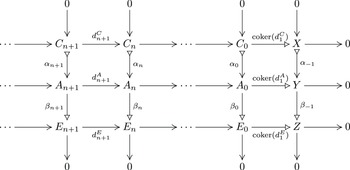


 Open access

