


1. Introduction
Designers use various design methods, such as Brainstorming, Design-by-Analogy, and Biologically-Inspired Design (BID) (Reference Keshwani, Lenau, Ahmed-Kristensen and ChakrabartiKeshwani et al., 2017) in the conceptual-design phase to come up with creative designs. BID is a widely popular design method which is known to produce creative designs (Reference Helms, Vattam and GoelHelms et al., 2009). In this method, designers draw inspiration from the biological domain to solve problems in the engineering domain (Reference Shu, Ueda, Chiu and CheongShu et al., 2011). A classic example of BID is Velcro, inspired by cocklebur seeds (Reference De MestralDe Mestral, 1955). Despite its potential for producing creative designs, BID remains underutilised due to designers’ limited understanding of the relevant biological phenomena. To address this knowledge gap, tools such as AskNature (Reference Deldin and SchuknechtDeldin & Schuknecht, 2014) and Idea Inspire (Reference Chakrabarti, Siddharth, Dinakar, Panda, Palegar and KeshwaniChakrabarti et al., 2017) were developed. With the recent advancements in generative artificial intelligence (GenAI), designers utilise tools such as ChatGPT (Reference Chen, Jing, Tsang, Wang, Sun and LuoChen et al., 2024a, Reference Chen, Song, Ding, Sun, Childs and Zuo2024b), DALL·E. (Reference Chulvi, Ruiz-Pastor, Royo and García-GarcíaChulvi et al., 2025; Reference López-Forniés and Asión-SuñerLópez-Forniés & Asión-Suñer, 2024), and Midjourney (Reference Liu, Zhang, Zhou, Shou, Yin and ChaiLiu et al., 2025). Specifically in BID, AskNature Chat (The Biomimicry Institute, 2025), Asteria (Asteria, 2025), and BioSpark (Reference Kang, Lin, Martelaro, Kittur, Chen and HongKang et al., 2024) have been developed to answer designers’ queries about biological phenomena, therby helping them understand them. Yet, it is unclear how integration of GenAI tools with design methods influences designers’ creative thinking, even though it is known that this integration influences the creativity of design outcomes (Reference Liu, Zhang, Zhou, Shou, Yin and ChaiLiu et al., 2025; Reference Wadinambiarachchi, Kelly, Pareek, Zhou and VellosoWadinambiarachchi et al., 2024). Therefore, we aim to investigate the influence of integrating GenAI tools, specifically ChatGPT, with BID on the creative thinking of designers.
Creative thinking is a highly cognitive process (Reference Beaty, Benedek, Silvia and SchacterBeaty et al., 2016). Traditional cognitive studies on creative thinking in design have relied on protocol analysis of verbal interactions and gestures. However, they offer limited possibilities for analysing designers’ cognition. Consequently, over the last 10+ years, researchers have borrowed techniques from neuroscience to study the cognitive aspects of design (Reference Zangeneh Soroush and ZengZangeneh Soroush & Zeng, 2024) and have utilised neurocognitive measures to assess the creative thinking of designers. Neurocognition is the study of the relationship between neural activity in the brain and cognitive processes, such as learning, decision-making, and creativity, as performed by humans (Reference Dietrich and KansoDietrich & Kanso, 2010). This neural activity gives rise to electromagnetic signals that can be measured by EEG (electroencephalography). These signals are majorly split into the following frequency bands: delta (0.5–4 Hz), theta (4–8 Hz), alpha (8–13 Hz), beta (13–30 Hz), and gamma (>30 Hz)—each associated with a distinct mental state or function. As our work focuses on assessing creative thinking, we use alpha and beta band, which can help recognise specific creative processes (Reference Dietrich and KansoDietrich & Kanso, 2010). Studies in neurocognition have shown that designers’ creative thinking involves two measurable cognitive functions: convergent thinking (CT) and divergent thinking (DT) (Reference GuilfordGuilford, 1967). In neuroscience, DT is found to be associated with alpha-band activation, and CT is found to be associated with beta-band activation (Reference Dietrich and KansoDietrich & Kanso, 2010). However, these associations should not be interpreted as functionally exclusive, meaning that activity in a given frequency band is not uniquely or solely tied to a single cognitive function (Reference Fink and BenedekFink & Benedek, 2014). Accordingly, our study focuses on measuring alpha and beta-band activations to examine designers’ cognitive processes. We compare these neural activations across the various phases within the BID method for the following modes : a) when designers apply the BID method only, b) when designers use ChatGPT only, and c) when designers apply the BID method with ChatGPT (Table 2). Each mode corresponds to one group (Group 1, Group 2, or Group 3, respectively). The overarching objective of our work is to compare designers’ neural activity associated with CT and DT across the design phases in these three modes. Given the small sample size of participants, we intend to explore the possibility of using EEG to characterise designers’ behaviour during biologically-inspired conceptual design tasks with varying forms of support and to provide preliminary findings towards this objective.
2. Literature review
This section summarises literature on GenAI in conceptual design (Section 2.1), design creativity (Section 2.2), and alpha–beta EEG correlates associated with design creativity (Section 2.3).
2.1. Use of GenAI tools during the conceptual design phase
With recent advancements in GenAI, designers are increasingly integrating GenAI-based tools—such as ChatGPT, Stable Diffusion, and DALL·E—into their design process. For instance, Reference Chulvi, Ruiz-Pastor, Royo and García-GarcíaChulvi et al. (2025) integrated ChatGPT and DALL·E with SCAMPER during the conceptual design phase to generate designs exhibiting novelty—an attribute of creative designs. Reference Chen, Song, Ding, Sun, Childs and ZuoChen et al. (2024b) developed TRIZ-GPT, integrating ChatGPT (GPT-3.5 and GPT-4) with TRIZ for generating solutions. They found that GPT-4 produced outcomes, compared with GPT3.5 ones, are closer to those developed by humans. In another study, Reference Chen, Jing, Tsang, Wang, Sun and LuoChen et al. (2024a) developed DesignFusion, which integrates the 5W1H design method with ChatGPT and Stable Diffusion to support conceptual ideation. Specifically, for BID, several GenAI tools have been developed to support designers in understanding the biological phenomena. For example, Asteria (Asteria, 2025) assists designers in translating biological principles into novel design solutions; AskNature Chat (The Biomimicry Institute, 2025) retrieves information about analogies, and BioSpark (Reference Kang, Lin, Martelaro, Kittur, Chen and HongKang et al., 2024) helps designers understand, critique, and combine biological analogies for ideation. Overall, while numerous studies have examined the integration of GenAI tools with various design methods, those focusing on BID are limited (Reference Kang, Lin, Martelaro, Kittur, Chen and HongKang et al., 2024). Thus, our work focuses on investigating the influence of integrating ChatGPT with the BID approach on design creativity, a crucial aspect of the design process.
2.2. Influence of GenAI tools on design creativity
Several studies have examined how GenAI tools enhance creativity in design outcomes, specifically in terms of novelty (an attribute of creativity). For instance, Reference López-Forniés and Asión-SuñerLópez-Forniés and Asión-Suñer (2024) studied designers’ interaction with several image-based GenAI tools, including DALL·E, Bing Image Creator, DeepDream AI Image Generator, and Starry AI, for producing design sketches of everyday items with new features. The results indicated that the generated ideas were more novel but had lower flexibility (an attribute of creativity that refers to the ability of designers to think of alternative solutions and new options while designing). Similarly, Reference Chandrasekera, Hosseini and PereraChandrasekara et al. (2025) reported that the group co-creating with an AI tool showed enhanced creativity and reduced cognitive load as compared to the group who ideated without the support from an AI tool. Reference Liu, Zhang, Zhou, Shou, Yin and ChaiLiu et al. (2025) employed a verbal protocol to understand the influence of Midjourney on generated design outcomes and designers’ cognitive styles. The study found that GenAI tool increased novelty, however the results were not significant across different cognitive styles. Conversely, Reference Wadinambiarachchi, Kelly, Pareek, Zhou and VellosoWadinambiarachchi et al. (2024) observed sketches from three groups—no inspiration, Google Image Search, and GenAI—and found that the GenAI group showed the most design fixation, while the no inspiration group showed the least. The third group also showed reduced novelty, and the group without an inspiration showed less decline in novelty as compared to the other groups.
While several studies have explored integrating GenAI tools with the BID method, this integration is still at a very early stage. Moreover, as far as we know, there is no study conducted to evaluate the creativity of design outcomes by integrating GenAI tools with the BID method, and specifically to use GenAI as a means to support the interpretation of a biological phenomenon in a design activity to stimulate creativity. Since design outcomes reflect designers’ cognitive behaviour, it is imperative to understand how integrating GenAI tools with design methods influences designers’ creative thinking. One way to measure creative thinking is by using neurocognitive measures as discussed in the next section.
2.3. Alpha–beta EEG correlates in design creativity tasks
Reference Hu, Ouyang, Wang, Zhang, Liu, Min and DuHu et al. (2022) used protocol analysis with EEG to understand the designer’s thought process during the concept generation phase. They found that alpha synchronisation—increase in power (the EEG signal within a predefined frequency band)—was observed during the Scenario task, while alpha desynchronisation—decrease in power—was observed in tasks like Problem Defining, Reflection and search for the solution, and its Synthesis. Beta desynchronisation observed during Synthesis task indicated high cognitive effort. Recent work by Reference Li, Becattini and CasciniLi et al. (2025) demonstrated that EEG variations, particularly alpha synchronisation, reliably predicted design tasks performance in Problem Solving and Torrance Tests of Creative Thinking. Reference Vieira, Benedek, Gero, Li and CasciniVieira et al. (2022) reported that alpha-band activation is associated with open-ended, creative, and idea-generation tasks, whereas beta-band activation corresponds to analytical and problem-solving tasks. Reference Liu, Li, Xiong, Cao and YuanLiu et al. (2018) similarly found alpha synchronisation during open-ended design tasks, indicating enhanced neural activation in creative, divergent thinking scenarios. Reference Colombo, Gero, Mazza and CantamessaColombo et al. (2024) further emphasised that EEG studies consistently identify alpha and beta oscillations as key indicators for understanding the brain dynamics underlying design creativity. Therefore, these findings indicate that alpha and beta band activity in design contexts is sensitive to task structure and processing stage, with both synchronisation and desynchronisation reported depending on whether cognition emphasises generation, restructuring, or integration (Reference Fink and BenedekFink & Benedek, 2014).
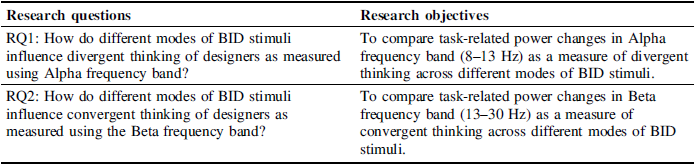
From the above review of literature, there remains limited research at the intersection of GenAI tools, design methods, and designers’ creative thinking. To address this gap, the present study introduces its research questions and objectives, as summarised in Table 1.
Research questions and research objectives

In addition to answering these RQs, a secondary objective of this work is to demonstrate the potential of EEG studies to analyse how different approaches in the integration of GenAI in ideation affect the creative behaviour of the designers.
3. Methodology
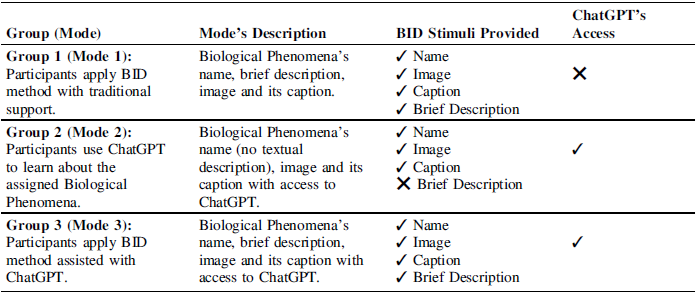
To address the research questions, we adopted an original empirical approach, preliminarily tested in a pilot study on 8 participants. The refined experimental procedure presented here included 30 participants—20 males and 10 females—with an age range of 18 to 21 years (Mean = 19.655; SD = 1.044). These participants were 1st- and 2nd-year B.Tech students at the Institute. For selecting the participants, the following exclusion criteria were decided: a) Computer Science and Biosciences (CSB) discipline students were avoided because their deeper biological knowledge than the students of other disciplines would influence the results, and b) Left-handed students were avoided to control the variability in the neural correlates of creative thinking, and to maintain experimental homogeneity. Our participants are representative of designers due to the following reasons: a) They credited DES102: Introduction to Human-Computer Interaction, a design methodology course; b) They underwent an Introductory Session corresponding to the mode they received (see Table 4); c) and partook in the Practice Session where we provided them feedback on their ideas, and prompt formulation: for Mode 2 and Mode 3 (see Table 4). The objective of the experiment was not revealed to the participants. This study was also approved by the Institutional Review Board Committee at the Institute. The experimental procedure is described below. We preliminarily assessed the creativity of the participants using the Creativity Evaluation Test (CET), adapted from the Alternative Uses Test (Reference AmabileAmabile, 1996). As participants were recruited sequentially, Group assignment was managed such that the average CET scores across the three modes remained closely aligned. This helped maintain comparable baseline creativity across modes while allowing the study to progress naturally. The average CET score was 5.5 for each group, based on the current distribution of 10 participants per group. This approach helped ensure that variability in individual creativity did not influence the results. Participants are referred to by the mode to which they were assigned; for example, those assigned to Mode 1 are referred to as Group 1, and so on. Table 2 summarises the presentation of BID stimuli for each group, and Figure 1 indicates how BID stimulus is presented to Group 1.
BID stimuli and group details

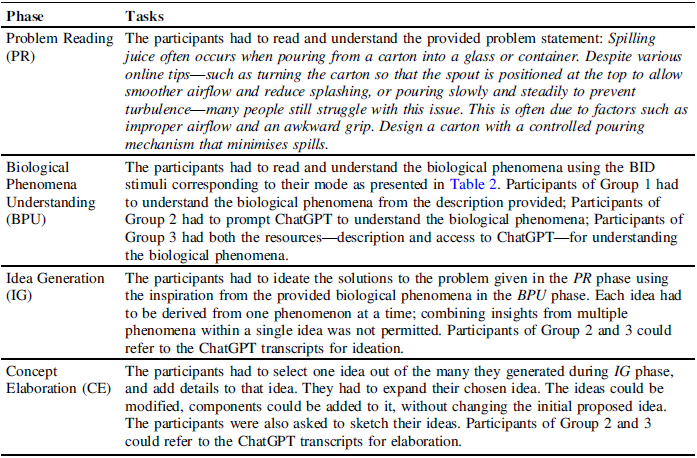
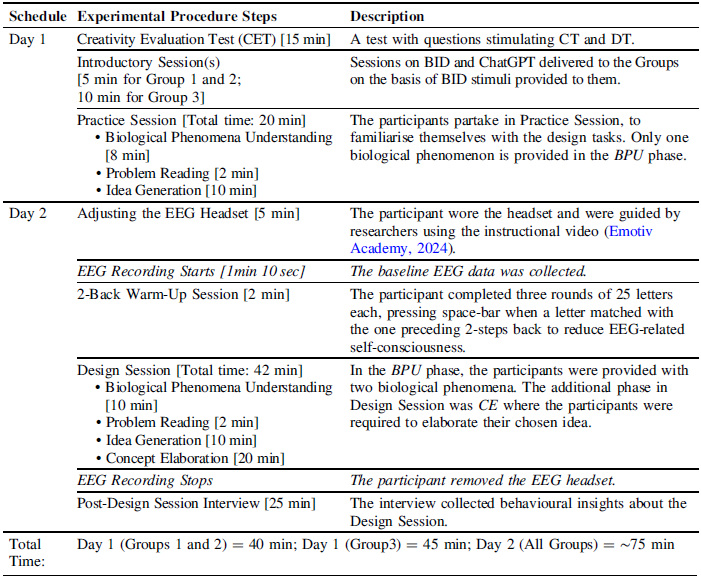
Here, Mode 1 depicts the traditional application of BID in which designers have access to information related to biological phenomena, Mode 2 emulates the real scenario in which, typically, the designers only know the name of the phenomenon and rely on ChatGPT to answer their queries, and Mode 3 integrates BID with ChatGPT, enabling us to examine how designers utilise both modalities in combination. Participants in each group were instructed to apply the design process comprising four phases, each phase consisting of distinct tasks, elaborated in Table 3. The selection of these phases is based on prior research, which broadly classified the BID method into similar stages (Reference Helms, Vattam and GoelHelm et al., 2009). The experiment was conducted over two consecutive days, as outlined in Table 4.
The Modes were introduced in the Biological Phenomena Understanding phase, which was conducted before the Problem Reading phase. This sequence was intended to prevent participants from interpreting the biological phenomena from a problem-solving perspective, thereby avoiding bias in their understanding. For Groups 2 and 3, this order of phases also ensured that the participants could not prompt ChatGPT for a solution. These groups were instructed to use only chain-of-thought and zero-shot prompt techniques. They were also instructed to avoid: a) role-based prompting that would make ChatGPT take on the various roles, thereby introducing variability in responses; b) prompts that would ask for image generation. Instructions for each phase were provided in printed form, and reiterated verbally by the researchers.
The phases and the tasks of the design process

Experiment design with duration of each phase

At the end of the Practice Session, participants were briefed about the Design Session scheduled for the following day and were instructed to: a) avoid coffee for at least two hours prior to the Design Session to minimise EEG fluctuations due to caffeine, b) avoid heavy meals at least an hour before the session to reduce fatigue, c) wash their hair on the day of the session to ensure optimal scalp conductivity for saline-based EEG headset, and d) get sufficient rest the previous night to ensure alertness during the experiment. We conducted all Day 2 sessions between 1230hrs to 1630hrs. Upon completion of the study, each participant was compensated Rs 200/- for their time and participation.
3.1. The experimental setup and data collection methods
Figure 1 shows the experimental setup. Data collection spanned five months, with each participant being assessed individually. Each participant was made to sit in a room with controlled lighting. The experiment was scheduled at a similar time of the day for all participants to minimise EEG variation. Two video cameras recorded the Design Session—one captured the participant’s upper body and the other the sheet on which they worked. The experimental material was provided in grayscale print. We used ChatGPT (GPT-4) Plus for AI-supported tasks, as it was the latest model available from OpenAI at the time of the experiment. We collected EEG data using the EMOTIV EPOC X 14-channel headset (EMOTIV, 2025) widely used in design neurocognition studies (Reference Li, Becattini and CasciniLi et al., 2025). The device follows the international 10-20 system for electrode placement across the scalp, and can record all frequency bands.
BID stimuli presented to group 1 during the design session (left); setup of the experiment (right)

Participants sketched design concepts and described them during the Idea Generation and Concept Elaboration phases. ChatGPT transcripts were collected for Groups 2 and 3, and all interviews were audio-recorded to understand participants’ design rationale.
4. Data processing and analysis
The EEG data was recorded throughout the Design Session and pre-processed for further analysis. All the pre-processing and analysis was done through MATLAB R2022a and EEGLAB (Reference Delorme and MakeigDelorme & Makeig, 2004), an open-source toolbox for EEG analysis. The data pre-processing and analysis followed standard neurocognitive pipelines (Reference Li, Becattini and CasciniLi et al., 2025; Reference Fink and BenedekFink & Benedek, 2014), including segmentation, artefact removal, filtering, and band extraction as outlined in Figure 2. EEG data collection began with a 35-second baseline for both Eyes Open and Eyes Closed conditions, followed by recording of the Design Session with a 128 Hz sampling rate. Segmentation was performed to separate baseline EEG data and Design Session EEG data. Artifact removal was performed by applying Infinite Impulse Response (IIR) to eliminate DC offset, and a 50 Hz notch filter to eliminate the line noise. Filtering was carried out through Bandpass Filter to extract signals within 4 to 45 Hz frequency range, followed by specific Bandpass Filters for extracting alpha frequency band (8–13 Hz) and beta frequency band (13–30 Hz), which are the focus of our work. After these steps, additional cleaning of the data was performed to remove artefacts, and the recorded videos were manually reviewed to verify the accuracy of the same. Subsequently, EEG data were analysed to compute Task-Related Power (TRP) which is the measurement of power during a task, relative to a baseline or resting state. Spectral power within each target frequency band was estimated using Welch’s method (pwelch) and the bandpower function. For each segment, TRP was calculated as the ratio of band power to total spectral power across all bands, yielding normalised TRP values for subsequent analysis by using Equation 1:

Where Band Power Task = EEG power in the frequency band of interest (e.g., alpha, beta) during the task; and Total Power Task = Sum of EEG power across all frequency bands during the task. TRP was computed as a normalised ratio during the task, as defined in Equation (1); baseline recordings were used only as a reference condition for interpretation. Conceptually, specific brain frequency bands are activated in response to different tasks, and such activations can be measured using EEG. TRP quantifies brain activity during task engagement relative to a resting baseline. In our study, TRP was calculated for alpha and beta bands during both design tasks and baseline conditions (Table 4). A positive value indicates increased power during the task, suggesting synchronisation, whereas a negative value indicates decreased power during the task, suggesting desynchronisation.
The data pre-processing and analysis pipeline

5. Results
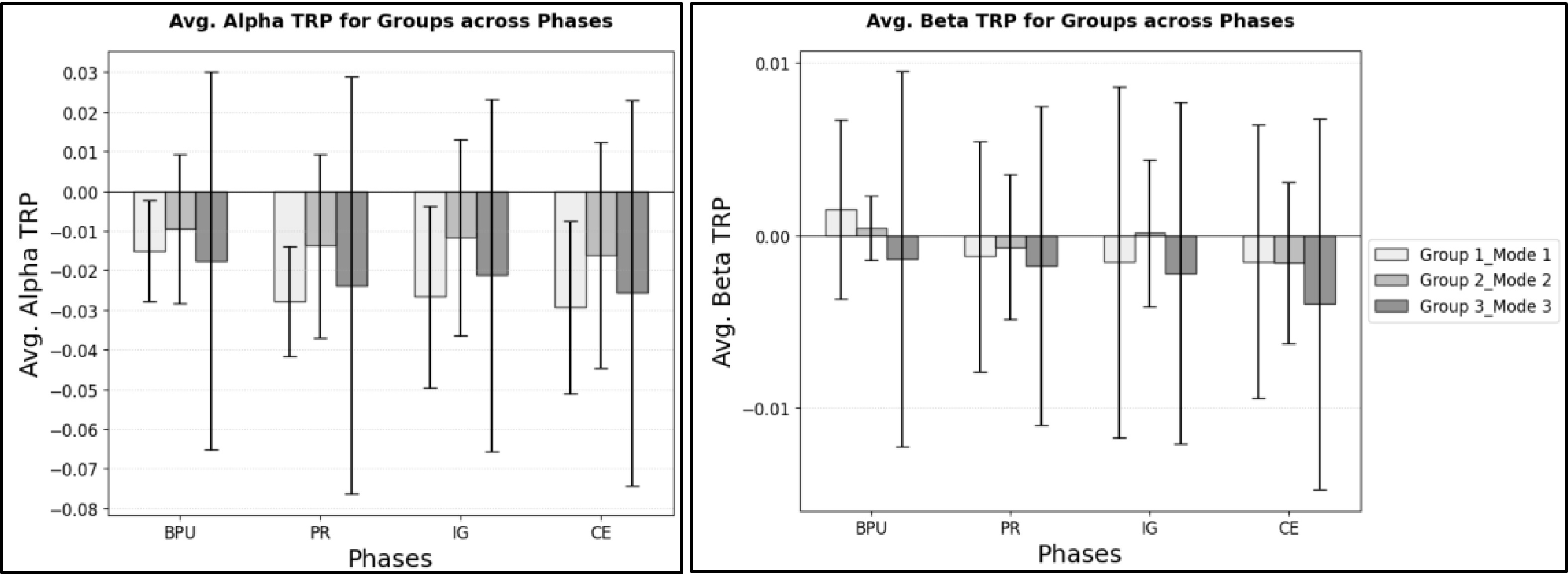
As part of this preliminary and exploratory analysis, we calculated the average TRP and standard deviation for the three groups across all phases, and the results are presented in Figure 3.
Average alpha and beta TRP values

Figure 3 Long description
Two bar graphs depict the average alpha and beta TRP values for different groups across various phases. Panel A: The bar graph on the left shows the average alpha TRP values. The x-axis is labeled Phases with categories BPU, PR, IG, and CE. The y-axis is labeled Avg. Alpha TRP with a range from -0.08 to 0.03. The graph includes three groups represented by different shades of bars: Group 1, Mode 1; Group 2, Mode 2; and Group 3, Mode 3. Panel B: The bar graph on the right shows the average beta TRP values. The x-axis is labeled Phases with categories BPU, PR, IG, and CE. The y-axis is labeled Avg. Beta TRP with a range from -0.01 to 0.01. Similar to the left graph, it includes three groups represented by different shades of bars: Group 1, Mode 1; Group 2, Mode 2; and Group 3, Mode 3.
In reporting the TRP trends with respect to alpha and beta desynchronisation, the notation “X avg.TRP Y” was used, where X avg.TRP = α or β and Y = G1, G2, G3 correspond to Groups 1, 2, and 3. The following trends were inferred from Figure 3 and are summarised in Table 5.
The graph shows that average alpha TRP values are consistently negative, indicating alpha desynchronisation. This suggests that the participants were thinking actively, paying attention to the design tasks during the Design Session, and processing information. Group 1 (BID mode) consistently demonstrated greater alpha desynchronisation across most phases—Problem Reading, Idea Generation and Concept Elaboration—followed by Group 3 (BID + ChatGPT mode) and Group 2 (ChatGPT mode); except in the Biological Phenomena Understanding phase where Group 3 shows stronger alpha desynchronisation. Moreover, Group 2 showed the least alpha desynchronisation across all phases. Similarly, average beta TRP values are mostly negative, indicating beta desynchronisation. This suggests that the participants were engaged in new activities and decision-making tasks during the Design Session. Group 3 shows greater beta desynchronisation in all phases—Biological Phenomena Understanding, Problem Reading, Idea Generation and Concept Elaboration. A slightly different trend was observed for Group 2 in Biological Phenomena Understanding and Idea Generation phases, where it showed beta synchronisation. Group 1 shows beta synchronisation in Biological Phenomena Understanding phase as well. Beta synchronisation suggests a steady, sustained thought process without many cognitive shifts. In summary, both alpha and beta bands are actively influenced during design tasks, with alpha desynchronisation marking cognitive effort and internal processing, and beta desynchronisation highlighting adaptive decision-making. These patterns also suggest that different design tasks are associated with distinct neural profiles across design phases. Hence, group differences across phases underline individual variations in strategy or focus during the Design Session.
Trends in αavg. TRP and βavg. TRP for groups across phases (per desynchronisation)

A Kruskal–Wallis test using participant-averaged TRP values showed no significant differences between support modes for Alpha, H(2) = 1.60, p = 0.45, or Beta, H(2) = 0.04, p = 0.98. Consequently, post-hoc pairwise comparisons were not conducted.
6. Discussion
Our preliminary and exploratory study examined how the various modes of BID stimuli influence Convergent and Divergent Thinking of designers through alpha and beta bands, respectively. CT involves the analysis, evaluation, and selection of appropriate solutions, whereas DT refers to the generation of multiple, novel alternatives in an open-ended manner. The discussion addresses the research questions sequentially, beginning with RQ1 and followed by RQ2.
RQ1: How do different modes of BID stimuli influence the divergent thinking of designers as measured using Alpha frequency band?
The trend observed in Figure 3 suggests that Group 1 (BID mode) showed the most alpha desynchronisation. The reduced alpha band power is associated with increased creative ideation and associative thinking (Reference Zangeneh Soroush and ZengZangeneh Soroush & Zeng, 2024) which may, depending on task demands, contribute to either exploratory or evaluative aspects of cognition rather than mapping exclusively onto divergent thinking. This could be due to lack of external assistance which required the participants to independently generate and elaborate ideas. Group 2 (ChatGPT mode) suggests least alpha desynchronisation across the four phases. This could be due to them being able to refer to the transcript in the succeeding phases, which can be understood as supporting internal attention, memory retrieval, associative processing, and higher cognitive load (Reference KlimeschKlimesch, 1999). While similar processes may also occur in the other modes, the availability of the transcript may have helped sustain them differently in this condition. Such processes are often involved in divergent exploration, although they may also support later evaluation and refinement. Therefore, Group 2 may be interpreted as demonstrating neural conditions that can facilitate divergent thinking relative to the other groups, rather than serving as a direct measure of it. Group 3 (BID + ChatGPT mode) also allowed participants to refer to the transcripts in the succeeding phases and was found to exhibit moderate alpha desynchronisation, possibly suggesting that combining a design method with ChatGPT may support a balance between exploratory and evaluative processing, compared to the design method alone, relative to other groups.
RQ2: How do different modes of BID stimuli influence the convergent thinking of designers as measured using the Beta frequency band?
The trend observed in Figure 3 indicates that Group 3 (BID + ChatGPT mode) consistently showed the most beta desynchronisation across the four phases. This reduced beta power is recognised as the neural correlate of goal-directed tasks and systematic problem-solving, which are associated with Convergent Thinking (Reference Zangeneh Soroush and ZengZangeneh Soroush & Zeng, 2024). Accordingly, this pattern may be compatible with increased demands on processes often involved in convergent activity. It could be that because this mode required participants to both engage with a structured design method and responses from ChatGPT, the task may have placed relatively greater demands on selecting, organising, and refining information compared to the other modes. These findings suggest that such integrations could help designers in engaging in convergence, synthesis, and refinement of ideas (Reference Zangeneh Soroush and ZengZangeneh Soroush & Zeng, 2024). Therefore, relative to the other groups, Group 3 may show stronger involvement of neural correlates typically linked to convergent processing. Group 1 (BID mode) showed beta synchronisation, particularly in the Biological Phenomena Understanding phase, which may foster focused attention—a component of Convergent Thinking (Reference Zangeneh Soroush and ZengZangeneh Soroush & Zeng, 2024). For the succeeding phases, Group 1 exhibited beta desynchronisation, which may require integrative demands, such as combining information extracted from biological principles and relating it to the emerging design requirements in the absence of external support. Group 2 (ChatGPT mode) demonstrated beta synchronisation for the Biological Phenomena Understanding and Idea Generation phases, suggesting the possibility that participants might have relied more on ChatGPT for their understanding of the biological phenomena and ideation. This may reflect cognitive stability and mental adaptation, which are required for unconstrained thinking. However, these dynamics should be interpreted cautiously, as beta activity can contribute to multiple forms of control depending on context. Additional evidence would be required to determine whether Group 1 or Group 2 shows more Convergent Thinking than the other.
From the findings, it can be concluded that the creative thinking of designers is influenced by both the BID stimuli and design phases, with patterns in alpha and beta bands providing indications of processes commonly related to CT and DT. Since these results are from the preliminary phase of the ongoing study, one limitation incurred due to challenges in participant recruitment was the small sample size. We did perform inferential statistics, but the results were not significant. Moreover, variability in prompt formulation across participants could have affected task-related mental effort during human–GenAI interaction. Furthermore, Reference Li, Becattini and CasciniLi et al. (2021) showed that relationships between EEG activation and design performance are sensitive to task complexity, and reported stronger evidence for elementary tasks than for higher-level design tasks. Accordingly, directly linking neural correlates to design outcome quality in complex design contexts requires dedicated evaluation frameworks which are beyond the scope of the present study. Future work will extend this work by examining EEG activity across specific brain regions (e.g., frontal and parietal lobes) and other frequency bands (gamma and theta) to provide deeper insight into the neural correlates of creative thinking during the design process, along with assessing the creativity of design outcomes. Moreover, the qualitative data—design sketches, ChatGPT transcripts, and interviews—will be examined in the follow-up study to enable triangulation with the EEG findings to better understand the designers’ creative thinking. We will also address the effects of BID stimuli across groups in detail.
7. Conclusion
This study focused on understanding the neural correlates of the creative thinking of the participants during the design process while they used either the BID method, ChatGPT, or a combination of both. Our results suggests that Group 1, exclusively using the BID method, may have experienced the relatively greater task-related cognitive demands. Using EEG as a neurocognitive measure, we analysed alpha and beta band activity to assess the creative thinking of the participants across all design phases. By comparing task-related powers for the three groups across the phases, the study provides exploratory insights into the stimuli influence on neurocognitive dynamics during ideation. Additionally, it supports the view that CT and DT form a continuous process, rather than a parallel process, in design. Taken together, these findings point toward the effective integration of GenAI tools with BID to help designers maximise their creative potential.




 Open access

