




By the 1640s, Book of Common Prayer ritual had been used for rites of passage in England for over eighty years. Retaining elements of older rites, such as the idea of spiritual regeneration through ritual washing at the font, or familiar words of the liturgy (largely based on the Sarum manual of the medieval Catholic Church), gave a sense of continuity and commonality to parish religion.Footnote 1 However, puritans in the church objected to the ceremonial elements of the Book of Common Prayer, and in 1645 these were banned by parliamentary legislation.Footnote 2 Evidence from diaries suggests that some members of the elite, notably the diarist John Evelyn, continued to demand old-style rites, and some clergy to offer them.Footnote 3 Because of this, historians have assumed that continuing use of traditionalist practice remained largely unquestioned during this period.Footnote 4 Using loyalist memories of antagonisms between puritan and non-puritan clergy and parishioners, as well as evidence from legal prosecutions and other sources, this article complicates such presumptions, showing how, with opinion sharply divided on their practice, rites of passage led to clashes and confrontations within parishes.
The focus here is on baptism, as the rite of greatest importance within the Christian religion. Deriving from the Gospels, it was one of only two of the seven Catholic sacraments retained by Protestants.Footnote 5 A very familiar ritual, commonly performed in the context of the gathered Sunday congregation, as David Cressy has shown, it also generated the most post-Reformation controversy over its precise theological meaning, as well as the way, time and place in which it should be conducted. If, as Anna French argues, the sacraments were ‘some of the most heavily debated aspects of reformed worship’ due to their ‘close connection to beliefs about salvation’, then in this period baptism was more contentious than the eucharist.Footnote 6
David Cressy cites both theological polemic and parochial confrontations surrounding baptism over the longer post-Reformation period. Yet despite increased interest among religious anthropologists in the role of religion within revolutionary contexts in recent years, Cressy notes the absence of research to substantiate patterns of response, within parishes, to the sharp change of official attitudes towards baptism in the mid-seventeenth century. ‘The demography of religious affiliation in this period has so far resisted scholarly investigation’, he writes, querying ‘how typical were the strategies’ of diarists like Evelyn or how attached people were to the new – post-Book of Common Prayer – style of worship.Footnote 7
The tendency in recent years, following the arguments of John Morrill, has been to emphasize the continuing vitality of traditional practice in the 1640s and 1650s.Footnote 8 Judith Maltby has argued convincingly for the existence of a ‘set of religious attitudes, practices and beliefs which found authenticity, comfort and renewal’ in traditional Church of England ritual while it was suppressed, although she and others rightly remind us not to see this as preserving a uniform, single strand equivalent to what we now think of as ‘Anglicanism’ within the pre-Civil War church.Footnote 9 Anthony Milton argues that the content of the Prayer Book petitions of 1641–2 was ‘hotly contested’, rather than deriving from an unchanging ‘Anglican’ orthodoxy.Footnote 10 Considering the example of Elizabeth Isham, Isaac Stephens warns against an oversimplified division between Maltby's ‘prayer-book Protestants’ and puritans: individual religious practice such as Elizabeth's might combine elements of both traditional ritual and puritan piety.Footnote 11 Eclectic practices before the English Revolution should prime us against making assumptions about how individuals and parishes responded to the religious changes that accompanied it, or assuming that any particular pattern of beliefs or practices, traditionalist or otherwise, had the support of the majority.
Although a number of historians have written about religion during this period, most substantively Christopher Durston and Bernard Capp, the reception and impact of the religious changes of the 1640s and 1650s within parishes has yet to be fully investigated. Since ‘social historians have long learned not to expect complete consistency between theological precept and practice’, as Susan Karant-Nunn observes, understanding the parochial context is at least as important as comprehending the doctrinal issues discussed in print or state policy.Footnote 12 Writing about the reception of the Reformation in Gloucestershire, Caroline Litzenberger alerts us to how the enforcement of ritual change on society results in a two-way process of ‘complicity, struggle and negotiation’ with official policy. ‘New or modified rituals not only changed people's pious practices, but were in turn changed by those same practices’.Footnote 13 At a statistical level, this response appears both as a rise in private baptism in the 1640s and 1650s, and as a decline of at least ten percent in the number of baptisms overall, according to Kitson, Wrigley and Schofield.Footnote 14 If, as Kitson suggests, ‘there was a fundamental shift in the nature of religious observance’ in the mid-seventeenth century, it was qualitatively different to the one originally envisaged by puritan reformers, and requires further examination.Footnote 15
Evidence of divisions over baptism appeared in many of the accusations against so-called ‘scandalous’ clergy made to Parliament and its committees in the early 1640s, which prefigured the changes introduced in 1645. Some reflect long-standing puritan opposition to making the sign of the cross in baptism as too reminiscent of Catholic gestures. Although Luther's baptismal rites of 1523 and 1526 had retained the sign, Martin Bucer's Strasbourg ritual of 1524 removed it and this influenced later Protestant groups, including Calvinists.Footnote 16 The Millenary petitioners of 1603 had asked that instructions to use this gesture be removed from the Book of Common Prayer rubric, but this request was firmly denied in the church canons of 1604.Footnote 17 The issue resurfaced in the 1640s, when several ministers were denounced for using the sign of the cross even before it had been officially banned by the parliamentary legislation of 1645.Footnote 18
In this period, parishioners seem to have felt that they had the right to determine how baptism was performed for their children. In 1644 it was reported that Richard Peacock, minister of Swaffham Prior in Cambridgeshire, when asked to baptize a child without using the sign of the cross, refused to do so without an order from a higher authority.Footnote 19 Cuthbert Nicholson, rector of Newbold Verdon in Leicestershire, was accused of baptizing a child with the sign of the cross ‘notwithstanding their fathers standing their forbade him’.Footnote 20 Thomas Newcomen, rector of Holy Trinity Church, Colchester, ‘not being suffered’ to cross a child, apparently retaliated by perverting the liturgy, saying, ‘We doe not receive this Child into the Congregation’.Footnote 21 Gentleman George Salter of King's Lynn testified that Thomas Holt, minister of All Saints in Stamford, had refused to christen his child except with the sign of the cross, ‘nor would suffer’ another minister to baptize without it. Salter's wife's puritan leanings perhaps swayed him; he also stated that she had ‘fallen out’ with Holt over the question of kneeling at the altar to receive communion.Footnote 22
Sometimes such concerns were long-standing and had previously been handled with some flexibility by church ministers. In 1646 Nicholas Hall of Loughborough, challenging his sequestration, claimed never to have used the sign of the cross in baptism, despite the church canons.Footnote 23 At Saddington in the same county, however, antipathy to the use of the cross was apparently a newly generated scruple. It was said that William Wood, ‘an honest godly man’, after taking the Solemn League and Covenant of 1643, desired rector Bernard Flesher to omit the sign in baptizing his child, but Flesher refused, causing Wood ‘great grief’.Footnote 24 Although the Covenant itself makes no mention of baptism, it probably encouraged further religious debate amongst those taking it.Footnote 25
Charles Hefling argues that the Prayer Book has long been a ‘primary carrier’ of meanings and values within Anglicanism, educating and informing its listeners, long before it was understood by philosophers ‘that language is what bestows meaning’ on the ‘human mind and heart’.Footnote 26 The Prayer Book words taught parents to conceptualize baptism as the crossing of a highly significant threshold: baptized infants were ‘born again’, made ‘dead unto sin’, ‘received into’ and made ‘lively members’ of ‘Christ's holy church’, ‘regenerated with the holy Spirit’, utterly abolishing ‘the whole body of sin’.Footnote 27 Yet in the early 1640s, while the Prayer Book was still officially the form of service required by the church, a number of clergy had been denounced for expressing this very doctrine, including George Kindleton of Magdalen Laver in Essex, London ministers Benjamin Spencer and William Quelch, and Nicholas Felton at Stretham in Cambridgeshire.Footnote 28 Theodore Crosland, vice master of Trinity College, Cambridge, was blamed for the ‘debayst drunken man’ he employed as his substitute at Bottisham who preached that ‘Children that are Baptized are absolutely regenerate’.Footnote 29 Hugh Reeve, parson of Ampthill in Bedfordshire, supposedly held ‘popish doctrines’, claiming that ‘the outward act of Baptism … pronounced by the meanest or silliest priest’ was sufficient to ‘conferre grace on the child’.Footnote 30 A logical, if unacceptable implication of such theology, in the puritan mind, was the belief, supposedly held by Suffolk rector Jeremiah Ravens, that the rite itself conferred salvation.Footnote 31 To these cases may be added, if we believe the sensationalized clerical denouncements in John White's First Century of Scandalous Malignant Priests (1643), those of Sussex ministers John Wilson and Richard Gough, and of Essex ministers Edward Cherry and William Osbalston.Footnote 32
More distressing, if true, was the claim made by James Buck of Stradbroke in Suffolk that unbaptized children were ‘undoubtedly damned’ and the complaint that Thomas Bayly, of Brasted, Kent, refused to bury them.Footnote 33 Catholic theology postulated the idea of limbo for unbaptized infants, from which they would eventually be released, but, as Protestants, these clergy conceptualized a more clearly defined separation between the elect, destined for heaven, and the reprobate, headed for hell.Footnote 34 Another Kent minister, Dr Vane at Crayford, was said to have taught that children who died unbaptized could not be saved.Footnote 35 The reported doctrine of Richard Dukeson of St Clement Danes, that children dying before baptism are saved by the faith of their godparents, was perhaps an attempt to ameliorate a distressing circumstance, albeit not one which was appealing to puritan sensibilities.Footnote 36 All these charges reveal that puritan polemicists were determined to make an issue of the precise theological implications of baptism.
The introduction to the Directory for Publique Worship of 1645 gave parliamentary reformers at Westminster the chance to replace Prayer Book orthodoxy with their own. The Directory is often thought a rather anodyne document, but on baptism it represents a profound shift in the way the rite was supposed to be conducted and perceived.Footnote 37 Godparents were no longer involved and the use of the font was outlawed.Footnote 38 Where the Prayer Book normalized public baptism in the context of the gathered congregation, the Directory insisted on it.Footnote 39 Where the Prayer Book held ‘parents’ responsible for baptism (although in practice lying-in mothers did not usually take part), the Directory involved only fathers.Footnote 40 This masculine bias perhaps derived from the Scottish or Genevan English baptismal rites, which involved fathers and godfathers but not mothers or godmothers.Footnote 41 More significantly, the Directory removed much of the power attached to the ritual itself, particularly the idea that it was anything more than symbolic. The baptismal water, it stated, merely ‘representeth and signifieth’ the taking away of original sin by Christ. Baptized children were received only into the visible church, thereby distinguishing between the baptized and the elect. By baptism, they received a ‘Seale of the Covenant of Grace’, an endorsement of a state existing separately from the rite itself: the ‘inward Grace of Baptisme’ was not tied to the moment wherein it was administered, ‘the fruit and power thereof reacheth to the whole course of our life’, and ‘outward Baptisme is not so necessary; that through the want thereof the Infant is in danger of Damnation or the Parents guilty’. While this wording seemed to offer comfort to parents whose children had died unbaptized, the Directory refused any guarantees: all that could be done was to pray that, if a child died in infancy, the Lord would be merciful and ‘receive him up into glory’; and if he lived to ‘years of discretion’, his word and Spirit would ‘make his Baptisme effectual to him’.Footnote 42
Even if, as Alec Ryrie argues, this downgraded conception of baptism was commonplace in puritan circles – Stephen Dennison was charged before the High Commission in 1634 for preaching that ‘Baptisme without the word is like a seal without writinge, … the word is the principall, and the Sacrament is the accessory’ – it was unfamiliar to parishioners whose doctrinal ideas were conditioned by the Book of Common Prayer.Footnote 43 Even amongst the puritan-inflected clerical accusations of the 1640s, complaints are found which revolved around more traditional concerns, notably that baptismal rites be performed as soon as the parents desired, and performed properly. In 1641 Bryan Walton was accused of refusing to baptize infants presented on a holy day before divine service, ‘for what cause, your petitioners know not, other than their parents were not in his favour’.Footnote 44 Similar complaints were made to Parliament in 1641 against Andrew Sandiland of Great Waldingfield, Suffolk, for refusing to baptize children presented to him in the forenoons.Footnote 45 In August 1644 three working men complained that William Underwood, minister at Hareby in Lincolnshire, had not administered the ‘sacrament of Baptisme’ once since coming to the church in the Spring.Footnote 46
Such concerns echo earlier objections from the church courts of the 1630s, complaining of clerical neglect causing children not to be baptized when requested, or worse, to die unbaptized. In 1633 William Warmington was cited before the Exeter church courts for refusing to baptize a child brought into church on a Sunday, despite being told it was weak, forcing the parents to travel two miles to another church.Footnote 47 Such cases continued to trouble parents years later. Similar allegations against William Churton of Hartland in Devon in 1638 harked back to an incident eight or nine years previously, when his neglect had led to a child's dying unbaptized.Footnote 48
Other accusations in the early 1640s, as well as earlier cases in the church court records of the 1630s, concerned baptisms improperly conducted: Robert Guyon, minister of White Colne in Essex, was said to have confused the marriage and baptism services; Henry Wright of Brampford Speke in Devon was cited in 1636 for baptizing while drunk; Edward Jeffry of Southminster in Essex was accused of baptizing in 1638 while himself excommunicate.Footnote 49 Complaints to Parliament against Dr Richard Etkins, vicar of Kensington, in 1641 included his ‘carelesse … fashion of performing the divine offices’, including ‘omissions of no lesse moment’ than forgetting the child's name in baptism.Footnote 50 A Harwich lecturer, Thomas Wood, was accused of inventing his own baptism service, to the ‘great disturbance’ of the inhabitants.Footnote 51
Mock baptisms, soon to be an offence associated with soldiers and sectarians, were said to have been performed by Essex minister John Fenwick and Leicestershire minister Francis Squire in local alehouses.Footnote 52 David Cressy gives other examples, although he perhaps underplays the significance and prevalence of such inversion rituals during the Civil War and Interregnum.Footnote 53 Blanford Parker writes that each period has its own characteristic modes of satire, involving the ‘constant assimilation and displacement of generic norms’.Footnote 54 Keith Thomas argues that, for the early modern period, mockeries of ecclesiastical rituals were ‘stock methods’.Footnote 55 Indeed, James Mawdesley highlights their role in the confessional conflicts of the period.Footnote 56 The set forms of traditional religion were also often parodied in printed satire during the 1640s and 1650s: there were mock litanies, mock catechisms, mock sermons, and satires on the Ten Commandments, the Creed, the Lord's Prayer and on biblical verses.Footnote 57 Such forms were mimicked precisely because they had such ‘serious and solemn Significations’, which the parody might critique, but also reinforce.Footnote 58 Repeated reports of mock baptisms in the mid-seventeenth century therefore suggest both the importance of the ritual in popular consciousness and the degree to which its conduct and meaning were disputed.
Such antics were only one of the ways in which conflicting ideas about baptism led to turbulence in churches during and after the Civil War. Although there were contemporary complaints that most of the congregation left the Sunday service at the start of a baptism, as part of the regular service of public worship it was open to anyone who wished to remain.Footnote 59 At a time of civil war and accompanying social unrest, this risked the possibility of interventions from soldiers, unrelated parishioners or strangers less likely to be present at other rites. Sometimes the conduct of the rite itself was at the heart of the dispute. Chaos erupted at Saddington Church in Leicestershire when a parishioner pressurized the rector Bernard Flesher to use the Directory for the first time during a baptism. ‘Much molested’ at the font by one married couple, Flesher had to abandon the baptism until the afternoon.Footnote 60 Charges made in July 1644 against Lincolnshire minister Hugh Barcroft refer to an apparent stand-off between Barcroft and ‘Captaine Moodies Troope’, temporarily in the town, over the lawfulness of Barcroft baptizing with the sign of the cross.Footnote 61 In August 1647, assize depositions were taken against Richard Dunwell, clerk, for baptizing with the sign of the cross using the Prayer Book at two churches in York. Three female parishioners testified against him. Ann Bird deposed that she ‘tooke notice’ of Dunwell's failure to use the Directory and told him there and then ‘that he would answere it’.Footnote 62 The public nature of the rite had facilitated her involvement; no doubt a desire to avoid such scenes encouraged the observed trend towards private baptism. From about 1649 onwards, public baptisms became vulnerable to disruption by Quakers, with two incidents reported in quarter sessions records for Somerset and one in Essex.Footnote 63 At Croscombe in Somerset in July 1653, minister John Whitborne complained that one George Hicks came into the church very irreverently, wearing his hat, and argued loudly concerning his son's baptism. He called for an officer to take Hicks away, but Hicks kept arguing and the congregation was dismissed. There is no specific indication of what the dispute was about.Footnote 64
Baptisms were also disrupted during disputes between clergy over titles to livings in the context of widespread clerical ejections. At Aldenham in Hertfordshire in 1643, the ejected vicar Joseph Soane reportedly waited until after the sermon and the start of the baptism to interrupt his replacement John Gilpin, who was ‘kneeling downe to pray’ at a font not yet made obsolete by the Directory. The violence of Soane and his supporters, including ‘many women’, halted the baptism.Footnote 65 In December 1646, Anthony Lapthorne was forced to baptize in the church porch after having the church doors at Sedgefield in Durham shut against him on two successive Sundays, in a contest with parishioners who wished their existing minister to continue to serve the living.Footnote 66
Similar conflicts within parishes, sometimes even violence, are described in loyalist sources relating to Interregnum religion in the Bodleian Library's John Walker Archive. Such sources, collected in the early eighteenth century, are based on personal memories, oral tradition within families or parishes, and some documentary evidence. As I have argued previously, these were collected with a concern for truthfulness, and not often found to be seriously in error, although they were naturally selective in what they chose to share.Footnote 67 They recall the forcible prevention of traditionalist baptisms. The son of curate Philip Goddard, citing legal documents in his possession, related how his father was arrested by soldiers at Durley in Hampshire in 1644 for baptizing with the sign of the cross.Footnote 68 Another undated confrontation with soldiers was said to have occurred during a baptism at Barton Blount in Derbyshire, soldiers tearing the leaves of the Book of Common Prayer out of the rector Emmanuel Haywood's combined Prayer Book and Bible.Footnote 69 The nephew of John Ferebee, minister of Woodchester in Gloucestershire, described his arrest by Colonel Massey's soldiers while ‘at the font baptising a child’. Given the dates of Massey's commands, this probably occurred in 1643–4, before the introduction of the Directory.Footnote 70 Also described was a failed attempt by one Captain Hitch to arrest the vicar of Childwall in Lancashire, William Lewis, during a private baptism.Footnote 71
‘The Protestant Reformation’, writes Madeleine Gray, ‘was a compromise between the ideas of the more radical reformers and the traditionalism of a large number (possibly a majority) of the population’.Footnote 72 The implications of further reformation in the 1640s came as a shock to many ordinary parishioners and clergy. Copies of accusations against clergy within the Walker archive add to the considerable number known to have been denounced for maintaining traditionalist rites, such as Derbyshire rector George Holmes, who used the Book of Common Prayer liturgy and the sign of the cross in baptism ‘long after they were abolished’.Footnote 73 However, the desire to maintain traditional ways did not just originate with the clergy. Loyalists remembered traditionalist parents being just as forceful as puritans in dictating the terms of their children's baptism. Daniel Whitby recounted how at his wife's baptism in 1642 the incumbent, Mr Strickland, was already demurring at using the liturgy and the sign of the cross, but that her mother, Mrs Margaret Swanton, ‘a strict Observer of the Rules of the church’ overruled him; in the end he conducted the baptism privately in her house.Footnote 74
After 1645, traditionalists continued to press for baptisms to be performed in the way and by the person they preferred. At Everley in Wiltshire, parishioners were said to have taken their children to neighbouring ministers ‘rather than suffer them to be touch't by the Hands’ of the ‘illiterate’ ‘Mechanick’, Mr Eastman, a former brasier.Footnote 75 At Pontefract in Yorkshire, it was said, the ‘Loyal Town’, ‘mightily disaffected’ from Interregnum incumbent Joshua Ferret, took their children to nearby Featherstone and Darrington to be baptized.Footnote 76 After his sequestration from Cruwys Morchard in Devon, William Frank arranged for his son-in-law, Jonas Holmes, to serve the living in his stead, but according to Holmes ‘his father Frank baptiz'd all the children’, probably because Holmes was not then ordained, something that parishioners probably felt crucial for performing baptismal rites.Footnote 77 Ejected loyalist clergy who recalled making a meagre income from illicit baptisms included Samuel Forward of Gillingham in Dorset, who ‘entertained … now and then at Christenings’, and William Seddon in Lancashire, who baptized at the request of loyalists ‘according to the antient forms of the church’.Footnote 78 This was not without personal risk: ‘it gave him sometimes the trouble of musquetiers to guard him into Preston as a Prisoner’, but, by the mediation of neighbouring gentry, ‘he was soon dismiss'd and returned to his family to recount his hazards’.Footnote 79 George Forster at Bolam in Northumberland was similarly said to have been sustained after sequestration by ‘the Tokens and presents which he got for Baptisms’, but when discovered ‘was severely reprimanded’ and ‘sent to Newcastle to be imprisoned’ before being bailed by two friendly JPs.Footnote 80
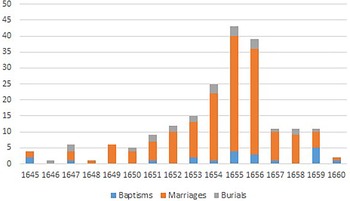
Legal records provide some evidence of tensions over the use of traditionalist rites. A study of over four thousand records of religious offences tried at assizes, quarter and borough sessions between 1645 and 1660 finds two dozen citations for the use of the Prayer Book, nearly half of them from Yorkshire.Footnote 81 The arrests of Seddon and Forster, and the assize prosecution of Richard Dunwell would therefore fit with a greater willingness to prosecute in northern counties, which also had higher rates of clerical sequestration.Footnote 82 Out of the whole set of records studied, nearly two hundred cases were found relating to rites of passage, including cases which do not mention the Prayer Book (Figure 1). Cases rise to a clear peak under the Major-Generals (1655–6) before declining. Cases relating to marriage predominate, because permissible practice was clearly defined after 1653 by the Marriage Act, but twenty-one relate to baptism.Footnote 83
Prosecutions related to rites of passage, 1645–60.

Forster was eventually offered a low-valued living where he apparently continued to perform Church of England rites according to the Book of Common Prayer, suggesting the possibility that severity towards traditionalism waned towards the end of the Interregnum.Footnote 84 Also undisturbed in a low-valued living was the minister at Slapton in Devon, who, it was said, ‘used the service book as often as desired’, letting parents decide whether baptism should take place in the basin or the font.Footnote 85 On the other hand, continued use of traditional rites of baptism was still used as grounds to deprive clergy in the late 1650s: Walter Bushnell, vicar of Box in Wiltshire, was charged in 1656 with habitually baptizing using the Prayer Book and making the sign of the cross.Footnote 86
Much depended on the zeal of local puritans to stir up trouble for traditionalists. Wiltshire clergy were subject to renewed attention following the Penruddock Rebellion of 1655; Bushnell, a non-associating traditionalist in a relatively rich living, was an obvious target and blamed Humphrey Chambers, minister at Pewsey, and Adoniram Byfield, rector of Collingbourne Ducis, for his ejection.Footnote 87 At St Mary's Lichfield, there was a notorious dispute between William Langley and his colleague John Butler because Butler was found to be baptizing using a false certificate of ordination, but it was Langley who ended up being removed.Footnote 88 Robert Bowber, rector of Stockleigh Pomeroy in Devon, was unfortunate that his neighbour was the officious Presbyterian Nathaniel Durant, rector of Cheriton Fitzpaine.Footnote 89 Bowber's son related that a ‘loyal’ ‘person of quality’, Sebastian Isaac, requested Bowber to baptize his child ‘at his house called Combe’ using the liturgy and the sign of the cross. The problem was that Isaac's house was in Durant's parish. Durant became ‘so incensed against my Father’, that he ‘fought by all wayes and meanes to turn him out of his place, which at length he effected’.Footnote 90 Elizabeth Bentham related how a minister in a nearby living ‘complained to Major General Packer’ when her husband Samuel Bentham, rector of Knebworth in Hertfordshire, baptized his own son by his first wife, born in 1653, using the Book of Common Prayer rite, ‘but by the means of An Lightfoot who had an interest in Packer … was not prosecuted any further’.Footnote 91
The keenest reforming ministers sought to rip fonts out of churches altogether. The royal injunctions of 1561 had prohibited removing the font or using a basin, showing that there was already debate over this issue in the Elizabethan church.Footnote 92 By the 1570s, some London churches were baptizing with basins placed near the pulpit, to stress the link between the sacraments and preaching.Footnote 93 Following the Directory's ban on using the font in 1645, churchwardens’ accounts record fonts being removed in parishes across the country: at St Thomas in Salisbury by order of the committee in April 1647, at Pittington in Durham in 1651, and at St Petrock in Exeter in 1655.Footnote 94
Loyalist narratives challenge the idea that this was always an ‘orderly’ and consensual process, describing the font as ‘torn down’ at Modbury in Devon, and other places where the task of removal proved difficult due to unenthusiastic parishioners and the solidity of the workmanship.Footnote 95 At Bovey Tracey in Devon, the minister Tucker reportedly tried to dispose of the font with his own hands. He managed to saw halfway through it, ‘but being weary, and no one helping him in so ill a work, he was forced to desist, and so it remains half saw'd to this day’.Footnote 96 A fifteenth-century font, with a font cover installed around 1660, seemingly in an attempt to restate its importance, survives in the church.Footnote 97 At Bedwas in Monmouthshire, it was said that the Anabaptist Watkin Jones, who served the parish, attacked ‘a very fine font of stone’ and ‘when himself and his men cou'd not break it into pieces’ used it as a horse and cattle trough.Footnote 98 At Carsington in Derbyshire, parishioners remembered that a basin on the side of the pulpit had been used ‘after the mode of those times’; the font was removed to the parsonage yard where the incumbent fed his swine, but afterwards returned to the church.Footnote 99 With passive resistance to their removal, Fincham and Tyacke are probably right to suggest, on the evidence of the survival of many medieval fonts, that many were left in situ and ignored as the cheapest and least controversial option.Footnote 100 Some churchwardens’ accounts record the introduction of the basin, but not the removal of the font: at Aldeburgh in Suffolk in 1645, at Shepton Mallet in Somerset in 1647–9, and at Hartland in Devon in 1646–7.Footnote 101 All three fonts survive.Footnote 102 This, combined with the varying dates of font removal elsewhere, suggests that it often needed the personal impetus of active reformists to effect a font's removal, against a backdrop of parochial inertia.
Yet there was more Interregnum font disturbance than font survival might suggest. Some fonts were restored soon after the Restoration, as early as January 1660 at St Thomas's in Salisbury.Footnote 103 At Ackworth in Yorkshire, the restored rector Dr Thomas Bradley re-erected the font in 1663 with a Latin inscription attacking the ‘bile’ of the ‘fanatics’ who had demolished it.Footnote 104 Other surviving fonts have a chequered history, latterly retrieved from all sorts of misappropriations, including being used as wells, sinks and cisterns, as sundials and for feeding farm animals.Footnote 105 A tradition of reverence for redundant fonts against profane uses (or destruction) may perhaps explain how often they have been found in nearby churchyards or gardens, or even in the church itself.Footnote 106 If only a minority of parishes removed fonts during the Commonwealth era, where this happened it was as an intentional signal of the new religious order. Loyalists blamed such actions on fanatical factions and depicted the clergy involved as isolated and unpopular.
Interregnum ministers did not help their cause by quibbling about children's rights to receive baptism. There was contemporary debate amongst reformist clergy over the concept of ‘believers’ baptism’, the idea that, for baptism to be effective, the candidate must understand the essentials of the faith it signified.Footnote 107 Equally, if baptism were, as the Directory implied, not essential for salvation, refusing it now seemed acceptable.Footnote 108 Some Independents would only baptize amongst their select congregation: a set of 1660 articles against Henry Butler of Yeovil charge him with denying the sacraments to anyone of ‘what quallity soever’ not amongst his ‘particular’ congregation, hindering infants from being baptized for years.Footnote 109 Parishioners at St Bartholomew's Exchange in London refused to pay tithes to the curate appointed by the Independent Philip Nye because he refused to ‘crissen children … except wee would bee joyned in Communion with his Church’; in twelve months none of the regular congregation had done so.Footnote 110
Sometimes there was rigidity over where and when baptism could take place. A set of 1660 articles against Richard Herring at Drewsteignton in Devon, copied in the Walker archive, claim that he refused to baptize except on Sunday afternoons, forcing parishioners to ‘repaire to strangers (much to theire greife)’.Footnote 111 The diary of Philip Henry records, in November 1658, his unease over a private baptism which he conducted reluctantly when the father was absent and the mother lying-in.Footnote 112 Francis Drake's account characterized Mr Walker, minister at Wakefield, as ‘a very Rigid man’ in religious practice. He refused to baptize even sick children, Drake said, ‘unless brought to Church’, leading to an exchange of letters with a Mr Rogers over his refusal to baptize his sick child, but ‘Mr. Rogers got the better of him’, pleading necessity in this case of private baptism. Another parishioner, Drake recalled, had a seven weeks premature child, ‘weak, but yet alive’, and ‘besought’ Walker to christen it; Walker refused unless it was taken to the church. The father warned him that in bad weather this would hazard the child's life; if it died ‘the Child's blood should lye at his Door’. The child died while being carried over the church stile.Footnote 113
At Ottery St Mary in Devon, the incumbent Mr Tuchin apparently set public interrogations for the parents, causing a dispute that was just as devastating for the family concerned. According to local people, gentleman Mr Nicholas Haydon brought his child to be baptized. Tuchin first asked Haydon to give a demonstration of his faith before the congregation. This was not unusual in the Reformed churches of Europe, but evidently unfamiliar to Haydon who, apparently not quite able to understand the question, replied that ‘several Articles of my faith are indemonstrable, as the Doctrine of the Trinity the Incarnation’.Footnote 114 Haydon's answer being deemed unsatisfactory, the child was brought home unbaptized, the trauma of which was blamed for the death of Haydon's wife soon after.Footnote 115
The baptizing of children born out of wedlock had previously been encouraged by the Church of England. Even Calvin had been willing to baptize infants of the wicked and the idolatrous, as long as faith still existed within the community: the parents were reproved, and there were sponsors to vouch for the children. But others thought differently and, in England, this now became a contentious issue.Footnote 116 In an extraordinary story related by John Walker's correspondent John Kemble, it was said that neighbours, out of charity, brought an illegitimate child to be baptized by the minister at Minchinhampton in Gloucestershire, Mr Herne. He ‘made a scruple to baptise it, but at last took up water in his hand, and basely struck the child in the face, and with Invocation of the Blessed Trinity baptized it Whoresbrat’, seemingly in echo of the use of exorcism in the older Catholic rite.Footnote 117 In November 1652, John Lake, then minister at Oldham in Lancashire, was removed by the Manchester Presbyterian classis. The charges against him included baptizing ‘bastards’ from his own and other congregations, including a ‘child begotten in adultery’ without the parents’ ‘giving satisfaccion’ to the congregation, ‘very much’ discouraging the ‘harts of the Godly’. Lake, later a bishop, defended his actions, saying ‘Christ is all in all’, and that ‘not only bastards but children of heathens and excommunicated persons’ should be baptized.Footnote 118 Legal cases relating to Interregnum clergy restricting baptism include a Cheshire minister, John Brereton, who in 1653 refused to baptize the child of a woman accused of adultery.Footnote 119 In Staffordshire in 1659, two ministers were accused of refusing to baptize ‘natural’ sons, one also being quoted as saying ‘it is not lawfull to baptise Children’.Footnote 120
Parishioners sometimes acted against what they perceived as poor service provision. Complaints were made to the Sussex quarter sessions in October 1653 that the minister of Heyshott, Richard Garret, refused to ‘execute the function of minister’ in baptizing the children of the parish.Footnote 121 According to the ‘ancient inhabitants’ at High Halden in Kent, ‘one Web … refused to Baptize Children saying he was sent to preach, not to Baptize’, but was removed after a petition to the authorities.Footnote 122 In November 1658, Judge Wyndham reportedly pronounced to a Western Circuit assize jury that they should pay ministers who refused to baptize only the minimum ‘agreeable to the Law’.Footnote 123
What should we conclude from the conflicts over rites of passage discussed here? Loyalist accounts express the outraged sensibilities of traditionalists towards the new ritual practices of the 1640s and 1650s. They do not suggest that traditional rites carried on blithely through the Interregnum but that, given the virulence of reformist opposition to them from the early 1640s onwards, they often required evasive tactics to proceed. If authorities rarely sanctioned the gentry involved, for the clergy it was a different matter. They might be arrested and potentially lose their livings, but this simply left a large necessitous cohort of ejected clergy willing to meet the demand. Baptism was a rite at the centre of mid-seventeenth-century people's experience and consciousness. It provoked strong emotions and disagreement in its every aspect: where and when it should take place; the conduct, form and meaning of the ceremony; and who should be baptized. The reduced incidence of baptism and the rise of private baptism during this period may have been influenced, at least in part, by a desire to avoid such controversies.Footnote 124 Ministerial rigidity over the issue is depicted in loyalist accounts as counter-productive. So was the Directory's emphasis on masculine authority: loyalist accounts and other sources tell stories of women's active desire for involvement in a rite reframed to exclude them, hardly surprising given women's role in childbirth. Private baptism facilitated this. With legal processes disrupted by civil war, many of the earlier confrontations described by loyalists went unrecorded elsewhere. As legal record-keeping recovered after 1645, some clergy were prosecuted for performing Prayer Book rites, although more usually for solemnizing illicit marriages. Faced with acute sensitivities and earlier clashes over baptisms or burials, authorities rarely chose to inflame tensions further by resorting to formal prosecution, which were of doubtful legality in any case after the Instrument of Government of December 1653 abrogated the legal requirement to use the Directory.Footnote 125 None of the recorded prosecutions after 1656 cite the use of the Prayer Book for rites of passage. Yet rites of passage remained a sensitive issue, and a grumbling focus of local antagonism.

 Open access

