


1. Introduction
While political scientists have been examining the effects of economic inequality on various outcomes for decades (Neckerman and Torche, Reference Neckerman and Torche2007), there is a surprising scarcity of research within the discipline examining the fundamental issue of what economic inequality is as a “treatment” people experience in their lives. Theory and empirical analysis on how ordinary citizens conceptualize and attend to inequality has mostly occurred in other disciplines (García-Castro et al., Reference García-Castro, Willis and Rodríguez-Bailón2019; Waldfogel et al., Reference Waldfogel, Sheehy-Skeffington, Hauser, Ho and Kteily2021; Goya-Tocchetto and Payne, Reference Goya-Tocchetto and Payne2022; Jachimowicz et al., Reference Jachimowicz, Davidai, Goya-Tocchetto, Szaszi, Day, Tepper, Phillips, Mirza, Ordabayeva and Hauser2023). Within the past decade, we have witnessed a notable shift from nation to state and local context as the levels of analysis used to test theories about the effect of economic inequality on public opinion and political behavior (Franko, Reference Franko2016; Johnston and Newman, Reference Johnston and Newman2016; Phillips, Reference Phillips2017; Sands, Reference Sands2017; Macdonald, Reference Macdonald2020, Reference Macdonald2021; Sands and de Kadt, Reference Sands and de Kadt2020; Szewczyk and Crowder-Meyer, Reference Szewczyk and Crowder-Meyer2020; Franko and Livingston, Reference Franko and Livingston2022; Han and Kwon, Reference Han and Kwon2023). Underscoring this shift is the observation that citizens “rarely have direct experience of inequality at the national level” (Jachimowicz et al., Reference Jachimowicz, Davidai, Goya-Tocchetto, Szaszi, Day, Tepper, Phillips, Mirza, Ordabayeva and Hauser2023) and are typically innumerate with respect to country-wide economic inequality (Bartels, Reference Bartels2008; Kenworthy and McCall, Reference Kenworthy and McCall2008; Trump, Reference Trump2023). In contrast, citizens are relatively attuned to state (Xu and Garand, Reference Xu and Garand2010; Franko, Reference Franko2017), and particularly aware of local (Newman et al., Reference Newman, Shah and Lauterbach2018; Minkoff and Lyons, Reference Minkoff and Lyons2019), levels of economic diversity and inequality.
While these veins of research have advanced our grasp on the political effects of economic inequality, there is more to be done, especially with respect to understanding inequality as a contextual “treatment.” One question surprisingly lacking clarity is whether mass perception of inequality is driven by routine exposure to poverty, affluence, or both in tandem? This question stands alongside ongoing debate over the best way to measure inequality (De Maio, Reference De Maio2007; Blesch et al., Reference Blesch, Hauser and Jachimowicz2022), such as with single-parameter measures calculating the extent of income concentration (e.g., the Gini Coefficient) or size of the income gap (e.g., the 80/20 Ratio), or alternate measures capturing other features of income distributions. Popular questions in survey research ask about “the difference in incomes between rich people and poor people,” “the gap between the rich and poor,” “American society as divided” into the “haves” and the “have-nots,” and the responsibility of government for “reducing income differences between the rich and the poor”.Footnote 1 Such questions imply a popular understanding of inequality as economic disparity instantiated by the joint presence of contrasting economic groups. It is unclear, however, if the way pollsters conceptualize inequality for survey questions corresponds with how ordinary citizens come to see and understand inequality in their daily lives. One thing that is clearer is that predominant objective measures of inequality (e.g., Gini) may not capture the degree of joint prevalence of contrasting economic groups.
This is illustrated in Figure 1. One of the main criticisms of the Gini coefficient is that units with the same value of Gini often possess striking differences in other facets of the income distribution (Liu and Gastwirth, Reference Liu and Gastwirth2022). Each plot in Figure 1 reveals that, among Americans residing in zip codes with similar values of Gini, there is drastic variation in the prevalence of low- and high-income people. This should be consequential for how Americans become aware that inequality exists, as extant work theorizes that a powerful source of perception of inequality is the availability of visible cues in one’s surrounding social and physical environment (García-Castro et al., Reference García-Castro, Willis and Rodríguez-Bailón2019; Phillips et al., Reference Phillips, Tepper, Goya-Tocchetto, Davidai, Ordabayeva, Mirza, Szaszi, Day, Hauser and Jachimowicz2022). Of these cues, the presence of contrasting socioeconomic groups and their differing material accompaniments (e.g., types of homes, cars, schools, restaurants) are paramount sources of perceived inequality (Goya-Tocchetto and Payne, Reference Goya-Tocchetto and Payne2022; Jachimowicz et al., Reference Jachimowicz, Davidai, Goya-Tocchetto, Szaszi, Day, Tepper, Phillips, Mirza, Ordabayeva and Hauser2023). As such, it stands to reason that environments with a higher prevalence of rich and poor makes encountering these cues a more frequent occurrence, which in turn should elevate perception of economic inequality. Indeed, perception of inequality in people’s daily lives is theorized to entail simultaneous exposure to people possessing material resources and others lacking them (García-Castro et al., Reference García-Castro, Willis and Rodríguez-Bailón2019), which further points toward the use of a contextual measure of inequality capturing the joint prevalence of well-off and hard-up individuals. Interestingly, in their analysis of New York City (NYC) residents, Minkoff and Lyons Reference Minkoff and Lyons(2019) found that the joint prevalence of low- and high-income households in respondents’ neighborhoods or zip code significantly predicted their perceived inequality in NYC, while neighborhood or zip code income concentration (i.e., the Gini coefficient) did not.Footnote 2 While this finding offers initial evidence supporting the idea that the prevalence of affluent and indigent people is more visible in daily life than the concentration of income, this finding is based on a single city and more research is needed to assess its robustness and generalizability.
Prevalence of low- and high-income households by Gini coefficient (zip code level). Plots depict the relationship of the percent of households earning below $30K annually (left) or above $100K annually (right) to the level of income inequality as measured by the Gini coefficient. Vertical red reference line is the mean value of Gini. Source: 2015–2019 ACS 5-year file.

In the analysis that follows, I assess the relationship of the separate and joint local prevalence of low- and high-income households to Americans’ perception of inequality in their local residential context. I then compare these findings to common measures of inequality capturing either income concentration or the size of the gap between economic strata. As these separate measures capture different facets of citizens’ surrounding economic environment, the goal of this analysis is to learn about the cues citizens use to inform their subjective perceptions of inequality. Identifying the contextual measure of inequality that most strongly corresponds to citizens’ perception of inequality is an important enterprise in light of mixed findings for the relationship of local inequality to various political outcomes when measuring inequality with Gini or when comparing Gini to alternative measures (Blesch et al., Reference Blesch, Hauser and Jachimowicz2022). I conclude this analysis by extending my assessment of the effect of different inequality measures to policy preferences—namely, support for taxing the rich.
2. Data and methods
My analysis relies on (1) an original national survey of adult Americans (N = 9,439) fielded online via Lucid Theorem in August of 2020, and (2) the stacked nationally representative survey data (N = 2,047) used by Newman, Shah, and Lauterbach (Reference Newman, Shah and Lauterbach2018; hereafter “NSL”) in their investigation of Americans’ perception of local inequality. The supplemental appendix provides detailed information about these data sets.
The 2020 Lucid survey measured perceived local inequality with respondents’ level of agreement with the statement: “I live in an area where there are visible signs of economic inequality—some people are well-off but others are economically struggling.” Response options ranged from (1)—“Strongly agree” to (5)—“Strongly disagree.” This item was reverse coded so that higher values indicate higher perceived local inequality. NSL measured perceived local inequality with an item asking respondents: “How much economic inequality (that is, the size of the gap between the rich and the poor) would you say there is in your local area?” Response options ranged from (1)—“None” to (5)—“A Great Deal.” These two survey items represent distinct measures of subjective local inequality, with the former (i.e., August 2020 Lucid survey) focusing on the visibility of inequality to respondents and the latter (i.e., NSL replication data) on the degree of economic disparity or gap-size. Having distinct outcomes allows us to observe differential relationships of various contextual measures of inequality to each outcome while also mitigating the concern that observed results are confined to a single outcome measure.
These survey items are consistent with prior research in two ways. First, past research exploring citizens’ perception of their local residential context uses measures soliciting perceptions at the local residential level (versus the nation as a whole). In other words, when the research question pertains to people’s perception of their local context, researchers typically use questions soliciting perceptions of populations or conditions in respondents’ “local community,” “neighborhood,” or “area where they live” (Wong, Reference Wong2007; Newman et al., Reference Newman, Velez, Hartman and Bankert2015; Velez and Wong, Reference Velez and Wong2017; Wilcox-Archuleta, Reference Wilcox-Archuleta2018; Gollust and Haselswerdt, Reference Gollust and Haselswerdt2021).Footnote 3 The items used in the current study are consistent with this practice in that they solicit judgments about economic inequality in respondents’ local residential area. Second, these survey items’ reference to contrasting economic groups (e.g., the “well-off” or “rich” versus the “economically struggling” or “poor”) is consistent with past research measuring Americans’ perception of economic inequality. As previously mentioned, most survey questions about inequality mention contrasting economic groups and this is also observed in past studies assessing Americans’ perception of economic inequality. For example, Franko Reference Franko(2017) uses a survey question referencing “the rich” and “the poor,” Minkoff and Lyons Reference Minkoff and Lyons(2019) use a survey question referencing “rich people” and “everyone else,” and the Perceived Economic Inequality in Everyday Life Scale (García-Castro et al., Reference García-Castro, Willis and Rodríguez-Bailón2019) uses questions referencing “people with very different levels of income,” “people who undergo many problems to pay for their home expenses” versus “others who do not,” and “those who can go on vacation” versus “those who cannot afford it.”
I rely on zip code as the contextual unit for this study and retrieved zip-level data from the 2012–2016 and 2015–2019 American Community Survey (ACS) 5-year files, with the former file merged with the NSL data and the latter with the 2020 Lucid survey. Prior research finds that zip code is an effective geographic unit for capturing the spatial plane envisioned by ordinary Americans when asked to describe features of their “local area” or “community” (Velez and Wong, Reference Velez and Wong2017). In fact, work in this area finds that zip-level measures of ethno-racial populations and economic conditions more strongly correspond to perceived ethno-racial populations and economic conditions in one’s “community” or “local area” than county-level measures (Newman et al., Reference Newman, Velez, Hartman and Bankert2015, Reference Newman, Shah and Lauterbach2018; Velez and Wong, Reference Velez and Wong2017). This makes sense given that counties are relatively large geographic units (≈1,124 miles $^{\textrm{2}}$ on average) and typically contain significant intra-county heterogeneity across myriad demographic characteristics. To capture the prevalence of “haves” and “have-nots,” my analysis focuses on the two-item interactive measure introduced by Johnston and Newman Reference Johnston and Newman(2016): the percent of households earning below $30,000 annually (% Below $30K), the percent of households earning above $100,000 annually (% Above $100K), and the interaction of these two variables. To dispel concern over the sensitivity of results to different income cutoffs, I also analyze the interaction of % Below $25K and % Above $125K and report results using additional cutoffs in Figure A1.
While levels of income and costs of living vary across states and local areas—which alters the meaning of one’s personal income (e.g., earning $60K per year) depending on where one lives (Ogorzalek et al., Reference Ogorzalek, Piston and Puig2020)—the income cutoffs used in this analysis largely capture low- and high-income households throughout the nation. The U.S. Census Bureau provides the mean and upper limit household income among households in each quintile of the zip code income distribution for the 32,989 zip codes in the 2015–2019 ACS 5-year file. When looking at the distribution of mean incomes for households in the bottom quintile of their respective zip code income distribution, the 95th percentile is a mean income of roughly $30K. This means that, in most zip codes throughout the U.S., the average income of the local “have-nots” aligns with the income cutoffs used in my analysis to define low-income households. Moreover, the mean value of the upper limit for income among households in the bottom quintile of their zip code is roughly $28K, meaning that, in the average zip code, the “have-nots” do not have incomes exceeding the cutoffs ($25K and $30K) used in my analysis. Alternately, when looking at the distribution of mean incomes for households in the fourth (i.e., upper-middle) quintile of their respective zip code income distribution, the mean value is roughly $94K per year. This means that the cutoffs used to define high-income households in my analysis are income values above the average income of the locally defined upper-middle class throughout the U.S. Further, the mean value of the upper limit for income among households in the fourth quintile of their zip code is roughly $111K. This means that, in the average zip code, the floor of income for the “haves” (i.e., those in the top quintile) is a value lying between the two cutoffs ($100K and $125K) used in my analysis to define high-income households. In the end, to the extent that some respondents in my data reside in zip codes where some of the locally defined “have-nots” earn slightly above $25K or $30K per year and some of the locally defined “haves” earn slightly below $100K or $125K per year, this should bias my analysis toward null results as usage of these cutoffs under-measures the prevalence of poor and rich people.
I compare this interactive measure of economic inequality to common single-parameter measures capturing the extent of either income concentration or disparity: the Gini Coefficient, the 80/20 Ratio, and the share of income held by the top 5% of the income distribution (Top 5% Share). Additionally, I include the ratio of median income among the top 5% to the median among the middle quintile (Top-Concentrated) and the ratio of medians among the middle and bottom quintiles (Bottom-Concentrated) to approximate the Ortega parameters used by Blesch et al. Reference Blesch, Hauser and Jachimowicz(2022).Footnote 4 I use multivariate regression to analyze the relationship of each contextual measure of inequality to perceived local inequality. All models adjust for individual-level (e.g., education, income, age, gender, race/ethnicity, partisanship) and zip-level (e.g., median income, college education rate, unemployment rate, racial composition, population density) variables potentially correlated with objective and subjective inequality. All models use zip code clustered standard errors and, to ease interpretation and comparison, all non-binary variables were standardized.
3. Results
Figure 2 presents the marginal effects of the local prevalence of low-income households conditional on the local prevalence of high-income households on respondents’ perceptions of inequality in their surrounding environment. Panel A (August 2020 Lucid survey) presents the results for the perceived visibility of local inequality and Panel B (NSL replication data) for the perceived degree of inequality or gap-size. These marginal effects plots were generated using the interflex package, which addresses nonlinear interaction effects and employs a binning estimator to ensure sufficient “common support” (Hainmueller et al., Reference Hainmueller, Mummolo and Xu2019). I use the default setting for this package, which bins the moderator (% Above $100K or % Above $125K) into three equal-sized bins (i.e., low, middle, and high value bins) based on the distribution of these variables.
Local prevalence of “haves” and “have-nots” and perceived local inequality. Figures use interflex package to plot estimated marginal effects of % Below $30K conditional on % Above $100K (left graphs) and % Below $25K conditional on % Above $125K (right graphs) on perceived local inequality using the August 2020 Lucid survey (Panel A) and stacked data from Newman, Shah, and Lauterbach (Reference Newman, Shah and Lauterbach2018) (Panel B). Bars on point estimates are 95% CIs.

The binned estimates in Figure 2 reveal some nonlinearity that would otherwise be masked by an approach assuming linear interactive effects. Beginning with Panel A, a standard deviation increase in the percent of “have-nots” (measured using two separate income cutoffs) has practically zero effect in zip codes where the “haves” (measured using two separate income cutoffs) are low prevalence (i.e., first bin). However, in zip codes where the “haves” are more prevalent (i.e., third bin), a standard deviation increase in the “have-nots” is associated with a statistically significant and substantively sizable increase in perception of local inequality. This pattern replicates using the data from NSL (Panel B); however, the estimates are less precise and observed relationships are less pronounced—likely due in part to relying on a substantially smaller sample. This said, the pattern evident across both data sets is that Americans perceive inequality in their surrounding environment to be more visible or severe when residing in contexts where the “haves” and “have-nots” are jointly prevalent. Appendix Figure A1 demonstrates that the results in Figure 2 hold in both data sets when using alternative income cutoffs to measure the “haves” and the “have-nots.”
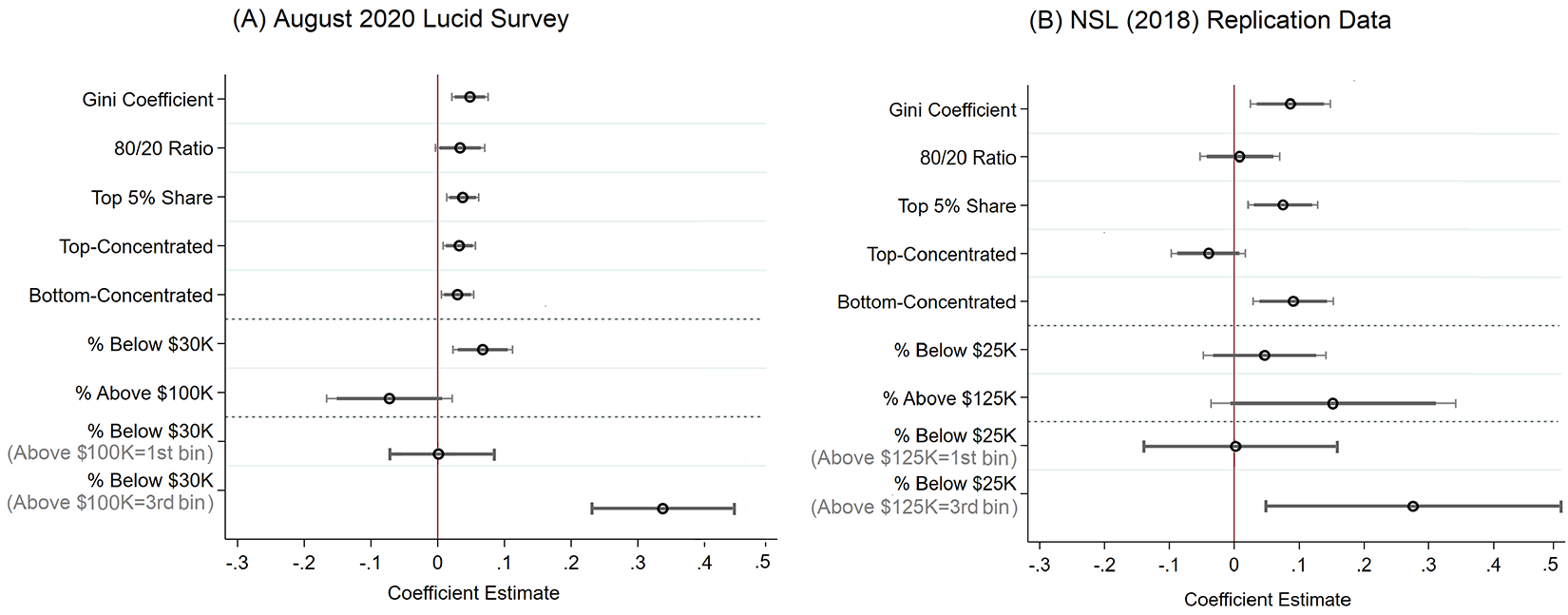
Figure 3 displays the estimated relationship of each zip code measure of economic inequality to perceived local inequality across both data sets. Beginning with Panel A, the first takeaway is that common measures of inequality capturing income concentration or gap-size have substantively small relationships with perceived inequality. Each estimate attains conventional (or near conventional) levels of statistical significance; however, a standard deviation increase in each is associated with less than .05 of a standard deviation change in perceived inequality. In short, several common objective measures do capture perceived inequality, albeit weakly. Second, all else constant, living around more people with low incomes is associated with elevated perception of local inequality. The opposite may be true for living around more people with high incomes—but this effect is statistically insignificant. Third, the most statistically and substantively significant relationship is between the prevalence of “have-nots” and perceived inequality in contexts where the “haves” are high prevalence. A standard deviation increase in % Below $30K in zip codes in the third interflex bin of % Above $100K is associated with over a .3 standard deviation increase in perceived inequality. In sum, high income concentration and a large income gap do not appear to be as visible to ordinary Americans as the joint presence of numerous indigent and affluent people.
Relationship of different measures of local inequality to perceived local inequality. Graphs plot coefficient estimates from six separate regression models of the relationship of each zip code measure of inequality to perceived local inequality. Dotted horizontal lines separate measures of income concentration or gap-size (top region), the unique effects of low- and high-income households (middle region), and the conditional effects of low-income households when high-income households are low (1st interflex bin) and high (3rd interflex bin) prevalence (bottom region). For top and middle graph regions, thick bars on point estimates are 90% CIs, thin capped bars are 95% CIs; for bottom graph region, thick capped bars are 95% CIs. Full results in Tables A1–2.

Turning to Panel B, key findings in Panel A are observed using the NSL data—namely, that the contextual indicator of inequality bearing the strongest relationship to perceived inequality is the prevalence of “haves-nots” when the “haves” are high prevalence. Thus, when shifting focus from the self-reported visibility of economic inequality to judgments about the extent of an income gap, we again see that the most pronounced factor is the joint prevalence of economically prosperous and depressed households. Worthy of note is that the joint presence of low- and high-income people has a substantively larger relationship to the perceived local income gap than various objective measures of the size of the local income gap (e.g., 80/20 Ratio, Top-Concentrated, Bottom-Concentrated). This said, when using a measure of perceived inequality focusing on gap-size (Panel B), we do see that objective zip code measures of income concentration (e.g., Top 5% Share) and gap-size (e.g., Bottom-Concentrated) exert somewhat larger effects than those observed in Panel A, which focuses on the visibility of contrasting economic groups. Finally, it is notable that exposure to the affluent alone is negatively related to perceived inequality in Panel A but positively in Panel B. While statistically insignificant in both cases, these diverging results invite further theory and research on the standalone effects of exposure to affluence.
What are the broader implications of these findings? Those interested in assessing the effects of inequality on political outcomes may wonder how the findings presented thus far bear on the politics of inequality? To this effect, this analysis can be concluded by illustrating how the differential relationships of distinct contextual measures of inequality to perceived inequality translate to an overtly political outcome: support for redistribution from the rich. While the replication data from NSL does not include measures of economic policy preferences, the August 2020 Lucid survey asked respondents to report their level of agreement with the statement: “We should raise taxes on households making more than $1,000,000 per year.” Response options for this item ranged from (1)—“Strongly agree” to (5)—“Strongly disagree” and the item was reversed (i.e., higher values indicating greater support) and standardized.
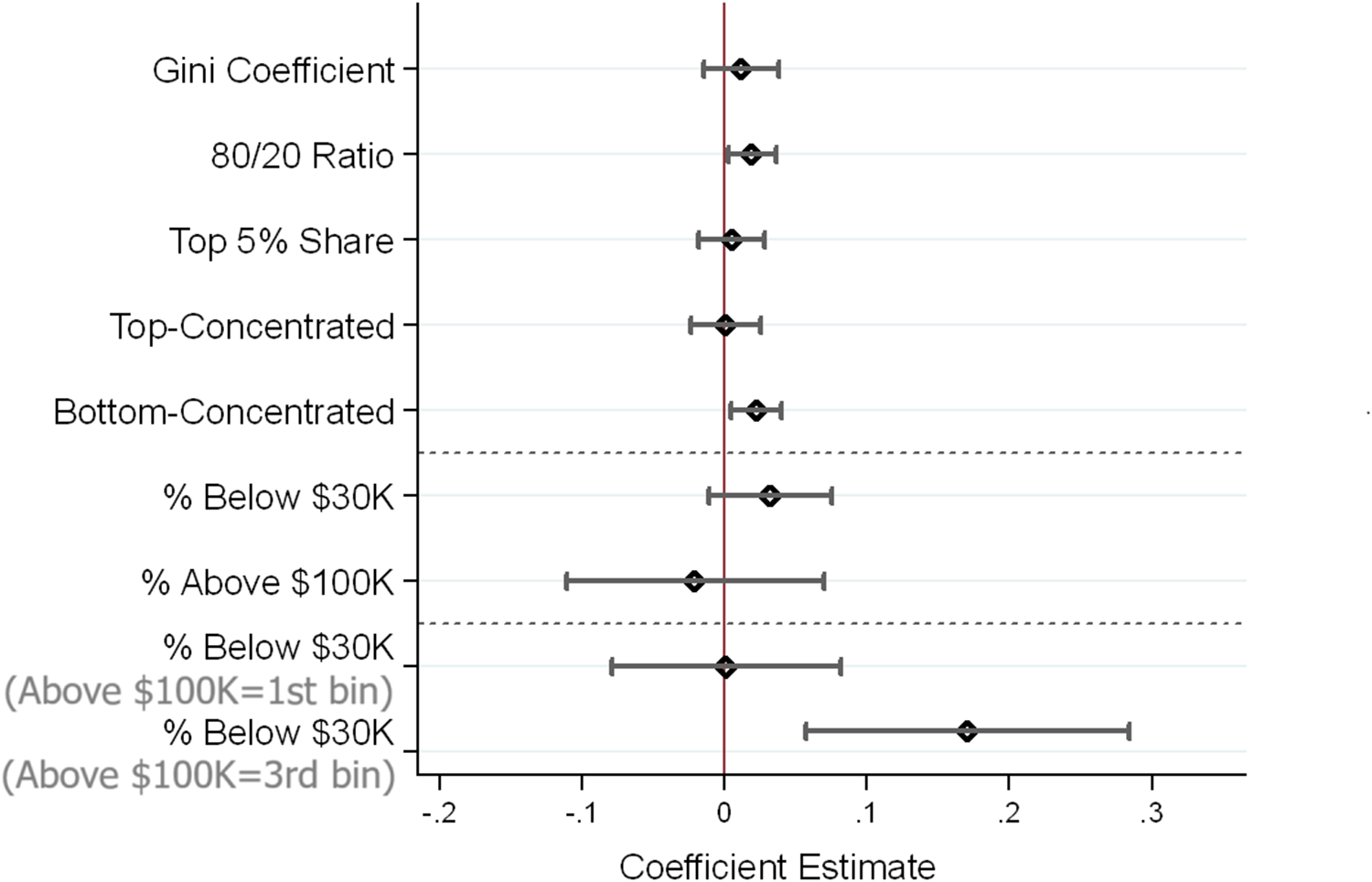
Figure 4 reveals that commonly used measures of income concentration and gap-size have statistically insignificant and/or substantively small relationships to support for taxing the rich. Consistent with the joint prevalence of “haves” and “have-nots” having a more pronounced relationship to perceived inequality, it also has the most statistically significant and substantively notable relationship to preferences over raising taxes on the wealthy. In short, using measures of inequality that fail to register in terms of citizens’ perception of inequality also fail to correlate with support for redistribution from the rich. This makes sense given that we would not really expect to observe an effect on a political outcome for a contextual “treatment” that is “not received” by citizens. In other words, if the theorized mechanism through which local inequality relates to policy preferences is first through detection of local inequality (i.e., receipt of the “treatment”), we would expect objective measures of local inequality that track less well with perceptions of local inequality to, by extension of our theoretical rationale, correlate less well with policy preferences. While a mediation analysis could be used, this simple demonstration is sufficient to illustrate the suggested point: objective measures with weaker reception have weaker downstream effects on policy attitudes.
Relationship of different measures of local inequality to support for taxing the wealthy. Graphs plot coefficient estimates from six separate regression models of the relationship of each zip code measure of inequality to support for raising taxes on households earning above $1M per year. Dotted horizontal lines separate measures of income concentration or gap-size (top region), the unique effects of low- and high-income households (middle region), and the conditional effects of low-income households when high-income households are low and high prevalence (bottom region). Thick capped bars on point estimates are 95% CIs. Full results in Table A3.

4. Conclusion
This research note offers preliminary evidence that single-parameter measures of economic inequality commonly used by scholars may not fully capture the features of people’s daily environment used to subjectively perceive the existence or magnitude of economic inequality. Prior research relying on the Gini coefficient to measure inequality suggests that Americans have an awareness of income inequality in their surrounding environment (Newman et al., Reference Newman, Shah and Lauterbach2018). The present research also finds that local estimates of Gini are positively related to perceived local inequality. However, the findings in this note suggest that exposure to the joint prevalence of “haves” and “have-nots” may represent more visible inequality to Americans than residing in an area with relatively high income concentration or a large income gap. As an extension of this finding, this note demonstrates that the joint prevalence of rich and poor is significantly related to support for taxing the rich while commonly used measures of inequality are either unrelated or evince a substantively small relationship. Lastly, the results revealed that, while perception of inequality is highly related to their mutual presence, the separate presence of the rich and poor mostly failed to attain significant standalone relationships to perceived inequality. Thus, future research seeking to instantiate inequality in lab, survey, or field settings may consider designs that manipulate exposure to poverty and affluence separately and simultaneously.
The findings presented in this note warrant replication and future research. Indeed, one potential limitation of this research worth noting is that the survey questions used to measure perceived local inequality may “stack the deck” toward finding a stronger relationship between the two-item interactive measure of objective local inequality and perceived inequality than that observed between Gini (or other commonly used measures of income concentration or gap-size) and perceived local inequality. The questions used to measure perceived local inequality in the present analysis each reference contrasting economic groups (e.g., “the rich” and “the poor”) and thus may have led respondents to think about the prevalence of these groups in their local area when answering these survey questions. This leaves open the question of whether the findings in this note would replicate when measuring perceived local inequality with a question referencing “economic inequality” but not mentioning any contrasting economic groups? While the questions used to measure perceived inequality in this note are consistent with those used in other explorations of perceived inequality in their reference to contrasting economic groups (Franko, Reference Franko2017; García-Castro et al., Reference García-Castro, Willis and Rodríguez-Bailón2019; Minkoff and Lyons, Reference Minkoff and Lyons2019), future research could explore whether the objective joint prevalence of low- and high-income households remains a prepotent predictor of perceived inequality when using questions not explicitly referencing the rich and poor or the “haves” and the “have-nots.”
Supplementary material
The supplementary material for this article can be found at https://doi.org/10.1017/psrm.2025.24. To obtain replication material for this article, https://doi.org/10.7910/DVN/PY3UJW.
Acknowledgements
I would like to thank Tyler T. Reny and Justin Gest for their generosity in including a short module of questions for this research in the data collection for their own research.
Competing interests
None.




 Open access

