

Museums with 100-year-old legacies are grappling not only with how to properly integrate modern curation standards in their collections but also with how to manage and record the histories of institutions created by decades of decisions by museum personnel. The Autry Museum of the American West is uncovering the wealth of culturally sensitive material it has collected over the century and a better understanding of its past practices.
The proper way to handle archives that are culturally sensitive is a topic frequently considered by both archival and archaeological communities (Evans et al. Reference Evans, McKemmish, Daniels and McCarthy2015; Johnson et al. Reference Johnson, Bernstein and Henry2006; Kaplan Reference Kaplan2002; Schwartz and Cook Reference Schwartz and Cook2002). Issues have included monitoring the excessive digital exposure of archaeological site locations, the use and protection of indigenous sacred and important sites, and how best to manage ethnographies or other documentation that contain detailed information on traditional knowledge. Additionally, conversations with tribal community members include the development of databases such as Murkurtu (Shepard Reference Shepard2014), which allows for differential access depending on the needs of the indigenous community and the creation of new or improved policies and consultation practices. This article describes how the Autry Museum of the American West is developing best practices and policies for both museum consultation and management of culturally sensitive material within archives. More specifically, this article highlights the interdepartmental developments of the museum as it rectifies outdated and informal management practices for culturally sensitive materials (for example, see Walters Reference Walters2011).
MUSEUM HISTORY AND LEGACY
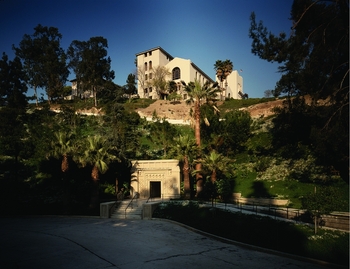
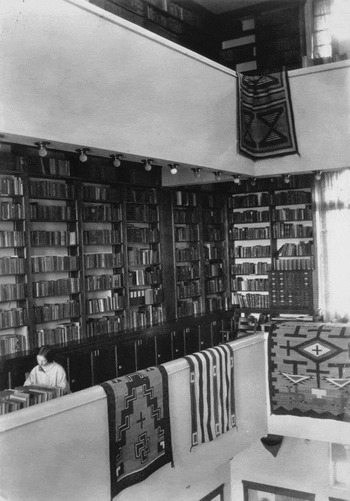
The Autry Museum of the American West (Autry) is a history museum (Figure 1) located in Los Angeles, California, within Griffith Park next to the Los Angeles Zoo. In 2003, the Autry merged with the Southwest Museum of the American Indian (Southwest Museum) (Figure 2), located in the Mt. Washington area of Los Angeles. Established in 1907, the Southwest Museum is the city's oldest museum. It also houses the second largest collection of Native American material culture and archives in the nation. The Braun Research Library (Braun), formerly known as the Southwest Museum Library, was created in 1909 to support the research activities of the Southwest Museum and preserve its institutional memory (Figure 3). The Braun (Figure 4) contains extensive collections of materials acquired by the Southwest Museum since its inception, including artwork, books, manuscripts, photographs, maps, and sound recordings. Specifically, the Braun collections include approximately 50,000 published volumes, 1,200 linear feet of manuscript collection, 300 works of art on paper, 4,500 maps, 1,500 linear feet of photographic material, and 2,300 sounds recordings.
Entrance to the Autry Museum of the American West. Photo by Jamie Pham.

Larry Reynolds, Southwest Museum of the American Indian from Museum Drive, 1986. Braun Research Library Collection, Autry Museum; P.56086.

Unidentified photographer, Southwest Museum Library, Los Angeles, California, 1929–1935. Braun Research Library Collection, Autry Museum; OP.1966.

Walt Wohlheter, Conservation area on the third floor of the Braun Research Library at the Southwest Museum, Los Angeles, California, December 1986. Braun Research Library Collection, Autry Museum; S1.752.

Most of the field reports, maps, photographs, and archival documents related to the Southwest Museum and other anthropological expeditions were deposited into the Braun. In addition, the Braun holds some of the most eminent and earliest materials documenting Native American peoples and cultures, as well as early California and Arizona literature and history. These collections provide the research materials necessary to place the artifactual collections of the museum in their cultural and historical contexts. The Braun's anthropological and archaeological archives are invaluable, not only for their representation of the era in which the material was collected but also for the vast body of information and references pertaining to American Indian communities and cultures across North and South America. It is clear from the way the collections and archives are organized that the librarians, archivists, archaeologists, and anthropologists—past and present—have been meticulous and thoughtful about this curation process since the inception of the library. However, at the same time, the transfer of institutional memory and information throughout the century has not been consistent. Aspects of the history of collections within the Braun and its relevance to the institutional history of the Southwest Museum risk being lost during staff transitions.
The 2003 merger with the Autry did not greatly disrupt the Braun's documenting procedures, staffing, or collections management. Initially, efforts to maintain the institutional history of the collection were overlooked because the priority was to update the curatorial standards of the entire collection of documents and objects in preparation for a 2016 move to the Autry's new state-of-the-art facility, the Resources Center located in Burbank.
This move required that staff check and update the Braun inventory, as well as physically rehouse the items for safe transport. During this time, the collections were closed to researchers. This pause in access served as an opportunity to evaluate the ways in which various researchers and members of the general public might engage with the materials in the archives.
Following the move, the focus has been on how best to reinstitute access while also addressing needs and concerns about culturally sensitive content in the archives. It is critical that the collection be made available not only to non-Native researchers and scholars but also to Native scholars and community members whose communities are reflected in the contents of the archive. Working with indigenous researchers and communities helps fill in important gaps in the metadata that may improve its accessibility to associated communities. This accessibility also informs the development of policies integrating community input for researcher access.
Historically, the level of access for researchers at the Braun has varied according to staff expertise, perceptions, and resources, as opposed to defined policies, and seemed to be set within an informal structure based on networks of interpersonal relationships between staff and researchers. This was not a sustainable approach, especially as research demand increased sharply with the emergence and increased use and development of “online discovery tools,” such as online library catalogues and digital image libraries (Dobreva and Duff Reference Dobreva and Duff2015; Tourney Reference Tourney2003).
eHUMANITY AND UNCOVERING THE CHALLENGES OF ONLINE TOOLS
In 2014, a situation that involved the website eHumanityFootnote 1 catalyzed an interdepartmental effort by the Braun's library, collections, and curatorial departments to revise access policies. eHumanity is a collaborative digital project, which aims to be a centralized digital hub for images representing Native American history and culture. The Autry participated by lending digital material to the website. A researcher contacted the Autry for permission to use one of these images for a report. The librarian and archivist who received the request to use the image then contacted the Autry's archaeologist. The image was of an object from an archaeological site in Los Angeles County, a site known for its ceremonial use and the presence of burials. The photograph the researcher was interested in had previously been published in a Southwest Museum paper, “Five Prehistoric Archaeological Sites in Los Angeles County, California” (Walker Reference Walker1952). After discussing the issue with the Autry's then NAGPRA coordinator, the staff decided that the best approach would be to have the researcher contact the Native American community affiliated with the archaeological site represented in the photograph. The researcher was asked to consult with tribal representatives about her research interests and goals and seek permission directly from the tribe for the use of the image. The tribe involved was the Gabrielino/Tongva, the indigenous community of the Los Angeles County Basin, Southern Channel islands, and Northern Orange County in Southern California.
The researcher sought advice from a Gabrielino/Tongva representative, hoping to receive permission to use the image. The representative discussed the request with members of her community, and they agreed that the photograph represented culturally sensitive content and preferred that it not be viewed by the general public. The community then asked the researcher how she acquired the image, and she identified eHumanity as the source. The tribe searched the website and discovered that there were several additional culturally sensitive images. Many of the images were of burials and human remains, as well as archaeological site maps. The tribe contacted the website administrators and expressed their grievances; additionally, the Autry responded by asking eHumanity to remove all of their photos from the website.
This situation motivated the library, collections, and curatorial departments to closely review photographic materials and materials that have been previously marked by tribes as culturally sensitive, as well as photographs of burials and sacred sites and archaeological locations. Additionally, the Autry's current process is to ensure that all archival materials are included in tribal consultations in order to identify culturally sensitive items that should be restricted from public view. Recent updates in the Autry's NAGPRA policy define “consultation” as a series of communications that can take various forms but should ideally be in-person conversations structured toward meeting a goal. The Autry's work with the archives borrows from this definition with the intent to work with tribes to determine what should be labeled as “culturally sensitive” and to identify protocols for access or restriction that should be implemented for those materials.
MUSEUMS PRACTICES
The situation with eHumanity exposed limitations in communications between tribes and researchers and made it clear that new policies needed to be developed. This led to a review of the current museum library objectives, which are to give as much access as possible and as is appropriate to all researchers that inquire by appointment. Library policies and guidelines focused on the development, cataloguing, preservation, and general research use of the collection, and, because the Braun has always been staffed by professionals from the library, museum, and archive fields, these policies blended professional with local library best practices. This review, however, led to the interdepartmental evaluation of how researchers accessed the archived collections.
Before the merger, access was at the discretion of staff curators and museum personnel. If the Braun collections held relevant information and if resources were available to assist the researcher, then an appointment was made. Researchers who were allowed access were then required to fill out a Researcher Application Form, and they often worked one-on-one with a staff person during their research visit. Occasionally, researchers were not allowed access. Denying access was at the discretion of library or museum personnel. Access was usually denied if the researcher required use of the culturally sensitive material in the Braun's collection of “archaeological archives,” which consist of photographs, sounds recordings, maps, and primary source paper documents. However, restrictions also applied to photographs and primary source documents that detailed sacred ceremonies, when such knowledge was provided.
Although policies were created for the overall management of the collection, policies pertaining to how the institution would allow access to culturally sensitive material were not specifically addressed. Informally, the practice was to follow guidelines inspired by NAGPRA, which limited access to materials containing information regarding burial sites and representations of the burials themselves. However, these guidelines did not set up a formal process for consulting with Native communities to discuss protocols or practices for granting access to archaeological materials and sharing information that will identify and “flag” culturally sensitive materials during the cataloguing process.
Policies for access need to be developed for information protection and equity, guiding patrons and researchers to have fair expectations and positive experiences (Pugh Reference Pugh1992:55). The historic Southwest Museum of the American Indian prided itself on communicating often and well with the Native communities it regularly engaged with, yet no formal policies were ever written. The lack of written protocols led to a loss of institutional and personal knowledge about culturally sensitive ethnographic, archaeological, and archival collections, creating situations that affect the trust and relationships between some Native communities and the institution (Anderson Reference Anderson2013).
In spite of this, the strong history of collaborative relationships between staff of the Southwest Museum of the American Indian and representatives of indigenous communities led to practices that mirror the guidelines outlined in Protocols for Native American Archival Material (PNAAM) (see Mathiesen Reference Mathiesen2012). Turnover in staff severed some communications with tribal representatives and consultants, allowing researchers to gain access to materials that would previously have been vetted by a consultant. Without a formal consultation process or a designated contact, many of the collaborative relationships dissipated and, as a result, some new consultations happened “after the fact” despite best intentions. This underscores the importance of creating written policies that are regularly reviewed and updated for collections access and that can survive staff changes. We think the following principles from the Autry provide a useful starting framework for other institutions:
-
(1) Library staff will work with the archaeologist and the NAGPRA coordinator to develop procedures that will flag culturally sensitive materials, as identified by indigenous community representatives through consultations, during the cataloguing and/or archival processing stage.
-
(2) Research proposals for the study of culturally sensitive archaeological archives are required, which are then reviewed by the Autry archaeologist, NAGPRA coordinator, and archive staff. Staff should then work with tribal representatives to develop a means to efficiently notify tribes of these research interests.
-
(3) Native communities are integrated into the Braun's process of granting access or applying restrictions to research materials that are deemed culturally sensitive or include restricted information.
-
(4) Guidelines are drafted and regularly updated to assist staff in identifying and documenting culturally sensitive material.
-
(5) Policies and procedures are regularly reviewed to align with professional and local best practices as well as current tribal protocols.
-
(6) A point person (most likely the NAGPRA coordinator) will always be assigned to contact Native communities for consultation and guidance on subjects that may be culturally sensitive.
At present, the Autry screens researchers who inquire about access to both objects and the archival materials that are culturally sensitive. Long-time researchers, whose relationship with the institutions predates the merger, now work within the new policies and have to contact indigenous communities when requesting this information. Now that all requested materials are evaluated for potential cultural sensitivity, some items are labeled as “restricted” to researchers until the appropriate tribal permissions are given. All aspects of the library, archives, and the museum are relational, and the institution is working on better approaches to linking the collections to give the institution a stronger organizational structure.
THE BRAUN RESEARCH LIBRARY: PAST, PRESENT, AND FUTURE
A museum's organizational structure needs to represent how libraries and archives fit within their larger organization and its collection priorities (Wilsted and Nolte Reference Wilsted and Nolte1991:15). Immediately after the merger, the Braun was embedded under the Autry's former research department, the Institute for the Study of the American West, which was dissolved in 2014. Now the archives are located in the Collections and Conservation Department. Anticipating a possible move to a new facility, the library has focused its efforts on collections management since 2007. The library received grants to survey the preservation needs of the collection and to process the backlog of its manuscript and archival collection in advance of relocation.
Having the libraries located within the collections department allowed for library and museum staff, particularly the archivist, NAGPRA coordinator, and archaeologist, to collaboratively align policies and procedures for the culturally sensitive material in the archives. The creation of the Autry's Native Communities Communications Caucus, an institution-wide committee, created a forum where these policies could be discussed and reviewed for feedback by administrative staff and other departments working closely with Native communities.
This move ensures that the archival repository not only is a place for storage but arranges important materials, provides references, and supports the conservation of the materials (Wilsted and Nolte Reference Wilsted and Nolte1991:55). The movement of the libraries to this facility is an organizational commitment to continue to maintain and expand the archives by providing critical resources and space. Regardless of which facility the collection is ultimately housed within, the arrangement of the collection is extremely important. The Braun archives and manuscript collections are arranged by provenance and original order, a fundamental technique (Miller Reference Miller1990:5), but the level of description for any particular archive collection varies.
Until the 1990s, staff resources and generous grant funding allowed for folder-level descriptions and microfilming for some of the Braun's biggest and most in-demand collections. Although these efforts led to thousands of detailed folder-level descriptions, it addressed only approximately 1% of the Braun's overall archival collections. From the 1996 to 2001, efforts were put toward getting the Braun's catalogue records online through an extensive record migration process. This pulled attention toward other aspects of the Braun's library collections and away from the archives.
The next major effort to address the Braun's archival collection began in 2010 when the Autry received a Basic Processing grant from the National Historical Publications and Records Commission (NHPRC). This grant project streamlined policies and procedures for incoming archival collections, ensuring that future backlog will be less than 5% and decreasing the existing backlog of unprocessed collections held at the Braun Library by 84% (and at the Autry Library by 75%). The scope of this project allowed only for collections larger than 10 linear feet to be processed at the series level and archives less than 10 linear feet to be processed at the collection level. There are few opportunities for funding item-level description projects of “unprocessed” collections, and most of these are digitization projects that further require collections to be accessible to the public.
For many of the formats of the Braun's archaeological archives, item-level description would be the most beneficial. Although grants are available to library staff and the curatorial department to properly describe the collections, especially the photographs, maps, and field notes, descriptive details of each collection are highly variable and for those lacking proper description, the staff needs to conduct a “deep dive” into institutional archives and records.
The Autry collaborative team's objective is to more actively review the materials housed in the archives and provide useful descriptions. Currently, this is done project by project. For instance, the archaeologist often reviews the materials as they relate to the organization of the archaeological collections, creating links that give more content to the archives and provide more knowledge about the archaeological collection. The associate curator of the Southwest Museum Collection updates and makes use of the archival material as it relates to the various curatorial themes from the exhibitions being developed. The curator also works with library staff and the NAGPRA coordinator to ensure that no culturally sensitive photographs are displayed or used as graphics in exhibitions and regularly consults with Native communities regarding inclusion of Braun Library photographs in exhibitions. For example, all of the photographs used for graphic panels in the Autry's Katsina in Hopi Life exhibition were reviewed with the Hopi Cultural Preservation Office. The curator has also worked with other departments within the institution—such as the exhibit design team and the marketing department—to vet all images that are considered for other forms of public use, such as promotional materials, calendars, or web content. The NAGPRA coordinator updates the archival records as more accurate and updated information is gathered from NAGPRA consultations, especially regarding any culturally sensitive information, cultural affiliations, or misinterpretations or misattributions in the records. Similarly, the curator updates the database with information provided by cultural consultants participating in exhibit development. The curators, library staff, and NAGPRA coordinator continually flag materials that are culturally sensitive.
The first step to an ideal management of Native American cultural materials housed within the Braun Research Library is defining what should be considered culturally sensitive. That requires the involvement of Native communities and indigenous perspectives. Although the Braun has worked with different communities in the past toward this effort, it has not been consistent.
Our goal is to develop a more streamlined process where Native communities who are represented in the collections are able to define what items are culturally sensitive from within their own perspectives and interpretations of the materials. This will be an evolving process as we recognize that each tribal community that we consult with will have their own interests, guidelines, and expectations. In this model, Autry staff works with the departments and representatives that tribes, as sovereign nations with their own governmental and authoritative structures, designate to work with us so that we can review materials and make decision about access and restrictions. These decisions may affect not only the access granted to both researchers and the general public but also to other members of the tribe who may want or need to follow certain cultural, religious, or community protocols before engaging with some of the sensitive content in the collections. Only through conversations with Native communities can the limitations of non-Native staff expertise be understood, as well as any inaccuracies in the information and interpretations represented in the collection. Identifying what can be categorized as “knowledge for all” and what is sacred, and needs to be handled as such, involves engaging in meaningful and ongoing conversations. Overall, the museum's new policies and procedures are similar to the Smithsonian's National Museum of Natural History (NMNH). The museum allows for written requests on the storage, handling, and display practices of materials. At this moment in the Autry's development, the communication between tribes and the museum on cultural sensitivity requests, in any form, is primarily between the NAGPRA coordinator and the tribe, and documented in the appropriate fields in the museum database.
Under new policies, the curatorial and the collections department, and particularly the NAGPRA coordinator, will review and consult on the handling and display of culturally sensitive objects. Research is not conducted in a vacuum and is often political. Sometimes Native communities find themselves in a power struggle with non-Native researchers over the dissemination of materials, data ownership, and the legacies of non-Native interpretation of those materials and data (Brayboy and Deyhle Reference Brayboy and Deyhle2000; Lomawaima Reference Lomawaima2000). Researchers and non-Native museum staff need to be cognizant of their positionality but also remain collaborative so they can appropriately and effectively utilize the information that Native representatives share.
As stated previously, the Braun Research Library is in the process of developing policies on how the Autry libraries will handle this subject. It begins with defining what culturally sensitive material is. There is a general consensus that photographs of burials, cemeteries, funerary sites, and identifiable funerary objects are unquestionably culturally sensitive and that progress is being made in these areas. However, it is best for tribal representatives who are visiting the museum and researching the archival records to inform staff of any materials they identify as culturally sensitive, such as photographs and documents of private ceremonies that may not be easily recognized by staff or personal information about families that the original ethnographers or anthropologists should not have captured or shared. Staff would then continue to consult with tribal representatives on how access to these materials should be restricted.
BENEFITS AND THE AUTRY'S PLAN FOR THE FUTURE
The Autry's commitment to collaboration is going to improve reliability of our data and better inform how access to the archaeological and culturally sensitive materials in the archival records are managed. The Braun Research Library houses important archaeological records that could be better identified, described, and rehoused in the library, which would help aid in archaeological research. Specifically, the archaeological field reports that exist in the archives and in the library stacks, as well as those dispersed throughout many collections, need further identification. The museum library contains copies of reports that are traditionally housed in state archaeological repositories, and contains data that are traditionally generated for state park departments and given state codes. Ideally, the Braun should organize their reports like these state archaeological information centers. In California, most state archaeological information centers are organized on a folder level, where the state archaeological site number labels the folder, both numerically and by county. Applying this method would better organize the data and make them more accessible to those performing research in particular areas. It would be a better way to manage and quantify the data.
On a broader scale, given that the Braun houses important archaeological data, all efforts are being dedicated to identifying where these records are within the broader collections. For example, the Autry is currently working on a project for the Bureau of Indian Affairs (BIA) to identify all objects collected off reservation land during BIA land ownership. That project includes identifying the supplemental materials, field maps, photographs, field notes, and reports located within the archives, as well as creating better finding aids and a detailed inventory so that these records can be used by tribes and researchers.
A project report by Rachel Edwards (Reference Edwards2012) analyzed the growing concern about space, conservation, and storage of archaeological material in the United Kingdom. Her objective was to enlighten archaeologists and archivists about the growing challenges surrounding the management of archaeological material. This concern is akin to the issues raised by the curation crisis, including the growing concern surrounding the lack of space and policies for curation of archaeological collections, as discussed at national and local archaeological conferences in the United States (Childs Reference Childs1995; Kersel Reference Kersel2015; Kletter Reference Kletter2015; Marquardt et al. Reference Marquardt, Montet-White and Scholtz1982). The study (Edwards Reference Edwards2012) resulted in eight recommendations addressing the archaeological archives of the entire United Kingdom, which can also be applied to local museum practices as well:
-
(1) Guide archival and museum practices regarding archaeology
-
(2) Promote the potential of the archaeological archives
-
(3) Develop a strategy for access to collections
-
(4) Develop a national strategy
-
(5) Recognize the significance of the archives
-
(6) Assist with the archived material that cannot fit in repositories
-
(7) Develop a framework
-
(8) Promote and publicize the archaeological archive
Given these recommendations, the Autry is developing and formalizing archival and museum practices as the institution looks toward opening the Resources Center. It hopes to promote research and highlight the potential of the archaeological collections, especially to local colleges and universities. This will have both positive effects at the internal and external level, and will remind the institution and the archaeological community of its valuable resources. The policy development will address key criteria for access to the collections. The Autry must continue to enhance its internal policies, before developing a national agenda, but will continuously evolve and collaborate with museums with successful policies such as the Smithsonian Museums in Washington, DC.
In 2006, Underhill compiled information developed for protocols for Native American archival materials. This meeting was at Northern Arizona University Cline Library in Flagstaff and gathered professionals and scholars representing 15 Native American Nations, Canadian First Nations, and Aboriginal Australian communities with four non-Native archivists to create a discussion around protocols (Underhill Reference Underhill2006). The bullet points discussed at this meeting can be used as a barometer for an assessment of the Braun in its archival practices for its Native American collections. For instance, the meeting stated that institutions with Native American materials should consider:
-
• Consultation
-
• Understanding the collections’ value
-
• Determine accessibility
-
• Reorganizing to better reflect the content in the collections
-
• Providing culturally responsive content
-
• Understanding and discussing intellectual, cultural, and property rights
-
• Consider copying and sharing information with Native communities
-
• Supporting community-based research
-
• Reciprocating with education and trainings
-
• Committing to raising awareness surrounding culturally sensitive collections
These points identify the responsibilities of institutions that have Native American collections, and the Braun excels at most of these tasks. These concepts are not new to either the Southwest Museum or now the Autry, but without a formal policy they have not been consistently applied. The museum regularly consults with Native American communities, whether it is for NAGPRA compliance, exhibits, or research. The library and archive staff is developing accessibility policies, working consistently to deepen their knowledge and familiarity of current intellectual property rights as well as cultural property rights, and continues to provide reproduction and reference services to Native American communities. The Braun needs more personnel, resources, and further feedback from the larger institution if it aspires to take on other tasks, such as education and trainings, or actively raise awareness about the collections.
These protocols are an ideal, and the Autry is working to monitor its access to culturally sensitive collections and to collaborate with Native American communities that are represented in the libraries and archives. The protocols suggest that all records should be marked with a content warning noting when information contained therein is potentially offensive or painful (Underhill Reference Underhill2006). The way the data is represented should be accurate yet respectful, and institutions should substitute language on inflammatory descriptions. There should be a good understanding of the background of the collections, and information on the various Native American communities represented in the collections should exist within the archives. Aspects of these methods remain a work in progress with the collection. Records are constantly being tagged as culturally sensitive, which prompts removal from the Autry's Collections Online. The Braun needs more staff to assist in marking records with content warnings; however, the existing staff actively tries to represent data respectfully and accurately, constantly seeking to better understand the background of the collections and provide details. There are many details that are often both outdated and offensive, and the terms may be archived for historical knowledge but the language is also updated by staff. For example, the staff archaeologist will update osteological terminology to continue to reflect contemporary museum standards. Additionally, curatorial and collections staff update tribal names and cultural descriptions to stay contemporary and acknowledge how tribal communities identify themselves.
This library is a resource that national and international scholars have accessed for decades. The changing management has restricted access for a variety of reasons. Reorganization of arrangement and an internal focus to boost and highlight the collections will be of significant value. The newly formed Native Communities Communications Caucus, an internal work group of various museum departments, meets quarterly to discuss issues such as cultural sensitivity and perhaps through this group, and through the ongoing efforts made by the curatorial and collection departments, the institution strives to be a prominent leader in the museum field regarding best archival practices.
This article presents a dilemma common to museums containing archaeological and culturally sensitive materials, and uses the merger between the Southwest Museum of American Indian and the Autry as a case study focused on the challenges that arose from informal understandings of cultural sensitivity. In response, the Autry and the Braun developed a successful interdepartmental management plan that formalized best practices for the collections, archives, and library and considers the benefits and consequences of access to these resources. Active collaborations with Native communities and the completion of the new Resources Center are a necessary part of the implementation of contemporary and inclusive best museum practices, and policies formalized now will evolve as indigenous communities contribute individualized input, and with museum missions and the availability of financial resources.
Data Availability Statement
No new data were created during this study. The article represents interpretations presented by current staff.