


Introduction
The advent of modernity, followed by the post-modern era, precipitated certain cultural conditions in various societies that sought to establish a social order beyond traditional religious dogma on the one hand or feudal aristocracy on the other. At the centre of this cultural and philosophical upheaval was the rise of the individual, a thinking being in its own right endowed with a set of basic, inalienable human rights. As the authority of arguments replaced arguments of authority (Jovchelovitch, Reference Jovchelovitch2007), the individual emerged as the seat of reason, perspective, experience and free will. The fundamental consequence of this state of affairs was the rise and recognition of diversity. The individual was no longer noble or plebeian; anointed, infidel or heretic. Social class divisions were reconfigured along the lines of wealth and capital, whilst individuals became entitled to their own ideas, their personal opinions and their individual talents. These made them different from everyone else. Individuals also came to enjoy the right to exercise their freedoms, interests and pursuits despite their differences. Herein lies the American dream, that is, the aspiration to establish a social order where a self-reliant and determined individual, regardless of ascribed personal characteristics, can pursue an innovative idea or scarce talent that leads at once to the betterment of society as well as to unlimited personal success. In these conditions, diversity is positively connoted as the harbinger of innovation, which in turn enables progress. The absence of diversity leads to a stale order that grants social harmony but that preserves inequalities and fails to adapt to changing circumstances. The result of a lack of diversity that short-circuits innovation is deemed as potentially catastrophic.
Whilst the post-modern condition has, to some extent, taken root across the globe, it masks two critical fractures. Firstly, the recognition and respect of diversity is accompanied by a relativistic pluralism where any idea is, at least initially, held to be as good as any other. The merit of ideas hinges on their pragmatic utility and whether they are useful in practice regardless of moral considerations. Social order, however, necessitates a basic consensus with regards to some fundamental precepts. As Asch (Reference Asch1952) argued, one cannot have plural definitions in a single society of what constitutes a crime. The solution to relativism in post-modern societies that has replaced traditional forms of authority is black letter law, which is continually challenged, revised and updated. This is why politics is a highly charged and contentious activity. It is the process that diverse human beings engage in to legitimate and regularise their own ways. Secondly, humans have evolved a sense of self that helps them to identify friend from foe. In this way they are able to collaborate in mutually beneficial projects as well as avoid doing the same with enemies or cheats (Park & Van Leeuwen, Reference Park, Van Leeuwen, Zeigler-Hill, Welling and Shackleford2015). This identification process pits them with some as well as distinguishes them from others when they are identified as members of some particular group. For this reason, individuals cultivate their identities to tap into the collaborative potential that group membership confers, that is, to tap a group’s social capital (Sammut, Reference Sammut2011). Human psychology is thus fundamentally political. Whilst our sense of identity is meant to define our individuality in terms that delineate us from everyone else, we only ever achieve this by recounting who we are in terms of categories that we share with many others (e.g. mother, Muslim, middle aged, black, Maltese, Arsenal fan, etc.). Given this banded diversity, therefore, the postmodern condition leads to the recognition that, as Giddens (Reference Giddens1991) famously noted, we cannot subscribe to any dictates without knowing, at the same time, that others in the same public sphere subscribe to wholly different and potentially opposing precepts. Post-modern societies are thus essentially imbued with the political challenge regarding whose dictates will ultimately prevail.
Identity Politics: Who I Am Is Who I Am Not
Identity politics – that is, the cultivation of identity in politically consequential ways (Fukuyama, Reference Fukuyama2018) – has replaced traditional party politics based on ideological criteria in many societies. The striving of subjects towards some utopic ideal that can only ever be approximated in reality but that can never be fully realised in practice has fuelled many political movements throughout history based on religious or national orders. Modernity has usurped these traditional orders. The freedom of association enjoyed by individuals today, enshrined in their basic human rights, also means that they are at liberty to establish coalitions to further their own aims and interests based on who they are or who they want to become. Membership in a social group confers identity and provides access to myriad resources associated with belonging. Human beings today enjoy the freedom to determine for themselves who they want to be for others. Crucially, this means that an individual is not fully identifiable through ascribed criteria alone (Cadge & Davidman, Reference Cadge and Davidman2006). Rather, individuals have a choice when it comes to who they want to be identified as. The post-modern cosmopolitan identity, which becomes available in cosmopolitan publics marked by a high degree of interconnected diversity, is based on loose, fluid and individualistic identity criteria that are meaningful to the self but that do not require social recognition (Beck, Reference Beck2002). In other words, I might be black and male, but I might also feel that I do not particularly identify either with my skin colour or with my masculinity. I might identify more strongly as a musician, or as a pet owner, and I use these criteria to associate in a public space that is so diverse that neither skin colour nor gender at birth serve as social markers of any kind any more than being into music or into pets does. Whilst this possibility is very real in highly diverse publics and offers some individuals self-enhancing and liberating possibilities in practice, it is worth noting that this state of affairs requires in any case a political commitment to the cosmopolitan vision (Bayram, Reference Bayram2017). I can only be gender fluid in a society that recognises gender fluidity, and this is by no means a political given. Recognition typically involves an emancipatory struggle, of a political nature, that opens new possibilities beyond established common sense.
The process of social identification thus bears political ramifications. One should note that negotiating a personal identity is an irreducibly social process, even in a cosmopolitan sense. I am not able to declare myself chairperson of any committee, no matter how much I might identify with the chair’s role or how much I feel the designation truly reflects my personal attributes. The formal status I am able to achieve as a result of my self-declared identity depends very tangibly on its recognition by others. In this way, therefore, our identities serve to establish relations with similar- and different-minded others relative to some object of concern. This triangulation of social relations is modelled on the systemic conception of social representations (Sammut & Howarth, Reference Sammut, Howarth and Teo2014) as a field of relational activity established between a minimal triad of two interacting subjects [S1, S2] concerned with an object [O] (Bauer & Gaskell, Reference Bauer and Gaskell1999; Sammut, Reference Sammut, Sammut, Andreouli, Gaskell and Valisner2015). A fourth element implicated in this relational activity is the project [P] that underlies the scope of interaction. The project essentially constitutes the social representations’ political dimension and unites subjects relative to an object of mutual concern. In this way, according to Bauer and Gaskell (Reference Bauer and Gaskell1999),
Representations have a triple genitive; representations of the subjects, representations of the object, and representations of the project. Subjects, object and project form a system of mutual constitution; the third mediating between the other two. This structure is essential if we want to understand how in the object, the project of the subjects is represented; or how in the subjects the object appears in relation to a project; or how the project links the subjects and the object. (p. 168)
Individuals are implicated in social representations whenever they associate with others in pursuit of some interest of mutual concern. Like identity, interests are typically understood in exclusively personal terms but transpire as irreducibly social under further scrutiny. In its basic etymological sense, an interest instantiates a ‘being together’ (Arendt, Reference Arendt1958; Sammut, Reference Sammut2011). Whilst interests can be pursued alone, such as when a musician plays music at home without an audience, or a trekker hiking alone on a mountain trail, they always minimally associate a subject with an object. The involvement of another subject establishes a social representation linking the two interacting subjects to a mutual interest, which is understood as an object of a certain kind – the kind that mutually fulfils the separate interests of the independent subjects. Understood in any other way, the object fails to satisfy one or another interest (e.g. hiking as a physical challenge versus a relaxing pastime). The result of this is a disinterested subject that breaks the interrelational triad. To overcome this breakdown, the object will require re-presentation by the subjects (e.g. hiking as a relaxing activity involving a degree of physical exercise) (Chryssides et al., Reference Chryssides, Dashtipour, Keshet, Righi, Sammut and Sartawi2009; Buhagiar & Sammut, Reference Buhagiar and Sammut2020).
The interested activity pursued in representational work of this kind instantiates a political project that aspires at serving mutual interests. In this way, the processes involved in social re-presentation are characteristically interobjective serving social constructionist aspirations (Sammut, Daanen & Sartawi, 2012). The understanding that inheres in established social representations serves as a common sense across implicated subjects and frames their individual interests. An individual coming from the outside who joins the established triad [S, S, O] in an effort to negotiate an inclusive identity with them partakes in this common sense and subscribes to the project entailed in the social representation. To the extent that this individual, however, holds discrepant interests to the other subjects that require accommodation through re-presentation of the object (e.g. hiking as a social activity), and where the re-presentation entailed is antithetical to the original project, then the members of the group will need to reformulate their project and revise their common sense in line or proceed with excluding the new interest to preserve the old. In such cases, the alien must pursue their discrepant interest by association with other non-belonging subjects – a competing coalition. This gives rise to a new project yielding an alternative common sense that satisfies the latter’s interests and that may well collide with the former’s.
To illustrate using the political context of Cyprus, a child growing up in Larnaca to parents who identify as Greek Cypriot internalises social representations of Cyprus as historically Hellenic and distinct from Turkey. The child goes on to assume a Greek Cypriot identity to the extent that she makes these representations her own and partakes in the political project of reclaiming Northern Cyprus from Turkey perceiving it as a commonsense reaction to the violation of national sovereignty suffered by Cyprus at Turkey’s hands. The child may, however, encounter alternative representations of the conflict during its development and opt to negotiate a different identity, such as an inclusive Cypriot identity. This might contrast with that of her parents. The child, however, partakes in social representations that frame the conflict as a historical misfortune and the Cypriot nation as ethnically diverse. The project pursued by such identification would be a project of unification, not reclamation, sensitive to ethnic diversity instead of overlooking it or subjugating it. The latter project re-presents Turkish Cypriots [the object] in a different way than the former, as co-nationals rather than invaders, towards fulfilling a project with diametrically opposed aspirations.
Framed in this way, it is clear that political conflict of any kind involves discrepant projects based in competing common senses serving diverse interests. Conflict occurs when not all interests are, or can be, accommodated in the face of new demands, requiring subjects to pursue alternative means. This conception of conflict also makes clear that the negotiation of identity based on the political pursuit of interests is as much a process of inclusion as it is of exclusion. In other words, who we choose to be in terms of what we choose to do defines us as much as who we choose not to be and what we choose not to do. Both sides of this identity coin put us in coalition with some pursuing similar interests and in competition with others involved in contrasting pursuits. The post-modern drift of identity politics culminates in a-ideological populist deeds that are more concerned with who to leave out than with who to allow in (Zaslove, Reference Zaslove2008).
Social Cognition and Social Influence
A frequent strategy pursued by politicians in instances of conflict is a call to dialogue. The idea behind dialogue is that through communication, parties pursuing different and conflicting ends acquire some sensitivity to the other side’s aspirations and negotiate, in light of this understanding, mutually satisfactory solutions. In successful cases, dialogue averts the need for armed conflict (Sammut & Bauer, Reference Sammut and Bauer2021). In practice, however, dialogue is no panacea and may not succeed in resolving an impasse that involves the forfeiture of some interests (Chryssides, Reference Chryssides2018; Condor, Reference Condor2018; Hopkins, Reference Hopkins2018; Nesbitt-Larking, Reference Nesbitt-Larking2018). Aside from the fact that it might not be in some subjects’ interest to yield – that is, take a loss of any kind for the other party to obtain a commensurate gain – as human beings we are ill-equipped to handle discrepant perspectives. Our social cognition relies on socio-cognitive strategies that discount the other’s perspective so that we can march ahead with our own. Wason (Reference Wason1960) noted how evidence that confirms our hypotheses is given more weight than disconfirming evidence, leading to failure to reject false beliefs. Kunda (Reference Kunda1990) observed how reasoning is motivated to fabricate arguments that justify the conclusions we wish to believe and to reject conclusions we are uncomfortable with. Ross and Ward (Reference Ross, Ward, Reed, Turiel and Brown1996) argue that human beings are naïve realists – that is, they naturally assume that their subjective perceptions and experiences are in fact objective, and therefore others perceive and experience things in the same way that they do. Moreover, to the extent that others argue differently, their thinking must be at fault and if they had access to our own knowledge, they would necessarily agree with us. Sammut and Sartawi (Reference Sammut and Sartawi2012) report attributions of ignorance on the part of those who hold contrasting beliefs to others, requiring education, not understanding. And Marques, Yzerbyt and Leyens (Reference Marques, Yzerbyt and Leyens1988) observed how group members judge deviant in-group members more severely than they do out-group members who disagree with them.
These biased socio-cognitive processes, embedded in human psychology over evolutionary time, may well have proven adaptive during our ancestral environment when resources were scare and different coalitions competed in zero-sum strategies for evolutionary survival (Campbell, Reference Campbell1965; Jackson, Reference Jackson1993). These biases have seemingly enabled the cultivation of bonding social capital amongst group members (Sammut, Reference Sammut2011) that would have enabled a sharing of resources with other identified (and identifiable) group members, such as amongst extended kinship networks, which would have facilitated survival through reciprocity and altruism within the group. This also would have necessitated discrimination towards out-group members and withholding of prosocial relations outside of one’s own group. In this way, social identity is evolutionarily adaptive and serves to consolidate projects over time that are self-serving and help dissenters to yield to mutual interests. Undoubtedly, these biases also get in the way of overcoming discrepancies in social representations and lead us down a path of conflictual standoffs in instances of discord, as both parties attribute ignorance to one another (Sammut & Sartawi, Reference Sammut and Sartawi2012).
Social cognition, in essence, fuels the spiral of conflict between differently interested social groups (Sammut, Bezzina & Sartawi, Reference Sammut, Bezzina and Sartawi2015). Interests, therefore, bind individuals together in collective projects (Sammut, Reference Sammut2011), which is how identity issues come to impact material interests (Moghaddam, Reference Moghaddam2010). These can only be secured if individuals stick to their guns and sustain their self-serving projects, personally and in collectives, over time. For this reason, if we must, we are able to socially re-present objects in ways that help our projects to survive in the face of challenge. There is perhaps no better example of this than Moscovici’s (1976/2008) own study of psychoanalysis, re-presented by the Catholics in France as a form of confession. The Catholic Church’s re-presentation strategy for survival is evident in other instances, such as its reconciliation with science through Pope John II’s encyclical of Fides et Ratio or the re-presentation of The Shroud of Turin from the burial shroud used in Jesus’ crucifixion to an iconic relic that invites contemplation of The Christ and His teachings. In this manner, social representation is an extension of motivated reasoning (Kunda, Reference Kunda1990) that enables the group’s project to survive. In the face of challenge by discrepant perspectives, therefore, human beings are not always motivated to dialogue in an open-minded manner, questioning the validity of their own perspectives (Sammut & Gaskell, Reference Sammut and Gaskell2010). Rather, they are often motivated to adopt self-preserving strategies and seek to influence the other party to recognise the legitimacy of their own ways. This happens both when social groups are in a dominant majority as well as when they find themselves in a non-dominant minority. In a majority, social groups seek compliance for minorities to conform to their own ways. In their turn, minorities pursue strict internal conformity, ostracising dissenters (Marques, Yzerbyt & Leyens, Reference Marques, Yzerbyt and Leyens1988), to pursue conversion for the majority. In any case, they have at their disposal a range of social influence tactics, from crowd activism, to leadership, laws, authority, mass media, artefacts, persuasion strategies and others, to pursue the legitimation of their own ways. Failing social influence, social groups are also capable of hard power and fighting, literally, for the recognition and preservation of their own ways, including such group altruistic self-sacrificing strategies as suicide bombing and terrorism (Sammut & Bauer, Reference Sammut and Bauer2021). Clearly, as the authors of the Harvard Method for conflict resolution advocate, when engaging another party in dialogue, it is always worth having a plan B (Fisher & Ury, Reference Fisher and Ury1981).
Positioning
In understanding how human beings orient themselves differently to social objects or events, the social sciences have traditionally relied on the study of attitudinal inclinations. Attitudes are conceptualised as the individual’s evaluation of an attitude object. Consequently, knowing one’s attitude towards some object or event reveals that person’s alignment towards the object as well as relative to others holding similar or discrepant attitudes (Sammut, Reference Sammut, Sammut, Andreouli, Gaskell and Valisner2015). In this way, the study of attitude-based public opinion relies on aggregated scores that reveal the proportion of those who are favourably inclined, those are who unfavourably inclined and lastly those who are neutral towards the object of inquiry. In this conception, political activity emerges as a rhetorical exercise of social influence that aims to tip the scales of public opinion one way or another in an effort to secure a decisive majority. This conception is useful in understanding the political battle for hearts and minds that typically observes democratic principles when engaging opponents. The numerous public opinion polls in the run-up to democratic elections in Western countries demonstrate the utility of this pursuit. It is arguably less useful, however, in understanding conflict resolution strategies that incorporate elements of both hard and soft power across incommensurable divides.
Billig (Reference Billig1987) argues that a fundamental shortcoming of the attitude construct is that it does not adequately reveal alliances in the social domain. According to Billig, when individuals express a socially relevant attitude, they are doing more than articulating a personal disposition towards an attitude object. In certain circumstances, articulating an attitude serves in taking up a position and occupying a standpoint in social domains rife with highly charged controversies that are also materially consequential. The passive measurement of attitudes using the pervasive Likert scale fails to take these implications into account. Consequently, with regards to social controversies, the study of attitudes may not reveal much and provides little insight when it comes to understanding the nature of a dispute and identifying strategies for how to resolve it.
For instance, a social scientist may very easily measure individual attitudes towards salted-caramel chocolate bars. To do this, a researcher typically presents respondents with an item pertaining to the attitude object and asks individuals to evaluate the item using a rating scale from Strongly Agree to Strongly Disagree. The exercise will reveal how many are favourably or unfavourably inclined towards the object as well as how many are sitting on the fence and might be tempted, with some effort, one way or another. This exercise may be very useful when deciding how much stock of a given product to manufacture or acquire given the size of the market. The same method, however, may be less useful in understanding individual inclinations towards controversial events like Brexit, the American forces’ withdrawal from Afghanistan, or the Cyprus–Turkey dispute. This is because some attitudes are not trivial. Rather, they are underlined by deep-seated standpoints on matters of controversy that position individuals for or against some issue and, consequently, with some people against some others in the very social domain they inhabit. In this way, changing attitudes is not merely an act of changing preferences. In certain cases this involves actually changing the environment in which the attitude is embedded, by constraining or legitimating contrasting positions which stand to overturn the prevalent order and usher in a new common sense (Sammut & Bauer, Reference Sammut and Bauer2021). For instance, following Brexit, the British are no longer European. This is the new common sense standing across the Brexit divide (Andreouli & Nicholson, Reference Andreouli and Nicholson2018).
It should be clear by now that not all positions regarding social controversies are reconcilable. Some involve trade-offs that benefit some at the expense of others. Others involve contrasting common senses that present different depictions of the social order and how it can or should be maintained. For instance, to the extent that one understands the present Cyprus–Turkey dispute in terms of a Turkish invasion of Cyprus, a strategy to dispel Turkish influence makes sense. But to the extent that one understands the dispute in light of the Greek military junta or as an ethnic problem of two conflicting nationalisms in Cyprus, one is able to see Turkish intervention in a new light. These nuanced levels of meaning are not revealed by attitudes but can be articulated as accounts (Harré & Secord, Reference Harré and Secord1972) that provide insight into the sense that inheres in taking a stand, through adopting a certain attitude, for or against some controversial issue. Accounts provide a gateway to understanding a subject’s point of view, which reveals how the subject perceives the issue relative to other perceiving subjects (Sammut & Gaskell, Reference Sammut and Gaskell2010; Sammut, Reference Sammut, Sammut, Andreouli, Gaskell and Valisner2015). That is, in furnishing accounts, subjects are able to articulate how they see things relative to how others are seeing the same thing and why the two points of view do not square up. Crucially, this understanding can be pursued across both sides of a conflict. The exercise ought to reveal discrepant realities, and if one is to pursue a reconciliatory strategy, the key must lie in fabricating solutions that are mutually satisfactory given the social representation of the issue already in place and the projects these have effectively sustained over time.
Bridging the Gap
In the rest of this chapter, I present a methodological procedure for reconciling divergent common sense that is based on a reformulation of social representations (Buhagiar & Sammut, Reference Buhagiar and Sammut2020). The study of social representations has typically foregrounded disputed objects whose representations are studied amongst particular social groups towards a deep understanding. This tradition of social representations research can be traced back to Moscovici’s (1976/Reference Moscovici2008) original study of psychoanalysis in France. In this study, the object of psychoanalysis was investigated amongst three group: Catholics, Communists and Liberals. This and many other studies in the social representations tradition (see Buhagiar & Sammut, Reference Buhagiar and Sammut2020) follow the implicit formula of studying the Social Representation [SR] of an Object [X] held by Group [Y] in Context [Z]:
SR of X by Y in Z
Buhagiar and Sammut (Reference Buhagiar and Sammut2020) provide a reformulation of social representations that is intended to complement the one presented above. They argue that whilst the traditional formula is useful in understanding the content of an existent social representation, it does not provide any detail regarding how the social representation provides users with an objectification serving some particular purpose. In other words, if processes of social re-presentation (Chryssides et al., Reference Chryssides, Dashtipour, Keshet, Righi, Sammut and Sartawi2009) serve social constructionist aspirations, then social representations are re-presented over time by particular groups for the purposes of pursuing self-serving projects. In this way, social representations change and evolve to accommodate emerging realities in ways that enable the group’s project to survive (Nicholson, Reference Nicholson2017; Sammut, Tsirogianni & Wagoner, Reference Sammut, Tsirogianni and Wagoner2012) over time. Consequently, it is only natural for Catholics to elaborate a different representation of psychoanalysis than Communists or Liberals would. That elaborated by Catholics serves the Catholic project whilst that elaborated by Communists serves the Communist project, and similarly for Liberals. In this way, the French public sphere contended with three social re-presentations that objectified psychoanalysis differently at the time. Moreover, the three groups also elaborated alternative representations (Gillespie, Reference Gillespie2008) of the other groups’ own social representations that enabled each group to retain certain meanings whilst keeping others that threatened the group’s underlying project. Formulated in this way, the study of social representations essentially involves the study of a Social Representation [SR] that serves Project [P] as Object [X] and Alternative Representation [AR] for Group [AY], by Group [Y] in Context [Z]:
SR for P as X + AR(AY) by Y in Z
To illustrate, in the Cyprus–Turkish dispute, one can readily identify three groups pursuing distinct political projects. Firstly, Greek Cypriots pursue a project of reunification of Cyprus by incorporation of Turkish Cypriots into the national population, as a minority, and the direct expulsion of Turkish intervention. Secondly, Turkish Cypriots pursue a project of reunification of Cyprus that involves a regional devolution of powers. Thirdly, non-aligned Cypriots persist in pursuing a Cypriot independence from both Hellenic and Turkish influences that melts and supersedes ethnic divides. To understand the conflict well enough to attempt a reconciliatory effort, one needs a deep understanding of how the social representations elaborated in pursuit of the different projects are justified and sustained in light of competing alternatives.
To this end, an empirical effort is required to unravel the different identity-positions entailed and to identify convergences that can be used towards fabricating mutually satisfactory solutions. The first step is to elicit arguments in favour or against an overarching project that all groups relate to. Arguments are typically elicited through qualitative interviews with subjects who are questioned about their views concerning a particular project. These interviews are analysed using an argumentation analysis (Sammut et al., Reference Sammut, Jovchelovitch, Buhagiar, Veltri, Redd and Salvatore2018) that reveals their structural components. Crucially, the researcher is looking to identify claims that are supported by warrants and justified by data but that can also be qualified or rebutted. The claims represent the argument’s conclusion and can be elaborated across different subjects who advance the same proposition. This first task needs to be undertaken separately for the different social groups that are identified as relevant players or stakeholders in the conflict.
The second step is undertaken once a list of claims has been elicited for the various groups. This involves a thematic analysis of claims to identify and categorise the ones that recur across the various groups. Limited claims that are proposed by less than the full range of groups involved are discarded, as these manifestly do not resonate with some groups and will thus serve no purpose in a reconciliatory effort. Some claims, however, will recur even if justified in different ways by different groups using different types of warrants or data. For instance, with regards to the Cyprus–Turkey dispute, one would expect the claim that ‘The unification of Cyprus is not feasible’ to emerge both amongst Greek Cypriots and Turkish Cypriots but to be justified differently by the two groups with reference to each other’s actions over the years. Similarly, the claim that ‘The unification of Cyprus is the only legitimate way forward’ would be expected to emerge in both groups, as one would expect at least some members of either group to endorse and elaborate this position even if in a minority, but that the claim would also be justified differently across the groups.
The third step is carried out once a full list of claims that resonate across the divide is identified and involves rank ordering the claims from those that support the project most to those that support the project least and/or those that oppose the project most. Rank ordering typically relies on experts and serves the purpose of devising an ecologically valid scale that includes practically extreme positions as well as other more or less polarised positions in between. For the sake of symmetry, the researcher should retain a similar number of claims for as against, with or without a neutral middle claim depending on the project’s characteristics.
In the fourth step, the scale is administered in a survey with populations of the different groups to measure the relative endorsement of claims within the various groups. The exercise should involve measurement of the extent (a) to which an individual endorses each of the claims and (b) to which the individual thinks each of the other groups is inclined to endorse the same claims. This yields insight into alternative representations that may have been elaborated to dismiss alternatives presented by others that contradict the group’s avowed project.
The fifth step involves an analysis of responses that is aimed at identifying convergences across groups in their endorsement of the claims as well as in their beliefs concerning the other group’s endorsement of the claims with the other group’s actual endorsement of the claims. For instance, this analysis might demonstrate diametrically opposite relative endorsement of claims, in which case the groups will converge with regards to the middle items. Alternatively, it might reveal similar general tendencies but differing proportional endorsements, in which case the range of items between one group’s most endorsed option and that of the other groups will provide a common ground. Moreover, the group’s beliefs about the other group and the other group’s actual beliefs can be contrasted to identify misrepresentations. For instance, a particular group may oppose unification if holding a mistaken impression that the other group does not wish for this and will only seek advantage if this option is tabled. In this case, the strategy for intervention should not target any particular group’s beliefs, but should instead target their attributions to other groups.
Finally, the identified convergences/common ground should be used for staircasing mutually plausible solutions. For instance, one group might lag behind another in endorsing some particular ends. In such a case, one group can be nudged up and another group nudged down towards a converging position. Alternatively, groups may be on the same page but hold contrasting representations of each other. In this case, their misperceptions of each other should be targeted to enable the groups to see eye to eye.
Fabricating a reconciliatory strategy utilising this empirically based method should (a) proceed from the most highly endorsed claim for the particular group in the direction towards the desired ends, like a staircase that enables movement up or down one step at a time, and (b) involve communicative appeals that resonate with the particular groups in their own terms. That is, appeals should utilise ecologically validated justificatory grounds as identified during the initial phases of research using this method, due to the fact that these are rooted in the particular group’s own common sense. In this way, claims that traverse different common senses may nevertheless hold appeal across the divide by recourse to different justificatory grounds that are, however, sensible within their own context (Jovchelovitch, Reference Jovchelovitch2007). In this way, this empirically based method presents a sequence of palatable options to different groups that enables their movement towards a mutually satisfactory common ground (Table 10.1).
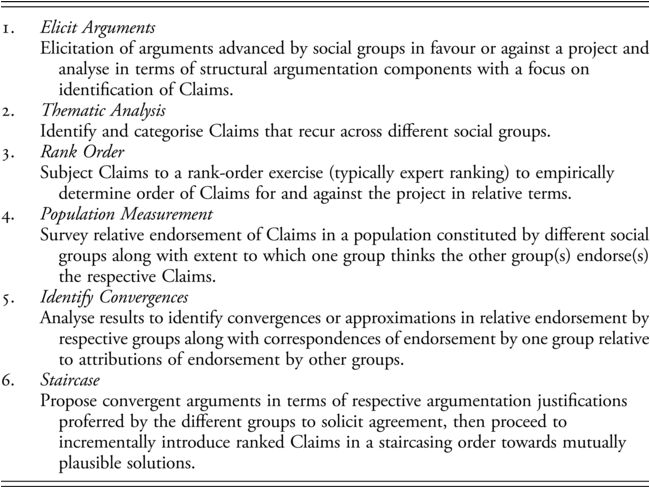
Table 10.1 Long description
The table lists the following.
1. Elicit Arguments.
Elicitation of arguments advanced by social groups in favour or against a project and analyse in terms of structural argumentation components with a focus on identification of Claims.
2. Thematic Analysis.
Identify and categorise Claims that recur across different social groups.
3. Rank Order.
Subject Claims to a rank-order exercise, typically expert ranking, to empirically determine order of Claims for and against the project in relative terms.
4. Population Measurement.
Survey relative endorsement of Claims in a population constituted by different social groups along with extent to which one group thinks the other groups endorses the respective Claims.
5. Identify Convergences.
Analyse results to identify convergences or approximations in relative endorsement by respective groups along with correspondences of endorsement by one group relative to attributions of endorsement by other groups.
6. Staircase.
Propose convergent arguments in terms of respective argumentation justifications proferred by the different groups to solicit agreement, then proceed to incrementally introduce ranked Claims in a staircasing order towards mutually plausible solutions.
Conclusion
The resolution of conflict that is rooted in different interests and aspirations requires a reconciliatory effort that avoids rewarding one group at the expense of another. Whilst a mutually satisfactory solution may not be evident, the empirical exploration of particular group projects and the social representations that are fashioned in their support may reveal convergences across conflicting groups that, if pursued in ecologically sensitive ways, may open up a window onto mutually satisfactory outcomes. This chapter has proposed an empirically based method for conflict resolution that is based on the investigation of social representations that are rooted in particular projects that grant individuals identity. The sobering reality of various age-old intractable conflicts across the globe (Bar-Tal, Reference Bar-Tal2000) provides a stark warning against highly optimistic silver-bullet solutions based on limited success. More likely, there is no one-size-fits-all approach to conflict resolution. A more realistic aspiration seems to be the installation of reconciliatory projects in themselves (Nicholson, Reference Nicholson2016, Reference Nicholson2019), faithful to the diverse contexts involved as well as to the grievances and animosities perpetrated in the past. This chapter has articulated a method for pursuing a reconciliatory ends based in processes of social identification and social representation (Sammut, Andreouli, Gaskell & Valsiner, Reference Sammut, Andreouli, Gaskell and Valsiner2015). The effort, aside from an empirically based procedure, requires the implementation of a strategy for shifting common sense and changing social representations for the future (Sammut & Bauer, Reference Sammut and Bauer2021). However daunting, the enterprise remains in any case preferable to the alternative of settling for long-standing and seemingly inevitable discord.

 Open access