


According to clinical lore, the combination of antidepressants and psychotherapy is preferable to psychotherapy alone in the treatment of depression. However, this view is not corroborated by empirical evidence. We found seven studies addressing this issue. Keller et al (Reference Keller, McCullough and Klein2000), Blackburn et al (Reference Blackburn, Bishop and Glen1981) and Weissman et al (Reference Weissman, Prushoff and Dimascio1979) reported a superior efficacy of combined therapy. On the other hand, Thase et al (Reference Thase, Greenhouse and Frank1997), Hollon et al (Reference Hollon, Shelton and Davis1993), Beck et al (Reference Beck, Hollon and Young1985) and Murphy et al (Reference Murphy, Simons and Wetzel1981) reported equal efficacy of the treatments. Thase et al (Reference Thase, Greenhouse and Frank1997), who found no difference in their total group, specified that combined therapy was more efficacious than psychotherapy only when the depression was severe. This paper reports the results of a trial comparing the 6-month efficacy of psychotherapy with that of combined therapy in patients with major depressive disorder of mild or moderate severity, defined according to DSM–IV criteria (American Psychiatric Association, 1994). The study is part of the long-term Depression Research Project of the Mentrum Mental Health Organisation, which studies the relative value of pharmacotherapy, psychotherapy and combined therapy in depression (Reference de Jonghe, Kool and Aalstde Jonghe et al, 2001; Reference Kool, Dekker and DuijsensKool et al, 2003).
METHOD
Sample
The study sample consisted of all consecutive patients newly registered during a 3-year period at two out-patient clinics of the Mentrum Mental Health Organisation in Amsterdam. Mentrum is a large psychiatric facility with several in-patient and out-patient clinics, covering a third of the population of Amsterdam, mainly the inner city. The inclusion criteria were age 18–65 years, DSM–IV major depressive disorder with or without dysthymia, a baseline score on the 17-item Hamilton Rating Scale for Depression (HRSD; Reference HamiltonHamilton, 1967) of 12–24 points, and written informed consent. Patients were excluded if they had a psycho-organic disorder, drug misuse, a psychotic disorder or a dissociative disorder; if they were considered too unreliable to participate in a clinical trial (e.g. ‘doctor shopping’); if they could not participate in the trial owing to a serious communicative problem (e.g. language barrier) or physical restrictions (e.g. the patient will soon leave the country); if any of the antidepressants prescribed by the pharmacotherapy protocol was contra-indicated; if the patient was treated adequately with antidepressants during the present depressive episode; if they used psychotropic medication other than drugs prescribed by the pharmacotherapy protocol; and if they were wishing to become pregnant. Patients were also excluded if they were considered by the psychiatrist to be ‘too ill’ or ‘too suicidal’ (e.g. hospitalisation is unavoidable) to participate in a clinical trial.
The flow of the patients through the first stages of the trial is shown in Fig. 1.
Flow of participants through the first stages of the randomised trial. HRSD, Hamilton Rating Scale for Depression.

The application of these criteria, other than the HRSD baseline scores, to 4035 newly registered out-patients selected 372 patients. Of these, 69 patients (18%) were excluded because of an HRSD baseline score lower than 12 points, and 70 (19%) because of a score higher than 24 points, leaving 233 patients who were asked to consent to randomisation. This means that, apart from other criteria, nearly a quarter of the patients presenting with a major depressive episode and an HRSD baseline score of at least 12 points were excluded because of the severity of their illness. The inclusion and exclusion criteria are the usual ones in clinical pharmacotherapy research. In regard to psychotherapy, no selection criterion was applied. Factors such as ego strength, introspection, psychological-mindedness or verbal abilities were not taken into account. After a complete description of the study to the patients, written informed consent was obtained. After randomisation, 17 patients refused the allocated intervention (see results).
Study design
This 6-month trial had a randomised, parallel group design. It was preceded by a 2-week period in which the diagnosis was assessed by means of a semi-structured interview (Reference Huyser, Jonghe and JonkersHuyser et al, 1996), the inclusion and exclusion criteria were checked, and the baseline assessments were made. This period was used, if necessary, as a drug wash-out period (without placebo). A 6-month follow-up after the end of the trial is intended.
All patients were treated by experienced psychodynamic psychotherapists or by residents who were supervised once a week. The psychotherapy provided was Short Psychodynamic Supportive Psychotherapy (SPSP), a draft of which is available – in Dutch – from the authors upon written request. It is based on the principles enunciated by, among others, Werman (Reference Werman1984), Strupp & Binder (Reference Strupp and Binder1984), Rockland (Reference Rockland1989) and de Jonghe et al (Reference de Jonghe, Rijnierse and Janssen1994). It consists of up to 16 sessions delivered within a 6-month period. Termination of the therapy in fewer sessions, if there is agreement between patient and therapist, is allowed. All psychotherapy sessions in the trial were audiotaped. The therapists met weekly for an hour-long discussion of their tapes; F.deJ., a fully trained psychoanalyst who formulated the guidelines for SPSP, participated in most of these meetings, listening to several tapes for each of the psychotherapists, and was especially attentive to the adherence to the manual.
In the combined therapy condition the psychotherapy started within 2 weeks of the start of pharmacotherapy. All patients receiving combined therapy were given, in addition to SPSP, antidepressant medication prescribed according to the protocol set out in the Appendix. The intended medication period was 6 months. The protocol provides for four consecutive steps to allow for intolerance or inefficacy. The first step is the prescription of the serotonin–noradrenaline reuptake inhibitor venlafaxine. Depending on the patient's response, this therapy continues at the same or an increased dosage, or the patient is switched to step 2, in which a selective serotonin reuptake inhibitor (SSRI) is substituted (for details, see Appendix). In the event of SSRI intolerance or inefficacy, the medication is changed to the tricyclic antidepressant nortriptyline in step 3, and if this too is inefficacious, lithium is added to step 4. The sequence in this protocol is arbitrary, but not unfounded. Venlafaxine is an efficacious and safe antidepressant with a relatively mild side-effect profile. In lower dosage it acts as an SSRI, at higher dosage it also acts as a noradrenaline reuptake inhibitor (Reference Harvey, Rudolph and PreskornHarvey et al, 2000). Nortriptyline is less safe and presents burdensome side-effects, but its efficacy is undisputed. Lithium addition is the best-studied addition procedure (for augmenting tricyclic antidepressant therapy). The psychiatrist makes eight follow-up appointments of 15 min each with the patient, the first four at 2-week intervals, the last four at monthly intervals. If considered necessary by the psychiatrist, e.g. when medication change is required, additional appointments are permitted. The task of the psychiatrist is to provide pharmacotherapy and clinical management. The latter consists of psycho-education, discussing the effects and side-effects of medication, motivating the patient to comply with the medication regimen, and providing practical and emotional support.
Outcome measures
Efficacy was defined by intra- and inter-group differences at several assessment points. The principal outcome measure was the difference between the assessments at baseline and those at week 24. The primary instrument was the 17-item Hamilton Rating Scale for Depression (HRSD; Reference HamiltonHamilton, 1967), rated by three independent observers, using a semi-structured interview (Reference de Jonghede Jonghe, 1994; Reference Kupka, de Jonghe and KoeterKupka et al, 1996). The reliability of these raters’ assessments was established before the study began and during the study they discussed their audiotaped assessments monthly with one of the authors (F.deJ.). Although the patients and the treating physicians were not masked to randomisation, the raters were not informed about the treatment condition and were instructed to restrict themselves to discussion of the HRSD items only. The magnitude of the differences is expressed in effect sizes. Efficacy is also expressed in success rates. Success (remission) is defined as an HRSD final score of 7 points or less.
The second instrument used was the Clinical Global Impression (CGI; Reference GuyGuy, 1976), both of severity (CGI–S) and of improvement (CGI–I). Assessments were made by the treating clinicians. The third instrument was a self-rating scale: the Depression sub-scale of the Symptom Checklist 90 (SCL–D; Reference Arrindell and EttemaArrindell & Ettema, 1986). Success according to these instruments was defined as a final score of 1–2 on the CGI–S or CGI–I, and as an improvement of at least 1 standard deviation on the SCL–D. In short, efficacy assessments were based on data drawn from three sources: the treating clinicians, the patients and independent observers. The assessments were made at weeks 4, 8, 12 and 24.
At each assessment 17 somatic complaints, whether or not related to therapy, were systematically inquired about and rated on a five-point scale (1, absent; 5, extreme). These complaints were nausea, headache, diarrhoea, constipation, dizziness, dry mouth, skin anomalies, eye problems, excessive sweating, drowsiness, shaking or trembling, loss of libido, fever, weight gain, weight loss, loss of appetite and ‘other complaints’. Scores 1 and 2 were subsequently converted to 0 (absent) and scores 3, 4 and 5 to 1 (present), before calculating a mean score for each treatment group.
Statistical analysis
Analysis of covariance (ANCOVA), including the initial measures as covariants, and multivariate analyses of variance (MANOVA) were used to test intra-group and inter-group differences. In addition, one-group pre–post effect sizes and comparative effect sizes (Cohen's d; Reference CohenCohen, 1988) were calculated as the standard difference between two means, using the pooled standard deviation as denominator (Reference Rosnow and RosenthalRosnow & Rosenthal, 1996). Pearson chi-squared calculations (two-sided, level of significance P<0.05) were used to compare refusal rates, base rates, withdrawal rates, success rates and somatic complaints; analysis of variance was used to compare mean age, total number of somatic complaints and psychotherapy sessions. Finally, using the HRSD remission rates and the SCL–D success rates, Kaplan–Meier survival estimates were calculated, and the curves obtained were compared using the log-rank test to take into account both the rate of remission and the time needed to achieve remission.
Our main results were calculated in a per protocol sample, which consists of all patients who started with the treatment they were allotted to. Secondary results were calculated in an intention-to-treat sample, which consisted of all randomised patients. In both of these samples the ‘last observation carried forward’ method was applied. Secondary results were also calculated in an observed-cases sample, which consisted of all patients who completed the treatment, and in this sample only the observed data were used.
Patients were considered to have withdrawn from pharmacotherapy if they stopped taking medication for any reason, or experienced no benefit after the four treatment steps in the protocol. Patients were considered to have withdrawn from psychotherapy if they stopped attending the sessions without the agreement of their therapist, but not if therapy was terminated before session 16 or before week 24 by mutual agreement. Patients randomised to the combined therapy condition could withdraw from both aspects of treatment.
At the start of the study, we expected a recovery rate difference of about 15%, with a success rate about 65% in the combined condition and 50% in the psychotherapy condition. Based on 0.75 power to detect a significant difference (P=0.05, one-sided), the intention was to involve about 200 participants in the study (100 in each condition).
RESULTS
A total of 208 participants were assigned to psychotherapy (n=107) or combined therapy (n=101) using block randomisation. Four blocks were formed, defined by gender and age. Of the randomised patients, 17 refused the proposed treatment: one in the psychotherapy group and 16 in the combined therapy group (χ2=15.30, d.f.=1; P<0.001). Almost all of those refusing the combined therapy objected to taking medication rather than the psychotherapeutic aspect. There was no significant difference between those who refused and those who accepted the proposed treatment, whether in clinical variables, psychiatric history or demographic characteristics.
The characteristics of the 191 patients in the per protocol sample are given in Table 1. Their mean age was 35.5 years (s.d.=10.7). There was no significant difference between the two treatment conditions, except that psychiatric treatment during the current episode was more frequent in the psychotherapy group (χ2=3.90, d.f.=1; P=0.048). The psychotherapy withdrawal rates are shown in Table 2. Three-quarters of the patients in the psychotherapy condition and 84% in the combined therapy condition terminated their psychotherapy with the agreement of their therapist; this difference is not statistically significant. These patients had a mean of 13 psychotherapy sessions in both treatment conditions.
Characteristics of the per protocol study sample

| Psychotherapy (n=106) | Combined therapy (n=85) | Total (n=191) | |
|---|---|---|---|
| Gender, % | |||
| Male | 33.0 | 32.9 | 33.0 |
| Female | 67.0 | 67.1 | 67.0 |
| Age (years), % | |||
| 19–29 | 34.9 | 34.1 | 34.6 |
| 30–39 | 34.0 | 35.3 | 34.6 |
| 40–49 | 17.9 | 18.8 | 18.3 |
| 50–59 | 10.4 | 7.1 | 8.9 |
| 60–65 | 2.8 | 4.7 | 3.7 |
| Marital status, % | |||
| Married | 18.4 | 25.9 | 21.8 |
| Divorced | 5.8 | 2.4 | 4.3 |
| Widowed | 1.0 | 1.2 | 1.2 |
| Never married | 73.8 | 70.6 | 72.3 |
| Other | 1.0 | 0.5 | |
| Educational level, % | |||
| Low | 13.7 | 12.9 | 13.4 |
| Intermediate | 35.3 | 42.4 | 38.5 |
| High | 51.0 | 44.7 | 48.1 |
| Living situation, % | |||
| Living with at least one person | 51.5 | 61.2 | 55.9 |
| Living alone | 46.6 | 38.8 | 43.1 |
| Other | 1.9 | 1.1 | |
| Job status, % | |||
| Job | 43.1 | 42.4 | 42.8 |
| On sickness benefit | 31.4 | 24.7 | 28.3 |
| Social security benefit | 7.8 | 7.1 | 7.5 |
| Disability benefit | 5.9 | 7.1 | 6.4 |
| Student | 6.9 | 5.9 | 6.4 |
| Other | 4.9 | 12.9 | 8.6 |
| Duration of present episode (years), % | |||
| <1 | 73.5 | 74.7 | 74.0 |
| 1–2 | 11.2 | 10.7 | 11.0 |
| > 2 | 15.3 | 14.7 | 15.0 |
| Psychiatric treatment during present episode, % | |||
| Not treated | 73.7 | 85.9 | 79.1 |
| Treated | 26.3 | 14.1 | 20.9 |
| Medication 3 months before study, % | |||
| No medication | 76.5 | 78.2 | 77.3 |
| Medication | 23.5 | 21.8 | 22.7 |
| Depressed episodes in past 5 years, % | |||
| 0 | 68.8 | 69.2 | 69.0 |
| 1 | 17.7 | 11.5 | 14.9 |
| 2 | 13.5 | 15.4 | 14.4 |
| ≥ 3 | 3.8 | 1.7 | |
| HRSD score | |||
| Mean (s.d.) | 18.14 (3.37) | 17.99 (3.57) | 18.07 (3.45) |
| Median | 18.00 (4.43) | 18.00 (4.38) | 18.00 (4.41) |
| CGI–S score | |||
| Mean (s.d.) | 0.73 | 0.72 | 0.72 |
| Median | 4.00 | 4.00 | 4.00 |
| SCL–D score | |||
| Mean (s.d.) | 49.90 (8.87) | 48.96 (9.48) | 49.48 (9.14) |
| Median | 50.00 | 49.00 | 49.00 |
Psychotherapy withdrawal rates for both conditions

| Week | Withdrawal rate (%) | Pearson χ2 (2-sided) | P | |
|---|---|---|---|---|
| Psychotherapy (n=106) | Combined therapy (n=85) | |||
| 8 | 10 | 9 | 0.05 | 0.825 |
| 16 | 22 | 13 | 2.47 | 0.116 |
| 24 | 25 | 16 | 2.27 | 0.132 |
Pharmacotherapy withdrawal rates are shown in Table 3. The rate was less than 10% after 8 weeks, but climbed to 35% at week 24.
Pharmacotherapy compliance and withdrawal rates for the combined therapy condition (n=85)

| Week | Patients taking medication (%) | Withdrawal rate (%) | |||
|---|---|---|---|---|---|
| Venlafaxine | SSRI | Nortriptyline | Lithium addition | ||
| 4 | 91 | 5 | 0 | 0 | 5 |
| 8 | 80 | 7 | 4 | 0 | 9 |
| 12 | 72 | 7 | 2 | 0 | 19 |
| 16 | 67 | 7 | 2 | 0 | 24 |
| 20 | 62 | 6 | 2 | 1 | 28 |
| 24 | 58 | 6 | 1 | 0 | 35 |
Table 4 presents the efficacy results, expressed in mean HRSD, CGI and SCL scores. Intra-group differences between baseline and week-24 assessments are statistically significant in both treatment conditions for both the per protocol and observed-cases samples. Inter-group differences at week 24 are statistically significant (ANCOVA) in the per protocol sample according to the CGI–I (P<0.05) and the SCL–D (P<0.001). In the observed-cases sample, statistically significant inter-group differences at week 24 are shown by the HRSD (P<0.046) and the SCL–D (P<0.001). In the intention-to-treat sample no difference between the two treatment groups was found at any point by any assessment method (according to the Bonferroni-adjusted P value).
Scores on the four outcome measures, and test results (analysis of covariance)

| Week | Psychotherapy | Combined therapy | F | P | |||||
|---|---|---|---|---|---|---|---|---|---|
| Mean | s.d. | n | Mean | s.d. | n | ||||
| Per protocol sample | |||||||||
| HRSD | 1 | 18.14 | 3.37 | 106 | 17.99 | 3.57 | 85 | ||
| 4 | 15.74 | 5.30 | 106 | 14.81 | 5.15 | 85 | 1.39 | 0.241 | |
| 8 | 13.73 | 5.95 | 106 | 12.73 | 6.36 | 85 | 1.15 | 0.284 | |
| 12 | 13.07 | 5.73 | 106 | 11.28 | 6.47 | 85 | 4.02 | 0.046 | |
| 24 | 11.35 | 7.13 | 106 | 9.53 | 6.93 | 85 | 3.04 | 0.083 | |
| CGI–S | 1 | 4.43 | 0.73 | 101 | 4.38 | 0.72 | 79 | ||
| 4 | 3.50 | 1.05 | 106 | 3.33 | 1.14 | 85 | 0.20 | 0.656 | |
| 8 | 2.84 | 1.11 | 106 | 2.54 | 1.24 | 85 | 1.40 | 0.238 | |
| 12 | 2.58 | 1.19 | 106 | 2.31 | 1.25 | 85 | 1.01 | 0.315 | |
| 24 | 2.15 | 1.28 | 106 | 1.80 | 1.23 | 85 | 2.26 | 0.134 | |
| CGI–I | 4 | 3.18 | 0.83 | 98 | 2.84 | 0.82 | 82 | 7.40 | 0.007 |
| 8 | 2.60 | 0.94 | 102 | 2.35 | 1.01 | 83 | 2.94 | 0.088 | |
| 12 | 2.36 | 1.06 | 102 | 2.12 | 1.03 | 83 | 2.26 | 0.134 | |
| 24 | 2.07 | 1.24 | 102 | 1.72 | 1.03 | 83 | 3.88 | 0.050 | |
| SCL–D | 1 | 49.90 | 8.87 | 103 | 48.96 | 9.48 | 83 | ||
| 4 | 45.19 | 11.94 | 106 | 40.48 | 12.00 | 84 | 8.81 | 0.003 | |
| 8 | 39.56 | 12.57 | 106 | 36.29 | 13.06 | 84 | 3.23 | 0.074 | |
| 24 | 36.91 | 13.91 | 106 | 30.50 | 12.30 | 84 | 10.87 | 0.001 | |
| Observed-cases sample | |||||||||
| HRSD | 1 | 18.14 | 3.37 | 106 | 17.99 | 3.57 | 85 | ||
| 4 | 15.48 | 5.39 | 94 | 14.52 | 5.06 | 81 | 1.12 | 0.291 | |
| 8 | 13.41 | 5.98 | 95 | 12.12 | 6.17 | 73 | 1.47 | 0.227 | |
| 12 | 12.74 | 5.54 | 85 | 10.20 | 6.16 | 66 | 6.95 | 0.009 | |
| 24 | 10.84 | 7.40 | 75 | 8.40 | 6.67 | 65 | 4.06 | 0.046 | |
| CGI–S | 1 | 4.43 | 0.73 | 101 | 4.38 | 0.72 | 79 | ||
| 4 | 3.33 | 1.08 | 81 | 3.29 | 1.14 | 70 | 0.10 | 0.749 | |
| 8 | 2.71 | 1.11 | 77 | 2.46 | 1.13 | 63 | 1.21 | 0.274 | |
| 12 | 2.42 | 1.13 | 65 | 2.16 | 1.22 | 50 | 0.69 | 0.409 | |
| 24 | 1.86 | 1.10 | 43 | 1.46 | 0.84 | 46 | 3.56 | 0.063 | |
| CGI–I | 4 | 3.10 | 0.83 | 81 | 2.79 | 0.78 | 70 | 5.27 | 0.023 |
| 8 | 2.51 | 0.94 | 77 | 2.32 | 0.96 | 63 | 1.35 | 0.247 | |
| 12 | 2.26 | 1.00 | 65 | 2.08 | 1.05 | 50 | 0.81 | 0.371 | |
| 24 | 1.74 | 1.00 | 43 | 1.48 | 0.72 | 46 | 1.74 | 0.191 | |
| SCL–D | 1 | 49.90 | 8.87 | 103 | 48.96 | 9.48 | 83 | ||
| 4 | 44.00 | 11.59 | 92 | 39.85 | 11.87 | 80 | 6.60 | 0.011 | |
| 8 | 38.53 | 11.89 | 94 | 35.46 | 12.65 | 72 | 3.50 | 0.063 | |
| 24 | 34.00 | 13.91 | 73 | 27.68 | 10.76 | 62 | 13.30 | <0.001 | |
As we calculated P separately for each time point and outcome in this table, a Bonferroni correction seems prudent. With 15 assessments in each sample and a mean intercorrelation of about 0.4 between the assessments, a probability of about 0.01 is more accurate, in which case only the difference in SCL–D scores in this table is relevant. This is also the case with the MANOVA analyses: only the SCL–D score shows significant inter-group differences (F=4.32, d.f.=1; P=0.008). Table 5 presents the efficacy results in the per protocol sample, expressed in effect sizes.
Effect sizes in the per protocol sample

| One-group pre–post effect size | Comparative effect size | ||
|---|---|---|---|
| Psychotherapy | Combined therapy | ||
| HRSD | 1.22 | 1.53 | 0.26 |
| CGI–S | 2.19 | 2.56 | 0.28 |
| CGI–I | NA | NA | 0.31 |
| SCL–D | 1.11 | 1.68 | 0.49 |
Table 6 presents the efficacy results, expressed in success rates. In the per protocol sample, the success rates at week 24 vary between 32% and 69% in the psychotherapy condition, and between 42% and 79% in the combined therapy condition. If CGI success is defined as a score of 1 or 2 on either the severity or the improvement scale, the success rates at week 24 rise to 73% for psychotherapy and to 81% for combined therapy. Statistically significant excess success rates at week 24 are shown by the SCL–D in both samples (with P values close to the Bonferroni-adjusted value of 0.01), and in neither sample by the other scales.
Success rates on the four outcome measures

| Week | Psychotherapy | Combined therapy | Total sample | Pearson χ2 (2-sided) | P | ||||
|---|---|---|---|---|---|---|---|---|---|
| % | n | % | n | % | n | ||||
| Per protocol sample | |||||||||
| HRSD remission | 4 | 9.4 | 106 | 5.9 | 85 | 7.9 | 191 | 0.82 | 0.365 |
| 8 | 17.9 | 106 | 22.4 | 85 | 19.9 | 191 | 0.58 | 0.446 | |
| 12 | 17.9 | 106 | 27.1 | 85 | 22.0 | 191 | 2.29 | 0.130 | |
| 24 | 32.1 | 106 | 42.4 | 85 | 36.6 | 191 | 2.15 | 0.143 | |
| CGI–S success | 4 | 19.8 | 106 | 22.4 | 85 | 20.9 | 191 | 0.18 | 0.668 |
| 8 | 42.5 | 106 | 52.9 | 85 | 47.1 | 191 | 2.08 | 0.149 | |
| 12 | 49.1 | 106 | 63.5 | 85 | 55.5 | 191 | 4.00 | 0.045 | |
| 24 | 67.0 | 106 | 75.3 | 85 | 70.7 | 191 | 1.57 | 0.210 | |
| CGI–I success | |||||||||
| 4 | 17.0 | 106 | 30.6 | 85 | 23.0 | 191 | 4.93 | 0.026 | |
| 8 | 45.3 | 106 | 56.5 | 85 | 50.3 | 191 | 2.36 | 0.124 | |
| 12 | 56.6 | 106 | 68.2 | 85 | 61.8 | 191 | 2.70 | 0.100 | |
| 24 | 68.9 | 106 | 78.8 | 85 | 73.3 | 191 | 2.39 | 0.122 | |
| SCL–D success | 4 | 29.1 | 103 | 50.6 | 83 | 38.7 | 186 | 8.94 | 0.003 |
| 8 | 51.5 | 103 | 68.7 | 83 | 59.1 | 186 | 5.64 | 0.018 | |
| 24 | 60.2 | 103 | 77.1 | 83 | 67.7 | 186 | 6.02 | 0.014 | |
| Observed-cases sample | |||||||||
| HRSD remission | 4 | 10.6 | 94 | 6.2 | 81 | 8.6 | 175 | 1.11 | 0.293 |
| 8 | 18.9 | 95 | 23.3 | 73 | 20.8 | 168 | 0.47 | 0.492 | |
| 12 | 17.6 | 85 | 31.8 | 66 | 23.8 | 151 | 4.11 | 0.043 | |
| 24 | 34.7 | 75 | 50.8 | 65 | 42.1 | 140 | 3.70 | 0.054 | |
| CGI–S success | 4 | 24.7 | 81 | 24.3 | 70 | 24.5 | 151 | 0.00 | 0.954 |
| 8 | 48.1 | 77 | 55.6 | 63 | 51.4 | 140 | 0.78 | 0.377 | |
| 12 | 53.8 | 65 | 70.0 | 50 | 60.9 | 115 | 3.10 | 0.078 | |
| 24 | 76.7 | 43 | 87.0 | 46 | 82.0 | 89 | 1.57 | 0.210 | |
| CGI–I success | 4 | 21.0 | 81 | 34.3 | 70 | 27.2 | 151 | 3.36 | 0.067 |
| 8 | 50.6 | 77 | 61.9 | 63 | 55.7 | 140 | 1.78 | 0.182 | |
| 12 | 61.5 | 65 | 74.0 | 50 | 67.0 | 115 | 1.98 | 0.159 | |
| 24 | 81.4 | 43 | 91.3 | 46 | 86.5 | 89 | 1.87 | 0.171 | |
| SCL–D success | 4 | 33.7 | 89 | 53.2 | 79 | 42.9 | 168 | 6.47 | 0.011 |
| 8 | 54.9 | 91 | 73.6 | 72 | 63.2 | 163 | 6.02 | 0.014 | |
| 24 | 66.2 | 71 | 85.2 | 61 | 75.0 | 132 | 6.35 | 0.012 | |
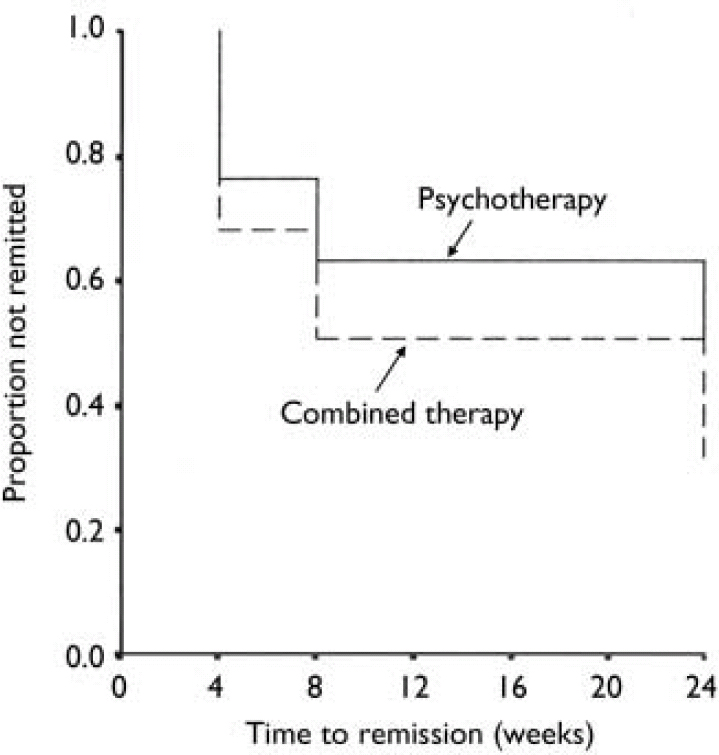
An overview of the main results is presented in Table 7. In the intention-to-treat sample no difference between the two treatment groups was found at any moment by any assessment method (according to the Bonferroni-adjusted P value). The Kaplan–Meier survival curves for the two treatment groups (of the per protocol sample) in terms of HRSD remission and SCL–D success are shown in Figs 2 and 3.
Kaplan–Meier survival curves of remission on the Hamilton Rating Scale for Depression in the per protocol sample.

Kaplan–Meier survival curves of success on the Symptom Checklist – Depression in the per protocol sample.
Statistical significance of inter-group differences at week 24

| Differences in mean scores | Differences in success rates | |||
|---|---|---|---|---|
| Per protocol | Observed cases | Per protocol | Observed cases | |
| HRSD | NS | P=0.046 | NS | NS |
| CGI-S | NS | NS | NS | NS |
| CGI-I | P=0.050 | NS | NS | NS |
| SCL-D | P=0.001 | P<0.001 | P=0.014 | P=0.012 |
In analysis of the Kaplan–Meier survival estimates based on the HRSD, the mean time needed to achieve remission was 138 days in the psychotherapy group and 129 days in the combined therapy group. There is no significant difference between the two treatment groups in the distribution of time to remission (log rank=2.39, d.f.=1, P=0.122). In the estimates based on the SCL–D the mean time needed to achieve success was 120 days in the psychotherapy group and 104 days in the combined therapy group. From week 4 on, the differences between the two treatment groups are significant (log rank=5.30, d.f.=1, P= 0.021). In both treatment groups, somatic complaints decreased between the baseline and end-point assessments. No statistically significant inter-group difference between the mean scores of somatic complaints was found at any assessment point. As far as individual items are concerned, 6 of the 17 complaints were significantly more frequent in one of the two treatment conditions: dry mouth and excessive sweating in combined therapy, and headache, nausea, trembling or shaking and ‘other complaints’ in psychotherapy.
Follow-up data on this study sample are still being gathered.
DISCUSSION
Sample selection
The inclusion and exclusion criteria applied in this study led to selection bias: our study population was restricted to ambulatory patients presenting with a major depressive disorder of mild or moderate severity and, in 75% of cases, a duration of less than 2 years. Nearly a quarter (23%) of potentially eligible patients were excluded on account of an HRSD baseline score of 25 points or more. This means that our results may be cautiously generalised, as far as severity is concerned, to 77% of the patients registered at our out-patient clinics with a major depressive disorder and an HRSD baseline score of 12 points or more.
Study design
Our study addresses the pragmatic question of the differential clinical utility of two fully realised treatment packages, both representative of actual clinical practice. To preserve external validity, limits were set to scientific rigour; there was no psychotherapy plus placebo condition, nor an antidepressant plus sham psychotherapy condition. The treating clinician emphasised to patients the importance of compliance, but there was no pill count nor plasma level confirmation. Our study did not address questions about therapeutic factors.
The randomisation in our study appears successful. However, there is one statistically significant difference between the treatment conditions, and it is one that possibly disadvantaged the psychotherapy arm: more patients in the psychotherapy condition (26%) than in the combined therapy condition (14%) had undergone a psychiatric treatment during the present episode, apparently to no avail, before entering the trial.
Acceptability
More patients (99%) agreed to receive psychotherapy than agreed to combined therapy (84%). The fact that many depressed patients refused pharmacotherapy comes as no surprise; it is a daily problem in clinical practice.
Feasibility
The feasibility of a 6-month course of psychotherapy is fair. That the mean number of actual sessions was less than 16 was foreseen, and is explicable; patients and therapists go on holiday, and sometimes they get influenza. More importantly, it is not unusual for patient and therapist to agree that a course of fewer than 16 sessions is enough. To nobody's surprise, 25% of the patients in the psychotherapy condition broke off their therapy. Interestingly, only 16% did so in the combined therapy group. The difference is not statistically significant, but at least we can say that adding pharmacotherapy to psychotherapy is not detrimental to the feasibility of the latter.
The feasibility of 2 months of anti-depressant therapy, in our study combined with psychotherapy, is fair: after 8 weeks less than 10% of the patients had abandoned treatment. Long-term feasibility is poor; nevertheless, after 20 weeks less than 30% of patients had withdrawn from the study. This result is above expectation; in antidepressant research a drop-out rate up to 30% after 4–6 weeks of treatment is generally considered acceptable. Adding psychotherapy to pharmacotherapy seems to improve the feasibility of the latter treatment. On the other hand, after 24 weeks of treatment only 65% of the patients were still taking antidepressants. Again, this accords with general research findings: poor compliance is a major problem in any long-term medical treatment.
Efficacy
Statistically significant and clinically relevant improvements between the baseline assessment and week 24 are shown on all instrument ratings in both treatment groups. The magnitude of the improvement is illustrated by the one group (pre–post) effect sizes (see Table 5). The effect sizes vary but they are all large (defined as 0.8 or more by Reference CohenCohen, 1988). In this context, the results of Lipsey & Wilson (Reference Lipsey and Wilson1993) are interesting: these authors reported that the mean one-group (pre–post) effect size of psychological interventions is 0.76 (45 meta-analyses). Another indicator of intra-group improvement is the success rates at week 24 (see Table 6). In both conditions they vary from moderate to large. These results corroborate the widely held view that combined therapy is an efficacious treatment of depression, and support the more controversial view that psychotherapy too (in this case SPSP) is an effective treatment of depression.
Statistically significant inter-group differences appear as early as week 4. However, the relevance of these data is limited. In 4 weeks SPSP has not yet had a fair chance to show its efficacy. Nobody expects psychotherapy to provide rapid results. The main results (HRSD scores at week 24 in the per protocol sample) do not demonstrate statistically significant differences between the treatment groups (Table 7). This result is corroborated by the facts that the comparative HRSD effect size is small and that the survival analysis does not indicate any superiority of combined therapy over pharmacotherapy. In contradistinction to this, the SCL–D scores do show, in both the per protocol sample and the completers sample, statistically significant and clinically relevant inter-group differences, all of which favour combined therapy over psychotherapy. The comparative SCL–D effect size is 0.49, a value considered medium by Cohen (Reference Cohen1988), and the survival analysis confirms the superiority of combined therapy. Thus, only the SCL–D consistently provides evidence supporting the view that combined therapy is more efficacious than psychotherapy alone. In a previous study (Reference de Jonghe, Kool and Aalstde Jonghe et al, 2001), in which we investigated the advantages of combined therapy over pharmacotherapy alone, we similarly found that it was the SCL–D, rather than the HRSD and the CGI, assessments that consistently demonstrated significant differences.
Different instruments combined with different definitions of success unsurprisingly result in different success rates. In addition, the emotional involvement of the observers differ: the HRSD scores determined by therapy-independent, assumedly more neutral raters, the CGI scores by probably more optimistic clinicians who were evaluating the treatment they provided, and the SCL–D scores by patients evaluating their own depression. The one-group pre–post effect sizes computed at week 24 in the total study group show that the clinician–CGI combination is considerably more optimistic than the patient–SCL–D or the observer–HRSD combinations. The latter two seem to agree quite well. The optimism of the clinician–CGI combination is also reflected in the fact that, if CGI success is defined as a score of 1 or 2 on either the severity or the improvement scale, the success rates at week 24 are 73% in the psychotherapy group and 81% in the combined therapy group. However, when it comes to possible differences in efficacy between the treatment conditions, the comparative effect sizes at week 24 show that it is the patients who detect a clinically meaningful difference, not the clinicians or the independent raters. The last finding is the more noteworthy, considering that Hamilton (Reference Hamilton1967) intended the HRSD to be an instrument suitable for the assessment of pharmacotherapy, and hence deliberately selected items he believed sensitive to antidepressant therapy.
Side-effects
Combining antidepressant therapy with psychotherapy does not increase the overall frequency of somatic complaints. Unsurprisingly, dry mouth and excessive sweating were more frequent in the combined therapy group, but the more frequent occurrence of headache, nausea, trembling or shaking and ‘other complaints’ in the psychotherapy group seems to be either a spurious or a mysterious finding.
Other relevant research
The paucity of studies investigating the relative value of psychotherapy and combined therapy in the treatment of depression is striking. We found only seven studies, five of which were published more than 10 years ago, addressing this issue in ambulatory psychiatric patients with major depressive disorder and assessing individual psychotherapy proper. Results are not only scarce, they are also conflicting. Three studies report the efficacy of combined therapy to be superior to that of psychotherapy, whereas four do not find a significant difference. In some respects our results seem to concur with those of Keller et al (Reference Keller, McCullough and Klein2000), Blackburn et al (Reference Blackburn, Bishop and Glen1981) and Weissman et al (Reference Weissman, Prushoff and Dimascio1979), who report a superior efficacy of combined therapy over psychotherapy. However, our main results seem to concur with those of Thase et al (Reference Thase, Greenhouse and Frank1997), Hollon et al (Reference Hollon, Shelton and Davis1993), Beck et al (Reference Beck, Hollon and Young1985) and Murphy et al (Reference Murphy, Simons and Wetzel1981), who report an equal efficacy of both forms of treatment. The main differences in design between the eight studies make comparisons precarious. The patients in our study sample were certainly less severely depressed than those studied by Keller et al (Reference Keller, McCullough and Klein2000), all of whom had chronic depression compared with 85% of our patients. Depression in our sample was probably less than in the ‘more severe’ subgroup and greater than in the ‘less severe’ subgroup studied by Thase et al (Reference Thase, Greenhouse and Frank1997), who found a significant difference in efficacy in their former subgroup. Another consideration is that the length of our study (24 weeks) was greater than that of the seven other studies. In addition, it may be mentioned that we studied both a per protocol and an observed-cases sample, that in our study the HRSD scores were assessed by an independent observer, not by the treating clinician, that we asked the opinion of the patient, and that we worked with experienced psychotherapists or intensively supervised residents.
Concluding remarks
In summary, we investigated the possible advantages of combining antidepressants with psychotherapy in ambulatory patients with mild to moderate major depressive disorder. We found that psychotherapy is more acceptable than combined therapy. The 6-month feasibility of psychotherapy was fair, that of combined therapy was poor. None the less, both therapies were efficacious in reducing the symptoms of depression. The advantages of combining antidepressants with SPSP appeared equivocal. Neither the treating clinicians nor the independent observers were able to ascertain them, but the patients experienced them clearly.
APPENDIX
Protocol for pharmacotherapy
Step 1
All patients start with the serotonin–noradrenaline reuptake inhibitor venlafaxine at a dosage of 75 mg per day. What happens afterwards depends on the duration of the treatment and the reaction of the patient (Table A1).
Protocol for patients started on venlafaxine at 75 mg/day

| Duration of treatment (weeks) | If the patient is... | |||
|---|---|---|---|---|
| Worse | Not better | Slightly better | Much better | |
| 1 | Switch1 | Maintain2 | Maintain | Maintain |
| 2 | Switch | 150 mg/day | Maintain | Maintain |
| 4 | Switch | Switch | 225 mg/day | Maintain |
| 6 | Switch | Switch | 300 mg/day | Maintain |
| 8 | Switch | Switch | Switch | Maintain |
Step 2
In case of venlafaxine intolerance or inefficacy, change the medication to a selective serotonin reuptake inhibitor (SSRI). Preference is given to fluoxetine or, as a second option, fluvoxamine. However, the choice can be influenced by the patient's preference or treatment history. The chosen SSRI is prescribed according to a specific guideline, different but comparable with that described in step 1 (further details available from the authors upon request).
Step 3
In case of SSRI intolerance or inefficacy, the medication is switched to nortriptyline, a tricyclic antidepressant, at a dosage of 50 mg per day. What happens afterwards depends on the duration of the treatment and the reaction of the patient (Table A2).
Protocol for patients switched to a selective serotonin reuptake inhibitor at 100 mg/day

| Duration of treatment (weeks) | If the patient is... | |||
|---|---|---|---|---|
| Worse | Not better | Slightly better | Much better | |
| 1 | Adapt1 | 100 mg/day | 100 mg/day | Maintain |
| 2 | Adapt | 150 mg/day | 150 mg/day | Maintain |
| 4 | Add3 | Adapt | Adapt | Maintain |
| 6 | (Failure)4 | Add | Add | Maintain |
| 8 | (Failure) | (Failure) | (Failure) | Maintain |
Step 4
In case of nortriptyline inefficacy, lithium is added. Plasma concentrations are maintained in the range 0.8–1.2 mmol/l.
Clinical Implications and Limitations
CLINICAL IMPLICATIONS
-
▪ Both psychotherapy and combined therapy (psychotherapy and antidepressants) are effective treatments of depression.
-
▪ The advantages of combining antidepressants with psychotherapy are equivocal.
-
▪ The preference of the patient may determine the choice between psychotherapy and combined therapy.
LIMITATIONS
-
▪ The study population was restricted to ambulatory patients presenting with a major depressive disorder of mild or moderate severity.
-
▪ The study period was limited to 24 weeks; follow-up data are not yet available.
-
▪ The study did not address questions about therapeutic factors.




eLetters
No eLetters have been published for this article.