


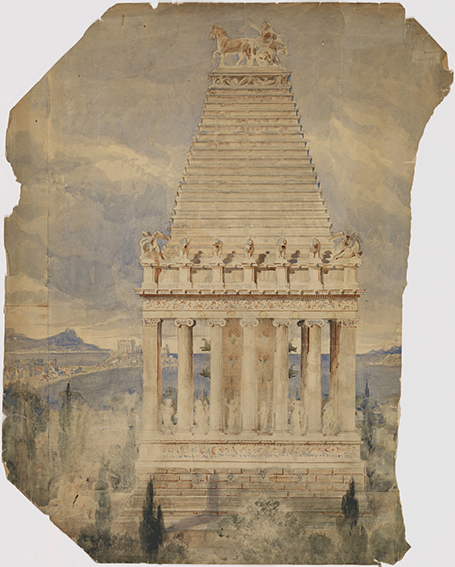
The Mausoleum at Halicarnassus has been an enthralling monument since its creation, yet its reception and afterlife have witnessed a large degree of variation over time.Footnote 1 The most comprehensive explorations of its historiography have defined the monument’s excavation as a pivotal moment, when the most dramatic changes took place in the perception and reconstruction of the Mausoleum.Footnote 2 British architect Charles Robert Cockerell (1788–1863) was listed by these authors as one of the before-excavation group, whose primary aim was to revise the existing historical record and present a visual interpretation of the Mausoleum. Yet, unlike his predecessors who could work only with textual sources from Antiquity, he had access to fragments of the monument that were uncovered and brought to London in 1846. While his attempts were thus among the very last reconstructions that could not make use of the measurements of the Mausoleum’s foundations established by Charles Newton in 1856–1857, they were simultaneously among the first that could rely on the study of some fragmentary remains of the building. Cockerell made several attempts at reconstruction drawings of the monument, both in sketches and watercolours.Footnote 3 He created a defining image of the Mausoleum (Fig. 14.1), and gave an account, in the Classical Museum (1848), of his interpretation of the newly identified fragments of bas-reliefs and carvings from Halicarnassus, which he connected to Pliny the Elder’s written record (Appendix i.iv).Footnote 4
Charles Robert Cockerell (late 1850s). [Mausoleum of Halicarnassus: Restoration Drawing ‘From the description of Pliny, and as in situ from the description of Vitruvius’], watercolour.
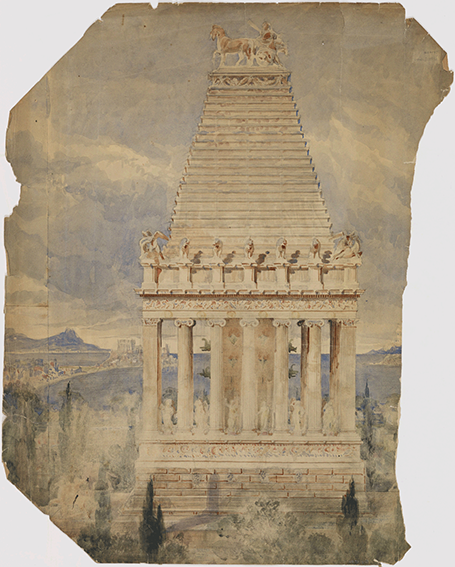
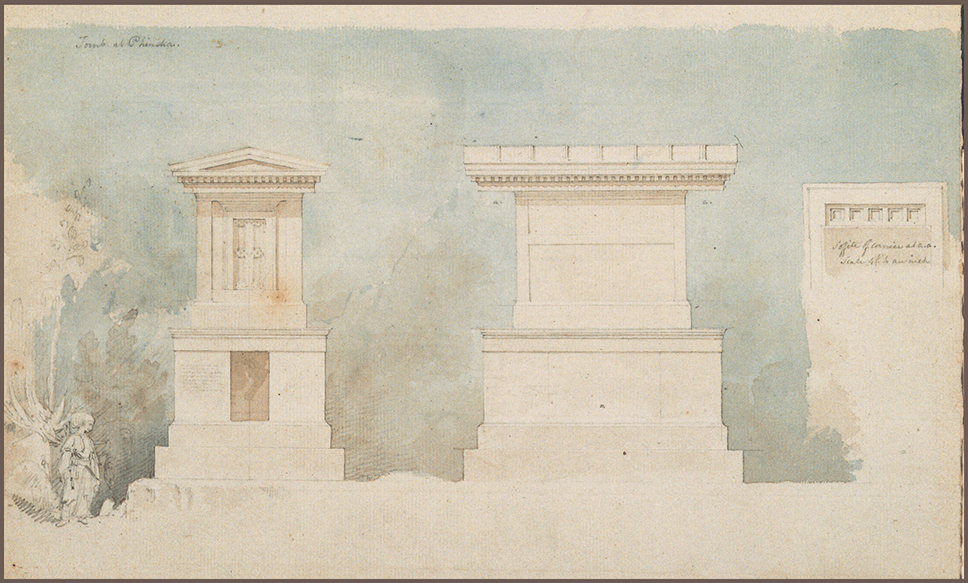
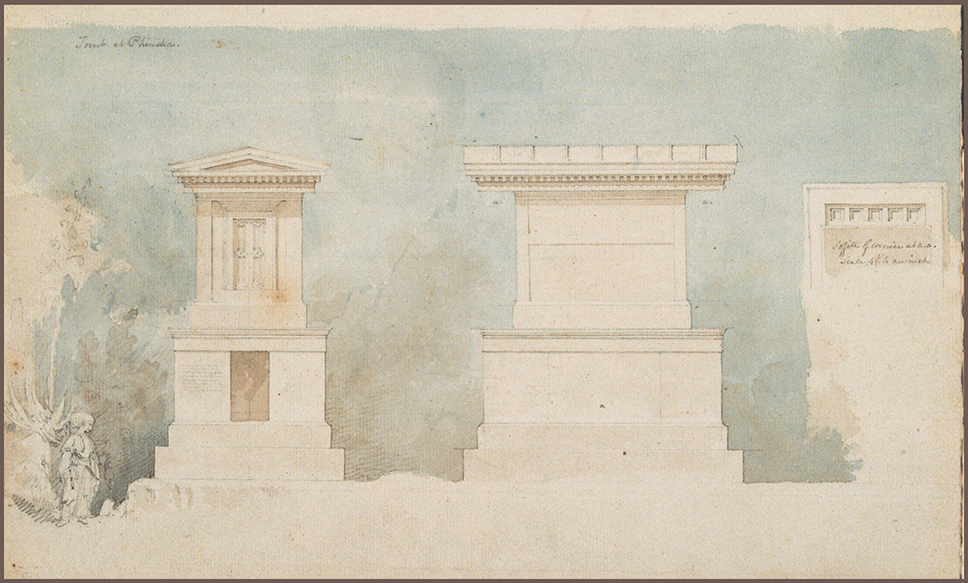
The present chapter draws from these nineteenth-century studies and examines Cockerell’s interpretation of the Mausoleum at Halicarnassus. It is proposed here that his methodology for reconstruction emerged from his meticulous examination of the classical architecture of Greece and Asia Minor, while on his Grand Tour during 1810–1817, whose purpose was to accurately remeasure the survey drawings previously published in Ionian Antiquities (1769 and 1797). He followed in the footsteps of the latter volume’s authors, Richard Chandler and Nicholas Revett, whose expedition to Greece and Asia Minor had been funded by the Society of Dilettanti and guided by indications from Robert Wood and Lord Charlemont.Footnote 5 Among the most important sources concerning Cockerell’s journey are his two grangerised copies of Ionian Antiquities (1767),Footnote 6 containing unpublished sketches and notes made by the architect during a tour of the kingdoms of Lycia and Caria – including the site of Halicarnassus – in 1812. These also contain essential information for understanding his later work on the Mausoleum: for instance, as will be shown, his watercolours of the latter monument (Fig. 14.1) drew much from his innovative set of blue and pink watercolour washes of Lycian tombs (Fig. 14.2).Footnote 7 More generally, Cockerell’s pursuit of correct admeasurements informed his architectural process, and he redefined architectural principles through his research on the different measurements of the orders of classical architecture, which enabled him to present the canon of ancient architectural detail and ornament, for use in contemporary neoclassical architecture.
Charles Robert Cockerell (1812 or later). Tomb at Phineka, watercolour.
C. R. Cockerell’s Contribution
A statue of Cockerell features among the British architects in the Architectura frieze section of George Gilbert Scott’s Albert Memorial in London (unveiled 1872):Footnote 8 this notable presence testifies to Cockerell’s position at the forefront of architectural design, indicating that he was recognised as one of the United Kingdom’s greatest architects during the nineteenth century.Footnote 9 Significantly, the same Parnassus frieze also contains figures of three of the sculptors who worked on the Mausoleum at Halicarnassus – Scopas, Leochares and Bryaxis – as well as a small model of the ancient monument itself, which, according to the official pamphlet describing the Albert Memorial, was based on a reconstruction by Cockerell.Footnote 10 This assertion is probably mistaken, since the low pyramidal roof of the miniature Mausoleum is far closer to reconstructions from the 1860s than to Cockerell’s steeper version, yet it reveals the high respect granted to his antiquarian expertise. Indeed, his experience in remeasuring Greek monuments provided the basis upon which he deduced several successive reconstructions of the Mausoleum in the 1840s and 50s. These combined the dimensions and proportions of the monument’s bas-relief sculptures, in London since 1846,Footnote 11 with an interpretation of Pliny the Elder’s written description. This union of ancient text and image in his research was part of Cockerell’s approach, both in practice and in theory, as he claimed in a comment on his first reconstruction of the Mausoleum: ‘my business, as an architect, is to adhere as nearly as possible to the received text as the programme of my restoration’.Footnote 12 The accuracy of the measurements provided a set of proportions and base-line measurements for his reconstruction, leading him to an interpretation of the monument’s scale based on the study of its construction details. The line of enquiry followed here will thus demonstrate Cockerell’s consistent quest for accuracy, his integration of existing published measurements, and his observation of decoration, in order to enable fact-based reconstructions.
Though the study of dimensions and proportions was one of the most significant endeavours of Cockerell’s Grand Tour, equally important to his later development was his extensive practice of draughtsmanship during the journey. His speculative watercolours of the Mausoleum (Fig. 14.1) from the late 1850s must be compared to works made either during or closely after his Mediterranean travels, especially when he was at Side and in the surrounding area around 1812, during a tour of the southern coast of Asia Minor on the Karamania ship with Sir Francis Beaufort (1774–1857).Footnote 13 A particularly compelling example, recalling the Mausoleum picture, is the large watercolour reconstruction of the Theatre at Laodicea ad Lycus in Cockerell’s own collection, coloured with use of light pink and blue.Footnote 14 Large-scale drawings such as these, predating the use of lantern slides in the classroom, were made for the purpose of educating students and informing architectural creation.Footnote 15 A description of Cockerell’s lecture technique is significant to note:
Two large sheets, or rather assemblage of sheets, were hung up, shewing in comparative juxtaposition most of the famous structures of antiquity, the one in elevation, the other in section … But there were others whose assemblage and lengthened treatment would make up volumes, some embodying the ingenious speculations of the professor, but, in the main, rigid and critical delineations of the buildings of the ancients from measurement.Footnote 16
Since Cockerell embraced the details and methodologies of Neoclassicism, referring to drawings from his Mediterranean travels for teaching constituted an assertion of architectural authority, allowing him to capture an image of Hellas and the ruins of Greece and Asia Minor which would inform style and taste. His extensive documentation was also beneficial to his career as a designer: when he returned to London in 1817, he established himself with a portfolio of ancient drawings and studies of antique monuments which enabled him to demonstrate a knowledge beyond that of his contemporaries, and from 1821 onwards, Cockerell was actively engaged in architectural projects making use of the orders.Footnote 17 He would eventually become Professor of Architecture at the Royal Academy (1840–1857).
During his Mediterranean travels with Beaufort, Cockerell had fleetingly visited Bodrum: his reflections on the Mausoleum were certainly nourished by this short encounter with the site and by the presence, in his 1797 edition of Ionian Antiquities, of additional images of the crusader castle in that town. He had acquired William Pars’s original watercolour of the scene, which had provided the basis for the print published in the first edition of Ionian Antiquities (1769).Footnote 18 Cockerell and Beaufort’s visit also remains a significant reference among endeavours to locate the site of the Mausoleum. As a passing observation, Beaufort questioned the legitimacy of Vitruvius’s indications, preferring to suggest that the Mausoleum had been erected on the site later occupied by Bodrum castle, due to ease of transport and reuse of materials:
Could the authority of Vitruvius be questioned, I should be almost inclined to imagine, that the present fortress occupies the place on which that superb monument had been erected … numerous pieces of exquisite sculpture, which are inserted in the walls of the castle, may perhaps add some weight to this conjecture …Footnote 19
Cockerell’s watercolour from the 1850s, however, shows the Mausoleum close to the midpoint of the bay’s curving shore, as was stated by Vitruvius and agreed by most of the British scholars, even before the discovery of the monument’s remains in that same neighbourhood in 1856–1857. The exact site had been noted by Thomas L. Donaldson (1795–1885), a founding member of the Royal Institute of British Architects, as an area containing ‘many fragments … of a superb Ionic edifice’.Footnote 20 But it was ultimately the expedition led by Charles T. Newton of the British Museum that would confirm this as the ancient tomb’s location and excavate the site, revealing the plan as quadrangular (1856–1857).Footnote 21 The finds made their way back to the British Isles: though some of the collection was dispersed to university museums for teaching purposes, as was the practice at the time, the most important sculptural and architectural fragments were sent to the British Museum.Footnote 22 They had been preceded, one decade earlier, by the bas-reliefs, which originally adorned the Mausoleum but had since been inserted into the walls of the crusader castle at Bodrum, and had finally been transported to London by Lord Stratford de Redcliffe, ambassador to Constantinople. To the London public, the arrival of these remains of a Wonder of the World would have been an event more important still than the regular news of recent discoveries in the distant site of Halicarnassus.
Cockerell’s Reconstructions of the Mausoleum
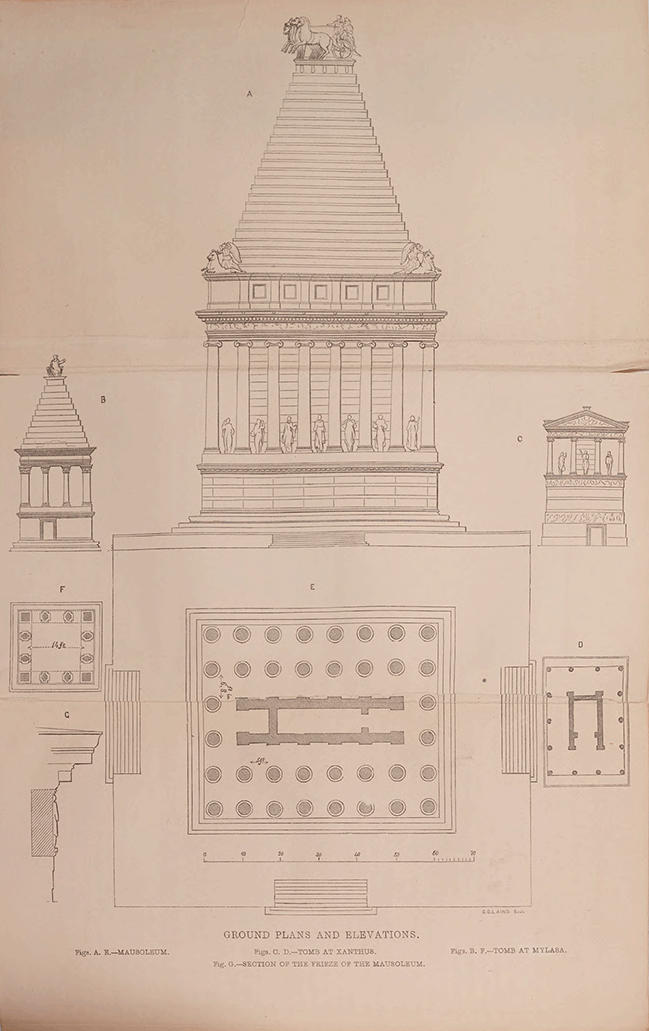
It was within this highly specific context that Cockerell made his work on the monument known: after a first reconstruction that was presented in 1845 during a Royal Academy lecture on tombs,Footnote 23 his two main suggestions regarding the Mausoleum’s form were presented to the public during the period between these two arrivals of sculptural fragments from Bodrum, which occurred in 1846 and 1858. His reconstructions drew both upon the study of the frieze slabs in the British Museum and on Cockerell’s own engagement with ancient sites.Footnote 24 The results of his Mediterranean expedition notably featured previously unknown monuments such as the Lycian tombs at Phineka (Fig. 14.2): these sepulchres were characterised by a simple temple-tomb type, with an entrance adorned with elaborate carved architectural details and a frieze. There were three sections: a pedestal, with bas-relief sculptures; a central pillar with a dentillated frieze; and a gable roof. This tripartite structure informed Cockerell’s reconstruction of the Mausoleum at Halicarnassus. Furthermore, the architect gleaned information from his visit to Xanthus, where the tomb chamber on a high base was a common type in the fourth century bc.Footnote 25 He also considered the Tomb at Mylasa (Fig. 8.1) to be a miniature version of the Halicarnassian monument, and mentioned it as a model justifying his reconstruction of the latter:
That so bold and unusual a mode of sustaining the superstructure [as that suggested in Cockerell’s reconstruction of the Mausoleum] may have existed, we have evidence in the tomb at Mylasa, which was still more astonishing in this respect, though smaller in dimensions, since the pyramid was sustained on a periphery of 12 columns, the interior space having no support whatever, and offering a void of 14 feet, while in the proposed restoration [of the Mausoleum] that void does not exceed 6 feet.Footnote 26
The lightness of the Mylasa monument’s appearance, which Cockerell sought to imitate in his reconstruction of the Mausoleum, also matched the description of the latter provided by Martial in De spectaculis (Appendix i.v) as ‘hanging in empty air’.Footnote 27 Cockerell granted far more importance to Martial’s evocation, and to the recreation of this effect, than most of the earlier scholars or architects did, and this is fully coherent with the verticality and transparency of his reconstruction:Footnote 28
By such an arrangement the pyramid is supported in the air, literally as Martial has expressed it, and reposes on a grove of columns, pervious to the eye, yet offering a full and sufficient means of sustaining the superincumbent weight …Footnote 29
To this attempt to understand the ancient Mausoleum’s visual effect, Cockerell added the fruits of his detailed study of Mediterranean sites, most importantly perhaps his survey of the Temple of Athena at Priene: his meticulous study of the proportions and entasis of this monument’s Ionic columns would later allow him to prove that the Mausoleum had made use of the same order, by demonstrating that Ionic proportions could be gleaned from the measurements of the sculptural fragments that had arrived in London. Thanks to his extensive knowledge of other Greek monuments, he would deduce from these few details the proportions used in the entire order of the Mausoleum:
The relative proportions of the Greek orders being fixed, we ascertain their entire size by a part, as we should that of a statue by a single member, ex pede Herculem. The frieze being 2 feet 51/4 inches in depth, we obtain an order of 371/2 feet.Footnote 30
Cockerell also added a footnote which demonstrates his superior knowledge of proportions:
The diameter of the columns was probably about 3 feet 4 inches, a respectable dimension, and exceeding by one half that in the French restorations. I have given the frieze that larger proportion which the Ionic examples of Athens afford, rather than the Asiatic.Footnote 31
Indeed, as he also argued:
It may well be presumed that a frieze destined to receive workmanship of so superior a quality, might have the utmost extension which the order admitted.Footnote 32
Such thorough familiarity with the ancients’ use of the orders meant that Cockerell’s suggestions were far closer to the reality of Greek architecture than the reconstructions of the Mausoleum developed by earlier generations of architects and scholars. This was also true of his insertion of sculpture: his study of the Amazon frieze resulted not only in architectural measurements, but also in the inclusion of its bas-reliefs in the sculptural decoration of his reconstruction. This is evidenced not only by the drawings of the entire monument but also by preparatory sketches of the sculptural programme, where the frieze appears among figures or groups that are imaginary, inspired by his knowledge of other ancient statues or based on Pliny’s description of the quadriga.Footnote 33 Cockerell’s extensive familiarity with ancient monumental works ensured that his reconstruction was the most respected of the pre-excavation attempts, and would even be referenced by later authors, writing after Newton’s study of the site.
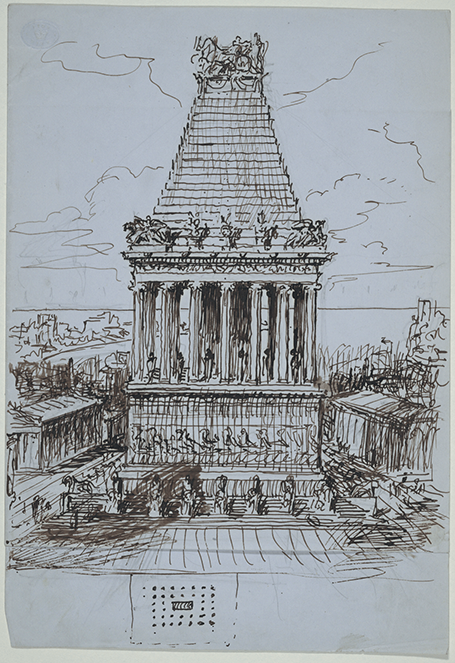
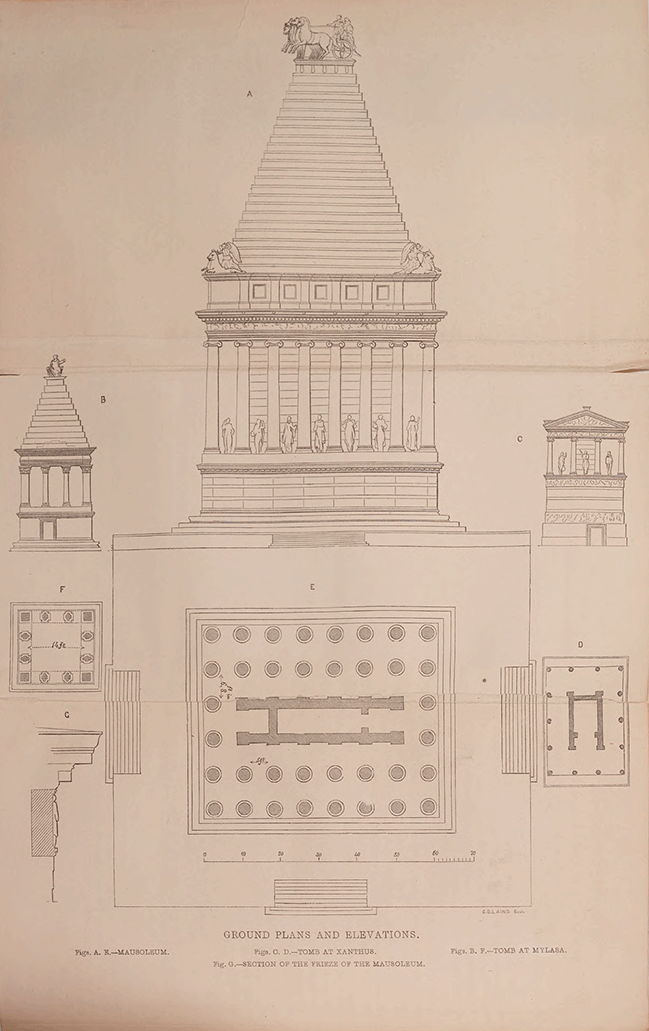
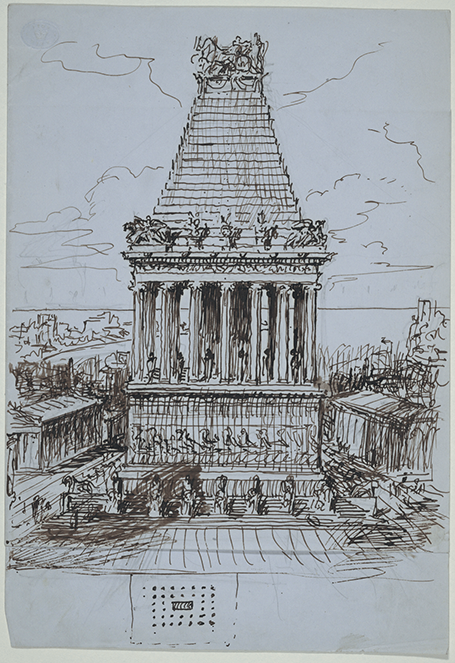
Nevertheless, the proportions of the order gave no indication as to how the columns were disposed, and one of Cockerell’s innovations was the suggestion that the thirty-six columns mentioned by Pliny were arranged in a dipteral rather than peripteral colonnade. This, of course, was closely connected to his period’s rediscovery of the remains of dipteral Greek temples that had been known only theoretically during earlier centuries. Cockerell’s first reconstruction, published in the 1848 Classical Museum, proposed doubling the lateral colonnades, resulting in a 6x8 plan (Fig. 14.3).Footnote 34 Commentators, though they lauded Cockerell’s insight, considered that the cella implied by this plan was too long for its width, and another scholar, William Watkiss Lloyd, suggested a modification to his reconstruction which would have made the entire colonnade dipteral, resulting in a 6x7 plan. Accounts indicate that Cockerell graciously accepted Lloyd’s version as more convincing than his own.Footnote 35 His drawings featuring seven columns on the lateral façade (Figs. 14.1 and 14.4; the latter includes a plan) can thus be dated after this scholarly discussion.Footnote 36 Indeed, his large watercolour at the Royal Institute of British Architects (Fig. 14.1) can probably be identified as either a copy or preliminary version of the more finished work exhibited at the Royal Academy in 1858. This date, as well as the year of publication of his earlier 6x8 version, in 1848, is significant: on both occasions, Cockerell’s public engagement with the Mausoleum coincided with – or closely followed – the arrival in London of impressive sculptures from the ancient monument, which fascinated the public and bolstered national pride at being both the rediscoverers and owners of the remains of one of the Wonders of the World. While one might identify in this timing an intention to make the most of the London public’s interest in the monument, it is equally true that Cockerell’s work on the Mausoleum seems to have emerged from discussions with colleagues specifically occasioned by the British expeditions to Halicarnassus.Footnote 37
Charles Robert Cockerell and Charles David Laing (1848). [Reconstruction of the Mausoleum of Halicarnassus], published in C. T. Newton and C. R. Cockerell, ‘On the Sculptures from the Mausoleum at Halicarnassus’, in The Classical Museum. A Journal of Philology, Ancient History and Literature. London: Taylor and Walton. Foldout between pages 192 and 193.
Charles Robert Cockerell (1850s). [Reconstruction of the Mausoleum of Halicarnassus], pen and brown ink on blue paper, 27 x 18.6 cm (11” x 7”).
Cockerell’s 1848 reconstruction of the Mausoleum was a print reproducing a line-drawn elevation of the monument, without a background (Fig. 14.3): it resembled similar images – architecturally interesting but visually dry – developed by earlier scholars who had suggested their own reconstructions. His 1858 drawing, inversely, was a refined watercolour featuring a view of the ancient city’s harbour in the background, and evidently conceived to elicit an aesthetic response from the public attending the Royal Academy exhibition (see the copy or preliminary drawing, Fig. 14.1). This is also attested by the octagonal format, for which a study exists in a sketch now at the British Museum.Footnote 38 This emphasises the pictorial composition’s two axes, namely Cockerell’s highly vertical reconstruction of the Mausoleum, and the horizontal view of the bay of Halicarnassus behind it. The unusual format begs the question of the frame, on which subject one of the exhibition reviews is informative:
Professor Cockerell, as we ascertain from the very learned quotations inscribed upon the broad gold frame, has gone for his particulars both to the fragments themselves and to Pliny, Vitruvius, and Martial, in which research he was aided by that admirable archaeologist, Mr. Consul Newton, under whose care the excavations were made.Footnote 39
Several observations can be drawn from this comment: the ‘broad gold frame’ inscribed with ‘very learned quotations’ indicates that the work combined an aesthetic and artistic ambition with a claim to advanced scholarship, while the mention of ancient authors as well as sculpted fragments and archaeological advice confirms, once more, that Cockerell combined philological and physical documentation in his reconstruction. This is further evidenced by the full title provided in the exhibition brochure: ‘Study of the Mausoleum of Halicarnassus, from the texts of Pliny, Vitruvius, and Martial, from the measurements of the fragments recently excavated by the British Government, and now in the British Museum, and according to the idea published in the “Classical Journal”, 1847, by Mr. C. Newton, and the author, C.R.C., R.A.’Footnote 40 The framed watercolour on show at the Royal Academy was thus a complex work at the crossroads of several artistic and scholarly fields, revealing the breadth of Cockerell’s competence and expertise. The inscriptions on the frame were certainly those surrounding the printed reproduction published by The Builder in 1896,Footnote 41 which shows a highly finished drawing which was probably the version exhibited in 1858 (the watercolour reproduced here, Fig. 14.1, differs in several details; it is also less finished, and executed on overlapping sheets of paper, denoting an altogether less prestigious work, most likely a copy or perhaps a preparatory watercolour sketch).Footnote 42 The print also includes a plan and section, which may have been carved, drawn or painted on the frame, further complexifying both the informative and aesthetic content of the work.
Although it was accepted, after Newton’s excavations, that the ancient Mausoleum differed from Cockerell’s reconstruction in several respects, his drawing continued to be shown during the second half of the century, both in exhibitions and to accompany public lectures.Footnote 43 Most importantly, it was donated to the British Museum in 1893 by the widow of Cockerell’s son Frederick,Footnote 44 and hung in the Mausoleum Room next to the remains of the monument, where it was noted by later commentators. Drawings of reconstructions by Wren and by Newton and Pullan were also featured, as well as a model based on Cockerell’s suggestions.Footnote 45 This display may reveal a patriotic intention to show a history of British engagement with the ancient Wonder, but also reflects the widely shared opinion, among nineteenth-century British architects and scholars, that Cockerell’s reconstruction was more tasteful than most of the later attempts based on the excavations. In other words, taste was a quality that was sometimes valued as much as conformity to measurements, and Cockerell’s version – though in its own day the most accurate reconstruction of the Mausoleum – was lauded in later decades chiefly for its graceful appearance, resting on the architect’s intimate knowledge of ancient monuments.Footnote 46
*****
Besides its aesthetic qualities, Cockerell’s reconstruction endures for the precision of its Ionic proportions and the learned knowledge of Antiquity which he brought to bear on the art of reconstruction. In their own day, Cockerell’s scholarly studies demonstrated a new scientific approach to recording archaeological sites, and through his research he advanced the science of documenting ancient monuments.Footnote 47 His personal copies of Ionian Antiquities demonstrated that Cockerell had set out to build on the expeditions and explorations of the Society of Dilettanti, revising their measurements and recording new aspects of the sites, and this study would inform his historical and creative endeavours throughout his ensuing career. Cockerell’s contemporary style of architecture in Britain was underwritten by his knowledge of classical architectural form, function and detailing, bridging a gap between eighteenth- and nineteenth-century architectural practices, based on informed ideas and a superior knowledge of the classical past. As one of the greatest architects of the nineteenth century, his steadfast position was solidified as he remained true to his formation and knowledge of the rich sources of Classical Antiquity in Asia Minor. His reconstruction of the Mausoleum of Halicarnassus, finally, ensured his place in the historiography of architecture.Footnote 48 It provides a unique illustration of the complex transformations undergone by perceptions of the Mausoleum in the mid-nineteenth century, due to the rapid evolution of scholarly knowledge of Greek architecture, but also to the arrival in London of sculptures from the ancient monument, and ultimately to the excavation of the latter’s foundations, which would open a new era in its long afterlife. Cockerell, in this sense, occupies an interesting intermediate position, lying both at the end of a long tradition of philological reconstructions beginning in Renaissance Italy, and at the beginning of a new series of studies increasingly relying on the methods of modern archaeology, which would lead to present-day suggestions regarding the appearance of the Mausoleum of Halicarnassus.

 Open access