

Introduction
For a long time, the Arctic was considered the last frontier. More precisely the Arctic Ocean, as a frozen sea, challenged our perception of the sea as a fluid environment and defied traditional distinctions between land and sea (Steinberg, Tasch, Gerhardt, Keul, & Nyman, Reference Steinberg, Tasch, Gerhardt, Keul and Nyman2015, p. chap. 3). This frozen sea provided a thriving environment for scientific cooperation with its governance largely resting on various international, regional and subregional organisations (Schram Stokke, Reference Schram Stokke, Hønneland and Jensen2015). Among these, the Arctic Council is the primary organisation that consolidated the Arctic’s regional identity.
However, in a few decades, the Arctic Ocean may no longer be an ice-covered area, and these unprecedented changes have contributed to the steady globalisation of the Arctic. A warming Arctic Ocean raises important issues related to the Arctic societies, marine environment and the climate, but it also presents economic opportunities such as resource extraction, trade routes and tourism (Wood-Donnelly & Pascale Bartels, Reference Wood-Donnelly and Bartels2022). This changing environment is also increasing the political salience of the Arctic and multiplying the interest in the governance of this region beyond Arctic states.
Undoubtedly, science diplomacy has been an important driver in shaping the governance of the Arctic, and it has progressively paved the way towards the involvement of non-Arctic stakeholders, such as Asian states, i.e., China, India, Japan, Singapore and South Korea, in Arctic governance through their participation in regional cooperation fora like the Arctic Council. Focusing strongly on developing Arctic science, their participation increased their relevance as actors in Arctic politics. Since becoming observers in the Arctic Council in 2013, most of these states have issued Arctic policies highlighting their connection to the Arctic Ocean from scientific, legal, historical, economic, security and environmental perspectives (Arctic Council, 2013; Government of India, 2022; Headquarters for Ocean Policy, 2015; Republic of Korea, 2013; State Council Information Office of the People’s Republic of China, 2018). Their admission as observers in the Arctic Council strengthened “the position of the Arctic Council in the global scene” as noted by the Swedish Foreign Minister Carl Bildt (U.S. Department of State, 2013). More importantly, their involvement was understood as a recognition of the legal and institutional structures already governing the Arctic.
Overall, science diplomacy is recognised as a vital tool for fostering cooperation and ensuring the Arctic remains a peaceful and low-tension region (Berkman, Reference Berkman2014). However, this perception is now being put to the test following the Russian invasion of Ukraine in February 2022. In the aftermath of the invasion, several Arctic cooperation forums have suspended Russia’s participation (Koivurova & Shibata, Reference Koivurova and Shibata2023). Amidst the ongoing conflict, it is worth considering if science diplomacy can still serve as a means to sustain peaceful collaboration in the Arctic region. We argue that science diplomacy could still guide Arctic governance, especially concerning the position of Asian states. In that context, we are examining the possible roles Asian states could have in governing the Arctic, taking into account legal and geopolitical factors. Specifically, we are considering if they could act as a link between the West and Russia, or whether their actions would cause any further fragmentation in Arctic governance.
The rest of the paper is structured as follows. “Methodology” introduces the methodology. “The Arctic: a global object of governance” explains the geopolitical and legal reasons shaping the Arctic as a global object of governance, which, in turn, has been heavily influenced by science diplomacy. “Asian states in Arctic governance: science for diplomacy in action” analyses the state practice of Asian countries in the Arctic, examining how these nations have used science to legitimise their Arctic identity and gain a foothold in the region’s governance. “Asian states’ science diplomacy: a middleman at a time of conflict?” scrutinises the role of Asian states in the aftermath of the Russian invasion of Ukraine and their impact on Arctic governance. “Conclusion” is dedicated to conclusions.
Methodology
Considering that the Russian invasion of Ukraine had a major impact on the governance of the Arctic, as it strained Russia’s relations with the West, this paper primarily discusses, from a legal and geopolitical perspective, future governance scenarios of the Arctic. We wonder, up to what extent could Asian states influence Arctic governance to avoid fragmentation in this time of conflict?
To answer this question, science for diplomacy is the theoretical framework, understood in this paper as a soft power that relies on scientific cooperation to advance both common and individual state interests (Goel, Reference Goel2021). Soft power, here, is based on relations between actors that co-produce scientific knowledge (Changhe, Reference Changhe, Cooper, Heine and Thakur2013). When scientific knowledge is created and shared among actors, it intensifies relations, builds trust and fosters symmetrical relationships. Yet, during times of conflict as Zaika and Lagutina point out, there is a risk of “interruption of knowledge and data sharing through political action” (Zaika & Lagutina, Reference Zaika and Lagutina2023). This can result in an asymmetrical distribution of power, with some actors (individuals or groups) having access to knowledge production and data while others are barred from it and, thus, affecting trust and cooperation. In the Arctic context, these actors are not limited to states but also include subnational regions, Indigenous communities, international organisations and civil society.
From a geopolitical perspective, we discuss the vast array of mechanisms used by these Asian states to build their Arctic identity and gain legitimacy in Arctic governance. From a legal perspective, we analyse whether such involvement could strengthen or further fragment Arctic governance in times of conflict. The legal analysis is based on a review of the legal structures of the Arctic, the Arctic policies of Asian states acting as observers in the Arctic Council, coupled with institutional and state practice. Such analysis is problem-oriented since we assess the ability of existing regulatory structures to adapt to the changing geopolitical context of the Arctic Ocean. The literature has been identified with the use of established databases (Scopus, HeinOnline and Google Scholar) as well as so-called snowballing, where known literature has been used to identify further relevant sources.
The Arctic: a global object of governance
Over the years, the Arctic has progressively consolidated its identity as a global object of governance thanks to its geopolitical salience and the legal structures governing it. To understand what makes the Arctic a global object of governance, it is important to first define what a governance object is. According to Corry, a governance object is “an … assemblage constituted as distinct, malleable and politically salient” (Corry, Reference Corry2013, p. 87). This salience comes from the problematisation of the object based on varied discourses, including, for example, environmental threats, state interests, or national identity. This problematisation makes the object relevant to govern due to its transnational effects (Bentley, Reference Bentley2017). More precisely, governance objects “emerge and are constructed, and rather than slotting neatly into existing structures, they have their own structuring effects on world politics” (Corry, Reference Corry2016, p. 60). The Arctic is an example of construction and steering efforts where the Arctic Council became the crucial element for making the Arctic a distinct region (Keskitalo, Reference Keskitalo2004, p. 53).
The consolidation of the Arctic as a regional object of governance
Today, it is almost a truism to state that the Arctic is no longer considered a remote and inhospitable environment with little governance relevance (Sörlin, Reference Sörlin, Bashford, Armitage and Sivasundaram2017). In the 20th century, resource security and environmental issues shaped the Arctic as a distinctive region. Notably, the Arctic gained interest for its potential in terms of renewable and non-renewable resources and the Svalbard Treaty settled issues of creeping national jurisdiction. Besides, the Second World War and the Cold War transformed the Arctic into a critical geopolitical space (Nord, Reference Nord2016, p. 11). From an environmental perspective, the radioactive material leak in Chernobyl triggered the creation of the Arctic Environmental Protection Strategy (AEPS) in 1991, an agreement between the Arctic Eight (Canada, Denmark, Finland, Iceland, Norway, Russia, Sweden and United States) and organisations representing Indigenous peoples (Nord, Reference Nord2016, p. 13). The Arctic Council replaced AEPS in 1996 and became the leading intergovernmental institution shaping the Arctic as a distinct region (Koivurova, Keskitalo & Bankes, Reference Koivurova, Keskitalo, Bankes, Koivurova, Keskitalo and Bankes2009). As a high-level intergovernmental forum, the Arctic Council is a model of inclusiveness, where science diplomacy has played a pivotal role (Bertelsen, Reference Bertelsen, Gjørv, Lanteigne and Sam-Aggrey2020a). This organisation became a platform aimed at facilitating cooperation on what was perceived common Arctic issues (article 1(a) of the Ottawa Declaration) between their members, that is, Arctic states and six permanent participants representing Arctic Indigenous peoples. More importantly, the establishment of this “Arctic” institution reinforced the legitimacy of subnational regions (Holm Olsen & Shadian, Reference Holm Olsen and Shadian2016) and non-state actors in shaping the future Arctic governance as they enjoy a privileged position and legitimacy as decision-makers within the Arctic Council.
The transition of the Arctic to a global object of governance
Over time, Arctic governance has evolved, among others, due to the soft power of “science for diplomacy” which has led to extensive connections between Arctic states, Indigenous communities and non-Arctic states (Machowski, Reference Machowski1993, pp. 178–179). From a geopolitical perspective, a warming Arctic Ocean represents a changing space that opens possibilities for intensified multilateral cooperation, leading to the development of interests beyond Arctic states (Raspotnik, Reference Raspotnik2018, p. 4). Undoubtedly, science on climate change is essential in strengthening the globalised perception of the Arctic by showing how a changing Arctic has transnational repercussions. For example, scientific evidence continuously highlights the significant role that the cryosphere, for example Arctic Ocean, plays in the regulation of the earth’s climate. The last Intergovernmental Panel on Climate Change (IPCC) Report acknowledged that the thawing of Arctic permafrost altered marine ecosystems and posed risks to many natural systems and vulnerable communities at a worldwide scale (IPCC, 2019, 2022). Consequently, the conservation of the Arctic Ocean in its frozen status is arguably fundamental to ensure that it continues to deliver public goods, for example, climate change regulation. This progressive globalisation of the Arctic has an impact on its construction as a common and complex space providing non-excludable and non-rival benefits to all countries, communities, and generations, and where any development affects all individuals, no matter the state those individuals belong to (Allison & Bélland, Reference Allison and Bélland2009; Bodansky, Reference Bodansky2012, p. 654).
This commonness has also opened the pathway for actors beyond the Arctic states to become legitimate stakeholders in the governance of the Arctic. The rising awareness of ocean connectivity in relation to climate change effects (Popova et al., Reference Popova, Vousden, Sauer, Mohammed, Allain, Downey-Breedt and Yool2019; Rogers et al., Reference Rogers, Sumaila, Hussain and Baulcomb2014) and the increasing involvement of non-Arctic states in Arctic science (research, investment and infrastructure) initiated the development of a “globalized Arctic Council” through the reform of observers’ status in 2013 and 2015 (Arctic Council, 2013, 2015; Popova et al., Reference Popova, Vousden, Sauer, Mohammed, Allain, Downey-Breedt and Yool2019; Rogers et al., Reference Rogers, Sumaila, Hussain and Baulcomb2014). These reforms gave place to the participation of non-Arctic states as observers in negotiation processes, widening their role in Arctic governance (Knecht, Reference Knecht2016).
The jurisdictional legal structure of the Arctic Ocean also strengthens the construction of the Arctic as a global object of governance. From a legal perspective, the Arctic Ocean comprises areas within and outside national jurisdiction. Undeniable, all states (beyond Arctic coastal states) have vested interests, rights and obligations in maritime zones beyond national jurisdiction, to wit, the high seas and the Area. In these maritime zones, all states enjoy certain rights, including, for example, scientific research, navigation, overflight, fishing and laying of submarine cables and pipelines, pursuant to the United Nations Convention on the Law of the Sea (UNCLOS, 1982) (articles 87, 90, 116, 119, 192) and general international law.
Finally, references to the Arctic Ocean as a space of “common concern” are nowadays usual (De Lucia, Reference De Lucia2016; Shelton, Reference Shelton2009). The label “common concern” has significant legal repercussions because it transcends national and regional boundaries and removes the object of governance from the “exclusive domain of sovereign jurisdiction” (De Lucia, Reference De Lucia2016). It does not mean, however, that existing regulatory and jurisdictional structures in the Arctic Ocean are irrelevant or inapplicable, but it implies that the number of legitimate stakeholders expands considerably to the whole international community. The engagement of non-Arctic states in Arctic governance with little or no direct connection to the Arctic reinforces its construction as an area of common concern.
However, the transition of the Arctic as a global object of governance has also been met with resistance and regionalisation efforts. For instance, the Arctic Five, a soft-law forum where coastal states of the Arctic meet outside of the Arctic Council is an example in point (Ilulissat Declaration, 2008). The Arctic Five claims a stewardship role in the governance of the Arctic Ocean conveying the image of a regional Arctic. But even in regional conceptions of the Arctic, states like China and India have been carefully positioning themselves as “near Arctic” states (Government of India, 2022; State Council Information Office of the People’s Republic of China, 2018) and the home of the Third Pole (Himalayas–Tibetan Plateau). Consequently, these states are proposing an expansive understanding of the Arctic state and positioning themselves as relevant regional stakeholders.
Asian states in Arctic governance: science for diplomacy in action
The consideration of the Arctic as an object of global governance poses the question of the involvement of non-Arctic states and its impact on Arctic governance. Among them, Asian states’ involvement has not been unnoticed. In this section, we summarise Asian states’ interests and practice in Arctic governance to gain legitimacy in Arctic politics. We analyse how this practice has shaped the governance of the Arctic as a global object. This serves as a basis for exploring Arctic governance’s future in a time of conflict, which will be the focus of the next section.
Gaining legitimacy in Arctic governance
Asian states have developed their engagement and gained legitimacy in Arctic governance over the past decades. Over the 2010–2020 decade, Asian states became significant Arctic stakeholders as a product of several cooperation mechanisms, including their involvement in regional cooperation arrangements, economic investments in extractive industries, interest in new navigational routes, national building capacities and research agendas. For instance, China is willing to participate in the Arctic economic development through financial and technological support in extractive oil industries (Heng & Freyman, Reference Heng and Freyman2023; Røseth, Reference Røseth2014) and to develop the Arctic Ocean as an economic hub, especially if the passage through the Arctic Ocean is open to shipping (Biedermann, Reference Biedermann2020). These new Arctic routes are part of China’s “One Belt One Road Initiative.” Japan is also promoting the development of maritime routes (Hayashi, Reference Hayashi2018), while Korea was “piloting shipping through the Northern Sea Routes (NSR).” (Kim & Stenport, Reference Kim and Stenport2021). Singapore has also expressed its interest in NSR development. Regarding environmental issues, Japan and Singapore are concerned about sea-level rise. Some Japanese islands are on the frontline, near the Arctic region (Mimura, Reference Mimura2013). Singapore, in particular, has modest polar research involvement and has yet to issue its Arctic Policy (Sim, Reference Sim2021). For Singapore, participating in Arctic governance, particularly in research, is a matter of survival. As a low-lying island, climate change endangers its territory and eventually even its statehood (Grote Stoutenburg, Reference Grote Stoutenburg2015). From an economic perspective, new shipping routes in the Arctic may jeopardise the competitiveness of existing shipping lanes in Pacific Asia (Heng & Freyman, Reference Heng and Freyman2023).
Then, Asian states’ ongoing research agendas and scientific cooperation have made their engagement crucial for the development of Arctic knowledge and, thus, Arctic governance. China, for example, has scientific agreements with the Arctic Eight and has explored joint research ventures with all of them (Smieszek, Koivurova & Nielsson, Reference Smieszek, Koivurova, Nielsson, Koivurova and Kopra2020). Since the late 1990s, China’s scientific research agenda has been related primarily to climate change. In 2004, the Polar Research Institute of China established the “Yellow River” research station in Svalbard (Huebert, Reference Huebert2012). In 2002, Korea inaugurated the “Dasan Arctic Research Station” at Ny-Ålesund (Kim & Stenport, Reference Kim and Stenport2021). This Asian states’ growing involvement peaked when China, India, Japan, Singapore and South Korea became observers in the Arctic Council, in 2013 (Arctic Council, 2013). Even if Arctic Council’s observers are not directly involved in decision-making, they can exert influence in Arctic governance by other means, including, for example, scientific efforts through “the participation in the projects of the Arctic Council’s working groups, submission of written statements at Ministerial meetings and proposing and financing projects through an Arctic state or permanent participant.” As such, in 2014, India deployed “lndArc” in Kongsfjorden, in cooperation with Norway, to collect real-time data on the Arctic climate and its impact on the monsoon. Later, in 2016, it established an atmospheric laboratory in Gruvebadet and enhanced its engagement in science and research, and scientific collaboration and exchange in the Arctic (Government of India, 2022).
Outside the Arctic Council, some cooperation fora have reinforced Asian states’ will to assume a leading role in the Arctic. China, Japan and South Korea are signatories to the Agreement to Prevent Unregulated High Seas Fisheries in the Central Arctic Ocean (CAOF Agreement) adopted in 2018, which imposes a temporary high-seas commercial fishing ban in the Central Arctic Ocean. The participation of Asian states in the negotiation of CAOF agreement evinces a political will to become and be perceived as an active part of Arctic marine resource management (Hayashi, Reference Hayashi2018). Since it concerns only fisheries, the development of similar engagement in other field areas is likely to happen. This is the case in the field of energy.
Regarding the rapid development of states like China and India, it is not surprising that energy is central to Asian policy and one of their main concerns in the Arctic. Such an interest explains the growing investments of Asian states in the Arctic. China and the Russian oil and gas company Rosneft signed a 25-year agreement that would significantly increase oil exportation to China (Stokke, Reference Stokke, Rottem, Soltvedt and Hønneland2020), while Japan is actively cooperating with Russia in energy infrastructure projects, including the “transhipment terminal for liquefied natural gas on the Kamchatka Peninsula” (Hayashi, Reference Hayashi2018). The Japanese state-run company Japan Oil, Gas, and Metals National Corporation (JOGMEC) has joint exploration projects with Greenland Petroleum Exploration Co., Ltd (Government of India, 2022). Likewise, South Korea has energy-intensive industries (e.g. shipbuilding), and the country itself is highly dependent on crude oil (Kim & Stenport, Reference Kim and Stenport2021), which justifies its interest in developing stronger ties in the Arctic to diversify its energy sources.
Regarding mining, Japan’s Arctic Policy already considers the possibility of future mineral exploration and exploitation and the need to develop technology to operate in this harsh environment (Headquarters for Ocean Policy, 2015). Japanese and South Korean companies are already operating on the Norwegian continental shelf (Stokke, Reference Stokke, Rottem, Soltvedt and Hønneland2020). The development of mining activities will undoubtedly impact the political salience of the Arctic and advance the leading role of Asian states through their scientific expertise. Nevertheless, Asian states’ economic, political and environmental engagement in the Arctic is a paradox.
Asian states involvement: a double-edged sword for Arctic governance
Science diplomacy has shaped two distinctive imaginaries concerning Asian states’ engagement in Arctic governance (Babin & Lasserre, Reference Babin and Lasserre2019). The first position considers the participation of Asian states as mostly positive in advancing a global governance approach. The second position fears that the involvement of Asian states will erode Arctic governance by developing governance fragmentation and giving preference to inter-state cooperation while weakening the participation of non-state actors, that is subnational regions and Indigenous participants (Stokke, Reference Stokke, Rottem, Soltvedt and Hønneland2020).
On the one hand, Asian states’ engagement in Arctic governance is seen as contributing to a more positive outlook in Arctic governance. Even though the Arctic is characterised by its exceptionalism, its governance is interwoven in global action and, thus, requires collective action (Bartenstein, Reference Bartenstein2015; Exner-Pirot & Murray, Reference Exner-Pirot and Murray2017). This is the case, for example, in addressing climate change issues. The involvement of non-Arctic states is vital in addressing the global sources and effects of Arctic environmental changes, especially regarding climate research (Government of India, 2022; Headquarters for Ocean Policy, 2015; Republic of Korea, 2013; State Council Information Office of the People’s Republic of China, 2018). Their participation in Arctic research contributes to developing knowledge resources to inform policy-making (Knecht, Reference Knecht, Woon and Dodds2020). Science is also seen as cultivating diplomacy and cooperation between conflicting interests (Berkman, Reference Berkman2014; Binder, Reference Binder2016). By co-creating knowledge, Asian states contribute to trust-building in multilateral and global cooperation (Su & Mayer, Reference Su and Mayer2018). In the Arctic context, science diplomacy has proved to maintain trust-building since the end of the Second World War. For example, Norwegian and Russian scientists cooperated in mapping Barent Seas fisheries resources since the 1950s. This cooperation led to the creation of the Joint Norwegian-Russian Fisheries Commission in 1975 for managing shared stocks of cod in the Barents Sea. This Commission has become the foundation for a “soft” cooperation between Norway and Russia, maintaining their relationship during and after the Cold War (Bertelsen, Reference Bertelsen, Gjørv, Lanteigne and Sam-Aggrey2020b; Bones, Reference Bones and Sverker2016; Rafaly, Reference Rafaly2022). In a globalised Arctic, Asian states’ scientific engagement and collaboration have a good impact on Arctic governance. It helps to maintain the power balance, where power shifting is likely to deter the established order. Giving them a voice or a “seat at the table” enhances the balance of interests and power and legitimises decision-making processes (Doran, Reference Doran, Zartman and Touval2010). As such, Asian states’ engagement in science within the Arctic Council, for example, has contributed to building international partnerships in addressing common problems (Hossain & Mihejeva, Reference Hossain and Mihejeva2017) and to integrating and socialising Asian states into the Arctic and its institutions in a non-conflictual way (Bertelsen, Xing & Gregersen, Reference Bertelsen, Xing, Gregersen, Conde and Sánchez2017).
On the other hand, the growing involvement of Asian states poses questions regarding regional interests such as Indigenous interests and environmental protection. As science is used to ascertain national interest in Arctic governance, it can lead to governance fragmentation and, thus, resource exploitation’s rush in the region (Wood-Donnelly & Pascale Bartels, Reference Wood-Donnelly and Bartels2022). Since Arctic policy-making is mainly based on scientific knowledge, the more a state reinforces its epistemic authority, the more it gains political stake. The growing power and prominence of Asian states in the international system and their growing scientific engagement in the Arctic gives them a prominent place in Arctic politics. Within a complex geopolitical context, it can result in giving preference to inter-state cooperation, leaving Indigenous communities behind. Indeed, the rising global interests in resource development, shipping and science contrast with Indigenous communities’ human, financial and technical capacity. Also, logistical and economic opportunities created through Asian states’ engagement can alter Indigenous cultural heritage and natural preservation in the Arctic (Henriques & Böhm, Reference Henriques and Böhm2022). Therefore, in the case of a precarious power balance and weaker institutional framework, Indigenous communities’ ability to participate in Arctic governance could be limited and challenged (Exner-Pirot, Reference Exner-Pirot, Coates and Holroyd2019).
Moreover, considering Arctic continental shelves represent the most extensive prospective areas in the world (Gautier et al., Reference Gautier, Bird, Charpentier, Grantz, Houseknecht, Klett and Wandrey2009), there is an increasing statal interest in natural resources (Palosaari & Tynkkynen, Reference Palosaari, Tynkkynen, Jensen and Hønneland2015). According to a US Geological Survey, the Arctic “holds 30 per cent of the world’s natural gas reserves and 13 per cent of its oil” (Huda & Ali, Reference Huda, Ali, Hancock and Allison2021). In that context, Asian states’ potential access to natural resources and the interests vested in developing novel trade routes are met with scepticism, mainly if these activities (despite environmental discourse) constitute a “resource rush” or “grabbing” of Arctic resources, at the expenses of the protection of the environment. Besides the changing geopolitical landscape of the Arctic, the financial and technological interest of Asian states in oil and natural extractive industries could be arguably construed as a deterrent to establishing harmonised climate policies in a region where oil and natural gas exploitation could increase in upcoming years. Overall, “what transpires from the emergence of Asian stakeholders is the diversification of interests that will negatively impact a coordinated climate policy in the Arctic” (Argüello, Reference Argüello2021), which can lead to governance fragmentation.
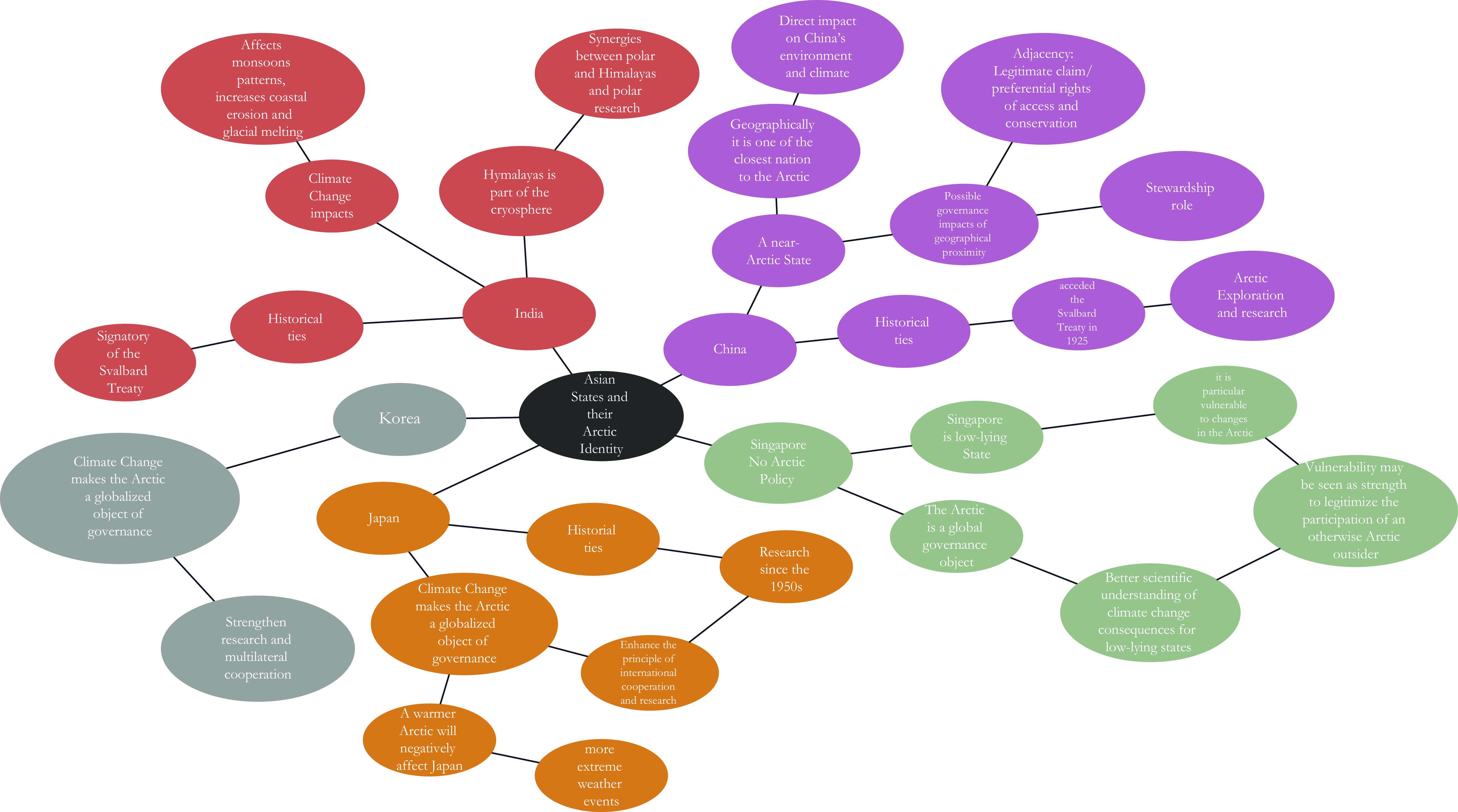
Overall, Asian states do not only aspire to be recognised as legitimate actors with vested interests in the Arctic; arguably, they are constructing an identity as Arctic stakeholders as illustrated in Fig. 1.
Shaping an Arctic identity: Asian states’ approach*.
*The information contained in this figure is based on the analysis of the Asian states’ Arctic policies including: State Council Information Office of the People’s Republic of China. (2018). China’s Arctic Policy. White Paper. Government of India. (2022). India’s Arctic Policy: Building a Partnership for Sustainable Development; Headquarters for Ocean Policy. (2015). Japan’s Arctic Policy; Republic of Korea. (2013). Arctic Policy of the Republic of Korea and Storey, I. (2016). Singapore and the Arctic: Tropical Country, Polar Interests. In V. Sakhuja & K. Narula (Eds.), Asia and the Arctic: Narratives, Perspectives and Policies (pp. 63–74). Springer.
Their engagement has squeezed regional interests and the power balance in a globalised Arctic. However, in times of conflict, Asian states’ engagement through science diplomacy poses questions on their possible role in Arctic governance, maintaining a manageable balance between the West and Russia.
Asian states’ science diplomacy: a middleman at a time of conflict?
The Arctic is an integrated part of the international system. Its governance has closely mirrored conflict at the international level (Bertelsen, Reference Bertelsen, Gjørv, Lanteigne and Sam-Aggrey2020a). After the annexing of Crimea by Russia in 2014, cooperation between Russia and the other Arctic states was still productive. This situation changed drastically after the Russian invasion of Ukraine in February 2022. Several regional cooperation fora, including the Barents Euro-Arctic Council (BEAC) (Cambou & Heninen, Reference Cambou, Heninen, Hossain and Cambou2018, p. 19), the Council of Baltic Sea States and the Northern Dimension suspended the participation of Russia (Council of Baltic Sea States, 2022; Koivurova & Lanteigne, Reference Koivurova and Lanteigne2022; Northern Dimension Policy, 2022). Signs of governance erosion are becoming more palpable after Russia withdrew, in September 2023, from BEAC, after the Finnish Presidency “failed to confirm the transfer of the BEAC presidency to Russia, scheduled for October 2023, in violation of the principle of rotation, thus disrupting the necessary preparations” (The Ministry of Foreign Affairs of the Russian Federation, 2023).
The Arctic Council took a more muted approach instead. Considering that Russia was chairing the Council (2021–2023), their members decided to temporarily pause the Council activities, including those of the subsidiary bodies, until alternative modalities were proposed to continue the Arctic Council’s work (Joint Statement, 2022). On June 8, 2022, Canada, Denmark, Finland, Iceland, Norway, Sweden and the United States issued a Joint Statement announcing that the Council will resume activities concerning projects not involving Russia (Arctic Council, 2022). Since then, both political and scientific cooperation between the West and Russia are strained. Still, it is apparent that the members of the Arctic Council still envision this forum as the most important platform for (global) Arctic governance, where Russian involvement is far from being precluded. Having the largest coastline, Russia’s involvement is a critical element to the Arctic scientific knowledge and, thus, governance.
The governance of the Arctic is now at a crossroads. If the Arctic Council does not find a way to include Russia, it will likely lead to governance fragmentation and undermine the long-standing cooperation effort in Arctic governance. Most studies focus on the Arctic Council’s survival, as the most comprehensive intergovernmental forum dealing with Arctic governance. Our aim here is to flip around the lens to assess whether Asian states’ engagement contributes to maintaining stability and the long-standing cooperation effort in Arctic governance.
A bridge between Arctic states
It is possible for Russia to be actively involved in Arctic governance through legally binding instruments, and cooperation in this area is expected to continue. It is important to consider that binding treaties are not ipso facto terminated or suspended due to the outbreak of armed conflicts, as stated in Article 3 of the International Law Commission (ILC) Draft articles on the effects of armed conflicts on treaties (Caflisch, Reference Caflisch2016). Yet, as Serguning and Shibata (Reference Sergunin and Shibata2022, p. 72) accurately explain, the continuous legal force of a treaty does “not necessarily ensure its effective implementation during an armed conflict.” Nevertheless, Russia has shown some signs of involvement in Arctic governance despite its strained relationships with other Arctic states. In November 2022, for instance, the parties to the CAOF agreement, including Russia, adopted the Conference of the Parties (COP), rules of procedure (Koivurova & Shibata, Reference Koivurova and Shibata2023). We can expect similar cooperation opportunities through the Agreement on Enhancing International Arctic Scientific Cooperation that entered into force in 2018 (Arctic Science Agreement). This agreement was adopted by the Arctic Eight, but according to Article 17 of the Agreement, cooperation with non-parties concerning Arctic science may continue to be promoted and enhanced. Even if the Arctic Council does not fully resume its activities, this provision can provide Asian states with a chance to pursue their scientific agendas in the Arctic. Following the Russian invasion of Ukraine, it is anticipated that collaboration under the Arctic Science Agreement will primarily occur on a bilateral basis (Sergunin & Shibata, Reference Sergunin and Shibata2022).
While binding agreements may still foster cooperation in the Arctic, productive collaboration in soft-law forums like the Arctic Council is uncertain. The war in Ukraine disrupted the trust-building effort in Arctic governance and left the Russian scientific community isolated (Andreeva, Reference Andreeva2023; Zaika & Lagutina, Reference Zaika and Lagutina2023). This isolation effectively disrupts the scientific networks developed under the auspices of the Arctic Council, a forum “that intertwines knowledge creation and decision-making” (Andreeva, Reference Andreeva2023). As a result, any efforts to resume scientific cooperation will require a mediator who is trusted, credible and acceptable to all Arctic states. (Bisen, Reference Bisen2023). Arguably, Asian states can serve as a mediator between the West and Russia. Science diplomacy is a field where Asian states can intensify cooperation ties with the West while still involving Russia (Berkman, Baeseman & Shibata, Reference Berkman, Baeseman and Shibata2022). Japan, for instance, places great importance on research and technology in shaping the Arctic legal framework and fostering collaboration in the region. This state has not precluded the possibility of continuing its collaboration with both Western states and Russia (Hataya, Reference Hataya2023).
China’s political influence on the world stage and involvement in Arctic science make it a potential mediator between the West and Russia, according to certain commentators (Chen, Reference Chen2023). It is noteworthy that China still maintains official contact with all Arctic states, including Russia. More importantly, it could use its role as an observer in the Arctic Council to promote collaboration between Russia and other Arctic and non-Arctic states (Chen, Reference Chen2023). Additionally, G20 and the Indian presidency are also acting as mediators (Bisen, Reference Bisen2023). The G20 Forum remains one of the limited platforms where cooperation between the West and Russia continues. In December 2022, India took over from Indonesia to assume the Presidency of the G20 Forum (G20, 2022). During its presidency, climate change is a priority for the organisation and since the Arctic plays a fundamental role in the regulation of the earth’s climate, G20 could work towards normalising scientific cooperation in the Arctic (Bisen, Reference Bisen2023).
Moreover, Norway assumed the chairmanship of the Arctic Council for the period 2023–2025, effectively replacing Russia. At the 13th Arctic Council Meeting in May 2023, the Arctic Eight, including Russia, and six permanent participants declared their commitment to promoting cooperation and stability in the region through the work of the Arctic Council. (Arctic Council, 2023). Although Russia is committed to being active in this forum, Nikolay Korchunov, the Russian Senior Arctic Official, stated that the work of the Council must be fully restored and all projects must be beneficial to the interests of all Arctic states (Jonassen, Reference Jonassen2023). At this stage, it is important not to overlook the role of observers, including Asian states, in the process of normalising activities within the Arctic Council. However, despite the promises that a new chairmanship may bring to the Arctic Council, many still raise concerns about the potential fragmentation of Arctic governance. As we discuss in the following section, there is still a possibility that Russia will strengthen its cooperation efforts with Asian states while dismissing cooperative efforts with the West.
A disruptive effect on the balance of power
Prior to the Ukraine crisis, Arctic governance was based on the soft power of science. The high degree of cooperation and collaboration in science, technology and innovation projects helped to maintain geopolitical stability. Nowadays, the inability to maintain long-standing cooperation within the Arctic Council and other regional bodies is likely to create disruption in the institutional order in the Arctic (Caymaz, Reference Caymaz2023; Exner-Pirot & Murray, Reference Exner-Pirot and Murray2017). From a governance perspective, studies envision several directions among which the development of pan-Asian Arctic era, or towards a Western Arctic Council and Russia/Asia coalition (Koivurova & Shibata, Reference Koivurova and Shibata2023, p.8; Landriault & Minard, Reference Landriault and Minard2022). In both cases, dismantling epistemic knowledge can politicise Arctic governance, endangering the scientific integrity of the Arctic Council.
First, regarding Asian states’ ramp-up presence in the Arctic, and their role in Arctic research, this interim period is likely to promote a new Arctic Asian era, particularly as Russia’s relations with Western nations continue to deteriorate. A case in point is the withdrawal of Russia from BEAC, where the Ministry of Foreign Affairs of Russia characterised the suspension of activities in this forum as the “fault” of Western member states. The withdrawal statement opens the possibility to continue collaboration in Arctic affairs with other partners (The Ministry of Foreign Affairs of the Russian Federation, 2023). These partners may well include Asian states.
The suspension of the Arctic Council’s operations is also negatively impacting the availability of accurate and comprehensive scientific data on the Arctic for decision-makers, at the international, regional and national levels (Johnstone, Reference Johnstone2015). For instance, the isolation of Russia will close access to one of the largest Arctic maritime zones for scientific purposes. It will be detrimental to the production of regular and comprehensive assessments of the Arctic environmental status. The dismantlement of activities in research, science and innovation will lead, among others, to the fragmentation of knowledge, a cost increase in scientific production, more pronounced competition between Arctic and non-Arctic states, and fragmented effort in addressing environmental issues in the Arctic. Asian states hold critical infrastructure and knowledge in advancing Arctic science, and their effort in investing in Arctic projects is significant. For instance, Japan and South Korea launched the construction of an icebreaker for scientific purposes, to be deployed in 2026 (Lindgren & Lanteigne, Reference Lindgren and Lanteigne2023). On the other side, the development of pan-Asian cooperation over Arctic issues reveals their willingness to have a leading role in Arctic affairs. This is the case of the Asian Forum for Polar Sciences (AFoPS), the only scientific cooperative organisation in Asia, created in 2004 to encourage and facilitate cooperation to advance polar science among countries in the Asian region (Kim & Jeong, Reference Kim and Jeong2015). In relation to scientific research areas, a trilateral cooperation between China, Japan and South Korea was launched in 2016, concerning mutual coordination, data sharing and collaborative surveys (Danner, Reference Danner2020; Valery, Reference Valery2018). Other conferences enabling informal dialogues give momentum for a greater involvement of Asian states in the Arctic, at a time of conflict. The last Arctic Circle Forum held in Japan, on 4–6 March 2023 reinforced Asian states’ willingness to be perceived as an epicentre for polar research and dialogue in the future of the Arctic (Lindgren & Lanteigne, Reference Lindgren and Lanteigne2023). These cooperative frameworks assert and enhance the presence of Asian states in the Arctic debate, with a risk of “Easternizing” the Arctic.
Second, Asian states seem to be divided in their ties and ally with the Arctic Eight. While the Ukraine crisis gave momentum for better opportunities for China and India’s cooperation with Russia, it opened the way for closer collaboration between the other Arctic states and Japan, South Korea on economic, scientific and security matters (Bloom, Reference Bloom2022). The actual trend is that scientific cooperation with Russia is riskier – both for Arctic and non-Arctic states. As a protest against the invasion of Ukraine, scientific events involving Russia may face boycotts. Such practices are likely to hinder the epistemic community’s cooperation established around the Arctic environmental research and/or promote a “Western Arctic” (Raspotnik, Reference Raspotnik2018). One scenario would be the possibility of a closer cooperation between Russia and Asian states – especially China and India, while becoming estranged from the West (Koivurova & Lanteigne, Reference Koivurova and Lanteigne2022). Russia may increase cooperation with China and India to strengthen existing political and economic alliances. For instance, Russia and China recently renewed their commitment for a long-standing cooperation (Jinping, Reference Jinping2023). Yet, the assumption of closer ties between Russia and Asian states cannot be taken for granted. China has not only remained neutral in the Russia–Ukraine war, but apparently, Sinopec (a Chinese state-run company) announced the suspension of petrochemical and gas activities in Russia (Aizhu, Zhu & Xu, Reference Aizhu, Zhu and Xu2022). Chinese commentators qualify Russian collaboration as opportunistic, since Russia had a more distant relationship with China before the annexation of Crimea, in 2014, especially regarding scientific research in the Russian part of the Arctic Ocean (Sun, Reference Sun2018). From the Russian local level, China’s investment in science, technology and innovation has long been viewed with scepticism, regarding its impact on domestic companies, the environment and the threat to regional security (Zhang & Xu, Reference Zhang and Xu2020).
Therefore, while Asian states can act as a bridge between the West and Russia to maintain manageable cooperation, for scientific and non-scientific matters, it appears that it cannot be taken for granted due to the fragile balance of power at the time of the Ukrainian crisis.
Conclusion
The Arctic raises common concerns issues among Arctic and non-Arctic states, and science has played a crucial role in maintaining long-standing cooperation between them, as their interests might diverge. Science for diplomacy is recognised as an essential tool to develop cooperation and trust-building among states with various interests, to address common concerns and to maintain a manageable balance of power. Our study showed that, in the context of conflict, science for diplomacy could lean towards the prevalence of national interests and, thus, might lead to governance fragmentation and polarisation. Such a situation could lead to competition in science and the isolation of research teams, like Russian scientists. It is important to note that those able to generate scientific knowledge in the Arctic will strengthen their soft power in the region.
Under the Western–Russian political divergence, the suspension of the Arctic Council’s operations impacted scientific cooperation among Arctic states and between them and non-Arctic states. It is likely to impact more than a half-century of collaborative efforts to establish a legal order in such a strategic legal space. Analysing Asian states’ role in that context, we argued that science for diplomacy relies on a proper institutional framework to address common issues, without which it may result in ambivalent effects. The Ukrainian crisis gives momentum to Asian leadership in Arctic affairs. On the one hand, Asian states can play as middlemen between the West and Russia through different soft cooperation channels. On the other hand, it can lead to power shifting, detrimental to the stability of the legal order and to addressing common concern issues in the Arctic, such as the protection of the environment. As Norway took over the Russian chairmanship of the Arctic Council, the resumption of activities within its working groups will most likely resume. This institutional framework is vital for the governance of a global Arctic, particularly to develop a coherent and manageable balance between common interests and states’ particular interests in a globalised Arctic.
Competing interests
The authors declare they do not have competing interests.
Authorship statement
The authors’ names are put in alphabetical order. They have contributed equally to the development of the concept, design, analysis, writing and revision of the manuscript.
About the authors
Gabriela is an Associate Senior Lecturer at the University of Gothenburg who specialises in the law of the sea and ocean governance. She is a member of the Centre for Collective Action Research (CeCAR), the Shipping Group at the Swedish Institute for the Marine Environment (SIME), and the Centre for Sea and Society. Gabriela completed her JD in Maritime and Transport Law at the University of Gothenburg. She also holds a master’s degree in Maritime Law from Lund University. Her research interests focus on interdisciplinary global environmental challenges related to the oceans and involving multi-scale actors (states, international organisations, industries and civil society organisations). She has researched various topics, including waste management, ship recycling, ship source pollution, ocean governance and climate governance.
Vonintsoa Rafaly is a postdoctoral fellow at the University of Copenhagen. She completed her JD in International Law of the Sea at the University of Nantes (France). Her research covers public international law, law of the sea, international environmental law, international fisheries law and international organisation law. It focuses on the consideration of common interest in ocean governance, from a theoretical and practical perspective.


 Open access

