





Introduction
Ventricular tachycardia is a rare condition in fetuses and neonates that can lead to significant morbidity and mortality. Reference Chiu, Wu and Lu1,Reference De Rosa, Butera and Chessa2 Ventricular tachycardia in the neonate is defined by having three or more ventricular complexes that happen in series at a rate of at least 20% more than the regular sinus rhythm. Reference De Rosa, Butera and Chessa2 Ventricular tachycardia in the fetus accounts for about 10% of fetal tachycardia and echocardiography permits definition of the diagnosis. Reference Batra and Balaji7 Ventricular tachycardia in fetal life is characterised by a fetal heart rate of 170–300 bpm with either A-V dissociation or association, with the ventricular rate being faster than the atrial rate in cases of A-V dissociation. Reference Simpson, Allan, Hornberger and Sharland5 Fetal echocardiography has played a major role in the diagnosis of fetal ventricular tachycardia with use of M-mode and Doppler-based methods that define the relationship between atrial and ventricular contractions to allow for arrhythmia classification. Reference Simpson, Allan, Hornberger and Sharland5 The maternal condition as well as fetal circulation affects the management of ventricular tachycardia in fetal compared to neonatal life. Reference Jaeggi and Ohman3–Reference Simpson, Allan, Hornberger and Sharland5 Fetuses may develop hydrops due to ventricular tachycardia, which has been reported in up to 41% of cases.4 Ventricular tachycardia may occur in the presence of a structurally and functionally normal heart or can be the result of myocarditis, electrical imbalance, long QT, cardiomyopathy or cardiac tumours. Reference Simpson, Allan, Hornberger and Sharland5,Reference Kilic, Celiker and Karagoz6
Although several past investigations have reported the clinical outcomes associated with paediatric ventricular tachycardia, Reference De Rosa, Butera and Chessa2,Reference Jaeggi and Ohman3 few report outcomes associated with fetal and neonatal ventricular tachycardia, with limited data regarding management strategies in these groups. In the present study, we sought to review the diagnosis, management, and clinical outcomes of fetal and neonatal ventricular tachycardia encountered in our centre.
Methods
This was a retrospective cohort study of all fetuses and neonates with ventricular tachycardia encountered at the Stollery Children’s Hospital between January 2005 and December of 2020. After receiving approval from the University of Alberta Health Research Ethics Board, we reviewed our University of Alberta Fetal & Neonatal Cardiology database to identify all cases of fetal ventricular tachycardia diagnosed prenatally. The Alberta Health System’s electronic medical records were also reviewed to identify all neonates with a coded diagnosis of ventricular tachycardia through 28 days of postnatal age. We excluded cases with incomplete follow-up and those in whom ventricular tachycardia only occurred intraoperatively or postoperatively.
Data collection included clinical variables at the time of diagnosis (age, presenting symptoms, associated syndromes, presence of CHD, presence of other medical diseases, family history of CHD, or arrhythmia), the results of diagnostic investigations (ECG, echocardiogram, and Holter), management, and clinical outcomes (length of hospital stay, duration of anti-arrhythmic therapy, age at last ventricular tachycardia recurrence, and mortality). Patients were divided into fetal and neonatal groups based on the age of initial presentation. We diagnosed ventricular tachycardia in the neonatal period if four or more consecutive wide QRS complexes with atrioventricular dissociation were observed with a rate 20% greater than that of the preceding sinus rhythm, whereas in fetal cases it was defined as a fetal heart rate of 170–300 bpm with A-V dissociation with a faster ventricular rate. Fetal or neonatal ventricular tachycardia could occur with A-V association and was diagnosed when the cardiologist had determined the arrhythmia to be ventricular tachycardia once other causes of wide complex tachycardia were ruled out.
Statistical analysis
Data were collected using REDCap (Research Electronic Data Capture) hosted by the University of Alberta. Baseline characteristics for the fetal and neonatal groups are summarised using percentages for proportions and the median (range) for continuous variables. Statistical analysis was performed using Chi-square or Fisher exact analysis for differences in proportions between groups. Statistical significance was defined as p ≤ 0.05.
Results
A total of 5 fetal and 8 neonatal cases were diagnosed with ventricular tachycardia from 2005 to 2020. Two (40%) of fetal and 5 (62%) of neonatal cases had structural heart disease (p = 0.59). The types of structural heart disease are provided in Table 1. Only 1 fetal case had a cardiomyopathy with findings suggesting restrictive myocardial physiology before the onset of ventricular tachycardia. Comparable functional findings were observed in a previous pregnancy. In all other fetal and all neonatal cases, tachycardia was the presenting feature. None presented with hydrops (fetal) or symptoms of heart failure (neonatal). Three fetal cases had normal left ventricular (Lfunction, while two had moderate systolic dysfunction with shortening fractions of 22 and 23%.
Fetal and neonatal VT presentation, management and outcome

For fetal age, this represents gestational age. VT = ventricular tachycardia, VSD = ventricular septal defect, ASD = atrial septal defect, HCM = hypertrophic cardiomyopathy, D-TGA = D-transposition of the great arteries *1 with fetal demise.
Median age at diagnosis among fetal cases was 34 weeks (range 26–37 weeks, interquartile range 28–26 weeks) gestation. Among neonatal cases, most were diagnosed in the first two weeks with a median age at diagnosis of 11 days (range 1–27 days, interquartile range 3–19 days). All neonatal cases who had normal cardiac function by Echocardiography.
Treatment of ventricular tachycardia
Four fetal cases were treated transplacentally with pharmacotherapy, and the fifth fetus had close surveillance. In 2 fetal cases, propranolol was used and in 2 others amiodarone was used (Figure 1). One of the fetuses initially treated with amiodarone required the addition of flecainide which was continued postnatally. Two fetuses had ventricular tachycardia resolution before birth with no postnatal recurrence, 2 had suppressed ventricular tachycardia prenatally that recurred after birth necessitating propranolol therapy in the neonatal period, and 1 (with cardiomyopathy) never achieved full control and evolved hydrops (Figure 1).
Management of fetal VT.

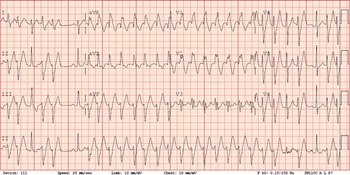
All the neonatal cases were diagnosed during the neonatal period with none having prenatal findings suggestive of ventricular tachycardia. The ventricular tachycardia rate ranged from 170–300 bpm, and all 8 had intermittent ventricular tachycardia. The ventricular tachycardia had a right bundle branch block morphology in 2 and left bundle branch block in 4 patients. The axis of the ventricular tachycardia was inferior in 3/4 with LBBB morphology, and superior in the remainder with RBBB or left bundle branch block morphology (Figure 2).
Neonatal VT bouts of non-sustained monomorphic ventricular tachycardia (RBBB and superior axis morphology).

One neonate was briefly treated with sotalol but never reoccurred, whereas, the 7 others had recurrence necessitating therapy. Of the 7 neonates who were treated for ventricular tachycardia, 4 received intravenous therapy including amiodarone in 3 and esmolol in 1 (Figure 3). Of those initially receiving IV therapy, 2 were converted to oral propranolol and 2 to oral sotalol with successful therapy to discharge. Three others initially received propranolol achieving successful treatment for 1, but requiring a change in medication to sotalol in 1 and to mexiletine in the other after failed treatment with sotalol as well (Figure 3).
Management of neonatal VT.

Ventricular tachycardia was suppressed or resolved with pharmacologic treatment in 3 of 4 (75%) of fetal cases and in 6 of 8 (75%) of neonatal cases at <1 month after birth. Postnatal ventricular tachycardia treatment lasted for a median of 10 (range 8–12) and 7 (range 2–12) months for fetal and neonatal cases, respectively (Table 1). Demise occurred in only 1 case, which was a fetus with restrictive cardiomyopathy and progressive hydrops.
Discussion
Fetal and neonatal ventricular tachycardia is a rare diagnosis that can range in severity from benign to life-threatening. Reference De Rosa, Butera and Chessa2–Reference Strasburger and Wakai4 The management varies based on the severity of symptoms, age of presentation, and haemodynamic status. Reference Wang, Zhu and Hamilton10 In our study, the clinical outcomes of both fetal and neonatal ventricular tachycardia were largely good with only a single fetal case developing hydrops related to evolving restrictive cardiomyopathy.
Ventricular tachycardia in fetuses and neonates has been reported in the presence of viral myocarditis, cardiomyopathies, cardiac tumours, anti-Ro antibodies, channelopathies, and abnormal electrolytes. Reference Jaeggi and Ohman3,Reference Strasburger and Wakai4,Reference Karpawich, Pettersen and Gupta13,Reference Sacchetti, Moyer and Baricella24 In our study, 40% of fetuses and 62% of neonates had coexistent structural heart disease and this includes one fetal case of cardiomyopathy which may have been a contributing factor to ventricular tachycardia development. Reference Kilic, Celiker and Karagoz6–Reference Iwamoto8
Fetal ventricular tachycardia may become life-threatening if there is evolution of fetal hydrops. Reference Jaeggi and Ohman3–Reference Simpson, Allan, Hornberger and Sharland5 However, proper management may reduce fetal death to less than 10%. Reference Simpson, Allan, Hornberger and Sharland5 In this study, the one fetus that died had evidence of restrictive cardiomyopathy, which is known to carry a poor prognosis. Reference Chiu, Wu and Lu1 Neonates with ventricular tachycardia may present with poor cardiac function and in rare cases this might lead to demise. Reference Batra and Balaji7,Reference Iwamoto8 As suggested by the present case series, the majority of neonatal ventricular tachycardia, however, is benign and if accurately diagnosed and managed, the outcome may be quite favourable. Reference Chiu, Wu and Lu1,Reference Iwamoto8
While neonatal ventricular tachycardia relies on well-defined electrophysiologic features on ECG, ventricular tachycardia in the fetus is indirectly inferred when there is tachycardia with faster ventricular rate relative to atrial contractions, or A-V dissociation. Occasionally, fetal ventricular tachycardia may be associated with A-V association, but differentiating the latter from supraventricular tachycardia with 1:1 ventricular-atrial or atrial-ventricular contractions may be difficult. Furthermore, differentiating fetal ventricular tachycardia from junctional tachycardia can be very challenging and should be confirmed after birth (Figure 4). The presence of intermittent ventricular ectopy can be informative in this context and lead to the suspicion of ventricular tachycardia. Reference Simpson, Allan, Hornberger and Sharland5,Reference Wang, Zhu and Hamilton10 Suspected fetal ventricular tachycardia should prompt exclusion of structural or functional fetal heart disease and acquisition of 12-lead ECGs in both the mother and father of the fetus given the possibility of a channelopathy, which may help tailor treatment and ensure ongoing surveillance and treatment of the affected parent. Reference Simpson, Allan, Hornberger and Sharland5
Differntiating VT from JET A: This 34-week fetus presented in tachycardia initially with 1:1 ventricular (arrow) to atrial (A) relationship at 180-190 bpm. When not in tachycardia, the baby was having ventricular trigeminy (P) and otherwise normal A-ventricular (V) synchrony. B: The ventricular ectopy was confirmed by the simultaneous superior vena cava (SVC)-ascending aortic Doppler interrogation with SVC a wave reversal and forward flow through the aorta are shown above the baseline and forward flow through SVC below the baseline. Normal atrial (A) and ventricular (V) contractions are shown, but with a premature ventricular contraction (P) occurring during an atrial contraction, the AV has a very high velocity in keeping with a cannon A wave (atrial contraction against a closed tricuspid valve). C: In addition to the presence of premature ventricular contractions out of tachycardia, the fetus also demonstrated ventricular (arrow)-atrial (A) dissociation at one point in tachycardia with a clearly faster ventricular rate.

In fetal ventricular tachycardia, use of transplacental antiarrhythmic medication has been recommended in cases with recurrent and prolonged tachycardia or in the presence of hemodynamic compromise. Reference Strasburger and Wakai4,Reference Simpson, Allan, Hornberger and Sharland5,Reference Wang, Zhu and Hamilton10 However, close surveillance is mandated for both treated and untreated fetuses. Reference Wang, Zhu and Hamilton10
In the current cohort, we were able to manage 4 of the 5 fetal cases with no need for early delivery. One fetus did not have rhythm normalisation until flecainide was added to the initial amiodarone therapy. Jaeggi et al. Reference Jaeggi and Ohman3 suggested that beta-blockers is the mainstay to treat fetal ventricular tachycardia; however, as propranolol has poor transplacental transfer, if not clearly reducing the ventricular tachycardia, moving to other medications, such as amiodarone, sotalol, and flecainide, after excluding long QT syndrome, may be necessary to achieve control. Further assessment is needed in these cases to role out long QT by getting detailed family history and ECG for the parents and genetic testing if needed. Reference Batra, Silka and Borquez32
In the neonatal period, we initially utilised intravenous medications in half and oral in the other half of our patients. The choice of antiarrhythmic was based on the stability of the neonates and the suitability of using oral or intravenous medication. Wang et al. Reference Isik, Celik and Kavurt9 reported beta-blockers as first-line treatment for paediatric ventricular tachycardia with good outcomes, and others have reported the successful use of slow infusion amiodarone as a second-line treatment in this age group. Reference Lulic Jurjevic, Podnar and Vesel11,Reference Sacchetti, Moyer and Baricella24,Reference Dai, Yin and Yang29 For all fetal and neonatal cases in the current report, successful therapy was achieved prior to discharge. Levin et al. Reference Lulic Jurjevic, Podnar and Vesel11 reported that infants with ventricular tachycardia have promising outcomes, with follow-up needed for most of the cases up to 3 years. Similarly, our study has found that all neonatal ventricular tachycardia resolved within the first year with a median follow-up of 33 months with no recurrence up to three years from the last episodes (Table 1).
Limitations
This study was retrospective resulting in variable treatment strategies. Treatment was guided by practitioner preferences and patient characteristics. It is possible that some of the fetal and neonatal cases would have had a favourable outcome without therapy. The number of cases encountered was also limited, but represents a single-centre experience of this rare diagnosis.
Conclusion
The majority of fetal and neonatal ventricular tachycardia may be manageable with pharmacologic therapy with promising outcomes in the absence of cardiomyopathy. Given its rarity, larger multi-centre studies are needed to identify optimal management strategies for this age group to further understand the incidence of associated cardiac pathology and clinical outcomes.
Competing interests
The authors have no disclosures. No conflicts of interest have been reported by the authors.




 Open access

