

Introduction
This article investigates the nature of public opinion on abortion in post-legalization Argentina, focusing specifically on how attitudinal ambivalence emerges from conflicting core values. Abortion is a uniquely contentious issue because it forces citizens to adjudicate between deeply rooted beliefs regarding the sanctity of life, bodily autonomy, and gender equality. When individuals are exposed to these competing dimensions, they often experience what we term doctrinal conflict—defined here as the internal psychological tension that occurs when a person simultaneously holds two deeply ingrained, yet practically competing, moral principles (e.g., the belief in fetal personhood and the commitment to a woman’s right to choose).
The enactment of Law 27.610 in December 2020 put an end to a century of historical legal ambiguity stemming from the 1921 Penal Code, which permitted abortion under specific, often unevenly applied, health and rape exceptions, but criminalized it otherwise.Footnote 1 This historical ambiguity was resolved by the Supreme Court of Justice in 2012 through the crucial “FAL ruling,” which set mandatory national jurisprudence by guaranteeing access to non-punishable abortion due to rape without requiring judicial intervention.Footnote 2 The new legislation was the culmination of a longstanding demand by the feminist movement—specifically the National Campaign for the Right to Legal, Safe, and Free Abortion, which had systematically drafted and introduced legalization bills to Congress for over fifteen years before its historic passage (Bellucci Reference Bellucci2014; Anderson Reference Anderson2020). The first major legislative push came in April 2018, when the executive branch submitted a bill for the Voluntary Interruption of Pregnancy (IVE). The bill’s treatment in Congress triggered one of the largest women’s mobilizations in the country’s history—the so-called “Marea Verde”—which profoundly reshaped the political landscape (Sutton Reference Sutton2020; Sutton and Vacarezza Reference Sutton and Luz Vacarezza2021; Daby and Moseley Reference Daby and Moseley2022; Anderson Reference Anderson2022). Although the 2018 bill received preliminary approval from the Chamber of Deputies, it was ultimately rejected by the Senate (Felitti and Prieto Reference Felitti and Prieto2018; Ruibal and Anderson Reference Ruibal and Fernandez Anderson2018; Anderson Reference Anderson2020). Following the arrival of a new government, a subsequent bill was sent to Congress, which finally approved the Voluntary Interruption of Pregnancy, cementing it as law in December 2020 (Lopreite Reference Lopreite, Collier, Grace and Vickers2020).
Furthermore, in the Argentine context, the very notion of the “sanctity of life” is historically contingent and highly contested. While opponents often mobilize around the right to life from conception, the Argentine feminist movement successfully challenged and resignified this framework. Proponents of legalization reclaimed the “right to life” by centering the public health crisis of clandestine abortions and maternal mortality, demonstrating that the defense of life does not exclusively belong to anti-abortion advocates, but is rather a disputed concept central to the arguments of both sides.
Despite the legal resolution, public opinion on abortion remains deeply complex, defying simple partisan or ideological sorting. In fact, issues like abortion are not merely political debates; they are fundamentally contentious policy domains (Htun Reference Htun2003; Htun and Weldom, Reference Htun and Laurel Weldomn.d.). As Laurence Tribe famously argued, abortion involves a “clash of absolutes,” making it a uniquely difficult subject for democratic resolution (Tribe Reference Tribe1992). Public support (or rejection) for the law is certainly correlated with traditional factors, such as religiosity being the primary explanation, and ideology playing a lesser role (Reynoso Reference Reynoso2021). Regardless, this tension highlights a critical phenomenon: while some individuals hold firm, binary positions, others exhibit ambivalence.
This internal conflict, where people may accept abortion under certain circumstances but reject it in others, gives rise to response ambivalence, the central subject of the present research. Ambivalence theory posits that individuals may simultaneously harbor both positive and negative attitudes toward an object (Minkowich et al. Reference Minkowich, Weingarten and Blum1966; Kaplan Reference Kaplan1972; Alvarez and Brehm Reference Alvarez and Brehm1995; Delft Reference Delft2004). While individuals with clearly defined belief systems are expected to hold firm, consistent positions, many citizens hold “mixed values” or “conflicting values” that become activated when facing controversial topics. For instance, respondents who strongly agree that “women have the right to decide over their own bodies” will tend to consider that abortion should be legal across different situations, whereas those who disagree with this premise and instead affirm that “life begins at conception” will tend to respond that it should not be legal. Conversely, individuals who simultaneously agree that women have the right to decide over their bodies and that life begins at conception will experience a tension between these competing values that leads them to exhibit ambivalence in certain scenarios—that is, a disposition to say yes and no at the same time. Understanding this internal value conflict is crucial for clarifying debates regarding support for public policies in contentious domains.
By extending Alvarez and Brehm’s (Reference Alvarez and Brehm1995) heteroskedastic model—rather than merely their empirical findings—to the Argentine context, this study captures the variance in public responses across different scenarios. Scenarios involving poverty, marital status, or the desire not to have more children are highly controversial because they shift the justification from medical necessity or severe trauma to personal agency and socioeconomic discretion, directly confronting traditional norms regarding motherhood and self-sacrifice. This article shows that citizens’ positions reflect internal tensions between beliefs about life and women’s bodily autonomy, and, utilizing a heteroscedastic probit model, reveals how this conflict heightens ambivalence in the most controversial scenarios (“Too Poor,” “Many Children,” “Any Reason,” and “Single Mother”). Ultimately, this research provides a more nuanced understanding of public opinion that holds important implications for political communication and democratic discourse, highlighting the need for a subtle approach that acknowledges the internal value conflicts held by citizens.
Value Conflict Model and Response Ambivalence
Ambivalence is understood as a state or disposition of simultaneously being for and against something. Minkowich et al. (Reference Minkowich, Weingarten and Blum1966) defined it as “the coexistence of opposed emotional attitudes toward a significant figure in the social environment.” It can also be understood as “a state of having simultaneous conflicting reactions, beliefs, or feelings towards some object” (Armitage and Conner Reference Armitage and Conner2000), or “the experience of having an attitude towards someone or something that contains both positively and negatively valenced components” (Crano and Prislin Reference Crano and Prislin2011, 262–85). Under certain circumstances, it is common for people to experience ambivalence. In a classic work, Zaller and Feldman (Reference Zaller and Feldman1992) found that “most people have opposing considerations on many issues, considerations that lead them to take positions on one side or the other of the debate. …” They termed this phenomenon the “ambivalence axiom.” Individuals may consider both sides of a debate, displaying doubt or insecurity when giving a favorable or unfavorable response on an issue. Zaller and Feldman (Reference Zaller and Feldman1992) identified various indicators to empirically test for ambivalence. The source of this ambivalence, in the first instance, can be a conflict between values or the presence of opposing values within an individual’s core beliefs. For example, regarding abortion, a person might agree that “women have the right to decide over their bodies” and, simultaneously, that “life originates at conception.” The presence of both beliefs or values can lead to an arduous internal dispute regarding agreement or disagreement with abortion legalization. Individuals who agree solely with a woman’s right to choose, or solely with the sanctity of life, would not experience such internal conflict.
However, not all manifestations of ambivalence necessarily arise from value conflict. An alternative reason could be the interviewee’s uncertainty regarding the interviewer’s reaction to their response (equivocation). In such circumstances, the person might hesitate to respond not due to a conflict of values, but because of their expectation of the impact their answer might provoke. Another reason could be that the interviewee is aware of many arguments on both sides of the debate but is insufficiently informed to answer the question independently (uncertainty). Again, this is a case where the interviewee may be unclear about how to respond due to a lack of information, rather than a conflict of values. A third reason might lie in the ambiguity of the question. The interviewee may have a clear position regarding the values at stake, but the question might be formulated in a way that generates doubt about the appropriate response. Often, changes in question phrasing can lead to shifts in responses, without necessarily involving a value conflict. A fourth reason is that the interviewee might be exhibiting informedness by considering or weighing both sides of the debate. Highly informed and politically educated interviewees are often capable of articulating arguments from both sides of an issue, even if they have a clear position, and demonstrate critical judgment even regarding their own stance. Thus, many potential sources of ambiguity exist in responses. But the conflict between values is of a different kind: the individual is certain of their values and certain of the ramifications of those values but, on one hand, finds it difficult to provide an answer to a complex question. This interviewee would appear identical to someone with no position on the issue. On the other hand, having more information would not resolve the difficulty, as the problem would stem from their values, not the available information. Thus, when there is a conflict between values, it is difficult for that individual to determine their position on an issue.
In this sense, it is crucial to conceptually distinguish ambivalence from indecision or uncertainty. While indecision typically reflects a lack of information or the absence of a crystallized opinion—what Zaller and Feldman (Reference Zaller and Feldman1992) might describe as unformed considerations—ambivalence arises from the simultaneous presence of strong, conflicting evaluative components (Armitage and Conner Reference Armitage and Conner2000; Crano and Prislin Reference Crano and Prislin2011).The ambivalent citizen is not uninformed or apathetic; rather, they are cross-pressured by competing, strongly held values. Unlike indecision, which might be resolved by acquiring more information, value-based ambivalence persists precisely because the individual, rather than lacking information, perceives the issue as governed by opposing moral imperatives. This conceptual distinction allows us to situate individual-level attitudes within broader debates on the nature of abortion politics. As characterized by Htun (Reference Htun2003) and Htun and Weldom (Reference Htun and Laurel Weldomn.d.), abortion represents a quintessential “doctrinal” and “contentious” policy domain, where disputes center on non-negotiable moral principles rather than technical means. Therefore, the ambivalence observed in our study should not be dismissed as indecision, but rather understood as the individual-level reflection of this macro-level doctrinal conflict. Far from engaging in a simple binary choice, citizens internalize the “clash of absolutes” (Tribe Reference Tribe1992) inherent to this policy domain, resulting in complex, conflicted positioning rather than mere uncertainty.
Consequently, relying on binary labels such as “pro-life” versus “pro-choice” (or their local equivalents, “celestes” versus “verdes”) risks obscuring the complexity of public opinion. While these categories may effectively describe mobilized activists or elite polarization, they often fail to capture the reasoning of ordinary citizens who may not subscribe to absolutist frameworks. Instead of treating abortion simply as “controversial” or “morally difficult”—terms that are subjective and imprecise—we conceptualize the issue as a clash between two specific, fundamental values: the sanctity of life and bodily autonomy.
To operationalize this theoretical approach, we adopt the Value Conflict Model originally developed by Alvarez and Brehm (Reference Alvarez and Brehm1995). This framework allows us to move beyond the assumption that citizens must fit neatly into one of two opposing camps. Instead, it posits that response variability (heteroscedasticity) is not merely statistical noise, but a substantive indicator of the tension between these core values. Under this model, individuals who strongly endorse both the sanctity of life and bodily autonomy are expected to exhibit the highest levels of response variability—that is, ambivalence. Conversely, those who prioritize one value to the exclusion of the other are expected to show low variability and consistent policy preferences. By applying this lens to the Argentine case, we avoid imposing a binary logic on a multifaceted doctrinal conflict.
Drawing upon Petty and Cacioppo (Reference Petty and Cacioppo1986) and Alvarez and Brehm (Reference Alvarez and Brehm1995), this study posits that it is possible to separate the impact of independent variables on the direction of the response (favoring or opposing legalization) from the sources of ambivalence that generate variance in those responses. Individuals who care about an issue and pay attention to it tend to bring their values into play, potentially leading to greater response variance. Crucially, this variance should not be misinterpreted as measurement error or respondent confusion. Rather, it stems from the cognitive demands of what Carmines and Stimson (Reference Carmines and Stimson1980) classify as “difficult” issues. While “easy” (or single-value valence) questions allow respondents to answer without delay based on a gut reaction, “difficult” questions require respondents to weigh conflicting options by comparing two or more value dimensions (Alvarez and Brehm Reference Alvarez and Brehm2002). In the case of abortion, this “difficulty” is not a matter of comprehension, but of adjudicating between the deeply held belief in women’s freedom to decide and the belief in the sanctity of human life from conception.
The replication of Alvarez and Brehm (Reference Alvarez and Brehm1995)’s framework in the Argentine context offers a novel contribution by examining value conflict in a post-legalization scenario within Latin America, a region historically characterized by restrictive abortion laws. Unlike the US case, where the debate has been entrenched for decades, Argentina underwent two decisive legislative rounds in a short span, creating a “natural experiment” on the activation of competing values. The first attempt in 2018 failed in the Senate, while the second in 2020 succeeded in enacting the Voluntary Interruption of Pregnancy Law.Footnote 3 This intense legislative trajectory highlights the profound and persistent value conflicts within Argentine society, providing a unique backdrop to observe how these competing considerations manifest as ambivalence even after legal resolution. Consequently, “more difficult” policy options for legalizing abortion imply that fundamental values come into conflict, causing respondents to become more ambivalent and making their responses harder to predict for standard models (exhibiting greater variance). Therefore, it is essential to capture the process by which the model produces unequal variances, which serves as a substantive source of information about the value conflict respondents hold.
Methodology and Data Collection
To empirically test the ambivalence hypothesis through the construction of a heteroscedastic regression model, we rely on original survey data designed specifically for this study. A battery of questions on abortion attitudes was included within the framework of the Encuesta de Satisfacción Política y Opinión Pública (ESPOP), conducted by the University of San Andrés. The fieldwork was carried out between May 27 and June 8, 2022, covering a total sample of N = 1,021 respondents. The study utilized a non-probability quota sampling strategy to ensure representativeness across key demographic variables. Participants were recruited through online panels, stratified by region,Footnote 4 with quotas established for age, gender, and socioeconomic status to mirror the distribution of the national census parameters. While online surveys inevitably exclude the unconnected population—a limitation we acknowledge—internet penetration in Argentina is among the highest in the region, and previous studies using ESPOP data have demonstrated high predictive validity in electoral and social attitudes. Post-stratification weights were applied to correct for minor deviations in the sample composition.Footnote 5
A central challenge in this study was adapting the classic battery of questions used by Alvarez and Brehm (Reference Alvarez and Brehm1995)—originally designed for the US General Social Survey (GSS)—to the contemporary Argentine context. Critics might argue that a 1990s US framework does not translate meaningfully to post-legalization Argentina. However, we contend that this specific battery is uniquely suited to capture the structure of the Argentine abortion debate because the seven standard scenarios map directly onto the country’s specific legal trajectory.
The survey posed the following question to respondents: “Please tell me whether you agree or disagree that a pregnant person should be able to legally abort in each of the following cases.” Subsequently, respondents were presented with a grid detailing seven specific situations (these situations correspond to distinct legal regimes in Argentina’s history): :
-
1. If there is a high chance of a serious defect in the fetus (Fetal Defect)
-
2. If she lives with a partner and does not wish to have more children (No More Children)
-
3. If the pregnancy puts the pregnant person’s health at risk (Health)
-
4. If the family has very low income and cannot support another child (Too Poor)
-
5. If she became pregnant as a result of rape (Rape)
-
6. If she is not in a relationship and does not wish to marry the progenitor (Single)
-
7. If the person wishes to abort for any reason (Any Reason)
Historical Grounds (ILE): Three scenarios—Health, Rape, and Fetal Defect—correspond conceptually to the Legal Interruption of Pregnancy (ILE) framework. In Argentina, the Health and Rape grounds have been non-punishable since the 1921 Penal Code and were further ratified and expanded by the Supreme Court’s 2012 “FAL” ruling. We adopted the standard wording “If the pregnancy puts the pregnant person’s health at risk.” We acknowledge that under current Argentine law (and the FAL ruling), the concept of “health” is integral (encompassing physical, mental, and social well-being). However, in public opinion surveys, using the phrase “seriously endangered” or “puts health at risk” provides a conservative test of support. If a respondent rejects abortion even when health is at risk, they hold a high-intensity “pro-life” value. Conversely, this wording avoids the ambiguity of broader definitions that might conflate health with general well-being in the respondent’s mind.
Voluntary Grounds (IVE): The remaining four scenarios—Too Poor, No More Children, Single, and Any Reason—correspond to the Voluntary Interruption of Pregnancy (IVE) framework introduced by Law 27.610 in 2020. These scenarios capture the discretionary aspect of the new law, which allows abortion on request up to the fourteenth week.
By retaining this distinction, our instrument does not merely replicate a US study but rather uses it to test the gap between the legal reality (where all these scenarios are now legal) and the moral intuition of the public. If the “binary” hypothesis were true, we would expect supporters of the 2020 law to support all items equally. Instead, the differentiation between these “1921 scenarios” (Historical) and “2020 scenarios” (Voluntary) allows us to observe the persistence of value conflict even after full legalization.
These situational alternatives were selected not only for their legal relevance but also because they allow us to observe varying thresholds of consensus on abortion attitudes (Alvarez and Brehm Reference Alvarez and Brehm1995; Yam et al. Reference Yam, Dries-Daffner and García2006). This structure enables a comparative analysis of how nuances in public opinion might shift across different political and social landscapes following the passage of the Voluntary Interruption of Pregnancy Law.
The percentage of agreement and disagreement with legalization in each case can be visualized, where the different abortion legalization options are organized from the highest to the lowest degree of agreement. In Figure 1, 1 signifies “yes,” indicating agreement with legalization, and 0 signifies “no,” indicating disagreement. The labels identifying each situation in the figure correspond to the labels in parentheses following the descriptions of each situation in the preceding list.
Public Support for Abortion Across Seven Scenarios. The figure displays the percentage of affirmative responses for each scenario, ordered from highest to lowest level of agreement. Data are derived from the original national survey conducted in Argentina (May–June 2022, N = 1,021). A clear distinction is observed between the high consensus on historical grounds (health, rape, fetal defect) and the divided opinions on voluntary grounds.

As observed, in situations where “the mother’s health is at risk” (85%), “in cases of rape” (85%), or due to a “fetal defect” (79%), the level of agreement with legalization is remarkably high: eight or more out of every ten individuals agree. Consensus diminishes significantly in other situations where opinions are more divided. For instance, when the pregnant person is “single” or wishes to abort “for any reason,” agreement with legalization drops to 43% and 44%, respectively. This pattern highlights a clear gradient of public consensus, moving from broad agreement in historically established grounds (ILE) to significant division in cases perceived as voluntary or discretionary (IVE).
The spectrum of situations in which abortion legalization is proposed can also serve as a gradual scale of overall attitude toward abortion legalization. Only 8.3% of respondents consistently indicated disagreement with abortion legalization across all situations, representing a segment with consistent opposition to legalization. Conversely, a substantial 36.4% consistently agreed with legalization in every scenario, indicating unconditional support. Between these two extremes lie individuals who agree in some instances and disagree in others. This offers compelling evidence that a significant number of people who might generally lean towards disagreement are, nonetheless, open to admitting legalization under specific circumstances. This nuanced response pattern underscores the complexity of public opinion on abortion, moving beyond a simple binary division.
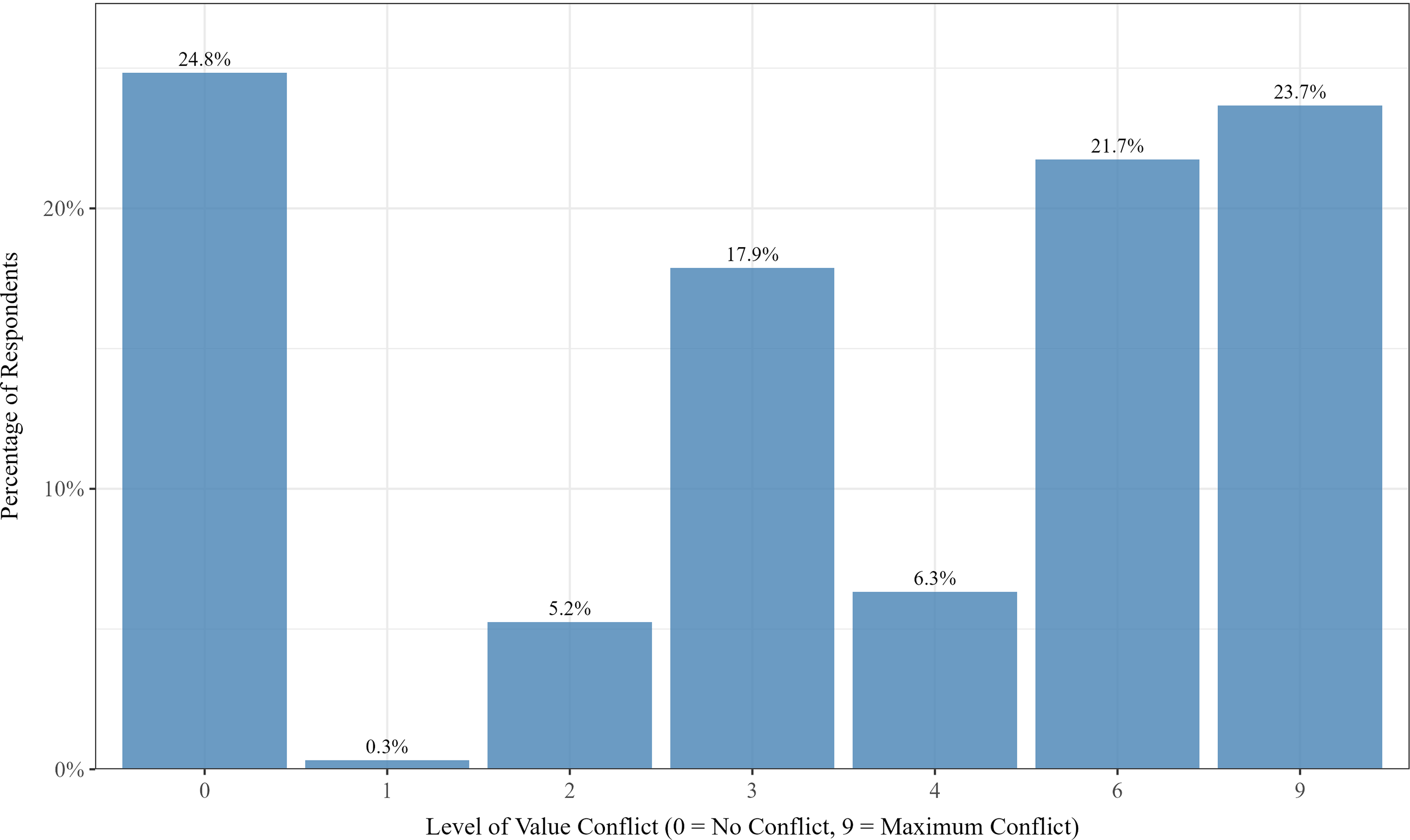
Figure 2 provides an empirical basis to suggest that individuals may simultaneously favor or oppose legalization, depending on the specific situation. This ambivalence, in turn, can be a product of confronting conflicting values when considering different alternatives. Evidently, the 8% of respondents who consistently disagree with abortion legalization under any context do not appear to face such conflicts. Similarly, the 36% who consistently agree across all situations also seem to exhibit a low degree of internal conflict on this issue. The heterogeneity of responses observed in the figure directly informs the central hypothesis of this study, pointing to the existence and significance of attitudinal ambivalence among a substantial portion of the population.
Independent Variables
To empirically test ambivalence in abortion attitudes, we will specify a two-part model. The first part, the predictive coefficient model, estimates the relationship between a set of variables and support for abortion legalization across each of the seven scenarios. The independent variables included in these models are drawn from the growing literature on abortion attitudes. The second half of the model estimates the variance of the error term in the binary choice component of the model, also known as heteroskedasticity. The basic premise is that individuals who believe life begins at conception and, simultaneously, believe women have the right to decide on the continuation of pregnancy should experience greater difficulty in making a decision regarding abortion legalization in certain situations. Consequently, these individuals are expected to manifest higher ambivalence in their responses. This heightened ambivalence would, therefore, result in greater variance in their answers (i.e., the model is not homoskedastic), making it more challenging to predict their observations. This approach allows us to disentangle the factors that influence the direction of an attitude (agreement/disagreement) from those that influence the certainty or ambivalence of that attitude, providing a richer understanding of public opinion dynamics.
To determine agreement or disagreement with abortion legalization across the seven scenarios previously described, a set of independent variables is included. The respondent’s sex “male,” is coded as 0 for female respondents and 1 for male respondents. The literature has extensively discussed and found evidence that women, as the primary subjects of this public policy, tend to show greater inclination towards agreement compared to men (Marsiglio and Shenan Reference Marsiglio and Shenan1993; Petraci Reference Petraci2011). Religion is another pivotal factor influencing the propensity to agree or disagree with abortion legalization (Sullins Reference Sullins1999; Center 2014; Rabbia and Ruata Reference Rabbia and Candelaria Sgró Ruata2014; Felitti and Prieto Reference Felitti and Prieto2018). To capture this, we include a nominal variable with categories: “Catholic,” “Evangelical,” and “Others” (grouping other responses due to their smaller individual sizes). Additionally, “no religion” serves as the reference or baseline category. It is crucial to distinguish between the profession of a faith and its intensity; thus, we also include religiosity, coded on a 0-to-1 scale, where 0 represents “not religious at all” and 1 signifies “very religious.” Religiosity is consistently identified as one of the variables with the most significant negative impact on attitudes toward abortion legalization (Reynoso Reference Reynoso2021). Church attendance (Sullins Reference Sullins1999; Singh and Leahy Reference Singh and Leahy1978) is another potential influential factor. The understanding is that individuals who attend religious services more frequently are in greater contact with discourses opposing abortion legalization, often considering it a grave moral transgression (Blofiedl Reference Blofiedl2006). Church attendance is captured across five frequency categories, ordered from “never attend temple” (coded as 1) to “attend very often” (coded as 5).
A schematic representation of individuals’ belief systems is ideology, conceptualized as the left-right distinction. We measure ideology using a self-placement scale ranging from 1 to 7, where 1 signifies the leftmost position and 7 the rightmost position. A belief system, of course, is a complex network of values and beliefs. Here, the left-right distinction is understood as a schema (J. T. Jost Reference Jost2009; J. Jost Reference Jost2021); that is, a cognitive structure that helps individuals organize diverse experiences. Accordingly, it is expected that the further to the right a person self-identifies, the less favorable they will be to abortion legalization, and conversely, the further to the left, the more favorable they will be (Reynoso Reference Reynoso2021).
As previously discussed, individuals may exhibit ambivalence in their responses or behave as if they do for various reasons. To control for these potential sources of ambivalence toward abortion legalization, a set of additional variables is included. Individuals with firm opinions are expected to show less hesitation when responding. Thus, the “firmness” of their opinions can be a potential factor of ambivalence distinct from value conflict. We construct the variable firmeza (firmness), originally with four categories (very likely to change opinion, somewhat likely, unlikely, very unlikely to change opinion), which we recoded from 0 to 1. Here, 0 means “very likely to change opinion” and 1 means “very unlikely to change opinion.” Similarly, people who assign greater “importance” to the issue will consider the matter in more detail and, consequently, might find it more difficult to give a clear pro- or anti-legalization response. This variable, indicating whether the person considers the issue “not at all important,” “slightly important,” “somewhat important,” or “very important,” has been recoded from 0 to 1, where 0 signifies “not important at all” and 1 “very important.” Additionally, individuals with higher levels of “information” are expected to show more ambivalence in their responses because, ceteris paribus, additional units of information could modify their considerations on the topic. The variable is included to indicate whether the person considers themselves “not at all informed,” “slightly informed,” “somewhat informed,” or “very informed,” and it is recoded between 0 and 1, where 0 means “not at all informed” and 1 “very informed.”
Finally, to estimate the impact of value conflict as a source of ambivalence, respondents were asked the extent to which they agreed or disagreed with two fundamental propositions: whether “life begins at conception” (conception) and whether “women have the right to decide over their own bodies” (decision). Both propositions were measured on a 4-category scale ranging from “strongly disagree” (0) to “strongly agree” (3). Theoretically, strong agreement with just one of these values should lead to response certainty (low ambivalence). However, individuals who demonstrate high levels of agreement with both propositions simultaneously are expected to experience a “clash of absolutes,” manifesting as greater response variability. To operationalize this internal tension, we constructed an interaction variable (conception × decision). This multiplicative term, ranging from 0 to 9, is specifically designed to capture the intensity of the conflict: it only reaches high values when the respondent strongly endorses both competing principles simultaneously.Footnote 6 As shown in Figure 2, the distribution of this variable reveals a polarized moral landscape: while a significant portion of the population holds consistent, non-conflicting views (scoring 0), approximately 23% of respondents indicated strong agreement with both propositions (scoring 9), and 51% showed moderate to strong overlap (scoring 4 or higher), highlighting the prevalence of potential value conflict.
Distribution of Doctrinal Value Conflict. The figure displays the distribution of the value conflict index, constructed from the interaction between respondents’ beliefs regarding the sanctity of life (“life begins at conception”) and bodily autonomy (“right to decide”). The index ranges from 0 (no conflict, aligned with a single dimension) to 9 (maximum conflict, simultaneously holding both opposing values).

Heterokedastic Regression Model
The problem of unequal variance across observations is commonly addressed by heteroscedastic regression models. These models simultaneously estimate the relationship between a set of variables and the respondent’s answer regarding abortion legalization, and the impact of a set of factors that can explain the error or variance around the estimation (ambivalence). Homoscedasticity refers to a situation where the error or variance is homogeneously distributed across observations. When this assumption is violated, heteroscedasticity is present. Estimations that assume homoscedasticity without controlling for heteroscedasticity can lead to inefficient estimates.
In standard probit regression models, the probability of an event (or response), namely P(Yi = 1), is modeled as:
 $$P\left( {{Y_i} = 1} \right) = {\pi _i} = \;{\rm{\Phi }}({x_i}^{\top}\beta )\,$$
Where Φ(⋅) is the cumulative density function (CDF) of the standard normal distribution. The general assumption of homoscedasticity implies that the variance of the error term εi is constant σi = 1, with a mean μi = 0. However, in the case of heteroscedastic models, the variance can vary systematically, such that it is necessary to model it as a multiplicative function of independent variables (the multiplicative heteroskedasticity idea from Harvey [Reference Harvey1976]), that is:
 $${\sigma _i} = {\rm{exp}}({z_i}^{\top}\gamma )$$
Thus, the probability of the (affirmative) response is estimated by:
 $${\pi _i} = \;{\rm{\Phi }}\left( {{{{x_i}^{\top}\beta } \over {{\rm{exp}}({z_i}^{\top}\gamma )}}} \right)$$
Note that the scale model is only identified without an intercept or constant. Fortunately, detailed discussions of heteroscedastic probit models and statistical packages for their application are available (Santer Reference Santer2017; Alvarez and Brehm Reference Alvarez and Brehm1995; Zeileis et al. Reference Zeileis, Koenker and Dobler2023; Altman and Mcdonald Reference Altman and Mcdonald2003).
In operational terms for this study, the model is specified by assigning distinct sets of covariates to each component of the equation. Sociodemographic and ideological variables—such as religion, religiosity, temple, age, education, gender—are entered into the mean equation (xi ⊤β) to estimate the direction of the response (support or rejection of legalization). Conversely, variables hypothesized to generate cognitive tension—specifically the interaction between core values (conception × decision), conviction firmness, and information levels—are entered into the variance equation (zi ⊤γ). Together, these two components constitute the full heteroskedastic probit model, allowing us to simultaneously assess what drives citizens’ positions on abortion and what factors drive the ambivalence or certainty of those positions.
Results
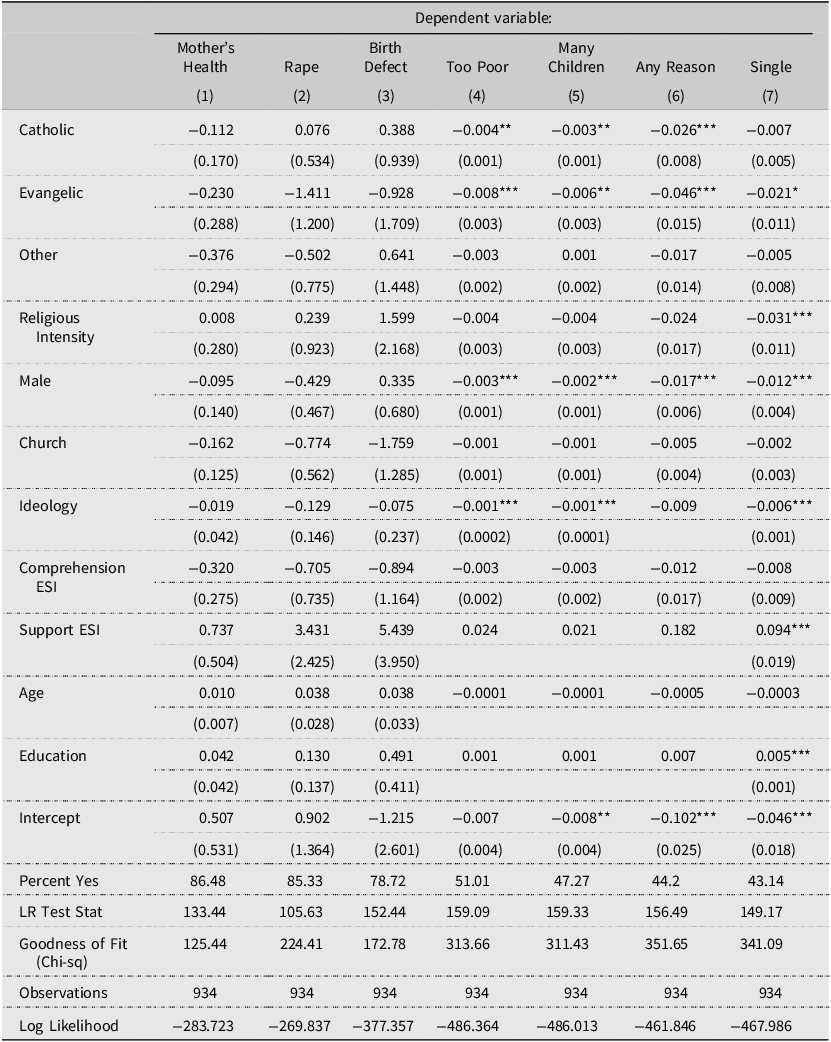
The data were utilized to estimate heteroscedastic probit regression models for attitudes toward abortion across the seven specific situations presented. The detailed results are displayed in Table 1. The models are ordered from the highest to the lowest level of public agreement, revealing a clear dichotomy that mirrors the legal distinction established in the theoretical framework.
Results of Heteroskedastic Probit Regression of Abortion Attitudes (Mean Model)

Note: *p < 0.1; **p < 0.05; ***p < 0.01.
The scenarios corresponding to the Historical Grounds (ILE)—“risk to mother’s health” (86%), “rape” (85%), and “fetal defect” (79%)—exhibit an overwhelming majority of favorable responses. In the framework of Carmines and Stimson (Reference Carmines and Stimson1980), these function as “easy” issues: they are likely processed through a single, dominant value dimension (e.g., humanitarian concern), resulting in high consensus. Conversely, the four scenarios associated with the Voluntary Grounds (IVE)—“poverty,” “no more children,” “single mother,” and “any reason”—show opinions that are significantly more divided, with support dropping to near or below 50%. These scenarios operate as “hard” or multidimensional issues, where respondents must adjudicate between competing considerations. Consequently, it is in these discretionary contexts where we expect latent value conflicts to manifest most acutely as increased response variance.
Model Fit
The Heteroscedasticity LR-test indicates significant levels of heteroscedasticity across all seven models. In every instance, the LR-test statistic exceeds the critical value of χ 2 = 14.4 for df = 6 (p > 0.01) and 12.59 for p > 0.05. This robustly rejects the null hypothesis of homoscedasticity (H 0: homoscedasticity), confirming that the variance of the error term is not constant across observations and justifying the use of heteroscedastic probit models.
Furthermore, the goodness-of-fit for all models consistently surpasses the critical value of χ 2 = 25.03 for df = 16 (p > 0.05) and 30.57 for p > 0.01. This indicates that the models provide a substantially better fit to the data compared to a null model, demonstrating their overall explanatory power.
Determinants of Support: The Mean Equation
The first component of the model (the mean equation) estimates the probability of supporting legalization. Across all seven models, religion emerges as the most consistent and powerful predictor. Using “No Religion/Atheist” as the reference category, identifying as Evangelical or Catholic has a statistically significant and negative impact on the likelihood of supporting abortion. The magnitude of this effect is particularly pronounced for Evangelicals, who show the strongest resistance across all scenarios. Similarly, religious intensity (measured as religiosidad) acts as a robust predictor of opposition; regardless of affiliation, higher intensity is associated with a lower probability of support. In contrast, church attendance (templo) does not consistently appear as a significant predictor across the models, suggesting that the subjective importance of religion is more determinant than the frequency of ritual practice in this context.
To illustrate the magnitude of these effects, we calculated predicted probabilities for the “Single Mother” scenario—a typical “voluntary” ground centered on autonomy. The results reveal deep cleavages driven by culture and values. For ideology, moving from the Left (1) to the Right (7) reduces the probability of supporting abortion by 24 percentage points (from 52.3% to 28.1%). However, the effect of religious intensity is even more profound: moving from “not religious at all” (0) to “very religious” (4) causes support to collapse by 42 percentage points, dropping to a negligible 0.9% probability of approval among the most devout. Education also plays a critical role in this autonomy-based scenario: respondents with the highest educational attainment are twice as likely (43.1%) to support legalization compared to those with the lowest education (22.0%). Finally, in terms of affiliation, those with No Religion show the highest support (38.5%), followed by Catholics (34.0%) and Evangelicals (25.2%), confirming the gradient of religious resistance.
Political and cultural values also play a decisive role. Ideological self-placement (where higher values indicate right-wing positioning) is negatively associated with support, although its effect size is generally smaller than that of religious variables. Notably, support for Comprehensive Sex Education (ESI) is a strong positive predictor of abortion support across all models. This suggests that attitudes toward abortion are part of a broader cluster of values regarding gender and sexuality rights.
Regarding sociodemographic controls, Age does not appear as a statistically significant predictor across most models, suggesting that generational differences may be less decisive than often assumed once value orientations are accounted for. Gender, however, exhibits a context-specific effect: while there is no significant difference between men and women in the ‘historical’ grounds (health, rape, fetal defect), being male is a significant and negative predictor of support in most ‘voluntary’ scenarios. This indicates that men are significantly less likely than women to support abortion when the decision is based on personal autonomy or socio-economic circumstances. Education, on the other hand, presents a specific pattern: it is a significant and positive predictor particularly in the ‘Single’ scenario. This finding aligns with the expectation that higher educational attainment correlates with greater acceptance of abortion in cases based on personal autonomy or lifestyle choices, which typically face lower consensus than health-related grounds.
Determinants of Ambivalence: The Variance Equation
The second component of the model (the variance equation) tests the central hypothesis of this study: that value conflict generates response ambivalence (observed as heteroscedasticity). In this equation, a positive coefficient indicates that the variable increases the variance (error) of the response—implying greater uncertainty or ambivalence—while a negative coefficient indicates reduced variance, or greater certainty.
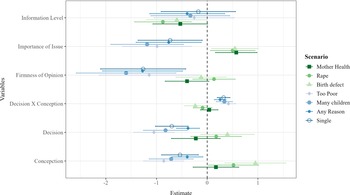
The results in Figure 3 provide strong support for the value conflict hypothesis. The key variable of interest, the interaction term Conception × Decision, exhibits a positive and statistically significant effect on the variance in the majority of the “Voluntary Grounds” (IVE) scenarios (specifically Any Reason, Too Poor, and No More Children). This signifies that individuals who simultaneously hold strong beliefs in the sanctity of life (conception) and women’s autonomy (decision) are statistically more variable in their responses. They do not fit neatly into a deterministic “yes” or “no”; rather, their internal value clash produces a measurable instability in their policy preferences.
Coefficients from the Heteroskedasticity Variance Model. Coefficient Estimate (Impact on Variance) 95% confidence intervals. In this heteroskedastic probit model, the variance equation models response instability. Positive coefficients (>0) indicate higher residual variance, representing greater ambivalence or value conflict. Negative coefficients (<0) indicate lower variance, reflecting greater certainty or crystallized attitudes.

Crucially, the analysis reveals a compelling nuance regarding the “Historical Grounds” (Rape and Fetal Defect). While these scenarios generally command high public consensus, the variance model indicates that individuals holding strong “pro-conception” values still experience significant ambivalence. This suggests that for this specific subgroup, even widely accepted legal exceptions trigger a meaningful internal conflict between their moral commitment to the sanctity of life and the humanitarian reality of these extreme cases. This finding challenges the notion that “easy” issues are effortlessly resolved by everyone; rather, they remain cognitively taxing for those with deep moral objections, further validating the presence of value conflict even in settled legal territories.
Conversely, the variables measuring cognitive certainty behave as expected. Firmness of opinion has a consistent, negative, and highly significant effect across all models. This indicates that respondents who perceive their own views as “firm” have significantly lower residual variance—their attitudes are crystallized and predictable. Similarly, Information tends to reduce variance, suggesting that higher political sophistication helps individuals structure their beliefs more consistently, reducing ambivalence.
Interestingly, the effect of Importance is more complex. In “hard” scenarios like Any Reason, assigning high importance to the issue tends to reduce variance (polarization). However, in some contexts, high importance does not necessarily eliminate ambivalence if the underlying value conflict is acute.
In sum, the heteroscedastic model reveals that while religious and ideological factors drive the direction of the opinion (Support/Opposition), the intensity and certainty of that opinion are structurally determined by the interplay of conflicting core values.
Discussion and Conclusions
This study set out to examine the structure of public opinion on abortion in Argentina following the landmark legalization in 2020. By applying a heteroscedastic probit model to original survey data, we tested the hypothesis that citizens’ attitudes are not merely binary positions (“pro-life” vs. “pro-choice”) but are often characterized by significant ambivalence stemming from value conflict. Our findings provide robust empirical support for this framework, revealing that response variability is not random noise, but a systematic outcome of the tension between competing core values: the sanctity of life and bodily autonomy.
Beyond Binary Polarization: The Limits of the “Grieta”
One of the most significant theoretical implications of this study concerns the limits of polarization. In the Argentine context, political debate is frequently framed through the lens of “la grieta” (the rift)—a deep, insurmountable division between opposing camps. However, our results suggest that this binary logic, while useful for describing elite mobilization or legislative voting blocs (Lopreite Reference Lopreite, Collier, Grace and Vickers2020), fails to capture the complexity of the mass public. The fact that the interaction between conflicting values (Conception × Decision) significantly increases response variance—particularly in “hard” or discretionary scenarios—demonstrates that a substantial portion of the citizenry occupies a “conflicted middle.” These individuals are not simply undecided or uninformed; they are cross-pressured by valid but competing moral imperatives. This finding challenges the narrative of a hopelessly polarized society and suggests that democratic consensus on controversial issues is not about achieving unanimity, but about managing the cognitive and moral tension inherent in pluralism.
Cross-National Convergence in Doctrinal Politics
The successful replication of Alvarez and Brehm (Reference Alvarez and Brehm1995)’s US-based model in post-legalization Argentina offers valuable insights for comparative politics. Despite profound cultural, religious, and institutional differences between the United States and Argentina—and the distinct trajectories of their abortion debates (judicialization vs. legislation)—the underlying psychological mechanism of ambivalence appears remarkably similar. This convergence suggests that when a policy domain is structurally “doctrinal” (Htun and Weldom, Reference Htun and Laurel Weldomn.d.) and involves a “clash of absolutes” (Tribe Reference Tribe1992), it triggers a universal cognitive process: value conflict generates ambivalence. The persistence of this ambivalence in Argentina, even after the legal resolution of the conflict (the 2020 IVE Law), indicates that legislative victories do not automatically resolve moral tensions at the individual level. Legalization changes the rules, but it does not erase the value conflict that defines the issue.
Implications for Political Communication and Public Policy
These findings have practical implications for how reproductive health policies are framed and communicated. If a significant segment of the population experiences ambivalence rather than dogmatic opposition, political communication strategies that rely on absolute, polarizing slogans are likely to alienate this conflicted middle. Instead, our results suggest that framing abortion not as an absolute good or evil, but as a complex moral dilemma where competing values (health, autonomy, life) must be balanced, may resonate more effectively with ambivalent citizens. For policymakers, acknowledging this ambivalence is crucial for the sustainable implementation of the law. Policies that are perceived as dismissing the moral weight of the “sanctity of life” may reactivate conflict, whereas those that frame access to abortion as a difficult but necessary compromise to protect other values (like health or autonomy) may find broader, albeit cautious, acceptance. However, while such framings might appease ambivalent sectors of the public, policymakers must be wary of the practical consequences of this rhetoric. Reasserting a heavy “moral weight” or stigma onto abortion in public discourse risks ostracizing and alienating the very individuals seeking care. Ultimately, there remains a fundamental tension between accommodating the moral sensitivities of the broader society and ensuring barrier-free access to a healthcare service that is exclusively relevant to, and vital for, the bodily autonomy of pregnant individuals.
Ultimately, this article contributes to the literature on contentious politics by specifying the micro-foundations of public opinion in doctrinal domains. We have shown that the “difficulty” of the abortion issue is not just a matter of political controversy, but a measurable cognitive reality for citizens. By moving beyond simple support metrics and modeling the uncertainty of responses, we gain a more realistic picture of the democratic citizen: not always a consistent ideologue, but often a conflicted moral agent navigating a complex world. Future research should explore whether this ambivalence fades as the policy becomes normalized over time, or if, as the US case suggests, the “clash of absolutes” ensures that abortion remains a permanently unsettled issue in the public mind.
Acknowledgments
The author would like to thank the anonymous reviewers and the editorial team for their valuable comments and suggestions, which have significantly improved the quality of this manuscript.
Data availability statement
Data files can be accessed at https://dataverse.harvard.edu/dataset.xhtml?persistentId=doi:10.7910/DVN/Z0OZBT
Competing interests
The author declares that there is no conflict of interest regarding the publication of this article.


 Open access

