


The underrepresentation of Black politicians in American politics is often thought to be a consequence of racial discrimination in elections (Knuckey and Orey, Reference Knuckey and Orey2000; Hutchings and Valentino, Reference Hutchings and Valentino2004). Indeed, the creation of majority–minority districts was motivated by a desire to increase the diversity of elected officials under the assumption that White voters would not support Black candidates and that Black voters preferred to be represented by Black elected officials (Brace et al., Reference Brace, Grofman and Handley1987). But an electoral penalty for Black candidates need not be rooted in racial animus—it could also arise if voters make inferences about Black candidates based on their race that disadvantage them electorally.
An extensive body of research in political science has focused on one such type of inference: candidate ideology. These inferences are thought to explain why White voters perceive Black candidates as more liberal (and Democratic) than otherwise equivalent White candidates. The emergence of prominent successful Black Republican candidates calls into question the assumption that all Black candidates are perceived as similarly liberal. Karpowitz et al. (Reference Karpowitz, King-Meadows, Quin Monson and Pope2021), for example, show that racially resentful white voters are more likely to vote for a Black candidate who signals they are conservative.
Perceptions of candidate ideology are one of several potential mechanisms by which candidate race may shape voter inferences. Of particular interest is whether candidate race shapes voters’ beliefs about whether they will prioritize the interests of some groups and issues over others. Concerns about which group's interests a candidate may prioritize—“group favoritism”—are particularly important, because beliefs about the relative attention candidates give to citizens of different races may affect vote choice even when voters believe that candidates are otherwise ideologically aligned. Similarly, views about issue prioritization are likely important for expectations about performance in office. But compared to work on inferences about ideology, scholarship has given less attention to whether candidate race affects inferences about group favoritism and issue prioritization.
In this paper, we focus on these three mechanisms and experimentally test whether Black and White candidates are perceived differently in terms of the groups they will favor, issue prioritization, and ideology. We also test whether candidate positions, particularly espousing conservative positions on a race-related policy, can ameliorate perceived differences based on candidate race. Across two studies, we find clear evidence that Black candidates are systematically perceived to favor Black over White constituents compared to equivalent White candidates and are perceived to prioritize certain issues. Confirming prior work, we also find evidence that Black candidates are perceived to be more liberal than equivalent White candidates, although this difference can be substantially reduced by adopting an explicitly conservative position on affirmative action. By contrast, the inference that Black candidates will favor Black constituents and certain policy issues does not diminish even when they express support for ending race-based affirmative action. This effect is therefore racially asymmetric because Black candidates face pressures that White candidates do not. Finally, we also show that these patterns are similar across different subgroups, indicating that racialized patterns of inference are not solely confined to White or conservative respondents. We provide novel evidence that racialized inferences change how people evaluate Black and White candidates and that such differences appear more persistent than concerns about ideological liberalness alone.
1. Theory and evidence: race and candidate evaluation
Prior research highlights the role candidate race plays in understanding voter behavior and preference. Work on descriptive representation argues that shared racial identity will increase turnout among voters of the same race, though this evidence is mixed (Highton, Reference Highton2004; McConnaughy et al., Reference McConnaughy, White, Leal and Casellas2010). McDermott (Reference McDermott1998) finds that liberal survey respondents are more likely to vote for a hypothetical Black candidate than White candidate, but the mechanism underlying this finding is unclear—both racial and ideological affinity are plausible explanations. Some studies suggest that racial prejudice among non-Black voters dissuades them from supporting a Black candidate (Terkildsen, Reference Terkildsen1993; Reeves, Reference Reeves1997). While prior work demonstrates that a Black candidate may garner more support from Black voters and/or less support from non-Black voters, there are a number of potential mechanisms for these patterns. A Black candidate may affect voter attitudes through mechanisms linked to racial attitudes, racial animus, or by affecting inferences made about a candidate based on their race, that may in turn affect vote choice.
Many studies have considered how a candidate's race affects inferences about their ideology and partisanship. Sigelman et al.'s (Reference Sigelman, Sigelman, Walkosz and Nitz1995) early survey experimental analysis shows that Black candidates without party labels who took moderate or conservative positions on issues were perceived to be more liberal than White candidates who took the same positions. Jones (Reference Jones2014) randomizes a candidate's race and policy congruency with the respondent and finds that non-White candidates are perceived to be more liberal and more Democratic, even compared to a White candidate who takes the same policy positions. Karl and Ryan (Reference Karl and Ryan2016) confirm that Black candidates are perceived to be more liberal than White candidates when a candidate's partisanship is not specified but find that these differences are eliminated when a candidate has a partisan affiliation. This implies that evidence from studies in which candidate partisanship is not specified are likely overstating the role of race per se. Undergirding these analyses is the argument that voters may vote against Black candidates not simply because of racial animus or outgroup bias, but because they infer that Black candidates are more liberal and therefore not ideologically congruent. What is more uncertain more generally is how these policy inferences are affected when candidates have identical policy positions and their partisan identity is known. In addition to ideology, candidate race may affect inferences about a candidate's priorities, both in terms of issues and constituents. McDermott (Reference McDermott1998) analyzes polling data and finds Black candidates are perceived to be more focused on social issues, such as ending discrimination. Karl and Ryan (Reference Karl and Ryan2016) also show that Black candidates, regardless of partisanship and ideology, were perceived to be more likely to prioritize racialized issues.
Of particular interest to us are beliefs about the constituents a candidate is likely to favor or prioritize in office. Hajnal (Reference Hajnal2006) examines election outcomes in contests between Black and White candidates and finds that Black incumbents do better than Black challengers. Hajnal argues this is because White voters have initial concerns about whether Black candidates will favor the interests of Black over White constituents that can be alleviated by observing that candidate's performance if they are elected to office (see also Goldman, Reference Goldman2017). Baek and Landau (Reference Baek and Landau2011) use data from the National Annenberg Election Study and show that White Democrats who were more concerned about racial favoritism were less likely to vote for Barack Obama. Notably, prior work that considers group favoritism does not account for confounders between a candidate's race and perceived group favoritism. Inferences about group favoritism may affect voting either because voters want to be part of a prioritized group or because they make inferences about a candidate's likely policy focus based on the constituents they are likely to prioritize (Craig et al., Reference Craig, Zou, Bai and Lee2022).
These prior studies highlight the role of candidate race as a heuristic. Heuristics, or informational shortcuts, are most valuable when they act as substitutes for information that is not immediately available and thus play a critical role in vote choice (Druckman and Lupia, Reference Druckman and Lupia2015). Individuals can use heuristics to make summary evaluations of dimensions they care about based on available information such as race or partisanship (Lau and Redlawsk, Reference Lau and Redlawsk2006). In election settings, race is most useful as a heuristic when information about partisanship or ideology is absent (e.g., since Black candidates are more likely to be Democrats and liberal).
The key argument for this paper is that the role of race as a heuristic is often affected by other factors such as partisanship or issue positions in an electoral context. Identifying the effect of race as a heuristic, in light of additional information, is important since we do not know when and how voters use candidate race as a cue. Is race useful as a heuristic when candidate partisanship is specified, particularly when they take issue positions on a racially salient issue? Additionally, heuristics may operate differently for different dimensions of inference, like assessments of candidate ideology and group prioritization. Prior research cannot tell us whether voters use candidate race as a cue for group prioritization in the same way as for ideology, nor whether those effects persist when candidate issue positions are specified (see Dafoe et al., Reference Dafoe, Zhang and Caughey2018 on information equivalence).
1.1 Unanswered questions
While experimental research has improved our understanding of how candidate race affects voter inferences, we still do not know how candidates’ policy positions affect other inferences voters form about them. Not only is this important for concerns about external validity—actual candidates always address policy—but the specific issue positions that a candidate adopts sends important signals to voters. For Black candidates in particular, their issue positions may serve to counteract differences in perceptions that voters might otherwise make based on race. For example, Piston et al. (Reference Piston, Krupnikov, Milita and Ryan2018) find that voters are less likely to support Black candidates who remain ambiguous on environmental issues than those who do not. Such a pattern may arise if Black candidates are perceived to be more liberal in the absence of policy signals to the contrary, particularly on race-related policy issues. Thus, a key component of our design is the randomization of both the policy position on a racialized issue as well as whether the candidate addresses racial policy issues at all.
Notably, even prior experimental designs that include candidate issue positions are insufficient to fully understand the effects of issue positions and how those effects vary by candidate race. For example, Karl and Ryan (Reference Karl and Ryan2016) randomize a candidate's race and party, but candidates do not take issue positions, and ideology does not vary within party. Jones (Reference Jones2014), by contrast, randomizes policy congruence rather than issue positions themselves. Table 1 provides a summary of relevant survey experimental work. Whereas this work has estimated the effects of select candidate features of interest on their own, we make an important contribution by considering, in tandem, three main candidate characteristics—candidate race, positions on non-racialized policy issues, and the presence and position on racialized policy issues—on the three outcomes: candidate ideology, issues prioritization, and group favoritism. As noted in Table 1, no experimental design to date has explicitly considered group favoritism as a potential inferential consequence of candidate race. For reference, we also note whether candidate partisanship is included in a design, specifying whether it is randomized or fixed in some form.
Prior experimental studies that randomized candidate race by measured outcomes
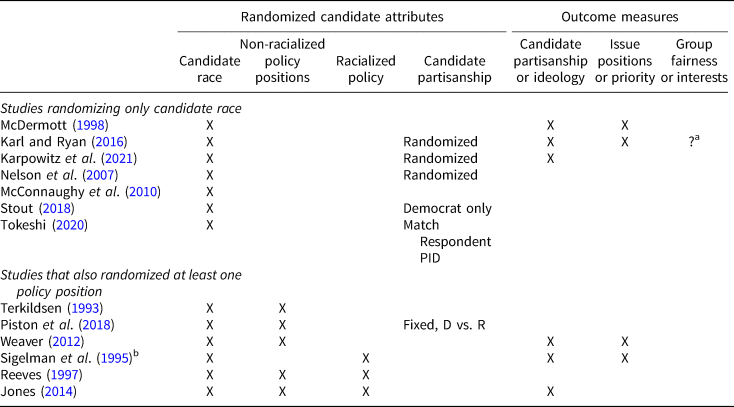
Notes: We only review experimental studies since our primary interest is in addressing common confounders that are correlated with both candidate race and vote choice. We include experiments that focused on estimating the effect of a candidate's race on inferences voters make about them. While many studies also randomize race and issue positions, we exclude them from this table if the primary manipulation was not candidate attributes or policy position or if the outcomes were not relevant to our study.
a Karl and Ryan (Reference Karl and Ryan2016) do not explicitly measure perceived group favoritism, but whether candidates would prioritize “expanding aid programs for inner city families.”
b Sigelman et al. (Reference Sigelman, Sigelman, Walkosz and Nitz1995) did measure as an outcome whether respondents believed the candidate would “favor people like me,” but this outcome was not included in their analysis.
2. Research design and data collection
Our study consists of two survey experiments which are designed to resolve theoretical and empirical ambiguities that persist in light of prior work and focus on perceived group favoritism. In both experiments, we randomize background characteristics, except partisanship, and manipulate their issue positions on both economic and social policy, and whether they take a position on affirmative action. We can therefore estimate how a candidate's race affects voters’ perceptions of their ideology in the presence of other relevant information. Since Black candidates are empirically more likely to be Democrats, we fix candidate partisanship as Democratic to maximize external validity and increase statistical power for our sample size.
A key advantage of factorial designs is that multidimensional treatments allow us to identify the marginal effects of multiple relevant factors, as well as their relative magnitudes (Hainmueller et al., Reference Hainmueller, Hopkins and Yamamoto2014). Moreover, this design better approximates the information environment present in real campaigns where individuals have multiple types of information about candidates. Importantly, we independently randomize whether a candidate takes a position on racialized policy—affirmative action—and the specific position taken if presented. Taking a position on race-related policy is a key choice a candidate can make, and this allows us to understand if racialized perceptions are made in the absence of specific cues or persist even when there is relevant information for that perception.
Our outcome measures include (1) perceived ideology of the candidate; (2) beliefs about issue prioritization (study 1 only); (3) and beliefs about which groups they would favor if elected to office. Table 2 summarizes the randomized components of each experiment and the main outcomes of interest. We discuss both designs in greater detail below. Analyses presented were preregistered with AsPredicted and Open Science Framework (OSF).Footnote 1
Summary of experimental designs
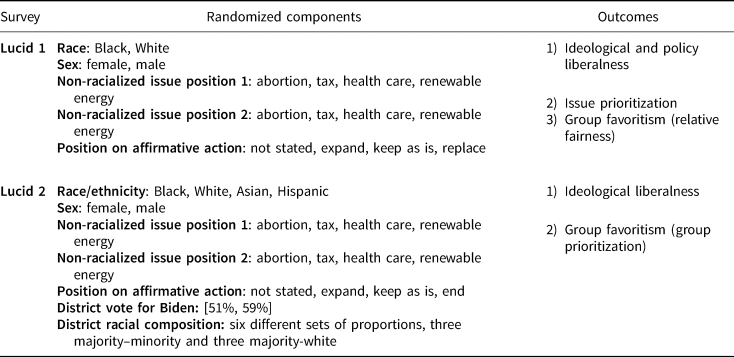
Notes: See Appendix A for full wording of the randomized components.
2.1 Study 1: 2020 Lucid experiment
Study 1 was fielded on Lucid Marketplace in early 2020. We recruited survey participants using quotas based on Census population proportions to ensure a demographically representative sample. |Approximately 2400 participants were recruited. A summary of respondent demographic characteristics is provided in the Appendix in Table A1.
In study 1, we used a vignette survey design where we independently randomize a candidate's race, age, sex, and positions on two non-racialized policy issues. The first two issue positions each candidate holds are randomized to be either moderate or liberal in one of four issue areas: abortion, taxes, healthcare, and the environment (specific wording in Appendix A). We refer to these policies as “non-racialized” policies. The third policy, which we refer to as a “racialized” policy, describes the candidate's position on affirmative action.Footnote 2 We randomly assigned the candidate to one of these four conditions, each with probability ¼: (1) no position, (2) a “liberal” position expressing support for expansion of affirmative action, (3) a “moderate” position expressing status quo support for affirmative action, or (4) a “conservative” position expressing support for replacing existing programs with ones that use socioeconomic disadvantage instead of race/ethnicity. The inclusion or exclusion of a racialized policy will allow us to account for the fact that voters potentially make inferences about a candidate's ideology based on a presumed position that is not explicitly stated, as well as the possibility that merely discussing racialized policy may affect inferences about a candidate's ideology. A complete profile therefore takes the following form:
[Name Withheld] is a [age] year old [race] [sex] who has served as a Democrat in the state legislature for the past 8 years. This candidate has taken the following policy positions:
• [Policy 1]
• [Policy 2]
• [Policy 3]
Policies are presented in a random order, and there are only two policy positions for candidates who do not take a position on affirmative action. Each respondent sees one profile in the survey.
After respondents are presented with their candidate profile, they are asked questions concerning three main sets of outcomes: ideology, issue prioritization, and group favoritism. For ideology, we first ask respondents to assess their candidate's overall political ideology, as well as the candidate's economic and social ideology, using a 7-point scale from “Extremely Liberal” (1) to “Extremely Conservative” (7). In addition to ideology, we also asked respondents to predict the position the candidate is likely to take on three other policies not specified in the vignette: TANF (welfare), minimum wage, and race reparations. The second set of outcomes was about issue prioritization. For a set of seven issues (tax, job creation, healthcare, environment, abortion, criminal justice reform, and social justice), respondents are asked whether the candidate would give each issue low priority, moderate priority, or high priority.Footnote 3
Finally, to measure group favoritism, we asked respondents to rate the candidate's perceived fairness to different groups. Specifically, respondents were asked to rate “how fair they believe the candidate will be to each of the following groups of Americans”: and provide scores for Whites, Blacks, Asians, Hispanics, Republicans, Democrats, Men, and Women. The groups were presented in a grid and responses were measured on a scale from “Very unfair” (1) to “Very fair” (7). For simplicity, we focus on differences in perceived fairness to Black and White constituents. Because respondents are asked perceived fairness for each group, we can interpret the difference between any two scores as the difference in relative fairness to those two groups. Therefore, a positive value on the scale means the respondent believed the candidate would be fairer to Black than White constituents. A negative value means that the respondent believed the candidate would be fairer to White constituents. In this study, outcome question ordering is randomized.
2.2 Study 2: 2022 Lucid experiment
Study 2 is a replication and extension that addresses potential limitations of study 1. In this follow-up study, we refined study 1's design by increasing the sample size to improve power for analysis. We include Asian and Hispanic candidates and ask respondents to evaluate five candidates, thereby creating a within-subject design. Adding Asian and Hispanic candidates addresses concerns about demand effects if respondents only saw Black and White candidates and inferred that the survey was about different in evaluations between those candidates. This also allows us to see whether treatment effects are due to seeing a Black candidate or a non-White one more broadly.
We also randomized details about the partisan and racial composition of the district in which the candidate is running to rule out alternative mechanisms that could explain the effect of candidate race. These characteristics are not of primary theoretical interest but instead address a potential problem of biased inference: including district characteristics allows us to control for the possibility that respondents’ beliefs are moved not just by candidate characteristics, but also by inferences about the district that produces such a candidate. In actual elections across districts, Black candidates are more likely to run and win in majority–minority district (Branton, Reference Branton2009). In our setting, respondents may believe a Black candidate is more likely to favor Black constituents, not because of shared identity, but because they are from a district with a greater number of Black constituents. This rules out additional inferences beyond those randomized in the experiment.
Finally, we revised the conservative position on affirmative action to be more overtly conservative in light of our analysis of study 1, describing support for ending affirmative action, which is arguably a more realistic conservative position than replacing program criteria. A vignette takes the following form:
Candidate #X
[NAME WITHHELD] is a [Age] year old Democratic [Race] [Sex] who [Experience]. This candidate is running in a district with the following characteristics:
• It is [W]% White, [B]% Black, [H]% Hispanic, [A]% Asian, and [O]% Other.
• In the 2020 presidential election, Democrat Joe Biden received [Vote Share]% of the district's votes.
Additionally, this candidate has taken the following policy positions:
• [Policy A]
• [Policy B]
• [Policy C]
Unlike study 1, study 2 respondents see five profiles instead of one (#X taking values 1 through 5), with each trait randomized with replacement.Footnote 4 Respondents were again recruited from Lucid Marketplace using quotas based on Census population statistics. To address concerns about survey attentiveness, we included an attention check item at the beginning of the survey. Respondents who failed this attention check were excluded from the analysis based on a pre-registered exclusion rule. In all, we recruited 1447 participants for the final sample, equating to an analytic sample size of 7235.
We focus on two outcomes in study 2.Footnote 5 First, as in study 1, we measured the perceived ideology of each candidate. We asked only overall ideology in to reduce respondent burden given that they rated five profiles and given that the correlation between the three measures in study 1 is relatively high.
Second, we asked respondents the extent to which they believe the candidate will favor the interests of different constituent groups. We amended the wording of this item to replace the language of fairness, which might be interpreted differently by respondents, with language describing candidate prioritization of each group. Respondents were asked: “If elected, how much do you think this candidate will prioritize the interests of the following groups in their district: Whites, Blacks, Asians, Hispanics, Republicans, Democrats, Men, and Women.” The groups were presented randomly in a grid and responses were measured on a 5-point scale from “None at all” to “A great deal.”
For our main analysis, we again take the difference between the rating respondents give to the perceived prioritization of Black constituents minus the prioritization of White constituents. A positive value on the scale means the respondent believed the candidate would prioritize White over Black constituents and a negative value means that the respondent believed the candidate would prioritize Black over White constituents.Footnote 6
3. Results
3.1 Study 1
Analyses of the main effects from study 1 are presented in Figure 1. We focus on three main outcomes: perceived candidate ideology, perception that the candidate prioritizes social justice issues, and perception that the candidate will favor Black over White constituents (measured as relative fairness). To generate these estimates, we regress each outcome measure on the complete vector of randomly assigned candidate characteristics using OLS with robust standard errors.Footnote 7 In all figures, we plot the estimates for the baseline (omitted from regression) in each category at 0, as comparisons within category are to those baselines. For example, in Figure 1, the effect of seeing a Black candidate is relative to the baseline of seeing a White candidate.
Study 1 estimates of main effects of candidate attributes. Data are from study 1 conducted on Lucid in 2020 (N = 2467). All profiles are for Democratic candidates. Points in each panel are coefficients from single regression, with 95 percent confidence intervals. Estimates for candidate age, political experience, and occupation not plotted. See Table S1 for complete regression results.
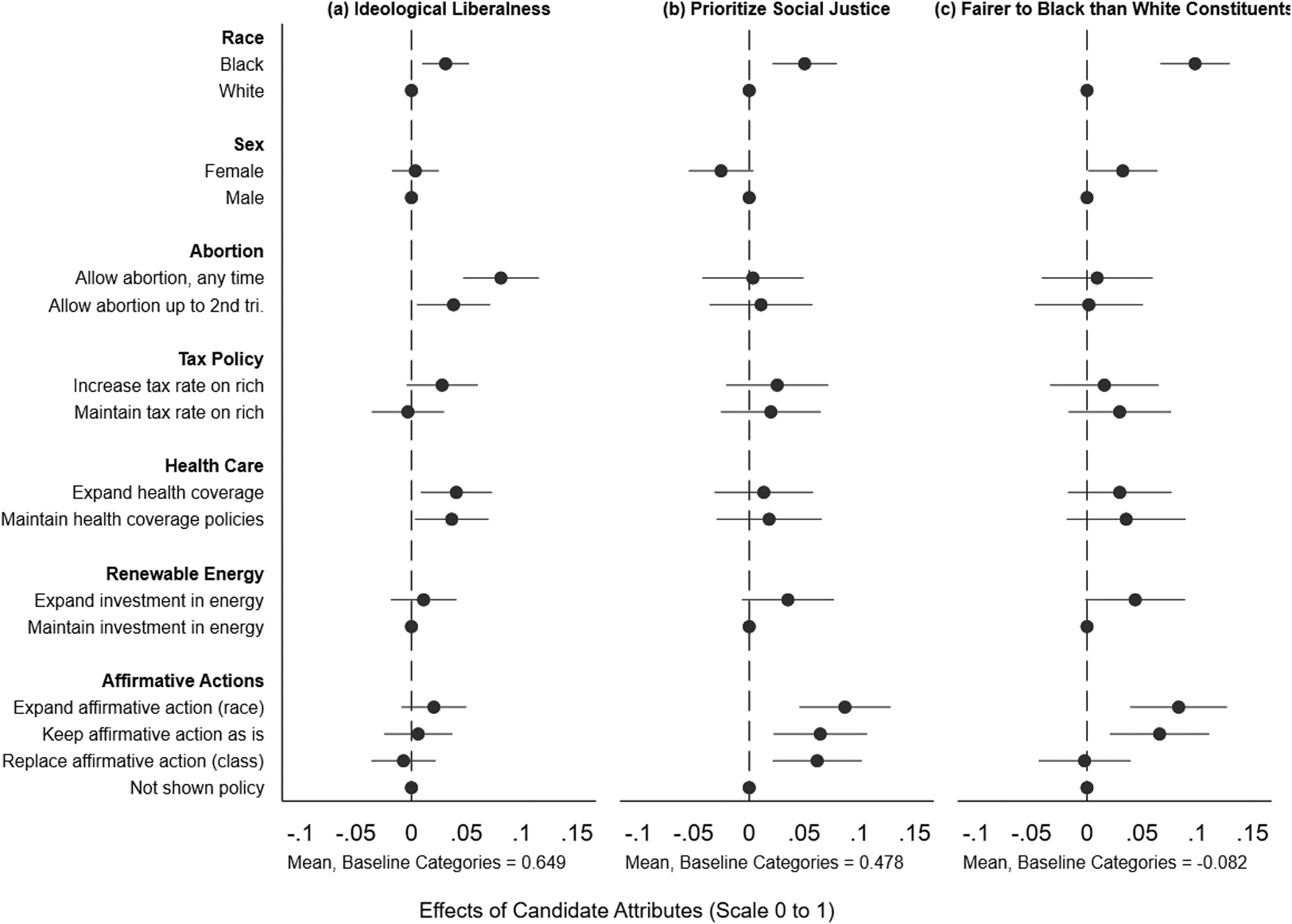
Panel (a) shows that Black candidates are perceived to be more ideologically liberal than otherwise similar White candidates. This marginal effect of 0.031 (p < 0.01) is comparable to the effect of taking certain policy positions. For example, the effects of taking either a moderate (0.036, p < 0.05) or liberal position (0.041, p < 0.05) on health care (relative to a moderate position on renewable energy) are slightly larger than the effect of a candidate being Black.
This means that while one's racial background may indeed signal liberalness, one can also affect inferred liberalness by articulating policy positions. Notably, we see that these affirmative action positions do not on average appear to serve as an important ideological cue—candidates are perceived to be no more or less liberal when they take a position on affirmative action relative to when they do not take any position. We note that this analysis assumes homogenous effects by candidate race, which we relax in a subsequent analysis.
In panel (b), however, we see that candidates who discuss affirmative action are also perceived to be more likely to prioritize social justice issues, regardless of which position on affirmative action they take.Footnote 8 This is perhaps not surprising, because affirmative action falls within the realm of social justice issues and the “conservative” position used here includes language about replacing race-based with class-based affirmative action. Additionally, Black candidates are perceived to be more likely to prioritize social justice issues relative to a White candidate (0.05, p < 0.01), an effect that is matched in size only by taking an affirmative action position or supporting expanded investment in renewable energy.
Finally, in panel (c), we present results for group favoritism. Note that the mean outcome for the baseline categories is −0.08, meaning that on average White candidates are believed to slightly favor White over Black constituents. Black candidates, who do not take an affirmative action position, are instead perceived to be significantly more likely to favor Black constituents over White constituents (0.097, p < 0.01). This is the largest estimated effect for this outcome. At the same time, the effect of a candidate taking a liberal position on affirmative action (0.082, p < 0.01) is comparable to and not significantly different from that of the candidate being Black. This suggests that, while Black candidates are perceived to favor Black interests over White even after accounting for policy positions, White candidates who explicitly take positions that signal prioritization of Black constituents (expanding affirmative action) will be similarly perceived to favor Black over White interests. In the following analysis, we show that this signaling effect, though larger for Black candidates, is present for both Black and White candidates.
As mentioned, a key question is not just whether Black candidates are perceived differently than White candidates on average, but also whether Black candidates can attenuate differences in these perceptions depending on the issue positions they take, particularly on race-related issues. In Figure 2, we therefore present similar analyses as above but focus on the effect of the interaction between candidate race and position on affirmative action. We estimate regression models predicting each outcome after including the interaction between candidate race and each potential affirmative action position, which allows us to identify the effect of a Black candidate taking a position on affirmative action on our main outcomes, relative to a White candidate who does not articulate any position (thus, the omitted category, plotted at 0 in Figure 2, is a White candidate who does not take a position).
Study 1 estimates of interacted effects of candidate attributes. Data are from study 1 conducted on Lucid in 2020 (N = 2467). All profiles are for Democratic candidates. Points in each panel are coefficients from single regression, with 95 percent confidence intervals. Estimates for candidate age, political experience, and occupation not plotted; see Table S2 for complete regression results.
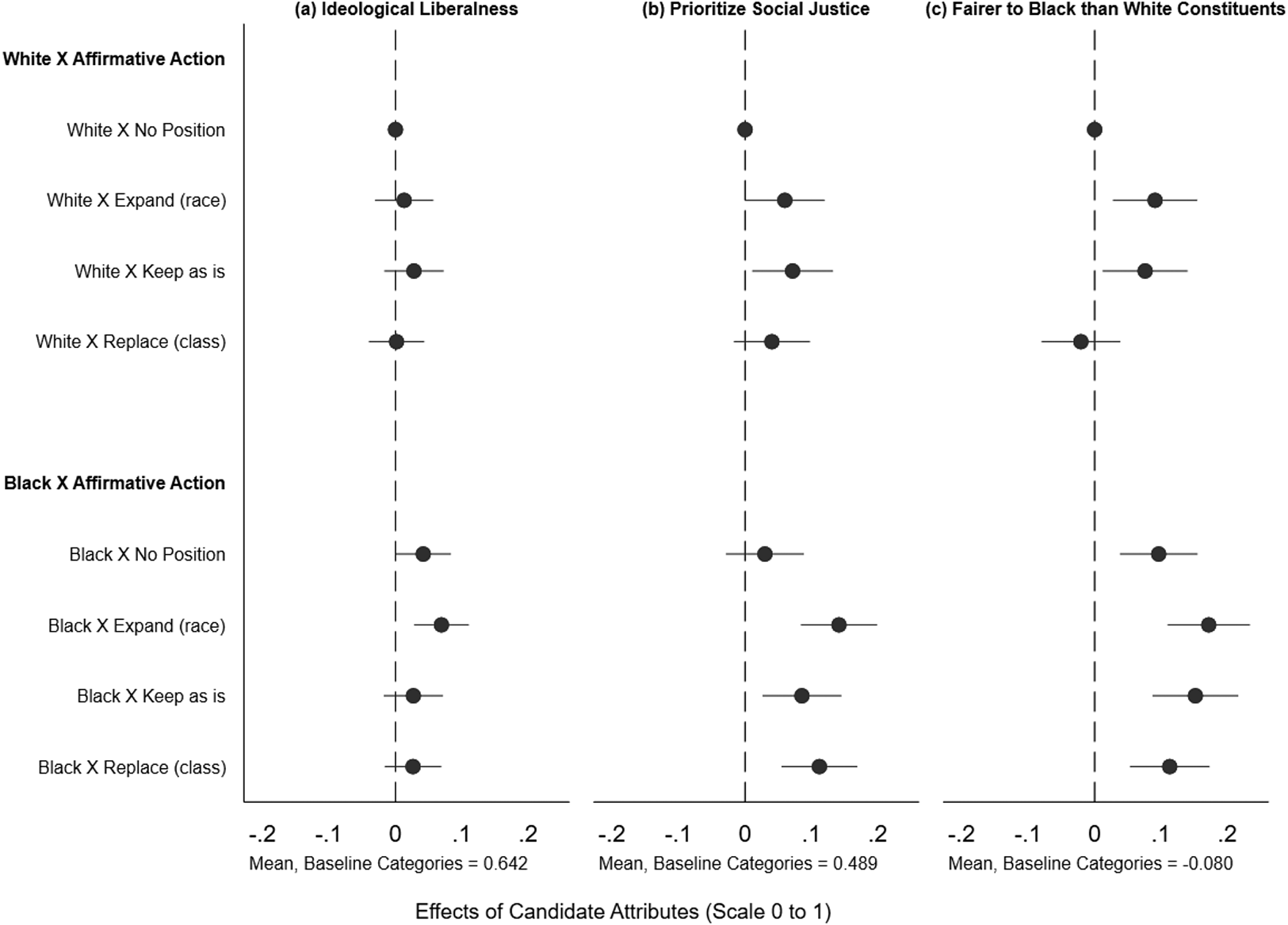
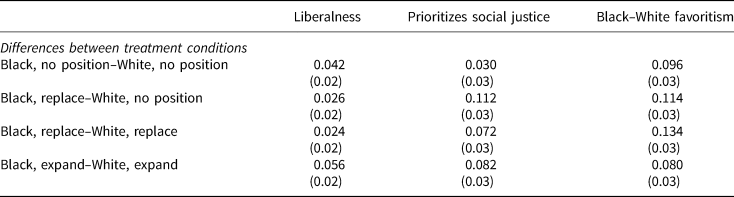
This allows the effect of affirmative action positions to vary by candidate race. For example, in panel (a), the estimate for the “Black X No Position” interaction is 0.96 units (p < 0.01), which means that Black candidates who do not take positions on racialized policies are inferred to be more liberal than White candidates who similarly do not take positions, even after signaling their position on non-racialized issues. We provide the estimated differences between the conditions of greatest theoretical interest in Table 3, which are equivalent to taking the differences between the corresponding pairs of point estimates in Figure 2.
Study 1 comparison of key marginal effects from interacted model
Notes: Robust standard errors in parentheses. Estimates are from a regression model where we interact candidate race and position on affirmative action (see Table S2 in the Appendix for complete model results).
Panel (a) of Figure 2 shows that Black candidates who do not take a position on affirmative action are perceived to be 0.042 units (p < 0.05) more liberal than White candidates who similarly do not take a position. This specification already accounts for non-racialized policy positions, meaning that Black candidates who do not articulate a position on a racialized policy are presumed to be more liberal regardless of their position on non-racialized policies. However, when a Black candidate takes a moderate or conservative position on affirmative action, they are perceived to be no more liberal than a White candidate who takes no position. More relevant cues are therefore more informative. These estimates are 0.0269 and 0.0263, respectively, which are statistically insignificant and modest in size (approximately 60 percent of the effect of the candidate being Black in the absence of an affirmative action position, although we note that the estimates are indistinguishable from the effect of candidate race in the absence of a racial policy position). A Black candidate who explicitly takes a liberal position on affirmative action is still perceived to be more liberal than a White candidate who takes the same position (0.056, p < 0.05), and this effect is larger than the effect of a Black candidate with no racial policy position (difference = 0.014, not significant). These results suggest that the ideological stereotypes faced by Black candidates can be attenuated when they explicitly take non-liberal positions on issues they are ex ante expected to be liberal on.Footnote 9 Our design is underpowered, however, to precisely estimate the magnitude of this reduction, and the conservative affirmative action position may not be conservative enough.
Figure 2 panel (b) plots the effect of interacting candidate race and their position on affirmative action on perceived prioritization of social justice issues. In contrast to the ideology result, here we find that a Black candidate who does not articulate a position on affirmative action is perceived to prioritize social justice issues no more nor less than a similar White candidate. However, candidates of either race who take any of these positions on affirmative action are perceived to be more likely to prioritize social justice issues. That is, simply addressing affirmative action (by taking any positions) is perceived to signal policy commitment. For example, the estimate for Black candidates who say they would keep affirmative action policy the same is 0.085 (p < 0.01). Notably, White candidates who articulate a position on affirmative action are also perceived to prioritize social justice issues, though to a lesser extent than Black candidates on the same position. The difference between a Black candidate (0.141, p < 0.01) and a White candidate (0.059, p < 0.10) who propose to expand affirmative action programs is about 0.08 and statistically significant (p < 0.01). The only comparisons where perceived prioritization does not differ between Black and White candidates are when no position is articulated or when moderate position is articulated.Footnote 10
Finally, in panel (C) of Figure 2, we examine the interacted results for group favoritism. Prior work has postulated that Black candidates are penalized electorally because non-Black voters presume that the candidates will not focus on their issue concerns, instead focusing on the concerns of their co-racial constituents (Hajnal, Reference Hajnal2006). Consistent with that account, here we see that Black candidates who do not take an explicitly racial policy position are perceived to be substantially fairer to Black than White Americans compared to a White candidate who does not address race. This effect is 0.096 units (p < 0.05). White candidates who propose to maintain or expand affirmative action are also perceived to be fairer to Black than White constituents by about the same degree (b = 0.091, p < 0.01 for expand) as a Black candidate who does not address affirmative action at all. Importantly, for a Black candidate, this effect is present even if they take a conservative position by proposing to replace race-based with class-based affirmative action (b = 0.114, p < 0.05). Black candidates who take a liberal or even status quo position on affirmative action are perceived to be even less fair to Whites (0.172, p < 0.01 if taking a liberal position and 0.152, p < 0.01 if proposing to maintain the status quo).
Cumulatively, these results are particularly important, because no prior work has experimentally tested whether Black candidates are perceived to favor Black over White interests, nor considered the possibility that adopting racially conservative positions could counteract this inference. We find that regardless of whether and which of the tested racial policy position Black candidates adopt, they are perceived to favor Black over White interests. Race therefore is a powerful heuristic for shaping inferences about group favoritism, even when other cues are present. Finally, we note that the difference between a Black candidate who does not take a position on affirmative action and a Black candidate who takes a conservative position is not significant. This suggests that, unlike perceived ideology, Black candidates cannot overcome voters’ biased perceptions of group favoritism by taking more conservative policy positions than otherwise equivalent White candidates.
3.2 Study 2
We focus on perceived ideology and group favoritism in study 2, which allows us to account for additional sources of variation that might undercut the inferences we draw from study 1, and which also includes a revised, more explicitly conservative racial policy position. Figure 3 presents regression results for our two main outcomes from specifications where we regress the outcomes on each randomized experimental manipulation. Table 4 presents regression-adjusted means for each outcome corresponding to each treatment condition for reference. Once again, some randomized covariates are excluded for visual convenience. We cluster the standard errors at the respondent-level because respondents evaluated five candidate profiles in study 2.
Study 2 estimates of main effects of candidate race on inferred ideology and group favoritism. Data are from study 2 conducted on Lucid in 2022 (N = 7235 profiles across 1447 respondents). All profiles are for Democratic candidates. Points in each panel are coefficients from single regression, with 95 percent confidence intervals. Estimates for all other candidate characteristics not plotted; see Table S4 for complete regression results.
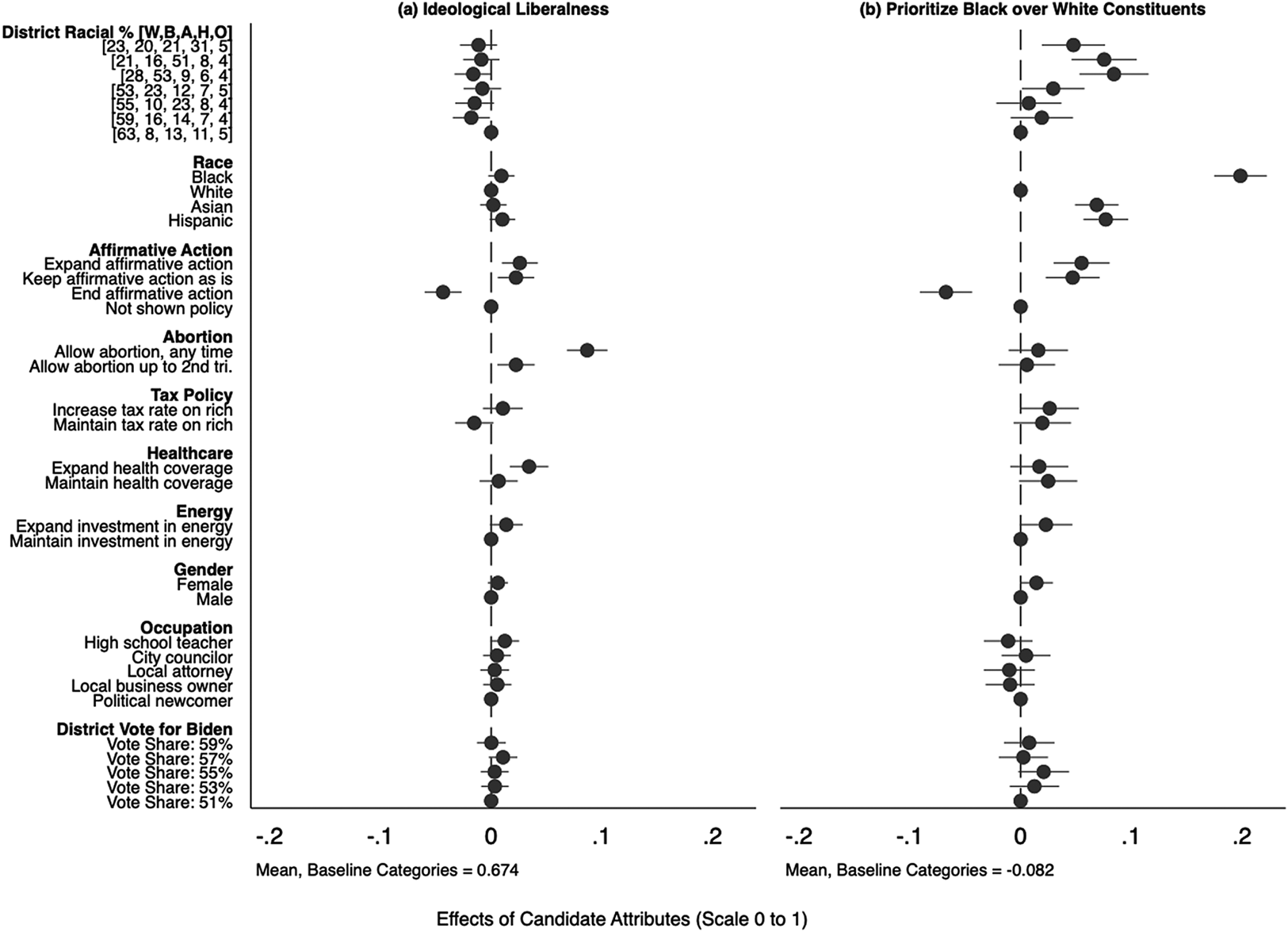
Study 2 regression adjusted means
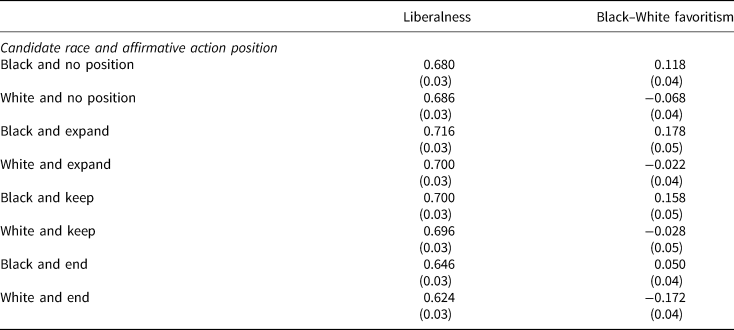
Notes: Robust standard errors in parentheses. Values reflect estimates from Figure 3, where we add the constant to the point estimates of the relevant randomized conditions.
We find some notable differences from study 1 in panel (a). First, while the estimate for a Black candidate is positive, it is no longer significant relative to a White candidate in a within-person design with additional information. Second, we find that affirmative action positions matter. Relative to a candidate who does not state a position on affirmative action, candidates who take moderate or liberal positions are viewed as more liberal, whereas candidates who take a clearly conservative position are viewed as less liberal. As we note above, the conservative position for affirmative action in study 2 is more clearly conservative than in study 1, because it involves abandoning affirmative action altogether.
Moving to panel (b), however, we do not see the same pattern for perceived group favoritism, which is measured here as group prioritization. In particular, we find that the effect of a Black candidate on group favoritism is positive and significant (0.198, p < 0.01). Given that the baseline favoritism score is −0.082, which means the baseline candidate is perceived to favor White over Black constituents, a Black candidate is perceived to favor Black over White candidates by an average score of 0.12 (0.198–0.082). We also estimate positive effects for Asian and Hispanic candidates, who are perceived to be more likely to prioritize Black over White interests relative to a White candidate (0.068, p < 0.01, and 0.076, p < 0.01, respectively), though not to the extent of Black candidates. We also note that district composition, which was not included in study 1, does seem to matter, all else equal. Candidates in majority-White districts are perceived as less likely than candidates in majority-Black districts to favor Black over White constituents.
We find that the position a candidate takes on affirmative action signals constituent prioritization. Candidates who take liberal or moderate positions on affirmative action are significantly more likely to be perceived as prioritizing Black interests relative to a candidate who does not take a position, whereas a candidate who takes a conservative position (−0.07, p < 0.01) can entirely offset the effect of a candidate being Asian or Hispanic (which is about half the estimate from being Black).
Are the effects of racial policy positions that we find in Figure 3 different by candidate race? As with study 1, we interact candidate race and affirmative action position and present our analysis in Figure 4. We focus on four specific comparisons of interest, which are presented in Table 5. First, as shown in panel (a) and consistent with Figure 3 results, we find that a Black candidate who does not take an affirmative action position is perceived to be no more liberal than a White who also does not take a position. However, the difference in perceived favoritism toward Black constituents is large and significant (0.186, p < 0.05).
Experiment 2 estimates of interacted effects of candidate race on inferred ideology and group favoritism. Data are from study 2 conducted on Lucid in 2022 (N = 7235 profiles across 1447 respondents). All profiles are for Democratic candidates. Points in each panel are coefficients from single regression, with 95 percent confidence intervals. Estimates for all other candidate characteristics not plotted; see Table S5 for complete regression results.
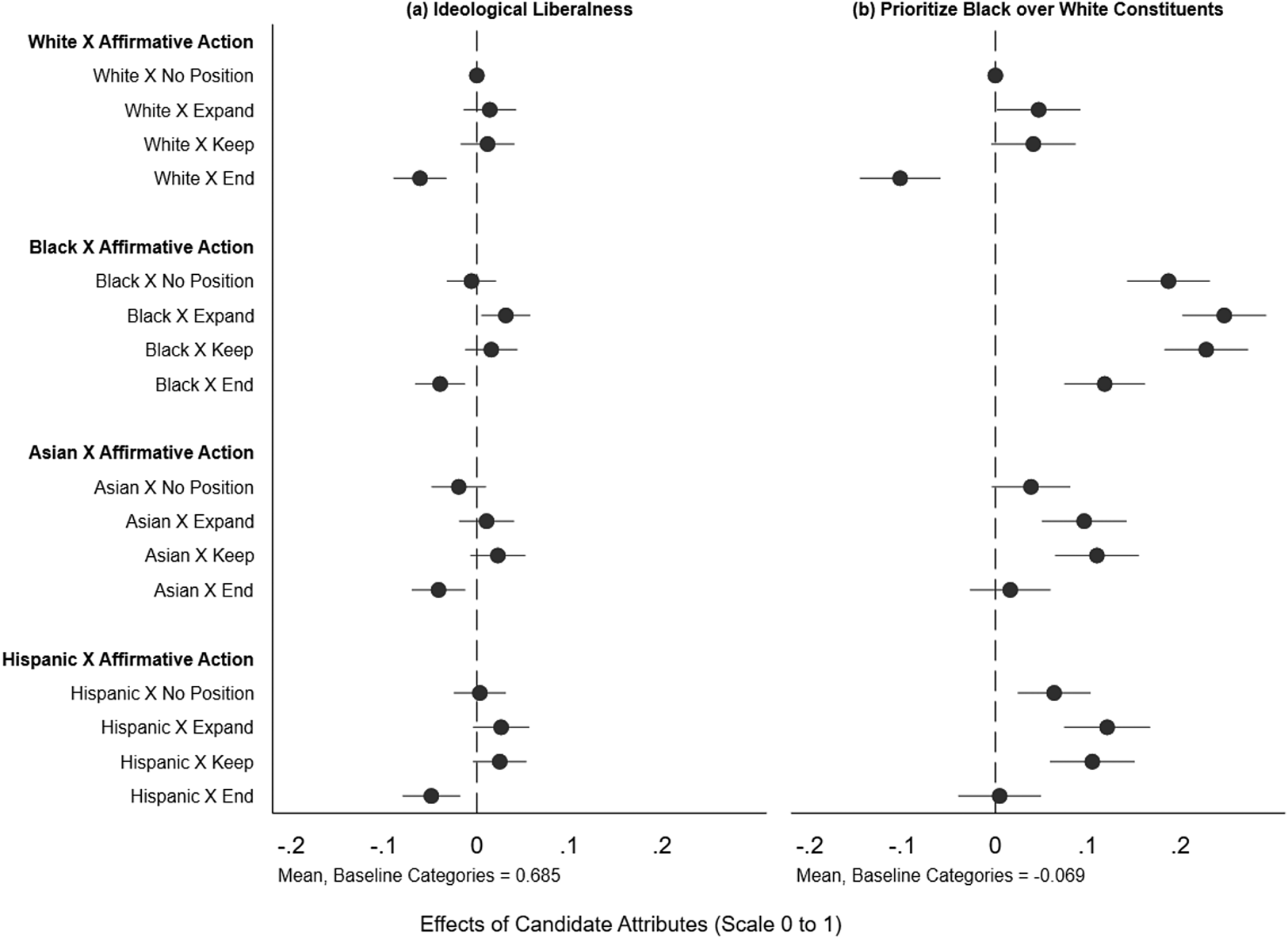
Study 2 comparisons between treatment conditions of interest
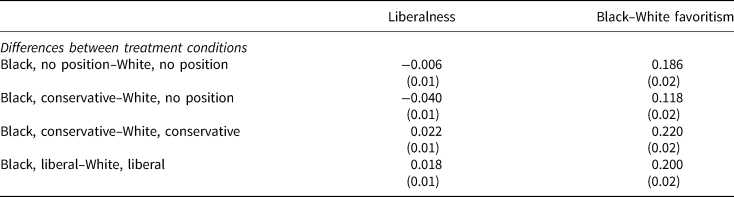
Notes: Robust standard errors in parentheses. Values reflect differences between treatment characteristics as shown in Figure 4, e.g., adjusted difference-in-differences. Positive values mean more liberal and greater favoritism toward Black constituents over White, respectively.
Second, while respondents perceived a Black candidate who takes a conservative position on affirmative action to be less liberal than a White candidate who takes no position (−0.05, p < 0.05), the difference in perceived group favoritism persists—a Black candidate conservative on affirmative action is still believed to prioritize Black over White interests (0.118, p < 0.05). In other words, Black candidates can become (viewed as) ideologically equivalent to White candidates but cannot similarly attenuate differences in perceived group favoritism—once again, showing the targeted and enduring effect of candidate race as a heuristic for assessing group prioritization.
Third, we find that when Black and White candidates both articulate conservative positions on affirmative action, both are perceived as more conservative than if they did not take a position, but the Black candidate is perceived as modestly more liberal (0.02, p < 0.05). However, Black candidates who are liberal on affirmative action are perceived to be no more liberal than similarly liberal White candidates (0.018, p = 0.19). Finally, in either case (when taking conservative or liberal positions), a Black candidate is always perceived to prioritize Black constituents over White ones, regardless of what position they take on affirmative action (0.22, p < 0.05, 0.20, p < 0.05, respectively).
While we focus on differences between Black and White candidates for theoretical reasons, we note that the patterns of differences across racial policy positions for Asian and Hispanic candidates are similar to those for White candidates. The two exceptions are: (1) Hispanic candidates who do not take a racial policy position are perceived to be more likely to favor Black over White constituents, and (2) Hispanic and Asian candidates who support ending affirmative action are perceived as equally likely as White candidates take no position to favor Black over White constituents. Race therefore has a different effect as a heuristic for beliefs about group favoritism for Black candidates compared to other non-White candidates.
More broadly, Figure 4 suggests that candidates are generally perceived to be less liberal when they take conservative positions on affirmative action, regardless of racial background. While affirmative action signals ideology, as suggested by the main effects in Figure 3, panel (a) in Figure 4 suggests that those ideological cues are not vastly different across candidates of different racial backgrounds. Differences in perceptions based on a candidate's racial identity about their inferred ideology can be attenuated by policy positioning. However, as described above, the same cannot be said of differences in perceived group favoritism.
In sum, analysis from study 2 affirms the importance of group prioritization in inferences made about candidates. Whereas much of the research in this vein has focused on studying the inferred policy priorities and ideology of a candidate as potential mechanisms for voter preference toward that candidate, this study shows that beliefs about group representation may also be an important mechanism linking candidate race to election outcomes.
4. Discussion
This paper provides two contributions. First, we expand on prior work to understand whether and when candidate race affects inferences about candidate ideology. This improves our understanding of when candidate race is used as a heuristic for judging candidates and how. Second, we examine a wider range of potential mechanisms, beyond perceptions of candidate ideology, that could link candidate race to changes in electoral performance. We examine inferences about hypothetical Democratic candidates’ issue positions, the constituent groups they will focus on, and the issues they will prioritize in office.
In two studies, we find that Democratic Black candidates are perceived to be more ideologically liberal than Democratic White candidates, despite expressing identical non-race policy positions. This may be in part due to the presumption that Black candidates are perceived to be more liberal on racialized policy issues. Thus, it is important that we find that these ideological stereotypes are attenuated when Black candidates take moderate or conservative positions on racialized policy issues.
However, this attenuation does not extend to differences in perceived group favoritism. Black candidates are perceived to prioritize Black constituents compared to similar White candidates. This holds even when a Black Democratic candidate signals their (conservative) position on affirmative action, suggesting that presumed group favoritism cannot be attenuated by addressing racialized policy directly or taking less liberal positions, as is the case for perceived ideology. This is true even when a Black candidate proposes ending race-based affirmative action. Importantly, White Democratic candidates who take liberal or moderate positions on racialized issues are also perceived to favor Black constituents over White, although not as much as Black candidates. This means race-relevant policy cues can counteract assumptions made about candidates on the basis of their race. Finally, on issue prioritization, we do not observe significant differences between Black and White Democratic candidates.
While our overall analysis focuses on the inferences made by respondents on average, we also use the larger analytic sample of study 2 to examine whether a respondent's own group membership affects their inferences. For example, if only White respondents perceive Black candidates to favor Black constituents, then such inference may mask simple outgroup prejudice. We do not find that differences in the patterns of assessments they draw about favoritism, implying that these heuristics are shared by Black and White respondents. As shown in Appendix Figures S4 and S5, both Black and White respondents perceive Black candidates to favor Black over White constituents and react similarly to the presence of affirmative action positions. We also find that Democrats and Republicans have similar perceptions about Black candidates prioritizing Black constituents (Appendix Figures S6 and S7). Finally, we consider the effect of district composition, an additional manipulation added in study 2. Appendix Figures S8 and S9 show that while district composition affects inferences about group favoritism, this effect does not appear to be substantially moderated by candidate race, meaning that people do not perceive candidate race to have a different signaling values in majority-White or majority-Black districts.
In summary, while Black candidates are sometimes perceived to be more liberal than White candidates, this difference can be attenuated by signaling (more conservative) issue positions. But perceived group favoritism is an important mechanism likely explaining some of the electoral performance of Black Democratic candidates and has been largely neglected in prior experimental work. In the presence of identical policy positions and party labels, and even when expressing racially conservative positions on affirmative action, people infer that Black Democratic candidates will favor Black constituents more than White constituents. People also believe Black candidates will prioritize social justice issues but do not seem to be making additional inferences on issue focus.
Notions of group favoritism are thought to be important for understanding the roles of racial resentment and prejudice in candidate evaluation, tapping into beliefs that one's group is losing out relative to another. Some theories of descriptive representation rest on the assumption that co-racial candidates will better represent group interests, so it is not surprising that non-co-racial voters perceive this focus in zero-sum terms. An important question is therefore whether candidates can adopt other rhetorical strategies to avoid the potential electoral consequences of being perceived to favor a group different from that to which (non-Black) voters belongs. Of course, voters may differ substantially in how concerned they are about issues of group favoritism, an issue distinct from whether there are differences in such inferences in the first place. It is nonetheless important to recognize that at baseline White candidates are perceived to be near race-neutral, while Black candidates are perceived to favor Black constituents, putting those candidates in a potentially disadvantageous starting point.
As with all studies, our research design has limitations. First, we do not examine how candidate race affects the likelihood of voting for an actual candidate in an electoral setting. Instead, we examine perceptions of candidates that are likely causal pathways between candidate race and electoral outcomes. While the electoral consequences of these perceptions are ambiguous, these perceptions are of immediate interest for theory testing. Perceptions of group favoritism likely have heterogeneous and potentially offsetting average effects even environments with additional candidate information. For example, Whites who exhibit racial sympathy (Chudy, Reference Chudy2021) may be more likely to support a Black candidate who they perceive to favor Black over White interests for the same reason other voters are less likely to do so.Footnote 11 We show that race is a bundled treatment that affects multiple inferences, but the large effect we find on group favoritism has been largely overlooked in experimental work.
Second, our study is not designed to identify relationships among the outcomes we measured. That we find different effects for ideology, issue prioritization, and group favoritism means these items do not measure the identical construct. We do not know if individuals form common inferences about all dimensions or if one dominates another in voter preference. Moreover, how these perceptions would shape vote choice likely depends on a respondent's other value commitments (e.g., their level of racial sympathy).
Finally, we focus only on perceptions of Democratic candidates to ensure external validity and statistical power, as most Black candidates are Democrats. Thus, we must exercise caution in assuming similar inferences are made about Black Republicans. On the one hand, partisanship is a powerful signal of policy commitments, and so Black Republicans, ex ante, may be presumed to be conservative on race-related policy issues. On the other hand, voters may still presume that even conservative Black candidates would prioritize Black constituents, which may damage their electoral prospects with White voters. We find that while Black candidates can address concerns about perceived liberalness by taking conservative positions, it does not appear that they can as easily resolve concerns about group favoritism. With the increasing rates of Black Republican candidates entering the political arena, this is an important area for future research in understanding race as a heuristic in electoral settings.
Supplementary material
The supplementary material for this article can be found at https://doi.org/10.1017/psrm.2024.50.
To obtain replication material for this article, https://doi.org/10.7910/DVN/ECBIHS
Data
Available upon request.
Acknowledgement
The authors gratefully acknowledge the helpful comments and suggestions of the editor and reviewers. We also thank Kyle Peyton for contributions made in early stages of the project. Previous versions of this paper were distributed with the title “Racialized Candidate Inferences in American Politics: Perceived Ingroup Favoritism is More Difficult for Black Candidates to Overcome than Ideological Stereotypes.”
Financial support
The authors did not receive support from any organization for the submitted work.
Competing interests
The authors have no relevant financial or non-financial interests to disclose.
Ethical standards
This study was reviewed and deemed example by the Yale Institutional Review Board.


 Open access

