

Javier Milei’s 2023 presidential election victory dramatically reshaped Argentina’s political landscape, shattering the bi-coalition system previously dominated by center-left Kirchnerism and Mauricio Macri’s center-right Propuesta Republicana (PRO). An improbable outsider, devoid of traditional party structures, Milei ascended to the presidency, propelled by a populist discourse and a politically incorrect style that ignited widespread antiestablishment sentiment. This watershed moment immediately positioned Argentina among nations witnessing the unexpected surge of populist radical right (PRR) leaders (Mudde Reference Mudde2007), situating Milei within a broader, global trend alongside figures like Trump, Bukele, and Bolsonaro.
However, Milei’s case underscores how the charismatic bond and negative antiestablishment discourse can carry more weight among supporters of right-wing populism than identity-based, programmatic, or ideological alignment. The article unpacks Javier Milei’s political appeal by examining how his discourse, leadership style, and campaign proposals were received and reinterpreted by a specific segment of his electorate: individuals in strategically selected regions who demonstrated strong support for him during the primary and first-round elections, as captured through intensive focus group discussions. Our observation scenario is the period in the 2023 campaign between the primary elections and the general election, which ultimately led Milei to the presidency through a runoff.
Our primary question is, To what extent do Milei’s supporters align themselves with his radical right-wing discourse? We explore how various factors contribute to the collective identity of his supporters, including his antiestablishment rhetoric, leadership style, promarket proposals, and views on moral issues. What are the areas of consensus and disagreement among them? To what degree do Milei’s voters resonate with his ideas, both personally and collectively? Our hypothesis assumes that Milei’s voters are not homogeneous and do not respond consistently to the traits that are characteristic of the radical right populism conveyed in Milei’s discourse, particularly regarding his promarket proposals and his positions on moral issues.
The article first discusses the literature on populism and radical right populism, situating Milei in this landscape. The second section describes the methodological approach of this research, which is based on ten focus groups with voters who opted for Milei in the primaries and intended to vote for him again in the presidential election. The third analyzes and interprets the focus group results, organizing them around points of consensus, disagreement, and emerging findings. Finally, the discussion shows no common identity among Milei’s voters, except for their shared rejection of the establishment.
Milei in the populist landscape
Populism, charisma, and the power of negativity
Early studies on populism—largely centered on mid-twentieth-century Latin American cases—conceptualized the phenomenon as a marginal occurrence associated with late modernization and with inward-oriented, domestically focused class coalitions. In the 1990s, the notion of neo-populism emerged to characterize leaders who sought a direct connection with voters while implementing neoliberal economic reforms, such as Menem or Berlusconi. A third wave of scholarship expanded alongside the rise of left-wing populisms in Latin America, including Chávez, Evo Morales, and Correa, as well as European cases like Podemos and Syriza, and soon intersected with contemporary analyses of radical right populisms in Europe, the United States, and Latin America.
Populism has become a global phenomenon (de la Torre and Srisa-Nga Reference de la Torre and Srisa-nga2021; Rosanvallon Reference Rosanvallon2020), and never before has scholarly production on the subject been as prolific as it has been in recent years. The field recognizes three contemporary approaches: the strategic approach, focused on the organizational links between leaders and followers, parties, and electoral competition; the ideational approach, which defines populism as a thin-centered ideology that opposes a virtuous people to a corrupt elite; and the discursive or performative approach, which analyzes populism as a process of political identity formation and pays attention to leaders’ discourse, political styles, ethos, and modes of self-presentation (Rovira Kaltwasser et al. Reference Rovira Kaltwasser, Taggart, Espejo and Ostiguy2017; de la Torre Reference de la Torre2018). The ideational approach is currently the most widely used in political science, as its minimalist definition better facilitates comparison. However, many studies also combine elements of all three approaches; political theory has followed this path to examine populism in relation to democracy and representation and to propose a mid-range concept that enables comparison while preserving the contextual richness of each case (Urbinati Reference Urbinati2019; Rosanvallon Reference Rosanvallon2020; de la Torre and Srisa-Nga Reference de la Torre and Srisa-nga2021).
The global reach of contemporary populism has been linked to the broader crisis of political representation and party-based democracy. Populisms emerge in response to deteriorated political ties, eroded by distrust and by a political class that appears privileged while remaining deaf to the problems of ordinary people (Rosanvallon Reference Rosanvallon2020). Contexts characterized by the cartelization of party politics, visible government failures, and the weakening of programmatic ties often give rise to populist leaders (Roberts Reference Roberts, Kaltwasser, Taggart, Espejo and Ostiguy2017). As Urbinati (Reference Urbinati2019) argues, populism advances a model of direct representation that contests all forms of institutional mediation—such as political parties, mainstream media, independent authorities, and oversight institutions—and relies fundamentally on a relationship of identification between leader and audience.
Indeed, the role of the leader (Weyland Reference Weyland2001; Barr Reference Barr2009; Laclau Reference Laclau2005) and, in particular, the function of charisma (Andrews-Lee Reference Andrews-Lee2020; Eatwell Reference Eatwell and Rydgren2018; Joosse and Zelinsky Reference Joosse and Zelinsky2022) lie at the heart of both classical and contemporary theories of populism. As Eatwell (Reference Eatwell and Rydgren2018, 289) states: “Charismatic leadership is not an optional extra for understanding national populism, but should be central to any convincing explanatory and causal framework.” Populist leaders often portray themselves as outsiders untainted by the vices of the establishment (Barr Reference Barr2009) but also as moral archetypes, presenting themselves as heroes, martyrs, or figures capable of doing what no one before them has been able to accomplish (De la Torre and Srisa-Nga Reference de la Torre and Srisa-nga2021). The charismatic bond established with populist leaders can be observed in the way that followers turn an ordinary human being into an extraordinary figure and an object of admiration, often directing toward them songs of devotion and tears of emotion. Likewise, the leader behaves as if they were someone exceptional, as if they had a mission (De la Torre and Srisa-Nga Reference de la Torre and Srisa-nga2021), proposing bold reforms and carrying out actions that seem almost miraculous (Andrews-Lee Reference Andrews-Lee2020). The charismatic leader demonstrates the ability to recognize the widespread feelings of frustration, hopelessness, and anger; constructs a narrative identifying who is responsible for such a situation; and delivers a political performance that cements an image of a savior who is both willing and able to transform society (Andrews-Lee Reference Andrews-Lee2020). At the same time, this charismatic exceptionalism becomes crystallized in political styles that break with established protocols and mobilize “bad manners” and vulgar performances, challenging elites’ claims to cultural superiority, as highlighted by performative approaches to populism (Ostiguy Reference Ostiguy, Kaltwasser, Taggart, Espejo and Ostiguy2017; Moffitt Reference Moffitt2016).
Crucially, this charismatic appeal is often channeled through, and amplified by, the mobilizing power of negativity. Several recent studies highlight the pervasive role of negativity in contemporary politics and the construction of political identities (Rosanvallon Reference Rosanvallon2006; Melendez and Rovira Kaltwasser Reference Melendez and Rovira Kaltwasser2021). Forming coalitions around shared rejection is often easier than building consensus around constructive projects. This dynamic is evident in elections that increasingly resemble “deselections,” in which voters oppose incumbents rather than actively supporting specific proposals (Rosanvallon Reference Rosanvallon2006). Negativity is also a central component across the different theoretical approaches to populism: the construction of an antagonistic frontier between “us” and “them” (Laclau Reference Laclau2005), the moralized opposition between a virtuous people and a corrupt elite (Mudde Reference Mudde2007; Hawkins and Rovira Kaltwasser Reference Hawkins and Rovira Kaltwasser2017), and the polarizing dynamic of one part of society against another (pars pro parte) (Urbinati Reference Urbinati2019; Rosanvallon Reference Rosanvallon2020). Indeed, most theories of populism underscore the constitutive role of negativity, suggesting that it can forge voter linkages more powerfully than positive identities or programmatic coherence.
To analyze the connection between charisma and negativity, the concept introduced by Joosse and Zelinsky (Reference Joosse and Zelinsky2022) is especially useful. Weber’s idea of “berserk charisma” refers to forms of charisma grounded in outward-directed aggression—charisma expressed as an attack on enemies. Berserk charisma is, in essence, a charisma of anger. In contemporary populisms, this anger often takes the form of ressentiment, a psychological mechanism that transforms feelings of personal devaluation and powerlessness into patterns of blame and hostility toward others, and into the search for a leader who can voice these emotions.
Together, charismatic leadership and the mobilization of negativity form a potent and often inseparable core of populist appeal, providing a framework for understanding how leaders attract and maintain support even in the absence of deeply ingrained programmatic or ideological alignment. This integrated understanding is particularly vital when examining the nuances of PRR.
Radical right populisms
Building on our integrated understanding of charismatic negativity, we turn to the specific variant of radical right populisms—often referred to as the populist radical right, or PRR. Although originally developed to analyze European phenomena (Bustikova Reference Bustikova2019), PRR has increasingly become a global phenomenon, recognized for its cross-national ideological diffusion (Caiani Reference Caiani and Rydgren2018; Wojczewski Reference Wojczewski2024). Beyond the general populist traits of antiestablishment and people-centric discourse, PRR, as defined by scholars like Mudde (Reference Mudde2007), typically interweaves nativism and xenophobia with a strong emphasis on conservative cultural values. These conservative values often fuel a cultural battle to reverse perceived gains made by progressive political ideas, and nativism manifests in xenophobic nationalism that portrays immigrants or minorities as threats to national identity and interests.
Latin America, in particular, has become a critical laboratory for observing the diverse manifestations of PRR. Prominent examples include Jair Bolsonaro in Brazil, who challenged PT policies (Tanscheit Reference Tanscheit2023), and Nayib Bukele in El Salvador, known for his security-focused message (Meléndez-Sánchez and Vergara Reference Meléndez-Sánchez and Vergara2024). Other leaders, such as José Antonio Kast in Chile (Rovira Kaltwasser Reference Rovira Kaltwasser2023) and Rafael López Aliaga in Peru (Ubilluz Raygada Reference Ubilluz Raygada2021), also reflect this regional trend. The unexpected electoral triumph of Javier Milei in Argentina appears as the most recent link in the regional diffusion of PRR politics.
Populist radical right leaders across the continent adopt common rhetorical strategies, inflecting them through national historical narratives and context-specific grievances to resonate with local audiences (Rovira Kaltwasser and Zanotti Reference Rovira Kaltwasser and Zanotti2023). While anti-immigration backlash is prominent in Europe and the United States (Ruzza Reference Ruzza and de la Torre2018; de la Torre and Srisa-Nga Reference de la Torre and Srisa-nga2021), nativism is less pronounced among Latin American PRR leaders, with Kast being a notable exception. Here, core issues often revolve around crime, gender and sexual politics, corruption, violence, and economic instability (De Jonge et al. Reference De Jonge, Georgiadou, Halikiopoulou, Kaltwasser and Tanscheit2025). However, there are also important nuances among the cases in the region: While all of them adopt a punitive stance, Bukele places security at the center of his message (Meléndez-Sánchez and Vergara Reference Meléndez-Sánchez and Vergara2024), whereas Milei focuses primarily on the economy.
A key distinction relevant to our demand-side focus concerns the characteristics of the support base. Cases like Trump and Bolsonaro often relied on preexisting organized groups with cohesive identities, such as evangelical communities, serving as a foundational social base (Renno Reference Renno2020).Footnote 1 Milei’s case, in contrast, challenges this model: His ascent occurred without such established, ideologically cohesive sectors playing the same foundational role in his support, which compelled us to investigate the drivers of cohesion where traditional identity markers are less pronounced.
Milei’s populism
Javier Milei’s ascent to the presidency offers a compelling, real-world manifestation of the intertwined roles of charismatic leadership and pervasive negativity in the contemporary populist landscape. His journey was quintessentially that of an outsider, building popularity not through traditional party structures but as a fiery television personality and leveraging platforms like TikTok to circulate charged video clips. This unorthodox rise, untethered from established political machines, epitomizes the meteoric rise of a leader fueled by raw antiestablishment sentiment. Milei consistently performed his outsider status, most notably through his relentless discourse against the “political caste”—an adaptable, empty signifier whose meaning flexed to encompass elected officials, business elites, union leaders, social activists, and even journalists. His public salary, which he drew as a national deputy, further concretized his image as “one of us” against “them.” He also did what populist leaders usually do with the media: attack established outlets, including journalists, and seek alternative channels (e.g., social media) to establish direct contact with the population. Since taking office, Milei has posted on X an average of three hundred times per day.
The articulation between charisma and negativity is highly visible in Milei’s case. Milei presented himself as a savior in a moment of crisis (economic but framed as a moral one as well). He cast himself as a messianic figure, a savior arriving in a moment of existential crisis, framing the crisis not just economically but morally. His campaign slogan, “the only solution,” coupled with appeals to an expert ethos as an economics professor, was overshadowed only by his dramatic persona as “the Lion,” on a mission to “awaken lions.” Drawing on “forces of heaven” and Old Testament references, his narrative constructed a Manichaean battle between the “good Argentines” and the corrupt casta. This relentless delegitimization of opponents, portraying them as a privileged and self-serving elite, became the centerpiece of his appeal, tapping into voter resentment.
Beyond these general populist traits, Milei’s discourse also explicitly incorporated elements characteristic of PRR, albeit with significant departures. He expertly mobilized cultural and political resentments against progressive agendas related to human rights, gender issues, and Indigenous rights while championing penal punitivism. His tough-on-crime rhetoric, exemplified by slogans such as “el que las hace, las paga,” and his critical stance toward the human rights framework resonated with a segment of the electorate. However, crucially, Milei’s discourse lacked the nativist or nationalist elements prevalent in European PRR. Instead, as Rovira Kaltwasser and Zanotti (Reference Rovira Kaltwasser and Zanotti2023) highlight, his brand of PRR is distinguished by a “thick libertarian ideology.” This ideology, whose prominence in a head of state is highly unusual, champions antistatism, antipolitics, and individual liberty, framing state intervention and social justice as immoral. Declaring himself the first libertarian president in history, Milei promotes ideas inspired by the Austrian school (Hayek, Mises). He proposes a radical alternative founded on the sanctity of property rights and individual liberty, built on a producerist logic that pits virtuous, productive individuals against parasitic elites and welfare-dependent sectors. A second distinctive feature of Milei’s populism, consistent with his libertarian ideology, is that “the people” appear more as a residual, passive category—“los argentinos de bien”—than as a political protagonist. He uses the term only sparingly and avoids invoking a unified collective will, instead favoring an image of atomized individuals pursuing personal freedom and well-being (Sendra and Marcos-Marne Reference Sendra and Marcos-Marne2024).
We contend that these myriad elements of Milei’s discourse, while present and significant, do not necessarily coalesce into a shared, coherent ideological identity among his voters. Instead, our central hypothesis is that programmatic alignment takes a back seat to a connection rooted primarily in negativity and antiestablishment sentiment and the potent appeal of his charismatic figure. This perspective directly challenges more sociological interpretations of Milei’s PRR, which tend to localize support in specific demographic groups, such as young men resistant to diversity rights or precarious informal workers embracing a “self-improvement” ethos (Vázquez Reference Vázquez and Semán2023; Semán Reference Semán2023). Our data reveal that although such factors might play a role, Milei’s broader appeal transcended rigid ideological consistency. Instead, voters developed a strong emotional attachment to the leader (Andrews-Lee Reference Andrews-Lee2020) and were mobilized by their shared negativity toward the status quo. This conjecture aligns with studies noting that the rise of right-wing electoral options in Latin America has often been a response to governmental dissatisfaction and a demand for leadership change rather than a profound ideological shift in public opinion (Luna and Rovira Kaltwasser Reference Luna and Rovira Kaltwasser2021).
Our study thus underscores the specificity of Milei’s case and highlights the necessary complementarity of the fields of research on charisma, negativity, and radical right politics. By emphasizing the demand side—an often-underexplored dimension (Nazareno and Brusco Reference Nazareno and Brusco2023)—we analyze how populist supporters receive discourse and identify the elements that truly forge a shared sense of meaning among them.
To guide our fieldwork, we focused on Milei’s most critical proposals during the campaign: economic measures such as “setting fire to the Central Bank” and dollarization, his “chainsaw plan” to reduce ministries, and privatizing education and health care via a voucher system. In the case of education, he proposed implementing a voucher system to subsidize demand rather than supply, requiring institutions to compete with one another. As for health care, he maintained that a doctor-client contract should determine prices. We also examined his stances on moral politics issues, including opposition to abortion, support for firearms ownership, and criticism of “gender ideology” in education, particularly his attacks on the Comprehensive Sex Education Law (ESI, by its Spanish acronym). We additionally considered his ambiguous positions on historical memory, such as questioning the number of disappeared persons during the dictatorship (“It was not thirty thousand”) and selecting as his running mate the daughter of a former military officer who leads an organization advocating for the “other victims” of the 1970s. These diverse topics enabled us to meticulously probe the consistency, agreement, and disagreement within Milei’s support base.
Methodology
Our study employed focus groups to delve into the complex dynamics of support for Javier Milei. We chose this qualitative approach explicitly to explore how voters understood politics and, critically, how they interpreted Milei’s discourse on economic and redistributive issues and conservative cultural values. We sought out individuals who had voted for Milei in Argentina’s mandatory internal elections (primarias abiertas simultáneas y obligatorias, or PASO) and intended to support him again in the general elections of October 2023. This selection was deliberate: Following the recommendations of Rovira Kaltwasser et al. (Reference Rovira Kaltwasser, Espinoza, Meléndez, Tanscheit and Zanotti2024), we focused on voters who demonstrated early commitment to a far-right option in the first round. This strategy enabled us to assess the intrinsic degree of ideological or programmatic homogeneity within what we consider Milei’s “pure” voter base, rather than those who might vote for him in a runoff out of a lack of other viable choices.
Focus groups proved particularly well suited for our objectives. First, they “replicate the social manner through which individuals form their opinions” (Cyr Reference Cyr2019, 9). This format enabled us to analyze not just group consensus but also the subtle dynamics of interaction, including reactions to comments that might challenge established social norms or be considered “politically incorrect.” The moderation guide was designed to generate comments that broke taboos and encouraged participants’ expression. It included stimuli, a video and references to Milei’s discourse, to observe participants’ reactions.Footnote 2 Second, focus groups were selected because they “are excellent for gathering data where little data currently exist; focus groups provoke hypotheses that can later be tested via other means” (Cyr Reference Cyr2019, 11). Given Milei’s unexpected rise, focus groups were ideal for developing initial hypotheses about his supporters to inform future quantitative studies.
We recruited participants using a criterion-based sampling method. Questions specifically screened for individuals who had voted for Milei during the PASO phase and expressed an intention to vote for him in the general elections. Only voters who were convinced supporters of Milei were accepted. According to focus group design guidelines (Cyr Reference Cyr2019), groups can be either homogeneous or heterogeneous. We opted for heterogeneity between groups with respect to region (so that each group would share common territorial experiences) while maintaining relative internal homogeneity within each group. We aimed to design groups that were homogeneous in terms of socioeconomic level and age. The relative homogeneity in socioeconomic level was defined precisely because the economy can be a sensitive topic (Cyr Reference Cyr2019). Age homogeneity helped us control for interpretations regarding Milei’s appeal to younger voters. In addition, mixing groups with obvious differences in social class or age can make participants feel uncomfortable and inhibit conversation instead of fostering it. The decision to make the groups mixed in terms of gender was based on prioritizing the level of interaction to address issues related to women’s and minority rights. Socioeconomic categories were defined using Argentina’s commonly accepted social pyramid classification (Reynoso Reference Reynoso2021), using indicators such as employment type, occupational position, and educational attainment. In this study, we prioritized the most representative social sectors and excluded the upper classes (ABC1). Accordingly, we focused on the middle class (C2–C3), the lower middle class (C3–D1), and the lower class (D1–D2–E).
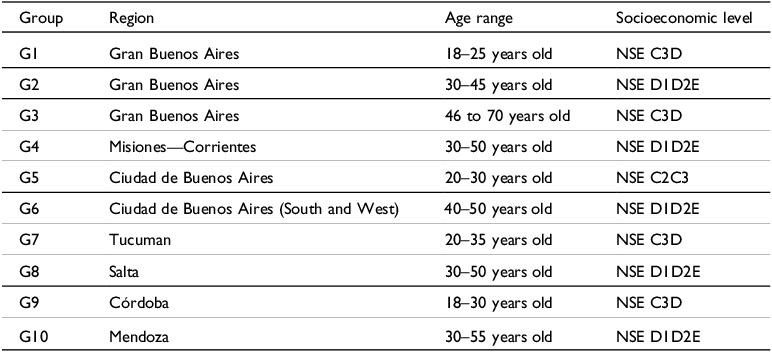
Between October 9 and 12, 2023, we conducted ten focus group sessions (Table 1). These sessions were strategically held in various districts where Milei had performed exceptionally well in the PASO (August 13, 2023), including the City of Buenos Aires, Gran Buenos Aires, Córdoba, Salta, Tucumán, Corrientes-Misiones, and Mendoza. Our sampling at the provincial or regional level, rather than solely at the city level, ensured a broader geographic representation of his support.
Focus Groups by Region, Age Range, and Socioeconomic Level

Each focus group session lasted approximately 1.5 hours and was led by a trained moderator. Participants were encouraged to freely express their opinions on Milei, his proposals, their expectations, and their past political affiliations and disappointments. Key inquiry areas included the emotional responses Milei evoked, his personality, his antiestablishment rhetoric, his economic proposals, and his cultural values. We observed the groups without disclosing our identities to maintain objectivity. Post-conclusion, all sessions were transcribed and then manually coded. Our coding process involved developing thematic classifications and categorizations that captured areas of agreement and disagreement among participants. We prioritized selecting passages that vividly illustrated shared or divergent views, focusing on how meanings were negotiated and contested, particularly leveraging the dialogic potential inherent in the focus group setting. Excerpts are cited with reference to their respective group (e.g., G1), preserving participant anonymity.
Regarding the analysis of the information, our primary focus was the group level, as we aimed to identify points of consensus around the ideas promoted by the presidential candidate. However, the interaction level was also important, as it revealed disagreements and, in particular, unexpected interpretations that participants attributed to Milei’s discourse.
It is essential to clarify the scope of this study by specifying the group we chose to examine. We can conceptualize this in terms of concentric circles: the first circle would be that of militants or activists, even if low-intensity activists, who nevertheless replicate the leader’s discourse on social media; the second would include his voters in the primaries and the first round of the election; and the third and final circle would consist of his voters in the runoff. Members of the first circle align with the sociological interpretations mentioned earlier—precarious and informal workers, as well as young men who manage social media and oppose “gender ideology.”Footnote 3 Members of the third circle are Milei’s voters who may have chosen him for his alliance with Juntos por el Cambio, many affiliates of which are traditional right-wing voters. Observing this group might have led us to a belief that Milei’s voters are consistently promarket and conservative, as argued in the work of Calvo et al. (Reference Calvo, Kessler, Murillo and Vommaro2024), from a survey conducted in December 2023. We believe that by focusing solely on the second circle, we can understand the “pure” voters of Milei and determine the extent to which his discourse reflects a new social identity.
Milei’s supporters: United by rejection
Consensus
Our first and most striking observation from focus groups revealed a profound disconnect between the diverse policy preferences of Milei’s voters and the specific programmatic agenda he proposed. Unlike studies of other radical right figures, such as pro-Kast individuals in Chile (Rovira Kaltwasser Reference Rovira Kaltwasser2023), pro-Milei participants exhibited considerable heterogeneity on moral issues like abortion and sexual education, as well as on the very role of the state. Yet an overwhelming consensus emerged: a shared, visceral rejection of professional politics, the establishment, and all previous governments. This collective disaffection, coupled with a powerful agreement on certain personal traits of Milei—particularly his perceived frankness—formed the bedrock of his support.
The actual glue binding these voters together was a potent blend of antiestablishment sentiment and the magnetic pull of Milei’s charismatic personality.
This consensus was rooted in participants’ shared emotional landscape of uncertainty, fear, disappointment, and pervasive anger. For instance, one participant stated that she felt a sense of hopelessness, pessimism, and disappointment about never being able to make progress. The leading causes of such feelings were the current economic crisis and the lack of security. “Everything has been quite complicated lately, and … it’s all rather dangerous,” maintained another participant from the same group (G1). Milei has gained popularity in politics by voicing the frustrations and anger many citizens feel. As one participant stated: “Milei is my voice, let’s say, he expresses the anger, the same anger that I have, the same anger that my neighbors have, the same anger that my coworkers have” (G4).
A significant catalyst for this anger was the memory of the COVID-19 pandemic and the perceived hypocrisy of the political class. A participant said, for example: “When we were all locked up because there was quarantine, he [President Alberto Fernández] was at home organizing a party, more or less … I don’t forget that, and everything we went through with the COVID crisis” (G1). We can also cite the example of another participant: “When we were in the pandemic, … he made his friends get vaccinated while many people were dying” (G3). These memories fueled a deep-seated resentment and a sense of betrayal.
Across all groups, uncertainty or fear about the immediate future emerged as the second most prevalent sentiment. Participants expressed profound anxiety about the economy, inflation, and their personal financial prospects, often painting a bleak picture. One likened the situation to the Titanic, on the brink of an inevitable disaster (G8). At the same time, another asserted, “It is going to be a disaster, I don’t want to be pessimistic, but I think there will be a lot of looting, the streets will be lawless, at least in the beginning” (G9). This profound disillusionment with past administrations, from Kirchner to Macri, solidified a widespread rejection of traditional politicians and paved the way for a leader who had never governed. As one exchange illustrates, Milei represented not just a choice but a desperate hope for change. When the moderator (M) asked if they believed they would fare better personally if Milei won the elections, participants (P) responded:
P1: Well, uh … worse than now … that is difficult.
M: Is it impossible to be worse than now?
P1: Yeah, I mean … he would have to do things badly for it to be “worse than now,” so yes … undoubtedly, better.
P2: The only way to be as bad or worse than now is to vote for the same ones who are in power now. I feel like … he proposes something viable, and we have not tried it yet.
P3: I think it is a hope …
P4: So, I have a bit of faith in Milei, but the government … with all the governments that have passed, it’s like … it’s enough, I don’t want to see them anymore, I want to see new people, like: what worse could come? If we’re already in the worst … what worse? I mean …
In G3, for example, participants reached similar conclusions:
P2: For now, I’ve already given chances to the rest. I’ve voted for them all. Every single one. I didn’t leave any without voting for.
P3: And as P1 said, “If he disappoints us in four years, we’ll see … but rather than voting again for the same ones who let us down, I’ll give the chance to someone new.
Moreover, most focus group participants were aligned with the antipolitical discourse and believed that “the caste” was directly responsible for the crisis afflicting the population. They fully adopted the belief that politicians are part of a self-interested and corrupt class or caste that operates systemically, meaning regardless of party differences. Take, for example, the words of a young participant from Gran Buenos Aires: “In an area like politics, which is the most screwed thing there is … there cannot be a ‘good politician,’ because everything, it ends up mixing” (G1). Focus group participants tended to view all politicians negatively because they are part of the system, and it is the system they perceive as corrupt. Another example of this opinion: “The one who did something good, at the same time did something bad in order to do the good, … for now … I don’t know of any about whom I can say ‘this is a good politician’” (G2).
Casta does not have a clear, single meaning; it is often associated with negative connotations, particularly concerning politicians. For some, it refers to those who stay in power for many years (although, if Milei needed to remain in power for twenty years to carry out his plan, he would belong to a “good caste,” as one participant said). For others, it is synonymous with corruption, a word closely linked to mafia-like practices and nepotism. To others, it refers to ñoquis, individuals who are paid for political work but fail to fulfill their duties. In G7 specifically, casta was mainly associated with Kirchnerism.
Therefore, there was a consensus in all the groups that voting for Milei was a vote against all politicians, as expressed by a participant from G3 when the moderator asked if they knew Milei’s proposals: “Uh … no. Because honestly, I’m not going to lie … I’m going to vote for him because … uh, to give this country some hope … It might sound bad, but my vote is like when you say a ‘rage vote,’ that would be my vote.”
In this regard, the participants of the focus groups viewed Milei’s leadership as an attempt to awaken citizens and free them from the yoke of the political class. In line with this, one of the participants stated, “To persecute the caste … That was the [proposal] that I liked the most” (G8).
The message that seemed to resonate with everyone was that of the “chainsaw,” serving as a symbol against the political class. Indeed, participants considered that public spending cuts should correspond to politicians’ salaries and the ñoquis, not workers’ salaries or investment in essential services. Participants believed that a “cut” in ministries would mainly affect politicians and that they would be the ones to bear the cost of the crisis: “Of course. [Milei] would adjust on the political side …, not on the people’s side as everyone says” (G2). Other participants also stated: “Why does a politician have a salary of 9 or 10 million pesos when the population in general, as the comrade said, does not reach the basic, vital, and mobile salary? … It is good that they cut off that side, so that they do not continue giving the benefits to those above, to the caste” (G7). “The ñoquis first, let them take out the ñoquis that the state has, cut there” (G8).
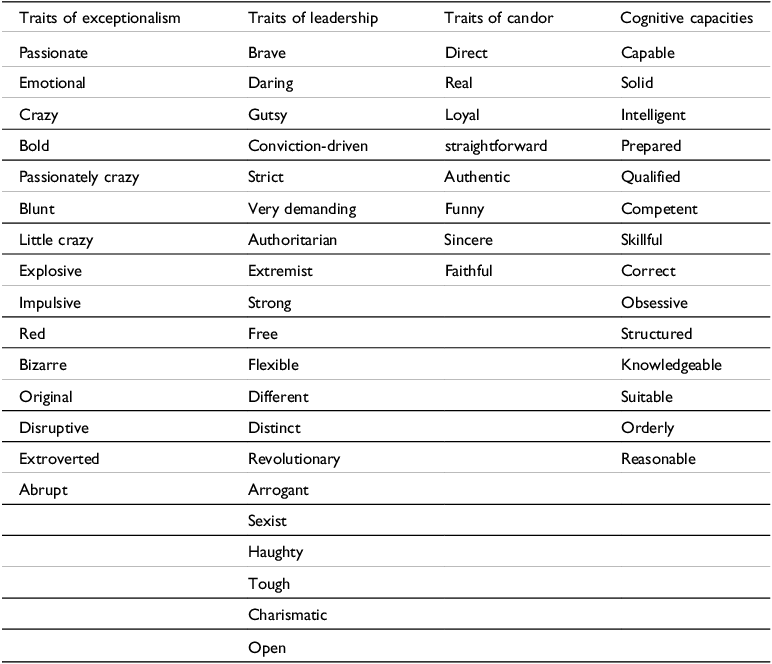
Another aspect that generated consensus across all groups was Milei’s charismatic personality. When we consider the adjectives associated with Milei’s figure by participants from the ten focus groups, attributes of an exceptional, out-of-the-ordinary personality stand out. These attributes pertain to his emotional traits, leadership qualities, frankness, and intellectual abilities or knowledge (Table 2).
Adjectives Associated with Javier Milei

Source: Inspired by Rovira Kaltwasser (Reference Rovira Kaltwasser2023).
Focus group participants emphasize his “frankness,” telling “the truth even if it hurts”: “If there is a problem, he is going to tell you ‘that is the problem,’ he is going to say it to your face” (G6), or “He would be one of those who don’t tell you the things you want to hear but what you need to hear instead, who tell you things straightforwardly and all at once” (G1), or “he is the friend who tells you the truth even if it hurts” (G8). Even a trait that might be seen as a disadvantage, such as being irritable and impulsive, is appreciated as a sign of his authenticity and honesty. Milei does not pretend to be someone he is not.Footnote 4
The attributes that focus group participants tend to highlight about Milei are those not usually associated with professional politicians, such as not being guided by advisers who dictate his words and actions or speaking his mind regardless of who is in front of him. For example: “You can see that he is a very passionate and real guy … when I listen to the other candidates … I feel they are super artificial, and coached. I do not like them … I notice Milei to be much more genuine in how he conveys his ideas” (G1).
While many attributes that emerged in the conversations seem typical of a political leader, such as bravery, the participants interpret them as traits that set Milei apart from the rest of the politicians. Indeed, the attributes of Milei that they value are those that differentiate him from professional politicians: “Everyone embraces him, and this is something that doesn’t happen with other politicians; it’s like other politicians always seem to be with security … whereas Milei isn’t” (G5).
Milei presents himself as an exceptional figure and, simultaneously, close to his followers. A moment from the conversation in G3 illustrates this well. When the moderator asked what Milei should do if he won the election to avoid becoming part of the casta, participants responded that he should maintain his closeness and similarity to the voters:
P1: For me, he should keep being just the way he is … exactly the way he is, an ordinary person who just happens to have another job, which is “being president” in this case.
P2: Yes … It should not be something different … otherwise, we’re back to the same old thing.
Later in the same conversation, his proximity attributes were emphasized again: “I like how he thinks … I like the way he talks. I feel identified with him … I’ve seen him in the streets … he was seen talking to anyone, to shopkeepers, and he has no problem being on equal footing with others” (G3).
Disagreements
Just as we found two central points of consensus regarding the rejection of “the caste” and Milei’s charismatic personality, we begin to see disagreements when we move on to the axes of the state’s role in the economy or moral issues. Here, the notion that supporting Milei automatically implied alignment with his radical ideological stances quickly dissolved; therefore, disagreements arise regarding the candidate’s proposals or positions, as well as among the participants themselves.
Even in a central aspect of Milei’s discourse, such as the promarket-prostate divide, we observed that focus group participants did not respond to a clear libertarian profile. Our participants, far from embodying a uniform libertarian profile, largely accepted the state’s fundamental role as a provider of public goods. Their critique was directed not at the principle of state intervention itself, but at its failure to deliver quality public services. What participants demanded was a more capable and effective state, one that could ensure robust provision of education, health care, and security.
Most participants in each group expressed their desire for a more “present state” that provides public health and education services more efficiently than the current system. They also expressed belief that if Milei were president, public goods, such as health care, would be of better quality. In other words, most do not think market forces should influence the health system. Instead, they complain about the lack of medical supplies in public hospitals and the difficulty they find in getting appointments: “You end up resorting to the private system to have your children treated because … at a public hospital, you have to go in person at 5 am to see if you can get an appointment” (G2). The participants do not believe that the market should have a more significant role than the state: “With the idea of privatizing public healthcare, I don’t agree … also [Milei] said he wanted to privatize public universities … I’m not in favor of that either” (G1).
However, there are also group participants who are more convinced by Milei’s discourse, share it, and defend it. Let’s see how this disagreement arises at one point in G3:
M: If I say the word state, what comes to mind?
P1: Absent. Today … absent.
P2: Same.
P3: Excessive spending.
P4: Or unnecessary spending.
P5: The same as P1 … totally absent in everything: in security, in education, in public health, in everything, everything, everything … in public works.
P3: I would say no; the state should be reduced … I don’t know, for me, the state is … a bureaucratic apparatus, and that’s the problem.
P1: … I believe that the state should equally distribute the money allocated for education to everyone, but equally, not that a public school has no heater, and a private school that charges a fee … in turn, receives 80 percent of subsidies from the state. Am I making myself clear?
P5: I think exactly the same: the state must guarantee … health, education … What the state does wrong is how it distributes the money, or to whom it gives the money, or how it delivers that money to guarantee health.
P6: … I agree with P1; it should be more equitable. It cannot be that someone attending a public school lacks fans, heaters, or classes while those who attend private schools always have guaranteed classes. It should be more equitable.
Instead of arguing that the state’s role in education or health should be reduced, a majority in each focus group believes that the state should better fulfill its role. In this way, participants often do not agree with Milei’s vision, nor with one another, as each group typically contains one or two participants who are familiar with Milei’s stance on these issues and actively defend it. The majority of them held ideas such as “public education for me obviously should receive more funds” (G8) and “the government … does not pay the salaries it should pay to public teachers. Consequently, teachers cannot give everything because they lack adequate material … or enough time to prepare as they should, for they have two or three jobs to cover to make ends meet” (G4).Footnote 5
Regarding Milei’s proposals or statements on moral issues, we find that most focus group participants disagree with him and, therefore, do not share a common ideology. This applies to the right to carry firearms, the criminalization of abortion, the rejection of sexual education in schools for transmitting “gender ideology,” and the questioning of the postdictatorship consensus.
Many focus group participants recounted incidents of insecurity that they experienced and showed themselves to be in favor of self-defense in case of criminal attacks. There is strong agreement regarding punitive positions in all groups. Here is an example from G4:
P1: I think there is much injustice regarding the fact that criminals can take your life and nothing happens, but when a good person defends themselves, they end up in jail for defending themselves, you know, and that is not right … That is why I liked Milei’s proposal, “He who does it, pays for it,” because we need that right now—being tough on criminals, you know.
P2: For example, that, uh, a minor goes to jail too, you know, if you are ten years old and you are capable of killing, you have to pay for that … There won’t be any mercy for criminals.
P3: Yes, as P2 says: I liked that proposal where … minors have to go to jail and pay for their crimes.
However, opinions are no longer in agreement regarding the right to carry firearms. For example: “And about the free carrying of weapons … I think the same as the boys say: It is complicated. They should ask for requirements, I do not know … something psychological … because imagine that they give it to anyone, and with the insecurity that we have now, no … [laughs], no, no” (G1).
Regarding the law that legalizes abortion (IVE), contradictory positions also emerge: “It is also something in which I did not agree so much with what Milei proposes, because for a ‘true liberal’ you can do whatever you want as long as you do not touch my pocket … I do agree with legalization” (G1). G6 illustrates the disagreement among the participants:
M: What do you think about legal abortion?
P1: I think legal abortion is perfect.
P2: Me too—I think it’s right.
P3: I think it’s OK.
M: What about you, P4?
P4: No.
P5: That’s fine. I mean, I believe everyone knows what they’re doing, and it comes down to taking care of oneself. You can’t accidentally get pregnant. I mean, there are many methods now …
P4: I’m against abortion.
P6: To get to the point of having an abortion … You have pills, condoms, and the implant. There are so many ways. It’s not necessary to end up having an abortion …
P2: Yes, but sometimes it can happen … with a minor, with a girl who was raped. For me, legal abortion is something one should decide by right.
P6: In the case of rape, I accept that. But in the case of teenagers, no, because they know what they’re doing.
P4: No. And, besides, that’s what sex education is for.
That is to say, there are minority positions within each focus group and across all groups that align with an ideological reaction against progressivism on all issues.Footnote 6 However, antiprogressivism is neither the shared nor the predominant identity of Milei’s voters.
Emergent findings
Our focus groups revealed specific instances in which supporters engaged with Milei’s proposals in ways that diverged sharply from the candidate’s stated intent, offering crucial empirical depth to our demand-side analysis. One of the striking elements of the focus groups was the complete support for Milei’s proposal of educational vouchers, although the way they understood these was unexpected. While the candidate framed this as a mechanism for privatizing education by subsidizing demand over supply, giving the money to individuals rather than educational institutions and promoting competition, participants overwhelmingly reinterpreted it as an expansion of their personal opportunities and rights. They envisioned vouchers as a means to access a wider array of educational institutions, including public and private universities (e.g., Universidad de Buenos Aires, Universidad Argentina de la Empresa, Universidad Católica Argentina), which they had felt were out of reach. A participant maintained, for example, “I had understood in part that this voucher gave you the possibility of choosing where to study, UBA, UADE, UCA” (G2). For many, it wasn’t about privatizing the system but akin to a personal scholarship, specifically for those they deemed “truly active” and deserving, distinguishing it from existing social programs like PROGRESAR. This reframing highlights how complex policy proposals can be selectively understood through the lens of individual aspiration rather than ideological doctrine.
Another unexpected emerging theme from the groups is their understanding of justice and equality. Their support for specific Milei proposals stemmed from a deep-seated desire for perceived fairness, often expressed as a yearning to “equalize” opportunities and prevent politicians from accumulating wealth. A participant said, for example: “For me, above all, what brings me closest [to Milei] is that he wants to equalize … equalize all Argentines … he wants to balance, let’s say, that politicians … do not become millionaires … [while the] worker who works seriously is really having a hard time every day” (G4). But they do have a problem with “small injustices.” Rosanvallon (Reference Rosanvallon2011) has drawn attention to the fact that, in contemporary societies, significant inequalities often seem to be tolerated because they are perceived as distant. Still, small injustices become unbearable, as was the case with Trump’s supporters regarding what the welfare state was doing for poor blacks. The perception of focus group participants about people accessing social welfare programs or about the incorporation of many people into the public pension system were good examples: “My mom, who worked her whole life, retired with a pension … that has almost no difference from someone who never worked; because suddenly they started giving pensions to people who never contributed to the state. That is unfair, isn’t it?” (G10).
In the groups with lower socioeconomic levels (D1D2E), specifically groups 2, 4, 6, 8, and 10, several participants mentioned living off various state subsidies, or “plans” from PROGRESAR, which help them complete their studies, to the ALIMENTAR card, which provides a monthly food basket, for example. Many participants reported being unemployed at the time of the focus group. In contrast, others reported selling items online from their homes and benefiting from welfare programs. In other words, they belong to the informal economy but still depend on the state. They do not hold a negative opinion about “social plans.” Still, they criticize the state for cutting off subsidies when people find formal employment, as it does not incentivize them to work. They also express moral disdain for those who prefer to rely on the plan rather than take the risk of working in the formal economy; above all, they believe these individuals are ill informed. Middle socioeconomic groups (1, 3, 5, 7, and 9), in contrast, use public goods less frequently and tend to hold a more disdainful view of people who depend on social programs. If we notice a moralizing tone in the interventions of all the groups, it is not an adoption of the classic topics of “the cultural battle”; instead, it is a moral suspicion regarding the small injustices and privileges concerning people who are in a very similar social condition to their own.
Conclusion
Our analysis of focus groups indicates that political support for Milei was based on a leadership style that resonated with existing socioeconomic grievances and political disenchantment rather than popular consent for the radical ideological agenda he proposes. The findings reveal that among Milei’s supporters, there is no clear group identity or shared ideology. The only consensus we identified among them is a negative attitude toward the establishment and the casta.
Antiestablishment sentiments and the pull of charismatic leadership—a kind of berserk charisma—rather than a shift toward right-wing ideology, were the main elements of a shared identity between his supporters. There was no agreement on Milei’s calls to reduce the state’s role or his advocacy for right-wing cultural values. Only a minority, whom we could refer to as “the fans,” embraced a libertarian, radical right perspective. Most participants, who could be labeled as “the rejecters,” disagreed with Milei’s proposals but felt a connection to his antiestablishment message, his status as a political outsider, and the appeal of his exceptionality and charisma.
However, now that he has transitioned from outsider to officeholder, he is in a position to transform these vague antiestablishment sentiments into more defined right-wing ideological positions. Moffitt (Reference Moffitt2016) has shown that repeated performative acts by those in power can reshape citizens’ identities. Similarly, Gemici (Reference Gemici2023) argues that when leaders speak from a position of authority, their discourse becomes performative: It can consolidate vague ideas, connect them, and legitimize previously marginalized or politically incorrect ways of thinking. With Milei in the presidency and a communication strategy aimed at deepening polarization, there is a plausible scenario in which these rejecters evolve into fans—something the favorable outcome he obtained in the 2025 midterm elections may already suggest.
This study makes two significant contributions that refine existing theoretical models of populism and PRR support. First, while PRR frameworks often implicitly assume a substantial ideological congruence between the leader’s specific nativist, authoritarian, or conservative agenda and the core identity of their voter base, our empirical data reveal a crucial insufficiency in this assumption. We demonstrate that, for Milei, supporter identity is predominantly forged through intense negative identification with the political establishment and a powerful charismatic bond with the leader rather than a shared embrace of his distinct libertarian, radical-right programmatic tenets or conservative moral positions.
Second, and crucially, our study underscores a vital methodological and theoretical imperative for populism studies: the need to rigorously analyze the demand side—how populist discourse is actively received and interpreted by voters—rather than solely focusing on the supply side. We provide concrete evidence that taking a leader’s proposals at face value can lead to significant mischaracterizations of the electorate’s actual beliefs. For instance, we found that supporters frequently reinterpreted Milei’s radical proposals (e.g., education vouchers, role of the state) in ways that aligned with their existing desires for improved public services or fairness, rather than indicating a genuine ideological conversion to libertarian principles. This highlights that understanding the meaning-making processes among the electorate, primarily through methods that capture nuance, is indispensable for accurately gauging the nature and depth of populist appeal and avoiding oversimplified assumptions about ideological shifts.
It is important to note that a study such as the one we have conducted has the limitation of not being representative of “Milei’s voters” in the way a survey would be. Nonetheless, some quantitative studies conducted before Milei’s rapid rise to public prominence pointed in a similar direction to our findings. A 2022 survey (Nazareno and Brusco Reference Nazareno and Brusco2023) found that his supporters’ subjectivity was somewhat eccentric in relation to the discourse of the libertarian leader. Another survey (Avritzer et al. Reference Avritzer, Peruzzotti and Iazzetta2023) conducted that year found that those who attributed positive qualities to Milei were more likely to hold antiestablishment sentiments. A September 2023 survey showed that Milei’s voters were mainly located at the ideological center, without a clear position on the progressive-conservative axis, except for a greater tendency toward punitivism (Rovira Kaltwasser et al. Reference Rovira Kaltwasser, Espinoza, Meléndez, Tanscheit and Zanotti2024). While subject to the inherent limitations of focus group methodology, our study contributes to deepening and nuancing existing quantitative research.
Our findings suggest two compelling avenues for future research that directly build on our insights. First, a critical next step is to extend this demand-side analysis longitudinally, comparing the (absence of) shared identity among Milei’s supporters during the electoral contest with how this identity evolves once he is firmly in office. Such a study would be invaluable for understanding how the performative acts and policy implementation from a position of authority might either consolidate a nascent identity or, conversely, further fragment a support base initially unified more by charisma and negative sentiment than by programmatic alignment. Second, comparing Milei’s case with others in the region can help assess the extent to which our hypothesis—regarding the predominance of negativity and charisma over ideological homogeneity in radical right-wing populisms—holds in other contexts. Previous research has shown, for example, that Bolsonaro in Brazil emerged from the mobilization of cohesive conservative sectors, marked by an evangelical ethos and the defense of patriotic symbols, which had been taking shape since the June 2013 protests (Renno Reference Renno2020). In contrast, to what extent does the demand-side interpretation of policy, as observed in Milei’s electorate, also shape support for leaders like Bukele, whose public-security agenda may be similarly reinterpreted by diverse voter segments eager for order rather than committed to a specific state model? More broadly, our findings invite us to question whether the internal programmatic contradictions within a populist base—effectively managed through a kind of berserk charisma and antiestablishment fervor in Milei’s case—are a more widespread feature of contemporary populism than traditional supply-side analyses have acknowledged.

 Open access

