





Impact statement
Suicide and self-harm are both pressing concerns within global mental health, with prevalence rates remaining high despite significant reductions in the global suicide mortality rate over the past three decades. Humanitarian crises – such as natural disasters, armed conflicts, forced displacement and public health emergencies – are known to increase the risk of suicide and/or self-harm thoughts and behaviours. Although suicide and self-harm are both preventable through evidence-based interventions, suicide prevention has only recently begun to receive dedicated attention within humanitarian programming. Previous reviews have assessed the effectiveness of interventions targeting suicide and self-harm in humanitarian contexts, but these have been limited to specific types of emergencies. In our review, we synthesise the global evidence base on suicide and self-harm prevention interventions across all types of humanitarian and fragile settings, assessing intervention effectiveness in improving suicide and/or self-harm outcomes. In doing so, we not only highlight a selection of promising approaches but also significant gaps in the evidence base for suicide prevention in humanitarian crises, most of which occur in low- to middle-income countries. Our findings have direct implications for strengthening suicide prevention efforts in humanitarian contexts, and we provide recommendations to guide future empirical work and resource development. Ultimately, the results of our review lay the groundwork for the development of robust, evidence-informed practical guidance to help frontline humanitarian workers respond more effectively to suicide and self-harm risk in the field.
Introduction
Suicide remains a major global public health crisis, claiming over 720,000 lives each year (WHO, 2025). The global prevalence of ‘self-harm’ or ‘non-suicidal self-injury’ (NSSI), a strong predictor of suicidal behaviour, is 17.7% (Moloney et al., Reference Moloney, Amini, Sinyor, Schaffer, Lanctôt and Mitchell2024). Notably, these statistics almost certainly underestimate the true burden of suicide, as widespread stigma and legal, religious and cultural prohibitions against suicide, as well as poor or absent suicide surveillance in many countries, account for the considerable under-reporting of suicide-related deaths (WHO, 2025). Moreover, the ramifications of suicide extend far beyond the individual (Knipe et al., Reference Knipe, Padmanathan, Netwon-Howes, Chan and Kapur2022), with surviving family members and friends commonly experiencing prolonged grief marked by guilt, shame, despair and a heightened risk of mental health problems themselves (Runeson & Wilcox, Reference Runeson, Wilcox and Pompili2021).
Critically, death by suicide is preventable through evidence-based interventions (WHO, 2018), with global suicide mortality declining by approximately one-third over the past three decades (Naghavi, Reference Naghavi2019). However, these gains remain inequitably distributed, with low- to middle-income countries (LMICs) seeing comparatively small improvements, with some LMICs, such as Zimbabwe, Paraguay and Jamaica, showing increasing rates of suicide (Lovero et al., Reference Lovero, Dos Santos, Come, Wainberg and Oquendo2023). Today, LMICs account for 73% of all suicides (WHO, 2025). More broadly, there is growing evidence that humanitarian emergencies and fragile states, most of which unfold in LMICs (Al Omari et al., Reference Al Omari, McCall, Hneiny and Sibai2024), are associated with elevated risk of suicide (Jourdi and Kyrillos, Reference Jourdi and Kyrillos2022) and NSSI (Alem et al., Reference Alem, Githaiga, Kiflom and Eloul2021; Basu et al., Reference Basu, Boland, Witt and Robinson2022). Epidemiological studies highlight this vulnerability: refugee populations frequently exhibit higher rates of suicidal behaviour (IOM, 2017; Akinyemi et al., Reference Akinyemi, Atilola and Soyannwo2015) and NSSI (Gargiulo et al., Reference Gargiulo, Tessitore, Grottaglie and Margherita2020) than non-displaced groups, with conflict-affected societies bearing a similarly heavy toll (Al-Ahdal and Farahat, Reference Al-Ahdal and Farahat2022; Sourander et al., Reference Sourander, Silwal, Osokina, Hinkka-Yli-Salomäki, Hodes and Skokauskas2024). Relatedly, survivors of natural disasters routinely report elevated rates of suicidal thoughts (Beaglehole et al., Reference Beaglehole, Mulder, Frampton, Boden, Newton-Howes and Bell2018) and increased likelihood of NSSI (Edwards et al., Reference Edwards, Taylor and Gray2024). In addition to conflict and natural disasters, public health emergencies represent another form of crisis that can increase suicidal ideation (Cénat et al., Reference Cénat, Felix, Blais-Rochette, Rousseau, Bukaka, Derivois, Noorishad and Birangui2020; Gunnell et al., Reference Gunnell, Appleby, Arensman, Hawton, John, Kapur, Khan, O’Connor and Pirkis2020; Yan et al., Reference Yan, Hou, Li and Yu2023) and NSSI (Farooq et al., Reference Farooq, Tunmore, Ali and Ayub2021) as strong predictors of suicide (Reeves et al., Reference Reeves, Vasconez and Weiss2022; Moloney et al., Reference Moloney, Amini, Sinyor, Schaffer, Lanctôt and Mitchell2024).
Several interrelated factors are thought to contribute to the increased risk of suicide and NSSI in humanitarian contexts (Jafari et al., Reference Jafari, Heidari, Heidari and Sayfouri2020; IASC, 2022). In addition to individual-level factors (e.g., age, sex and prior trauma history; Knipe et al., Reference Knipe, Padmanathan, Netwon-Howes, Chan and Kapur2022), humanitarian emergencies are characterised by disrupted or limited access to basic necessities, such as food, water, sanitation and safe shelter (IASC, 2007); forced displacement (Nguyen et al., Reference Nguyen, Lasater, Lee, Mallawaarachchi, Joshua, Bassett and Gelsdorf2023); increased rates of mental health disorders (Charlson et al., Reference Charlson, van Ommeren, Flaxman, Cornett, Whiteford and Saxena2019); increased exposure to potentially traumatic events (Sabawoon et al., Reference Sabawoon, Keyes, Karam and Kovess-Masfety2022); a lack of accessible care (Cogo et al., Reference Cogo, Murray, Villanueva, Hamel, Garner, Senior and Henschke2022); and the inability of governments to adequately promote suicide prevention (IASC, 2022). Simultaneously, disruptions to family cohesion and community networks diminish protective social supports (Jafari et al., Reference Jafari, Heidari, Heidari and Sayfouri2020). Finally, humanitarian emergencies can exacerbate challenges arising from shortages of trained personnel, poor or unreliable referral pathways and the absence of practical tools for frontline workers to identify and assist high-risk individuals (UNHCR, 2023).
Despite this pressing need, suicide prevention has only recently begun to receive dedicated attention within humanitarian programming. Over the past decade, initiatives have included training frontline health workers on the World Health Organization’s (WHO) Mental Health Gap Action Programme (mhGAP; Humayun et al., Reference Humayun, Haq, Khan, Azad, Khan and Weissbecker2017; Keynejad et al., Reference Keynejad, Spagnolo and Thornicroft2021), which includes content on suicide risk screening (WHO, 2015), campaigns to foster help-seeking behaviour (Schouler-Ocak, Reference Schouler-Ocak, van Bergen, Montesinos and Schouler-Ocak2015) and deploying contact and safety planning interventions (Vijayakumar et al., Reference Vijayakumar, Mohanraj, Kumar, Jeyaseelan, Sriram and Shanmugam2017). Additionally, the Inter-Agency Standing Committee (IASC) – the World’s ‘longest-standing and highest-level humanitarian coordination forum’ (IASC, 2025, para. 1) – recently developed its ‘Addressing Suicide in Humanitarian Settings’ guidance note, which asserts that responding to suicide in emergency settings requires a multisectoral and collaborative approach (IASC, 2022).
Nonetheless, there are a few – yet heterogeneous – specific suicide prevention programmes. Previous evidence syntheses of suicide prevention interventions in humanitarian contexts have focused only on populations in displacement (Haroz et al., Reference Haroz, Decker, Lee, Bolton, Spiegel and Ventevogel2020) or have excluded grey literature and contexts of armed conflict (Reifels et al., Reference Reifels, Krysinska and Andriessen2024). Therefore, we set out to answer the following review question: Which suicide and self-harm prevention strategies have been implemented and evaluated in all types of humanitarian crises worldwide, and what is currently known about their effectiveness?
By synthesising this body of knowledge, we intend not only to highlight promising approaches but also to guide future empirical work and resource development – ultimately laying the groundwork for the development of robust, evidence-informed practical guidance to enhance the capacity of frontline humanitarian workers.
Methods
We undertook a scoping review of the literature, conducted in accordance with the PRISMA extension for scoping revies (PRISMA-ScR) guidelines (Tricco et al., Reference Tricco, Lille, Zarin, O’Brien, Colquhoun, Levac, Moher, Peters, Horsely, Weeks, Hempel, Akl, Chang, McGowan, Stewart, Hartling, Aldcroft, Wilson, Garritty, Lewin, Godfrey, Macdonald, Langlois, Soares-Weiser, Moriarty, Clifford, Tunçalp and Straus2018). Please see Supplementary File 1 for a completed PRISMA-ScR checklist. No language or date restrictions were applied to the search, which was conducted in November 2024.
Search strategy
A comprehensive search strategy was developed in collaboration with a subject librarian (GS) to identify relevant peer-reviewed literature across the following databases: CINAHL, Embase, MEDLINE, PsycINFO, Web of Science Core Collection and PTSDPubs. Search terminology spanned three domains: suicide/self-harm, humanitarian and fragile contexts, and intervention efficacy. Example search terms for each domain, respectively, included: suicid*, selfharm*, selfinjur*; disaster*, humanitarian, pandemic, fragile; intervention*, prevent*, effect*, outcome*. Supplementary File 2 contains our complete utilised search strings, formatted for MEDLINE (Ebsco).
Grey literature sources were identified through expert recommendations and searches of relevant organisational websites and grey literature databases (see Supplementary File 3).
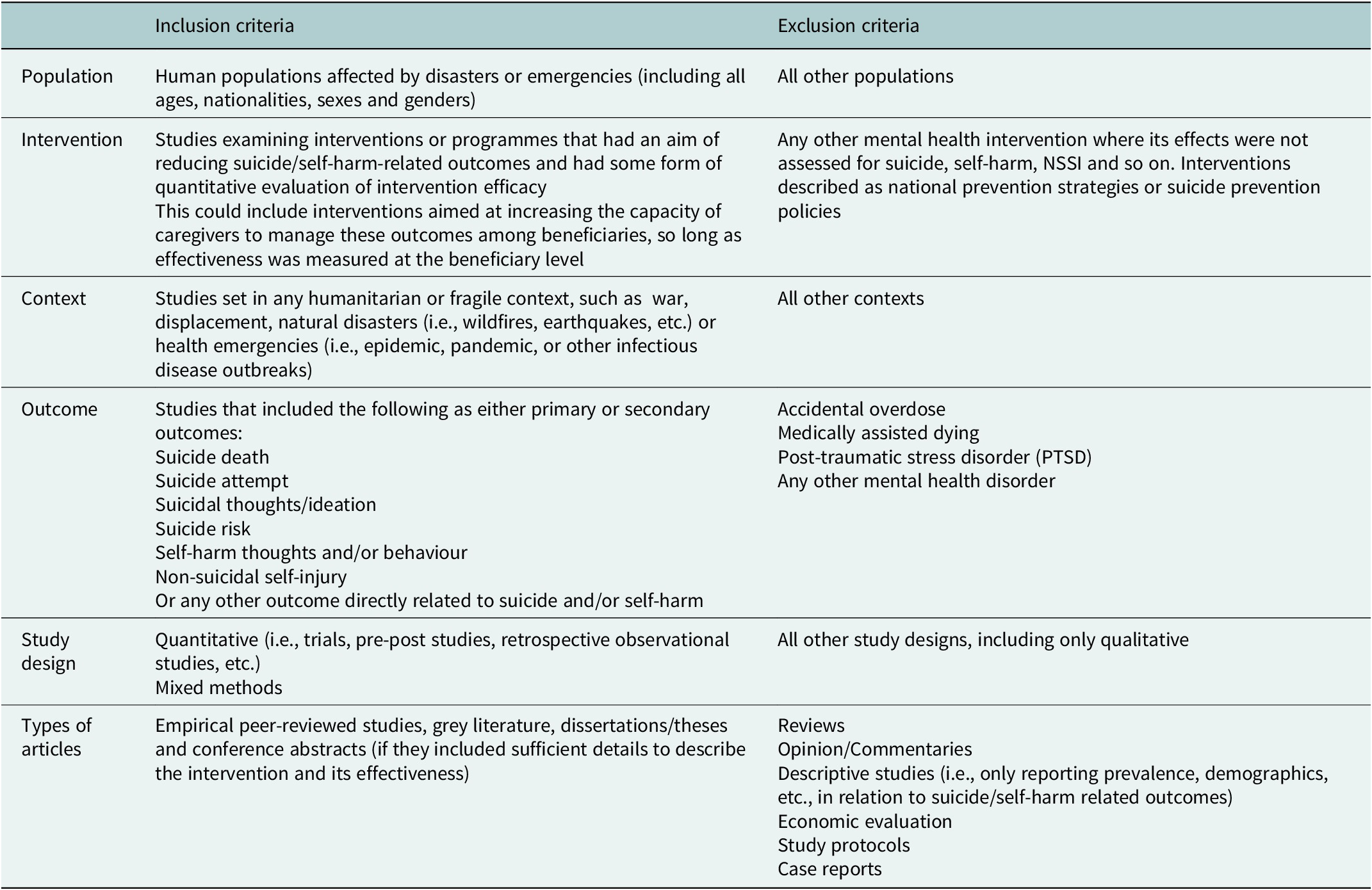
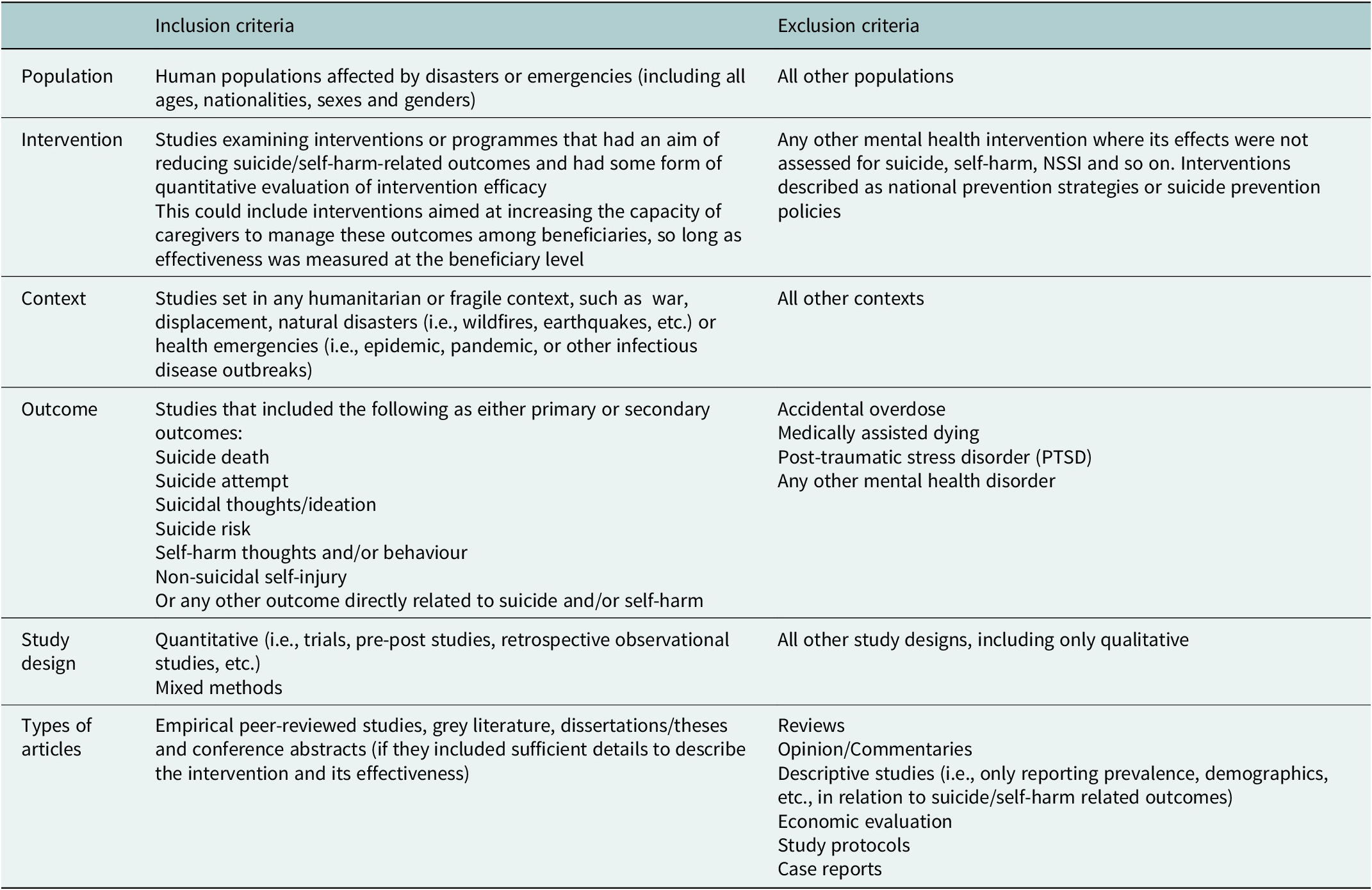
Table 1 presents the criteria for inclusion in our review.
Inclusion/exclusion criteria for record inclusion and data extraction
Screening and data extraction
All sources were uploaded to and deduplicated in Covidence (2024). Five authors were involved in the screening process (CZ, FV, FB, IK and RS). At both title/abstract and full text screening, each record was screened by two authors. Any discrepancies between the first two screeners were resolved by discussion and involving a third screener, if necessary. Data were extracted for the following domains: study characteristics, intervention details, suicide/self-harm-related outcomes, and efficacy of the intervention (see Supplementary File 4). Data extraction was first completed independently by two authors (CZ and RS), who then met to discuss any discrepancies.
Quality assessment
The Mixed Methods Appraisal Tool (MMAT; Hong et al., Reference Hong, Pluye, Fàbregues, Bartlett, Boardman, Cargo, Dagenais, Gagnon, Griffiths, Nicolau, O’Cathain, Rousseau and Vedel2018) was applied to assess the quality of each included study, chosen for its capacity to appraise multiple empirical study designs. For each study design category, reviewers respond ‘yes’ (=1), ‘no’ (=0) or ‘cannot tell’ (=0) to five questions related to methodological rigour. Each study is thus assigned a quality score, ranging from 0 (0%) to 5 (100%). Two authors (CZ and RS) first independently assessed each study and subsequently discussed any discrepancies. As per the MMAT, studies were not excluded based on methodological quality, but those deemed of the highest quality were prioritised in our reporting. Table 2 provides a 0–100% quality score for each study, in accordance with the MMAT.
Overview of included studies and their evaluated interventions

M, mean; SD, standard deviation; OR, odds ratio; CI, confidence interval; SE, standard error; IQR, interquartile range.
Note: 1Beck Scale for Suicide Ideation (Beck et al., Reference Beck, Steer and Ranieri1988); 2Patient Health Questionnaire-9 (Kroenke et al., Reference Kroenke, Spitzer and Williams2001); 3Suicidal Ideation Attributes Scale (van Spijker et al., Reference van Spijker, Batterham, Calear, Farrer, Christensen, Reynolds and Kerkhof2014); 4Plutchik Suicide Risk Scale (Plutchik and Van Praag, Reference Plutchik and Van Praag1994); 5Mini International Neuropsychiatric Interview – English Version 5.0.0 (Sheehan et al., Reference Sheehan, Lecrubier, Sheehan, Amorim, Janavs, Weiller, Hergueta, Baker and Dunbar1998); 6Ask Suicide-Screening Questions (Horowitz et al., Reference Horowitz, Bridge, Teach, Ballard, Klima, Rosenstein, Wharff, Ginnis, Cannon, Joshi and Pao2012); 7Alexian Brothers Assessment of Self-Injury (Washburn et al., Reference Washburn, Potthoff, Juzwin and Styer2015); 8Beck Depression Inventory (Beck et al., Reference Beck, Ward, Mendelson, Mock and Erbaugh1961); 9Suicide Status Form (Conrad et al., Reference Conrad, Jacoby, Jobes, Lineberry, Shea, Ewing, Schmid, Ellenbecker, Lee, Fritsche, Grenell, Gehin and Kung2010); 10P4 Suicidality Screener (Dube et al., Reference Dube, Kroenke, Bair, Theobold and Williams2010).
* According to the Mixed Methods Appraisal Tool (MMAT; Hong et al., Reference Hong, Pluye, Fàbregues, Bartlett, Boardman, Cargo, Dagenais, Gagnon, Griffiths, Nicolau, O’Cathain, Rousseau and Vedel2018), which scores a study out of five criteria with quality scores ranging from 0 to 100%.
Results
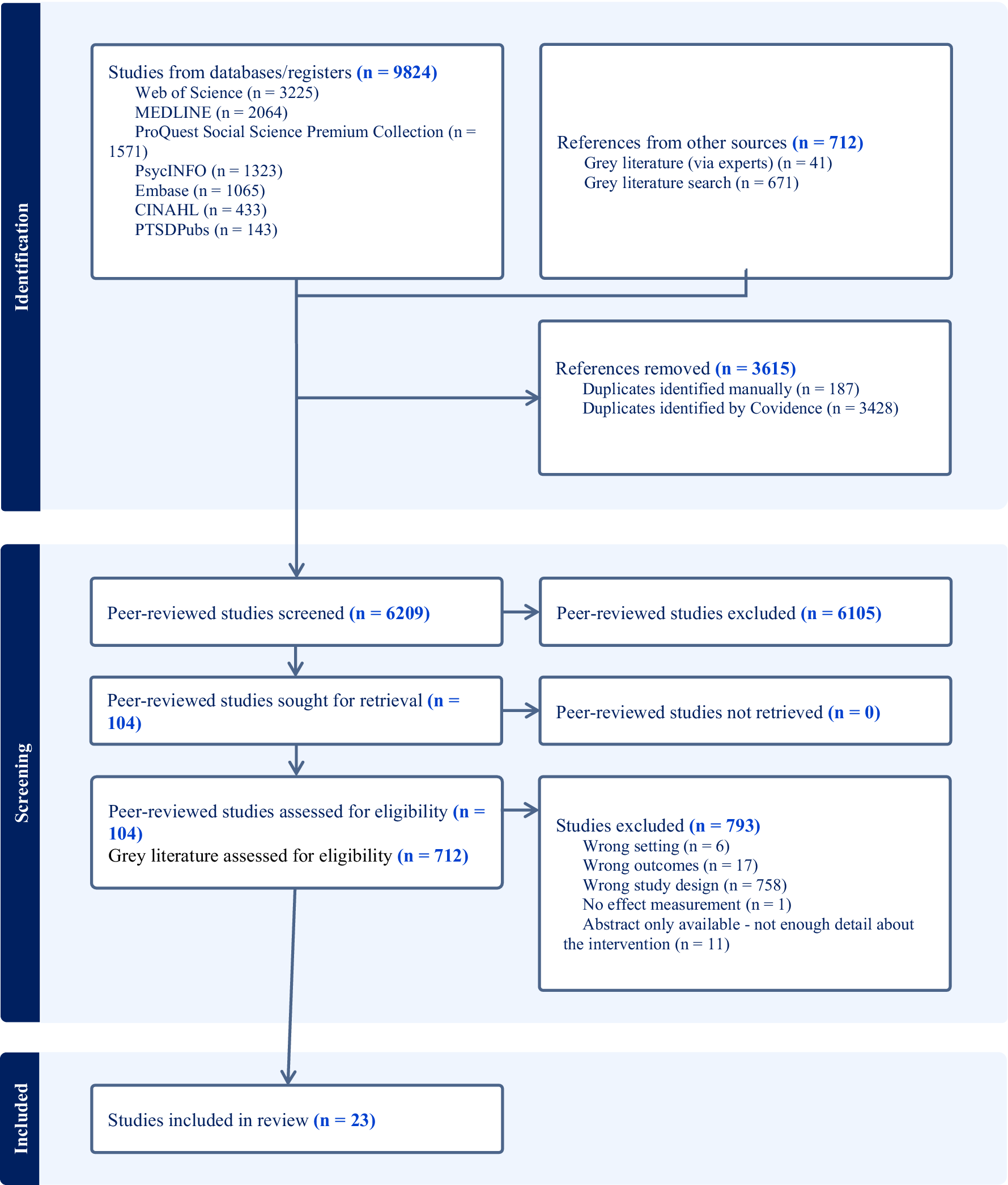
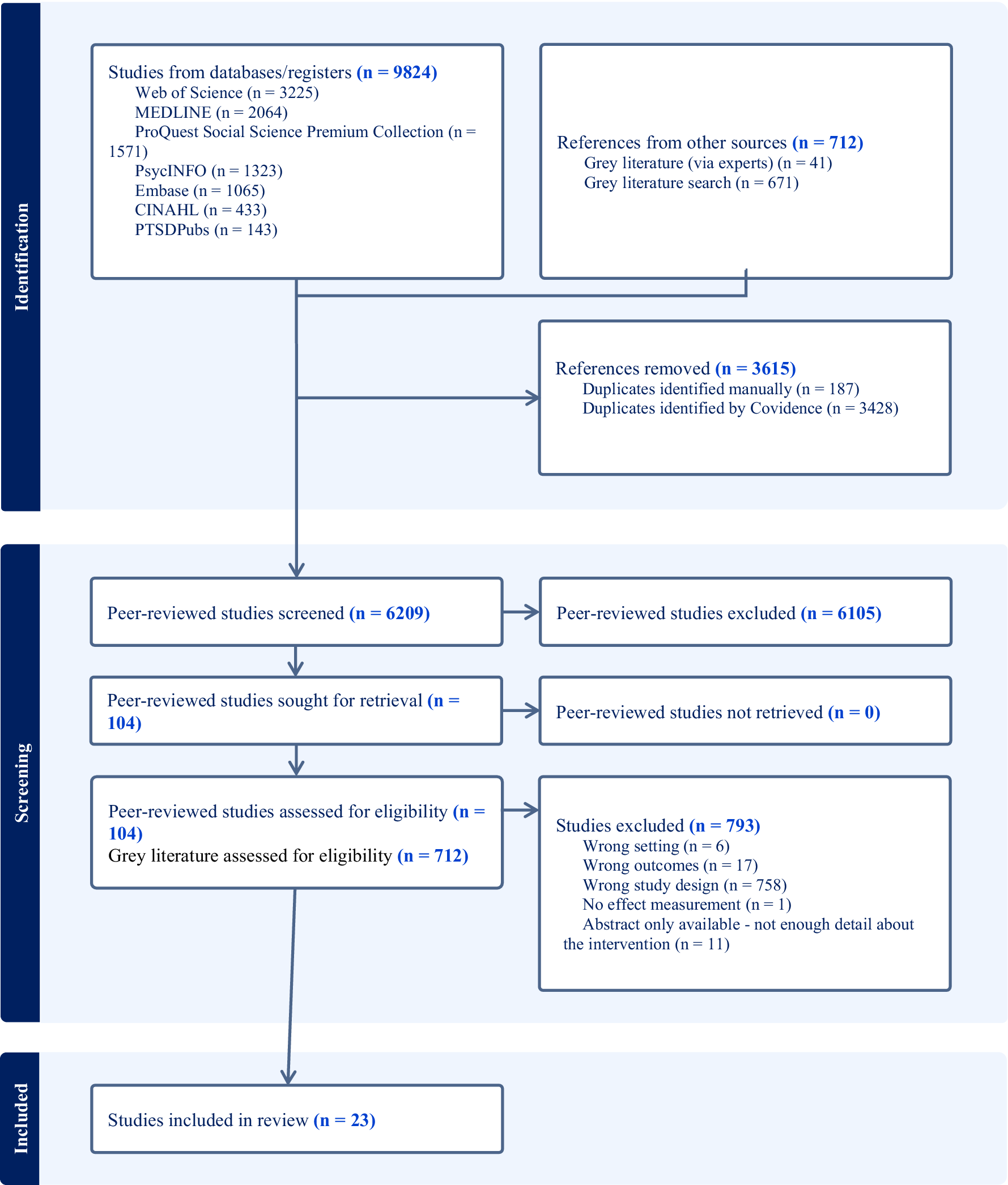
Our search of the peer-reviewed literature identified a total of n = 9,824 records, including 3,615 duplicates. Of the remaining 6,209 screened at the title/abstract phase, 104 were included for full text screening. Twenty-three studies were included for data extraction.
Our grey literature search identified 712 relevant records (Supplementary File 2). These were reviewed by one author, and 29 records were included for full-text review. None of these, however, met our full inclusion criteria. Figure 1 summarises the screening process.
PRISMA 2020 flow diagram generated through Covidence (2024).
Study characteristics
Characteristics of the 23 included studies and interventions are presented in Table 2. All studies were published between 2003 and 2024.
Study design
The largest proportion of studies employed a non-randomised experimental approach (n = 9, 39.1%; Abdulah and Abdulla, Reference Abdulah and Abdulla2020; Agyapong et al., Reference Agyapong, Shalaby, Hrabok, Vuong, Noble, Gusnowski, Mrklas, Li, Snaterse, Surood, Cao, Li, Greiner and Greenshaw2021; Agyapong et al., Reference Agyapong, Shalaby, Vuong, Gusnowski, Surood, Greenshaw, Wei and Agyapong2023; Anichini et al., Reference Anichini, D’Alessandro, Davico, Favole, Longo, Carbonara, Marcotulli, Mazzone, Oddone, Stolfa, Rainò and Vitiello2020; Dias et al., Reference Dias, Shalaby, Agyapong, Vuong, Gusnowski, Surood, Greenshaw and Agyapong2023; Kim et al., Reference Kim, Stewart, Kang, Jung, Kim and Kim2020; Obuobi-Donkor et al., Reference Obuobi-Donkor, Shalaby, Agyapong, Dias and Agyapong2024; Vijayakumar and Kumar, Reference Vijayakumar and Kumar2008; Won et al., Reference Won, Lee, Lee, Choi, Hong and Jung2023), followed by randomised controlled trials (n = 6; Ertl et al., Reference Ertl, Pfeiffer, Schauer, Elbert and Neuner2011; Devassy et al., Reference Devassy, Scaria, Shaju, Cheguvera, Joseph, Benny and Joseph2021; Persich et al., Reference Persich, Smith, Cloonan, Woods-Lubbert, Strong and Killgore2021; Bryant et al., Reference Bryant, Dawson, Azevedo, Yadav, Tran, Choi-Christou, Andrew, Beames and Keyan2023; Dominguez-Rodriguez et al., Reference Dominguez-Rodriguez, Sanz-Gomez, Ramírez, Herdoiza-Arroyo, Garcia, Rosa-Gómez, González-Cantero, Macias-Aguinaga and Miaja2023, Reference Dominguez-Rodriguez, Sanz-Gomez, Ramírez, Herdoiza-Arroyo, Garcia, Rosa-Gómez, González-Cantero, Macias-Aguinaga, Landgrave and Chávez-Valdez2024). Four studies employed a retrospective observational design (Kelly et al., Reference Kelly, Ansari, Rafferty and Stevenson2003; Puspitasari et al., Reference Puspitasari, Heredia, Coombes, Geske, Gentry, Moore, Sawchuk and Schak2021; Gliske et al., Reference Gliske, Berry, Ballard, Evans-Chase, Solomon and Fenkel2022; Gujral et al., Reference Gujral, Van Campen, Jacobs, Kimerling, Blonigen and Zulman2022). Three studies used mixed methods (all of which employed non-randomised experimental quantitative methods; Ramaiya et al., Reference Ramaiya, McLean, Pokharel, Thapa, Schmidt, Berg, Simoni, Rao and Kohrt2022; Stevens et al., Reference Stevens, Farías, Mindel, D’Amico and Evans-Lacko2022; Vijayakumar et al., Reference Vijayakumar, Mohanraj, Kumar, Jeyaseelan, Sriram and Shanmugam2017) and one study used implementation science (Landrum et al., Reference Landrum, Akiba, Pence, Akello, Chikalimba, Dussault, Hosseinipour, Kanzoole, Kulisewa, Malava, Udedi, Zimba and Gaynes2023).
Sample descriptions
Most studies (n = 14, 60.7%) focused on adult (aged ≥18 years) populations, while eight studies involved children, adolescents and young adults. The remaining study involved publicly accessible data from all individuals residing in Northern Ireland between the years of 1989–1999 (Kelly et al., Reference Kelly, Ansari, Rafferty and Stevenson2003).
Intervention details
Intervention context
Of the 23 studies in our analysis, the majority (n = 16, 69.6%) examined interventions implemented or evaluated during the coronavirus disease 2019 pandemic (COVID-19). Most occurred in the United States (Persich et al., Reference Persich, Smith, Cloonan, Woods-Lubbert, Strong and Killgore2021, Puspitasari et al., Reference Puspitasari, Heredia, Coombes, Geske, Gentry, Moore, Sawchuk and Schak2021; Gliske et al., Reference Gliske, Berry, Ballard, Evans-Chase, Solomon and Fenkel2022; Gujral et al., Reference Gujral, Van Campen, Jacobs, Kimerling, Blonigen and Zulman2022), Canada (Agyapong et al., Reference Agyapong, Shalaby, Hrabok, Vuong, Noble, Gusnowski, Mrklas, Li, Snaterse, Surood, Cao, Li, Greiner and Greenshaw2021, Reference Agyapong, Shalaby, Vuong, Gusnowski, Surood, Greenshaw, Wei and Agyapong2023; Dias et al., Reference Dias, Shalaby, Agyapong, Vuong, Gusnowski, Surood, Greenshaw and Agyapong2023) or other high-income countries (Anichini et al., Reference Anichini, D’Alessandro, Davico, Favole, Longo, Carbonara, Marcotulli, Mazzone, Oddone, Stolfa, Rainò and Vitiello2020; Kim et al., Reference Kim, Stewart, Kang, Jung, Kim and Kim2020; Stevens et al., Reference Stevens, Farías, Mindel, D’Amico and Evans-Lacko2022; Bryant et al., Reference Bryant, Dawson, Azevedo, Yadav, Tran, Choi-Christou, Andrew, Beames and Keyan2023; Won et al., Reference Won, Lee, Lee, Choi, Hong and Jung2023). The remaining four interventions implemented during COVID-19 occurred in India (Devassy et al., Reference Devassy, Scaria, Shaju, Cheguvera, Joseph, Benny and Joseph2021), Mexico (Dominguez-Rodriguez et al., Reference Dominguez-Rodriguez, Sanz-Gomez, Ramírez, Herdoiza-Arroyo, Garcia, Rosa-Gómez, González-Cantero, Macias-Aguinaga and Miaja2023, Reference Dominguez-Rodriguez, Sanz-Gomez, Ramírez, Herdoiza-Arroyo, Garcia, Rosa-Gómez, González-Cantero, Macias-Aguinaga, Landgrave and Chávez-Valdez2024) and Malawi (Landrum et al., Reference Landrum, Akiba, Pence, Akello, Chikalimba, Dussault, Hosseinipour, Kanzoole, Kulisewa, Malava, Udedi, Zimba and Gaynes2023). The second most prevalent humanitarian contexts were natural disasters – occurring in Canada (Obuobi-Donkor et al., Reference Obuobi-Donkor, Shalaby, Agyapong, Dias and Agyapong2024), Nepal (Ramaiya et al., Reference Ramaiya, McLean, Pokharel, Thapa, Schmidt, Berg, Simoni, Rao and Kohrt2022) and India (Vijayakumar and Kumar, Reference Vijayakumar and Kumar2008). The remaining intervention contexts were internally displaced person camps located in Iraqi Kurdistan (Abdulah and Abdulla, Reference Abdulah and Abdulla2020) and Northern Uganda (Ertl et al., Reference Ertl, Pfeiffer, Schauer, Elbert and Neuner2011), refugee camps in India (Vijayakumar et al., Reference Vijayakumar, Mohanraj, Kumar, Jeyaseelan, Sriram and Shanmugam2017) and the armed conflict in Northern Ireland (Kelly et al., Reference Kelly, Ansari, Rafferty and Stevenson2003).
Description of interventions
The largest proportion (n = 8, 34.8%) of studies examined interventions that either entirely or predominantly involved a psychotherapeutic approach, seven of which were delivered remotely. Four studies evaluated Text4Hope, a self-subscription, automated text messaging service that sends users daily messages informed by a cognitive behavioural therapy (CBT) framework (Agyapong et al., Reference Agyapong, Shalaby, Hrabok, Vuong, Noble, Gusnowski, Mrklas, Li, Snaterse, Surood, Cao, Li, Greiner and Greenshaw2021, Reference Agyapong, Shalaby, Vuong, Gusnowski, Surood, Greenshaw, Wei and Agyapong2023; Dias et al., Reference Dias, Shalaby, Agyapong, Vuong, Gusnowski, Surood, Greenshaw and Agyapong2023; Obuobi-Donkor et al., Reference Obuobi-Donkor, Shalaby, Agyapong, Dias and Agyapong2024). Two studies investigated similar modularised, self-administered online platforms housing content based on CBT, behavioural activation (BA) therapy and positive psychology – with additional incorporation of mindfulness practices (Dominguez-Rodriguez et al., Reference Dominguez-Rodriguez, Sanz-Gomez, Ramírez, Herdoiza-Arroyo, Garcia, Rosa-Gómez, González-Cantero, Macias-Aguinaga and Miaja2023) or chat support from therapists-in-training (Dominguez-Rodriguez et al., Reference Dominguez-Rodriguez, Sanz-Gomez, Ramírez, Herdoiza-Arroyo, Garcia, Rosa-Gómez, González-Cantero, Macias-Aguinaga, Landgrave and Chávez-Valdez2024). The remote, mental health specialist-led (hereafter referred to as ‘specialist-led’) intensive outpatient programme (IOP) evaluated by Puspitasari et al. (Reference Puspitasari, Heredia, Coombes, Geske, Gentry, Moore, Sawchuk and Schak2021) involved a similar multitude of psychotherapies, where high-risk participants engaged in group-based BA therapy, dialectical behavioural therapy (DBT), and occupational therapy (OT). Finally, Ertl et al. (Reference Ertl, Pfeiffer, Schauer, Elbert and Neuner2011) investigated the in-person delivery of narrative exposure therapy and academic catch-up with elements of supportive counselling, administered by trained local ‘lay’ (i.e., non-specialist) counsellors.
Four studies examined interventions utilising multiple therapeutic models, each delivered remotely. The IOP evaluated by Gliske et al. (Reference Gliske, Berry, Ballard, Evans-Chase, Solomon and Fenkel2022) involved primarily group-based therapies of both a psychotherapeutic and experiential (i.e., mindfulness and creative arts) nature, with individuals at high risk of suicide participating in DBT groups. Anichini et al. (Reference Anichini, D’Alessandro, Davico, Favole, Longo, Carbonara, Marcotulli, Mazzone, Oddone, Stolfa, Rainò and Vitiello2020) investigated a specialist-led intervention that offered a wide range of services, including art therapy workshops, group and individual psychotherapy and neuropsychiatric consultations. Kim et al. (Reference Kim, Stewart, Kang, Jung, Kim and Kim2020) evaluated a specialist-led intervention featuring psychoeducation on COVID-19, CBT techniques, and psychotropic medication, when required. Finally, Stevens et al. (Reference Stevens, Farías, Mindel, D’Amico and Evans-Lacko2022) evaluated Kooth, an online platform with self-administered well-being activities, a moderated peer support platform, and access to professional counselling.
Five studies evaluated interventions that provided direct crisis intervention of both a therapeutic and/or practical nature. Three of these were administered remotely. Devassy et al. (Reference Devassy, Scaria, Shaju, Cheguvera, Joseph, Benny and Joseph2021) assessed a telephone-based befriending intervention, administered by trained lay individuals, which focused on proactive engagement and crisis intervention, problem-solving oriented supportive therapy, and linking in with community resources. An additional remote intervention was a telephone-based suicide risk assessment protocol and subsequent safety planning delivered by trained lay individuals (Landrum et al., Reference Landrum, Akiba, Pence, Akello, Chikalimba, Dussault, Hosseinipour, Kanzoole, Kulisewa, Malava, Udedi, Zimba and Gaynes2023). Won et al. (Reference Won, Lee, Lee, Choi, Hong and Jung2023) examined a telephone-delivered, specialist-led psychiatric consultation programme that included education on COVID-19, stress management, and relaxation therapy. For high-risk individuals, intervention activities shifted to in-person provision of emotional support, assistance in meeting practical needs, and future disposition planning. Two interventions were delivered in-person: Vijayakumar et al. (Reference Vijayakumar, Mohanraj, Kumar, Jeyaseelan, Sriram and Shanmugam2017) evaluated Contact and Safety Planning (CASP), involving the provision of emotional support and safety planning by trained lay individuals, while Vijayakumar and Kumar (Reference Vijayakumar and Kumar2008) evaluated a lay-delivered befriending intervention that centred on regular contact and emotional support for recently bereaved individuals.
Three studies evaluated skills-based training programmes, two of which were remote. Persich et al. (Reference Persich, Smith, Cloonan, Woods-Lubbert, Strong and Killgore2021) investigated a brief, self-administered online emotional intelligence (EI) training, with Bryant et al. (Reference Bryant, Dawson, Azevedo, Yadav, Tran, Choi-Christou, Andrew, Beames and Keyan2023) investigating a specialist-led group-based positive affect training. Ramaiya et al. (Reference Ramaiya, McLean, Pokharel, Thapa, Schmidt, Berg, Simoni, Rao and Kohrt2022) evaluated a DBT-informed, emotion-focused training programme delivered to groups in-person by trained lay individuals.
Additional interventions included the in-person delivery of group-based creative arts therapy – administered by a creative arts specialist (Abdulah and Abdulla, Reference Abdulah and Abdulla2020), the provision of video-enabled tablets (Gujral et al., Reference Gujral, Van Campen, Jacobs, Kimerling, Blonigen and Zulman2022) and antidepressant medication (Kelly et al., Reference Kelly, Ansari, Rafferty and Stevenson2003).
Table 2 provides more information around the content/duration of each intervention, as well as the training content for the five lay-delivered interventions.
Outcomes and modes of assessment
Most studies focused on individual-level suicide/NSSI-related outcomes, employing a variety of assessment methods. The most frequent method was through validated measurement tools (n = 17, 73.9%). Of these, Item 9 of the Patient Health Questionnaire-9 (Kroenke et al., Reference Kroenke, Spitzer and Williams2001), a measure of suicidal ideation and/or thoughts of NSSI, was used most frequently (Agyapong et al., Reference Agyapong, Shalaby, Hrabok, Vuong, Noble, Gusnowski, Mrklas, Li, Snaterse, Surood, Cao, Li, Greiner and Greenshaw2021, Reference Agyapong, Shalaby, Vuong, Gusnowski, Surood, Greenshaw, Wei and Agyapong2023; Dias et al., Reference Dias, Shalaby, Agyapong, Vuong, Gusnowski, Surood, Greenshaw and Agyapong2023; Landrum et al., Reference Landrum, Akiba, Pence, Akello, Chikalimba, Dussault, Hosseinipour, Kanzoole, Kulisewa, Malava, Udedi, Zimba and Gaynes2023; Obuobi-Donkor et al., Reference Obuobi-Donkor, Shalaby, Agyapong, Dias and Agyapong2024). In addition to using the Beck Scale for Suicidal Ideation (Beck et al., Reference Beck, Steer and Ranieri1988) to assess individual suicidal ideation, Vijayakumar et al. (Reference Vijayakumar, Mohanraj, Kumar, Jeyaseelan, Sriram and Shanmugam2017) also assessed rates of death by suicide and suicide attempt per 100,000 individuals in two refugee camps. Table 2 presents additional validated measurement tools used to assess suicide/NSSI-related outcomes.
One study assessed suicidal ideation/behaviour and NSSI through clinical interviews (Anichini et al., Reference Anichini, D’Alessandro, Davico, Favole, Longo, Carbonara, Marcotulli, Mazzone, Oddone, Stolfa, Rainò and Vitiello2020) and another assessed suicidal ideation through a four-item scale developed by the authors (Ramaiya et al., Reference Ramaiya, McLean, Pokharel, Thapa, Schmidt, Berg, Simoni, Rao and Kohrt2022). Two studies drew from public records, one of which assessed the likelihood of a suicide-related emergency department visit and the number of suicide behaviour and overdose reports (SBORs) among US rural veterans (Gujral et al., Reference Gujral, Van Campen, Jacobs, Kimerling, Blonigen and Zulman2022), while the other used the recorded cases of suicide and undetermined deaths across 10 years in Northern Ireland (Kelly et al., Reference Kelly, Ansari, Rafferty and Stevenson2003).
Two studies did not report their mode of assessment for their suicide-related outcome of interest (Vijayakumar and Kumar, Reference Vijayakumar and Kumar2008; Devassy et al., Reference Devassy, Scaria, Shaju, Cheguvera, Joseph, Benny and Joseph2021).
Effectiveness of interventions by type and quality assessment
Most included studies (n = 15, 65.2%) reported a statistically significant positive impact of their intervention on suicide and/or NSSI-related outcomes.
Six of the eight studies evaluating interventions with predominantly psychotherapeutic content reported a significant positive effect (Agyapong et al., Reference Agyapong, Shalaby, Hrabok, Vuong, Noble, Gusnowski, Mrklas, Li, Snaterse, Surood, Cao, Li, Greiner and Greenshaw2021; Puspitasari et al., Reference Puspitasari, Heredia, Coombes, Geske, Gentry, Moore, Sawchuk and Schak2021; Dias et al., Reference Dias, Shalaby, Agyapong, Vuong, Gusnowski, Surood, Greenshaw and Agyapong2023; Dominguez-Rodriguez et al., Reference Dominguez-Rodriguez, Sanz-Gomez, Ramírez, Herdoiza-Arroyo, Garcia, Rosa-Gómez, González-Cantero, Macias-Aguinaga and Miaja2023; Obuobi-Donkor et al., Reference Obuobi-Donkor, Shalaby, Agyapong, Dias and Agyapong2024). The highest quality studies examined Text4Hope, the CBT-informed texting service, which consistently reported reduced suicidal ideation and/or thoughts of NSSI after 6 weeks of daily text messages (Agyapong et al., Reference Agyapong, Shalaby, Hrabok, Vuong, Noble, Gusnowski, Mrklas, Li, Snaterse, Surood, Cao, Li, Greiner and Greenshaw2021, Reference Agyapong, Shalaby, Vuong, Gusnowski, Surood, Greenshaw, Wei and Agyapong2023; Dias et al., Reference Dias, Shalaby, Agyapong, Vuong, Gusnowski, Surood, Greenshaw and Agyapong2023; Obuobi-Donkor et al., Reference Obuobi-Donkor, Shalaby, Agyapong, Dias and Agyapong2024); and the remote IOP prioritising DBT, BA therapy, and OT for high-risk individuals, which was associated with reductions in suicide risk (Puspitasari et al., Reference Puspitasari, Heredia, Coombes, Geske, Gentry, Moore, Sawchuk and Schak2021).
Two studies evaluated interventions drawing from multiple therapeutic models that were associated with statistically significant reductions in suicidal ideation and NSSI (Gliske et al., Reference Gliske, Berry, Ballard, Evans-Chase, Solomon and Fenkel2022; Stevens et al., Reference Stevens, Farías, Mindel, D’Amico and Evans-Lacko2022). The higher quality of these studies involved the remote IOP combining both psychotherapeutic and experiential approaches – with group DBT being provided to high-risk individuals (Gliske et al., Reference Gliske, Berry, Ballard, Evans-Chase, Solomon and Fenkel2022).
Of the five studies evaluating direct crisis management interventions, two in-person approaches – emotional support alone (Vijayakumar and Kumar, Reference Vijayakumar and Kumar2008) and emotional support with safety planning (Vijayakumar et al., Reference Vijayakumar, Mohanraj, Kumar, Jeyaseelan, Sriram and Shanmugam2017) – showed significant positive effects, though they were deemed to be of low quality. Among the skills-based interventions, both positive affect training (Bryant et al., Reference Bryant, Dawson, Azevedo, Yadav, Tran, Choi-Christou, Andrew, Beames and Keyan2023) and EI training (Persich et al., Reference Persich, Smith, Cloonan, Woods-Lubbert, Strong and Killgore2021) were associated with significant reductions in suicidal ideation. However, only the evaluation done by Bryant et al. (Reference Bryant, Dawson, Azevedo, Yadav, Tran, Choi-Christou, Andrew, Beames and Keyan2023) was assessed as high-quality. The high-quality study done by Kelly et al. (Reference Kelly, Ansari, Rafferty and Stevenson2003) found that, among individuals aged 30 years and above, there was a significant negative association between the rate of prescription of antidepressant medication and recorded cases of suicide and undetermined deaths. In another high-quality study, Gujral et al. (Reference Gujral, Van Campen, Jacobs, Kimerling, Blonigen and Zulman2022) reported that the provision of video-enabled tablets led to a significant decrease in the likelihood of a suicide-related emergency department visit and the number of submitted SBORs. Finally, the study done by Abdulah and Abdulla (Reference Abdulah and Abdulla2020), of moderate quality, found that two months of creative arts therapy led to significant reductions in suicidal ideation.
Discussion
This scoping review set out to synthesise the extant literature on interventions deployed in humanitarian settings to improve suicide and NSSI-related outcomes. A total of 23 articles were included, with most reporting positive effects of their interventions. However, multiple characteristics of these interventions necessitate nuanced discussion. Consistent with previous suicide prevention evidence syntheses from both humanitarian (Reifels et al., Reference Reifels, Krysinska and Andriessen2024) and non-humanitarian settings (Calear et al., Reference Calear, Christensen, Freeman, Fenton, Grant, van Spijker and Donker2016; Mann et al., Reference Mann, Michel and Auerbach2021; Poudel et al., Reference Poudel, Pathrose, Jeffries and Ramjan2025), included articles varied in their quality and evaluated a heterogeneous pool of interventions – many of which involved multiple components, and relied, at least in part, on specialists for their implementation (see Table 2). The use of diverse, predominantly multicomponent, and specialist-led approaches is not surprising, given the variety of populations represented within included studies and the complex aetiology of suicide and NSSI (Knipe et al., Reference Knipe, Padmanathan, Netwon-Howes, Chan and Kapur2022). However, challenges emerge when attempting to translate findings into actionable recommendations for humanitarian programming.
A principal challenge relates to the feasibility of implementing these interventions within the full breadth of contexts affected by humanitarian crises. The global impact of pandemics (i.e., COVID-19) notwithstanding, most humanitarian emergencies occur in LMICs (Al Omari et al., Reference Al Omari, McCall, Hneiny and Sibai2024) where both human and financial resources for mental health are scarce (Giebel et al., Reference Giebel, Gabby, Shrestha, Saldarriaga, Reilly, White, Liu, Allen and Zuluaga2024). That most interventions included in our review were implemented and evaluated in high-income countries (HICs), during the COVID-19 pandemic, and administered by specialists, reflects both previous reviews on humanitarian suicide prevention (Reifels et al., Reference Reifels, Krysinska and Andriessen2024) and the broader suicide-related literature, where <15% of research on suicide prevention takes place within LMICs (Knipe et al., Reference Knipe, Padmanathan, Netwon-Howes, Chan and Kapur2022). Attempts to implement multicomponent interventions, particularly those relying on specialists for delivery, may therefore fall victim to a ‘failure to launch’ scenario, while high stigma, illegality of suicide, and the absence of national surveillance systems that capture data on suicide-related outcomes (WHO, 2025) present substantial barriers to sustainable implementation and scale-up (Barbui et al., Reference Barbui, Purgato, Abdulmalik, Acarturk, Eaton, Gastaldon, Gureje, Hanlon, Jordans, Lund, Nosè, Ostuzzi, Papola, Tedeschi, Tol, Turrini, Patel and Thornicroft2020).
Beyond concerns regarding the feasibility of implementing interventions predominantly evaluated in HICs, there are similar uncertainties regarding the applicability of findings to LMICs, where the epidemiological profiles of individuals who die by suicide and/or engage in behaviours of self-harm – and the very conceptualisation of self-harm – may vary (Knipe et al., Reference Knipe, Padmanathan, Netwon-Howes, Chan and Kapur2022). Taken together, this suggests an inadequate evidence base for effective suicide prevention strategies in LMICs (Knipe et al., Reference Knipe, Padmanathan, Netwon-Howes, Chan and Kapur2022), and therefore, given their significant imbrication, humanitarian settings (Al Omari et al., Reference Al Omari, McCall, Hneiny and Sibai2024). Rectification of this knowledge gap requires urgent attention within humanitarian research efforts (Haroz et al., Reference Haroz, Decker, Lee, Bolton, Spiegel and Ventevogel2020; Reifels et al., Reference Reifels, Krysinska and Andriessen2024).
Despite these concerns, a subset of interventions stands out as promising opportunities to address the high risk for suicide and/or NSSI within humanitarian emergencies. The use of remote interventions for use in low-resource/humanitarian settings, particularly when considering issues of feasibility, accessibility (Ibragimov et al., Reference Ibragimov, Palma, Keane, Ousely, Crowe, Carreño, Casas, Mills and Llosa2022; Knipe et al., Reference Knipe, Padmanathan, Netwon-Howes, Chan and Kapur2022), and scalability (Alvarez et al., Reference Alvarez, Waitz-Kudla, Brydon, Crosby and Witte2022; He et al., Reference He, Marzouk, Balk, Boyle and Lee2023), for example, warrants further consideration.
Keeping in mind its self-subscription model (with results not necessarily reflective of individuals identified as high-risk for suicide), the CBT-informed automated texting service Text4Hope – which consistently demonstrated effectiveness in reducing suicide-related outcomes – stands out as particularly promising for reducing suicidal ideation and NSSI in an emergency with good mobile penetration and reliable coverage (Agyapong et al., Reference Agyapong, Shalaby, Hrabok, Vuong, Noble, Gusnowski, Mrklas, Li, Snaterse, Surood, Cao, Li, Greiner and Greenshaw2021, Reference Agyapong, Shalaby, Vuong, Gusnowski, Surood, Greenshaw, Wei and Agyapong2023; Dias et al., Reference Dias, Shalaby, Agyapong, Vuong, Gusnowski, Surood, Greenshaw and Agyapong2023; Obuobi-Donkor et al., Reference Obuobi-Donkor, Shalaby, Agyapong, Dias and Agyapong2024). This finding is consistent with the broader scientific knowledge; in their Lancet seminar on suicide and self-harm, Knipe et al. (Reference Knipe, Padmanathan, Netwon-Howes, Chan and Kapur2022) assert that CBT-aligned approaches have the strongest evidence base for reducing suicidal ideation and repeat instances of self-harm. The many advantages of text-messaging services compared to more complex forms of remote health services (Ruzek and Yeager, Reference Ruzek and Yeager2017) – including well-documented cost effectiveness (Agyapong et al., Reference Agyapong, Shalaby, Vuong, Gusnowski, Surood, Greenshaw, Wei and Agyapong2023; Obuobi-Donkor et al., Reference Obuobi-Donkor, Shalaby, Agyapong, Nkrumah, Adu, Eboreime, Wozney and Agyapong2025) – together with its single-component approach and automated administration may help overcome both the stigma associated with seeking help and the limited number of human resources in humanitarian settings (Raftree, Reference Raftree2023; WHO, 2025). In addition, the significant increases in mobile phone ownership within low-resource settings (Maliwichi et al., Reference Maliwichi, Mthoko, Chigona, Mburu and Densmore2024), including among displaced populations (Ashfaq et al., Reference Ashfaq, Esmaili, Najjar, Batool, Mukatash, Al-Ani and Koga2020), further highlight text-based CBT-aligned interventions as a promising suicide prevention intervention within humanitarian contexts. Incorporation of (an adapted) Text4Hope or similar programme into regional or national mental health policies – particularly those already engaging with digital health agendas – would likely benefit the intervention’s efficient rollout following the onset of a humanitarian crisis (Agyapong et al., Reference Agyapong, Shalaby, Vuong, Gusnowski, Surood, Greenshaw, Wei and Agyapong2023; Obuobi-Donkor et al., Reference Obuobi-Donkor, Shalaby, Agyapong, Dias and Agyapong2024, Reference Obuobi-Donkor, Shalaby, Agyapong, Nkrumah, Adu, Eboreime, Wozney and Agyapong2025). Similarly, the leveraging of governmental early warning systems and/or mobile crisis information applications (Goniewicz and Burkle, Reference Goniewicz and Burkle2019; Chan and Tsai, Reference Chan and Tsai2023) may help facilitate timely and wide-reaching implementation of text-based mental health initiatives – keeping in mind the need for equitable access across affected populations (Goniewicz and Burkle, Reference Goniewicz and Burkle2019).
Moreover, and consistent with the IASC’s (2022) ‘Addressing Suicide in Humanitarian Settings’, building life skills that serve as protective factors is an essential component of suicide prevention in humanitarian contexts. Two remote training programmes that made use of skills-based approaches – one targeting the general population (Persich et al., Reference Persich, Smith, Cloonan, Woods-Lubbert, Strong and Killgore2021) and the other individuals who screened positive for psychological distress (Bryant et al., Reference Bryant, Dawson, Azevedo, Yadav, Tran, Choi-Christou, Andrew, Beames and Keyan2023) – were associated with reductions in suicidal ideation. While the authors observed high participant drop-off, the positive effects of the EI training programme evaluated by Persich et al. (Reference Persich, Smith, Cloonan, Woods-Lubbert, Strong and Killgore2021), for example, are consistent with previous meta-analyses and reviews recommending that EI training programmes be integrated into suicide prevention strategies (Domínguez-García and Fernández-Berrocal, Reference Domínguez-García and Fernández-Berrocal2018; Avanci et al., Reference Avanci, Gonçalves, da Silva Filho, Tavares and de Assis2024; Darvishi et al., Reference Darvishi, Farhadi and Poorolajal2025). Like text-based services, its brief self-administered (more anonymous) nature may also be useful towards surmounting insufficient resources and significant stigma (Raftree, Reference Raftree2023; WHO, 2025), while also allowing for flexibility in user engagement (Raftree, Reference Raftree2023). However, the absence of a user-practitioner relationship likely implies that the usability of any self-administered programme is prioritised to support uptake and continuous use (Raftree, Reference Raftree2023). Similarly, the reduction in suicidal ideation associated with the brief positive affect training programme evaluated by Bryant et al. (Reference Bryant, Dawson, Azevedo, Yadav, Tran, Choi-Christou, Andrew, Beames and Keyan2023) is corroborated by additional evidence (Bennardi et al., Reference Bennardi, Caballero, Miret, Ayuso-Mateos, Haro, Lara, Arensman and Cabello2019; Teismann et al., Reference Teismann, Brailovskaia and Margraf2019; Yen et al., Reference Yen, Ranney, Krek, Peters, Mereish, Tezanos, Solomon, Beard and Spirito2020, Reference Yen, Suazo, Doerr, Macrynikola, Villarreal, Sodano, O’Brien, Wolff, Breault, Gibb, Elwy, Kahler, Ranney, Jones and Spirito2023), suggesting that this may be another useful method of protecting against suicide and NSSI in humanitarian contexts. Importantly, Bryant et al. (Reference Bryant, Dawson, Azevedo, Yadav, Tran, Choi-Christou, Andrew, Beames and Keyan2023) note that their positive affect intervention was delivered by clinical psychologists, emphasising how ‘substantive scale-up…especially in low- and middle-income countries’ will require the development of ‘structured training protocols… for people with varying qualifications’ (p. 6).
Implementing remote interventions, however, requires careful consideration to ensure their effectiveness and sustainability. These include community-driven cultural/contextual adaptations (IASC, 2022, Maliwichi et al., Reference Maliwichi, Mthoko, Chigona, Mburu and Densmore2024); identification of logistical barriers (Komi et al., Reference Komi, Chianumba, Forkuo, Osamika and Mustapha2021), particularly regarding existing communications infrastructure (Ibragimov et al., Reference Ibragimov, Palma, Keane, Ousely, Crowe, Carreño, Casas, Mills and Llosa2022); ensuring inclusive service delivery (Komi et al., Reference Komi, Chianumba, Forkuo, Osamika and Mustapha2021; Maliwichi et al., Reference Maliwichi, Mthoko, Chigona, Mburu and Densmore2024); and mitigating ethical challenges associated with data security (Komi et al., Reference Komi, Chianumba, Forkuo, Osamika and Mustapha2021; He et al., Reference He, Marzouk, Balk, Boyle and Lee2023). That said, Komi et al. (Reference Komi, Chianumba, Forkuo, Osamika and Mustapha2021) and He et al. (Reference He, Marzouk, Balk, Boyle and Lee2023) put forward useful conceptual frameworks for integrating remote initiatives into humanitarian response. Future implementation research on remote interventions – including documentation of context-specific adaptations (Reifels et al., Reference Reifels, Krysinska and Andriessen2024) and details on cost-effectiveness (Bowsher et al., Reference Bowsher, El Achi, Augustin, Meagher, Ekzayez, Roberts and Patel2021; Komi et al., Reference Komi, Chianumba, Forkuo, Osamika and Mustapha2021) – are required to advance the evidence base (Haroz et al., Reference Haroz, Decker, Lee, Bolton, Spiegel and Ventevogel2020; Reifels et al., Reference Reifels, Krysinska and Andriessen2024) and to develop standard protocols for delivering remote Mental Health and Psycho-Social Support (MHPSS) in humanitarian settings, as advocated for by Ahmed and Huen (Reference Ahmed and Huen2024).
While remote initiatives serve as an advantageous – and perhaps, as Komi et al. (Reference Komi, Chianumba, Forkuo, Osamika and Mustapha2021) contend, necessary – component of humanitarian response, significant limitations to their wholesale implementation remain (Ibragimov et al., Reference Ibragimov, Palma, Keane, Ousely, Crowe, Carreño, Casas, Mills and Llosa2022; Parkes et al., Reference Parkes, Pillay, Bdaiwi, Simpson, Almoshmosh, Murad and Abbara2022). In their guide on designing digital (i.e., remote) MHPSS interventions for displaced populations, the United Nations High Comissioner for Refugees (UNHCR) categorises these limitations into five areas: access and inclusion; relevance, trust, and credibility; user context; digital protection; and a lack of evidence-based approaches (Raftree, Reference Raftree2023). Given their associated risks, some argue that the role of remote interventions should be to amplify, rather than substitute in-person service delivery (Armijos et al., Reference Armijos, Bonz, Brown, Charlet, Cohen, Greene, Hermosilla, James and Le Roch2023).
Two in-person interventions included in our review emerge as promising in this regard (Vijayakumar and Kumar, Reference Vijayakumar and Kumar2008; Vijayakumar et al., Reference Vijayakumar, Mohanraj, Kumar, Jeyaseelan, Sriram and Shanmugam2017), particularly given their administration by trained lay (non-specialist) individuals, as a well-established strategy to increase access to mental health services in contexts of low human resources (Knipe et al., Reference Knipe, Padmanathan, Netwon-Howes, Chan and Kapur2022; Yankam et al., Reference Yankam, Adeagbo, Amu, Dowou, Nyamen, Ubechu, Félix, Nkfusai, Badru and Bain2023). While assessed as low-quality, the CASP intervention, which focuses on providing regular emotional support and safety planning to individuals at high-risk of suicide, was found to reduce rates of suicide attempt and death by suicide (Vijayakumar et al., Reference Vijayakumar, Mohanraj, Kumar, Jeyaseelan, Sriram and Shanmugam2017) and is specifically mentioned within the IASC’s (2022) ‘Addressing Suicide in Humanitarian Settings’ guidance note. Similarly, the befriending intervention evaluated by Vijayakumar and Kumar (Reference Vijayakumar and Kumar2008), which centres the provision of regular emotional support, was found to be associated with a reduction in suicide attempts over the course of the intervention’s delivery and is consistent with creating a ‘protective and supportive environment and a feeling of social connectedness’ (IASC, 2022, p. 22). Indeed, the utility of these approaches is supported by robust evidence base. Multiple systematic reviews and meta-analyses highlight the effectiveness and feasibility of safety planning in suicide prevention among adult populations (Ferguson et al., Reference Ferguson, Rhodes, Loughhead, McIntyre and Procter2021; Nuij et al., Reference Nuij, van Ballegooijen, de Beurs, Juniar, Erlangsen, Portzky, O’Connor, Smit, Kerkhof and Riper2021; Marshall et al., Reference Marshall, Crowley, Carmichael, Goldszmidt, Aryobi, Homes, Easton, Isard and Murphy2022), highlighting its adaptability for individuals with distinct demographic profiles and support needs (Ferguson et al., Reference Ferguson, Rhodes, Loughhead, McIntyre and Procter2021), with Rogers et al. (Reference Rogers, Gai, Lieberman, Musacchio Schafer and Joiner2022) cautioning against implementing safety planning as a standalone intervention. Meanwhile, the importance of promoting community and family cohesion is considered an integral component of protecting against mental distress within humanitarian crises (Miller et al., Reference Miller, Jordans, Tol and Galappatti2021; Papola et al., Reference Papola, Prina, Ceccarelli, Cadorin, Gastaldon, Ferreira, Tol, van Ommeren, Barbui and Purgato2024).
Like replication of remote interventions, future implementation of these in-person interventions must undergo an assessment of their need for cultural adaptation (Jordans and Kohrt, Reference Jordans and Kohrt2020; Perera et al., Reference Perera, Salamanca-Sanabria, Caballero-Bernal, Feldman, Hansen, Bird, Dinesen, Wiedemann and Vallières2020). Moreover, the use of lay individuals requires regular supportive supervision (IASC, 2007; Travers et al., Reference Travers, Abujaber, McBride, Blum, Wiedemann and Vallières2022) of those directly responsible for intervention delivery. Designed specifically for individuals delivering MHPSS services in humanitarian settings, the ‘Integrated Model for Supervision’ (IFRC PS Centre and TCGH, 2023) offers useful guidance for how supervision can help protect the well-being and professional capacities of those delivering MHPSS (Ryan et al., Reference Ryan, Zemp, Abujaber, Sonnenstuhl, Alshibi, Blum, Cheffi, Fox, Githaiga, Green, Islam, Jabbour, Jahan, de Matos, Maurya, McBride, Nielsen, Ockenden, Rigall, Whitton, Wright and Vallières2025).
Future research directions
Our results suggest several key areas for future research on suicide prevention in humanitarian emergencies. Principal among these is the dearth of research conducted in LMICs (Knipe et al., Reference Knipe, Padmanathan, Netwon-Howes, Chan and Kapur2022). Given the disproportionate burden of suicide in these settings (WHO, 2025), future research on suicide aetiology, epidemiology and prevention in LMICs (Lovero et al., Reference Lovero, Dos Santos, Come, Wainberg and Oquendo2023) – including among populations affected by humanitarian crisis (IASC, 2022) – is not only an ethical imperative but is essential towards meeting global development goals (UN, 2025). While requiring careful navigation of the significant stigma and legal repercussions surrounding suicide in many contexts (Knipe et al., Reference Knipe, Padmanathan, Netwon-Howes, Chan and Kapur2022; WHO, 2025), research is needed for the development of more robust global surveillance systems of suicide-related outcomes (IASC, 2022; Knipe et al., Reference Knipe, Padmanathan, Netwon-Howes, Chan and Kapur2022). One potential avenue for this research is to investigate the feasibility and utility of integrating a standalone indicator and means of verification (MoV) of suicide and NSSI risk within the IASC’s (2021) guidance note on the monitoring and evaluation of humanitarian MHPSS programming. While critical for evaluating MHPSS activities in humanitarian settings, the lack of a suicide-specific MoV within this guidance note risks undermining its stated purpose of ‘build[ing] the MHPSS evidence base and better inform[ing] those working in’ (IASC, 2021, p. 12) humanitarian MHPSS – an aim that necessarily includes suicide prevention.
Additional routes for future research include the adaptation, replication and evaluation of the interventions highlighted in our review, as well as the evaluation of the downstream impact of health worker training interventions on beneficiary-level suicide-related outcomes. For instance, while mhGAP has been widely implemented across humanitarian settings (Humayun et al., Reference Humayun, Haq, Khan, Azad, Khan and Weissbecker2017; Keynejad et al., Reference Keynejad, Spagnolo and Thornicroft2021), investigations into whether and, if so, how its implementation translates into reduced rates of suicide and/or NSSI remain limited (Haroz et al., Reference Haroz, Decker, Lee, Bolton, Spiegel and Ventevogel2020).
Moreover, there is limited evaluative research done on suicide prevention for populations affected by armed conflicts, natural disasters or forced displacement (Knipe et al., Reference Knipe, Padmanathan, Netwon-Howes, Chan and Kapur2022) – all of which are common (UNOCHA, 2024) and are likely characterised by a more complex constellation of suicide risk factors compared to COVID-19. Relatedly, there is minimal knowledge around effective interventions for suicide and/or NSSI prevention among specific at-risk sub-populations, including survivors of gender-based violence (Nam et al., Reference Nam, Kim, Kim and Lee2023; Patel et al., Reference Patel, Dixon, Rojas, Gopalakrishnan and Carmio2024); persons with disabilities (Marlow et al., Reference Marlow, Xie, Tanner, Jo and Kirby2021; Koly et al., Reference Koly, Anjum, Muzaffar, Pollard, Akter, Rahman, Ahmed and Eaton2024); lesbian, gay, bisexual, transgender and queer/questioning individuals (Burgess et al., Reference Burgess, Potocky and Alessi2021; Paudel et al., Reference Paudel, Gautam, Bhandari, Shah, Wickersham, Acharya, Sapkota, Adhikari, Baral, Shrestha and Shrestha2024); and indigenous populations (Pollock et al., Reference Pollock, Naicker, Loro and Colman2018), all of whom must be meaningfully involved in the development, delivery and research of suicide prevention interventions (Pollock et al., Reference Pollock, Naicker, Loro and Colman2018; Burgess et al., Reference Burgess, Potocky and Alessi2021; IASC, 2022). Finally, while multisectoral approaches to suicide prevention are considered essential (IASC, 2022) – with combined systems-level approaches demonstrating effectiveness across multiple non-humanitarian settings (Mann et al., Reference Mann, Michel and Auerbach2021) – there is a need to identify which combination(s) of intervention(s) are most effective in reducing the risk of suicide within humanitarian settings, as well as to clarify how and when they should be integrated into humanitarian programming.
Strengths and limitations
This scoping review has several strengths. First, we focused on suicide and self-harm prevention across all types of humanitarian crises, thus differentiating our review from past similar efforts (Haroz et al., Reference Haroz, Decker, Lee, Bolton, Spiegel and Ventevogel2020; Reifels et al., Reference Reifels, Krysinska and Andriessen2024). Second, our adherence to the PRISMA-ScR checklist (Tricco et al., Reference Tricco, Lille, Zarin, O’Brien, Colquhoun, Levac, Moher, Peters, Horsely, Weeks, Hempel, Akl, Chang, McGowan, Stewart, Hartling, Aldcroft, Wilson, Garritty, Lewin, Godfrey, Macdonald, Langlois, Soares-Weiser, Moriarty, Clifford, Tunçalp and Straus2018) enhances the ‘rigour, reproducibility and quality’ of our review, thus improving its value and utility to end users (Peters et al., Reference Peters, Marnie, Colquhoun, Garritty, Hempel, Horsely, Langlois, Lillie, O’Brien, Tunçalp, Wilson, Zarin and Tricco2021, p. 4). This is a notable strength particularly when considering the proliferation of scoping reviews that fail to do so (Peters et al., Reference Peters, Marnie, Colquhoun, Garritty, Hempel, Horsely, Langlois, Lillie, O’Brien, Tunçalp, Wilson, Zarin and Tricco2021). Similarly, our use of a standardised tool to assess the methodological quality of each of our included studies allowed us to make more nuanced interpretations and thoughtful recommendations (Peters et al., Reference Peters, Marnie, Colquhoun, Garritty, Hempel, Horsely, Langlois, Lillie, O’Brien, Tunçalp, Wilson, Zarin and Tricco2021). Fourth, by placing no restrictions on the year or language of publication during the screening process, we were able to capture a wider range of potentially relevant records.
Our scoping review has three principal limitations. First, we excluded studies that evaluated higher-level suicide prevention interventions, such as governmental policies or restricting access to lethal means (see Table 1). While we elected to do this to only capture interventions feasibly deliverable by humanitarian practitioners, it nonetheless ignores population-level strategies proven to be effective in preventing suicide (Hawton et al., Reference Hawton, Knipe and Pirkis2024), including following humanitarian crises (see Matsubayashi and Kamada, Reference Matsubayashi and Kamada2021). Second, our review was not concerned with qualitative findings related to humanitarian suicide prevention activities. Due to our focus on effectiveness of interventions, this absence of qualitative evidence overlooks important dimensions related to the lived experience of those who engage in suicide prevention services (Watling et al., Reference Watling, Preece, Hawgood, Bloomfield and Kõlves2022), such as intervention acceptability, feasibility and participant-driven identification of barriers to access and areas for intervention improvement (Blattert et al., Reference Blattert, Armbruster, Buehler, Heiberger, Augstein, Kaufmann and Reime2022; O’Brien et al., Reference O’Brien, Quinlan, Humm, Cole, Pires, Jacobs and Grumet2022; Castillo-Sánchez et al., Reference Castillo-Sánchez, Toribio-Guzmán, Celada-Bernal, Hernández, de la Torre-Díez and Franco-Martín2024). Finally, about one-third (n = 8) of the studies included in our review were deemed to be of low quality, evincing a need for more high-quality research focused on the prevention of NSSI and suicide in humanitarian settings.
Conclusion
As the number of individuals affected by armed conflict, natural disasters and forced displacement continues to grow (UNOCHA, 2024) – alongside the looming risk of future pandemics (Global Preparedness Monitoring Board, 2024) – the need for effective interventions to address the associated elevated risk of suicide and self-harm becomes increasingly urgent.
We conducted the first scoping review aimed at identifying and synthesising the extant literature on effective interventions for preventing suicide and/or self-harm across the entire spectrum of humanitarian and fragile contexts. We identified a selection of promising approaches, including CBT-based interventions, skills-building programmes that promote protective factors and strategies that foster a supportive and protective environment for high-risk individuals. Moreover, while acknowledging their limitations, we point to the potential of remotely administered interventions to augment the provision of in-person services. This becomes particularly important in LMIC settings, where most humanitarian crises occur.
Nevertheless, our findings point to a notable scarcity of literature in this area. Most studies originate from HICs, despite the disproportionate burden of both humanitarian crises and suicide in LMICs. This emphasises the resounding need for increased implementation and evaluative research of suicide prevention strategies in humanitarian settings – especially within lower resourced settings.
Open peer review
To view the open peer review materials for this article, please visit http://doi.org/10.1017/gmh.2025.10108.
Supplementary material
The supplementary material for this article can be found at http://doi.org/10.1017/gmh.2025.10108.
Data availability statement
Data sharing associated with this study is not applicable – no data were collected or generated as part of this scoping review.
Acknowledgements
The authors would like to thank the members of the Advisory Group for this project, who voluntarily lent their time to guide our efforts, including by supplying resources for the authors’ grey literature review. The authors would also like to thank Mel Ó Súird for offering feedback on the structure and readability of the manuscript. Finally, the authors offer their sincerest of thanks to all those engaged in efforts of suicide and self-harm prevention – in both humanitarian and non-humanitarian contexts – across the globe.
During the preparation of this work, the author(s) used ChatGPT to improve the readability and language of certain excerpts of the manuscript. After using this tool/service, the author(s) reviewed and edited the content as needed and take(s) full responsibility for the content of the published article.
Author contribution
CZ: Conceptualisation, methodology, data curation, investigation, formal analysis, validation, visualisation, project administration and writing – original draft. FV: Conceptualisation, methodology, investigation, project administration, supervision, funding acquisition and writing – review and editing. FB: Investigation, writing – original draft and writing – review and editing. EEH: Writing – review and editing. IK: Investigation, writing – original draft and writing – review and editing. GS: Methodology and writing – review and editing. JSYL: Writing – review and editing. SH: Project administration and supervision. RS: Conceptualisation, methodology, data curation, investigation, visualisation, project administration, writing – original draft and writing – review and editing.
All authors approved the final version of the manuscript for publication.
Financial support
This work was supported by the American People through the United States Agency for International Development (USAID) (grant number 720BHA21IO00253). The contents of this study are the sole responsibility of the authors and do not necessarily reflect the views of USAID or the United States Government.
Competing interests
The authors declare none.
Ethics statement
All authors declare to adhere to the publishing ethics of Global Mental Health. Ethical approval for this study is not applicable – no primary data were collected, nor secondary data were analysed as part of this scoping review.



 Open access


Comments
Dear Dr. Galea,
We are pleased to submit our manuscript entitled “Self-harm and suicide prevention in humanitarian and fragile contexts: A systematic scoping review.” to be considered for publication in the ‘Self-harm and suicide: A global priority’ special issue of Cambridge Prisms: Global Mental Health.
Evidence suggests that humanitarian emergencies and fragile states, most of which occur in low- to middle-income countries (LMICs), are associated with elevated risk of suicide and self-harm. While both self-harm and death by suicide are preventable through evidence-based interventions, suicide prevention efforts have only recently begun to receive dedicated attention within humanitarian programming and policy-making. While existing evidence syntheses of specific suicide prevention programmes in humanitarian contexts exist, they have focused only on populations of displacement or have excluded grey literature and context of armed conflict – therefore failing to cover the entire breadth of humanitarian emergencies and published literature on suicide prevention interventions in the same. To address this gap, we have conducted a systematic scoping review with the following central research question: Which suicide and self-harm prevention strategies have been implemented and evaluated in all types of humanitarian crises worldwide, and what is currently known about their effectiveness?
We found a total of 23 studies that had evaluated interventions aimed, in part, at improving self-harm and/or suicide related outcomes during humanitarian settings. Of these interventions, the majority were implemented during COVID-19 and in high income countries (HIC), with most relying on specialist mental health care providers (i.e., psychologist, psychiatrists) for their provision. While the majority of our included interventions demonstrated statistically significant positive impacts on suicide-related outcomes, the above characteristics introduce questions around their feasibility and applicability to the full range of humanitarian contexts, most of which occur in LMICs where financial and human resources for mental health service provision are scarce. However, we identified a selection of promising approaches, including CBT-based interventions, skills-building programmes that promote protective factors, and strategies that foster a supportive and protective environment for high-risk individuals, as well as the utility in leveraging remote delivery strategies as a way to overcome resource limitations (while also acknowledging the requisite limitations).
The results of our review highlight the relatively minimal published evaluative literature around the effectiveness of suicide and self-harm prevention interventions deployed in humanitarian contexts. We leverage our findings to provide recommendations for future research, including adaptation and replication of certain effective interventions – particularly within LMIC contexts and involving particularly at-risk, yet frequently overlooked, populations. By synthesising this body of knowledge, we have aimed to not only highlight promising approaches but also to guide future empirical work and resource development – ultimately laying the groundwork for the development of robust, evidence-informed practical guidance to enhance the capacity of frontline humanitarian workers.
The manuscript is an original piece of research and has been prepared in accordance with the journal style. The manuscript is 5,000 words long (excluding title page, impact statement, abstract, references, 1 figure, 2 tables and their captions/notes, and the sections at the end of the manuscript – i.e., acknowledgements, data availability statement, etc.). The manuscript has not been previously published and is not under consideration for publication elsewhere. I have assumed the role as corresponding author and all co-authors have agreed to the order of the author list.
I greatly look forward to hearing back from you regarding this submission.
With thanks for your consideration,
Charles (Chad) Zemp
Trinity Centre for Global Health, Trinity College Dublin