





1. Introduction
Globally, mown grass is one of the most common features of our human-shaped landscapes; it is almost ubiquitous in suburban residential gardens, especially in the USA, Australia and New Zealand (Ignatieva & Stewart, Reference Ignatieva, Stewart, McDonnell, Hahs and Breuste2009). It dominates in parks (e.g. 75–95% of the park area in Europe (Gilbert, Reference Gilbert1989)), covers approximately 23% of urban areas (Ignatieva & Hedblom, Reference Ignatieva and Hedblom2018) and is common on highway margins and street verges. Mown grass is estimated to cover 16.4 Mha in the contiguous 48 states of the USA alone (Milesi et al., Reference Milesi, Running, Elvidge, Dietz, Tuttle and Nemani2005), an area which roughly equals that of England and Belgium combined. Globally it occupies 15–80 Mha of land within urban areas (Ignatieva & Hedblom, Reference Ignatieva and Hedblom2018). The imperial lawn originated from hand-cut grass in lieu of grazed pasture to demonstrate wealth among the gentry. It then became part of the order that colonists implanted on the conquered land, representing a pastoral nostalgia of the European landscape (Ignatieva & Stewart, Reference Ignatieva, Stewart, McDonnell, Hahs and Breuste2009). Today a large range of lawnscapes are formed from mown grass. While some of these can have a specific purpose (such as for sport fields and recreation), often their occurrence is purely historical because land that has no specific designated use is often mown just to keep it tidy, and in many cases, there is a lack of rationale for maintaining them as mown grass.
Mown grass has been promoted as providing important ecosystem services such as carbon sequestration, and while it may have advantages relative to impervious surfaces (Ignatieva & Hedblom, Reference Ignatieva and Hedblom2018; Velasco et al., Reference Velasco, Segovia, Choong, Lim and Vargas2021), we believe the more apposite comparison is with trees and shrublands that would have once occupied current lawnscapes. Given the widespread nature of mown grass, and with humanity facing a catastrophic climate crisis, it is important to review the role lawnscapes play with respect to greenhouse gases. Here we review the potential of carbon storage in mown grass relative to that provided by other vegetation types. Carbon sequestration/emissions and long-term storage estimates are projected over two decades, the time frame that aligns with the critical period for action on climate change. We conclude that mown grass in almost all cases makes a negative contribution (carbon release) when emissions associated with lawn maintenance are considered. Other forms of vegetation cover, such as shrubs and trees, store substantially more carbon, both below and above ground. We therefore recommend radical changes in policy settings to maximise conversion of mown grass to shrub, tree or mixed vegetation.
2. Methods
Articles reporting carbon sequestration in mown grass and planted trees were searched using Google scholar using the following search strings: (1) ‘carbon sequestration’ AND (grass OR turf OR lawn) (2) ‘carbon sequestration’ AND tree*. Article titles and abstracts were examined for reporting of quantified carbon sequestration rates or storage. Studies were excluded if they only reported one component of carbon flux or if they related to sports fields or golf courses. References in selected publications were also examined for relevant publications. Summary data from 65 studies are reported in Supplementary Tables S1 and S2.
3. Carbon storage and emissions in lawnscapes
Soil organic carbon (SOC) capacity is influenced by bioclimatic conditions and increases at higher latitudes due to slow mineralisation at low temperatures (Vasenev & Kuzyakov, Reference Vasenev and Kuzyakov2018). Across the USA, SOC stored in the top 15 cm of residential lawns averaged 45.8 t ha−1 (Selhorst & Lal, Reference Selhorst and Lal2013) (Table 1). In the top 30 cm of fertilised and irrigated lawn soil at a warm temperate site as much as 108 t ha−1 has been recorded (Weissert et al., Reference Weissert, Salmond and Schwendenmann2016). Reported annual gross carbon sequestration into lawn soils, summed over two decades, may be as high as 28 t ha−1 (Table 1). However, although sequestration of carbon into lawn soils can occur over some years, it can be expected to asymptote to zero within 30–50 years, depending on climate (Lindén et al., Reference Lindén, Riikonen, Setälä and Yli-Pelkonen2020; Qian et al., Reference Qian, Bandaranayake, Parton, Mecham, Harivandi and Mosier2003). At very slow rates of accumulation, this might extend to 100 years (Smith et al., Reference Smith, Williamson, Pataki, Ehleringer and Dennison2018), after which carbon sequestration will level off. On the other hand, climate forcing gas emissions that occur through mowing, fertilising and irrigation are summative, and extend past periods of biological carbon sequestration into soils. Therefore, these need to be subtracted from gross sequestration to establish net carbon equivalent fluxes and pools.
A sample of publications reporting carbon equivalent emitted due to maintenance and organic carbon stored or sequestered in soil

All units are tonnes carbon equivalent ha−1. See Supplementary Information for an extended version of table.
*Emissions associated with mowing, fertilising, irrigation, and pesticide application.
The rate of carbon emissions due to mowing depends on the size and type of mower used and the regularity of mowing. Estimates range from 1.4 to 6.7 t C ha−1 over two decades (Table 1). Given that the estimated area of mown grass in the continental USA is 16.4 million hectares (Milesi et al., Reference Milesi, Running, Elvidge, Dietz, Tuttle and Nemani2005), this implies that in the USA alone 1.1–5.5 million tonnes of carbon are emitted every year due to mowing.
The addition of fertiliser to lawns causes emissions of N2O, which has a climate forcing effect 298 times that of CO2 (Townsend-Small & Czimczik, Reference Townsend-Small and Czimczik2010a). Emissions from fertilising depend on the regularity and rate of application, but with the high rates often recommended, they can offset carbon sequestration over two decades by up to 26.6 tonnes carbon equivalent ha−1, an amount almost equal to the highest rates of sequestration reported (Townsend-Small & Czimczik, Reference Townsend-Small and Czimczik2010b) (Table 1).
Irrigation of lawns involves carbon emissions due to the energy required to capture, pump and transport the water. Detailed calculations for lawns are sparse. Townsend-Small & Czimczik (Reference Townsend-Small and Czimczik2010b) estimate up to 0.5 t ha−1 y−1 carbon emissions (10.6 tonnes of carbon per hectare over two decades). Studies of agricultural irrigation suggest similar numbers: 0.1–0.5 t C ha−1 y−1 (Griffiths-Sattenspiel & Wilson, Reference Griffiths-Sattenspiel and Wilson2009; Nelson et al., Reference Nelson, Robertson, Msangi, Zhu, Liao and Jawajar2009; Zou et al., Reference Zou, Li, Li, Cremades, Gao, Wan and Qin2015).
Therefore, grass that is mown, fertilised and irrigated may produce emissions over two decades equal to as much as 43.9 tonnes of carbon equivalent per hectare. Some estimates of emissions due to lawn maintenance are as high as 126 tonnes carbon equivalent per hectare over two decades (Kong et al., Reference Kong, Shi and Chu2014) (Table 1). Such emission rates far outweigh the highest reported gross soil sequestration of 28 tonnes over the same timeframe. Beyond our two decade horizon, emissions from lawns will always outweigh initial soil carbon sequestration. Kong et al. (Reference Kong, Shi and Chu2014) estimated that the carbon sink capacity of the lawns they studied would be offset by carbon emissions in 5–24 years under their current management, thereby shifting them from carbon sinks to permanent carbon sources. This number is within the range of data we gathered from multiple sources (Figure 1). Greenhouse gas emissions related to even basic lawn maintenance (i.e. infrequent mowing without fertiliser or irrigation) will eventually outweigh the carbon storage potential, transforming lawns from carbon sinks into carbon sources (Selhorst & Lal, Reference Selhorst and Lal2013). Given that many lawnscapes are old and have been in place for many decades, most of them can be assumed to act as carbon sources.
Cumulative carbon sequestration/emissions over time (log scale) for lawns and treescapes with the assumption of starting at zero carbon content both below and above ground at year 1. Note that carbon gains level off after about 50 years for grass, and after about 100 years for trees. Conversely, carbon losses associated with mowing, fertilising, irrigation and trimming are constant and quickly outweigh potential carbon gains in grass soils. The ‘carbon compensation point’ (where emissions equal sequestration) occurs as early as after a few years in lawns but may never occur in forest or treescapes. If older trees are removed and either used to replace fossil fuel, or as construction timber, then the carbon balance looks even more in favour of trees. Coloured bands represent a range of values sourced from Tables 1 and 2.

Finally, the carbon stored above ground in mown grass is 1.0 t ha−1 on average and 1.4 t ha−1 below ground (Guertal, Reference Guertal, Lal and Augustin2012) (Table 2). This is negligible compared to the potential for carbon stored in plant tissue of trees and shrubs.
A sample of publications reporting carbon stored and sequestered in urban vegetation: tonnes of carbon per hectare of vegetation cover and per hectare of land
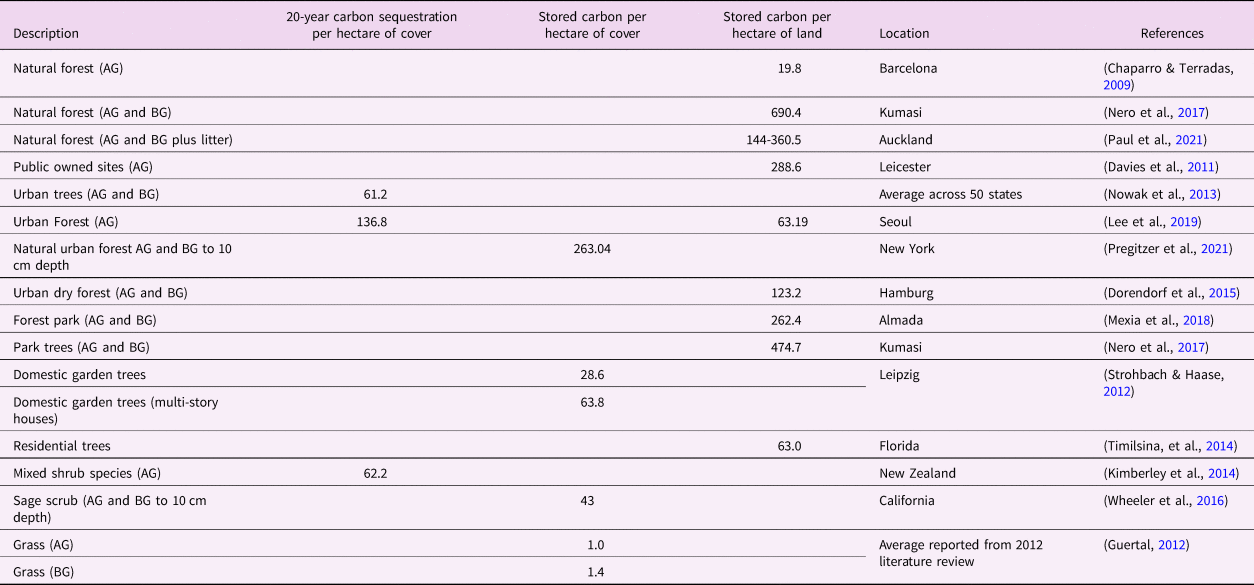
AG, above ground stems; BG, below ground roots.
See Supplementary Information for an extended version of table.
4. Carbon storage potential from converting lawns into treescapes
The reported carbon stored in plant tissue in natural forests varies considerably but can, for example, be as much as 690 t ha−1 in tropical Ghana (Nero et al., Reference Nero, Callo-Concha, Anning and Denich2017) and 360 t ha−1 in cool temperate climates such as New Zealand (Paul et al., Reference Paul, Kimberley and Beets2021) (Table 2). Even low shrub vegetation can store quantities of carbon that are significantly higher than those in lawns. For example, native sage scrub in California contains 43 t ha−1 of above and below ground carbon (Wheeler et al., Reference Wheeler, Dipman, Adams, Ruina, Robins and Meyer2016). While these pristine natural forests and dense shrublands may not be compared directly to the carbon storage potential of urban treescapes, some report almost as high stores of carbon from parks: up to 420 t ha−1 of above ground carbon in tropical Ghana (475 t C ha−1 roots included) (Nero et al., Reference Nero, Callo-Concha, Anning and Denich2017) and up to 289 t ha−1 of above ground carbon in the cool temperate climate of Leicester, England (Davies et al., Reference Davies, Edmondson, Heinemeyer, Leake and Gaston2011) (Table 2). Residential trees in Florida are reported to store 63 t of above ground carbon per hectare, and in Leipzig, Germany, above ground carbon stored per hectare of tree cover in areas with multi-story houses is as high as 64 tonnes (Strohbach & Haase, Reference Strohbach and Haase2012).
Reported above and below ground sequestration rates of carbon average 61.2 t ha−1 over two decades in urban areas across the USA but over the same timeframe above ground carbon sequestration alone is as high as 137 t ha−1 in Seoul urban forest (Table 2) (Lee et al., Reference Lee, Kil, Jo and Choi2019; Nowak et al., Reference Nowak, Greenfield, Hoehn and Lapoint2013). Shrubland can sequester up to 62 t ha−1 over two decades (Kimberley et al., Reference Kimberley, Bergin and Beets2014). However, sequestration cannot continue indefinitely and approaches zero as rates of respiration match rates of photosynthesis. For example, net carbon flux does not differ significantly from zero in natural forests across New Zealand (Paul et al., Reference Paul, Kimberley and Beets2021). In an urban context, the fate of removed biomass will be important. If the wood from felled or pruned trees is used for furniture or to replace fossil fuels the carbon balance can remain positive.
In addition to the much higher carbon storage in above and below ground plant tissue in treescapes compared to lawnscapes, the potential to store SOC must be considered. Soils under natural forests store more organic carbon than those under natural grasslands in the same climatic zones (Jobbágy & Jackson, Reference Jobbágy and Jackson2000). Carbon content in soil under urban trees can be as high as 144 t ha−1 without the addition of fertiliser or irrigation (Dorendorf et al., Reference Dorendorf, Eschenbach, Schmidt and Jensen2015) (Table 1). Furthermore, SOC under mown grass increases with the addition of trees or shrubs in a linear relationship with aboveground tree biomass (Bae & Ryu, Reference Bae and Ryu2015; Huyler et al., Reference Huyler, Chappelka, Prior and Somers2014b, Reference Huyler, Chappelka, Fan and Prior2017; Lerman & Contosta, Reference Lerman and Contosta2019). From sites in Seoul, Bae and Ryu (Reference Bae and Ryu2015) report 37.4 t ha−1 of organic carbon in the top metre of lawn soil whereas carbon under urban forest was 2.4 times greater (89 t ha−1) and that under mixed forest 2.7 times greater (101.9 t ha−1). Lindén et al. (Reference Lindén, Riikonen, Setälä and Yli-Pelkonen2020) found more soil carbon under shrubs than under lawns (91.5 and 73 t ha−1, respectively, 0–60 cm depth) in Helsinki parkland. By contrast, in Auckland higher concentrations of carbon under mown grass than under urban forest have been reported (108 and 89 t ha−1 respectively) (Weissert et al., Reference Weissert, Salmond and Schwendenmann2016). However, this difference was probably due to three out of the four mown grass sites being subject to fertilisation and irrigation, which in turn will have led to carbon emissions.
Emissions from treescapes due to trimming and other maintenance need to be considered as permanent components of their carbon balance. A study in Florida found carbon emissions due to maintaining trees of 0.04 t ha−1 projected over two decades, a rate of greenhouse gas emission related to maintenance approximately two orders of magnitude lower than for lawns (Horn et al., Reference Horn, Escobedo, Hinkle, Hostetler and Timilsina2015) (Table 1, Figure 1). While urban trees provide carbon sequestration benefits this may be offset to some extent by their potential cost in water consumption, especially in arid or semi-arid landscapes where water is already scarce (Dwyer et al., Reference Dwyer, McPherson, Schroeder and Rowntree1992). Direct comparisons between water requirements for mown grass and trees are few. However, in semi-arid Los Angeles, Litvak et al. (Reference Litvak, Bijoor and Pataki2014) found evapotranspiration of irrigated turfgrass was an order of magnitude higher than tree transpiration and in summer, evapotranspiration of the lawns with trees was lower than lawns without trees. Litvak et al. concluded that planting trees that partially shade irrigated urban lawns could be a water-saving measure in semi-arid environments. In Colorado, a significant negative relationship between water consumption and tree canopy was found, suggesting that homes with greater tree canopy area were associated with less water use (Rasmussen et al., Reference Rasmussen, Warziniack, Neel, O'Neil-Dunne and McHale2021), and two study sites in Spain show consistently greater irrigation requirements for turf grass than for shrubs and trees (Hof & Wolf, Reference Hof and Wolf2014).
In summary, tree cover in any form or shape presents a much greater potential for sequestering and storing carbon, both above and below ground. The mid- to long-term effects of replacing lawns with treescapes are visualised in Figure 1, with the main advantage of trees being the much higher above ground storage, combined with the summative nature of emissions related to lawn maintenance. If urban trees that die, or need removal for other reasons, are used for timber or to replace fossil fuels, a more favourable carbon balance than shown in Figure 1 will result.
5. The upside of treescapes
Lawns have been promoted as providing ecosystem services including carbon sequestration (Velasco et al., Reference Velasco, Segovia, Choong, Lim and Vargas2021). By contrast, we demonstrate that in bioregions capable of supporting trees, mown grass represents a degraded ecosystem in terms of carbon relative to the forested land that once occupied these sites. The literature we review clearly demonstrates that treescapes not only store considerably more carbon per unit surface area than mown grass, but they remain carbon sinks for much longer time periods. Even more important than the larger carbon pools and sequestration rates offered by treescapes are the inevitable and constant emissions due to lawns, mostly caused by mowing, fertilisation and irrigation. With the ubiquity of mown grassland (Milesi et al., Reference Milesi, Running, Elvidge, Dietz, Tuttle and Nemani2005), an opportunity exists to create alternative landscapes that not only store more carbon above ground, but also have a potential for greater below-ground storage. Although the role of urban trees in providing ecosystem services, particularly carbon sequestration, has been evidenced in many cities around the world, little work has been done to implement this knowledge into land use policies (Haase et al., Reference Haase, Larondelle, Andersson, Artmann, Borgström, Breuste, Gomez-Baggethun, Gren, Hamstead, Hansen, Kabisch, Kremer, Langemeyer, Rall, McPhearson, Pauleit, Qureshi, Schwarz, Voigt and Elmqvist2014).
Planting trees in urban environments, in addition to fixing carbon, can reduce pollution, cool summer air temperatures thereby reducing heat stress-related mortality (Manickathan et al., Reference Manickathan, Defraeye, Allegrini, Derome and Carmeliet2018; Singh et al., Reference Singh, Takahashi, Kim, Chun and Adams2012; Zölch et al., Reference Zölch, Maderspacher, Wamsler and Pauleit2016), mitigate stormwater runoff (O'Sullivan et al., Reference O'Sullivan, Holt, Warren and Evans2017), and if species native to the region are used, enhance ecological restoration. Lawns contribute to homogeneity of the landscape, and generally lack biodiversity, particularly if mowing occurs often (Ignatieva & Hedblom, Reference Ignatieva and Hedblom2018).
There are also social and health benefits associated with converting mown grass to trees. Increasing tree cover is usually favourable to residents for aesthetic reasons (O'Sullivan et al., Reference O'Sullivan, Holt, Warren and Evans2017) as well as for higher perceived safety (Mouratidis, Reference Mouratidis2019). Significant positive associations between tree cover and self-reported health of residents have been found, whereas no such benefits to health were associated with grass (Reid et al., Reference Reid, Clougherty, Shmool and Kubzansky2017). Significant improvement in cardiovascular health parameters have been found among people walking among trees in contrast to no effect achieved from city-walking (Lee & Lee, Reference Lee and Lee2014). One study conducted in Athens, Greece found that people had higher heart rates when running on routes without trees and that they felt more calm and experienced more joy running in a treescape or a seascape than running in treeless environments (Paraskevopoulou et al., Reference Paraskevopoulou, Chletsou and Malesios2022).
Although the majority of people value the presence of trees (Camacho-Cervantes et al., Reference Camacho-Cervantes, Schondube, Castillo and MacGregor-Fors2014; Lusk et al., Reference Lusk, da Silva Filho and Dobbert2020), some people dislike them due to the shade they create. Shading is, and will continue to be, an important consideration for city planners. Perceptions and behaviour towards trees in urban areas is complex and multidimensional (Camacho-Cervantes et al., Reference Camacho-Cervantes, Schondube, Castillo and MacGregor-Fors2014). However, despite a diversity of opinion, a literature review by Mullaney et al. (Reference Mullaney, Lucke and Trueman2015) found that residents consistently view street trees positively, and most believe that the benefits provided by trees significantly outweigh any detriments. It is not surprising that shade trees are valued more in warm climates than in cold climates. For example, 93% of respondents in Florence thought the city needed more trees to provide shaded cool places (Speak & Salbitano, Reference Speak and Salbitano2021). Nonetheless, tree cover has been found to raise winter temperatures in cold climates (Edmondson et al., Reference Edmondson, Stott, Davies, Gaston and Leake2016). Community perceptions of trees are important. However, negative attitudes towards trees by some members of the public should not outweigh the imperative to address global warming.
Lawns have a significant influence on landscapes, forming a component of most urban green spaces. They can foster a sense of well-being, and access to them is viewed by many people as very valuable to the extent that many people in the Western world view them as a compulsory element of urban landscapes (Ignatieva et al., Reference Ignatieva, Eriksson, Eriksson, Berg and Hedblom2017). Lawns have become such a common feature of our living environments that it is difficult for some people to imagine alternatives (Hellner & Vilkénas, Reference Hellner and Vilkénas2014). Generally people do not question their social, or aesthetic values, let alone their ecological consequences (Ignatieva et al., Reference Ignatieva, Eriksson, Eriksson, Berg and Hedblom2017). We do not suggest that all lawns should be converted into treescapes but the imperative of addressing climate change is of such importance that we believe there should be an effort to convert as much as possible, and there may be greater acceptance of such change than land managers imagine. One study conducted in Warsaw found that a clear majority of park visitors thought conversion of lawns to tree plantations would increase the attractiveness of the parks' interiors (Sikorska et al., Reference Sikorska, Macegoniuk, Łaszkiewicz and Sikorski2020). Ultimately, the societal and psychological complexities of the introduction of trees needs to be addressed separately; here, we are focusing on the aspect of the net carbon balance.
To maximise sequestering atmospheric carbon, local and central governments need to: firstly, quantify the area of mown grass and identify the potential for carbon sequestration by conversion to treescapes. Improvements in data quality from satellite images and improved classification algorithms now allow for accurate mapping of mown grassland cover (Weng, Reference Weng2012). Secondly, specific policies and plans to maximise this conversion should be introduced. We propose four types of urban and non-urban space that, prior to human occupation, would have supported forest but are now degraded to lawns: public parks and recreational reserves, highway verges, residential street berms and private gardens. The relevance and suitability of these types of spaces for conversion to treescapes will vary depending on the country or even region in question. To evaluate the practicality and socio-ecological acceptance of the type of conversion is beyond the scope of this study.
6. Public parks and recreational reserves
We propose widespread re-evaluation of park management plans with the view to identifying areas to be retired from mown grass. This will require a fundamental shift in what people perceive as desirable and usable in parks. However, the climate crisis is of such magnitude that all possible options must be explored, and action taken to reduce emissions and increase carbon sequestration wherever possible. Planting approaches will need to take account of the quantity of public traffic the areas receive. We therefore propose a range of planting options, a mixture of which might be introduced into any given park. These options range from a fully tiered forest structure (canopy and emergent trees with under storey shrubs and ground vegetation such as ferns, woody shrubs, grasses and/or herbs depending on the location), to open-plan treescapes with mostly closed canopies but with an open understorey and gaps to provide spaces for people to gather for picnics and other activities, to low-density treescapes with indigenous grass species that require little or no mowing (Figure 2). Shrubland can be used where an open vista is required.
Left-hand side: potential impact on the global carbon cycle if one-third of urban lawns are converted into treescapes globally. The model calculation is based on an average of three different planting regimes: restoration of a full forest ecosystem, open-plan treescapes with light gaps and low-density treescapes. On the right-hand side, a model calculation for New Zealand highway verges is shown, assuming a highway network of 94,000 km (not including minor roads) a verge of 1–2 m and a mix of low- and high-density plantings. Over two decades, this conversion would result in carbon storage of 1.2–2.3 Mt C 20 y−1.

7. Road verges and private gardens
Highway margins are routinely cleared of vegetation and maintained as mown grass due to a perception that it makes roads safer. On the one hand, trees in close proximity to road margins create crash hazards for drivers that lose control, but, on the other hand, they reduce driver stress, lower driving speeds and thereby reduce the occurrence and severity of crashes (Van Treese II et al., Reference Van Treese Ii, Koeser, Fitzpatrick, Olexa and Allen2017). There is, therefore, a case to be made for converting roadside mown verges into shrubs and trees that can contribute to carbon sequestration and remove the need for mowing (Figure 2). In New Zealand, for example, with a population of approximately 5 million, there is 94,000 km of highway (NZTA). Assuming 1–2 m of mown grass on each side of the road, we estimate a total area of 18,800–37,600 ha of mown highway road margins. New Zealand native shrubs can store up to 62.2 t ha−1 of above ground carbon after two decades of growth thereby potentially providing 1.2–2.3 Mt of above ground carbon storage over two decades (Figure 2) (Kimberley et al., Reference Kimberley, Bergin and Beets2014). Planting with trees could store more over longer timeframes. Similarly, front and back lawns and streetside berms of grass are common in many countries especially those influenced by colonisation (Ignatieva & Stewart, Reference Ignatieva, Stewart, McDonnell, Hahs and Breuste2009). Some of these areas provide spaces for children to play or to access below-ground infrastructure, but many exist without a specific reason as a default setting that is seldom questioned. Much of this grass could be converted into shrubs or trees (Figure 2).
8. Recommendations and conclusions
Central and local governments throughout the world should consider introducing policies to regulate or incentivise the conversion of treeless mown grass areas into shrublands and/or treescapes, eliminating mown grass wherever possible, and where circumstances dictate, trees with minimal grass should be retained. Such a process will reduce greenhouse gas emissions associated with maintaining mown grass and add stored carbon to the landscape. To estimate the global potential of carbon sequestration from converting mown grass into trees we use 61.2 t ha−1 for whole tree carbon, which is the average across 50 states in the USA (Nowak et al., Reference Nowak, Greenfield, Hoehn and Lapoint2013) (Table 2). Global urban lawn area is estimated at 150,000–800,000 km2 (Ignatieva & Hedblom, Reference Ignatieva and Hedblom2018). If one-third of the lawn in urban areas could be converted to tree cover, we estimate that 0.31–1.63 Gt of carbon could be sequestered over two decades. The estimate might be ambitious, but even one-tenth of these figures would be substantial. The rate of sequestration will accelerate in following decades, and SOC sequestration as well as emission savings due to the redundant lawn maintenance will be additional to this estimate. Importantly, a large proportion of the lawns in scope are in the developed world, and their conversion to treescapes will contribute to a more equitable global land use (Creutzig et al., Reference Creutzig, d'Amour, Weddige, Fuss, Beringer, Gläser, Kalkuhl, Steckel, Radebach and Edenhofer2019). Finally, the many co-benefits of trees most importantly for human health and biodiversity make a strong case to reconsider urban land use.
Supplementary material
The supplementary material for this article can be found at https://doi.org/10.1017/sus.2023.1
Acknowledgements
Not applicable.
Author contributions
LNG wrote the first draft and edited the manuscript, SL designed the figures, contributed to writing and editing, BB contributed to writing and editing.
Financial support
Not applicable.
Conflict of interest
There are no conflicts of interest, and all data are in the Supplementary Materials File.


 Open access

