


European Integration and the Political Economy of Bad Ideas
Despite a recent uptick in the data, the European Union (EU) seems to have been in a permanent state of crisis since the global financial crash of 2007–2008. The Eurozone’s sovereign and private debt woes that began in Greece in the fall of 2009 quickly laid bare the design flaws of its single currency and the fraught politics of economic adjustment brought back the gap between North and South. Russia’s illegal annexation of Crimea and clandestine invasion of Eastern Ukraine in 2014 showed the EU’s vulnerability on its Eastern border. The Schengen crisis caused by a surge of refugees from the Middle East and North Africa in 2015 revealed stark differences between Eastern and Western states over immigration policy. And the British vote to leave the EU in June 2016 marked the moment integration went into reverse for the first time, as a key member state decided to leave the bloc altogether. Europe’s quadruple crisis has raised questions over the sustainability of the European integration process, and the future of Europe in general. Footnote 1 While there are many reasons for Europe’s current predicament, we argue here that one of Europe’s central problems is a lack of economic dynamism, with the persistence of bad economic ideas in policymaking driving a multitude of perverse effects. Footnote 2
Specifically, we argue that if one makes a distinction between “fiscal” and “monetary” policy—national government decisions on the levels of taxation and spending on the one hand versus interest rate policies and open market operations conducted by the central bank on the other—and then one walks backwards over the evolution of Eurozone policy starting in the spring of 2017, a remarkable divergence reveals itself. Fiscal policy, which is today almost constitutionally ultra vires in the Eurozone, becomes looser and more discretionary the further back one travels. Footnote 3 By contrast, monetary policy, which in 2017 includes negative deposit rates as well as massive private and public asset purchases to suppress sovereign bond yields, becomes tighter and more rules-based the further back one goes, as summarized in table 1. Footnote 4
Europe’s changing macroeconomic policy mix, 1993–2017

Source: Authors
Given that the optimal “macroeconomic policy mix” is unlikely to ever be found in the tails of the distribution, how are we to explain both the emergence and the persistence of this pattern over time?
We will show here how a specific politics of social learning reveals itself in the evolution of European ideas about how to govern the euro. That is, one of EU policymakers consistently learning what are—from the point of view of conducting a balanced macroeconomic policy mix—the wrong lessons from past policy episodes. By “wrong” we mean wrong in a specific sense. That despite an ever-increasing body of evidence arguing against continuing along the same policy path, policy does not actually change. Footnote 5 We justify this claim as follows.
We argue that the ideas that gave birth to the euro presupposed the completion of political institutions that never came to pass. Thus, what was “sovereign money in waiting” in 1992—money that governments can devalue, inflate, and default on—ended up becoming “non-sovereign money in use” in 2002—a currency one can use but cannot devalue, inflate, etc. Footnote 6 That simple fact, seen as the euro’s singular strength at its inception since it would discipline national policy choices, instead built critical fragilities into the currency and the institutions of the European Union that were exposed when the financial crisis hit Europe in 2008–2009. As currency users rather than currency issuers, EU level technocrats and policy elites—who are not directly responsive or accountable to an electorate—were forced to ask very different questions from their more democratically responsive Anglo-American colleagues about how to resolve the crisis. Footnote 7
Specifically, the question asked by Anglo-American policymakers was what can be done to save the system. Their answer was, broadly, to open the monetary toolbox, add massive liquidity, recapitalize the system, and do fiscal policy. After all, a sovereign issuer has no liquidity constraint and it can respond to an economic crisis by devaluation, by inflation, and in extremis, by default. In contrast, the question asked by EU policy elites who were currency users rather than issuers—and whose European Central Bank (ECB) had a liquidity constraint by constitutional design—was how to keep the system they had built together when they could not directly bail it out. The answer that question produced was to keep ever-stricter adherence to fiscal rules, regardless of the macroeconomic consequences. But following this policy path has been, especially in the face of mounting contrary evidence, economically counterproductive. So why continue to do it?
We argue first that this particular answer stemmed from both being a currency user, as well as from a prior lesson learned by European policy elites in 2003–2005, when the rules of the Stability and Growth Pact (SGP) were violated by the single currency’s two principal members, Germany and France. This SGP “crisis” episode was interpreted by European elites at that time, and crucially, amplified by them during the early stages of the euro crisis, as a clear policy failure that must never be repeated. Given that framing of past experience, the brief period of fiscal activism that spread across Europe at the start of the global financial crisis (2008–2009) was interpreted by euro elites as a policy error.
Rather than taking the improvements in performance that the breaking of the pact led to as evidence that expansionary fiscal policy was working, the stimulus episode was instead interpreted in the light of France and Germany’s prior violation of the SGP. The macroeconomic indicators may have been moving in the right direction, but as then ECB president Jean-Claude Trichet admonished Europe’s leaders, “stimulate no more, it is now time for all to tighten.” Footnote 8
Yet restrictive budgetary policies would prove to be continually counterproductive for the Eurozone’s overall economic performance. Footnote 9 Indeed, Trichet’s 2009–2011 tightening combined with redoubled efforts at the level of European institutions to permanently bind fiscal policy options—again via a particular framing of the SGP episode—all the while discounting mounting evidence that the policies being followed were in fact the problem, rather the solution. Footnote 10 This period of double tightening ended when Trichet’s term at the ECB expired and Mario Draghi took over the helm in November 2011. We then examine the period from 2012 to 2016, where Draghi’s embrace of monetary discretion has increasingly faced off against ever-stricter fiscal rules, with each policy slowly dragging the other down. In effect, ECB policy acted as a stabilizer to the deflationary pressures created by the EU’s own contractionary fiscal framework. Footnote 11
In sum, we see economic ideas driving fiscal policy in an ever-tighter direction while monetary discretion gets ever looser in response. This is a policy mix that, from a policy optimality point of view, is economically irrational. Explaining it therefore deserves our attention. Our analysis of these episodes shows that this pattern of policymaking can be seen as social learning, but of a particular type: Footnote 12 one that places politics above the purported economics, while reducing policy outcomes to political imperatives. What then are the conditions under which such social learning takes place?
Social Learning Revisited
One of the most prominent political science models that seeks to understand how ideas and material factors influence policy is the approach put forward by Peter Hall. Footnote 13 At its core, Hall’s “paradigms” model sees policy change as a function of two distinct mechanisms: empirical anomalies and authority contests. Empirical anomalies as causes views social learning as a rational process of quasi-Bayesian updating given information flows. Authority contests, in contrast, see learning as a political struggle over what the information actually means. Footnote 14 Both mechanisms view policy paradigms, defined as “a framework of ideas and standards that specifies not only the goals of policy . . . but also the very nature of the problems that they are supposed to be addressing,” as the location where social learning, “a deliberate attempt to adjust the goals or techniques of policy in response to past experience and new information,” takes place. Footnote 15 Since we are mainly interested in the social learning part rather than the paradigm change part of Hall’s model, we ask the following question: From a theoretical point of view, what are the conditions under which policymaking elites can consistently learn the wrong lessons?
There already exists a rich body of literature on the question of why (bad) ideas persist in political science. Stephen Walt asked where bad ideas come from in the realm of foreign policy; Bryan Jones and Walter Williams traced “the curse of Reaganism” and the self-defeating logic of perpetual tax cuts that continues to bedevil American politics today, while Mark Schrad studied the broad diffusion of the “temperance movement” in the early twentieth century—an idea widely recognized by experts as bad at the time—throughout the Western world. Footnote 16 In behavioral economics, recent work by Cass Sunstein has tried to come to terms with the curious and continued appeal of all kinds of “conspiracy theories and other dangerous ideas.” Footnote 17
Even more recent work that builds on Hall’s social learning approach suggests that policy change is as much a function of authority contests over the meaning of empirical anomalies as it is of empirical anomalies bringing about change since “facts” are always theory dependent. Footnote 18 As such, empirical anomalies do not simply hollow out existing paradigms by weight of the facts revealing themselves, to which policy makers neutrally update. Footnote 19 Rather, events identified as anomalies—such as a financial crisis and how to respond to it—can either add to or subtract from the “authority” of those arguing for specific policies. Footnote 20 Especially for technocratic officials who do not have a democratic mandate, their authority rests in large part upon appeal to the “ruling ideas” of the day. Footnote 21 As such, social learning about what to do is dependent upon who is institutionally authorized to learn, their ability to make policy, and their power to define what actually counts as an anomaly and what does not. Footnote 22
Key here is the ability of such agents to use what Thomas Kuhn called “paradigmatic incommensurability” as a political weapon to delegitimize other agents’ interpretations of “why policy is wrong,” despite accumulating evidence to the contrary. Footnote 23 In our case, this applies to technocratic governors who have insufficient tools to make a “first best” policy fix and lack the ability to change policy via a democratic mandate. In such a political field, incommensurability can be deployed as a mechanism to deflect attention from actual performance while insulating those in power from challenges to their technocratic authority. In what follows we detail how the European Commission (EC), the European Central Bank (ECB), and the German government each, at particular times, played “incommensurability politics,” and in doing so, socially, and rationally, learned the wrong lessons.
Hypotheses
We hypothesize that technocratic actors, operating with non-sovereign money and highly insulated from politics, have both the capacity and the incentive to systematically skew the interpretation of policy anomalies. By doing so, technocrats can end up producing policy choices that are “globally irrational but locally rational,” for two reasons. First, they lack the full set of tools that national macroeconomic policymakers with sovereign money usually have at their disposal. EU officials lack sovereign money, which would give them the ability to make unlimited liquidity pledges, to devalue, and to inflate their way out of trouble. As such, they are forced to fight liquidity and solvency crises with an inadequate toolkit. Second, because there are no direct democratic checks upon their policies, technocratic elites are incentivized to choose policies that insulate them from criticism (politically rational) while reproducing economic policies that are suboptimal (economically irrational). Meanwhile, due to their inability to fully respond to asymmetric shocks, member-state politicians cannot respond to domestic demands for alternative policies. Due to these mutual constraints, and facing declining legitimacy given the ineffectiveness of the policies they choose to use, Footnote 24 policymakers in both spheres are incentivized to continue to implement policies where what Robert Wade termed “paradigm maintenance” trumps actual “paradigm change” through the continuous and deliberate social learning of the wrong lessons. Footnote 25
In sum, while technocrats may both “power and puzzle,” as Hugh Heclo once famously put it, Footnote 26 the key here is how they can authoritatively dictate what the puzzle is in the first place and can then use that authority to define how power should be applied. Social learning can therefore also lead to the persistence of bad ideas, just as much as it can lead to positive change in actual policy. Footnote 27 To see how these politics actually unfolded, we must first return to the ideas that underpinned the euro at its inception in the late 1980s.
The Euro’s and the SGP’s Ordo- and Neo-Liberal Instruction Sheets
The euro’s institutional architecture blended together ordoliberal and neoliberal ideas that reached a broad consensus among the elites of the advanced industrial world by the early 1990s. Footnote 28 Erik Jones refers to this set of ideas in the context of the European Union as the “Brussels-Frankfurt consensus.” Footnote 29 The neoliberal part of that consensus swapped full employment for price stability as the main goal of macroeconomic policy given the time-inconsistency problem of politicized monetary policymaking. Footnote 30 The Bundesbank’s success in fighting inflation in Germany during the 1970s was taken to show that such an approach actually worked in practice. Footnote 31 But it was the ordoliberal part of these ideas that was to prove the most consequential when the crisis hit. Footnote 32
The ordoliberal part of the Brussels-Frankfurt consensus insisted that capitalism performed best when governments set clear rules for competition in all markets and pursued sound public finances, preferably with fiscal budgets in balance or in surplus, while individuals and states were held to be the generators of moral hazard. Footnote 33 Given that moral hazard problem, the main constraint on growth, it followed, was uncertainty over public finances. Footnote 34 Once that uncertainty was taken away from investors by governments’ credible commitments to pursue sound fiscal policies—which in practice meant deficit and debt control and strict adherence to an inflation target—business confidence, and thus investment, would follow. Footnote 35 These ideas were enshrined in a piece of European legislation, the Stability and Growth Pact (SGP) with its related Excessive Deficit Procedure (EDP). The SGP would prove to be the key mechanism through which the wrong lessons about shocks would be learned, again and again, in Europe.
Critics warned at the time of the euro’s introduction that the euro’s bias was going to be a deflationary one, and that its governing institutions lacked the discretionary tools needed to deal with asymmetric shocks. Footnote 36 They did not have to wait too long to be proven correct. The first asymmetric shock hit when Germany and France slid back into recession in 2002. As unemployment rose, their automatic stabilizers kicked in, putting pressure on their countries’ public finances. Their budgetary stances soon came into direct conflict with the ordoliberal rules of the SGP.
Germany, whose leaders had insisted on these strict fiscal rules as a condition for anchoring the new single currency, would at this juncture come to see them as a hindrance to adjustment rather than a bonus, and simply chose to ignore them. Footnote 37 In doing so Germany, followed by France, would solve its macroeconomic problem in the short term. But the unintended consequence would be for the technocratic guardians of the EU treaties, and their domestic-level allies (especially those in Germany who were in opposition at the time), to learn the wrong lesson from that episode.
Breaking the SGP
The Stability and Growth Pact (SGP) was created because of German worries about moral hazard problems. It was feared that Eurozone member states would fall back into their old fiscal habits of running large deficits and promoting inflation once they had adopted the euro. Footnote 38 Germany therefore demanded that the Maastricht convergence criteria—3% fiscal deficits and 60% public-debt-to-GDP ratios—were written into European law. Footnote 39 Together with the ECB’s mandate to first and foremost maintain price stability above any other targets, the SGP emerged as the ordoliberal cornerstone of the euro’s fiscal governance framework.
The SGP was criticized, however, at its inception from an unexpected corner. Romano Prodi, then president of the European Commission, put it bluntly in an interview with Le Monde in October 2002: “I know very well that the stability pact is stupid, like all decisions which are rigid. The pact is imperfect. We need a more intelligent tool and more flexibility.” Footnote 40 Prodi’s comments followed earlier remarks from then-EU Trade Commissioner, Pascal Lamy, that the Pact was “crude and medieval.” Footnote 41 Yet despite Germany being the author of these rules, it was Germany, followed by France, that would violate them in 2003 by running budget deficits in excess of 3% of GDP. The European Commission had to initiate an Excessive Deficit Procedure (EDP) in response. But when it became clear that the “big two” would be the first ones to break the pact, it also became plain that, as a matter of politics, the intergovernmental European Council was going to overrule the supranational Commission and let France and Germany off the hook. Footnote 42
The EU’s response to this crisis of macroeconomic governance was to make the rules of the SGP more flexible. After the Pact’s spurning by France and Germany, the EDP was considerably weakened in 2005 to allow the European Council, where larger member states tend to have a much stronger voice, more discretion in interpreting the reasons for violating the 3% rule. Footnote 43 Before the 2005 reforms the “exceptional circumstances” allowing abrogation were defined as cases where a country experiences an annual fall in real GDP of at least 2%, which amounts to a serious economic recession.
After the 2005 reform, a severe downturn was reinterpreted as a negative annual real GDP growth rate, or an accumulated loss of output during a longer period of very slow GDP growth. Footnote 44 In other words, the unintended consequence of the 2005 reform of the SGP was that it placed a rather large Keynesian elephant in the ordoliberal tent. The introduction of these softer governance mechanisms at the EU level once again made fiscal policy, and the discretion over when to use it, the preserve of the member states. Footnote 45 In effect, individual member states could now almost define “a loss of output” to their own liking, pursue their autonomous budgetary goals, and then inform the Commission once they had done so. For any serious ordoliberal, this was moral hazard run amok.
What Did the EU’s Ordoliberal Governors Learn from the SGP Episode?
The SGP episode, what EU and German officials were to later describe as a policy “failure,” was actually a success economically. Once the pact was broken, the economic situation in both countries improved significantly. Footnote 46 It was also a political success insofar as the 2005 SGP reform handed national governments back a critical tool to fight the deleterious impact of a “one-size-fits-none” monetary policy. The episode hence put the euro on a politically more sustainable footing. But crucially, the reform clashed with the ruling ideas of the EU, whereby such discretion can only be seen as a moral hazard generator and therefore as an accident waiting to happen.
The breaking of the pact marked a significant weakening of the “Brussels-Frankfurt consensus” and opposition to this move from the European Commission, the ECB, the German Bundesbank, and the German opposition parties (CDU/CSU and FDP at the time) was both swift and stern. Pedro Solbes, the European Commissioner for Economic and Monetary Affairs, said after the Franco-German compromise that “the Commission deeply regret[ted] that these proposals [were] not following the spirit and the rules of the [EU] treaty.” Footnote 47 The Governing Council of the ECB expressed serious concerns in an official press release in March 2005, pointing out that the changes to the corrective arm of the SGP could “undermine confidence in the fiscal framework of the European Union and the sustainability of public finances in the euro area Member States.” Footnote 48 Jean-Claude Trichet, who had taken over the reins of the ECB from Wim Duisenberg in November 2003, warned that “the conclusions adopted by the ECOFIN Council carr[ied] serious dangers.” He added that “the failure to respect the rules and procedures foreseen [in the SGP] risk[ed] undermining the credibility of the [euro’s] institutional framework.” Footnote 49
But the strongest opposition to the reform of the fiscal rules came from within ordoliberalism’s German Heimat. The Bundesbank lamented that the pact would be “decisively weakened,” and that “the incentives for sound fiscal policies and the binding effect of the rules [had been] reduced.” Furthermore, the Frankfurt-based bank feared that the new rules were “not transparent, [were] complicated, and ultimately [would be] more difficult to enforce” and fretted that the next move would be for “the ceiling for the government deficit of 3% of GDP [to be] softened.” Footnote 50 The center-right German opposition was even more scathing in its critique. Friedrich Merz, deputy CDU leader in the German Bundestag, called it a “black day for the whole of Europe,” adding that “one of the most important rules was in fact being laid to rest in the grave . . . with a significant impact on interest rates and monetary stability in the long term.” Footnote 51 Karl Ludwig Thiele of the liberal FDP agreed with the Christian Democrats that the reforms set “a bad example for possible further stability sinners among the euro countries.” Footnote 52
Yet despite all this Sturm und Drang, the core of the Eurozone returned to rapid growth between 2004 and 2007. Footnote 53 The SGP’s new flexibility did not seem to have brought about the collapse of trust in the euro some had feared. Instead, it was delivering the goods. But rather than accept the episode’s positive lesson, the global financial crisis and subsequent Eurozone debt crisis would allow a radical recoding of this moment by the EU policy elite. The proof that they had been waiting for would finally arrive.
Round One: Recoding the SGP from Stimulus to Austerity
The 2009 turn to fiscal stimulus in Europe was made possible by the fact that the ideas that lay behind Europe’s money—ever deeper integration, market efficiency, policy credibility, and a single currency—effectively denied that such a crisis could ever arise in the first place. Given this rather obvious failure of ruling ideas, “governments quickly came to believe that monetary policy was insufficient on its own to resuscitate the real economy.” Footnote 54 As a result, countries as diverse as Brazil, China, the United Kingdom and the United States, as well as many Eurozone members, lined up to stimulate their economies through tax cuts and increases in public spending. Even Germany stimulated its economy to the tune of 1.6% of GDP, the biggest program in Europe. Footnote 55 But that the Germans did so did not mean that they liked doing so Footnote 56 —neither did the Commission in Brussels nor did the ECB in Frankfurt.
On the monetary policy side, and unlike the US Federal Reserve or the Bank of England, both of whom were extremely active in deleveraging and recapitalizing their banking systems, the ECB sat on the sidelines and did very little in the initial stages of the crisis, for two reasons. First, Fortis and Dexia banks in Belgium aside, there did not appear to be much of a European banking crisis to address until early 2010. Footnote 57 Second, given that its job was to fight an inflation that was absent, there did not seem to be all that much to be done on that front either. But despite the policy passivity, yields on European bonds became more volatile in early 2009 and financial spreads began to widen. Footnote 58
In response, the ECB under Jean-Claude Trichet decided to cut rates and intervene to the tune of €60 billion in the market for what are known as “covered bonds” under a program called “credit easing.” Footnote 59 More important than the program itself was what Trichet said during the ECB press conference question and answer session at the time of the announcement. When asked if this program was the ECB’s equivalent to the US and UK “quantitative easing” schemes, he replied, “we are not at all embarking on quantitative easing.” Footnote 60 Trichet’s response that day was hugely significant. In confirming that QE was not going to happen in Europe, the European Central Bank in effect admitted that it would not stand behind banking-book asset values, even of AAA-rated sovereign bonds, and that it would not act as a traditional lender of last resort. With Eurozone member states lacking their own sovereign money, the only way periphery bond yields would go from that point on was up.
The timing of events here is very important. The ECB eschewed QE in May 2009. In September 2009, Germany’s general election saw the CDU’s grand coalition with the SPD fall and a new CDU-FDP center-right coalition arose that was to take a much tougher line on fiscal policy discretion going forward. Footnote 61 In short, the ordoliberals who objected to the SGP’s 2005 modifications were now back in power, and they were soon strengthened by events. Footnote 62 Wolfgang Schäuble, the staunchly ordoliberal CDU grandee who had opposed any weakening of the SGP, was promoted to finance minister, replacing the SPD’s more pragmatic Peer Steinbrück. Footnote 63 Jens Weidmann, who had been head of economic and financial policy in Merkel’s chancellery since 2006, was promoted to president of the Bundesbank in 2011. When in mid-2009 a slow-motion bank run began, spreading first to Greece (spring 2010), then to Ireland (fall 2010) and Portugal (spring 2011), and then in increasingly severe waves to Spain and Italy (summer 2011), ordoliberal forces in Germany and at the ECB began to gain the upper hand and repeatedly analogized ongoing events to the previous SGP episode.
The Umpires Strike Back
With a run through the bond markets of Europe gathering pace the ordoliberals struck back. Footnote 64 Leading German politicians had joined forces with the ECB to send a common message. ECB Chief Jean-Claude Trichet fired the opening salvo in his “stimulate no more” Footnote 65 broadside in the Financial Times, explicitly rejecting Keynesian demand deficiency arguments in favor of debt reduction as the sine qua non of a “confidence led” recovery. Two days later, German Finance Minister Wolfgang Schäuble published an extended opinion piece in the same Financial Times stressing the need for “expansionary” fiscal consolidation. Schäuble wrote the following: “it is an undisputable fact that excessive state spending has led to unsustainable levels of debt and deficits that now threaten our economic welfare. Piling on more debt now will stunt rather than stimulate growth in the long run.” Footnote 66 But he put his thinking at the time most clearly in a later speech in Berlin in April 2014. As he insisted, “we are not just the warning voice of others, without first turning to our own house and show that we adhere to the rules. It was a serious mistake for Germany and France to be the first to break the Stability Pact. Exactly from that episode we have learnt our lesson.” Footnote 67
Volker Kauder, leader of the CDU/CSU faction in the Bundestag, amplified this lesson in a prior speech in June 2011, arguing that “with the softening of the Stability Pact, you have sent a crucial wrong signal, so that the train has arrived on the wrong track. That was the exact opposite of what was needed. This government coalition will bring the train back on the right track.” Footnote 68 Or, as FDP party leader Rainer Brüderle put it slightly more colorfully in the same Bundestag debate, “you [the SPD/Green coalition] have deviated from and ultimately destroyed the Stability Pact [in 2003–2005] until it could no longer function properly. That is the ultimate cause of our current misery. You punched through the fundaments [of the euro] and now they no longer hold. Your policy was misguided . . . . That is why we are now creating a sort of Stability Pact II.” Footnote 69
Finally, Theo Waigel, the influential CSU finance minister during much of the 1990s who had negotiated the original pact, also observed that it had been a mistake to water down the SGP after Germany and France broke it, and that “no one should be surprised that eventually serious problems arose in a difficult situation.” Footnote 70 In short, German political elites’ ability to appeal to existing ordoliberal rules, as inscribed in the institutions of European monetary governance, allowed them to contest and recode the economic lessons of the 2005 revisions to the SGP to win an authority contest over defining policy in the (then) current moment.
The Umpires Take Sides
Given this authority contest, sympathetic EU actors at the Commission and the ECB increasingly appealed to the same ordoliberal ideas to strengthen their hand. As early as December 2008, Trichet warned against ignoring the SGP, claiming in a revealing interview with the Financial Times that “we would destroy confidence if we blew up the stability and growth pact.” Footnote 71 In that same interview he also cited “Ricardian effects” insisting that “one might lose more by loss of confidence than one might gain by additional spending.” Footnote 72 The president of the European Commission at the time, José-Manuel Barroso, echoed Germany’s and Trichet’s sentiments in his “2010 State of the Union” in Strasbourg in front of the European Parliament: “Unsustainable budgets make us vulnerable. Debt and deficits lead to boom and bust. . . . Our proposals will strengthen the Stability and Growth Pact through increased surveillance and enforcement.” Footnote 73 Barroso had plenty of ordoliberal ideas to appeal to in his attempt to strengthen the pact, and thereby, the Commission, in this moment of crisis. But he also had many other ideas he could appeal to. Why did he choose to side with the German interpretation of what the crisis meant and what to do about it?
Indeed, article 127 (1) and 282 (2) of the Treaty on the Functioning of the European Union (TFEU), the EU’s most basic law, says that “the primary objective of the European System of Central Banks (hereinafter referred to as ‘the ESCB’) shall be to maintain price stability.” Further, it continues that “without prejudice to the objective of price stability, the ESCB shall support the general economic policies in the Union with a view to contributing to the achievement of the objectives of the Union as laid down in Article 3 of the Treaty on European Union [TEU].” Footnote 74
But what does Article 3 actually say? It says, inter alia, that “the Union shall . . . work for the sustainable development of Europe based on balanced economic growth and price stability . . . aiming at full employment and social progress, and a high level of protection . . . . It shall promote economic, social and territorial cohesion, and solidarity among Member States.” Footnote 75 In its Declaration on Article 126 of the TFEU, the Lisbon Treaty, as signed in 2007, elaborated on what those objectives were: “The Union aims at achieving balanced economic growth and price stability. Economic and budgetary policies thus need to set the right priorities towards economic reforms, innovation, competitiveness and strengthening of private investment and consumption in phases of weak economic growth. This should be reflected in the orientations of budgetary decisions at the national and Union level.” Footnote 76
The inclusion of the goals of balanced economic growth, full employment, and social progress leaves substantial room for intervention beyond maintaining price stability, especially, as the Treaty says, during economic downturns or periods of weak growth. That the ECB chose not to do more given its statutes can be sustained. That it was somehow “unable” to do more given its statutes is unsupportable. Footnote 77 The decision under Trichet for the ECB to ignore these goals and to focus on the narrow mandate of price stability, despite a recession deepening around them, was fundamentally a political decision. Footnote 78 The parallel decision by Barroso’s Commission to follow suit slammed the interventionist door shut.
This recoding of what the crisis was, where it stemmed from, and what to do about it spilled over into the wider international context. Opposition to Keynesian policies intensified in the spring of 2010 just as the Greek crisis became newsworthy. In the UK, Germany, and the United States, politicians in favor of rules over discretion zeroed in on the Greek crisis as a metaphor for the perils of Keynesianism and interventionism. George Osborne, the new Conservative British Chancellor of the Exchequer, made repeated comparisons to the fiscal situation of Greece and the UK from the moment he was in office. Footnote 79 Congressional Republicans in the United States leapt upon the Umpires’ comments with undisguised glee, while media outlets picked up and amplified the story throughout the spring of 2010. In Europe, the ECB in particular repeatedly honed in on Greece as the future of all European states unless fiscal budgets were cut. Footnote 80
The offensive against Keynesianism at a global level, and at the EU level via the recoding of the SGP episode, was then linked to bond market contagion to establish an ordoliberal tightening of policy as the only “reasonable” way forward. What the 2005 SGP reform augured—a better balance between fiscal and monetary policy, and between rules and discretion—was thus actively recoded in the rewriting of the crisis as “a crisis of state spending rather than private lending.” Footnote 81 The right lesson had been learned in terms of winning an authority contest. But the wrong lesson had been learned in terms of economic sustainability, as the next several years would show all too well.
Contesting the Authority Contest: From Re-Coding to Actively Discounting Evidence
The closing of the interventionist window led European economic policy down a particularly destructive path. As sovereign bond spreads between core and periphery Eurozone members continued to widen, a manageable Greek fiscal problem morphed into a full-fledged crisis of sovereign debt in 2011. The European economy as a whole fell into a deep recession. Nonetheless, the ECB actually raised interest rates, twice—first in April and then in July 2011—further compounding the situation. Footnote 82 The policy response of the Commission and the ECB, actively encouraged by the ascendant ordoliberals in Berlin, ignored the private sector origins of the crisis and insisted, against mounting evidence, that the periphery’s “irresponsible borrowing” was to blame. Footnote 83
The periphery countries, it was argued, needed to implement strict budgetary austerity measures and enact far-reaching structural reforms to restore fiscal balance. Footnote 84 This thinking resulted in the “troika” bailouts of Greece, Ireland, and Portugal. Despite good adherence to the programs, this policy of austerity backfired badly in the euro periphery. Footnote 85 Because of, rather than despite, cuts to spending, as well as the collapse in private sector activity, the periphery countries saw rising levels of national debt after 2008 as the “denominator effect” kicked in (figure 1). In fact, if one examines the evolution of gross debt figures between 2007 and 2016, Portugal’s debt-to-GDP ratio has doubled, Spain’s has nearly tripled, and Ireland’s almost quadrupled.
Government debt (% of GDP), 1995–2016
Source: IMF, 2016. World Economic Outlook Database, updated October 2016

As a consequence, by 2015, the standards of living of Greece, Spain, and Italy vis-à-vis Germany had fallen roughly to their levels in the mid-1990s, to 56%, 73%, and 76% respectively. Footnote 86 Unemployment in Greece and Spain rose rapidly while countries like Germany and Austria experienced record-low levels of unemployment (refer to figure 2).
Unemployment Rates in the Eurozone, 1995–2016
Source: IMF, 2016. World Economic Outlook Database, updated October 2016
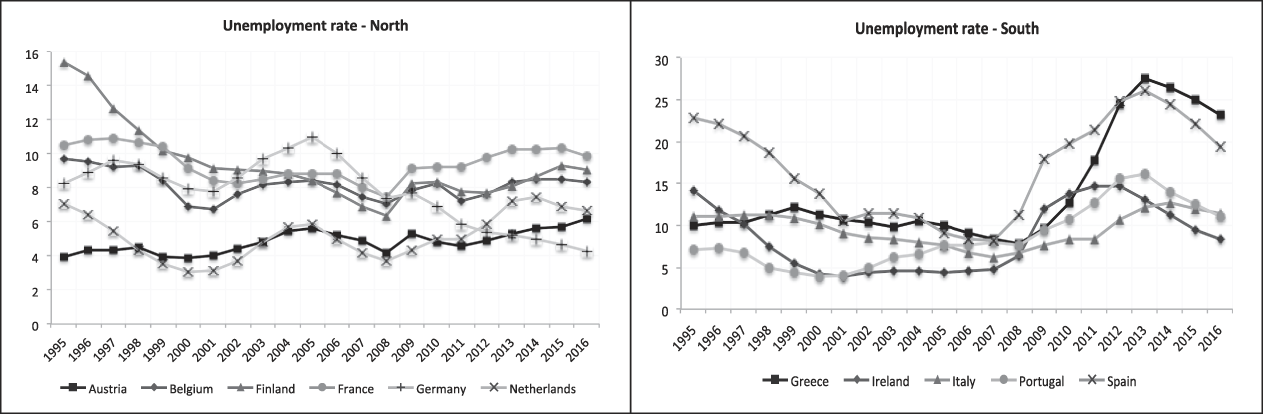
Meanwhile, monetary conditions further contracted throughout 2011 such that real interest rates in the periphery rose, intensifying already deep distress. Unsurprisingly, the bond-market crisis went from bad to worse in the midst of this self-inflicted recession. When Trichet was succeeded at the ECB by the decidedly less ordoliberal Mario Draghi in November 2011, some respite was at hand. Footnote 87 But that respite, which was designed to effectively counter the economic contraction caused by the strict adherence to these ordoliberal ideas, was to push further the divergence in monetary and fiscal policy noted at the beginning of this article.
Bailing Out the Water While Drilling a Hole in the Boat
Almost the moment his ECB tenure began, Mario Draghi introduced the Long Term Refinancing Operations (LTROs) in December 2011 and February 2012, totaling over €1 trillion worth of bank loans at 1% for a maturity of three years. Draghi then reduced reserve requirements while increasing eligible collateral by widening the range of authorized asset-backed securities (ABSs). Despite these initiatives, during the summer of 2012, fear over the potential break-up of the Eurozone reached an all-time high when interest rates on Italian and Spanish bonds peaked at 7%. In response, Draghi made a now-famous speech to investors in London on July 26, 2012, where he calmed the markets with the following promise: “Within our mandate, the ECB is ready to do whatever it takes to preserve the euro.” He followed up on his words in early September 2012 by rolling out a program of conditional Eurozone-wide bond buying called Outright Monetary Transactions (OMTs).
It is vital to note here that Draghi was neither fighting external events nor asymmetric shocks. Rather, he was fighting a recession brought on by an adherence to economic ideas that made political sense in a transnational authority contest—they strengthened German ordoliberals and EU-level technocrats—but that made no sense as economic policy. Footnote 88 And to compound this, while Draghi was giving Europe room to breathe, the ordoliberals in power in Berlin and Brussels were busy designing new instruments of fiscal constriction. These instruments, imposed by the member states themselves, only further distressed the economies of the euro periphery, as the European Union introduced a new series of laws and regulations to more actively monitor the budgetary decisions of all EMU member states going forward.
Given the recoded focus on periphery profligacy via the lesson learned from the SGP reforms, the focus of EU policymakers through 2012 fell mainly on correcting the ordoliberally-preferred “national” causes of the crisis (fiscal profligacy and a lack of competitiveness) rather than the “systemic” ones (a central bank that was not a full lender of last resort, the lack of a common debt instrument, as well as the missing joint banking supervision and resolution powers to deal with a continent-wide banking crisis). Footnote 89 As can be seen in table 2, the EU “turbo-charged” the SGP lesson of 2005 with three sets of ever-tightening fiscal measures.
EU Fiscal Crisis Measures

Source: European Commission, 2016
The Six-Pack—five EU regulations and one EU directive—was designed to ensure a much stricter application of the EMU fiscal rules by defining quantitatively what a “significant deviation” from the country-specific “Medium Term Objective” (MTO) meant. The Six-Pack basically sets out under what conditions an Excessive Deficit Procedure (EDP) can be initiated against a member state, and stipulates which financial sanctions will be imposed if it is so designated. Footnote 90
The “Fiscal Compact”—or Treaty on Stability, Coordination, and Governance (TSCG)—is an intergovernmental agreement (not EU law) concluded in Brussels in December 2011 that went into force in January 2013 after early ratification by 16 EU member states. The Fiscal Compact requires EU member states to respect and ensure convergence towards the country-specific Medium Term Objective (MTO), with a lower limit on the structural deficit of 0.5% of GDP.
The idea was for these strict budget rules to be enshrined into national law through clear-cut provisions of “binding force and permanent character, preferably constitutional.” Footnote 91 It also introduced reverse qualified majority voting (RQMV), making it harder for big countries to band together, as France and Germany had done in 2003—again, a “social learning” reaction to the SGP reform episode. Finally, the “Two-Pack,” which came into force in May 2013, set out simplified rules for the enhanced surveillance of member states facing financial instability, those receiving financial assistance, and those exiting a financial assistance program.
Yet all that this tightening of fiscal monitoring and further constriction achieved by the spring of 2016 was to make growth outside of Germany, with the exception of a few Eastern European states tied into its export supply chains, even more sclerotic. Footnote 92 More importantly for our purposes, they mark the institutional reconsolidation of the ordoliberal ideas at the heart of the European monetary project, all of which stemmed from the ordoliberal victory in the authority contest over the original SGP episode.
While the central debate within EU studies revolves around whether the Eurozone debt crisis strengthened the hand of Germany and the inter-governmental European Council as the main decision-making body to call the shots, Footnote 93 or the supra-national European Commission since it gained significant discretionary powers over the actual implementation of the new rules, Footnote 94 our point is that alternative economic policies that significantly deviated from both ordo- and neo-liberalism were a priori ruled out, and the new institutions that were put in place made fiscal policy quasi-illegal.
Building these new institutions thereby confirmed one bias and instituted another. That bias was to ignore any and all contrary evidence that binding fiscal policy so tightly required an ever-looser monetary policy—and that ever-looser monetary policy would soon cause its own problems. Fiscal and monetary policies were thereby being driven further in opposite directions, which would open up a second authority contest on what the economic evidence actually meant.
Round Two: The Intra-Troika Authority Contest
As we noted earlier, one strand of the social learning literature argues that policymakers alter their stance when anomalies such as large policy failures emerge. Given how large the forecast errors were in the policy estimates of the Troika (the European Commission, the ECB, and the IMF), regarding what their preferred policies were supposed to do in the periphery, and what they actually did, one would think that some new thinking might have occurred in response to these errors. And indeed, this happened with one-third of the troika, the IMF, even though the big shift there on fiscal multipliers was in the research department rather than among its leadership team. Footnote 95 With the other two-thirds however, the ECB and the Commission, while we see a shift in emphasis, the underlying ideas remained largely the same, despite any and all evidence to the contrary. Footnote 96 The reason why, we suggest, was not the efficacy of these policy ideas. Rather, it was the authority that they continued to give to those who wielded them.
For example, the 2014 European Parliament-commissioned Bruegel Report on the three troika bailout programs usefully analyzes the language of Troika documents over time. The report notes the shift from the use of terms such as “fiscal,” “consolidation,” and “reform,” which dominated the initial bailout documents, to a greater emphasis on terms such as “growth” and “employment,” Footnote 97 which is perhaps unsurprising given the lack of growth and the record high unemployment produced by the implementation of these policies. Footnote 98 However, as far as admitting error is concerned, acknowledgement is in short supply. As the Bruegel report notes, “since greater economic and social cohesion is a major EU objective . . . we study how often issues such as poverty, fairness, and inequality are discussed in the documents,” observing that “except for Greece, the issue received practically no attention in the Commission program documents.” Footnote 99
The one part of the Troika that did change their ideas was the IMF. As Cornel Ban details, the IMF’s policy ideas shifted quite substantially over the course of the crisis, across multiple positions. Footnote 100 However, the ideas of the other two members of the Troika have barely moved at all, as was demonstrated in the so-called “Battle of the Boxes” between the Commission and the IMF in 2013, which played out as “round two” of the authority contest over Eurozone policy. Footnote 101
By 2012 a series of IMF studies had shown negative fiscal multipliers greater than one for the periphery countries of Europe, which meant that a 1% cut in public expenditure led to a greater than 1% cut in GDP, with no offsetting confidence effects. Footnote 102 Since negative multipliers also imply positive ones, as any reciprocal would demand, the IMF’s seemingly technical challenge effectively argued for a political shift towards fiscal expansion, which is precisely what the new fiscal pacts and packs discussed above were designed to obviate. In making this challenge the entire ordoliberal framework of the ECB and EC approach to the crisis was attacked from within the Troika itself.
Unsurprisingly, the EC struck back at the end of 2012 with its own version of multiplier estimates to counter the IMF’s. The Commission argued that, in essence, while the IMF was correct, Troika policies were the right policies, but that the multipliers would have been less than one had it not been for a lot of people talking about the break-up of the euro, which made things worse. Footnote 103 In other words, ceteris paribus, fiscal contraction would have had a positive effect in theory even if it did not in practice.
The IMF nevertheless continued deploying these new ideas, despite the Commission’s contestation of them, where the EC was quickly supported by the ECB. Footnote 104 It is also worth noting that that other great booster of fiscal tightness and credibility, the Paris-based OECD, authored a report in February 2016 arguing that developed-country growth prospects had “practically flat-lined” due to misapplied austerity policies and that “a commitment to raising public investment would boost demand and help support future growth.” Footnote 105 Neither the Commission, nor the ECB, nor the German government had any response to the OECD report. In sum, if social learning, as it is generally understood in the academic literature, is going on in Europe, it should, we argue, be understood as a process where the wrong lessons seem to be constantly reaffirmed as a part of an ongoing authority contest over what the crisis means, and who gets to dictate how to respond.
How the Wrong Policy Mix Became the New Normal
Despite bond markets rallying after Draghi’s LTRO and OMT policies, the Eurozone struggled through a recession and found itself on the brink of deflation in 2013. In July 2013, Draghi added “forward guidance” to his toolbox, stating that “the Governing Council expects the key ECB interest rates to remain at present or lower levels for an extended period of time.” Footnote 106 Less than a year later, with deflationary conditions pressing further, the ECB introduced so-called Targeted Long-Term Refinancing Operations (TLTROs) in June 2014, allowing banks to borrow up to 7% of a specific part of their loans to get ever-more cheap credit into the system. In short, the ECB was trying to force banks to lend more in an environment where potential borrowers were instead paying back debt because of low rates, low inflation, low growth, and above all, diminished demand expectations. The ECB was by now, de facto, being forced to counteract the costs of the recoding of the 2005 SGP episode.
June 2014 also saw the introduction of negative deposit rates by the ECB. This led European banks to buy US dollar assets rather than place their cash reserves with the ECB, which resulted in a significant fall in the value of the euro. While the euro/dollar rate was 1.36 at the time of Draghi’s introduction of negative deposit rates, by January 2015 the euro was trading at 1.06 to the dollar. Footnote 107 But with practically every emerging market starting to put downward pressure on its currency, the “exchange rate channel” for recovery by exports was exhausted by early 2015.
With deflation ongoing, Draghi introduced a third “Covered Bonds Purchase Program” (CBPP3), followed by an “Asset-Backed Securities Purchase Program” (ABSPP), before announcing the long-awaited “Public Sector Purchase Program” (PSPP) in January 2015. With PSPP, which is all out quantitative easing (QE), Draghi committed the ECB to buy up a total of 60 billion euro of mainly public sector securities every month for a period of at least 18 months. PSPP was later extended beyond March 2017. In other words, the ECB’s main job has become countering the deflationary expectations that have become embedded in large parts of Europe, mainly due to the excessive fiscal contractions that the European Union had thrust upon itself via the Six-Pack and the Two-Pack, etc., which was itself made possible by the ordoliberal recoding of the 2005 SGP episode.
Conclusions: Ideas, Social Learning, and the Rational Persistence of Irrational Ideas
We have attempted to show that social learning can lead to paradigm maintenance as well as paradigm change. First, we argued that states that are currency users rather than currency issuers cannot credibly bail out their financial systems when they get into trouble. As such, users of “non-sovereign money” face a different set of incentives from users of “sovereign money” when a crisis hits. While the UK and the US, and even Iceland, followed the sequence of “bail, fail, recapitalize and (occasionally) send to jail,” the EU’s sequence was one more akin to “retreat to first principles for political reasons and stick to them despite the evidence.” The EU was able to do this due to the wrong lessons being learned from the 2003–2005 episode when the SGP was revised. This recoding of the SGP episode combined with the ordoliberal meta-rules inscribed in the architecture of the EU’s governing institutions to give authority to those claiming homology with these rules, despite increasing evidence that doing so was self-destructive.
We next showed how these ideas were both re-inscribed and reinforced in the new EU institutions of fiscal governance—the six-pack, two-pack, and fiscal compact—in 2012. This turn to an “ever closer squeezing” of budgets paradoxically necessitated “ever looser money” from the ECB to both cushion the recession that fiscal tightening was causing, as well as to counter the deflationary expectations that were being sown. In the second round of this authority contest—which is still ongoing over the sustainability of Greek debt at the time of writing—evidence from the IMF and other organizations was actively being discounted by the other troika institutions. What remains to be discussed is the one question that we opened with—why continually learn the wrong lessons despite the evidence?
Our answer is that non-sovereigns with sovereign responsibilities, but without sovereign capacities, must rule by appeal to authority. In the case of the EU governors, that authority is drawn from adherence to a set of ideas and institutional rules that, while irrational for the crisis environment in which they are employed, are the only ones such actors can draw upon to maintain their authority when under pressure since they have no democratic mandate to actually change policy.
While the overall policy response to the euro crisis was very much driven by the Eurozone member-state leaders, particularly by German chancellor Angela Merkel and her Finance Minister Wolfgang Schäuble, such that technocrats in both the Commission and the ECB took their cues from their “paymasters” in Berlin, that does not detract from the fact that those technocrats derived their legitimacy and authority from following and implementing the rules they were instructed to follow—whether they truly believed in those rules or not. Lacking democratic legitimacy themselves, they had very little choice in not doing so. In contrast, among national leaders, the appeal to such rules allowed them to expand their claims to authority beyond their electorate, into the institutions of supranational governance. Without appeal to such ideas, their authority, like their capacity, would stop at the border.
Seen in this way, “doubling down” on bad policy, as the EU has repeatedly done since 2010, is neither irrational nor purely ideological. Instead, as Keynes said about the adherence to deflation in the 1930s, it is locally rational but globally irrational. And as long as authority is produced and contested via appeal to these ordo- and neo-liberal ideas, and through reconstructed readings of past events, a rather unbalanced and ineffective macroeconomic policy mix will be the result. Just how long Europe can stand this policy mix remains an open question. But what our analysis suggests is that so long as the answer is framed in ordoliberal terms, those in authority will not be compelled to give an alternative answer.
Europe continues to face a quadruple crisis of stagnation, migration, security, and legitimacy. Any one of these crises is potentially manageable on its own. But trying to solve all four at the same time would be a serious challenge to any state with sovereign money, let alone to a union of states with non-sovereign money. ECB yield suppression via QE is the latest glue applied to this fragmenting structure. But such suppression comes at a cost—not only in the form of a lost decade of growth, or destructive labor market hysteresis, but also in the form of a populist reaction that seeks to extinguish the European project itself. At this point, what is locally rational, winning an authority contest, becomes globally disastrous. The EU now finds itself at that point. Its future rests upon its ability to learn some new lessons. We doubt that it has the capacity to learn. We hope that we are wrong and that it does.



