





1 Introduction
One of the most beautiful aspects of self-similar group theory is its connections, discovered by Nekrashevych [Reference Nekrashevych11], to the theory of dynamical systems. To any contracting self-similar group, one can construct its limit dynamical system, which is a self-map of a compact metric space whose dynamical properties are governed by the properties of the self-similar group, and vice versa. Many natural dynamical systems arise as examples, for instance, hyperbolic post-critically finite rational maps acting on their Julia sets. This description was used, for instance, to solve the twisted rabbit problem [Reference Bartholdi and Nekrashevych1].
We prove that Putnam’s binary factors of subshifts of finite type [Reference Putnam13] arise as limit dynamical systems of self-similar groupoids.
An embedding pair consists of two directed graphs H and E, along with a pair of embeddings $\xi ^0, \xi ^1:H \hookrightarrow E$
satisfying certain conditions. Putnam’s factor is obtained by identifying two (one-sided) infinite paths in E that arise from the same path in H embedded along two binary sequences of embeddings that are related through carry over in binary addition. He then proves that the natural extension of these dynamical systems are Smale spaces, computes their homology, as well as the K-theory of the associated
$\xi ^0, \xi ^1:H \hookrightarrow E$
satisfying certain conditions. Putnam’s factor is obtained by identifying two (one-sided) infinite paths in E that arise from the same path in H embedded along two binary sequences of embeddings that are related through carry over in binary addition. He then proves that the natural extension of these dynamical systems are Smale spaces, computes their homology, as well as the K-theory of the associated $C^{*}$
-algebras. As a corollary, Putnam proves that these
$C^{*}$
-algebras. As a corollary, Putnam proves that these $C^{*}$
-algebras exhaust all possible Ruelle algebras arising from irreducible Smale spaces [Reference Putnam13, Theorem 6.5].
$C^{*}$
-algebras exhaust all possible Ruelle algebras arising from irreducible Smale spaces [Reference Putnam13, Theorem 6.5].
We show that Putnam’s construction naturally defines a self-similar groupoid action on a graph. Moreover, we prove, in Theorem 4.3, that the limit dynamical system of the self-similar groupoid action is identical (not just conjugate) to Putnam’s dynamical system. Through our approach to studying these systems, we are able to remove one of Putnam’s standing hypotheses and weaken his requirement of the graph E being primitive to having no sources, see Section 4.
An interesting corollary of our construction that follows from [Reference Putnam13, Theorem 6.5] and [Reference Brownlowe, Buss, Gonçalves, Hume, Sims and Whittaker3, Corollary 8.5] is that the class of (stabilised) $C^{*}$
-algebras associated to contracting and regular self-similar groupoids acting on strongly connected finite graphs is equal to the class of Ruelle algebras associated to irreducible Smale spaces.
$C^{*}$
-algebras associated to contracting and regular self-similar groupoids acting on strongly connected finite graphs is equal to the class of Ruelle algebras associated to irreducible Smale spaces.
This result should be compared with Katsura’s seminal paper [Reference Katsura8], where he proved that all Kirchberg algebras can be realised, up to strong Morita equivalence, as certain $C^*$
-algebras associated with two integer matrices A, B. While studying these algebras, Exel and Pardo [Reference Exel and Pardo4] realised that they arise from self-similar group actions, with the finite alphabet replaced by a (possibly infinite) graph.
$C^*$
-algebras associated with two integer matrices A, B. While studying these algebras, Exel and Pardo [Reference Exel and Pardo4] realised that they arise from self-similar group actions, with the finite alphabet replaced by a (possibly infinite) graph.
Using Kitchens’ out-split construction for graphs [Reference Kitchens9], which we extend to self-similar groupoid actions, we prove that every self-similar groupoid action coming from an embedding pair can be out-split to a Katsura–Exel–Pardo action. Therefore, Putnam’s dynamical systems are topologically conjugate to the limit dynamical system of a Katsura–Exel–Pardo action. This explains the similarity in the K-theory results [Reference Putnam13, Theorems 6.1 and 6.2] and Theorem 3.1 due to Katsura and Exel–Pardo.
The matrices A, B arising from this out-split satisfy some relations between them that ensure the associated self-similar groupoid is contracting and regular. These conditions are dynamically important, as contracting guarantees the limit space is Hausdorff and, assuming contracting, regular is equivalent to the limit dynamical system being an expanding local homeomorphism (see [Reference Brownlowe, Buss, Gonçalves, Hume, Sims and Whittaker3, Proposition 4.8]). Moreover, the $KK$
-duality results of [Reference Brownlowe, Buss, Gonçalves, Hume, Sims and Whittaker3] may be applied in this setting. We characterise these properties in terms of properties of the matrices A and B.
$KK$
-duality results of [Reference Brownlowe, Buss, Gonçalves, Hume, Sims and Whittaker3] may be applied in this setting. We characterise these properties in terms of properties of the matrices A and B.
Given a self-similar groupoid action on a graph, we show the connected component space of the limit space can be identified with the quotient of the infinite path space of the graph by a natural equivalence relation. We use this description to prove, for a large class of Katsura–Exel–Pardo actions, the connected components in their limit spaces are circles and points, analogous to Putnam’s result [Reference Putnam13, Corollary 7.7]. We identify the dynamics on the circle components as $z\to z^{n}$
, where
$z\to z^{n}$
, where $n\in \mathbb {N}$
can vary, dependent on the value of z under a natural factor map to a subshift of finite type. Thus, ‘Katsura–Exel–Pardo systems’ exhibit interesting interplay of zero- and one-dimensional dynamics.
$n\in \mathbb {N}$
can vary, dependent on the value of z under a natural factor map to a subshift of finite type. Thus, ‘Katsura–Exel–Pardo systems’ exhibit interesting interplay of zero- and one-dimensional dynamics.
This description provided the impetus to look for a planar embedding of the limit space for such Katsura–Exel–Pardo actions, to better understand how the circles and points are configured. The embedding is reminiscent of a solar system trajectory, with planets orbiting a star and moons orbiting the planet, but ad infinitum. As a corollary, we prove that Putnam’s dynamical systems embed into the plane, answering Putnam’s question (see [Reference Putnam13, Question 7.10]).
The paper is organised as follows. In Section 2, we provide background on self-similar groupoid actions and their limit dynamical systems. Section 3 introduces Katsura’s construction and Exel and Pardo’s realisation of these as Katsura–Exel–Pardo groupoid actions on graphs, and contains our matrix characterisation of when they are contracting and regular. Section 4 introduces Putnam’s binary factors of subshifts of finite type, and we prove that they are limit dynamical systems of certain self-similar groupoid actions on graphs. Section 5 defines out-splits and uses them, along with the previous result, to show that Putnam’s dynamical systems are topologically conjugate to the limit space dynamical systems of Katsura–Exel–Pardo actions over certain out-split graphs. Section 6 contains our results on the connected components of limit spaces. The final section proves that regular Katsura–Exel–Pardo systems with $B \in M_N(\{0,1\})$
embed into the plane and, hence, so do Putnam’s dynamical systems.
$B \in M_N(\{0,1\})$
embed into the plane and, hence, so do Putnam’s dynamical systems.
2 Self-similar groupoid actions on graphs
In this section, we describe self-similar groupoid actions on finite directed graphs and their properties. These generalise the notion of a self-similar group introduced by Bartholdi, Grigorchuk, Nekrashevych and others.
2.1 Directed graphs and their path spaces
We quickly introduce directed graphs; for a detailed treatment, see Raeburn’s seminal book [Reference Raeburn14].
A directed graph E is a quadruple $E = (E^0, E^1, r, s)$
consisting of two sets
$E = (E^0, E^1, r, s)$
consisting of two sets $E^0$
and
$E^0$
and $E^1$
along with two functions
$E^1$
along with two functions $r,s : E^1 \to E^0$
called the range and source maps, respectively. Elements in
$r,s : E^1 \to E^0$
called the range and source maps, respectively. Elements in $E^0$
are vertices and elements in
$E^0$
are vertices and elements in $E^1$
are edges. We think of an edge e as a directed arrow from its source vertex
$E^1$
are edges. We think of an edge e as a directed arrow from its source vertex $s(e)$
to its range
$s(e)$
to its range $r(e)$
.
$r(e)$
.
Perhaps the most important aspect of a directed graph is its path space. A finite path $\mu $
in a directed graph E is either a vertex
$\mu $
in a directed graph E is either a vertex $\mu = v$
, or a finite sequence of edges
$\mu = v$
, or a finite sequence of edges $\mu = e_1 \cdots e_n$
such that
$\mu = e_1 \cdots e_n$
such that $s(e_i) = r(e_{i+1})$
for all
$s(e_i) = r(e_{i+1})$
for all $i\leq n-1$
. Let the paths of length n in E be denoted by
$i\leq n-1$
. Let the paths of length n in E be denoted by $E^n = \{e_1 \cdots e_n : e_i \in E^1, s(e_i) = r(e_{i+1})\}$
. We then let
$E^n = \{e_1 \cdots e_n : e_i \in E^1, s(e_i) = r(e_{i+1})\}$
. We then let  denote the set of all finite paths in E. For a path $\mu =\mu _1 \cdots \mu _n$
in
$\mu =\mu _1 \cdots \mu _n$
in $E^n$
, let
$E^n$
, let $r(\mu ) =r(\mu _1)$
and
$r(\mu ) =r(\mu _1)$
and $s(\mu )=s(\mu _n)$
. For
$s(\mu )=s(\mu _n)$
. For $\mu \in E^*$
and
$\mu \in E^*$
and $X \subseteq E^*$
, we define
$X \subseteq E^*$
, we define
 $$ \begin{align*} \mu X = \{\mu \nu : \nu \in X, s(\mu) = r(\nu)\}\quad\text{and}\quad X \mu = \{\nu\mu : \nu \in X, r(\mu) = s(\nu)\}. \end{align*} $$
We then have $\mu X \nu = \mu X \cap X \nu $
.
$\mu X \nu = \mu X \cap X \nu $
.
A graph is finite if both $E^0$
and
$E^0$
and $E^1$
are finite. A graph is strongly connected if, for all
$E^1$
are finite. A graph is strongly connected if, for all $v,w \in E^0$
, the set
$v,w \in E^0$
, the set $v E^* w$
is nonempty. Notice that if E is strongly connected, then
$v E^* w$
is nonempty. Notice that if E is strongly connected, then $vE^1$
and
$vE^1$
and $E^1v$
are nonempty for all
$E^1v$
are nonempty for all $v \in E^0$
, unless E is the graph with one vertex and no edges. We say a vertex v in a graph E is a source if
$v \in E^0$
, unless E is the graph with one vertex and no edges. We say a vertex v in a graph E is a source if $vE^1=\emptyset $
and a sink if
$vE^1=\emptyset $
and a sink if $E^1v=\emptyset $
.
$E^1v=\emptyset $
.
In this paper, we need to work with both left-, right- and bi-infinite paths in a graph E. Thus, we define:
-
•
 ;
; -
•
; and -
•
.
 ;
; ; and
; and .
.As usual, we endow these spaces with the product topology, with a basis of cylinder sets. These are indexed by finite paths in each of the three spaces, so we distinguish them as follows. For
-
•
$E^{+\infty }$
: when
$\mu \in E^n$
, let ; for -
•
$E^{-\infty }$
: when
$\mu \in E^n$
, let ; and for -
•
$E^{\mathbb {Z}}$
: when
$n \ge 0$
and
$\mu \in E^{2n+1}$
, let .


 ; for
; for

 ; and for


 .
.If x is an element in any of the spaces above and $m < n \in \mathbb {Z}$
appropriately chosen for the space in question, we define
$m < n \in \mathbb {Z}$
appropriately chosen for the space in question, we define

2.2 Self-similar actions of groupoids on graphs
Katsura–Exel–Pardo actions are a type of self-similar groupoid action on a graph, so we take a few paragraphs to introduce them. For further details, see [Reference Laca, Raeburn, Ramagge and Whittaker10].
Suppose E is a directed graph. Given $v,w \in E^0$
, a partial isomorphism of
$v,w \in E^0$
, a partial isomorphism of $E^*$
is a bijection
$E^*$
is a bijection $g : vE^* \to wE^*$
that is length and path preserving in the sense that
$g : vE^* \to wE^*$
that is length and path preserving in the sense that $|g(\mu )|=|\mu |$
and
$|g(\mu )|=|\mu |$
and $g(\mu e) \in g(\mu )E^1$
for all
$g(\mu e) \in g(\mu )E^1$
for all $\mu \in E^*$
and
$\mu \in E^*$
and $e \in E^1$
satisfying
$e \in E^1$
satisfying $s(\mu ) = r(e)$
. We use the notation
$s(\mu ) = r(e)$
. We use the notation  to reduce the number of parentheses. These two conditions are equivalent to the following property: g is length preserving, and for every $\mu \in vE^{*}$
, there is a partial isomorphism
$\mu \in vE^{*}$
, there is a partial isomorphism $h:s(\mu )E^{*}\to s(g \cdot \mu )E^{*}$
such that
$h:s(\mu )E^{*}\to s(g \cdot \mu )E^{*}$
such that
 $$ \begin{align} g \cdot(\mu\nu) = (g\cdot \mu)(h \cdot \nu)\quad\text{for all } \nu \in s(\mu)E^{*}. \end{align} $$
We write $h = g|_{\mu }$
, as it is uniquely defined by the above property, and call it the restriction of g to
$h = g|_{\mu }$
, as it is uniquely defined by the above property, and call it the restriction of g to $\mu $
.
$\mu $
.
Let $\operatorname {PIso}(E^*)$
denote the set of all partial isomorphisms of
$\operatorname {PIso}(E^*)$
denote the set of all partial isomorphisms of $E^*$
, which is itself a groupoid with units
$E^*$
, which is itself a groupoid with units $\operatorname {id}_v: vE^* \to vE^*$
defined by
$\operatorname {id}_v: vE^* \to vE^*$
defined by $\operatorname {id}_v(\mu )=\mu $
for all
$\operatorname {id}_v(\mu )=\mu $
for all $\mu \in vE^*$
and multiplication given by composition of maps. Since units are associated with vertices, we go ahead and identify the unit space of
$\mu \in vE^*$
and multiplication given by composition of maps. Since units are associated with vertices, we go ahead and identify the unit space of $\operatorname {PIso}(E^*)$
with
$\operatorname {PIso}(E^*)$
with $E^0$
. The isotropy group of a unit
$E^0$
. The isotropy group of a unit $v \in E^0$
is the set of partial isomorphisms from
$v \in E^0$
is the set of partial isomorphisms from $vE^*$
to
$vE^*$
to $vE^*$
.
$vE^*$
.
Given a partial isomorphism $g : vE^* \to wE^*$
, define its domain to be
$g : vE^* \to wE^*$
, define its domain to be $d(g) = v$
and its codomain to be
$d(g) = v$
and its codomain to be $c(g) = w$
. That is, we are renaming the range and source maps in the groupoid
$c(g) = w$
. That is, we are renaming the range and source maps in the groupoid $\operatorname {PIso}(E^*)$
by the terms codomain and domain since the symbols s and r are already in use.
$\operatorname {PIso}(E^*)$
by the terms codomain and domain since the symbols s and r are already in use.
Restriction and multiplication of elements satisfy several relations, which we record in the following lemma.
Lemma 2.1 [Reference Laca, Raeburn, Ramagge and Whittaker10, Lemma 3.4 and Proposition 3.6].
Let E be a finite directed graph. For $(g,h) \in \operatorname {PIso}(E^*)^{(2)}$
,
$(g,h) \in \operatorname {PIso}(E^*)^{(2)}$
, $\mu \in d(g)E^*$
,
$\mu \in d(g)E^*$
, $\nu \in s(\mu )E^*$
and
$\nu \in s(\mu )E^*$
and $\eta \in c(g)E^*$
, we have:
$\eta \in c(g)E^*$
, we have:
-
(1)
$r(g \cdot \mu ) = c(g)$
and
$s(g \cdot \mu ) = g|_\mu \cdot s(\mu )$
; -
(2)
$g|_{\mu \nu } = (g|_\mu )|_\nu $
; -
(3)
$\operatorname {id}_{r(\mu )}|_\mu = \operatorname {id}_{s(\mu )}$
; -
(4)
$(hg)|_\mu = (h|_{g \cdot \mu })(g|_\mu )$
; and -
(5)
$g^{-1}|_{\eta } = (g|_{g^{-1} \cdot \eta })^{-1}$
.


A groupoid G with unit space $E^0$
acts on
$E^0$
acts on $E^*$
if there is a groupoid homomorphism
$E^*$
if there is a groupoid homomorphism $\phi : G \to \operatorname {PIso}(E^*)$
that restricts to the identity map on
$\phi : G \to \operatorname {PIso}(E^*)$
that restricts to the identity map on $E^0$
. Define
$E^0$
. Define $\operatorname {Ker}(\phi ) = \phi ^{-1}(E^{0})$
, which is a normal sub-groupoid of G. We say G acts faithfully on
$\operatorname {Ker}(\phi ) = \phi ^{-1}(E^{0})$
, which is a normal sub-groupoid of G. We say G acts faithfully on $E^*$
if
$E^*$
if $\phi $
is injective or, in other words,
$\phi $
is injective or, in other words, $\operatorname {Ker}(\phi ) = E^0$
. We write
$\operatorname {Ker}(\phi ) = E^0$
. We write $g \cdot \mu $
in place of
$g \cdot \mu $
in place of $\phi (g)(\mu )$
.
$\phi (g)(\mu )$
.
Definition 2.2. Suppose $E = (E^0, E^1, r, s)$
is a directed graph, and G is a groupoid with unit space
$E = (E^0, E^1, r, s)$
is a directed graph, and G is a groupoid with unit space $E^0$
and a faithful action
$E^0$
and a faithful action $\phi :G\to \operatorname {PIso}(E^*)$
. We say
$\phi :G\to \operatorname {PIso}(E^*)$
. We say $(G, E)$
is a self-similar groupoid action if for every
$(G, E)$
is a self-similar groupoid action if for every $g\in G$
and
$g\in G$
and $e\in d(g)E^*$
, there is
$e\in d(g)E^*$
, there is $h\in G$
such that
$h\in G$
such that $\phi (g)|_{e} = \phi (h)$
. We write
$\phi (g)|_{e} = \phi (h)$
. We write  and call it the restriction of g to e. Using Lemma 2.1, $g|_{\mu }\in G$
for
$g|_{\mu }\in G$
for $\mu \in d(g)E^{n}$
is well defined and satisfies
$\mu \in d(g)E^{n}$
is well defined and satisfies
 $$ \begin{align} g \cdot(\mu\nu) = (g\cdot \mu)(g|_{\mu} \cdot \nu)\quad\text{for all } \nu \in s(\mu)E^{*}. \end{align} $$
Moreover, all the conclusions in Lemma 2.1 hold for the restriction and multiplication when $\operatorname {PIso}(E^*)$
is replaced with G.
$\operatorname {PIso}(E^*)$
is replaced with G.
If the action of G on $E^*$
is range preserving, then
$E^*$
is range preserving, then  is a group and, hence, G is a group bundle. In that case, we say $(G,E)$
is a self-similar group bundle on E. As we see later, this holds for all Katsura–Exel–Pardo actions by definition.
$(G,E)$
is a self-similar group bundle on E. As we see later, this holds for all Katsura–Exel–Pardo actions by definition.
It is useful in this paper to work with nonfaithful actions of groupoids by partial isomorphisms whose faithful quotient is self-similar. These should be considered as nonfaithful self-similar groupoids. However, such a term is an oxymoron, so we name them as below.
Definition 2.3. Let E be a directed graph and G a groupoid with unit space $E^{0}$
. An action-restriction pair for
$E^{0}$
. An action-restriction pair for $(G,E)$
is a map
$(G,E)$
is a map

such that:
-
(A0)
$r(g\cdot e) = c(g)$
and
$d(g|_{e}) = s(e)$
for every ; -
(A1)
$r(e)\cdot e = e$
and
$r(e)|_{e} = s(e)$
for every
$e\in vE^{1}$
; -
(A2)
$gh\cdot e = g \cdot (h\cdot e)$
for every
$(g,h)\in G^{(2)}$
and
$e\in d(g)E^1$
; -
(A3)
$g^{-1}|_{e} = (g|_{g^{-1}\cdot e})^{-1}$
for every
$g\in G$
and
$e\in c(g)E^1$
.


 ;
;


We usually denote an action-restriction pair by $(G,E)$
when there is no ambiguity.
$(G,E)$
when there is no ambiguity.
If we replace G in the definition above with a finite set A with $E^{0}\subseteq A$
and retracts
$E^{0}\subseteq A$
and retracts $c,d:A\to E^{0}$
, then this is the notion of an automaton defined in [Reference Laca, Raeburn, Ramagge and Whittaker10], and one checks that such a pair extends to an action-restriction pair of the free groupoid associated to
$c,d:A\to E^{0}$
, then this is the notion of an automaton defined in [Reference Laca, Raeburn, Ramagge and Whittaker10], and one checks that such a pair extends to an action-restriction pair of the free groupoid associated to $(A,c,d)$
. Katsura–Exel–Pardo actions are, in general, not generated from an automaton but an action-restriction pair as defined above.
$(A,c,d)$
. Katsura–Exel–Pardo actions are, in general, not generated from an automaton but an action-restriction pair as defined above.
If we consider a group G, a finite directed graph E, an action $\sigma :G\times E^{1}\to E^{1}$
and a one-cocycle
$\sigma :G\times E^{1}\to E^{1}$
and a one-cocycle $\varphi : G\times E^{1}\to E^{1}$
satisfying Exel and Pardo’s conditions in [Reference Exel and Pardo4, Section 2.3], then such a pair defines an action-restriction pair on the group bundle
$\varphi : G\times E^{1}\to E^{1}$
satisfying Exel and Pardo’s conditions in [Reference Exel and Pardo4, Section 2.3], then such a pair defines an action-restriction pair on the group bundle $G\times E^{0} =\{g_{v} : g\in G, v\in E^{0}\}$
by
$G\times E^{0} =\{g_{v} : g\in G, v\in E^{0}\}$
by
 $$ \begin{align*}(g_{v},e)\to (\sigma(g,e), (\varphi(g,e)_{s(e)})).\end{align*} $$
An action-restriction pair for $(G,E)$
defines a (not-necessarily faithful) action
$(G,E)$
defines a (not-necessarily faithful) action ${\phi :G\to \operatorname {PIso}(E^{*})}$
: for
${\phi :G\to \operatorname {PIso}(E^{*})}$
: for $g\in G$
and
$g\in G$
and $\mu = e\nu \in d(g)E^{n}$
, we inductively define
$\mu = e\nu \in d(g)E^{n}$
, we inductively define
 $$ \begin{align} g \cdot \mu = (g\cdot e)(g|_{e} \cdot \nu). \end{align} $$
Note that if $g\in \operatorname {Ker}(\phi )$
and
$g\in \operatorname {Ker}(\phi )$
and $e\in d(g)E^{1}$
, then for all
$e\in d(g)E^{1}$
, then for all $\nu \in d(g|_{e})E^{*} = s(e)E^{*}$
, we have
$\nu \in d(g|_{e})E^{*} = s(e)E^{*}$
, we have $e g|_{e}\cdot \nu = g\cdot (e\nu ) = e\nu $
and, hence,
$e g|_{e}\cdot \nu = g\cdot (e\nu ) = e\nu $
and, hence, $g|_{e}\cdot \nu = \nu $
. Therefore,
$g|_{e}\cdot \nu = \nu $
. Therefore, $g|_{e}\in \operatorname {Ker}(\phi )$
.
$g|_{e}\in \operatorname {Ker}(\phi )$
.
It follows that if  is the quotient map, then $q(g|_{e}) = q(g)|_{e}$
for all
$q(g|_{e}) = q(g)|_{e}$
for all $g\in G$
and
$g\in G$
and $e\in d(g)E^{1} = d(q(g))E^{1}$
. Hence, the induced action
$e\in d(g)E^{1} = d(q(g))E^{1}$
. Hence, the induced action $G_{\phi }\to \operatorname {PIso}(E^*)$
is self-similar.
$G_{\phi }\to \operatorname {PIso}(E^*)$
is self-similar.
The case that the self-similar action comes from an action-restriction pair induced by an Exel–Pardo action as above is covered in more detail in [Reference Laca, Raeburn, Ramagge and Whittaker10, Appendix A].
Every self-similar groupoid is an example of an action-restriction pair. Moreover, self-similar groupoids are in one–one correspondence with action-restriction pairs whose induced actions as partial isomorphisms are faithful.
2.3 Properties and limit spaces of self-similar groupoid actions on graphs
In this section, we recall standard properties and constructions associated to action-restriction pairs and self-similar groupoids acting on the path space of a graph.
Definition 2.4. Let G be a groupoid and E a finite directed graph. An action-restriction pair $(G, E)$
is contracting if there exists a finite subset
$(G, E)$
is contracting if there exists a finite subset $F \subseteq G$
so that, for every
$F \subseteq G$
so that, for every $g \in G$
, there is an
$g \in G$
, there is an $n \ge 0$
such that
$n \ge 0$
such that $g|_{\mu }\in F$
for every path
$g|_{\mu }\in F$
for every path $\mu \in E^{k}$
,
$\mu \in E^{k}$
, $k\geq n$
. Such a subset F is called a contracting core of
$k\geq n$
. Such a subset F is called a contracting core of $(G,E)$
. The nucleus of
$(G,E)$
. The nucleus of $(G,E)$
is the set
$(G,E)$
is the set

Definition 2.5 [Reference Nekrashevych12, Definition 6.1].
Let $(G, E)$
be an action restriction pair. Then,
$(G, E)$
be an action restriction pair. Then, $(G, E)$
is regular if, for every
$(G, E)$
is regular if, for every $g \in G$
, there is
$g \in G$
, there is $K\in \mathbb {N}$
such that if
$K\in \mathbb {N}$
such that if $g\cdot \mu = \mu $
and
$g\cdot \mu = \mu $
and $|\mu |\geq K$
, then
$|\mu |\geq K$
, then $g|_{\mu } = s(\mu )$
.
$g|_{\mu } = s(\mu )$
.
Let us see that this notion of regularity is equivalent to that of [Reference Brownlowe, Buss, Gonçalves, Hume, Sims and Whittaker3, Definition 4.1] for self-similar groupoids.
Proposition 2.6. Let $(G,E)$
be a self-similar groupoid such that E has no sources. Then,
$(G,E)$
be a self-similar groupoid such that E has no sources. Then, $(G,E)$
is regular if and only if for every
$(G,E)$
is regular if and only if for every $y \in E^{+\infty }$
such that
$y \in E^{+\infty }$
such that $g \cdot y = y$
, there exists
$g \cdot y = y$
, there exists $\mu $
in
$\mu $
in $E^*$
such that
$E^*$
such that $y \in {Z[{\mu })}$
,
$y \in {Z[{\mu })}$
, $g \cdot \mu = \mu $
and
$g \cdot \mu = \mu $
and $g|_\mu = s(\mu )$
.
$g|_\mu = s(\mu )$
.
Proof. The ‘only if’ direction is immediate, and the ‘if’ direction follows from [Reference Brownlowe, Buss, Gonçalves, Hume, Sims and Whittaker3, Lemma 4.4].
We recall from [Reference Brownlowe, Buss, Gonçalves, Hume, Sims and Whittaker3, Section 3] (see [Reference Nekrashevych11, Ch. 3]) the construction of the limit space from a self-similar groupoid. Let $(G, E)$
be a self-similar groupoid. For
$(G, E)$
be a self-similar groupoid. For $\mu ,\nu \in E^{-\infty }$
, we say
$\mu ,\nu \in E^{-\infty }$
, we say $\mu $
is asymptotically equivalent to
$\mu $
is asymptotically equivalent to $\nu $
if there is a finite set
$\nu $
if there is a finite set $F\subseteq G$
and a sequence
$F\subseteq G$
and a sequence $(g_{n})_{n<0}\subseteq F$
such that
$(g_{n})_{n<0}\subseteq F$
such that $d(g_{n}) = r(\mu _{n})$
and
$d(g_{n}) = r(\mu _{n})$
and $g_{n}\cdot \mu _{n}\cdots \mu _{-1} = \nu _{n}\cdots \nu _{-1}$
for all
$g_{n}\cdot \mu _{n}\cdots \mu _{-1} = \nu _{n}\cdots \nu _{-1}$
for all $n < 0$
. We write
$n < 0$
. We write $\mu \sim _{ae} \nu $
. It is shown in [Reference Brownlowe, Buss, Gonçalves, Hume, Sims and Whittaker3, Section 3] that
$\mu \sim _{ae} \nu $
. It is shown in [Reference Brownlowe, Buss, Gonçalves, Hume, Sims and Whittaker3, Section 3] that $\sim _{ae}$
is an equivalence relation and
$\sim _{ae}$
is an equivalence relation and $\mu \sim _{ae} \nu $
implies
$\mu \sim _{ae} \nu $
implies $\sigma (\mu )\sim _{ae}\sigma (\nu )$
. The quotient space
$\sigma (\mu )\sim _{ae}\sigma (\nu )$
. The quotient space $E^{-\infty }/\sim _{ae}$
is called the limit space of
$E^{-\infty }/\sim _{ae}$
is called the limit space of $(G,E)$
and is denoted
$(G,E)$
and is denoted $\mathcal {J}_{G, E}$
. The induced continuous mapping from
$\mathcal {J}_{G, E}$
. The induced continuous mapping from $(\sigma , E^{-\infty })$
is called the shift on
$(\sigma , E^{-\infty })$
is called the shift on $\mathcal {J}_{G, E}$
and is denoted
$\mathcal {J}_{G, E}$
and is denoted $\tilde {\sigma }$
.
$\tilde {\sigma }$
.
It is shown in [Reference Brownlowe, Buss, Gonçalves, Hume, Sims and Whittaker3, Theorem 4.3] that if $(G, E)$
is a contracting and regular self-similar groupoid such that E has no sources, then
$(G, E)$
is a contracting and regular self-similar groupoid such that E has no sources, then $(\tilde {\sigma }, \mathcal {J}_{G,E})$
is an open, surjective and positively expansive local homeomorphism.
$(\tilde {\sigma }, \mathcal {J}_{G,E})$
is an open, surjective and positively expansive local homeomorphism.
In many ways, the remainder of this paper is dedicated to understanding, in various contexts, this limit space dynamical system $(\tilde {\sigma }, \mathcal {J}_{G,E})$
and the conditions above on
$(\tilde {\sigma }, \mathcal {J}_{G,E})$
and the conditions above on $(G,E)$
that give rise to its regularity properties.
$(G,E)$
that give rise to its regularity properties.
3 Katsura–Exel–Pardo groupoid actions on directed graphs
The main examples of self-similar groupoid actions on graphs that we are interested in are the Katsura–Exel–Pardo groupoid actions [Reference Katsura8]. Katsura developed a family of Cuntz–Pimsner algebras using two matrices as models for Kirchberg algebras. Exel and Pardo [Reference Exel and Pardo4, Section 18] realised these as self-similar groupoids acting on a graph [Reference Laca, Raeburn, Ramagge and Whittaker10, Example 7.7]. For Katsura–Exel–Pardo actions, we completely characterise when these are contracting and regular, which turns out to be rather subtle.
Let $N \in \mathbb {N}$
. A Katsura pair is a matrix
$N \in \mathbb {N}$
. A Katsura pair is a matrix $A=(A_{ij})$
in
$A=(A_{ij})$
in $M_N(\mathbb {N})$
and a matrix
$M_N(\mathbb {N})$
and a matrix $B=(B_{ij})$
such that
$B=(B_{ij})$
such that $A_{ij}=0$
implies
$A_{ij}=0$
implies $B_{ij}=0$
. Then, A is the adjacency matrix of the graph
$B_{ij}=0$
. Then, A is the adjacency matrix of the graph $E_A$
with
$E_A$
with
 $$ \begin{align*} E_A^0=\{1,2,\ldots,N\},\quad E_A^1=\{e_{i,j,m}: 0\leq m<A_{ij}\},\quad r(e_{i,j,m})=i,\quad s(e_{i,j,m})=j. \end{align*} $$
Exel and Pardo [Reference Exel and Pardo4, pages 1048–1049] realised that a Katsura pair gives a self-similar action on a graph in the following way. Define a group action $\sigma :\mathbb {Z}\times E_{A}\to E_{A}$
and a one-cocycle
$\sigma :\mathbb {Z}\times E_{A}\to E_{A}$
and a one-cocycle $\varphi :\mathbb {Z}\times E_{A}\to \mathbb {Z}$
as follows: write
$\varphi :\mathbb {Z}\times E_{A}\to \mathbb {Z}$
as follows: write $g\in \mathbb {Z}$
multiplicatively as
$g\in \mathbb {Z}$
multiplicatively as $g = a^{k}$
,
$g = a^{k}$
, $k\in \mathbb {Z}$
. Then,
$k\in \mathbb {Z}$
. Then, $\sigma (a^{k},e_{i,j,m}) = e_{i,j,\hat {m}}$
and
$\sigma (a^{k},e_{i,j,m}) = e_{i,j,\hat {m}}$
and $\varphi (a^{k},e_{i,j,m}) = a^{\hat {k}}$
, where
$\varphi (a^{k},e_{i,j,m}) = a^{\hat {k}}$
, where
 $$ \begin{align} kB_{ij}+m=\hat{k}{A_{ij}}+\hat{m}\quad\text{and}\quad 0\leq \hat{m}< A_{ij}. \end{align} $$
We then obtain an action-restriction pair for ( $\mathbb {Z}\times E_{A}^{0}, E_{A})$
, defined by
$\mathbb {Z}\times E_{A}^{0}, E_{A})$
, defined by
 $$ \begin{align} (a_{i}^{k},e_{i,j,m})\to (e_{i,j,\hat{m}},a^{\hat{k}}_{j}), \end{align} $$
and we call these Katsura–Exel–Pardo groupoid actions (KEP-actions). See [Reference Laca, Raeburn, Ramagge and Whittaker10, Appendix A] for a more careful treatment of these actions and [Reference Laca, Raeburn, Ramagge and Whittaker10, Example 7.7] for a description of the faithful quotient. We reserve the notation $(G_{B},E_A)$
for the corresponding faithful KEP-action associated with a Katsura pair of matrices A and B.
$(G_{B},E_A)$
for the corresponding faithful KEP-action associated with a Katsura pair of matrices A and B.
These actions realise their importance within $C^*$
-algebras due to the following.
$C^*$
-algebras due to the following.
Theorem 3.1 [Reference Katsura8, Propositions 2.6, 2.9 and 2.10, Remark 2.8], [Reference Exel and Pardo4, Remark 18.3].
Let $N \in \mathbb {N}$
and let
$N \in \mathbb {N}$
and let $A=(A_{ij})$
be a matrix in
$A=(A_{ij})$
be a matrix in $M_N(\mathbb {N})$
, and
$M_N(\mathbb {N})$
, and $B=(B_{ij})$
a matrix in
$B=(B_{ij})$
a matrix in $M_N(\mathbb {Z})$
such that A has no zero rows and
$M_N(\mathbb {Z})$
such that A has no zero rows and $A_{ij}=0$
implies
$A_{ij}=0$
implies $B_{ij}=0$
. Then, the Cuntz–Pimsner algebra of the associated self-similar groupoid action
$B_{ij}=0$
. Then, the Cuntz–Pimsner algebra of the associated self-similar groupoid action $\mathcal {O}(G_{B},E_A)$
is separable, nuclear and in the UCT class. The K-theory groups of
$\mathcal {O}(G_{B},E_A)$
is separable, nuclear and in the UCT class. The K-theory groups of $\mathcal {O}(G_{B},E_A)$
are given by
$\mathcal {O}(G_{B},E_A)$
are given by
 $$ \begin{align*} K_0(\mathcal{O}(G_{B},E_A))&= \operatorname{coker}(I-A) \oplus \operatorname{ker}(I-B)\quad\text{and} \\ K_1(\mathcal{O}(G_{B},E_A))&= \operatorname{coker}(I-B) \oplus \operatorname{ker}(I-A). \end{align*} $$
Moreover, if A and B also satisfy:
-
• A is irreducible and
$A_{ij}=0\Longrightarrow B_{ij}=0$
; and -
•
$A_{ii} \geq 2$
and
$B_{i,i}=1$
for every
$1 \leq i \leq N$
,


then $\mathcal {O}(G_{B},E_A)$
is a unital Kirchberg algebra.
$\mathcal {O}(G_{B},E_A)$
is a unital Kirchberg algebra.
Theorem 3.1 outlines several restrictions that can be put on a KEP-action whose associated Cuntz–Pimsner algebra is a unital Kirchberg algebra. We now consider restrictions that arise on the self-similar groupoid side. It is helpful to first understand the kernel of a KEP-action $\phi _{A,B}:\mathbb {Z}\times E^{0}_{A}\to \operatorname {PIso}(E^*_{A})$
.
$\phi _{A,B}:\mathbb {Z}\times E^{0}_{A}\to \operatorname {PIso}(E^*_{A})$
.
Following Exel and Pardo [Reference Exel and Pardo4, page 1124], for $\mu \in E_A^n$
, write
$\mu \in E_A^n$
, write $\mu =e_{i_0,i_1,r_1}e_{i_1,i_2,r_2} \cdots e_{i_{n-1},i_n,r_n}$
. Define
$\mu =e_{i_0,i_1,r_1}e_{i_1,i_2,r_2} \cdots e_{i_{n-1},i_n,r_n}$
. Define

That is, $A_{\mu }$
and
$A_{\mu }$
and $B_{\mu }$
are the products of the number of edges through the set of vertices specified by
$B_{\mu }$
are the products of the number of edges through the set of vertices specified by $\mu $
.
$\mu $
.
Proposition 3.2. Let $(A, B)$
be a Katsura pair. Then,
$(A, B)$
be a Katsura pair. Then, $a^{k}_{i}\in \operatorname {ker}(\phi _{A,B})$
if and only if
$a^{k}_{i}\in \operatorname {ker}(\phi _{A,B})$
if and only if ${kB_{\mu }}/{A_{\mu }} \in \mathbb {Z}$
for all
${kB_{\mu }}/{A_{\mu }} \in \mathbb {Z}$
for all $\mu \in iE_{A}^{*}$
.
$\mu \in iE_{A}^{*}$
.
Proof. One sees by induction on $n\in \mathbb {N}$
that for
$n\in \mathbb {N}$
that for $k\in \mathbb {Z}$
and
$k\in \mathbb {Z}$
and $\mu \in iE_{A}^{n}$
,
$\mu \in iE_{A}^{n}$
, $a^{k}_{i}\cdot \mu = \mu $
if and only if
$a^{k}_{i}\cdot \mu = \mu $
if and only if $k ({B_{\mu [1,i]}}/{A_{\mu [1,i]}}) \in \mathbb {Z}$
for all
$k ({B_{\mu [1,i]}}/{A_{\mu [1,i]}}) \in \mathbb {Z}$
for all $i\leq n$
. Therefore,
$i\leq n$
. Therefore, $a^{k}_{i}\in \operatorname {ker}(\phi _{A,B})$
if and only if
$a^{k}_{i}\in \operatorname {ker}(\phi _{A,B})$
if and only if $k ({B_{\mu }}/{A_{\mu }})\in \mathbb {Z}$
for all
$k ({B_{\mu }}/{A_{\mu }})\in \mathbb {Z}$
for all $\mu \in iE^{*}_{A}$
.
$\mu \in iE^{*}_{A}$
.
Note that for $\mu \in E^{n}$
such that
$\mu \in E^{n}$
such that $B_{\mu }\neq 0$
,
$B_{\mu }\neq 0$
, $k ({B_{\mu }}/{A_{\mu }})\in \mathbb {Z}$
if and only if
$k ({B_{\mu }}/{A_{\mu }})\in \mathbb {Z}$
if and only if ${A_{\mu }}/{\text {gcd}(A_{\mu }, |B_{\mu }|)}$
divides k. So, by Proposition 3.2, the group
${A_{\mu }}/{\text {gcd}(A_{\mu }, |B_{\mu }|)}$
divides k. So, by Proposition 3.2, the group $(G_{B})_{i}$
is finite if and only if
$(G_{B})_{i}$
is finite if and only if $\max _{\mu \in iE^{*}: B_{\mu }\neq 0} {A_{\mu }}/({\text {gcd}(A_{\mu }, |B_{\mu }|)}) <\infty $
and its cyclic order
$\max _{\mu \in iE^{*}: B_{\mu }\neq 0} {A_{\mu }}/({\text {gcd}(A_{\mu }, |B_{\mu }|)}) <\infty $
and its cyclic order $o_{i}$
is the smallest
$o_{i}$
is the smallest $k\in \mathbb {Z}$
such that
$k\in \mathbb {Z}$
such that ${A_{\mu }}/{\text {gcd}(A_{\mu },|B_{\mu }|)}$
divides k for all
${A_{\mu }}/{\text {gcd}(A_{\mu },|B_{\mu }|)}$
divides k for all $B_{\mu }\neq 0$
. Thus,
$B_{\mu }\neq 0$
. Thus,
 $$ \begin{align*} o_{i} = \text {lcm}(\{{A_{\mu }}/{\text {gcd}(A_{\mu },|B_{\mu }|)}: \mu \in iE_{A}^{*}: B_{\mu }\neq 0\}). \end{align*} $$
We have the following corollary.
Corollary 3.3. Suppose $(G_{B}, E_{A})$
is a KEP-action and define
$(G_{B}, E_{A})$
is a KEP-action and define

Then, $E_{A,<\infty }^{0}$
is invariant in the sense that if
$E_{A,<\infty }^{0}$
is invariant in the sense that if $e\in E^{1}$
satisfies
$e\in E^{1}$
satisfies $B_{e}\neq 0$
and
$B_{e}\neq 0$
and $r(e)\in E_{A,<\infty }^{0}$
, then
$r(e)\in E_{A,<\infty }^{0}$
, then $s(e)\in E_{A,<\infty }^{0}$
.
$s(e)\in E_{A,<\infty }^{0}$
.
Proof. Let $\nu \in E^{*}$
and
$\nu \in E^{*}$
and $e\in E^{1}$
be such that
$e\in E^{1}$
be such that $s(e) = r(\nu )$
and
$s(e) = r(\nu )$
and $B_{e\nu }\neq 0$
. We have
$B_{e\nu }\neq 0$
. We have $A_{e\nu } = A_{e}A_{\nu }$
,
$A_{e\nu } = A_{e}A_{\nu }$
, $|B_{e\nu }| = |B_{e}||B_{\nu }|$
and therefore
$|B_{e\nu }| = |B_{e}||B_{\nu }|$
and therefore $\text {gcd}(A_{e},|B_{e}|)\text {gcd}(A_{\nu }, |B_{\nu }|)$
divides
$\text {gcd}(A_{e},|B_{e}|)\text {gcd}(A_{\nu }, |B_{\nu }|)$
divides $A_{e\nu }$
and
$A_{e\nu }$
and $B_{e\nu }$
so that
$B_{e\nu }$
so that $\text {gcd}(A_{e},|B_{e}|)\text {gcd}(A_{\nu }, |B_{\nu }|)$
divides
$\text {gcd}(A_{e},|B_{e}|)\text {gcd}(A_{\nu }, |B_{\nu }|)$
divides $\text {gcd}(A_{e\nu }, |B_{e\nu }|)$
. If we let
$\text {gcd}(A_{e\nu }, |B_{e\nu }|)$
. If we let $A^{\prime }_{\nu } = {A_{\nu }}/{\text {gcd}(A_{\nu }, |B_{\nu }|)}$
and
$A^{\prime }_{\nu } = {A_{\nu }}/{\text {gcd}(A_{\nu }, |B_{\nu }|)}$
and $B^{\prime }_{\nu } = {B_{\nu }}/{\text {gcd}(A_{\nu }, |B_{\nu }|)}$
, then
$B^{\prime }_{\nu } = {B_{\nu }}/{\text {gcd}(A_{\nu }, |B_{\nu }|)}$
, then

Since $\text {gcd}(A^{\prime }_{\nu }, B^{\prime }_{\nu }) = 1$
, the factors in m that divide
$\text {gcd}(A^{\prime }_{\nu }, B^{\prime }_{\nu }) = 1$
, the factors in m that divide $B^{\prime }_{\nu }$
must divide
$B^{\prime }_{\nu }$
must divide $A_{e}$
and the factors that divide
$A_{e}$
and the factors that divide $A^{\prime }_{\nu }$
must divide
$A^{\prime }_{\nu }$
must divide $B_{e}$
. From this, we see that m divides
$B_{e}$
. From this, we see that m divides $A_{e}B_{e}$
and, therefore,
$A_{e}B_{e}$
and, therefore,
 $$ \begin{align*}\text{gcd}(A_{e},|B_{e}|)\text{gcd}(A_{\nu}, |B_{\nu}|)\leq \text{gcd}((A_{e\nu}, |B_{e\nu}|))\leq A_{e}|B_{e}|\text{gcd}(A_{e},|B_{e}|)\text{gcd}(A_{\nu}, |B_{\nu}|). \end{align*} $$
So, if we let $C = \max _{e\in E^{1}}{A_{e}}/{\text {gcd}(A_{e},|B_{e}|)}$
and
$C = \max _{e\in E^{1}}{A_{e}}/{\text {gcd}(A_{e},|B_{e}|)}$
and $D = \max _{e\in E^{1}}|B_{e}|\text {gcd}(A_{e}, |B_{e}|)$
, then
$D = \max _{e\in E^{1}}|B_{e}|\text {gcd}(A_{e}, |B_{e}|)$
, then
 $$ \begin{align} C\frac{A_{\nu}}{\text{gcd}(A_{\nu}, |B_{\nu}|)} \geq \frac{A_{e\nu}}{\text{gcd}(A_{e\nu}, |B_{e\nu}|)}\geq \frac{1}{D}\frac{A_{\nu}}{\text{gcd}(A_{\nu}, |B_{\nu}|)}. \end{align} $$
In particular, if $\max _{\nu \in s(e)E^{*}:B_{\nu }\neq 0} ({A_{\nu }}/{\text {gcd}(A_{\nu }, |B_{\nu }|)}) = \infty $
, then
$\max _{\nu \in s(e)E^{*}:B_{\nu }\neq 0} ({A_{\nu }}/{\text {gcd}(A_{\nu }, |B_{\nu }|)}) = \infty $
, then
 $$ \begin{align*}\infty = \max_{\nu\in s(e)E^{*}:B_{\nu}\neq 0}\frac{A_{e\nu}}{\text{gcd}(A_{e\nu}, |B_{e\nu}|)}\leq \max_{\mu\in r(e)E^{*}:B_{\mu}\neq 0}\frac{A_{\mu}}{\text{gcd}(A_{\mu}, |B_{\mu}|)}.\end{align*} $$
This proves that for $B_{e}\neq 0$
, if
$B_{e}\neq 0$
, if $s(e)\notin E^{0}_{A,<\infty }$
, then
$s(e)\notin E^{0}_{A,<\infty }$
, then $r(e)\notin E^{0}_{A,<\infty }$
.
$r(e)\notin E^{0}_{A,<\infty }$
.
Now, define

and note that $E^{0}_{A,\infty } = E^{0}_{A}\setminus E^{0}_{A, <\infty }$
. Similarly, define
$E^{0}_{A,\infty } = E^{0}_{A}\setminus E^{0}_{A, <\infty }$
. Similarly, define

By Corollary 3.3,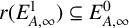 $r(E^{1}_{A,\infty })\subseteq E^{0}_{A,\infty }$
, so
$r(E^{1}_{A,\infty })\subseteq E^{0}_{A,\infty }$
, so  is a sub-graph of $E_{A}$
, and the action of
$E_{A}$
, and the action of  on
on $E^{*}_{A}$
restricts to an action
$E^{*}_{A}$
restricts to an action $\phi _{A,B,\infty }:G_{B,\infty }\to \operatorname {PIso}(E^{*}_{A,\infty })$
.
$\phi _{A,B,\infty }:G_{B,\infty }\to \operatorname {PIso}(E^{*}_{A,\infty })$
.
By re-ordering the vertices if necessary, we may assume $E^{0}_{A,\infty } = \{1,\ldots ,k\}$
for some
$E^{0}_{A,\infty } = \{1,\ldots ,k\}$
for some $k\leq N$
. Then, letting
$k\leq N$
. Then, letting $A_{\infty }$
be the adjacency matrix of
$A_{\infty }$
be the adjacency matrix of $E^{1}_{A,\infty }$
, we see that
$E^{1}_{A,\infty }$
, we see that
 $$ \begin{align*} (A_{\infty})_{i,j} = \begin{cases} A_{i,j} & \text{ if } B_{i,j}\neq 0,\\ 0 & \text{ otherwise.} \end{cases} \end{align*} $$
Since $(G_{B})_{i}$
is infinite for
$(G_{B})_{i}$
is infinite for $i\leq k$
, we must have (by Corollary 3.3)
$i\leq k$
, we must have (by Corollary 3.3) $r^{-1}(i)\cap E_{A,\infty }^{1}\neq \emptyset $
. Hence,
$r^{-1}(i)\cap E_{A,\infty }^{1}\neq \emptyset $
. Hence, $A_{\infty }$
has no zero rows. Letting
$A_{\infty }$
has no zero rows. Letting  , we have $\phi _{A_{\infty },B_{\infty }} = \phi _{A,B,\infty }$
. Note that, in general,
$\phi _{A_{\infty },B_{\infty }} = \phi _{A,B,\infty }$
. Note that, in general, $G_{B_{\infty }}$
is a quotient of
$G_{B_{\infty }}$
is a quotient of $G_{B,\infty } = \mathbb {Z}\times E^{0}_{A,\infty }$
.
$G_{B,\infty } = \mathbb {Z}\times E^{0}_{A,\infty }$
.
Similarly, let

so that  is, by Corollary 3.3, a sub-graph of $E_{A}$
and set
$E_{A}$
and set  . Then, $\phi _{A,B}$
restricts to an action
$\phi _{A,B}$
restricts to an action $\phi _{A,B,<\infty }:G_{B,<\infty }\to \operatorname {PIso}(E^{*}_{A,<\infty })$
and letting
$\phi _{A,B,<\infty }:G_{B,<\infty }\to \operatorname {PIso}(E^{*}_{A,<\infty })$
and letting $A_{<\infty }$
be the adjacency matrix of
$A_{<\infty }$
be the adjacency matrix of $E_{A,<\infty }$
and
$E_{A,<\infty }$
and $B_{<\infty } = (B_{i,j})_{i,j>k}$
, we have
$B_{<\infty } = (B_{i,j})_{i,j>k}$
, we have $\phi _{A_{<\infty }, B_{<\infty }} = \phi _{A,B,<\infty }$
and
$\phi _{A_{<\infty }, B_{<\infty }} = \phi _{A,B,<\infty }$
and $G_{B_{<\infty }} = G_{B,<\infty }$
. Note however that
$G_{B_{<\infty }} = G_{B,<\infty }$
. Note however that $E_{A_{<\infty }}$
may have sources even if
$E_{A_{<\infty }}$
may have sources even if $E_{A}$
has none.
$E_{A}$
has none.
Definition 3.4. Let $(A,B)$
be a Katsura pair. We call
$(A,B)$
be a Katsura pair. We call $(A_{\infty }, B_{\infty })$
the infinite part of
$(A_{\infty }, B_{\infty })$
the infinite part of $(A,B)$
and
$(A,B)$
and $(A_{<\infty }, B_{<\infty })$
the finite part of
$(A_{<\infty }, B_{<\infty })$
the finite part of $(A,B)$
, as defined immediately above.
$(A,B)$
, as defined immediately above.
For the following proposition, recall the notion of contracting from Section 2.3.
Proposition 3.5. Let $(A,B)$
be a Katsura pair. Then, the KEP-action
$(A,B)$
be a Katsura pair. Then, the KEP-action $(G_{B}, E_{A})$
is contracting if and only if
$(G_{B}, E_{A})$
is contracting if and only if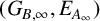 $(G_{B,\infty }, E_{A_{\infty }})$
is contracting.
$(G_{B,\infty }, E_{A_{\infty }})$
is contracting.
Proof. The ‘only if’ direction is immediate, so we prove the ‘if’ direction by proving its contrapositive. If $(G_{B}, E_{A})$
is not contracting, then for every finite set F such that
$(G_{B}, E_{A})$
is not contracting, then for every finite set F such that $G_{B,<\infty }\cup E^{0}\subseteq F\subseteq G_{B}$
, there is
$G_{B,<\infty }\cup E^{0}\subseteq F\subseteq G_{B}$
, there is $g\in G_{B}$
such that
$g\in G_{B}$
such that $g|_{\mu _{n}}\notin F$
for infinitely many paths
$g|_{\mu _{n}}\notin F$
for infinitely many paths $(\mu _{n})_{n\in \mathbb {N}}$
. For
$(\mu _{n})_{n\in \mathbb {N}}$
. For $\mu \in E^{*}_{A}$
such that
$\mu \in E^{*}_{A}$
such that $B_{\mu } = 0$
, we have
$B_{\mu } = 0$
, we have $g|_{\mu } = s(\mu )\in F$
and, hence,
$g|_{\mu } = s(\mu )\in F$
and, hence, $B_{\mu _{n}}\neq 0$
. If
$B_{\mu _{n}}\neq 0$
. If $\mu \in E^{n}_{A}$
satisfies
$\mu \in E^{n}_{A}$
satisfies $B_{\mu }\neq 0$
and
$B_{\mu }\neq 0$
and $r(\mu _{i})\in E^{0}_{A, <\infty }$
for some
$r(\mu _{i})\in E^{0}_{A, <\infty }$
for some $i\leq n$
, then by Corollary 3.3, we have
$i\leq n$
, then by Corollary 3.3, we have $s(\mu )\in E^{0}_{A, <\infty }$
and, therefore,
$s(\mu )\in E^{0}_{A, <\infty }$
and, therefore, $h|_{\mu }\in G_{B, <\infty }\subseteq F$
for any
$h|_{\mu }\in G_{B, <\infty }\subseteq F$
for any $h\in r(\mu )G_{B}$
. Since
$h\in r(\mu )G_{B}$
. Since $g|_{\mu _{n}}\notin F$
and
$g|_{\mu _{n}}\notin F$
and $B_{\mu _{n}}\neq 0$
, it follows that
$B_{\mu _{n}}\neq 0$
, it follows that $\mu _{n}\in E_{A,\infty }^{*}$
for all
$\mu _{n}\in E_{A,\infty }^{*}$
for all $n\in \mathbb {N}$
and
$n\in \mathbb {N}$
and $g\in G_{B,\infty }$
. Therefore,
$g\in G_{B,\infty }$
. Therefore, $(G_{B_{\infty }}, E_{A_{\infty }})$
is not contracting.
$(G_{B_{\infty }}, E_{A_{\infty }})$
is not contracting.
Now, we determine a necessary and sufficient condition for the infinite part of a KEP-action to be contracting. Suppose G is a finitely generated groupoid with generating set $S = S^{-1}$
, with associated length function
$S = S^{-1}$
, with associated length function $\ell _S:G \to \mathbb {N}$
, and suppose
$\ell _S:G \to \mathbb {N}$
, and suppose $(G,E)$
is an action-restriction pair. Following Nekrashevych [Reference Nekrashevych11, Definition 2.11.9], the contraction coefficient of
$(G,E)$
is an action-restriction pair. Following Nekrashevych [Reference Nekrashevych11, Definition 2.11.9], the contraction coefficient of $(G,E)$
is the quantity:
$(G,E)$
is the quantity:
 $$ \begin{align} \rho = \limsup_{n \to \infty}\bigg( \limsup_{g \in G, \ell_S(g) \to \infty} \max_{\mu \in d(g)E^n} \frac{\ell_S(g|_{\mu})}{\ell_S(g)} \bigg)^{1/n}. \end{align} $$
Nekrashevych proved the following result in the case of a self-similar group action. However, his proof goes through line-for-line with the obvious extension from words to paths in the action-restriction pair setting.
Proposition 3.6 [Reference Nekrashevych11, Lemma 2.11.10 and Proposition 2.11.11].
Let G be a finitely generated groupoid and E a finite graph with no sources. If $(G,E)$
is an action-restriction pair, then the contraction coefficient
$(G,E)$
is an action-restriction pair, then the contraction coefficient $\rho $
is finite and does not depend on the generating set. Furthermore,
$\rho $
is finite and does not depend on the generating set. Furthermore, $(G,E)$
is contracting if and only if
$(G,E)$
is contracting if and only if $\rho <1$
.
$\rho <1$
.
Now suppose that $(\mathbb {Z}\times E^{0}_{A},E_A)$
is the action-restriction pair associated to a Katsura pair
$(\mathbb {Z}\times E^{0}_{A},E_A)$
is the action-restriction pair associated to a Katsura pair $(A,B)$
. Then, Equation (3-5) becomes
$(A,B)$
. Then, Equation (3-5) becomes
 $$ \begin{align} \rho = \limsup_{n \to \infty}\bigg( \limsup_{m \to \infty} \max_{\mu \in E_A^n} \frac{\ell_S(a^m_{r(\mu)}|_{\mu})}{m} \bigg)^{1/n}. \end{align} $$
Proposition 3.7. Let $(A,B)$
be a Katsura pair such that A has no zero rows and let
$(A,B)$
be a Katsura pair such that A has no zero rows and let $(\mathbb {Z}\times E^{0}_{A}, E_{A})$
be the associated action-restriction pair. Then, the contraction coefficient is given by
$(\mathbb {Z}\times E^{0}_{A}, E_{A})$
be the associated action-restriction pair. Then, the contraction coefficient is given by
 $$ \begin{align*} \rho=\limsup_{n \to \infty}\bigg( \max_{\mu \in E_A^n} \frac{|B_{\mu}|}{A_{\mu}} \bigg)^{1/n}. \end{align*} $$
Proof. We first prove by induction on $m \in \mathbb {N}$
that, for fixed
$m \in \mathbb {N}$
that, for fixed $1 \leq i,j \leq N$
and
$1 \leq i,j \leq N$
and ${0\leq r <N}$
,
${0\leq r <N}$
,
 $$ \begin{align} a_i^{m} \cdot e_{i,j,r}\nu=e_{i,j,r_m}(a_j^{l} \cdot \nu) \quad \text{where } l=m\frac{B_{ij}}{A_{ij}} + \frac{r-r_m}{A_{ij}} \quad \text{for all } \nu \in jE^*. \end{align} $$
For $m=1$
, using Equation (3-1), we have
$m=1$
, using Equation (3-1), we have $B_{ij}+r=l_1 A_{ij} +r_1$
so that
$B_{ij}+r=l_1 A_{ij} +r_1$
so that
 $$ \begin{align*} a_i \cdot e_{i,j,r}\nu=e_{i,j,r_1}(a_j^{l} \cdot \nu) \quad\text{where } l=l_1=\frac{B_{ij}}{A_{ij}} + \frac{r-r_1}{A_{ij}}, \end{align*} $$
as desired. Using Equation (3-7) for $m-1$
, we have
$m-1$
, we have
 $$ \begin{align} a_i^{m} \cdot e_{i,j,r}\nu=a_i \cdot e_{i,j,r_{m-1}}(a_j^{l'} \cdot \nu) \quad \text{where } l'=(m-1)\frac{B_{ij}}{A_{ij}} + \frac{r-r_{m-1}}{A_{ij}}. \end{align} $$
From Equation (3-1), we have $B_{ij}+r_{m-1}=l_m A_{ij} +r_m$
, so that Equation (3-8) gives
$B_{ij}+r_{m-1}=l_m A_{ij} +r_m$
, so that Equation (3-8) gives
 $$ \begin{align*} a_i^{m} \cdot e_{i,j,r}\nu=e_{i,j,r_{m}}(a_j^{l_m} \cdot (a_j^{l'} \cdot \nu))=e_{i,j,r_{m}}(a_j^{l'+l_m} \cdot \nu), \end{align*} $$
where
 $$ \begin{align*} l=l'+l_m=(m-1)\frac{B_{ij}}{A_{ij}} + \frac{r-r_{m-1}}{A_{ij}}+\frac{B_{ij}}{A_{ij}} + \frac{r_{m-1}-r_m}{A_{ij}}=m\frac{B_{ij}}{A_{ij}} + \frac{r-r_{m}}{A_{ij}}. \end{align*} $$
Thus, Equation (3-7) holds.
Suppose $\mu =e_{i_0,i_1,r_1}e_{i_1,i_2,r_2} \cdots e_{i_{n-1},i_n,r_n}$
,
$\mu =e_{i_0,i_1,r_1}e_{i_1,i_2,r_2} \cdots e_{i_{n-1},i_n,r_n}$
, $\nu =e_{i_0,i_1,r^{\prime }_1}e_{i_1,i_2,r^{\prime }_2} \cdots e_{i_{n-1},i_n,r^{\prime }_n}$
and
$\nu =e_{i_0,i_1,r^{\prime }_1}e_{i_1,i_2,r^{\prime }_2} \cdots e_{i_{n-1},i_n,r^{\prime }_n}$
and $a_{i_0}^m \cdot \mu =\nu $
. We prove by induction on
$a_{i_0}^m \cdot \mu =\nu $
. We prove by induction on $|\mu | = n$
that
$|\mu | = n$
that
 $$ \begin{align} a_{r(\mu)}^{m}|_{\mu}=a_{s(\mu)}^{l}\quad \text{where } l=m\frac{B_{\mu}}{A_{\mu}} + \sum_{t=1}^n (r_t-r^{\prime}_t) \frac{B_{\mu[t+1,n]}}{A_{\mu[t,n]}}. \end{align} $$
For $|\mu |=1$
, Equation (3-9) holds by Equation (3-7). Using Equation (3-9) for
$|\mu |=1$
, Equation (3-9) holds by Equation (3-7). Using Equation (3-9) for $n-1$
and Equation (3-7), we compute for
$n-1$
and Equation (3-7), we compute for $|\mu |=n$
:
$|\mu |=n$
:
 $$ \begin{align*} l&=\bigg( m\frac{B_{\mu[1,n-1]}}{A_{\mu[1,n-1]}} + \sum_{t=1}^{n-1} (r_t-r^{\prime}_t) \frac{B_{\mu[t+1,n-1]}}{A_{\mu[t,n]}} \bigg)\frac{B_{i_{n-1}i_{n}}}{A_{i_{n-1}i_{n}}} + \frac{r_n-r^{\prime}_n}{A_{i_{n-1}i_n}} \\ &=m\frac{B_{\mu}}{A_{\mu}} + \sum_{t=1}^{n} (r_t-r^{\prime}_t) \frac{B_{\mu[t+1,n]}}{A_{\mu[t,n]}}, \end{align*} $$
so Equation (3-9) holds by induction.
We now use Equation (3-9) to compute the contraction coefficient
 $$ \begin{align*} \rho &= \limsup_{n \to \infty}\bigg( \limsup_{m \to \infty} \max_{\mu \in E_A^n} \frac{\ell_S(a^m_{r(\mu)}|_{\mu})}{m} \bigg)^{1/n}\\ &= \limsup_{n \to \infty}\bigg( \limsup_{m \to \infty} \max_{\mu \in E_A^n} \bigg|\frac{B_{\mu}}{A_{\mu}} + \frac{1}{m}\bigg( \sum_{t=1}^n (r_t-r^{\prime}_t) \frac{B_{\mu[t+1,n]}}{A_{\mu[t,n]}} \bigg)\bigg|\bigg)^{1/n} \\ &= \limsup_{n \to \infty}\bigg( \max_{\mu \in E_A^n} \frac{|B_{\mu}|}{A_{\mu}} \bigg)^{1/n}.\\[-40pt] \end{align*} $$
Corollary 3.8. Let $(A,B)$
be a Katsura pair. Then, the associated KEP-action
$(A,B)$
be a Katsura pair. Then, the associated KEP-action $(G_{B}, E_{A})$
is contracting if and only if
$(G_{B}, E_{A})$
is contracting if and only if $\limsup _{n \to \infty }( \max _{\mu \in E_{A,\infty }^{n}} {|B_{\mu }|}/{A_{\mu }} )^{1/n} < 1$
.
$\limsup _{n \to \infty }( \max _{\mu \in E_{A,\infty }^{n}} {|B_{\mu }|}/{A_{\mu }} )^{1/n} < 1$
.
For the following proposition, recall the notion of regular from Section 2.3.
Proposition 3.9. Let $(A,B)$
be a Katsura pair. Then, the KEP-action
$(A,B)$
be a Katsura pair. Then, the KEP-action $(G_{B}, E_{A})$
is regular if and only if
$(G_{B}, E_{A})$
is regular if and only if $(G_{B,\infty }, E_{A_{\infty }})$
and
$(G_{B,\infty }, E_{A_{\infty }})$
and $(G_{B_{<\infty }}, E_{A_{<\infty }})$
are regular.
$(G_{B_{<\infty }}, E_{A_{<\infty }})$
are regular.
Proof. The ‘only if’ direction is immediate, so we prove the ‘if’ direction. Suppose $g\in G$
. We show there is
$g\in G$
. We show there is $M\in \mathbb {N}$
such that
$M\in \mathbb {N}$
such that $g\cdot \mu = \mu $
,
$g\cdot \mu = \mu $
, $g|_{\mu }\neq s(\mu )$
implies
$g|_{\mu }\neq s(\mu )$
implies $|\mu |\leq M$
.
$|\mu |\leq M$
.
Since $G_{B_{<\infty }}$
is finite, there is an
$G_{B_{<\infty }}$
is finite, there is an $M'\in \mathbb {N}$
such that for every
$M'\in \mathbb {N}$
such that for every $h\in G_{B_{<\infty }}$
and
$h\in G_{B_{<\infty }}$
and $\nu \in E^{*}_{A,<\infty }$
satisfying
$\nu \in E^{*}_{A,<\infty }$
satisfying $h\cdot \nu = \nu $
and
$h\cdot \nu = \nu $
and $g|_{\nu }\neq s(\nu )$
, we have
$g|_{\nu }\neq s(\nu )$
, we have $|\nu |\leq M'$
.
$|\nu |\leq M'$
.
Note that $g|_{\mu }\neq s(\mu )$
implies
$g|_{\mu }\neq s(\mu )$
implies $B_{\mu }\neq 0$
, so by Corollary 3.3, we can write
$B_{\mu }\neq 0$
, so by Corollary 3.3, we can write $\mu = \mu _{1}e\mu _{2}$
for some
$\mu = \mu _{1}e\mu _{2}$
for some $\mu _{1}\in E^{*}_{A,\infty }$
and
$\mu _{1}\in E^{*}_{A,\infty }$
and $\mu _{2}\in E^{*}_{A,<\infty }$
(in this decomposition, we allow
$\mu _{2}\in E^{*}_{A,<\infty }$
(in this decomposition, we allow $\mu _{1} = \emptyset $
or
$\mu _{1} = \emptyset $
or $\mu _{2}=\emptyset $
).
$\mu _{2}=\emptyset $
).
If $\mu _{1} = \emptyset $
, then
$\mu _{1} = \emptyset $
, then $|\mu |\leq M' + 1$
.
$|\mu |\leq M' + 1$
.
If $\mu _{1}\neq \emptyset $
, then
$\mu _{1}\neq \emptyset $
, then $g\in G_{B,\infty }$
. Let
$g\in G_{B,\infty }$
. Let $M"$
be such that for
$M"$
be such that for $\nu \in E^{*}_{A,\infty }$
,
$\nu \in E^{*}_{A,\infty }$
, $g\cdot \nu = \nu $
and
$g\cdot \nu = \nu $
and $g|_{\nu }\neq s(\nu )$
implies
$g|_{\nu }\neq s(\nu )$
implies $|\nu |\leq M"$
. Then,
$|\nu |\leq M"$
. Then, $|\mu |\leq M" + M' + 1$
.
$|\mu |\leq M" + M' + 1$
.
In either case, we have 
Proposition 3.10. Let $(A,B)$
be a Katsura pair such that A has no zero rows. If the associated action-restriction pair
$(A,B)$
be a Katsura pair such that A has no zero rows. If the associated action-restriction pair $(\mathbb {Z}\times E^{0}_{A},E_A)$
is contracting, then it is regular.
$(\mathbb {Z}\times E^{0}_{A},E_A)$
is contracting, then it is regular.
Proof. Suppose $(\mathbb {Z}\times E^{0},E_A)$
is contracting. Write
$(\mathbb {Z}\times E^{0},E_A)$
is contracting. Write $g = a^{k}_{i}$
. By Propositions 3.6 and 3.7, there is
$g = a^{k}_{i}$
. By Propositions 3.6 and 3.7, there is $M\in \mathbb {N}$
such that
$M\in \mathbb {N}$
such that ${|B_{\mu }|}/{A_{\mu }} < {1}/{k}$
for all
${|B_{\mu }|}/{A_{\mu }} < {1}/{k}$
for all $|\mu |\geq M$
and, hence,
$|\mu |\geq M$
and, hence, $k ({B_{\mu }}/{A_{\mu }})\notin \mathbb {Z}$
. It follows that
$k ({B_{\mu }}/{A_{\mu }})\notin \mathbb {Z}$
. It follows that $g\cdot \mu \neq \mu $
for
$g\cdot \mu \neq \mu $
for $|\mu |\geq M$
. Hence,
$|\mu |\geq M$
. Hence, $(\mathbb {Z}\times E^{0},E_A)$
is regular.
$(\mathbb {Z}\times E^{0},E_A)$
is regular.
Corollary 3.11. Let $(A,B)$
be a Katsura pair such that the KEP-action
$(A,B)$
be a Katsura pair such that the KEP-action $(G_{B}, E_{A})$
is contracting. Then,
$(G_{B}, E_{A})$
is contracting. Then, $(G_{B}, E_{A})$
is regular if and only if
$(G_{B}, E_{A})$
is regular if and only if $(G_{B_{<\infty }}, E_{A_{<\infty }})$
is regular.
$(G_{B_{<\infty }}, E_{A_{<\infty }})$
is regular.
We now determine a necessary and sufficient condition for when the finite part of a KEP-action is regular.
Proposition 3.12. Let $(A,B)$
, satisfying
$(A,B)$
, satisfying $\mathrm {sup}_{\mu \in E^{*}:B_{\mu }\neq 0} ({A_{\mu }}/\mathrm {gcd} (A_{\mu }$
,
$\mathrm {sup}_{\mu \in E^{*}:B_{\mu }\neq 0} ({A_{\mu }}/\mathrm {gcd} (A_{\mu }$
, $|B_{\mu }| )) <\infty $
be a Katsura pair. Then, the KEP-action
$|B_{\mu }| )) <\infty $
be a Katsura pair. Then, the KEP-action $(G_{B}, E_{A})$
is regular if and only if there is
$(G_{B}, E_{A})$
is regular if and only if there is $K\in \mathbb {N}$
such that for all
$K\in \mathbb {N}$
such that for all $\mu \in E^{K}_{A}$
and
$\mu \in E^{K}_{A}$
and $\omega \in s(\mu )E^{*}_{A}$
,
$\omega \in s(\mu )E^{*}_{A}$
, $A_{\omega }$
divides
$A_{\omega }$
divides $({B_{\mu }}/{\mathrm {gcd}(A_{\mu }, |B_{\mu }|)})B_{\omega }$
.
$({B_{\mu }}/{\mathrm {gcd}(A_{\mu }, |B_{\mu }|)})B_{\omega }$
.
Proof. We first prove the ‘only if’ direction. Now $G_B$
is finite since
$G_B$
is finite since $\text {sup}_{\mu \in E^{*}:B_{\mu }\neq 0} ({A_{\mu }}/\text {gcd}(A_{\mu }, |B_{\mu }|)) <\infty $
; so by regularity, there is
$\text {sup}_{\mu \in E^{*}:B_{\mu }\neq 0} ({A_{\mu }}/\text {gcd}(A_{\mu }, |B_{\mu }|)) <\infty $
; so by regularity, there is $K\in \mathbb {N}$
such that for every
$K\in \mathbb {N}$
such that for every $g\in G_{B}$
and
$g\in G_{B}$
and $\mu \in E^{K}_{A}$
, if
$\mu \in E^{K}_{A}$
, if $g\cdot \mu = \mu $
, then
$g\cdot \mu = \mu $
, then $g|_{\mu } = s(\mu )$
. In particular, for
$g|_{\mu } = s(\mu )$
. In particular, for $\mu \in E^{K}_{A}$
and
$\mu \in E^{K}_{A}$
and $k = {A_{\mu }}/{\text {gcd}(A_{\mu }, |B_{\mu }|)}$
, we have
$k = {A_{\mu }}/{\text {gcd}(A_{\mu }, |B_{\mu }|)}$
, we have $a^{k}_{r(\mu )}\cdot \mu = \mu $
and, therefore,
$a^{k}_{r(\mu )}\cdot \mu = \mu $
and, therefore, $a^{k}_{r(\mu )}|_{\mu } = s(\mu )$
, which implies
$a^{k}_{r(\mu )}|_{\mu } = s(\mu )$
, which implies $({B_{\mu }}/{\text {gcd}(A_{\mu }, |B_{\mu }|)})\cdot {B_{\omega }}/{A_{\omega }} = ({A_{\mu }}/{\text {gcd}(A_{\mu }, |B_{\mu }|)})\cdot {B_{\mu \omega }}/{A_{\mu \omega }} \in \mathbb {Z}$
for all
$({B_{\mu }}/{\text {gcd}(A_{\mu }, |B_{\mu }|)})\cdot {B_{\omega }}/{A_{\omega }} = ({A_{\mu }}/{\text {gcd}(A_{\mu }, |B_{\mu }|)})\cdot {B_{\mu \omega }}/{A_{\mu \omega }} \in \mathbb {Z}$
for all $\omega \in s(\mu )E_{A}^{*}$
. Therefore,
$\omega \in s(\mu )E_{A}^{*}$
. Therefore, $A_{\omega }$
divides
$A_{\omega }$
divides $({B_{\mu }}/{\text {gcd}(A_{\mu }, |B_{\mu }|)})B_{\omega }$
for all
$({B_{\mu }}/{\text {gcd}(A_{\mu }, |B_{\mu }|)})B_{\omega }$
for all $\mu \in s(\mu )E_{A}^{*}$
.
$\mu \in s(\mu )E_{A}^{*}$
.
We prove the ‘if’ direction now. Suppose $g = a_{i}^{k}$
satisfies
$g = a_{i}^{k}$
satisfies $a_{i}^{k}\cdot \mu = \mu $
for some
$a_{i}^{k}\cdot \mu = \mu $
for some $\mu \in iE_{A}^{K}$
. This implies
$\mu \in iE_{A}^{K}$
. This implies ${kB_{\mu }}/{A_{\mu }}\in \mathbb {Z}$
, which is equivalent to
${kB_{\mu }}/{A_{\mu }}\in \mathbb {Z}$
, which is equivalent to ${A_{\mu }}/{\text {gcd}(A_{\mu }, |B_{\mu }|)}$
divides k. Let
${A_{\mu }}/{\text {gcd}(A_{\mu }, |B_{\mu }|)}$
divides k. Let $m\in \mathbb {Z}$
be such that
$m\in \mathbb {Z}$
be such that $k = m\cdot {A_{\mu }}/{\text {gcd}(A_{\mu }, |B_{\mu }|)}$
. By the hypothesis, if
$k = m\cdot {A_{\mu }}/{\text {gcd}(A_{\mu }, |B_{\mu }|)}$
. By the hypothesis, if $\omega \in s(\mu )E^{*}_{A}$
, then
$\omega \in s(\mu )E^{*}_{A}$
, then $({A_{\mu }}/{\text {gcd}(A_{\mu }, |B_{\mu }|)})\cdot {B_{\mu \omega }}/{A_{\mu \omega }} = {B_{\mu }}/{\text {gcd}(A_{\mu }, |B_{\mu }|)}\cdot {B_{\omega }}/{A_{\omega }}\in \mathbb {Z}$
. Hence,
$({A_{\mu }}/{\text {gcd}(A_{\mu }, |B_{\mu }|)})\cdot {B_{\mu \omega }}/{A_{\mu \omega }} = {B_{\mu }}/{\text {gcd}(A_{\mu }, |B_{\mu }|)}\cdot {B_{\omega }}/{A_{\omega }}\in \mathbb {Z}$
. Hence, $k\cdot {B_{\mu \omega }}/{A_{\mu \omega }} = m\cdot ({A_{\mu }}/{\text {gcd}(A_{\mu }, |B_{\mu }|)})\cdot {B_{\mu \omega }}/{A_{\mu \omega }}\in \mathbb {Z}$
. Then, letting
$k\cdot {B_{\mu \omega }}/{A_{\mu \omega }} = m\cdot ({A_{\mu }}/{\text {gcd}(A_{\mu }, |B_{\mu }|)})\cdot {B_{\mu \omega }}/{A_{\mu \omega }}\in \mathbb {Z}$
. Then, letting $l = {k B_{\mu }}/{A_{\mu }}$
, by Proposition 3.2, we have
$l = {k B_{\mu }}/{A_{\mu }}$
, by Proposition 3.2, we have $a_{i}^{k}|_{\mu } = a^{l}_{s(\mu )}= s(\mu )$
.
$a_{i}^{k}|_{\mu } = a^{l}_{s(\mu )}= s(\mu )$
.
We summarise the results of this section into a theorem.
Theorem 3.13. Let $(A,B)$
be a Katsura pair. Then, the KEP-action
$(A,B)$
be a Katsura pair. Then, the KEP-action $(G_{B}, E_{A})$
is contracting and regular if and only if
$(G_{B}, E_{A})$
is contracting and regular if and only if $\limsup _{n \to \infty }( \max _{\mu \in E_{A,\infty }^{n}} {|B_{\mu }|}/{A_{\mu }} )^{1/n} < 1$
, and there is
$\limsup _{n \to \infty }( \max _{\mu \in E_{A,\infty }^{n}} {|B_{\mu }|}/{A_{\mu }} )^{1/n} < 1$
, and there is $K\in \mathbb {N}$
such that
$K\in \mathbb {N}$
such that $A_{\omega }$
divides
$A_{\omega }$
divides $({B_{\mu }}/{\mathrm {gcd}(A_{\mu }, |B_{\mu }|)})B_{\omega }$
for all
$({B_{\mu }}/{\mathrm {gcd}(A_{\mu }, |B_{\mu }|)})B_{\omega }$
for all $\mu \in E^{K}_{A, <\infty }$
and
$\mu \in E^{K}_{A, <\infty }$
and $\omega \in s(\mu )E^{*}_{A,<\infty }$
.
$\omega \in s(\mu )E^{*}_{A,<\infty }$
.
Later in this paper, we restrict to considering Katsura pairs with B taking values of either $0$
or
$0$
or $1$
. The above theorem has a nice reformulation in this setting.
$1$
. The above theorem has a nice reformulation in this setting.
Corollary 3.14. Let $(A, B)$
be a Katsura pair such that
$(A, B)$
be a Katsura pair such that $B\in M_{N}(\{0,1\})$
. If the KEP-action
$B\in M_{N}(\{0,1\})$
. If the KEP-action $(G_{B}, E_{A})$
is regular, then
$(G_{B}, E_{A})$
is regular, then $(G_{B}, E_{A})$
is contracting. Moreover,
$(G_{B}, E_{A})$
is contracting. Moreover, $(G_{B}, E_{A})$
is regular if and only if there is
$(G_{B}, E_{A})$
is regular if and only if there is $K\in \mathbb {N}$
such that:
$K\in \mathbb {N}$
such that:
-
•
$\mu \in E^{*}_{A,\infty }, A_{\mu } = 1\implies |\mu |\leq K$
; and -
•
$\mu \in E^{*}_{A, <\infty }$
,
$|\mu |\geq K\implies A_{\mu [K, |\mu |]} = 1$
.


Proof. By Proposition 3.5, it suffices to show $(G_{B,\infty }, E_{A,\infty })$
is contracting. By Proposition 3.9,
$(G_{B,\infty }, E_{A,\infty })$
is contracting. By Proposition 3.9, $(G_{B,\infty }, E_{A,\infty })$
is regular. For
$(G_{B,\infty }, E_{A,\infty })$
is regular. For $\mu \in E^{*}_{A,\infty }$
, we have
$\mu \in E^{*}_{A,\infty }$
, we have $a_{r(\mu )}\cdot \mu = \mu $
if and only if
$a_{r(\mu )}\cdot \mu = \mu $
if and only if $A_{\mu } = 1$
, in which case
$A_{\mu } = 1$
, in which case $a_{r(\mu )}|_{\mu } = a_{s(\mu )}$
. By regularity, there is
$a_{r(\mu )}|_{\mu } = a_{s(\mu )}$
. By regularity, there is $K\in \mathbb {N}$
such that
$K\in \mathbb {N}$
such that $A_{\mu } = 1$
implies
$A_{\mu } = 1$
implies $|\mu |\leq K$
. Hence, for
$|\mu |\leq K$
. Hence, for $\mu \in E^{*}_{A,\infty }$
, we have
$\mu \in E^{*}_{A,\infty }$
, we have $A_{\mu }\geq 2^{{|\mu |}/{K}}$
, so that the contracting coefficient (by Proposition 3.7) is
$A_{\mu }\geq 2^{{|\mu |}/{K}}$
, so that the contracting coefficient (by Proposition 3.7) is $\rho < (\tfrac 12)^{{1}/{K}} < 1$
. By Proposition 3.6,
$\rho < (\tfrac 12)^{{1}/{K}} < 1$
. By Proposition 3.6, $(G_{B,\infty }, E_{A,\infty })$
is contracting.
$(G_{B,\infty }, E_{A,\infty })$
is contracting.
The second point is equivalent (by Proposition 3.12) to regularity of $(G_{B_{<\infty }}, E_{A_{<\infty }})$
.
$(G_{B_{<\infty }}, E_{A_{<\infty }})$
.
To prove that the two bullet points imply $(G_{B}, E_{A})$
is regular, it therefore suffices to show (by Propositions 3.9 and 3.10) that
$(G_{B}, E_{A})$
is regular, it therefore suffices to show (by Propositions 3.9 and 3.10) that $(G_{B,\infty },E_{A,\infty })$
is contracting, but this is the same argument as above.
$(G_{B,\infty },E_{A,\infty })$
is contracting, but this is the same argument as above.
We use our characterisations of contracting and regular to provide four examples of Katsura pairs that exhibit all the possible combinations of the two properties holding (or not holding).
Example 3.15 (Contracting and regular).
Let $(G_B,E_A)$
be the KEP-action defined by
$(G_B,E_A)$
be the KEP-action defined by
 $$ \begin{align} A=\left(\begin{matrix} 2 & 1 \\ 1 & 2 \end{matrix}\right) \quad \text{and}\quad B=\left(\begin{matrix} 1 & 1 \\ 0 & 1 \end{matrix}\right). \end{align} $$
Then, A is the adjacency matrix for the graph $E_A$
depicted in Figure 1.
$E_A$
depicted in Figure 1.


Using the relations in Equation (3-1), for $\mu \in 1 E_A^*$
and
$\mu \in 1 E_A^*$
and $\nu \in 2E_A^*$
, we obtain the self-similar action defined by the partial isomorphisms
$\nu \in 2E_A^*$
, we obtain the self-similar action defined by the partial isomorphisms
 $$ \begin{align*} a_1\cdot e_{1,1,0}\mu=e_{1,1,1}\mu; \quad& a_2 \cdot e_{2,1,0}\mu=e_{2,1,0}\mu;\\ a_1\cdot e_{1,1,1}\mu=e_{1,1,0}(a_1 \cdot \mu); \quad& a_2 \cdot e_{2,2,0}\nu=e_{2,2,1}\nu; \\ a_1\cdot e_{1,2,0}\nu=e_{1,2,0}(a_2 \cdot \nu);\quad& a_2 \cdot e_{2,2,1}\nu=e_{2,2,0}(a_2 \cdot \nu). \end{align*} $$
We have $A_{\infty } = (\begin {smallmatrix} 2 & 1 \\ 0 & 2 \end {smallmatrix})$
and
$A_{\infty } = (\begin {smallmatrix} 2 & 1 \\ 0 & 2 \end {smallmatrix})$
and $A_{<\infty } = \emptyset $
. Therefore, being contracting and regular depends only on the first bullet point in Corollary 3.14 holding. For
$A_{<\infty } = \emptyset $
. Therefore, being contracting and regular depends only on the first bullet point in Corollary 3.14 holding. For $\mu \in E_{A_{\infty }}$
, we have
$\mu \in E_{A_{\infty }}$
, we have $|\mu |>1$
implies
$|\mu |>1$
implies $A_{\mu }> 1$
. Hence,
$A_{\mu }> 1$
. Hence, $(G_{B}, E_{A})$
is contracting and regular. Note also that
$(G_{B}, E_{A})$
is contracting and regular. Note also that $\max _{\mu \in E_{A,\infty }^n} {|B_{\mu }|}/{A_{\mu }} = {1}/{2^{n-1}}$
. Therefore, the contracting coefficient
$\max _{\mu \in E_{A,\infty }^n} {|B_{\mu }|}/{A_{\mu }} = {1}/{2^{n-1}}$
. Therefore, the contracting coefficient
 $$ \begin{align*} \rho=\limsup_{n \to \infty}\bigg( \max_{\mu \in E_{A,\infty}^n} \frac{|B_{\mu}|}{A_{\mu}} \bigg)^{1/n}=\limsup_{n \to \infty} \bigg( \frac{1}{2^{n-1}} \bigg)^{1/n} = \frac{1}{2}. \end{align*} $$
Example 3.16 (Not contracting and not regular).
Let $(G_B,E_A)$
be the KEP-action defined by
$(G_B,E_A)$
be the KEP-action defined by
 $$ \begin{align} A=\left(\begin{matrix} 2 & 1 \\ 1 & 2 \end{matrix}\right) \quad \text{and}\quad B=\left(\begin{matrix} 1 & 1 \\ 1 & 1 \end{matrix}\right). \end{align} $$
Since A is the same as in Example 3.15, A is again the adjacency matrix for the graph $E_A$
in Figure 1. The action is also the same other than
$E_A$
in Figure 1. The action is also the same other than $a_1 \cdot e_{1,2,0}\nu =e_{1,2,0}\nu $
.
$a_1 \cdot e_{1,2,0}\nu =e_{1,2,0}\nu $
.
However, we have $A_{\infty } = A$
and observe that
$A_{\infty } = A$
and observe that $\max _{\mu \in E_A^n} {|B_{\mu }|}/{A_{\mu }} = 1$
. Therefore, the contracting coefficient is
$\max _{\mu \in E_A^n} {|B_{\mu }|}/{A_{\mu }} = 1$
. Therefore, the contracting coefficient is $\rho =1$
so that
$\rho =1$
so that $(G_B,E_A)$
is not contracting. It follows from Corollary 3.14 that
$(G_B,E_A)$
is not contracting. It follows from Corollary 3.14 that $(G_B,E_A)$
is not regular.
$(G_B,E_A)$
is not regular.
Example 3.17 (Contracting and not regular).
Let $(G_B,E_A)$
be the KEP-action defined by
$(G_B,E_A)$
be the KEP-action defined by
 $$ \begin{align} A=\left(\begin{matrix} 1 & 2 \\ 2 & 1 \end{matrix}\right) \quad \text{and} \quad B=\left(\begin{matrix} 1 & 1 \\ 0 & 1 \end{matrix}\right). \end{align} $$
We have $A_{<\infty } = (\begin {smallmatrix} 1 & 2 \\ 0 & 1 \end {smallmatrix})$
and
$A_{<\infty } = (\begin {smallmatrix} 1 & 2 \\ 0 & 1 \end {smallmatrix})$
and $A_{\infty } = \emptyset $
. Therefore,
$A_{\infty } = \emptyset $
. Therefore, $G_{B}$
is finite, making
$G_{B}$
is finite, making $(G_{B}, E_{A})$
automatically contracting. However, for every
$(G_{B}, E_{A})$
automatically contracting. However, for every $k\in \mathbb {N}$
, we have
$k\in \mathbb {N}$
, we have $B_{\mu _{k}} = 1$
and
$B_{\mu _{k}} = 1$
and $A_{\mu _{k}} = 2$
for
$A_{\mu _{k}} = 2$
for $\mu _{k} = e_{1,1,0}^{k-1}e_{1,2,0}$
. Corollary 3.14 implies that
$\mu _{k} = e_{1,1,0}^{k-1}e_{1,2,0}$
. Corollary 3.14 implies that $G_{B}$
is not regular.
$G_{B}$
is not regular.
The three examples above have $B\in M_{N}(\{0,1\})$
. For an example to be not contracting and regular, by Corollary 3.14, we must have
$B\in M_{N}(\{0,1\})$
. For an example to be not contracting and regular, by Corollary 3.14, we must have $B\notin M_{N}(\{0,1\})$
.
$B\notin M_{N}(\{0,1\})$
.
Example 3.18 (Not contracting but regular).
Let $(G_B,E_A)$
be the KEP-action defined by
$(G_B,E_A)$
be the KEP-action defined by
 $$ \begin{align} A=(\begin{matrix} 2 \end{matrix}) \quad\text{and}\quad B=(\begin{matrix} 3 \end{matrix}). \end{align} $$
We have $A_{\infty } = (\begin {smallmatrix} 2 \end {smallmatrix})$
with contracting coefficient
$A_{\infty } = (\begin {smallmatrix} 2 \end {smallmatrix})$
with contracting coefficient $\rho = \tfrac 32> 1$
. Hence,
$\rho = \tfrac 32> 1$
. Hence, $(G_{B}, E_{A})$
is not contracting. Moreover, for every
$(G_{B}, E_{A})$
is not contracting. Moreover, for every $\mu \in E_{A}^{*}$
, we have
$\mu \in E_{A}^{*}$
, we have ${B_{\mu }}/{A_{\mu }} = (\tfrac 32)^{|\mu |}$
. Therefore, for every
${B_{\mu }}/{A_{\mu }} = (\tfrac 32)^{|\mu |}$
. Therefore, for every $k\in \mathbb {Z}$
,
$k\in \mathbb {Z}$
, $|\mu |> |k|$
implies
$|\mu |> |k|$
implies ${kB_{\mu }}/{A_{\mu }}\notin \mathbb {Z}$
and, hence,
${kB_{\mu }}/{A_{\mu }}\notin \mathbb {Z}$
and, hence, $a^{k}\cdot \mu \neq \mu .$
It follows that
$a^{k}\cdot \mu \neq \mu .$
It follows that $(G_{B}, E_{A})$
is regular.
$(G_{B}, E_{A})$
is regular.
4 Binary factors of shifts of finite type and self-similar groupoids
In this section, we show a certain class of topological dynamical systems introduced by Putnam in [Reference Putnam13] can be realised as shifts on the limit spaces of contracting and regular self-similar groupoids. We would like to note that a generalisation of the spaces on which Putnam’s systems are defined appears in the PhD thesis of Haslehurst, see [Reference Haslehurst5, Ch. 3]. We first recall Putnam’s construction.
Our notation differs slightly from [Reference Putnam13]. First, Putnam uses G to denote a directed graph, whereas we have reserved G for groupoids and E, H for graphs. He also calls the source map s the initial map and denotes it i, and calls the range map r the terminal map, denoting it t. The last important distinction is his notation for infinite paths. We write an infinite path $x = (\cdots x_{-2}, x_{-1})\in E^{-\infty }$
, whereas Putnam writes
$x = (\cdots x_{-2}, x_{-1})\in E^{-\infty }$
, whereas Putnam writes $(x_{1},x_{2},\ldots )\in X^{+}_{E}$
for the same path.
$(x_{1},x_{2},\ldots )\in X^{+}_{E}$
for the same path.
4.1 Putnam’s construction
Let E and H be finite directed graphs, and let $\xi = \xi ^{0},\xi ^{1}:H \to E$
be two injective graph homomorphisms (embeddings) satisfying
$\xi = \xi ^{0},\xi ^{1}:H \to E$
be two injective graph homomorphisms (embeddings) satisfying $\xi ^{0}|_{H^{0}} = \xi ^{1}|_{H^{0}}$
and
$\xi ^{0}|_{H^{0}} = \xi ^{1}|_{H^{0}}$
and $\xi ^{0}(H^{1})\cap \xi ^{1}(H^{1})=\emptyset $
. We refer to
$\xi ^{0}(H^{1})\cap \xi ^{1}(H^{1})=\emptyset $
. We refer to $\xi $
satisfying the properties above as an embedding pair.
$\xi $
satisfying the properties above as an embedding pair.
For $\mu ,\nu \in E^{-\infty }$
with
$\mu ,\nu \in E^{-\infty }$
with $\mu = \cdots \mu _{-2}\mu _{-1}$
and
$\mu = \cdots \mu _{-2}\mu _{-1}$
and $\nu = \cdots \nu _{-2}\nu _{-1}$
, we say
$\nu = \cdots \nu _{-2}\nu _{-1}$
, we say $\mu \sim _{\xi } \nu $
if
$\mu \sim _{\xi } \nu $
if $\mu = \nu $
, or there is
$\mu = \nu $
, or there is $n<0$
,
$n<0$
, $i\in \{0,1\}$
and
$i\in \{0,1\}$
and $(y_{k})_{k\leq n}\subseteq H^{1}$
such that
$(y_{k})_{k\leq n}\subseteq H^{1}$
such that $\mu _{k} = \xi ^{i}(y_{k})$
and
$\mu _{k} = \xi ^{i}(y_{k})$
and $\nu _{k} = \xi ^{1-i}(y_{k})$
for all
$\nu _{k} = \xi ^{1-i}(y_{k})$
for all $k\leq n$
, and one of the following holds:
$k\leq n$
, and one of the following holds:
-
(1)
$n=-1$
; -
(2)
$n < 1$
,
$\mu _{j} = \nu _{j}$
for all
$j> n+1$
, and there is
$y_{n+1}\in H^{1}$
such that
$\mu _{n+1} = \xi ^{1-i}(y_{n+1})$
and
$\nu _{n+1} = \xi ^{i}(y_{n+1})$
; or -
(3)
$n<1$
,
$\mu _{j} = \nu _{j}$
for all
$j\geq n+1$
, and
$\mu _{n+1}= \nu _{n+1}\notin H_{\xi }^{1}$
.


By [Reference Putnam13, Proposition 3.7], $\sim _{\xi }$
is an equivalence relation and
$\sim _{\xi }$
is an equivalence relation and $\mu \sim _{\xi } \nu $
for
$\mu \sim _{\xi } \nu $
for $\mu ,\nu \in E^{-\infty }$
implies
$\mu ,\nu \in E^{-\infty }$
implies $\sigma (\mu )\sim _{\xi }\sigma (\nu )$
. Therefore, if we denote by
$\sigma (\mu )\sim _{\xi }\sigma (\nu )$
. Therefore, if we denote by $\mathcal {J}_{\xi }$
the quotient space
$\mathcal {J}_{\xi }$
the quotient space $E^{-\infty }/ \sim _{\xi }$
, the shift
$E^{-\infty }/ \sim _{\xi }$
, the shift $\sigma $
descends to a continuous mapping
$\sigma $
descends to a continuous mapping $\sigma _{\xi }:\mathcal {J}_{\xi } \to \mathcal {J}_{\xi }$
.
$\sigma _{\xi }:\mathcal {J}_{\xi } \to \mathcal {J}_{\xi }$
.
Putnam shows in [Reference Putnam13, Section 3] that if E is assumed primitive and $\xi $
satisfies an extra hypothesis (H3), then
$\xi $
satisfies an extra hypothesis (H3), then $\sigma _{\xi }$
is an expanding surjective local homeomorphism. In addition, he describes the expanding metric in great detail. We show the same, but with hypothesis (H3) removed and primitive weakened to no sources by proving that
$\sigma _{\xi }$
is an expanding surjective local homeomorphism. In addition, he describes the expanding metric in great detail. We show the same, but with hypothesis (H3) removed and primitive weakened to no sources by proving that $(\sigma _{\xi }, \mathcal {J}_{\xi })$
is isomorphic to the limit space dynamical system of a contracting and regular self-similar groupoid acting on E. We then apply the recent work on these dynamical systems in [Reference Brownlowe, Buss, Gonçalves, Hume, Sims and Whittaker3]. We do not, however, extend Putnam’s metric results.
$(\sigma _{\xi }, \mathcal {J}_{\xi })$
is isomorphic to the limit space dynamical system of a contracting and regular self-similar groupoid acting on E. We then apply the recent work on these dynamical systems in [Reference Brownlowe, Buss, Gonçalves, Hume, Sims and Whittaker3]. We do not, however, extend Putnam’s metric results.
4.2 Putnam’s binary factor maps as self-similar groupoid actions on graphs
In this section, we show that Putnam’s construction gives rise to a self-similar groupoid on a graph.
Let $\xi = \xi ^{0},\xi ^{1}:H \to E$
be an embedding pair. Denote
$\xi = \xi ^{0},\xi ^{1}:H \to E$
be an embedding pair. Denote  and
and  . Let
. Let $\tilde {G}_{\xi } = \mathbb {Z}\times E^{0}$
, with groupoid structure determined by the projection
$\tilde {G}_{\xi } = \mathbb {Z}\times E^{0}$
, with groupoid structure determined by the projection $\pi :\tilde {G}_{\xi } \to E^{0}$
. This means that
$\pi :\tilde {G}_{\xi } \to E^{0}$
. This means that $(m,v),(n,w)\in \tilde {G}_{\xi }$
are composable if and only if
$(m,v),(n,w)\in \tilde {G}_{\xi }$
are composable if and only if $v = w$
, in which case,
$v = w$
, in which case, $(m,v)(n,v) = (m+n, v)$
. Hence,
$(m,v)(n,v) = (m+n, v)$
. Hence, $d(m,v)=c(m,v)= \pi (m,v)$
, so that
$d(m,v)=c(m,v)= \pi (m,v)$
, so that $\tilde {G}_{\xi }$
is a group bundle in the sense that
$\tilde {G}_{\xi }$
is a group bundle in the sense that $\pi ^{-1}(v)=\mathbb {Z}$
for all
$\pi ^{-1}(v)=\mathbb {Z}$
for all $v \in E^0$
.
$v \in E^0$
.
For $v\in H^{0}$
, let
$v\in H^{0}$
, let $\ell (v)$
be the maximum length of a path y in H satisfying
$\ell (v)$
be the maximum length of a path y in H satisfying ${r(y) = v}$
. Consider the quotient bundle
${r(y) = v}$
. Consider the quotient bundle $G_{\xi } = (\bigcup _{v\in H^{0}} \mathbb {Z}/2^{\ell (v)}\mathbb {Z}\times \{\xi ^{0}(v)\}) \cup (\{0\}\times (E^{0}\setminus H_{\xi }^{0}))$
, where we make the convention that if
$G_{\xi } = (\bigcup _{v\in H^{0}} \mathbb {Z}/2^{\ell (v)}\mathbb {Z}\times \{\xi ^{0}(v)\}) \cup (\{0\}\times (E^{0}\setminus H_{\xi }^{0}))$
, where we make the convention that if $\ell (v) = \infty $
, then
$\ell (v) = \infty $
, then $\mathbb {Z}/2^{\ell (v)}\mathbb {Z} = \mathbb {Z}$
. We aim to define a (faithful) self-similar groupoid action of
$\mathbb {Z}/2^{\ell (v)}\mathbb {Z} = \mathbb {Z}$
. We aim to define a (faithful) self-similar groupoid action of $G_{\xi }$
on E.
$G_{\xi }$
on E.
For $(m,v) \in \tilde {G}_{\xi }=\mathbb {Z}\times E^{0}$
and
$(m,v) \in \tilde {G}_{\xi }=\mathbb {Z}\times E^{0}$
and $e\in vE^{1}$
, we define
$e\in vE^{1}$
, we define
 $$ \begin{align} (m,v) \cdot e &= \begin{cases} e & \text{ if } e \notin H^{1}_{\xi},\\ \xi^{j}(h)&\text{ if } e =\xi^{i}(h)\ \text{for } h\in H^{1}, i,j,n \in\{0,1\}\ \text{such that } m+i = 2n+j, \end{cases} \notag\\ (m,v)|_{e} &= \begin{cases} (0,s(e)) & \text{ if } e \notin H^{1}_{\xi},\\ (n, s(e)) & \text{ if } e =\xi^{i}(h)\ \text{for }h\in H^{1}, i,j,n\in\{0,1\}\ \text{such that } m+i = 2n+j. \end{cases} \end{align} $$
This defines an action-restriction pair in the sense of Definition 2.3. To find the kernel of the induced action $\phi :\tilde {G}_{\xi }\to \operatorname {PIso}(E^{*})$
, let us describe the action and restriction in terms of the binary odometer action. Let
$\phi :\tilde {G}_{\xi }\to \operatorname {PIso}(E^{*})$
, let us describe the action and restriction in terms of the binary odometer action. Let $\alpha :\mathbb {Z} \curvearrowright \{0,1\}^{*}$
be the self-similar group representation of
$\alpha :\mathbb {Z} \curvearrowright \{0,1\}^{*}$
be the self-similar group representation of $\mathbb {Z}$
by the
$\mathbb {Z}$
by the $2$
-odometer action [Reference Nekrashevych11, Section 1.7.1]. In our language, this is the self-similar group defined by the Katsura pair
$2$
-odometer action [Reference Nekrashevych11, Section 1.7.1]. In our language, this is the self-similar group defined by the Katsura pair $A = (2)$
and
$A = (2)$
and $B = (1)$
. More explicitly, for
$B = (1)$
. More explicitly, for $m\in \mathbb {Z}$
and
$m\in \mathbb {Z}$
and $i\in \{0,1\}$
, we have
$i\in \{0,1\}$
, we have
 $$ \begin{align*} a^{m}\cdot i = j\quad\text{and}\quad a^{m}|_{i} = a^{n}\quad \text{where }m + i = 2n + j. \end{align*} $$
For example, we have $a\cdot 1^{k} = 0^{k}$
,
$a\cdot 1^{k} = 0^{k}$
, $a|_{1^{k}} = a$
and
$a|_{1^{k}} = a$
and $a\cdot 0 = 1$
,
$a\cdot 0 = 1$
, $a|_{0} = \text {id}$
. This completely describes a as an automorphism of
$a|_{0} = \text {id}$
. This completely describes a as an automorphism of $\{0,1\}^{*}$
.
$\{0,1\}^{*}$
.
For $n\geq 0$
,
$n\geq 0$
, $i = i_{1}i_{2}\cdots i_{n}\in \{0,1\}^{n}$
and
$i = i_{1}i_{2}\cdots i_{n}\in \{0,1\}^{n}$
and $h = h_{1}h_{2}\cdots h_{n}\in H^{n}$
, let
$h = h_{1}h_{2}\cdots h_{n}\in H^{n}$
, let

Notice that the embedding $\xi :H^1 \to E^1$
extends to an embedding
$\xi :H^1 \to E^1$
extends to an embedding $\xi ^i:H^n \to E^n$
via Equation (4-2). If
$\xi ^i:H^n \to E^n$
via Equation (4-2). If $\mu \in E^n$
satisfies
$\mu \in E^n$
satisfies $\mu = \xi ^{i}(h)$
for some
$\mu = \xi ^{i}(h)$
for some $i\in \{0,1\}^{n}$
and
$i\in \{0,1\}^{n}$
and $h\in vH^{n}$
, then for any
$h\in vH^{n}$
, then for any $\nu \in s(\mu )E^*$
, we have
$\nu \in s(\mu )E^*$
, we have
 $$ \begin{align} (m,r(\mu)) \cdot \mu\nu = \xi^{(a^m \cdot i)}(h)\, (a^m|_i, s(\mu)) \cdot \nu. \end{align} $$
If $e\notin H_{\xi }^{1}$
, then for any
$e\notin H_{\xi }^{1}$
, then for any $\nu \in s(e)H^{*}$
, we have
$\nu \in s(e)H^{*}$
, we have $(m,r(e)) \cdot e\nu = e\nu $
. Thus, the action
$(m,r(e)) \cdot e\nu = e\nu $
. Thus, the action ${\phi :\tilde {G}_{\xi }\to \operatorname {PIso}(E^{*})}$
is completely described by the
${\phi :\tilde {G}_{\xi }\to \operatorname {PIso}(E^{*})}$
is completely described by the $2$
-odometer action and the trivial action.
$2$
-odometer action and the trivial action.
Since the kernel of $\alpha :\mathbb {Z}\curvearrowright \{0,1\}^{n}$
is
$\alpha :\mathbb {Z}\curvearrowright \{0,1\}^{n}$
is $2^{n}\mathbb {Z}$
, the kernel of the
$2^{n}\mathbb {Z}$
, the kernel of the $\tilde {G}_{\xi }$
-action on
$\tilde {G}_{\xi }$
-action on $E^{*}$
is given by
$E^{*}$
is given by $(\bigcup _{v \in H^{0}}2^{\ell (v)}\mathbb {Z}\times \{\xi ^{0}(v)\}) \cup (\mathbb {Z} \times (E^{0}\setminus H_{\xi }^{0}))$
. Hence, the quotient of the
$(\bigcup _{v \in H^{0}}2^{\ell (v)}\mathbb {Z}\times \{\xi ^{0}(v)\}) \cup (\mathbb {Z} \times (E^{0}\setminus H_{\xi }^{0}))$
. Hence, the quotient of the $\tilde {G}_{\xi }$
-action is
$\tilde {G}_{\xi }$
-action is $G_{\xi }$
. The quotient action
$G_{\xi }$
. The quotient action $\phi :G_{\xi }\to \operatorname {PIso}(E^*)$
is then self-similar by the results in Section 2.2.
$\phi :G_{\xi }\to \operatorname {PIso}(E^*)$
is then self-similar by the results in Section 2.2.
Example 4.1. Consider the graphs E and H in Figure 2 along with the embedding pair $\xi :H \to E$
defined by
$\xi :H \to E$
defined by $\xi ^{0}(e)=e_{0}, \, \xi ^{1}(e)=e_{1}.$
Then, Equation (4-1) gives partial isomorphisms generating a self-similar groupoid
$\xi ^{0}(e)=e_{0}, \, \xi ^{1}(e)=e_{1}.$
Then, Equation (4-1) gives partial isomorphisms generating a self-similar groupoid $(G_\xi ,E)$
via:
$(G_\xi ,E)$
via:
 $$ \begin{align*} &(1,v) \cdot e_{0} =e_{1} \quad (1,v)|_{e_{0}}=(0,v), & &(1,v) \cdot e_{1} =e_{0} \quad (1,v)|_{e_{1}}=(1,v),\\ &(1,v) \cdot f =f \quad (1,v)|_f=(0,v), \end{align*} $$
where $(G_{\xi }, E)$
is not a self-similar groupoid action arising from a KEP-action. Indeed, if
$(G_{\xi }, E)$
is not a self-similar groupoid action arising from a KEP-action. Indeed, if $(G_{\xi }, E)$
was isomorphic to
$(G_{\xi }, E)$
was isomorphic to $(G_{B}, E_{A})$
for some Katsura pair, then
$(G_{B}, E_{A})$
for some Katsura pair, then $A = (3)$
and
$A = (3)$
and $B = (n)$
for some
$B = (n)$
for some $n\in \mathbb {Z}$
. The action of
$n\in \mathbb {Z}$
. The action of $G_{\xi } = \mathbb {Z}$
on E is nontrivial and contracting, so its contracting coefficient satisfies
$G_{\xi } = \mathbb {Z}$
on E is nontrivial and contracting, so its contracting coefficient satisfies $0 <\rho = {|n|}/{3} < 1$
. So either
$0 <\rho = {|n|}/{3} < 1$
. So either $|n| = 1$
or
$|n| = 1$
or $|n| = 2$
, but neither of these cases allow for
$|n| = 2$
, but neither of these cases allow for $\mathbb {Z}\cdot f = f$
,
$\mathbb {Z}\cdot f = f$
, $\mathbb {Z}|_{f} = 0$
. Thus,
$\mathbb {Z}|_{f} = 0$
. Thus, $(G_{\xi }, E)$
is not isomorphic to a KEP-action.
$(G_{\xi }, E)$
is not isomorphic to a KEP-action.
The embedding pair $\xi : H \to E$
for Example 4.1.
$\xi : H \to E$
for Example 4.1.

However, we show in Section 5 that every self-similar groupoid from an embedding pair is an out-splitting of a KEP-action.
4.3 Properties of
$(G_{\xi }, E)$

In this section, we prove that the self-similar groupoid actions associated with a binary factor are contracting and regular. Moreover, we prove that the shift map on the limit space of the self-similar groupoid is conjugate to Putnam’s expanding local homeomorphism on the quotient space $\mathcal {J}_{\xi }=E^{-\infty }/\sim _{\xi }$
described in Section 4.
$\mathcal {J}_{\xi }=E^{-\infty }/\sim _{\xi }$
described in Section 4.
Proposition 4.2. Let $\xi = \xi ^{0},\xi ^{1}:H \to E$
be an embedding pair. Then,
$\xi = \xi ^{0},\xi ^{1}:H \to E$
be an embedding pair. Then, $(G_{\xi }, E)$
is contracting and regular.
$(G_{\xi }, E)$
is contracting and regular.
Proof. We first show $(G_{\xi },E)$
is contracting. We show the nucleus is contained in
$(G_{\xi },E)$
is contracting. We show the nucleus is contained in $\mathcal {N} = (\{-1,0,1\}\times H_{\xi }^{0})\cup \{0\}\times (E^{0}\setminus H_{\xi }^{0}).$
Let
$\mathcal {N} = (\{-1,0,1\}\times H_{\xi }^{0})\cup \{0\}\times (E^{0}\setminus H_{\xi }^{0}).$
Let $g = (m,w)\in G_{\xi }$
. If
$g = (m,w)\in G_{\xi }$
. If $w\notin H^{0}_{\xi }$
, then
$w\notin H^{0}_{\xi }$
, then $m = 0$
and, hence,
$m = 0$
and, hence, $g\in \mathcal {N}$
. So suppose
$g\in \mathcal {N}$
. So suppose $w = \xi ^{0}(v)$
. First, assume
$w = \xi ^{0}(v)$
. First, assume $\ell (v) < \infty $
. Then, if there is a path
$\ell (v) < \infty $
. Then, if there is a path $\mu \in wE^{*}$
such that
$\mu \in wE^{*}$
such that $|\mu | = n\geq \ell (v) +1$
, at least one of its edges
$|\mu | = n\geq \ell (v) +1$
, at least one of its edges $\mu _{k}\notin H_{\xi }^{1}$
. So, we have by Equation (4-1) that
$\mu _{k}\notin H_{\xi }^{1}$
. So, we have by Equation (4-1) that
 $$ \begin{align} g|_{\mu} = (g|_{\mu_{1}\cdots \mu_{k}})|_{\mu_{k+1}\cdots \mu_{n}} = (0,s(\mu_{k}))|_{{\mu_{k+1}\cdots \mu_{n}}} = (0, s(\mu_{n})) \in \mathcal{N}. \end{align} $$
If there are no paths $\mu $
of length
$\mu $
of length $|\mu |\geq \ell (v)+1$
in
$|\mu |\geq \ell (v)+1$
in $E^{*}$
ending at
$E^{*}$
ending at $\xi ^{0}(v)$
, then the contracting condition is satisfied for g vacuously.
$\xi ^{0}(v)$
, then the contracting condition is satisfied for g vacuously.
Now, suppose $w =\xi ^{0}(v)$
and
$w =\xi ^{0}(v)$
and $\ell (v) = \infty $
. The 2-odometer action of
$\ell (v) = \infty $
. The 2-odometer action of $\mathbb {Z}$
is contracting, with
$\mathbb {Z}$
is contracting, with $\mathcal {N}=\{-1,0,1\}$
, see [Reference Nekrashevych11, Section 1.7.1]. So, let
$\mathcal {N}=\{-1,0,1\}$
, see [Reference Nekrashevych11, Section 1.7.1]. So, let $K\in \mathbb {N}$
be the number such that
$K\in \mathbb {N}$
be the number such that $a^m|_{i}\in \{-1,0,1\}$
for all
$a^m|_{i}\in \{-1,0,1\}$
for all $|i|\geq K$
. Let
$|i|\geq K$
. Let $\mu \in wE^{*}$
have length
$\mu \in wE^{*}$
have length $|\mu | = n\geq K$
. If there is
$|\mu | = n\geq K$
. If there is ${k\leq n}$
such that
${k\leq n}$
such that $\mu _{k}\notin \xi ^{0}(H^{1})\cup \xi ^{1}(H^{1})$
, then Equation (4-4) implies
$\mu _{k}\notin \xi ^{0}(H^{1})\cup \xi ^{1}(H^{1})$
, then Equation (4-4) implies $g|_{\mu } = (0, s(\mu )) \in \mathcal {N}$
. Otherwise,
$g|_{\mu } = (0, s(\mu )) \in \mathcal {N}$
. Otherwise, $\mu _{1}\cdots \mu _{n} = \xi ^{i}(h)$
for some
$\mu _{1}\cdots \mu _{n} = \xi ^{i}(h)$
for some $i\in \{0,1\}^{n}$
and
$i\in \{0,1\}^{n}$
and $h\in H^{n}$
. By Equation (4-3), letting
$h\in H^{n}$
. By Equation (4-3), letting $a^{l} = a^{m}|_{i}$
, we have
$a^{l} = a^{m}|_{i}$
, we have
 $$ \begin{align*} g|_{\mu} = (l, s(\mu))\in\mathcal{N}. \end{align*} $$
Thus, $(G_{\xi }, E)$
is contracting.
$(G_{\xi }, E)$
is contracting.
We now show $(G_{\xi }, E)$
is regular. Let
$(G_{\xi }, E)$
is regular. Let $g = (m,w)$
and
$g = (m,w)$
and $\mu \in wE^{*}$
satisfy
$\mu \in wE^{*}$
satisfy $g\cdot \mu = \mu $
and
$g\cdot \mu = \mu $
and $g|_{\mu }\neq s(\mu )$
. Then, Equation (4-4) implies
$g|_{\mu }\neq s(\mu )$
. Then, Equation (4-4) implies $\mu = \xi ^{i}(h)$
for some
$\mu = \xi ^{i}(h)$
for some $i\in \{0,1\}^{*}$
and
$i\in \{0,1\}^{*}$
and $h\in H^{*}$
. By Equation (4-3), we have
$h\in H^{*}$
. By Equation (4-3), we have
 $$ \begin{align*}\xi^{a^{m}\cdot i}(h) = g\cdot \mu = \mu = \xi^{i}(h).\end{align*} $$
The $2$
-odometer action is regular, so let
$2$
-odometer action is regular, so let $M\in \mathbb {N}$
be such that if
$M\in \mathbb {N}$
be such that if $a^{m}\cdot \tilde {i} = \tilde {i}$
and
$a^{m}\cdot \tilde {i} = \tilde {i}$
and $|\tilde {i}|> M$
, then
$|\tilde {i}|> M$
, then $a^{m}|_{\tilde {i}} = e$
. Hence, we have
$a^{m}|_{\tilde {i}} = e$
. Hence, we have $|\mu | = |i| \leq M$
. Therefore,
$|\mu | = |i| \leq M$
. Therefore, $(G_{\xi }, E)$
is regular.
$(G_{\xi }, E)$
is regular.
4.4 Equality of the dynamical systems
$(\sigma _{\xi }, \mathcal {J}_{\xi })$
and
$({\tilde \sigma }, \mathcal {J}_{G_{\xi },E})$


In this section we prove the following theorem.
Theorem 4.3. Let $\xi = \xi ^{0},\xi ^{1}:H \to E$
be an embedding pair and
$\xi = \xi ^{0},\xi ^{1}:H \to E$
be an embedding pair and $(G_{\xi },E)$
be the associated self-similar groupoid action on E. Then, the equivalence relation
$(G_{\xi },E)$
be the associated self-similar groupoid action on E. Then, the equivalence relation $\sim _{\xi }$
on
$\sim _{\xi }$
on $E^{-\infty }$
is equal to the asymptotic equivalence relation
$E^{-\infty }$
is equal to the asymptotic equivalence relation $\sim _{ae}$
on
$\sim _{ae}$
on $E^{-\infty }$
. Thus,
$E^{-\infty }$
. Thus, $(\sigma _{\xi }, \mathcal {J}_{\xi }) = (\tilde {\sigma }, \mathcal {J}_{G_{\xi },E})$
.
$(\sigma _{\xi }, \mathcal {J}_{\xi }) = (\tilde {\sigma }, \mathcal {J}_{G_{\xi },E})$
.
We begin by first proving a couple of lemmas.
Lemma 4.4. Let $\xi = \xi ^{0},\xi ^{1}:H \to E$
be an embedding pair and
$\xi = \xi ^{0},\xi ^{1}:H \to E$
be an embedding pair and $(G_{\xi },E)$
be the associated self-similar groupoid action on E. Suppose
$(G_{\xi },E)$
be the associated self-similar groupoid action on E. Suppose $\mu \in E^{-\infty }$
has the property that
$\mu \in E^{-\infty }$
has the property that $\mu _{j}\notin H_{\xi }^{1}$
for infinitely many
$\mu _{j}\notin H_{\xi }^{1}$
for infinitely many $j\in \mathbb {N}$
. Then,
$j\in \mathbb {N}$
. Then, $\mu $
is only asymptotically equivalent to itself.
$\mu $
is only asymptotically equivalent to itself.
Proof. Suppose $\nu \in E^{-\infty }$
and
$\nu \in E^{-\infty }$
and $\mu \sim _{ae} \nu $
. Let
$\mu \sim _{ae} \nu $
. Let $F\subseteq G_{\xi }$
be a finite set and
$F\subseteq G_{\xi }$
be a finite set and $(g_{n})_{n<0}\subseteq F$
be a sequence such that
$(g_{n})_{n<0}\subseteq F$
be a sequence such that $d(g_{n}) = r(\mu _{n})$
and
$d(g_{n}) = r(\mu _{n})$
and $g_{n}\cdot \mu _{n}\cdots \mu _{-1} = \nu _{n}\cdots \nu _{-1}$
for all
$g_{n}\cdot \mu _{n}\cdots \mu _{-1} = \nu _{n}\cdots \nu _{-1}$
for all $n<0$
. Let
$n<0$
. Let $(j_{n})_{n<0}\subseteq \{n<0 : n \in \mathbb {Z}\}$
be a decreasing sequence such that
$(j_{n})_{n<0}\subseteq \{n<0 : n \in \mathbb {Z}\}$
be a decreasing sequence such that $\mu _{j_{n}}\notin H_{\xi }^{1}$
for all
$\mu _{j_{n}}\notin H_{\xi }^{1}$
for all $n<0$
. Then, by definition of the action, we have that
$n<0$
. Then, by definition of the action, we have that $g_{j_{n}}\cdot \mu _{j_{n}} = \mu _{j_{n}}$
,
$g_{j_{n}}\cdot \mu _{j_{n}} = \mu _{j_{n}}$
, $g_{j_{n}}|_{\mu _{j_{n}}} = (0, s(x_{j_{n}}))$
and, hence,
$g_{j_{n}}|_{\mu _{j_{n}}} = (0, s(x_{j_{n}}))$
and, hence, $\nu _{j_{n}}\cdots \nu _{-1} = g_{j_{n}}\cdot \mu _{j_{n}}\cdots \mu _{-1} = \mu _{j_{n}}\cdots \mu _{-1}$
for all
$\nu _{j_{n}}\cdots \nu _{-1} = g_{j_{n}}\cdot \mu _{j_{n}}\cdots \mu _{-1} = \mu _{j_{n}}\cdots \mu _{-1}$
for all $n<0$
. So
$n<0$
. So $\mu = \nu $
.
$\mu = \nu $
.
Lemma 4.5. Let $\xi = \xi ^{0},\xi ^{1}:H\to E$
be an embedding pair and
$\xi = \xi ^{0},\xi ^{1}:H\to E$
be an embedding pair and $(G_{\xi },E)$
be the associated self-similar groupoid action on E. For
$(G_{\xi },E)$
be the associated self-similar groupoid action on E. For $\mu ,\nu \in E^{-\infty }$
,
$\mu ,\nu \in E^{-\infty }$
, $\mu \sim _{ae} \nu $
if and only if
$\mu \sim _{ae} \nu $
if and only if $\mu = \nu $
or there is
$\mu = \nu $
or there is $n<0$
such that
$n<0$
such that $(y_{k})_{k\leq n} \subseteq H^{1}$
,
$(y_{k})_{k\leq n} \subseteq H^{1}$
, $(i_{k})_{k\leq n}, (i^{\prime }_{k})_{k\leq n}\subseteq \{0,1\}$
with
$(i_{k})_{k\leq n}, (i^{\prime }_{k})_{k\leq n}\subseteq \{0,1\}$
with $\mu _{k} = \xi ^{i_{k}}(y_{k})$
,
$\mu _{k} = \xi ^{i_{k}}(y_{k})$
, $\nu _{k} = \xi ^{i^{\prime }_{k}}(y_{k})$
, for all
$\nu _{k} = \xi ^{i^{\prime }_{k}}(y_{k})$
, for all $k\leq n$
,
$k\leq n$
, $(\cdots i_{n-1}i_{n})\sim _{ae}(\cdots i^{\prime }_{n-1}i^{\prime }_{n})$
relative to the 2-odometer action of
$(\cdots i_{n-1}i_{n})\sim _{ae}(\cdots i^{\prime }_{n-1}i^{\prime }_{n})$
relative to the 2-odometer action of $\mathbb {Z}$
, and one of the following hold:
$\mathbb {Z}$
, and one of the following hold:
-
(1)*
$n = -1$
; or -
(2)*
$n < 1$
,
$\mu _{j} = \nu _{j}$
for all
$j\geq n+1$
and
$\mu _{n+1} = \nu _{n+1}\notin H_{\xi }^{1}$
.


Proof. We prove the forward direction first. Suppose that $\mu \sim _{ae} \nu $
and
$\mu \sim _{ae} \nu $
and $\mu \neq \nu $
. From Lemma 4.4, we know that there is
$\mu \neq \nu $
. From Lemma 4.4, we know that there is $n<0$
such that for all
$n<0$
such that for all $k \leq n$
, there is
$k \leq n$
, there is $i_{k}, i^{\prime }_{k} \in \{0,1\}$
and
$i_{k}, i^{\prime }_{k} \in \{0,1\}$
and $y_{k}, y^{\prime }_{k}\in H^{1}$
with
$y_{k}, y^{\prime }_{k}\in H^{1}$
with $\mu _{k} = \xi ^{i_{k}}(y_{k})$
and
$\mu _{k} = \xi ^{i_{k}}(y_{k})$
and $\nu _{k} = \xi ^{i^{\prime }_{k}}(y^{\prime }_{k})$
. Let n be the largest such n for which this is true, and let
$\nu _{k} = \xi ^{i^{\prime }_{k}}(y^{\prime }_{k})$
. Let n be the largest such n for which this is true, and let $(g_{k})_{k<0}$
be a sequence contained in some finite set F of
$(g_{k})_{k<0}$
be a sequence contained in some finite set F of $G_{\xi }$
satisfying
$G_{\xi }$
satisfying $d(g_{k}) = r(\mu _{k})$
and
$d(g_{k}) = r(\mu _{k})$
and $g_{k}\cdot \mu _{k}\cdots \mu _{-1} = \nu _{k}\cdots \mu _{-1}$
for all
$g_{k}\cdot \mu _{k}\cdots \mu _{-1} = \nu _{k}\cdots \mu _{-1}$
for all $k<0$
.
$k<0$
.
Let $\tilde {F}$
be a finite set in
$\tilde {F}$
be a finite set in $\mathbb {Z}$
such that
$\mathbb {Z}$
such that $(g_{k})_{k\leq n}\subseteq \pi (\tilde {F}\times H_{\xi }^{0})$
, where
$(g_{k})_{k\leq n}\subseteq \pi (\tilde {F}\times H_{\xi }^{0})$
, where $\pi :\tilde {G}_{\xi }\to G_{\xi }$
is the quotient map. Then, there is
$\pi :\tilde {G}_{\xi }\to G_{\xi }$
is the quotient map. Then, there is $(n_{k})_{k\leq n}\subseteq \tilde {F}$
such that
$(n_{k})_{k\leq n}\subseteq \tilde {F}$
such that
 $$ \begin{align*} \xi^{a^{n_{k}}\cdot (i_{k}\cdots i_{n})}(y_{k}\cdots y_{n}) = g_{k}\cdot \mu_{k}\cdots \mu_{n} = \nu_{k}\cdots \nu_{n} = \xi^{i^{\prime}_{k}\cdots i^{\prime}_{n}}(y^{\prime}_{k}\cdots y^{\prime}_{n}). \end{align*} $$
It follows that $y_{k} = y^{\prime }_{k}$
for all
$y_{k} = y^{\prime }_{k}$
for all $k\leq n$
and
$k\leq n$
and $(\cdots i_{n-1}i_{n})\sim _{ae} (\cdots i^{\prime }_{n-1}i^{\prime }_{n})$
.
$(\cdots i_{n-1}i_{n})\sim _{ae} (\cdots i^{\prime }_{n-1}i^{\prime }_{n})$
.
Now, if $n =-1$
, then we are done, so assume
$n =-1$
, then we are done, so assume $n<1$
and, without loss of generality, that
$n<1$
and, without loss of generality, that $\mu _{n+1}\notin H^{1}_{\xi }$
. Then
$\mu _{n+1}\notin H^{1}_{\xi }$
. Then $\nu _{n+1} = g_{n+1}\cdot \mu _{n+1} = \mu _{n+1}$
and
$\nu _{n+1} = g_{n+1}\cdot \mu _{n+1} = \mu _{n+1}$
and $g_{n+1}|_{\mu _{n+1}} = (0, s(\mu _{n+1}))$
, so that
$g_{n+1}|_{\mu _{n+1}} = (0, s(\mu _{n+1}))$
, so that $\nu _{n+1}\cdots \nu _{-1} = g_{n+1}\cdot \mu _{n+1}\cdots \mu _{-1} = \mu _{n+1}\cdots \mu _{-1}$
.
$\nu _{n+1}\cdots \nu _{-1} = g_{n+1}\cdot \mu _{n+1}\cdots \mu _{-1} = \mu _{n+1}\cdots \mu _{-1}$
.
Now, we prove the reverse direction. Let $\tilde {F}$
be a finite set in
$\tilde {F}$
be a finite set in $\mathbb {Z}$
and
$\mathbb {Z}$
and $(n_{k})_{k\leq n}\subseteq \tilde {F}$
a sequence such that
$(n_{k})_{k\leq n}\subseteq \tilde {F}$
a sequence such that $\alpha ^{n_{k}}\cdot i_{k}\cdots i_{n} = i^{\prime }_{k}\cdots i^{\prime }_{n}$
for all
$\alpha ^{n_{k}}\cdot i_{k}\cdots i_{n} = i^{\prime }_{k}\cdots i^{\prime }_{n}$
for all $k\leq n$
. It follows from the definition of the action of
$k\leq n$
. It follows from the definition of the action of $G_{\xi }$
that if we let
$G_{\xi }$
that if we let $g_{k} = \pi ((n_{k}),s(\mu _{k}))$
, then
$g_{k} = \pi ((n_{k}),s(\mu _{k}))$
, then $g_{k}\cdot \mu _{k}\cdots \mu _{n} = \nu _{k}\cdots \nu _{n}$
for all
$g_{k}\cdot \mu _{k}\cdots \mu _{n} = \nu _{k}\cdots \nu _{n}$
for all $k\leq n$
. If
$k\leq n$
. If $n=-1$
, then we are done, so assume
$n=-1$
, then we are done, so assume $n < -1$
. Since
$n < -1$
. Since $\mu _{n+1} = \nu _{n+1}\notin H^{1}_{\xi }$
, it and its extension to the path
$\mu _{n+1} = \nu _{n+1}\notin H^{1}_{\xi }$
, it and its extension to the path $\mu _{n+1}\cdots \mu _{-1} = \nu _{n+1}\cdots \nu _{-1}$
are fixed by any element in
$\mu _{n+1}\cdots \mu _{-1} = \nu _{n+1}\cdots \nu _{-1}$
are fixed by any element in $G_{\xi }\cap d^{-1}(s(\mu _{n+1}))$
. Then,
$G_{\xi }\cap d^{-1}(s(\mu _{n+1}))$
. Then,
 $$ \begin{align*} g_{k}\cdot \mu_{k}\cdots \mu_{-1} &= \nu_{k}\cdots \nu_{n}(g|_{\mu_{n}}\cdot \mu_{n+1}\cdots \mu_{-1})\\& = \nu_{k}\cdots \nu_{n} \nu_{n+1}((0,s(\mu_{n+1})) \cdot \mu_{n+2}\cdots \mu_{-1}) = \nu_{k}\cdots \nu_{-1}. \end{align*} $$
So, if we let $g_{j} = (0, s(\mu _{j}))$
for
$g_{j} = (0, s(\mu _{j}))$
for $j\geq n+1$
, then
$j\geq n+1$
, then $(g_{k})_{k<0}$
is a sequence contained in
$(g_{k})_{k<0}$
is a sequence contained in $\pi (\tilde {F}\times H^{0}_{\xi })\cup \{0\}\times (E^{0}\setminus H^{0}_{\xi })$
implementing
$\pi (\tilde {F}\times H^{0}_{\xi })\cup \{0\}\times (E^{0}\setminus H^{0}_{\xi })$
implementing $\mu \sim _{ae} \nu $
.
$\mu \sim _{ae} \nu $
.
We now prove the main theorem.
Proof of Theorem 4.3.
Recall from [Reference Nekrashevych11, Section 3.1.2] that two sequences $(\cdots i_{n-1}i_{n})$
and
$(\cdots i_{n-1}i_{n})$
and $(\cdots i^{\prime }_{n-1}i^{\prime }_{n})$
are asymptotically equivalent relative to the 2-odometer action of
$(\cdots i^{\prime }_{n-1}i^{\prime }_{n})$
are asymptotically equivalent relative to the 2-odometer action of $\mathbb {Z}$
if and only if either
$\mathbb {Z}$
if and only if either $i_{k} = i^{\prime }_{k}$
for all
$i_{k} = i^{\prime }_{k}$
for all $k\leq n$
, or there is
$k\leq n$
, or there is $n'\leq n$
and
$n'\leq n$
and $i\in \{0,1\}$
such that
$i\in \{0,1\}$
such that $i_{k} = i$
and
$i_{k} = i$
and $i^{\prime }_{k} = 1-i$
for all
$i^{\prime }_{k} = 1-i$
for all $k\leq n'$
, and one of the following holds:
$k\leq n'$
, and one of the following holds:
-
(1)**
$n = n'$
; or -
(2)**
$n' < n$
,
$x_{k} = x^{\prime }_{k}$
for all
$n \geq k> n'+1$
,
$i_{n'+1} = 1-i$
and
$i^{\prime }_{n'+1} = i$
.


Combining this description of asymptotic equivalence for the 2-odometer action with the description of asymptotic equivalence for $(G_{\xi }, E)$
in Lemma 4.5 yields equality with
$(G_{\xi }, E)$
in Lemma 4.5 yields equality with $\sim _{\xi }$
. For clarity, cases
$\sim _{\xi }$
. For clarity, cases $(1)$
,
$(1)$
, $(2)$
and
$(2)$
and $(3)$
of
$(3)$
of $\sim _{\xi }$
correspond respectively to cases
$\sim _{\xi }$
correspond respectively to cases $(1)^{*} + (1)^{**}$
(
$(1)^{*} + (1)^{**}$
( $n'= n = -1$
),
$n'= n = -1$
), $(2)^{**}$
(
$(2)^{**}$
( $n' < n \leq -1$
), and
$n' < n \leq -1$
), and $(2)^{*} + (1)^{**}$
(
$(2)^{*} + (1)^{**}$
( $n' = n < -1$
) of Lemma 4.5 and above.
$n' = n < -1$
) of Lemma 4.5 and above.
5 Out-splittings and KEP-action models for embedding pairs
In this section, we determine the relationship of $(G_{\xi }, E)$
with a KEP-action model. In particular, we show there are matrices
$(G_{\xi }, E)$
with a KEP-action model. In particular, we show there are matrices $A\in M_{N}(\{0,1,2\})$
and
$A\in M_{N}(\{0,1,2\})$
and $B\in M_{N}(\{0,1\})$
such that
$B\in M_{N}(\{0,1\})$
such that $(\tilde {\sigma }, \mathcal {J}_{G_{\xi }, E})$
is topologically conjugate to
$(\tilde {\sigma }, \mathcal {J}_{G_{\xi }, E})$
is topologically conjugate to $(\tilde {\sigma },\mathcal {J}_{G_B,E_A})$
. We do so by showing out-splits of self-similar group bundles preserve limit spaces, and that a certain KEP-action arises as an out-split of
$(\tilde {\sigma },\mathcal {J}_{G_B,E_A})$
. We do so by showing out-splits of self-similar group bundles preserve limit spaces, and that a certain KEP-action arises as an out-split of $(G_{\xi },E)$
.
$(G_{\xi },E)$
.
5.1 Out-splits of self-similar group bundles
We take the approach on out-splits found in [Reference Brix, Mundey and Rennie2]. For the ‘classical’ approach, see [Reference Kitchens9]. Let E be a directed graph and let $OS = (\pi , \beta )$
be a tuple, where
$OS = (\pi , \beta )$
be a tuple, where $\pi : E^{1}\to E^{0}_{OS}$
and
$\pi : E^{1}\to E^{0}_{OS}$
and $\beta :E_{OS}^{0}\to E^{0}$
are maps such that
$\beta :E_{OS}^{0}\to E^{0}$
are maps such that ${s = \beta \circ \pi} $
. The out-split of E by
${s = \beta \circ \pi} $
. The out-split of E by $OS$
is the graph
$OS$
is the graph $E_{OS} = (E^{0}_{OS}, E^{1}_{OS}, r_{OS}, s_{OS})$
, where
$E_{OS} = (E^{0}_{OS}, E^{1}_{OS}, r_{OS}, s_{OS})$
, where  and
and $r_{OS},s_{OS}:E^{1}_{OS}\to E_{OS}^{0}$
are defined for
$r_{OS},s_{OS}:E^{1}_{OS}\to E_{OS}^{0}$
are defined for $(v,e)\in E_{OS}^{1}$
as
$(v,e)\in E_{OS}^{1}$
as ${r_{OS}(v,e) = v}$
and
${r_{OS}(v,e) = v}$
and $s_{OS}(v,e) = \pi (e)$
.
$s_{OS}(v,e) = \pi (e)$
.
Example 5.1. Let E be the graph on the left of Figure 3. Let  and
and $\pi : E^{1}\to E^{0}_{OS}$
be defined by
$\pi : E^{1}\to E^{0}_{OS}$
be defined by
 $$ \begin{align*} \pi(1)=v_1,\quad \pi(2)=v_2,\quad \pi(3)=v_3\quad \text{and}\quad \pi(4)=v_3. \end{align*} $$
Since $s = \beta \circ \pi $
, the map
$s = \beta \circ \pi $
, the map $\beta :E_{OS}^{0}\to E^{0}$
is given by
$\beta :E_{OS}^{0}\to E^{0}$
is given by
 $$ \begin{align*} \beta(v_1)= \beta(\pi(1))= s(1)=x,\quad \beta(v_2)=x\quad\text{and}\quad \beta(v_3)=y. \end{align*} $$
Then,

with the out-split graph $E_{OS}$
depicted on the right of Figure 3.
$E_{OS}$
depicted on the right of Figure 3.
An out-split of the graph on the left appears on the right.

It is routine to check that the dynamical systems $(\sigma , E^{-\infty })$
and
$(\sigma , E^{-\infty })$
and $(\sigma , E_{OS}^{-\infty })$
are topologically conjugate via the map
$(\sigma , E_{OS}^{-\infty })$
are topologically conjugate via the map $I: E^{-\infty } \to E_{OS}^{-\infty }$
given by
$I: E^{-\infty } \to E_{OS}^{-\infty }$
given by
 $$ \begin{align*} I(\ldots ,e_{-2}, e_{-1})= (\ldots ,(\pi(e_{-3}), e_{-2}), (\pi(e_{-2}), e_{-1})). \end{align*} $$
More generally, for every $n\in \mathbb {N}$
, there is a bijection
$n\in \mathbb {N}$
, there is a bijection  defined for
  with
with $\mu =e_{-n} \cdots e_{-1}$
by
$\mu =e_{-n} \cdots e_{-1}$
by
 $$ \begin{align*} I_{n}(v,\mu) = (v,e_{-n})(\pi(e_{-n}), e_{-n+1}) \cdots (\pi(e_{-2}), e_{-1}). \end{align*} $$
Now, suppose $(G,E)$
is a self-similar group bundle; that is, the action of G on
$(G,E)$
is a self-similar group bundle; that is, the action of G on $E^*$
is range preserving. We can define a new group bundle
$E^*$
is range preserving. We can define a new group bundle $(G_{OS},E_{OS})$
with
$(G_{OS},E_{OS})$
with
 $$ \begin{align*} G_{OS} = \{(g,v)\in G \times E_{OS}^{0} : d(g)=c(g)=\beta(v)\}, \end{align*} $$
where $(g,v)$
and
$(g,v)$
and $(g, v')$
are composable if and only if
$(g, v')$
are composable if and only if $v = v'$
, in which case
$v = v'$
, in which case
 $$ \begin{align*} (g,v)\cdot (g',v) = (gg', v). \end{align*} $$
The action-restriction pair $(G_{OS},E_{OS})$
is defined for
$(G_{OS},E_{OS})$
is defined for $(g,v)\in G_{OS}$
and
$(g,v)\in G_{OS}$
and $(v, e)\in E_{OS}^{1}$
, as
$(v, e)\in E_{OS}^{1}$
, as
 $$ \begin{align} (g,v) \cdot (v, e) = (v,g\cdot e) \quad \text{and} \quad (g, v)|_{(v, e)} = (\pi(e), g|_{e}). \end{align} $$
The induced action of $(g,v)$
on a path
$(g,v)$
on a path $I_{n}(v,e)$
, for
$I_{n}(v,e)$
, for  , is
, is
 $$ \begin{align} (g,v)\cdot I_{n}(v,e) = I_{n}(v, g\cdot e), \end{align} $$
making it clear that the homomorphism $\phi :G_{OS}\to \operatorname {PIso}(E^{*}_{OS})$
is faithful. Therefore,
$\phi :G_{OS}\to \operatorname {PIso}(E^{*}_{OS})$
is faithful. Therefore, $(G_{OS}, E_{OS})$
is a self-similar groupoid action on a graph. We call
$(G_{OS}, E_{OS})$
is a self-similar groupoid action on a graph. We call $(G_{OS}, E_{OS})$
the out-split of
$(G_{OS}, E_{OS})$
the out-split of $(G,E)$
by
$(G,E)$
by $OS$
.
$OS$
.
Theorem 5.2. Let $(G,E)$
be a self-similar group bundle and
$(G,E)$
be a self-similar group bundle and $E_{OS}$
an out-split of E. Then, for
$E_{OS}$
an out-split of E. Then, for $\mu ,\nu \in E^{-\infty }$
,
$\mu ,\nu \in E^{-\infty }$
, $\mu $
is asymptotically equivalent to
$\mu $
is asymptotically equivalent to $\nu $
relative to
$\nu $
relative to $(G,E)$
if and only if
$(G,E)$
if and only if $I(\mu )$
is asymptotically equivalent to
$I(\mu )$
is asymptotically equivalent to $I(\nu )$
relative to the out-split
$I(\nu )$
relative to the out-split $(G_{OS}, E_{OS})$
. Consequently,
$(G_{OS}, E_{OS})$
. Consequently, $(\tilde {\sigma }, \mathcal {J}_{G,E})$
is topologically conjugate to
$(\tilde {\sigma }, \mathcal {J}_{G,E})$
is topologically conjugate to $(\tilde {\sigma }, \mathcal {J}_{G_{OS},E_{OS}})$
.
$(\tilde {\sigma }, \mathcal {J}_{G_{OS},E_{OS}})$
.
Proof. If $F\subseteq G$
is a finite set, we let
$F\subseteq G$
is a finite set, we let $F_{OS} = \{(g,v)\in F\times E_{OS}^{0}: d(g) = \beta (v)\}$
. Then,
$F_{OS} = \{(g,v)\in F\times E_{OS}^{0}: d(g) = \beta (v)\}$
. Then, $\mu $
is asymptotically equivalent to
$\mu $
is asymptotically equivalent to $\nu $
if and only if there is a sequence
$\nu $
if and only if there is a sequence $(g_{n})_{n<0}$
contained in some finite set F of G, such that
$(g_{n})_{n<0}$
contained in some finite set F of G, such that $d(g_{n}) = r(\mu _{n})$
and
$d(g_{n}) = r(\mu _{n})$
and $g_{n}\cdot \mu _{n}\cdots \mu _{-1} = \nu _{n}\cdots \nu _{1}$
for all
$g_{n}\cdot \mu _{n}\cdots \mu _{-1} = \nu _{n}\cdots \nu _{1}$
for all $n<0$
, if and only if there is a sequence
$n<0$
, if and only if there is a sequence $(g_{n})_{n<0}\subseteq G$
and a finite set
$(g_{n})_{n<0}\subseteq G$
and a finite set $F\subseteq G$
such that
$F\subseteq G$
such that $((g_{n},\pi (\mu _{n-1})))_{n<0}$
is contained in
$((g_{n},\pi (\mu _{n-1})))_{n<0}$
is contained in $F_{OS}$
and satisfies
$F_{OS}$
and satisfies $(g_{n},\pi (\mu _{n-1}))\cdot I_{-n}(\pi (\mu _{n-1}), \mu _{n}\cdots \mu _{-1}) = I_{-n}(\pi (\nu _{n-1}),\nu _{n}\cdots \nu _{-1})$
for all
$(g_{n},\pi (\mu _{n-1}))\cdot I_{-n}(\pi (\mu _{n-1}), \mu _{n}\cdots \mu _{-1}) = I_{-n}(\pi (\nu _{n-1}),\nu _{n}\cdots \nu _{-1})$
for all $n<0$
, if and only if
$n<0$
, if and only if $I(\mu )$
is asymptotically equivalent to
$I(\mu )$
is asymptotically equivalent to $I(\nu )$
.
$I(\nu )$
.


5.2 KEP-action models for embedding pairs
Suppose $\xi = \xi ^{0},\xi ^{1}:H\to E$
is an embedding pair and
$\xi = \xi ^{0},\xi ^{1}:H\to E$
is an embedding pair and $(G_{\xi }, E)$
its associated self-similar groupoid action. We show there is a Katsura pair
$(G_{\xi }, E)$
its associated self-similar groupoid action. We show there is a Katsura pair $(A,B)$
such that
$(A,B)$
such that $(G_{A},E_{B})$
is the out-split of
$(G_{A},E_{B})$
is the out-split of $(G_{\xi }, E)$
.
$(G_{\xi }, E)$
.
Let $E_{OS}^{0}$
be the set obtained from
$E_{OS}^{0}$
be the set obtained from $E^{1}$
by identifying the edges
$E^{1}$
by identifying the edges $\xi ^{0}(h)$
and
$\xi ^{0}(h)$
and $\xi ^{1}(h)$
for all
$\xi ^{1}(h)$
for all $h\in H^{1}$
. Let
$h\in H^{1}$
. Let $\pi :E^{1}\to E_{OS}^{0}$
be the quotient map. Since the edges being identified share the same source, there is a unique map
$\pi :E^{1}\to E_{OS}^{0}$
be the quotient map. Since the edges being identified share the same source, there is a unique map $\beta :E_{OS}^{0}\to E^0$
satisfying
$\beta :E_{OS}^{0}\to E^0$
satisfying $\beta \circ \pi = s$
. Therefore, the tuple
$\beta \circ \pi = s$
. Therefore, the tuple $OS = (\pi , \beta )$
determines an out-split
$OS = (\pi , \beta )$
determines an out-split $(G_{OS}, E_{OS})$
of the self-similar group bundle
$(G_{OS}, E_{OS})$
of the self-similar group bundle $(G_{\xi }, E)$
. We show
$(G_{\xi }, E)$
. We show $(G_{OS},E_{OS})$
is isomorphic to a KEP-action.
$(G_{OS},E_{OS})$
is isomorphic to a KEP-action.
If $w\in \pi (H_{\xi }^{1})$
, there is a unique
$w\in \pi (H_{\xi }^{1})$
, there is a unique $h\in H^{1}$
such that
$h\in H^{1}$
such that $\pi ^{-1}(w) = \{\xi ^{0}(h),\xi ^{1}(h)\}$
. Otherwise,
$\pi ^{-1}(w) = \{\xi ^{0}(h),\xi ^{1}(h)\}$
. Otherwise, $\pi ^{-1}(w) = \{w\}\subseteq E^{1}\setminus H_{\xi }^{1}$
.
$\pi ^{-1}(w) = \{w\}\subseteq E^{1}\setminus H_{\xi }^{1}$
.
Therefore, for $v,w\in E_{OS}^0$
, if
$v,w\in E_{OS}^0$
, if  , we have
 $$ \begin{align} v(E_{OS}^{1})w &= \begin{cases} \{(v, \xi^{0}(h)), (v,\xi^{1}(h))\} \text{ for some }h\in H^{1}& \text{ if } w\in\pi(H_{\xi}^{1}),\\ \{(v, w)\} &\text{ otherwise.} \end{cases} \end{align} $$
In the first case, we denote  for
for $m\in \{0,1\}$
and in the second case, denote
$m\in \{0,1\}$
and in the second case, denote  . Replacing the notation $(k,v)\in G_{OS}$
with
$(k,v)\in G_{OS}$
with $a_{v}^{k}$
, we see that when
$a_{v}^{k}$
, we see that when $A_{v,w}\neq 0$
, the action and restriction
$A_{v,w}\neq 0$
, the action and restriction $(G_{OS})_{v}\times v(E_{OS}^{1})w\to v(E_{OS}^{1})w\times (G_{OS})_{w}$
is given by
$(G_{OS})_{v}\times v(E_{OS}^{1})w\to v(E_{OS}^{1})w\times (G_{OS})_{w}$
is given by $(a_{v}^{k}, e_{v,w,m})\to (e_{v,w, \hat {m}}, a_{w}^{\hat {k}})$
, where
$(a_{v}^{k}, e_{v,w,m})\to (e_{v,w, \hat {m}}, a_{w}^{\hat {k}})$
, where
 $$ \begin{align} k(A_{v,w}-1) + m = \hat{k}(A_{v,w}) + \hat{m}\quad \text{and}\quad 0\leq m,\quad \hat{m} < A_{v,w} - 1. \end{align} $$
Comparing Equation (5-4) with Equations (3-1) and (3-2), we see that $(G_{OS}, E_{OS})$
is canonically isomorphic to
$(G_{OS}, E_{OS})$
is canonically isomorphic to $(G_{B}, E_{A})$
, where
$(G_{B}, E_{A})$
, where $B = (\max \{0, A_{v,w} - 1\})_{v,w\in E_{OS}^{0}}$
. We record this formally as a corollary to Theorem 5.2.
$B = (\max \{0, A_{v,w} - 1\})_{v,w\in E_{OS}^{0}}$
. We record this formally as a corollary to Theorem 5.2.
Corollary 5.4. Let $\xi = \xi ^{0},\xi ^{1}:H\to E$
be an embedding pair and let
$\xi = \xi ^{0},\xi ^{1}:H\to E$
be an embedding pair and let $(G_{\xi },E)$
be its associated self-similar groupoid action, as described in Section 4.2. Then, the out-split
$(G_{\xi },E)$
be its associated self-similar groupoid action, as described in Section 4.2. Then, the out-split $(G_{OS},E_{OS})$
of
$(G_{OS},E_{OS})$
of $(G_{\xi }, E)$
, described in Section 5.2 is canonically isomorphic to the KEP-action
$(G_{\xi }, E)$
, described in Section 5.2 is canonically isomorphic to the KEP-action $(G_{B}, E_{A})$
with
$(G_{B}, E_{A})$
with $A = (A_{v,w})_{v,w \in E_{OS}^{0}}$
the adjacency matrix of
$A = (A_{v,w})_{v,w \in E_{OS}^{0}}$
the adjacency matrix of $E_{OS}$
and
$E_{OS}$
and $B = (\max \{0, A_{v,w} - 1\})_{v,w\in E_{OS}^{0}}$
. Moreover, the limit spaces
$B = (\max \{0, A_{v,w} - 1\})_{v,w\in E_{OS}^{0}}$
. Moreover, the limit spaces $(\tilde {\sigma },\mathcal {J}_{G_{\xi }, E})$
and
$(\tilde {\sigma },\mathcal {J}_{G_{\xi }, E})$
and $(\tilde {\sigma }, \mathcal {J}_{G_B,E_A})$
are topologically conjugate.
$(\tilde {\sigma }, \mathcal {J}_{G_B,E_A})$
are topologically conjugate.
Example 5.5. Consider again Example 4.1. We have $E^{0}_{OS} = \{e,f\}$
and the quotient map
$E^{0}_{OS} = \{e,f\}$
and the quotient map $\pi :E^{1}\to E^{0}_{OS}$
satisfies
$\pi :E^{1}\to E^{0}_{OS}$
satisfies
 $$ \begin{align*} \pi(e_{0})=\pi(e_{1}) = e, \quad \pi(f)=f \end{align*} $$
and
 $$ \begin{align*} E_{OS}^1=\{(f,f), (e,f), (e,e_{i}),(f,e_{j}) : i,j\in\{0,1\}\}. \end{align*} $$
The graph E and its out-split $OS$
is recorded in Figure 4. If we order
$OS$
is recorded in Figure 4. If we order $e< f$
, then the KEP-action is defined by the matrices
$e< f$
, then the KEP-action is defined by the matrices
 $$ \begin{align*} A = \left( \begin{matrix} 2 & 1 \\ 2 & 1 \\ \end{matrix} \right) \quad \text{and} \quad B = \left( \begin{matrix} 1 & 0\\ 1 & 0 \\ \end{matrix} \right). \end{align*} $$

6 KEP-systems as bundles of odometers
We now provide a description of the KEP-systems $(\tilde {\sigma },\mathcal {J}_{G_B,E_A})$
as a bundle of dynamical systems that fibre over the shift space of the connectivity graph of
$(\tilde {\sigma },\mathcal {J}_{G_B,E_A})$
as a bundle of dynamical systems that fibre over the shift space of the connectivity graph of $E_{A}$
when B is a matrix taking values in
$E_{A}$
when B is a matrix taking values in $\{0,1\}$
. Note that from the previous section, this class includes the dynamical systems arising from embedding pairs.
$\{0,1\}$
. Note that from the previous section, this class includes the dynamical systems arising from embedding pairs.
We go even farther and first describe the connected component space of the limit space for an arbitrary finitely generated and contracting self-similar groupoid $(G, E)$
. This result does not appear in the literature anywhere else.
$(G, E)$
. This result does not appear in the literature anywhere else.
Recall that for a topological space X, its connected component space $\mathcal {C}(X)$
is the quotient of X by the equivalence relation
$\mathcal {C}(X)$
is the quotient of X by the equivalence relation $\sim _{C}$
, where
$\sim _{C}$
, where $x\sim _{C}y$
if and only if x and y are in the same connected component.
$x\sim _{C}y$
if and only if x and y are in the same connected component.
For a self-similar groupoid $(G, E)$
and
$(G, E)$
and $\mu , \nu \in E^{-\infty }$
, we say
$\mu , \nu \in E^{-\infty }$
, we say $\mu \sim _{e} \nu $
if and only if there is
$\mu \sim _{e} \nu $
if and only if there is $(g_{n})_{n<0} \subseteq G$
such that
$(g_{n})_{n<0} \subseteq G$
such that $d(g_{n}) = r(\mu _{n})$
and
$d(g_{n}) = r(\mu _{n})$
and $g_{n}\cdot \mu _{n}\cdots \mu _{-1} = \nu _{n}\cdots \nu _{-1}$
for all
$g_{n}\cdot \mu _{n}\cdots \mu _{-1} = \nu _{n}\cdots \nu _{-1}$
for all $n<0$
. Note that this is the same as asymptotic equivalence, except we do not require the sequence of groupoid elements to lie in a finite set.
$n<0$
. Note that this is the same as asymptotic equivalence, except we do not require the sequence of groupoid elements to lie in a finite set.
Proposition 6.1. Let $(G, E)$
be a finitely generated and contracting self-similar groupoid. Then,
$(G, E)$
be a finitely generated and contracting self-similar groupoid. Then, $\mathcal {C}(\mathcal {J}_{G, E}) = E^{-\infty }/\sim _{e}$
.
$\mathcal {C}(\mathcal {J}_{G, E}) = E^{-\infty }/\sim _{e}$
.
Proof. Let $q:E^{-\infty } \to \mathcal {J}_{G, E}$
be the quotient map. We show
$q:E^{-\infty } \to \mathcal {J}_{G, E}$
be the quotient map. We show $q(\mu )\sim _{C}q(\nu )$
if and only if
$q(\mu )\sim _{C}q(\nu )$
if and only if $\mu \sim _{e} \nu $
.
$\mu \sim _{e} \nu $
.
First, suppose $\mu , \nu \in E^{-\infty }$
are such that
$\mu , \nu \in E^{-\infty }$
are such that $\mu \nsim _{e} \nu $
. Let
$\mu \nsim _{e} \nu $
. Let $n<0 $
be such that
$n<0 $
be such that $g\cdot \mu _{n}\cdots \mu _{-1}\neq \nu _{n}\cdots \nu _{-1}$
for all
$g\cdot \mu _{n}\cdots \mu _{-1}\neq \nu _{n}\cdots \nu _{-1}$
for all $g\in G$
such that
$g\in G$
such that $d(g) = r(\mu _{n})$
. Then, the set
$d(g) = r(\mu _{n})$
. Then, the set
 $$ \begin{align*} Z = \bigcup_{\{g\in G : d(g) = r(\mu_{n})\}}Z(g\cdot \mu_{n}\cdots \mu_{-1}] \end{align*} $$
is clopen and does not contain $\nu $
, which is also saturated with respect to the asymptotic equivalence relation. Therefore,
$\nu $
, which is also saturated with respect to the asymptotic equivalence relation. Therefore, $q(Z)\subseteq \mathcal {J}_{G, E}$
is a clopen set such that
$q(Z)\subseteq \mathcal {J}_{G, E}$
is a clopen set such that $q(\mu )\in q(Z)$
and
$q(\mu )\in q(Z)$
and $q(\nu )\notin q(Z)$
. Hence,
$q(\nu )\notin q(Z)$
. Hence, $q(\mu )\nsim _{C} q(\nu )$
.
$q(\mu )\nsim _{C} q(\nu )$
.
Suppose now $\mu ,\nu \in E^{-\infty }$
are such that
$\mu ,\nu \in E^{-\infty }$
are such that $\mu \sim _{e} \nu $
. Let
$\mu \sim _{e} \nu $
. Let $V = s(E^{-\infty })$
. For
$V = s(E^{-\infty })$
. For $n<0$
, let
$n<0$
, let
 $$ \begin{align*} Z_{n} = \bigcup_{\{g\in G : d(g) = r(x_{n}), \, c(g)\in V\}}Z(g\cdot \mu_{n}\cdots \mu_{-1}]. \end{align*} $$
Then, $Z_{n-1}\subseteq Z_{n}$
and
$Z_{n-1}\subseteq Z_{n}$
and $\mu ,\nu \in Z_{n}$
for all
$\mu ,\nu \in Z_{n}$
for all $n<0$
. Denote
$n<0$
. Denote $Z_{-\infty } = \bigcap _{n<0}Z_{n}$
. We show
$Z_{-\infty } = \bigcap _{n<0}Z_{n}$
. We show  is connected.
Suppose $\mathcal {J}_{-\infty } = \mathcal {J}_{0}\cup \mathcal {J}_{1}$
, where
$\mathcal {J}_{-\infty } = \mathcal {J}_{0}\cup \mathcal {J}_{1}$
, where $\mathcal {J}_{0}$
,
$\mathcal {J}_{0}$
, $\mathcal {J}_{1}$
are nonempty, pairwise disjoint and clopen in the relative topology induced from
$\mathcal {J}_{1}$
are nonempty, pairwise disjoint and clopen in the relative topology induced from $\mathcal {J}_{-\infty }$
. Since
$\mathcal {J}_{-\infty }$
. Since $Z_{-\infty }$
is closed and saturated with respect to the asymptotic equivalence relation,
$Z_{-\infty }$
is closed and saturated with respect to the asymptotic equivalence relation, $\mathcal {J}_{0}$
and
$\mathcal {J}_{0}$
and $\mathcal {J}_{1}$
are also closed in
$\mathcal {J}_{1}$
are also closed in $\mathcal {J}_{G, E}$
. Let
$\mathcal {J}_{G, E}$
. Let $X_{0} = q^{-1}(\mathcal {J}_{0})$
and
$X_{0} = q^{-1}(\mathcal {J}_{0})$
and $X_{1} = q^{-1}(\mathcal {J}_{1}).$
Let d be an ultrametric metric on
$X_{1} = q^{-1}(\mathcal {J}_{1}).$
Let d be an ultrametric metric on $E^{-\infty }$
. Since
$E^{-\infty }$
. Since $X_{0}$
and
$X_{0}$
and $X_{1}$
are disjoint compact sets and
$X_{1}$
are disjoint compact sets and $Z_{-\infty } = X_{0}\cup X_{1}$
, there is
$Z_{-\infty } = X_{0}\cup X_{1}$
, there is $N<0$
such that for all
$N<0$
such that for all ${n\leq N}$
,
${n\leq N}$
, $VG \cdot \mu _{n}\cdots \mu _{-1} = P_{0,n}\cup P_{1,n}$
, where
$VG \cdot \mu _{n}\cdots \mu _{-1} = P_{0,n}\cup P_{1,n}$
, where $P_{0,n}\cap P_{1,n} = \emptyset $
and
$P_{0,n}\cap P_{1,n} = \emptyset $
and  ,
,  . In particular, if $d(X_{0}, X_{1}) =\inf \{d(x_{0}, x_{1}) : x_{i}\in X_{i}\} = \alpha $
and N satisfies
$d(X_{0}, X_{1}) =\inf \{d(x_{0}, x_{1}) : x_{i}\in X_{i}\} = \alpha $
and N satisfies $\text {sup}_{p\in E^{-N}}\text {diam}(Z(p]) < \alpha $
, then for
$\text {sup}_{p\in E^{-N}}\text {diam}(Z(p]) < \alpha $
, then for $n\leq N$
, let
$n\leq N$
, let
 $$ \begin{align*} P_{0,n} &= \{p\in VG \cdot \mu_{n}\cdots \mu_{-1} : d(X_{0}, Z(p]) <\alpha\}. \end{align*} $$
Since d is an ultrametric, we have $Z(p]\cap X_{1}=\emptyset $
for all
$Z(p]\cap X_{1}=\emptyset $
for all $p\in P_{0,n}$
. Therefore, we may set
$p\in P_{0,n}$
. Therefore, we may set $P_{1,n} = VG\cdot \mu _{n}\cdots \mu _{-1}\setminus P_{0,n}$
. Since G is finitely generated, so is the groupoid
$P_{1,n} = VG\cdot \mu _{n}\cdots \mu _{-1}\setminus P_{0,n}$
. Since G is finitely generated, so is the groupoid $G|_{V} = \{g\in G : d(g),c(g)\in V\}$
. Let F be a finite generating set for
$G|_{V} = \{g\in G : d(g),c(g)\in V\}$
. Let F be a finite generating set for $G|_{V}$
; that is,
$G|_{V}$
; that is, $\bigcup _{n\in \mathbb {N}} F^{n} = G|_{V}$
. For each
$\bigcup _{n\in \mathbb {N}} F^{n} = G|_{V}$
. For each $n<0$
, choose
$n<0$
, choose $p^{0,n}\in P_{0,n}$
such that there is
$p^{0,n}\in P_{0,n}$
such that there is $f_{n}\in F$
with
$f_{n}\in F$
with  .
.
Since $r(p^{0,n}), r(p^{1,n})\in V$
, there are infinite paths
$r(p^{0,n}), r(p^{1,n})\in V$
, there are infinite paths $x^{0,n},x^{1,n}\in E^{-\infty }$
such that
$x^{0,n},x^{1,n}\in E^{-\infty }$
such that ${x^{0,n}\in Z(p^{0,n}]}$
and
${x^{0,n}\in Z(p^{0,n}]}$
and $x^{1,n}\in Z(p^{1,n}]$
for all
$x^{1,n}\in Z(p^{1,n}]$
for all $n<N$
. Let
$n<N$
. Let $(n_{k})_{k<0}$
be a decreasing sequence such that
$(n_{k})_{k<0}$
be a decreasing sequence such that $(x^{0,n_{k}})_{k<0}$
and
$(x^{0,n_{k}})_{k<0}$
and $(x^{1,n_{k}})_{k<0}$
converge to
$(x^{1,n_{k}})_{k<0}$
converge to $x^{0}$
and
$x^{0}$
and $x^{1}$
, respectively. Since
$x^{1}$
, respectively. Since $x^{0,n_{k}}, x^{1, n_{k}}\in Z_{n_{k}}$
for all
$x^{0,n_{k}}, x^{1, n_{k}}\in Z_{n_{k}}$
for all $k<0$
, we have
$k<0$
, we have $x^{0}, x^{1}\in Z_{-\infty }$
. Let us show
$x^{0}, x^{1}\in Z_{-\infty }$
. Let us show $x^{0}\in X_{0}$
and
$x^{0}\in X_{0}$
and $x^{1}\in X_{1}$
.
$x^{1}\in X_{1}$
.
We have $d(y, x^{0,n_{k}})\geq \alpha $
for all
$d(y, x^{0,n_{k}})\geq \alpha $
for all $k<0$
and
$k<0$
and $y\in X_{1}$
; for if not, then there is
$y\in X_{1}$
; for if not, then there is $K<0$
,
$K<0$
, ${y_{1}\in X_{1}}$
and
${y_{1}\in X_{1}}$
and $y_{0}\in X_{0}$
such that
$y_{0}\in X_{0}$
such that $d(y_{0}, y_{1})\leq \max \{d(y_{0}, x^{0,n_{K}}), d(y_{1}, x^{0,n_{K}})\} < \alpha $
, contradicting that
$d(y_{0}, y_{1})\leq \max \{d(y_{0}, x^{0,n_{K}}), d(y_{1}, x^{0,n_{K}})\} < \alpha $
, contradicting that $d(X_{0}, X_{1}) = \alpha $
. Hence, we have
$d(X_{0}, X_{1}) = \alpha $
. Hence, we have $d(X_{1}, x^{0})\geq \alpha $
. It follows that
$d(X_{1}, x^{0})\geq \alpha $
. It follows that $x^{0}\in Z_{-\infty }\setminus X_{1} = X_{0}.$
By definition,
$x^{0}\in Z_{-\infty }\setminus X_{1} = X_{0}.$
By definition, $d(X_{0}, x^{1,n_{k}})\geq \alpha $
for all
$d(X_{0}, x^{1,n_{k}})\geq \alpha $
for all $k<0$
, and so
$k<0$
, and so $x^{1}\in Z_{-\infty }\setminus X_{0} = X_{1}.$
Now, we show $x^{0}\sim _{ae}x^{1}$
. Since
$x^{0}\sim _{ae}x^{1}$
. Since $(x^{0, n_{k}})_{k<0}$
converges to
$(x^{0, n_{k}})_{k<0}$
converges to $x^{0}$
and
$x^{0}$
and $(x^{1, n_{k}})_{k<0}$
converges to
$(x^{1, n_{k}})_{k<0}$
converges to $x^{1}$
, there is a nonincreasing sequence
$x^{1}$
, there is a nonincreasing sequence $(m_{k})_{k<0}$
such that
$(m_{k})_{k<0}$
such that $m_{k}\geq n_{k}$
,
$m_{k}\geq n_{k}$
, $\lim _{k\to -\infty }m_{k} = -\infty $
and
$\lim _{k\to -\infty }m_{k} = -\infty $
and $x_{m_{k}}^{i,n_{k}}\cdots x^{{i,n_{k}}}_{-1} = x_{m_{k}}^{i}\cdots x^{i}_{-1}$
for each
$x_{m_{k}}^{i,n_{k}}\cdots x^{{i,n_{k}}}_{-1} = x_{m_{k}}^{i}\cdots x^{i}_{-1}$
for each $i\in \{0,1\}$
and
$i\in \{0,1\}$
and $k<0$
. If we denote
$k<0$
. If we denote $g_{m_{k}} = f_{n_{k}}|_{p^{0,n_{k}}_{n_{k}}\cdots p_{m_{k}-1}^{0,n_{k}}}$
for all
$g_{m_{k}} = f_{n_{k}}|_{p^{0,n_{k}}_{n_{k}}\cdots p_{m_{k}-1}^{0,n_{k}}}$
for all $k<0$
, then it follows that
$k<0$
, then it follows that $g_{m_{k}}\cdot x_{m_{k}}^{0}\cdots x^{0}_{-1} = x_{m_{k}}^{1}\cdots x_{-1}^{1}$
. Since F is finite and
$g_{m_{k}}\cdot x_{m_{k}}^{0}\cdots x^{0}_{-1} = x_{m_{k}}^{1}\cdots x_{-1}^{1}$
. Since F is finite and $(G, E)$
is contracting, we have that
$(G, E)$
is contracting, we have that $F' = \bigcup _{n\in \mathbb {N}}F|_{E^{n}}$
is finite. Define, for
$F' = \bigcup _{n\in \mathbb {N}}F|_{E^{n}}$
is finite. Define, for $m_{k}> n > m_{k+1}$
,
$m_{k}> n > m_{k+1}$
, $g_{n} = g_{m_{k+1}}|_{x_{m_{k+1}}^{0}\cdots x^{0}_{n+1}}$
. Then,
$g_{n} = g_{m_{k+1}}|_{x_{m_{k+1}}^{0}\cdots x^{0}_{n+1}}$
. Then, $(g_{n})_{n<0}\subseteq F'$
satisfies
$(g_{n})_{n<0}\subseteq F'$
satisfies $d(g_{n}) = r(x_{n}^{0})$
and
$d(g_{n}) = r(x_{n}^{0})$
and $g_{n}\cdot x_{n}^{0}\cdots x^{0}_{-1} = x^{1}_{n}\cdots x_{-1}^{1}$
for all
$g_{n}\cdot x_{n}^{0}\cdots x^{0}_{-1} = x^{1}_{n}\cdots x_{-1}^{1}$
for all $n<0$
. Hence,
$n<0$
. Hence, $x^{0}\sim _{ae} x^{1}$
.
$x^{0}\sim _{ae} x^{1}$
.
We have shown $q(x^{0}) = q(x^{1})\in \mathcal {J}_{0}\cap \mathcal {J}_{1}$
, which is a contradiction to the assumption that
$q(x^{0}) = q(x^{1})\in \mathcal {J}_{0}\cap \mathcal {J}_{1}$
, which is a contradiction to the assumption that $\mathcal {J}_{0}\cap \mathcal {J}_{1}=\emptyset $
. Hence,
$\mathcal {J}_{0}\cap \mathcal {J}_{1}=\emptyset $
. Hence, $\mathcal {J}_{-\infty }$
is connected and
$\mathcal {J}_{-\infty }$
is connected and $q(\mu )\sim _{C} q(\nu )$
.
$q(\mu )\sim _{C} q(\nu )$
.
Remark 6.2. Let $\mathcal {C}_{(G, E)} = \mathcal {J}_{G, E}/\sim _{C}$
and
$\mathcal {C}_{(G, E)} = \mathcal {J}_{G, E}/\sim _{C}$
and $q_{C}:E^{-\infty }\to \mathcal {C}_{(G, E)}$
be the quotient map. Define, for
$q_{C}:E^{-\infty }\to \mathcal {C}_{(G, E)}$
be the quotient map. Define, for $\eta \in E^{n}$
,
$\eta \in E^{n}$
, $n\in \mathbb {N}$
, the set
$n\in \mathbb {N}$
, the set
 $$ \begin{align*} U_{\eta} = q_{C}\bigg(\bigcup_{\{g\in G : d(g) = r(\eta)\}}Z(g\cdot \eta]\bigg). \end{align*} $$
These clopen sets form a basis for the quotient topology on $\mathcal {C}_{(G, E)}$
. It is easy to see that
$\mathcal {C}_{(G, E)}$
. It is easy to see that $\mu \sim _{e} \nu $
implies
$\mu \sim _{e} \nu $
implies $\sigma (\mu )\sim _{e}\sigma (\nu )$
, and so there is an induced dynamical system
$\sigma (\mu )\sim _{e}\sigma (\nu )$
, and so there is an induced dynamical system $\sigma _{C}:\mathcal {C}_{(G, E)}\to \mathcal {C}_{(G, E)}$
. It is not typically locally injective, but it is always an open mapping when
$\sigma _{C}:\mathcal {C}_{(G, E)}\to \mathcal {C}_{(G, E)}$
. It is not typically locally injective, but it is always an open mapping when $(G,E)$
is contracting.
$(G,E)$
is contracting.
Proposition 6.3. Let $(G_B,E_A)$
be a KEP-action such that
$(G_B,E_A)$
be a KEP-action such that $B\in M_{N}(\{0,1\})$
. For
$B\in M_{N}(\{0,1\})$
. For $\mu , \nu \in E^{- \infty }_{A}$
,
$\mu , \nu \in E^{- \infty }_{A}$
, $\mu \sim _{e} \nu $
if and only if
$\mu \sim _{e} \nu $
if and only if $\mu = \nu $
, or there is
$\mu = \nu $
, or there is $K<0$
such that
$K<0$
such that  and
and $B_{v_{k-1}, v_{k}} = 1$
for all
$B_{v_{k-1}, v_{k}} = 1$
for all $k\leq K$
, and
$k\leq K$
, and $B_{v_{K}, v_{K+1}} = 0$
,
$B_{v_{K}, v_{K+1}} = 0$
, $\mu _{K+1}\cdots \mu _{-1} = \nu _{K+1}\cdots \nu _{-1}$
if
$\mu _{K+1}\cdots \mu _{-1} = \nu _{K+1}\cdots \nu _{-1}$
if $K < 1$
.
$K < 1$
.
Proof. Suppose $\mu \sim _{e} \nu $
and let
$\mu \sim _{e} \nu $
and let $(g_{k})_{k<0}$
be a sequence of groupoid elements such that
$(g_{k})_{k<0}$
be a sequence of groupoid elements such that $d(g_{k}) = r(\mu _{k})$
and
$d(g_{k}) = r(\mu _{k})$
and $g_{k}\cdot \mu _{k}\cdots \mu _{-1} = \nu _{k}\cdots \nu _{-1}$
for all
$g_{k}\cdot \mu _{k}\cdots \mu _{-1} = \nu _{k}\cdots \nu _{-1}$
for all $k<0$
. Since
$k<0$
. Since $G_B$
is a group bundle, the action of it on
$G_B$
is a group bundle, the action of it on $E^{*}_{A}$
preserves the range and source vertices of paths. Therefore,
$E^{*}_{A}$
preserves the range and source vertices of paths. Therefore, $s(\mu _{k}) = s(g_{k}\cdot \mu _{k}) = s(\nu _{k})$
for all
$s(\mu _{k}) = s(g_{k}\cdot \mu _{k}) = s(\nu _{k})$
for all $k<0$
.
$k<0$
.
If $B_{v_{k-1}, v_{k}} = 0$
, then we have
$B_{v_{k-1}, v_{k}} = 0$
, then we have $g_{k}\cdot \mu _{k} = \mu _{k}$
and
$g_{k}\cdot \mu _{k} = \mu _{k}$
and $g|_{\mu _{k}} = v_{k}$
, so that
$g|_{\mu _{k}} = v_{k}$
, so that $\mu _{k}\cdots \mu _{-1} = g \cdot \mu _{k}\cdots \mu _{-1} = \nu _{k}\cdots \nu _{-1}$
. So, if
$\mu _{k}\cdots \mu _{-1} = g \cdot \mu _{k}\cdots \mu _{-1} = \nu _{k}\cdots \nu _{-1}$
. So, if $B_{v_{k-1}, v_{k}} = 0$
infinitely often, then
$B_{v_{k-1}, v_{k}} = 0$
infinitely often, then $\mu = \nu $
. Otherwise, there is
$\mu = \nu $
. Otherwise, there is $K<0$
such that
$K<0$
such that $B_{v_{k-1}, v_{k}} = 1$
for
$B_{v_{k-1}, v_{k}} = 1$
for $k\leq K$
and
$k\leq K$
and $B_{v_{K}, v_{K+1}} = 0$
if
$B_{v_{K}, v_{K+1}} = 0$
if $K> 1$
, in which case,
$K> 1$
, in which case, $\mu _{K+1}\cdots \mu _{-1} = \nu _{K+1}\cdots \nu _{-1}$
.
$\mu _{K+1}\cdots \mu _{-1} = \nu _{K+1}\cdots \nu _{-1}$
.
We prove the reverse direction. For $k\leq K$
, each
$k\leq K$
, each $A_{v_{k-1}, v_{k}}$
-odometer action is recurrent in the sense that given
$A_{v_{k-1}, v_{k}}$
-odometer action is recurrent in the sense that given $g\in G_{B}$
and
$g\in G_{B}$
and $e, f\in E^{1}_{A}$
satisfying
$e, f\in E^{1}_{A}$
satisfying $d(g) = v_{k}$
,
$d(g) = v_{k}$
, $r(e) = r(f) = v_{k-1}$
and
$r(e) = r(f) = v_{k-1}$
and $s(e) = s(f) = v_{k}$
, there is
$s(e) = s(f) = v_{k}$
, there is $h\in G_{B}$
such that
$h\in G_{B}$
such that $d(h) = v_{k-1}$
,
$d(h) = v_{k-1}$
, $h\cdot e = f$
and
$h\cdot e = f$
and $h|_{e} = g$
. It is then an easy induction argument to see the action of
$h|_{e} = g$
. It is then an easy induction argument to see the action of $\{g\in {G}_{B} : d(g) = v_{k-1}\}$
on
$\{g\in {G}_{B} : d(g) = v_{k-1}\}$
on $\{\mu = \mu _{k}\cdots \mu _{K} \in E^{(K- k) +1}_{A} : r(\mu ) = v_{k-1}, s(\mu _{j}) = v_{j}\text { for all } \, k\leq j\leq K\}$
is transitive.
$\{\mu = \mu _{k}\cdots \mu _{K} \in E^{(K- k) +1}_{A} : r(\mu ) = v_{k-1}, s(\mu _{j}) = v_{j}\text { for all } \, k\leq j\leq K\}$
is transitive.
It follows that every path $\eta = \cdots \eta _{K-1}\eta _{K}$
such that
$\eta = \cdots \eta _{K-1}\eta _{K}$
such that $s(\eta _{k}) = s(\mu _{k})$
for all
$s(\eta _{k}) = s(\mu _{k})$
for all $k\leq K$
satisfies
$k\leq K$
satisfies $\eta \sim _{e} \cdots \mu _{K-1}\mu _{K}$
. If
$\eta \sim _{e} \cdots \mu _{K-1}\mu _{K}$
. If $K = 1$
, then we are done. Otherwise, since
$K = 1$
, then we are done. Otherwise, since $B_{v_{K}, v_{K+1}} = 0$
, we have
$B_{v_{K}, v_{K+1}} = 0$
, we have  .
.
Since the action of a KEP-action preserves the vertices of paths, there are factor maps $\pi _{\mathcal {J}}:\mathcal {J}_{G_{B},E_{A}}\to E^{-\infty }_{C}$
and
$\pi _{\mathcal {J}}:\mathcal {J}_{G_{B},E_{A}}\to E^{-\infty }_{C}$
and $\pi _{\mathcal {C}}:\mathcal {C}_{G_{B},E_{A}}\to E^{-\infty }_{C}$
, where C is the connectivity matrix of
$\pi _{\mathcal {C}}:\mathcal {C}_{G_{B},E_{A}}\to E^{-\infty }_{C}$
, where C is the connectivity matrix of $E_{A}$
. We can use this factor map to describe the connected components of
$E_{A}$
. We can use this factor map to describe the connected components of $\mathcal {J}_{G_{B},E_{A}}$
. The following fact is contained in the proof of Proposition 6.3.
$\mathcal {J}_{G_{B},E_{A}}$
. The following fact is contained in the proof of Proposition 6.3.
Corollary 6.4. Let $(G_B,E_A)$
be a KEP-action such that
$(G_B,E_A)$
be a KEP-action such that $B\in M_{N}(\{0,1\})$
and
$B\in M_{N}(\{0,1\})$
and ${z\in \mathcal {J}_{(G_B,E_A)}}$
. Denote
${z\in \mathcal {J}_{(G_B,E_A)}}$
. Denote $\pi _{\mathcal {J}}(z) = v$
. Then, z is a connected component if
$\pi _{\mathcal {J}}(z) = v$
. Then, z is a connected component if $B_{v_{k-1}, v_{k}} = 0$
infinitely often.
$B_{v_{k-1}, v_{k}} = 0$
infinitely often.
Proof. The fact that $z\in \mathcal {J}_{(G_B,E_A)}$
is a connected component if
$z\in \mathcal {J}_{(G_B,E_A)}$
is a connected component if $B_{v_{k-1}, v_{k}} = 0$
infinitely often is contained in the proof of Proposition 6.3.
$B_{v_{k-1}, v_{k}} = 0$
infinitely often is contained in the proof of Proposition 6.3.
We now study the remaining case where $\pi _{\mathcal {J}}(z) = v$
satisfies
$\pi _{\mathcal {J}}(z) = v$
satisfies $B_{v_{k-1},v_{k}} = 1$
eventually.
$B_{v_{k-1},v_{k}} = 1$
eventually.
Suppose first $B_{v_{k-1},v_{k}}{\kern-1pt} ={\kern-1pt} 1$
for all
$B_{v_{k-1},v_{k}}{\kern-1pt} ={\kern-1pt} 1$
for all $k {\kern-1pt}<{\kern-1pt} 0$
. Let
$k {\kern-1pt}<{\kern-1pt} 0$
. Let $X_{v} {\kern-1pt}={\kern-1pt} \{\mu \in E_{A}^{-\infty } : s(\mu _{k}) = v_{k} \text { for all } k<0\}$
. Let
$X_{v} {\kern-1pt}={\kern-1pt} \{\mu \in E_{A}^{-\infty } : s(\mu _{k}) = v_{k} \text { for all } k<0\}$
. Let  be the natural identification, where we send $\mu = (\cdots e_{v_{-3}, v_{-2}, i_{-2}}e_{v_{-2}, v_{-1}, i_{-1}})$
to
$\mu = (\cdots e_{v_{-3}, v_{-2}, i_{-2}}e_{v_{-2}, v_{-1}, i_{-1}})$
to $\iota _{v}(\mu ) = (\cdots i_{-2}i_{-1})$
.
$\iota _{v}(\mu ) = (\cdots i_{-2}i_{-1})$
.
Define a mapping $C_{v}:\mathcal {A}_{v}\to \mathbb {T}^{1} = \mathbb {R}/\mathbb {Z}$
by sending
$C_{v}:\mathcal {A}_{v}\to \mathbb {T}^{1} = \mathbb {R}/\mathbb {Z}$
by sending $i = (\cdots i_{-2}i_{-1})$
to
$i = (\cdots i_{-2}i_{-1})$
to $C_{v}(i) = \sum ^{-\infty }_{k=-1} {i_{k}}/{A_{v[k,-1]}}.$
It is easy to see that
$C_{v}(i) = \sum ^{-\infty }_{k=-1} {i_{k}}/{A_{v[k,-1]}}.$
It is easy to see that $C_{v}:\mathcal {A}_{v}\to \mathbb {T}$
is a surjection if
$C_{v}:\mathcal {A}_{v}\to \mathbb {T}$
is a surjection if $\max _{k<0}A_{v[k,-1]}=\infty $
; for
$\max _{k<0}A_{v[k,-1]}=\infty $
; for $t\in [0,1)$
, write
$t\in [0,1)$
, write $t_{0} = t$
,
$t_{0} = t$
, $t_{0} = ({t_{-1} + i_{-1}})/{A_{v_{-2},v_{-1}}}$
for some
$t_{0} = ({t_{-1} + i_{-1}})/{A_{v_{-2},v_{-1}}}$
for some $t_{-1}\in [0,1)$
and
$t_{-1}\in [0,1)$
and $i_{-1}\in \{0,\ldots ,A_{v_{-2},v_{-1}}-1\}$
and inductively
$i_{-1}\in \{0,\ldots ,A_{v_{-2},v_{-1}}-1\}$
and inductively $t_{k-1} = ({t_{k} + i_{k}})/{A_{v_{k-1},v_{k}}}$
for
$t_{k-1} = ({t_{k} + i_{k}})/{A_{v_{k-1},v_{k}}}$
for $t_{k}\in [0,1)$
and
$t_{k}\in [0,1)$
and $i_{k}\in \{0,\ldots ,A_{v_{k-1},v_{k}}-1\}$
. Since
$i_{k}\in \{0,\ldots ,A_{v_{k-1},v_{k}}-1\}$
. Since $\max _{k<0}A_{v[k,-1]}=\infty $
, we have
$\max _{k<0}A_{v[k,-1]}=\infty $
, we have $C_{v}(\cdots i_{-2},i_{-1}) = t$
.
$C_{v}(\cdots i_{-2},i_{-1}) = t$
.
If $(G_{B}, E_{A})$
is regular, the case where
$(G_{B}, E_{A})$
is regular, the case where $\max _{k<0}A_{v[k,-1]}<\infty $
can only happen if
$\max _{k<0}A_{v[k,-1]}<\infty $
can only happen if $A_{v_{k-1}, v_{k}} = 1$
for all
$A_{v_{k-1}, v_{k}} = 1$
for all $k\in \mathbb {N}$
. In this case,
$k\in \mathbb {N}$
. In this case, $\mathcal {A}_{v}$
is a single point.
$\mathcal {A}_{v}$
is a single point.
Proposition 6.5. Let $(G_B, E_A)$
be a regular KEP-action such that
$(G_B, E_A)$
be a regular KEP-action such that $B\in M_{N}(\{0,1\})$
. Suppose
$B\in M_{N}(\{0,1\})$
. Suppose $v\in E_{C}^{-\infty }$
satisfies
$v\in E_{C}^{-\infty }$
satisfies $B_{v_{k-1},v_{k}} = 1$
for all
$B_{v_{k-1},v_{k}} = 1$
for all $k\in \mathbb {N}$
. For
$k\in \mathbb {N}$
. For $\mu , \nu \in \mathcal {A}_{v}$
,
$\mu , \nu \in \mathcal {A}_{v}$
, $\mu \sim _{ae} \nu $
if and only if
$\mu \sim _{ae} \nu $
if and only if $C_{v}(\mu ) = C_{v}(\nu )$
.
$C_{v}(\mu ) = C_{v}(\nu )$
.
Proof. The proposition is trivial (by regularity) if $\max _{k<0}A_{v[k,-1]}<\infty $
, so we assume
$\max _{k<0}A_{v[k,-1]}<\infty $
, so we assume $\max _{k<0}A_{v[k,-1]}=\infty $
. Given
$\max _{k<0}A_{v[k,-1]}=\infty $
. Given $t\in [0,1)$
, there is a unique choice for
$t\in [0,1)$
, there is a unique choice for $(\cdots i_{-2}i_{-1})$
if and only if
$(\cdots i_{-2}i_{-1})$
if and only if $t_{k}\neq 0$
for all
$t_{k}\neq 0$
for all $k<0$
.
$k<0$
.
If $t_{k} = 0$
for some
$t_{k} = 0$
for some $k<0$
, then if we let
$k<0$
, then if we let $K\geq k$
be the first number such that
$K\geq k$
be the first number such that $i_{K}\neq 0$
, then
$i_{K}\neq 0$
, then $C_{v}(\cdots 00i_{K}\cdots i_{-1}) = C_{v}(\cdots (A_{v_{K-2},v_{K-1}}-1)(i_{K}-1)\cdots i_{-1})$
, and these are the only two choices.
$C_{v}(\cdots 00i_{K}\cdots i_{-1}) = C_{v}(\cdots (A_{v_{K-2},v_{K-1}}-1)(i_{K}-1)\cdots i_{-1})$
, and these are the only two choices.
Suppose $\mu \sim _{a.e.}\nu $
for
$\mu \sim _{a.e.}\nu $
for $\mu ,\nu \in X_{v}$
, where a.e. is almost every, and let
$\mu ,\nu \in X_{v}$
, where a.e. is almost every, and let $\{g_{k}\}_{k<0}$
and
$\{g_{k}\}_{k<0}$
and $F\subseteq \mathbb {N}$
be a finite set satisfy
$F\subseteq \mathbb {N}$
be a finite set satisfy $g_{k}\cdot \mu _{k}\cdots \mu _{-1} = \nu _{k}\cdots \nu _{-1}$
for all
$g_{k}\cdot \mu _{k}\cdots \mu _{-1} = \nu _{k}\cdots \nu _{-1}$
for all $k < 0$
and
$k < 0$
and $g_{k} = a^{m_{k}}_{r(\mu _{k})}$
for
$g_{k} = a^{m_{k}}_{r(\mu _{k})}$
for $m_{k}\in F$
. By Equation (3-9) and
$m_{k}\in F$
. By Equation (3-9) and $\max _{k<0}A_{v[k,-1]}=\infty $
, there is
$\max _{k<0}A_{v[k,-1]}=\infty $
, there is $K\in \mathbb {N}$
such that
$K\in \mathbb {N}$
such that $g_{k}|_{\mu [k,k+K-1]} = a^{l_{k}}_{r(\mu _{k+K})}$
for some
$g_{k}|_{\mu [k,k+K-1]} = a^{l_{k}}_{r(\mu _{k+K})}$
for some $l_{k}\in \{-1,0,1\}$
. Since
$l_{k}\in \{-1,0,1\}$
. Since $\{g\in G_{B}: g = a_{i}^{l},l\in \{-1,0,1\}\}$
is invariant under the restriction map, it follows that we may assume
$\{g\in G_{B}: g = a_{i}^{l},l\in \{-1,0,1\}\}$
is invariant under the restriction map, it follows that we may assume $g_{k} = a_{r(\mu _{k})}^{m_{k}}$
for
$g_{k} = a_{r(\mu _{k})}^{m_{k}}$
for $m_{k}\in \{-1,0,1\}$
. Further invariance conditions imply either
$m_{k}\in \{-1,0,1\}$
. Further invariance conditions imply either $m_{k}\geq 0$
for all
$m_{k}\geq 0$
for all $k <0$
or
$k <0$
or $m_{k}\leq 0$
for all
$m_{k}\leq 0$
for all $k < 0$
. It is then routine to see
$k < 0$
. It is then routine to see $\mu \sim _{ae} \nu $
if and only if
$\mu \sim _{ae} \nu $
if and only if $\iota (\mu ) = \iota (\nu )$
or
$\iota (\mu ) = \iota (\nu )$
or $\{\iota (\mu ), \iota (\nu )\} = \{(\cdots 00i_{k}\cdots i_{-1}),(\cdots (A_{v_{k-2},v_{k-1}}-1)(i_{k}-1)\cdots i_{-1})\}$
for some
$\{\iota (\mu ), \iota (\nu )\} = \{(\cdots 00i_{k}\cdots i_{-1}),(\cdots (A_{v_{k-2},v_{k-1}}-1)(i_{k}-1)\cdots i_{-1})\}$
for some $k\in \mathbb {N}$
.
$k\in \mathbb {N}$
.
We have for $\mu \in \mathcal {A}_{v}$
,
$\mu \in \mathcal {A}_{v}$
,
 $$ \begin{align*} C_{v}(\mu)^{A_{v_{-2},v_{-1}}} = A_{v_{-2},v_{-1}}\sum^{-\infty}_{k=-1}\frac{i_{n}}{A_{v[k,-1]}} = \sum^{-\infty}_{k=-2}\frac{i_{k}}{A_{v[k,-2]}} = C_{\sigma(v)}(\sigma(\mu)). \end{align*} $$
Therefore, when the connected components above the paths v and $\sigma (v)$
in the connectivity graph
$\sigma (v)$
in the connectivity graph $E_{C}$
of
$E_{C}$
of $E_{A}$
are identified with the circle, the dynamics becomes
$E_{A}$
are identified with the circle, the dynamics becomes $z\to z^{A_{v_{-2}, v_{-1}}}$
. We are now able to summarise the results of this section into a theorem.
$z\to z^{A_{v_{-2}, v_{-1}}}$
. We are now able to summarise the results of this section into a theorem.
Theorem 6.6. Let $(G_B,E_A)$
be a regular KEP-action such that
$(G_B,E_A)$
be a regular KEP-action such that $B\in M_{N}(\{0,1\})$
. Then, a connected component of
$B\in M_{N}(\{0,1\})$
. Then, a connected component of $\mathcal {J}_{G_{B}, E_{A}}$
is either a point or a circle.
$\mathcal {J}_{G_{B}, E_{A}}$
is either a point or a circle.
Let C be the graph $E_A$
's connectivity matrix and
$E_A$
's connectivity matrix and $\pi {\kern-1pt}:{\kern-1pt} E^{-\infty }_{A}{\kern-1pt}\to{\kern-1pt} E^{-\infty }_{C}$
and
$\pi {\kern-1pt}:{\kern-1pt} E^{-\infty }_{A}{\kern-1pt}\to{\kern-1pt} E^{-\infty }_{C}$
and $\pi _{\mathcal {J}}{\kern-1pt}:{\kern-1pt}\mathcal {J}_{G_{B}, E_{A}}{\kern-1pt}\to{\kern-1pt} E^{-\infty }_{C}$
be the induced factor maps. For
$\pi _{\mathcal {J}}{\kern-1pt}:{\kern-1pt}\mathcal {J}_{G_{B}, E_{A}}{\kern-1pt}\to{\kern-1pt} E^{-\infty }_{C}$
be the induced factor maps. For $v \in E_C^{-\infty }$
, let
$v \in E_C^{-\infty }$
, let $K(v) = -\min \{k<0 : B_{v_{k-1}, v_{k}} = 0\}$
. Set
$K(v) = -\min \{k<0 : B_{v_{k-1}, v_{k}} = 0\}$
. Set $K(v) = 0$
if
$K(v) = 0$
if $\{k<0 : B_{v_{k-1}, v_{k}} = 0\} = \varnothing $
.
$\{k<0 : B_{v_{k-1}, v_{k}} = 0\} = \varnothing $
.
-
(1) If
$K(v) = \infty $
, then
$\pi _{\mathcal {J}}^{-1}(v)\simeq \pi ^{-1}(v)$
. Under this identification,
$\tilde {\sigma }$
is the shift
$\sigma :\pi ^{-1}(v)\to \pi ^{-1}(\sigma (v))$
. -
(2) If
$K(v) = 0$
and
$\max _{k<0}A_{v[k,-1]} = \infty $
, then
$\pi _{\mathcal {J}}^{-1}(v)\simeq \mathbb {T}_{v}$
. Under this identification,
$\tilde {\sigma }$
is
$z^{n}:\mathbb {T}_{v}\to \mathbb {T}_{\sigma (v)}$
,
$n = A_{v_{-2},v_{-1}}$
. -
(3) If
$K(v) = 0$
and
$\max _{k<0}A_{v[k,-1]} < \infty $
, then
$\pi ^{-1}(v)$
is a single point. -
(4) If
$ 0 < K(v) < \infty $
, then
$\pi _{\mathcal {J}}^{-1}(v)\simeq \pi ^{-1}_{\mathcal {J}}(\sigma ^{K(v)}(v))\times \pi ^{-1}(v_{K-1}\cdots v_{1})$
and cases
$(2)$
and
$(3)$
apply to describe
$\pi ^{-1}_{\mathcal {J}}(\sigma ^{K(v)}(v))$
. Under this identification,
$\tilde {\sigma }$
is
$\text {id}\times \sigma :\pi ^{-1}_{\mathcal {J}}(\sigma ^{K(v)}(v))\times \pi ^{-1}(v_{K-1}\cdots v_{1})\to \pi ^{-1}_{\mathcal {J}}(\sigma ^{K(v)}(v))\times \pi ^{-1}(v_{K-1}\cdots v_{2})$
.


Example 6.7. The description in Theorem 6.6 does not extend when B takes values different than $0$
or
$0$
or $1$
. For instance, if
$1$
. For instance, if $A = (3)$
and
$A = (3)$
and $B = (2)$
, then
$B = (2)$
, then $\mathcal {J}_{G_B,E_A}$
is not homeomorphic to the circle. For if
$\mathcal {J}_{G_B,E_A}$
is not homeomorphic to the circle. For if $\mathcal {J}_{(G_B,E_A)}\simeq \mathbb {T}^{1}$
, then
$\mathcal {J}_{(G_B,E_A)}\simeq \mathbb {T}^{1}$
, then $(\tilde {\sigma }, \mathcal {J}_{G_B,E_A})$
is conjugate to either
$(\tilde {\sigma }, \mathcal {J}_{G_B,E_A})$
is conjugate to either $(\alpha ^{-3}, \mathbb {T}^{1})$
or
$(\alpha ^{-3}, \mathbb {T}^{1})$
or $(\alpha ^{3}, \mathbb {T}^{1})$
, where
$(\alpha ^{3}, \mathbb {T}^{1})$
, where $\alpha :\mathbb {T}^{1}\to \mathbb {T}^{1}$
is a homeomorphism isotopic to the identity. Hence, the K-theory of the
$\alpha :\mathbb {T}^{1}\to \mathbb {T}^{1}$
is a homeomorphism isotopic to the identity. Hence, the K-theory of the $C^{*}$
-algebra associated to
$C^{*}$
-algebra associated to $(\tilde {\sigma }, \mathcal {J}_{G_B,E_A})$
is isomorphic to the K-theory associated to
$(\tilde {\sigma }, \mathcal {J}_{G_B,E_A})$
is isomorphic to the K-theory associated to $(z^{3}, \mathbb {T}^{1})$
or
$(z^{3}, \mathbb {T}^{1})$
or $(z^{-3}, \mathbb {T}^{1})$
, which by [Reference Hume6, Theorem 3] is either
$(z^{-3}, \mathbb {T}^{1})$
, which by [Reference Hume6, Theorem 3] is either $(\mathbb {Z}/2\mathbb {Z}\oplus \mathbb {Z},\mathbb {Z})$
or
$(\mathbb {Z}/2\mathbb {Z}\oplus \mathbb {Z},\mathbb {Z})$
or $(\mathbb {Z}/2\mathbb {Z}, \mathbb {Z}/2\mathbb {Z})$
. However, by [Reference Brownlowe, Buss, Gonçalves, Hume, Sims and Whittaker3], we have
$(\mathbb {Z}/2\mathbb {Z}, \mathbb {Z}/2\mathbb {Z})$
. However, by [Reference Brownlowe, Buss, Gonçalves, Hume, Sims and Whittaker3], we have $\mathcal {O}_{(\tilde {\sigma }, \mathcal {J}_{G_B,E_A})}\simeq \mathcal {O}_{A,B}$
and Katsura shows in [Reference Katsura7, Example A.6] that the K-theory of
$\mathcal {O}_{(\tilde {\sigma }, \mathcal {J}_{G_B,E_A})}\simeq \mathcal {O}_{A,B}$
and Katsura shows in [Reference Katsura7, Example A.6] that the K-theory of $\mathcal {O}_{A,B}$
is
$\mathcal {O}_{A,B}$
is $(\mathbb {Z}/2\mathbb {Z}, 0)$
.
$(\mathbb {Z}/2\mathbb {Z}, 0)$
.
7 Planar embedding of Putnam’s spaces
In [Reference Putnam13, Question 7.10], Putnam asked when $\mathcal {J}_{\xi }=E^{-\infty }/\sim _{\xi }$
embeds into the plane. In this section, we prove
$\mathcal {J}_{\xi }=E^{-\infty }/\sim _{\xi }$
embeds into the plane. In this section, we prove $\mathcal {J}_{\xi }$
always embeds into the plane by using our description of
$\mathcal {J}_{\xi }$
always embeds into the plane by using our description of $\mathcal {J}_{\xi }$
as the limit space of a regular KEP-action. In particular, Theorem 6.6 gave a topological description of the limit space when
$\mathcal {J}_{\xi }$
as the limit space of a regular KEP-action. In particular, Theorem 6.6 gave a topological description of the limit space when $B \in M_N(\{0,1\})$
as a Cantor set bundle of circles (with the convention that a point is a circle of radius zero). We use this as inspiration to define an embedding from the limit space to the complex plane whenever
$B \in M_N(\{0,1\})$
as a Cantor set bundle of circles (with the convention that a point is a circle of radius zero). We use this as inspiration to define an embedding from the limit space to the complex plane whenever $B\in M_N(\{0,1\})$
and
$B\in M_N(\{0,1\})$
and $(G_{B}, E_{A})$
is regular. See Corollary 3.14 for a characterisation of regularity in terms of A and B. Notice that Section 5.2 proved that the KEP-actions from embedding pairs always have the property that
$(G_{B}, E_{A})$
is regular. See Corollary 3.14 for a characterisation of regularity in terms of A and B. Notice that Section 5.2 proved that the KEP-actions from embedding pairs always have the property that $A \in M_N(\{0,1,2\})$
and
$A \in M_N(\{0,1,2\})$
and $B=(B_{ij})$
, where
$B=(B_{ij})$
, where $B_{ij}=\max \{A_{ij}-1,0\}$
. Thus, Putnam’s question is answered by the following more general result.
$B_{ij}=\max \{A_{ij}-1,0\}$
. Thus, Putnam’s question is answered by the following more general result.
Theorem 7.1. Let $(G_B,E_A)$
be a regular KEP-action such that
$(G_B,E_A)$
be a regular KEP-action such that $B\in M_N(\{0,1\})$
. Then, there is a continuous injection
$B\in M_N(\{0,1\})$
. Then, there is a continuous injection $\zeta :\mathcal {J}_{G_B,E_A}\to \mathbb {C}$
.
$\zeta :\mathcal {J}_{G_B,E_A}\to \mathbb {C}$
.
Corollary 7.2. Let $\xi = \xi ^{0},\xi ^{1}:H\to E$
be an embedding pair. Then, there is a continuous injection
$\xi = \xi ^{0},\xi ^{1}:H\to E$
be an embedding pair. Then, there is a continuous injection $\zeta :\mathcal {J}_{\xi } \to \mathbb {C}$
.
$\zeta :\mathcal {J}_{\xi } \to \mathbb {C}$
.
To prove these results, we make several definitions to define the map ${\zeta :\mathcal {J}_{G_B,E_A}\to \mathbb {C}}$
. First, we assume
${\zeta :\mathcal {J}_{G_B,E_A}\to \mathbb {C}}$
. First, we assume $\|A\|_{\max }=\max _{i,j} |a_{i,j}|> 1$
, otherwise,
$\|A\|_{\max }=\max _{i,j} |a_{i,j}|> 1$
, otherwise, $\mathcal {J}_{G_{B},E_{A}}\simeq E_{A}^{-\infty }$
and it is a classical fact
$\mathcal {J}_{G_{B},E_{A}}\simeq E_{A}^{-\infty }$
and it is a classical fact $E^{-\infty }_{A}$
embeds into
$E^{-\infty }_{A}$
embeds into $\mathbb {C}.$
Recall that we are working with infinite paths $\mu \in E_{A}^{-\infty }$
with edges labelled by negative integers
$\mu \in E_{A}^{-\infty }$
with edges labelled by negative integers $\mu = \cdots \mu _{-2} \mu _{-1}$
.
$\mu = \cdots \mu _{-2} \mu _{-1}$
.
For negative integers $m,n$
such that
$m,n$
such that $m\leq n$
, let
$m\leq n$
, let $[m,n] = \{k\in \mathbb {Z}: m\leq k\leq n\}$
, which we call an interval. We also consider infinite intervals
$[m,n] = \{k\in \mathbb {Z}: m\leq k\leq n\}$
, which we call an interval. We also consider infinite intervals $[-\infty , n] = \{k\in \mathbb {Z}: k\leq n\}$
. We denote the collection of intervals by
$[-\infty , n] = \{k\in \mathbb {Z}: k\leq n\}$
. We denote the collection of intervals by $\mathcal {I}$
, and if
$\mathcal {I}$
, and if $I\in \mathcal {I}$
, then we let
$I\in \mathcal {I}$
, then we let $I^{-},I^{+}\in \mathbb {Z}\cup \{-\infty \}$
be such that
$I^{-},I^{+}\in \mathbb {Z}\cup \{-\infty \}$
be such that $I = [I^{-}, I^{+}]$
.
$I = [I^{-}, I^{+}]$
.
For $e_{i,j,k} \in E^{1}_{A}$
, we let
$e_{i,j,k} \in E^{1}_{A}$
, we let $A(e_{i,j,k}) = A_{i,j}$
,
$A(e_{i,j,k}) = A_{i,j}$
, $B(e_{i,j,k}) = B_{i,j}$
and
$B(e_{i,j,k}) = B_{i,j}$
and $\#(e_{i,j,k}) = k$
. If
$\#(e_{i,j,k}) = k$
. If $\mu \in E_{A}^{-\infty }$
, then let
$\mu \in E_{A}^{-\infty }$
, then let $\mathcal {I}^{1}(\mu )$
be the collection of intervals I such that
$\mathcal {I}^{1}(\mu )$
be the collection of intervals I such that $B(\mu _{j}) = 1$
for all
$B(\mu _{j}) = 1$
for all $j\in I$
, and is maximal with respect to this property. We call an interval in
$j\in I$
, and is maximal with respect to this property. We call an interval in $\mathcal {I}^{1}$
type 1. Similarly, let
$\mathcal {I}^{1}$
type 1. Similarly, let $\mathcal {I}^{0}(\mu )$
denote the maximal intervals I satisfying the property
$\mathcal {I}^{0}(\mu )$
denote the maximal intervals I satisfying the property $B(\mu _{j}) = 0$
for all
$B(\mu _{j}) = 0$
for all $j\in I$
and call these intervals type 0. Then,
$j\in I$
and call these intervals type 0. Then, $\mathcal {I}(\mu ) = \mathcal {I}^{0}(\mu )\cup \mathcal {I}^{1}(\mu )$
is a collection of pairwise disjoint intervals such that
$\mathcal {I}(\mu ) = \mathcal {I}^{0}(\mu )\cup \mathcal {I}^{1}(\mu )$
is a collection of pairwise disjoint intervals such that $\bigcup _{I\in \mathcal {I}(\mu )}I = [-\infty , -1]$
.
$\bigcup _{I\in \mathcal {I}(\mu )}I = [-\infty , -1]$
.
We aim to define an embedding map $\zeta :E^{-\infty }_{A}\to \mathbb {C}$
, which has several components. For
$\zeta :E^{-\infty }_{A}\to \mathbb {C}$
, which has several components. For $-n\in \mathbb {N}\cup \{\infty \}$
and
$-n\in \mathbb {N}\cup \{\infty \}$
and $\mu = \mu _{-n}\cdots \mu _{-1} \in E_{A}^{n}$
, we adapt Equation (3-3) by defining
$\mu = \mu _{-n}\cdots \mu _{-1} \in E_{A}^{n}$
, we adapt Equation (3-3) by defining
 $$ \begin{align*} A^0_{\mu} = \prod_{j=-1}^{-n} (A(\mu_{j})+1) \quad\text{and}\quad A^1_{\mu} = \prod_{j=-1}^{-n} A(\mu_j), \end{align*} $$
to define
 $$ \begin{align*} \theta^0(\mu) = \sum_{j=-1}^{-n}\frac{\#(\mu_{j})}{A^0_{\mu[j,-1]}} \quad\text{and}\quad \theta^1(\mu) = \sum_{j=-1}^{-n}\frac{\#(\mu_{j})}{A^1_{\mu[j,-1]}}. \end{align*} $$
Moreover, let $M=\|A\|_{\max }=\max _{i,j} |a_{i,j}|$
and
$M=\|A\|_{\max }=\max _{i,j} |a_{i,j}|$
and $R=M(N+1)$
, and define
$R=M(N+1)$
, and define
 $$ \begin{align*} \Omega(\mu) = \sum_{j=-1}^{-n} s(\mu_{j})R^{j} + r(\mu_{-n})R^{-(n+1)}. \end{align*} $$
For an interval $I \subseteq [-\infty ,-1]$
and
$I \subseteq [-\infty ,-1]$
and $\mu \in E_{A}^{-\infty }$
, let
$\mu \in E_{A}^{-\infty }$
, let $\mu _{I} = \mu [I^-,I^+]$
. Define
$\mu _{I} = \mu [I^-,I^+]$
. Define $\zeta :E^{-\infty }_{A}\to \mathbb {C}$
by
$\zeta :E^{-\infty }_{A}\to \mathbb {C}$
by
 $$ \begin{align} \zeta(\mu) = \sum_{I\in\mathcal{I}^{0}(\mu)}R^{3I^+}\Omega(\mu_{I})e^{2\pi i (\theta^0(\mu_{I}))} + \sum_{I\in\mathcal{I}^{1}(\mu)}R^{3I^+}\Omega(\mu_{I})e^{2\pi i (\theta^0(\mu_{I}))}. \end{align} $$
The idea of breaking apart ‘A-ary’ expansion along the intervals in $\mathcal {I}(\mu )$
was inspired by Putnam’s construction of a metric for
$\mathcal {I}(\mu )$
was inspired by Putnam’s construction of a metric for $\mathcal {J}_{\xi }$
, where this idea appears in a more basic form.
$\mathcal {J}_{\xi }$
, where this idea appears in a more basic form.
For $k < 0$
and
$k < 0$
and $I\in \mathcal {I}$
, denote
$I\in \mathcal {I}$
, denote $I\cap [-k,-1]=:I_{k}$
. Observe that
$I\cap [-k,-1]=:I_{k}$
. Observe that $\zeta $
is continuous, as it is the uniform limit of
$\zeta $
is continuous, as it is the uniform limit of $(\zeta _{k}:E^{-\infty }_{A}\to \mathbb {C})_{k<0}$
, defined for
$(\zeta _{k}:E^{-\infty }_{A}\to \mathbb {C})_{k<0}$
, defined for $ \mu \in E_{A}^{-\infty }$
as
$ \mu \in E_{A}^{-\infty }$
as
 $$ \begin{align*} \zeta_{k}(\mu) = \sum_{I\in\mathcal{I}^{0}(\mu):\text{ } k\leq I^{+}}R^{3I^+}\Omega(\mu_{I_{k}})e^{2\pi i (\theta^0(\mu_{I_{k}}))} + \sum_{I\in\mathcal{I}^{1}(\mu):\text{ } k\leq I^{+}}R^{3I^+}\Omega(\mu_{I_{k}})e^{2\pi i (\theta^1(\mu_{I_{k}}))}, \end{align*} $$
which is continuous as it only depends on $\mu _{[k,-1]}$
.
$\mu _{[k,-1]}$
.
Before continuing the proof, we consider an example that gives a feeling as to how the embedding works.
Example 7.3. Let $(G_B,E_A)$
be the KEP-action defined by
$(G_B,E_A)$
be the KEP-action defined by
 $$ \begin{align} A=\left(\begin{matrix} 2 & 2 \\ 3 & 2 \end{matrix}\right) \quad\text{and}\quad B=\left(\begin{matrix} 1 & 1 \\ 0 & 1 \end{matrix}\right). \end{align} $$
Then, A is the adjacency matrix for the graph $E_A$
depicted in Figure 5.
$E_A$
depicted in Figure 5.
The graph $E_A$
specified by the adjacency matrix A from Example 7.3.
$E_A$
specified by the adjacency matrix A from Example 7.3.

Notice that there are classical odometers at vertices $1$
and
$1$
and $2$
, along with a countably infinite number of odometers with range
$2$
, along with a countably infinite number of odometers with range $1$
and eventual source at vertex
$1$
and eventual source at vertex $2$
. However, we only have the one odometer action with range
$2$
. However, we only have the one odometer action with range $2$
, since any groupoid element
$2$
, since any groupoid element $a_2^m$
restricts to the unit
$a_2^m$
restricts to the unit $1$
through the edges
$1$
through the edges $e_{2,1,i}$
for
$e_{2,1,i}$
for $i=0,1,2$
.
$i=0,1,2$
.
Consider the collection of paths with each edge having range and source $1$
,
$1$
,
 $$ \begin{align*} O_{1,1}=\{\cdots e_{1,1,{m_{-3}}} e_{1,1,{m_{-2}}} e_{1,1,{m_{-1}}} : m_i \in \{0,1\} \text{ for all }i<0\} \end{align*} $$
We have that $\mathcal {I}^{1}(\mu )=[-\infty ,-1]$
for all
$\mathcal {I}^{1}(\mu )=[-\infty ,-1]$
for all $\mu \in O_{1,1}$
and, using
$\mu \in O_{1,1}$
and, using $M=2$
,
$M=2$
, $N=2$
and
$N=2$
and ${R=M(N+1)=6}$
, we compute
${R=M(N+1)=6}$
, we compute
 $$ \begin{align*} \Omega(\mu) &=\sum_{j=-1}^{-\infty} 6^{j} s(\mu_j)=\sum_{j=1}^\infty \frac{1}{6^{j}}=\frac{1}{5} \quad \text{and} \quad \theta(\mu) =\sum_{j=-1}^{-\infty} 2^{j}\#(\mu_j)=\sum_{j=1}^\infty \frac{m_{-j}}{2^{j}}. \end{align*} $$
Thus,
 $$ \begin{align*} \zeta(\mu) &=\frac{1}{5 \cdot 6^3} e^{2\pi i(\theta(\mu) + 0)} = \frac{1}{1080} e^{2\pi i \theta(\mu)}. \end{align*} $$
Observe that $O_{1,1}$
is in bijective correspondence with binary representations of numbers in
$O_{1,1}$
is in bijective correspondence with binary representations of numbers in $[0,1]$
, reading right to left, and two decimal expansions are equal exactly when the paths in
$[0,1]$
, reading right to left, and two decimal expansions are equal exactly when the paths in $O_{1,1}$
are asymptotically equivalent. Thus, the image of
$O_{1,1}$
are asymptotically equivalent. Thus, the image of $\zeta :O_{1,1} \to \mathbb {C}$
is the circle centred at the origin with radius
$\zeta :O_{1,1} \to \mathbb {C}$
is the circle centred at the origin with radius $1/1080$
. Moreover, since
$1/1080$
. Moreover, since $O_{1,1}$
is a classical odometer,
$O_{1,1}$
is a classical odometer, $\mathcal {J}_{G_B,E_A}$
restricted to
$\mathcal {J}_{G_B,E_A}$
restricted to $O_{1,1}$
is a circle [Reference Nekrashevych11, page 72] and the embedding is bijective.
$O_{1,1}$
is a circle [Reference Nekrashevych11, page 72] and the embedding is bijective.
Similar computations show that
 $$ \begin{align*} O_{2,2}=\{\cdots e_{2,2,{m_{-3}}} e_{2,2,{m_{-2}}} e_{2,2,{m_{-1}}} : m_i \in \{0,1\} \text{ for all } i<0\} \end{align*} $$
maps to the circle centred at the origin with radius $1/540$
. Moreover, consider
$1/540$
. Moreover, consider
 $$ \begin{align*} O_{n}=\{\cdots e_{1,1,{m_{-n-2}}} e_{1,1,{m_{-n-1}}} e_{1,2,m_{-n}} e_{2,2,{m_{-n+1}}} \cdots e_{2,2,{m_{-1}}} : m_i \in \{0,1\} \text{ for all } i<0\}. \end{align*} $$
For $\nu \in O_n$
, we compute
$\nu \in O_n$
, we compute
 $$ \begin{align*} \Omega(\nu) &=\sum_{j=-1}^{-\infty} 6^{j}s(\nu_j)=\sum_{j=1}^n \frac{2}{6^{j}}+\sum_{j=n+1}^\infty \frac{1}{6^{j}}=\frac{2-\frac{1}{6^n}}{5}. \end{align*} $$
Thus,
 $$ \begin{align*} \zeta(\nu) &=\frac{2-\frac{1}{6^n}}{5\cdot 6^3} e^{2\pi i\theta(\nu)} =\bigg(\frac{1}{540}-\frac{1}{1080 \cdot 6^n}\bigg)\; e^{2\pi i\theta(\nu)}. \end{align*} $$
So, for each $n \in \mathbb {N}$
, we have a circle centred at the origin of radius
$n \in \mathbb {N}$
, we have a circle centred at the origin of radius ${1}/{540} - {1}/({1080 \cdot 6^n})$
.
${1}/{540} - {1}/({1080 \cdot 6^n})$
.
Now, we consider a collection that does not give a circle centred at the origin. Consider the collection
 $$ \begin{align*} \mathcal{P}= \{\nu e_{2,1,m_{-1}} : m_{-1} \in \{0,1,2\} \text{ and } \nu \in \mathcal{O}_{n} \}. \end{align*} $$
For $\eta \in \mathcal {P}$
, we compute
$\eta \in \mathcal {P}$
, we compute
 $$ \begin{align*} \Omega(\eta_{[-1,-1]}) =\frac{1}{6} \quad \text{and} \quad \theta(\eta_{[-1,-1]}) = \frac{\#(\mu_{-1})}{3+1} =\{0,1/4,1/2\}. \end{align*} $$
Thus, the image of $\zeta (\mathcal {P})$
consists of circles of radius
$\zeta (\mathcal {P})$
consists of circles of radius ${1}/{6^3}({1}/{540} - {1}/({1080 \cdot 6^n}))$
centred at
${1}/{6^3}({1}/{540} - {1}/({1080 \cdot 6^n}))$
centred at ${1}/{6^4}$
,
${1}/{6^4}$
, ${i}/{6^4}$
and
${i}/{6^4}$
and $({-1})/{6^4}$
.
$({-1})/{6^4}$
.
See Figure 6 for the visible image of $\zeta :\mathcal {J}_{G_B,E_A} \to \mathbb {C}$
.
$\zeta :\mathcal {J}_{G_B,E_A} \to \mathbb {C}$
.
The embedding $\zeta :\mathcal {J}_{G_B,E_A} \to \mathbb {C}$
for Example 7.3. The outer circles are centred at the origin with radius
$\zeta :\mathcal {J}_{G_B,E_A} \to \mathbb {C}$
for Example 7.3. The outer circles are centred at the origin with radius ${1}/{540}- {1}/({1080 \cdot 6^n})$
. The other visible circles are scaled copies of the outer circles and continue ad infinitum.
${1}/{540}- {1}/({1080 \cdot 6^n})$
. The other visible circles are scaled copies of the outer circles and continue ad infinitum.

We must show that for $\mu , \nu \in E_{A}^{-}$
, we have
$\mu , \nu \in E_{A}^{-}$
, we have $\zeta (\mu ) = \zeta (\nu )$
if and only if
$\zeta (\mu ) = \zeta (\nu )$
if and only if $\mu \sim _{ae} \nu $
. One direction is easy.
$\mu \sim _{ae} \nu $
. One direction is easy.
Proposition 7.4. Let $(G_B,E_A)$
be a regular KEP-action such that
$(G_B,E_A)$
be a regular KEP-action such that $B\in M_N(\{0,1\})$
. If
$B\in M_N(\{0,1\})$
. If $\mu , \nu \in E_{A}^{-\infty }$
satisfy
$\mu , \nu \in E_{A}^{-\infty }$
satisfy $\mu \sim _{ae} \nu $
, then
$\mu \sim _{ae} \nu $
, then $\zeta (\mu ) = \zeta (\nu )$
.
$\zeta (\mu ) = \zeta (\nu )$
.
Proof. Proposition 6.5 shows that $\mu \sim _{ae} \nu $
for
$\mu \sim _{ae} \nu $
for $\mu \neq \nu $
if and only if there is
$\mu \neq \nu $
if and only if there is $k<0$
and
$k<0$
and $I {\kern-1pt}={\kern-1pt} [-\infty , k] {\kern-1pt}\in{\kern-1pt} \mathcal {I}^{1}(\mu ){\kern-1pt}\cap{\kern-1pt} \mathcal {I}^{1}(\nu )$
such that
$I {\kern-1pt}={\kern-1pt} [-\infty , k] {\kern-1pt}\in{\kern-1pt} \mathcal {I}^{1}(\mu ){\kern-1pt}\cap{\kern-1pt} \mathcal {I}^{1}(\nu )$
such that $\mu _{[k+1,-1]} {\kern-1pt}={\kern-1pt} \nu _{[k+1,-1]}$
,
$\mu _{[k+1,-1]} {\kern-1pt}={\kern-1pt} \nu _{[k+1,-1]}$
, $s(\mu _{j}) {\kern-1pt}={\kern-1pt} s(\nu _{j}){\kern-1pt}=:{\kern-1pt}v_{j}$
,
$s(\mu _{j}) {\kern-1pt}={\kern-1pt} s(\nu _{j}){\kern-1pt}=:{\kern-1pt}v_{j}$
, $B_{v_{j-1}, v_{j}} = 1 $
for all
$B_{v_{j-1}, v_{j}} = 1 $
for all $j\leq k$
, and
$j\leq k$
, and $C_{v}(\mu _{[-\infty ,k]}) = C_{v}(\nu _{[-\infty ,k]})$
.
$C_{v}(\mu _{[-\infty ,k]}) = C_{v}(\nu _{[-\infty ,k]})$
.
Since $\mu _{[k+1,-1]} = \nu _{[k+1,-1]}$
and
$\mu _{[k+1,-1]} = \nu _{[k+1,-1]}$
and $s(\mu _{j}) = s(\nu _{j})$
for all
$s(\mu _{j}) = s(\nu _{j})$
for all $j\leq k$
, we have that
$j\leq k$
, we have that $\mathcal {I}^{0}(\mu ) = \mathcal {I}^{0}(\nu )$
,
$\mathcal {I}^{0}(\mu ) = \mathcal {I}^{0}(\nu )$
, $\mathcal {I}^{1}(\mu ) = \mathcal {I}^{1}(\nu )$
and
$\mathcal {I}^{1}(\mu ) = \mathcal {I}^{1}(\nu )$
and $\Omega (\mu _{I}) = \Omega (\nu _{I})$
for all
$\Omega (\mu _{I}) = \Omega (\nu _{I})$
for all $I\in \mathcal {I}(\mu )$
, as well as
$I\in \mathcal {I}(\mu )$
, as well as $\theta ^i(\mu _{I}) = \theta ^i(\nu _{I})$
for all
$\theta ^i(\mu _{I}) = \theta ^i(\nu _{I})$
for all $I\in \mathcal {I}^{i}(\mu )\setminus [-\infty , k]$
, for
$I\in \mathcal {I}^{i}(\mu )\setminus [-\infty , k]$
, for $i\in \{0,1\}$
. The equality
$i\in \{0,1\}$
. The equality $\theta ^1(\mu _{[-\infty , k]}) = \theta ^1(\nu _{[-\infty , k]})$
follows from
$\theta ^1(\mu _{[-\infty , k]}) = \theta ^1(\nu _{[-\infty , k]})$
follows from $C_{v} = \theta ^{1}|_{\mathcal {A}_{v}}$
and the above paragraph. All the above equalities then imply
$C_{v} = \theta ^{1}|_{\mathcal {A}_{v}}$
and the above paragraph. All the above equalities then imply $\zeta (\mu ) = \zeta (\nu )$
.
$\zeta (\mu ) = \zeta (\nu )$
.
To prove the converse direction requires a more careful analysis that we undertake through a series of lemmas.
Lemma 7.5. Let $(G_B,E_A)$
be a regular KEP-action such that
$(G_B,E_A)$
be a regular KEP-action such that $B\in M_N(\{0,1\})$
. Suppose
$B\in M_N(\{0,1\})$
. Suppose $\mu , \nu $
are in
$\mu , \nu $
are in $E^{-\infty }_{A}$
and let
$E^{-\infty }_{A}$
and let $J \in \mathcal {I}(\mu )$
and
$J \in \mathcal {I}(\mu )$
and $K \in \mathcal {I}(\nu )$
be the intervals containing
$K \in \mathcal {I}(\nu )$
be the intervals containing $-1$
, respectively. If
$-1$
, respectively. If $J^- \leq K^-$
,
$J^- \leq K^-$
, $-\infty < K^-$
and
$-\infty < K^-$
and $\Omega (\mu _{K})\neq \Omega (\nu _{K})$
, then
$\Omega (\mu _{K})\neq \Omega (\nu _{K})$
, then $\zeta (\mu ) \neq \zeta (\nu )$
.
$\zeta (\mu ) \neq \zeta (\nu )$
.
Proof. We can write $R^{3}\zeta (\mu ) = w\Omega (\mu _{K}) + r$
and
$R^{3}\zeta (\mu ) = w\Omega (\mu _{K}) + r$
and $R^{3}\zeta (\nu ) = z\Omega (\nu _{K}) + s$
for some
$R^{3}\zeta (\nu ) = z\Omega (\nu _{K}) + s$
for some ${w,z \in \mathbb {T}}$
and
${w,z \in \mathbb {T}}$
and $r,s\in \mathbb {C}$
such that
$r,s\in \mathbb {C}$
such that $|r|, |s| \leq {R^{(K^{-}-1)}N}/{(R - 1)}$
. For any
$|r|, |s| \leq {R^{(K^{-}-1)}N}/{(R - 1)}$
. For any $0 < p,q\in \mathbb {R}$
, we have
$0 < p,q\in \mathbb {R}$
, we have $|wp - zq|\geq |p-q|$
. It follows that
$|wp - zq|\geq |p-q|$
. It follows that
 $$ \begin{align*} R^{3}|\zeta(\mu) - \zeta(\nu)| &\geq |\Omega(\mu_{K}) - \Omega(\nu_{K})| - \frac{R^{(K^{-}-1)}2N}{(R - 1)} \\ &\geq R^{(K^{-}-1)} - \frac{R^{(K^{-}-1)}2N}{(R - 1)} = R^{(K^{-}-1)}\bigg(1 - \frac{2N}{R-1}\bigg) =:(*). \end{align*} $$
As $R=M(N+1)$
and
$R=M(N+1)$
and $M \geq 2$
, we have
$M \geq 2$
, we have
 $$ \begin{align*} & (*) = R^{(K^{-}-1)}\bigg(1 - \frac{2}{M}\frac{1}{1 + \frac{1}{N} - \frac{1}{MN}}\bigg)\geq R^{(K^{-}-1)}\bigg(1 - \frac{1}{1 + \frac{1}{N} - \frac{1}{MN}}\bigg)> 0. \\[-43pt] \end{align*} $$
Lemma 7.6. Let $(G_B,E_A)$
be a regular KEP-action such that
$(G_B,E_A)$
be a regular KEP-action such that $B\in M_N(\{0,1\})$
. Suppose
$B\in M_N(\{0,1\})$
. Suppose $\mu , \nu $
are in
$\mu , \nu $
are in $E^{-\infty }_{A}$
, and let
$E^{-\infty }_{A}$
, and let $J \in \mathcal {I}(\mu )$
and
$J \in \mathcal {I}(\mu )$
and $K \in \mathcal {I}(\nu )$
be the intervals containing
$K \in \mathcal {I}(\nu )$
be the intervals containing $-1$
. If
$-1$
. If $J^- < K^-$
, then
$J^- < K^-$
, then $\zeta (\mu ) \neq \zeta (\nu )$
.
$\zeta (\mu ) \neq \zeta (\nu )$
.
Proof. If $\Omega (\mu _{K}) \neq \Omega (\nu _{K})$
, then Lemma 7.5 implies
$\Omega (\mu _{K}) \neq \Omega (\nu _{K})$
, then Lemma 7.5 implies $\zeta (\mu ) \neq \zeta (\nu )$
, so assume
$\zeta (\mu ) \neq \zeta (\nu )$
, so assume $\Omega (\mu _{K}) = \Omega (\nu _{K})$
. Therefore, J and K are of the same type. We denote this type by
$\Omega (\mu _{K}) = \Omega (\nu _{K})$
. Therefore, J and K are of the same type. We denote this type by $i \in \{0,1\}$
. We have
$i \in \{0,1\}$
. We have
 $$ \begin{align*} R^{3}|\zeta(\mu)| \geq |\Omega(\mu_{J})e^{2\pi i (\theta^i(\mu_{J}))}| - R^{3J^{-}}\sum^{\infty}_{j=1}\frac{N}{R^{j}} = \Omega(\mu_{J}) - \frac{R^{3J^{-}}N}{R-1} \end{align*} $$
and
 $$ \begin{align*} R^{3}|\zeta(\nu)| \leq |\Omega(\nu_{K})e^{2\pi i (\theta^i(\nu_{K}))}| + R^{3K^{-}}\sum^{\infty}_{j=1}\frac{N}{R^{j}} = \Omega(\nu_{K}) + \frac{R^{3K^{-}}N}{R-1}. \end{align*} $$
Therefore,
 $$ \begin{align*} R^3|\zeta(\mu)|-R^{3}|\zeta(\nu)| \geq \Omega(\mu_{J})-\Omega(\nu_{K})-\frac{N}{R-1}(R^{3J^{-}} + R^{3K^{-}} ). \end{align*} $$
Since $\Omega (\mu _{K}) = \Omega (\nu _{K})$
, we have
$\Omega (\mu _{K}) = \Omega (\nu _{K})$
, we have
 $$ \begin{align*} \Omega(\mu_{J}) - \Omega(\nu_{K}) \geq \sum_{j=-K^{-} +2}^{-J^{-}+1}\frac{1}{R^{j}} \geq \frac{R^{K^{-}-1}}{2(R-1)}, \end{align*} $$
so to show $|\zeta (\mu )|> |\zeta (\nu )|$
, it suffices to show
$|\zeta (\mu )|> |\zeta (\nu )|$
, it suffices to show
 $$ \begin{align*} \frac{R^{K^{-}-1}}{2(R-1)}> \frac{N}{R-1}(R^{3J^{-}} + R^{3K^{-}}). \end{align*} $$
Or equivalently, by dividing the above inequality by the left-hand side, show $1> 2N(R^{3J^{-} - K^{-}+1} + R^{2K^{-}+1}).$
Using
$1> 2N(R^{3J^{-} - K^{-}+1} + R^{2K^{-}+1}).$
Using $3J^{-} - K^{-} + 1\leq -3$
and
$3J^{-} - K^{-} + 1\leq -3$
and $K^{-}\leq -1$
, we have
$K^{-}\leq -1$
, we have ${2N(R^{-3} + R^{-1})\geq 2N(R^{3J^{-} - K^{-}+1} + R^{2K^{-}+1})}$
, so it suffices to show
${2N(R^{-3} + R^{-1})\geq 2N(R^{3J^{-} - K^{-}+1} + R^{2K^{-}+1})}$
, so it suffices to show $R^{3}> 2N(1 +R^{2})$
. Using
$R^{3}> 2N(1 +R^{2})$
. Using $R = M(N+1)$
and
$R = M(N+1)$
and $M\geq 2$
, we have
$M\geq 2$
, we have
 $$ \begin{align*}R^{3} = MNR^{2} + R^{2} \geq 2NR^{2} + R^{2}> 2NR^{2} + 2N = 2N(1 + R^{2}).\\[-37pt] \end{align*} $$
Lemma 7.7. Let $(G_B,E_A)$
be a regular KEP-action such that
$(G_B,E_A)$
be a regular KEP-action such that $B\in M_N(\{0,1\})$
. Suppose
$B\in M_N(\{0,1\})$
. Suppose $\mu \neq \nu $
are in
$\mu \neq \nu $
are in $E^{-\infty }_{A}$
such that
$E^{-\infty }_{A}$
such that $\zeta (\mu )=\zeta (\nu )$
. Let
$\zeta (\mu )=\zeta (\nu )$
. Let $j<0$
be the largest number such that
$j<0$
be the largest number such that $\mu _j \neq \nu _j$
and let
$\mu _j \neq \nu _j$
and let $J_{1}(\mu ) \in \mathcal {I}(\mu )$
and
$J_{1}(\mu ) \in \mathcal {I}(\mu )$
and $J_{1}(\nu ) \in \mathcal {I}(\nu )$
be the intervals containing j. Then,
$J_{1}(\nu ) \in \mathcal {I}(\nu )$
be the intervals containing j. Then, ${J_{1}(\mu )^+=J_{1}(\nu )^+}$
.
${J_{1}(\mu )^+=J_{1}(\nu )^+}$
.
Proof. Let $k>j$
be the smallest number such that
$k>j$
be the smallest number such that $k = I_{\mu }^{-}$
and
$k = I_{\mu }^{-}$
and $k = I_\nu ^{-}$
for some
$k = I_\nu ^{-}$
for some $I_\mu \in \mathcal {I}(\mu )$
and
$I_\mu \in \mathcal {I}(\mu )$
and $I_\nu \in \mathcal {I}(\nu )$
. Since
$I_\nu \in \mathcal {I}(\nu )$
. Since $\mu _{m} = \nu _{m}$
, for all
$\mu _{m} = \nu _{m}$
, for all $m\geq k$
, it follows that
$m\geq k$
, it follows that $I_\mu =I_\nu $
. Thus, there exists
$I_\mu =I_\nu $
. Thus, there exists $z\in \mathbb {C}$
such that
$z\in \mathbb {C}$
such that $\zeta (\mu ) = z + R^{3k}\zeta (\sigma ^{|k|}(\mu ))$
and
$\zeta (\mu ) = z + R^{3k}\zeta (\sigma ^{|k|}(\mu ))$
and $\zeta (\nu ) = z + R^{3k}\zeta (\sigma ^{|k|}(\nu ))$
. Hence,
$\zeta (\nu ) = z + R^{3k}\zeta (\sigma ^{|k|}(\nu ))$
. Hence, $\zeta (\sigma ^{|k|}(\mu )) = \zeta (\sigma ^{|k|}(\nu ))$
. Denote
$\zeta (\sigma ^{|k|}(\mu )) = \zeta (\sigma ^{|k|}(\nu ))$
. Denote $\mu ' = \sigma ^{|k|}(\mu )$
and
$\mu ' = \sigma ^{|k|}(\mu )$
and $\nu ' = \sigma ^{|k|}(\nu )$
. Let us now show
$\nu ' = \sigma ^{|k|}(\nu )$
. Let us now show $J_{1}(\mu )^{+} = k-1 = J_{1}(\nu )^{+}$
, or equivalently,
$J_{1}(\mu )^{+} = k-1 = J_{1}(\nu )^{+}$
, or equivalently, $J_{1}(\mu ')^{+} = -1 = J_{1}(\nu ')^{+}$
. Let
$J_{1}(\mu ')^{+} = -1 = J_{1}(\nu ')^{+}$
. Let $K_{1}(\mu ')\in \mathcal {I}(\mu ')$
and
$K_{1}(\mu ')\in \mathcal {I}(\mu ')$
and $K_{1}(\nu ')\in \mathcal {I}(\nu ')$
be the intervals containing
$K_{1}(\nu ')\in \mathcal {I}(\nu ')$
be the intervals containing $-1$
.
$-1$
.
By minimality of k, either $j-k\in K_{1}(\mu ')$
or
$j-k\in K_{1}(\mu ')$
or $j-k\in K_{1}(\nu ')$
or
$j-k\in K_{1}(\nu ')$
or $[K_{1}(\mu ')]^{-}\neq [K_{1}(\nu ')]^{-}$
. Hence, we have either:
$[K_{1}(\mu ')]^{-}\neq [K_{1}(\nu ')]^{-}$
. Hence, we have either:
-
(1)
$j-k\in K_{1}(\nu ')\cap K_{1}(\mu ')$
; -
(2)
$j-k\notin K_{1}(\nu ')\cap K_{1}(\mu ')$
and
$j-k\in K_{1}(\nu ')\cup K_{1}(\mu ')$
; or -
(3)
$[K_{1}(\mu ')]^{-}\neq [K_{1}(\nu ')]^{-}$
.


Let us confirm the lemma in each case.
Case (1). If $j-k\in K_{1}(\nu ')\cap K_{1}(\mu ')$
, then
$j-k\in K_{1}(\nu ')\cap K_{1}(\mu ')$
, then $J_{1}(\mu ') = K_{1}(\mu ')$
and
$J_{1}(\mu ') = K_{1}(\mu ')$
and $J_{1}(\nu ') = K_{1}(\nu ')$
. Hence,
$J_{1}(\nu ') = K_{1}(\nu ')$
. Hence, $J_{1}(\mu ')^{+} = [K_{1}(\mu ')]^{+} = 1 = [K_{1}(\nu ')]^{+}= J_{1}(\nu ')^{+}.$
Case (2). If $j-k\notin K_{1}(\nu ')\cap K_{1}(\mu ')$
and
$j-k\notin K_{1}(\nu ')\cap K_{1}(\mu ')$
and $j-k\in K_{1}(\nu ')\cup K_{1}(\mu ')$
, then either
$j-k\in K_{1}(\nu ')\cup K_{1}(\mu ')$
, then either $K_{1}(\mu ')^{-} < K_{1}(\nu ')^{-}$
or
$K_{1}(\mu ')^{-} < K_{1}(\nu ')^{-}$
or $K_{1}(\nu ')^{-} < K_{1}(\mu ')^{-}$
. In either case, Lemma 7.6 implies
$K_{1}(\nu ')^{-} < K_{1}(\mu ')^{-}$
. In either case, Lemma 7.6 implies ${\zeta (\mu ')\neq \zeta (\nu ')}$
, which is a contradiction.
${\zeta (\mu ')\neq \zeta (\nu ')}$
, which is a contradiction.
Case (3). If $j-k\notin K_{1}(\nu ')\cup K_{1}(\mu ')$
, then
$j-k\notin K_{1}(\nu ')\cup K_{1}(\mu ')$
, then $K_{1}(\nu ')^{-}> j-k$
,
$K_{1}(\nu ')^{-}> j-k$
, $K_{1}(\mu ')> j-k$
and
$K_{1}(\mu ')> j-k$
and ${\nu ^{\prime }_{m} = \mu ^{\prime }_{m}}$
for all
${\nu ^{\prime }_{m} = \mu ^{\prime }_{m}}$
for all $m\geq j-k$
. Therefore, we have
$m\geq j-k$
. Therefore, we have $[K_{1}(\nu ')]^{-} = [K_{1}(\nu ')]^{-}$
. However, this is a contradiction to the assumption in case
$[K_{1}(\nu ')]^{-} = [K_{1}(\nu ')]^{-}$
. However, this is a contradiction to the assumption in case $(3)$
.
$(3)$
.
Lemma 7.8. Let $(G_B,E_A)$
be a regular KEP-action such that B is in
$(G_B,E_A)$
be a regular KEP-action such that B is in $M_N(\{0,1\})$
. Suppose
$M_N(\{0,1\})$
. Suppose $\mu , \nu $
are in
$\mu , \nu $
are in $E^{-\infty }_{A}$
and let
$E^{-\infty }_{A}$
and let $J \in \mathcal {I}(\mu )$
and
$J \in \mathcal {I}(\mu )$
and $K \in \mathcal {I}(\nu )$
be the intervals containing
$K \in \mathcal {I}(\nu )$
be the intervals containing $-1$
. If
$-1$
. If $-\infty < J^-$
,
$-\infty < J^-$
, $J=K$
and
$J=K$
and $\Omega (\mu _{J}) = \Omega (\nu _{J})$
, then
$\Omega (\mu _{J}) = \Omega (\nu _{J})$
, then $\theta ^k(\mu _J) \neq \theta ^k(\nu _J)$
implies
$\theta ^k(\mu _J) \neq \theta ^k(\nu _J)$
implies $\zeta (\mu ) \neq \zeta (\nu )$
.
$\zeta (\mu ) \neq \zeta (\nu )$
.
Proof. Note that $\Omega (\mu _{J}) = \Omega (\nu _{K})$
implies
$\Omega (\mu _{J}) = \Omega (\nu _{K})$
implies $J= K$
is type
$J= K$
is type $1$
for
$1$
for $\mu $
and
$\mu $
and $\nu $
, or type
$\nu $
, or type $0$
for
$0$
for $\mu $
and
$\mu $
and $\nu $
. We denote this shared type as k. From
$\nu $
. We denote this shared type as k. From $\Omega (\mu _{J}) = \Omega (\nu _{J})$
, we have
$\Omega (\mu _{J}) = \Omega (\nu _{J})$
, we have $A^{k}_{\mu _{J}} = A^{k}_{\nu _{J}} =: A$
. Therefore, we may write
$A^{k}_{\mu _{J}} = A^{k}_{\nu _{J}} =: A$
. Therefore, we may write $\theta ^k(\mu _{J}) ={m}/{A}$
and
$\theta ^k(\mu _{J}) ={m}/{A}$
and $\theta ^k(\nu _{J}) = {n}/{A}$
for some
$\theta ^k(\nu _{J}) = {n}/{A}$
for some $m, n\in \mathbb {N}\cup \{0\}$
such that
$m, n\in \mathbb {N}\cup \{0\}$
such that $m,n < A$
. By the hypothesis, we have
$m,n < A$
. By the hypothesis, we have $m\neq n$
. Hence,
$m\neq n$
. Hence,
 $$ \begin{align*}|e^{2\pi i \theta^{k}(\mu_{J})} - e^{2\pi i \theta^{k}(\nu_{J})}| = |1 - e^{{2\pi i(n-m)}/{A}}|\geq |1 - e^{{2\pi i}/{A}}|.\end{align*} $$
Denote $-J^{-} {\kern-1pt}=:{\kern-1pt} j $
and
$-J^{-} {\kern-1pt}=:{\kern-1pt} j $
and $M_k {\kern-1pt}={\kern-1pt} M {\kern-1pt}+{\kern-1pt} 1{\kern-1pt}-{\kern-1pt}k$
. We have
$M_k {\kern-1pt}={\kern-1pt} M {\kern-1pt}+{\kern-1pt} 1{\kern-1pt}-{\kern-1pt}k$
. We have $A{\kern-1pt}\leq{\kern-1pt} M_k^{j}$
and, since
$A{\kern-1pt}\leq{\kern-1pt} M_k^{j}$
and, since $\theta ^k(\mu _J) \neq \theta ^k(\nu _J)$
,
$\theta ^k(\mu _J) \neq \theta ^k(\nu _J)$
, $A> 1$
. Therefore,
$A> 1$
. Therefore,
 $$ \begin{align*} |1 - e^{{2\pi i}/{A}}|\geq |1 - e^{{2\pi i}/{M_k^{j}}}| = \sqrt{2 - 2\cos\bigg(\frac{2\pi}{M_k^{j}}\bigg)} = 2\sin\bigg(\frac{\pi}{M_k^{j}}\bigg). \end{align*} $$
Putting these two inequalities together, we have
 $$ \begin{align} |e^{2\pi i \theta^{k}(\mu_{J})} - e^{2\pi i \theta^{k}(\nu_{J})}|\geq 2\sin\bigg(\frac{\pi}{M_k^{j}}\bigg). \end{align} $$
Denote $\Omega (\mu _{J}) = \Omega (\nu _{J}) =:\omega $
and write
$\Omega (\mu _{J}) = \Omega (\nu _{J}) =:\omega $
and write $\zeta (\mu ) = ({\omega }/{R^{3}}) e^{2\pi i \theta ^{k}(\mu _{J})} + ({1}/{R^{3j}})\zeta (\sigma ^{j}(\mu ))$
,
$\zeta (\mu ) = ({\omega }/{R^{3}}) e^{2\pi i \theta ^{k}(\mu _{J})} + ({1}/{R^{3j}})\zeta (\sigma ^{j}(\mu ))$
, $\zeta (\nu ) = ({\omega }/{R^{3}}) e^{2\pi i \theta ^{k}(\nu _{J})} + ({1}/{R^{3j}})\zeta (\sigma ^{j}(\nu ))$
. Using Equation (7-3) and
$\zeta (\nu ) = ({\omega }/{R^{3}}) e^{2\pi i \theta ^{k}(\nu _{J})} + ({1}/{R^{3j}})\zeta (\sigma ^{j}(\nu ))$
. Using Equation (7-3) and $|\zeta |\leq {N}/{R^{3}(R-1)},$
we see that
$|\zeta |\leq {N}/{R^{3}(R-1)},$
we see that
 $$ \begin{align} |\zeta(\mu) - \zeta(\nu)|\geq 2\frac{\omega}{R^{3}}\sin\bigg(\frac{\pi}{M_k^{j}}\bigg) - \frac{2N}{R^{3j + 3}(R-1)}. \end{align} $$
From $\omega \geq \sum ^{j+1}_{i=1}{1}/{R^{j}}\geq {1}/{2(R-1)}$
and
$\omega \geq \sum ^{j+1}_{i=1}{1}/{R^{j}}\geq {1}/{2(R-1)}$
and $\sin (x)\geq x - {x^{3}}/{3!}$
for all
$\sin (x)\geq x - {x^{3}}/{3!}$
for all $x\geq 0$
, we have
$x\geq 0$
, we have
 $$ \begin{align} 2\frac{\omega}{R^{3}}\sin\bigg(\frac{\pi}{M_k^{j}}\bigg) - \frac{2N}{R^{3j + 3}(R-1)}\geq \frac{1}{(R-1)R^{3}}\bigg(\frac{\pi}{M_{k}^{j}} - \frac{\pi^{3}}{6 M_{k}^{3j}}\bigg) - \frac{2N}{R^{3j+3}(R-1)}. \end{align} $$
By multiplying the right-hand side of inequality (7-5) by $M^{3j}_{k}R^{3}(R-1)$
, we see that, by inequality (7-4), to prove the lemma, it suffices to prove
$M^{3j}_{k}R^{3}(R-1)$
, we see that, by inequality (7-4), to prove the lemma, it suffices to prove
 $$ \begin{align*} M_{k}^{2j}\pi - \frac{\pi^{3}}{6}> \frac{2NM^{3j}_{k}}{R^{3j}}. \end{align*} $$
Note that
 $$ \begin{align*} \frac{2NM^{3j}_{k}}{R^{3j}}\leq \frac{2N(M+1)^{3j}}{(N+1)^{3j}M^{3j}}\leq \frac{4(M+1)^{3j}}{2^{3j}M^{3j}}\leq 4.\end{align*} $$
Therefore,
 $$ \begin{align*}M_{k}^{2j}\pi - \frac{\pi^{3}}{6} - \frac{2NM^{3j}_{k}}{R^{3j}}\geq M^{2j}_{k}\pi - \frac{\pi^{3}}{6} - 4 \geq 4\pi - \frac{\pi^{3}}{6} - 4> 0.\\[-39pt] \end{align*} $$
Theorem 7.9. Let $(G_B,E_A)$
be a regular KEP-action such that
$(G_B,E_A)$
be a regular KEP-action such that $B\in M_N(\{0,1\})$
. If
$B\in M_N(\{0,1\})$
. If $\mu , \nu \in E^{-\infty }_{A}$
are such that
$\mu , \nu \in E^{-\infty }_{A}$
are such that $\zeta (\mu ) = \zeta (\nu )$
, then either
$\zeta (\mu ) = \zeta (\nu )$
, then either $\mu =\nu $
or there is
$\mu =\nu $
or there is $k<0$
such that
$k<0$
such that $\mu _{[k,-1]} = \nu _{[k,-1]}$
,
$\mu _{[k,-1]} = \nu _{[k,-1]}$
, $[-\infty , k-1]\in \mathcal {I}^{1}(\mu )\cap \mathcal {I}^{1}(\nu )$
,
$[-\infty , k-1]\in \mathcal {I}^{1}(\mu )\cap \mathcal {I}^{1}(\nu )$
, $s(\mu _{j}) = s(\nu _{j})$
for all
$s(\mu _{j}) = s(\nu _{j})$
for all $j\leq k-1$
and
$j\leq k-1$
and $\theta ^{1}(\mu _{[-\infty , k-1]}) = \theta ^{1}(\nu _{[-\infty , k-1]})$
.
$\theta ^{1}(\mu _{[-\infty , k-1]}) = \theta ^{1}(\nu _{[-\infty , k-1]})$
.
Proof. If $\mu =\nu $
, we are done, so suppose
$\mu =\nu $
, we are done, so suppose $\mu \neq \nu $
. Let
$\mu \neq \nu $
. Let $j<0$
be the largest number such that
$j<0$
be the largest number such that $\mu _j \neq \nu _j$
and let
$\mu _j \neq \nu _j$
and let $J \in \mathcal {I}(\mu )$
and
$J \in \mathcal {I}(\mu )$
and $K \in \mathcal {I}(\nu )$
be the intervals containing j and note that Lemma 7.7 implies that
$K \in \mathcal {I}(\nu )$
be the intervals containing j and note that Lemma 7.7 implies that $J^+=K^+$
.
$J^+=K^+$
.
We claim that it suffices to show that $J^{-}= K^-= -\infty $
and that
$J^{-}= K^-= -\infty $
and that $J=K$
is of type
$J=K$
is of type $1$
. Indeed, If this is the case, denoting
$1$
. Indeed, If this is the case, denoting $\mu ' = \sigma ^{|J^{+}+1|}(\mu )$
and
$\mu ' = \sigma ^{|J^{+}+1|}(\mu )$
and $\nu ' = \sigma ^{|J^{+}+1|}(\nu )$
, then
$\nu ' = \sigma ^{|J^{+}+1|}(\nu )$
, then ${1}/{R^{2}} \Omega (\mu _{J})e^{2\pi i \theta ^1(\mu _{J})}=\zeta (\mu ') = \zeta (\nu ') = {1}/{R^{2}}\Omega (\nu _{J})e^{2\pi i \theta ^1(\nu _{J})}$
. This implies that
${1}/{R^{2}} \Omega (\mu _{J})e^{2\pi i \theta ^1(\mu _{J})}=\zeta (\mu ') = \zeta (\nu ') = {1}/{R^{2}}\Omega (\nu _{J})e^{2\pi i \theta ^1(\nu _{J})}$
. This implies that ${\Omega (\mu _{J})=\Omega (\nu _{J})}$
and
${\Omega (\mu _{J})=\Omega (\nu _{J})}$
and $e^{2\pi i \theta ^1(\mu _{J})}=e^{2\pi i \theta ^1(\nu _{J})}$
, which is the case if and only if
$e^{2\pi i \theta ^1(\mu _{J})}=e^{2\pi i \theta ^1(\nu _{J})}$
, which is the case if and only if $s(\mu _{j}) = s(\nu _{j})$
for all
$s(\mu _{j}) = s(\nu _{j})$
for all $j\leq k-1$
and
$j\leq k-1$
and $\theta ^{1}(\mu _{[-\infty , k-1]}) = \theta ^{1}(\nu _{[-\infty , k-1]})$
.
$\theta ^{1}(\mu _{[-\infty , k-1]}) = \theta ^{1}(\nu _{[-\infty , k-1]})$
.
Suppose either $-\infty < J$
or
$-\infty < J$
or $-\infty < K$
. Then, one of
$-\infty < K$
. Then, one of $J^{-} < K^{-}$
or
$J^{-} < K^{-}$
or $K^{-} < J^{-}$
, or
$K^{-} < J^{-}$
, or $J = K$
and
$J = K$
and $-\infty <J^{-}$
. In the first two cases, Lemma 7.6 implies
$-\infty <J^{-}$
. In the first two cases, Lemma 7.6 implies $\zeta (\mu ')\neq \zeta (\nu ')$
, which is a contradiction. In the final case, Lemma 7.5 implies
$\zeta (\mu ')\neq \zeta (\nu ')$
, which is a contradiction. In the final case, Lemma 7.5 implies $\zeta (\mu ')\neq \zeta (\nu ')$
if
$\zeta (\mu ')\neq \zeta (\nu ')$
if $\Omega (\mu _{J})\neq \Omega (\nu _{J})$
and Lemma 7.8 implies
$\Omega (\mu _{J})\neq \Omega (\nu _{J})$
and Lemma 7.8 implies $\zeta (\mu ')\neq \zeta (\nu ')$
if
$\zeta (\mu ')\neq \zeta (\nu ')$
if $\Omega (\mu _{J}) = \Omega (\nu _{J})$
, which is a contradiction in both cases.
$\Omega (\mu _{J}) = \Omega (\nu _{J})$
, which is a contradiction in both cases.
Therefore, we must have $J^{-} = K^{-} = -\infty $
. For
$J^{-} = K^{-} = -\infty $
. For $\nu \in E_{A}^{-\infty }$
,
$\nu \in E_{A}^{-\infty }$
, $\#(\nu _{i})\leq A_{\nu _{i}}^{0} -2$
for all
$\#(\nu _{i})\leq A_{\nu _{i}}^{0} -2$
for all ${i < 0}$
. Hence,
${i < 0}$
. Hence, $e^{2\pi i\theta ^{0}}:E^{-\infty }_{A}\to \mathbb {T}$
is injective. Therefore, if J was type
$e^{2\pi i\theta ^{0}}:E^{-\infty }_{A}\to \mathbb {T}$
is injective. Therefore, if J was type $0$
, then
$0$
, then $e^{2\pi i\theta ^{0}(\mu _{J})} = e^{2\pi i\theta ^{0}(\nu _{J})}$
implies
$e^{2\pi i\theta ^{0}(\mu _{J})} = e^{2\pi i\theta ^{0}(\nu _{J})}$
implies $\mu _{J} = \nu _{J}$
, which is a contradiction. So, J is of type
$\mu _{J} = \nu _{J}$
, which is a contradiction. So, J is of type $1$
and the proof is complete.
$1$
and the proof is complete.
Corollary 7.10 (Proof of Theorem 7.1).
Let $(G_B,E_A)$
be a regular KEP-action such that
$(G_B,E_A)$
be a regular KEP-action such that ${B\in M_N(\{0,1\})}$
. If
${B\in M_N(\{0,1\})}$
. If $\mu , \nu \in E^{-\infty }_{A}$
are such that
$\mu , \nu \in E^{-\infty }_{A}$
are such that $\zeta (\mu ) = \zeta (\nu )$
, then
$\zeta (\mu ) = \zeta (\nu )$
, then $\mu \sim _{ae} \nu $
. Therefore,
$\mu \sim _{ae} \nu $
. Therefore, $\zeta :\mathcal {J}_{G_B,E_A}\to \mathbb {C}$
is an embedding.
$\zeta :\mathcal {J}_{G_B,E_A}\to \mathbb {C}$
is an embedding.


Acknowledgement
The authors would like to thank Enrique Pardo for comments on an early draft.


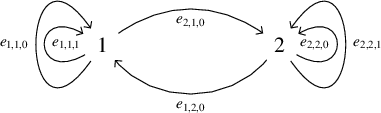

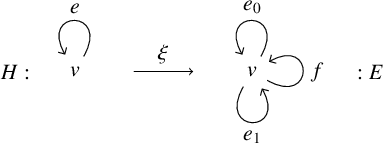

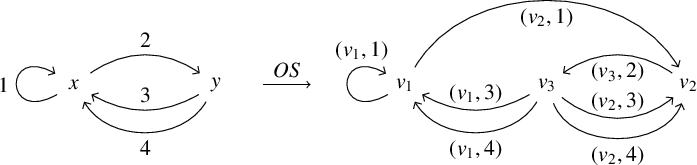
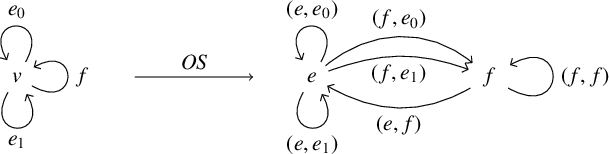
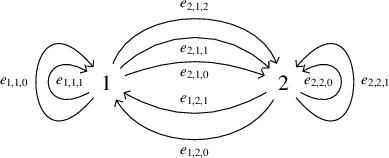



 Open access

