


During the last twenty years, the study of abusive leadership behaviors has rapidly increased (Tepper et al., Reference Tepper, Simon and Park2017). Abusive supervision (AS) is defined as “subordinates’ perceptions of the extent to which supervisors engage in the sustained display of hostile verbal and nonverbal behaviors, excluding physical contact” (Tepper, Reference Tepper2000, p. 178). Years later, AS was identified by the manifestation of hostile managerial behaviors towards subordinates, such as ridicule, yell, humiliate and put-down (Tepper et al., Reference Tepper, Duffy, Henle and Lambert2006). This abusive behavior from supervisors has a negative influence on subordinates, as evidenced by increased levels of stress, anger, anxiety, turnover intentions, and reduced levels of well-being, performance, commitment, and productivity (Tepper et al., Reference Tepper, Simon and Park2017; Zhang & Bednall, Reference Zhang and Bednall2016; Zhang & Liao, Reference Zhang and Liao2015). Additionally, subordinates’ coping the abuse behavior from supervisors promotes more aggressive behaviors on employees and further increases the leader’s abusive behavior (Hon & Lu, Reference Hon and Lu2016; Tepper et al., Reference Tepper, Simon and Park2017; Zhang & Lui, Reference Zhang and Liu2018). Previous AS research demonstrated several consequences on employees, such as negatively affecting leader-member exchange (LMX) relations, employees’ job satisfaction and self-efficacy, impairing team members creativity and creating interpersonal deviance on the work group (Bowling & Michel, Reference Bowling and Michel2011; Choi et al., Reference Choi, Kim and Yun2019; Decoster et al., Reference Decoster, Camps, Stouten, Vandevyvere and Tripp2013; Jiang et al., Reference Jiang, Gu and Tang2019; Liu et al., Reference Liu, Liao and Loi2012; Mawritz et al., Reference Mawritz, Mayer, Hoobler, Wayne and Marinova2012). Furthermore, the presence of abuse is also related to more deep damage, such as employees’ strain, anxiety, depression, and exhaustion, and leads to negative externalities such as subordinates engaging to drinking problems (Bamberger & Bacharach, Reference Bamberger and Bacharach2006; Pyc et al., Reference Pyc, Meltzer and Liu2017). Besides, previous research demonstrated leaders modify the behavior day by day and can be more abusive one day than another day (Kelemen et al., Reference Kelemen, Matthews and Breevaart2000). Abusive leadership is a quite detrimental negative daily real damage for organizations. Supervisors abusive behavior can differ daily influencing the employee’s events in the working place every day, and it is worth to examine the daily destructive power of this abuse, and how it affects personal resources reflected in less affective and cognitive resources (Park et al., Reference Park, Kim, Jung, Yun and Hai2021; Qin et al., Reference Qin, Huang, Johnson, Hu and Ju2018; Yu & Duffy, Reference Yu and Duffy2021).
Most AS research has been focused on behavioral and organizational outcomes framed with social and relational theoretical perspectives (Tepper et al., Reference Tepper, Simon and Park2017) finding that employees lose their resources displaying emotional exhaustion (Akram et al., Reference Akram, Li and Akram2019; Lam et al., Reference Lam, Walter and Huang2017; Lee et al., Reference Lee, Kim and Yun2018; Wang et al., Reference Wang, Jiang, Yang and Shing Chan2016; Wheeler et al., Reference Wheeler, Halbesleben and Whitman2013; and Wu et al., Reference Wu, Hu and Yang2013). Moreover, employees with negatives emotions are more frequently able to be victims of abusive leaders. Employees’ feelings of shame and fear were found to be linked to coworker and self-abuse (Henle & Gross, Reference Henle and Gross2014; Peng et al., Reference Peng, Schaubroeck, Chong and Li2019). In addition, research investigated the important role of gender: Women react differently to AS than men and prefer not to go to work or leave the job rather than facing the supervisor (Chu, Reference Chu2014; Peng et al., Reference Peng, Schaubroeck, Chong and Li2019; Pradhan et al., Reference Pradhan, Jena and Mohapatra2018). While abusive supervisory behaviors are part of a leader’s behavioral pattern, research has shown that the extent to which leaders are abusive towards their employees varies from day to day (Courtright et al., Reference Courtright, Gardner, Smith, McCormick and Colbert2016; Yu & Duffy, Reference Yu and Duffy2021). Barnes et al. (Reference Barnes, Lucianetti, Bhave and Christian2015) also showed that daily abusive behavior fluctuated and was related to a negative daily sleep quality. Therefore, organizations need to be aware of and prevent the negative emotions abusive supervisors causes on subordinates (Xia et al., Reference Xia, Zhang and Li2019). These previous finding encourages future research to investigate the fluctuation of other variables, such as anxiety, health, emotions, and well-being variables on a daily basis. In the current study, we contribute investigating these daily fluctuations in AS and how they affect followers on a day-to-day basis.
As noted above, the day-to-day working relation between supervisor and employees varies; the abusive behavior increases or decreases trough days according to the leadership dynamic (Kelemen et al., Reference Kelemen, Matthews and Breevaart2020). Specifically, we contribute investigating how daily AS affects daily employees’ recovery after work. Previous studies suggest that AS affects followers not only at work, but also at home, making it likely that AS affects followers’ daily recovery from their work. According to Sonnentag and Fritz (Reference Sonnentag and Fritz2007), employees who engaged in a day-to-day positive recovery showed positive moods, more energy and lower stress levels. The repercussion of daily AS on employees’ emotions is still scarce. To study the underlying mechanism between daily AS and employees’ daily recovery, we focused on how AS affects employees’ emotional experiences. While not much is known about the relationship between AS and employees’ emotional experiences, we applied the affective events theory (AET) (Weiss & Cropanzano, Reference Weiss, Cropanzano, Staw and Cummings1996) to within-person perspective to hypothesize that abusive leaders can affect employees’ daily fluctuation of positive and negative emotions through the working day. We also apply the job demands-resources model (JD-R) (Bakker & Demerouti, Reference Bakker, Demerouti, Cooper and Chen2014), investigating the role and possible effect of the personal resource (Wu et al., Reference Wu, Hu and Yang2013) recovery within the relationship of the AS, as the social aspect of a high job demand (Huang, et al., Reference Huang, Su, Lin and Lu2019; Huang, et al., Reference Huang, Lin and Lu2020; Tepper, Reference Tepper2007, Velez & Neves, Reference Velez and Neves2016), and daily negative and positive employee emotions. We hypothesize under the JD-R model that if employees have a high-quality recovery experience after work, then negative emotions decrease, and they can recover positive emotions to slow down the daily effect of abuse. Finally, we contribute analyzing how AS, daily emotions, and recovery can be affected by predictive variables such as the type of company, day, gender, marital status, and tenure.
Abusive Supervision and Employee Emotions
According to the AET (Weiss & Cropanzano, Reference Weiss, Cropanzano, Staw and Cummings1996), employee emotions can be affected by supervisor behavior (Cropanzano et al., Reference Cropanzano, Dasborough and Weiss2017). Previous research demonstrated that positive and negative affective factors, such as emotions, are related to employee identification with the supervisor (Ashkanasy & Dorris, Reference Ashkanasy and Dorris2017). Additionally, when subordinates received abusive treatment, this further affected employees’ emotions, e.g., an employee who suffers AS can experience negative emotions such as anger or fear (Peng et al., Reference Peng, Schaubroeck, Chong and Li2019). Furthermore, prior findings show that AS leads subordinates to negative effects and encourages adverse reactions to strive the abuse and mechanisms to improve well-being (Oh & Farh, Reference Oh and Farh2017; Tse et al., Reference Tse, Troth, Ashkanasy and Collins2018). In order to investigate affective states, the AET has been used as a framework to help researchers to understand employee’s emotions variations and find the link between work events and emotional responses (Weiss & Beal, Reference Weiss, Beal, Ashkanasy and Härtel2005). Additionally, researchers found that negative emotions and negative affective states are related to AS (Michel et al., Reference Michel, Newness and Duniewicz2015). Based on the premise that emotions vary across individuals and grounded in the knowledge that subjective feelings change within-person across time (Naeem et al., Reference Naeem, Weng, Ali and Hameed2020; Tse et al., Reference Tse, Troth, Ashkanasy and Collins2018), we argue that employees’ emotions can fluctuate during the working day if they experience diverse abuse episodes perpetrated by supervisors.
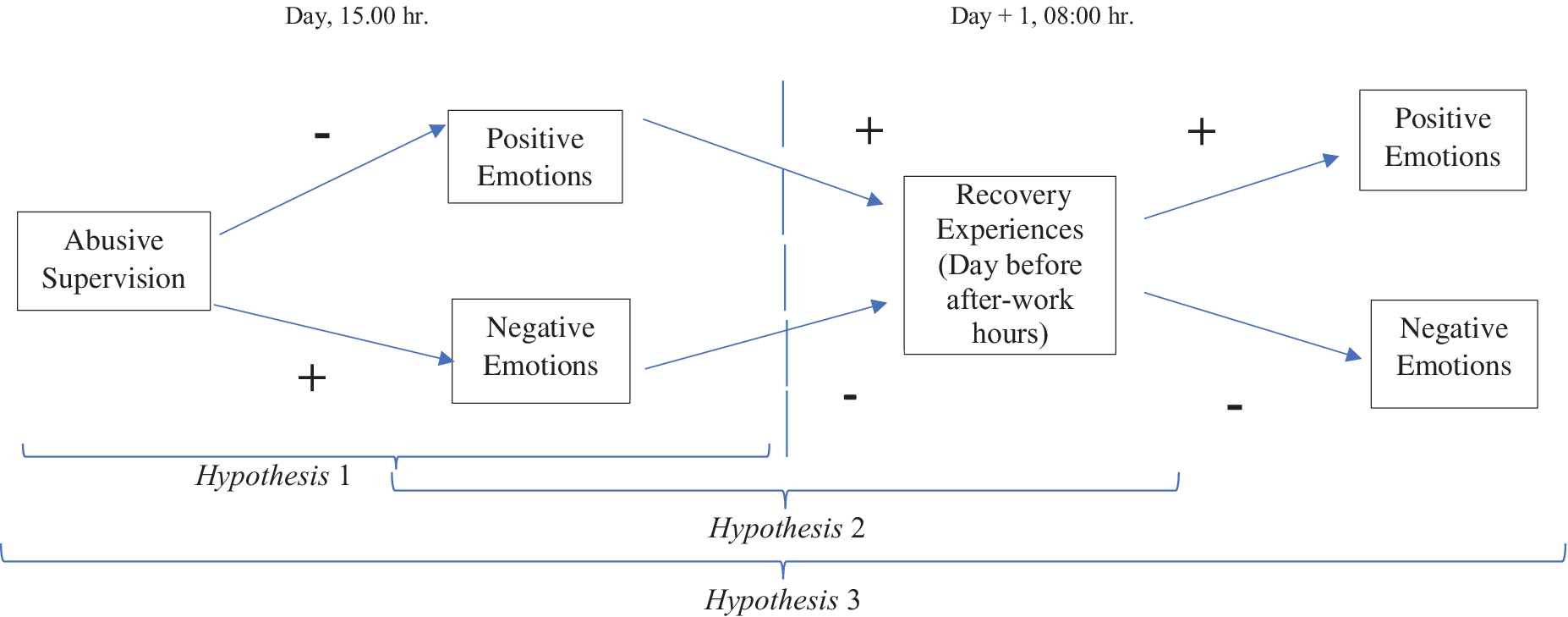
Hypothesis 1: Daily AS influences the emotions fluctuation by: (a) Decreasing followers’ daily positive emotions in the afternoon, and (b) increasing followers’ daily negative emotions in the afternoon.
The Recovery after Work
Besides the negative effect of AS on employees’ emotions, employees that faced abuse lose more resources than they normally would and need to replenish their resources and continue with the normal daily job demands. When employees are worried all the time, they are incapable of concentrating and focusing on daily work activities (Breevaart & Bakker, Reference Breevaart and Bakker2018). According to the JD-R (Bakker & Demerouti, Reference Bakker, Demerouti, Cooper and Chen2014), the diverse demands at work imply psychological, physical, social and/or organizational efforts, including any extra emotions or efforts made under work pressure as a result of abusive managerial practices. To ensure that next day employees feel energetic again, they must maintain energy levels by undertaking quality recovery experience to restore the strain levels from high-stress levels to low-stress levels (Sonnentag et al., Reference Sonnentag, Venz and Casper2017). Additionally, daily low-effort recreational activities (social or physical) increase the welfare of individuals (Sonnentag et al., Reference Sonnentag, Venz and Casper2017). To understand the degree of damage caused by abusive leaders, we focus our research on daily recovery outcomes to acknowledge that daily work activities demand employees’ resources, impairing internal resources. To frame this recovery process, we focus on the four dimensions that are useful to measure recovery: First, psychological detachment explores whether employees can detach psychologically from work activities in their non-working time. Second, relaxation allows employees to recover from abuse through leisure activities. Third, mastery experience challenges employees to try activities and hobbies that help employees to restore their resources again. Finally, control activities lead employees to make free decisions to enjoy their free time and help them to enhance recovery. Huang et al. (Reference Huang, Su, Lin and Lu2019) found that daily AS affects employee behavior by decreasing motivation and requiring more effort to carry out daily tasks. Furthermore, grounded in the JD-R model, we propose a good daily recovery provides more resources to employees to enhance positive and reduce negative emotions the next working day (Hypothesis 2).
Hypothesis 2: Recovery after work influences fluctuation by: (a) Enhancing the experience of positive emotions the next morning and (b) reducing the experience of negative emotions the next morning.
Additionally, prior research has analyzed that when subordinates are satisfied with other positive outcomes, the supervisors’ hostile behavior towards them can be ignored or even forgotten (Zhang & Liu, Reference Zhang and Liu2018). If employees recover well from stressful situations day by day, they experience more positive emotions (Sonnentag & Fritz, Reference Sonnentag and Fritz2007). In addition, employees’ pleasure time and recreational activities have positive impacts on recovery (van Hooff et al., Reference van Hooff, Geurts, Beckers and Kompier2011). Therefore, our third hypothesis states that AS influences the fluctuation of daily emotions by reducing daily positive emotions and increasing negative daily emotions, but a significant recovery after work restores the positive emotions the next working day (see Fig. 1).
Hypothesis 3: Daily AS influences fluctuation by: (a) Reducing daily followers’ positive emotions in the afternoon, but a significant recovery after work increases again the positive emotions the next morning, by (b) increasing daily followers’ negative emotions in the afternoons, but a significant recovery after work reduces the experience of negative emotions the next morning. Furthermore, there is limited research on the relationship between AS and other predictive variables that can influence the relationship between leader and subordinates. According to Harvey et al. (Reference Harvey, Harris, Gillis and Martinko2014), gender could influence behaviors on the individuals and influence the perception of abuse. Additionally, Ouyang et al. (Reference Ouyang, Lam and Wang2015) found female perception of AS was more negative than a male perception of the same behavior. Previous research also discovered that women react differently and strongly to abusive leaders and prefer leaving the organization before facing their supervisor (Pradhan et al., Reference Pradhan, Jena and Mohapatra2018). Following this, we explore how other predictive variables such as the company, day, gender, marital status, and tenure can affect the relationship between daily AS and employees’ emotions in the afternoon, recovery after work and employees’ emotions the next morning.
Daily research model
Note. The time period ¨hr¨ referred to 24 hr. per day.
Method
Participants
The study was conducted among employees from two companies in Mexico, working in the electronic and finance sectors. We contacted human resource (HR) managers from both companies. To measure employees’ individual perceptions of AS, HR recruited employees that were working under the same supervisor. All participants were full time workers. To guarantee that the responses were confidential, we followed ethical research procedures, and all participants gave written informed consent in accordance with the Declaration of Helsinki. We offered to raffle two food certificates from a famous restaurant in the country for 300 Mexican pesos each, among the employees that finished all the surveys. A total of 102 employees agreed to participate in our study. The sample consisted of 48 men (48.9%) and 54 women (55.1%) who were 40.65 years old on average (SD = 9.11).
Procedures
Data was collected using electronic surveys and were conducted in Spanish. To be able to identify the different responses of the same participant, we informed and asked them to create an identification code before answering the surveys. Participants received daily emails with a link to answer the survey for 10 consecutive working days, the first email at 08.00 hr, when they arrived at the workplace, in which we asked them to report on their positive and negative emotions at that moment, and their recovery experience (psychological detachment, relaxation, mastery and control subscales) of the day before after-work hours. The second email was sent at 15.00 hr, before participants left the workplace, and asked them to report their perception of AS of that day and their positive and negative emotions at that moment, to capture the variances of the emotions through the day. We received completed morning surveys from 67 employees (response rate = 65.96%), a 426 daily-level data, and 59 employees completed afternoon survey (response rate = 57.84%), a 349 daily-level data. The criterion to capture the daily contact between employee and supervisor, and capture differences within the same person across days, only employees who completed three consecutive daily surveys were included in the data set (Breevaart & Zacher, Reference Breevaart and Zacher2019); the missing data from participants that responded only one and two days was removed. Our final sample consisted of 52 employees (response rate = 50.98%), and 347 daily-level data from morning and 255 day-level data from afternoon usable responses. The sample consisted of 18 men (34.6%) and 34 women (65.4%) who were 38.31 years old (SD = 9.15) on average. Most of them were single (42.3%) and married (42.3%) and had an organizational average tenure of 5.04 years (SD = 5.21).
Measures
We followed a translation and back-translation procedure (Brislin, Reference Brislin, Triandis and Berry1980; International Test Commission [ITC], 2017) for the AS scale (Tepper, Reference Tepper2000) (original α = .90). For the emotions, we used the Spanish version of the positive affect and negative affect schedule (PANAS) scale (Dufey & Fernandez, Reference Dufey and Fernandez2012) with an original alpha ranging from .73 to .89. Additionally, we applied the Spanish version of the four-dimensional recovery experience scale (Sanz-Vergel et al., Reference Sanz-Vergel, Sebastián, Rodríguez-Muñoz, Garrosa, Moreno-Jiménez and Sonnentag2010) with original alphas ranging from .74 to .87 (psychological detachment: α = .82; relaxation: α = .74, mastery: α = .84; control α = .87). To investigate the effect of other variables over the relationship between AS, emotions and recovery we used the variables tenure, marital status, gender and days.
Abusive Supervision
AS was measured using a 6-item version of the original unidimensional 15-items AS Scale (ASS; Tepper, Reference Tepper2000) used in Harvey et al. (Reference Harvey, Harris, Gillis and Martinko2014) and Martinko et al. (Reference Martinko, Harvey, Sikora and Douglas2011) studies. We adapted these items to assess employee’s perceptions of daily abusive behavior towards the subordinates who work for the same supervisor. A sample item is “Today, my supervisor made negative comments about some team members” (1 = never to 5 = always). The average Cronbach’s (α) across days in our study was .87.
Emotions
Emotions were measured using the 20-item PANAS scale, which includes 10 positive and 10 negative emotions. The PANAS was originally developed by Watson, Clark and Tellegen (Reference Watson, Clark and Tellegen1988) and adapted to Spanish by Dufey and Fernandez (Reference Dufey and Fernandez2012). A sample item is “How do you feel at this moment: Strong (positive), scared (negative)” (1 = very slightly or not at all to 5 = extremely). The average Cronbach’s (α) across days in our study was .93.
Recovery
Recovery experience were measured using the Spanish version of the 12-item short scale of the original 16-item scale developed by Sonnentag and Fritz (Reference Sonnentag and Fritz2007). It is composed by the four dimensions “psychological detachment”, “relaxation”, “mastery” and “control” with 3-items per dimension (Sanz-Vergel et al., Reference Sanz-Vergel, Sebastián, Rodríguez-Muñoz, Garrosa, Moreno-Jiménez and Sonnentag2010). Participants rated the previous day, after they leave the workplace. A sample item for “psychological detachment” is “Yesterday, did you forget about work?” Cronbach’s (α) across days in our study was .91. A sample item for “relaxation” is “Yesterday, did you use the time to relax?” Cronbach’s (α) across days in our study was .84. A sample item for “mastery” is “Yesterday, did you seek out intellectual challenges?” Cronbach’s (α) across days in our study was .88. A sample item for “control” is “Yesterday, did you decide your own schedule?” Cronbach’s (α) across days in our study was .88. All items were rated on a Likert scale from 1 to 5 (1 = strongly disagree to 5 = strongly agree).
Descriptive Statistics
First, we provided the descriptive analysis of each variable involved in this study in Table 1. In addition, correlational analysis was carried out to evaluate some disturbances in the observed distributions. As expected, AS was positively correlated with negative emotions in the afternoon (r = .32, p < .01) and negatively correlated with positive emotions in the afternoon (r = −.43, p < .01). Additionally, AS was found to be negatively correlated with recovery experience “control” (r = −.18, p < .01); regarding employees´ emotions the next day, AS was found positively associated with negative emotions in the morning (r = .34, p < .01) and negatively associated with positive emotions in the morning (r = −.43, p < .01). Considering the data structure for within-person design, we used the hierarchical linear modeling (HLM) analysis on SPSS to test our hypotheses. The following table shows the fundamental values of the dependent variables because none of the first and second were significant, and the same effect has been estimated through aleatoric effects.
Descriptive Statistics and Correlations
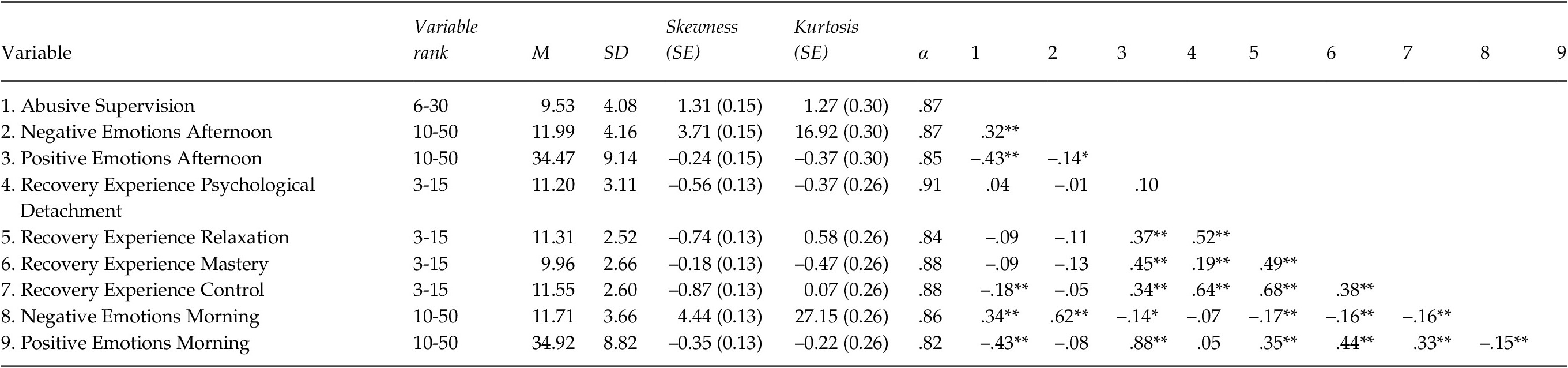
Note. SE = Standard Error.
*p < .05. **p < .01.
Analysis
In view of Table 1, it seems easy to establish that the observed distributions do not conform to normality. The clearest examples are shown in the variables’ total score of negative emotions in the afternoon and total score of negative emotions in the morning (of the next day) with strongly skewed distributions. Therefore, within the different options to take this issue into account, it was decided to analyze the data using some of the robust techniques derived from linear models. This ruled out techniques are not very resistant to the violation of the assumptions of normality.
In view of the previous results, it was decided to estimate a model for each of the dependent variables using hierarchical longitudinal models. The option to rank the models (process of incorporation of the variables) was not based on a stepwise process. Given the sample size, it was decided to estimate the intraclass correlation coefficients (ICC) to establish that the variability observed in each distribution was due to longitudinal variability. For this, the value of the ICC was estimated for the null model and for the model with the main effects. Table 2 shows the ICC for the model with the main effects incorporated as regressors, assuming the random effects of the independent variables (Company, Day, Gender, Marital Status, and Tenure).
HLM Estimation for Predictors for Each Dependent Variable
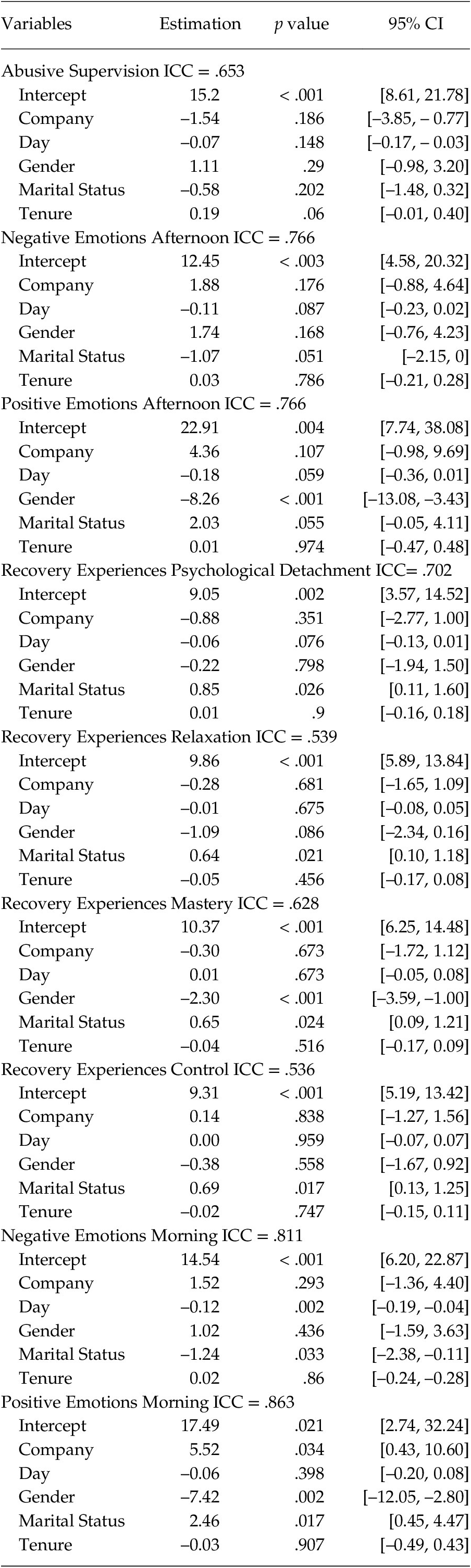
Note. CI = Confidence Interval; ICC = Intraclass Correlation all p < .001.
The following table show the parameter estimates for each dependent variable (Table 2). We used the variables to examine the daily within-person fluctuation. The results revealed significant within-person variances in the intercept of each variable, using hierarchical longitudinal linear models (HLM).
Analytic Strategy
Some statistically significant and relevant results emerge from the table above. We must highlight the positive impact of tenure on total score AS (β = .19; p = .06) which, despite not being statistically significant, we believe should be mentioned for descriptive purposes. Likewise, in the case of the prediction of total score negative emotions in the afternoon, the negative effect appears on marital status (β = –1.07; p = .051). Regarding the distribution of the total score for positive emotions in the afternoon, the effect of gender (β = –8.26; p < .001) were of much greater intensity than the effects of day (β = –.18; p = .059) and marital status (β = 2.03; p = .055) or tenure (β = .01; p = .974).
In the case of the total score for recovery experience as “psychological detachment” variable, we highlight the statistically significant effect due to marital status (β = .85; p = .026). In the model corresponding to the total score for recovery experience “relaxation”, the relevant effect is, again, due to marital status (β = .64; p = .021). It is also maintained in the total score for the recovery experience “mastery” variable in which appear marital status (β = .65; p = .024) and the effect due to gender (β = –2.30; p < .001). Also, the relevant effect of marital status (β = .69; p = .017) for the variable of total the score for recovery experience “control”.
In the last two models of the previous table, we highlight in the case of the total score for negative emotions in the morning with relevant effect of day (β = –.12; p = .002) and marital status (β = –1.24; p = .033). On total the score for positive emotions morning the relevant effect is on three variables: Company (β = 5.52; p = .034), gender (β = –7.42; p = .002) and marital status (β = 2.46; p = .017).
Tests of the Hypotheses
In Hypothesis 1, we proposed that daily AS influences the fluctuation by: (a) Decreasing followers’ daily positive emotions in the afternoon and (b) increasing followers’ daily negative emotions in the afternoon. The results revealed a strong alteration of employees’ positive and negative emotions in the afternoon. However, daily AS does not show effect influencing (a) the decrease of daily positive emotions in the afternoon or (b) the increase of the daily negative emotions in the afternoon. Thus, H 1a and H 1b were not supported.
In Hypothesis 2, we proposed daily recovery after work influences fluctuation by: (a) Enhancing the experience of positive emotions the next morning and (b) reducing the experience of negative emotions the next morning. Our results show that three of the four dimensions of recovery have an effect: a) The positive recovery experience in “relaxation” (r = .35; p < .01), “mastery” (r = .44; p < .01), and “control” (r = .33; p < .01) have a positive effect on emotions next morning; (b) the negative recovery experience in “relaxation” (r = –.17; p < .01), “mastery” (r = –.16; p < .01), and “control” (r = –.16; p < .01) have a negative effect on next day negative emotions in the morning. Supporting mainly H 2a, “relaxation”, “mastery” and “control” dimensions of recovery experience enhanced positive emotions the next morning. H 2b was also mainly supported, because recovery reduced the negative emotions the next day. The exception in the recovery experience was with “psychological detachment”. It did not present any recovery effect on both, positive and negative emotions.
Following Hypothesis 3, we expected that daily AS influence fluctuation by: (a) Reducing daily followers’ positive emotions in the afternoon, but a significant recovery after work enhances the experience of positive emotions the next morning, (b) reducing daily followers’ negative emotions in the afternoons, but a significant recovery after work reduces the experience of negative emotions the next morning. Following Hypothesis 1, AS has not effect (a) on reducing positive emotions in the afternoon, which have a positive effect on after-work recovery experience in “relaxation” (r = .35; p < .01), “mastery” (r = .44; p < .01), and “control” (r = .33; p < .01); and this recovery experience has an effect on enhancing positive emotions the next morning. Also, daily AS has not effect influencing by (b) reducing daily followers’ negative emotions in the afternoons. Despite that, recovery showed an effect over negative emotions the next morning on “relaxation” (r = –.17; p < .01), “mastery” (r = –.16; p < .01), and “control” (r = –.16; p < .01); but the negative emotions the next morning does not showed effects. Consequently, H 3a was partially supported, because afterwork, some recovery effect was found on three dimensions and because recovery enhanced positive emotions the next day. Despite the results showed some daily effect due to the recovery, this does not have any effect reducing the negative emotions the next working day. Thus, H 3b was not supported.
Additionally, we found effects on the predictive variables’ day, gender, marital status and tenure. Our analysis shows an effect of day reducing the level of both emotions: As the days of the week go by, positive emotions in the afternoon and negative emotions in the morning decrease. Besides, gender shows more negative effect on men than on women: Men showed a more negative effect on positive emotions in the afternoon and in the next morning and for the recovery dimension "mastery". Also, marital status shows by incrementing the four dimensions of recovery more predictive effect over married individuals: Their positive emotions increase, and their negative emotions reduce, both, in the afternoon and in the next morning. Finally, we found that tenure has effect over AS: The longer employees work in the company; more likely it is for them to suffer AS.
Discussion
Previous studies noticed an absence of research on how AS influences the non-working time and claimed the necessity to explore if non-work events produce situations that influence the relationship between abusive leaders and employees (Tepper et al., Reference Tepper, Simon and Park2017). In response to these concerns, our research examined how daily AS has effects over daily employees’ emotions fluctuations on positive and negative emotions throughout the day, and how after work, through a recovery experience, employees can or cannot improve the emotions of the next day. Our results show that the abusive behavior of supervisors has an effect predicting the fluctuation of employees’ daily positives and negative emotions and how a recovery experience can restore the positive emotions the next day but cannot have an effect restoring the negative emotions the next day and therefore cannot recover completely from the effects of abuse.
Furthermore, prior studies showed that recovery activities are not completely independent, and some domestic activities influenced recovery if the home activities depleted resources (Sonnentag et al., Reference Sonnentag, Venz and Casper2017). Accordingly, we found that factors besides AS, such as gender and marital status can influence the daily recovery experience of employees with regard to improving their emotions again. These results demonstrate interesting findings: When the AS is present, it has an impact on employees’ daily emotions. We further evidence that the positive emotions in the workday can be recovered day by day, but not enough to complete restoration; and how other variables, such as marital status and gender play an important role participating in the recovery after work.
The findings of our research provide theoretical and practical contributions for AS literature and organizations. Our results provide evidence showing that employees can be daily emotionally affected by abusive leaders and how difficult it is to improve entirely the negative emotions as consequence of these damages. AS involves multiple demands from employees, when they waste resources, negative emotions manifest stronger (Tepper et al., Reference Tepper, Simon and Park2017). Furthermore, our study makes a novel contribution by researching the daily recovery of the non-working time on emotions of abused employees, showing that some recovery occurs, restoring the daily positive emotions, similar to prior studies that showed that positive relaxation after work was related to daily positive affective states (Sonnentag et al., Reference Sonnentag, Venz and Casper2017).
Additionally, this study offers practical implications to companies and HR directors by means of a clear display of the negative emotional consequences of AS on their employees. Hence, organizations and HR departments should consider developing effective strategies to detect and mitigate the emotional damage caused by supervisors, to prepare awareness programs, provide psychological sessions to employees to help them psychologically, continue to train supervisors to avoid any abusive behavior, and going deeper implementing training programs to find more factors that can be involved in the none-recovery process. For example, giving advice to employees with lower wellness or poor daily recovery can result in less stressors (Sonnentag, Reference Sonnentag2015). Our result implies the importance of being detached from work after finishing the workday. To optimize recovery, some action has to be taken e.g., not overloading employees by imposing excessive overtime or calling employees after they finished working.
As with every study, our research presents several limitations. First, the sample size was small. Despite finding important effects of AS with regards to the variables, the limited sample size and did not allow for further analysis. However, to minimize common method variance issues we collected data twice per day, in the morning and afternoon to test the daily effect (Qin et al., Reference Qin, Huang, Johnson, Hu and Ju2018), allowing us to find results that demonstrate the daily negative power of AS. Second, our study focused only on the analysis of the effect within the subordinate-level, and we did not assess between subordinates’ level. This limited us from discovering if the effect of AS is similarly affecting all subordinates’ emotions working by the same leader, and if recovery works in same way on the team. Third, our sample was collected in a country, Mexico, with a cultural context where the research on AS is scarce. It limited our research because we did not have any precedent on how AS is developed and if the culture of the country can influence or have impact on the perception of abuse and on the behaviors.
Also, our findings have implications for future research. First, our study should be replicated with a bigger sample to see if the fluctuations of specific emotions continue within-person and between-persons; also, with a larger sample size other type of analyses can be applied to capture how the recovery process works (e.g., structural equation modeling). Second, while our study measures recovery on a daily basis, it could be relevant to examine this recovery experience through longer periods of time, through longitudinal measures, as employees may have a good recovery from abuse on longer term recoveries e.g., after a vacations period or holidays. Sonnentag et al. (Reference Sonnentag, Venz and Casper2017) found that feeling recovered is stronger after vacations, holidays, or long weekends. Third, our results suggest that future research should further investigate other independent factors, as gender or marital status, to find how other factors can influence the perception of abuse and affect the abusive behavior of the own supervisor. Pradhan et al. (Reference Pradhan, Jena and Mohapatra2018) provided evidence that AS is perceived differently across genders, as well as affecting differently women and men. Finally, future AS research needs to be expanded to Latin American countries to investigate the impact and development of abusive leaders in Latin cultures.
Our study contributes to the AS literature by revealing the deep daily damage to employees’ positive and negative emotions as a consequence of working under an abusive leader. Moreover, we showed that the recovery of daily positive emotions is possible; also, we demonstrated that other factors such as marital status and gender can affect the emotions and recovery. Overall, our findings suggest the importance of investigating the effects and consequences of AS on employees’ emotions, and equally important is examining potential recovery outcomes.


 Open access

