





Introduction
Traditionally, the median sternal incision, which contributes to clear field exposure and easy surgical manipulation, is selected as the main surgical access for heart valvular diseases. However, some shortcomings of median sternal incision have been found during clinical practice, such as a scary appearance due to a longer incision of 20 cm, an unstable thoracic cavity, an increased risk of sternal infection Reference Phoon and Hwang1 and a higher bleeding tendency; therefore, more postoperative pains and discomforts adversely affect the outcome of patients. Recently, a novel minimally invasive attempt has been introduced into the surgical strategy of heart valvular diseases. Currently, a consensus between surgeons and patients has been established that a video-assisted minimally invasive heart surgery through an intercostal incision is free from sternum injury with decreased sternal infection and also better appearance, less transfusion, and faster postoperative recovery. Reference Gumus, Hasde, Bermede, Kilickap and Durdu2 Nowadays, the video-assisted minimally invasive surgery for a single heart valve has been performed in several medical centres around the world with the fact that the clinical outcome of patients is relatively satisfactory. Reference Bonaros, Hoefer and Oezpeker3 Whereas, compared with the learning curve of video-assisted minimally invasive surgery for a single heart valve, that for multiple heart valves is longer and more difficult. Hence, there is less literature or reports on this topic. Reference Dinh, Chuong, Hieu, Thuan and Nam4,Reference Paparella, Margari and Santarpino5 In this paper, we have tried to present and share some initial experience focusing on the video-assisted minimally invasive surgery for combined heart valves.
Material and method
Patients
A total of 50 patients undergoing video-assisted minimally invasive surgery for combined heart valvular diseases were selected from Jun. 2022 to Apr. 2025. The combined valves within surgical procedures were set as mitral valve plus tricuspid valve, aortic valve plus mitral/tricuspid valve, and mitral valve plus tricuspid valve concomitant with a larger atrial septal defect. The patients with a smaller aortic annulus, severe calcification at the posterior mitral annulus, failed femoral cannulation due to anatomical abnormalities of the femoral artery, severe adhesion of the right thoracic cavity, redo-cardiac surgery, or combined coronary artery bypass grafting due to complications with coronary heart disease were excluded. This study has been approved by the ethics committee of the first affiliated hospital of Anhui Medical University (approval number: PJ 2025-05-71). All patients have signed informed consent before surgery. Clinical trial number: not applicable.
Surgical procedures
A double-lumen endobronchial intubation was performed under general anaesthesia (single-lumen endotracheal intubation was considerable). The right upper limb was positioned in abduction and the chest was padded higher by 20–30°. The surface defibrillation device was ready for emergency. Peripheral cardiopulmonary bypass was established through femoral artery-venous bypass, and if necessary, another internal jugular venous bypass was also added due to unsatisfactory drainage. Vacuum-assisted venous drainage was available regularly with a negative pressure < −40 mmHg. CO2 was filled through a trocar port. A two-dimensional vision at a range within 30° was set.
For the surgical procedure of combined mitral and tricuspid valves, the 4th right intercostal incision along the anterior axillary line was set as the primary access with a length of 4–5 cm. The video port was the trocar placed into the 4th intercostal space between the anterior axillary and midaxillary lines. A Chitwood clamp was inserted through the 3rd intercostal space along the anterior axillary line. The right pericardial traction stitches were pulled out through the trocar. The mitral valve was exposed by the left atrium retractor via the interatrial groove incision, and the tricuspid valve was exposed via the right atrial incision (Figure 1( a )).
Blue arrow shows the main incision, ( a ) is for mitral and aortic valve; ( b ) is for mitral and tricuspid valve; ( c ) is for mitral and tricuspid valve concomitant atrial septal defect.

For the surgical procedure of combined aortic and mitral valves, the 3rd intercostal incision next to the sternum was set as the primary access with a length of 5–6 cm and 1 cm away from the right internal mammary artery with the aim to avoid damage to the right internal mammary artery. Both left and right pericardial margins were suspended at the surface of skin around the incision. Then, a soft tissue retractor was placed, through which the traction suture was held. The ascending aorta was clamped by a Glauber clamp through an incision directly or a Chitwood clamper inserted through the 3rd intercostal space along the anterior axillary line. The video could be inserted through the primary access. The aortic valve was exposed through an oblique incision of the ascending aorta. The mitral valve was exposed through an interatrial groove incision. If necessary, the tricuspid valve was exposed through a right atrial incision (Figure 1( b )).
For the surgical procedure of combined mitral and tricuspid valves concomitant with a large defect of the atrial septal, the 4th right intercostal incision along the midclavicular line was set as the primary access. The video port was the trocar placed into the 4th intercostal space between anterior axillary lines. A Chitwood clamper was inserted through the 3rd intercostal space along the anterior axillary line. The tricuspid valve was exposed through a right atrial incision. The surgical procedure of the mitral valve was completed through a large defect of the atrial septum suspended by traction stitches. Finally, the tricuspid valve repair was completed after the large defect was patched (Figure 1( c )). The replacement for both aortic and mitral valves was performed with interrupted suture. The repair for the mitral valve was performed with junctional suture, rings, and artificial chordae tendineae. Moreover, the repair of the tricuspid valve was performed with rings or key’s. At the end of the surgery, all patients will receive ropivacaine for intercostal nerve block to relieve postoperative pain. All perioperative data of patients was collected.
Statistics
Continuous variables were expressed as mean ± standard deviation (x̄ ± s), and Student’s t-test was used. Categorical variables were expressed as percentages, and Fisher’s exact test was used. Software of SPSS 26.0 (SPSS Inc., Chicago) was run for data analysis. P < 0.05 is considered as the statistical significance.
Results
Demographic baseline
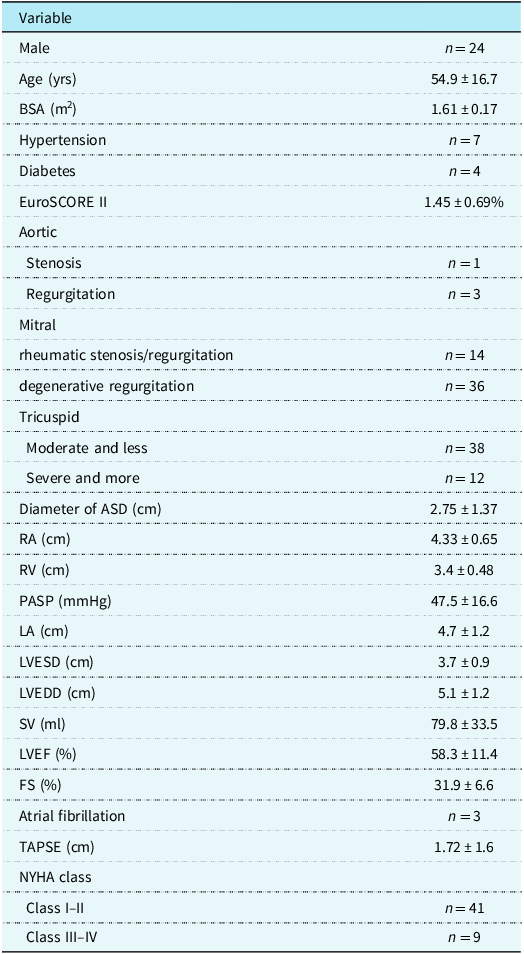
The age of the patients ranged from 19 to 82 yrs; the average age was 54.9 ± 16.7 yrs, with 24 male cases. There were 7 and 4 patients complicated with hypertension and diabetes, respectively (Table 1).
Baseline patient characteristics

BSA = body surface area; ASD = atrial septal defect; RA = right atrium; RV = right ventricle; PASP = pulmonary arterial systolic pressure; LA = left atrium; LVESD = left ventricular end-systolic dimension; LVEDD = left ventricular end-diastolic dimension; SV = stroke volume; LVEF = left ventricular ejection fraction; FC = fractional shortening; TAPSE = tricuspid annular plane systolic excursion; NYHA = New York Heart Association.
Surgical procedures
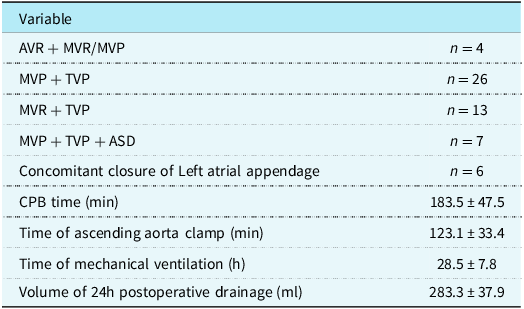
All 50 patients underwent video-assisted minimally invasive surgery completely, and there was no patient with an exceptional conversion to open surgery. There were 26 patients for mitral valve repair plus tricuspid valve repair, 13 for mitral valve replacement plus tricuspid valve repair (1 case with concomitant MAZE IV procedure), 7 for mitral valve repair plus tricuspid valve repair plus large atrial septal defect repair, as well as 4 for aortic valve replacement plus mitral valve replacement/repair. The times of cardiopulmonary bypass and ascending aorta clamping were 183.5 ± 47.5 min and 123.1 ± 33.4 min, respectively. The time of postoperative mechanical ventilation was 28.5 ± 7.8 h. The volume of 24 h postoperative drainage was 283.3 ± 37.9 ml. There were 14 patients who were transfused with blood products (Table 2).
Operative characteristics and post-operative outcomes

AVR = aortic valve replacement; MVR = mitral valve replacement; MVP = mitral valve repair; TVP = tricuspid annuloplasty; ASD = Tricuspid annuloplasty; CPB = cardiopulmonary bypass.
Postoperative complications
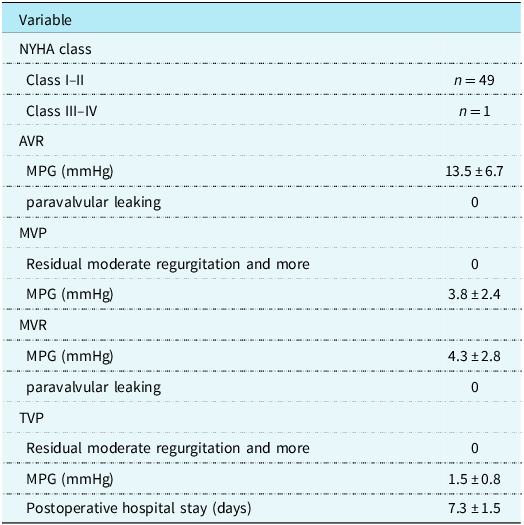
A total of 49 patients were discharged as expected, except for only 1 elderly (82 yrs) patient who was transferred into a local medical institution for extended rehabilitation due to delayed postoperative awakening. Postoperative complications were not found, such as severe infection, implantation of an intra-aortic balloon pump, continuous renal replacement therapy and tracheostomy.
Outcome at discharging
Postoperatively, the heart function of patients has been improved significantly. It has been demonstrated by echocardiography that the haemodynamics of replaced mitral and aortic valves were stable without paravalvular leaking. The mitral and tricuspid valves exhibit only mild or no regurgitation, with no moderate or severe regurgitation observed. Additionally, the forward flow velocity of these two valves does not increase (Table 3).
Outcome at discharging

AVR = aortic valve replacement; MVR = mitral valve replacement; MVP = mitral valve repair; TVP = tricuspid annuloplasty; MPG = mean pressure gradient.
Discussion
It has been considered that the easier and more convenient median sternal incision is a classic access in the surgical procedure of heart valvular diseases. However, some concerns about adverse events caused by this access, such as sternal and incision unhealing, mediastinal infection, increased risk of bleeding, and scary appearance, have gradually risen. Following the updates of surgical techniques, different minimally invasive incisions have been adopted and standardised, Reference Zhao, Wei and Zhu6 for instance, suprasternal incision, Reference Alkady and Abouramadan7,Reference Risteski, Monsefi and Miskovic8 Da Vinci robotic intercostal incision Reference Rao, Tauber and Szeto9 and video-assisted intercostal incision, Reference Qiao, An and Chen10 among which video-assisted intercostal incision is a more preferred and favoured option for minimally invasive surgery of heart valvular diseases. At present, in most heart centres, it has been demonstrated that minimally invasive surgery through video-assisted intercostal incision is indicated for the surgical strategy of single heart valvular disease. Reference Berdajs, Miazza, Koechlin, Gahl, Reuthebuch and Eckstein11 Nevertheless, different from single valvular disease, video-assisted minimally invasive surgery for combined valvular diseases is more difficult and challenging. Both skilled manipulations and comprehensive surgical thoughts are critical for this kind of minimally invasive surgery for combined valvular diseases.
Surgical details
Access
For video-assisted surgery of combined aortic and mitral valves, the candidate primary accesses are transverse incision of the 3rd right intercostal space next to the sternum, Reference Lu, Zhu and Long12 transverse incision of the 3rd intercostal space along the anterior axillary line, Reference Nakayama, Nakamura and Kanamori13 and transverse incision of the 4th intercostal space right infra-axillary thoracotomy with a length of 5–6 cm. Different incisions meet corresponding surgical demands. The author selects the incision next to the sternum as primary access with a variety of cautious considerations: (1) this incision is closer to intracardiac tissues, which means some surgical manipulations (suture and knotting) may be performed with available common devices; (2) the surgical procedure for the aortic valve can be performed directly, and the mitral valve is exposed directly using a regular retractor through a left atrial incision without the need of an additional port for the left atrial retractor. It is more friendly to surgeons and especially acceptable to beginners. For thinner patients, to some extent, this kind of incision is more predominant, whereas it is not indicated for patients with larger thoracic cavities or obesity, especially for those with a special shape of ascending aorta closer to the sternal back or with left-side dominance due to increased surgical difficulties. For video-assisted surgical procedures of combined mitral and tricuspid valves, the commonly selected access is an inner horizontal incision of the 4th right intercostal space along the anterior axillary line for better exposure of the mitral and tricuspid valves with a length of 4–5 cm [9]. Actually, vertical incision is also possible in case of inaccurate position and damaged breast tissue caused by extraordinary obesity and larger breasts of females, respectively. Besides, if a right elevated diaphragm is obvious, an incision of the 3rd intercostal space is also reasonable. A surgical viewpoint has been acknowledged that malformation of the mitral valve is commonly found in adult patients with large atrial septal defects requiring patch repair and a smaller posterior leaflet is the predominant pathological alteration. Interestingly, preoperative regurgitation is not as severe as expected due to the compressed annulus by the dilation of the right heart system. When a large defect is patched, the compression from the right heart to the left heart is released, leading to a complete blood transfer from the left atrium to the ventricle and subsequent dilation of the mitral annulus which is associated with increased mitral regurgitation. Taking this secondary regurgitation into consideration, not only is the dysfunctional tricuspid valve with severe regurgitation repaired, but also mitral valve repair is performed synchronously. Hence, horizontal incision of the 4th intercostal space along the right midclavicular line, which is surgically compatible for both repair of mitral and tricuspid valves and patch of atrial septal defect, is selected as the primary access. Additionally, for female patients, although primary access is kept with a length of 4–5 cm, skin incision may be lower than the usual plan with the aim to maintain a better appearance and protect the breast.
Venous drainage
Completed venous drainage plays an important role during the minimally invasive surgery of heart valvular diseases. The drainage may be inadequate with only a single femoral venous bypass. Accordingly, it is more significant for effective drainage when an extra right internal jugular venous bypass is added. Nevertheless, added venous bypass-related events should not be ignored, including longer surgical time, higher risk of infection, bleeding, and tissue injury. During the earlier stage of video-assisted surgery for heart valvular diseases, a double-venous bypass had been adopted in our centre until 1 patient was diagnosed with a diffused haematoma of the right pleura due to damaged pleura caused by an inappropriate internal jugular venous puncture. Although guided by intraoperative transesophageal echocardiography, the risk of puncture-related injury decreased, but even for experienced manipulators, internal jugular vein injury is unavoidable. That is why, nowadays, single femoral venous unipolar bypass is a preferred option. For surgery of combined mitral and tricuspid valves, firstly, the mitral valve is targeted within the left atrium through an interatrial groove incision. In our opinion, the tip of the femoral venous bypass should be inserted into the superior vena cava with a depth of 3–4 cm before exposure of the mitral valve by the left atrial retractor. If not enough, the femoral venous bypass will be withdrawn from the superior vena cava when the left atrium is suspended by the left atrial retractor, leading to incomplete venous drainage and elevated central vein pressure. After the mitral valve procedure, the interatrial groove incision is closed, and maintenance of left heart suction is not compulsive; then, the right atrium is opened. Immediately, the tip of the femoral venous bypass should be backward into the inlet of the inferior vena cava. The blood in the superior vena cava can be pooled into the femoral venous bypass by a higher head position. If still inadequate, more drainage is added with 3 attempts through primary access (without extra incisions) and right atrial incision: (1) suction of the aortic root is activated, and left heart suction is withdrawn from the left atrium and placed into the superior vena cava with increased flow; (2) another regular venous bypass is inserted into the superior vena cava to establish a double-venous drainage mode. This modification can improve drainage significantly, whereas the surgical vision may be covered partly, and the procedure of the tricuspid valve is slightly difficult. (3) Reference Wu, Ma, Li and Ni14 A cut regular venous bypass is inserted into the superior vena cava, and the tip of the femoral venous bypass is placed into the regular venous bypass to form an “inner tunnel,” through which blood within the superior vena cava is directly pooled into the femoral venous bypass. For surgery of combined aortic and mitral valves, since there is no need to open the right atrium, a single femoral venous bypass is enough for effective drainage. If necessary to open the right atrium, the same description as mentioned above. For surgery of combined mitral and tricuspid valves complicated with a large atrial septal defect, if complex for procedure of the mitral valve, an extra jugular venous bypass is placed and the superior vena cava is banded to expose the mitral valve completely. If not complex, only annuloplasty is needed, and right internal jugular venous bypass is not necessary, and drainage of the superior vena cava is the same as that mentioned above. Whether the superior vena cava is banded or not depends on the placement necessity of the right internal jugular venous bypass. Generally, with the assistance of the vacuum-assist venous drainage, there is no need to band the inferior vena cava.
Exposure and suture
For surgery of combined aortic and mitral valves, there are 6 traction stitches sutured onto the skin for pericardium suspension (3 stitches on the left and the other 3 stiches on the right). Then, stitches are held into a soft tissue retractor. Lastly, the retractor is placed and fixed. After that, the heart is exposed completely, then we do not have to worry so much about the position and the angle of the ascending aorta (angle between the ascending aorta and the patient’s midline > 45°). Reference Musumeci, Lio and Montalto15 For surgery of combined mitral and tricuspid valves complicated with atrial septal defect, there are 3 traction stitches sutured onto the right pericardium and pulled out through the trocar without any additional ports. The aortic valve is exposed well through an incision opened by 3 traction stitches (2 proximal stitches and 1 distal stitch). The skin puncture of the left atrial retractor is usually parallel to the right upper pulmonary vein in order to expose the mitral valve easily. When the tricuspid valve is exposed, the first stitch is sutured at the midpoint of the anterior annulus and then pulled a little harder. For surgery of combined aortic and mitral valves, we set stitches around the aortic annulus without knotting, then, when the procedure of the mitral valve is completed, finally the knotting of the aortic sutures is performed.
Selection of endotracheal intubation
The usage of a dual-lumen endotracheal tube or endotracheal blocker may lead to collapse of the right lung in order to provide a stable manipulated platform for video-assisted surgery, but it also increases risk and financial cost. A conventional single-lumen endotracheal tube is our preferred option if there is no severe adhesion found within the thoracic cavity. For surgery of combined aortic and mitral valves, since the manipulated space is relatively smaller, the pericardium can be exposed after the right lung is compressed with wet gauze, and the heart is well exposed after the pericardium is suspended. For surgery of combined mitral and tricuspid valves, cardiopulmonary bypass is activated and run at full flow, then mechanical ventilation is ceased. The pericardium is opened, and another 3 traction stitches are sutured onto the right to keep the right lung from video vision. A small tidal volume (100–200 ml) is maintained until the ascending aorta is clamped and ventilation is restarted after the heart re-beats. Ventilation is ceased temporarily for 1–2 min for the remaining necessary manipulations within the thoracic cavity after weaning of cardiopulmonary bypass. Mostly, surgery is completed with a single-lumen endotracheal tube.
Feasibility and safety
Besides intraoperative optimal strategy, preoperative assessment is also important. More than preoperative routine tests, CTA of the total aorta is indispensable to screen atherosclerosis and evaluate femoral artery structure. Reference Lamelas, Williams, Mawad and LaPietra16 Especially for patients with large septal defects, the diameter of the femoral artery is relatively smaller; thus, an appropriate femoral artery bypass or even bilateral femoral artery bypasses should be considered. Furthermore, some patients are thought to be contraindicated for this kind of surgery due to more difficulties during surgical manipulation, including one with severe calcification and left-side dominance of the ascending aorta, a significantly smaller aortic annulus, a severely calcified aortic valve with even the left ventricle involved, and poorer heart function. The selected 50 patients in the current study were assessed perioperatively and underwent surgery successfully, and there was no conversion to open surgery, major bleeding, heart re-beating difficulty, or other adverse events. Undoubtedly, compared with median sternotomy, the time of cardiopulmonary bypass and aorta cross-clamp in video-assisted surgery of combined heart valvular disease is longer, Reference Doenst, Berretta and Bonaros17 which is associated with a higher incidence of organic dysfunction for patients with renal and respiratory system injury before surgery, which means we should be cautious about making surgical decisions for this cohort. In this study, only 1 older patient was complicated with delayed awakening. Reference LaPietra, Santana and Mihos18 Other postoperative complications were not found, such as reoperation for bleeding, renal failure, tracheostomy and mechanical circulatory support. The total outcome is satisfactory and similar to that reported in previous studies. Reference Sabatino, Okoh and Chao19,Reference Santana, Xydas and Williams20 When discharging, the function of the replaced aortic and mitral valves was satisfactory, and there was no paravalvular leaking. There was no or less than mild regurgitation for repaired mitral and tricuspid valves. There was no residual shunt for the patched atrial septal. Overall, the heart function significantly improved. Therefore, we conclude that video-assisted surgery of combined heart valvular disease is feasible safe, and the postoperative outcome is optimal. Reference Faerber, Tkebuchava and Scherag21–Reference Yang, Soliman and Pepe23
Limitations & expectation
This is a retrospective study in a single centre. The sample is smaller, and all patients are classified as low risky, Reference Salenger, Ad and Grant24 whether this procedure can be applied to high-risk patients requires further study. The clinical value of video-assisted surgery of combined heart valvular diseases to patients with intermediate- and high-risk is still unknown. In China, the aortic sutureless valve Reference Baghai, Glauber and Fontaine25 and the automated fastener device Cor-Knot have not been widely used yet. It is believed that the development of video-assisted surgery of combined heart valvular diseases should be more optimistic following the wider application of these devices.
Conclusion
Through accurate preoperative evaluation and modified intraoperative techniques, video-assisted surgery of combined heart valvular diseases is safe and effective, and the short-term outcome is satisfactory.
Acknowledgements
Not applicable.
Author contributions
Study conception and design were performed by Jinguo Xu and Chengxin Zhang. The operative data collection was performed by Jinguo Xu. Statistical analysis of the data and the writing of the first draft of the paper were performed by Jinguo Xu. Chengxin Zhang revised the article. All authors confirmed the final version of the paper. All authors read and approved the final manuscript.
Financial support
This work was financially supported by the Clinical and Translational Research Project of Anhui Province (202427b10020131,202427b10020140), Scientific Research Fund project of Anhui Medical University (2023xkj147,2023xkj152), Provincial quality project of University in Anhui province (2024xsxx136) and Open Fund of the State Key Laboratory of Catalysis in Dalian Institute of Chemical Physics, Chinese Academy of Sciences (DICP, CAS) (N-23-16).
Competing interests
The authors have no conflicts of interest to declare.
Ethical standard
This retrospective study was approved by the Institutional Review Board at the First Affiliated Hospital of Anhui Medical University (No.PJ2025-05-71). All patients have signed informed consent.
Availability of data and materials
All data analysed during this study and its supplementary information files have been presented as separate ones of attached Excel Format.
Consent for publication
Not applicable.
Patient and public involvement
Not applicable.


 Open access

