Miner et al. (Reference Miner, Walker, Bergman, Jean, Carter-Sowell, January and Kanaus2018) call for industrial and organizational (I-O) psychologists to examine the societal structures that influence women's underrepresentation in STEM. Here we extend their ideas and suggest that diversity in STEM would benefit from considering how people develop within the context of their environment. Educational researchers refer to the knowledge people develop through daily experiences with their cultural milieu as funds of knowledge. Funds of knowledge essentially represent a person's expertise, and educational researchers have recognized that designing environments that draw from expertise facilitates success for students, including women and underrepresented minorities in STEM.
Here we (a) describe the funds of knowledge framework, (b) highlight the value of this framework in facilitating success in STEM, and (c) suggest a research agenda for using funds of knowledge to address diversity issues in STEM schools and organizations. Our contribution is in introducing funds of knowledge as a viable framework for examining the success of women and underrepresented minorities in STEM and more generally as a useful approach in I-O psychology.
Funds of Knowledge
Funds of knowledge is a theoretical framework introduced by González (Reference González, González, Moll and Amanti2005), Moll, Amanti, Neff, and Gonzalez (Reference Moll, Amanti, Neff and Gonzalez1992), and Vélez-Ibáñez and Greenberg (Reference Vélez-Ibáñez, Greenberg, González, Moll and Amanti2005), and is defined as the “historically accumulated and culturally developed bodies of knowledge and skills essential for household or individual functioning and well-being” (Moll et al., Reference Moll, Amanti, Neff and Gonzalez1992, p. 133). Researchers and teachers work alongside students and their families to identify household knowledge and skills, and subsequently design classroom lesson plans and activities that draw upon the identified expertise (González, Moll, Tenery, et al., Reference González, Moll, Tenery, Rivera, Rendón, Gonzales, Amanti, González, Moll and Amanti2005). We refer readers to González, Moll, and Amanti (Reference González, Moll and Amanti2005) for a comprehensive review.
Funds of Knowledge in STEM Education
The funds of knowledge perspective acknowledges that students from backgrounds where role models (e.g., parents) successfully navigate established systems (i.e., school or work) will be more successful, not because they are smarter or more motivated per se but because they already have important knowledge that facilitates the transition from high school STEM education to college (e.g., how to network with professors and join research labs). By contrast, students from underrepresented backgrounds may have less exposure to traditional educational contexts through role models, which may negatively affect their performance in school. Moreover, the knowledge under-represented students likely possess—although varied and extensive—may not apply as readily to traditional postsecondary educational environments.
Research suggests classroom interventions that clearly connect students’ funds of knowledge and STEM performance environments lead to more favorable outcomes for women and underrepresented minorities in STEM (see Verdin, Godwin, & Capobianco [Reference Verdin, Godwin and Capobianco2016] for a review). That is, connecting classroom activities to students’ lived experiences can support and enhance STEM learning and facilitate interest and positive beliefs about STEM (e.g., Basu & Calabrese Barton, Reference Basu and Calabrese Barton2007; Mejia, Wilson-Lopez, Hailey, Hasbun, & Householder, Reference Mejia, Wilson-Lopez, Hailey, Hasbun and Householder2014; Stevens, Andrade, & Page, Reference Stevens, Andrade and Page2016).
Funds of Knowledge in STEM and Beyond
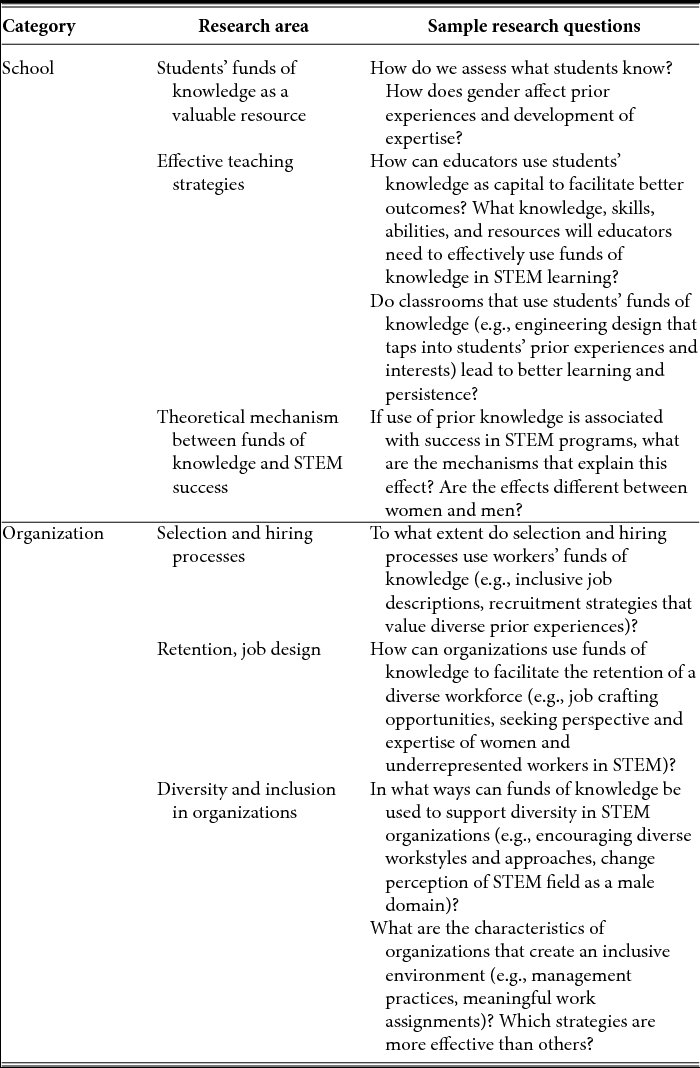
STEM organizations—like all organizations—struggle to attract and retain a diverse workforce. Research questions that can be addressed through a funds of knowledge approach are shown in Table 1. Currently, sparse research demonstrates the application of expertise in the STEM classroom, and even fewer studies have examined the STEM organization (only 14 studies examining funds of knowledge in STEM education were found; see Verdin et al., Reference Verdin, Godwin and Capobianco2016).
Table 1.Research Needs for Using Funds of Knowledge to Address Diversity Issues in STEM
One consideration in the funds of knowledge approach is that it is essential to understand what students bring to the table in terms of existing knowledge. To identify students’ expertise, I-O psychologists can further develop valid and reliable tools and methods that involve students and their families. Additionally, we need to identify the institutional changes that can be strategically designed to connect the experiences and strengths of students with the STEM curriculum.
More generally, organizational scientists have not typically focused on the funds of knowledge that make workers successful, and more effort is needed to define the knowledge construct and on knowledge measurement (Beier, Young, & Villado, Reference Beier, Young, Villado, Ones, Anderson, Viswesvaran and Sinangil2018). A greater understanding of what people know and the extent to which the environment can be tailored to use prior knowledge will potentially increase the fit between the worker and the work environment. For example, organizations can strategically tailor job tasks to use workers’ prior experiences, such as when managers allow employees to use well-learned tools and/or processes rather than adopt those most prevalent in the organization and more generally when workers are strategically positioned in the organization in roles that capitalize on their unique skills and abilities. Similar to key challenges in educational environments, a key strategy in the funds of knowledge approach for working adults will be assessing worker funds of knowledge.
Because it permits students and workers to capitalize on a diverse set of prior knowledge and experience, the funds of knowledge approach has promise for increasing the participation of women in STEM education programs and organizations. However, more work is needed to understand how gender and status as an underrepresented minority would affect experiences that influence the development of funds of knowledge. The funds of knowledge approach suggests one active strategy in which instructors and managers can make the experiences, values, and interests of women and underrepresented minority students relevant.





Miner et al. (Reference Miner, Walker, Bergman, Jean, Carter-Sowell, January and Kanaus2018) call for industrial and organizational (I-O) psychologists to examine the societal structures that influence women's underrepresentation in STEM. Here we extend their ideas and suggest that diversity in STEM would benefit from considering how people develop within the context of their environment. Educational researchers refer to the knowledge people develop through daily experiences with their cultural milieu as funds of knowledge. Funds of knowledge essentially represent a person's expertise, and educational researchers have recognized that designing environments that draw from expertise facilitates success for students, including women and underrepresented minorities in STEM.
Here we (a) describe the funds of knowledge framework, (b) highlight the value of this framework in facilitating success in STEM, and (c) suggest a research agenda for using funds of knowledge to address diversity issues in STEM schools and organizations. Our contribution is in introducing funds of knowledge as a viable framework for examining the success of women and underrepresented minorities in STEM and more generally as a useful approach in I-O psychology.
Funds of Knowledge
Funds of knowledge is a theoretical framework introduced by González (Reference González, González, Moll and Amanti2005), Moll, Amanti, Neff, and Gonzalez (Reference Moll, Amanti, Neff and Gonzalez1992), and Vélez-Ibáñez and Greenberg (Reference Vélez-Ibáñez, Greenberg, González, Moll and Amanti2005), and is defined as the “historically accumulated and culturally developed bodies of knowledge and skills essential for household or individual functioning and well-being” (Moll et al., Reference Moll, Amanti, Neff and Gonzalez1992, p. 133). Researchers and teachers work alongside students and their families to identify household knowledge and skills, and subsequently design classroom lesson plans and activities that draw upon the identified expertise (González, Moll, Tenery, et al., Reference González, Moll, Tenery, Rivera, Rendón, Gonzales, Amanti, González, Moll and Amanti2005). We refer readers to González, Moll, and Amanti (Reference González, Moll and Amanti2005) for a comprehensive review.
Funds of Knowledge in STEM Education
The funds of knowledge perspective acknowledges that students from backgrounds where role models (e.g., parents) successfully navigate established systems (i.e., school or work) will be more successful, not because they are smarter or more motivated per se but because they already have important knowledge that facilitates the transition from high school STEM education to college (e.g., how to network with professors and join research labs). By contrast, students from underrepresented backgrounds may have less exposure to traditional educational contexts through role models, which may negatively affect their performance in school. Moreover, the knowledge under-represented students likely possess—although varied and extensive—may not apply as readily to traditional postsecondary educational environments.
Research suggests classroom interventions that clearly connect students’ funds of knowledge and STEM performance environments lead to more favorable outcomes for women and underrepresented minorities in STEM (see Verdin, Godwin, & Capobianco [Reference Verdin, Godwin and Capobianco2016] for a review). That is, connecting classroom activities to students’ lived experiences can support and enhance STEM learning and facilitate interest and positive beliefs about STEM (e.g., Basu & Calabrese Barton, Reference Basu and Calabrese Barton2007; Mejia, Wilson-Lopez, Hailey, Hasbun, & Householder, Reference Mejia, Wilson-Lopez, Hailey, Hasbun and Householder2014; Stevens, Andrade, & Page, Reference Stevens, Andrade and Page2016).
Funds of Knowledge in STEM and Beyond
STEM organizations—like all organizations—struggle to attract and retain a diverse workforce. Research questions that can be addressed through a funds of knowledge approach are shown in Table 1. Currently, sparse research demonstrates the application of expertise in the STEM classroom, and even fewer studies have examined the STEM organization (only 14 studies examining funds of knowledge in STEM education were found; see Verdin et al., Reference Verdin, Godwin and Capobianco2016).
Research Needs for Using Funds of Knowledge to Address Diversity Issues in STEM
One consideration in the funds of knowledge approach is that it is essential to understand what students bring to the table in terms of existing knowledge. To identify students’ expertise, I-O psychologists can further develop valid and reliable tools and methods that involve students and their families. Additionally, we need to identify the institutional changes that can be strategically designed to connect the experiences and strengths of students with the STEM curriculum.
More generally, organizational scientists have not typically focused on the funds of knowledge that make workers successful, and more effort is needed to define the knowledge construct and on knowledge measurement (Beier, Young, & Villado, Reference Beier, Young, Villado, Ones, Anderson, Viswesvaran and Sinangil2018). A greater understanding of what people know and the extent to which the environment can be tailored to use prior knowledge will potentially increase the fit between the worker and the work environment. For example, organizations can strategically tailor job tasks to use workers’ prior experiences, such as when managers allow employees to use well-learned tools and/or processes rather than adopt those most prevalent in the organization and more generally when workers are strategically positioned in the organization in roles that capitalize on their unique skills and abilities. Similar to key challenges in educational environments, a key strategy in the funds of knowledge approach for working adults will be assessing worker funds of knowledge.
Because it permits students and workers to capitalize on a diverse set of prior knowledge and experience, the funds of knowledge approach has promise for increasing the participation of women in STEM education programs and organizations. However, more work is needed to understand how gender and status as an underrepresented minority would affect experiences that influence the development of funds of knowledge. The funds of knowledge approach suggests one active strategy in which instructors and managers can make the experiences, values, and interests of women and underrepresented minority students relevant.