


Knowledge about determinants of tobacco use and of nicotine dependence is required for effective tobacco control. Prenatal exposure to tobacco has been implicated as such a determinant, since nicotine crosses the placenta barrier, and can result in even higher fetal than maternal blood concentrations. Reference Hellstrom–Lindahl and Nordberg1 Nicotine acetylcholine receptors are present in the fetal brain from the fourth week of gestation onwards, Reference Hellstrom–Lindahl and Nordberg1 and it has been suggested that exposure to nicotine can lead to sensitisation and early disruption of acetylcholine-mediated pathways (teratogenesis). Reference Slotkin, Tate, Cousins and Seidler2 Ultimately, these functional and perhaps morphological changes could result in an enhanced vulnerability to tobacco dependence. Reference Hellstrom–Lindahl and Nordberg1 This hypothesis is supported by findings from animal studies, Reference Slotkin, Tate, Cousins and Seidler2,Reference Levin, Lawrence, Petro, Horton, Seidler and Slotkin3 and from studies on human cell systems. Reference Hellstrom–Lindahl, Seiger, Kjaeldgaard and Nordberg4
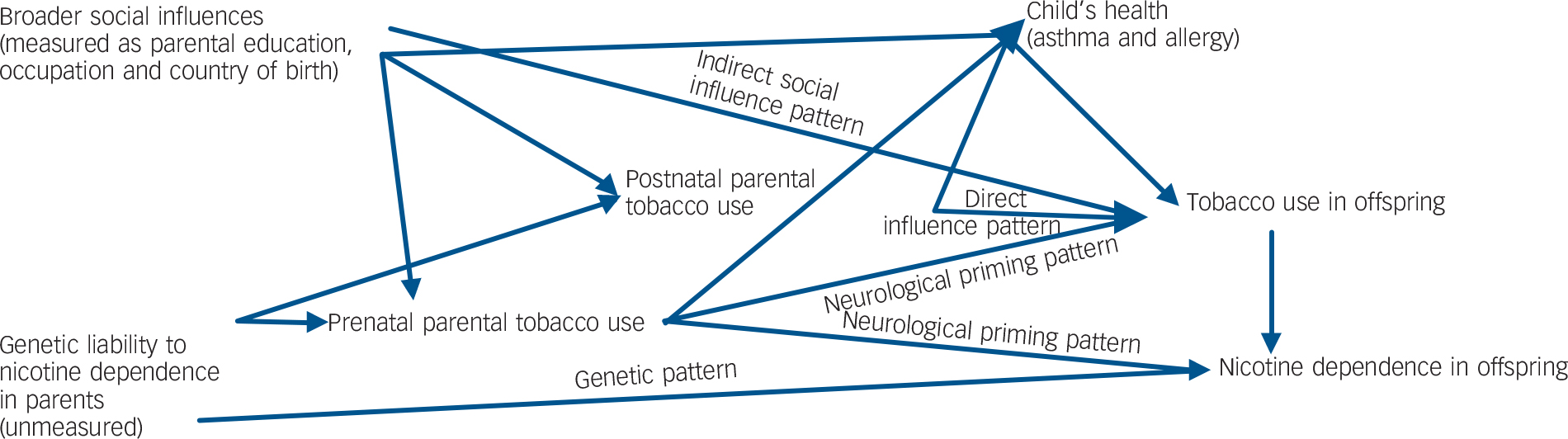
However, neurological teratogenesis is not the only mechanism by which prenatal tobacco exposure may be linked to tobacco use and/or nicotine dependence later in life. The causal model Reference Hernan, Hernandez–Diaz, Werler and Mitchell5 presented in Fig. 1 posits that maternal tobacco use can be associated with use and dependence through: (a) a common genetic liability; Reference Kendler, Thornton and Pedersen6 (b) direct behavioural influence of parental postnatal tobacco use; Reference Tyas and Pederson7 and (c) influence from common social factors Reference Tyas and Pederson7 on both maternal and children's behaviour. In light of the complexity of this causal model, it is not surprising that the few existing studies of tobacco uptake have yielded inconsistent results, including reports of positive, Reference Oncken, McKee, Krishnan–Sarin, O'Malley and Mazure8–Reference Tehranifar, Liao, Ferris and Terry18 null Reference Roberts, Munafo, Rodriguez, Drury, Murphy and Neale19,Reference Cornelius, Leech, Goldschmidt and Day20 or even inverse associations. Reference Porath and Fried21,Reference Buka, Shenassa and Niaura22 Stronger evidence of a positive and causal association have, however, been found in relation to nicotine dependence. Reference Oncken, McKee, Krishnan–Sarin, O'Malley and Mazure8–Reference Kardia, Pomerleau, Rozek and Marks10,Reference Buka, Shenassa and Niaura22,Reference O'Callaghan, Al Mamun, O'Callaghan, Alati, Najman and Williams23 Our understanding of the potential brain priming impact of fetal nicotine exposure is thus hampered by incomplete control of confounding in prior studies. In addition, there are no data on smokeless tobacco use, either as a source of prenatal exposure to nicotine or as an offspring outcome.
The primary purpose of this study, based on a large prospective cohort of youths, was to clarify whether there is an association between prenatal tobacco exposure and risk of tobacco use and dependence during adolescence, after controlling for the influence of parental postnatal tobacco use as well as familial social position. Secondarily, we wanted to assess whether such an association differs between genders. In fact, animal studies indicated a stronger effect of prenatal exposure to nicotine among females, Reference Levin, Lawrence, Petro, Horton, Seidler and Slotkin3 while previous epidemiological studies were inconsistent. Reference Al Mamun, O'Callaghan, Alati, O'Callaghan, Najman and Williams12,Reference Roberts, Munafo, Rodriguez, Drury, Murphy and Neale19
Method
Study population
The BROMS (Children's Smoking and Environment in Stockholm County) cohort study was conducted in Stockholm County between 1998 and 2005, with the main purpose of studying development and determinants of tobacco use in adolescence. The study was approved by the ethical board at Huddinge University Hospital and has been described in detail elsewhere. Reference Post, Galanti and Gilliam24,Reference Post, Gilljam, Rosendahl, Bremberg and Galanti25 Briefly, 3020 children recruited during the fifth grade of compulsory school (average age 11 years) were followed until 3 years after compulsory school (average 18 years), resulting in one baseline assessment and six follow-up surveys. At each survey, the children reported their past and current tobacco use by means of a structured questionnaire. The annual participation rate ranged from 87 to 96%, with 69% of the adolescents participating in all surveys. At baseline, the children's parents were also asked to complete a questionnaire eliciting information on parental characteristics (participation rate 99%). Reference Post, Galanti and Gilliam24
Possible associations between prenatal exposure to tobacco, tobacco use, and nicotine dependence in offspring.
Measures
Exposure
Information regarding prenatal exposure to tobacco was reported from parents at baseline. The mother and father were separately asked whether they smoked or used snus (the Swedish form of moist oral snuff) when the mother was pregnant with the index child. Parental tobacco use was investigated according to both timing (use during the first or second/third trimesters of pregnancy) and frequency (daily or occasional).
Prenatal tobacco exposure from the maternal source was defined as the mother's self-reported use of any tobacco (cigarettes and/or snus), categorised as: any v. none. As very few mothers changed their tobacco use during the pregnancy, duration of use was not considered.
Furthermore, we considered the cumulative passive exposure to the fetus, deriving from maternal tobacco use and from paternal smoking, resulting in one variable with four mutually exclusive categories:
-
(a) exposure from both parents (father smoked at least occasionally during the index pregnancy and mother smoked and/or used snus at least occasionally);
-
(b) exposure to maternal tobacco use only (mother smoked and/or used snus at least occasionally, while father did not use tobacco at all, or only used snus);
-
(c) exposure to paternal smoking only (father smoked at least occasionally, while mother did not use tobacco at all);
-
(d) no prenatal exposure to tobacco use from parental source (no maternal use of tobacco, no paternal smoking).
If non-use of tobacco was reported by a parent during the first trimester of pregnancy, missing information during the second and third trimester was categorised as non-use, since initiation of tobacco use during pregnancy is very rare. Reference Lindqvist, Lendahls, Tollbom, ÅBerg and Håkansson26 Incomplete information regarding either mother's or father's use of tobacco during pregnancy was coded as missing for the combined measure of parental tobacco use. Due to missing values, 142 study participants were excluded from analyses where maternal tobacco use during pregnancy was used as the exposure variable and 327 participants were excluded from analysis where any prenatal tobacco exposure from a parental source (i.e. using information on both maternal and paternal tobacco use) was used.
Outcome
Outcome measures included: onset of any current use and of daily use of tobacco during follow-up; lifetime experience of intense craving for tobacco; lifetime experience of withdrawal symptoms in case of discontinuation of tobacco use; and total current tobacco consumption. The latter three outcomes were based on reports elicited at the age of 17 years.
Onset of tobacco use. Combining answers from survey questions, an average index of total annual consumption was calculated separately for cigarettes and snus. Two outcome variables were analysed for each type of tobacco: onset of any current use (having smoked at least 12 cigarettes or used at least 12 snus dips during the year preceding the survey); and onset of daily use (at least 240 cigarettes or snus dips during the year preceding the survey). Children who were current users at baseline (n = 10), and those who did not take part in any follow-up survey (n = 9) were excluded from the analyses of onset of tobacco use.
Measures of nicotine dependence and withdrawal symptoms. The study population for the analysis of these outcomes consisted of adolescents who reported any current use of tobacco and who participated in the survey conducted at the age of 17 years (2 years after compulsory school) when the assessment of nicotine dependence and withdrawal symptoms was conducted for the first time. Details regarding this assessment have been reported previously. Reference Post, Gilljam, Rosendahl, Bremberg and Galanti25
Among the items used to identify nicotine dependence included in the survey, Reference Post, Gilljam, Rosendahl, Bremberg and Galanti25 we restricted the current analyses to lifetime reports of intense urge to use tobacco (craving). In fact, craving has been found to occur early and frequently in adolescents’ smoking trajectories, and to be independent of withdrawal symptoms. Reference Doubeni, Reed and DiFranza27,Reference Savageau, Mowery and DiFranza28 In addition, it has been argued that the presence of this symptom is sufficient to make a diagnosis of nicotine dependence, based on a neurobehavioural model predicting drug administration and escalation. Reference DiFranza29
The following withdrawal symptoms after discontinued tobacco use were investigated: craving, feeling upset or tense, impaired concentration, feeling depressed, increased appetite/weight, heart palpitation, nausea, anxiety and sleeping problems (all categorised as yes v. no). An index of these items was created, and dichotomised as experienced four or more symptoms v. fewer, based on the median value. The number of symptoms in this analysis represents a conservative estimate because of partially missing answers.
Tobacco consumption. A variable for total tobacco consumption at age 17 was derived, in order to distinguish between high (at least five cigarettes and/or snus dips per day), low (less than five cigarettes and/or snus dips per day) and no consumption.
Other covariates
Postnatal exposure to parental tobacco use was assessed through the children's surveys between the ages of 11 and 14 years (baseline through follow-up wave three). Answers obtained separately for each parent were combined into a summary variable where a child was considered exposed to postnatal tobacco use if the child at any time point recalled either parent using any type of tobacco. Missing information on no more than two occasions, in combination with reports of non-use on the other occasions, was regarded as parental non-use. Apart from this instance, a combination of negative and missing information for any variable was generally categorised as missing.
Family's socioeconomic position was assessed through self-reported information on parental occupation and education. Occupation was coded according to the Swedish socioeconomic classification from Statistics Sweden. Parental education, defined as the number of years each parent had attended school, was categorised as compulsory (⩽9 years), intermediate (10–12 years) or high (>12 years). For the purpose of this study, the mother's occupation and education were primarily used. We also analysed a combined measure of higher education for both parents, coded as: both parents, either parent or neither with college education.
Information on parents’ country of birth was reported by the children at baseline and categorised as both parents, either parent or neither parent born in a Nordic country (i.e. Sweden, Denmark, Finland, Iceland and Norway). Childhood health events that may have influenced tobacco habits were obtained through reports from school nurses. For this analysis, we used information on diagnoses of asthma and allergies (coded as yes v. no).
Statistical analyses
Study populations and analytical samples for the outcomes included in this analysis are reported in Table 1. SAS version 9.2 for Windows was used for all analyses. Onset of tobacco use was analysed by means of Cox regression, with failure time corresponding to the year during which monthly or daily use was first reported. Follow-up time in absence of failure was censored at refusal to continue participation, death or end of follow-up, whichever occurred first. For individuals with intermittent missing information, we assumed that tobacco-using status remained the same until a positive report was obtained. Hazard ratios (HRs) and corresponding 95% confidence intervals (CIs) were used as measures of association and its precision. The assumption of proportionality was verified via calculation of Odds ratios (ORs) of tobacco onset for each year of follow-up, producing similar point estimates with overlapping CIs. Odds ratios of craving, withdrawal symptoms and tobacco consumption at the age of 17 years were calculated through logistic regression.
Analytical samples employed for the various study outcomes

| Outcome | Inclusion criteria |
Analytical
sample, n |
|---|---|---|
| Current smoking |
Cohort participants with at least one follow-up assessment, no previous current smoking at baseline |
3003 |
| Daily smoking |
Cohort participants with at least one follow-up assessment, no previous daily smoking at baseline |
3008 |
| Current snus use |
Male cohort participants with at least one follow-up assessment, no previous current snus use at baseline |
1529 |
| Daily snus
use |
Male cohort participants with at least one follow-up assessment, no previous daily snus use at baseline |
1531 |
| Craving | Cohort participants with at least one follow-up assessment, who at any time reported current tobacco use between the age of 11 and 17 years, and answered the question about feeling a strong urge to use tobacco at age 17 |
897 |
| Withdrawal symptoms |
Cohort participants with at least one follow-up assessment, who at any time reported current tobacco use between the age of 11 and 17 years and answered the questions on withdrawal symptoms at age 17 |
747 |
| Tobacco consumption |
Cohort participants who answered the questionnaire at age 17, with information on total annual amount of both cigarettes and snus used |
2587 |
Adjustments were made for potential confounders following the causal model illustrated in Fig.1. In brief, social characteristics assumed to have a direct or indirect effect on the child's tobacco use and nicotine dependence, as well as the child's health, were considered potential confounders. In multivariate models, we only adjusted for those characteristics that were associated with the respective outcomes in univariate models and modified the crude association between exposure and outcome by at least 10%.
All analyses were done separately among boys and girls. Analyses of snus uptake were restricted to boys, since such uptake was rare in girls.
Results
Sociodemographic characteristics of the study population are shown in Table 2. The majority of the study participants were 11 years or younger at baseline, and had highly educated parents born in Sweden or other Nordic countries. About 27% of the participants with available information were prenatally exposed to maternal tobacco use, while 43% were prenatally exposed to any parental tobacco use. Expectedly, the proportion of individuals exposed to prenatal maternal use of tobacco increased with decreasing level of parental education, and was higher among pregnancies to blue collar workers compared with white collar workers, but was markedly lower if neither parent was born in a Nordic country. Furthermore, 84% of the children prenatally exposed to maternal tobacco use were also exposed to parents’ postnatal tobacco use, in contrast with 41% of those unexposed. During follow-up, 1007 children became current smokers (41.7% of those exposed to prenatal maternal tobacco use, compared with 30.6% of those unexposed), of which 761 started smoking daily (33.7% of those exposed to prenatal maternal tobacco and 22.2% of those unexposed). The corresponding figures for any current snus use were 38.3% of those exposed and 29.2% of those unexposed, while 34.1% and 24.8% for those exposed and unexposed respectively took up daily snus use.
Prevalence of prenatal tobacco exposure in relation to baseline characteristics

| n | Prenatally exposed to maternal use of tobacco, % |
|
|---|---|---|
| Gender | ||
| Male | 1467 | 27.3 |
| Female | 1411 | 27.4 |
| Age | ||
| 11 years or younger | 2480 | 26.9 |
| 12 years or older | 398 | 30.2 |
| Maternal educationFootnote a | ||
| Compulsory | 328 | 43.6 |
| Intermediate | 1089 | 33.1 |
| High | 1403 | 19.5 |
| Parents with college educationFootnote a | ||
| None | 971 | 36.8 |
| One | 734 | 26.7 |
| Both | 928 | 15.1 |
| Maternal occupationFootnote a | ||
| Unskilled worker | 378 | 37.8 |
| Skilled worker | 256 | 30.9 |
| Low-level clerk | 457 | 28.5 |
| Middle-level clerk | 763 | 24.3 |
| High-level clerk | 465 | 19.1 |
| Self-employed | 129 | 23.3 |
| Not in the labour force | 313 | 31.3 |
| Parents' born in the Nordic countriesFootnote a | ||
| Both parents | 2304 | 28.4 |
| One parent | 253 | 27.7 |
| Neither parent | 236 | 16.5 |
| Parents' postnatal tobacco useFootnote a , Footnote b | ||
| Never | 1277 | 9.8 |
| Ever | 1446 | 44.3 |
a. P-value for χ2-test <0.001.
b. Parents' postnatal tobacco use includes any parental smoking or snus use during the index child's age of 11–14 years.
Table 3 gives the crude and adjusted HRs for onset of daily smoking. In both genders, there was a significant crude association with prenatal exposure to tobacco and any smoking in adolescence. The associations were, however, considerably attenuated after adjustment for parental postnatal use of tobacco and parental education. Exposure to both parents’ prenatal use of tobacco was associated with higher risks of daily smoking than exposure to one parental source only. Among boys, daily smoking remained associated with prenatal exposure from both parents and from the father only, after adjustment for potential confounders, while among girls the associations were no longer evident after this adjustment (Table 3). Very similar results were obtained when any current smoking was analysed as an outcome, as well as in the analysis of any current and daily snus use among boys (data not shown).
Odds ratios of lifetime experience of nicotine dependence and withdrawal symptoms at age 17 are shown in Table 4. Compared with those unexposed, girls prenatally exposed to maternal tobacco use had twofold higher adjusted odds of feeling a strong urge to use tobacco (craving), while no association was evident among boys.
Having experienced four or more withdrawal symptoms after discontinuation of tobacco use was more common among children prenatally exposed to parental tobacco compared with those unexposed (Table 4). Separate analyses by gender again showed statistically significant associations only among girls, with ORs of 3.28 if both parents used tobacco, and of 2.30 if only the mother did, but no association with paternal smoking only.
Table 5 shows the adjusted ORs of being a low (less than five cigarettes and/or snus dips per day) or heavy consumer (five or more cigarettes and/or snus dips per day) of tobacco at the age 17 of years. After adjusting for parental postnatal use of tobacco and parental education, girls prenatally exposed to maternal tobacco use had twofold increased odds of being heavy consumers of tobacco compared with girls unexposed to maternal tobacco use, whereas no such an association could be found in boys. Prenatal tobacco exposure was not associated with low consumption of tobacco.
Discussion
In this large prospective study we found clear associations between maternal tobacco use during pregnancy and nicotine dependence as well as heavy smoking among adolescent girls – but not boys. These findings were robust, also when important confounding factors including parental social position and postnatal tobacco use were accounted for. However, prenatal exposure to tobacco was not linked to onset of regular tobacco use in adolescence in a straightforward way. In fact, the association appeared to be confined to boys, and was as strong for maternal as for paternal sources, probably indicating residual confounding. These results are compatible with the theoretical model in Fig.1, postulating social influences as the main causal pathway to substance use initiation, while the importance of intra-uterine exposure would be revealed in the clinical manifestation of dependence (such as strong urge to use tobacco and heavy consumption).
All previous studies where nicotine dependence was analysed in relation to prenatal exposure to maternal smoking showed associations of direction and magnitude very similar to ours. Reference Oncken, McKee, Krishnan–Sarin, O'Malley and Mazure8–Reference Kardia, Pomerleau, Rozek and Marks10,Reference Buka, Shenassa and Niaura22,Reference O'Callaghan, Al Mamun, O'Callaghan, Alati, Najman and Williams23 We add to this knowledge that the strength of withdrawal symptoms appears associated with prenatal exposure to tobacco in a dose–response fashion.
The lack of a clear association between prenatal exposure to tobacco and daily smoking in our study was rather surprising, as onset of daily smoking is an obvious indication of progression in smoking behaviour, which may be related to early onset of dependence. Reference DiFranza, Savageau, Fletcher, Pbert, O'Loughlin and McNeill30 In fact, the majority of earlier studies did report such an association, Reference Oncken, McKee, Krishnan–Sarin, O'Malley and Mazure8–Reference Tehranifar, Liao, Ferris and Terry18 although others did not Reference Roberts, Munafo, Rodriguez, Drury, Murphy and Neale19,Reference Cornelius, Leech, Goldschmidt and Day20 or presented inconsistent results. Reference Porath and Fried21,Reference Buka, Shenassa and Niaura22 However, our findings regarding the risk of high tobacco consumption in late adolescence suggest that transition to more established and regular tobacco use (as opposed to initial episodes of tobacco use) is associated with prenatal exposure to tobacco, which is in line with previous results. Reference Oncken, McKee, Krishnan–Sarin, O'Malley and Mazure8,Reference Kandel, Wu and Davies15,Reference Buka, Shenassa and Niaura22
Comparison of findings between our and other studies is hampered by differences in study designs and population characteristics. For instance, many studies reporting an association between prenatal tobacco exposure and tobacco use in offspring were based on relatively small and/or high-risk samples of pregnant mothers, with low retention at follow-up. Reference Oncken, McKee, Krishnan–Sarin, O'Malley and Mazure8–Reference Kandel, Wu and Davies15,Reference O'Callaghan, O'Callaghan, Najman, Williams, Bor and Alati17,Reference Tehranifar, Liao, Ferris and Terry18,Reference Cornelius, Leech, Goldschmidt and Day20,Reference Porath and Fried21 Also, some studies employed retrospective assessment of prenatal exposure, Reference Oncken, McKee, Krishnan–Sarin, O'Malley and Mazure8–Reference Agrawal, Knopik, Pergadia, Waldron, Bucholz and Martin11,Reference Kandel, Wu and Davies15,Reference Kandel, Griesler and Schaffran16 in some instances even based on reports from the offspring, Reference Oncken, McKee, Krishnan–Sarin, O'Malley and Mazure8,Reference Kardia, Pomerleau, Rozek and Marks10 thus potentially being prone to recall bias. In addition, differences in ages and outcome definition may have contributed to discrepancies. In our analysis, spanning from early to late adolescence, daily tobacco use was categorised as average use of 20 cigarettes or snus dips or more per month during the previous year. Therefore, it is possible that many of these young daily users were far from having completed the progression to the established and intensive consumption pattern considered in other studies. Reference Oncken, McKee, Krishnan–Sarin, O'Malley and Mazure8,Reference Kardia, Pomerleau, Rozek and Marks10,Reference Agrawal, Knopik, Pergadia, Waldron, Bucholz and Martin11,Reference Kandel, Griesler and Schaffran16,Reference Tehranifar, Liao, Ferris and Terry18 The association we found with intense daily use at age 17 speaks in favour of this interpretation. However, confounding by direct and indirect postnatal social influences is the most important concern when interpreting the current evidence. For instance, most previous studies did not adjust for exposure to paternal postnatal influences, as we did in our analysis.
Gender differences
The question of a gender-specific pattern of tobacco progression and nicotine dependence associated with fetal exposures among humans is still unsettled. In fact, four of ten epidemiological studies presenting gender-specific analyses found no difference, Reference Lieb, Schreier, Pfister and Wittchen9,Reference Al Mamun, O'Callaghan, Alati, O'Callaghan, Najman and Williams12,Reference O'Callaghan, O'Callaghan, Najman, Williams, Bor and Alati17,Reference Cornelius, Leech, Goldschmidt and Day20 stronger associations with lifetime-smoking were found in three studies for females, Reference Griesler, Kandel and Davies14,Reference Kandel, Wu and Davies15,Reference Roberts, Munafo, Rodriguez, Drury, Murphy and Neale19 and in one study for males. Reference Porath and Fried21 The two remaining studies showed opposite gender patterns depending on the outcome under study. Reference Oncken, McKee, Krishnan–Sarin, O'Malley and Mazure8,Reference Buka, Shenassa and Niaura22
We found that the associations between prenatal exposures and excess risks of nicotine dependence (Table 4) and high consumption of tobacco (Table 5) were stronger among girls than boys. This finding adds strength to the hypothesis of a stronger vulnerability of the female fetal brain to nicotine neurotoxicity, Reference Levin, Lawrence, Petro, Horton, Seidler and Slotkin3 a vulnerability that may be related to modification of the brain response to nicotine modulated by oestrogens. Reference Dluzen and Anderson31 In fact, such a gender-specificity was not seen with the uptake of current or daily tobacco use (Table 3).
Hazard ratios (HRs) and corresponding confidence intervals (CIs) of onset of daily smoking during adolescence in relation to parental tobacco use during pregnancy

| All | Boys | Girls | |||||||||||
|---|---|---|---|---|---|---|---|---|---|---|---|---|---|
| Crude | AdjustedFootnote a | Crude | AdjustedFootnote a | Crude | AdjustedFootnote a | ||||||||
| Cases | OR | 95% CI | OR | 95% CI | OR | 95% CI | OR | 95% CI | OR | 95% CI | OR | 95% CI | |
| Maternal tobacco use during pregnancy | |||||||||||||
| None | 519 | 1.00 | 1.00 | 1.00 | 1.00 | 1.00 | 1.00 | ||||||
| Any | 264 | 1.76 | 1.51–2.06 | 1.26 | 1.05–1.52 | 1.82 | 1.42–2.32 | 1.36 | 1.01–1.82 | 1.76 | 1.43–2.16 | 1.23 | 0.97–1.57 |
| Parental tobacco use during pregnancyFootnote b | |||||||||||||
| No parental use | 319 | 1.00 | 1.00 | 1.00 | 1.00 | 1.00 | 1.00 | ||||||
| Both maternal tobacco use and paternal smoking |
146 | 2.12 | 1.73–2.60 | 1.40 | 1.09–1.78 | 2.40 | 1.76–3.29 | 1.80 | 1.23–2.63 | 2.00 | 1.52–2.63 | 1.21 | 0.88–1.67 |
| Only maternal tobacco use | 87 | 1.75 | 1.37–2.24 | 1.26 | 0.96–1.66 | 1.84 | 1.24–2.73 | 1.41 | 0.90–2.21 | 1.69 | 1.23–2.32 | 1.18 | 0.84–1.67 |
| Only paternal smoking | 123 | 1.35 | 1.09–1.67 | 1.02 | 0.80–1.31 | 1.71 | 1.23–2.37 | 1.45 | 1.00–2.12 | 1.13 | 0.85–1.50 | 0.79 | 0.57–1.09 |
a. Adjusted for parental postnatal tobacco use during the index child's age of 11–14 years (any v. none) and for parents with college education (none, one or both).
b. Some cases exposed to maternal tobacco use are missing because of missing information on paternal smoking.
Odds ratios (ORs) and corresponding confidence intervals (CIs) of lifetime experience of symptoms of nicotine dependence and withdrawal at age 17 in relation to parental tobacco use during pregnancy

| All | Boys | Girls | ||||||||||||
|---|---|---|---|---|---|---|---|---|---|---|---|---|---|---|
| Crude | AdjustedFootnote a | Crude | AdjustedFootnote a | Crude | AdjustedFootnote a | |||||||||
| Cases | OR | 95% CI | OR | 95% CI | OR | 95% CI | OR | 95% CI | OR | 95% CI | OR | 95% CI | ||
| Craving/strong urge | ||||||||||||||
| Maternal tobacco use during pregnancy | ||||||||||||||
| None | 303 | 1.00 | 1.00 | 1.00 | 1.00 | 1.00 | 1.00 | |||||||
| Any | 195 | 1.78 | 1.33–2.40 | 1.45 | 1.05–2.01 | 1.41 | 0.94–2.11 | 1.10 | 0.69–1.73 | 2.40 | 1.55–3.77 | 2.04 | 1.28–3.32 | |
| Parental tobacco use during pregnancyFootnote b | ||||||||||||||
| No parental use | 211 | 1.00 | 1.00 | 1.00 | 1.00 | 1.00 | 1.00 | |||||||
| Both maternal tobacco use and paternal smoking |
107 | 1.62 | 1.12–2.37 | 1.32 | 0.89–1.98 | 1.14 | 0.69–1.89 | 0.87 | 0.50–1.51 | 2.58 | 1.46–4.73 | 2.24 | 1.22–4.29 | |
| Only maternal tobacco use | 64 | 2.10 | 1.29–3.50 | 1.66 | 1.00–2.83 | 1.54 | 0.79–3.10 | 1.14 | 0.56–2.38 | 2.91 | 1.43–6.41 | 2.45 | 1.17–5.54 | |
| Only paternal smoking | 79 | 0.89 | 0.62–1.28 | 0.74 | 0.50–1.09 | 0.86 | 0.51–1.43 | 0.72 | 0.41–1.23 | 0.92 | 0.55–1.56 | 0.74 | 0.42–1.32 | |
|
At least four withdrawal symptoms
(v. fewer than four) |
||||||||||||||
| Maternal tobacco use during pregnancy | ||||||||||||||
| None | 253 | 1.00 | 1.00 | 1.00 | 1.00 | 1.00 | 1.00 | |||||||
| Any | 161 | 1.86 | 1.34–2.59 | 1.59 | 1.11–2.29 | 1.17 | 0.74–1.86 | 0.92 | 0.54–1.55 | 3.01 | 1.87–4.97 | 2.83 | 1.68–4.87 | |
| Parental tobacco use during pregnancyFootnote b | ||||||||||||||
| No parental use | 163 | 1.00 | 1.00 | 1.00 | 1.00 | 1.00 | 1.00 | |||||||
| Both maternal tobacco use and paternal smoking |
93 | 2.19 | 1.29–2.93 | 1.68 | 1.08–2.62 | 1.20 | 0.69–2.10 | 0.99 | 0.54–1.83 | 3.60 | 1.91–7.22 | 3.28 | 1.66–6.94 | |
| Only maternal tobacco use | 49 | 2.14 | 1.25–3.76 | 2.07 | 1.17–3.79 | 1.96 | 0.88–4.59 | 1.86 | 0.80–4.62 | 2.24 | 1.09–4.88 | 2.30 | 1.06–5.34 | |
| Only paternal smoking | 78 | 1.35 | 0.91–2.02 | 1.18 | 0.77–1.83 | 1.79 | 1.01–3.26 | 1.62 | 0.88–3.04 | 1.04 | 0.60–1.81 | 0.83 | 0.45–1.53 | |
a. Adjusted for parental postnatal tobacco use during the index child's age of 11–14 years (any v. none) and for parents with college education (none, one or both).
b. Some cases exposed to maternal tobacco use are missing because of missing information on paternal smoking.
Adjusted odds ratios (ORs) and corresponding confidence intervals (CIs) of tobacco consumption at age 17 in relation to parental tobacco use during pregnancyFootnote a

| All | Boys | Girls | ||||||||||||
|---|---|---|---|---|---|---|---|---|---|---|---|---|---|---|
| LowFootnote b v. no | HighFootnote b v. no | LowFootnote b v. no | HighFootnote b v. no | LowFootnote b v. no | HighFootnote b v. no | |||||||||
| Cases | OR | 95% CI | Cases | OR | 95% CI | OR | 95% CI | OR | 95% CI | OR | 95% CI | OR | 95% CI | |
| Maternal tobacco use during pregnancy | ||||||||||||||
| None | 684 | 1.00 | 225 | 1.00 | 1.00 | 1.00 | 1.00 | 1.00 | ||||||
| Any | 228 | 1.07 | 0.85–1.34 | 145 | 1.61 | 1.23–2.12 | 1.12 | 0.81–1.55 | 1.36 | 0.93–2.00 | 1.02 | 0.75–1.40 | 1.93 | 1.30–2.86 |
| Parental tobacco use during pregnancyFootnote c | ||||||||||||||
| No parental use | 516 | 1.00 | 155 | 1.00 | 1.00 | 1.00 | 1.00 | 1.00 | ||||||
| Both maternal tobacco use and paternal smoking |
117 | 1.12 | 0.83–1.50 | 84 | 1.72 | 1.21–2.43 | 1.20 | 0.79–1.84 | 1.56 | 0.96–2.53 | 1.04 | 0.69–1.59 | 1.90 | 1.15–3.13 |
| Only maternal tobacco use | 87 | 1.03 | 0.74–1.42 | 51 | 1.43 | 0.96–2.12 | 0.83 | 0.52–1.31 | 0.98 | 0.57–1.70 | 1.28 | 0.81–2.04 | 2.12 | 1.20–3.75 |
| Only paternal smoking | 154 | 1.03 | 0.79–1.34 | 65 | 1.02 | 0.72–1.44 | 1.04 | 0.72–1.51 | 1.11 | 0.70–1.76 | 1.02 | 0.71–1.47 | 0.89 | 0.53–1.52 |
a. Adjusted for parental postnatal tobacco use during the index child's age of 11–14 years (any v. none) and for parents with college education (none, one or both).
b. Low consumption = less than five cigarettes and/or snus dips per day; high consumption = five or more cigarettes and/or snus dips per day.
c Some cases exposed to maternal tobacco use are missing because of missing information on paternal smoking.
Nicotine dependence is difficult to assess at young ages, when its features may be partly different from those seen among adults. Reference DiFranza, Savageau, Rigotti, Fletcher, Ockene and McNeill32 Therefore, discrepancies between studies may be related to methods and timing of this assessment. To investigate nicotine dependence we used a single item suitable to adolescents’ low intensity and low level of regularity in using tobacco, Reference DiFranza, Savageau, Rigotti, Fletcher, Ockene and McNeill32 while other studies relied on complete scales mostly used among adults. Reference Oncken, McKee, Krishnan–Sarin, O'Malley and Mazure8–Reference Kardia, Pomerleau, Rozek and Marks10,Reference Buka, Shenassa and Niaura22,Reference O'Callaghan, Al Mamun, O'Callaghan, Alati, Najman and Williams23 Further, our study included the outcomes of both smoking and smokeless tobacco use, two behaviours with a recognised uneven gender distribution in the Swedish population. Reference Furberg, Lichtenstein, Pedersen, Bulik and Sullivan33 For instance, only 6.6% of girls became current snus users at any time during follow-up in our sample. It is possible that the lower frequency of quit attempts found among exclusive snus users compared with pure smokers in this cohort Reference Post, Gilljam, Rosendahl, Bremberg and Galanti25 accounts for the lack of detectable associations or paradoxical findings concerning symptoms of dependence and withdrawal among boys. Other explanations for the somewhat inconsistent patterns of boys’ tobacco use in relation to exposure may be the considerable group of dual users, or residual confounding from parental postnatal influences. Finally, the separate analyses by gender presented in this study were based on small samples, although the sample size was similar in boys and girls.
Strengths and limitations
This study has several strengths. First, it was based on a large longitudinal sample with high retention at follow-up. Prenatal exposures were assessed prospectively and outcomes were assessed through repeated measurements over 7 years. Recognising that maternal smoking may not be the only source of tobacco toxicants to the fetus, we also included information on maternal snus use and paternal smoking during the index pregnancy (as a possible source of passive prenatal tobacco exposure). Although the distant recall of pregnancy tobacco use by the parents might have introduced some misclassification, a validation study among mothers of the children in the BROMS cohort showed good concordance with self-reports of smoking elicited during pregnancy. Reference Post, Gilljam, Rosendahl, Meurling, Bremberg and Galanti34 This good concordance is further supported by findings from an American study that showed high congruency between retrospective reports of pregnancy smoking, prospective reports and levels of urinary cotinine. Reference Pickett, Kasza, Biesecker, Wright and Wakschlag35 Likewise, a validation study of a subsample of this cohort's participants showed a 98% concordance between self-reported no use of any tobacco in the past month and cotinine concentration in saliva, with a sensitivity of 90% and specificity of 93%. Reference Post, Gilljam, Rosendahl, Meurling, Bremberg and Galanti34 Finally, we could adjust for major confounders chosen a priori, Reference Hernan, Hernandez–Diaz, Werler and Mitchell5 according to a theoretical model. Parental use of tobacco during childhood and adolescence is one of the factors with the strongest impact on adolescent smoking, Reference Shenassa, McCaffery, Swan, Khroyan, Shakib and Lerman36 probably acting through both role modelling and availability of tobacco. In this study, we took advantage of repeated reports on parent's tobacco use as experienced by their children (i.e. the final target of social influences).
Some limitations should be kept in mind when interpreting our results. Children of highly educated parents born in Nordic countries were overrepresented, because of initial selection owing to parental consent. Reference Post, Galanti and Gilliam24 This may have affected the power of the study to detect weak associations, because of low rates of daily smoking among children. However, if parents’ social status were a moderator of the effect of prenatal exposure to tobacco, the bias introduced by this selection would most likely result in underestimation of the association under study. We could not adjust for other potential confounders such as parenting style, parental comorbidity, exposure to passive smoking as an infant, Reference Shenassa, McCaffery, Swan, Khroyan, Shakib and Lerman36 other early life influences and genetic liability to nicotine dependence, well documented in previous studies on twins. Reference Kendler, Thornton and Pedersen6 However, the gender differences found in our study would suggest genetic confounding to have a minor role.
Findings from this study indicate that symptoms of nicotine dependence and progression in tobacco use in adolescent girls can be linked with nicotine exposure in utero. This suggests that tobacco dependence should be added to the risks of passive exposure during the prenatal life. Female smoking prevalence above 20% is common in several countries. Reference Mackay and Eriksen37 It should also be noted that even in Sweden, with a low overall prevalence of smoking among women and in pregnancy in particular, there is a gap still to be tackled concerning young mothers and women with limited education, Reference Moussa, Östergren, Grahn, Kunst, Eek and Essén38 a clear priority in public health programmes.
Funding
This study was funded with grant from the Swedish Council for Working Life and Social Research. The BROMS Cohort Study was funded with grant from the Swedish Research Council and by the Stockholm County Council. Study sponsors had no role in the design and conduct of the study; collection, management, analysis and interpretation of the data; or preparation, review or approval of the manuscript.
Acknowledgements
We are grateful to Simon Lind, Peeter Fredlund and Gunilla Björklund for assistance with data analysis.




eLetters
No eLetters have been published for this article.