


Introduction
Heirs’ property (HP) arises when property passes without a will through intestate succession. With HP, heirs receive fractional, undivided interests in the entire property, creating a complex form of tenancy in common that spans generations. The lack of a clear, marketable title inherent in HP creates barriers to property development, access to capital, and wealth building.
Identifying HP cases presents obstacles to both research and policy implementation. One such obstacle is local variation in property records. This is because counties often maintain distinct recording systems. Moreover, some families transfer land through informal channels spanning generations, and documentation gaps persist across jurisdictions. These identification issues hamper efforts to quantify HP’s scope or assess program effectiveness.
We test different ways to identify HP using real estate records. We evaluate seven distinct methods for HP identification, ranging from direct indicators in property records to more complex algorithms incorporating multiple property characteristics. The analysis is based on CoreLogic’s national database and compares identification methods across jurisdictions in the contiguous United States. Our national analysis shows substantial geographic variation in method effectiveness. Results demonstrate critical weaknesses in existing identification strategies, particularly when applied across diverse recording systems.
Our results could facilitate future research and policy around HP. Our systematic evaluation of different methodologies reveals their strengths and weaknesses and is useful for future research design and understanding challenges in HP program delivery. Moreover, the timing of this research is especially relevant given the expanding state adoption of the Uniform Partition of Heirs Property Act (UPHPA).
Background
HP creates what legal scholars call the “tragedy of the anticommons” – that is, when divided ownership rights prevent effective land use (Heller, Reference Heller1998). Unlike the classic tragedy of the commons, where shared access leads to overuse, the anticommons in HP manifests through coordination failures among multiple owners. With HP, property decisions require unanimity among heirs—even basic maintenance or improvement decisions require it and can be difficult to execute. As generations pass without wills, ownership splits further – more owners mean harder decisions about the property.
Recent legislative efforts have attempted to address these issues. The UPHPA has been enacted in 25 U.S. states and territories as of 2025. It introduced procedural protections for HP owners, including requirements for notice, appraisal, and rights of first refusal in partition actions. A goal of this Act is to prevent predatory partition sales while promoting more equitable alternatives like partition in kind. Partition sales happen when any co-owner of a tenancy in common petitions the court to force the sale of jointly held property.
Predatory partition sales, on the other hand, usually require an outsider – such as a land speculator or developer. The buyer deliberately acquires a fractional interest in HP – sometimes by purchasing it from a single heir – and then uses the partition action to force a sale of the entire parcel at auction. Because forced sales often yield below-market prices, the other heirs are disproportionately harmed and receive less than the property’s true value. These predatory partition sales can also lead to involuntary displacement – contributing to generational wealth loss in vulnerable communities.
The UPHPA aims to curb these abuses by introducing notice requirements, appraisals, and buyout options. Research, however, has revealed problems with the Act’s effectiveness. Cole (Reference Cole2021) argues that the UPHPA is better suited to “wealthy and legally savvy” property owners than the low-income families it purports to help, particularly in its buyout provisions and handling of legal fees. Taylor et al. (Reference Taylor, Johnson Gaither, White, Perry, Hiten and Dobbs2021) found awareness of the UPHPA’s provisions remains limited among local probate judges and lawyers, even in states where it has been adopted. Thus, the benefits of the Act may not be fully realized due to implementation challenges.
The 2018 Farm Bill adds multiple reforms beyond the UPHPA. First, it lets HP operators get Farm Service Agency numbers, giving them access to USDA programs they could not use before. Second, it created the Heirs’ Property Relending Program, though Richardson & Miller (Reference Richardson and Miller2023) show this program faces several problems – few lenders participate, paperwork is complicated, and many heirs do not qualify for loans.
The consequences of HP extend beyond individual owners to affect the broader neighborhood or locality – especially in areas where multiple HPs remain underinvested. Because banks typically refuse HP property as collateral, HP owners cannot secure loans needed for maintenance or new ventures. Farm families, in particular, find it difficult to sustain agricultural operations without access to credit. In neighborhoods where HP parcels are prevalent, these issues can reinforce cycles of underinvestment and economic stagnation. What initially appears to be a property-law issue can thus become a barrier to local economic development and long-term wealth building.
Finding reliable ways to identify HP is difficult. Researchers currently use several methods – looking at tax records, studying legal documents, and tracking property sales over time. While each method has informational value, none works perfectly. Our research fills this knowledge gap by testing and comparing these identification strategies side-by-side, helping shape smarter policies and lay groundwork for further study.
Challenges to agricultural production on heirs’ property
HP’s legal complications make farming the land more difficult. Despite recent policy interventions like the UPHPA and Farm Bill provisions, the primary challenge of “clouded titles” – situations where ownership documentation is unclear or incomplete – continues to restrict agricultural development. Because of these clouded titles, landowners cannot access private financing options. In turn, this severely limits their ability to invest in agricultural improvements. Studies show this constrained access to credit lowers both agricultural output and income (Briggeman et al., Reference Briggeman, Gunderson and Gloy2009; Nadolnyak et al., Reference Nadolnyak, Shen and Hartarska2017). The 2018 Farm Bill contains provisions to help HP owners obtain a farm number from the USDA Farm Service Agency. It is, however, unclear how many rural HP owners farm or have engaged in conservation measures that would qualify for USDA assistance. Further, it is unclear if information on these measures has reached HP owners – especially if they have not participated in USDA programs or extension programs before.
HP owners are particularly impacted – most already lack financial resources, and HP status makes it even harder to invest in farming their land (Barlow and Bailey, Reference Barlow and Bailey2017). Banks are extremely reluctant to provide loans to HP owners – even in cases where all heirs might agree – because the time and legal risks involved make such loans impractical (Bailey et al., Reference Bailey, Barlow and Dyer2019a). Despite new policies meant to help, these owners still cannot access many basic financial services that other farmers rely on (Bailey et al., Reference Bailey, Zabawa, Dyer, Barlow and Baharanyi2019b). When legal hurdles combine with limited funding options, HP farmland often sits underused, exactly as the anticommons theory predicts.
Managing HP gets trickier across generations. Different heirs have different goals – some might push for quick profits through development, while others want to keep traditional farming. With conflicting visions, group decisions become nearly impossible. State laws make things worse by being vague about costs and benefits. While all heirs must share any gains equally, the rules are fuzzy about who pays for upkeep and taxes. Why spend money fixing up the property when others who didn’t chip in get an equal share of the benefits (Bailey et al., Reference Bailey, Zabawa, Dyer, Barlow and Baharanyi2019b)?
Challenges in HP Identification
Challenges in identifying HP stem primarily from inadequate documentation. When property passes through intestate succession, the absence of wills or formal estate-planning often results in poorly maintained or nonexistent legal records. This informal generational transfer creates cascading documentation gaps that complicate ownership verification.
Several factors make documenting HP challenging. Property records are managed differently by over 3,000 counties and county-equivalent government entities, with recording practices varying even within single counties depending on staff and timing. Laws and regulations around property change not just between states but between local areas, forcing researchers to work with many different legal systems and naming rules. Many old HP records remain on paper only, are scattered in different places, or have deteriorated over time.
Companies like CoreLogic help by combining property records from thousands of counties, but they cannot fix problems with missing records, different recording methods, or fragmented historical documents. The more complex and obscure a property’s characteristics, the higher the likelihood of data gaps, further complicating efforts to identify HP.
Literature review
Recent years have seen growing research into different aspects of HP. While the literature is extensive, several studies illuminate our understanding of HP’s impacts and challenges.
Deaton (Reference Deaton2005) established a foundational understanding of HP in Central Appalachia through a phone survey in Letcher County, Kentucky. The study showed that approximately 24% of property owners held some real estate as HP, with a 95% confidence interval ranging from 11% to 37%. This work revealed how HP constrains local housing and lending practices, as banks typically do not accept such property as collateral. Building on this, Deaton (Reference Deaton2007) examined HP through the lens of anticommons theory, demonstrating how fragmented ownership rights can lead to property underutilization when multiple heirs exercise exclusionary rights. Deaton, Baxter, & Bratt (Reference Deaton, Baxter and Bratt2009) further deepened this analysis through three family case studies in Kentucky, identifying two primary concerns: efficiency problems leading to resource underutilization, and displacement risks through partition sales. Their examination of affidavits of descent revealed a significant gender disparity – while 76% of deceased men were survived by a spouse, only 29% of deceased women were, suggesting gendered vulnerability to HP’s economic challenges.
Land use patterns have emerged as a critical tool in understanding HP’s economic impacts. Baba et al. (Reference Baba, Zabawa and Zekeri2018) compared heir and titled property owners in rural Alabama. They showed that titled owners make more long-term investments through timber management and building improvements, while HP owners typically focus on short-term activities like annual crop production and hunting leases. Winters-Michaud et al. (Reference Winters-Michaud, Burnett, Callahan, Keller, Williams and Harakat2023) found HP land was five times more likely to be classified as “other rural land” than non-HP, though both have similar cropland percentages. Bownes and Zabawa (Reference Bownes and Zabawa2019) further illuminated these patterns through their case study of Prairie Farms in Alabama, demonstrating that HP lands have lower appraised tax values compared to titled property, especially regarding improvements, with landowner residence significantly affecting property value.
The urban dimensions of HP have also attracted scholarly attention. The Pew Charitable Trusts (2021) report identified 10,407 “tangled titles” in Philadelphia worth $1.1 billion, showing how inheritance without legal transfer leads to property neglect and neighborhood instability, particularly in low-income areas. Using a novel four-variable index methodology, Thomson and Bailey (Reference Thomson and Bailey2023) identify nearly 500,000 HP parcels across 11 Southern and Appalachian states, totaling 5.3 million acres worth $41.9 billion, with concentrations in the South and Appalachian coalfield regions.
The socioeconomic dimensions of HP reveal persistent barriers to wealth generation. Neal (Reference Neal2019) emphasizes how lack of access to legal services and systematic barriers have contributed to HP’s prevalence. The study identifies three critical areas for addressing HP: title clearance, property management structures, and prevention through estate planning. Copeland and Buchanan (Reference Copeland and Buchanan2019) examined the 1980 Emergency Land Fund study and surveyed PigfordFootnote 1 claimants, finding that about 35% of respondents had some portion of their farms on HP. Certain aspects, like receiving Pigford settlement payments and farm size, majorly affected whether farmers continued operations and took action to resolve clouded titles.
Given these significant economic and social implications, researchers have developed various approaches to identify and quantify HP’s extent systematically. One common method is to scrutinize property owner names for terms or markers that may signify HP ownership. This method appears in several studies, including those by Dobbs and Johnson Gaither (Reference Dobbs and Gaither2023), Dyer et al. (Reference Dyer, Bailey and Tran2008), Thomson and Bailey (Reference Thomson and Bailey2023), and Pippin et al. (Reference Pippin, Jones and Gaither2017). Researchers compile lists of search terms such as “heirs of,” “estate of,” and variations in spelling, making this approach practical though dependent on consistent recording practices.
Building on these methods, researchers have leveraged real estate databases to analyze property ownership structures. Thomson and Bailey (Reference Thomson and Bailey2023), hereafter referred to as “T&B 23,” used CoreLogic data alongside other sources to examine HP across 11 states in the South and Appalachia. While CoreLogic includes variables related to HP status, these identifiers vary significantly between counties, making them unreliable indicators. T&B 23 addressed this limitation by building a more robust methodology combining property tax records with an index of four variables: owner names combined with ownership rights codes, owner “care of” name listings, effective year built pre-1990, and pre-1980 sale dates. This approach identified 496,994 HP parcels in their study.
Advanced computational approaches using computer-assisted mass appraisal (CAMA) data and geographic information systems (GIS) have further expanded identification capabilities. Pippin et al. (Reference Pippin, Jones and Gaither2017) introduced a GIS methodology combining census and CAMA data to enable broad-scale statistical analysis. Their approach focused on properties owned by individuals rather than organizations, excluded properties with preferential tax status, and considered transfer dates, finding HP rates of 11%–25% in studied Georgia counties. Dobbs and Gaither (Reference Dobbs and Gaither2023) used LightBox data with computational techniques to evaluate parcel records, identifying 444,172 likely heirs’ parcels across the United States. This enabled an examination of spatial clustering patterns in HP ownership. Winters-Michaud et al. (Reference Winters-Michaud, Burnett, Callahan, Keller, Williams and Harakat2023) developed a search algorithm in CoreLogic using six criteria: properties with three or more owners, no record of past property transactions, no mortgage records, no easement records, and no formal organizational structure. This method enabled consistent large-scale identification of HP across the Southern United States.
While researchers’ different approaches show ingenuity in identifying HP, no method is perfect. Records differ between jurisdictions, and findings need on-the-ground checking. Yet combining these methods helps reveal where HP exists and what makes it distinct, pointing toward better solutions.
Data
Our study draws on CoreLogic’s nationwide database of real estate records spanning over 3,000 counties. Our data is updated to 2021.Footnote 2 This database tracks ownership, sales, and property details useful for spotting HP. Each record shows who owns the land now, past sales, legal descriptions, physical features, and location data. While CoreLogic tries to standardize how ownership is coded across counties, recording methods still differ between places. Records also vary in how complete they are, depending on the area and time period.
Though HP research often examines historical cases, new HP emerges whenever owners die without wills, creating identification challenges. When land enters probate, property records rarely distinguish new HP from regular property owned by living people. We call these “new” HP cases, which property records alone can’t reliably identify. Our method thus targets “historical” HP – properties that have been HP long enough for signs to appear in their ownership records, sales history, and other documented traits.
Our data tests HP identification algorithms from earlier studies. While finding HP remains difficult due to inconsistent records between jurisdictions and the need for in-person verification, many researchers have visited properties to confirm their findings. Our study lacks this ground-truthing component.
Methodology
We test several methods for identifying possible HP using CoreLogic data. Since no definitive list of HP exists, we cannot directly validate these methods. Instead, we examine how well each method corresponds with characteristics often associated with HP. Our analysis begins with data cleaning to ensure the integrity of our dataset. We exclude parcels exceeding 500 acres and those with estimated market values over $1 million to address outliers and data anomalies. We remove all parcels flagged by CoreLogic as corporate-owned. Given frequent gaps in corporate ownership data, we conduct additional searches to identify and remove properties held by corporations, trusts, churches, government entities, or other non-HP entities. We also reviewed the 100 most frequently recurring owner names, manually eliminating those clearly unrelated to HP, primarily corporate or government entities.
The first method uses CoreLogic’s internal HP identifier. While CoreLogic’s process for identifying HP is not documented, this variable provides the only baseline we have in the absence of ground truthing.Footnote 3 We augment these results by including properties flagged as undivided interest, estates, and deceased owners, as these designations often indicate HP status. The second method searches property owner names for terms indicating HP status, following approaches used by Dobbs and Johnson Gaither (Reference Dobbs and Gaither2023), Thomson and Bailey (Reference Thomson and Bailey2023), Pippin et al. (Reference Pippin, Jones and Gaither2017), and Bailey et al. (Reference Bailey, Dobbs, Gaither and Thomson2023). Our third method applies these same search terms to property legal descriptions rather than owner names. This approach tests whether legal descriptions might reveal HP properties missed by traditional name searches. We recognize, however, that these descriptions might reflect past rather than current HP status.
The fourth method combines the name and legal description searches to test whether this improves identification. This combination helps us understand whether these approaches identify distinct sets of properties or largely overlap. The fifth method, inspired by Winters-Michaud et al. (Reference Winters-Michaud, Burnett, Callahan, Keller, Williams and Harakat2023) and informed by McWilliams (Reference McWilliams2021) and Jones and Pippin (Reference Jones and Pippin2019), is called the “inverse kitchen sink” approach. Rather than searching for HP indicators, we remove properties showing characteristics incompatible with HP status. These include properties with recent sales records, mortgage activity, documented improvements, or single owners. This approach stems from the observation that HP properties typically lack these characteristics due to their clouded titles. This approach cannot distinguish between properties that have not been sold and those with missing sales records.
Our sixth method implements an approximation of the Thomson and Bailey (T&B 23) algorithm – creating an index based on multiple characteristics. Their approach assigns two points when either owner names contain HP terms or ownership rights codes indicate HP status. Properties receive an additional point for each of these conditions: “care of” appears in the owner address, no sales recorded since 1980, and no renovations since 1990. Properties scoring three or more points are classified as potential HP. In the seventh method, we test a modification of the T&B 23 approach, replacing their name search component with our combined name and legal description search. This tests whether expanding the search criteria improves the algorithm’s performance.
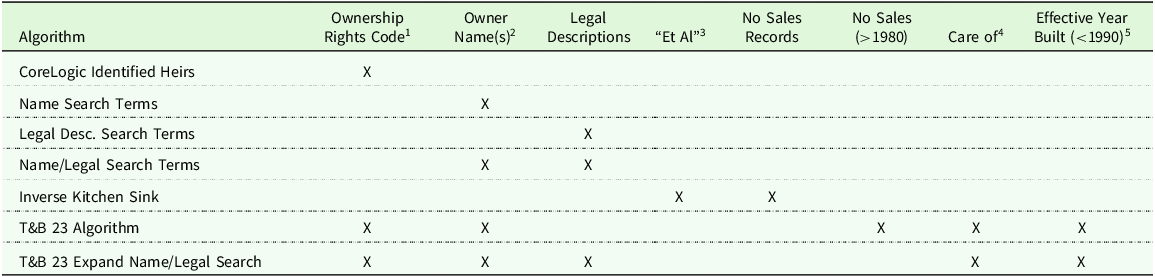
For each identified property, we collect its physical traits, ownership setup, how the land gets used, past sales, and tax situation. Our goal is to see the degree to which parcels identified by each algorithm overlap, and whether the average characteristics reflect anticipated patterns of HP. Table 1 summarizes the characteristics used to identify HP in each method.
Explanation of the underlying characteristics of each search algorithm
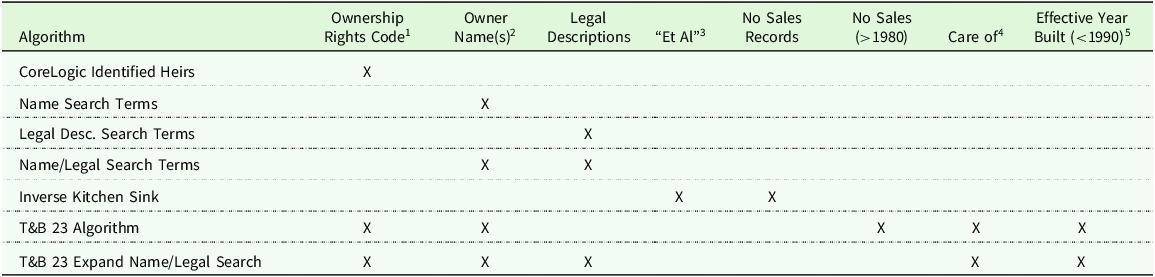
Notes: Sample excludes parcels with reported corporate ownership and those with owner names indicating institutional ownership (corporations, trusts, churches, government entities).
1 CoreLogic ownership rights codes identify HP (code “99”), deceased owners (code “DC”), et al owners (code “EA”), and undivided interests (code “UI”).
2 Search terms for owner names and legal descriptions include variations of: “heirs of,” “et al,” “intestate,” “partition,” “deceased,” “family of,” “undivided,” “interest,” “each,” “fractional interest,” “undivided interest,” “etc” “executor,” and “executrix,” following Pippin et al. (Reference Pippin, Jones and Gaither2017) and Bailey, Dobbs and Gaither (Reference Dobbs and Gaither2023).
3 The CoreLogic Et Al Indicator (A) is excluded from our T&B 23 replication as it appears unique to our dataset.
4 “Care of” searches are conducted separately from owner name searches per T&B 23 methodology.
5 Effective year built” indicates no property improvements after 1990.
Results
Using nationwide data, we analyze seven ways to identify HP, studying where their results overlap and what kinds of properties they find. Our study breaks new ground by testing all these methods side by side with the same dataset.
Summary statistics and comparative performance of search algorithms
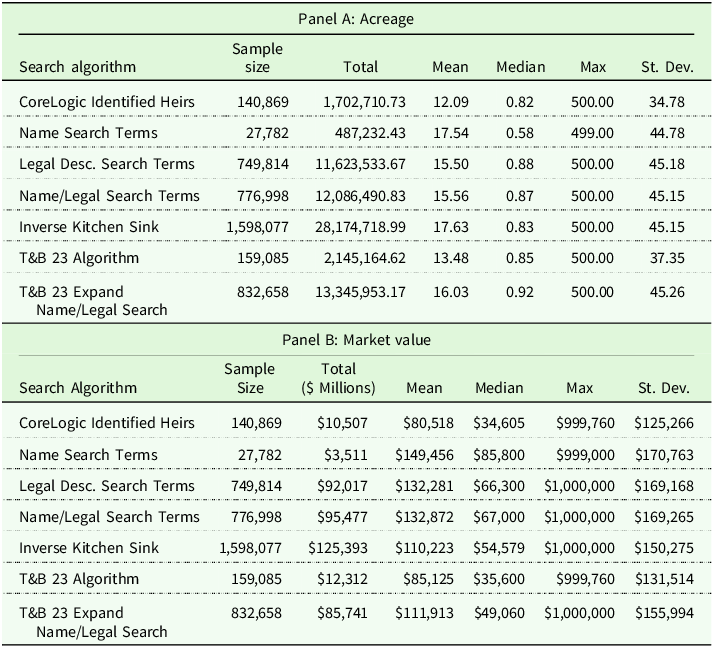
Our analysis of the seven HP identification methods reveals differences in both the number of properties identified and their characteristics. Table
Descriptive statistics of acreage and estimated market value of candidate heirs’ property based on the identification algorithms
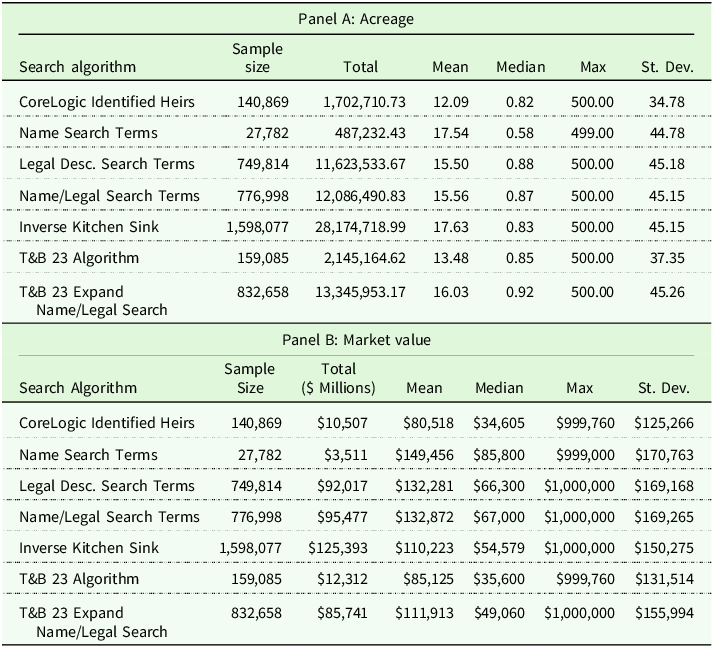
Notes: Summary statistics for candidate heirs’ properties by identification method. See Table 1 for method descriptions.
2 shows the acreage and market values for properties flagged by each method. The methods identify widely varying numbers of properties. CoreLogic’s ownership rights codes, name searches, and our implementation of T&B 23Footnote 4 each flag fewer than 200,000 parcels (140,869, 27,782, and 159,085, respectively). In contrast, methods using legal descriptions or the inverse kitchen sink approach identify far more properties – from 832,658 parcels using our expanded T&B method to nearly 1.6 million parcels using the inverse kitchen sink approach.
Property sizes also differ across methods. Properties identified through CoreLogic codes and T&B 23 tend to be smaller, with mean acreages of 12.09 and 13.48 acres, respectively. The inverse kitchen sink method finds larger properties overall (17.63 acres), though median acreages remain similar across methods, ranging from 0.58 to 0.92 acres.
Market values provide another point of comparison. Properties flagged by CoreLogic codes and T&B 23 show notably lower values (median values of $34,605 and $35,600) compared to those identified through other methods. The name search and legal description methods flag properties with substantially higher values (medians of $85,800 and $66,300). Given that HP typically faces market constraints and underinvestment, these patterns suggest the CoreLogic and T&B 23 approaches may better target actual HP. These differences in property values and sizes indicate we may be capturing distinct types of properties.
Method overlap analysis
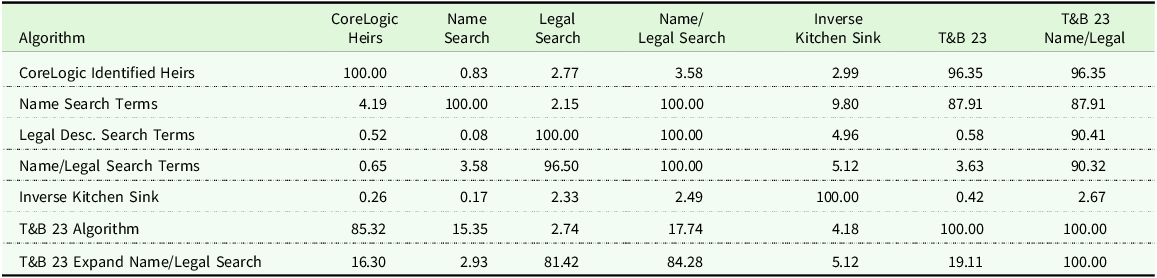
These differences extend to which specific properties each method identifies. Table 3 reveals perhaps our most striking finding: these methods largely identify different sets of properties. While CoreLogic-identified properties heavily overlap with T&B 23 results (96% shared properties), they rarely match properties found through other methods (less than 5% overlap). Similarly, properties flagged through name searches seldom match those found via legal descriptions (2% overlap). The inverse kitchen sink approach shows minimal overlap with any other method – never exceeding 5% shared properties.
Percentage overlap between candidate heirs’ property based on the identification algorithms
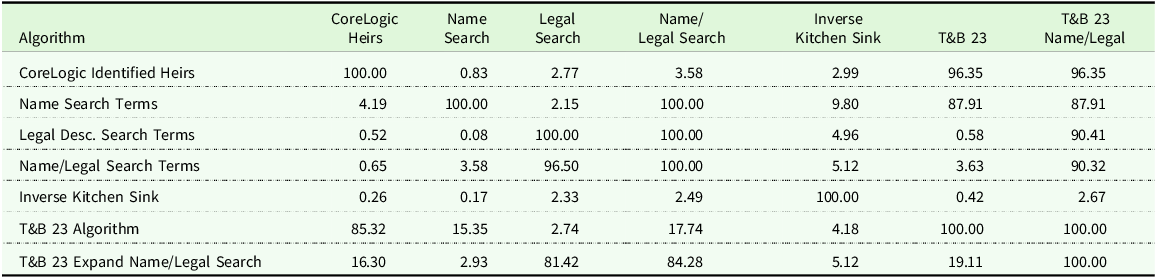
Notes: Percentage overlap between identification methods. Values show the percent of properties identified by the row method that are also identified by the column method. See Table 1 for method descriptions.
The T&B 23 method’s design intentionally combines multiple indicators, leading to more overlap with other approaches. The algorithm draws mainly from two sources: CoreLogic ownership codes (accounting for 85% of identified properties) and name searches (15%). Our modified version, including legal description searches, shifts this balance dramatically – CoreLogic identifiers account for only 16% of properties, name searches 3%, and legal description searches the remaining 84%. This minimal overlap between methods presents a clear challenge: either most methods exclude some valid HP, or some methods misidentify HP.
Property characteristics
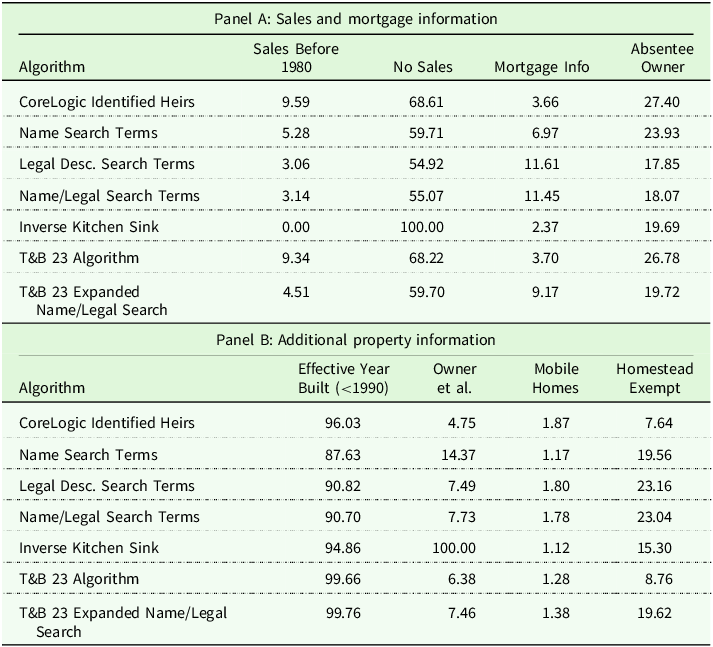
Several characteristics help evaluate how well these methods identify HP. Looking at property characteristics in Table 4, we find consistent patterns across methods. Most properties show no sales records – a common HP trait given their clouded titles – particularly those flagged by CoreLogic codes (69% without sales) and T&B 23 (68%). The higher mortgage rate in legal description properties (12% versus 7% or less for other methods) suggests these might include resolved HP where old legal descriptions remained unchanged.
Percentage of observations containing other hypothetical heirs’ property characteristics by heirs’ property identification algorithm
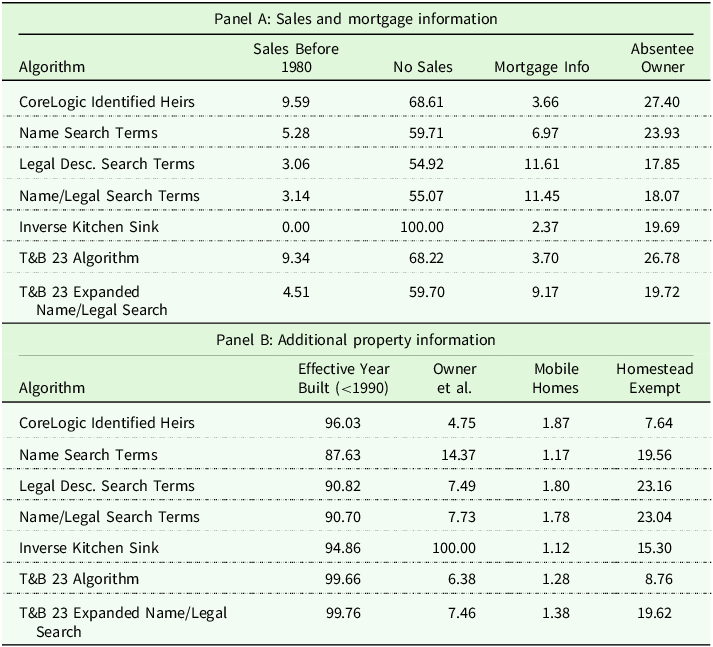
Notes: Percentage of identified properties showing various characteristics by method. See Table 1 for method descriptions.
Absentee ownership rates remain relatively stable across methods (18%–27%), suggesting this may not help distinguish HP as previously thought. The CoreLogic “et al” ownership indicator shows interesting patterns – while it defines the inverse kitchen sink method’s results by design, it appears less frequently in properties identified through other methods, even appearing in only 5% of CoreLogic-flagged properties.
Nearly all identified properties (87%–99%) show no renovations since 1990, suggesting these methods successfully target older, potentially neglected properties. Mobile home ownership proves rare across all methods. Homestead tax exemptions vary meaningfully – appearing on only 8% of CoreLogic-identified properties but reaching 23% for properties found through legal description searches. These patterns, especially in mortgage activity and tax status, suggest different methods might identify properties at different stages of resolving their HP status.
Land use patterns
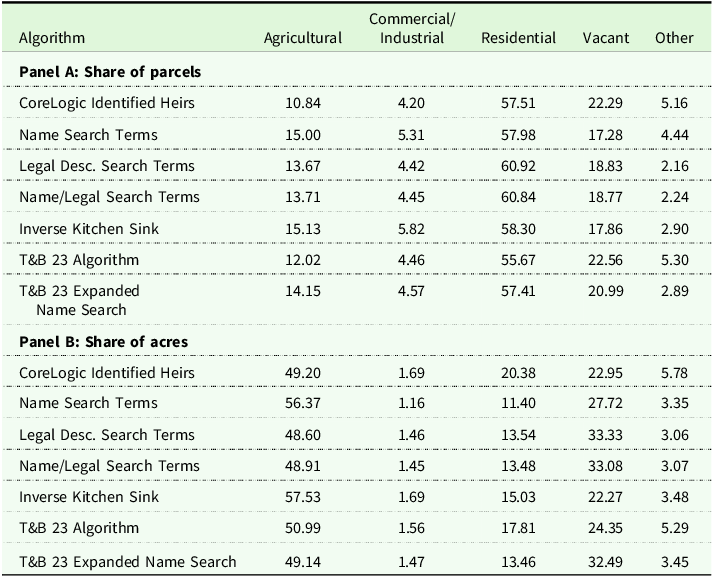
Land use distributions add another dimension to understanding properties. Table 5 shows how residential properties dominate by parcel count (56%–61% of parcels), and agricultural properties account for the largest share of acreage (49%–58%). Commercial and industrial properties remain rare across all methods – never exceeding 6% of parcels or 2% of acreage. Vacant land makes up a substantial portion of both parcels (17%–23%) and acreage (22%–33%). Other uses account for less than 6% of either measure. The prevalence of both residential and agricultural properties indicates HP affects urban and rural areas alike.
Percentage of parcels and acres of candidate heirs’ property by land use
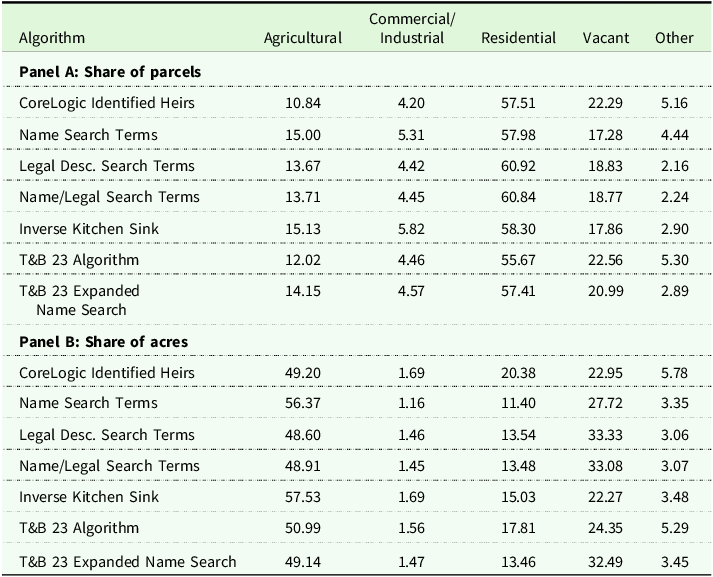
Notes: Distribution of identified properties across land use categories by method, shown as percentages of total parcels and total acres. See Table 1 for method descriptions. Land use categories come from CoreLogic.
Discussion and conclusions
Real estate records provide an imperfect but necessary tool for quantifying HP. Our investigation examined seven methods to identify HP across the contiguous United States. The analysis sought to establish reliable indicators of HP prevalence, determine characteristic property attributes, and estimate market values. We cannot directly confirm HP status for properties flagged by our methods. In an ideal empirical framework, effective methodologies would show substantial overlap in their results. Additionally, a better method would flag properties exhibiting characteristics that align with documented HP patterns from case studies and field research. Our findings, however, resist such clear interpretation.
The minimal overlap among identification algorithms raises concerns about their effectiveness. While we cannot definitively prove these methods are ineffective without a benchmark dataset of confirmed HP properties, their divergent results demand cautious interpretation. Some tentative patterns emerge – the CoreLogic HP identifier and the T&B 23 method identify properties with average acreages and market values more consistent with documented HP characteristics. Sale histories, mortgage data, and construction dates provide additional circumstantial support for these methods while casting doubt on legal description searches. Yet even these apparent patterns require verification through ground truthing.
Researchers routinely withhold important methodological details to protect HP owners from predatory investors – a practice we continue here. Although this protective custom serves an ethical purpose, it creates barriers to replication. Our attempt to replicate Thomson and Bailey (Reference Thomson and Bailey2023) identified only one-third as many properties nationally as they found regionally. Without access to their precise methodology, we cannot determine whether this disparity stems from different regional concentrations of HP, variations in data cleaning protocols, or other methodological differences. Our rigorous inspection of property owner names for potential misidentification substantially reduced our sample size, suggesting varying standards in data cleaning could explain some cross-study differences.
Our legal description search methodology reveals an unexpected pattern requiring further investigation. HP-indicating terms appear nearly ten times more frequently in legal descriptions than in owner names – a finding that seems implausible given other property characteristics. During data inspection, we found entire subdivisions where modern residential properties retained legal descriptions suggesting historical HP status. These descriptions may identify historical rather than current HP, potentially marking properties where HP status was resolved but legal descriptions remained unchanged.
The T&B 23 approach is a promising framework for future research via its weighted evidence methodology. Their index-based system permits straightforward incorporation of additional property characteristics and allows threshold adjustments for HP owners. Future research could refine these algorithms and examine farm program participation among rural HP owners. The field would benefit from greater transparency in methodology, though privacy concerns remain paramount. Coordinated efforts among researchers could enable more precise replication studies without compromising owner privacy. Our findings that HP significantly affects residential properties alongside agricultural and vacant land suggests other federal agencies could consider HP in their programming.
The absence of ground truthing represents a critical limitation to our analysis. There are substantial variations in real estate data entry practices across jurisdictions. Methods validated through ground truthing in one region may fail in others due to local idiosyncrasies in record keeping. This constraint limits the certainty of our findings. Given variations in real estate data by vendor, geography, and search methodology, these discrepancies are inevitable, and a total accounting of HP is an unrealistic goal. However, the goal of building and refining a representative sample of HP, which can be used to study the characteristics of HP, is an attainable goal with future research. Further, the various HP identification algorithms explored in this research prove that HP remains a pervasive phenomenon throughout the United States.
Data availability statement
Data for the project are proprietary and cannot be shared with outside researchers, as this would violate our licensing agreement with CoreLogic.
Competing interests
The authors declare none.

 Open access

