

Introduction
Local elections are regarded as a core system of local autonomy and grassroots democracy, as they allow local residents to elect representatives who, in turn, form local government agencies. Since voters select candidates on the basis of a wide range of determining factors, the process of voter choice in local elections can be viewed as the former’s evaluation of incumbents’ policy decisions and organizational performance. Chief executives in local governments will thus strive to provide voters with positive perceptions and to receive favorable evaluation from the latter through various measures during their term in office.Footnote 1 Yet, getting re-elected to local government office is neither guaranteed nor an easy task. For example, as of 2025, in the most recent local election in South Korea held in 2022, among 17 provincial government heads, only four incumbents were re-elected. This leads us to raise the following research question: What determines incumbent chief executives’ re-election in local government?
Most research on this subject focuses on the impact of incumbents’ political or economic performance. For instance, former studies examine incumbents’ political experience and party affiliation (e.g., Carson and Sievert Reference Carson and Sievert2017; Dey and Sen Reference Dey and Sen2016; Oliver and Ha Reference Oliver and Ha2007; Schwirz and Marsh Reference Schwirz and Marsh2012; Simon et al. Reference Simon, Ostrom and Marra1991), while latter studies tend to look into incumbents’ fiscal performance, such as government spending (e.g., Cohen and King Reference Cohen and King2004; Kim et al. Reference Kim, Lee and Bae2015; Park and Cho Reference Park and Cho2019). When it comes to the evaluation of incumbents and their re-election in local government, however, it is not only about political competition among those who are affiliated with major parties but also involves dynamics surrounding the government’s administrative performance, which incumbents defend and opponents attack. Given that this kind of administrative performance is often closely tied to local citizens’ daily life, it may realistically affect local voters’ perceptions and their assessment of incumbents.
In this article, we argue that, given chief executives in local government are not just politicians who aim to win elections but also heads of government who manage the administrative performance of local government, their re-election should be understood in the administrative dimension as well as in the political dimension.Footnote 2 Specifically, we fill this gap in the literature by examining how administrative innovation by incumbents, as a new administrative factor, affects their re-election in local government. Local governments are only qualified for administrative innovation when they sufficiently promote transparency, fairness, and efficiency within government operations, so that it leads to tangible changes that local citizens perceive in their daily lives. Therefore, this performance is expected to have a clear impact on local voters’ evaluation of incumbent chief executives, and investigating this impact should nicely add value to the literature.
Analyzing an original dataset of 292 incumbents’ re-election and their vote shares in the two most recent local government elections in South Korea as of 2025 (i.e. 2018 and 2022), we examine the impact of incumbents’ political and economic performance as conventional factors as well as their administrative performance as a new factor. Moreover, we investigate to what extent this administrative factor matters vis-à-vis the political and economic factors in determining incumbents’ re-election in local government. We find that both political factors, such as partisan alignment with the central government and affiliation with major parties, and administrative factors, such as incumbents’ administrative innovation, have a statistically significant and positive impact on their re-election and vote shares, whereas economic factors, such as social welfare spending, only have a significant impact on incumbents’ vote shares but not on their re-election.
Further, the standardized coefficients of our analysis indicate that the political factors, specifically partisan alignment with the central government, have the largest substantive effect on incumbents’ re-election, as incumbents who are politically aligned with the central government have a 57.9 percentage points higher chance of re-election than those who are not. Yet, the impact of administrative innovation by incumbents was not meager, as such performance, particularly that a year before the election, increases incumbents’ re-election chance by 11.7 percentage points.
This article has clear theoretical and empirical implications. First, most research on incumbent chief executives’ re-election in local government tends to view elections as political games, where candidates who are affiliated with major parties compete with each other (see Alt et al. Reference Alt, Bueno de Mesquita and Rose2011 and Ferraz and Finan Reference Ferraz and Finan2011 for rare exceptions). However, we provide a more comprehensive view of local government elections by suggesting that they are not just political competitions but also involve dynamics surrounding the administrative performance of incumbents. Second, our analysis makes empirical contributions by illuminating the question of which, among conventional political and economic factors versus new administrative factors (i.e. expert-assessed administrative performance), are the key determinants for incumbents’ re-election, but testing it with a new dataset of the most recent local government elections in South Korea. Our findings not only show the statistically and substantively significant effects of these old and new factors but also reveal more nuanced patterns related to some political and economic factors, which are detailed below.
Foundational research on the determinants of incumbents’ re-election
Research on the determinants of incumbents’ re-election originates from the studies of incumbency advantage. Exploring why incumbents are able to receive additional electoral support (Cox and Morgenstern Reference Cox and Morgenstern1995), existing explanations from so-called “foundational research” fall largely into four categories: 1) advantages conferred by resources, 2) constituency service, 3) challenger quality, and 4) the decline of parties.
First, some scholars argue that incumbents are advantaged electorally because they have more resources at their disposal compared to challengers, thereby enhancing their re-election prospects. For example, Mayhew (Reference Mayhew1974) originally argued that an increase in government resources in the 1960s, such as staff allowances, office expenses, media resources, and franking privileges, contributed to an incumbent’s ability to “claim credit.” Fenno (Reference Fenno1978) also argues that the development of a “home style” can be seen as a resource that advantages the incumbents by developing trust with their constituents. Moreover, incumbents substantially outraise challengers, largely due to contributions from access-oriented interest groups, and this financial advantage boosts incumbents’ electoral advantage (Fouirnaies and Hall Reference Fouirnaies and Hall2014). In addition, incumbents develop superior resource management skills through accumulated political experience over time, further enhancing their electoral competitiveness (Praino and Stockemer Reference Praino and Stockemer2012).
A second explanation relies on the increasing importance of constituency service. As incumbents better learn how to use their resources over time, they can devote more time to casework, which enhances their re-election prospects (Fiorina Reference Fiorina1977). Indeed, incumbency advantage is relatively larger in local areas where candidates engage in more casework (Cox and Morgenstern Reference Cox and Morgenstern1995). For instance, incumbents who establish stronger personal trust and ideological proximity with their constituents can more effectively deliver constituency services, enhancing their re-election chances (Stone and Simas Reference Stone and Simas2010). Yet, this claim has not been consistently confirmed empirically and is rather debated among scholars (e.g., Fiorina Reference Fiorina1981; Johannes and McAdams Reference Johannes and McAdams1981).
Thirdly, some argue that the advantage results, because the opposition is discouraged (Jacobson and Kernell Reference Jacobson and Kernell1990), and strong challengers are unlikely to challenge incumbents (Cox and Katz Reference Cox and Katz1996; Levitt and Wolfram Reference Levitt and Wolfram1997). Indeed, declining challenger quality increases incumbents’ chances of re-election, even in highly partisan environments (Algara and Bae Reference Algara and Bae2024). Incumbents typically take positions closer to their ideologies, while challengers take more extreme policy positions, unless they can significantly improve their competitiveness through increased fundraising efforts (Stone and Simas Reference Stone and Simas2010). However, there are skeptical views, arguing that the advantage is only created if voters respond to it in the election booth (Boyne et al. Reference Boyne, James, John and Petrovsky2009).
The fourth explanation for the incumbency advantage focuses on de-alignment. As voters became less party-oriented and more candidate-oriented in the second half of the 20th century, they tended to use personal characteristics and incumbency status, rather than partisan cues, as shortcuts (Ferejohn Reference Ferejohn1986). However, this evaluation merits reconsideration, because we are now in an era of increasing partisanship and polarization. As recent evidence indicates, heightened partisan polarization substantially diminishes the incumbency advantage by prompting voters to prioritize party affiliation over incumbents’ individual attributes or achievements, reshaping the dynamics of electoral competition (Algara and Bae Reference Algara and Bae2024). In highly party-centered political contexts, such as Denmark, strong partisan loyalty can reduce incentives for incumbents to cultivate individualized electoral support, further weakening personal incumbency advantage (Skjæveland and Christiansen Reference Skjæveland and Christiansen2018).
In sum, it has been recognized that incumbency represents an electoral advantage; however, there is no real agreement about how incumbency enhances the electoral chances of politicians. As exemplified by recent research (e.g., Klasnja and Titiunik Reference Klasnja and Titiunik2017), the incumbency effect is not even universally beneficial and may vary across different political environments and electoral systems. Moreover, in local government settings, given that incumbent chief executives, as managers of local government, are also evaluated by and held accountable for their government performance, focusing solely on incumbents’ political aspects is an important oversight. Therefore, we aim to contribute to the literature by not only revisiting the effect of conventional factors in the local government context but also highlighting how and to what extent new factors impact incumbents’ re-election in local government.
Testing the new and conventional determinants of incumbents’ re-election in local government
As much as there is no consensus on how incumbency increases the electoral chances of politicians, there has also been disagreement over how to measure its effect. Yet, more recent research on local government elections provides insights into its measurement by focusing simply on whether incumbent chief executives were re-elected or not (e.g., Alt et al. Reference Alt, Bueno de Mesquita and Rose2011; Ferraz and Finan Reference Ferraz and Finan2011; Park and Lee Reference Park and Lee2022). In this study, we thus build on this literature and examine what impacts chief executives’ re-election in local government, particularly both new administrative factors and existing political and economic factors.
While the dominant literature on incumbency advantage has focused primarily on incumbents’ political characteristics, when it comes to local government elections, however, scholars also draw attention, beyond political aspects of local chief executives, to the importance of government performance. It is because local government elections not only have a political nature but also involve a managerial aspect, so that incumbents defend and opponents attack the performance of local governments during the election period. Evidence that local chief executives’ behavior is closely tied to electoral accountability surrounding government performance abounds. For instance, governors and mayors who are eligible for re-election demonstrate significantly lower levels of corruption (Ferraz and Finan Reference Ferraz and Finan2011) and tend to be more dedicated to implementing national policy at the local level (Alt et al. Reference Alt, Bueno de Mesquita and Rose2011), compared to those who are not.
Extending this logic concerning the impact of government performance but illuminating less explored but still impactful factors in local chief executives’ re-election (see Cohen and King Reference Cohen and King2004; Kim et al. Reference Kim, Lee and Bae2015; Park and Cho Reference Park and Cho2019), we argue that incumbents’ “administrative innovation,” defined as incumbents’ efforts to implement and institutionalize changes within their organizational units to achieve desirable governance for local communities (Moon Reference Moon2005), should have a positive effect on their re-election. For example, local governments’ performance ratings, published before elections, meaningfully affect incumbents’ electoral support (Hong et al. Reference Hong, Ji and Kim2024); and perceived performance of local governments significantly shapes citizens’ trust and satisfaction levels, which in turn affect their voting behavior and incumbents’ re-election prospects (Li and He Reference Li and He2024). This evidence highlights the importance of incumbents’ effective administrative innovation, as credible local leadership and successful organizational innovation can positively shape voter perceptions, potentially contributing to incumbents’ electoral advantage (Gabris et al. Reference Gabris, Golembiewski and Ihrke2001).
Moreover, through successful administrative innovation, which helps to integrate the strengthening of the internal capacity of local governments with improvements in the process of local governments’ service delivery (Moon Reference Moon2005), incumbents may enhance efficiency and fairness within government operations, resulting in tangible (positive) changes that citizens perceive in their daily lives.Footnote 3 Supporting this view, previous research highlights that innovative behaviors among public employees lead to improved organizational effectiveness and service quality that citizens can directly observe and appreciate (Miao et al. Reference Miao, Newman, Schwarz and Cooper2018; Pieterse et al. Reference Pieterse, Van Knippenberg, Schippers and Stam2010). Similarly, public organizations’ employee-driven innovations induce concrete improvements in service delivery processes and outcomes (Berman and Kim Reference Berman and Kim2010). As such, it can exert a significant influence on local citizens’ evaluations of their government in general and of their local chief executives at the voting booth in particular. Therefore, our first hypothesis is,
H1 Successful administrative innovation by incumbents will have a positive effect on their re-election in local government.
On top of the importance of administrative innovation as a new determinant of incumbents’ re-election in local government, there are conventional political determinants that should also matter for incumbents’ re-election, as discussed in past research. Borrowing insights from this literature and selecting some political factors that are applicable to the local government context, we examine the impact of the following political determinants: 1) partisan alignment with the central government, 2) affiliation with major political parties, and 3) the duration of incumbency in local government.
First, as evidenced by the study involving 30 U.S. municipalities – which identified shared partisanship as one of the key factors explaining local voters’ support for incumbents (Oliver and Ha Reference Oliver and Ha2007) – partisan alignment with the central government may serve as a significant factor in local elections (Carson and Sievert Reference Carson and Sievert2017; Dey and Sen Reference Dey and Sen2016; Simon et al. Reference Simon, Ostrom and Marra1991). When local governments are politically aligned with the central government, they are more likely to approve the central government’s policy planning decisions (Clegg Reference Clegg2021), leading to more grants and financial support from the center (Baskaran and Hessami Reference Baskaran and Hessami2017). Local government heads’ partisan alignment with the central government can also generate stronger support from local residents and result in higher vote shares, because these residents not only expect more benefits due to such alignment (Dey and Sen Reference Dey and Sen2016) but may also have positive perceptions of the ruling party in local government due to its communication with the center emphasizing specific policies and achievements for local communities (de Benedictis-Kessner Reference de Benedictis-Kessner2021). Thus, we predict that
H2 Incumbents’ partisan alignment with the central government will have a positive effect on their re-election in local government.
Second, while the individual appeal of candidates may help in elections, when it comes to incumbents’ re-election, scholars tend to weigh more on the party’s organizational impact than on the candidate’s personal effect (e.g., Algara and Bae Reference Algara and Bae2024; Gelman and King Reference Gelman and King1990; Skjaeveland and Christiansen Reference Skjæveland and Christiansen2018). In local elections, where there is often a lack of “big names” among candidates and thus a mismatch between the party and the candidate, voters tend to follow the former rather than the latter, suggesting that party preference has a more significant influence on voter choice than the individual appeal of candidates (Schwirz and Marsh Reference Schwirz and Marsh2012). This implies that voters seem to prioritize party policies or resources over the personal attributes of candidates. Therefore, this line of logic leads to the prediction about the value of party affiliation, particularly with major parties due to their impact, for incumbents’ re-election.
H3 Incumbents who are affiliated with major political parties will have a greater chance of being re-elected in local government than those who are not.
Third, based on the argument that incumbency advantage is due to the resources that incumbents have (e.g., Fenno Reference Fenno1978; Fouirnaies and Hall Reference Fouirnaies and Hall2014; Mayhew Reference Mayhew1974; Praino and Stockemer Reference Praino and Stockemer2012), it is likely that the longer they serve as incumbents, the more resources they are able to access, which in turn leads to a higher chance of being re-elected. The evidence of the positive impact of incumbency duration abounds, as in the case of U.S. local elections. Past research on this subject commonly shows that the longer the incumbency, the higher the likelihood of re-election (Ansolabehere and Snyder Reference Ansolabehere and Snyder2002; Lee Reference Lee2001; Warshaw Reference Warshaw2019), suggesting that voters seem to place a high value on candidates’ experience in office. Therefore, the fourth hypothesis is,
H4 The duration of incumbency in local government will have a positive effect on incumbents’ re-election in local government.
In addition to these political determinants, the literature also identifies the influence of local government’s economic performance over incumbents’ re-election (e.g., Alt et al. Reference Alt, Bueno de Mesquita and Rose2011). In the local government context, one of the economic factors that can directly affect local citizens’ perceptions is government spending on the latter’s welfare. As explained in the incumbency advantage literature, constituency service becomes increasingly important for incumbents, and given the key common aspect of constituency service is that of incumbents’ devotion and dedication to constituents in using their resources, modern constituency service can take the form of activity to promote constituents’ welfare (Kartik and Van Reference Kartik and Van Weelden2019). That is, incumbents who care about constituents are more likely to use their resources for the latter’s welfare, and one way to do so is increasing social welfare spending.
Past research on incumbency advantage also shows that expenditure on voters’ welfare during the term have a significant impact on incumbents’ re-election (Park and Cho Reference Park and Cho2019), and this cannot be emphasized more particularly in the local context. Therefore, we predict that more spending on social welfare may help increase incumbents’ re-election chances.
H5 The more incumbents spend on social welfare, the higher their chance of being re-elected in local government.
Context: local government elections and performance in South Korea
The administrative structure of South Korea’s government is composed of three levels – central, provincial, and local. In total, there are 243 local governments, including 17 provincial and 226 municipal governments. After several revisions of the law, direct elections for provincial governors and municipal mayors were adopted in 1995.Footnote 4 Since then, chief executives for local governments have been elected every four years concurrently with but separately from local councilors and can serve up to three terms. The adoption of local executive elections meant the beginning of establishing a local self-government system (Lee and Park Reference Lee and Park2024). Local government employees are regulated by the Local Civil Service Act, which indicates that local chief executives have power to manage their own human resources (i.e. local civil servants). In particular, local chief executives, as powerful political figures, make decisions on how to address policy direction and guidance from the central government (Park and Lee Reference Park and Lee2022). Local councils, which comprise a number of committees that oversee local government agencies, tend to be dedicated to formulating and enacting ordinances. This indicates that local councilors from jurisdictionally relevant committees may have some influence on local bureaucrats through oversight and audit (Lee and Park Reference Lee and Park2024).Footnote 5
South Korea is a useful case study to examine how the performance of local governments shapes citizens’ perceptions of leadership, which in turn are likely to affect local chief executives’ re-election chances. Existing studies analyzing South Korea’s local election data tend to focus on national-level political factors (e.g., support for the ruling party and partisan alignment with the president) (Ha and Lee Reference Ha and Lee2022; Kim and Ha Reference Kim and Ha2024), economic conditions (e.g., local unemployment rates and fiscal execution) (Kang Reference Kang2016; Lee and Glasure Reference Lee and Glasure2012), party factors (e.g., party competition and nominations) (Kang et al. Reference Kang, Park and Song2018), and candidate attributes (e.g., age, education, career background) (Kim and Ha Reference Kim and Ha2024). This literature suggests that national-level political factors and economic conditions form the core of voter behavior, with party factors and candidate traits conditioning the magnitude and direction of incumbency advantages. In addition, the few studies that examine local government’s fiscal performance remain limited in scope, as they look at spending levels or intergovernmental grants dependence (e.g., Ha and Lee Reference Ha and Lee2022). Our study advances this literature by moving beyond fiscal performance as well as conventional factors and directly linking official “administrative innovation” performance to electoral outcomes.Footnote 6 Given that local chief executives are not just politicians who seek to win elections but also managers who care about the performance of local governments, we are likely to observe administrative, as well as political, factors determining incumbent governors’ and mayors’ re-election in South Korea.
In terms of electoral outcomes, South Korea’s local elections show rich dynamics. For example, across local government units, the rates of voter turnout vary significantly. During the two most recent elections (i.e. 2018 and 2022), they ranged from 38% to 83%. Overall, local elections are often deemed to be second-order elections, as local voters tend to reward or punish the national government, depending on the timing of the elections, given national and local elections are non-concurrent.Footnote 7 In 2018 and 2022, when local elections were held less than a year and a half after presidential elections during the so-called honeymoon period, the ruling party enjoyed a landslide victory; in contrast, in 2010, when local elections were held in the middle of the incumbent president’s term, the ruling party ended up losing heavily, as the local elections played the role of a midterm election.
Lastly, the outcomes of local executive and legislative elections reveal a clear two-party pattern, as most mayors and councilors are elected under the banner of either a mainstream liberal or conservative party (Lee and Park Reference Lee and Park2024). In the past three election cycles, these two dominant parties have together secured over 90 percent of the seats for local councilors and chief executives. While the liberal party achieved a landslide victory in 2018, the conservative party held majorities in both branches in 2014 and 2022, indicating a distinct swing in local voters’ preferences over time.
Data and measurement
Data
In order to test the hypotheses proposed above, we construct an original dataset that includes all incumbent governors and mayors who ran for re-election in the 2018 and 2022 local government elections, the two most recent ones as of 2025, in South Korea. We decide to analyze the two election outcomes, given that information about some of our key variables, such as administrative innovation by local chief executives, is only available after 2016. Information on a list of incumbents, their personal and political backgrounds, and the share of votes they earned is obtained via the official website of the National Election Commission in South Korea. For other information, such as the assessment of incumbents’ performance regarding administrative innovation and their social welfare spending, we provide the data sources below together with a description of how they were measured. In total, the dataset covers 292 incumbents, with 137 being from the 2018 election and 155 from the 2022 election.
Dependent variables: local chief executives’ re-election
Following recent research on local government elections, our primary measure of local chief executives’ re-election is whether they were actually re-elected (1) or not (0) in the local government election. In addition, as a higher share of votes leads to a greater chance of re-election, we also use the share of votes earned by the incumbents in the local government election. Both measures have been widely employed in the literature on local government elections, and the alternative measure will provide additional robustness to our results.
In Figure 1, we graphically display re-election outcomes for incumbent governors and mayors in the 2018 and 2022 local government elections in South Korea. We employ Geographic Information System (GIS) technology by integrating the election data from the Central Election Management Committee into a GIS framework. On the left panel, we present the re-election outcomes for incumbent mayors in the 2018 (top) and 2022 (bottom) elections. On the right panel, we present the re-election outcomes for incumbent governors in 2018 (top) and 2022 (bottom) elections. All the local governments where incumbents ran for re-election are colored, and among them, the local governments where incumbents were re-elected are slash-marked.
Incumbents’ re-election map: local government elections in 2018 and 2022.
Source: Election statistics of the central election management committee, South Korea (https://www.nec.go.kr/site/eng/ex/bbs/List.do?cbIdx=1273 accessed August 13, 2024).

As shown in Figure 1, incumbents’ re-election rate varies across elections. In 2018, the re-election rate was higher, as 70% (7/10) of governors and 58.3% (74/127) of mayors were re-elected. On the other hand, in 2022, only a minority of incumbents were re-elected, as 40% (4/10) of governors and 49% (71/145) of mayors were re-elected.
Independent variables
We have five independent variables to test the five hypotheses proposed above, respectively. Our first independent variable concerns the local chief executives’ performance regarding administrative innovation. The “Local Government Innovation Evaluation” system, introduced by the Ministry of Public Administration and Security in South Korea, serves as a mechanism to accelerate local administrative innovation, emphasizing the importance of innovation in local administration. Incumbents’ local innovation efforts and outcomes in the areas of autonomous innovation, inclusive administration, participation and cooperation, trusted government, innovation dissemination, and public perception,Footnote 8 are evaluated by a team of independent experts from academia and the private sector, as well as citizens representing regional, gender, and age diversity (Official Website of the Ministry of Public Administration and Security, February 8, 2022).Footnote 9
Specifically, administrative innovation is conceptualized as the intentional introduction, adaptation, and diffusion of novel processes, technologies, and collaborative arrangements that reconfigure how services are designed and delivered, which is analytically distinct from general administrative competence that primarily reflects routine efficiency and rule-compliant performance within existing processes (Matei and Savulescu Reference Matei and Savulescu2014; OECD 2022). Within this conceptualization, South Korea’s national “Local Government Innovation Evaluation” system emphasizes novelty, experimentation, and diffusion (e.g., proactive administration; open data and data-driven redesign; cross-sector collaboration). The evaluation rubric comprises Autonomous Innovation (30 points), Innovation Outcomes (60 points) – covering Participation & Cooperation, Inclusive Administration, and Trusted Government – and Innovation Diffusion & Public Perception (10 points), with up to four extra points for exemplary practices. An explicitly perception-based subscale (“citizen perception of the representative innovation case”) accounts for seven to nine points out of 100.
The results of the evaluation of administrative innovation by incumbents have been officially announced by the Ministry of Public Administration and Security annually since 2016 and are extensively covered by major media outlets in South Korea. The publication of such performance information may help citizens hold local chief executives accountable with their votes, as it provides a transparent basis for evaluating incumbents’ effectiveness in office (Cifuentes-Faura et al. Reference Cifuentes-Faura, Benito, Guillamón and Faura-Martínez2023). Hence, the actual performance in administrative innovation not only affects local citizens’ daily lives but also powerfully shapes their perceptions of local chief executives’ leadership.Footnote 10 Further, incumbents often seek to leverage this widely known information to claim credit during election campaigns (see Berry and Howell Reference Berry and Howell2007).
Incumbents are coded 1 if their performance was evaluated as above average and 0 otherwise. In our analysis, to estimate the immediate and long-term impact of this performance as well as its total impact on incumbents’ re-election, we create one-year and two-year lagged variables, as well as a variable that combines total scores during the incumbency. Since the information about this performance is only available from 2016, for the 2018 election the total scores for incumbents range from 0 to 2 (combining 2016 and 2017), while for the 2022 election they range from 0 to 3 (combining 2019, 2020, and 2021).
Second, a set of political characteristics of incumbents in local government, required to test our Hypotheses 2 to 4, are coded as follows: 1) our independent variable to measure whether incumbents’ party affiliation is aligned with that of the central government (i.e. the president’s party) is coded 1 if aligned and 0 otherwise; 2) the independent variable to measure whether incumbents are affiliated with a major party is coded 1 if they ran under the label of either the major liberal or major conservative party in local government elections and 0 otherwise; and 3) to measure the duration of incumbency in local government, we use the total number of years serving as governors or mayors.
Third, to test our last hypothesis concerning incumbents’ social welfare spending in local government, we collect the information about the proportion of local government budgets spent in the areas of local citizens’ social welfare, such as basic livelihood security, support for vulnerable groups, childcare and family support, support for the elderly and youth, and housing assistance.Footnote 11
Although a considerable share of Korean local welfare spending is tied to national matching programs, local governments still retain notable discretion in expanding or supplementing these programs with their own funds (e.g., elderly care facilities and community-based welfare projects). In particular, the Ministry of Health and Welfare’s Region-Autonomous Social Services Investment framework empowers municipalities to design and reallocate budgets among locally tailored voucher-type services within national guidelines, evidencing a meaningful discretionary margin at the local level (Chung et al. Reference Chung, Choi, Kim, Min, Oh and Ahn2024). This indicator thus can be interpreted as capturing the extent of local fiscal commitment to welfare policy, rather than purely reflecting statutory obligations or demographic need. In sum, the measure approximates local chief executives’ policy orientation and willingness to invest in social welfare, within the institutional constraints of the intergovernmental fiscal system.
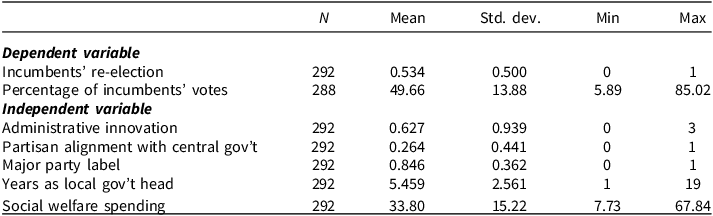
Our measure of social welfare spending is based on financial indicators from the Local Finance Integrated Open System.Footnote 12 For our measure, we use the average proportion of the total annual spending of a local government that is allocated to the social welfare sector for the three years preceding each election. In Table 1, we provide descriptive statistics for our dependent and independent variables. We also summarize the coding rules for our variables in Appendix Table A1.
Descriptive statistics for dependent and independent variables

Control variables
In our models, we control for a set of demographic, political, and fiscal variables that may affect incumbents’ re-election in local governments. The first set of variables concern demographic information about incumbents, including gender (1 if male, 0 if female), age (in years), and education levels (1 if completion of secondary education or lower, 2 if community college graduate, 3 if four-year college graduate, 4 if holding an MA degree, and 5 if holding a Ph.D. degree). These traits operate as signals of candidate resources and voter heuristics (e.g., experience, perceived competence, policy literacy, and network capital) that can systematically shape electoral performance independent of policy or institutional factors (Acconcia and Ronza Reference Acconcia and Ronza2023; Haime et al. Reference Haime, Vallejo and Schwindt-Bayer2022; Hessami and Khasanboev Reference Hessami and Khasanboev2024).
The second set of variables is about political characteristics of incumbents or elections, including which term incumbents serve in the current position (1 if one-term and 2 if two-term incumbents), the number of candidates in the district, and which election year (1 if election year is 2022, 0 if election year is 2018). Tenure in office can shape re-election prospects by allowing incumbents to accumulate policy expertise, organizational networks, and name recognition (Larsen Reference Larsen2021; Schultz Reference Schultz2008). The number of candidates proxies district competitiveness and potential vote fragmentation (Archambault and Winer Reference Archambault and Winer2023; Silva et al. Reference Silva Junior, Morais, Paranhos and Lima2020). An election-year variable is included to absorb cycle-specific shocks, such as changes in rules, national mood, or the campaign environment.
The third set of variables includes fiscal information about local governments obtained via the Local Finance Integrated Open System, such as local tax burden per person (a logged value of the average amount of local tax paid by a person for the three years preceding each election).Footnote 13 It captures residents’ fiscal exposure and a jurisdiction’s revenue base – conditions that expand or constrain service provision and investment capacity and thus shape voters’ evaluations (Berry and Howell Reference Berry and Howell2007; Burnett and Kogan Reference Burnett and Kogan2017). In local elections, voters routinely trade off taxes and services and retrospectively reward or punish officeholders for salient tax changes (Ahrens and Bandau Reference Ahrens and Bandau2024; Allers and Rienks Reference Allers and Rienks2024). Without incorporating fiscal fundamentals, models that include only policy outcomes (e.g., growth, welfare spending) risk bias from latent cross-jurisdiction fiscal differences (Peralta and Pereira Reference Peralta and Pereira dos Santos2020). Accordingly, when estimating incumbents’ re-election effects, we control for voters’ tax burden.
Methods
Since we have two dependent variables to measure incumbent governors’ and mayors’ re-election in local governments, we adopt two models for our analysis. First, for the model where the dependent variable is dichotomous (i.e. whether incumbents were re-elected or not), we use logistic regression analysis. Second, for the model where the dependent variable is continuous (i.e. the percentage of votes earned by incumbents), we use ordinary least squares (OLS) regression analysis. In all models, we use standardized coefficients not only to see the statistical significance of our independent variables but also to make these variables comparable regarding the magnitude of their effects. In addition, we employ province fixed effects to account for unspecified province-level covariates in all models, which were estimated with robust standard errors (clustered on province).
Results
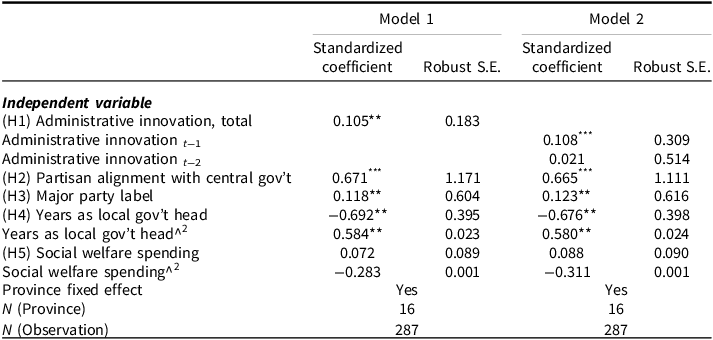
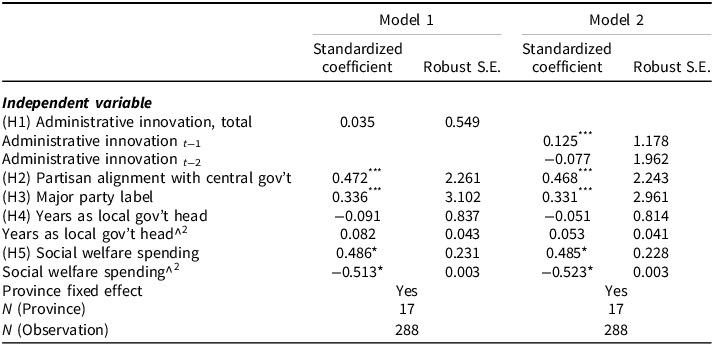
We report the results of our analysis in Tables 2 and 3. In Table 2, we adopt logistic regression analysis, as our dependent variable is incumbents’ re-election. We only show the standardized coefficients of our independent variables, but full models that display the standardized coefficients of the control variables are shown in Appendix Table A2. In Table 3, we employ OLS regression analysis, as our dependent variable is incumbents’ vote share. Only the standardized coefficients of our independent variables are shown, and full models that display the standardized coefficients of the control variables are shown in Appendix Table A3.
Logit analysis: the likelihood of incumbents’ re-election, condensed models

Notes: Control variables are included but not shown. Full models are shown in Appendix Table A2. Robust S.E. (standard errors) clustered on province in parentheses. ***p < 0.01, **p < 0.05, *p < 0.10.
OLS regression analysis: the percentage of votes earned by incumbents, condensed models
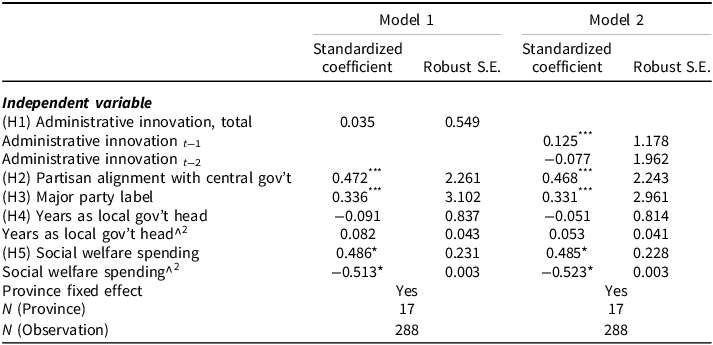
Notes: Control variables are included but not shown. Full models are shown in Appendix Table A3. Robust S.E. (standard errors) clustered on province in parentheses. ***p < 0.01, **p < 0.05, *p < 0.10.
The results in Tables 2 and 3 suggest that administrative innovation by incumbents (H1), their partisan alignment with the central government (H2), and their affiliation with major parties (H3) not only increase the chance of incumbents’ re-election but also help incumbents to earn more votes in the election. The duration of incumbency in local government (H4) only helps to increase the re-election probability, although its impact is not linear but exponential, as reported in Table 2. On the other hand, social welfare spending (H5) helps incumbents to gain more votes, with diminishing returns, as indicated in Table 3, and has no impact on the re-election chance (Table 2). Specific results are discussed below.
First, in Tables 2 and 3, we test the impact of incumbents’ administrative innovation in two different models, in order to see its total effect during the incumbents’ term (Model 1) and the effect of the performance one year (short-term) and two years (long-term) before the election (Model 2). We find that the coefficient of total scores of administrative innovation is positive and statistically significant only in Model 1 of Table 2, while the coefficient of the annual performance, particularly that of one year before the election, is positive and statistically significant in Model 2 of both Tables 2 and 3. This suggests that, while the total performance helps to increase the incumbents’ re-election chance, the performance a year before the election is so impactful that it boosts the incumbents’ vote shares in the election as well as their re-election probability. Therefore, Hypothesis 1 is empirically supported.
The marginal effect of such performance is also not meager. Based on the estimation of Model 1 of Table 2, incumbents who received a maximum score for administrative innovation (3) have a 15.8 percentage points higher likelihood of re-election than those who received a minimum score for administrative innovation (0) during their term.Footnote 14 In the case of the impact of the performance a year before the election, incumbents whose local governments were selected for positive performance (i.e. above average) have an 11.7 percentage points higher likelihood of re-election and a four percentage points higher vote share, based on the estimation of Model 2 of Tables 2 and 3 respectively, than those whose local governments failed to be chosen for positive performance.Footnote 15
In Figure 2, we visualize re-election outcomes for incumbents and their administrative innovation during their term in 2018 (left) and 2022 (right) local government elections in South Korea. For graphical display, we integrate the election data and the administrative innovation indicators into a GIS framework. All the local governments where incumbents ran for re-election are colored, and among them, the local governments where incumbents were actually re-elected are slash-marked. The size of the dots indicates the level of administrative innovation, meaning that the larger the dot in the district, the better performance incumbents achieved. Since the administrative innovation indicators were first adopted in 2016, there are three levels of performance in the 2018 election (i.e. from 0 to 2) and four levels of performance in the 2022 election (i.e. from 0 to 3).
Local governments’ administrative innovation and incumbents’ re-election.
Source: Election statistics of the central election management committee, South Korea (https://www.nec.go.kr/site/eng/ex/bbs/List.do?cbIdx=1273, accessed August 13, 2024).
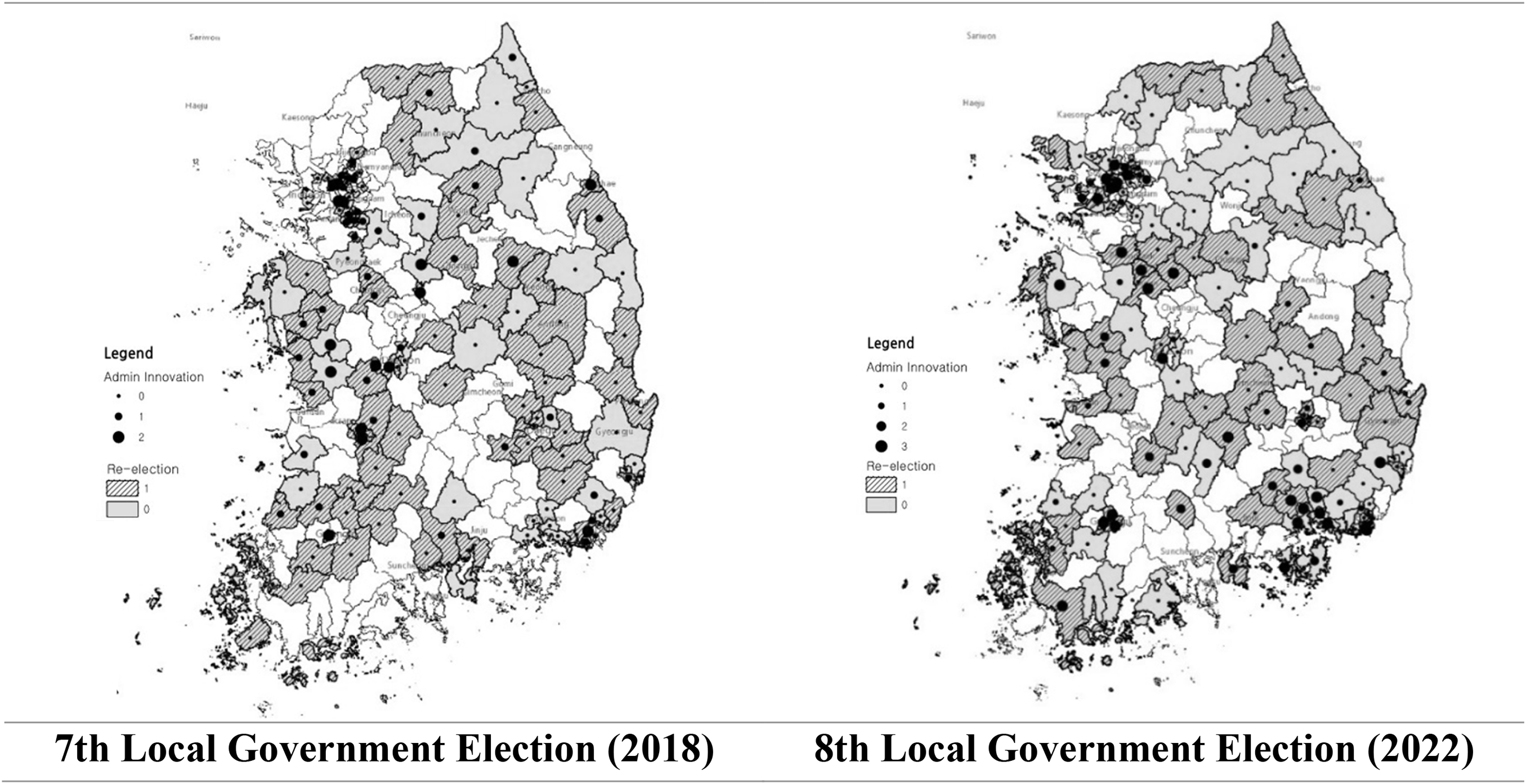
As exhibited in Figure 2, incumbents who accomplished successful administrative innovation at least once during the term have a greater chance of re-election than those who did not achieve it at all. In 2018, the re-election rate for the former was 64.8% (35/54), and that for the latter was 55.4% (46/83). In 2022, the advantage for the higher performers continued, as the re-election rate for the former was 54.4% (31/57), whereas that for the latter was less than 50% and reached only 44.9% (44/98).
Second, we test whether local chief executives’ partisan alignment with the central government has the predicted positive impact on their re-election chances (Table 2) and their vote shares in the election (Table 3). We find that the coefficient of this variable is positive and statistically significant in all models in Tables 2 and 3. This finding suggests that the central government’s coattails indeed strongly influence local government election outcomes. Hypothesis 2 is thus strongly supported.Footnote 16
The substantive effect of the variable is also fairly large. Based on the estimation of Model 1 of Table 2, incumbents whose party affiliation is aligned with the president’s party have a 58.3 percentage points higher chance of re-election than those whose party affiliation is not aligned with the president’s party. Regarding the impact on the vote share, based on the estimation of Model 1 of Table 3, incumbents who belong to the president’s party have a 15 percentage points higher vote share than those who are not affiliated with the president’s party.
Third, we further test whether local chief executives who run for re-election under a major party label enjoy the predicted positive effect. The results in all models in both Tables 2 and 3 show that the coefficient of the variable is positive and statistically significant. This means that, when incumbent governors and mayors seek re-election affiliated with one of the two major parties (either conservative or liberal) in South Korea, they have a greater advantage in being re-elected (Table 2) and garnering more votes (Table 3) in the local government elections. Therefore, Hypothesis 3 is also supported.
According to its marginal effect, based on the estimation of Model 1 of Table 2, incumbents under a major party label have a 14.3 percentage points higher probability of re-election than those not under a major party label. Moreover, based on the estimation of Model 1 of Table 3, incumbents under a major party label have a 12.8 percentage points higher vote share than those not under a major party label.
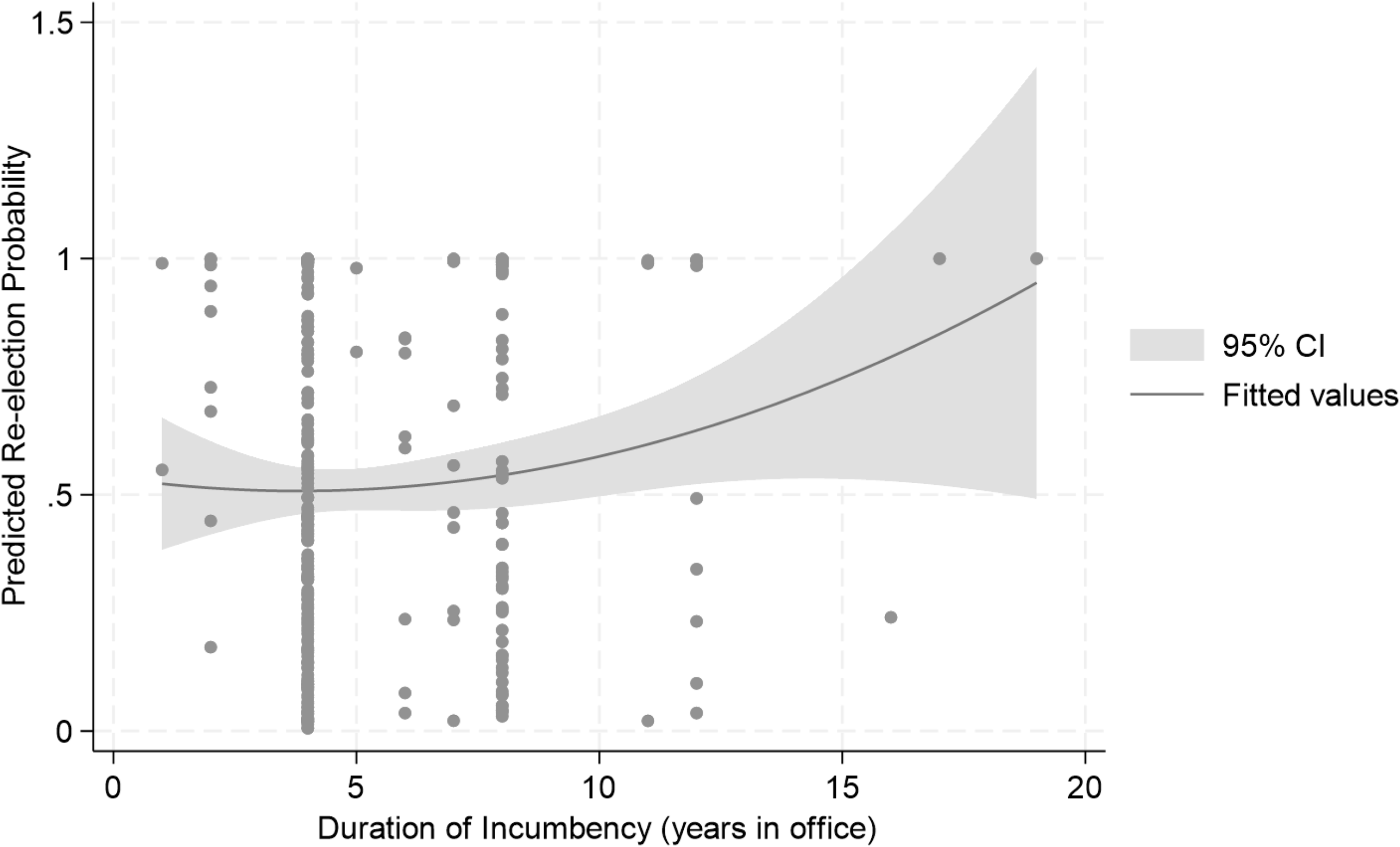
Fourth, we also test whether the duration of incumbency in local government helps incumbents’ re-election in local government elections. The results in Tables 2 and 3 indicate that, while it increases incumbents’ re-election chances (Table 2), it does not have a statistically significant impact on their vote share in the election (Table 3). Yet, its impact on the re-election chance is not straightforward, as the effect is not linear but rather exponential. We graphically display its effect in Figure 3.
Predicted re-election probability across duration of incumbency and quadratic fit.
Note: The estimation is based on Model 1 of Table 2.

Figure 3 indicates that the duration of incumbency, measured as years in office, has a somewhat modest effect during the first few years and then has a boosting effect after eight years. Given that one term in office is four years in South Korea’s local government, this pattern shows a clear incumbency advantage. This finding thus partially supports Hypothesis 4.
Finally, we test whether incumbents’ spending on social welfare indeed helps their re-election chances in local government elections. Based on the results in Tables 2 and 3, we find that it helps incumbents to garner more votes in the election (Table 3), although its impact on incumbents’ re-election probability is not statistically significant (Table 2). Not surprisingly, its effect on incumbents’ vote share is not linear but is marked by decreasing returns. Specifically, social welfare spending, measured as the proportion of the total budgets spent in the areas of local citizens’ social welfare, slightly increases the vote share up to a certain point (around 40%) and then no longer increases it after this point. This pattern seems reasonable, given that the allocation of local government budgets should be balanced across areas rather than heavily focused on one or only a few areas. In sum, Hypothesis 5 is not confirmed.
In terms of the magnitude of their effects, the standardized coefficients of the independent variables in Table 2 show that among conventional political and economic and new administrative factors, the political determinants, such as partisan alignment with the central government and affiliation with major parties, have the largest impact on incumbents’ re-election. At the same time, the administrative determinant, such as administrative innovation by incumbents, turns out to be no less important, as its impact on incumbents’ re-election is substantial and comparable in magnitude to major-party affiliation. On the other hand, the economic determinant, such as social welfare spending, has a limited impact, as it does not increase incumbents’ re-election probability but only helps them to gain more votes in local elections.
In addition, we also conduct a robustness check with a couple of additional control variables, such as turnout rates at the district level and the incumbent’s margin of victory. We report the results of our additional analysis in Appendix Tables A7 and A8. The results show that, while social welfare spending is no longer statistically significant in Table A8, the rest of the results are qualitatively similar to those of our main analysis in Tables 2 and 3, indicating that our results are overall robust to the alternative model specifications.Footnote 17
Discussion and conclusion
This study investigates how local government leaders are held accountable through elections, building on the literature on incumbents’ re-election and focusing on administrative as well as political and economic factors. Our analysis of the original dataset of recent local government elections in South Korea identifies several key variables that significantly influence local chief executives’ re-election chances and the percentage of votes they earn at the election, namely administrative innovation by local government heads (H1), their partisan alignment with the central government (H2), their affiliation with major political parties (H3), duration of their incumbency (H4), and their social welfare spending (H5).
Specifically, among administrative factors, we find that local chief executives’ administrative innovation, when accomplished successfully right before the election, significantly improved both incumbents’ re-election chances and their vote shares. Regarding political factors, the results suggest that incumbents affiliated with the president’s party and those from major political parties had a notable advantage in both re-election probabilities and vote shares. We also find that the duration of local government heads’ incumbency boosted their re-election chances exponentially rather than linearly over time. Concerning economic factors, while incumbents’ social welfare spending helped to increase their vote shares, with diminishing returns, its impact was somewhat limited, as the effect on re-election chances was not statistically significant.
Importantly, our findings concerning administrative innovation may travel outside South Korea and to different regions, such as Europe and North America, as recent studies on local governments in these regions also broadly find the positive effects of administrative innovation, particularly on local citizens’ perceptions. For example, a panel study of Spanish local governments quantifies innovation and shows that political–economic structures help explain innovation activity, with higher innovation associated with improvements in citizen evaluations and administrative performance (Alcaide-Muñoz et al. Reference Alcaide-Muñoz, Ignacio Criado and Liarte2026). Evidence from Northern Europe further indicates that local policy innovation and citizen-engagement strategies can strengthen residents’ willingness to participate politically and enhance political efficacy and belonging (Jäntti and Kurkela Reference Jäntti and Kurkela2021). More directly on institutional innovation and turnout, U.S. evidence demonstrates that state-level election administration reforms (e.g., online registration, automatic registration, and preregistration) can increase both intentions to vote and actual turnout (Garnett and Miller Reference Garnett and Miller2020). In sum, these studies support the idea that local government innovation improves citizen satisfaction and administrative outcomes, strengthens political trust and accountability, and ultimately translates into electoral gains, such as higher reelection rates, vote shares, and participation.
Our findings have several clear implications. Most importantly, the finding about the positive impact of administrative innovation at the local level indicates the significance of innovative and efficient local governance, which seems to foster positive voter perceptions and ultimately leads to voter support for the incumbents in the voting booth (Boyne et al. Reference Boyne, James, John and Petrovsky2009). This also suggests that local government heads, although elected to office, are not merely political figures but also administrative managers responsible for leading the executive branch of local governments and ensuring the effective implementation of innovative policies. In sum, this study not only illuminates the dual role of local government heads but also provides evidence of the influence of administrative determinants based on objective performance data.
Secondly, that both of our independent variables concerning political parties have a powerful influence on incumbents’ re-election chances and their vote shares indicates that political parties play a crucial role in electoral competition. Political parties are indeed key variables in elections, as they can directly engage in activities that improve laws and systems for voters, and the nomination of candidates from major parties helps the candidates’ fundraising and broader endorsement from voters (Seo Reference Seo2004). Regarding the partisan alignment with the central government, its significance is in line with past research showing that public support for or evaluation of the president does influence local elections (Jang Reference Jang2019; Park and Chang Reference Park and Chang2019). Indeed, in the case of the 8th local election held in June 2022, due to its temporal proximity to the 2022 presidential election held in March, we suspect that the national support for the president, or the honeymoon effect, likely influenced the local election results.
While we made every effort to ensure the robustness of our analysis, this study is not without limitations. For example, while this research empirically examines the impact of administrative, political, and economic factors on election outcomes, it does not directly examine the psychological process through which performance information is conveyed or the degree to which citizens’ perceived satisfaction with government performance translates into support for incumbents, leaving voter-side factors in the black box in our analysis. Given that citizens’ positive perceptions of government performance lead to greater support for the government (Boyne et al. Reference Boyne, James, John and Petrovsky2009) and media coverage of positive government performance tends to increase support for incumbents (Berry and Howell Reference Berry and Howell2007), future research should delve into how voter-side factors, including citizens’ satisfaction with government performance, determine incumbents’ re-election. Such studies could clarify the relationship between government performance, citizen perception, and electoral outcomes.
In addition, given that the incumbent advantage literature has been developed in the U.S. context, characterized by a stable two-party system, it would be worthwhile investigating the origin of the incumbent advantage: whether it is from an individual candidate or from the party a candidate belongs to. Although past research on the incumbent advantage argues that such an advantage is attached to the former due to the personal trust developed with their constituents (Fenno Reference Fenno1978; Stone and Simas Reference Stone and Simas2010), to our understanding, this question has not been much addressed in the literature. If the incumbent advantage originates from the party candidates belong to, then we might see offices retained by the same party even if an individual candidate is replaced.
Since, due to data limitations, this study focuses only on the administrative, political, and economic circumstances surrounding the two most recent local elections in South Korea, further research is still necessary to determine whether our findings travel to other contexts (e.g., future local elections) or other countries, in order to enhance its generalizability. Despite the limited empirical scope of this study, however, it still makes a clear contribution by viewing local government heads as more than political figures and testing the effect of both new (i.e. expert-assessed administrative performance) and conventional factors based on the literature in a new setting. Therefore, the findings from this study enhance our understanding of the importance of local government’s leadership role and provide valuable insights into how voters make decisions in local elections based on the performance of local governments.
Supplementary material
The supplementary material for this article can be found at https://doi.org/10.1017/S0143814X2610107X
Data availability statement
Replication materials are available in the Journal of Public Policy Dataverse at https://doi.org/10.7910/DVN/IVGHHA
Acknowledgements
We are grateful for support from Nam-Kook Kim, Director of the Peace & Democracy Institute, and other faculty members in the Institute. All errors are our own.




 Open access

