

28.1 Introduction
The current chapter focuses on potential connections between music and speech rhythm processing. Music and speech share a remarkable number of qualities, including acoustic features, temporal and sequence processing, and hierarchical structure building. Studying music and speech rhythm processing together provides broader insights into perception and cognition than when studying each domain separately. This chapter will outline similarities and differences between music and speech rhythm in relation to (1) acoustic elements and their perceptual and cognitive processing; (2) correlational links between the processing of rhythm in both domains; and (3) experimental studies showing effects of music rhythm training on language skills. It will then open out to what these links can suggest for (4) clinical research, and (5) future perspectives for both fundamental and applied research.
28.2 Acoustic and Cognitive Similarities between Music and Speech Rhythm
28.2.1 Acoustic Similarities between Music and Speech Rhythm
Music and speech are acoustic signals that are structured and delivered in time, containing frequency (pitch), intensity (loudness), timbre (sound quality), and duration (timing) information. For each domain, the ordering and duration of the events in time are referred to as rhythm (London, Reference London2012; McAuley, Reference McAuley and Jones2010). Importantly for the current discussion, a major difference between music and speech rhythm is that music is typically structured in time so that events occur regularly, and their onsets can be easily predicted by listeners (Jones, Reference Jones2018; Patel and Morgan, Reference Patel and Morgan2017). In most music, this regularity in rhythm gives rise to the perception of an underlying regular (isochronous) beat, which listeners are able to extract and to move along with (e.g., Repp and Su, Reference Repp and Su2013), and which drives auditory-motor activation and connection (Morillon and Baillet, Reference Morillon and Baillet2017; Zatorre et al., Reference Zatorre, Chen and Penhune2007). As has been noted throughout this book (see Chapter 26), speech rhythm does not contain this same kind of regularity, and intervals between speech elements (syllables, words) are not perfectly regular. There is a large discussion in the literature around whether speech can be considered rhythmic (Nolan and Jeon, Reference Nolan and Jeon2014; Turk and Shattuck-Hufnagel, Reference Turk and Shattuck-Hufnagel2013), and a long history of searching for periodicity in speech has proven difficult (i.e., searching for measures to categorize “stress-timed” versus “syllable-timed” languages; see Chapters 7 and 9). However, research has shown that speech rhythm emerges through the interaction of accentual, prosodic, and lexical factors, which create patterns of stress (Beier and Ferreira, Reference Beier and Ferreira2018; Goswami and Leong, Reference Goswami and Leong2013; Kohler, Reference Kohler2009) and prominence (see Kohler, Reference Kohler2009). These rhythmic patterns, which have also been referred to more globally as prosodic structure and surface speech timing (Turk and Shattuck-Hufnagel, Reference Turk and Shattuck-Hufnagel2013), have been shown to aid the segmentation of the acoustic signal into syllables, words, and phrases (Cutler, Reference Cutler1994; Spinelli et al., Reference Spinelli, Grimault, Meunier and Welby2010), allow for the prediction of upcoming information (Beier and Ferreira, Reference Beier and Ferreira2018), and facilitate turn-taking between speakers (see Pickering and Garrod, Reference Pickering and Garrod2013).
In both music and speech, the structuring of acoustic events in time can be described as creating a hierarchical structure, where smaller event units are embedded within larger event groups or chunks. In music, interacting acoustic and temporal patterns create – based on the underlying regular pulse – metrical structures with a metric hierarchy, leading to the perception of strong and weak beats (Lerdahl and Jackendoff, Reference Lerdahl and Jackendoff1983; London, Reference London2012; Povel and Essens, Reference Povel and Essens1985). In speech, the interacting acoustic and temporal patterns relate to the combination of phonemes, syllables, and words into phrases and sentences that can also be integrated within a rhythmic hierarchy of more and less prominently accented elements (Beier and Ferreira, Reference Beier and Ferreira2018). The similarities and differences in acoustic cues, regularity, and hierarchically structured events suggest that the combined or at least comparative investigation of music and speech rhythm processing can provide novel insights into perceptual and cognitive processing and sequencing, with potentially shared mechanisms.
28.2.2 Cognitive Similarities between Music and Speech Rhythm Processing
Empirical research has suggested that the acoustic and hierarchical features of music and speech may be processed by the brain in a similar way (Heard and Lee, Reference Heard and Lee2020; Patel, Reference Patel2008), and several theoretical frameworks have been proposed aiming to better understand cognitive connections between music and speech rhythm processing as well as their neural correlates (e.g., Fujii and Wan, Reference Fujii and Wan2014; Patel, Reference Patel2011; Tierney and Kraus, Reference Tierney and Kraus2014). Here, we will outline the Processing Rhythm in Speech and Music (PRISM) framework, which focuses on three mechanisms underlying speech and music rhythm processing: precise auditory processing, synchronization/entrainment of neural oscillations to an external rhythm, and sensorimotor coupling (Fiveash et al., Reference Fiveash, Bedoin, Gordon and Tillmann2021; see Figure 28.1). PRISM was developed on the basis of previous theoretical frameworks of music, speech, or music and speech processing that each discuss some of the individual mechanisms potentially involved in the processing of one or both domains. The goal of PRISM is to provide a larger perspective that traverses music and speech. PRISM extracts and combines the most central mechanisms discussed across different theories into a single framework, which can inform new research. In addition, PRISM also aims to provide future directions to identify specific mechanisms that could be underlying the effects of music rhythm training in the long term, and rhythmic stimulation in the short term, on speech and language processing.
The PRISM framework.
The three mechanisms proposed in the PRISM framework (Fiveash et al., Reference Fiveash, Bedoin, Gordon and Tillmann2021).
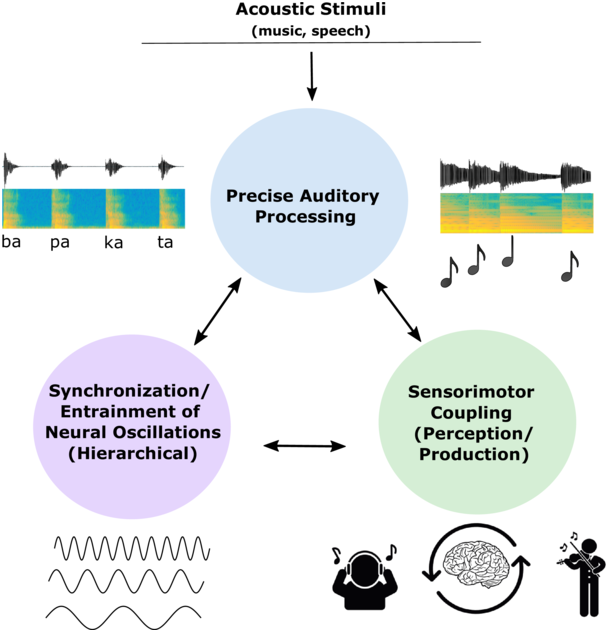
Figure 28.1 Long description
It shows three interconnected circles, reflecting three mechanism for rhythmic processing in music and speech: Precise Auditory Processing, Synchronization or Entrainment of Neural Oscillations, and Sensorimotor Coupling. The arrows show the connections between mechanisms.
Among the incorporated frameworks, the following three were the most influential when creating PRISM: the Sound Envelope Processing and Synchronization and Entrainment to Pulse (SEP) hypothesis (Fujii and Wan, Reference Fujii and Wan2014), the Precise Auditory Timing Hypothesis (PATH) (Tierney and Kraus, Reference Tierney and Kraus2014), and the Temporal Sampling Framework of developmental dyslexia (TSF) (Goswami, Reference Goswami2011). Larger theoretical frameworks including the Overlap, Precision, Emotion, Repetition, and Attention (OPERA) hypothesis (e.g., Patel, Reference Patel2014), the Dynamic Attending Theory (Jones, Reference Jones1976, Reference Jones2018; Jones and Boltz, Reference Jones and Boltz1989), and active sensing approaches (Morillon et al., Reference Morillon, Hackett, Kajikawa and Schroeder2015; Schroeder et al., Reference Schroeder, Wilson, Radman, Scharfman and Lakatos2010) also informed the current framework. Each of these frameworks point towards different, though partly overlapping, aspects of the music and speech/language connection, which PRISM aimed to combine with the proposition of three mechanisms, as presented below. Outlining these three mechanisms and their potential interactions – both for deficits and expertise – lead to new research perspectives for both fundamental and clinical research.
28.2.2.1 Precise Auditory Processing
Precise auditory processing is the basis for the processing of complex acoustic information carried in the music and speech signals, notably in relation to frequency, duration, and timbre. It is often tested by the investigation of the perception of just noticeable differences of variations between sounds (e.g., see Niebuhr et al., Reference Niebuhr, Reetz, Barnes, Yu, Gussenhoven and Chen2020, for the pitch dimension). Regarding the time dimension, the auditory system can discriminate millisecond-level timing deviations, and even timing deviations that are below the conscious change detection threshold (i.e., at 3 ms, Madison and Merker, 2004). This precise auditory timing has been suggested to underlie numerous beneficial effects of music training on speech and language processing (Fujii and Wan, Reference Fujii and Wan2014; Kraus and Chandrasekaran, Reference Kraus and Chandrasekaran2010; Patel, Reference Patel2014). Precise auditory timing is the foundation of the SEP, PATH, and TSF hypotheses, and is reflected in the precision element of OPERA. Both SEP and PATH (drawing on the OPERA hypothesis) suggest that the precision necessary for successful entrainment, which is enhanced by music training (see Section 28.3), underlies the benefits of music training on phonological processing and on the segmentation of the speech signal (Fujii and Wan, Reference Fujii and Wan2014; Tierney and Kraus, Reference Tierney and Kraus2014). In addition, the SEP hypothesis suggests that the enhanced precision to process the sound envelope of a music signal can also benefit processing of the speech envelope (in relation to the overlap element of the OPERA hypothesis). The TSF focuses on encoding of the speech envelope, and a role of potentially impaired encoding in pathology, notably in line with the findings that children with developmental dyslexia are impaired in precise tracking of the speech envelope (Goswami, Reference Goswami2011; Goswami et al., Reference Goswami, Power, Lallier and Facoetti2014). In particular, individuals with dyslexia are impaired in detecting the rise time (or onset) of incoming syllables in speech perception (Di Liberto et al., Reference Di Liberto, Peter and Kalashnikova2018; Goswami et al., Reference Goswami, Gerson and Astruc2010; Leong and Goswami, Reference Leong and Goswami2014; Power et al., Reference Power, Colling, Mead, Barnes and Goswami2016), which requires precise auditory processing and the synchronization/entrainment of neural oscillations (see Section 28.2.2.2). The different theoretical frameworks proposed earlier therefore point to a strong overlap between cognitive and neural correlates involved in music and speech rhythm processing in relation to precise auditory processing. This research suggests that music rhythm training can enhance the precision by which listeners process not only the music signal but also the speech signal.
28.2.2.2 Synchronization/Entrainment of Neural Oscillations to External Stimuli
Neural oscillations are endogenous rhythms of electrical activity that can be observed throughout the brain, and are hypothesized to support numerous cognitive processes (Buzsáki and Draguhn, Reference Buzsáki and Draguhn2004). Neuroscience research has shown that neural oscillations can support the perception of speech (Giraud and Poeppel, Reference Giraud and Poeppel2012; Kösem et al., Reference Kösem, Bosker and Takashima2018; Kösem and Wassenhove, Reference Kösem and van Wassenhove2017; see also Chapters 3 and 5) and of music (Fujioka et al., Reference Fujioka, Trainor, Large and Ross2012; Nozaradan et al., Reference Nozaradan, Peretz, Missal and Mouraux2011, Reference Nozaradan, Peretz and Mouraux2012) in a similar way (Harding et al., Reference Harding, Sammler, Henry, Large and Kotz2019). The role of neural oscillations is strongly developed in the TSF, briefly mentioned in PATH, and appears to be the neural basis of both sound envelope processing and synchronization and entrainment to pulse in the SEP hypothesis, though this is not explicitly stated. The role of neural oscillations is also essential to the dynamic attending theory (DAT). The DAT suggests that endogenous neural oscillations entrain to external rhythmic (or quasi-rhythmic) stimuli at multiple levels in a hierarchical fashion, resulting in levels of embedded neural oscillations that form nested oscillations (Jones, Reference Jones1976; see also Chapter 3). The entrainment of endogenous neural oscillations to external stimuli creates the foundation for hypotheses about how the brain predicts upcoming information, notably in time but also content (Arnal and Giraud, Reference Arnal and Giraud2012; Friston, Reference Friston2010; Friston and Buzsáki, Reference Friston and Buzsáki2016; Jones, Reference Jones2018). A more extended link has been further described between precise auditory processing and neural oscillations (Goswami, Reference Goswami2011; Poeppel, Reference Poeppel2003), as well as between neural oscillations and sensorimotor coupling (Morillon and Baillet, Reference Morillon and Baillet2017; van Wijk et al., Reference van Wijk, Beek and Daffertshofer2012).
28.2.2.3 Sensorimotor Coupling
Sensorimotor coupling refers to the connections between the auditory and motor cortices of the brain, and supports the perception and production of music and speech rhythm. The Action Simulation for Auditory Prediction hypothesis (ASAP) (Cannon and Patel, Reference Cannon and Patel2021; Patel and Iversen, Reference Patel and Iversen2014) and the active sensing framework (Morillon et al., Reference Morillon, Hackett, Kajikawa and Schroeder2015; Schroeder et al., Reference Schroeder, Wilson, Radman, Scharfman and Lakatos2010) suggest a tight connection between auditory and motor cortices, with the motor cortex implicated in generating precise auditory predictions (even in the absence of overt movement or movement preparation). The role of the motor system in generating auditory predictions could explain why motor cortex activation is routinely shown when just listening to music (Chen et al., Reference Chen, Penhune and Zatorre2008; Fujioka et al., Reference Fujioka, Trainor, Large and Ross2012; Gordon et al., Reference Gordon, Cobb and Balasubramaniam2018; Grahn and Brett, Reference Grahn and Brett2007) or to speech (Möttönen et al., Reference Möttönen, Dutton and Watkins2013; Wilson et al., Reference Wilson, Saygin, Sereno and Iacoboni2004). The role of the motor system in interaction with perception is illustrated by the human ability to seamlessly perceive and produce speech (e.g., turn-taking in conversations; Hidalgo et al., Reference Hidalgo, Falk and Schön2017; Pickering and Garrod, Reference Pickering and Garrod2013; see also Chapter 6), or to move in time with a song while on the dance floor (e.g., Janata et al., Reference Janata, Tomic and Haberman2012). Further, adding a motor component that is aligned with the regularity of the external stimulus can enhance the perception of that stimulus (Falk and Dalla Bella, Reference Falk and Dalla Bella2016). Both the SEP hypothesis and PATH focus on the role of the motor system in synchronizing and entraining the brain and body to an external stimulus. PATH suggests that motor entrainment (i.e., the act of aligning one’s movements with the onset of sound in a consistent way) satisfies all of the conditions laid out in the OPERA hypothesis, and could support transfer between music and speech processing abilities (in PATH, specifically phonological awareness), as well as enhance listeners’ precise auditory timing abilities.
28.3 Correlational Links between Music Rhythm and Speech Rhythm Processing
Similar acoustic and perceptual features (i.e., frequency/pitch, intensity/loudness, and timbre/sound quality), rhythmic structures (related to durational cues), as well as perceptual and cognitive processing mechanisms, including hierarchical structure processing, provide the basis for the investigation of potential transfer effects and connections between speech and music skills. This section will focus primarily on reported correlations between musical rhythm skills (measured mostly through rhythm production, rhythm perception, and synchronization to an external pulse) and various speech and language skills. One of the questions resulting from the observation of transfer or of correlations between music and speech/language processing is how to define the mechanisms that underlie these connections. Transfer effects and correlations have been observed for both (1) skills related to rhythm, temporal organization, and auditory discrimination (e.g., in word segmentation, word encoding, speech rhythm awareness, and phonological awareness, which could be considered as more low-level or direct transfer), and (2) literacy skills not necessarily related directly to rhythm processing per se (e.g., reading, syntactic processing, and spelling, which could be considered as more high-level or indirect transfer; see Besson et al., Reference Besson, Chobert and Marie2011; Bigand and Tillmann, Reference Bigand and Tillmann2022; Miendlarzewska and Trost, Reference Miendlarzewska and Trost2014). The low-level transfer effects might be based on improvement of fine-grained temporal processing and the synchronization of neural oscillations to external stimuli, which have been shown to be improved through musical training (Goswami, Reference Goswami2011; Tallal and Gaab, Reference Tallal and Gaab2006; Tierney and Kraus, Reference Tierney and Kraus2013). High-level language and literacy skills may develop from the more direct transfer, as the development of fine-grained temporal processing skills enhances sensitivity to speech rhythm, facilitating the processing of phonemes and syllables and in turn enhancing these higher-level language and literacy skills (Holliman et al., Reference Holliman, Wood and Sheehy2010; Tallal and Gaab, Reference Tallal and Gaab2006; Tierney and Kraus, Reference Tierney and Kraus2014). The review of the following correlational studies is presented with a couple of caveats. First, while correlational data are an important piece of the puzzle when understanding transfer effects, they should be interpreted with caution, and alongside longitudinal, experimental studies that consist of an experimental group and a control group that also receives some kind of nonmusical training (see Section 28.4). Second, correlational studies comparing musicians to nonmusicians cannot focus on music rhythm training specifically, as musicians are exposed to a large variety of musical training beyond only rhythm-focused aspects. In the following sections, we will first focus on potential beneficial effects of musical training on encoding, segmentation, and phonological awareness, before moving on to reading, syntax, and spelling.
28.3.1 Encoding, Segmentation, and Phonological Awareness
One link between musical rhythm skills and low-level speech processing is based on the processing of acoustic features. At the encoding stage of sound events (i.e., when acoustic features of a sound are first processed), musicians (compared to nonmusicians) show earlier and larger brainstem responses to the onset of both musical sounds and speech syllables (Musacchia et al., Reference Musacchia, Sams, Skoe and Kraus2007). Compared to nonmusicians, musicians also show enhanced syllable discrimination abilities based on amplitude rise time and voice onset time (Zuk et al., Reference Zuk, Ozernov-Palchik and Kim2013), perform better in speech-timing discrimination tasks (Sares et al., Reference Sares, Foster, Allen and Hyde2018), are quicker and more accurate at segmenting words in an artificial language (François et al., Reference François, Jaillet, Takerkart and Schön2014), and are more sensitive to metrically incongruous words (Marie et al., Reference Marie, Magne and Besson2011). Correlational studies have shown that (1) rhythm perception proficiency (as measured with a same-different rhythm task) is correlated with the amplitude of neural responses to violations in speech rhythm for nonmusicians (Magne et al., Reference Magne, Jordan and Gordon2016); (2) beat entrainment abilities in young children are correlated with more precise neural encoding of the speech envelope (Woodruff Carr et al., Reference Woodruff Carr, White-Schwoch, Tierney, Strait and Kraus2014); and (3) higher music rhythm perception abilities are correlated with more consistent grouping of speech rhythms in adults with varying musical ability (Boll-Avetisyan et al., Reference Boll-Avetisyan, Bhatara and Höhle2017). These rhythm-related skills as well as speech encoding and segmentation skills may contribute to phonological awareness abilities.
Phonological awareness is a central element of language learning and relates to the ability to manipulate and break up units of speech sounds, such as words, syllables, and phonemes (Ball, Reference Ball1993; Gordon et al., Reference Gordon, Fehd and McCandliss2015a). Several studies have shown links between phonological awareness and musical rhythm skills in school-aged children. For example, in typically developing children, phonological awareness measures correlate with performance in rhythmic discrimination tasks (Ozernov-Palchik et al., Reference Ozernov-Palchik, Wolf and Patel2018), as well as rhythm perception and production tasks (Degé et al., Reference Degé, Kubicek and Schwarzer2015), rhythm and melody repetition tasks (Cohrdes et al., Reference Cohrdes, Grolig and Schroeder2016), and rhythm production skills over development (David et al., Reference David, Wade-Woolley, Kirby and Smithrim2007). Links between rhythm perception and production skills and phonological awareness skills have also been shown in pathology, notably for children with dyslexia (Flaugnacco et al., Reference Flaugnacco, Lopez and Terribili2014; Huss et al., Reference Huss, Verney, Fosker, Mead and Goswami2011; Thomson and Goswami, Reference Thomson and Goswami2008) and developmental language disorder (Corriveau and Goswami, Reference Corriveau and Goswami2009). For example, Flaugnacco et al. (Reference Flaugnacco, Lopez and Terribili2014) showed that both rhythm reproduction and rhythm tapping correlated with phonological awareness in children with dyslexia (see also correlations with reading skills). Note that the potential relations between “phonological awareness” and “rhythm” abilities vary across studies, and that these patterns of correlation (versus noncorrelation) seem to be influenced by the types of tasks used to measure these broader constructs.Footnote 1
28.3.2 Reading, Syntax, and Spelling
Music rhythm skills have also been shown to correlate with reading, syntax, and spelling abilities. For example, music aptitude (especially music perception skills) and reading ability were shown to correlate with subcortical responses to predictable speech sounds, and these subcortical responses were reduced in poor readers (Strait et al., Reference Strait, Hornickel and Kraus2011). Groups with musical training also showed enhanced novel word learning (through picture–word associations) for children (Dittinger et al., Reference Dittinger, Chobert, Ziegler and Besson2017) and adults (Dittinger et al., Reference Dittinger, Barbaroux and D’Imperio2016). Further, rhythm perception abilities correlate with rapid word naming (Bekius et al., Reference Bekius, Cope and Grube2016), enhanced grammatical skills (Gordon et al., Reference Gordon, Shivers and Wieland2015b), and both reading and spelling skills while controlling for the effect of verbal ability (Douglas and Willatts, Reference Douglas and Willatts1994), and reading attainment (Holliman et al., Reference Holliman, Wood and Sheehy2010). Converging results have been reported for rhythm production abilities. For example, paced tapping performance correlates with word and nonword reading (González‐Trujillo et al., Reference González‐Trujillo, Defior and Gutiérrez‐Palma2014; Tierney and Kraus, Reference Tierney and Kraus2013), and rhythm production skills at school entry (~six years) predict: (1) reading and spelling at the end of the first year of school (Kertész and Honbolygó, Reference Kertész and Honbolygó2021; Lundetræ and Thomson, Reference Lundetræ and Thomson2018), (2) reading skills at the end of the second year of school (Dellatolas et al., Reference Dellatolas, Watier, Le Normand, Lubart and Chevrie-Muller2009), and (3) reading and spelling skills in the third year of school (in the same children as listed in (1): Kertész and Honbolygó, Reference Kertész and Honbolygó2023).
Links between rhythm perception and production and reading skills have also been shown in children with dyslexia (Flaugnacco et al., Reference Flaugnacco, Lopez and Terribili2014; Goswami et al., Reference Goswami, Thomson and Richardson2002; Huss et al., Reference Huss, Verney, Fosker, Mead and Goswami2011; Thomson and Goswami, Reference Thomson and Goswami2008) and developmental language disorder (Corriveau and Goswami, Reference Corriveau and Goswami2009). For example, Corriveau and Goswami (Reference Corriveau and Goswami2009) showed that children with developmental language disorder were impaired in paced tapping compared to age-matched control children, and that their paced tapping performance was related to reading and spelling measures.
28.4 Experimental Manipulations Investigating Links between Music and Speech Rhythm
28.4.1 Short-Term Rhythmic Stimulation
Experimental manipulations of music and speech materials have shown that rhythmic stimulation and entrainment to music can influence the subsequent processing of a speech signal – an experimental paradigm referred to as rhythmic cueing or rhythmic priming.
Rhythmic cueing studies involve a short rhythmic cue that matches one to one with the accents (stressed syllables) of a subsequent sentence.Footnote 2 These studies have shown that a matching rhythmic cue preceding a sentence enhances phoneme detection (Cason et al., Reference Cason, Astésano and Schön2015a; Cason and Schön, Reference Cason and Schön2012) and can enhance the neural response to a subsequent sentence (Falk et al., Reference Falk, Lanzilotti and Schön2017) compared to an irregular, mismatching cue. This effect can be boosted by simultaneous movement (e.g., tapping along; Falk and Dalla Bella, Reference Falk and Dalla Bella2016) and can also influence the sentence repetition performance of hearing-impaired children (Cason et al., Reference Cason, Hidalgo, Isoard, Roman and Schön2015b).
Rhythmic priming studies involve a longer rhythmic prime, typically 30 seconds, followed by a set of naturally spoken sentences. Such rhythmic priming experiments have shown that children and adults perform better at grammaticality judgments for auditorily presented sentences when presented after regular rhythmic primes compared to after irregular rhythmic primes or other control conditions (Canette et al., Reference Canette, Lalitte and Bedoin2020b; Chern et al., Reference Chern, Tillmann, Vaughan and Gordon2018; Fiveash et al., Reference Fiveash, Bedoin, Lalitte and Tillmann2020). This effect has also been observed for children with dyslexia and developmental language disorder (Bedoin et al., Reference Bedoin, Brisseau, Molinier, Roch and Tillmann2016; Ladányi et al., Reference Ladányi, Lukács and Gervain2021; Przybylski et al., Reference Przybylski, Bedoin and Krifi-Papoz2013), and can be seen in the brain response to syntax violations. The P600 neural response to grammatical errors increased after regular compared to irregular primes for adults with and without dyslexia (Canette et al., Reference Canette, Fiveash and Krzonowski2020a). Rhythmic priming also reinstated the P600 response for patients with basal ganglia lesions (Kotz et al., Reference Kotz, Gunter and Wonneberger2005), who typically do not show this response (Kotz et al., Reference Kotz, Frish, von Cramon and Friederici2003). In addition to grammatical error detection, recent research has shown a rhythmic priming effect for sentence repetition in children with and without developmental language disorder (Fiveash et al., Reference Fiveash, Ladányi and Camici2023b). These results show that in the short term, listening to a regular music rhythm with a strong metrical structure can improve the processing of the less regular speech signal in typically developing children and adults, as well as individuals with neurodevelopmental language disorders.
28.4.2 Long-Term Music (Rhythm) Training
Experimentally controlled music (rhythm) training studies have shown that speech and language abilities (especially speech rhythm processing and phonological awareness) can be enhanced following music training.Footnote 3 For example, Zhao and Kuhl (Reference Zhao and Kuhl2016) showed that musical activities focusing on temporal structures (12 sessions over a four-week period) enhanced nine-month-old infants’ sensitivity to the temporal structure of speech (and music), as measured by the neural response to rhythmic structural violations. A longitudinal study over two years showed that music training resulted in increased speech segmentation skills of eight-year-old children (François et al., Reference François, Chobert, Besson and Schön2013; see also Chobert et al., Reference Chobert, François, Velay and Besson2014, for a follow-up).
Other studies have reported that groups following experimentally implemented music training programs showed enhanced phonological awareness. For example, music training for 30 minutes a week over four months enhanced phoneme-segmentation fluency in kindergarten children (Gromko, Reference Gromko2005). In four- to six-year-old children, both music and phonological training, but not sports training, improved phonological awareness (Degé and Schwarzer, Reference Degé and Schwarzer2011; Patscheke et al., Reference Patscheke, Degé and Schwarzer2016). Several other studies have shown increased phonological awareness after music training (Bolduc and Lefebvre, Reference Bolduc and Lefebvre2012; Cogo-Moreira et al., Reference Cogo-Moreira, de Ávila, Ploubidis and Mari2013; Herrera et al., Reference Herrera, Lorenzo, Defior, Fernandez-Smith and Costa-Giomi2011; Moritz et al., Reference Moritz, Yampolsky, Papadelis, Thomson and Wolf2013). Phonological awareness has also been improved by music training (focusing specifically on rhythm) in dyslexic children (Flaugnacco et al., Reference Flaugnacco, Lopez and Terribili2015; see also Bonacina et al., Reference Bonacina, Cancer, Lanzi, Lorusso and Antonietti2015). These studies have also shown that the rhythmic training improved the dyslexic children’s reading performance, an effect that has been similarly shown in typically developing children.
Music (rhythm) training has also been shown to improve literacy skills. For example, Taub and Lazarus (Reference Taub and Lazarus2012) tested adolescents in Grades 9–10 (approximately 14–15 years old) and found that an experimental group who had 12 sessions of rhythm production training improved in their reading fluency and reading performance. Rautenberg (Reference Rautenberg2015) tested children in Grade 1 (approximately seven- to eight-years-old and showed that a group with eight months of music training (emphasizing both perception and production rhythmic skills) had enhanced reading accuracy. Further, eight-year-old children who underwent six months of music training (including rhythm, melody, harmony, and timbre training) showed improved reading performance (Moreno et al., Reference Moreno, Marques and Santos2009). In summary, music (rhythm) training programs have shown promising effects on different speech and language abilities, including improving speech rhythm processing, phonological awareness, and reading skills. Interestingly, the effect of the music training programs on phonological tasks, for example, can be similarly strong as that of specifically tailored language training programs (e.g., phonological training; see Bigand and Tillmann, Reference Bigand and Tillmann2022).
28.5 Clinical Perspectives
The link between rhythm and speech/language processing has been shown both in typically developing and clinical populations. Critically, research has revealed that processing music/rhythmic materials (perception and production) can improve speech/language processing through short-term stimulation (Bedoin et al., Reference Bedoin, Brisseau, Molinier, Roch and Tillmann2016; Fiveash et al., Reference Fiveash, Ladányi and Camici2023b; Ladányi et al., Reference Ladányi, Lukács and Gervain2021; Przybylski et al., Reference Przybylski, Bedoin and Krifi-Papoz2013) as well as long-term training (Bonacina et al., Reference Bonacina, Cancer, Lanzi, Lorusso and Antonietti2015; Flaugnacco et al., Reference Flaugnacco, Lopez and Terribili2015) for children with speech and language processing difficulties (see also Schön and Tillmann, Reference Schön and Tillmann2015, for a review). These beneficial effects of rhythmic stimulation and training are compelling considering the evidence that children with neurodevelopmental language disorders have difficulty with different types of rhythmic tasks. Timing deficits have been observed in rhythm perception and production tasks for individuals with dyslexia (e.g., Bégel et al., Reference Bégel, Dalla Bella and Devignes2022; Degé et al., Reference Degé, Kubicek and Schwarzer2015; Flaugnacco et al., Reference Flaugnacco, Lopez and Terribili2014; Overy et al., Reference Overy, Nicolson, Fawcett and Clarke2003; Thomson and Goswami, Reference Thomson and Goswami2008), developmental language disorder (Cumming et al., Reference Cumming, Wilson, Leong, Colling and Goswami2015; Sallat and Jentschke, Reference Sallat and Jentschke2015), and stuttering (Falk et al., Reference Falk, Müller and Dalla Bella2015; Olander et al., Reference Olander, Smith and Zelaznik2010; Wieland et al., Reference Wieland, McAuley, Dilley and Chang2015). Related timing deficits have also been shown in children with other pathologies where language processing is not the central deficit, such as children with developmental coordination disorder (Chang et al., Reference Chang, Li and Chan2021; Trainor et al., Reference Trainor, Chang, Cairney and Li2018), attention deficit hyperactivity disorder (Puyjarinet et al., Reference Puyjarinet, Bégel, Lopez, Dellacherie and Dalla Bella2017), and autism spectrum disorder (Dahary et al., Reference Dahary, Rimmer and Quintin2023; Isaksson et al., Reference Isaksson, Salomäki and Tuominen2018). Based on such evidence, the Atypical Rhythm Risk Hypothesis (ARRH) suggests that atypical rhythm processing can be considered as a risk factor for the potential development of later speech/language disorders (Ladányi et al., Reference Ladányi, Persici, Fiveash, Tillmann and Gordon2020; see also Lense et al., Reference Lense, Ladányi, Rabinowitch, Trainor and Gordon2021).
Rhythm and timing abilities are multifaceted (Bouwer et al., Reference Bouwer, Honing and Slagter2020; Fiveash et al., Reference Fiveash, Bella, Bigand, Gordon and Tillmann2022; Tierney and Kraus, Reference Tierney and Kraus2015). It is thus likely that impairments in different underlying mechanisms (and their combinations) could result in different types of timing impairments, having differential impacts on speech and language processing. For example, deficits in neural synchronization to the speech envelope have been reported for children with dyslexia (Molinaro et al., Reference Molinaro, Lizarazu, Lallier, Bourguignon and Carreiras2016; Power et al., Reference Power, Colling, Mead, Barnes and Goswami2016), whereas deficits in sensorimotor coupling (Chang et al., Reference Chang, Chow, Wieland and McAuley2016; Hickok et al., Reference Hickok, Houde and Rong2011) and disrupted timing cues produced from the basal ganglia (Alm, Reference Alm2004; Toyomura et al., Reference Toyomura, Fujii and Kuriki2011) have been reported for individuals who stutter. The PRISM framework proposes that designing training programs considering the three proposed underlying mechanisms (precise auditory processing, synchronization and entrainment to an external rhythm, and sensorimotor coupling) could have beneficial effects on speech and language processing in children with different developmental language disorders. This proposal is in line with the TSF (Goswami, Reference Goswami2011; Goswami et al., Reference Goswami, Power, Lallier and Facoetti2014) and the SEP hypothesis (Fujii and Wan, Reference Fujii and Wan2014). The TSF suggests that the regularity of music rhythm makes it a promising stimulus to train the tracking of hierarchical speech rhythm. Experimentally implemented training studies provide supportive data for this hypothesis, notably by showing that music rhythm training can improve tracking of the speech envelope, which should benefit phoneme perception and enhance phonological awareness (Flaugnacco et al., Reference Flaugnacco, Lopez and Terribili2015; Goswami, Reference Goswami2012). Administering tasks tapping specifically into each of the three mechanisms for each participant group and disorder should allow for creating a record of impairments and their potential relationships. This investigation may thus lead to an understanding of different patterns and potential weightings of impairments to specific mechanisms across disorders.
The SEP hypothesis has focused on applications of rhythm-based therapy to Parkinson’s disease (PD), stuttering, aphasia, and autism spectrum disorder. Short-term, direct stimulation interventions, such as auditory cueing and rhythmic stimulation, are effective in improving language processing in PD patients (Kotz and Gunter, Reference Kotz and Gunter2015) and enhance fluency in individuals who stutter (Toyomura et al., Reference Toyomura, Fujii and Kuriki2011). The rhythmic element of melodic intonation therapy has also been shown to be more effective than the melodic element for some aphasic patients (Stahl et al., Reference Stahl, Kotz, Henseler, Turner and Geyer2011), and providing an external auditory cue can improve gait in PD patients (Dalla Bella, Reference Dalla Bella2018; Dalla Bella et al., Reference Dalla Bella, Benoit and Farrugia2017). This research (see Fiveash et al., Reference Fiveash, Bedoin, Gordon and Tillmann2021, for an overview, and Section 7) suggests music rhythm training as an ideal tool to tap into the three proposed underlying mechanisms. One goal would be to enhance fine-grained auditory processing and sharpen the precision necessary to (1) process the speech signal, (2) enhance synchronization to process onset information more precisely in an unrolling sequence, as well as improve hierarchical processing and prediction of speech rhythm, and (3) strengthen auditory-motor networks in the brain, which are also shown to enhance predictive processing.
28.6 Future Perspectives
The three mechanisms highlighted by PRISM (i.e., precise auditory processing, synchronization and entrainment to an external rhythm, and sensorimotor coupling) have emerged from a combination of previously proposed theoretical frameworks. Now that these three mechanisms are clearly stated and combined, research can target each mechanism and/or their interactions to better understand their contribution to speech/language processing in both typically developing brains and pathological brains. PRISM predicts that (1) observed deficits within one of the underlying mechanisms proposed above should have consequences for both music and speech/language processing, (2) observed speech/language impairments across disorders should be related to impairments within one (or more) of the proposed mechanisms, and (3) training targeting the proposed mechanisms should enhance related skills across both speech/language and music processing.
This approach can be applied both at the fundamental research level as well as within training programs to better uncover links between neural mechanisms and their relation to music and speech/language processing abilities. Future research needs to better understand how these mechanisms (or their combinations) might be differently impaired across developmental disorders. This enhanced understanding would then provide the basis to develop and propose evidence-based training programs that aim to directly target specific impaired neural mechanisms.
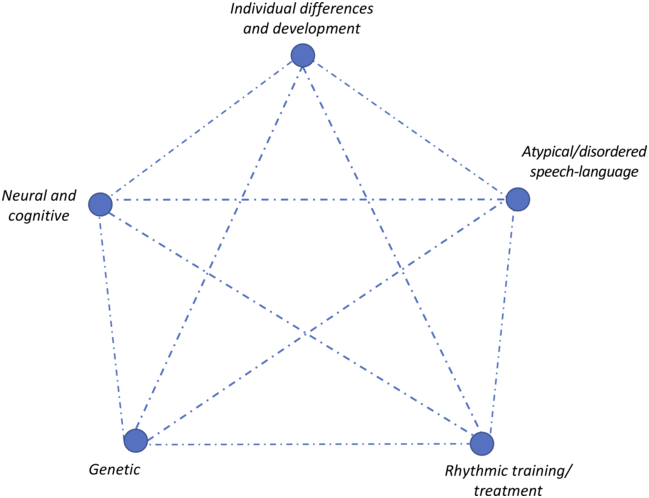
The current chapter has focused on connections between music and speech rhythm, and has done so largely from a cognitive perspective. However, there are broader cognitive and biological connections between music and speech/language processing that should also be considered. In relation to rhythm specifically, the ARRH (Ladányi et al., Reference Ladányi, Persici, Fiveash, Tillmann and Gordon2020) has a strong focus on the genetic and biological factors that may underlie atypical rhythm processing and the connection to speech and language impairments (see Niarchou et al., Reference Niarchou, Gustavson and Sathirapongsasuti2022). Genetic building blocks may create the foundation by which joint deficits could occur within music and speech rhythm, and associated individual differences. As part of the PRISM hypothesis, Fiveash et al. (Reference Fiveash, Bedoin, Gordon and Tillmann2021) outline that in addition to the neural and cognitive factors covered by PRISM, future research should also incorporate the broader context (see Figure 28.2), including individual differences, atypical and disordered speech/language processing and related deficits in music rhythm, beneficial effects of rhythmic training in the long term and rhythmic priming in the short term on speech/language processing, and genetic influences (outlined further in Ladányi et al., Reference Ladányi, Persici, Fiveash, Tillmann and Gordon2020).
Broader cognitive and biological considerations.
In addition to the neural and cognitive considerations presented in the PRISM framework, there are broader cognitive and biological considerations to keep in mind when investigating speech and music connections.
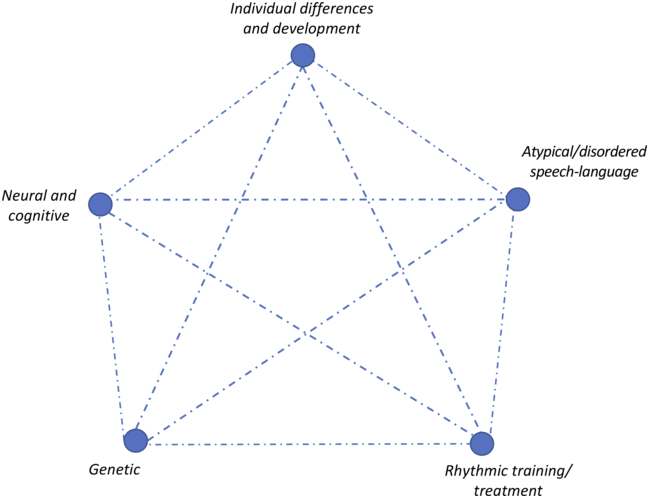
Figure 28.2 Long description
The nodes represent different factors, and the dashed lines connecting them indicate relationships. The factors are as follows. Individual differences and development, atypical or disordered speech-language, rhythmic training or treatment, genetic and neural and cognitive.
Reward might also play an important role in the beneficial effects of rhythm on learning and memory and social connection (Fiveash et al., Reference Fiveash, Ferreri and Bouwer2023a). Intrinsic reward elicited through music (and in particular, the temporal dimension) might also be an important driving factor as to why music is particularly valuable within rehabilitation and training scenarios (e.g., Altenmüller and Schlaug, Reference Altenmüller and Schlaug2013). Therefore, optimizing musical reward should be considered when designing training experiments, in link with the groove literature (e.g., Matthews et al., Reference Matthews, Witek, Lund, Vuust and Penhune2020; Witek et al., Reference Witek, Clarke, Wallentin, Kringelbach and Vuust2014) and individual differences in sensitivity to music reward (Mas-Herrero et al., Reference Mas-Herrero, Marco-Pallares, Lorenzo-Seva, Zatorre and Rodriguez-Fornells2013). One could further extend this investigation by testing whether the beneficial effect of rhythm can be further boosted by social situations including joint action (see Fiveash et al., Reference Fiveash, Ferreri and Bouwer2023a).
Beyond the genetic and neural bases, referred to as internal factors, Nayak et al. (Reference Nayak, Coleman and Ladányi2022) also takes into account external factors (e.g., environment and experience) to explain music–language connections. Their Musical Abilities, Pleiotropy, Language, and Environment (MAPLE) framework considers studies supporting both rhythmic and tonal-melodic associations with speech perception, reading-related skills, and morphosyntactic skills (presented in their Tables 3, 4, and 5). It complements the more rhythm-specific links related to speech perception, phonological awareness, reading, and grammar (see supplementary material of Fiveash et al., Reference Fiveash, Bedoin, Gordon and Tillmann2021). Teasing apart the associations between rhythmic/tonal-melodic and speech/language abilities will shed light on which abilities might be supported by specific and shared underlying mechanisms.
These theories of music and speech/language processing (PRISM, ARRH, MAPLE) also underline the need to consider individual differences, both in typically developing and patient populations. The perception and production of music and speech/language involve numerous interacting elements that can be processed by the brain in different and widespread ways. Individual differences in genetic architecture, personality, musicality, musical training, musical reward sensitivity, and environmental influences (among others) may affect differently how music and speech/language are processed by the brain. This suggests that future research should also consider differences across individuals and across developmental disorders when investigating rhythm processing and potential effects of music training on language processing.
Summary
Music and speech rhythms display acoustic and structural similarities that are processed with shared cognitive and neural resources. The PRISM framework outlines perceptual and cognitive processes that could underlie the connections between music and speech/language processing observed in both correlational and experimental research. It provides perspectives and implications for clinical interventions, training, and future research.
Implications
The regularity of music rhythm provides a strong basis to better understand less regular speech signal processing. The proposed framework combines speech and music rhythm processing to facilitate future research investigating how the brain processes rhythm, and the mechanisms by which music training could be beneficial to speech processing.
Gains
We have presented a parsimonious framework to propel research in music and speech. Its goal is to better understand speech/music connections and how these could be used to help speech/language processing, even in pathological conditions.

 Open access