

Introduction
Disasters affect all people, but they do not affect all people equally. Children have unique physiological and developmental characteristics that make them more vulnerable during disasters and emergencies, but there is a lack of pediatric-specific disaster preparedness funding, research, and resources.Reference Krug1 In addition, there is often stark racial, ethnic, and socioeconomic inequity in disaster response, demonstrated by recent disasters such as the COVID-19 pandemic,Reference Sirleaf and Clark2 hurricanes across the southern and eastern United States (US) and Caribbean,Reference Willison, Singer and Creary3, Reference Messias and Lacy4 and wildfires in the western US.Reference Méndez, Flores-Haro and Zucker5 This project focuses specifically on climate-related disasters such as wildfires, floods, extreme heat, and extreme storms, which will affect the lives and health of all people, especially those in high-risk areas.Reference Watts, Amann and Arnell6 Children in immigrant families are at the intersection of these vulnerable populations.
Previous studies in both the US and abroad have demonstrated that immigrant households are less prepared for disasters than citizens.Reference Carter-Pokras, Zambrana and Mora7–Reference Yong, Lemyre and Pinsent9 The same has been shown for US households that speak languages other than English at home.Reference Nepal, Banerjee and Perry10 Nearly 40% of California households identify as Hispanic or Latino, and 27% of the state’s residents are immigrants, the largest share of any state.Reference Bureau11, 12 California also faces significant threats from climate-related disasters, making it essential for California to equitably prepare people and systems for the impacts of climate change.Reference LaTourrette, Lauland, Fischbach and Stelzner13 In this study, the authors focused on disaster preparedness among families with children, as this is an area with fewer research efforts and resources.
The objective of this study is to identify community strengths and gaps in climate disaster preparedness and education in Spanish-speaking families in order to inform linguistically and culturally appropriate disaster preparedness materials and policy advocacy to meet their needs. The research team consists of medical professionals and disaster preparedness experts. Acknowledging the context of conducting research in the Spanish-speaking community as a research team without Hispanic or Latino representation, the authors collaborated with the non-profit community organization Vision y Compromiso throughout study development and execution. The title of our study, Todos Preparados, means “All Prepared” in Spanish.
Methods
This mixed-methods needs assessment combines qualitative data from focus groups and quantitative survey data from Spanish-speaking family representatives. This study was conducted in collaboration with Vision y Compromiso, a community organization that supports, trains, and employs Promotores de Salud , or Spanish-speaking health promoters. Study materials including recruitment flyers, pre-participation consent documents, focus group interview guides, and surveys were translated into Spanish with the help of UCSF interpreter services. In December of 2024, study authors conducted an English-language pilot study of focus group and survey questions about climate preparedness with a university-affiliated Youth Research Advisory Council to collect feedback. They solicited feedback on the Spanish-language translation of focus group and survey questions from collaborators at Vision y Compromiso, and this group also helped devise the recruitment plan.
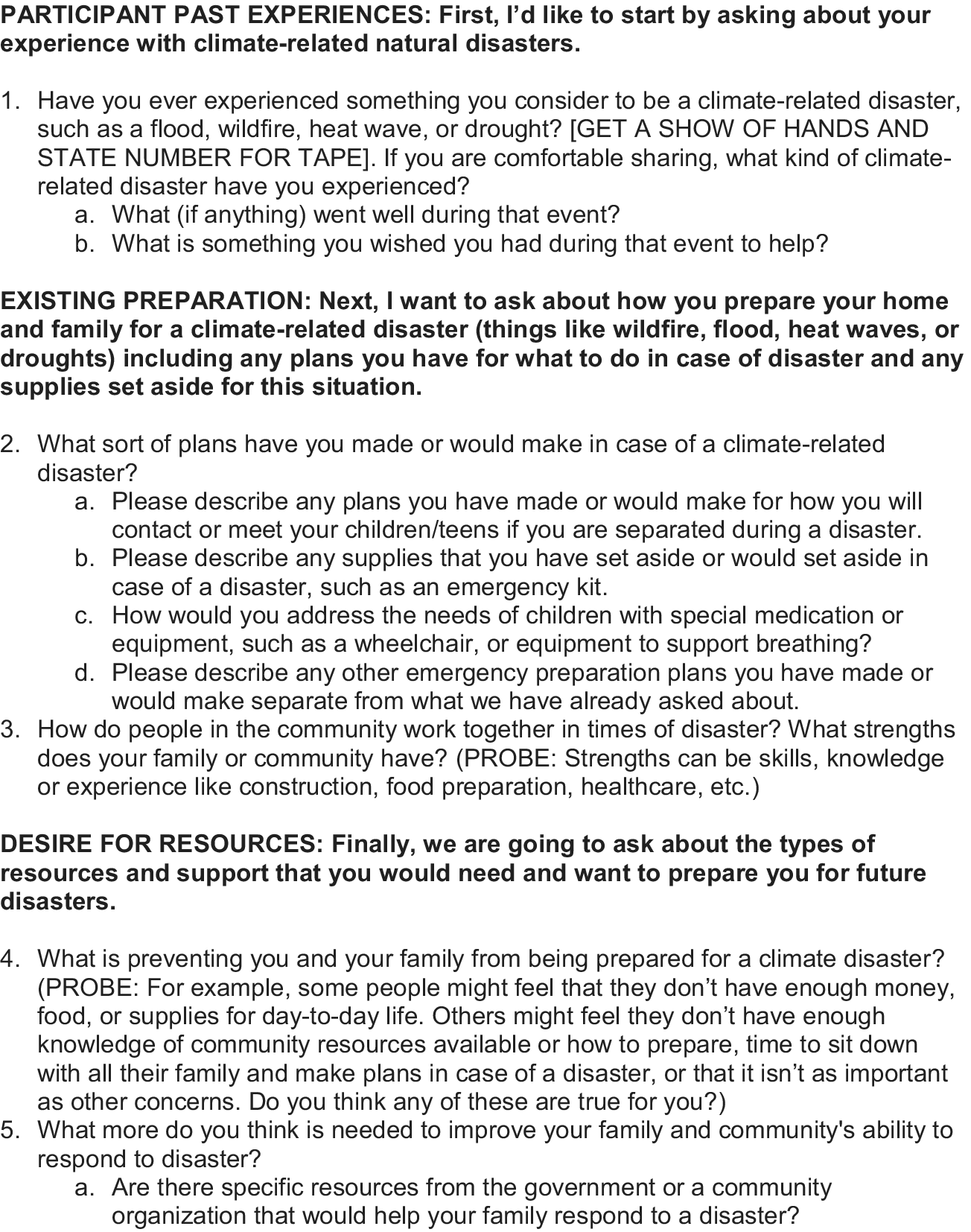
Participants were recruited via informational flyers distributed by Promotoras at two community sites. A $50 gift card was offered as incentive to participants. Focus groups and surveys of Spanish-speakers were facilitated by Promotoras at the Mexican Consulate in San Francisco. Participants first gave verbal consent to participate and performed a warm-up exercise, answering the question, “what does being prepared mean to you?” as a group. Promotoras then started the focus group, asking about participants’ past experiences with disasters, their current preparations with their family and household, and what education and resources they would like in the future to help prepare for climate disasters (Figure 1). Each session lasted about 90 minutes including time to complete the survey. The Promotoras had undergone an orientation on the purpose of the project, the questions being asked, and training in how to facilitate and guide a focus group discussion.
Focus group interview questions.

Focus groups were recorded with the consent of the participants, and the original Spanish transcript was translated into English by Trint, a commercially available software program that utilizes Artificial Intelligence (AI) including automated speech recognition and natural language processing to transcribe audio into text and translate between languages. Transcripts were then reviewed and edited by bilingual team members for accuracy, and any identifiable information was removed from the transcripts. Two authors (ML, RH) developed an initial framework of key codes from these transcripts. Codes were then reviewed and revised with the larger author group, with discrepancies resolved by team consensus. Final themes were determined using modified grounded theory common in qualitative data analysis.Reference Corbin and Strauss14
At the end of each focus group, Promotoras distributed a brief survey to all participants. The survey tool is a modified version of the Community Assessment for Public Health Emergency Response (CASPER) Preparedness survey available from the Centers for Disease Control and Prevention (CDC).15 It was modified for direct response from participants (rather than for administration verbally by a CDC researcher) and questions were added to assess specific disaster preparedness for children. Data from the quantitative survey was analyzed with descriptive statistics.
This study was determined to be exempt with limited review by the Institutional Review Board (IRB) of the University of California, San Francisco, IRB # 24-42063.
Results
There were 20 study participants total, representing 108 family members from at least 6 countries in North, Central, and South America. Household size ranged from 1 to 18 with most households (n = 17) including minors and all participants reporting past or present responsibility for minor family members.
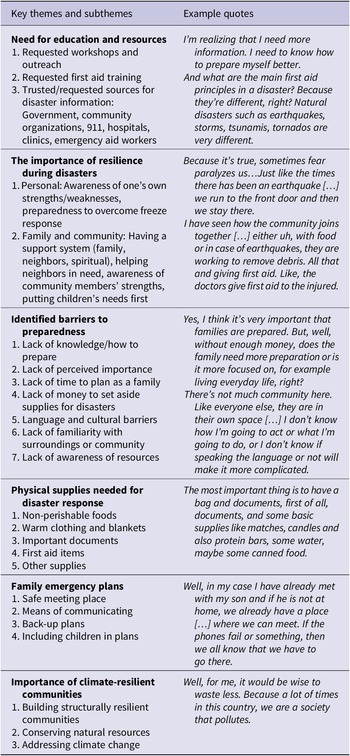
In focus group discussions, participants identified many perceived barriers to improved disaster preparation, had good awareness of family emergency plans and physical supplies, and recognized the importance of resilience during disasters. Nearly all participants identified a lack of knowledge about disaster preparedness and a desire to learn more and build skills to prepare their homes and families for climate disasters. See Table 1 for key themes, subthemes, and example quotes.
Major themes from focus groups with Spanish-speaking family representatives and example quotes

Table 1. Long description
The table consists of two columns: Key themes and subthemes, and Example quotes.
Row 1: Need for education and resources. Subthemes include requests for workshops, outreach, and first aid training, and identifying trusted sources like government and hospitals. Quote: I am realizing that I need more information. I need to know how to prepare myself better.
Row 2: The importance of resilience during disasters. Subthemes cover personal awareness to overcome freeze response and community support systems. Quote: I have seen how the community joins together either with food or in case of earthquakes, they are working to remove debris.
Row 3: Identified barriers to preparedness. Subthemes include lack of knowledge, time, money, and awareness of resources, alongside language and cultural barriers. Quote: Without enough money, does the family need more preparation or is it more focused on living everyday life?
Row 4: Physical supplies needed for disaster response. Subthemes list non-perishable foods, warm clothing, documents, and first aid items. Quote: The most important thing is to have a bag and documents, first of all, and some basic supplies.
Row 5: Family emergency plans. Subthemes include safe meeting places, communication means, and including children. Quote: If the phones fail or something, then we all know that we have to go there.
Row 6: Importance of climate-resilient communities. Subthemes focus on structurally resilient buildings, conserving resources, and addressing climate change. Quote: For me, it would be wise to waste less. Because a lot of times in this country, we are a society that pollutes.
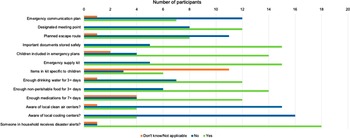
In a survey to assess existing disaster preparedness, most participants reported some disaster preparations. Many participants reported having an emergency supply kit (n = 15), storing important documents safely (n = 15), having at least 3 days of extra food (n = 14) or water (n = 12) in the home in case of disaster, and receiving disaster alerts (n = 18). Very few participants were aware of local resources like clean air and cooling centers (n = 4), and only about a third of participants reported having an emergency communication plan (n = 7) (Figure 2).
Household disaster preparedness survey results from a mixed-methods needs assessment of Spanish-speaking families.

Figure 2. Long description
The x-axis represents the number of participants from 0 to 20. The y-axis lists twelve preparedness measures.
* Emergency communication plan: No 12, Yes 7, Don’t know 1.
* Designated meeting point: Yes 12, No 8, Don’t know 0.
* Planned escape route: No 11, Yes 8, Don’t know 1.
* Important documents stored safely: Yes 15, No 5, Don’t know 0.
* Children included in emergency plans: Yes 14, No 4, Don’t know 2.
* Emergency supply kit: Yes 15, No 5, Don’t know 0.
* Items in kit specific to children: Don’t know 11, Yes 6, No 3.
* Enough drinking water for 3+ days: Yes 12, No 7, Don’t know 1.
* Enough non-perishable food for 3+ days: Yes 14, No 6, Don’t know 0.
* Enough medications for 7+ days: Yes 12, No 4, Don’t know 4.
* Aware of local clean air centers?: No 15, Yes 4, Don’t know 1.
* Aware of local cooling centers?: No 16, Yes 4, Don’t know 0.
* Someone in household receives disaster alerts?: Yes 18, No 1, Don’t know 1.
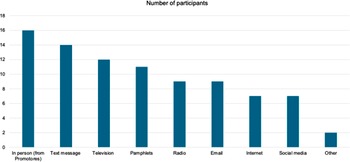
The most common preferred methods for receiving information about household disaster preparedness were in person from Promotores and by text message, with general internet and social media sources being less preferred (Figure 3).
Preferred methods of receiving disaster preparedness information from a mixed-methods needs assessment of Spanish-speaking families.

Figure 3. Long description
The Y-axis is labeled Number of participants with a scale from 0 to 18 in increments of 2. The X-axis lists nine communication methods. The data shows a downward trend from left to right.
* In person from Promotores: 16 participants.
* Text message: 14 participants.
* Television: 12 participants.
* Pamphlets: 11 participants.
* Radio: 9 participants.
* Email: 9 participants.
* Internet: 7 participants.
* Social media: 7 participants.
* Other: 2 participants.
Limitations
The main limitation of this study is the small number of participants and single geographic area sampled, since focus groups and surveys were conducted at the Mexican Consulate in just one major city. This could limit the generalizability of these findings, although the study team was able to recruit participants from more than 6 different countries in North, Central, and South America. The project also relied on self-reported data from participants with the time and inclination to attend a focus group mid-day on a weekday. Participants were also given a financial incentive ($50 gift cards for each participant at the conclusion of the focus group and survey) which could have led to a sample that does not accurately represent the larger community of Spanish-speaking immigrants in the study area more generally.
Social desirability bias could have led participants to report increased preparedness behavior to impress the researchers and other participants,Reference Callegaro and Paul J.16 though researchers attempted to mitigate this bias by asking participants what preparations they had made or would make, allowing hypothetical answers to minimize judgment. Participants may have changed their behavior when they learned about the study topic at the time of recruitment, improving their disaster preparedness simply because attention was drawn to it. This is also a strength of the study, since many participants expressed an intention to improve their family disaster plans and preparedness after participating in the focus group.
Additional strengths include assessing the preparedness needs of Spanish-speaking families, and inclusion of children and adolescents in household disaster preparedness plans, both populations often underrepresented in community disaster research. Participants were recruited without reference to the presence of minor children in the home, so not all family-representatives currently lived with a minor, but all participants answered disaster preparedness questions regarding minors, often referring to grandchildren or other children in their extended family. In addition, this study explored not only the community’s needs but also their strengths, skills, and experience with past disasters.
Discussion
Key Findings
This study demonstrates strong interest from Spanish-speaking families for more disaster preparedness education, first aid training, and preparedness resources. Participants were broadly aware of key components of a family communication plan and disaster supplies but identified barriers to household preparedness. Some of these are common across many populations, such as lack of knowledge, time, money, and perceived importance, while others were specific to this population including language barriers, feeling isolated from their community, and being far from family and support systems.
Many participants identified the importance of resilience at a personal, family, and community level. Personal resilience was often described as staying calm, especially to care for children and other family and community members. Family and community strengths included caring for one another, skills such as cooking, construction, and first aid, and using experiences from past disasters to prepare for the future.
Finally, participants highlighted the importance of climate-resilient communities, such as homes built on high ground to avoid flooding, as well as actions to mitigate and address climate change, such as conservation, reducing waste, and avoiding pollution.
Comparison to Previous Studies
A previous qualitative study showed that low-income Latino immigrants voiced obstacles to family disaster preparedness including space to store supplies, convincing other family members to help form a family communication plan, and misunderstanding of the proper quantity of water and types of food to store as disaster supplies.Reference Eisenman, Glik and Maranon17 Participants identified small group discussions as an acceptable way to learn more about disaster preparedness,Reference Eisenman, Glik and Maranon17 a method that was also acceptable to participants in this study.
Overall, study participants reported levels of household preparedness that are comparable to those found in past surveys that utilized the CDC’s Community Assessment for Public Health Emergency Response (CASPER), a tool widely used both during disaster response and in times without disasters.18–20 Relatively few people knew of community resources like cooling centers and clean air centers, but a majority had a designated meeting place, an emergency supply kit with at least some recommended materials, and copies of important documents, and most had included children and adolescents in household emergency planning.
Conclusions
These results demonstrate that while many Spanish-speaking households have experience with disasters and have made some disaster preparations, there are significant gaps in information and preparedness. There is a clear opportunity and desire for culturally appropriate Spanish-language information and education on disaster preparedness.
Next steps include further needs assessments to collect more information from specific populations, like families of children with complex medical needs and immigrant families with different backgrounds and in different locations. Ultimately, study authors hope the study results can inform a culturally sensitive educational curriculum on disaster preparedness for Spanish-speaking families that builds upon the valuable experience and resources that already exist in these communities.
Acknowledgments
Funding for this project was provided by the American Academy of Pediatrics’ Disaster Preparedness Ambassador Program via the American Academy of Pediatrics Northern California chapter (AAPCA1) and a Care and Connect Microgrant from AAPCA1. Thanks to our collaborators at Vision y Compromiso: Hugo Ramirez, Josefita Maldonado, and Cindia Martinez. Additional thanks to Shruti Kant, MBBS, Hilary Ong, MD, Yolanda Ruiz, UCSF Benioff Children’s Hospital Oakland Interpreter Services, the UCSF Youth Research Advisory Council, and the Mexican Consulate in San Francisco.
Author contribution
Dr. Leighton conceptualized and designed the study; developed the focus group and survey tools, led collaboration with community partners, supervised participant recruitment and conduct of focus groups and surveys, and led thematic analysis; drafted, reviewed, and revised the manuscript; and approved the final manuscript as submitted.
Dr. Hojjati participated in development of the focus group and survey tools; collaborated on thematic analysis; participated in drafting, reviewing, and revising the manuscript; and approved the final manuscript as submitted.
Dr. McCarten-Gibbs participated in the design of the study, critically reviewed and revised focus group and survey tools, participated in collaboration with community partners, critically reviewed thematic analysis and the manuscript, and approved the final manuscript as submitted.
Dr. Glines participated in the design of the study, critically reviewed and revised focus group and survey tools, participated in collaboration with community partners, critically reviewed thematic analysis and the manuscript, and approved the final manuscript as submitted.
Dr. Glomb supervised the conceptualization and design of the study, supervised development of the focus group and survey tools, participated in collaboration with community partners, conducted training for community partners on conducting focus groups, supervised data analysis interpretation, critically reviewed and revised the manuscript, and approved the final manuscript as submitted.
Funding statement
This study was supported by a Disaster Preparedness Ambassador Grant from the American Academy of Pediatrics (AAP) and by a Care and Connect Microgrant from the American Academy of Pediatrics Northern California chapter (AAPCA1). The AAP had no role in the design and conduct of the study.
Competing interests (includes financial disclosures)
The authors have no conflicts of interest or financial disclosures to report.

 Open access

