





Highlights
-
1. Interpreting training enhances cognitive flexibility (CF).
-
2. Interpreters’ CF advantage developed from local switching to global monitoring.
-
3. Interpreters’ CF advantage appeared first in switch cost and then in mixing cost.
-
4. The CF advantage transition appeared around intermediate interpreter expertise.
-
5. Test tasks of cognitive control may be sensitive in different ways.
Introduction
How language experience could affect cognitive faculties or processes is a critical issue in the realm of bilingualism (e.g., Saville-Troike, Reference Saville-Troike2005) and the plasticity of the human cognitive system (e.g., Li & Dong, Reference Li and Dong2020). One way to approach this issue is to investigate the effects of the extremely cognitively demanding bilingual experience of interpreting. Dong and Li (Reference Dong and Li2020) suggest that frequent and regular switching between languages is a distinguishing feature of interpreting when compared with other bilingual processes. Since interpreting necessitates frequent and efficient switching between the source language and the target language, the successful execution of an interpreting task (especially a simultaneous interpreting (SI) task) demands a high degree of cognitive control in the form of cognitive flexibility, the ability to switch between different tasks or mental sets in diverse situations (Diamond, Reference Diamond2013; Miyake et al., Reference Miyake, Friedman, Emerson, Witzki, Howerter and Wager2000). However, despite the taxing demands on cognitive flexibility during interpreting, it remains contentious whether interpreters possess cognitive flexibility advantages over general bilinguals, with both positive results (e.g., Dong & Liu, Reference Dong and Liu2016; Yudes et al., Reference Yudes, Macizo and Bajo2011) and null results (e.g., Babcock et al., Reference Babcock, Capizzi, Arbula and Vallesi2017). According to Dong’s (Reference Dong, Derreira and Schwieter2023) review, the seemingly messy results are probably due to two critical types of factors: interpreter expertise and task differences. Yet, there has been no attempt to empirically test the influence of these two factors on the presence of interpreters’ cognitive flexibility advantage (when compared with general bilinguals). Such attempts may help depict the dynamic picture of how language experience may impact cognitive flexibility advantage, and specify features of typical tasks used to test cognitive flexibility, providing methodological implications for future research, especially research on the hot-debated issue of bilingual advantages (for opposing views, see Bialystok, Reference Bialystok2017; Paap, Reference Miyake, Friedman, Emerson, Witzki, Howerter and Wager2022). The present study is the first attempt to consider the above two factors in the investigation of interpreter advantage, and future research on bilingual advantage research may take a similar approach.
Effects of interpreting on cognitive flexibility
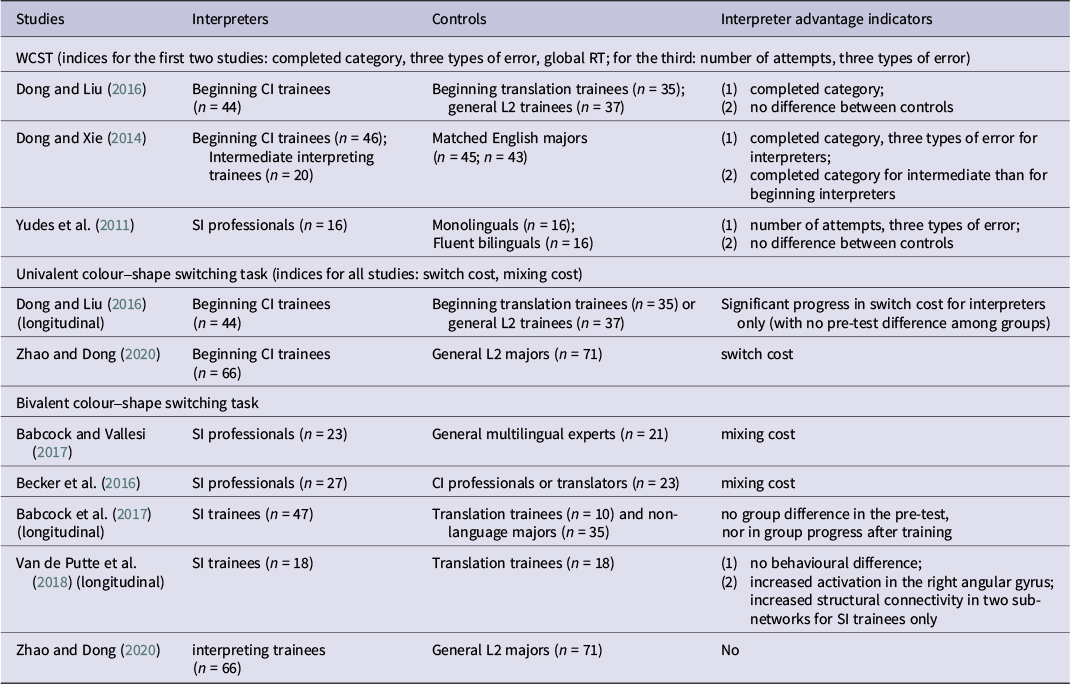
Cognitive flexibility, also known as switching/shifting ability, is one of the three core functions of cognitive control (also known as executive functioning or executive control, see Diamond, Reference Diamond2013; Miyake et al., Reference Miyake, Friedman, Emerson, Witzki, Howerter and Wager2000). It refers to our ability to flexibly disengage our attention from an old target and switch to a new target, to efficiently adapt to new demands and rules or to quickly change perspectives or approaches to problems (Diamond, Reference Diamond2013). Previous studies on interpreters’ cognitive flexibility advantage are quite mixed, which is probably a result of at least two influencing factors: task differences and interpreter expertise. Based on this hypothesis, Table 1 summarizes the relevant literature that we know thus far. We will first review relevant studies conducted with the Wisconsin Card Sorting Test (WCST), and then studies with the colour–shape switching task, trying to depict possible influences of task differences and interpreter expertise.
Indicators of interpreter advantage in switching found in the WCST and in the univalent and bivalent colour–shape switching tasks in the literature

Table 1. Long description
Table 1 summarizes previous findings on interpreter advantages in switching. Evidence is organized by WCST, univalent colour–shape switching and bivalent colour–shape switching tasks. WCST studies generally reported advantages for interpreters on completed categories, error measures, response time or attempts. Univalent task studies reported advantages or training-related progress in switch cost. Bivalent task findings were less consistent: some studies reported advantages in mixing cost, whereas others found no behavioural group difference.
Studies conducted with the WCST
Switching in the WCST is rule-based because participants are required to match each popped-up response card (e.g., a card of three blue squares) with one of the four stimulus cards on the computer screen by their shared colour or shape or number. The underlying rule (i.e., categorizing by colour, shape or number) may change every few trials (e.g., 5–8 trials regardless of participants’ response in Dong & Liu, Reference Dong and Liu2016; Dong & Xie, Reference Dong and Xie2014) or until participants “complete a category” (e.g., 10 consecutive correct responses in Yudes et al., Reference Yudes, Macizo and Bajo2011), and to perform well, participants have to change to a new rule upon receiving “wrong” feedback. All three relevant studies (Table 1) calculated three types of errors in WCST performance, that is, overall error, perseverative error (i.e., number of trials in which participants make continuous errors) and previous category perseverative error (i.e., perseverative error caused by repeating the previous incorrect rule). Two of the relevant studies (Dong & Liu, Reference Dong and Liu2016; Dong & Xie, Reference Dong and Xie2014) calculated “global RT” (i.e., average RT for each trial) and “completed category” (i.e., five consecutive correct responses constituting one completed category). The third study (Yudes et al., Reference Yudes, Macizo and Bajo2011) calculated “number of attempts” (i.e., number of trials to complete the six categories designed, with 10 consecutive correct responses constituting one completed category).
As for interpretations of these WCST performance indices, “WCST error” can be considered an indicator of cognitive flexibility in switching mental sets to new rules (Barceló, Reference Barceló1999; Hartman et al., Reference Hartman, Bolton and Fehnel2001; Xie & Dong, Reference Xie and Dong2017) since participants with better cognitive flexibility would make fewer errors (especially previous category perseverative errors) when given negative feedback. When there is no trade-off effect between RT and accuracy/error, “Global RT” in the WCST can be considered an indicator of performance efficiency and global monitoring since faster responses without sacrificing accuracy require heightened monitoring. “Completed category” or “number of attempt” is probably related to one’s problem-solving ability in inferring rules from “correct” and “wrong” feedback in rule-based switching tasks (Heaton et al., Reference Heaton, Chelune, Talley, Kay, Gary and Curtiss1993).
All three previous studies with the WCST have found evidence supporting interpreters’ cognitive flexibility advantage, no matter whether the expertise level is low (Dong & Liu, Reference Dong and Liu2016; Dong & Xie, Reference Dong and Xie2014), intermediate (Dong & Xie, Reference Dong and Xie2014) or advanced (Yudes et al., Reference Yudes, Macizo and Bajo2011). Dong and Liu (Reference Dong and Liu2016) compared three comparable groups of participants in their WCST performances (see supplementary materials in Dong & Liu, Reference Dong and Liu2016), that is, beginning consecutive interpreting (CI) trainees (with 32 hours’ in-class interpreting training plus 40 hours’ after-class practice), beginning translation trainees (with 32 hours’ in-class training plus 40 hours’ after-class practice) and a control group of general second language training at the same time. The results showed that the CI trainees outperformed both the translation trainees and the control group in the index of completed category (with no difference in error or global RT). Dong and Xie (Reference Dong and Xie2014) recruited two groups of interpreting students, which can be, respectively, considered beginning trainees (i.e., undergraduate English majors with about 128 hours’ CI training, including after-class practice) and intermediate trainees (i.e., graduates majoring in translation and interpreting studies, with about triple the 128 hours’ interpreting training). The results showed that both interpreting groups outperformed their respective control groups in “completed category” and the three types of error (but not in global RT), with the intermediate trainees outperforming the beginning trainees in “completed category.” Yudes et al. (Reference Yudes, Macizo and Bajo2011) compared the WCST performances of three groups of participants, and found that the professional SI interpreters (with an average of 10.83 years of interpreting experience) outperformed the monolingual and fluent bilingual groups in all the indices they calculated, that is, number of attempts and the three types of error.
Based on the above analysis of the WCST performance indices and the three previous studies conducted with the WCST, we tentatively hypothesized a rough three-stage developmental trajectory of interpreter advantages as reflected in the WCST indices, that is, from (1) completed category or number of attempts to (2) an additional index of error to (3) a further additional index of global RT. This is probably due to the fact that, along the developmental trajectory of interpreter expertise, the most critical challenge of interpreting experience changes from “the pressure to complete the task” to “the pressure to transmit as accurately as possible” and then to “the pressure to perform efficiently.” Under the different kinds of interpreting pressure, the attentional control system is heavily taxed and then adapted in corresponding ways, which may then lead to better domain-general task performance in corresponding ways (as reflected in the WCST performance indices)(Dong & Li, Reference Dong and Li2020). However, we must emphasize that this three-stage developmental trajectory is a working, tentative hypothesis that calls for empirical investigation.
Studies conducted with the colour–shape switching task
Different from the WCST, the task of colour–shape switching is cue-based or more generally task-based, because participants are required to press a designated key corresponding to either colour (e.g., green or red) or shape (e.g., circle or triangle) according to either the colour or shape cue/task instructions. In the univalent version, each stimulus is generally either an abstract patch of colour (e.g., red or green, with no ready name for the shape of the colour) or a simple shape (e.g., circle or triangle, in the same white colour as the computer screen). In the bivalent version, each stimulus is a combination of colour and shape (e.g., green circle). In either version, there are two types of blocks, for example, the single-task blocks (i.e., judging according to one cue throughout the block) and the mixed-task blocks (i.e., judging according to one of the two cues given with each stimulus). The two major indices of such switching tasks are switch cost (i.e., the performance difference between switch and non-switch trials in the mixed block) and mixing cost (i.e., the performance difference between non-switch trials in the mixed block and trials in single-task blocks). Switch cost and mixing cost are, respectively, considered indices for one’s ability in transient/local and sustained/global control in task switching (Braver et al., Reference Braver, Reynolds and Donaldson2003; Koch et al., Reference Koch, Prinz and Allport2005), or one’s ability in local switching and global monitoring (Hofweber et al., Reference Hofweber, Marinis and Treffers-Daller2016; Zhao & Dong, Reference Zhao and Dong2020).
As for previous studies with the colour–shape switching task, the situation is more complex, with one of them employing only the univalent version of the task, four of them only the bivalent version and one both versions. With the univalent version, Dong and Liu (Reference Dong and Liu2016) conducted a longitudinal study with three groups of university students (as described above in the WCST section), and found that, although matched in the pre-test, the group of participants with 32 hours’ in-class interpreting training made significant progress in the post-test in switch cost (but not in mixing cost) while neither the group of translation training nor the control group did, directly indicating the significant impact of interpreting experience. Among the four studies that employed the bivalent instead of the univalent version of the switching task, two of them compared professional interpreters and their corresponding control groups (professional CI interpreters and translators in Becker et al., Reference Becker, Schubert, Strobach, Gallinat and Kühn2016; multilinguals in Babcock & Vallesi, Reference Babcock and Vallesi2017), and found that professional interpreters performed better in the index of mixing cost. The two other studies did not find similar effects, with Babcock et al. (Reference Babcock, Capizzi, Arbula and Vallesi2017) comparing SI trainees (post-graduate students majoring in conference interpreting) with translation trainees and non-language students at the beginning and end of a master’s degree program, and Van de Putte et al. (Reference Van De Putte, De Baene, García-Pentón, Woumans, Dijkgraaf and Duyck2018) comparing beginning SI trainees and matched translation trainees (both without interpreting training in the pre-test) before and after a nine-month Master course of SI or translating. Despite the null effects of behavioural data in the fMRI and DTI study, Van de Putte et al. (Reference Van De Putte, De Baene, García-Pentón, Woumans, Dijkgraaf and Duyck2018) discovered that, compared with the translation trainees, the SI trainees showed increased activation in the right angular gyrus (connected to language control, supramodal attentional control and supramodal semantic control), and incremented structural connectivity in two subnetworks (related to inhibitory control and language control), providing evidence for neural plasticity as a consequence of SI training. Comparing the behavioural data of the four studies using the bivalent version (Babcock et al., Reference Babcock, Capizzi, Arbula and Vallesi2017; Babcock & Vallesi, Reference Babcock and Vallesi2017; Becker et al., Reference Becker, Schubert, Strobach, Gallinat and Kühn2016; Van de Putte et al., Reference Van De Putte, De Baene, García-Pentón, Woumans, Dijkgraaf and Duyck2018), we may reach an assumption or a hypothesis that interpreter expertise plays an important role in the presence or absence of a mixing cost advantage, but we are fully aware that there was no clear-cut pattern for the interpreter expertise levels compared in these studies.
Zhao and Dong (Reference Zhao and Dong2020) was the only study that employed both versions of the colour–shape switching task. With the univalent version, this study found that interpreting students (with altogether 677 hours of in- and after-class interpreting training) outperformed the control group of general L2 learners (with only about 35 hours’ interpreting training) in switch cost (but not in mixing cost). The bivalent version of the task, however, did not result in any group difference. Dividing the interpreting students into two groups differing in L2 proficiency (44 or 50 among a total of 60 scores in the Oxford Quick Placement Test), and comparing each group with its control group, Zhao and Dong (Reference Zhao and Dong2020) found that interpreting students of higher L2 proficiency tended to outperform their control group in mixing cost in the bivalent version of the task (but not in switch cost).
Taken together, the six studies employing the colour–shape switching task suggest that at an early stage of interpreting training, when interpreting trainees’ two languages were unbalanced and their interpreter expertise was not good enough, swift and immediate switching between listening to one language and speaking in another was not easy, and trainees had to first keep up with the pace of the speaker(s) and thus the pace of switching, resulting in an exercise and probably a boost in local and transient switching ability (as indicated by the decreased switch cost in the univalent version of the colour–shape switching task). It is probably only when cognitive resources are sufficient that interpreters can devote more of their attention to global and sustained control in interpreting, resulting in an exercise and probably a boost in global and sustained control ability (as indicated by the decreased mixing cost in the bivalent version of the switching task). Higher interpreter expertise and/or L2 proficiency could free up more cognitive resources, which may explain the pattern of findings with the colour–shape switching task in Table 1. Yet, there has been no test of the role of interpreter expertise in the literature, and the role of L2 proficiency in Zhao and Dong (Reference Zhao and Dong2020) was only marginally significant. Since interpreter expertise and L2 proficiency are often intertwined, it is probably better to manipulate interpreter expertise in future research, since interpreter expertise, rather than L2 proficiency, is more directly related to the issue of how interpreter experience may influence cognitive flexibility.
Based on the above review of the six previous studies in the literature and a unified interpretation of their findings, we hypothesized a DEVELOPMENTAL TRANSITION of interpreter advantages as reflected in the indices of the colour–shape switching task, that is, from switch cost in the univalent version of the task to mixing cost in the bivalent version, testifying an advancement from local switching control to global monitoring control.
The present study
As analysed above, the mixed findings in the literature are probably related to the two factors of task differences and interpreter expertise. The present study, therefore, aimed to explore the influences of these two factors on the issue of how interpreting experience may impact cognitive flexibility, providing evidence supporting or modifying the above two hypotheses about the developmental features of interpreter advantages in cognitive flexibility.
As for task differences, the present study would employ both the rule-based WCST and the cue-based colour–shape switching task (including both univalent and bivalent versions) to test the same group of interpreting students and their control group.
As for interpreter expertise, Table 1 seems to show that a critical stage of interpreter expertise is the intermediate level, around which interpreters’ cognitive flexibility advantages may develop from local control to global control (respectively, indexed by lower switch cost and lower mixing cost). Although there is neither clear nor consistent definition in the literature for what can be considered intermediate interpreter expertise, the present study takes the interpreter expertise of graduate students majoring in interpreting (students in MTI programmes or master programmes in translation and interpreting) as a rough line, with their entrance level as the pre-intermediate level and with their graduate level (after completing interpreting training courses) as the post-intermediate level. We would thus recruit such a group of graduate students majoring in interpreting, and compare them with matched controls, that is, graduate students majoring in English literature or linguistics) both at the beginning of their master’s programmes (the pre-test) and after one academic year of specialized training (the post-test). During the interval, the interpreter group received specialized interpreting training while the control group received general bilingual training in linguistics or literature (see the Method section for Experiment 2 for more details).
Since no previous studies have directly explored the issue of task differences in interpreters’ cognitive advantage, we would separately report, in Experiment 1 (cross-sectional), how the interpreting students differed from their bilingual controls in the three switching tasks at the pre-test (i.e., with the interpreting students at the pre-intermediate interpreter expertise level). At the post-test, the two groups of graduate students would have received, respectively, one academic year’s interpreting training or linguistics/literature training, with the interpreting students being generally considered at the post-intermediate level of interpreter expertise. We would thus report, in Experiment 2 (longitudinal), possible interactions between the factor of Time (pre- and post-test) and Group (interpreting students and controls), aiming to explore any development of interpreters’ advantage in cognitive flexibility.
Based on the above design and the literature (Table 1), we had two major predictions. First, at the pre-test (pre-intermediate interpreter expertise level), interpreter advantage would emerge in the WCST indices of completed category and error, and in switch cost (instead of mixing cost) in the univalent colour–shape switching task. Second, at the post-intermediate interpreter expertise level, interpreter advantage would also show up in WCST global RT, and in mixing cost (instead of switch cost) in the bivalent version of the task, indicating an advancement to performance efficiency and global monitoring, and from local switching control to global monitoring control.
Experiment 1
Participants
Altogether, 93 post-graduate freshmen aged 19–29 years (M = 22.37 years, SD = 1.15 years) from a major university in China were recruited in the pre-test and were given monetary compensation. The interpreter group consisted of 50 students who had just entered their master’s degree programme in Interpreting, with an average of 109.95 hours of interpreting training (SD = 57.97 hours) during their undergraduate years (not including practice hours), while the control group comprised 43 general bilinguals who had just entered their master’s degree programme in linguistics or literature, with an average of 23.57 hours of interpreting training (SD = 21.39 hours) during their undergraduate years.
To exclude potential confounding factors, participants’ biological and socio-economic status information (i.e., age, IQ and parental education) and L2-related information (i.e., age of L2 acquisition, years of L2 learning, and their L2 proficiency) were collected and analysed in the group matching process (procedures described below) before further data analyses.
Materials and tasks
The WCST task
To better reflect the developmental trajectory of interpreter advantage in cognitive flexibility as tested in the WCST task, the present study used an adapted WCST version from Dong and Xie (Reference Dong and Xie2014) and Dong and Liu (Reference Dong and Liu2016) rather than that of Yudes et al. (Reference Yudes, Macizo and Bajo2011), which means “global RT” rather than “number of attempts” would be reported as one of the indices. To minimize the confounding factor of pre-test practice on the post-test, participants were explicitly told in the test instructions that there would be altogether three possible categorizing rules (by shape, colour or number), which differ from the three relevant cross-sectional tests (Dong & Liu, Reference Dong and Liu2016; Dong & Xie, Reference Dong and Xie2014; Yudes et al., Reference Yudes, Macizo and Bajo2011).
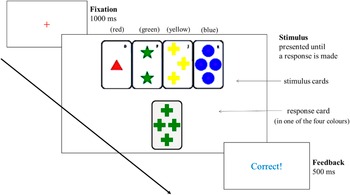
Figure 1 illustrates the procedures and stimuli for the WCST computerized through E-prime. The programme started with 12 practice trials, followed by 128 formal trials. For each trial, participants were required to categorize each popped-up response card (e.g., four green squares) into one of the four stimulus cards on the screen, according to their shared feature in one of the three dimensions (shape, colour and number), and were given “correct” or “wrong” feedback for each response. The underlying categorizing rule would change after a few trials (from 5 to 8 trials). At the beginning of each trial, a “+” fixation was presented for 1000 ms, after which the stimulus appeared and lasted until the participants made a response by pressing one of the four designated keys (“D,” “F,” “J” and “K”) representing one of the four stimulus cards. Feedback on the accuracy of each response lasted for 500 ms, followed by the next trial until participants finished sorting all of the 128 response cards (see Figure 1).
Procedures and stimuli for WCST.

Figure 1. Long description
Figure 1 illustrates a WCST trial. A fixation cross appears for 1000 ms, followed by four stimulus cards: one red triangle, two green stars, three yellow crosses and four blue circles. A response card with four green crosses appears below. The participant selects one stimulus card according to a sorting rule such as colour, shape or number. The display remains until response, and feedback, such as “Correct!,” is then shown for 500 ms.
Univalent and bivalent colour–shape tasks
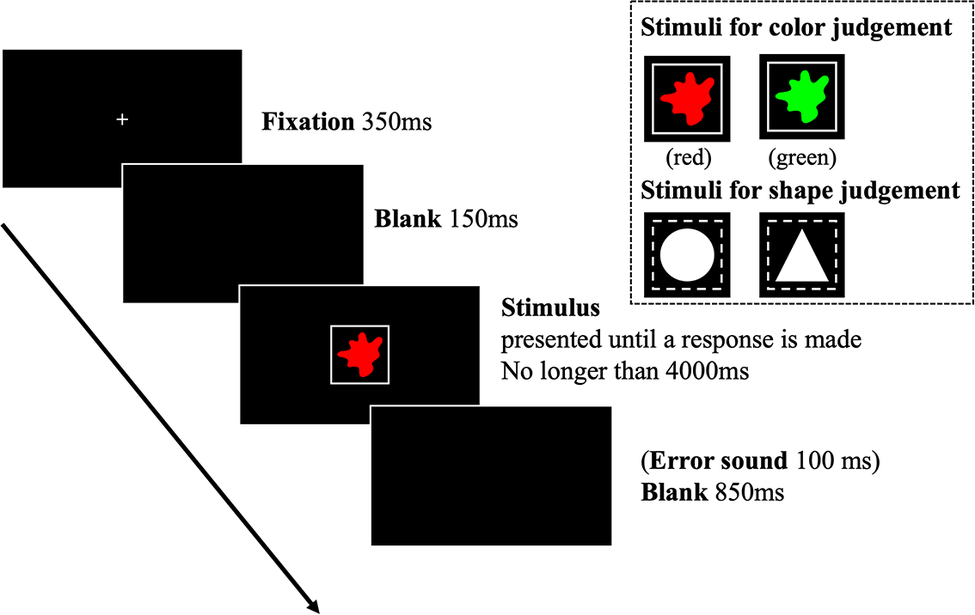
There were four types of stimuli in the univalent colour–shape task (Figure 2): two coloured patches (red/green) and two empty shapes (circle/triangle). The first two stimuli were used for colour judgements, while the latter two were used for shape judgements. The solid or dotted line of the square was a cue for colour or shape judgement. For half of the participants, the colour judgements were assigned to keys “A” and “S” on their left hand, and the shape judgements were assigned to keys “K” and “L” on their right hand. The keys were counterbalanced for the other half of the participants.
Procedures and stimuli for the univalent colour–shape switching task.

Figure 2 Long description
Figure 2 illustrates one trial in the univalent colour–shape switching task. A fixation cross appears for 350 ms, followed by a blank screen for 150 ms. The stimulus remains until response, up to 4000 ms. Incorrect responses trigger a 100-ms error sound and an 850-ms blank interval. Example stimuli include red or green irregular shapes for colour judgements in a solid frame, and white circles or triangles for shape judgements in a dashed frame.
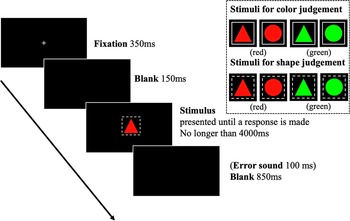
There were also four stimuli in the bivalent task, each containing two dimensions (Figure 3): colour (green/red) and shape (circle/triangle). Every stimulus could be judged by colour or shape, cued by either a solid or dotted line of the square. For half of the participants, the key “D” on their left hand was for red and circle, and the key “J” on their right hand was for green and triangle. The keys were counterbalanced for the other half of the participants. This task was thus bivalent both in stimuli and responses.
Procedures and stimuli for the bivalent colour–shape switching task.

Figure 3 Long description
Figure 3 illustrates one trial in the bivalent colour–shape switching task. The sequence includes a 350-ms fixation cross, a 150-ms blank screen and a stimulus shown until response, up to 4000 ms. Incorrect responses trigger a 100-ms error sound and an 850-ms blank interval. Example bivalent stimuli combine colour and shape information, including red and green circles and triangles. Solid frames indicate colour judgement, while dashed frames indicate shape judgement.
For each version of the switching task, participants had to complete three blocks of trials, with a mixed block preceded and followed by a single block. In the single blocks, participants were required to make either a colour or shape judgement throughout the block (arranged in counterbalanced order), while in the mixed block, participants had to make judgements according to either the colour or shape cue indicated by the solid or dotted line of the square. Each single block started with 8 practice trials and 62 experimental trials, while the mixed block started with 16 practice trials, followed by 5 sub-blocks, each consisting of 50 trials. Participants could take a break between the blocks or sub-blocks.
In both the univalent and bivalent tasks, each trial began with a fixation “+” at the centre of the screen for 350 ms, followed by a blank screen for 150 ms. Then, the stimulus was presented at the centre of the screen until the participants responded to it or the time exceeded 4000 ms. If the response was not correct, there would be a beep sound for 100 ms. At the end of each trial, there was a blank screen for 850 ms.
Other materials
To elicit participants’ background information, the present study adopted relevant materials from Zhao and Dong (Reference Zhao and Dong2020), including the Oxford Quick Placement Test (Geranpayeh, Reference Geranpayeh2003; Syndicate, Reference Syndicate2001) for L2 proficiency, Raven’s Advanced Progressive Matrices Set (Raven et al., Reference Raven, Court and Raven1977) for IQ and a short version of the language history questionnaire (LHQ) (Li et al., Reference Li, Zhang, Tsai and Puls2013) for other background information.
Procedures
Experiment 1 started with the collection of background information. All the participants first completed the QPT, the IQ test and the LHQ. After a short break, they finished the univalent colour–shape task, the WCST task, and then the bivalent colour–shape task.
The authors assert that all procedures contributing to this work comply with the ethical standards of the relevant national and institutional committees on human experimentation and with the Helsinki Declaration of 1975, as revised in 2008.
Results
Data trimming
The data-trimming procedures for the univalent and bivalent colour–shape switching tasks were the same. The first two trials in each block were excluded. Trials with erroneous/missing responses were discarded from RT. The outlier responses with RTs below 200 ms or exceeding 3 SDs of the individual mean were also eliminated. The trimmed extreme behavioural data accounted for less than 5% of the total data (1.48% for the univalent colour–shape task and 1.62% for the bivalent task).
Data of one student from the interpreter group and three students from the control group were excluded from further analyses due to their low accuracy rate in the bivalent colour–shape switching task (below 75%) or their misunderstanding of the tasks.
Group matching
To ensure the comparability of the two groups, a group matching procedure was applied for participants’ background information, including biological and socio-economic status information (i.e., age, IQ and parental education) and L2-related information (i.e., age of L2 acquisition, years of L2 learning and L2 proficiency).
We conducted a non-parametric Mann–Whitney U test to compare the two groups in parental education (rank data), and independent-samples t tests to estimate group differences in other background information. The results showed that the interpreting students were higher in L2 proficiency (t = 2.184, p = .032, Cohen’s d = 0.465), and father education (Z = −2.115, p = .034, Rank-Biserial Correlation = 0.249). To match the two groups of students, we screened out participants with relatively low (for controls) or high (for interpreters) scores on these two indicators and conducted between-group comparisons each time we discarded the data of one participant until all the confounding factors were matched. In total, the data of two interpreting trainees (with father education at 5 or QPT scores greater than 54 out of 60) and four controls (with father education at 1 or QPT scores less than 41 out of 60) were excluded. We also excluded one 29-year-old interpreting trainee due to her considerable age disparity with other participants, which might potentially impact her cognitive control functionsFootnote 1.
After matching, the remaining number of participants in the interpreting and control groups was, respectively, 46 and 36. There were no significant between-group differences in all the potentially confounding factors (ps > .098) while the amount of interpreting training of the interpreter group was significantly larger than that of the control group (t = 9.295, p < .001, Cohen’s d = 1.887).
As illustrated in Supplementary Table S1 in the Supplementary Materials, the matched background data (mean and SD) for the two groups of interpreters and controls were, respectively, 22.20 (0.69) versus 22.49 (0.84) for age; 66.98 (3.79) versus 66.25 (3.63) for IQ (with the maximum score at 72); 2.98 (1.32) versus 2.53 (0.91) for father’s education (1–7); 2.63 (1.16) versus 2.28 (1.00) for mother’s education (1–7); 8.83 (2.03) versus 9.22 (2.41) for age of L2 acquisition; 13.37 (2.11) versus 13.26 (2.48) for years of L2 learning; 49.37 (3.81) versus 48.28 (3.00) for QPT (≤60). As for interpreting training hours collected at the pre-test (with practice hours not included), the contrast was 112.96 (59.37) versus 24.31 (22.73).
Results of cognitive flexibility
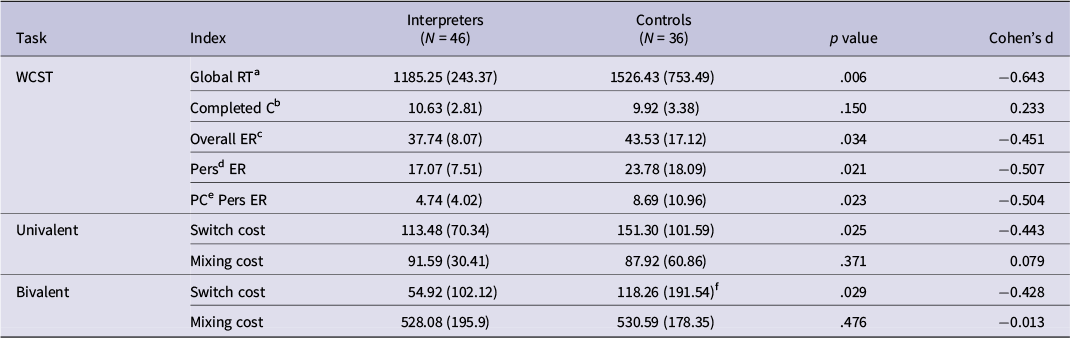
One-tailed independent-samples t-tests were conducted for cognitive flexibility indices due to the one-way direction of our predictions, that is, the interpreters would perform better than their controls (there has been no report of interpreters’ disadvantage in the literature). Table 2 presents the descriptive data together with the results of inferential analyses. Data for WCST showed that the two groups significantly differed in global RT (t = −2.612, p = .006, Cohen’s d = −0.643), overall error (t = −1.872, p = .034, Cohen’s d = −0.451), perseverative error (t = −2.089, p = .021, Cohen’s d = −0.507) and previous category perseverative error (t = −2.060, p = .023, Cohen’s d = −0.504), but not in completed categories.
Group means (with SD) and comparisons (p-value and Cohen’s d) of participants’ performance in Experiment 1

Table 2. Long description
Table 2 compares interpreters and controls in Experiment 1. Interpreters showed faster WCST global response time and lower overall, perseverative and previous-category perseverative error rates than controls. Completed categories did not differ significantly. In the univalent colour–shape task, interpreters showed a smaller switch cost, but no mixing-cost difference. In the bivalent task, interpreters also showed a smaller switch cost, although this effect was unstable due to high variance and an influential outlier. Bivalent mixing cost did not differ.
Note: aRT: response time. bC: category. cER: error. dPers: perseverative. ePC: previous category. fGiven the high variance of bivalent switch cost observed in the control group, we conducted a Welch’s t-test that assumes unequal variance, which revealed a significant group difference (t = 1.795, p = .039). After examining influential outliers, we found that removing the influential outlier in the control group reduced the effect to marginal significance (t = 1.530, p = .065). These results indicate that the bivalent switch-cost effect is unstable and should, therefore, be interpreted with caution.
As for the results of the switching task, significant between-group differences were found in switch cost in the univalent version (t = −1.990, p = .025, Cohen’s d = −0.443) and the bivalent version (t = −1.923, p = .029, Cohen’s d = −0.428), but not in mixing cost in either of the versions. As noted in Table 2, the significance of switch cost in the bivalent version is probably partly due to the large variance in switch cost for the control group, and with the most influential outlier deleted, the significance became marginal (t = 1.530, p = .065), indicating that the bivalent switch-cost effect is unstable and should therefore be interpreted with caution.
Discussion for experiment 1
As stated earlier, Experiment 1 was a report of an initial comparison between the interpreting students and their controls at the pre-test (conducted at the entrance of their master’s programmes), aiming to verify our predictions about task differences and interpreter advantages at the pre-intermediate interpreter expertise level (see Experiment 2 for the effect of one more year’ training for the same participants).
Findings in the WCST
The prediction about an interpreter advantage in WCST errors was verified. The interpreter group made significantly fewer errors (including overall error, perseverative error and previous category perseverative error), indicating that they could adapt better based on feedback, and if necessary, they could shift their mindset to a new rule more effectively.
What differs from our prediction is that an interpreter advantage in WCST global RT was found instead of the predicted interpreter advantage in WCST completed category, which is probably due to the fact that, unlike in the relevant previous studies (Dong & Liu, Reference Dong and Liu2016; Dong & Xie, Reference Dong and Xie2014), participants in the present study were explicitly told that there would be three possible categorizing rules. This cause ascription is supported by the data of completed categories that almost reached ceiling performance in the present study. Among all the possible 19 completed categories (with each category corresponding to a rule of either colour, shape or number), 6 of them had 8 trials (or category size 8), 7 had 5 trials, 6 had 5 trials, 5 had 3 trials, amounting to 128 trials in total. Since 5 or more consecutive correct responses constitute one completed category, and since there could be two wrong responses when a new category starts, even for a ceiling performance, a reasonable ceiling performance for “completed category” is the summary of categories sized over 6, which is 11 in the present study (i.e., 6 and 5 categories, respectively, in sizes 8 and 7). This index of completed category for the interpreters and their controls in the present study was, respectively, 10.63 (SD: 2.81) and 9.92 (SD: 3.38), approaching ceiling performance and resulting in no group difference. On the other hand, with resources freed from problem-solving in inferring rules in the WCST, interpreters’ advantage emerged in global RT, indicating higher performance efficiency and global monitoring.
Together with findings from previous studies using more or less the same version of the WCST (Dong & Xie, Reference Dong and Xie2014; Dong & Liu, Reference Dong and Liu2016, see Table 1), the above WCST findings in the present study were basically consistent with our hypothesis about the developmental trajectory of interpreter advantages as reflected in the WCST indices, that is, from (1) completed category to (2) an additional index of error to (3) a further additional index of global RT. The findings in the present study matched the third stage. Findings supporting the first stage came from beginning interpreters compared with general L2 learners (Dong & Liu, Reference Dong and Liu2016), and from intermediate interpreters compared with beginning interpreters (Dong & Xie, Reference Dong and Xie2014). Findings supporting the second stage came from student interpreters (beginning and intermediate) compared with their matched L2 learners (Dong & Xie, Reference Dong and Xie2014). As reasoned in the section of Introduction, this developmental trajectory is consistent with the demanding pressures along the developmental trajectory of interpreter expertise, that is, (1) “the pressure to complete the task” to (2) “the pressure to transmit as accurately as possible” and then to (3) “the pressure to perform efficiently.” The attentional control system is taxed and then adapted in ways corresponding to the critical pressures, which may then lead to better domain-general WCST performance in corresponding ways (Dong & Li, Reference Dong and Li2020).
Findings in the colour–shape switching task
As for the colour–shape switching task, the results revealed a significant interpreter advantage in switch cost instead of mixing cost in both the univalent and bivalent versions. This is exactly what we predicted for interpreting trainees before they reached an intermediate level of interpreter expertise, except that we did not expect there to be a switch cost in the bivalent task version.
These findings from the colour–shape switching task were, in general, consistent with relevant findings in the literature (see Table 1), and taken together, these findings suggest that switch cost in the colour–shape switching task (especially the univalent version of the task) is sensitive to initial interpreting experience. First, the only two studies that employed the univalent version of the switching task (Dong & Liu, Reference Dong and Liu2016; Zhao & Dong, Reference Zhao and Dong2020) had the same finding as the present study, that is., an interpreter advantage in switch cost but not in mixing cost. In addition, the interpreter groups in both of these studies were beginning CI trainees (32 in-class and 40 off-class training hours in Dong & Liu, Reference Dong and Liu2016) or at most pre-intermediate interpreting trainees (part of the interpreter group in Zhao & Dong, Reference Zhao and Dong2020), indicating that interpreters not yet reaching an intermediate level of interpreter expertise enjoy a benefit in switch cost.
Second, what differs from the literature is that the bivalent task in the present study also found an interpreter advantage in switch cost, while none of the previous studies with the bivalent task did, although this finding seemed unstable, as noted in Table 2. A direct contrast is Zhao and Dong (Reference Zhao and Dong2020) in which both task versions were used, but only the univalent version found an interpreter switch cost advantage. The interpreter participants in the present study were graduate students majoring in interpreting, while the corresponding participants in Zhao and Dong (Reference Zhao and Dong2020) were more mixed (with interpreter expertise ranging from beginning to pre-intermediate). The control groups in these two studies were more or less the same in interpreter experience. We may, therefore, assume that, apart from the large variance noted in Table 2, the bivalent switch cost advantage in the present study (but not in Zhao & Dong, Reference Zhao and Dong2020) is probably due to the combined effect of interpreter expertise and task sensitivity. That is, the bivalent switching task is not as sensitive to switch cost as the univalent (as shown by previous studies in Table 1), but with higher interpreter expertise, a switch cost advantage may also appear in the bivalent version.
To sum up, Experiment 1 constitutes an important stage of interpreter expertise (i.e., pre-intermediate) and is the first study that tested the same groups of participants with the WCST and with both the univalent and bivalent switching versions. In general, the findings in Experiment 1 matched well with the predictions that we obtained from a systematic analysis of the literature (Table 1). Experiment 2 would focus on the developmental aspect, that is, the pre-intermediate versus post-intermediate comparison.
Experiment 2
Methods
Participants involved in Experiment 1 (the pre-test) were invited to take part in a post-test at the end of the first academic year of their master’s degree programme. Experiment 2, with a longitudinal design (including both the pre-test reported in Experiment 1 and the post-test), therefore, consists of participants’ background data collected in Experiment 1, possible changes in the variable of interpreting training during the past year, and post-test switching flexibility measured by the tasks used in the pre-test. Altogether, 78 students participated in Experiment 2, with 40 of them from the interpreter group and 38 from the control group. During the 1-year interval, students in the interpreter group had received six translation courses and eight interpreting courses on average (with each course including 32 hours of classroom instruction, and each interpreting course requiring at least 32 hours of after-class practice), while the students in the control group received training in either linguistics or literature.
The data-trimming processes were the same as those in Experiment 1, and less than 5% of data were excluded. Data from four participants (two from each group) were excluded due to their low accuracy rate in the colour–shape switching task (below 75%). Before group matching, the two groups were marginally different in the father’s (p = .094, Rank-Biserial Correlation = 0.213) and mother’s education (p = .075, Rank-Biserial Correlation = 0.232) levels. Thus, in the group matching procedures (the same as those in Experiment 1, without reference to outcomes of cognitive measures), one participant from the control group with the lowest parental education level (with both father and mother education levels at 1) was excluded so that the two groups were not significantly different in all the potentially confounding factors (ps > .101).
Since the composition of participants whose data entered into the final statistical analysis was not exactly the same as in Experiment 1, we list here the matched background data (mean and SD), respectively, for the two groups of interpreters and controls (see Supplementary Table S2 in the Supplementary Materials for more details): 22.08 (0.85) versus 22.39 (0.81) for age; 67.45 (3.61) versus 66.14 (3.65) for IQ (with the maximum score at 72); 2.97 (1.37) versus 2.49 (0.92) for father’s education (1–7); 2.63 (1.20) versus 2.17 (1.04) for mother’s education (1–7); 8.61 (1.98) versus 9.03 (2.35) for Age of L2 acquisition; 13.47 (2.15) versus 13.36 (2.48) for years of L2 learning; 49.18 (3.91) versus 47.86 (3.46) for QPT (≤60). As for the total interpreting training hours measured in the post-test, the contrast was 493.66 (163.77) versus 25.94 (26.44).
The indices in the tasks were analysed through a two-way repeated measures ANOVA, with Group (interpreters versus controls) as a between-participant factor, and Time (pre-test versus post-test) as a within-participant factor. After the ANOVA analyses, we also calculated the simple effects of the two factors if the interaction effects were (marginally) significant. Due to the one-way direction of our prediction (same as in Experiment 1), the simple effects of Time and Group were, respectively, calculated through one-tailed paired-samples or independent-samples t-tests.
Results
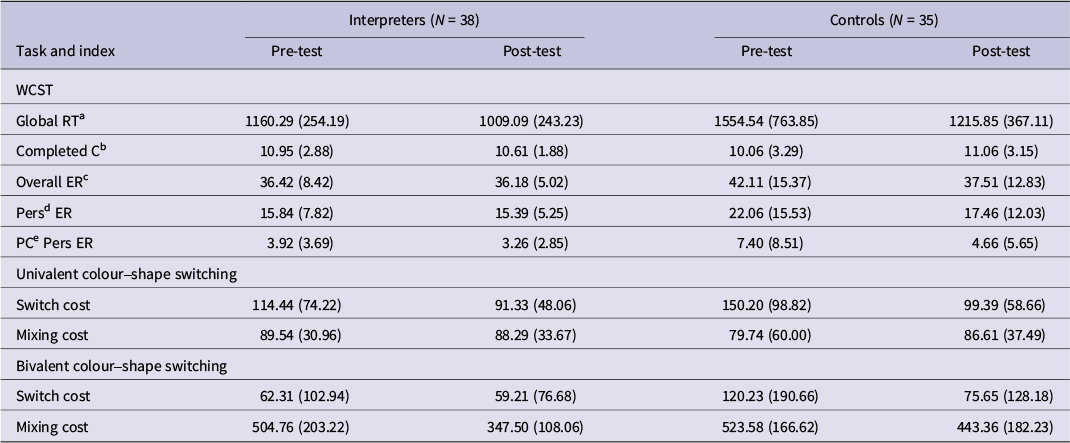
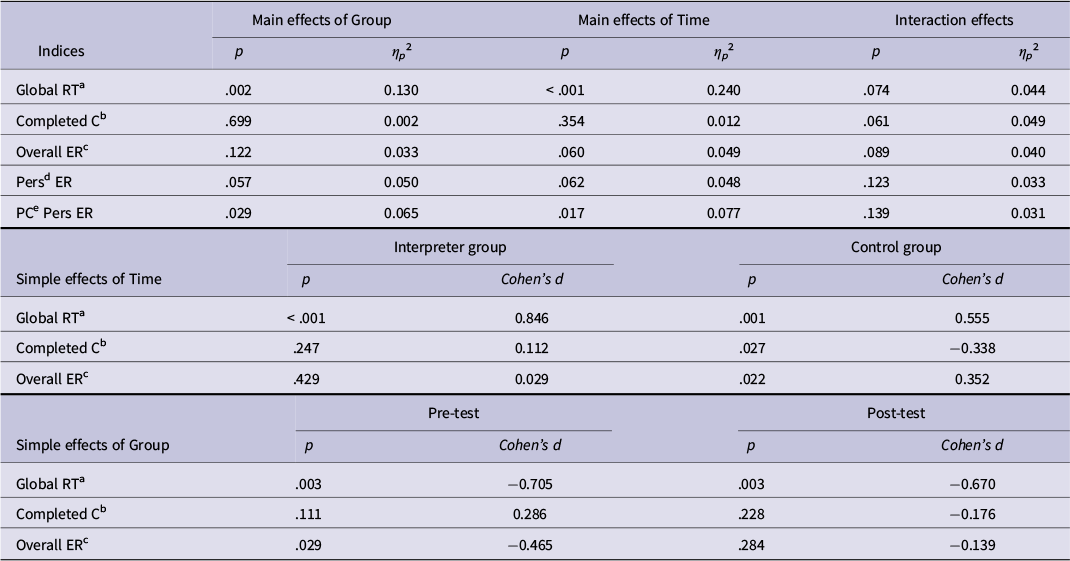
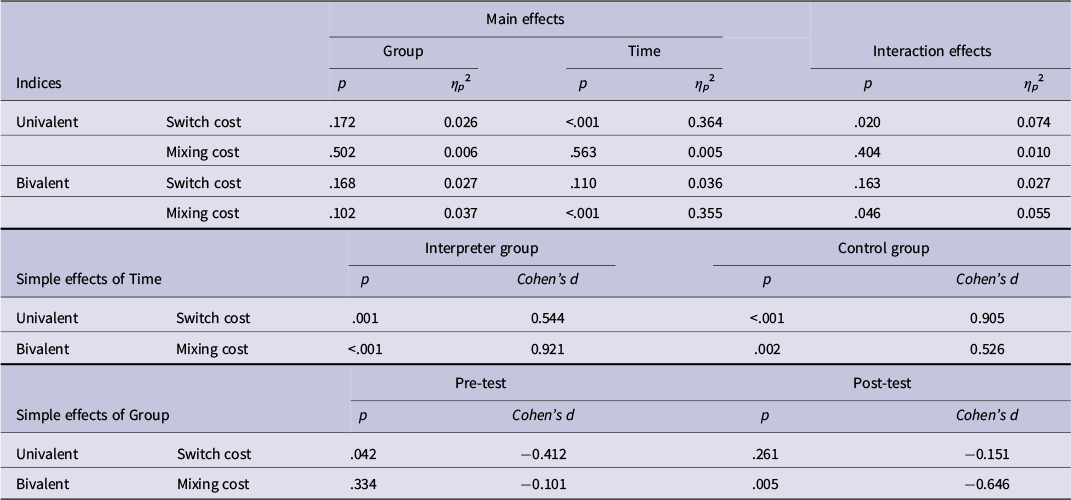
Table 3 shows the descriptive results of the participants’ performance in the three switching tasks in both the pre- and post-test. The results of the two-way repeated measures ANOVA of WCST and colour–shape switching task performances are, respectively, presented in Tables 4 and 5.
Group means (with SD) of participants’ performance in Experiment 2

Table 3. Long description
Table 3 presents pre-test and post-test means in Experiment 2. Both groups improved in WCST global response time, with controls also showing clearer reductions in some error measures. In the univalent task, switch cost decreased in both interpreters and controls, while mixing cost remained relatively stable. In the bivalent task, switch cost changed modestly, but mixing cost decreased in both groups, especially among interpreters.
Note: aRT: response time. bC: category. cER: error. dPers: perseverative. ePC: previous category.
Results of the two-way repeated measures ANOVA (Group × Time) and t-tests on WCST indices

Table 4. Long description
Table 4 reports ANOVA and follow-up t-test results for WCST indices in Experiment 2. Global response time showed significant Group and Time effects, with interpreters faster than controls at both tests and both groups improving over time. Previous-category perseverative error rate also showed significant Group and Time effects. Completed categories, overall error rate and perseverative error rate showed no significant interaction effects, although some comparisons approached significance.
Note: aRT: response time. bC: category. cER: error. dPers: perseverative. ePC: previous category.
Replication of results reported in Experiment 1
Since the composition of participants in Experiment 2 (38 interpreters and 35 controls) was not exactly the same as reported in Experiment 1 (46 interpreters and 36 controls), whether the results reported in Experiment 1 were replicated in Experiment 2 was critical. Supplementary Table S3 in the Supplementary Materials, similar to Table 2, presents both descriptive data and results of independent t-tests. For the WCST, the results were the same as those of Experiment 1, with the interpreter group performing better in global RT (t = −2.909, p = .003, Cohen’s d = −0.705) and the indices of error (overall error: t = −1.939, p = .029, Cohen’s d = −0.465; perseverative error: t = −2.132, p = .019, Cohen’s d = −0.512; and previous category perseverative error: t = −2.232, p = .015, Cohen’s d = −0.538). For the colour–shape switching task, the results were again the same as in Experiment 1, that is, the null result of mixing cost, an interpreter switch cost advantage that is significant in the univalent task (t = −1.757, p = .042, Cohen’s d = −0.412), but marginally significant in the bivalent task (t = −1.633, p = .053, Cohen’s d = −0.382).
Results of interpreting training effects in the WCST
As Table 4 shows, the main effect of Group was significant in global RT (F (1,71) = 10.58, p = .002, ηp 2 = 0.130) and previous category perseverative error (F (1,71) = 4.96, p = .029, ηp 2 = 0.065), but marginally significant in perseverative error (F (1,71) = 3.75, p = .057, ηp 2 = 0.050), indicating that the interpreter group responded faster than the control group and in general made fewer errors. The main effect of Time was significant in global RT (F (1,71) = 22.45, p < .001, ηp 2 = 0.240) and previous category perseverative error (F (1,71) = 5.94, p = .017, ηp 2 = 0.077), and was marginally significant in overall error (F (1,71) = 3.661, p = .060, ηp 2 = 0.049) and perseverative error (F (1,71) = 3.608, p = .062, ηp 2 = 0.048), indicating that both groups made progress in these WCST indices in the post-test.
As for interaction effects between Group and Time, we discovered marginally significant interaction effects in global RT (F (1,71) = 3.29, p = .074, ηp 2 = 0.044), completed categories (F (1,71) = 3.63, p = .061, ηp 2 = 0.049) and overall error (F (1,71) = 2.98, p = .089, ηp 2 = 0.040). For the simple effects of Group, the interpreter group outperformed the control group in global RT (t = −2.909, p = .003, Cohen’s d = −0.705) and overall error (t = −1.939, p = .029, Cohen’s d = −0.465) in the pre-test, but only in global RT (t = −2.858, p = .003, Cohen’s d = −0.670) in the post-test. As for the simple effects of Time, the interpreter group made significant improvement in global RT (t = 5.212, p < .001, Cohen’s d = 0.846), while the control group made significant progress in global RT (t = 3.286, p = .001, Cohen’s d = 0.555), completed categories (t = −1.998, p = .027, Cohen’s d = −0.338) and overall error (t = 2.082, p = .022, Cohen’s d = 0.352).
Results of interpreting training effects in the colour–shape switching task
Table 5 illustrates two contrasts, that is, univalent versus bivalent task versions and switch versus mixing costs. For the univalent version, only switch cost demonstrated a main effect of Time (F (1,71) = 40.63, p < .001, ηp 2 = 0.364), and an interaction effect of Time and Group (F (1,71) = 5.71, p = .020, ηp 2 = 0.074). Further simple effects analysis for the interaction revealed two results. First, both groups made significant improvements in the post-test (interpreter: t = 3.354, p = .001, Cohen’s d = 0.544; control: t = 5.352, p < .001, Cohen’s d = 0.905). Second, the interpreter group’s switch cost was significantly smaller than that of the control group in the pre-test (t = −1.757, p = .042, Cohen’s d = −0.412), while they did not differ in the post-test (t = −0.644, p = .261, Cohen’s d = −0.151).
Results of the two-way repeated measures ANOVA (Group × Time) and t-tests on switch costs and mixing costs of the univalent and bivalent colour–shape switching tasks

Table 5. Long description
Table 5 reports ANOVA and follow-up t-test results for switch and mixing costs in Experiment 2. Univalent switch cost showed a significant Time effect and Group by Time interaction, with both groups improving. Univalent mixing cost showed no significant effects. Bivalent switch cost showed no significant effects. Bivalent mixing cost showed a significant Time effect and Group by Time interaction, with both groups improving and interpreters showing a smaller post-test mixing cost than controls.
For the bivalent version, only mixing cost demonstrated a main effect of Time (F (1,71) = 39.06, p < .001, ηp 2 = 0.355), and an interaction effect of Time and Group (F (1,71) = 4.11, p = .046, ηp 2 = 0.055). Simple effects analysis for the interaction also revealed two results. First, as for the univalent version, both groups made significant improvements in the post-test (interpreter: t = 5.680, p < .001, Cohen’s d = 0.921; control: t = 3.114, p = .002, Cohen’s d = 0.526). Second, in contrast to the univalent version, the interpreter group significantly outperformed the control group in mixing cost in the post-test (t = −2.705, p = .005, Cohen’s d = −0.646), while they did not differ in the pre-test (t = −0.431, p = .334, Cohen’s d = −0.101).
Two additional analyses for the colour–shape switching task
Since the advantage issue is debatable and the colour–shape switching task is most frequently cited for the debate over the switching advantage issue (e.g., Paap, Reference Paap2022), we conducted two additional analyses with the switching task (see Supplementary Materials 4 and 5, respectively, for more details).
First, to complement the cost-based analyses above, we conducted additional trial-based analyses, that is, three-way ANOVAs of Group × Trial Type × Time, with Trial Type being operationalized as switching- or mixing-related performance (switch versus repeat; repeat versus single). For switching, the three-way interaction was significant only in the univalent task, F = 4.44, p = .039, with follow-up analyses revealing a marginal Group × Switching interaction at pretest, F = 3.16, p = .080, but not at post-test, F = 0.90, p = .346. For mixing, the three-way interaction was significant only in the bivalent task, F = 4.95, p = .029, with follow-up analyses revealing a significant Group × Mixing interaction at post-test, F = 5.59, p = .021, but not at pretest, F = 1.38, p = .244. Further simple effects analyses showed the same findings as the above cost-based analyses, that is, the interpreter group outperformed the control group in switch cost in the pre-test, and in mixing cost in the post-test.
Second, to complement the group-based analyses above, we conducted additional regression analyses, treating interpreting experience (i.e., hours of interpreting training) as a continuous predictor (as recommended by Paap, Reference Paap2022), and further examined estimated marginal means of linear trends to further illustrate how interpreting experience may modulate performance across different trial types. Briefly speaking, for the pre-test, regression analyses on Interpreting Hours x Switching (Switch versus Repeat trials) or Mixing (Repeat versus Single trials) failed to reveal significant interaction effects, but Interpreting Hours significantly predicted faster responses in switch trials in all possible cases, and in repeat trials in the univalent task (see Supplementary Materials 5). For the post-test, with interpreting training hours accumulated from the academic year of graduate education, only the interaction of Interpreting Hours x Mixing was significant (p = .021), and follow-up trend analyses revealed that more interpreting experience significantly predicted faster responses on repeat trials (slope = −0.247, 95% CI [−0.368, −0.126]), whereas no reliable association was observed for single trials (slope = −0.045, 95% CI [−0.166, 0.076]). In short, the regression analyses failed to find interpreters’ switch cost advantage in the pre-test, but confirmed interpreters’ advantage in mixing cost in the post-test.
Discussion for experiment 2
With a longitudinal study design, Experiment 2 aimed to explore how additional interpreting training during the critical training period of the intermediate level may further enhance cognitive flexibility, which may help reveal the developmental features of interpreter advantage in switching ability. First of all, although the composition of participants in Experiment 2 was not exactly the same as reported in Experiment 1, the findings in Experiment 1 were replicated in the pre-test in Experiment 2.
As for the findings in the WCST, the inferential analyses, as summarized in Table 4 (together with the descriptive statistics in Table 3) resulted in two major findings. First, as indicated by the simple effects of Group, the interpreter group at both the pre- and post-test performed faster than the control group, confirming the presence of an interpreter advantage in WCST global RT from the pre-intermediate to the post-intermediate expertise level.
Second, the interpreter advantage in WCST error (found in the pre-test) disappeared in the post-test. Similar to the discussion of ceiling performance in the “completed category” in Experiment 1, the interpreter group may have also reached ceiling performance in “WCST error” in the pre-test, and there was little space to make progress. To complete each of the 19 categories, participants may have to try two times before hitting on the right rule, which amounts to 38 overall errors and 19 perseverative errors. As shown in Table 3, the interpreters made less than 36 overall errors and less than 16 perseverative errors in the pre-test, and their performance in the post-test was just as good. As for the control group, there was space to make progress with practice in the pre-test (140 trials in total), and yet, even with this practice effect, their error numbers were numerically larger in the post-test than those of the interpreters (Table 3). The disappearance of the interpreter advantage in WCST error in the post-test is thus probably due to the ceiling effect for the interpreter group and the practice effect for the control group.
As for the findings in the colour–shape switching task, the inferential analyses (see Table 5) illustrate, for the first time, two neat contrasts. The first contrast is between the univalent and bivalent versions of the colour–shape switching task, which were found to be, respectively, sensitive to switch cost and mixing cost. The second contrast is between switch cost and mixing cost. That is, there was a very neat transition from a switch cost interpreter advantage at the pre-test to a mixing cost interpreter advantage at the post-test, confirming our prediction of a developmental transition from local switching control at the pre-intermediate expertise level to global monitoring control at the post-intermediate expertise level.
In addition, the findings obtained from the two additional analyses (trial-based analyses and regression analyses) confirmed the cost-based and group-based results discussed above, except that the regression analysis that took interpreting experience as a continuous variable failed to find the interpreters’ switch cost advantage in the pre-test. This exception is probably due to the long and uneven interval between the time of the participants’ interpreting experience during their undergraduate studies and the time of the pre-test at the start of their graduate studies. This interval was probably too long for some participants who may have taken a gap a few years before graduate education. As for most of the participants attending graduate education immediately, they generally did not have classes for at least the past 9 months at the pre-test, since fourth-year university students in China generally do not have classes for at least the last/second semester. In addition, this time interval was uneven across participants, since interpreting classes were generally given to third-year students, but participants may have attended one or two interpreting courses in their second year or the first semester of their fourth year. With this limitation of the long and uneven interval overcome, the regression analyses for the post-test (with most training hours accumulated during the past year, see Supplementary Table S2) did confirm the bivalent mixing cost advantage. Even with this limitation, interpreting experience significantly predicted faster responses in switch trials in all possible cases, and in repeat trials in the univalent task.
General discussion
Aiming to account for the mixed findings in the literature on the issue of how interpreting experience may impact cognitive flexibility, the present study explored the influence of task differences and interpreter expertise. Based on a systematic review of previous studies as summed up in Table 1, we had two hypotheses about the developmental features of interpreters’ cognitive flexibility advantages as tested in the rule-based WCST and in the univalent and bivalent versions of the cue-based colour–shape switching task (see “Introduction”), and we predicted that for interpreting students around the intermediate expertise level (when compared with bilingual controls), there would be an advancement of interpreter advantage to performance efficiency and global monitoring as tested in the WCST, and a transition of interpreter advantage from local switching control to global monitoring control as tested in the colour–shape switching task. These predictions were, in general, confirmed in the present study, and the findings could be explained by the two factors of interpreter expertise and task differences.
Effect of interpreter expertise on interpreter advantage in cognitive flexibility
The first major finding concerns the effect of interpreter expertise on interpreter advantage in cognitive flexibility. A critical manipulation of interpreter expertise in the present study was a comparison of two testing times when a group of MTI students had just started their MTI programme and when they had just entered their second year, which we took as representing an advancement from the pre-intermediate to the post-intermediate expertise level. At the same time, the control group of bilingual graduate students majoring in linguistics or literature also moved from the entrance to a year later. Exactly as predicted for the colour–shape switching task, there was a transition of interpreter advantage from local switching control (indexed by switch cost in the pre-test) to global monitoring control (indexed by mixing cost in the post-test). As for the rule-based WCST, the interpreter advantage in global RT in the pre-test was retained in the post-test, indicating that more interpreting training could further boost performance efficiency and global monitoring. However, due to interpreters’ ceiling performance in the pre-test and the rule-based nature of the WCST, interpreter advantages in error disappeared in the post-test, which will be discussed in the next section on task differences.
As reasoned in the sections of “Introduction” and “Discussion” (for Experiments 1 and 2), the development of interpreter advantage is consistent with typical pressures or challenges along the development of interpreter expertise. At the beginning stage of interpreter expertise, interpreting students are under pressure to complete the task and follow the fast alternating rhythm of listening and speaking. With increased expertise, interpreters can afford more attention to the demands of interpreting accurately and then efficiently, and become better at monitoring the whole task. The attentional control system is taxed and adapted in corresponding ways, and with the adapted attentional control system, interpreters may outperform their bilingual controls in other tasks in corresponding ways. The present study found preliminary evidence suggesting that interpreter expertise around the intermediate level is critical in terms of attentional control adaptation.
Our finding of the developmental transition of interpreter advantage from local switching to global monitoring in colour–shape switching tasks verified the hypothesis that we had reached from a systematic review of the previous studies, as summed up in Table 1. As shown in Table 1, interpreter advantages in switch cost and mixing cost were, respectively, found for beginning CI trainees (Dong & Liu, Reference Dong and Liu2016; Zhao & Dong, Reference Zhao and Dong2020) and SI professional interpreters (Babcock & Vallesi, Reference Babcock and Vallesi2017; Becker et al., Reference Becker, Schubert, Strobach, Gallinat and Kühn2016). Interestingly, the two previous longitudinal studies that recruited SI trainees (with probable expertise lying between beginners and professionals) (Babcock et al., Reference Babcock, Capizzi, Arbula and Vallesi2017; Van de Putte et al., Reference Van De Putte, De Baene, García-Pentón, Woumans, Dijkgraaf and Duyck2018) did not find any behavioural group differences in either switch cost or mixing cost, which seems contradictory to what has been found in the present study. This is probably due to the fact that SI trainees in these two studies were compared with either translation trainees (Babcock et al., Reference Babcock, Capizzi, Arbula and Vallesi2017; Van de Putte et al., Reference Van De Putte, De Baene, García-Pentón, Woumans, Dijkgraaf and Duyck2018) or non-language majors (Babcock et al., Reference Babcock, Capizzi, Arbula and Vallesi2017). Translation also involves frequent switching between two languages, although it is under much less time pressure than interpreting. Comparing interpreting trainees with translation trainees is thus certainly different from comparing them with general L2 majors (as in the present study, see also Dong & Liu, Reference Dong and Liu2016, who found a switch cost advantage in beginning CI trainees instead of beginning translation trainees). As for the non-language majors (Babcock et al., Reference Babcock, Capizzi, Arbula and Vallesi2017), their diverse background experiences may have played a role in the finding of null group differences, as different bilingual language experiences (Green & Abutalebi, Reference Green and Abutalebi2013) or more broadly language (e.g., public speaking) and other life experiences (e.g., video games) (Li & Dong, Reference Li and Dong2020) may produce different effects on cognitive control (including cognitive flexibility). Nevertheless, more research is needed to make definite and specific claims.
Effects of task differences on interpreter advantage in cognitive flexibility
What has been found in the colour–shape switching task in the present study constitutes a contrast between the two versions of the task. That is, the univalent version detected group differences in switch cost (in the pre-test) instead of mixing cost, indicating its sensitivity to switch cost, while only the bivalent version detected group differences in mixing cost, indicating its sensitivity to mixing cost.
The above contrast of findings in switch cost and mixing cost can be explained by two task differences. First, participants responding to each stimulus in the bivalent version have to solve interferences from the two attributes for each stimulus. That is, they have to pay attention to the cue accompanying each stimulus, remember it and resist interference from the other attribute, while the univalent version is more straightforward since there is no interference from the other attribute. Responses in the bivalent version are also more complex and may cause interferences, for example, with “D” for red and circle, and “J” for green and triangle (or counterbalanced) in the present study. Facing interferences, participants have to be more careful and alert, paying more attention to attributes, cues and responding fingers and especially their changes, which requires better global control. In short, switching performances in the bivalent task are associated with interference control (e.g., Kiesel et al., Reference Kiesel, Steinhauser, Wendt, Falkenstein, Jost, Philipp and Koch2010), which is in turn associated with global monitoring. The mixing cost in the bivalent task is considered an index of global/sustained control (Braver et al., Reference Braver, Reynolds and Donaldson2003; Koch et al., Reference Koch, Prinz and Allport2005) or global monitoring (Hofweber et al., Reference Hofweber, Marinis and Treffers-Daller2016). The bivalent colour–shape switching task is, therefore, probably more appropriate for detecting group differences in cognitive flexibility that involve more interferences and global control, and is thus sensitive to the index of mixing cost.
Second, compared with the bivalent version, the univalent version is “purer” in the basic sense of the term “switching” or cognitive flexibility. There are, of course, interferences from a previous trial if there is a switch of cues between the previous trial and the current trial, but that is itself part of switching between different cues. Focusing on each current stimulus would lead to good performance since the stimulus is consistent with the cue (e.g., the stimulus of a blank triangle versus the cue of shape) and the other possible attribute is not present in the present stimulus (e.g., colour). The univalent colour–shape switching task may therefore best capture group differences in cognitive flexibility that mainly involve switching between trials and local control, and is thus sensitive to the index of switch cost.
As for the relationship between the bivalent version and the switch cost index, there were detailed discussions in Experiments 1 and 2. To be brief, the switch cost interpreter advantage detected by the bivalent version in Experiment 1 was only marginally significant in Experiment 2, while the same advantage detected by the univalent version was exactly replicated in Experiment 2. This contrast suggests that the relationship between the bivalent version and switch cost is probably not as stable or firm as that between the univalent version and switch cost, which is further supported by the pattern of findings in the previous studies, as summed up in Table 1.
As for the rule-based WCST, we predicted an interpreter advantage in the indices of completed categories and error in the pre-test, and an additional index of global RT in the post-test. What was found were interpreter advantages in error and global RT in the pre-test, and in global RT in the post-test. The persistent finding of an interpreter advantage in global RT in both the pre- and post-test is consistent with our general prediction that more interpreting training would lead to performance efficiency and global monitoring.
As for the discrepancy between the predictions and the findings in WCST, it has been discussed in detail above in Experiments 1 and 2. Briefly speaking, this discrepancy is mainly due to the fact that the participants were instructed beforehand that there would be three possible categorizing rules in the WCST, which saved them the trouble of figuring out the rules (indexed by completed category) and led to both participant groups’ ceiling performance in completed category and the interpreters’ ceiling performance in WCST error in the pre-test. A related reason is the rule-based nature of the WCST. Even if the participants had not been informed of the three possible rules, a pre-test with many trials (e.g., 140 trials in the present study) would most probably lead to significant practice effects, which may confound the post-test results. In short, a longitudinal experimental design for the rule-based WCST may reduce group differences in the post-test, especially in indices (i.e., completed category and error) in which the supposedly advantageous group has approached its performance ceiling in the pre-test.
To conclude, the current data provide preliminary evidence that around the intermediate level of interpreting training, interpreters showed a different pattern of advantages across tasks and indices, which may reflect changes in the demands placed on attentional control. Particularly worth noting is that the major finding with the colour–shape switching task demonstrated a developmental transition from local switching control (as indexed by switch cost in the pre-test, with participants at the pre-intermediate expertise level) to global monitoring (as indexed by mixing cost in the post-test, with participants at the post-intermediate expertise level), which may help patch up the mixed findings in the literature. More empirical research is certainly warranted to provide more definitive support for this staged development of cognitive flexibility.
There are implications for research on the hot-debated issue of bilingual advantage (e.g., Bialystok, Reference Bialystok2017 versus Paap, Reference Paap2022). Theoretically, since the present study found preliminary evidence supporting the staged development of the interpreter advantage that presumably corresponds to what is most urgent in cognitive control at different stages of interpreting training, we believe it is most critical to systematically analyse what is most urgent in cognitive control for different types of bilingualism and at different stages of bilingualism. Methodologically, since the present study found that different tasks are sensitive in different ways, and that taking interpreting as a continuous variable necessitates collecting more information than interpreting training hours, we believe that systematically manipulating task differences and considering more variables of bilingualism will benefit future research on how bilingualism may impact cognitive control. The Adaptive Control Hypothesis (Green & Abutalebi, Reference Green and Abutalebi2013), classifying bilingualism into three contexts of language use based on the competitive relationship of the two languages, is a milestone, but as can be seen from the present study, testing tasks are probably sensitive to more variables of bilingualism, especially when taking bilingualism as a continuous predictor at the individual level. Bilingualism in terms of its dynamic relationship with cognitive control (e.g., Li & Dong, Reference Li and Dong2020) is probably more diverse than generally operationalized in empirical research, and therefore null results in research that operationalized bilingualism as language proficiency, language use frequency and L2 AOA probably serve more as a call for systematic research theoretically and methodologically, rather than as a definitive refutation of bilingualism’s influence on cognitive control.
Supplementary material
The supplementary material for this article can be found at http://doi.org/10.1017/S1366728926101485.
Data availability statement
Data will be available upon request.


 Open access

