





Introduction
The small stories approach to narrative research (Georgakopoulou Reference Georgakopoulou2007; Patron Reference Patron2020; Georgakopoulou et al. Reference Georgakopoulou, Giaxoglou and Patron2023) builds upon a conversation analytic emphasis on interactional work and recipient design (Jefferson Reference Jefferson and Schenkein1978; Sacks and Schegloff Reference Sacks, Schegloff and Psathas1979; Sacks Reference Sacks1992; Selting and Couper-Kuhlen Reference Selting and Couper-Kuhlen2001; Betz Reference Betz2015). Joining a constellation of sociolinguistic inquiry into emergent and partial identity work (see Bucholtz and Hall Reference Bucholtz and Hall2005), small stories raise the possibility of deconstructing narrative both temporally and structurally to, in turn, examine the pragmatics of discourse marking (Georgakopoulou Reference Georgakopoulou1997, 90–110), the use of shared stories (Georgakopoulou Reference Georgakopoulou, Uta and Becker2005), iterative, prospective, or moot narrative elements (Georgakopoulou Reference Georgakopoulou2007, 40–55), and their resulting stances, footings, and voicings (Bamberg and Georgakopoulou Reference Bamberg and Georgakopoulou2008).
This is to say that small stories, generally, de-emphasise whole narrative discursive units, turning rather to the interlacing conversational work in which narrative elements are combined, emerge, and are co-constructed. This deconstruction raises the question of how different parts relate to the whole, and therefore of the intersubjective value, management and tactical appropriation of the successive levels of both organisation and analytic reflexivity that may concern: (i) turn shape and composition, (ii) turn by turn talk and inter speaker coordination, (iii) take up and exchange of narrative elements (that may or may not be clearly bounded, contiguous, or coherent), and (iv) structuration and distribution over the course of a situation of interaction.
Small stories, in consequence, provide an opportunity to examine what may be termed “multiplex” tactics. Multiplexity, as a research orientation, departs from questions of “duplex” referential-indexical operation (Jakobson Reference Jakobson1971; Silverstein Reference Silverstein, Keith and Henry1976, Reference Silverstein2003; Fludernik Reference Fludernik1991; Moore Reference Moore, Fina and Georgakopoulou2020), seeking to capture the imbrication of interactional context and history in the organisation of talk, and to emphasise the ways in which oral discourse is both simultaneously and sequentially polysemic, multilayered and multifunctional. Multiplex tactics may refer to participant footings, registers, discursive sequences, inter-personal, and evaluative alignments but also the different embeddings of storied events and existential and narrated spatio-temporal coordinates (Kelleher Reference Kelleher2022). These concern, thus, conversational choices and patternings that can be understood to be demonstrations both of “competence” but also of in-situ creativity, complicity, and empathy. This is a point that recalls Agha’s work into chains of semiosis in which role, relationship, and type of social practice are part of reflexive processes of indexicality and personhood (Agha Reference Agha and Duranti2004, Reference Agha2005).
Multiplex tactics concern, and thereby contribute to, the vast body of work into discourse “marking” (Bollinger Reference Bollinger1977; Schiffrin Reference Schiffrin1987, Reference Schiffrin1998; Norrick Reference Norrick2001; Fischer Reference Fischer2006; Lam Reference Lam, Barth-Weingarten, Dehé and Wichmann2009; Maschler and Schiffrin Reference Maschler, Schiffrin, Tannen, Hamilton and Schiffrin2015); however, in preferring the term “tactic,” this article hopes to, firstly, underline individual creativity in the local, intersubjective, and involved telling of stories and, secondly, to avoid some of the restrictive definitional criteria associated with markers, emphasising, rather, the different “planes” (Schiffrin Reference Schiffrin1987, 316) that are relevant to narrative.
The article adopts a descriptive case-study approach with a participant from the Gauteng, South Africa in order to understand how multiplex tactics can be used to: gain the floor, introduce or exit from a story element, and divide a longer narrative into cohesive elements that may be distributed within a situation of interaction. Such tactics raise further questions of style (Eckert Reference Eckert2003; Podesva Reference Podesva2008) and involvement (Gumperz Reference Gumperz1982, 118; Tannen Reference Tannen2007) both as an analytic frame and as part of local sociopolitical identity in the post-colony (Goebel and Schabio Reference Goebel and Schabio2013; Ebongue and Hurst Reference Ebongue and Hurst2017; Hurst-Harosh Reference Hurst-Harosh2019). We rely on three long research recordings with the same participant over an interval of three years. The hiatus in the accomplishment of our daily lives afforded by our doing the roles of “researcher” and “participant” offer a kind of interstitial space from which to understand some of the tactics and differentialities between ourselves.
The sections that follow will (i) review aspects of the literature on small stories, indexicality, and discourse marking, (ii) give an example of a multiplex tactic used to exit from a small story, and (iii) examine some tactics used to coordinate narrative elements and framing within a situation of interaction. Transcriptions made with ELAN (https://archive.mpi.nl/tla/elan), and waveforms, pitch graphs, and annotations made with PRAAT (https://www.fon.hum.uva.nl/praat/) are provided so as to be able to clearly appreciate the oral data.
Multiplex tactics and involvement
Small stories, i.e., those narrative units that emerge and that are co-constructed between interactional participants, are a fertile terrain to research the complexity of ordinary identity work and the situated nature of storying as praxis (De Fina and Georgakopoulou Reference De Fina and Georgakopoulou2008). Small stories offer a break with a literary narrative canon that is both temporal, in that they reference stories that are cast prospectively, and “emic,” in that a predominant concern is what participants understand themselves to be achieving with the interactional work they undertake. Small stories therefore present, on the one hand, an orientation to the coordinates of the situation of interaction (footing, voice, and stance), and, on the other, intersubjectivity and shared knowledge.
Footing, voice, and stance represent three principal coordinates of an interactional and discursive situation: (i) footing orientates to participants and frame (Goffman Reference Goffman1981, Reference Goffman1986), (ii) voice refers to our ability to bring to bear context-dependent discourses (Ribeiro Reference Ribeiro, de Fina, Schiffrin and Bamberg2006, 50) and thereby our social attributes and agency, and (iii) stance orientates to both wider, and more locally contingent, social processes and discourses (Du Bois Reference Du Bois and Englebretson2007; Bois et al. Reference Bois, John and Kärkkäinen2012). Stances also involve the footings and voicings used for this evaluation that, generally, can be referred to as “positioning” (Davies and Harré [1990] Reference Davies, Harré, Wetherell, Taylor and Yates2001; De Fina Reference De Fina2013). Studies of interactional coordinates sometimes obscure, however, emic emphasis on the shared knowledges and intersubjectivity necessary for successful communication.
This is a key issue for this article, because, although we will be concerned with the “functioning” of multiplex tactics, we will be doing so from the perspective of participant involvement. Involvement refers to the mutual understanding necessary for communication, and operates at both a linguistic and a sociocultural level (Gumperz Reference Gumperz1982; Tannen Reference Tannen2007). The resources that allow participants to involve themselves in conversation, and in narrative, are affective and poetic, linking to coherence, or, “how different kinds of meaning converge in a particular utterance,” creating, “an emotional experience of insight (understanding the text) and connectedness (to other participants, to the language, to the world)” (Tannen Reference Tannen2007, 28). In Tannen’s view therefore, participants orient to the activity of being engaged or involved in talk and this necessitates an awareness of indexicality; the pointing of a sign to sociocultural and material context (Peirce Reference Peirce and Peirce1998; Silverstein Reference Silverstein2003). The mobilisation of shared resources, further, implies a consideration of style (Eckert Reference Eckert2003) and of tactic (de Certeau Reference de Certeau1990), since both involvement and indexicality can imply non-arbitrary, personally motivated, iterative regularity that attaches to participants’ interactional behaviour.
This article, in consequence, will examine multiplex effects from the perspective of a tactics of involvement. In turning to multiplexity as a means of appreciating the tactical nature of intersubjective communication, we hope to contribute a means of critically approaching that intersubjectivity. We hope to understand one aspect of how such tactics function and serve as indicators of what Goffman, in his early work on social organisation, referred to as “poise” (Goffman Reference Goffman1956, 267) which is to say the tactical ability and involvement necessary to turn talk to one’s advantage.
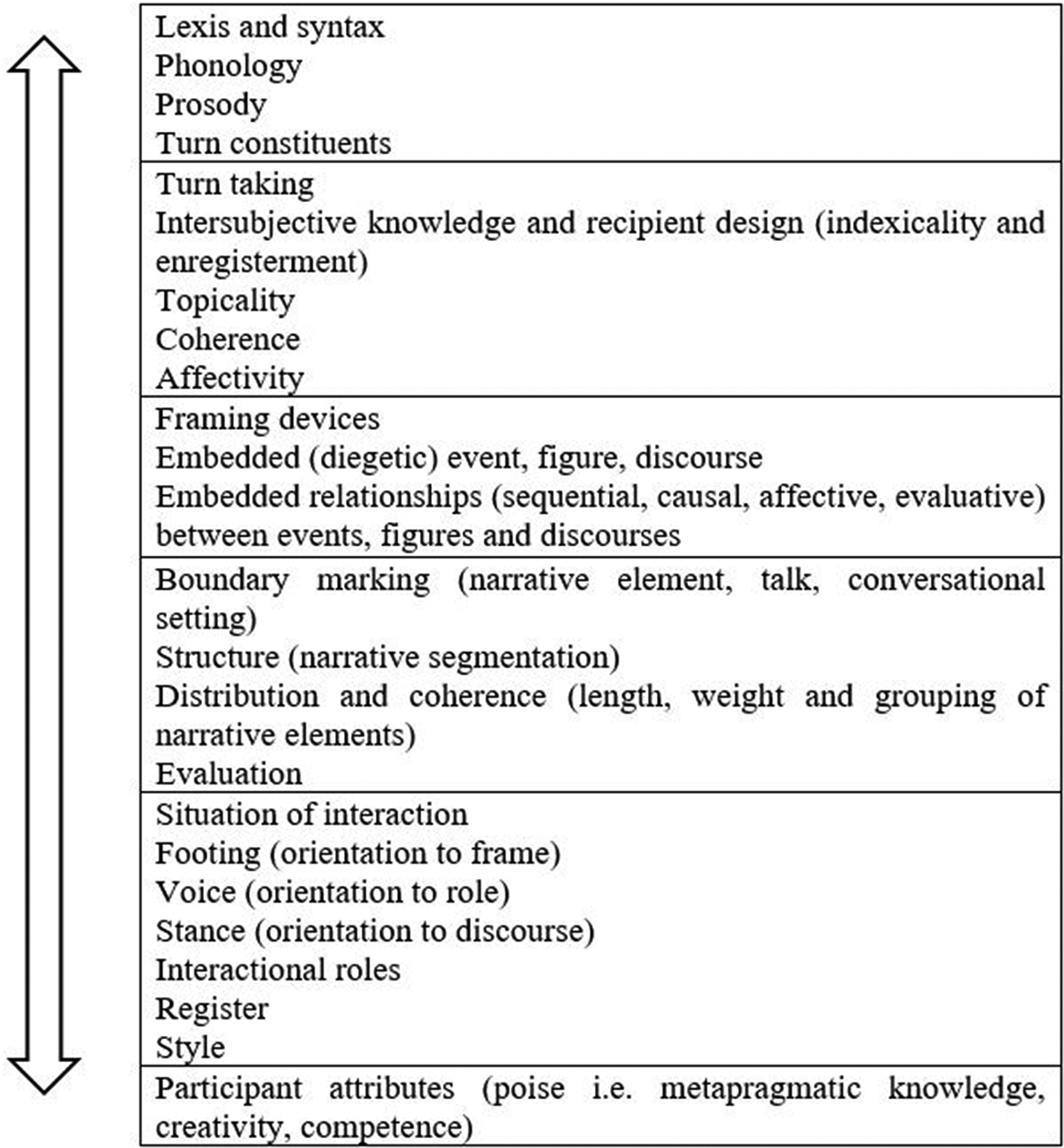
Multiplexity (see Figure 1) generates a concatenation of discursive functions and, thereby, an interchange of tokens (linguistic, pragmatic, or semiotic) in talk. The term “multiplex” itself borrows from two literatures, both concerned with the relation of form and structure to interactional coordinates: that of, on the one hand, discourse marking and, on the other, referential-indexical categories. Discourse marking involves an indexing of different domains of interactional behaviour. As Maschler and Schiffrin note:
Two aspects of communicative knowledge closely related to one another are expressive and social: the ability to use language to display personal and social identities, to convey attitudes and perform actions, and to negotiate relationships between self and other […] Discourse markers – expressions such as oh, well, y’know, and but – are one set of linguistic items that function in cognitive, expressive, social, and textual domains. (Maschler and Schiffrin Reference Maschler, Schiffrin, Tannen, Hamilton and Schiffrin2015, 189)
Small story discourse levels which may be involved in multiplex tactics.
Maschler and Schiffrin’s conception of discourse markers is at once semantic—concerned with consecrated terms whose initial meanings have undergone “leeching” (Bollinger Reference Bollinger1977), and multifunctional, concerned with the different planes of talk that Schiffrin described as being informational, interactional or participative, ideational, and actional (Schiffrin Reference Schiffrin1987, 316). The interest, then, of discourse markers, is that they can scaffold cohesion, indicate transition relevance places in turn taking, establish sequentiality, or demarcate the boundaries of discourse units, initiating and concluding narrative action (Norrick Reference Norrick2001). They are also very often used by hearers to emphasise their involvement. The examples of multiplex tactics that will be discussed below could be held to refer to discourse markers, but this article shows that interlocutor tactical creativity can be both multifunctional and local.
With respect to referential-indexical categories, Jakobson (Reference Jakobson1971) coined the term “duplex.” By “duplex,” he meant that within his communicative model (consisting of addresser, addressee, context, message, contact, and code) message and code could “at once be utilized and referred to (= pointed at)” (Jakobson Reference Jakobson1971, 130). Duplex signs are therefore signs that are both referential and indexical, i.e., concerned with meaning and the pragmatic organisation and interpretation of language. By adopting the term “multiplex,” we wish to further underline the contribution of personal and socio-historical context to meaning and in so doing contribute to understanding interlocutionary attributes such as voice and footing, since, within narrative interactions, as within talk, roles, framings, and meanings can be simultaneous and multiple. This represents a slight repurposing of Jakobson’s original ideas. In the phrase he gives as an example, “Jim told me ‘flicks’ means ‘movies’” (Jakobson Reference Jakobson1971, 133) each analysable item (proper name, shifter, reported speech, etc.) represents a different combination of message and code, but identity and socio-historical context—in, for instance, the use of the enregistered term “flicks”—are largely ignored by Jakobson’s analysis, giving rise to an approach that is relatively distant from interactional approaches.
Silverstein, by contrast, refers to “referential-indexical” categories in order to re-assert the need for a grammar of pragmatic relations (Silverstein Reference Silverstein, Keith and Henry1976, 46). Silverstein recognises the multifunctionality of linguistic signs (Silverstein Reference Silverstein2003, 194). He also recognises the culturally informed variations of indexicality from “pure” to “imputed” to “pragmatic non-indexicality” (Silverstein Reference Silverstein, Keith and Henry1976, 47–48). Notably, he emphasises the “creativity” of use in indexical tokens and, to a certain extent, pre-empts the subject of the present article by noting what we are here referring to as involvement and poise (preferring the term “strategy” to “tactic” however). Silverstein, finally, discusses indexical “orders” that may be understood to be culturally informed valences in indexicality. This has been an enormously productive line of inquiry, particularly given the social conjunctures created by the inequality that holds between the global North and South (Blommaert Reference Blommaert2010).
The discussion in and around indexicality, shifters, and discourse, is, one notes, complicated by definitional and field-specific constraints. The term “multiplex” has the immediate advantage of not being “duplex” nor a “marker” and can be construed as any of the following:
(i) As pertaining to simultaneous instances of what Silverstein names “utterance fractions” (Silverstein Reference Silverstein, Keith and Henry1976, 57). It is therefore a multiplier of the referential-indexical relationship [(referential-indexical) x n];
(ii) As combining different layers or domains of referential/indexical information [(referential-indexical)n];
(iii) As simultaneously including different “types” of relationships (much as in Jakobson’s original example [(referential-indexical)i + (referential-indexical)ii + (referential-indexical)iii …];
(iv) As referring to multiple and concatenated spatio-temporal coordinates [(REFERENTIAL (referential (referential-indexical) indexical) INDEXICAL)];
(v) As referring to multiple and concatenated roles (speaker/addressee/listener/figure);
(vi) As referring to multiple parallel sign systems—linguistic, gestural, phonologic, etc. [(referential-indexical)/(referential-indexical)/(referential-indexical) …]; and
(vii) As referring to multiple simultaneous utterance contexts—a situation that holds frequently in multimedia and multimodal interchange.
Departing from an appreciation of lexical and syntactic items, their combination and their phonation (the uppermost level in Figure 1), subsequent levels concern the sequential management of small stories discourse units and their “fit” within the situation of interaction in terms of topic and affect. It is this level of description that would explain what Jefferson terms “sequential deletion” (Jefferson Reference Jefferson and Schenkein1978, 229) or the failure to uptake a story, by offering a second story say, or an evaluation. The following level refers to narrative structure and to the means that are used to manage a narrative element. Questions of “framing” for instance (Goffman Reference Goffman1986; Haring Reference Haring2004) concern the ways in which the successive embeddings of an event are accomplished (this would correspond to a figure in the narrative talking about an event at a remove from represented narrative time).
The following level concerns the interactional management of narrative elements. Narratives are scinded into parts, and these parts are then distributed over the course of an interlocutionary situation. Narrative elements, at this level, have differing lengths and “weights” (provoking different degrees of evaluation and involvement). The subsequent level refers to the situation of interaction and the roles and styles that are maintained by participants. Finally, at a meta-level, participants display pragmatic knowledge and creativity—or Hymesian “competence” (Hymes Reference Hymes1985).
Particularly in small storytelling, several challenges arise that require tactical solutions. Some of these challenges concern cohesion. When sharing stories, speakers often have to juggle with the lack of cohesion between different narrative elements and the sequential presentation of the different plot strands provided by different settings, events, and characters. The distribution and length of narrative elements not only needs to be coherent, it also needs to correspond to the possibilities offered by a time-bounded situation of interaction; bringing to the fore questions of topic and relative weight. Weighting, here, refers to the interactional work being done by each narrative element. Narrative elements that present the resolution or the evaluation of a series of events, for instance, often do a lot more identity work than background or durative informational segments.
Research methods, data, and participants
Multiplex tactics, as discussed above, with respect to small storying, are highly relevant to the Gauteng, South Africa, the research site where the three interviews used for data in this article were collected. English, the predominant language of teaching and learning, media and business, is marked by the effervescence of post-Apartheid and by youth styles such as Isicamtho (Baloyi Reference Baloyi2012; Hurst-Harosh Reference Hurst-Harosh2019). Studies of “camthos” illustrate the richness of South African language varieties as sites of identity work but also of meta-reflexion.
South Africans, generally, have been led to be aware of the post-Apartheid linguistic economy and to modify their language use in order to take account of the widely differing social values that accrue to languages with pre-colonial origins, such as Sesotho or isiZulu, colonial lingua francas such as English—taken both locally and internationally—and to newer varieties or contact forms such as Isicamtho, mentioned above, or Sepitori, that is spoken in Pretoria. Small stories have already offered a window into participant doing being in South Africa’s complex sociocultural environment (Oostendorp and Jones Reference Oostendorp and Jones2015), and this article aims to contribute to this literature.
The data which inform this study were gathered over seven years (2015–2022) with a participant, here called Faith, who kindly lent her voice and stories to several interviews in two successive research projects. At the time of the interviews discussed here, Faith was a student. Since the research projects concerned the transformation of South African cities, home literacy, and educational insertion, Faith’s family life is relevant. She grew up in Southern Johannesburg in a residential area quite close to two bigger informal settlements that are known as “townships” in South African parlance. It is a residential area that maintains solidarity, cooperates in neighbourhood policing, and bears witness to the slow improvement and extension of houses using personal savings. Faith is a “millenial” and a good example of South Africa’s changing socio-economic and cultural dynamics. Her parents managed to send her to private school and she could go on to study drama at university, as well as participate in the foundation of South African Poet Laureate Mongane Wally Serote. Faith is active and committed to local artistic endeavour, students’ rights and women’s rights.
She is a first language Sesotho speaker through her mother and a first language isiZulu speaker through her father. Is she a speaker of South African English (SAE) or, more polemically, “Black” SAE (BSAE)? This is a complex question to answer. Since early post-Apartheid descriptions of BSAE (Mesthrie Reference Mesthrie2004) much has changed in the country and the world. South Africa is more open to international content through YouTube and other streaming services, and the overlay of racial discrimination on linguistic norm has come under contestation (McKinney Reference McKinney2007). There is considerable inter-speaker variability particularly with those who, like Faith, have received their education and professional experiences in English and have worked to attain standard L1 English competence. The features that are associated with BSAE such as avoidance of central vowels, reduction of diphthongs, and generalised penultimate syllable stress are largely absent in the recordings we discuss here. Faith’s suprasegmental intonation contours generally respect L1 English conventions. Bantu languages (such as isiZulu and Sesotho) tend not to demonstrate focus-related intensity and pitch changes—preferring emphasis through morpho-syntactic means. Zerbian (Reference Zerbian, Fludernik and Kohlmann2012), in this light, notes a resulting tendency, by South African L2 speakers of English, to dissociate frequency and intensity. In more recent work, Turco and Zerbian (Reference Turco and Zerbian2021) remark on sensitivity to L2 English prosodic structure, even by L1 Sesotho speakers.
In interactions, Faith is very personable and committed—preparing stories and reflexions beforehand—she also adopts a light-hearted franchise towards the interview process—helping the researcher with recordings and proposing activities. This is evidently not “natural” data as such, but the length of the recordings and long participant involvement mitigate against considering this data as simply question/response type interview data. Interview 1 took place on 21 September 2015 during an outing to Sandton, a business district in the Gauteng, South Africa, pertinent to Faith’s work and studies. Interviews 2 and 3 took place on 23 April and 20 September 2018 during a trip from Pretoria to Faith’s family home in South Johannesburg. It is significant that these audio recordings do involve a researcher. Firstly, this allows the researcher to partake directly in, and co-construct, epistemological and ontological orientation. Secondly, it foregrounds researchers as participants, and thereby introduces a subjective, emic, appreciation of the interaction.
Analysis and findings
The following two sections explore different examples of multiplex tactics in small storytelling. Analysis moves from interview 3 to interview 1. The examples chosen illustrate: (i) exit from a single small story narrative element and (ii) coordination of narrative elements and framing. We hope to better make visible questions of multiplex operation that extend from lexis and syntax, to turn by turn talk, to the organisation of a speech event as a whole (see Figure 1).
Multiplex tactics and story exit
This first analytical section begins by looking at some of the elements that characterise Faith’s interactional style, before examining an isolable use of a multiplex tactic to exit from a narrative element. A terminological clarification is necessary here. Jefferson (Reference Jefferson and Schenkein1978) refers to “entry” into and “occasioning” of a story, as against “re-engagement” of talk; she also often conceives of stories as being “triggered” or “completed.” Schegloff and Sacks (Reference Schegloff and Sacks1973) refer to “pre-closing devices” and “terminal” exchanges, having in mind the closure of talk in a single conversation—which would correspond to a single speech event or participation framing. Here, following Walker (Reference Walker, Sidnell and Stivers2012) and for disambiguation, we refer to “entry” and “exit” for stories as sequences of talk within a conversation and “closure” as the ending of that conversation.
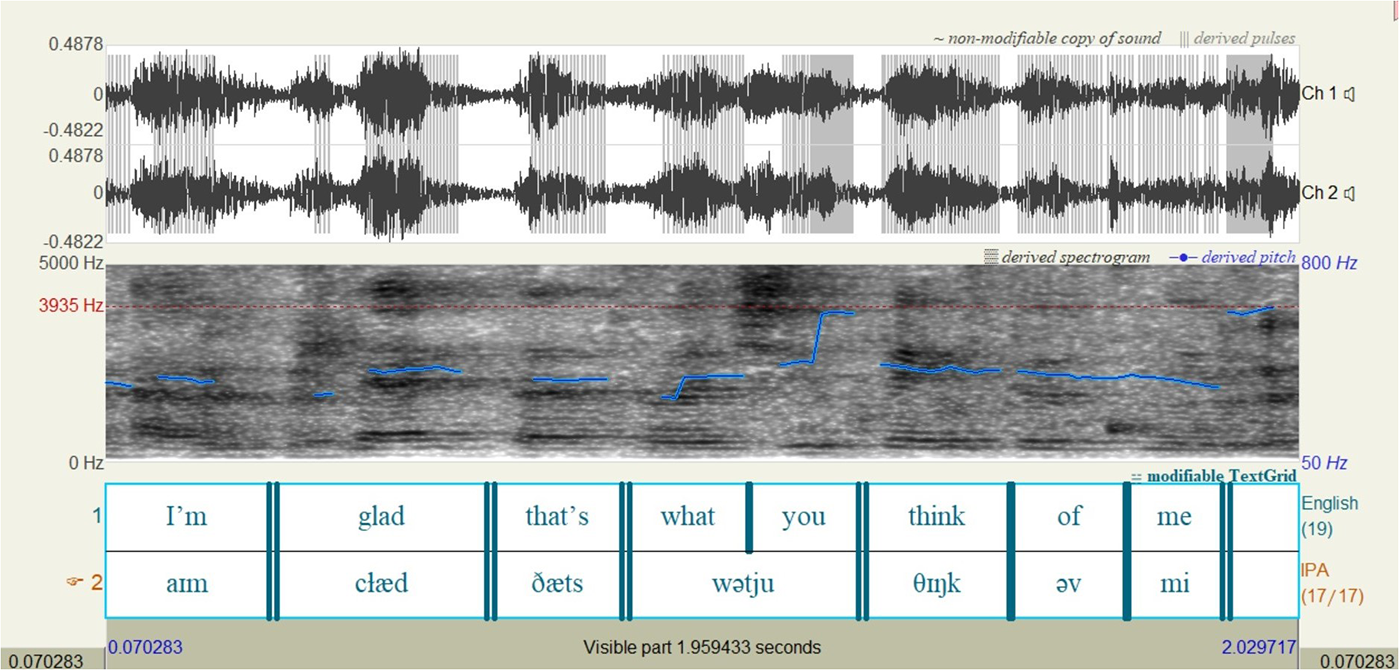
The story transcribed in Extract 1 is an interview account (De Fina Reference De Fina2009). It takes just over three minutes to tell, which is concordant with the cohort of which Faith was a member (Kelleher and Masenge Reference Kelleher and Masenge2022). Extract 1 provides the transcript whilst Figure 2 provides a PRAAT plot for line 9, giving amplitude, pitch, intonation, transcription, and International Phonetic Alphabet (IPA) annotation. We will first be interested in lines 1–11 and the way in which Faith introduces her story, so as to gather her more usual interactional tactics.
Capture of a PRAAT plot of line 9 of Extract 1: i’m glad that’s what you think of me, showing wave form, pulses, spectrogram (narrowband), and plotted intonation contour in the graph, accompanied by transcription and IPA annotation.
A story from interview 3 at 3’17”

The exchange of Extract 1 is occasioned when the interviewer volunteers to help Faith with housework preparatory to accompanying her on the train and shared taxi route from Pretoria (a city in the North of the Gauteng) to Faith’s residence in the South. Whilst doing the washing up, the interviewer is teasing Faith about a plate with a picture of Queen Elizabeth II printed upon it. Banter such as this is fairly usual prior to a teller taking the floor to tell a story, it nevertheless raises challenges for the participant who must:
(i) end banter whilst still demonstrating involvement and uptake;
(ii) re-establish footing, or orientation to the frame of the interview; which is that of a research project into literacy;
(iii) introduce the story about hybrid learning;
(iv) provide orientative details;
(v) make manifest her stance (here with relation to discourses on new media);
(vi) exit story and resume talk;
(vii) do so in a manner that is coherent with prior and subsequent talk.
Faith’s tactics to do this, her conversational style, generally consist of markers of involvement (yeah, no) and frequent checks for shared knowledge (for instance the token right in line 13). She employs lexicalised irony (wow) with corresponding prosodic effects. The intonation of line 9 (the blue line) that is given in Figure 2 is representative of Faith’s doing of irony with a deliberately low, flat, unvarying, contour. The pitch step up corresponds to focus on person deixis (you). The level pitch, in the remainder of the phrase, provides an alternate, but conventional, English turn-final intonation (Szczepek Reed Reference Szczepek Reed, Couper-Kuhlen and Ford2004). As noted above, focus dissociates frequency and intensity (Zerbian Reference Zerbian, Fludernik and Kohlmann2012). One can also note, in the IPA annotation, some devoicing and velarisation (on glad for instance).
These effects of involvement and irony are accompanied by work on turn intervals. Faith’s turns frequently exhibit a 0.1 second overlap, and turn onset occurs slightly before co-locutor turn completion. Faith’s speech in Extract 1 also illustrates some interesting pausings and silences. She marks, for instance, a 0.8 second pause for effect before her exclamation of mock surprise wow (line 8) and follows this exclamation with a further 0.3 second pause. The 1.3 second pause between I’m glad that’s what you think of me (line 9) and so yah let me describe the:: thingy (line 11) is, similarly, related to sequential management. It allows interviewer laughter and gives interactional space for the disjunct marker so yah (line 11) that allows Faith to initiate her narrative. This line also illustrates what could be termed Faith’s “strategic ambiguity” (Tannen Reference Tannen2007, 28) in that it is the listener who must infer what Faith intends to talk about, and that Faith intends it this way. Thingy could be referring to the whole story to come. It could also be referring to the prefacing work that Faith accomplished prior to the interview, in which she had indicated that she wished to tell two stories, one about an assignment and one about her problems with the university’s online platform. Thingy could, finally, be referring specifically to the narrative orientation (beginning in line 13) which, structurally, is just one part of the story. Faith’s more habitual tactics, and particularly her recourse to structural ambiguity, inform her use of multiplex tactics, of which thingy should be considered a proto-example in that it is indeterminate rather than multilayered.
In the rest of this discussion, we will be concerned with the multiplex token blablablablabla (line 40) in the turn yes yes so I use YouTube to like ∙hhh see her videos while she’s presenting on The Real blablablablabla. Jefferson (Reference Jefferson and Schenkein1978, 221) notes that management of story introduction, telling, and exit requires (i) topical cohesion or disjunct, (ii) embedded repetition, and/or (iii) overt fit to turn-by-turn talk. Jefferson additionally notes employing the term “sequential implicativeness” that stories occur within a flow of talk and that therefore they ideally (i) trigger topically coherent subsequent talk, (ii) use a “range of techniques [to] display a relationship between the story and subsequent talk,” or (iii) “more routinely, the relationship of a story to subsequent talk is negotiated between teller and recipients” (Jefferson Reference Jefferson and Schenkein1978, 228). Blablablablabla is best understood as part of such negotiation.
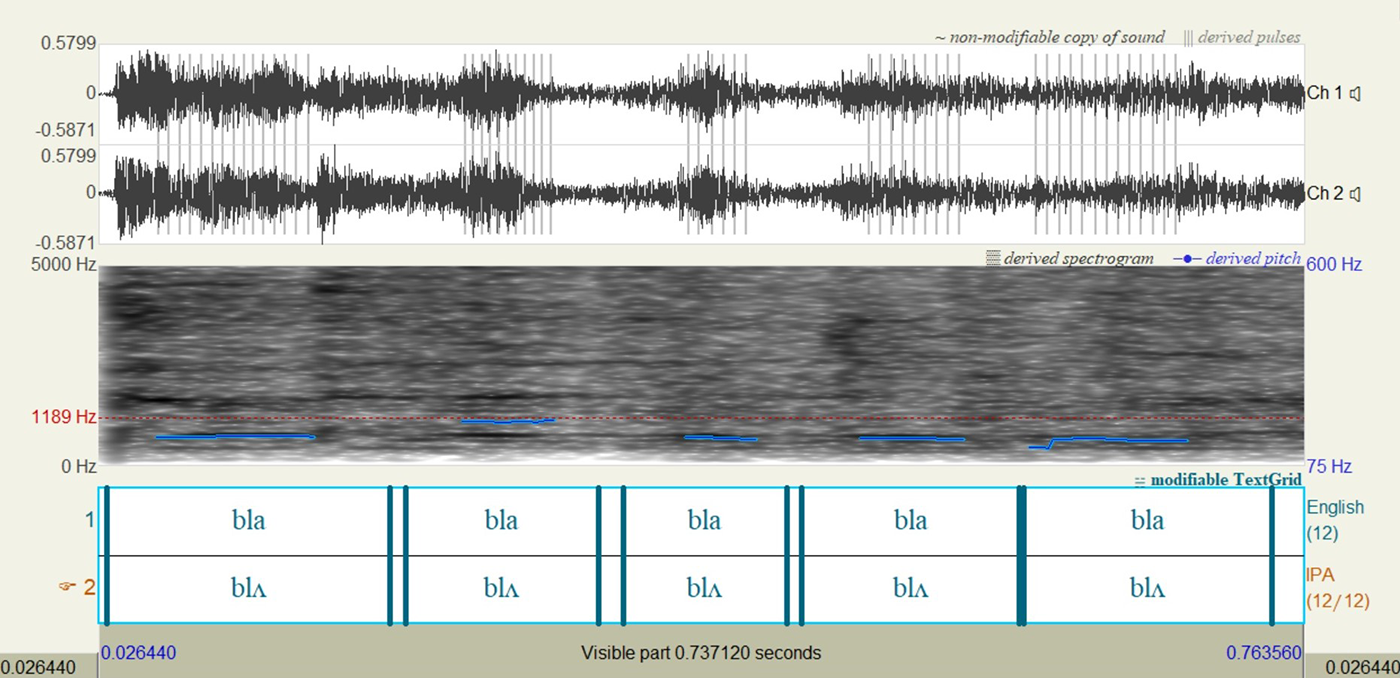
Blablablablabla is a token with a duration of 0.74 seconds. Within the contours of this sound word, several decisive operations take place simultaneously. Its primary function is to mark story exit with the same self-deriding tone and ambivalence as used in the rest of Faith’s turns. Structurally, blablablablabla marks a “coda” (Labov Reference Labov1972, 365–366) in that it reiterates the topic line of the story and returns participants to the more habitual turn taking of ordinary talk. However, with this tactic, Faith is also alluding to her role, the frame of the interview, its register, and carrying out a meta-commentary.
Referring to Figure 3, one can note that there is light stress (pitch and loudness) on the second syllable. The token generally maintains the level turn final intonation that was noted above (Figure 2) but here the decreasing loudness that provides a trail-off (Cole Reference Cole2015) would tend to indicate floor-holding and thus suspension of turn-by-turn talk. The lack of focus also motivates the attribution of an effect of disinterestedness. Blablablablabla seems, firstly then, to be a negative evaluative token, that, when paraphrased, could be taken to mean that someone keeps talking without saying anything meaningful. The person who “keeps talking” is either Faith—who would therefore be deriding her own story, or the interviewer—in which case this is a laconic imitation of a researcher’s analysis of digital media and home literacy (the theme of the interview). There is support for this latter point in that the interviewer has been rather heavy-handedly pursuing a research line in the preceding turns (lines 23, 25, 28, 30, 33, 37, and 39).
Capture of a PRAAT plot of line 40 of Extract 1: blablablablabla, showing wave form, pulses, spectrogram (narrowband), and plotted intonation contour in the graph, accompanied by transcription and IPA annotation.
Blablablablabla presents, additionally, a case of constructed speech. Faith is verbalising a putative continuation of explanations concerned with The Real. It is an example of what Goffman refers to as “forsaying” (Goffman Reference Goffman1981, 150–151) in that Faith “animates” words that are not hers. This would be the case irrespective of whether it is Faith or the interviewer who is being projected as an embedded figure. Blablablablabla therefore performs stylistic, functional, and structural operations. In terms of storytelling, it further accomplishes a complex change in register and footing. The register of this token indexes a change in role and corresponding social range (Agha Reference Agha2005). This could be resumed as a change that encompasses the roles of “student” vs “participant” vs “young black South African female.” Faith puts a term to her role as participant in a research project and returns to the housekeeping in her student flat that needs to be finished before the interviewer and herself can leave. This is reinforced in line 41 where she provides another disjunct marker (↑oh).
Blablablablabla is a multiplex tactic, functioning at the level of phonology, at the level of constructed speech, at the level of evaluation and within the situation of interaction to effect story exit, whilst also introducing a meta-commentary on the register and frame of that interaction. There is, finally, a risk inherent in blablablablabla—its use, and its derogative connotations, could potentially shock or perturb Faith’s interlocutor. Good interpersonal knowledge, ease with conversational style and mutual involvement is a prerequisite to minimise the possibilities of misconstrual. This is especially true of stylised tokens that lie on the boundary of language (Keevallik and Ogden Reference Keevallik and Ogden2020).
It could be objected that this is, certainly, a very humble case of multiplex operation, very close to the ordinary polysemy of everyday conversation. Nevertheless, firstly, multiplex tactics occur in situations of interaction and take their meaning from shared interlocutory knowledges, footings, stances, and voicings. These are indexical-referential meanings that point simultaneously to the participation frame, real-time interactional dynamics, discursive structure, and the embedded interactions and discourses that are rendered through narrative. In the second place, their unexceptionality has a snug fit in small stories that bring to light quotidian complicities and doing being. The kind of play on meaning and interactional situation that multiplex tactics represent is a useful addition to the small stories toolkit. Our contention is that multiplex tactics are a good place to look when seeking to understand intersubjectivity and interpersonal relationships. We are referring to such aspects of an interactional situation by the term “poise,” since what is at issue is the ability to play creatively within discursive and interactional coordinates.
Multiplex tactics and the coordination of narrative elements within a situation of interaction
This section turns from the introduction and exit of a single narrative element, as discussed in the previous section, to the arrangement of several narrative elements within a speech event as a whole. We will be looking at data from interviews 1 and 2 in order to appreciate the operations and patternings that can give rise to a sense of cohesion both between these narrative elements and with respect to the interaction frame. We turn, first, to how Faith takes a term and progressively endows it with multiplex interpersonal (stance and voice), situational (footing and frame), and narrative (evaluation) meaning. The example selected is the word annoying that is repeated at several key points over the course of interview 2.
Interview 2 contains four main narrative strands: (i) a story about friendship groups, (ii) a story about the use made of an internet study platform by lecturers, (iii) a story about accessing the same platform on Faith’s phone, and (iv) a story about multitasking and literacy. The first occurrence of annoying happens in a fairly natural manner within the story (i) about friendship groups. Its second occurrence, 10 minutes later, in story (ii), qualifies the act of listening to voicenotes on an internet platform. The repetitions of both the word, and its phonological contours, begin a process of local indexical-endowment that simultaneously allows Faith to evaluate digital platforms, to reinforce her interactional stance and footing, and to structure the interview as a whole.
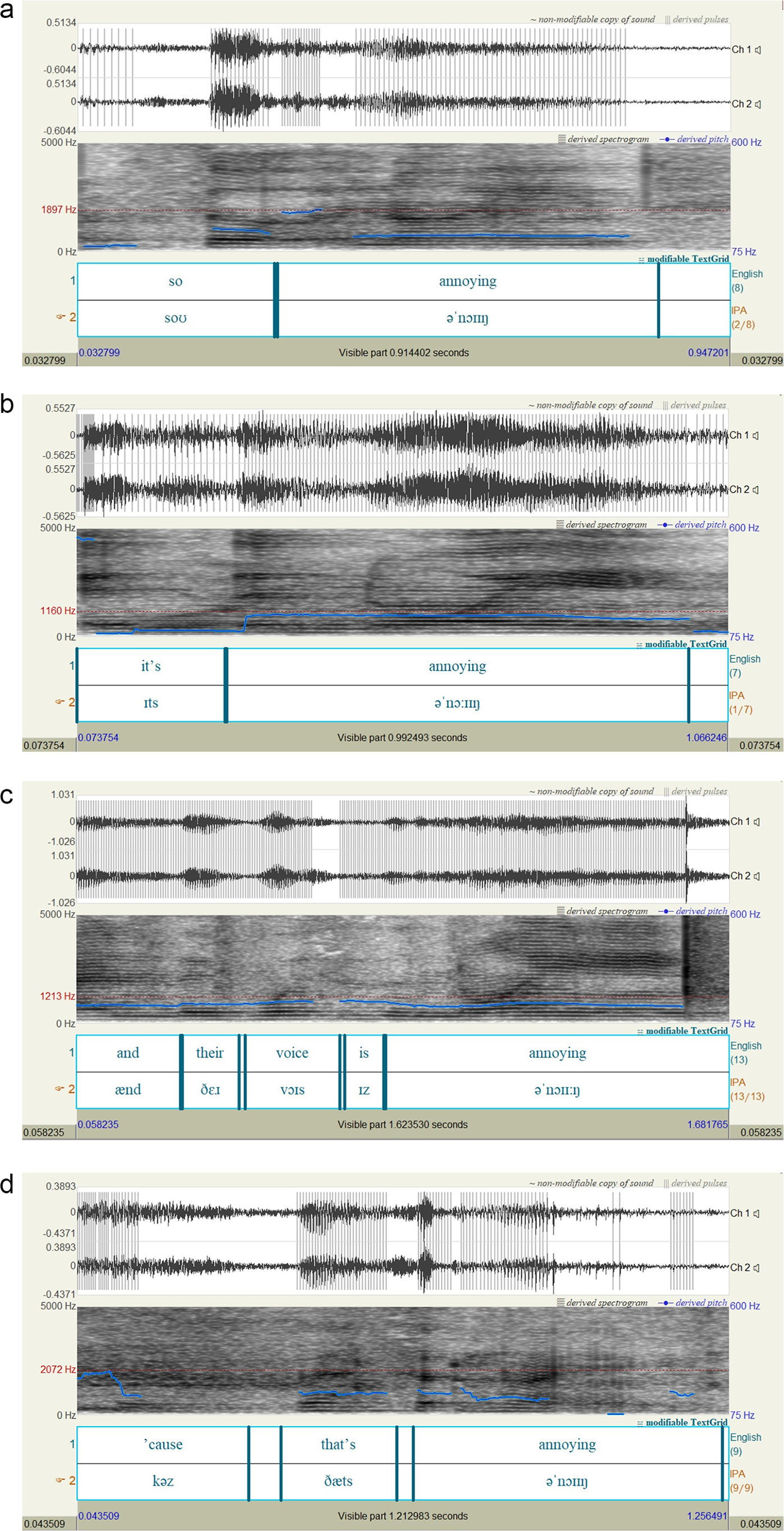
In all annoying is repeated 10 times in interview 2 within differing locutions: (i) so annoying at 15’17”, (ii) so annoying at 25’36”, (iii) it’s annoying at 25’51”, (iv) and their voice is annoying at 25’59”, (v) yah it’s quite annoying actually at 26’28”, (vi) it’s quite annoying to listen to at 26’31”, (vii) yah but it gets annoying at some point at 30’35”, (viii) yah at some point it gets really annoying’ cause then at 30’43”, (ix) annoying at 37’01”, and (x) ‘cause that’s annoying at 46’53”. Figure 4 provides PRAAT plots for intonation, pitch, loudness, transcription, and IPA annotation for instances (i), (iii), (iv), and (x). Extract 2 provides the turns preceding the final iteration that functions as a pre-closing device.
PRAAT captures of four different iterations of annoying from interview 2, showing wave form, pulses, spectrogram (narrowband), and plotted intonation contour in the graph, accompanied by transcription and IPA annotation. (a) Capture of a PRAAT plot of interview 2 at 15’17”: so annoying iteration (i). (b) Capture of a PRAAT plot of interview 2 at 25’51”: it’s annoying iteration (iii). (c) Capture of a PRAAT plot of interview 2 at 25’59”: and their voice is annoying taken from the turn, the lecturer’s like sitting comfortably and their voice is annoying iteration (iv). (d) Capture of a PRAAT plot of interview 2 at 46’53”: ’cause that’s annoying iteration (x) (four turns from end of interview).
The tenth iteration of a repetitive evaluation token annoying used in interview closure (taken from interview 2 at 46’30”)

Figure 4 makes visible a recognisably similar intonational contour for annoying. Lam (Reference Lam, Barth-Weingarten, Dehé and Wichmann2009) discusses similar prosodic and pragmatic correlations for the discourse particle well. There are some slight divergences in the way the word is pronounced, but despite this, Faith’s intonational regularity scaffolds a very local process of functional, structural, and identity endowment. In Figure (4a) (iteration i), the token receives emphasis on so and a conventional pitch step up on the first syllable followed by level intonation with increased loudness and vowel elongation on the final syllable. In Figure (4b) (iteration iii), the level intonation is repeated but it is the penultimate syllable that is louder and elongated. In Figure (4c) (iteration iv), the entire clause receives level intonation with few variations in intensity and it is the final syllable that is elongated. In Figure (4d) (final iteration x), there is a pitch step up to mid on the final syllable, accompanied by a trail off into a breathy creak that, as in Figure 3 above, corresponds to terminal sequence behaviour (Walker Reference Walker, Sidnell and Stivers2012). Intonational similarity is accentuated through four closely spaced iterations of the word (iterations ii–v) that then allow much longer intervals of seven and ten minutes.
The word progressively sheds its denotative (or uniquely referential) content, working instead as a multiplex tactic. It provides personal evaluation in the story about friendship groups, it is then applied to research-oriented discursive evaluation of digital media in iterations (ii)–(ix), iteration (x) provides interview-final evaluation and frame closure. The multiplex operation of the word is therefore: (a) as an evaluative token for a series of narrative characters, processes, and events, (b) an element of cohesion for narrative elements, (c) a marker for footing and role, allowing Faith to differentiate between those opinions that concern her personal life, and those opinions that are pertinent to a research interview, (d) a token for stance and identity work, whereby Faith emphasises her remove from and disapproval of digital media resources, and (e) a means of orientating to the interview frame and marking the closure of the interview.
The use of annoying to orient to frame and to close the interview is illustrated in Extract 2. This extract occurs four turns from the end of the interview as a whole and ten minutes following the closest previous iteration of the word. What Extract 2 makes obvious is the intersubjective involvement and cooperation between interlocutors that accompanies the very local multiplex endowment of the word. In this case, the function and placing of the last iteration of annoying are so obvious from the preceding interaction that even though the interviewer interrupts Faith’s turn at line 3, obliging Faith to repeat, in line 4, the turn initially begun in line 2, the interviewer still laughs before Faith mentions annoying. This is to say that the interviewer’s acknowledgement of Faith’s turn precedes Faith’s repetition of the word.
The only explanation for this kind of interlocutor behaviour is that previous iterations have established a store of local and contextualised shared resources and have allowed the interviewer to predict which of those resources could be a possible candidate for frame management. Multiplex tactics, therefore, at the level of the interactional management of the participation situation as a whole, can relate to patterned distributions. In the achievement of these patternings, phrases can receive motif-like phonological contours that make specific discourse units recognisable. Patternings occur at several levels of discourse organisation. As a case in point Table 1 provides an overview of the narrative elements of interview 1 with columns listing telling time and interval between narrative elements as well as the theme of each.
Distribution of narrative elements in interview 1 (average duration is adjusted to exclude the two outlying values of 1700 and 2511 that are due to recording conditions during the outing)
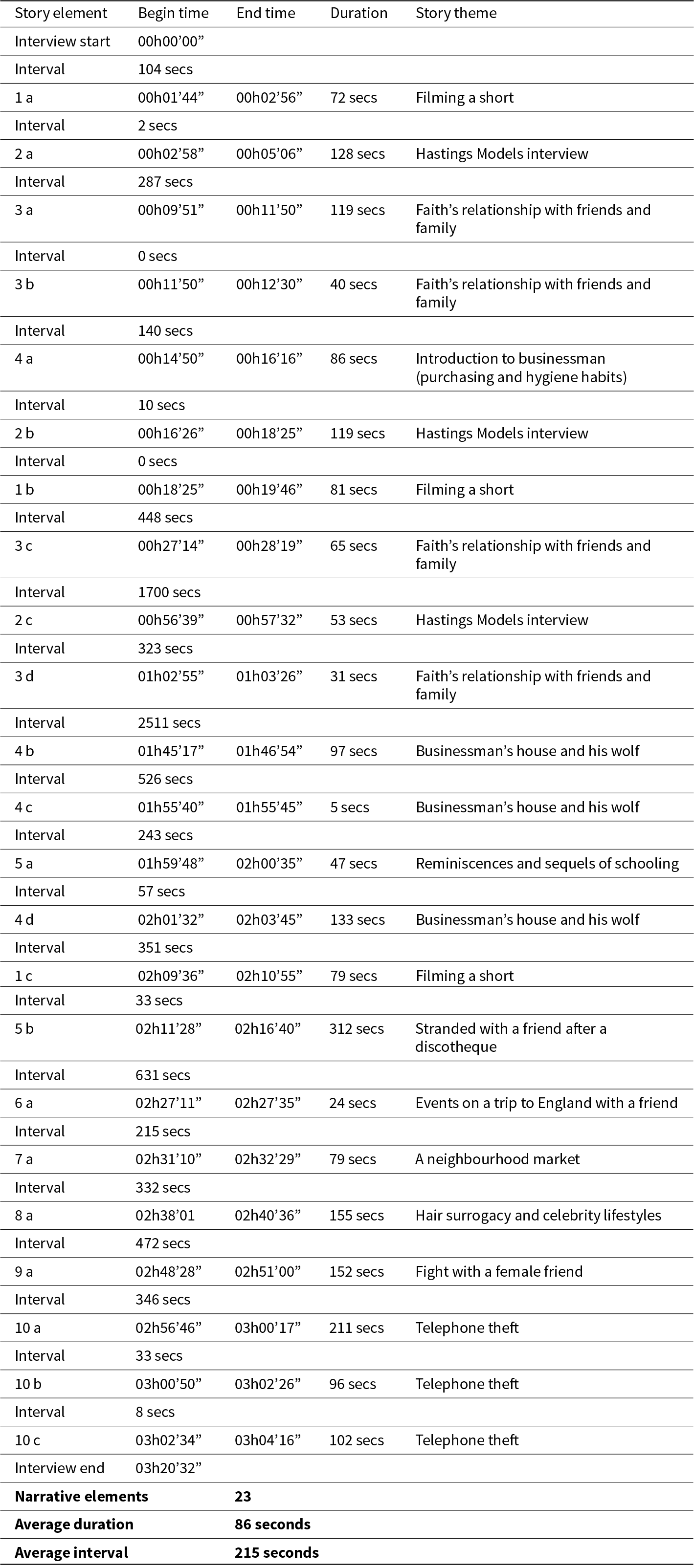
Faith’s distribution of narrative elements is regular, with an average length of 86 seconds. Each narrative element may be held to be minimally complete, in that it contains complicating action and resolution, but each elucidates different aspects of the underlying narrative events, what Polanyi refers to as the “adequate paraphrase” (Polanyi Reference Polanyi1981, 329). The Hastings Models story (elements 2 a–c, of the thematic episodic descriptions in Table 1), is split into three different sub-stories, for instance, where the first gives the details of the interview with the member of the modelling agency, the second gives the import of the interview for Faith’s role as a student journalist, and the third the upshot for the magazine itself. A similar pattern is reproduced with stories about a filming project (elements 1 a–c) and the events surrounding the theft of a telephone (elements 10 a–c).
Table 1 displays a recurrent fragmentation of a single underlying narrative plot into several narrative elements. These elements are spread out evenly over the recording with an average interval time of 215 seconds, which is to say that length to interval provides a ratio of 1/3. The result is a tetrahedral series wherein each narrative element is one quarter part of each conversational segment. Patternings such as this are well documented in the literature. Bamberg (Reference Bamberg, Sugiman, Gergen, Wagner and Yamada2008) and Kelleher (Reference Kelleher2020) both examine a series of retellings that display regularities in terms of topic and structure. Each narrative element, in being relatively short, need not monopolise the interlocutionary floor, and successive series of narrative elements allow a sort of qualified return to a previous topic. Patterning establishes a scaffolding for co-locutor feedback and narrative emergence, it also, like multiplex tactics, exemplifies a principle of economy: 23 story elements are crafted out of only 10 underlying narratives and these occupy over three hours of tape.
Discussion and conclusion
As we have seen in this article, multiplex tactics may produce effects on several levels of interactional and discursive organisation simultaneously: interactional role, story entry and exit, distribution and cohesion of storied elements, discursive embedding, stance, narrative frame, and metapragmatic functions. Multiplexity can thus be regarded as a resource for gaining access to intersubjective meaning-making and narrative co-construction in interaction. In this paper, we have drawn on two examples from the sociocultural environment of South Africa. The first example illustrates (i) exit and coda, (ii) evaluation and meta-commentary, (iii) constructed speech, (iv) shift in footing, and (v) management of frame. The second example illustrates the accretion and concatenation in function that a token may undergo through several iterations, resuming questions of (i) prosodic regularity and participant style, (ii) evaluation and stance, (iii) footing, (iv) coherence, and (v) metapragmatic marking.
The preceding examination of interactional resources has brought to the fore three key reflexions and two possible expansions of this study. The first reflexion emphasises multiplex tactics’ link to creativity and poise. We have hoped to show that multiplex tactics draw on ready-to-hand conversational resources and not necessarily on enregistered or received forms, and that their employ finds its pair in the readiness of one’s interlocutor to acknowledge and ratify this kind of conversational economy. Multiplex tactics require interactional cooperation that is symmetric: creativity in use relies on interlocutor accommodation. Secondly, our analysis has brought to the fore interactional patternings that raise the question of style. The employ of multiplex tactics is stylistically coherent and relies on lexical and prosodic choices that continue the identity work carried out by other interactional behaviours such as turn taking and more familiar discourse markers such as those used to backchannel assent and involvement. Thirdly, because of their economy, their polysemy, and their locally contingent nature, these tactics call for shared knowledges, intersubjectivity, and involvement. As such, multiplex tactics demonstrate a fit with small storying research and practice.
Multiplex tactics may support conclusions in two further directions. The first direction concerns speaker competence, which, one can appreciate, does not necessarily imply the use of complex, formal, semantic, and syntactic baggage. This raises the spectre of those places, institutions, and linguistic dispensations that are unequal. Much of the struggle of the post-colony has gone into righting linguistic inequality and making both governments and educators aware of more fluid constructions (Makalela Reference Makalela2014). However, there are many testing and standardisation formats that retain a vision of sociolinguistic and sociocultural competence that is concerned with difference, demarcation, and with artificial stability in form and register (for example Council of Europe 2020).
The second direction concerns our relationship to the world and the ways in which multiplex tactics can be used as a lens to highlight complicity and involvement: intimate relationships, vested interests, but also, through absence or lack of functional efficiency, areas in which we lack confidence or those moments in which we suffer skewed and unequal participation frames. Such a qualitative approach can be conceived of in terms of several complementary and mutually imbricated axes. The first axis is the heuristic “ways of (story)telling—sites—tellers” (Georgakopoulou Reference Georgakopoulou2007, Reference Georgakopoulou and Patron2020) that establishes a horizontal relationship between practice and narration. This is complemented by work on narrative positioning that moves in a bottom-up way from story world, to the interactional world, to broader social discourses and processes (De Fina Reference De Fina2013). The intersubjectivity and involvement that have been discussed in this article recall, moreover, the tactics of intersubjectivity (Bucholtz and Hall Reference Bucholtz and Hall2005, 599) that align along axes of similarity/difference, genuineness/artifice, and authority/delegitimacy.
Acknowledgements
The authors and contributors would like to thank all the participants and institutions involved in the original projects and particularly the participant named Faith for her patience and enthusiasm over the years.
Funding statement
Original research financed through a post-doctoral fellowship granted by the South African National Research Foundation (UID 112028) and the Oppenheimer Memorial Fund. Data visualisation and analysis were financed through a Région Bretagne SAD (2023_UR2_CQNC_Ce qui nous concerne) post-doctoral fellowship.


 Open access

