


Introduction
It is intriguing to know that Alexander von Humboldt, who studied law and business in Hamburg, and later science in Jena, had such a far-reaching insight into what are turning out to become the twenty-first century’s determining trends. In Jena, a young Alexander met the older Goethe in his brother Wilhelm’s house. It is hard to overestimate the value of their discussions for the development of what higher education has become today. Wilhelm von Humboldt’s name was later given to what has become the modern research university in which research and education thrive at arm’s length from state and government interference. The adventurous Alexander was stimulated to explore the world. Indeed, in the Llanos of Venezuela, he realized how human activities forever change the biosphere.Reference Wulf 1 Maybe that moment in Humboldt’s brain was the philosophical kick-off point of the Anthropocene. On the slopes of the Ecuadorean volcano Chimborazo, Humbolt also realized the interdependency of plant species and the physical environment. Indeed Alexander von Humboldt in his monumental work Kosmos (1845–1850) laid the foundation for understanding what we call climate change and global interdependency.Reference Von Humboldt 2 Since Humboldt visited the Chimborazo in 1802, the vegetation and the snow line have risen 500 metres (vertically) as a very visible expression of global warming. The resulting fundamental changes in the biosphere, to a very large extent, define the global context in which universities develop. Much of today’s discussion on university development starts out in Wilhelm’s universe and will play out in that of Alexander.
The main resource for a country’s endogenous growth is its human and cultural capital.Reference Romer 3 Universities play a very important, but not the only, role in maintaining and building this resource.Reference Boulton and Lucas 4 That role however, is changing rapidly as the demands on universities become increasingly complex and challenging.
The key components of a higher education system are its human capital, funding structures, governance framework, institutional landscape, its research and study programmes. Universities, particularly in open and competitive economies, face increasing competition for talent and resources. Institutions are being challenged by politicians and society in general to produce better graduates and more (relevant) research in less time and on less funding.
Universities are institutions situated amongst strong and changing forces, as described in Burton Clark’s triangle: they are caught between government, the market, and academia. 5 In many institutions this has led to strengthening the executive leadership at the expense of the influence by collegial bodies, and members external to the institution have been introduced into the governing bodies. Sometimes external board members form the majority of the universities’ executive boards. In Europe today, countries and institutions balance these forces in many different ways.
Modern complex institutions cannot be governed effectively and exploit the benefit of autonomy without sufficient, professional and executive leadership, which can also satisfy external demands for accountability. This development has resulted in diminished state control and more flexible and autonomous systems but has also led to expanded reporting and accounting, which often in reality limit freedom and are perceived as control.
Will academic creativity thrive within this reality? This article attempts to highlight some of the issues and outline a few of the current trends.Reference Holm-Nielsen 6 It is based on a draft paper by the same author on higher education reforms in Denmark published by CyD (la Fundación Conocimiento y Desarollo, Barcelona).Reference Holm-Nielsen 7
Which would be the dominant trends?
From lecture halls and laboratories to Massive Open On-line Courses (MOOCs) and freely accessible life-long learning?
From formal instruction to informal coaching?
From physical campuses to virtual campuses?
From (tenured) professors to dispersed groups of research and teaching staff?
From class teaching to self-designed learning?
From supply of degree programs to courses on demand?
From local (national) universities to transnational institutions for R&I, and Education?
From ministries of education to ministries of societal development?
From UNESCO to WTO?
The Organization for Economic Co-operation and Development 5 called for member countries to establish a grand vision for tertiary education because it is well established that universities are positioned at the nexus of knowledge creation, education, innovation, and economic growth. Significant reforms, such as Europe’s Bologna Processes, to some degree foreshadow this call, but it is fair to say that the tertiary education sector is still in the midst of a sea change – the contours of which are emerging. It may lead to universities that are not supply driven.
Grand Challenges and UN Development Goals
All societies share a number of grand challenges. These are summarized in the Lund Declaration (see Box 1).Reference Vetenskabsrådet 8 The United Nations (2015) summarized a global action plan, to face the challenges towards 2030, into 17 sustainable development goals: No Poverty; Zero Hunger; Good Health and Well-being; Quality Education; Gender Equality; Clean Water and Sanitation; Affordable and Clean Energy; Decent Work and Economic Growth; Industry, Innovation and Infrastructure; Reduced Inequalities; Sustainable Cities and Communities; Responsible Consumption and Production; Climate Action; Life Below Water; Life on Land; Peace, Justice and Strong Institutions; and Partnerships for the Goals. All of these actions are complex and interdisciplinary in nature, and it is quite obvious that all parts of knowledge systems must be brought into play in order to reach these goals. Because opportunities and labour markets for graduates will change, this may cause many universities to redirect the emphasis towards interdisciplinarity and global issues.
The Lund Declaration 2015
Europe needs clear political commitment to step-up efforts to align strategies, instruments, resources and actors at national and European level in order to address the grand societal challenges.
This commitment needs to be underpinned by an excellent science base, world-class infrastructure and a new generation of researchers with the right set of skills, notably creativity, entrepreneurship and innovation.
Europe needs to connect with partners around the world, in advanced, emerging and developing countries to address the grand societal challenges in partnership and to attract the world’s best researchers and innovators and private sector investment.
Greater impacts on the challenges have to be achieved through involvement of the public sector and industry in knowledge creation, with a stronger focus on open innovation and the role of end users.
The answer to solving the challenges and thus adapting to a new reality would expand upon the classical university paradigm,Reference Kjærgaard and Kristensen 9 , Reference Liburd 10 and would entail a modernization of the university model from the disciplinary university towards the collaborative university.Reference Liburd 10 The university as a ‘learned republic’ owned and governed by its citizens – a community of teachers and students, universitas magistrorum et scholarium – is no longer sufficient. The citizenry of this learned republic consisted of the faculty and (elite) students. More recently, post 1968, its members became academics, staff and students. However, this does not correspond to the needs of contemporary societies in which most people attend tertiary level study programmes at some point in their lives, and higher education is increasingly for everyone. Societies (public and private sectors) invest more in the common good than the individuals of the ‘learned republic’ (students and professors), therefore (and for accountability reasons) societies claim the control of universities, resulting in new legal frameworks and governance reforms in many countries. In short, the ownership of universities must be shared between faculty, students and society at large.
Educational systems are being revisited in order to introduce the necessary changes. New ways of tackling the demands will be developed and the nations and institutions that manage these changes in the best way will be the most attractive for advanced human capital, knowledge and innovation. This article argues that Universities 4.0 must respond to the needs of society, answer labour market needs more directly, integrate new technologies and social communication networks, and develop the capability to mine mega data and include deep data systems.
Those countries that have the most flexible legal framework and which best stimulate integration with Industries 4.0 (Box 2) in a knowledge-based economic system will see highly diversified tertiary systems that are integrated with the labour market and which are globally networked.Reference Hermann, Pentek and Otto 11 Such systems are the most competitive.
Industry 4.0
In an Industry 4.0 environment, industries customize products under the conditions of high flexibilized (mass-)production.Reference Kagermann, Wahlster and Helbig 12 The required automation technology is improved by the introduction of methods of self-optimization, self-configuration, self-diagnosis, cognition and intelligent support of workers in their increasingly complex work.Reference Jasperneite and Niggemann 13 There are six design principles in Industry 4.0.Reference Hermann, Pentek and Otto 11 , Reference Jasperneite 14
Interoperability: the ability of cyber-physical systems (i.e. workpiece carriers, assembly stations and products), humans and Smart Factories to connect and communicate with each other via the Internet of Things and the Internet of Services
Virtualization: a virtual copy of the Smart Factory, which is created by linking sensor data (from monitoring physical processes) with virtual plant models and simulation models.
Decentralization: the ability of cyber-physical systems within Smart Factories to make decisions on their own.
Real-Time Capability: the capability to collect and analyse data and provide the derived insights immediately.
Service Orientation: offering of services (of cyber-physical systems, humans or Smart Factories) via the Internet of Services.
Modularity: flexible adaptation of Smart Factories to changing requirements by replacing or expanding individual modules.
Because of an ever-increasing demand for higher education, many higher education systems have become mass systems, with very high participation rates.Reference Lenzen 15 British universities, for example, have increased student enrolment from about 500,000 in 1980 to 2.4 million in 2008. The global student population has increased 10 times over the last 50 years to more than 150 million today. In Denmark more than 60% of a cohort attend higher education and about 25% graduate at master level.
The comprehensive universities of the future will have to accommodate a changing and diverse student population, and the absence of physical distance (ICT-driven learning systems, remote access to mega data, education through social networks, and so on). Stakeholders in modern universities, be it students, faculty, scientists, partners or customers, are not dependent on offices or lecture halls to the same degree as before. Higher education systems actually behave much like other complex systems, for example ecosystems.Reference Battiston, Doyne Farmer, Flache, Garlaschelli, Haldan, Heesterbeek, Hommes, Jaeger, May and Scheffer 16
Brains on the Move, Brains in the Cloud
The mobility of advanced human capital is one of the most important factors for successful insertion into the global knowledge exchange system.Reference Thorn and Holm-Nielsen 17 It seems that sometimes it is easier for European advanced human capital to move to other regions, because the European ‘market’ is too slow, too compartmentalized and has too many bottlenecks, than to recruit such brains to Europe. This is disadvantageous for the European innovation system as a whole and certainly for Europe’s universities. According to the findings of Kamalski and Plume,Reference Kamalski and Plume 18 in some countries this is evident through the high percentages of sedentary researchers. Such systems appear to belong to the periphery of the global knowledge exchange structure. For these regions or countries it is imperative to strive to become active partners in the global brain circulation system.
No institution is better than the sum of its human capital. Universities are to a large degree shaped by institutional recruitment policies, faculty development programmes and incentive systems. Unfortunately many institutions have very traditional, and locally biased, recruitment procedures, which favour ‘more of the same’. In some cases, recruitment procedures may be controlled by older faculty and local unions.
How well do Universities Integrate Brains on the Move and Brains from the Cloud?
The Bologna Process in Europe has been a great success. It has played a large role in the increased mobility of students in the EU (also facilitated by the Erasmus Programmes). If we look a little closer at mobility, it is obvious that there is a corresponding need for a unified open market for ‘advanced human capital’. In such a market, well-trained people will behave like other types of capital. For example they will move towards innovation centres/hubs much in the same way that investment capital and risk capital concentrate in innovative regions. This does not happen at the moment, because it is very difficult to transfer social benefits, medical insurances and pension rights. An additional obstacle lies in the very uneven career systems and traditions for researchers and scientists that exist in the various European nations. In fact, a new development in which the most advanced human capital is in the cloud and is globally available any time is changing the competitive pattern for advanced industries and may lead to fundamental changes within the university sector as well. Brains in the cloud are engaged right on time anywhere on earth. In other words, they are full-time engaged globally, and it is not obvious to which nation they belong.
In some other global regions, notably North America, there are innovation regions to which advanced human capital is drawn, and accumulation of human capital takes place. Well-known examples are Massachusetts, Silicon Valley, the research triangle of North Carolina, but also, in Europe, OxBridge and a few other places.
Kamalski et al.Reference Kamalski 19 identifies patterns and clusters in the world of research, and she defines five groups of countries: the Key Players (the US, the UK, Germany, France, the Netherlands, Switzerland and Denmark), the Up and Coming (BRIC, Poland, South Korea, Iran and Turkey), the Internationally Dependent (Spain, Portugal, Czech Republic, Bulgaria, Hungary, South Africa, Argentine, Chile, Finland and Norway), the Smallest Science Footprints (Mexico, Cuba, Egypt, Iraq, Malaysia and Kuwait), and the Attractive Destinations (Singapore, Hong Kong, Saudi Arabia, Qatar and UAE). The Key Players are characterized by a relatively large and highly productive research base, high field-weighted citation impact, a highly mobile researcher base (about 70% of which spend time abroad), high levels of international collaboration and a net loss of researchers.
If we look globally, innovation centres exist in a rather small number, probably fewer than 50, in the world. Several of such innovation centres are in Europe, but our human capital is not moving as quickly as it is in the other regions. Such innovation centres are characterized by high percentages of highly mobile researchers. This phenomenon is well known from the US and the other Key Player countries.Reference Kamalski and Plume 18 In other words these innovation hubs act as magnets for the best trained and best networked brains. However, the mobility of knowledge will probably increase due to the disappearance of distance, and in the future such innovation centres may become hubs for brains in the cloud and become increasingly virtual.
Nations and institutions are experimenting with new international and trans-national learning systems in which students and faculty do not belong to a single institution. New ways of organizing and delivering higher education are being implemented, among others MOOCs and, more often, blended learning systems, and reversed classrooms. The institutional organisation is also being experimented with. The emergence of transnational colleges and campuses probably began in the business school sector, and is now occurring more widely. Today, many universities have distributed and offshore campuses, on-campus international programmes, etc. One example of a new way of developing university research and teaching is the Sino Danish College in Beijing, a (national) joint venture between China and Denmark (see Box 3).
Sino-Danish Center (SDC) in Beijing
The purpose of the SDC was to establish a new institution in China, which was not Danish and not Chinese, but which would have students and faculty from both partners on equal terms. The principle behind the SDC is very simple: 50:50. On the Danish side, Denmark’s eight research universities join forces and provide funding to a common SDC budget proportional to their individual current budgets, and this is matched by the Danish government, 1:1. The SDC’s Chinese partner is the University of the Chinese Academy of Sciences (UCAS). UCAS provides faculty and enrols Chinese students 1:1 to the Danish partners. This means that the college has an international group of faculty and students; most are Chinese and Danish, but a number of other nationalities participates. All faculty are tenured at one of the partner universities but none at the SDC, which means that the SDC is an elite college without a permanent faculty.
Altogether, the SDC has about 350 master students in seven programmes (Water and Environment, Energy and Sustainability, Neuroscience and Imaging, Protein Biology, Nano Science and Technology, Innovation Management, and Public Sector Management. Food and Health is being planned as a new programme. A further 150 PhD students are enrolled in related academic fields of study. The students obtain double degrees because the study programmes are accredited in China as well as in Denmark. The faculty from Denmark comprises, on a yearly basis, about 200–250 individuals, who participate in SDC activities as visiting professors and visiting researchers as part of their tenure at one of the Danish universities. The SDC has its own building, 12,000 square metres of Danish architecture, on UCAS’s new Yanquihu campus for 10,000 students near the Great Wall, Beijing. The SDC is the only international college at the Yanquihu campus.
The comprehensive universities are increasingly challenged not only by their sheer size in terms of budgets, campuses, students and staff, but also by the complexity in all aspects of their operation. Just to mention a few problems: distances in line management have increased, transparency and communication are increasingly difficult, languages and cultures are diversifying, and key academic staff lose influence. In addition, universities are facing the challenge of accommodating elite students as well as a growing mass of highly diverse HE-students. Massification of higher education will be a sustained trend for many years, especially in economically less mature regions. For this reason, universities will have to differentiate the provisions for higher education and include programmes for elite students, and most will have to consider what position to aim for in the higher education landscape.
Responding to the Challenges
Modern universities will adapt to the needs of contemporary societies in which most people attend tertiary level study programmes at some point in their lives, and higher education is increasingly available to everyone. Societies (public and private) invest more in the common good than the individuals of the ‘learned republic’ (students and professors), therefore (and for accountability reasons) societies claim the control of universities, resulting in new legal framework and governance reforms in many countries. In short, the ownership of universities must be shared between faculty, students, and now society as well.
Change processes are guided by a general theory of change. Figure 1 and Box 4 show a sequence of inputs and intermediary results that, according to the literature and international experience, lead to better graduates and research, provided that the framework conditions (Box 4) are favorable.Reference Holm-Nielsen and Salmi 20
Theory of change for producing more/better-qualified graduates and more/higher quality research.Reference Holm-Nielsen and Salmi 20
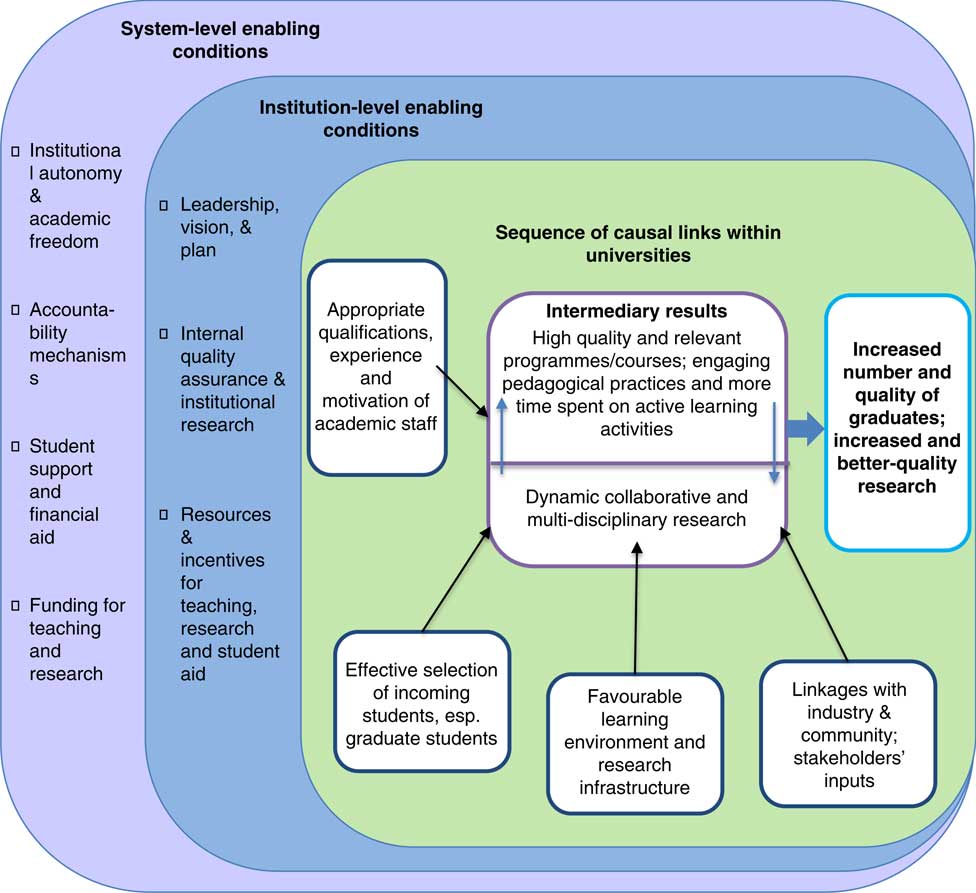
System-level enabling conditions (Ref. 20)
Higher education institutions do not operate in a vacuum. To understand the determinants of their performance, it is essential to take key forces at play into account at the level of what could be called the tertiary education ecosystem within which universities and other institutions evolve.Reference Salmi 21 These forces can have a facilitating or constraining effect, depending on the circumstances.
The tertiary education ecosystem includes the following key elements: (a) overall political and economic macro environment; (b) national higher education vision and strategy; (c) governance and regulatory framework influencing the degree of autonomy of institutions; (d) quality assurance framework; (e) financial resources and incentives; (f) articulation between high schools and tertiary education and among the various types of tertiary education institutions; (g) economic, social and cultural characteristics of the geographical location of higher education institutions, which determine their ability to attract scholars and students; and (h) digital and telecommunications infrastructure.
The dimensions of the tertiary education ecosystem that most systematically influence the situation of individual higher education institutions are (a) governance, particularly with respect to the degree of institutional autonomy and academic freedom enjoyed by higher education institutions; (b) the accountability measures (quality assurance and accreditation, assessment of learning outcomes, labour market results, research assessment) linked in one way or the other to performance measures of higher education institutions; and (c) the funding available for research and teaching, especially for the public universities that are heavily dependent on state resources, and for student aid.
I will, in the following paragraphs, provide a summary of the various challenges and issues as I see them at the moment. Boulton and Lucas (Ref. 4, p. 15) point out, that
a central dilemma for university governance is (therefore) how to retain the sense of ownership of the university enterprise by its members, which creates the setting for their creativity to range freely, whilst implementing the structural changes that are inevitably needed from time to time if a university is to remain a creative force for future generations.
This statement reflects well the challenges experienced during the change process at Aarhus University 2011–2015 (see below). No higher education system can be stronger than the weakest of the previously mentioned five pillars: human capital, funding structures, governance framework, institutional landscape and study programmes.
Human Capital
The human capital is the sum of brains in a system and the accumulated knowledge, insight and experience they possess.
Education systems are designed to train the brain and to build cultural and technical skills for the learners. Some educational traditions pay more attention to humanities and social sciences and others more to technical- or science-based traditions, some are mostly based on formal learning while others balance this with informal and lifelong learning. It is important for universities not simply to mimic one model for higher learning institutions but to build on their own strengths and traditions, and that they strike a balance between training and forming the individual students.
Recruiting excellent faculty and stimulating their development in academic freedom, but accountable to their talent and responsible to their individual fields of study, is sine qua non. However, the academic horizon is not static. This means that HR strategies must be at the same time flexible and of a long-term nature. Traditionally, recruitment is guided by peer systems; however, it must also be dynamic in such a way as to enable the institution to change its academic profile in the course of time. In some European higher education systems academic recruitment is too far removed from the academic environment of the institutions. Often, transparent career pathways are missing, and recruitment as well as dismissal of underperforming staff are folded into somewhat obscure processes. This results in a static pool of talent because HR policies do not combine patience with dynamism. Many universities are stuck and unable to adapt, whether due to national regulations, civil service traditions, or other reasons. However, it is a prerequisite for universities to have clear strategies for recruitment, retention and quality support of their staff.
The integration of education and research is the most decisive factor in the development of a strong university,Reference Halliwell 22 but it is too often assumed that a good researcher also is a good teacher. Professors are supposed to be both (in addition to excellent communicators), and well-performing universities take this into account when developing their HR policies. These universities focus on offering adequate research and teaching infrastructure, they develop good research capacity practices, policies that promote an open and autonomous research culture, and ensure the quantity and quality of academic human resources. This includes leadership attention to the age profile of the staff.
On top of these issues, many universities lack effective faculty development programmes. It is the experience that effective faculty development programmes are built on the recognition of teaching as a scholarly activity and the need to respect faculty freedom and knowledge. Such programmes work better when academics are brought together into communities of practice, when the programme considers the development of the entire career of participating academics, and when universities emphasize professional growth rather than remedial training. Furthermore, the literature on effective practices for improving teaching and learning in universities indicates that occasional training events are not the most appropriate way of building faculty capacity. What is needed is to design capacity development activities as a natural part of individual work programmes and a systemic ingredient of institutional development.Reference Qualters 23 , Reference Qualters 24
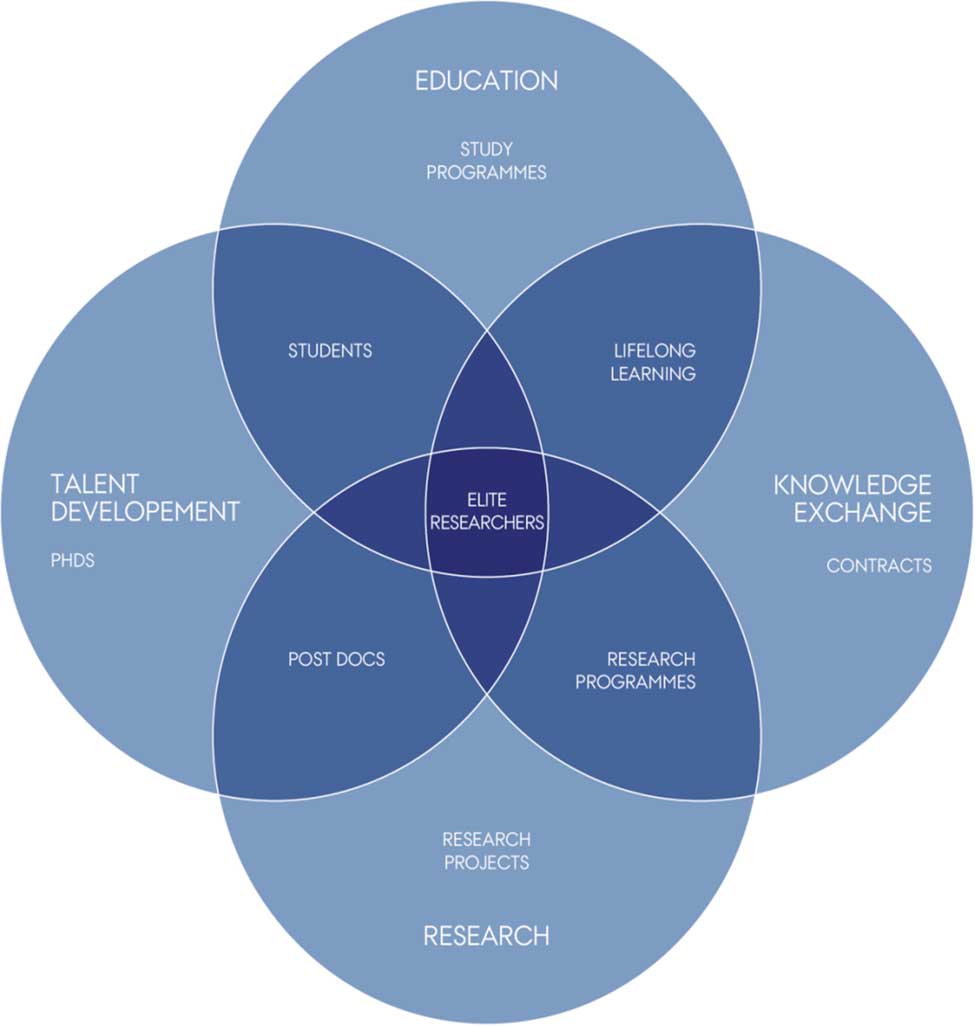
The ability of a higher education system to enrol qualified students is a key determinant of the quality of future graduates. Many researchers have identified students’ prior academic performance to be the best predictor of academic success.Reference McKensie and Schweitzer 25 , Reference Zeegers 26 Appropriate selection processes and criteria to identify promising young scholars are particularly critical at the graduate level, not only for the preparation of competent professionals with appropriate values, but also for the formation of the new generation of researchers. Building a critical mass of scholars cannot happen without increasing and improving the supply of doctoral students in the pipeline of future faculty.Reference Olsson, Meek and Cooke 27 Aarhus University has, in practice, introduced a model, the quadruple helix, which recognises talent development as an equally important element along with education, research and knowledge exchange in the university’s strategy.Reference Holm-Nielsen 28
Universities will pay increasing attention to selection of incoming students. A familiar challenge to most universities is the changing composition of the student body. A formal period of university studies of 4–7 years will probably not be the norm in the future. Many will seek a second academic degree or right-on-time courses and training programmes to improve their job opportunities, or engage in academic education just because they follow their curiosity. The age of an average student will increase as universities start to offer advanced courses to working people seeking a specialization to their first degree.
Additionally, students will be looking for an international element in their education, be it a summer school, a semester or a full degree at an institution abroad. Foreign students already form an increasingly important addition to the student body at any given university and this trend will continue. These challenges require universities to adjust their ability to handle a highly diversified student body in terms of age and cultural background. Increasing demand has forced universities to invest in infrastructure to improve services for international students, and to develop courses taught in English. Universities may, when designing courses and new curricula, have to scale back traditional curricula in exchange for elements of fundamental language skills and of an interdisciplinary nature, and employ massive ICT-based learning systems in order to meet diversifying student demand. This is not least required at masters-level, in order for students to test their acumen in a practical and/or entrepreneurial setting.
Funding Structures
Institutional autonomy is regarded as a prerequisite to good performance. However, one could argue that formal autonomy is not enough because the funding systems and general financial conditions (in all situations) limit institutional freedom. Government core funding systems are challenged by the tension between equal distribution of funds among universities and the demands for focusing on (research) excellence. Funders require accountability systems and most of these systems are measuring second-order indicators.Reference Boulton and Lucas 4 Such indicators dominate the thinking within New Public Management. Real outcomes are often long term and influenced by many factors beyond the control of the institution or the individual grant holder.
Financial resources affect higher education institutions in two related ways, not only through the volume of resources mobilized and available, but also through the allocation modalities and the extent to which they are performance-linked.Reference Salmi and Hauptman 29 Competitive research grants, for instance, are a powerful mechanism to motivate academics and stimulate research. Needs-based scholarships and student loans can increase opportunities for students from low-income and other minority groups.
Funding for universities in Europe follows highly diverse routes. First and foremost ‘a university is not a university’. In some countries (for example the Netherlands and Denmark) universities are the cornerstones of the knowledge society, they educate students to the highest levels and they house most of the autonomous research. In other countries, higher education is conducted in a binary system of research intensive universities, and colleges or schools for (professional) tertiary education. In addition, in some countries (such as Germany, France and Spain) a substantial volume of fundamental research is undertaken outside of the universities (in organizations such as the Max Planck Gesellschaft, CNRS and CSIC). It is therefore complicated to compare university systems. Indeed, there is not one right way to organize this, but some ways seems to be more efficient than others. If measured by the impact of scientific publications relative to population size or EUR invested funding, countries such as Switzerland, the Netherlands and Denmark often show high performance, and are probably comparable to innovation regions in other continents.
When analysing systems it is recommended to look for bottlenecks and for obstacles to networking, cooperation and stimulating synergies. This article argues that larger (mass) universities that balance education, research, knowledge exchange, and talent development, because of their scope, variety of academic fields and massive human capital accumulation, are better suited to this. Therefore, their strategic horizon reaches beyond current conjunctures and short-term political agendas, which corresponds to the long-term nature of academic development processes. Such universities in general do better in global competitions (and university rankings). Institutions with a wider scope and larger autonomous budgets can respond more rapidly to new challenges and opportunities, provided that their internal organization and management structures are efficient and accountable. Considering this, it is important that an analysis of funding systems follow the money from input to output, and to the impact of the investment, whether it is private, individual or societal. For example, study programme finance could be based on tuition fees, public grants per enrolled student, taximeter systems (payment per exam or per study credit point, in the European Credit Transfer System, completed), etc. In any case it is a prerequisite for effective study programme funding that the institution is held accountable for the outcome of the programmes. This could be measured against labour market or societal impact.
Research activities can be funded in a variety of ways: through core funding of institutions based on historical numbers and political adjustments, output-based formula funding, competitive institutional grants (centres of excellence, etc.), and individual competitive project grants, amongst others. Funding of hard research infrastructure and buildings very often follow distinct routes outside of, or within the control of, individual institutions. Many research systems are underperforming because funding systems do not provide the necessary coherence in funding structures, predictability is limited, and one or more critical inputs (well-trained people, equipment, ICT infrastructure, square metres, etc.) are in limited supply. On the other hand, competitive individual project grants are often the foundation for a dynamic development of research centres and, in the longer term, potential new study programmes and departments. History shows how such a development has occurred in, for example, political science, public health, tourism, molecular biology, biomedicine, computer science, and nanoscience.
An example of recent developments in a comprehensive research intensive university is Aarhus University (see below), which receives a performance-based core grant, study taximeter grants, and engages in multiple contract and individual research grants. The university manages a budget of €850 million comprised of more than 6000 individual grants. Naturally, this is a complicated system; still, such a university does not depend entirely on one or a few income streams, and the annual total budgets are therefore relatively stable and predictable, although individual grants depend on competitive forces. The bottom line is that such a university has the luxury of being able to lift the view to the longer term, and the freedom to set its own strategy is greater.
Governance Framework
The classical (Humboldtian) university paradigm served elite higher education systems very well. However, it does not suit mass higher education systems equally well, as they have much wider responsibilities in society than the elite universities of the past.Reference Liburd 10 Governance systems in many mature higher education systems are in transition towards more managerial models. This is driven by the fact that institutions often become very large with many thousands of students, staff and faculty, large and expensive facilities, and multi-million euro budgets coming through highly diversified funding systems. Such universities simply need to be run professionally, by highly qualified individuals in an effective organizational setup. Arguably, it is difficult to organize a well-balanced governance structure in which the leadership is conducted with checks and balances externally (society, funders, etc.) as well as internally (faculty, staff and students).
Burton Clark’s triangle describes
that co-ordination of higher education is organised in a triangular space consisting of the three dimensions of government (from highly centralised State authority to less State intervention), market (with different degrees of influence of markets) and academic oligarchy (with varying degrees of influence of the academic profession). (Ref. 5, p. 68)
The trend has been for a reduction of direct state control of tertiary education in most OECD countries, 5 less involvement in the running of tertiary education institutions on a day-to-day basis, and the introduction of new forms of supervision and influence through accountability mechanisms. These trends have three main effects on internal institutional governance: (i) a strengthening of the power of executive authorities within institutions, increasingly being appointed for their leadership and management qualities in addition to the traditional academic leadership skills; (ii) a concomitant loss of power and influence by existing collegial bodies; and (iii) an increase in participation on governing bodies by individuals external to the institution, which has strengthened the leadership of tertiary education institutions.
Some argue that ‘academic freedom of faculty and students is inversely proportional to an institution’s degree of autonomy’, and that in the German (Prussian) case a balance between absolute individual freedom and loyalty to the funder (the state) was secured through providing civil service status for faculty (professors) (Ref. 15, p. 31). Boulton and Lucas (Ref. 4, p. 15) state
although there has been widespread recognition of the value of university autonomy in permitting institutions to act decisively and flexibly in response to need or opportunity, and where state control is recognized as having been a barrier to development, freedom is necessarily accompanied by calls for greater accountability. However, accountability can often be control by another name.
Many European countries have moved towards institutional autonomy to grant higher education institutions, particularly Universities, independent legal status, and have attempted to solve the challenge of the dichotomy of university governance. In a White Paper presented to the Swedish Government, BremerReference Bremer 30 states: ‘Collegiality is a fundamental component of the management of universities’. Bremer thoroughly discusses the principles of collegiality and how it is complementary to line management (Rector, deans, heads of department, etc.). The argument is that the roles of both academic collegial management and line management in the Swedish higher education system should be clarified and strengthened, with one not at the expense of the other.
Institutional Landscape
Higher education institutions are being challenged by a number of global trends and a wide range of demands. Instead of challenges, the latter could also be seen as inviting a strategy for expansion under resource constraints and increased competition. Many institutions consider their internal and external efficiency and look for competitors and partners. This has led to considerations concerning the institutional landscape in many countries. There is not one right way of organizing institutions of higher education; however, diversification in a mass higher education scenario is a prerequisite to efficiency. As mentioned above, students increasingly form a highly diverse population, and the societal demands for education vary very much geographically. Therefore, countries and institutions must consider how they best can organize in order to employ their resources in an optimal manner. Institutions (and academics) would normally have a longer term view on what would be in their best interest compared with ministries and politicians and they often resist change.
Universities are looked upon as defensive institutions hard to tackle from a political perspective and maybe not responsive enough to societal needs. In consequence, under political influence, expanding systems have responded by creating too many small and weak institutions and within institutions too many new units (faculties, departments and centres). This has led to subsequent consolidation, strategic alliances, network institutions and real mergers in a number of countries. In many countries, the institutional landscape is under consideration, and sometimes it undergoes rather fundamental change. HEFCE has drawn lessons learned from collaborations, alliances and mergers, and established a set of guidelines for English universities. 31 The most wide ranging change towards high quality globally competitive institutions has been mergers,Reference Salmi 32 for example in Finland,Reference Aarrevaara, Dobson and Erlander 33 , Reference Tienary, Aula and Aarrevaara 34 and in Denmark, following the recommendations from the Danish Globalization Council in 2006.Reference Danish Government 35 , Reference Aagaard and Mejlgaard 36 The experiences from Swedish and Danish mergers have been summarized by Melin et al.Reference Melin, Fridholm and Ärenman 37
Research Base
At the core of any university or research institute is its advanced human capital. The integration of education and research is the most decisive factor in the development of a strong university.Reference Halliwell 22 In Figure 2 it is shown that at the core of the quadruple helix stand the leading professors and researchers. Whatever activity a higher education institution undertakes, the quality of that activity is determined by the quality of the core faculty. There is probably no better way to stimulate this key resource than to provide opportunities for the best talent to develop by engaging in independent free and fundamental research and academic activities. In the past, this was a rather easy governance task, because the enrolment of students was limited, and full professors were relatively few, traditionally only one per academic field. This has changed dramatically. Today, in many academic fields, the norm has become teams of professors. The leadership in such teams changes over time, and individuals enjoy differentiated degrees of freedom to choose their research objectives, although the freedom to choose research methods in general is high.
The quadruple helix of Aarhus University.Reference Holm-Nielsen 28
What has changed with the rise of the mass university and an increased diversification of funding sources, is that institutions have diversified their staff and faculty. The hierarchy of researchers has increased. The norm now is for institutions to have PhD students and candidates, post docs, temporary lecturers and professors, adjunct professors, assistant professors, associate professors, full professors, and senior researchers doing directed research within the same departments. It could be argued that today only a small group of professors and academic researchers enjoy full academic freedom, maybe only about 10% of all faculty. The percentage depends on the balance between core funding and external funding, and the diversity of external funding sources.
This is a challenge to handle for institutional governance and funding systems. The days in which most of the research was done as core activities, funded through the funding base, have long gone. In fact, they only existed in much narrower higher education and research systems, which were mostly dedicated to educational purposes.
It is a natural consequence of today’s mass systems that funders request specific objectives and outcome targets in relation to their funding. This holds true for fundamental research grants as well as for research contracts with industry and government and public sector entities. Given below is the case of Aarhus University, which shows how this university deals with the challenge of having about 6000 individual research grants and contracts. Such a system is only sustainable when the core research budget is large enough to form a long-term and solid foundation for such a variety of shorter term projects.
In universities, the current reality calls for a combination of solid departmental structures, aligned with the teaching needs, and a much more flexible research organization in which temporary, sometimes interdisciplinary, centres are organized around outstanding individuals and major external funding opportunities, in combination with funding for multiple individual projects. A thriving undergrowth of smaller and individual, sometimes interdisciplinary, projects are a sound base for a dynamic development of research centres and, in the longer term, potential new departments, study programmes, etc. The most recent half-century of university development shows how such a process has occurred in many universities in academic fields such as political science, molecular biology, bio-medicine, computer science and nanoscience, academic areas that have now become mainstream.
The most successful institutions have found ways to differentiate internal academic freedom in order for the most outstanding researchers (brains) to pursue their interests and instincts. In some way, the institutions and the collegial academic governance structures must provide opportunities for individuals to play with their talent. This means that in large institutions the leadership must differentiate the space for freedom granted to particular units, individuals, etc. This could be interpreted as unequal distribution of opportunity but, in fact, when the legitimate academic peer forces are properly brought into play, it is a fair and equitable system. At Aarhus University, the leadership defined and resourced independent space for excellent talent recruited from around the world in its institute for advanced study (AIAS, see Box 5). This was done in order to stimulate excellent talent and create ample room for creativity irrespective of academic field of study and external funding parameters. By doing this, the university wanted to be an active global partner and to stimulate its own academic development.
Aarhus Institute of Advanced Studies
Aarhus Institute of Advanced Studies (AIAS) aims to nurture and advance the highest quality research, by creating the opportunity for researchers to pursue their research interest for 6–36 months, while being completely free from other educational and administrative obligations. AIAS offers an international and interdisciplinary environment, which stimulates collaboration and knowledge exchange across academic disciplines, traditions and cultures.
AIAS was founded in 2013 and is the only institute of its kind in Denmark. AIAS hosts 35 fellows at the moment. Besides office space in the institute itself, AIAS provides access to labs and the necessary equipment for each fellow to conduct his or her research.
There are relatively few similar institutions worldwide, all based on IAS Princeton, which was the first Institute of Advanced Study. AIAS, despite its young age, is already a member of the two most prestigious networks for Institutes of Advanced Studies; NetIAS and UBIAS respectively, along with IAS institutions from Wissenschaftskolleg zu Berlin, Cambridge, Universität Zürich, LMU München, Stanford University, and others.
For an institution’s sum of talent and creativity to flourish it is important not to accept an even distribution of freedom space but to rather carefully direct such freedom to creativity centres in which individual researchers can benefit from this higher level of autonomy. Maybe it could be termed freedom right on time, because not everybody needs the same autonomy at the same time.
Study Programmes
Graduates are increasingly expected to demonstrate their employability when seeking their first job. In addition, individuals in an increasingly global and flexible labour market are likely to engage in further education throughout their lives. Employers will be looking for graduates that have experience from outside of their university. International experience certainly helps, but the real employability comes from concrete labour market experience, from internships, work-study programmes, relevant student jobs or the like. Learning skills and interdisciplinary knowledge are increasingly in demand. Labour markets are becoming more flexible, and employees will change jobs and functions more frequently, while social and professional demands on individuals will also change much more frequently in the future. Therefore, graduates will be expected to become more adaptable. The first degree is relevant for the first job, but for the second job it will become the individual’s capacity to acquire higher level professional and social skills that will be decisive.
Many authors have discussed the importance of building relevant curricula and have provided recommendations on how to achieve this result.Reference Olsson, Meek and Cooke 27 , Reference Van Deuren 38 , Reference Wang 39 Much less research has been published on the impact of new pedagogical approaches. A recent OECD review of the literature offers useful initial findings on the effect of innovative pedagogical practices, concluding that active learning approaches, which offer opportunities for autonomous and group learning, such as problem-based learning (PBL), tend to be more effective in preparing students to work and live in societies driven by innovation, than traditional teaching methods.
At many universities, the key input factors (students, academics, learning and research infrastructure, linkages with industry) are combined into flexible curricula, offering a collaborative and proactive learning process. Postgraduate students are encouraged and facilitated to participate in global research activities, and they contribute their brains to the Cloud. In turn, such university activities translate ultimately into high-quality graduates and high quality research outputs.
Therefore, responsive universities will develop flexible education programmes and make pervasive use of new technologies, active learning and pedagogy. In fact, a massive wave of curricular reform is likely to occur in existing universities, or new providers will seize the opportunity that allows for people with varying backgrounds to enrol in interdisciplinary courses, on-the-job training, or in – for example – flexible masters programmes.
Problem-based Learning
Compared with more conventional higher education teaching, problem-based learning (PBL) can be an effective way to develop different discipline-specific and transferable skills for innovation. Research focusing mainly on medical education suggests that students in PBL programmes outperform students in more traditional programmes in applying their knowledge to unfamiliar real-world situations. PBL appears to be beneficial for developing thinking and creativity skills, such as critical thinking and problem-solving. It seems also to benefit the development of different social and behavioural skills such as motivation, interest, self-confidence, self-directed learning and teamwork.Reference Hoidn and Kärkkäinen 40
How are Countries Responding to Developing Demands?
Europe’s higher education landscape is in many ways unique. It is by far the most diversified higher education ‘system’ in the world and, especially due to the Bologna Process, EU’s Erasmus programmes, and framework programmes such as Horizon 2020, the most integrated system known. This being said, the European Higher Education Area suffers from having to integrate a diversity of over-regulated systems. Some of these systems have been reformed and are among the leading systems of the world, some systems are deeply rooted, conservative and unreformed, and others are younger and at a much less advanced level of maturity.
Therefore, responses to challenges must reflect local circumstances. This means that any analysis of university reforms and adaptation must necessarily address the specificities within each national context. Several reviews have been conducted in Europe and elsewhere – see, for example, reviews of developing and transition economies from the World Bank, Eisemon and Holm-Nielsen,Reference Eisemon and Holm-Nielsen 41 Salmi in World Bank,Reference Salmi 42 Baker and Lenhardt for a discussion of German higher education,Reference Baker and Lenhardt 43 Capano on Italian reforms,Reference Capano 44 Meister-Scheytt and Scheytt for examples from Austria,Reference Meister-Scheytt and Scheytt 45 Aagaard and MejlgaardReference Aagaard and Mejlgaard 36 on Danish reforms, and Tienari et al.Reference Tienary, Aula and Aarrevaara 34 on Finnish reforms.
In Lenzen’s argument, it is ‘obvious that individual freedom for professors and students has been significantly limited by the Bologna Process’ (Ref. 15, p. 31). He describes a process under which study programmes, under the pressure of the massification of higher education, have led from academic orientation of higher education to study programmes oriented towards labour markets and employability. On the other hand, we have seen an increased integration of European higher education, increased student mobility, sharing of resources such as human capital as well as research infrastructure, and in some cases efficient European universities capable of answering to global demands. The Bologna Process does shatter traditional thinking, and it has opened up European universities to much needed change, but it is not to blame for a lack of strategic leadership in European universities.
In the Nordic countries, mass universities are a reality. In Finland, participation in higher education (tertiary) is more than 65%, in Norway, Sweden and Denmark more than 60%. In Denmark, a particularly large subset of students in higher education are enrolled in postgraduate (master) programmes (29%), and graduation at the masters level is approaching 25% of the cohort. Because mass higher education and research systems in the Nordic countries are highly integrated, the efficiency gains from lower per-student costs could easily be shifted towards meeting increased demands for research and innovation activities (EU Barcelona targets). To a large extent, falling per-student income for the universities has been offset by increasing and diverse funding for such activities. On the research side, competitive and performance-based funding systems have been put in place. This development has set the scene for experimentation within the higher education system in order to accommodate elite students within mass institutions.
Nordic countries and the Netherlands have small open economies, dependent on a highly trained workforce, high levels of trust, and tight social safety nets. One of the strategic tools employed by these countries has been to constantly set higher targets for educational achievements: in this context they have expanded access to higher education from already high levels of participation and they have developed a variety of efficiency measures as well as quality assurance systems. An integral component of these processes has been to reform governance and funding systems. From a financial point of view, the overarching purpose was to ensure lower costs per students without loss of quality.
Conclusion: Addressing Contemporary Challenges with a View towards the Future
A few key questions need to be kept in mind: will cultural (human) aspects of higher education be lost in transition? Will campus programmes become fully integrated with virtual (global) programmes? Is higher education becoming universal? Will national institutions become global systems? And can brain power be recruited from the Cloud?
-
∙ Who owns the universities? Is there a National (and European) vision for education and research?
-
∙ What would be the average age of a 2050 student?
-
∙ What does a balanced academic staff profile look like?
-
∙ Who will be the citizens of the learned republic anno 2100?
-
∙ How to balance line management and academic leadership?
-
∙ Will new university governance models enable and stimulate academic creativity?
Developing strong higher education systems takes time, decades rather than years. Consolidating mass higher education systems is a generational process; successful examples indicate that institutions diversify and universities re-invent themselves in order to adjust to contemporary societies. Reforms have many facets, and must be introduced over time and with persistent support from many sides, and they are most likely controversial because they do alter existing balances. In the case of Denmark, post-1968 democratization of university governance, massification of higher education and expansion of the research system were later followed by five waves of reforms.Reference Holm-Nielsen 7 These fundamental changes were initiated in the mid-1980s by a reform of doctoral programmes. This was a timely choice, because subsequent reform waves could make use of a strong base of advanced human capital.
Complexity in institutional funding envelopes will grow along several dimensions: time, size, purpose, academic spectrum, and more. External funders are increasingly becoming partners and will influence internal governance, which will increasingly limit real autonomy. New demands will likely continue to challenge the institutional landscape, and transnational structures may develop.
Post-secondary education for all and rapid changing opportunities will challenge existing systems. For universities, the reform agenda will continue to focus on: human capital, funding structures, governance framework, institutional landscape, the research base and study programmes. However, is to be expected that higher education will become much more integrated with work life. It is likely that disciplinary and collaborative universities will develop into Universities 4.0 and further integrate with Industry 4.0.Reference Liburd 10 .
The scale of dynamics in the student population is hardly possible to imagine. However, higher education systems must become much more flexible and responsive to demands both in terms of study programme structure and curriculum. Disciplines and interdisciplinary education programmes are not conflicting.
It is obvious that specific challenges and framework conditions differ around the world. Yet it is clear that higher education institutions will be at the forefront of developing knowledge societies alongside industry and governments. The quadruple helix model permits a new focus on, and integration of, four key missions of the tertiary education sector. By highlighting talent development as a strategic priority, it responds to a number of challenges posed by national and international trends. Through its quadruple helix and institute of advanced study, Aarhus University has implemented new structures that are expected to help the university and society to meet the challenges of the future.
There is not a single best way of organizing university governance. Universities are institutions where ideas and values are deeply integrated with structures, functions, roles and cultures. Their governance reflects the history and the context of the institution itself and of the country. Change processes must, therefore, address the socio-emotional and symbolic aspects of institutional life, as well as the instrumental aspects of the business. This represents an important agenda for those who have the task of leading change in universities.Reference Middlehurst 46
While Danish university policy has long emphasized the need for links with other sectors, the new trends have nonetheless required substantial reorganization of Danish universities, in particular with regard to global competition. As the scope of partners has broadened, expectations have grown. In addition to fulfilling their traditional mandates of educating citizens for a productive work life, Danish universities find themselves to be central players on the national stage because economic strategies focus on innovation for job creation and global competition.
Can the citizens of the learned republic absorb such fundamental changes? In the best of cases it could be argued that the success of the learned republic was to integrate (take over) the society. This is to a large extent what has happened in mature knowledge economies in which everybody participates, most receive higher education, and life-long learning is a rule and not an exception. Would universities then be submerged in their own success? Maybe yes – and an answer to this could be Universities 4.0, a model very different from most existing universities.
Responsive Universities 4.0 will integrate new technologies, social communication networks, and the capability to mine mega data and deep data systems. People will move in and out of formal education, and they may complement their knowledge and skills through informal life-long learning systems. Diversification in recruitment and flexible engagement of all staff and students, as well as social and academic mobility will determine success. Much like, and integrated with, Industry 4.0, strategic development of universities will involve similar principles: Virtualization, Decentralization, Real-Time Capability, Service Orientation, and Modularity. The ‘winner’ does not take all, because the global leaders will be those that integrate Universities 4.0 with society and industry. Such institutions will increasingly become pro-active in complex global networks and thus transcend national borders, and they will take advantage of brains on the move and brains in the Cloud.
Would such a University 4.0 encourage academic creativity? The answer to that question, though it goes back to Wilhelm von Humboldt’s universe, will only come in the universe of Alexander von Humboldt.
Lauritz B. Holm-Nielsen is the Executive Director of the Sino-Danish Center. He was the Rector of Aarhus University (AU) from 2005–2013. He is President of Euroscience, and was Vice President of the European University Association (EUA), and member of the Gothenburg University Board. In addition, Lauritz B. Holm-Nielsen was a member of the Danish Prime Minister’s Growth Forum, Vice-Chairman of Universities Denmark, member of the Africa Commission, Vice-Chairman of the Danish Research Commission, member of several OECD expert review teams on higher education, Chairman of the Nordic University Association, Board Member of the Danish National Research Foundation, Rector of the Danish Research Academy, Chairman of the Danish Natural Science Research Council and the Danish Council for Development Research. Lauritz B. Holm-Nielsen has a degree in botany from AU (1971) and was Dean of the Faculty of Science at AU (1976–79) before he became professor at P. Universidad Católica, Quito, Ecuador (1979–1981). He has spent 18 years working abroad, 12 of these at the World Bank in Washington, DC (1993–2005). He is Commander of the Order of Dannebrog & Gran Oficial del Orden Gabriela Mistral (Grand Officer), Chile. For further information please see: http://pure.au.dk/portal/en/persons/lauritz-b-holmnielsen(e59c05f8-fc79-4657-8ad4-2ac1d6f5f814).ht


 Open access

