





1. Introduction
The main development path for fusion energy is based on the deuterium–tritium (D-T) reaction. This may seem as an obvious choice, since this process provides the highest cross section at the lowest ignition temperature for all known fusion reactions. Recent progress in inertial fusion and magnetic confinement experiments underpin this trend (Refs Reference Ning, Liang, Wu, Liu, Liu, Hu, Sheng, Ren, Jiang, Zhao, Hoffmann and He1–Reference Collaboration, Abu-Shawareb, Acree, Adams, Adams, Addis, Aden, Adrian, Afeyan, Aggleton, Aghaian, Aguirre, Aikens, Akre, Albert, Albrecht, Albright, Albritton, Alcala, Alday, Alessi, Alexander, Alfonso, Alfonso, Alger, Ali, Ali, Alley, Amala, Amendt, Amick, Ammula, Amorin, Ampleford, Anderson, Anklam, Antipa, Appelbe, Aracne-Ruddle, Araya, Arend, Arnold, Arnold, Asay, Atherton, Atkinson, Atkinson, Auerbach, Austin, Auyang, Awwal, Ayers, Ayers, Ayers, Azevedo, Bachmann, Back, Bae, Bailey, Bailey, Baisden, Baker, Baldis, Barber, Barberis, Barker, Barnes, Barnes, Barrios, Barty, Bass, Batha, Baxamusa, Bazan, Beagle, Beale, Beck, Beck, Bedzyk, Beeler, Behrendt, Belk, Bell, Belyaev, Benage, Bennett, Benedetti, Benedict, Berger, Bernat, Bernstein L, Berry, Bertolini, Besenbruch, Betcher, Bettenhausen and Betti5). However, the feasibility within the present technical level should not be taken as granted but should be taken with a grain of salt. The start-up process for the ITER reactor will consume the available world amount of tritium and the resupply of tritium by lithium-n reactions on a scale that is necessary for a power reactor is a yet unsolved technological problem. Moreover, the D-T reaction provides most of the energy release in the form of high energy neutrons, which may pose an acceptance problem for the general public at least in some countries. Even though that all these problems will eventually find an acceptable solution, the fusion community has to keep an open mind for alternative fusion reactions (Refs Reference Hoffmann, Richter, Schrieder and Seegebarth6–Reference Cai, Xie, Li, Tuszewski, Zhou and Chen8). Currently, the p-11B reaction with the generation of short-range high-linear energy transfer α particles is recently regarded as a novel promising approach for cancer treatment, i.e., proton–boron fusion therapy (Refs Reference Yoon, Jung and Suh9–Reference Giuffrida, Margarone, Cirrone, Picciotto, Cuttone and Korn11).
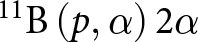
Early in the 20th century (1933), Oliphant and Rutherford (Ref. Reference Oliphant and Rutherford12) pointed out the p-11B fusion reaction channel, with an energy release of 8.7 MeV per reaction (Eq. 1). The prevailing belief is that the main reaction path is sequential. As shown in Fig. 1, the process involves the fusion of a proton and a boron nucleus to form an excited state of 12C*, which then decays into an α particle (α 1) and an excited state of 8Be*. Ultimately, three  $\alpha $ particles can be obtained. The intermediate state could be a ground state 8Be, alternatively, and the associated α (α 0) would have maximum energy. Additionally, there is a small fraction of 12C* that directly decays into three α particles with equal energy, known as the direct channel:
 \begin{equation} \hspace{12pc}{p + {}^{11}{\text{B}} \to 3\alpha + 8.7{\text{ MeV}}.} \end{equation}
The schematic diagram of p-11B sequential processes. A proton and a 11B nuclei fuses into a 12C* in excited state, then the 12C* becomes (a) 8Be in ground state by releasing  ${\alpha _0}$ or (b) 8Be* in excited state by releasing ${\text{P}}{{\text{u}}^{239}} + {\text{A}}{{\text{m}}^{241}} + {\text{C}}{{\text{m}}^{244}}$. Finally, the 8Be breaks up into two $\alpha $ particles.

Becker et al. re-studied the p-11B reaction cross section (Ref. Reference Becker, Rolfs and Trautvetter13) and analysed the reaction process in 1987, to be a sequential decay starting with an  $\alpha $ emission from excited 12C to 8Be, and from there decaying into a pair of two $\alpha $ particles. More recently, Nevins and Swain (Ref. Reference Nevins and Swain14) developed the theoretical model in the energy range from ${{\text{E}}_{{\text{c}}.{\text{ m}}.}} = 22\,{\text{keV}}$ to $3.5{\text{ MeV}}$. Munch et al. (Ref. Reference Munch, Kirsebom, Swartz and Fynbo15) summarized the tabulated data available via EXFOR (Ref. Reference Otuka, Dupont, Semkova, Pritychenko, Blokhin, Aikawa, Babykina, Bossant, Chen and Dunaeva16) for ${\alpha _0}$ channel and compared them to their measurement. While most of the studies focus on the MeV energy range, there is a lack of data in the energy regime close to the first resonance (at around 160 keV). However, the p-11B cross section in this energy region is critical for the ignition of a magnetic confinement thermonuclear fusion, as Putvinski et al. (Ref. Reference Putvinski, Ryutov and Yushmanov17) presented. Recently, an experiment on the large helical device has firstly measured p-11B reactions in a magneticconfinement device, by injecting a neutral beam of protons at 160 keV (Ref. Reference Magee, Ogawa, Tajima, Allfrey, Gota, McCarroll, Ohdachi, Isobe, Kamio, Klumper, Nuga, Shoji, Ziaei, Binderbauer and Osakabe18), which rises an interest of p-11B studies in low energy. Thus, we decided to address this energy regime.
With the widespread emerging of high-power lasers in many laboratories worldwide stimulated by the chirped-pulse amplification technique, a series of laser-triggered p-11B fusion experiments were performed and reported orders of magnitude higher reaction rates (Refs Reference Belyaev, Matafonov, Vinogradov, Krainov, Lisitsa, Roussetski, Ignatyev and Andrianov19–Reference Istokskaia, Tosca, Giuffrida, Psikal, Grepl, Kantarelou, Stancek, Di Siena, Hadjikyriacou, McIlvenny, Levy, Huynh, Cimrman, Pleskunov, Nikitin, Choukourov, Belloni, Picciotto, Kar, Borghesi, Lucianetti, Mocek and Margarone25). In 2020, the experiment carried out by Giuffrida et al. (Ref. Reference Giuffrida, Belloni, Margarone, Petringa, Milluzzo, Scuderi, Velyhan, Rosinski, Picciotto, Kucharik, Dostal, Dudzak, Krasa, Istokskaia, Catalano, Tudisco, Verona, Jungwirth, Bellutti, Korn and Cirrone23) measured as much as  ${10^{11}}\,\alpha $ particles emitted during a single laser pulse at ${10^{16}}{\text{ W}}/{\text{c}}{{\text{m}}^2}$. Composite targets were used in some of these experiments, forming a proton-enriched plasma, in which protons and boron ions could react directly. However, so far, there is no report that a solid hydrogen-enriched boron target can also increase the fusion reaction yield.
Given the lack of further investigations in the low energy regime and the promising results obtained from laser-driven hydrogen-enriched plasma, we conducted an experiment on p-11B fusion using a proton beam in the energy range of 120–260 keV from the accelerator at the Institute of Modern Physics (IMP, Lanzhou). Solid state targets of boron with natural isotope composition and hydrogen–boron (HB)-mixed were used. Notably, we observed the first experimental evidence of an apparent increase in p-11B reactions at the HB target.
2. Experiment set-up
The experiment was carried out at the 320 kV high-voltage platform at IMP, Chinese Academy of Sciences. The proton beam, produced by an electron cyclotron resonanceion source and accelerated to 120–260 keV, was transported to the target chamber after a series of beam optical components. At the target, the beam current was around 1 μA and the beam diameter was about 5 mm. A transmitting Faraday cup (tFC) equipped with a 3 mm diaphragm in front of the target was monitoring the beam current in-situ, while a regular Faraday cup (FC) was applied after the target to calibrate the real beam current. The schematic diagram of the experiment set-up is shown in Fig. 2.
Schematically shows the experimental set-up at IMP. From left to right are: tFC, pre-amplifiers and detectors (parallelly placed), targets and the FC, respectively.

The detectors and the preamplifiers used to measure the  $\alpha $ particles produced from the p-11B reaction were developed in-house. The ion detector consists of 2 sets of 15-strips ( $10{\text{ mm}} \times 2{\text{mm}} \times 150{\mu \text{m}}$ for each) of positive-intrinsic-negative (PIN) diodes (Ref. Reference Chen, Z-k, Wang, R-h, Fang, Wang and Li26). To protect the PIN from scattered protons, they were covered by a Mylar film of 2 micron thickness and an additional 100 nm Al layer. These strips are arranged symmetrically on both sides of the beam at ${\theta _{{\text{lab}}}} = 100.5^\circ $, with a total coverage area of approximately 0.3 sr. The pre-amplifiers were installed inside the target chamber where the vacuum remained at ${10^{ - 7}}{ }$mbar. The recorded signals from the PIN detectors were transmitted to the main amplifier (MSCF-16 Mesytec) and the data acquisition system through multi-pin coaxial cables and the feedthroughs. A N405 – Triple 4-Fold Logic Unit and a GG8020 Octal Gate and Delay Generator were used as the logic and gate control unit. A fast 32-channel Versa Module Eurocard peak sensing analog-to-digital converter converted the logic signals to the digital ones. Finally, we developed a data acquisition program based on the ROOT framework to record the data and to display the spectrum. All of the detectors and data acquisitionsystem were pre-calibrated with a standard ${\text{P}}{{\text{u}}^{239}} + {\text{A}}{{\text{m}}^{241}} + {\text{C}}{{\text{m}}^{244}}$ α source (Refs Reference Adams and Carboneau27–Reference Hummel29), as shown in Fig. 3. The fit contains three Gaussian signal peaks and one continuum background. The total fitted result agrees with the calibration data quite well. The calibration introduces an uncertainty of approximately ±5%, which varies across different channels.
Energy calibration for source of  ${\text{P}}{{\text{u}}^{239}} + {\text{A}}{{\text{m}}^{241}} + {\text{C}}{{\text{m}}^{244}}$, the three signals are fitted as Gaussians with backgrounds distributed continuously.

Figure 4 displays the targets used in our experiments and the typical characterization results. We used three different targets: a natural boron target and two HB targets, all with a size of  $20 \times 10{\text{ m}}{{\text{m}}^2}$ and provided by the material technology group at ENN Energy Research Institute, China. The natural boron target was a block of 5 mm thickness with a density of 1.4 ${\text{g}}/{\text{c}}{{\text{m}}^3}$. The HB targets were manufactured by the plasma-enhanced chemical vapour deposition which deposited HB films on boron substrates. The HB-mixed layer on the targets is 1.5–2 ${\mu \text{m}}$ thick and has a density of 1.3–1.5 ${\text{g}}/{\text{c}}{{\text{m}}^3}$, with a hydrogen atom concentration of about 25%. We determined the target characteristics using the weighing method, scanning electron microscope, elastic recoil and Rutherford backscattering diagnostics. The two HB targets yielded consistent experimental results in our study. To clarify our experimental conclusions and avoid redundancy, we only present the results from one of the HB targets in the following analysis, which we compare with the boron target.
Targets before (a) and after (b) the experiment, boron, two HB targets are listed from top to the bottom. The characteristics for HB target by scanning electron microscope (SEM) and elastic recoil detection (ERD) are shown in (c) and (d).

3. Results
From  ${E_{{\text{lab}}}} = 120$ to $260{\text{ keV}}$, we performed measurements at 21 different proton beam energies with increments of 2 keV near the resonance energy of ${{\text{E}}_{{\text{lab}}}} = 162\,{\text{keV}}$ and big steps of 20 keV around 120 keV and 260 keV respectively. Figure 5 shows a comparison of the α particle energy spectra produced by the p-11B nuclear reaction when 164 keV protons impinge the boron target and HB target. In both the boron target and the HB target, the spectrum clearly shows the α 0 and the α 1 emission, corresponding to the two different reaction pathways depicted in Fig. 1. The spectrum has been cut off at about 1.4 MeV. Considering the fact that the irradiation time per spectrum, and target densities are almost the same. It is obvious that for the HB target the p-11B reaction yield is higher than in pure boron case. The curves also show that the factor of yield increase does not dependent on α energy (see lower part of Fig. 5), which indicates that all 12C* decay channels are enhanced.
A typical α spectrum at  ${{\text{E}}_{{\text{lab}}}} = 164\,{\text{keV}}$, comparing the boron (black) and HB (red) targets.

An appropriate comparison of the reaction rates from different targets requires normalization to the incident proton numbers ( ${N_{\text{p}}}$) and the number density of boron atoms ( ${N_{\text{b}}}$). When counting the yield of α particles ( ${N_\alpha }$), a correction based on the SRIM database (Ref. Reference Ziegler, Ziegler and Biersack30) has been taken into account. This correction accounts for the significant energy loss experienced by α particles as they penetrate through the targets. Spraker et al. (Ref. Reference Spraker, Ahmed, Blackston, Brown, France, Henshaw, Perdue, Prior, Seo, Stave and Weller31) derived the results in terms of counts/luminosity ( $X$), in order to avoid figuring out all three emitted α particles from the spectrum. In thick targets, the proton incident depth is regarded as the target thickness, thus $X$ is referred to as $\bar X$, the average differential cross section in intensity of α productions. It is calculated as:
 \begin{equation} {\bar X} = \frac{{{N_\alpha }}}{{{N_{\text{b}}}{N_{\text{p}}}d\Omega }}\;\left( {{\text{c}}{{\text{m}}^2}/{\text{sr}}} \right), \end{equation}
 in which  $d{{\Omega }}$ is the solid angle of each strip. Systematic uncertainties are dominating the experimental uncertainty. They are mainly due to beam fluctuations (less than $ \pm 14{\text{\% }}$, varying in different shots) and the energy calibration (less than $ \pm 10{\text{\% }}$, varying in different shots and detection channels). The statistical errors contribute only little to the total uncertainty, since they are on the order of 0.5%. The comparison between different targets is shown in Fig. 6.
Comparison of  ${\bar X}$ for different targets and the analytic approximation by Nevins et al. (Ref. Reference Nevins and Swain14) among centre-of-mass energy between 110 and 240 keV. The experimental results in HB target are shown as red curves with dots, while the boron target result is displayed as a black solid curve with dots. Error bars on each point represent the sum of experimental and statistical uncertainties. The prediction has been given in magenta curves with a yellow error band, which includes the uncertainties of approximation and detector efficiency variations.

In theory, the prediction of Nevins’ analytic approximation (Ref. Reference Nevins and Swain14) can also be applied to derive to  $\bar X$:
 \begin{equation}
{\bar X} = \frac{{{R_{{\text{eff}}}}}}{{4\pi }}\int\limits_0^{{E_{\text{p}}}} \sigma \left( E \right) \times {{\left( {\frac{{{\text{d}}E}}{{{\text{d}}x}}} \right)}^{ - 1}}{\text{d}}E, \end{equation}
\begin{equation}
{\bar X} = \frac{{{R_{{\text{eff}}}}}}{{4\pi }}\int\limits_0^{{E_{\text{p}}}} \sigma \left( E \right) \times {{\left( {\frac{{{\text{d}}E}}{{{\text{d}}x}}} \right)}^{ - 1}}{\text{d}}E, \end{equation} in which  ${R_{{\text{eff}}}}$ is the rate of detection efficiency estimated by the α source calibration, at $ \pm 34.4{\text{\% }}$. The stopping power ( ${\text{d}}E/{\text{d}}X$) is estimated by SRIM (Ref. Reference Ziegler, Ziegler and Biersack30), whose systematic errors were evaluated by Paul (Ref. Reference Paul and Schinner32), to have an impact of $ \pm 0.5{\text{\% }}$ on the final results, for both proton and α particles. At last, a systematic uncertainty on the detector location and size is evaluated as $ + 24.2{\text{\% }}/ - 21.6{\text{\% }}$, and the theoretical error on the approximation is derived as $ \pm 7.81{\text{\% }}$. All detector and theory uncertainties are considered only when we compare to the analytic approximation, shown as the yellow band in Fig. 6. The experiment and prediction are in good agreement within $1\sigma $ variation.
Figure 7 shows the enhancement factor of production yield in HB target over pure boron target. An average of 30% excess is observed for HB target among the energy points between  ${{\text{E}}_{{\text{c}}.{\text{m}}.}} = 110{ }$ and $240{\text{ keV}}$. The enhancement factor is around 1.3 and exceeds the $1\sigma $ error band at most energy points. No clear trend was found for the enhancement factor as a function of energy, which is against a potential explanation of screening effect (Refs Reference Assenbaum, Langanke and Rolfs33–Reference Bencze35).
The enhancement factor of HB target to pure boron target among centre-of-mass energy between 110 and 240 keV. The red solid line with points represents the enhancements of HB target with error. The line shows a scale of 1.

4. Discussion
To the best of our knowledge, this experiment is the first to demonstrate that HB targets can generate a higher intensity of α particles in the energy range of 120–260 keV for protons. By introducing hydrogen atoms into the solid boron target, we observed a reaction yield excess similar to what has been observed in high-profile laser-driven p-11B reaction experiments (Refs Reference Labaune, Baccou, Depierreux, Goyon, Loisel, Yahia and Rafelski20–Reference Istokskaia, Tosca, Giuffrida, Psikal, Grepl, Kantarelou, Stancek, Di Siena, Hadjikyriacou, McIlvenny, Levy, Huynh, Cimrman, Pleskunov, Nikitin, Choukourov, Belloni, Picciotto, Kar, Borghesi, Lucianetti, Mocek and Margarone25), albeit under very different experimental conditions with respect to proton beam intensity, proton energy and here the target is not in a plasma state. The mechanism behind this observation has yet to be determined.
Hora and Eliezer et al. (Refs Reference Hora, Korn, Giuffrida, Margarone, Picciotto, Krasa, Jungwirth, Ullschmied, Lalousis, Eliezer, Miley, Moustaizis and Mourou36, Reference Eliezer, Hora, Korn, Nissim and Martinez Val37) have put forward a potential avalanche process that suggests α particles in plasma can generate protons with energies around the largest resonance peak (675 keV) via two consecutive collisions with high momentum transfer, leading to an increase in the yield of the p-11B fusion reaction. However, in dense solid targets and in the proton energy range considered here electronic collisions with bound target electrons dominate the energy loss process. The range of α particles is therefore limited to just a few microns, making the likelihood of two consecutive hard collisions extremely low (Refs Reference Wang, Chen and Huang38, Reference Bogdanović Radović and Benka39), and thus we expect this to have a negligible effect on the yield. Another potential explanation of the experimental observation also takes into account the large momentum transfer between  $\alpha $ particles and protons, which suggests that protons gaining energy exceeding 1 MeV may be mistakenly identified as $\alpha $ particles by the detector. However, the lower part of Fig. 5 shows a uniform enhancement with increasing α energy, which is inconsistent with the expectation of alpha–proton (α-p) scattering. Also, our calculation indicates that the contribution is negligible, limited by the elastic scattering cross-section (Refs Reference Wang, Chen and Huang38, Reference Bogdanović Radović and Benka39).
Ren et al. (Ref. Reference Ren, Deng, Qi, Chen, Ma, Wang, Yin, Feng, Liu, Xu, Hoffmann, Wang, Fan, Cui, He, Cao, Zhao, Cao, Gu, Zhu, Cheng, Zhou, Xiao, Zhao, Zhang, Zhang, Li, Wu, Zhou and Zhao40) have recently proposed an alternative theory to explain the gain in laser-driven p-11B reactions, suggesting that the localized electric field induced by an intense beam alters the energy loss of protons in plasma, thereby enhancing the reaction rate. Also, this theory does not apply to the beam intensity or target type used in our experiment and cannot account for the difference in p-11B reaction rates between boron and HB targets. We also do not consider the screening effect (Refs Reference Assenbaum, Langanke and Rolfs33–Reference Bencze35) as the driving mechanism behind the increased yield, which suggests a 10% deviation compared to the bare system at 100 keV (Ref. Reference Assenbaum, Langanke and Rolfs33). This effect cannot explain the differences between solid HB and pure boron targets, and we did not observe any trend in the gain coefficient with respect to changes in energy (see Fig. 7).
The most likely explanation for the increased yield in our experiment is the contribution of protons affected by elastic upscattering of α particles to the secondary reaction, which could be higher than expected. Previous studies have focused on elastic scatterings involving high momentum transfer (Refs Reference Hora, Korn, Giuffrida, Margarone, Picciotto, Krasa, Jungwirth, Ullschmied, Lalousis, Eliezer, Miley, Moustaizis and Mourou36, Reference Eliezer, Hora, Korn, Nissim and Martinez Val37). It is worth noting that the p-11B reaction has a resonance peak at as low as162 keV, and as a result, the secondary reaction caused by α-p small-angle Rutherford scattering cannot be ignored. The differential scattering cross section could be as high as 35.4 b/sr for a 4 MeV α particle producing a 200 keV proton, according to the Rutherford law (Refs Reference Rutherford41, Reference Kamal42), and drives secondary and even multiple reactions. Currently, we are conducting comprehensive theoretical and simulation work to support this explanation. Measuring the Rutherford cross section of α-p at small scattering angles in experiments can be challenging, but the results of this experiment have the potential to provide corrections to improve the theoretical model.
According to calculations by Putvinski et al. (Ref. Reference Putvinski, Ryutov and Yushmanov17), using cross section data by Sikora et al. (Ref. Reference Sikora and Weller43) instead of Nevins et al. (Ref. Reference Nevins and Swain14) (which are approximately 20% larger at E c.m. < 1 MeV) could allow the fusion power to overcome the radiation loss due to Bremsstrahlung at  ${{\text{T}}_{\text{i}}} 300{\text{ keV}}$. An enhancement of 30% in reaction yield, as presented in our work in the low energy region, can also contribute to achieving this breakthrough and further lower the optimum ${T_{\text{i}}}$. A recent study by Xie et al. (Ref. Reference Xie, Tan, Luo, Li and Liu44) shows that an increase of 20% in reactivity could significantly lower the Lawson criteria (Refs Reference Lawson45, Reference Wurzel and Hsu46). Therefore, further exploration of p-11B reactions in low energy regime is crucial for thermonuclear fusion research. With a deeper understanding, the feasibility of p-11B fusion as a future energy source is gradually increasing.
5. Conclusion
In this study, we report on measurements of the α particle yields in p-11B reactions from pure boron and hydrogen-doped (HB) targets for the proton energy range  ${E_{{\text{lab}}}} = 120$ to $260{\text{ keV}}$. We find good agreement with Nevins’ model (Ref. Reference Nevins and Swain14). Notably, we observe a 30% increase in α particle yield for the HB target, which is significant even considering the 1σ error band. This is the first time that experimental evidence has been reported for an increase in reaction yield from a hydrogen-doped-boron target. Based on our observations, we believe the most likely theoretical explanation is that α particles undergo small-angle elastic scattering with hydrogen atoms in the HB target, producing a significant amount of protons above 100 keV that participate in secondary reactions. We are currently conducting comprehensive simulation calculations based on theoretical models and plan to further investigate the influence of different hydrogen atom concentrations in the HB target on the experimental results. We call for more independent experiments and studies on this topic. The low energy regime is not well explored, and further studies may yield more clues about the possibility of p-11B fusion in general and, especially in the keV energy regime, for future fusion energy applications.
Acknowledgements
The authors sincerely acknowledge the technical support from the group of 320 kV HCI platform at IMP. We would like to appreciate Ong Hooi Jin and Jianguo Wang’s guidance in building the data acquisition system and also thanks to Yang Li and Jianhua Feng for the help during the experiment.


 Open access

