

Introduction
The Middle Pleistocene in Africa saw the rise of Homo sapiens, the emergence of cumulative culture, and the appearance and proliferation of a battery of sophisticated new technologies (McBrearty & Brooks 2000; Reference FerraroFerraro 2012). Quite simply, these are the foundation stones upon which modern humanity rests. And yet, as relatively few African localities encompass this important timeframe (i.e. the period from around 781–126 ka), the specific details of the timing, setting and dynamics that underlie the emergence and early evolution of these advances remain poorly understood.
This point is well-illustrated—and often revisited—in current debates and discussions on the Acheulean to Middle Stone Age (MSA) transition (Reference Mcbrearty, Barham and Robson-BrownMcBrearty 2001; Reference HerriesHerries 2011). While still somewhat ill-defined, this transition is perhaps best described as a long-term process of technological experimentation, spanning several hundred thousand years. It witnessed the occasional introduction of novel elements to local and regional toolkits (e.g. blades, points), the not-infrequent loss and subsequent reinvention of technological skillsets, the later proliferation and long-term retention of prepared core reduction techniques and formal tool forms, and the eventual abandonment of Acheulean large cutting tool technologies entirely (Reference Mcbrearty, Barham and Robson-BrownMcBrearty 2001; Tryon et al. 2005). While the latter portion of this transition has received a considerable amount of attention, much less is known about the origins and early evolutionary history of this process (Tryon & McBrearty 2002; McBrearty & Reference TryonTryon 2005). Recent discoveries in the Kapthurin Formation of Kenya (Johnson & McBrearty 2010) and at Kathu Pan, South Africa (Wilkins & Chazan 2012; Wilkins et al. 2012) show that some of the first steps in this transition (e.g. the appearance of blades and points, a diversity of prepared core reduction techniques, and the presumed origins of hafted tools) certainly pre-date c. 500 ka, and may emerge as early as c. 680 ka at Kathu Pan (Porat et al. 2010). Here we present an overview of an active field project in northern Kenya with early Middle Pleistocene archaeological discoveries that pre-date c. 600 ka and provide a rare view on an early stage in this transition.
Chalbi basin
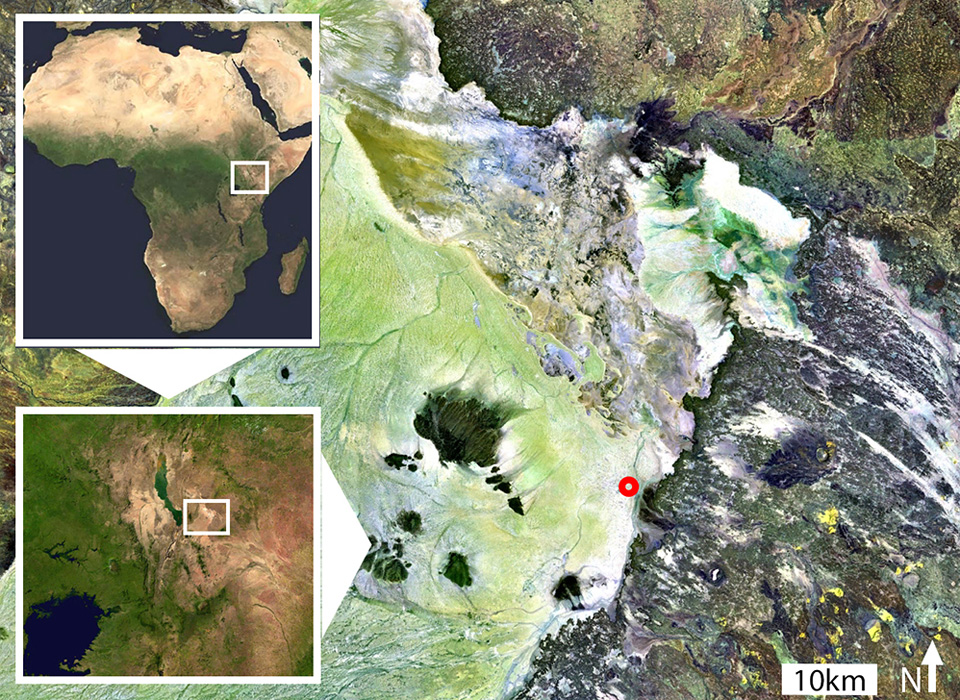
The Chalbi basin, northern Kenya. The locality of Farre is designated by a red circle. (Satellite images courtesy of NASA.)

The Chalbi basin of northern Kenya lies to the immediate south-east of Lake Turkana, a research area well-known for its important Oldowan and early Acheulean archaeological records (Figure 1). Once the primary outlet of the Turkana basin as it drained towards the Indian Ocean, the modern-day Chalbi is a desert setting of xeric shrublands, sand dunes and salt flats, with erosional surfaces often revealing underlying fluvial-lacustrine Quaternary deposits (Reference NyamweruNyamweru 1986). In the summer of 2011, a ground-based survey of the southernmost margin of the basin, under the auspices of the Chalbi Basin Paleoanthropological Project and the National Museums of Kenya, led to the discovery of the rich open-air archaeological site of Farre.
Farre
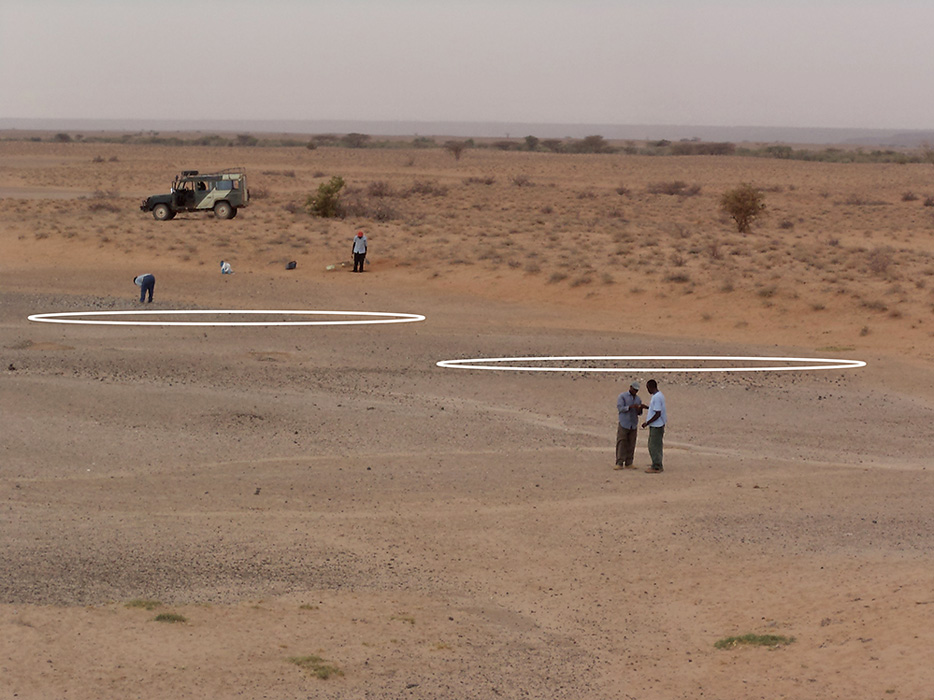
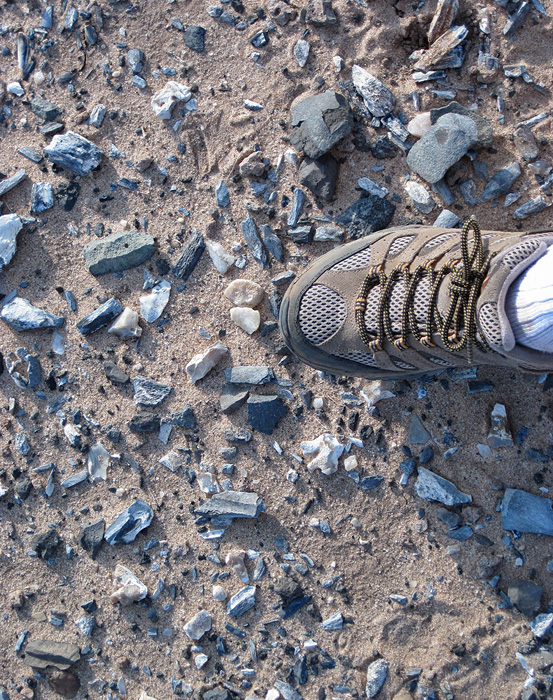
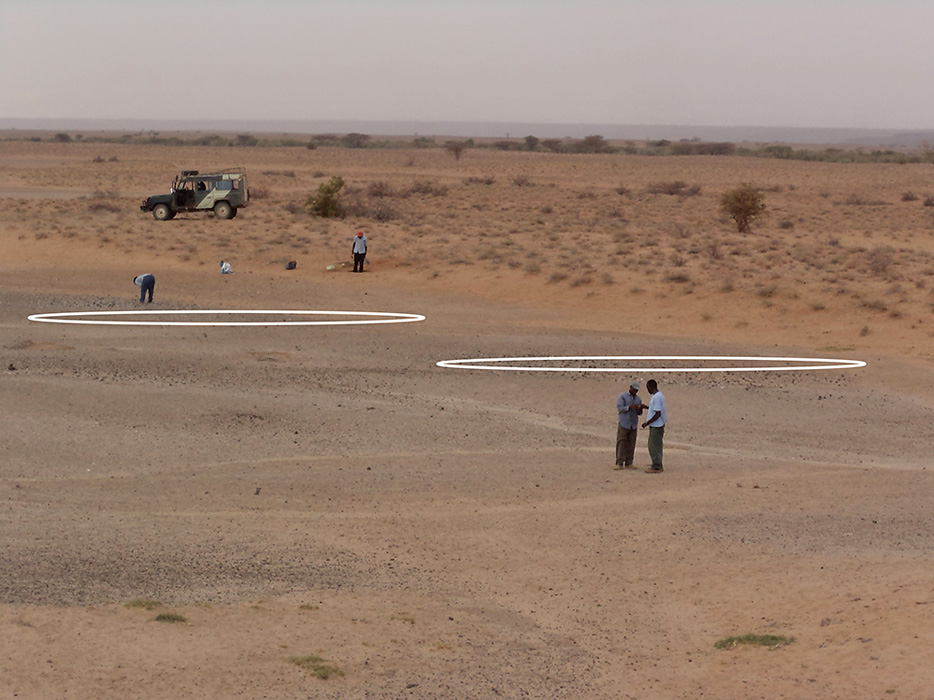
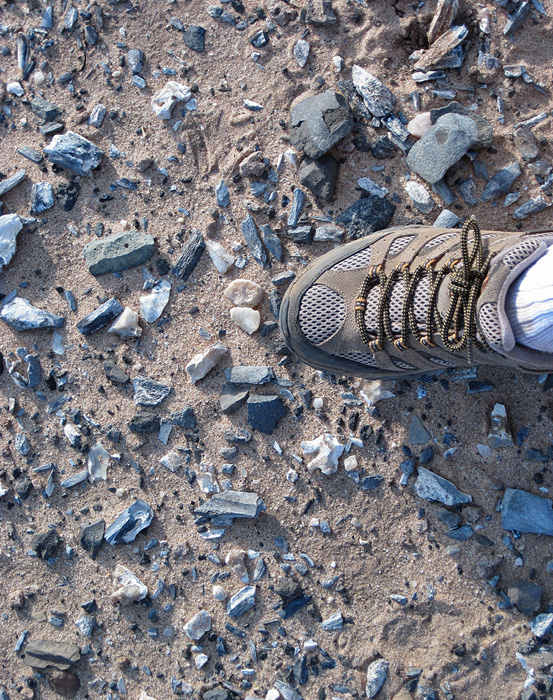
The site of Farre is located on a relatively small hillock (around 200m in diameter) encircled by a vast plain of low-lying dunes and a latticework of seasonally flooded pans (Figure 2). Fossils and artefacts, numbering in the thousands, are found dispersed across two surface scatters, each measuring approximately 20m in diameter (Figure 3). Given the overall proximity and similar elevation(s) of the scatters, the inferred low-energy depositional setting of the site, the absence of an overlying sedimentary unit, and the near-absence of archaeological materials outside of these scatters, all surface finds at Farre are considered to be contemporaneous. Preliminary collections were made at each scatter, and a representative subset of materials was transported to the National Museums of Kenya for analysis and curation.
Farre: an early Middle Pleistocene site. White ovals outline dense concentrations of lithic artefacts and vertebrate fauna.
A close-up view of one of the archaeological concentrations.
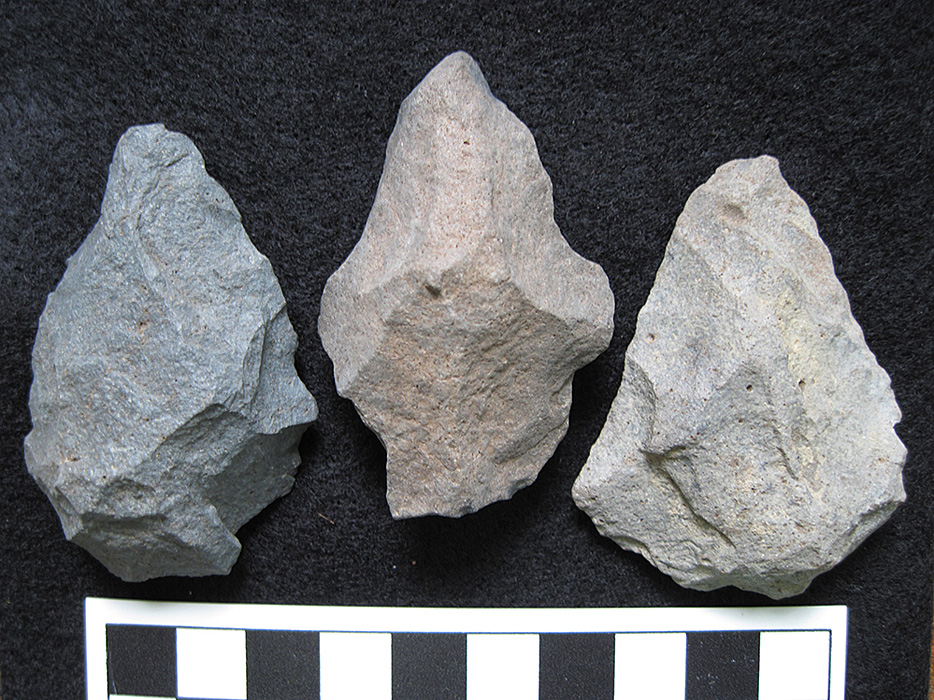
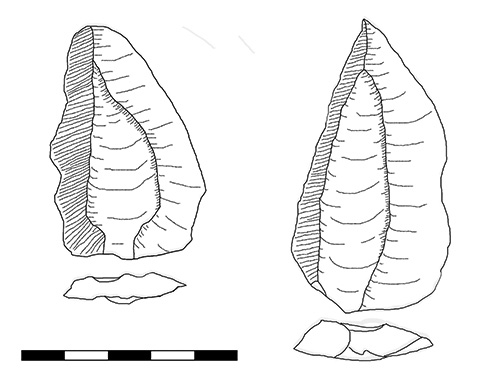
The artefact collection (n=55) reflects a fairly wide range of technologies. Specimens include several large handaxes and a variety of casual cores and flakes—artefact forms consistent with an Acheulean attribution. Other components, though, evince a much greater degree of technological 'sophistication' (sensu Reference FerraroFerraro 2012). These include a number of small bifacially flaked pointed forms—pieces that represent points, miniature handaxes or perhaps an assortment of both (Figure 4); convergent pointed forms (Figure 5); and several blade-like specimens. There are also numerous tools on flakes (scrapers, etc.), some of which reflect prepared core techniques. Collectively, the assemblage is best described as being intermediate in nature between the Acheulean and the MSA. Roughly comparable technological collections are known from the 'Fauresmith' assemblages of South Africa (e.g. Kathu Pan), the Kapthurin Formation (e.g. Rorop Lingop) and elsewhere (McBrearty & Reference TryonTryon 2005; Porat et al. 2010; Reference HerriesHerries 2011).
Three bifacially flaked pointed forms. Scale in cm.

Two convergent pointed forms. Scale in cm.

The recovered fauna indicate that the site formed in an edaphic grassland setting along the shoreline of a large river or lake. Dry secondary grasslands and light bushlands were also present at slightly higher elevations. The faunal list includes alcelaphine and reduncine bovids, carnivores and terrestrial primates, as well as a variety of aquatic animals (e.g. crocodiles, fish and turtles). The collection also includes numerous specimens of Equus sp., the extinct equid Eurygnathohippus sp. (last appearance datum [LAD] c. 600 ka), and the extinct suid Metridiochoerus cf. hopwoodi (LAD c. 800–600 ka). The latter two taxa provide the current minimum age estimate for the site.
A small test excavation (2m x 1m x 0.4m) located immediately upslope from the two surface scatters documents the presence of additional archaeological materials in situ. In each of eight 5cm-deep levels, we recovered some 50–100 flakes, as well as the occasional core, fossil and non-artefactual pebble. Interestingly, artefact raw materials vary considerably by depth; some excavation levels are dominated by flakes of quartz, others solely contain flakes of basalt. This pattern may reflect multiple episodes of past hominin activities on site.
Discussion and future directions
With an estimated minimum age of around 600 ka, recent discoveries at Farre add important new data to the early Middle Pleistocene archaeological record of Africa. Initial interest in the site centres on an intriguing assortment of spatially and temporally-associated lithic technologies: a combination of tool forms and production techniques that transcend simple assemblage-wide classification to either the Acheulean or to the MSA. Instead, the assemblage reflects a relatively high level of technological skill coupled with tool forms characteristic of both traditions (sensu lato). This result is consistent with suggestions that the transition between the Acheulean and the MSA was a 'mosaic process', one characterised by non-synchronised advances and retreats in technological knowledge, with some general tool forms (points, blades, etc.) likely having multiple independent origins (Tryon et al. 2005; Johnson & McBrearty 2010; Porat et al. 2010; Reference HerriesHerries 2011; Wilkins & Chazan 2012). It is also consistent with models in which cumulative culture played an increasingly important role in the retention—and loss—of Palaeolithic technologies through time (Reference FerraroFerraro 2012 and references therein).
Future research at Farre will explore these and related topics in detail. In upcoming field seasons, the Chalbi Basin Paleoanthropological Project will recover additional archaeological materials via expanded surface collections and excavations; refine the age of the site using a combination of U-series, ESR, OSL, magneto-stratigraphic, biostratigraphic, tephrostratigraphic and 40Ar/39Ar analyses; and thoroughly document hominin behaviour and palaeoecology through studies of lithic technology, zooarchaeology, vertebrate palaeontology, geoarchaeology and isotopic geochemistry. Results will elucidate the archaeology and palaeobiology of early Middle Pleistocene archaic Homo sapiens in a sub-Saharan grassland context—a topic of substantial interest and debate.
Acknowledgements
We thank the Office of the President, Republic of Kenya; Dr I.O. Farah, Director General of the National Museums of Kenya; and Dr E. Mbua, Earth Sciences Department, National Museums of Kenya. Funding was provided by the Leakey Foundation and Baylor University.