


The term abreaction has a long history in psychiatry and has its origins in psychoanalysis (Reference Breuer and FreudBreuer & Freud, 1893). In psychoanalysis, abreaction came to represent “the discharge of emotion attaching to a previously repressed experience” (Reference RycroftRycroft, 1972; p. 1). Gradually the term was extended to include the use of drugs to interview patients for a wide range of indications (Reference Perry and JacobsPerry & Jacobs, 1982). The technique of abreaction is still mentioned in many psychiatric textbooks but is not described in any detail.
Patrick and Howells (Reference Patrick and Howells1990), in a review of barbiturate-assisted interviewing, suggested that the technique may be of value as an aid to diagnosis. They highlighted the small number of controlled studies on the use of abreaction and uncertainty about indications for its use. Brandon et al (Reference Brandon, Boakes and Glaser1998), in a review of recovered memories of childhood sexual abuse, cautioned against using drug-mediated abreaction for the recovery of memories and questioned the validity of any information obtained. Abreaction is still used in Asia (Reference Adityanjee, Balaraju and KhandelwalAdityanjee et al, 1991) and the US (Reference Perry, Alexander and LiskowPerry et al, 1997) but little is known about its current use in the UK.
The postal questionnaire was designed to find out how often abreaction is now used and for what indications. In this paper the term abreaction has been used in preference to the more cumbersome terms of drug-assisted or drug-mediated interviewing and narcoanalysis.
The study
A postal questionnaire was developed from an initial semi-structured pilot interview. I surveyed all consultant psychiatrists treating adult patients within the County of Yorkshire, including those working privately. I identified 170 consultants using the membership list of the Royal College of Psychiatrists and by contacting the personnel departments of local trusts and private hospitals. The sample included psychiatrists working in a wide range of settings and across two regions of the NHS.
I sent a questionnaire and covering letter explaining the purpose of the survey to each consultant. Non-responders were sent a reminder 1 month later. Abreaction was defined on the questionnaire as “the use of sedative or stimulant medication for the specific purpose of facilitating a psychiatric interview”.
Findings
Of the 133 consultants (78%) who returned a completed questionnaire, 64 consultants (48%) had used abreaction at some point in their careers; 20 (15%) had done so within the past 5 years. Of these 20 consultants, six considered their use to be decreasing and 14 that their use was unchanged. The median number of times that abreaction was used in the past 5 years was two (range 1-5). As a group, consultants who had used abreaction at some point in their career had worked longer in psychiatry (mean of 21 years) than those who had never used abreaction (mean of 15 years).
The use of abreaction differed between specialties. Of the seven consultants working in liaison psychiatry, six (86%) had used abreaction, compared with 45 (58%) of the 78 consultants working in general adult psychiatry. Only 13 (28%) of the 47 consultants working in remaining specialities had used abreaction at some point in their career.
Drugs used
All consultants used intravenous (IV) drug administration. Drugs used in the past 5 years, with dose ranges, were (number of consultants in parentheses): diazepam 5-20 mg IV (10); sodium amytal 100-500 mg IV (7); midazolam up to 2 mg IV (2); and lorazepam 2-5 mg IV (1).
Most consultants used abreaction on in-patients, with one consultant also treating out-patients. Eleven consultants who had used abreaction said they also used hypnosis. Only one consultant who had never used abreaction used hypnosis. One consultant had used rapid eye movement desensitisation as an alternative to abreaction.
Adverse events and complications
Six consultants (9%) reported adverse events. These included overactivity, disinhibition, confusion, intense emotional abreactions and in one case extreme violence. There were no reports of respiratory depression or laryngospasm with the use of barbiturates.
Training and supervision
Fifteen of the 20 consultants who had used abreaction in the preceding 5 years had been taught the technique by another psychiatrist during their training. The remaining five were self-taught by reference to textbooks. None had attended a course. Seven consultants had taught and supervised a trainee in the use of abreaction within the previous 5 years.
Obtaining consent
Of the 20 consultants who had used abreaction in the previous 5 years, 19 stated how they obtained consent: eight obtained verbal consent; six written consent; and five both written and verbal consent. In addition, three consultants asked relatives.
Indications
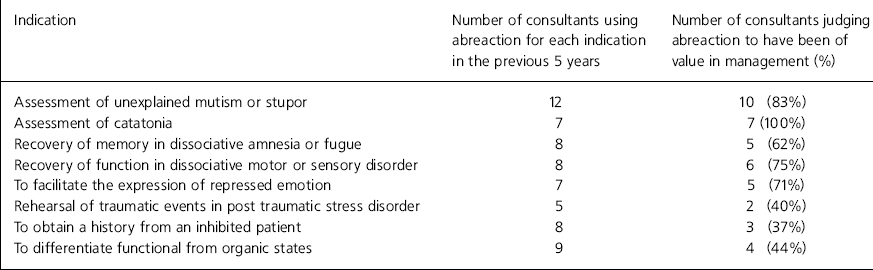
Table 1 lists indications, with the number of consultants who had used abreaction for each indication. Only five consultants considered that they used abreaction for indications not on the list. These indications all involved clarification of the history. The indications listed are not all mutually exclusive and some clinical problems may be covered by more than one indication, e.g. assessment of stupor and assessment of catatonia.
Indications for the use of abreaction
| Indication | Number of consultants using abreaction for each indication in the previous 5 years | Number of consultants judging abreaction to have been of value in management (%) |
|---|---|---|
| Assessment of unexplained mutism or stupor | 12 | 10 (83%) |
| Assessment of catatonia | 7 | 7 (100%) |
| Recovery of memory in dissociative amnesia or fugue | 8 | 5 (62%) |
| Recovery of function in dissociative motor or sensory disorder | 8 | 6 (75%) |
| To facilitate the expression of repressed emotion | 7 | 5 (71%) |
| Rehearsal of traumatic events in post traumatic stress disorder | 5 | 2 (40%) |
| To obtain a history from an inhibited patient | 8 | 3 (37%) |
| To differentiate functional from organic states | 9 | 4 (44%) |
Assessment of outcome
Consultants who had used abreaction in the previous 5 years were asked to judge whether it had been of value in management. The table shows the number of consultants judging abreaction to be of value for each indication.
Reasons for not using abreaction
Sixty-nine consultants (52%) had never used abreaction. Reasons given were (number of consultants in parentheses): do not see suitable patients (20); lack of evidence of efficacy (16); not trained (9); abreaction seen as potentially harmful (8); ethical concerns about obtaining consent (7); and only spurious information obtained (6).
Consultant opinion
Consultants were asked whether they agreed with a number of statements about abreaction. Seventy-seven consultants (64%) felt that abreaction was of value in rare circumstances and 45 (38%) agreed that it should be taught to trainees. However, 53 (44%) were of the opinion that it should no longer be taught and 25 (21%) that the practice should cease. Audit was felt to be necessary by 89 consultants (76%), although some pointed out that the infrequency of its use would limit the value of information obtained.
Comment
If the results of this survey are representative of practice in other areas of the UK, abreaction is now a rarely used intervention and the majority of consultant psychiatrists practise without it. Only seven consultants (5%) had taught or supervised a trainee in the use of abreaction in the previous 5 years. Given this, it is likely that the use of abreaction will become rarer in the future. However, some consultants, and the majority of those working in liaison psychiatry, find that abreaction continues to be of value in rare circumstances.
Questionnaires were returned by consultant psychiatrists from a range of specialities and practice settings within the NHS and private practice. This suggests that there was no systematic bias in the findings. However, it is possible that only those consultants with strong opinions about abreaction returned a questionnaire. Judgements about the value of abreaction were open to bias as judgements were retrospective and numbers small.
Consultant opinion differed widely about the continued use of abreaction, with 21% feeling that its use should cease. There is little high quality evidence on which to base an argument for or against the continued use of abreaction. If abreaction is to continue we need evidence to enable us to distinguish those patients who may benefit, those who don't and those who may possibly be harmed. If it is used as rarely as the findings of this survey suggests, and for as many different indications, a randomised controlled trial of sufficient power to provide this evidence is unlikely. One way forward may be to develop networks of psychiatrists, with an interest in abreaction, to exchange information on indications, techniques and outcomes. Shared protocols and case series' could form a foundation for future audit, training and research without which the use of abreaction may not continue for long into this century.
Acknowledgements
I would like to thank Professor Allan House for his helpful comments on the questionnaire and drafts of this paper. The survey was supported by a grant from the Max Hamilton Memorial Research Fund.


 Open access


eLetters
No eLetters have been published for this article.