Book contents
- Frontmatter
- Contents
- List of figures
- List of tables
- Preface
- Map: administrative units under the 1993 Constitution
- 1 From communist to postcommunist rule
- 2 Voters, parties and parliament
- 3 Presidential government
- 4 From plan to market
- 5 A divided society
- 6 Changing times, changing values
- 7 Russia and the wider world
- 8 What kind of system?
- Notes
- A Note on surveys
- Index
- References
3 - Presidential government
Published online by Cambridge University Press: 05 June 2012

Book contents
- Frontmatter
- Contents
- List of figures
- List of tables
- Preface
- Map: administrative units under the 1993 Constitution
- 1 From communist to postcommunist rule
- 2 Voters, parties and parliament
- 3 Presidential government
- 4 From plan to market
- 5 A divided society
- 6 Changing times, changing values
- 7 Russia and the wider world
- 8 What kind of system?
- Notes
- A Note on surveys
- Index
- References
Summary
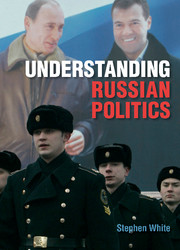
Russia had already established a directly elected presidency during the final year of Soviet rule. But it had also elected a new parliament, and it was not until the adoption of the 1993 Constitution, after parliamentary resistance had been violently suppressed, that it became what some called a ‘superpresidency’, with the government headed by the prime minister as its executive agency. Yeltsin was succeeded in 2000 by Vladimir Putin, and then Putin, after the end of his second four-year term, by Dmitri Medvedev, with Putin remaining as prime minister. Russians themselves called this new arrangement a ‘tandem’. It did not, all the same, appear to represent a real and enduring redistribution of authority, Putin continued to be seen as the dominant figure, and it was widely expected that he would return to the presidency in 2012, when Medvedev's first term expired. Whoever held the leading positions, this was clearly a political system dominated by a powerful executive. It was less clear that there were mechanisms that would help to ensure that this dominant power was not abused by those who exercised it, and perhaps in their own interests.
The end of the Soviet period saw the establishment of an executive presidency in Russia as well as the USSR itself, although the dominance of a single leader was of much older origin.
Information
- Type
- Chapter
- Information
- Understanding Russian Politics , pp. 71 - 114Publisher: Cambridge University PressPrint publication year: 2011
References
, Yeltsin: A Revolutionary Life (New York: St Martin's and London: HarperCollins, 2000).
, and , eds., Constitution of the Russian Federation: With Commentaries and Interpretation (Lawrenceville, VA: Brunswick Publishing Company and Moscow: Novosti, 1994).
, and , ‘Putin, Putiniana and the question of a post-Soviet cult of personality’, Slavonic and East European Review, vol. 88, no. 4 (October 2010), pp. 681–707.Google Scholar
, Yeltsin: A Life (New York: Basic Books, 2008).
, and , ‘The Putin vote: presidential electorates in a hybrid regime’, Slavic Review, vol. 68, no. 3 (Fall 2009), pp. 473–503.Google Scholar
, Boris Yeltsin and Russia's Democratic Transformation (Seattle, WA, and London: University of Washington Press, 2006).
First Person: An Astonishingly Frank Self-Portrait by Russia's President Vladimir Putin, with Nataliya Gevorkyan, Natalya Timakova, and Andrei Kolsenikov, trans. (London: Hutchinson and New York: Random House, 2000).
, Russian Constitutionalism: Historical and Contemporary Development, trans. and (London and New York: Routledge, 2006).
, and , The Tragedy of Russia's Reforms: Market Bolshevism against Democracy (Washington, DC: United States Institute of Peace Press, 2001).
, Putin: Russia's Choice, 2nd edn (Abingdon and New York: Routledge, 2008).
and , ‘The Putin phenomenon’, Journal of Communist Studies and Transition Politics, vol. 24, no. 4 (December 2008), pp. 604–28.Google Scholar
Accessibility standard: Unknown
Why this information is here
This section outlines the accessibility features of this content - including support for screen readers, full keyboard navigation and high-contrast display options. This may not be relevant for you.Accessibility Information
Accessibility compliance for the PDF of this chapter is currently unknown
and may be updated in the future.