



Introduction
The health sector has always relied on technologies. According to World Health Organization (Kirigia et al., Reference Kirigia, Seddoh, Gatwiri, Muthuri and Seddoh2005), technologies form the backbone of the services to prevent, diagnose and treat diseases. Information and communication technologies (ICTs) are only one category of the vast array of technologies that may be of use. Given the right policies, organization, resources and institutions, ICTs can be powerful tools in the hands of those working to improve health and wellbeing (Daly, Reference Daly2003). Health information technology is in general increasingly viewed as the most promising tool for improving the overall quality, safety and efficiency of the health delivery system (Chaudhry et al., Reference Chaudhry, Wang, Wu, Maglione, Mojica, Roth, Morton and Shekelle2006).
ICTs are defined as tools that can facilitate communication and the processing and transmission of information and the sharing of knowledge by electronic means. Health information technologies include the application of health information systems designed primarily to support the management of patient’s records such as Electronic Health Record system and to assist medical and healthcare delivery such as clinical decision support system and computerized provider order entry system (Jamal et al., Reference Jamal, Mckenzie and Clark2009).
The use of ICTs in mining information is expected to improve health issues in developing countries and this hypothesis is based on three resources. The first is their role as a tool for continuing education and lifelong learning. The second is their use as a delivery mechanism to remote areas with a wide variety of services varying from improved public health education to emergency advice. The third source is their potential use as a mechanism to increase the transparency and efficiency of governance which would, in turn, improve the available and delivery of publicly provided health services. Conceptually, this implies that the potential of ICTs in the health area lies in their mediatory role between differentially endowed segments of the health system and between the health system, the health service provider and the beneficiary (Chandrasekhar and Ghosh, Reference Chandrasekhar and Ghosh2001). However, there is a sacristy of studies on ICT in primary healthcare in Egypt.
Objectives
This was to assess the current situation of ICTs in primary healthcare (PHC) in the terms of describing and classifying the existing work, identify gaps and exploring the personal experiences and the challenges of ICTs application in the PHC.
Subjects and methods
A mixed research method in the form of sequential explanatory design was applied. The two-phase, explanatory methods were applied and the obtained statistical, quantitative results from a sample were then followed up with a few individuals to probe or explore those results in more details. In the first phase, quantitative research questions had addressed the ICTs descriptive structure in the primary care settings and the relationship of ICTs practice and utilization, also the general characteristic of the studied group within these places. In the second phase, qualitative focus groups discussions were used to shed the light on the significance of low practice score despite ICTs presence and training among the participants by exploring aspects of the ICTs personal experience with few participants at the study setting (Creswell and Plano Clark, Reference Creswell and Plano Clark2011).
Participants
Quantitative
All family medicine postgraduate students including the first and the second parts in family medicine departments in Menoufia University and Cairo University in addition to demonstrators and assistant lecturers in both departments during the academic year 2013/2014 were invited to participate in the study.
Qualitative
The ICTs users among the participant were invited to take part in the study. The sample was a convenience one and the snowball approach to sampling was adopted. Each respondent was asked to recommend to the researcher another physician who might be able to articulate their views about their experience with ICTs.
Instruments
A semi-structured interviewing questionnaire consisted of two parts. The first part includes the socio-demographic characteristics, for example age, sex, educational level, years of experience, etc. The second part contained information’s about ICTs in primary care services at the workplace, for example: availability of ICTs in the current workplace, it’s type, previous training on ICTs, site of training, the variety of ICTs utilized in the workplace, etc. The third part covers the practice of ICTs in primary care through six questions. It covers the use of ICTs in word processing, medical records handling, Emailing, health education message, research and management plan with a yes or no answer. A score of ⩾4 out of 6 is considered a good practice while a score of <4 is considered a poor practice.
Procedures
Quantitative data
A cross-sectional study among 172 physicians working in primary care settings attending the Family Medicine Departments in Menoufia University and Cairo University for their postgraduate studies during the academic year 2013/2014 were invited to participate in the study.
Qualitative data
Focus groups were chosen due to their ability to elicit unique perspectives on the study subject, originating from interactions between participants within each group. The study included 35 participants. Four focus group discussions were conducted (n 1,2=8, n 3=9, n 4=10). Each session lasted 60 min, facilitated by a moderator and an observer and was recorded. An interview guided questions were used to collect data.
Data analysis
Quantitative data
Statistical program SPSS v. 15.0 (SPSS Inc., Chicago, IL, USA) was used. Continuous data were presented as means±standard deviations and range. Percentages were calculated for dichotomous variables. Group comparisons were performed by Pearson’s χ2 test or the Mann–Whitney U test, as appropriate.
Qualitative data
All of the transcripts were read by the researcher and coded in the style of a grounded theory approach to data analysis. Seven category headings were generated from the data and under these all of the data were accounted for. Two independent researchers were asked to verify the seeming accuracy of the category system and after discussion with them, minor modifications were made to it.
Results
The aim of this study was to gain a better understanding of the current situation of ICTs in PHC for health promotion and highlight the factors affecting such communication in a PHC setting. The study revealed that about half of the 172 physicians working in primary care settings and participated in the study (51.2%) had ICTs available in their workplaces.
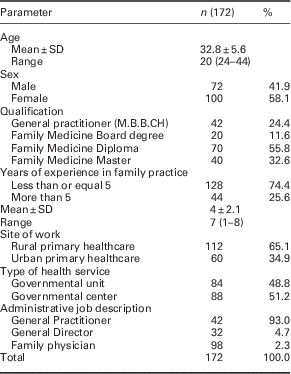
Table 1 showed that the mean age of the participated physicians was 32.8±5.6 SD, with mean years of experience of 4±2.1 SD and around two-third of them (58.1%) were females. The highest percentage of them were GPs (93.0%), working in rural areas (65.1%) that are governmental health center (51.2%), holding family medicine diplomas (55.8%) and had ⩽5 years of experience (74.4%).
General characteristics of studied group
The results in Table 2 that all physicians who had an available ICTs at their workplaces mentioned that they had a training experience on ICTs representing (51.2%) for both of them, and one-fourth of them received their training in the Ministry of Health and Population (25.0%). Also, the table shows that the most available type of ICT was computers (29.2%) and Fax was the least available type present in only 4.0% of studied workplaces. Computers were mostly used for evidence-based treatment (72.7%), followed by research (42.0%), while the least utilization for ICT was for dissemination of information (13.6%).
Current situation of information and communication technologies (ICT)
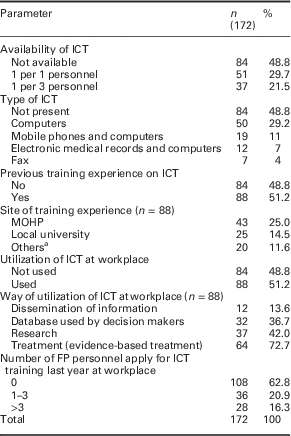
MOHP=Ministry of Health and Population; FP=family physician.
a Private company, international university, etc.
Table 3 shows that there is a highly significant relation (with P-value<0.05) between the practice score of the studied group and their qualifications, years of experience and the availability of electronic connections at their workplaces, P values 0.008, 0.000 and 0.000, respectively.
Relation between practice score and general characteristics of the studied group
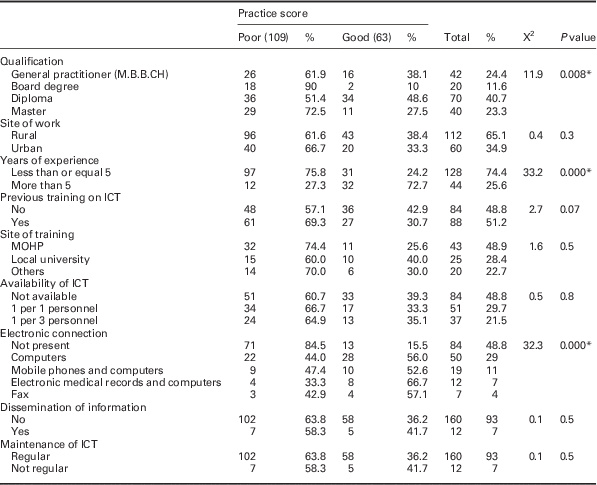
MOHP=Ministry of Health and Population.
* Statistical significant difference.
From Table 4 we noted that the differences between physicians who received training on ICTs and those who did not get trained was significant for the years of experience, availability of ICTs and their electronic connections at P values of 0.007, 0.000 and 0.04, respectively. It also shows that utilization of ICTs by the studied group for producing databases to be used by decision makers, participating in any activities using ICT, medical records handling, health education, research and in management plans were statistically significant for the trained group in comparison with those who were not trained.
Effect of training on utilization of information and communication technologies (ICT)
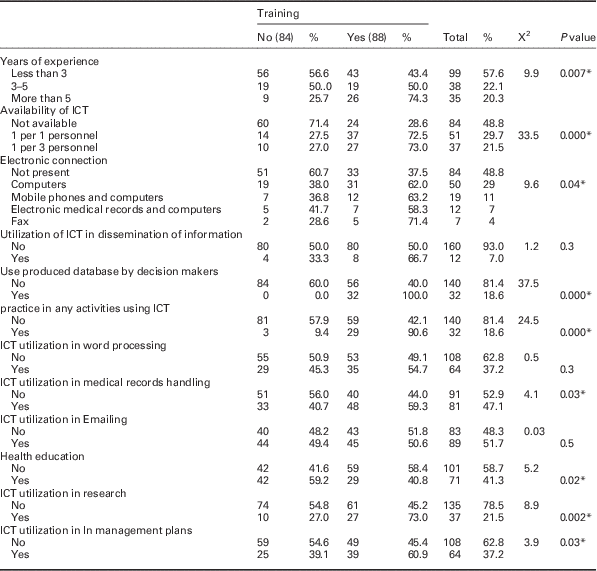
* Statistical significant difference.
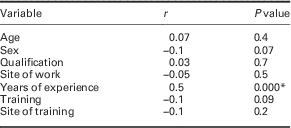
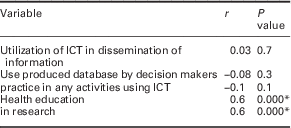
According to Tables 5 and 6, we found that practice scores have positive correlations with years of experience confirming the previous results showed in Table 3, in addition to the utilization of ICTs in health education and research; denoting the importance of using ICTs for these two domains in order to achieve better practice scores in primary care settings.
Correlation between practice score and general criteria of the participants
* Statistical significant difference.
Correlation between practice score and utilization of information and communication technologies (ICT)
* Statistical significant difference.
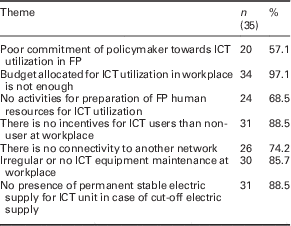
The results of the qualitative data from the focus group discussions done with 35 physicians revealed that that the budget allocated for ICT utilization in workplaces in not enough (97.1%). Also, the majority of them mentioned (88.5%) that stable electronic supply for ICTs units and incentives for ICTs users as well as maintenance for ICTs equipment should be made available.
Around three-quarters of participated physicians (74.2%) quoted that there is no connectivity to a central network was present at their workplaces and 85.7% of them agreed that there was no maintenance for the ICTs equipment at their workplaces.
It is noteworthy that more than half of the physicians who attended the focus group discussions reported that no activities for preparation of family physician (FP) human resources for ICTs utilization were available and further explained that policymakers had a poor commitment towards ICTs utilization in FP (68.5 and 57.1%, respectively) (Table 7).
Barriers and challenges of information and communication technologies (ICT) utilization
FP=family physician.
Discussion
According to Kreps and Neuhauser (Reference Kreps and Neuhauser2010), understanding, the context is central to planning of health communication interventions, especially within the healthcare services, where a myriad of individual, organizational and societal factors influence health-related decisions and practice.
Despite a low level of ICTs availability in workplaces of the studied group, where only half of them (51.2%) mentioned having ICTs and being trained on it, 88.5% of them indicated the importance of the use of ICTs in primary care and stated that incentives should be given to ICTs users. This percentage is higher than what was mentioned in one Poland study done by Pędziński et al. (Reference Pędziński, Sowa, Pędziński, Krzyżak, Maślach and Szpak2013) where 67% of the surveyed GPs believed that the use of software and information technology (IT) systems improves the quality of healthcare services. Those results were also similar to the European survey on Benchmarking ICTs use published in 2008 (EE, Reference EE2008), which showed that, regardless of the degree of implementation of ICTs in the country, most physicians see opportunities to use IT systems to improve the quality of services.
In some studies where the attitudes towards ICTs use were analyzed, the results have shown that physicians who were using the ICTs system were more convinced of the positive effects than those who had never worked with it (Leung et al., Reference Leung, Yu, Wong, Johnston and Tin2003; Morin et al., Reference Morin, Tourigny, Pelletier, Robichaud, Mathieu, V_Zina, Bonin and Buteau2005; Sequist et al., Reference Sequist, Cullen, Hays, Taualii, Simon and Bates2007; EE, Reference EE2008; Jha et al., Reference Jha, Bates, Jenter, Orav, Zheng, Cleary and Simon2009). Findings from the present study go hand in hand with the above mentioned studies; where physicians who received training on ICTs had a significant difference in using it than those who did not receive training before.
This difference was obvious in relation to their practice score, where good scores were achieved with a high statistically significant difference (P=0.000) in primary care facilities with electronic connections. The same pattern was followed when comparing trained studied physician on ICT with non-trained one, where high statistically significant difference was found between the two groups in areas of handling medical records, producing database and practicing activities using ICT.
Our study highlight that physicians trained on ICT are using it in health education, research and in management plans with a high statistically significant difference than those who are not using it. This could partly explain the above mentioned results of good practice scores among ICTs users than non-users in this study.
In the 2008 Benchmarking ICTs study (EE, Reference EE2008; Egea et al., Reference Egea, González and Menéndez2010), the most important facilitating factors in Europe and in Poland were as follows: the need for e-health inclusion in medical education, the need for more IT training and a better networking of all healthcare in order to share clinical information. These recommendations are in line with what was found in the current study where the above finding emphasizes the importance of providing training on ICTs usage, since all trained studied physicians agreed on the importance of using it in their workplaces. Also, among the 35 physicians who attended the focus group discussions, three-quarters of them (74.2%) stated the usefulness of having connectivity to other networks for sharing information.
However, when it comes to the potential barriers, lack of budget allocation for ICTs in primary care setting was the most reported obstacle mentioned by 97.1% of physicians, followed by incentives and maintenance. This is in accordance with Poland in 2008, where cost was a decisive factor concerning ICTs use and was seen as more important than the lack of ICTs maintenance support (EE, Reference EE2008).
The four most common hurdles to ICTs implementation in this study were the lack of fund, the absence of motivations to ICTs users and inadequate stable electric supply and maintenance of equipment. The lack of funds as a major barrier to adoption of ICTs has been shown in several other studies, particularly in the United States (Miller and Sim, Reference Miller and Sim2004; Gans et al., Reference Gans, Kralewski, Hammons and Dowd2005; Jha et al., Reference Jha, Bates, Jenter, Orav, Zheng, Cleary and Simon2009; Kreps and Neuhauser, Reference Kreps and Neuhauser2010; Desroches et al., Reference Desroches, Painter and Jha2013).
Conclusions
ICTs resources are underutilized by health information professionals. Lack of funds, risk of instability of the electric supply and lack of incentives for ICTs users were the most common barriers to ICTs implementation. These three challenges highlight the importance of designing systems from intergovernmental and non-governmental organizations perspective. Statistically significant differences between ICTs trained and non-trained groups concludes that ICTs training is recommended to optimize the use of digital resources. However, ICTs implementation depends not merely on the willingness of health administrators to adopt ICTs as a tool, but on the spread of, and access to, a network of ICTs among different segments of the health system.
Acknowledgments
The authors would like to acknowledge all the participants for their patience and understanding during the data collection.
Authors’ Contributions
Taghreed farahat, Nagwa Nashat and Maha Mowafy: conception and design, analysis of data, interpretation of data, revising the article critically for important intellectual content. N.N.H.: conception and design, contribution to writing and revising the article critically for important intellectual content. All the authors have read and approved the final version of the manuscript.
Financial Support
This research received no specific grant from any funding agency, commercial or not-for-profit sectors.
Conflicts of Interest
None.
Ethical Standards
The authors assert that all procedures contributing to this work comply with the ethical standards of the relevant national and institutional guidelines on human experimentation of the ethical committee of the Menoufia University and with the Helsinki Declaration of 1975, as revised in 2008.



