


Introduction
Cyberbullying, defined as an intentional and repeated aggression, perpetrated through electronic communication, is now consistently associated with depression, anxiety, self-harm, and suicidal ideation among adolescents across multiple regions around the world (Li, Wang, Martin-Moratinos, Bella-Fernández & Blasco-Fontecilla, Reference Li, Wang, Martin-Moratinos, Bella-Fernández and Blasco-Fontecilla2024; Zhu, Huang, Evans & Zhang, Reference Zhu, Huang, Evans and Zhang2021). A recent report by World Health Organisation (WHO) reveals a substantial rise in cyberbullying despite growing awareness (WHO, 2024).
What may be less focused, however, is how the phenomenon should be understood in the light of evolving digital infrastructures. Most contemporary platforms operate under content-ranking and engagement-based recommendation systems, influencing which interactions gain visibility and occur more frequently (Gillespie, Reference Gillespie2018; Koshiyama, Kazim & Treleaven, Reference Koshiyama, Kazim and Treleaven2022). Emotionally charged communications attract comments and reposts; therefore, they are circulated far more than other communications. A harmful message shared within a small peer group can appear on broader feeds within minutes. Therefore, cyberbullying may be shaped not only by adolescent behaviour but also by the systems working behind digital platforms.
In response to this, governments have introduced online safety legislation and regulatory frameworks such as the EU Digital Services Act, expecting increased platform accountability (Tourkochoriti, Reference Tourkochoriti2023). Schools are also required to launch digital literacy programs to foster responsible online engagement (UNESCO, 2023). However, it is not entirely clear whether scholarly research has kept pace with these institutional policies. A substantial proportion of cyberbullying studies (i.e. Li et al., Reference Li, Wang, Martin-Moratinos, Bella-Fernández and Blasco-Fontecilla2024; Zhu et al., Reference Zhu, Huang, Evans and Zhang2021) continue to focus primarily on victim experiences and psychological outcomes, whereas relatively little attention has been given to organisational interventions, algorithmic moderation practices, or coordination across institutional actors.
Over the past two decades, the volume of the cyberbullying research corpus has grown remarkably (Cretu & Morandau, Reference Cretu and Morandau2024). Earlier research has focused on synthesising dominant patterns and behavioural predictors (Kowalski, Morgan, Drake-Lavelle & Allison, Reference Kowalski, Morgan, Drake-Lavelle and Allison2016). More recent research has incorporated longitudinal evidence and cross-cultural comparisons (Stevens, Coleman, Waasdorp & Mehari, Reference Stevens, Coleman, Waasdorp and Mehari2024; Yin, Han & Li, Reference Yin, Han and Li2024); however, comprehensive bibliometric analyses on adolescent cyberbullying remain limited, except for a few studies (Barragan Martin et al., Reference Barragan Martin, Molero Jurado, Pérez-Fuentes, Simon Marquez, Martos Martínez, Sisto and Gazquez Linares2021; Hueso Romero, Quintana & Sánchez Romero, Reference Hueso Romero, Quintana and Sánchez Romero2025; Saif & Purbasha, Reference Saif and Purbasha2023). Without systematic mapping and thematic evaluation, discussions of organisational issues are more likely to rely on general impressions than on structured evidence. It is difficult to determine, for example, whether issues such as minority vulnerability, artificial intelligence (AI)-based detection systems, or regulatory accountability are becoming central or remain peripheral within the research network.
This study addresses this issue by conducting a systematic bibliometric analysis of adolescent cyberbullying research published between 2001 and 2025. By examining publication trajectories, leading contributors, and keyword co-occurrence patterns, it seeks to clarify how the field has developed and where conceptual clustering appears strongest. Instead of focusing on a single disciplinary lens, this approach reflects the interdisciplinary character of the topic, ranging from psychology, education, and public health to governance and organisational perspectives.
The paper addresses the following research questions:
RQ1. What is the historical development and publication trajectory of adolescent cyberbullying research between 2001 and 2025?
RQ2. Which journals, authors, and institutions have most significantly shaped this research domain?
RQ3. What thematic clusters and conceptual structures characterise adolescent cyberbullying research?
RQ4. What research gaps and future directions emerge from the bibliometric mapping of the field?
This paper is structured into the following sections: introduction, theoretical background, methodology, results, discussion, and conclusion. The descriptive analysis reveals historical trends, leading journals, influential authors, and institutions, of the research activities. In addition, the thematic analysis of the field is performed through keyword co-occurrence analysis using VOSviewer. This analysis helps identify dominant research clusters and areas of conceptual concentration. Through visualisation of clusters, this study seeks to clarify how different elements of research connect and where fragmentation may occur. The discussion highlights key structural imbalances within the field and proposes a research agenda of future inquiries. The resulting research agenda is intended to inform scholars seeking greater theoretical coherence, as well as policymakers and organisational actors concerned with digital safety and governance in adolescent online environments.
Theoretical background
Digital platforms have transformed adolescents’ social lives, with interactions that were once confined to school boundaries, are now occurring within highly interconnected online networks (Boyd, Reference Boyd2014). Content on such networks is searchable, and often publicly available beyond private social circles. What may appear to be a private peer conflict can quickly spread across networks in ways that traditional bullying rarely allows. In that sense, cyberbullying may not simply be an extension of offline aggression, but it is shaped by the dynamics of digital infrastructures themselves. The promotion of trending and viral content, owing to the platform architecture and attention economy, also amplifies the heightened online risks faced by adolescents, such as violence, extremism, self-harm, and sexual harassment (Livingstone et al., Reference Livingstone, Jessen, Stoilova, Stänicke, Graham, Staksrud and Jensen2025). Importantly, these early digital interactions may also represent socialisation processes that influence later workplace conduct, leadership behaviour, and organisational norms (Gupta et al., Reference Gupta, Chaudhuri, Apoorva, Chaudhary, Thrassou, Sakka and Grandhi2025; Symons, Di Carlo & Caboral-Stevens, Reference Symons, Di Carlo and Caboral-Stevens2021).
Cyberbullying is commonly known as an intentional and repeated harm inflicted through electronic means (Hinduja & Patchin, 2010; López-Castro, Smith, Robinson & Görzig, Reference López-Castro, Smith, Robinson and Görzig2023). Over the past decade, empirical research has consistently linked cyberbullying to depression, anxiety, self-harm, and suicidal ideation among adolescents (Evangelio Caballero, Rodriguez-Gonzalez, Fernández Río & González Víllora, Reference Evangelio Caballero, Rodriguez-Gonzalez, Fernández Río and González Víllora2022; Kowalski, Giumetti, Schroeder & Lattanner, Reference Kowalski, Giumetti, Schroeder and Lattanner2014; Zhu et al., Reference Zhu, Huang, Evans and Zhang2021). While these consequences are substantial, the dominant research focus on victims and peer dynamics may overlook the broader organisational and managerial implications (Sanchez, Reference Sanchez2025). Adolescents are future employees and managers. Patterns of online aggression may evolve into workplace incivility in organisational environments. Thus, the growth in adolescent cyberbullying may be understood not only as a public health issue but also as a precursor to future organisational risk (Zhu et al., Reference Zhu, Huang, Evans and Zhang2021). These findings clearly indicate that the consequences are substantial and cannot be overlooked. The research lens remains heavily focused on victim traits or peer dynamics; it appears that a sustained engagement with the organisational systems by which these interactions occur remains under-researched.
Digital platforms are not passive conduits. They function as organisational actors and their content-ranking and recommendation systems influence which content becomes prominent (Gillespie, Reference Gillespie2018). Algorithms that are designed to maximise engagement can unintentionally favour emotionally intense content, as such material tends to generate higher levels of interaction. When harmful exchanges receive comments and shares, the underlying platform functions may further increase such content visibility, thus extending their reach. Recent AI governance research suggests that such intensity dynamics are not merely system functions, but governance choices embedded in platform design (Koshiyama et al., Reference Koshiyama, Kazim and Treleaven2022; Mökander & Axente, Reference Mökander and Axente2023). OECD report reveals that regulatory response in relation to these dynamics remains uneven across jurisdictions, indicating that institutional oversight is struggling to keep up the pace with technological advancement (OECD, 2021).
From an institutional theory perspective, organisations respond to social risks to maintain legitimacy and compliance (Scott, Reference Scott2008). Schools, social media firms, and government each play a different role within their governance system (Milosevic, Reference Milosevic2016). For instance, schools are increasingly encouraged to consider digital literacy in their curriculum design to develop ethical competence in students (OECD, 2021; UNESCO, 2023). Such digital capabilities may also be viewed as managerial competency skills required for responsible communication and conflict management in digital contexts.
Identity-based vulnerability introduces further complexity. Evidence suggests that LGBTQ+ adolescents are excessively exposed to online harassment (Earnshaw et al., Reference Earnshaw, Watson, Eaton, Brousseau, Laurenceau and Fox2022; Russell & Fish, Reference Russell and Fish2016). Minority stress theory explains how ongoing exposure to social marginalisation can increase stress and vulnerability among adolescents (Meyer, Reference Meyer2003). If these stress patterns continue into early adulthood, they may influence how individuals experience workplace inclusion and organisational commitment. So, the digital harm may have long-term effects on a firm’s workforce and talent development. Yet organisations rarely consider these aspects in their governance models (Earnshaw et al., Reference Earnshaw, Watson, Eaton, Brousseau, Laurenceau and Fox2022). Digital platform policies may prohibit discriminatory content, but algorithms intersecting social inequalities remain insufficiently theorised.
Automated moderation technologies are also an important point of discussion among researchers. Machine learning has shown its capabilities in detecting harmful patterns accurately during communication (Zhang, Robinson & Tepper, Reference Zhang, Robinson and Tepper2018). However, detection accuracy does not ultimately resolve concerns related to transparency and fairness of the systems. AI auditing literature emphasises the need for powerful accountability mechanisms for systems’ legitimacy and stakeholder trust (Koshiyama et al., Reference Koshiyama, Kazim and Treleaven2022; Mökander & Axente, Reference Mökander and Axente2023). In organisational settings, technology alone is rarely effective without cultural acceptance. It has long been understood that control systems that employees do not trust or support often fail in practice (Suchman, Reference Suchman1995). Similarly, relying only on automated detection tools to address cyberbullying may reduce symptoms, but deeper organisational issues will remain unresolved.
Thus, the literature suggests that adolescent cyberbullying is a socio-technical phenomenon. Bridging to management scholarship, cyberbullying may be conceptualised as an early-stage trajectory within broader systems of digital governance and organisational behaviour. It allows cyberbullying to be examined not only as adolescent misconduct but as an organisational and managerial capability challenge within digitally mediated societies.
Methodology
Data collection
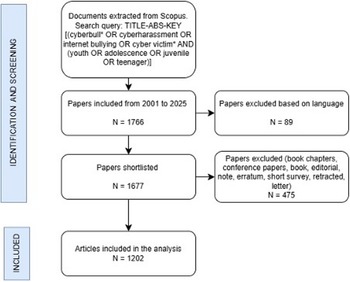
The documents used for bibliometric analysis were retrieved from Scopus covering the period from 2001 to 2025. Scopus is a multidisciplinary abstract and citation database of literature with capabilities to track, analyse, and visualise publications. It retrieved a large corpus of peer-reviewed journals across the scientific, technical, medical, and social science fields, published by a wide range of international publishers. The widespread use of social media began around 2001, and so did research on cyberbullying. Therefore, to fully understand the developments and evolutions in this field, the research period for our bibliometric analysis is from 2001 to 2025. The search query string was TITLE-ABS-KEY=[cyberbull* OR cyber harassment OR internet bullying OR cyber victim* AND (youth OR adolescence OR juvenile OR teenager)] filtered by title, abstract, and keyword to search articles published between 2001 and 2025. Only English-language articles were considered. Regarding other inclusion and exclusion criteria, we included only studies that specifically focused on cyberbullying among adolescents. Additionally, only journal articles were considered, and conference papers and book titles were excluded as they are not always subjected to a rigorous peer-review process. Finally, we included 1,202 documents altogether following the selection process illustrated in Figure 1.
Inclusion and exclusion criteria.

Figure 1 Long description
The flowchart illustrates the process of identifying and screening documents extracted from Scopus for a bibliometric analysis on cyberbullying. The search query used is TITLE-ABS-KEY=[cyberbull OR cyber harassment OR internet bullying OR cyber victim AND (youth OR adolescence OR juvenile OR teenager)]. The process begins with 1,766 papers included from 2001 to 2025. Papers excluded based on language total 89. The next step shows papers shortlisted, totaling 1,677. Papers excluded include book chapters, conference papers, book editorials, notes, erratum, short surveys, retracted papers and letters, totaling 475. Finally, articles included in the analysis total 1,202.
Bibliometric analysis method
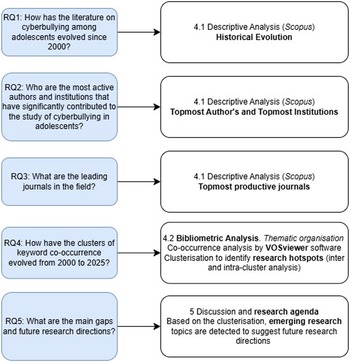
This paper uses a bibliometric analysis method, specifically, a co-occurrence analysis, to provide thematic analysis of the scientific literature in the field. Bibliometric analysis is a quantitative technique that enables the visualisation of links between concepts (Klarin, Reference Klarin2024). Co-occurrence analysis uses keyword frequency and links to provide an understanding of the field’s conceptual structure and has been successfully used in management, public health, education, and entrepreneurship (e.g. Cretu & Morandau, Reference Cretu and Morandau2024; Fu et al., Reference Fu, Ge, Xu, Liang, Yu, Shen and Zhang2022; Guleria & Kaur, Reference Guleria and Kaur2021; Liu, Ali & Lee, Reference Liu, Ali and Lee2025). The entities in the networks can be linked by keywords, co-occurrences, citations, bibliographic couplings, or co-citations. For this study, we limited the minimum number of keyword occurrences to 10. Based on this, 303 keywords were identified across 1,202 articles and 6 thematic clusters were developed using VOSviewer. Finally, building on the research gaps identified in the clustering process, we adopted a review approach informed by the prior work of González-Mendes, Alonso-Muñoz, García-Muiña and González-Sánchez (Reference González-Mendes, Alonso-Muñoz, García-Muiña and González-Sánchez2024) and Cretu and Morandau (Reference Cretu and Morandau2024) to categorise the underrepresented areas of research for the future agenda. Figure 2 shows the process of bibliometric analysis adopted in this study to address the formulated RQs.
Bibliometric analysis.
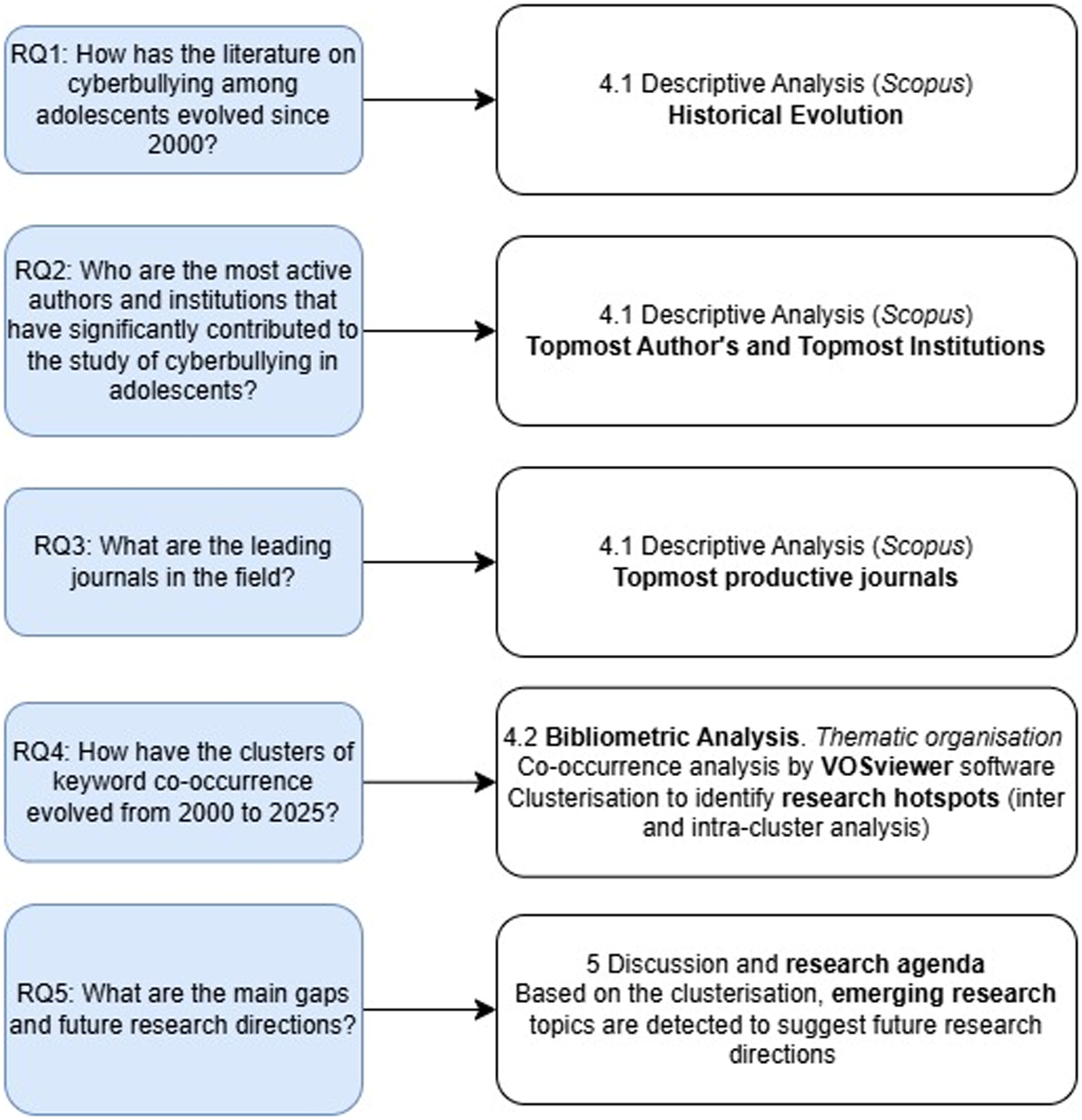
Figure 2 Long description
The flowchart outlines the analysis of cyberbullying literature among adolescents through five research questions (RQs) and corresponding analyses. RQ1: 'How has the literature on cyberbullying among adolescents evolved since 2000?' connects to '4.1 Descriptive Analysis (Scopus) Historical Evolution.' RQ2: 'Who are the most active authors and institutions that have significantly contributed to the study of cyberbullying in adolescents?' links to '4.1 Descriptive Analysis (Scopus) Topmost Author's and Topmost Institutions.' RQ3: 'What are the leading journals in the field?' connects to '4.1 Descriptive Analysis (Scopus) Topmost productive journals.' RQ4: 'How have the clusters of keyword co-occurrence evolved from 2000 to 2025?' leads to '4.2 Bibliometric Analysis. Thematic organisation Co-occurrence analysis by VOSviewer software Clusterisation to identify research hotspots (inter and intra-cluster analysis).' RQ5: 'What are the main gaps and future research directions?' connects to '5 Discussion and research agenda Based on the clusterisation, emerging research topics are detected to suggest future research directions.'.
Results
Descriptive analysis
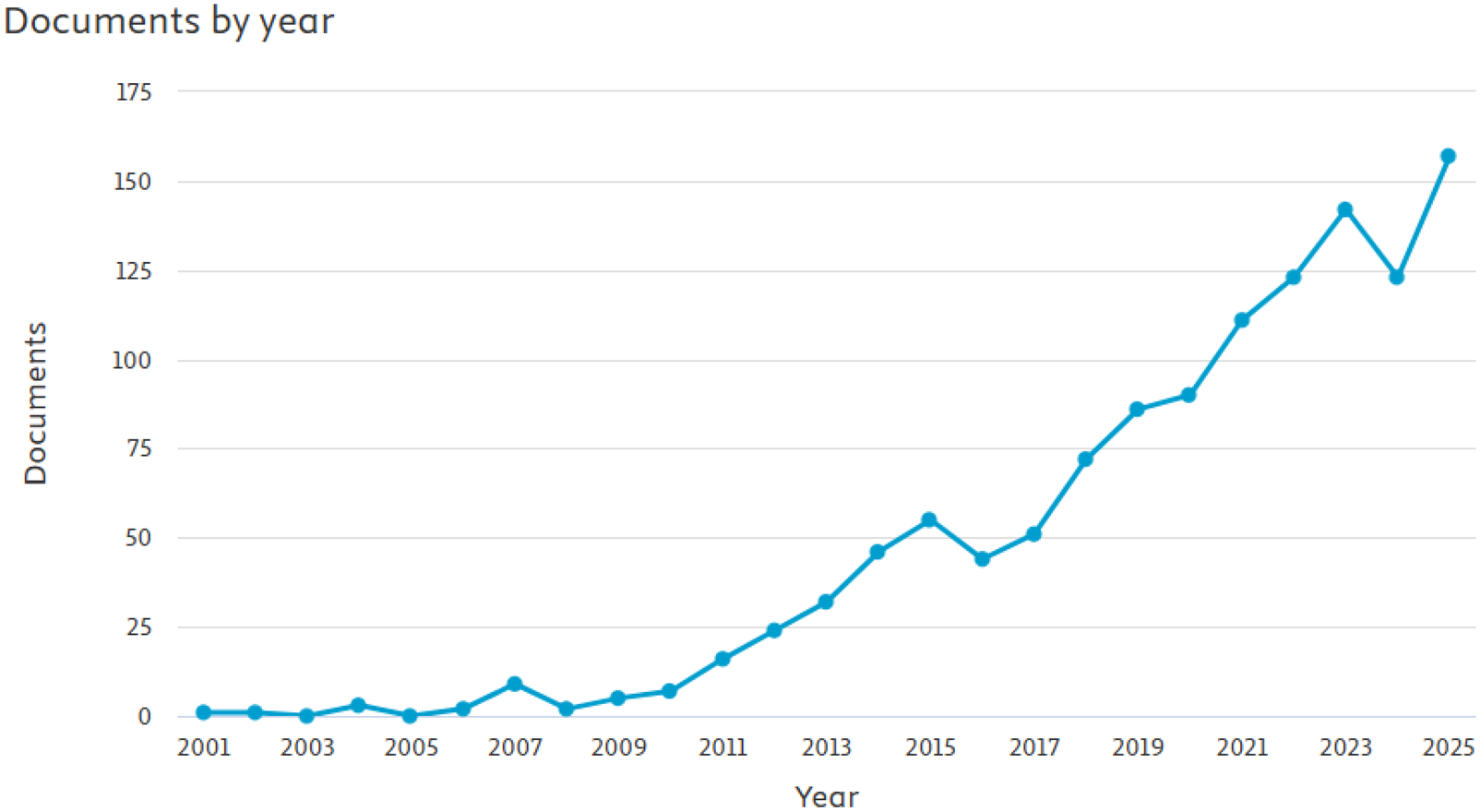
The evolution of adolescent cyberbullying research reflects a sustained growth in scholarly attention (see Figure 3). The research work, from 2001 to 2010, was relatively limited, with only a small number of studies addressing the phenomenon. However, from 2010 onwards, there was a sharp rise in publications, indicating a shift from exploratory inquiries to more systematic investigations into the phenomenon. This growth accelerated further after 2015, with outputs more than doubling by 2018 and continuing to rise sharply through 2021, nonetheless, from 2020 to 2025, the publication rate remained consistently high.
Publications trajectory.
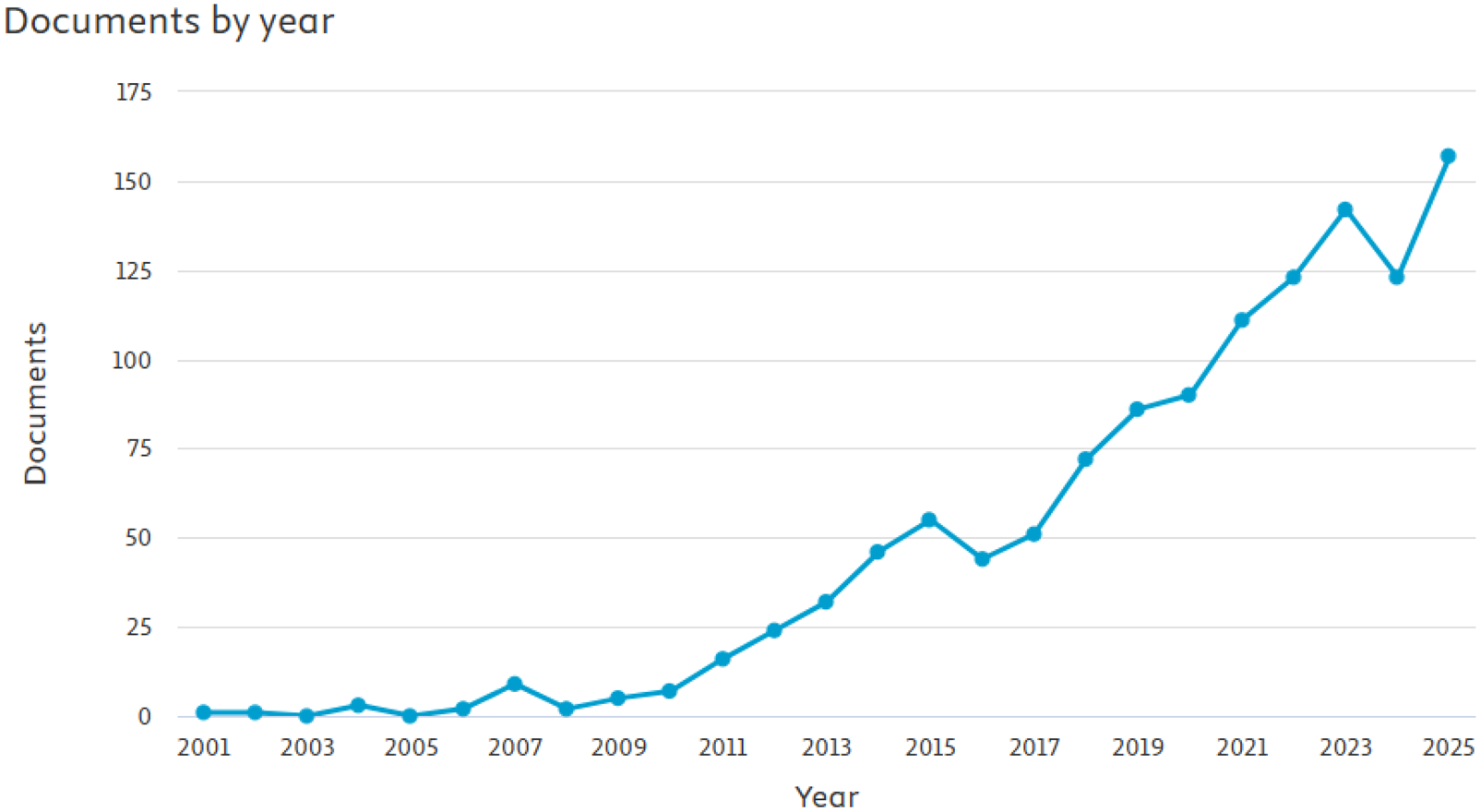
Figure 3 Long description
Title: Documents by year. The x- axis represents Year from 2001 to 2025. The y- axis represents Documents from 0 to 175. One line with point markers is shown. Overall pattern: Values stay low from 2001 to 2011, rise from 2012 onward, include a dip at 2017, then increase to the highest value at 2025. The line passes through the following points: (2001, 2), (2002, 2), (2003, 1), (2004, 3), (2005, 1), (2006, 4), (2007, 2), (2008, 10), (2009, 3), (2010, 5), (2011, 8), (2012, 15), (2013, 25), (2014, 35), (2015, 45), (2016, 55), (2017, 45), (2018, 50), (2019, 70), (2020, 85), (2021, 90), (2022, 110), (2023, 125), (2024, 145), (2025, 160). Key values: Start at (2001, 2). Dip at (2017, 45) after (2016, 55). Highest value at (2025, 160).
The trend line, in Figure 3, therefore, indicates that adolescent cyberbullying has moved from a marginal research topic to a well-established and globally recognised topic of concern. Recent expansion into this research appears to be driven by increased use of digital technologies by adolescents. The rising volume of publications highlights the maturity of this research field and sustained academic and societal interest in addressing cyberbullying among young people. Therefore, it warrants a systematic bibliometric analysis to map the intellectual structure of the field, identify dominant thematic clusters and emerging streams, and unpack underexplored topic directions that require deeper theoretical and empirical investigation.
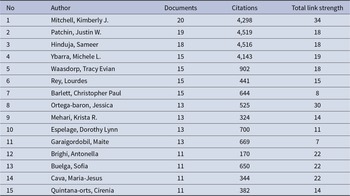
Table 1 presents the top 15 authors in this research domain, reporting the number of documents they have produced, their total citations, and total link strength (TLS). TLS reflects the overall strength of co-authorship connections within the research network. In this study, a minimum threshold of five documents per author was applied. Out of 4,978 authors, 119 met this criterion and have been included in this analysis. The TLS values for the top 15 authors range between 14 and 34, suggesting that these researchers maintain active collaborative relationships within the field. Citation counts further present their scholarly impact. Although no strong correlation has been observed between TLS and the number of publications or citations, except that Mitchell, Kimberly J, stands out with 20 publications and 4,302 citations, along with a TLS of 616, reflecting both substantial academic influence and collaborative engagement.
Top authors’ research work by total link strength (TLS)
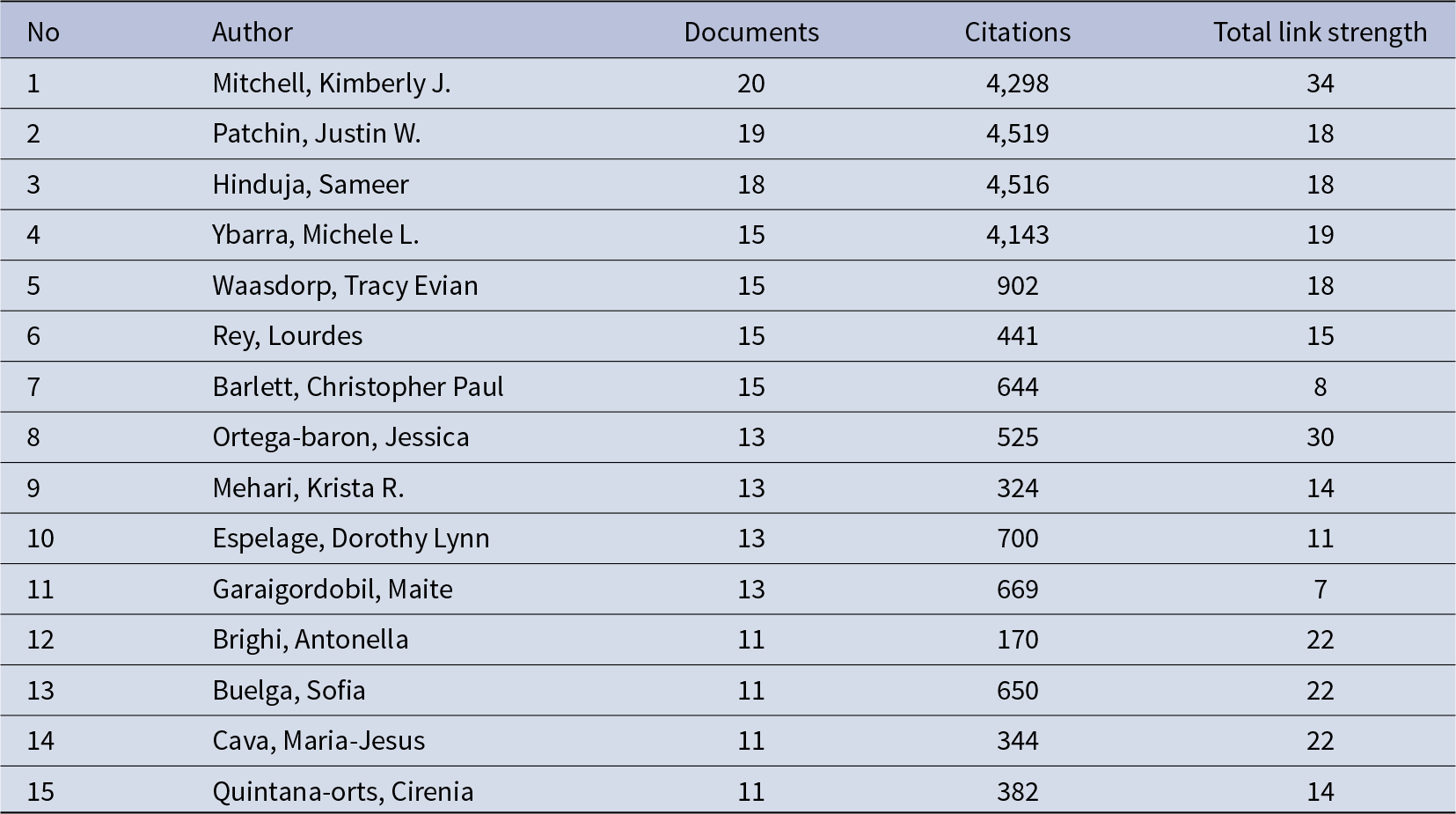
Table 1 Long description
The table ranks 15 authors by their research output and influence using document count, citation count, and total link strength, a measure of collaboration or connectedness. Mitchell, Kimberly J. has the most documents at 20 and is among the most cited with 4,298 citations and a total link strength of 34. Patchin, Justin W. and Hinduja, Sameer follow closely in output with 19 and 18 documents and have the highest citation totals at 4,519 and 4,516, each with total link strength of 18. Ortega-baron, Jessica stands out for collaboration with the highest total link strength of 30 despite fewer documents at 13 and 525 citations. Several authors have 15 documents but vary widely in citations, from Ybarra, Michele L. at 4,143 to Rey, Lourdes at 441, showing that publication count does not directly match citation impact. Brighi, Antonella, Buelga, Sofia, and Cava, Maria-Jesus each have 11 documents and share a total link strength of 22, but their citations differ from 170 to 650. Citations and total link strength reflect different aspects of impact and networking and may be influenced by field, publication age, and database coverage.
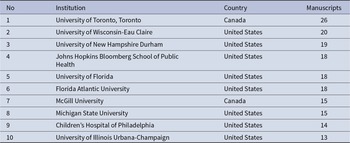
Econometric analysis of the manuscripts produced and cited by the institutions (Table 2) reveals that the top 10 institutions are in developed countries. More specifically, these institutions belong to two countries, out of which 80% of the institutions are located in the United States. University of Toronto is the leading institution in the number of publications (26) followed by University of Wisconsin-Eau Claire (20) and University of New Hampshire Durham (19).
Top 10 institutions with notable research production
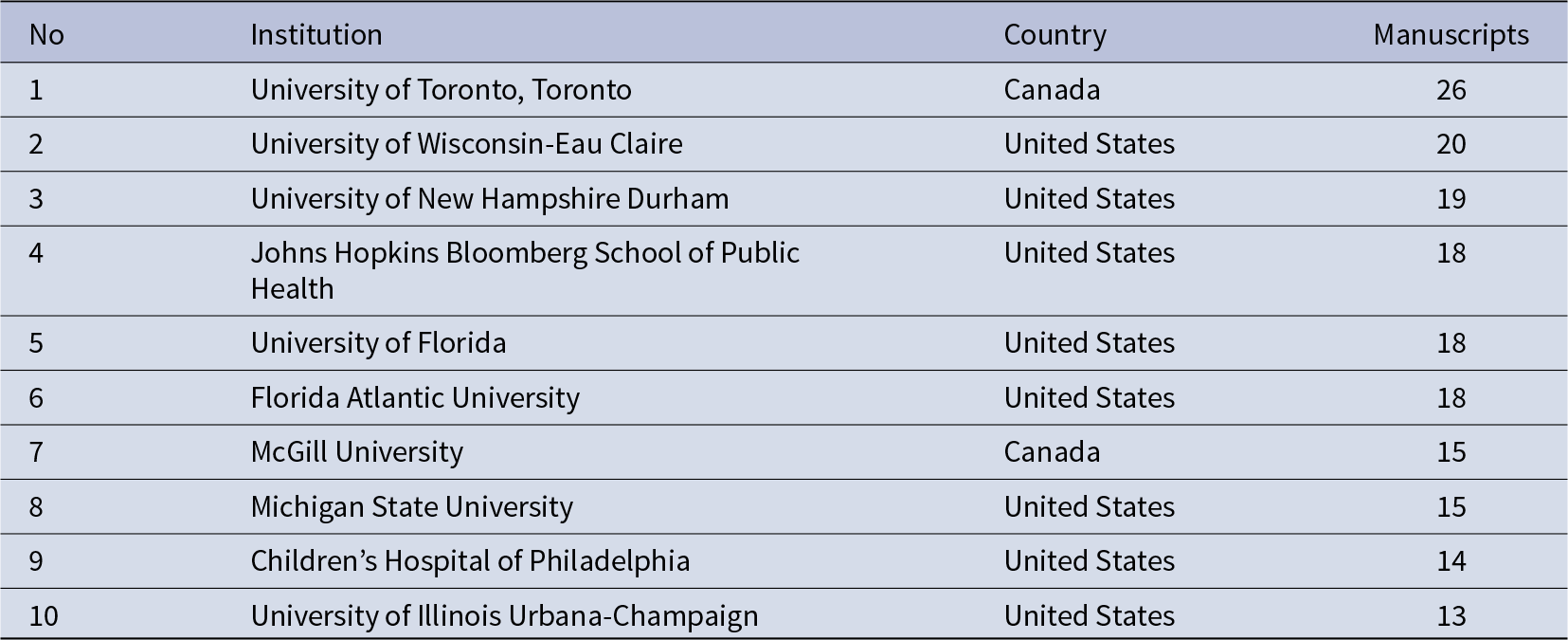
Table 2 Long description
The table ranks ten institutions by the number of manuscripts attributed to each. University of Toronto has the highest count at 26 manuscripts. The next highest are University of Wisconsin–Eau Claire with 20 and University of New Hampshire Durham with 19. Three institutions tie at 18 manuscripts: Johns Hopkins Bloomberg School of Public Health, University of Florida, and Florida Atlantic University. Mid-ranked entries include McGill University and Michigan State University with 15 each, followed by Children’s Hospital of Philadelphia with 14 and University of Illinois Urbana-Champaign with 13. The United States accounts for eight of the ten institutions, while Canada accounts for two. Counts are close across much of the list, with a clearer lead for the top-ranked institution.
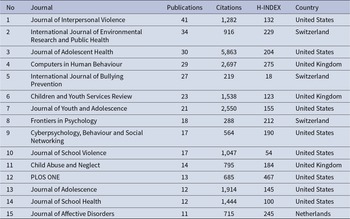
Table 3 (top journals publishing in the area of cyberbullying) indicates that the topic is highly interdisciplinary; however, it is primarily anchored in public health, psychology, and social science disciplines. For example, the Journal of Adolescent Health and Computers in Human Behaviour are showing high average citations per document (5,863 and 2,697, respectively) relative to their number of published articles (30 and 29, respectively), indicating strong theoretical and methodological contributions from these outlets Journal of Interpersonal Violence has published the highest number of articles at 41. It indicates that cyberbullying is a population-level health issue rather than an individual behavioural problem. Education and psychology-related journals provide conceptual depth in the context of schools, the development of adolescents, and psychosocial outcomes.
Top 15 journals publishing on cyberbullying
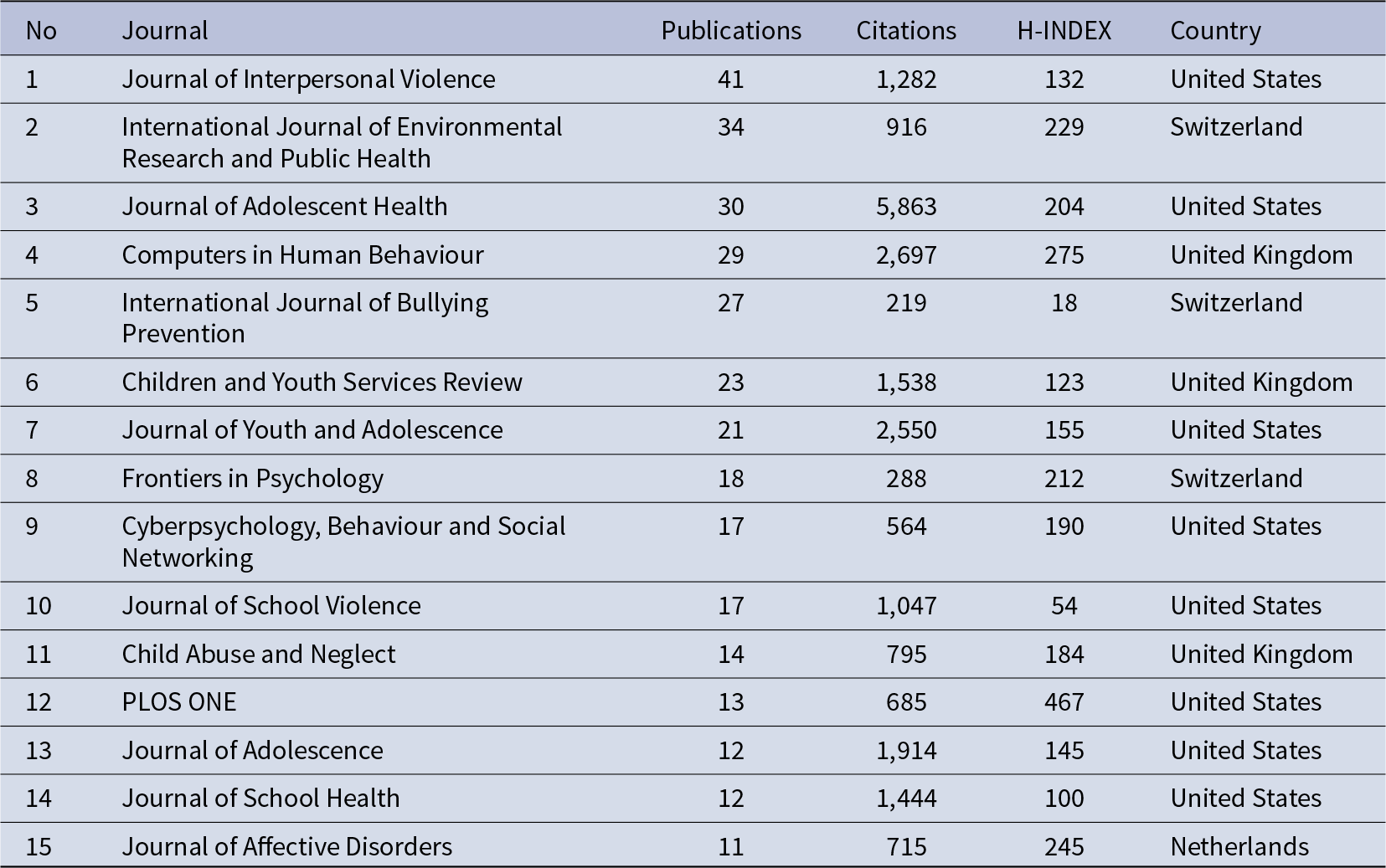
Table 3 Long description
The table ranks 15 journals by number of cyberbullying-related publications and reports each journal’s citations, H-index, and country. Journal of Interpersonal Violence has the most publications with 41 and 1,282 citations. Journal of Adolescent Health has fewer publications at 30 but the highest citation count at 5,863, indicating greater citation impact per paper than the publication leader. Computers in Human Behaviour and Journal of Youth and Adolescence also show strong citation totals at 2,697 and 2,550 with 29 and 21 publications. Several journals have moderate publication counts but comparatively low citations, such as International Journal of Bullying Prevention with 27 publications and 219 citations, and Frontiers in Psychology with 18 publications and 288 citations. Countries represented include the United States, Switzerland, the United Kingdom, and the Netherlands, with the United States appearing most frequently. The H-index values shown are journal-level metrics and are not specific to cyberbullying articles, so they should not be interpreted as impact measures for this topic alone.
Bibliometric analysis: developing themes
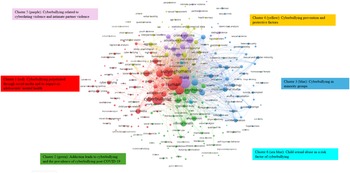
The thematic analysis is based on the results of a bibliometric analysis using the co-occurrence technique in VOSviewer. All keywords were included in the analysis, and the minimum number of co-occurrences of each keyword was set to 10. The clusters were formed by assessing the strength of links among keywords, as identified by VOSviewer. Altogether, 303 keywords were included in the final analysis. The TLS measures the strength of the relationships between the keywords (van Eck & Waltman, Reference Van Eck and Waltman2010). The analysis resulted in six keyword clusters, each represented by a different colour (see Figure 4). The following section presents detailed information about the clusters. This study analyses the relationships, both inter- and intra-cluster, to establish the connections between the concepts in the literature.
Co-occurrence analysis by VOSviewer software.

Figure 4 Long description
A VOSviewer keyword co-occurrence network map displaying 303 keywords organized into six distinct clusters based on link strength among co-occurring terms. The network has no axes or units, as it is a relational visualization. Each node represents a keyword and node size reflects the frequency or weight of that keyword across the analyzed literature. Lines connecting nodes represent co-occurrence links, with thicker lines indicating stronger co-occurrence relationships between keyword pairs. The six clusters are each represented by a distinct color, grouping keywords that share strong mutual connections. The cluster labels visible in the image are as follows. Cluster 1 is labeled Cyberbullying related to victimizing violence and intimate partner violence. Cluster 2 is labeled Addiction issues in cyberbullying and the prevalence of cyberbullying post COVID-19. Cluster 3 is labeled Cyberbullying prevention and protective factors. Cluster 4 is labeled Cyberbullying as minority groups. Cluster 5 is labeled Other. Cluster 6 is labeled Child sexual abuse as a root factor of cyberbullying. The central region of the network contains the densest concentration of nodes and links, indicating high co-occurrence activity across multiple clusters. Several large nodes are visible near the center of the map, suggesting these keywords appear frequently and share connections with keywords from multiple clusters, forming bridging points between thematic groups. The minimum co-occurrence threshold applied was 10, meaning only keywords appearing at least 10 times were included in the final network.
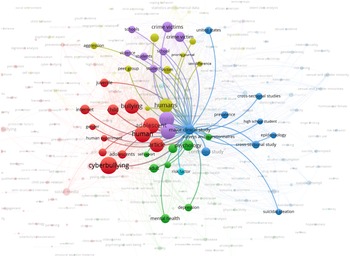
Cluster 1 (red): cyberbullying perpetrated through social media and impacts adolescents’ mental health
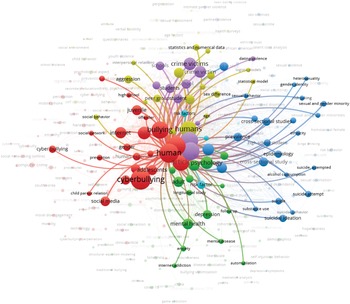
The first cluster shown in Figure 5 reveals that cyberbullying in adolescence is linked to ‘aggression’ on ‘social media’ and the ‘internet’ (yellow cluster), and it has an impact on adolescents’ ‘mental health’ (green cluster). The main channel through which cyberbullying takes place is social media or social networking sites. Mobile phones also make the use of social media easier for adolescents and, therefore, act as an enabler for cyberbullying. Researchers have shown that the use of cell phones has been associated with a greater probability of being an aggressor and an increased risk of becoming a cyberbullying victim (Méndez, Jorquera Hernández & Ruiz-Esteban, Reference Méndez, Jorquera Hernández and Ruiz-Esteban2020). Aggression on social media is considered a widespread phenomenon among school children (Sobkin & Fedotova, Reference Sobkin and Fedotova2021), and it is prevalent at all levels of education, including middle school, secondary school, high school, and college. Facing aggression on social media has a direct impact on the academic success of children (Sobkin & Fedotova, Reference Sobkin and Fedotova2021). Research also suggests that a lack of transparency and accountability in social media platform policies may shape how educational organisations define safe environments, ultimately influencing the protections available to young users and students (Milosevic, Reference Milosevic2016).
Cyberbullying perpetrated through social media and its impact on mental health.
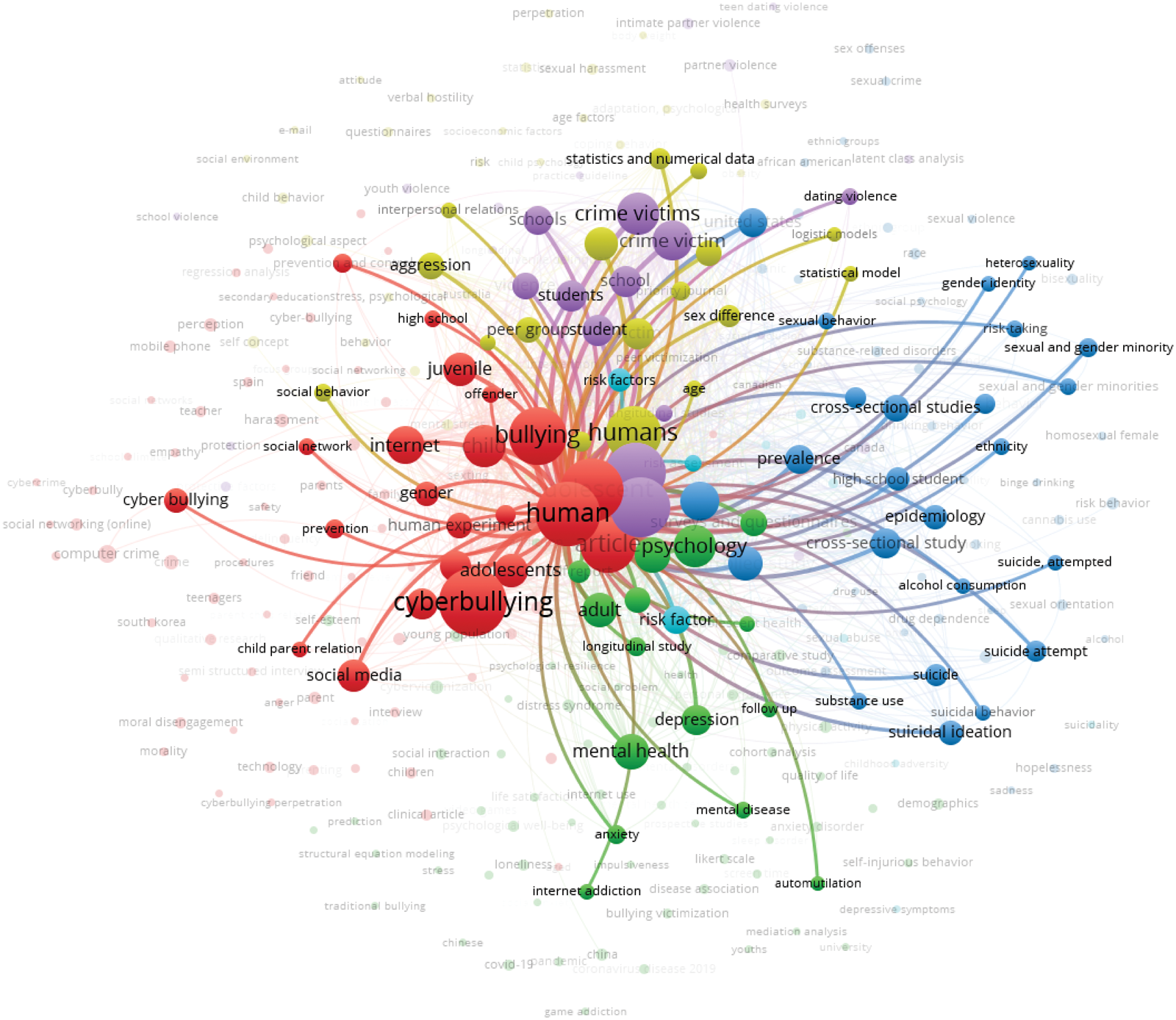
Figure 5 Long description
The network diagram displays interconnected nodes representing various concepts. Central nodes include 'bullying', 'humans', 'cyberbullying' and 'psychology'. Lines connect these nodes to related terms such as 'crime victims', 'mental health', 'internet' and 'social media'. Each node is linked to multiple other nodes, forming clusters that highlight relationships between topics. The diagram visually represents the complexity and interrelation of themes like cyberbullying and its impact on different areas such as psychology and crime.
These victims of cyberbullying encounter adverse effects on their mental health, and the impact on ‘male’ and ‘female’ can be different. Mental health is also associated with a ‘risk factor’ in the green cluster. This indicates that poor mental health, such as low life satisfaction or ‘self-esteem’, can lead to cyberbullying aggression. The ‘self-concept’ and ‘self-control’ of the aggressor can be low, too, especially in family and academic domains.
AI, machine learning, and deep learning also came up as keywords in this cluster. However, since it’s a new technology, the number of occurrences is low. It shows that emerging technologies are increasingly being used to detect and combat cyberbullying (Milosevic et al., Reference Milosevic, Verma, Carter, Vigil, Laffan, Davis and O’Higgins Norman2023).
Cluster 2 (green): addiction leads to cyberbullying and a rise in cyberbullying post-COVID-19
With the COVID-19 epidemic, the probability of being cyberbullied has increased due to prolonged school closures, going for online learning, increased time spent online, and social isolation (António, Guerra & Moleiro, Reference António, Guerra and Moleiro2024; Sorrentino et al., Reference Sorrentino, Sulla, Santamato, Di Furia, Toto and Monacis2023). However, Eden, Heiman, Olenik-Shemesh and Yablon (Reference Eden, Heiman, Olenik-Shemesh and Yablon2023) argue that cyberbullying perpetration was reduced or there was no change during the pandemic. This could be due to increased parent supervision during the pandemic (Huang et al., Reference Huang, Zhang, Mu, Yu, Riem and Guo2024). Social isolation reduced in-person interaction, which reduced the appeal of cyberbullying (Englander, Reference Englander2021). However, for those who experienced cyberbullying during the pandemic, the impact on mental health and psychological distress, such as sadness and loneliness, was higher (António et al., Reference António, Guerra and Moleiro2024).
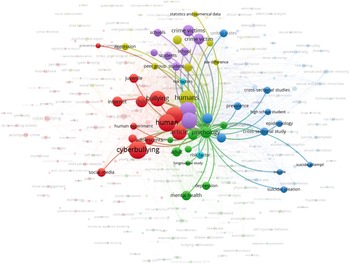
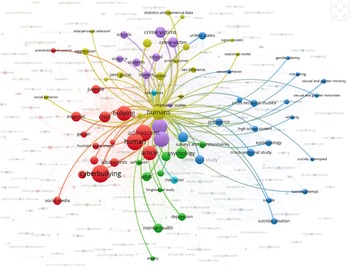
Cluster 2 (Figure 6) also appears to link cyberbullying with risk factors such as gaming addiction, internet addiction, internet gaming disorder, video game addiction, social media addiction, gambling addiction and increased screen time. Internet addiction is associated with increased cyberbullying problems in adolescents, which can, in turn, cause mental health problems (Chang et al., Reference Chang, Chiu, Miao, Chen, Lee, Chiang and Pan2015). They also have a higher level of social anxiety (Guisot, Aparisi, Delgado & Martínez-Monteagudo, Reference Guisot, Aparisi, Delgado and Martínez-Monteagudo2026). Internet addiction can take the form of gambling addiction, gaming addiction (Siomos et al., Reference Siomos, Floros, Fisoun, Evaggelia, Farkonas, Sergentani and Geroukalis2012), or simply using social networking sites (Tsitsika et al., Reference Tsitsika, Janikian, Schoenmakers, Tzavela, Olafsson, Wójcik and Richardson2014). When youth are exposed to violence through online games, they are more likely to carry out verbal violence either directly or indirectly through chatting on social media (Hidayat, Permatasari & Mani, Reference Hidayat, Permatasari and Mani2022). They also receive or carry out online verbal violence from their peers.
Risk factors of cyberbullying.

Figure 6 Long description
A network infographic showing a keyword map with many labeled circles connected by curved lines. The largest labels include: cyberbullying, internet addiction, human rights, humans, adolescent and mental health. Other readable labels include: internet, crime victim, crime victims, crime, bullying, social media, cross-sectional studies, prevalence, student and school. The circles are grouped into several clusters, with dense connections around the central terms cyberbullying and internet addiction. Multiple curved lines connect the central terms to surrounding keywords, forming a hub-and-spoke layout with branching links between nearby keywords. No axis labels, units, numeric values, or table entries are shown.
Cluster 3 (blue): cyberbullying in minority groups
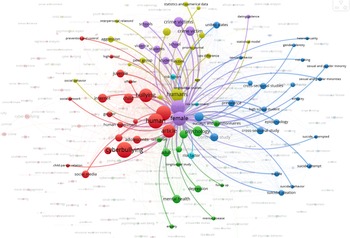
The blue cluster, in Figure 7, shows the prevalence of cyberbullying in minority groups or a high-risk population, including ‘sexual and gender minorities’, ‘African Americans’, ‘Hispanics’, and ‘ethnic groups’. Victims are also targeted based on their sexual preferences or sex differences, such as if they are ‘bisexual’, ‘heterosexual’, ‘transgender’, or ‘homosexual’ and sexual minorities are the most vulnerable groups (Zhu et al., Reference Zhu, Huang, Evans and Zhang2021). Victimisation of vulnerable groups is associated with low family support, early coming out and traditional bullying victimisation (Méndez et al., Reference Méndez, Jorquera Hernández and Ruiz-Esteban2020). It is also reported that individuals with disabilities face higher cyberbullying victimisation than individuals without disabilities (Kowalski & Toth, Reference Kowalski and Toth2018) and consequently suffer from lower self-esteem and depression (Kowalski et al., Reference Kowalski, Morgan, Drake-Lavelle and Allison2016).
Cyberbullying prevalence in minority groups.

Figure 7 Long description
The diagram displays interconnected nodes representing topics such as cyberbullying, mental health, crime and human rights. Each node is linked to related terms, forming clusters. The central node labeled 'cyberbullying' connects to nodes like 'bullying', 'victim' and 'mental health'. Other clusters include terms like 'crime', 'human' and 'study'. Lines between nodes indicate relationships or associations between these topics, creating a complex web of connections.
Cyberbullying also has a different impact on males and females. Researchers have found that both female and male cyberbullying victims suffer from poor mental health, such as loneliness, insomnia, anxiety, suicidal thoughts, and attempts (Dadras, Reference Dadras2025). However, females had a higher probability of suicide ideation, suicide attempts and suicide overall, and depression. This also results in females adopting poor lifestyle choices, such as a sedentary lifestyle, poor nutritional intake, and oral hygiene (Dadras, Reference Dadras2025). They also have a higher risk of victimisation than their male counterparts (Kumar & Goldstein, Reference Kumar and Goldstein2020). Racial minority and sexual minority groups are significantly associated with depression and suicidal behaviours. For instance, early-career non-managerial Chinese women reported experiencing workplace bullying through reputational attacks, exclusion from group chats, sexualised promotion rumours, and client-initiated online sexual harassment (Cheng, Barlas, Chen & Wu, Reference Cheng, Barlas, Chen and Wu2026).
Various types of studies, such as clinical, cross-sectional, and controlled studies, have been conducted to analyse the impact of cyberbullying on minority victims. Most of the controlled studies appear to be conducted in the United States. The impact of cyberbullying is observable (green cluster) on the victim’s ‘mental health’, causing ‘depression’, which may ultimately lead to ‘suicidal ideation’ or ‘substance-related disorders’ (Duarte, Pittman, Thorsen, Cunningham & Ranney, Reference Duarte, Pittman, Thorsen, Cunningham and Ranney2018). Substance abuse has also been noticed in both perpetrators and victims, with perpetrators being three times more likely to use drugs as compared to victims (Valdebenito, Ttofi & Eisner, Reference Valdebenito, Ttofi and Eisner2015). The substance abuse includes ‘binge drinking’, ‘cannabis use’, ‘cigarette smoking’, ‘drug dependence’, ‘tobacco use’, and ‘vaping’. Alcohol has also been found to be the most consumed substance, followed by tobacco and cannabis (Pichel, Feijóo, Isorna, Varela & Rial, Reference Pichel, Feijóo, Isorna, Varela and Rial2022). The increased substance abuse is mostly seen in male victims. Most of the studies have been conducted in ‘high schools’, as high school students are considered to be a high-risk factor for cyberbullying perpetration (Zhu et al., Reference Zhu, Huang, Evans and Zhang2021).
The cluster in Figure 7 also demonstrates connections between cyberbullying and ‘epidemiology’, indicating that researchers are actively analysing and understanding scientific studies on cyberbullying. This includes identifying affected populations, timing, mechanisms, risk factors, and outcomes.
Cluster 4 (yellow): cyberbullying prevention and protective factors
The fourth cluster (Figure 8) highlights cyberbullying as a public health issue that requires a comprehensive approach that considers personal as well as environmental factors. The protective factors include family support, emotion regulation, high-quality friendships, self-control, self-esteem, and a positive parent–child relationship. If parents have more knowledge and are aware of their children’s online activities, it leads to less problematic internet use and reduces the risk of cyberbullying (Ang, Reference Ang2015). Additionally, parents need to have an open communication with their children regarding the usage of the internet and participate actively in their children’s lives (Zhu et al., Reference Zhu, Huang, Evans and Zhang2021).
Cyberbullying prevention and protective factors.

Figure 8 Long description
A network infographic with labeled circles connected by lines. Circle size varies across the map and line thickness varies. The largest central label is “humans.” Nearby large labels include “cyberbullying,” “bullying,” “adolescent,” “female,” “male,” “child,” “young adult,” “crime victim,” “crime,” “internet,” “social media,” “social networking,” “social support,” “mental health,” “depression,” “anxiety,” “suicide,” “suicidal ideation,” “self concept,” “self esteem,” “emotion regulation,” “family,” “parents,” “parent child relationship,” “friendship,” “peer,” “school,” “education,” “prevention,” “intervention,” “risk factor,” “protective factor,” “questionnaire,” “survey,” “cross sectional study,” “controlled study,” “longitudinal study,” “cohort analysis,” “statistics,” and “statistical model.” Connections radiate from “humans” to multiple topic groups. One group centers on “cyberbullying” and “bullying,” with links to “adolescent,” “child,” “young adult,” “internet,” “social media,” “social networking,” “school,” “peer,” and “friendship.” Another group includes “mental health,” “depression,” “anxiety,” “suicide,” and “suicidal ideation,” connected into the same network. Another group includes “crime victim” and “crime,” connected to “statistics” and “statistical model.” A methods-related group includes “questionnaire,” “survey,” “cross sectional study,” “controlled study,” “longitudinal study,” and “cohort analysis,” connected to the main network. The layout is a central hub (“humans”) with multiple clusters of connected keyword labels around it, linked by many intersecting lines.
High emotional intelligence or empathy of an individual can also reduce the rate of cyberbullying. This can be cultivated through management training in emotion regulation (Zhu et al., Reference Zhu, Huang, Evans and Zhang2021). Protecting children from cyberbullying would also require efforts from the school and the wider community, such as improved teacher training and a highly supportive school environment (Tozzo, Cuman, Moratto & Caenazzo, Reference Tozzo, Cuman, Moratto and Caenazzo2022). Adolescents with stronger teacher–student relationships tend to exhibit lower cyberbullying perpetration (Gao, Li, Wu & Wang, Reference Gao, Li, Wu and Wang2025). Research has also found the importance of bystanders’ reactions to cyberbullying as a powerful preventive measure (Pyżalski, Plichta, Szuster & Barlińska, Reference Pyżalski, Plichta, Szuster and Barlińska2022). They can play a useful role in de-escalating cyberbullying on public platforms (Beavon, Jenkins, Bradley & Verma, Reference Beavon, Jenkins, Bradley and Verma2024).
Cluster 5 (purple): cyberbullying is related to cyber dating violence and intimate partner violence
The purple cluster (Figure 9) highlights the occurence of cyberbullying between partners in schools and other contexts, commonly recognised as cyber dating violence. Cyberbullying is a predictor of the rise in cyber dating aggression. It can be generalised from one relational context, e.g. a peer relationship, to another relationship context, e.g. a dating relationship, especially around mid-adolescence (Stevens et al., Reference Stevens, Coleman, Waasdorp and Mehari2024). Youth who experience physical dating violence, sexual dating violence, or forced sexual intercourse are at a higher risk of cyberbullying (Post & Huber, Reference Post and Huber2024). Solicitations and sexualised interactions with adults also have a significant correlation with peer cybervictimisation and cyber dating abuse (Ortega-Barón et al., Reference Ortega-Barón, Machimbarrena, Caba-Machado, Díaz-López, Tejero-Claver and González-Cabrera2023). Additionally, victims of sexual cyber dating abuse were seven times more likely to experience sexual coercion, and the perpetrators of sexual cyber dating abuse are 17 times more likely to perpetrate sexual coercion (Zweig, Dank, Yahner & Lachman, Reference Zweig, Dank, Yahner and Lachman2013). These risks increase around ‘middle school’ as students are more likely to get into a romantic relationship at that age.
Cyberbullying in school and among students.

Figure 9 Long description
The network diagram illustrates keyword associations related to cyberbullying, human interactions and gender. Central nodes include 'human', 'female' and 'cyberbullying', with colored clusters representing thematic areas such as crime-related terms, mental health and social media/platform terms. The diagram uses varying node sizes to indicate importance and curved lines to show connections. Spatially, clusters branch outward from the center, with themes like crime and mental health positioned prominently. Key connected terms include 'abuse', 'victim', 'online' and 'platform'. The diagram serves as a keyword co-occurrence map, highlighting strong links between cyberbullying and human interactions, emphasizing the interconnected nature of these themes.
The impact of cyber dating violence is also different based on sex. According to Cava, Tomás, Buelga and Carrascosa (Reference Cava, Tomás, Buelga and Carrascosa2020), both boys and girls who were victims of cyber dating violence also suffered more cyberbullying, and girls experienced more loneliness and depression than boys. Girls are also more likely to suffer from digital and sexual violence victimisation (Hellevik & Øverlien, Reference Hellevik and Øverlien2016). Particularly, sexual and gender minorities are at a higher risk of experiencing intimate partner violence due to minority stressors (Whitton, Dyar, Mustanski & Newcomb, Reference Whitton, Dyar, Mustanski and Newcomb2019).
Cluster 6 (sea blue): child sexual abuse as a risk factor of cyberbullying
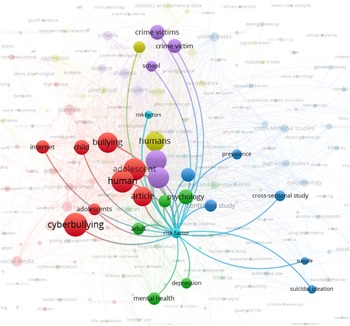
Scholars have characterised cyberbullying as an adverse childhood experience due to the severity of the impact it has on youths’ development (Lillestolen, De La Guardia & Omar, Reference Lillestolen, De La Guardia and Omar2024). Even minor cyberbullying can have a significant impact on youth (Hinduja & Patchin, Reference Hinduja and Patchin2025). Females who were sexually abused as children are more likely to experience cyberbullying, as per the themes identified in the sea blue cluster (Figure 10). As maltreated females, they may be prone to oversharing, have provocative profile pictures, have references to drug or alcohol use, use profanity, language with lower cognitive abilities, and reduced social skills (Kennedy, Font, Haag & Noll, Reference Kennedy, Font, Haag and Noll2022). The risk of cyberbullying was twice as likely in children who experienced sexual abuse (Hébert, Cénat, Blais, Lavoie & Guerrier, Reference Hébert, Cénat, Blais, Lavoie and Guerrier2016). Additionally, researchers have found that childhood maltreatment, such as childhood emotional abuse, has increasingly been linked to cyberbullying, specifically in those children who develop antisocial behavioural patterns (Kircaburun et al., Reference Kircaburun, Jonason, Griffiths, Aslanargun, Emirtekin, Tosuntaş and Billieux2021). The psychological maltreatment leads to greater moral disengagement, decreased moral standards, and distorted identity, which may lead to higher cyberbullying perpetration (Emirtekin, Balta, Kircaburun & Griffiths, Reference Emirtekin, Balta, Kircaburun and Griffiths2020). The impact of cyberbullying on those who also experience sexual abuse as children presents suicidality and depressive symptoms.
Cyberbullying risk factors include child sexual abuse.

Figure 10 Long description
The diagram shows interconnected nodes representing various topics. Key nodes include 'cyberbullying,' 'crime victims,' 'adolescents,' 'humans,' 'mental health,' and 'psychology.' Lines connect these nodes, indicating relationships between them. Smaller nodes branch out from the main topics, such as 'internet,' 'bullying,' 'article,' 'risk factors,' 'suicidality,' and 'study.' Each node is labeled with text and the connections suggest thematic links between the subjects. The diagram visually represents the complex interplay of these topics in a network format.
Discussion and research agenda
The cluster analysis indicates that adolescent cyberbullying research has expanded considerably over the past two decades; however, the intellectual structure of the field remains predominantly focused on individual-level psychological outcomes rather than organisational and institutional factors. The strong co-occurrence between cyberbullying and mental health constructs such as depression, anxiety, and suicidal ideation confirms it as a serious public health issue (Kowalski et al., Reference Kowalski, Giumetti, Schroeder and Lattanner2014). From a management perspective, focusing on individual victims limits the understanding of how organisational policies shape and control cyberbullying within digital environments. Nevertheless, these organisational dimensions have comparatively been understudied in the literature (Brochado, Soares & Fraga, Reference Brochado, Soares and Fraga2017; Zhu et al., Reference Zhu, Huang, Evans and Zhang2021).
The bibliometric analysis further demonstrates that keywords such as ‘mental health’, ‘victimisation’, and ‘adolescents’ occupy central positions in the network, whereas the constructs associated with ‘regulation’, ‘platform governance’, and ‘algorithmic accountability’ appear peripheral. This is a critical finding, particularly when safety legislation, corporate responsibility, and platform liability are increasingly being debated globally (Livingstone & Smith, Reference Livingstone and Smith2014). This issue presents an opportunity for scholars to investigate cyberbullying not just as an individual behavioural issue but also as a management challenge that should be embedded within organisational risk management frameworks. Digital platforms operate as organisations, and their technical and governance systems shape the interactions of their users. Therefore, cyberbullying cannot be fully understood without examining how platform incentives, content moderation policies, and algorithm visibility influence the behaviour of the platform users (Gillespie, Reference Gillespie2018). Especially when internet addiction and gaming addiction are key risk factors for cyberbullying in adolescents. Managing ‘addictive design features’ can protect adolescents from compulsive and problematic internet use (Yao & Yang, Reference Yao and Yang2025). However, this requires organisations to regulate the design architecture of their platforms. While some international regulatory frameworks, such as the EU’s Digital Services Act, exist, more customised risk assessments and youth-focused governance frameworks are required for organisations to systematically assess risks associated with their platform use.
Likewise, digital literacy has been widely acknowledged in policy discussions, but its limited presence in the clusterisation indicates that it has not been systematically incorporated into school policies, platform practices, or organisational frameworks. Suzor (Reference Suzor2019) argues that prevention is likely to be most effective when schools, technology firms, and regulatory bodies provide an institutional-level coordinated response rather than operating in isolation. For example, online gaming risks among youth have been viewed as a socio-technical governance challenge that requires interventions that go beyond digital literacy and parental supervision to broader structural and regulatory support (Makmun, Reference Makmun2026). Currently, there is a weak connection between the research findings and the preventive measures implemented by the institutions. This gap highlights the need for improved coordination across sectors, stronger organisational capabilities, and a clearer governance structure for digital environments.
The emergence of minority vulnerability in clusters highlights the importance of institutional-level analysis. Empirical studies show that cyberbullying among LGBTQ+ youth and other marginalised groups is disproportionate (Abreu & Kenny, Reference Abreu and Kenny2018; Gower et al., Reference Gower, Forster, Gloppen, Johnson, Eisenberg, Connett and Borowsky2018). Researchers found that early-career non-managerial Chinese women experience workplace bullying in the form of reputational attacks, public undermining, exclusion from group chats, and spreading sexualised rumours about promotions or in the form of client-initiated online sexual harassment (Cheng et al., Reference Cheng, Barlas, Chen and Wu2026). These are, in part, influenced by culture. Identity-based harm is, therefore, often treated as an individual vulnerability rather than as a reflection of systemic design and regulatory deficiencies. Constructs such as minority stress theory (Meyer, Reference Meyer2003; Nishii & Leroy, Reference Nishii and Leroy2022) have rarely been considered in organisational governance models. From a management viewpoint, this suggests that issues of inclusion, equity, and digital safety have not yet been fully considered in digital platform strategies and organisational policy development (Milosevic, Reference Milosevic2016). The intersection of cyberbullying with digital citizenship, gender-based violence and mental health requires a more comprehensive solution at the institutional and policy levels (Motsepe, Reference Motsepe2025). More inclusive digital communication model is needed not only in workplaces but also in schools to support adolescents’ development into respectful and responsible adults. Participatory design in organisational interventions can help empower the minority groups, increase engagement, enhance contextual relevance, and ultimately reduce cyberbullying (Chen & Chen, Reference Chen and Chen2026). More longitudinal research is needed to evaluate the effectiveness of organisational interventions and digital platform regulations as adolescents who experience cyberbullying transition into the workforce. Finally, the leadership of schools, post-secondary institutions, and workplaces must promote an environment that supports diversity, a culture of civility, community belonging, and trust (Cassidy, Faucher & Jackson, Reference Cassidy, Faucher and Jackson2023).
AI and machine learning have increasingly been discussed in recent studies; however, the focus has been on improving detection accuracy rather than evaluating organisational responsibility. Automated moderation systems demonstrate strong technical performance (Zhang et al., Reference Zhang, Robinson and Tepper2018), but concerns related to transparency and fairness remain insufficiently examined. This issue suggests the need for research initiatives on AI governance, and it is particularly important when technological advancement occurs more rapidly than the evolution of ethical and regulatory frameworks (Floridi et al., Reference Floridi, Cowls, Beltrametti, Chatila, Chazerand, Dignum and Vayena2018). Digital media-specific anti-cyberbullying policies are required along with awareness programs and mental health support at both schools and workplaces (Kumar, Reference Kumar2025). Digital platforms are required to balance operational efficiency with ethical responsibility for developing governance frameworks, aligning technological design with institutional oversight.
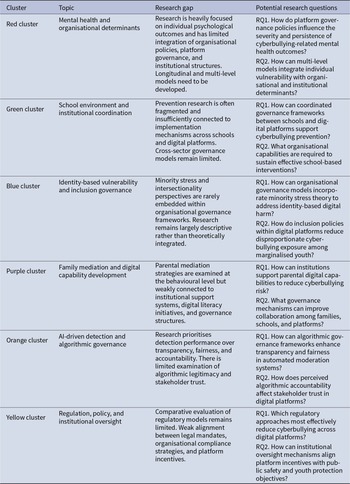
Thus, the clusterisation indicates that adolescent cyberbullying research has matured conceptually at the individual level but is underdeveloped from organisational and regulatory perspectives. To address this imbalance, it is required to shift analytical attention towards platform governance, cross-sector coordination, and regulatory effectiveness of digital organisations. Such a shift would align cyberbullying research more closely with management and organisation scholarship, where institutional design and socio-technical governance are central concerns. Based on the identified research gaps in clusterisation and following the review approach of previous articles such as González-Mendes et al. (Reference González-Mendes, Alonso-Muñoz, García-Muiña and González-Sánchez2024) and Cretu and Morandau (Reference Cretu and Morandau2024), Table 4 provides future research avenues of this field.
Research gap and future research agenda
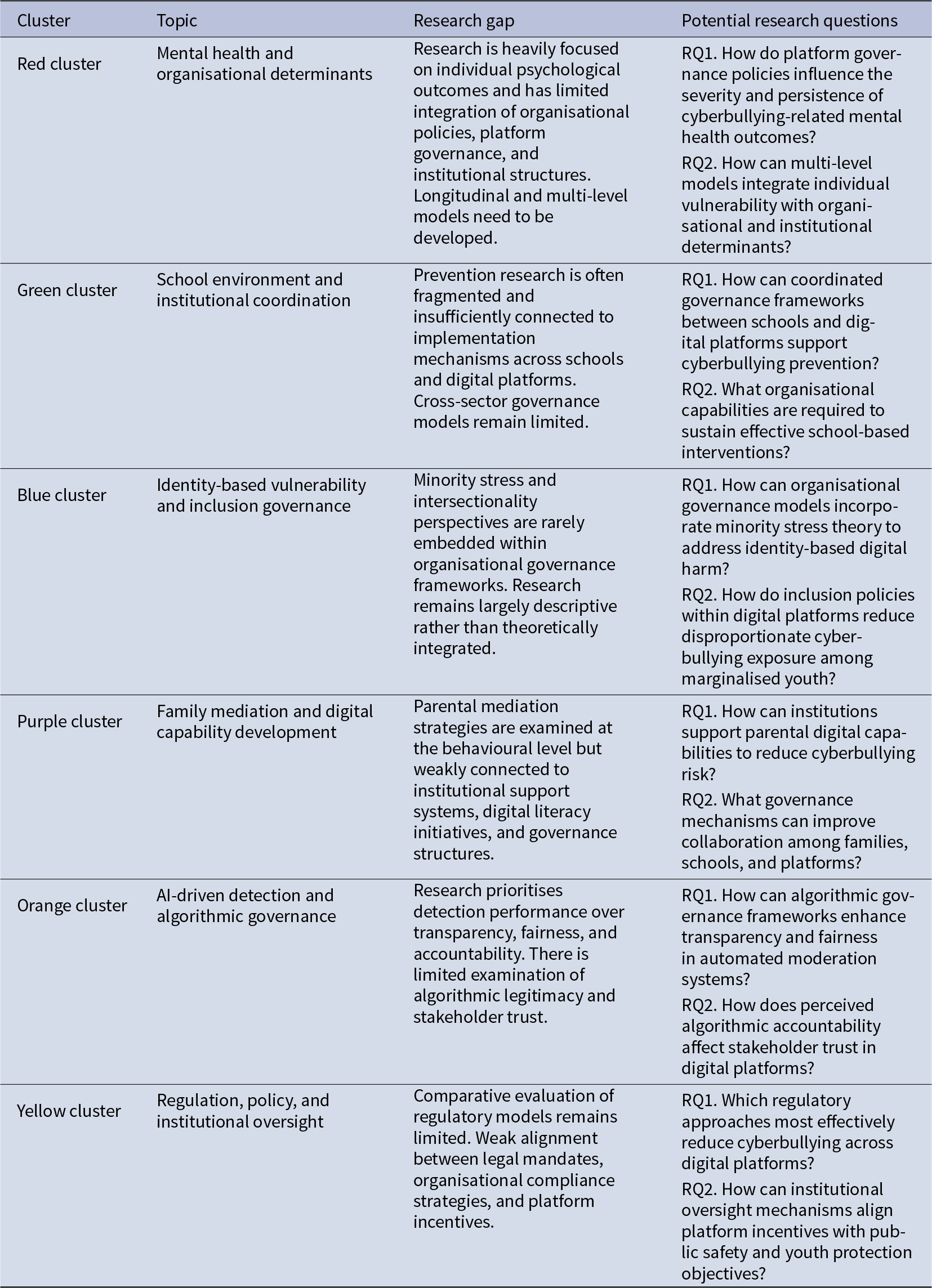
Table 4 Long description
The table organises a future research agenda into six thematic clusters, each listing a topic, a stated research gap, and two potential research questions. The red cluster notes mental health research is concentrated on individual outcomes and calls for longitudinal, multi-level approaches that include organisational policy, platform governance, and institutional structures. The green cluster highlights fragmented prevention work and limited cross-sector governance, emphasising coordination between schools and digital platforms and the capabilities needed to sustain interventions. The blue cluster points to limited integration of minority stress and intersectionality within governance models, asking how inclusion policies and governance can reduce disproportionate harm for marginalised youth. The purple cluster finds parental mediation is studied mainly as behaviour, with weak links to institutional supports, digital literacy initiatives, and governance, and proposes questions on institutional support and collaboration among families, schools, and platforms. The orange cluster critiques AI moderation research for prioritising detection performance over transparency, fairness, accountability, and legitimacy, and asks how accountability affects stakeholder trust. The yellow cluster identifies limited comparative evaluation of regulation and weak alignment among legal mandates, organisational compliance, and platform incentives, proposing research on effective regulatory approaches and oversight that aligns incentives with youth protection.
Conclusion
Adolescent cyberbullying has evolved into a complex organisational and societal challenge. This bibliometric analysis provides a comprehensive overview of the development of adolescent cyberbullying research between 2001 and 2025. The sharp rise in publications from 2015 reflects the growing recognition of cyberbullying as a salient public health and organisational issue.
Overall, research has been heavily focused on psychological outcomes, such as depression, anxiety, and suicidal ideation. Recent systematic reviews confirm the strong association between cyberbullying and adverse mental health consequences. However, governance-related issues such as platform accountability, digital regulation, and institutional oversight have been comparatively less considered in the research field. This imbalance is noteworthy given that global policy bodies provide emphasis on online safety regulations and platform responsibility in their reports.
AI and machine learning have emerged as important themes, particularly in automated detection systems, but recent AI research highlights that transparency, bias mitigation, and algorithmic accountability often negatively impact the technical performance. This also suggests that cyberbullying research has not yet fully incorporated organisational accountability concerns into technological discussions.
A future research agenda is proposed, which emphasises the need to foster cyberbullying research from organisational and institutional perspectives. Stronger integration of governance frameworks, cross-sector coordination models, and stakeholder accountability mechanisms are required to complement individual-level cyberbullying research. In addition, emerging research on digital inequality and identity-based harm suggests that minority stress should be systematically incorporated into regulatory frameworks. Finally, collaboration between the public and private sectors under regulation enforcement is necessary to ensure that the technological solutions are supported by effective institutional oversight.
Theoretical implications
This study makes a significant theoretical contribution by providing a systematic analysis of the intellectual structure and thematic development of research in adolescent cyberbullying. Recent reviews highlight the need for multi-level models that integrate individual, organisational, and structural determinants (Evangelio Caballero et al., Reference Evangelio Caballero, Rodriguez-Gonzalez, Fernández Río and González Víllora2022; Zhu et al., Reference Zhu, Huang, Evans and Zhang2021). However, our findings demonstrate that governance and regulatory constructs remain underdeveloped relative to individual psychological themes. The results reveal opportunities to incorporate institutional, socio-technical systems, and stakeholder theories into cyberbullying research. Digital platforms act as organisational actors whose algorithmic architectures influence users’ interaction behaviours. This influence needs to be fully theorised within mainstream cyberbullying research. In addition, recent work on AI governance emphasises the importance of accountability and transparency of digital systems. Integrating these perspectives into cyberbullying research can enhance theoretical coherence and, most importantly, broaden the field beyond a victim-focused approach.
Practical implications
This study is insightful for educators, policymakers, and regulators. The findings suggest that a coordinated institutional response is required for an effective approach to cyberbullying prevention. A cross-sector collaboration among schools, technology firms, and regulators can help to enhance digital safety. Also, digital platforms need to prioritise algorithmic transparency and bias to enhance organisational legitimacy. In this regard, educational institutions are required to consider digital literacy in their curriculum design. Finally, policymakers should develop regulatory frameworks to better align platform incentives with youth protection objectives.
Limitations and future research
This study is subject to several limitations. First, the bibliometric analysis relies on publications from a single database, potentially excluding relevant studies from other sources. Although co-occurrence analysis offers valuable insights, additional analysis such as bibliographic coupling and co-citation analysis could provide deep understanding of conceptual foundations of the filed. Future research should prioritise longitudinal and cross-national studies to improve causal understanding with deeper contextual insights. More empirical research is needed to assess potential bias in autonomous moderation systems and governance approaches, supporting inclusion and equity in digital environments. Addressing these gaps will support the development of institutionally aligned, ethically grounded, and technologically responsible approaches to managing adolescent cyberbullying.
Acknowledgements
The authors would like to acknowledge Ziming Sue for participation in early-stage ideation that inspired the development of this paper.
Conflict of interest
Authors declare no competing interests related to this publication.
Dr. Abdul Babar is an associate lecturer in Business Analytics at the School of Business, Western Sydney University. His teaching and research have focused on business analytics, artificial intelligence, and organisational performance. He has published articles in leading journals such as CAISE and IS Frontiers, including a book with IGI Global, Strengthening Human Relations in Organisations with AI. His current research explores AI leadership, ethical analytics, and curriculum innovation in the era of Generative AI (ORCID: https://orcid.org/0009-0005-5437-7844).
Dr. Muhammad Salman Asif is an Associate Lecturer in Operations Management at the School of Business, Western Sydney University. His research focuses on integrating innovative technologies with organisational operations and supply chains. He has published in leading journals and presented his work at reputed international conferences. His industry-oriented projects include developing mechanisms for environmental collaboration between multinational corporations and their partners in developing countries and proposing new methods of innovation and technology diffusion. He is a member of the Chartered Institute of Logistics and Transport (MILT) and the Australian and New Zealand Academy of Management (ANZAM), holds Chartered Professional Logistician (CPL) status, and is a certified Lead Auditor for ISO 14001 and ISO 50001 (ORCID: https://orcid.org/0000-0001-9769-910X).
Isha Kharub is a PhD candidate at Western Sydney University. Her research interests included the use of social robots in service marketing and hospitality settings. Her PhD research aims to develop a scale to measure Willingness to Accept Social Robot Recommendations in hospitality settings (ORCID: https://orcid.org/0009-0004-4259-3809).
Prof Ghassan Beydoun received the degree in computer science and the PhD degree in knowledge systems from the University of New South Wales. He is currently a Professor of Information Systems with the School of Computer Science, University of Technology Sydney. He has authored more than 200 papers in international journals and conferences. His research projects are sponsored by the Australian Research Council, the NSW State Government, and the private sector. He investigates the best uses of models in developing methodologies for distributed intelligent systems. His other research interests include cloud adoption, disaster management, decision support systems, and their applications (ORCID: https://orcid.org/0000-0001-8087-5445).

 Open access

