




Introductory Statement
In many developing countries, recommendations distributed by public agricultural extension are still assumed to apply for entire countries or agro-ecological zones. This concerns, in particular, fertilizer use, cultivar choice (often so-called improved varieties), and tillage practices. This extension approach contradicts the obvious variability of site conditions within landscapes, village territories, and even individual farms or fields (Vanlauwe et al., Reference Vanlauwe, Coe and Giller2017). Soil types and properties usually change along topographic position. Based on respective field observations in Tanzania, Milne (Reference Milne1935) developed the catena concept that is widely used in soil science. Surface and subsurface flows redistribute particulate as well as dissolved soil matter, e.g., nutrients. In consequence, notably subsistence agriculture that mainly depends on soil conditions as natural resource, and is limited by available area or labor, needs site-adapted recommendations considering environmental gradients. Further aspects to be considered in agricultural extension are climatic constraints (e.g. intra-seasonal droughts, spatial variability of rainfall), as well as limited access to inputs (e.g. fertilizer) and production risk. Multi-year experiments are, therefore, of highest importance to evaluate inter-annual influences on crop yield (Herrmann et al., Reference Herrmann, Haussmann, van Mourik, Traoré, Oumarou, Traoré, Ouedraogo and Naab2013).
In Tanzania, agricultural policy emphasized the need for extension services to primarily support subsistence farmers. The number of extension staff indeed increased over the last years (Elifadhili, Reference Elifadhili2013). However, extension services rather addressed livestock-related problems than cropping (Elifadhili, Reference Elifadhili2013), even in regions, which suffer from high population pressure that results in soil degradation. Droughts leading to famines are still frequent threats for subsistence agriculture in central Tanzania.
The Trans-SEC project (Innovating strategies to safeguard food security using technology and knowledge transfer: a people-centered approach) participatorily investigated the transfer and distribution of knowledge along whole food value chains in Tanzania in order to improve the different steps from land preparation to consumption. In the project framework, the need appeared to better integrate all stakeholders reaching from scientists and extension services over farmers’ organizations to farmers. A crucial aspect was to include soil information as explanatory variable. For this purpose, three different types of field trials were conducted reaching from researcher managed on-station trials and researcher-managed demonstration plots in the village to farmer-managed on-farm trials on variable soil units.
Emphasis in this paper is put on the questions (1) which type of experiments can support which kind of recommendation, (2) which explanatory power soil information has in this respect, and (3) what other aspects need to be considered. This topic is discussed taking fertilizer and tillage experiments as examples.
Materials and Methods
The research was conducted on a research station and in two villages in central Tanzania. With respect to the research, the traditional top-down approach was applied and combined with participatory methods, i.e., international and national scientists selected potential innovations based on previous experience and literature research and discussed with farmers in the intervention zones applicability and constraints. Based on these discussions, the scientists adapted chosen technologies to their best knowledge to local conditions.
General description of the study area
All field trials were conducted in the semi-arid Dodoma region of Tanzania. Average rainfall amounts to 594 mm and average temperature is 23°C at Dodoma airport (1980–2010; TMA, 2013). Evaporation reaches about 1600 mm per year (Kahimba et al., Reference Kahimba, Mutabazi, Tumbo, Masuki and Mbungu2014). The rainy season lasts from December to April. Milne`s catena concept (Reference Milne1935) applies for the study area, reaching from rock outcrops and low pH at hilltops to fine grain sizes and alkaline conditions in valley bottoms. Rainfall scarcity and variations within short distances as well as water redistribution by lateral flow along slopes are common.
Elevations in the study area range between 990 and 1190 m asl. On geological maps from 1953 and 1967, obtained from the Geological Survey of Tanzania in Dodoma, so-called ‘contaminated granite’ (i.e. incorporation of foreign petrographic material) appears as major rock type. Due to low spatial resolution (1:100 000 and 1:125 000, respectively), and own field observations, those maps were not considered adequate. In fact, variable petrography was found during field trips, reaching from unconsolidated sorted Quaternary sediments over tertiary intermediary metamorphic rocks to felsic and intermediary Precambrian volcanic rocks.
Soils are variable reaching from highly weathered and nutrient-deficient ones (e.g. Acrisol), over those degraded by overgrazing and erosion (e.g. Leptosol), to temporally inundated Vertisols rich in nutrients. Soil surfaces have been observer to be bare during the dry season.
Most farmers practice subsistence agriculture, growing pearl millet (Pennisetum glaucum (L.) R.Br.), sorghum (Sorghum bicolor (L.) Mönch), and maize (Zea mays L.) as staple crops during the rainy season. As inter- and cash crops, peanuts (Arachis hypogaea L.), bambara nuts (Vigna subterranea (L.)Verdc.), pigeon peas (Cajanus cajan (L.)Millsp.), or cow peas (Vigna unguiculata (L.)Walp.) were found. On more fertile Vertisols, vegetables are grown. Either hand hoes, or, in better off households, ox-ploughs are used for tillage. If available, manure is applied, while hardly any mineral fertilizer is used.
Study sites, soil mapping, and information
The research station of the Agricultural Research Institute (ARI) Makutupora (E35°46′7″ S5°46′7″, ca. 1100 m a.s.l.) is located in Mjini district of Dodoma, approximately 20 km north of Dodoma city. According to the World Reference Base for Soil Resources (WRB, IUSS working group, 2015), the soils of both fields were classified as Rhodic Luvisol (loamic, ochric) characterized by clay illuviation as major soil-forming process. Previous soil surveys showed the following nutrient content for the top 0.15 m, evaluated after Landon (Reference Landon1984):
Field A: 0.06% N – very low, 16.7 mg kg−1 P – medium, 414 mg kg−1 K – high
Field B: 0.09% N – very low, 96.6 mg kg−1 P – high, 582 mg kg−1 K – high
Soil mapping in the villages Ilolo (E35°59′11″ S6°25′13″) and Idifu (E35°54′50″ S6°20′26) in Chamwino district approx. 45 km to the southeast of Dodoma followed a mixed approach, beginning with participatory mapping (including local denomination of major soil units) and adding information from transect mapping, gamma spectrometry, and remote sensing. The mapping approach is detailed in Reinhardt and Herrmann (Reference Reinhardt and Herrmann2017).
In both villages similar reference soil groups (RSGs) occurred. Leptosols were found on eroded hilltops, Chromic Lixisols (hypereutric) on middle slopes, Chromic Lixisol (loamic in Idifu) on foot slopes, Haplic Acrisols (loamic) in flat terrain, and Sodic Vertisols (hypereutric) in depressions. Cutanic Stagnic Luvisols (hypereutric) were solely found in a small area in Ilolo in the same topographic position as Chromic Lixisols. Chromic Lixisol (hypereutric) units were rare in Idifu. The dominating soils in both villages are those characterized by clay illuviation (Luvisol, Lixisol, Acrisol) representing a typical soil-forming process in seasonal climates. The occurrence of the soils within the landscape is a function of the underlying rock (large variability of magmatic, metamorphic, and volcanic parent materials) and the topographic position. The latter is important due to lateral redistribution of soil materials mainly through water erosion. While the hilltops are strongly eroded (Leptosols), sand accumulation belts are found at the foot slopes (Acrisols) and finest material (clay) and solutes are accumulated in the endorheic depressions (Vertisols).
Soil properties of reference soil pits are presented in Table 1. Texture spreads from loamy sand to pure clay. Organic matter content is generally low. The pH values show a wide spread from acidic to alkaline (pH 5.0–8.7 in Ilolo and 5.5–7.1 in Idifu). Electrical conductivity was unremarkable, except higher values for the Vertisol in Ilolo that are only relevant for sodium-sensitive plants.
Primary limiting nutrients are phosphorus and nitrogen. Plant-available phosphate is rated low to very low (0.3–11.7 mg kg− 1), nitrogen very low on nearly all sampled plots. Rated after Landon (Reference Landon1984), plant-available potassium was high with few exceptions.
Means for various soil properties of sampled reference profiles in (a) Ilolo and (b) Idifu. All means were calculated from weighted averages for the top 30 cm (n.d. = not detectable). EC: electrical conductivity; BS: base saturation, pa: plant available

Given this variability of soil conditions, it cannot be expected that crops on all sites respond to management measures in the same manner. This is particularly true for both tested innovations, that is, fertilization (given the spread of plant-available P), and soil tillage (work load depending on texture). Vertisols were ex ante exempted from field trials due to their special character, i.e., good nutrient status and inundation risk.
During focus group discussions, local farmers distinguished the major soil types due to color, texture, water-holding capacity, and crop performance. Acrisols were designated suitable for plants with low nutrient demand like pearl millet, white sorghum, peanuts, cow peas, or cassava (Manihot esculenta Crantz). On more fertile soils like Lixisols, sunflowers, grapes (vitis vinifera), or sesame (Sesamum indicum L.) were grown. Plants having higher nutrient requirements like vegetables or sugarcane were exclusively grown on Vertisols (and the Luvisol in Ilolo).
Innovations tested in pearl millet cropping
Tested innovations that deal with the actual production constraints water scarcity and soil nutrient status were tied ridging as tillage and water conservation practice, and placed fertilizer (PF) application in order to restrict fertilizer input and increase fertilizer efficiency at the same time.
Tied ridges (TR) increase soil moisture by decreasing surface flow and enhancing infiltration (Kilasara et al., Reference Kilasara, Boa, Swai, Sibuga, Boniface and Kisetu2015). Ridges in combination with ties act as water erosion barriers, thus conserving fertile topsoil and rainwater. However, the establishment of TRs is work demanding in comparison to flat cultivation and requires about 266 labor hours per hectare (measurements in situ). General TR design recommendations were as follows: Ridge distance 0.75–0.80 m, ridge height 0.2 m, ties every 1.5 and 0.15 m high, and fixed in a staggered way (Trans-SEC factsheet, 2016).
PF application has multiple goals. It enhances fertilizer efficiency and leads, in consequence, to reduced nutrient losses, in the case of mobile K and N, and less fertilizer demand in comparison to broadcast application. This, in turn, results in lower investment, decreases the risk for loss of investment, while increasing the yield potential (Bielders and Gerard, Reference Bielders and Gerard2015). However, as it is true for tied ridging, the workload is increased. Application was recommended as follows: a full screw cap from a water bottle, that is, 2 g (resulting in 7.5 kg P ha−1) of triple superphosphate (TSP) fertilizer was placed into each planting hole and covered with some soil before the seeds were sown right next to the fertilizer spot.
Pearl millet (P. glaucum (L.)R.Br. cv. okoa) as test crop was chosen since it represents a major staple crop in the semi-arid areas of Tanzania. The average grain yield in Tanzania according to Kamhambwa (Reference Kamhambwa2014) is 0.77 t ha−1; in Chamwino district, however, it only reaches 0.36 t ha−1. Responsible for low crop performance is poor soil fertility and insufficient precipitation in combination with erosion and low soil water retention capacity (Kimenye, Reference Kimenye2014).
One-dimensional testing: the on-station researcher-managed trial
On-station field trials were conducted on two fields at ARI Makutupora from January to May in 2015 and 2016. In this context, we call these experimental conditions one-dimensional (1D), since only the treatments are expected to mainly influence the crop yield. Climate and soil conditions are regarded constant at this spatial level. The experiment was designed to reveal the maximum potential of TR. A researcher designed, supervised, and conducted the experiments in a controlled environment (i.e. on-station in randomized block design).
A weather station (WS-GP1, Delta-T) was installed close to the experimental site on-station. The observed precipitation substantially differed between the two seasons (Table 2) and between the research station and intervention villages.
Mean rainfall data ± standard deviation [mm] collected from the weather station in Makutupora (i.e. on-station) and by local farmers in Ilolo and Idifu for the cropping periods 2015 and 2016, N is the number of observations

Pearl millet was grown on two experimental fields (field A and B) during the rainy seasons 2015 and 2016 from January until beginning of May. Hereby, rainfed plots with TR were compared with rainfed flat plots (R) without any alteration of the soil. A fully irrigated (FI) treatment was part of the experiment on field A in order to explore the potential yield under the prevailing environmental conditions. These plots were connected to a drip irrigation system and irrigated whenever the rainfall amount was not sufficient to meet the crop water requirements. The weeding frequencies and input of fertilizer were identical among the mentioned treatments. Each treatment was tested with four replicates on both fields.
Plots were 4.0 m × 5.7 m in size; every treatment was installed with 5 rows, each containing 18 plants. Border plants were not harvested and not included in yield calculations.
On-station, all plots received a mixture of fertilizers at the recommended rate (Kanyeka et al., Reference Kanyeka, Kamala and Kasuga2007; Khairwal et al., Reference Khairwal, Rai, Diwakar, Sharma, Rajpurohit, Nirwan and Bhattacharjee2007): 60 kg N ha−1, 13.1 kg P ha−1, 24.9 kg K ha−1 via Yara Mila complex fertilizer (23–10–5), potassium nitrate (13–0–46), and triple super phosphate (0–44.5–0) were placed into each planting hole during sowing and covered with some soil before the seeds were added. Urea (46–0–0) was side dressed 4–6 weeks after emergence over all treatments. Adequate nutrient supply of millet with N, P, and K can therefore be assumed.
The TR geometry was based on general recommendations (Trans-SEC factsheet, 2016) and adjusted to the irrigation setup: the ridges were 0.8 m apart and 0.25 m high. They were connected via cross ties in 0.6 m distance and with a height of 0.15 m. Seeds were sown on top of the ridges.
Two- and multiple-dimension experiments in the local environment: mother and baby trials
As next step, the experiments were expanded to the intervention areas, i.e., the two villages llolo and Idifu. The experiments on mother (demonstration plots) and baby trials (on-farm) started in the end of 2014. The distance between these and Makutupora-station amounts to approximately 60 km linear distance. Mother trials served as researcher-managed demonstration plots, whereas baby trials reflected real farm environments managed by the plot owners.
Mother trials took place on one field per village that was provided by local farmers. Soil properties did not play a primary role during the site-selection process. Instead, availability, that is, farmers’ disposition to provide their land was decisive. In consequence, the mother trials differed between each other and from the on-station fields in their soil reference group. This way, variability with respect to soil as well as meteorological variables (rainfall and its distribution) was introduced into the experimental error. Due to the limited variability of experimental factors and the management still being in the hand of the researcher, we call this experimental approach two-dimensional (2D). Plot size per repetition was 21.6 m²; each treatment was repeated five times in Ilolo in 2015 and three times in both villages in 2016. The Idifu mother trial failed to produce any yield in 2015 due to deficient precipitation. In order to reduce the risk of repeated crop failure, the experiment was shifted from the highly degraded site to an area with better water holding capacity. Therefore, from Idifu, only data for the season 2015 are available. RSGs were Haplic Acrisol (loamic) in Idifu at the new plot and Chromic Lixisol in Ilolo in both seasons. On the mother trials, three different fertilizer rates were applied. The ‘full rate’ is based on recommendations of Kanyeka et al. (Reference Kanyeka, Kamala and Kasuga2007): (1) recommended rate, that is, 60 kg N ha−1 and 13.1 kg P ha−1; zero K (di-ammonium phosphate and calcium ammonium phosphate). The two other applied rates were: (2) 25% of treatment 1, and (3) control plots without fertilization (i.e. common farmers’ practice). The furrows related to tied ridging followed the given recommendations. The seeds were sown on top of the ridges. Control plots were left flat.
Project staff guided the installation of the on-farm experiments (baby trials) by explaining the principal setup, but finally, farmers themselves managed the land. Baby trial treatments were to the farmers’ independent choice. Within their fields, one 10 m × 10 m plot was assigned as treatment plot and one as control. Rainfall was also measured by some farmers. The amounts between the two consecutive seasons 2015 and 2016 differed tremendously (Table 2).
For the analytical work, only data from plots within village borders, and from one of the major RSGs (except Sodic Vertisol (hypereutric)) were taken into account to grant a sufficient number of repetitions. The number of yield data for analyses was n = 141.
Apart from the variability of environmental conditions (soil, topography, etc.), this approach incorporates one further uncertainty for data analysis, that is, management control in the hands of the farmers. Consequently, transferred information on management practices per site might not be complete. In addition, certain yield explanatory environmental factors like rainfall or pest occurrence often remain unknown. Due to these added uncertainty components, we call these experimental conditions multi-dimensional (multiD).
Statistical analysis
On-station trials (1D)
The following linear mixed effects model was used to evaluate on-station trials:
 $${y_{abil}} = \mu + {s_a} + {j_b} + {(sj)_{ab}} + {r_{abl}} + {\tau _j} + {\left( {s\tau } \right)_{ai}} + {\left( {j\tau } \right)_{bj}} + {\left( {u\tau } \right)_{abj}} + {e_{(a)bjl}}$$
where ${y_{abil}}$
are the square root-transformed millet yields in site a, at year b, in replicate l within year and site and treatment level j. μ is the intercept;
${y_{abil}}$
are the square root-transformed millet yields in site a, at year b, in replicate l within year and site and treatment level j. μ is the intercept; ${s_a}$
is the fixed effect of the ath site;
${s_a}$
is the fixed effect of the ath site; ${j_b}$
is the fixed effect of the bth year;
${j_b}$
is the fixed effect of the bth year; ${\left( {sj} \right)_{ab}}$
is the fixed-year-specific site effect;
${\left( {sj} \right)_{ab}}$
is the fixed-year-specific site effect; ${r_{abl}}$
is the effect of the lth replicate within the combinations of site and year;
${r_{abl}}$
is the effect of the lth replicate within the combinations of site and year; ${\tau _j}$
is the effect of the jth treatment;
${\tau _j}$
is the effect of the jth treatment; ${\left( {s\tau } \right)_{aj}}$
,
${\left( {s\tau } \right)_{aj}}$
, ${\left( {j\tau } \right)_{bj}}$
, and
${\left( {j\tau } \right)_{bj}}$
, and ${\left( {sj\tau } \right)_{abj}}$
are the interactions of treatment with site, year, and their combination.
${\left( {sj\tau } \right)_{abj}}$
are the interactions of treatment with site, year, and their combination. ${e_{\left( a \right)bjl}}$
are the residual error terms. In order to account for heterogeneity of variance between the two sites, separate error variances were estimated with expected mean of zero and variances
${e_{\left( a \right)bjl}}$
are the residual error terms. In order to account for heterogeneity of variance between the two sites, separate error variances were estimated with expected mean of zero and variances $\sigma _{e1}^2$
and
$\sigma _{e1}^2$
and $\sigma _{e2}^2$
:
$\sigma _{e2}^2$
: ${e_{\left( 1 \right)bjl}}\sim N\left( {0,\sigma _{e1}^2} \right)$
and
${e_{\left( 1 \right)bjl}}\sim N\left( {0,\sigma _{e1}^2} \right)$
and ${e_{\left( 2 \right)bjl}}\sim N\left( {0,\sigma _{e2}^2} \right)$
.
${e_{\left( 2 \right)bjl}}\sim N\left( {0,\sigma _{e2}^2} \right)$
.
Mother trials (2D)
The following linear mixed effects model was used to evaluate on-site mother trials. We renounced to a joint analysis with multiD due to the enormous increase in factor variability from mother to baby trials (e.g. soil type, climate, management). Information about the blocks in mother trials is missing; therefore, the data were analyzed as a completely randomized design. The following model was used.
 $$\eqalign{{y_{abjkl}} = \mu &+ {s_a} + {j_b} + {\tau _j} + {\phi _k} + {\left( {\tau \phi } \right)_{jk}} + {(s\tau )_{aj}} + {(s\phi )_{ak}} + {(s\tau \phi )_{ajk}} \cr &+ {\left( {\ j\tau } \right)_{bj}} + {(\ j\phi )_{bk}} + {\left( {\ j\tau \phi } \right)_{bjk}} + {e_{(ab)jkl}}}$$
where ${y_{abikl}}$
the log-transformed millet yield on the lth plot in site a and year b, with the combination of the water harvesting type j and fertilizer level k. μ is the intercept,
${y_{abikl}}$
the log-transformed millet yield on the lth plot in site a and year b, with the combination of the water harvesting type j and fertilizer level k. μ is the intercept, ${s_a}$
is the effects site a,
${s_a}$
is the effects site a, ${j_b}$
is the effect of year b.
${j_b}$
is the effect of year b. ${\tau _j}$
is the effect of the jth water harvesting system,
${\tau _j}$
is the effect of the jth water harvesting system, ${\phi _k}$
is the effect of the kth fertilizer level,
${\phi _k}$
is the effect of the kth fertilizer level, ${\left( {\tau \phi } \right)_{jk}}$
their interaction.
${\left( {\tau \phi } \right)_{jk}}$
their interaction. ${\left( {s\tau } \right)_{aj}}$
,
${\left( {s\tau } \right)_{aj}}$
, ${\left( {s\phi } \right)_{ak}}$
,
${\left( {s\phi } \right)_{ak}}$
, ${\left( {s\tau \phi } \right)_{ajk}}$
,
${\left( {s\tau \phi } \right)_{ajk}}$
, ${\left( {\ j\tau } \right)_{bj}}$
,
${\left( {\ j\tau } \right)_{bj}}$
, ${\left( {\ j\phi } \right)_{bk}}$
, and
${\left( {\ j\phi } \right)_{bk}}$
, and ${\left( {\ j\tau \phi } \right)_{bjk}}$
are the interactions of site, season, and both treatment factors as well as their combination.
${\left( {\ j\tau \phi } \right)_{bjk}}$
are the interactions of site, season, and both treatment factors as well as their combination. ${e_{\left( {ab} \right)ikl}}$
are the residuals error terms. In order to account for heterogeneity of variance between environments, separate error variances were estimated:
${e_{\left( {ab} \right)ikl}}$
are the residuals error terms. In order to account for heterogeneity of variance between environments, separate error variances were estimated: ${e_{\left( {11} \right)bjl}}\sim N\left( {0,\sigma _{e11}^2} \right)$
,
${e_{\left( {11} \right)bjl}}\sim N\left( {0,\sigma _{e11}^2} \right)$
, ${e_{\left( {12} \right)bjl}}\sim N\left( {0,\sigma _{e12}^2} \right)$
, and
${e_{\left( {12} \right)bjl}}\sim N\left( {0,\sigma _{e12}^2} \right)$
, and ${e_{\left( {22} \right)bjl}}\sim N\left( {0,\sigma _{e22}^2} \right)$
.
${e_{\left( {22} \right)bjl}}\sim N\left( {0,\sigma _{e22}^2} \right)$
.
On-farm trials (multiD)
The following linear mixed effects model was used to evaluate yield data from the two-site/two-season on-farm data. The treatment combination TR without fertilizer was not sufficiently often chosen by farmers for statistical evaluation. Therefore, a single treatment factor variable with three levels (FTF0, FTPF, and TRPF) was used in the model:
 $$\eqalign{{y_{abijl}} = \mu &+ {s_a} + {j_b} + {\left( {sj} \right)_{ab}} + {\eta _i} + {\tau _j} + {\left( {\eta \tau } \right)_{ij}} + {\left( {s\eta } \right)_{ai}} + {\left( {s\tau } \right)_{aj}} + {\left( {\ j\eta } \right)_{bi}} \cr &+ {\left( {\ j\tau } \right)_{bj}} + {\left( {sj\eta } \right)_{abi}} + {\left( {sj\tau } \right)_{abj}} + {\left( {sj\eta \tau } \right)_{abij}} + {e_{bi\left( {aj} \right)l}}}$$
where ${y_{abijl}}$
is the log-transformed millet yield on the lth farmers plot of soil type i, in site a and year b and treatment j. μ is the intercept,
${y_{abijl}}$
is the log-transformed millet yield on the lth farmers plot of soil type i, in site a and year b and treatment j. μ is the intercept, ${s_a}$
is the fixed effect of site a.
${s_a}$
is the fixed effect of site a. ${j_b}$
is the fixed effect of season b.
${j_b}$
is the fixed effect of season b. ${\eta _i}$
is the fixed effect of the ith soil type,
${\eta _i}$
is the fixed effect of the ith soil type, ${\tau _j}$
is the fixed effect of the jth treatment,
${\tau _j}$
is the fixed effect of the jth treatment, ${\left( {\eta \tau } \right)_{ij}}$
is the two-way interactions of soil and treatment.
${\left( {\eta \tau } \right)_{ij}}$
is the two-way interactions of soil and treatment. ${\left( {sj} \right)_{ab}}$
,
${\left( {sj} \right)_{ab}}$
, ${\left( {s\eta } \right)_{ai}}$
,
${\left( {s\eta } \right)_{ai}}$
, ${\left( {s\tau } \right)_{aj}}$
,
${\left( {s\tau } \right)_{aj}}$
, ${\left( {j\eta } \right)_{bi}}$
,
${\left( {j\eta } \right)_{bi}}$
, ${\left( {j\tau } \right)_{bj}}$
,
${\left( {j\tau } \right)_{bj}}$
, ${\left( {sj\eta } \right)_{abi}}$
,
${\left( {sj\eta } \right)_{abi}}$
, ${\left( {sj\tau } \right)_{abj}}$
, and
${\left( {sj\tau } \right)_{abj}}$
, and ${\left( {sj\eta \tau } \right)_{abij}}$
are the random site and year-specific effects of soil and treatment.
${\left( {sj\eta \tau } \right)_{abij}}$
are the random site and year-specific effects of soil and treatment. ${e_{bi\left( {aj} \right)l}}$
are the residual error terms, whereby individual variances for each combination of site and water treatment were allowed to achieve homogeneity of variance. Independence of soil type and treatment factors was perceived to be a prerequisite in order to formulate model (3). The allocation of the factor soil is not randomized. Participating farmers themselves chose which treatment combination to use for their plot. Hence, possibly the selection of treatment could be guided by farmers’ assumption which treatment might turn out favorable on different soils. Such selection would distort any conclusions drawn from an analysis of performance of treatment combinations on different soils. To control for such bias before applying model (3), association of treatment and soil type was tested for each site and season combination. Independence of soil and treatment allocation was tested in contingency tables. As the expected frequencies in the tables were very low, p-values for the χ²-test were estimated by resampling from the contingency Table 10,000 times.
${e_{bi\left( {aj} \right)l}}$
are the residual error terms, whereby individual variances for each combination of site and water treatment were allowed to achieve homogeneity of variance. Independence of soil type and treatment factors was perceived to be a prerequisite in order to formulate model (3). The allocation of the factor soil is not randomized. Participating farmers themselves chose which treatment combination to use for their plot. Hence, possibly the selection of treatment could be guided by farmers’ assumption which treatment might turn out favorable on different soils. Such selection would distort any conclusions drawn from an analysis of performance of treatment combinations on different soils. To control for such bias before applying model (3), association of treatment and soil type was tested for each site and season combination. Independence of soil and treatment allocation was tested in contingency tables. As the expected frequencies in the tables were very low, p-values for the χ²-test were estimated by resampling from the contingency Table 10,000 times.
Model fitting
The model parameters were estimated using the software SAS 9.4. Variance components were estimated by restricted maximum likelihood method (REML). Model assumptions normal distribution of residuals and homogeneity of variance were assessed by inspecting plots of standardized residuals. For the former assumption quantile–quantile plots were used, for the latter the scatter plots of residuals against predicted values. If assumptions were not fulfilled, response variables were transformed and heterogeneous variances were used until assumptions appeared. Random effects were tested for significance using likelihood-ratio tests and non-significant effects were removed from the model. Fixed effects were tested for significance by sequential Wald-type F-test. Non-significant fixed effects were removed from the model. Denominator degrees of freedom and standard errors were adjusted using the method of Kenward and Roger (Littell et al., Reference Roy, Littell, Milliken, Stroup, Wolfinger and Schabenberger2007). The levels of factors found significant in the F-test were compared by pairwise t-tests and other linear contrasts. Throughout the entire statistical analysis, a significance level of 5% was used.
Results and Discussion – Treatment Effects on Different Levels
1D testing: the on-station researcher-managed trials – potential yield of and tied ridging effect on pearl millet grain yield
When model (1) was fitted to the pearl millet yields obtained from the on-station trials, the F-test showed a significant interaction of season and treatment (p < 0.0001, Table S1 in supplementary material, available online at https://doi.org/10.1017/S0014479719000103) while the three-way interaction of site, season and treatment, as well as the two-way interaction of site (here field A and B) and treatment were not significant (p = 0.95 and p = 0.56, respectively, Table S1 in supplementary material).
Estimates of treatment levels within each season and estimates of seasons within each treatment level were compared by pairwise t-tests. Median estimates and test results are reported in Figure 1. The yield ranking between the treatments was the same in both cropping seasons, that is, FI >TR >R. Consequently, water availability during the rainy season was identified as production constraint. Based on the guidelines of the FAO-56 methodology (Allen et al., Reference Allen, Pereira, Smith, Raes and Wright2005), evapotranspiration of pearl millet under the local conditions is 524 mm. However, only 252 mm of rainfall occurred between sowing and harvest in 2015 (Table 2). Consequently, solely rainfed crops in flat terrain suffered from drought stress and hardly produced any grain. Highest susceptibility to water shortage was observed during the reproductive stage, i.e., at flowering.
Median estimates and 95% confidence intervals of different water harvesting treatments in the on-station trials at Makutupora research station (Tanzania) in 2015 and 2016 averaged over two sites. Treatment medians within each year are compared by pairwise t-tests. Medians of treatments within one season that share a common small letter do not differ significantly at α = 5%. Medians of two seasons within the same treatment factor level that share a capital letter do not differ significantly at α = 5%. Median estimates are based on model (1) fitted to square-root-transformed data and back-transformed for graphical display. Legend: R: rainfed, TR: tied ridging, FI: full irrigation.
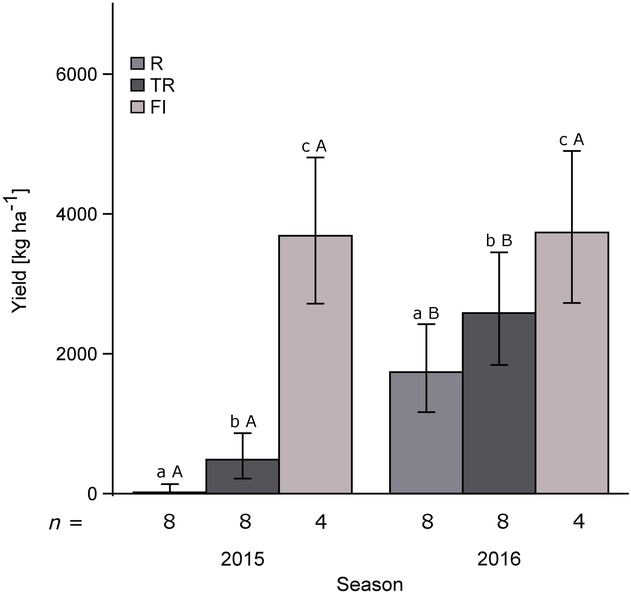
In contrast, the FI treatment revealed the yield potential under ideal water supply on-station, that is, 3.6 ± 0.7 t ha− 1 (Figure 1), but showing N-deficiency being common in semi-arid areas. Exchangeable P and K were present in sufficient amounts. Micronutrients were not analyzed. As to be expected, the FI grain yields did not statistically differ between the two growing seasons. Pearl millet in TR treatments performed significantly better than under rainfed conditions. R and TR treatments differed between the seasons, most probably due to water availability. The efficiency of TR in 2016 is underlined via approximation of yields to those of the FI treatment.
The generally higher yields on TR plots compared to R plants were probably attributed to reduced run-off as often argued in literature. However, farmers stated that they could apply this technology only to one acre per season, due to the extra-ordinary workload. In contrast, several reports state that only little maintenance is necessary in following seasons (UNEP, undated). In this respect, farmers stated that erratic high-intensity rain events cause enormous efforts to repair tied ridged fields.
In conclusion, under the given soil conditions (Rhodic Luvisol (loamic, ochric)) TR increased yield compared to rainfed conditions. No information was produced how TR would perform under other soil conditions (e.g. low nutrient levels, different texture), and whether this technology is economically feasible given the high workload. The on-station trials revealed the importance of water availability in certain growth stages, especially in the reproductive stage of pearl millet. On-station plots were not useable for technology transfer to farmers, mainly due to the distance of 60 km from the villages and diverging soil and climate conditions.
2D testing: researcher-managed trials in the investigated villages – tied ridging and placed fertilizer effect on pearl millet grain yield
When model (2) was fitted to mother trial yields, the F-test showed a significant three-way interaction of water harvesting, fertilizer, and site (p = 0.0017, Table S2 in supplementary material), while the same interaction with season was not significant (p = 0.2316, Table S2 in supplementary material) but the season main effect (p = 0.002, Table S2 in supplementary material).
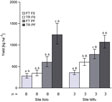
Figure 2 shows the pearl millet yield means of fertilizer regimes and water harvesting systems on mother trials in the two intervention villages. Crop failure in the first experimental season on the mother trial in Idifu was caused by highly degraded soil in combination with erosion on-site and severe drought. This is, however, reality in the village. In 2015, farmers in both villages lost most of their crop due to drought (Table 2).
Median estimates and 95% confidence intervals of combinations of water harvesting systems and fertilizer regimes at Illolo and Idifu villages (Tanzania). Medians at Ilolo are averaged over 2 years. Medians of treatment combinations which share a common small letter do not differ within each site at α = 5% significance level. Medians of the same treatment combination that share a common capital letter do not differ between sites at site at α = 5% significance level. Medians are estimated from model (2) fitted to log-transformed data and back-transformed for graphical display. Mean comparisons based on pairwise t-tests. Legend: FT: flat ties, F0: no fertilization, TR: tied ridging, PF: placed fertilizer.
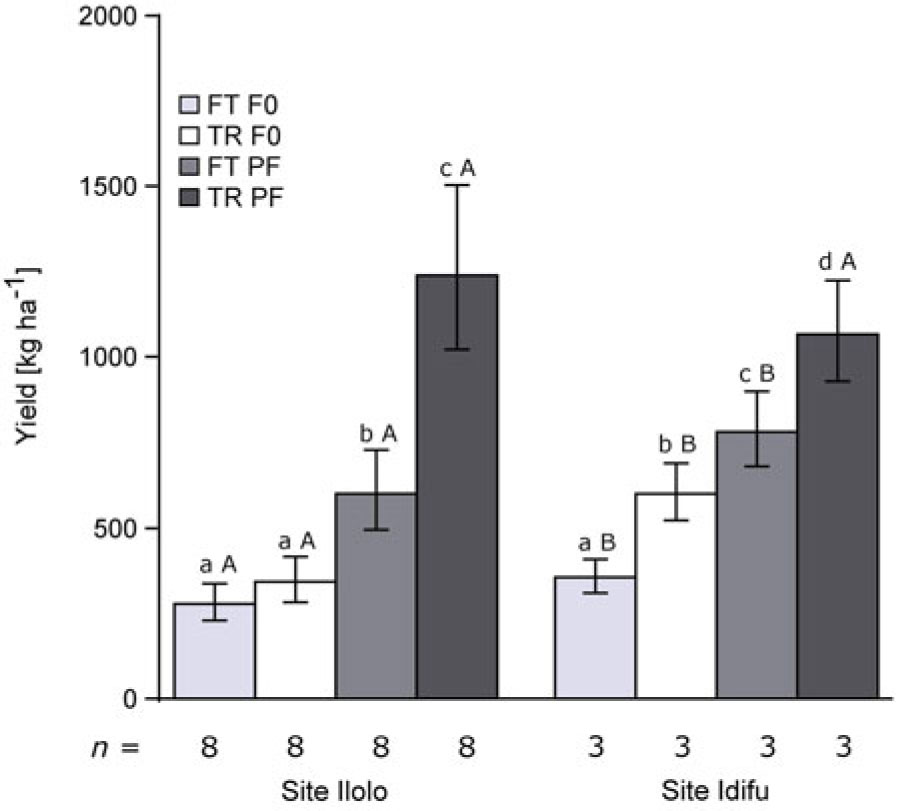
The order of treatment effects on pearl millet grain yield over the years and sites is consistently the same: Combined water harvesting and fertilizer > fertilizer > water harvesting > control. The control yields are with 0.3–0.4 t ha− 1 exactly in the range that are reported to be average on local farms in the district (i.e. 0.36 t ha− 1, Kimenye, Reference Kimenye2014). Given the low rainfall in 2015, this year can be taken as worst-case scenario with an average yield in the control of 0.31 ± 0.1 t ha− 1 and an observed minimum yield of 0.14 t ha− 1. Thus, the yield range at the chosen sites with low-input conditions is 0.1–0.4 t ha− 1 and serves as a reference for treatment effects
Indifferent from the site and whether water harvesting was used, fertilizer always increased yields. The difference between fertilized and unfertilized plots did not differ in magnitude between flat and ridged plots (p = 0.1763). On both sites water harvesting together with fertilizing increased the yield significantly. However, the effect was significantly higher in Idifu compared to Ilolo as found in an additional contrast (p = 0.011).
Yields in Idifu were – except for the combined treatment – higher than in Ilolo. The ranking of treatment effects as well as the general significant effect of fertilizing shows that nutrients might be more limiting than water in the village environment, where irrigation is far beyond farmer means, and fertilizer access and affordability are limited. Nevertheless, water deficiency can reinforce nutrient deficiency as only water can dissolve and transport nutrients to the plant roots.
The maximum average yield achieved by combined treatments reaches only about 40% of the potential yield determined on-station. Combined stresses in the villages (water availability: less than 400 mm rainfall and depending on sowing date; nutrient availability: limited fertilization; biotic stresses: not recorded) can explain this result. The effect of combined tied ridging and placed fertilizer (TRPF) on pearl millet grain yield was significant in all cases.
The interlinkage of water deficit due to scarce precipitation, surface run off, and low infiltration, worsened by sealed soil surfaces and low water holding capacity in local sandy soils, together with nutrient deficiency, led to low grain yields in both intervention villages.
Demonstration plots in the village served for training purposes as well as for showing the potential success of the applied technologies. In conclusion, the experiments clearly show that the placed fertilizer and tied ridging treatments are also effective in the village environment. However, the absolute yield level and relative yield increase differ from on-station results. In consequence, their economic returns – as most relevant information for the farmer – differ.
Multi-dimensional testing
Spatially dispersed farmer-managed trials in the case study sites – tied ridging and fertilizer effect on pearl millet grain yield
Due to absence of significant inter-annual differences, statistical analyses consider all baby trial yield data for 2015 and 2016 together. The soils were grouped with regard to: (1) RSGs (IUSS Working Group, 2015) and and – where reasonable – (2) landscape position, for example, in flat (Acrisol (flat)) or undulating terrain (Acrisol (slope)). Only RSGs with a sufficient number of repetitions were considered; therefore, the pure placed fertilizer treatment and the Sodic Vertisol (hypereutric) were not evaluated.
An independence test for each environment revealed no indications for a systematic association of soil types and treatments by farmers in the resampling-based χ²-tests. Monte Carlo estimates (and confidence intervals) for p-values were 0.51 (0.503; 0.529) for Idifu in 2015, 0.9211 (0.9142; 0.9280) in 2016. In Ilolo, a p-value of 0.6296 (0.6172; 0.6420) was estimated for 2015 and 0.8571 (0.8481; 0.8661) in 2016. We concluded that it is therefore justifiable to draw conclusions from the evaluation of the factor soil in the baby trial experiment.
When model (3) was fitted to the yield data obtained from the farmer-managed baby trials, a significant interaction of treatment and soil (p = 0.0033, Table S3 in supplementary material) was found.
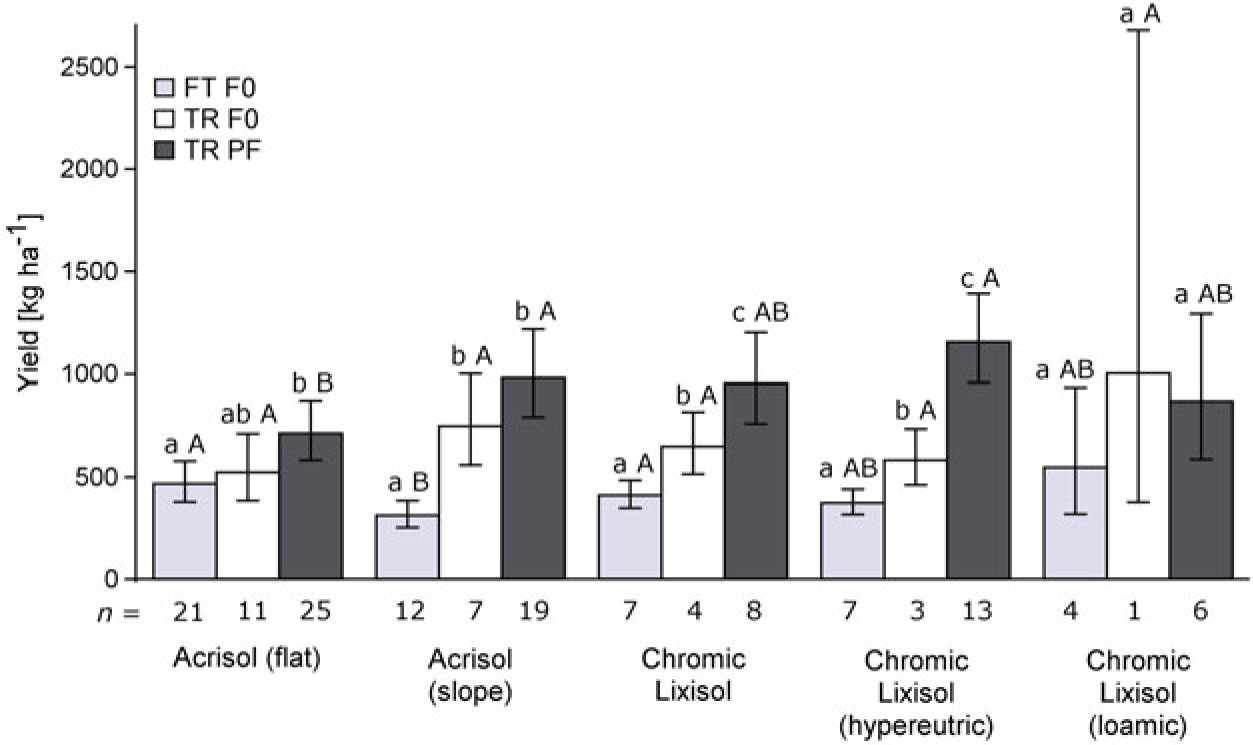
Figure 3 shows the estimates treatment factor levels on different soils.
Treatments were subsequently compared within each soil type by pairwise t-tests. Yields on the control plots (FTF0) over all RSGs ranged within reported ones (Kamhambwa, Reference Kamhambwa2014), i.e., between 203 and 1239 kg ha− 1 (arithmetic mean: 518 ± 262 kg ha− 1; n = 54). Yield differences between RSGs are not overall significant here (Figure 3). The mean grain yield is 515 ± 212 kg ha− 1 on Acrisols altogether, 336 ± 47 kg ha− 1 on Lixisols, both being lower compared to 550 ± 261 kg ha− 1 on Chromc Lixisols (loamic). Farmers evaluated the latter in focus group discussions as rather fertile with adequate infiltration. Their advantages are their position in rather flat landscape, promoting infiltration, a higher base saturation and at the same time a similar plant-available P content compared to Acrisols.
Median estimates and 95% confidence intervals of combinations of water harvesting systems and fertilizer in on-farm baby plots averaged over Illolo and Idifu sites (Tanzania) and years. Treatment combination medians within one soil type that share a common small letter do not differ at α = 5% significance level. Medians between soil types with the same treatment that share a common capital letter do not differ at α = 5% significance level. Medians are estimated from model (3) fitted to log-transformed data and back-transformed for graphical display. Mean comparisons are based on pairwise t-tests. Legend: FT: flat ties, F0: no fertilizer, TR: tied ridging, PF: placed fertilizer.
Per definition, Lixisols have a higher base saturation, i.e., a higher saturation of cations like Ca2+, Mg2+, and K+ at the exchange complex than Acrisols (IUSS Working Group, 2015). This indicates a higher chemical fertility status in this respect. The reference soil profile properties (Table 1) indicate that Lixisols (except the loamy one) have generally a lower plant-available P status. Statistical analysis of P contents in baby trials showed that those on all Lixisols (5.2 ± 4.5 mg kg− 1, n = 32; except the loamic variant) are significantly lower than those of Acrisols (12.9 ± 13.2 mg kg− 1, n = 29), the latter being closer located to the village centers with a higher chance of organic wastes being deployed. Plant-available P – as usual in non-fertilized terrestrial ecosystems – is rated decisive for yield in the control plots. Those Acrisols with highest yields are situated close to the swamps in the depressions and profit from eolian redistribution of the fertile swamp deposits (Reinhardt and Herrmann, Reference Reinhardt and Herrmann2017) as well as lateral sub-surface water flow (own observations). In addition, capillary rise from the shallow groundwater can positively influence these Acrisol sites. The plant performance gradient was obvious during field visits at the end of the rainy season.
TR resulted in significantly increased pearl millet yields in the cases of Acrisol (slope), Chromic Lixisol on foot slopes, and Chromic Lixisol (hypereutric) situated on middle slopes. It appears that with TR in sloped terrain increased water infiltration led to better plant performance. In contrast, Chromic Lixisols (loamic) and Acrisols (flat) were solely found in leveled terrain where less surface flow but more lateral subsurface flow can be expected, hence TR should have less effect. The number of observations for Chromic Lixisol (loamic) and treatment TRF0 was only one and can hardly be interpreted.
Combined fertilizer and water harvesting treatments revealed significantly higher yields compared to controls except for Chromic Lixisols (loamic). On Lixisols, affected by P-deficiency, TRPF resulted in significant yield increase as well in comparison to TR. Chromic Lixisols (loamic) baby trials exhibited already adequate plant-available P-content without fertilizing which was 13.6 ± 17.7 mg kg−1 on baby trials (n = 11) which as well correlate with the distance from settlements and higher P-input from manure and household waste near settlements (Vanlauwe et al., Reference Vanlauwe, Coe and Giller2017), that is, fertilization impacted to a lesser extent.
Average yield gains with respect to treatment were the following:
Acrisols in plains: TRF0 +21%, TRPF +66%
Acrisols on slopes: TRF0 +59%, TRPF +142%
Chromic Lixisols: TRF0 +19%, TRPF +102%
Chromic Lixisols (hypereutric): TRF0 +55%, TRPF +215%
Chromic Lixisols (loamic): TRF0 +76% (n = 1), TRPF +66%
The treatment effects (Figure 3) allow the following conclusions: (1) water availability is less a constraint on Acrisols in flat landscape positions but on slopes where run-off can be expected. (2) Lixisols (except Chromoc Lixisol (loamic) near the settlement) are more limited by nutrients (in particular P) than water (higher additional yield gain in TRPF treatment). (3) Loamic Lixisols respond mainly to additional water input. (4) The yield on plots with both treatments exceeds the control yield more than twofold. (5) Highest yields in the control treatment are near the swamp and the settlement in Idifu, benefiting from additional water due to low landscape position. With the TRPF treatment, highest yields were achieved in proximity to the swamp in Idifu in undulating terrain.
In summary, nutrient status (in particular P) and water availability in dependence of RSG, slope position and distance to settlements mainly control the pearl millet crop yield. Landscape position influences soil development. It can interfere with soil-type-specific features, for example, run off reducing infiltration on relatively fertile slopes, and in turn leading to less yield. Combined treatments have the best effect (except for loamic Lixisols). The relative low yield level in the combined treatments (ca. 1000 kg ha− 1) reveals that further undiscovered limiting factors exist.
On-farm plots could have performed better with a higher share of supervision from researcher to farmer. For smallholder farmers, local experiments are more valuable due to conditions influencing plant performance in their respective environment. In conclusion, a typical problem of on-farm trials in large numbers is an unbalanced data set that influences the statistical significance evaluations.
Pros and cons of different research dimensions
Yields from on-station experiments were major compared to those from village level, most probably due to constant fertilization, higher overall precipitation and the highest level of control. Plot size also differed, which was a bit over 20 m2 for on- station and demonstration plots and 100 m2 for baby plots on farm. The increasing complexity with increasing research dimensions is obvious. Even on-station, factors vary despite an envisaged controlled environment, e.g., sowing time and related water received from rain. From on-station to village mother trials, complexity increases by addition of the factors relief, RSG, soil fertility, meteorology, and external forces. At the same time, the possibility of control decreases leading to a higher necessary number of replicates. This, however, could not be managed within the Trans-SEC framework due to communication and resource constraints as well as disadvantageous timing of activity planning.
External forcing can i.a. occur in the form of intermediate trampling and browsing by animals, local inundations, fire, intended influence or destruction by humans, and so on. These are not necessarily reported, since the managing person can hardly constantly observe the mother trials. Particular care is necessary for the choice of the demonstration plot locations (mother trials) also in the sense of local acceptance and availability. The local population often chooses degraded terrain for such experiments (and on-farm trials) resulting in non-representative outcome. Degraded sites pose a low risk of non-expected crop loss. Risk aversion can also lead to non-participation (Guttormsen and Roll, Reference Guttormsen and Roll2014) or low responsibility taken. Therefore, lack of adequate plot care is frequently observed.
Mother and baby trials experience in a general sense similar environmental conditions in the same landscape. However, for the baby trials again factor diversity and weight increase. Next to soil fertility variability related to landscape position and distance from home stead, socio-cultural factors (e.g. wealth status or gender-related plot quality; Franke et al., Reference Franke, Baijukya, Kantengwa, Reckling, Vanlauwe and Giller2016) and management skills (i.e. education) are added. But also RSG diversity (by their intrinsic properties) impact on the most important site conditions, i.e., potential rooting depth, chemical soil fertility, and water infiltration/budget. Baby trials were at most visited three times by scientific staff: before planting for preparation of the trials, at some sites for intermediate control, and after harvest for data collection. In 2015, many participating farmers shifted the beforehand indicated baby trials to other locations. Since soil sampling for analysis already had been carried out on the foreseen baby trials, a spatial mismatch between soil analytical information and plot setting occurred. Therefore, distances between new baby trials and sampled locations were calculated, and within the same soil unit, distances of 100 m were tolerated to relate yields to laboratory soil analyses. However, soil properties variability can be tremendous within short distances even within small farms as in our work (Vanlauwe et al., Reference Vanlauwe, Coe and Giller2017).
The advantage to introduce those additional factors is that they offer more possibilities to draw conclusions on applicability of innovations in the farmer’s environment. The mother trials allow farmers a first insight into the potential performance of a technology, into its constraints and necessary adaptations in their environment. In most cases, if the technology does not perform during the first season, farmers lose interest. Therefore, mother trials need to be well prepared in time, i.e., at the end of the preceding season.
Lacking communication of mandatory conditions for the baby trials led in our example to increased data uncertainty: control plots were partly not installed (i.e. no reference yield) and some plots were installed too late (i.e. different rainfall experienced in control and treatment). In consequence, for further experiments, either a better supervision of baby trials has to be implemented, or, ex ante, the number of replicates needs to be fixed at higher numbers.
It must be stated that in this case the soil map accuracy was never tested due to time constraints. In consequence, an unknown level of inaccuracy contributes to the spread of data within one ‘theoretically pure’ RSG. This means that (1) all treatments need to be present in a sufficient (not necessarily equal; Vanlauwe et al., Reference Vanlauwe, Coe and Giller2017) number for statistical evaluation and that (2) the normal cropping sites are represented in a sufficient number, since farmers tend to offer their worst sites for such kind of tests.
Table 3 summarizes pros and cons of the research levels.
Properties, tasks and conclusions of the different research dimensions

How to prepare for a balanced trial scheme on-farm?
With respect to the baby trials, it is fundamental to establish a spatially distributed testing scheme, in relevant terrain conditions. The term ‘terrain condition’ is chosen by intention in order to reflect the finding that apart from RSGs (or ‘soil types’) also landscape position, and distance from settlements play a role in the response function. In fact, such a mapping approach was introduced since long aiming at lower resolution scales by ISRIC, that is, the SOTER approach (Herrmann et al., Reference Herrmann, Graef, Weller and Stahr2001) that considers terrain units that respond similarly to management and are usually defined by soil and relief variables.
However, in a local subsistence context, it appears more feasible to rely on an indigenous knowledge approach in order to ease communication and later technology adaptation. In addition to the map unit geometry information, it is wise to collect a reduced data set on soil variables in order to ease later yield data interpretation. For this purpose, a mixed sample of the topmost tilled horizon, sampled before the season starts, is sufficient. The following (analytical) data are recommended:
- location, that is, GPS position (please make sure that all data are collected in the same format, i.e. respect projection, map datum, grid, etc.);
- slope inclination (as indicator for water budget and erosion);
- local soil/terrain type name;
- texture (allows for conclusions on nutrient stock and available water capacity);
- pH value (as indicator for nutrient availability or toxicities);
- organic matter content (as indicator for N and P stocks); and
- plant-available (potassium and) phosphate contents (since phosphate is limiting in most subsistence environments; Vanlauwe and Giller, Reference Vanlauwe and Giller2006)).
For adequate initial terrain unit information, Reinhardt and Herrmann (Reference Reinhardt and Herrmann2017) carried out an innovative approach: local knowledge-based mapping is advantageous due to decade-old experience of local farmers leading to a rapid terrain and terrain unit overview. The following checks were executed using in situ ground-based gamma-ray spectrometry with preliminary reference soil profile descriptions and transect walks, as well as subsequent randomly distributed gamma-ray measurements. For the on-farm trials, it is advantageous to plan an adequate number of plots per terrain unit in advance. For this purpose, a statistical power analysis which includes factor variability would be appropriate. Guidance of farmers in the first experimental year could lead to results which afterwards can induce further experimental progress.
Conclusions
Referring to research question (1), on-station trials rarely reflect conditions of subsistence farms due to nutrient-rich soils on-station related to previous fertilization and diverging conditions compared to the village (climate, relief, soil type). Factor complexity tremendously increases from 1D researcher-managed plots on station over 2D demonstration plots in the village to multiD farmer-managed plots that are spatially spread over the village area. Transferability of on-station results to smallholder environments was, hence, hardly possible. On-station trials, however, enable to determine the maximum yield under a given management and detailed observation in a quasi-controlled environment.
Related to research question (2), management adaption to soil type is one possible strategy to perform site-adapted agriculture for efficient use of available resources, especially in Sub-Saharan agriculture. However, this did not completely match in this approach. Landscape position (swamp proximity and correlated subsoil water reserves), distance to settlements (soil fertility gradients due to manure and household waste application near homesteads), as well as differing sowing dates (amount of received rainfall in certain plant growth stages), emerged as important influences on pearl millet performance in the village. Water and P deficiency were attributed as limiting factors for pearl millet yields in the study area.
According to research question (3), multiple limitations have to be considered that impede food security in rural central Tanzania, e.g., investment ability in fertilizer, and variable rainfall patterns with intermediate droughts. TRPF was proven successful on-station and in the villages, on demonstration plots (mother trials) as well as on-farm and farmer-managed plots (baby trials). Nevertheless, not only financial capital but also labor is restricted making tied ridging only possible on a limited area of farmers’ land. With appropriate supervision, mechanized preparation could be an adequate way to overcome this constraint.
Researchers should work together with local farmers, at first, to learn from their experience related to needs and barriers in the local environment and, secondly, to jointly develop strategies for overcoming those barriers and fulfill the needs using technologies adapted to local environmental and social conditions. This was targeted in the Trans-SEC approach; however, shortcomings related to communication issues appeared.
The only way of transferring technologies to smallholder farmers is the demonstration of technologies in situ, i.e., the introduction of demonstration plots for training. Therefore, farmers should be supervised on their own plots in establishing adapted and sustainable technologies for yield stabilizing or increase. Plots should not be located far away from each other to work with comparable initial conditions on all research levels, i.e., soils with similar nutrient deficiency and related zero fertilization experiments on-station, or rainfall in similar amounts, should apply in future studies to be able to draw more revealing conclusions from the different types of field experiments.
Author ORCIDs
Nadja Reinhardt, 0000-0002-4009-537X, Filippo Capezzone, 0000-0001-8064-2297.
Supplementary materials
To view supplementary material for this article, please visit https://doi.org/10.1017/S0014479719000103.
Acknowledgements
We thank the German Federal Ministry of Education and Research for funding.
Financial support
None.




 Open access

