




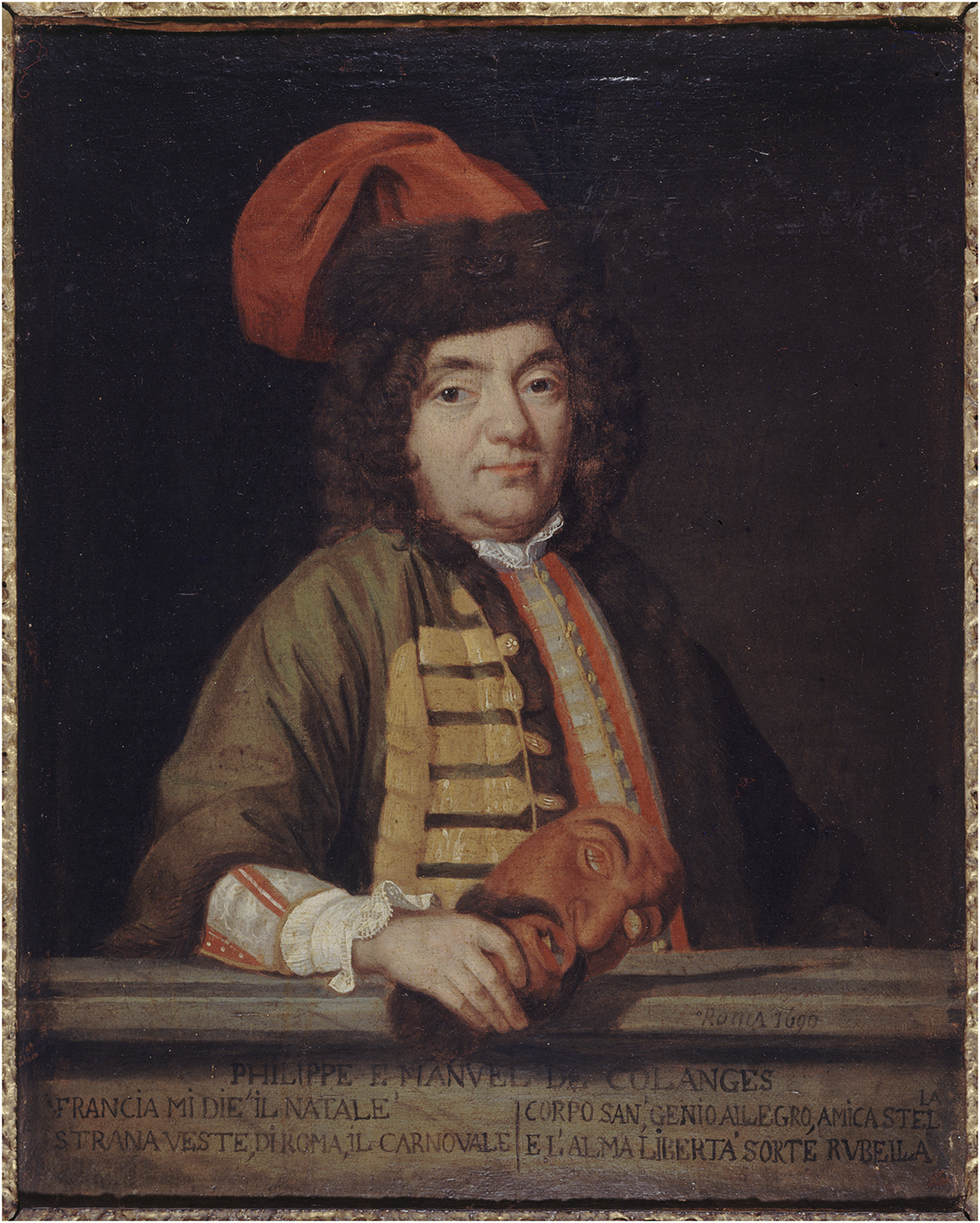
On 19 January 1674, Alceste, ou le triomphe d’Alcide, Jean-Baptiste Lully and Philippe Quinault’s second tragédie en musique, ignited the imaginations of Parisians. According to Charles Perrault, soon after its premiere at the Opéra, all of Paris became enchanted by the newest spectacle, learned the airs ‘by heart’ and sang them all over the city.Footnote 1 One of those individuals stimulated by the latest spectacle was Philippe-Emmanuel de Coulanges, a magistrate born into a life of leisure. The diarist Saint-Simon provides a literary portrait of the Marquis de Coulanges: ‘a very small man, fat, with a cheerful face, of easy wit, gay, agreeable, who produces only pretty trifles, but who always produces new ones, and off the cuff’ (for a visual portrait, see Figure 1).Footnote 2 Coulanges filled his idle hours on a quest for diversions with other members of his social circle of urban elites and developed a reputation in fashionable society for his wit and talent as a chansonnier, that is for his passion – bordering on an obsession – for composing new texts, at times improvised, to pre-existing tunes. He shared his gift at intimate gatherings of friends as they drank and dined together, as they refined their linguistic skills in galant conversations, as they recited poetry, as they read aloud from letters and from voluminous novels, as they sharpened their wits by playing salon games, and as they attended the Parisian theatres, including the Opéra.Footnote 3 Coulanges is neither a historical anomaly nor an exceptional figure; his songs reflect broader social trends in which fashionable Parisians performed, manipulated, quoted and parodied operatic artefacts.
Portrait of Philippe Emmanuel de Coulanges dressed for carnival, Nicolas Colombel (1690). Oil on canvas. Musée de la ville de Paris, Musée Carnavalet, Paris, France.
Soon after the premiere of Alceste, for example, Coulanges penned a parody of ‘Alcide est vainqueur du trépas’.Footnote 4 In this air (Figure 2), which opens the final act, a chorus echoes Admète, the king of Thessaly, as he sings in celebration of Alcide’s (Hercules’s) triumph over death and his restoration of Alceste to the world of the living:
‘Alcide est vainqueur du trépas’ Admète’s air from act 5 scene 1 of Jean-Baptiste Lully’s Alceste. Alceste, tragédie en musique par Monsieur DE LULLY, Ecuyer-Conseiller-Secretaire du Roy, Maison, Couronne de France & de ses Finances, & Sur-Intendant de la Musique se SA MAJESTÉ. Imprimée pour la premiere fois (Paris, 1727), 254–5. Courtesy of the Bibliothèque nationale de France.
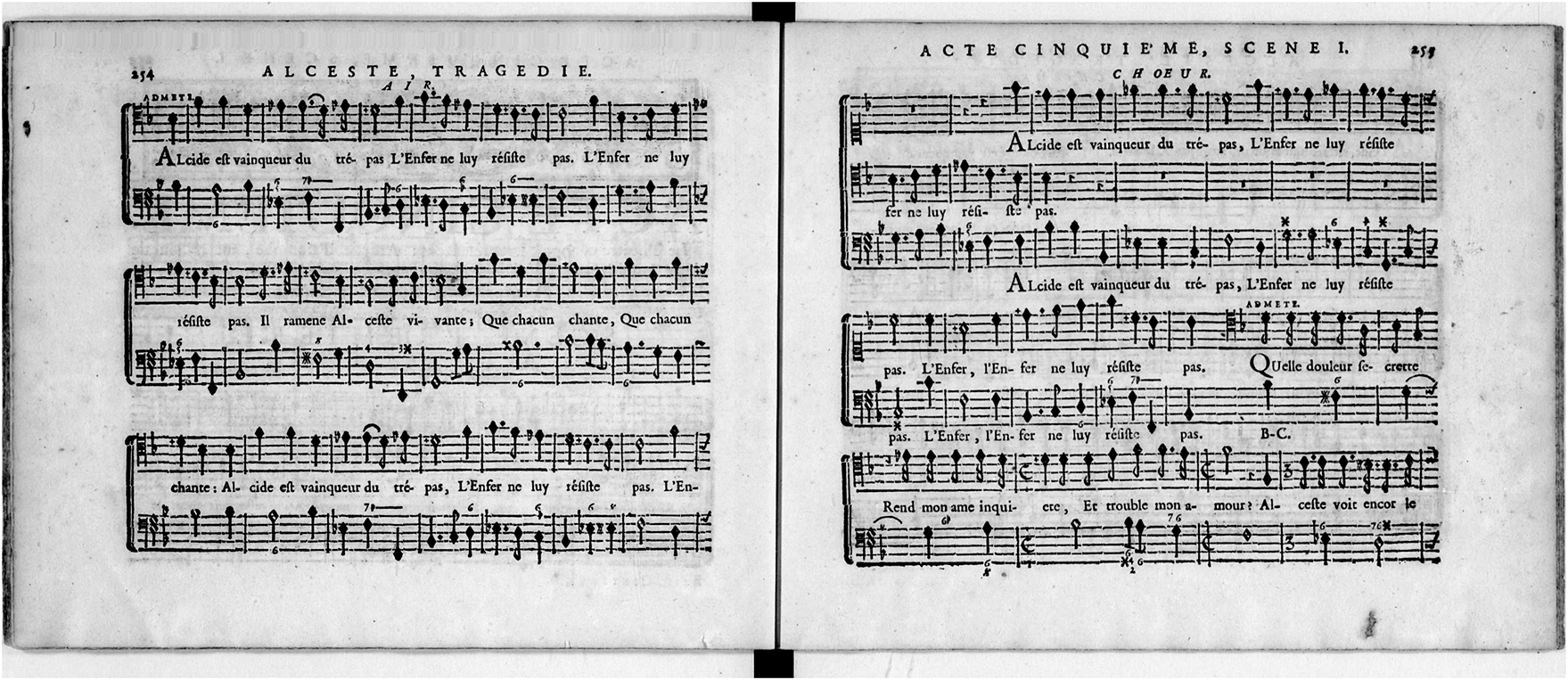
[Hercules is conqueror of death! Not even Hades holds him back. He returns Alceste to the living; Let us all sing! Hercules is conqueror of death! Not even Hades holds him back.]
Coulanges produced, by preserving ‘as much as possible the original rhymes, words, and cadences’, the following parodic verse for the air:Footnote 5
[Têtu is the conqueror of Brancas! La Trousse cannot hold him back. With him alone [dame de] Coulanges is happy. Her husband sings: Têtu is the conqueror of Brancas! La Trousse cannot hold him back.]
The parody mocks Charles, the Count of Brancas, who was in love with Coulanges’s wife, Marie-Angélique de Coulanges, known as a fashionable wit and épistolière in her own right. Although Brancas was infatuated with Marie-Angélique, the Abbé Jacques Têtu de Belval deprived him of some unspecified advantage he had while courting her.Footnote 7 Coulanges chides Brancas through song in a lighthearted manner that individuals apprised of events in his personal life found droll and charming, especially in a performance originating from this ‘fat little man of jovial and spiritual physiognomy’.Footnote 8 Coulanges’s quick wit, which he used to mock his rivals, served as his passport to fashionable social gatherings.
When Coulanges first performed his parody at a social event, it was likely that his cousin, the celebrated épistolière Marie de Rabutin-Chantal, the marquise de Sévigné, witnessed the performance. As long as Alceste held the boards of the Opéra and his topical verse did not appear dated to the novelty-obsessed mondains (a Parisian sociological group, which included both nobles and upwardly mobile bourgeois, and the ideal of sociability they exemplified), Coulanges could contribute a performance as part of an evening’s entertainment.Footnote 9 By 29 December of the following year, the charm of Coulanges’s verse had not yet been exhausted. In a letter to her daughter Madame de Grignan, Sévigné first relays a bit of gossip about her cousin the Marquis de La Trousse and shapes her own barb by rearranging the text of Coulanges’s parodic verse:
[La Trousse is the conqueror of Brancas! Têtu cannot hold him back … With him alone, Coulanges is happy. Let everyone sing.]
By referring to Coulanges’s chanson as ‘last year’s song’, she suggests that his parody was a memorable manipulation of musical material from Alceste, at least within their social circle.Footnote 11
These parodic texts document some of the ways in which mondains manipulated an operatic artefact in the ludic culture that flourished in fashionable Paris. The performance of Alceste at the Opéra was a measurable success, but as I will argue here, its success should not only be quantified by ticket sales, length of a run and number of revivals. Mondains sought to articulate and fashion the latest trends by repurposing material generated by new court and public spectacles, which included all types of ballets, theatre and especially operas. These individuals internalised and reused material from spectacles as a signifier of status, one that could broadcast their privileged identities.Footnote 12 They adopted individual tunes for song games that could traverse performance spaces, social networks and rank.
Scholars of early modern France have worked to decentre musical performance from the gravitational pull of Louis XIV’s court and the Opéra. They have untangled the layers of meanings bound up with the politics of spectacle and examined the plural sites of French operatic experience within France and outside its borders.Footnote 13 Others have illuminated the intertwined musical and literary traditions that unfolded in the egalitarian and ludic social spaces of the Parisian salons.Footnote 14 Numerous scholars working on the fairground theatres of the early eighteenth century have further highlighted the roles of song and theatrical opera parody in spaces in which social ranks mixed.Footnote 15 Little attention has been paid, however, to the interactive nature of opera and the complex ways in which spectators manipulated operatic artefacts in constructing individual and group identities.
Coulanges’s chansons provide a glimpse of the elusive singing culture of mondains. His songs appeared in two published collections produced without his participation or permission. Some of Coulanges’s parodic songs emerged from salon games in which participants improvised new texts to existing melodies to create musical conversations. Song networks can be expanded by incorporating surviving parodic texts, which are today preserved in hundreds of manuscript chansonniers, written for the same airs parodied by Coulanges.Footnote 16 Parodies of two tunes from Isis, Lully and Quinault’s fifth tragédie en musique, suggest that melodies achieved various degrees of diffusion. While some tunes remained in privileged mondain circles, others became vaudevilles – chansons contemporaries described as ‘in the mouth of the people’ and ‘that run through the streets’ – and also circulated among the lower ranks, including street singers, servants (such as shop boys, porters, cabaret maids, valets and cooks) and merchants.Footnote 17 Further, the contrast between the use and manipulation of operatic music by Coulanges with his cousin and confidant Sévigné, a lifelong member of his intimate social network and a prolific writer who occasionally attended the court, delineates a discrete conversational tradition of operatic quotation that operated in parallel to the parodic song tradition. All these types of interactions with operatic music reveal how contemporary audiences understood, listened to and valued a work and its musical components as they atomised works and reused fragments in their daily lives. Finally, an understanding of the interactive nature of opera forces us to reevaluate the documentary evidence of operatic performances from early modern France. Besides providing sociological insights into audience behaviour, reconstructing operatic song games shapes our understanding of how print and manuscript scores and collections of opera airs were used by the early modern consumers who collected them.
Songs owned by the public: Coulanges’s Recueil de chansons choisies
On 15 November 1694, Coulanges, who was then 61 years old, saw his songs – which had for decades circulated orally, as manuscripts and in letters – appear in print.Footnote 18 This publication offers concrete documentation of Coulanges’s improvisatory song creation, and his parodic texts open a window into his social world. Simon Bénard published a two-volume collection consisting of 222 chanson texts, most of which were authored by Coulanges.Footnote 19 Bénard was the son of a printer–publisher of the same name who had established a shop on the rue Saint-Jacques near the Sorbonne in the Latin Quarter where many book dealers and printers congregated. In the 1670s and 1680s, the elder Bénard had published ecclesiastical works in Latin and programmes for ballets and tragedies performed by students at the Collège de Louis le Grand de la Compagnie de Jésus (renamed the Collège de Clermont de Compagnie de Jésus in 1682 after Louis XIV patronised the school), a nearby Jesuit institution.Footnote 20 On 1 May 1684, after seizing a counterfeit edition of Pierre Richelet’s Dictionnaire françois in Villejuif, Simon I Bénard was murdered, leaving his widow to run the family business until their son was elevated to master printer on 7 August 1691. The son took over operations in January 1694, and on 15 May he published Charlotte-Rose de Caumont La Force’s Histoire secrète de Bourgogne, one of the first publications to bear his imprint. This novel represents a radical break from his father’s academic and Jesuit clientele, and the firm’s maiden voyage in publishing mondain literature.Footnote 21 Three months later, Bénard produced Coulanges’s Recueil de chansons choisies, divisé en deux parties, a venture that would sell well enough to merit, in 1698, a revised and expanded edition containing 392 chansons.Footnote 22 Both editions begin with an Au lecteur that contains valuable information about mondain song cultures, explaining how these two publications came into existence without Coulanges’s participation.
The Le libraire au lecteur to the first edition of the Recueil de chansons choisies provides context for the genesis of the collection. Bénard claims that he collected songs that circulated (literally ‘ran’) as manuscripts and ‘were admired everywhere there were good connoisseurs’.Footnote 23 Collectors of songs lent manuscripts to friends and acquaintances to make copies for their personal cabinets, and Coulanges’s songs survive both as part of manuscript anthologies and as single-author collections.Footnote 24 Bénard laments that these sources are ‘filled with faults, as usually occurs in handwritten works’; however, by comparing multiple copies of the same text, he was able to rectify many of the errors.
Bénard further asserts that ‘What I did to the author is not larceny, although this is done without his participation. The pieces that are in the hands of everyone belong to the public.’Footnote 25 According to his reasoning, once the literary products of a mondain author circulated as material objects in fashionable society, they were public property.Footnote 26 Further, because Bénard published Mademoiselle de la Force’s novel and Coulanges’s songs in quick succession, he seems to have been targeting a mondain readership. Perhaps Bénard used tout le monde in the Au lecteur as a shrewd marketing tactic to attract socially aspirational readers who sought to participate in the interactive song games of fashionable society or to live vicariously through Coulanges’s poetry. Throughout the published volumes, Bénard disguised, if only half-heartedly, the author of the chansons by referring to him as ‘Monsieur de C ***’.Footnote 27 Potential purchasers would have recognised the author of the chansons, however, because Bénard relied on Coulanges’s reputation as a marketing tool for the collection.
Coulanges did not acquiesce to Bénard’s assertion of innocence and instead flew into a state of panic and agitation. In a letter to Madame de Coulanges dated 19 November 1694, five days after the initial printing by the Bénard firm, Sévigné reports that ‘M. De Coulanges found a great affliction on his return [to Paris]. There appears in the world a printed book of his chansons, and at the head of this book, an admirable encomium of his person.’ She claims that ‘He is very stricken by this experience’, and that she ‘aggravated him by not taking it [the affair] seriously’. The cure, in her opinion, is obvious: ‘To all this I answer: songs, songs!’Footnote 28 She concludes by hoping he composes enough songs to fill another volume, an activity that would restore his jovial constitution.
Bénard next provides a brief biographical portrait of Coulanges – presumably what Sévigné referred to as an ‘admirable encomium’ – including descriptions of his personality and travels, in which he touts his international fame as a chansonnier and claims that Coulanges ‘is capable of the most serious and most lively conversations’. ‘It is good to remark’, continues Bénard, ‘that some of these songs are impromptus made in conversation, or at the table, glass in hand. They are not less beautiful. Monsieur de C *** is inimitable even in the things that escape him on the spot, and there is no one in these encounters who thinks, nor who expresses himself like he [does].’Footnote 29 Coulanges’s songs therefore cannot be disassociated from the refined conversational practice developed at the Parisian salons and were frequently acts of improvisation fuelled by libation. Finally, the songs in this collection, claims Bénard, are more effective when they are performed: ‘No matter how pleasant these chansons are when we read them, it is quite another thing when we sing them. It is with them as with all works that are made for singing.’Footnote 30 Bénard asserts that while song texts circulated in written form, they were best experienced as a performance. The act of singing parodic songs highlights the inherent intertextuality and orality of the practice.
The Au lecteur to the second revised and expanded edition from 1698 consists of merely a few paragraphs, but nevertheless provides additional valuable details about Bénard’s process in assembling the texts and the steps he took to ensure that Coulanges’s songs could be experienced by consumers as musical performances. After extolling the success of the first edition, which he describes as a panegyric to the author, Bénard further explains his methodology for gathering chansons for the collection. In addition to referring to multiple manuscript sources for each song text, he also ‘consulted people who have heard of this sort of work’. These editorial advisors lend an air of credibility to Bénard’s claim of textual accuracy. ‘The airs to which these songs were composed’, he adds, ‘are known to everyone; we took care to indicate them exactly.’Footnote 31 Unlike many of the manuscript chansonniers in which mondains collected song texts, Bénard’s publications identified the pre-existing tunes, in most cases by a title following the phrase sur l’air, or ‘to the air’.Footnote 32 In both editions, although the melodies are not printed, the tune names are indicated to ensure that the purchaser could experience the songs as music and not merely as poetry. The second revised and expanded edition includes many additional chansons, all composed by Coulanges, with the texts from the first edition that were written by other poets removed from the second edition. It seems Coulanges must have heeded Sévigné’s advice that he should continue to compose enough chansons to fill another volume. Both editions document an ephemeral performance practice in which parodic songs served as ludic diversions and as tools of self-fashioning when performed at social events attended by other mondains.
Musical conversations
In seventeenth-century Paris, mondains gathered at salons, where literature, conversation and music comingled. Female hosts and their coteries carved out exclusive social spaces independent from the court in which they could wield power as arbiters of taste. A tradition of galant conversation sprouted from the refined modes of social interaction nurtured at salons.Footnote 33 The French conversational practice – known throughout Europe as la conversation française – in turn served as the foundation for a literary aesthetic. Eric Walter has estimated that by the year 1660 there were approximately forty salons with 800 participants and 200 writers.Footnote 34 Attendees gathered to hear literature, from pithy maxims and poems to serially published novels, read aloud (à haute voix) and to contribute suggestions for revision.Footnote 35 Literature was therefore performative, collaborative, interactive, and integrated into conversational aesthetics. A witty conversationalist, for example, might respond to a question with a quotation from a fashionable poem.Footnote 36 Coulanges’s songs reflect this tradition through examples of both dialogues and portraits, the two building blocks of salon literature.Footnote 37
Anne-Madeleine Goulet and Catherine Gordon-Seifert have focused attention on the musical practices that unfolded at seventeenth-century Parisian salons. Goulet has demonstrated that musical performance at salons must be understood as a mode of sociability.Footnote 38 Gordon-Seifert has shown that airs sérieux, the quintessential musical genre of the salons, participated in ‘a great literary game’ (un grand jeu littéraire). She has reconstructed various techniques used to create musical dialogues by substituting new texts to pre-existing songs. One conversationalist might sing a strophe to an air, prompting another to respond by singing a new strophe to the same air.Footnote 39 As Coulanges’s chansons and manuscript chansonniers attest, an identical process unfolded using tunes from spectacles and vaudevilles as parodic vehicles for ludic musical conversations.
Musical portraits have received less attention than musical dialogues, but Anne Duggan has established that literary portraits were exchanged between salon participants as a kind of currency.Footnote 40 In seventeenth-century France, a literary portrait was more than a verbal description of a person’s physical characteristics. In an age in which physiognomy – the art of judging character from physical, especially facial, characteristics – was a thriving pseudoscience, contemporaries believed that portraits provided evidence of the immutable psychological and character traits of an individual.Footnote 41 A portrait could therefore provide a window into an individual’s soul.Footnote 42 The musical portraits composed and performed at salons, like the portrait songs produced by Coulanges, also functioned as a type of currency or gift exchange.
Three consecutive song texts published in both editions of the Recueil de chansons choisies demonstrate how Coulanges created musical conversations. All three texts are set to the same tune, identified as ‘Je suis une fois en débauche’. Although no tune identified by that name survives, a manuscript copy of the third text in this musical conversation identifies the tune as ‘Joconde’, a well-known vaudeville (Figure 3) favoured in salon circles.Footnote 43 It is probable that ‘Je suis une fois en débauche’ and ‘Joconde’ were two names for the same tune. The first text is described as ‘to Mademoiselle de Scudéry, on her convalescence’. Scudéry, a leading writer in her day, hosted one of the most influential salons, known as the Société du Samedi (Saturday Society), at her home in the Marais. She invented the roman à clef – a genre of novel that fused ‘history’ (that of the Persian Wars or the foundation of the first Roman republic) with the stories circulating in French high society – in which she was known as Sapho, a pseudonym used in the context of both her fictions and in the game space of the salon. In a single strophe Coulanges trumpets the return of Scudéry’s health after she had recovered from a fever:
‘L’air de Joconde, &c.’ in La clef des chansonniers, vol. 1 (Paris, 1717), 70–1.
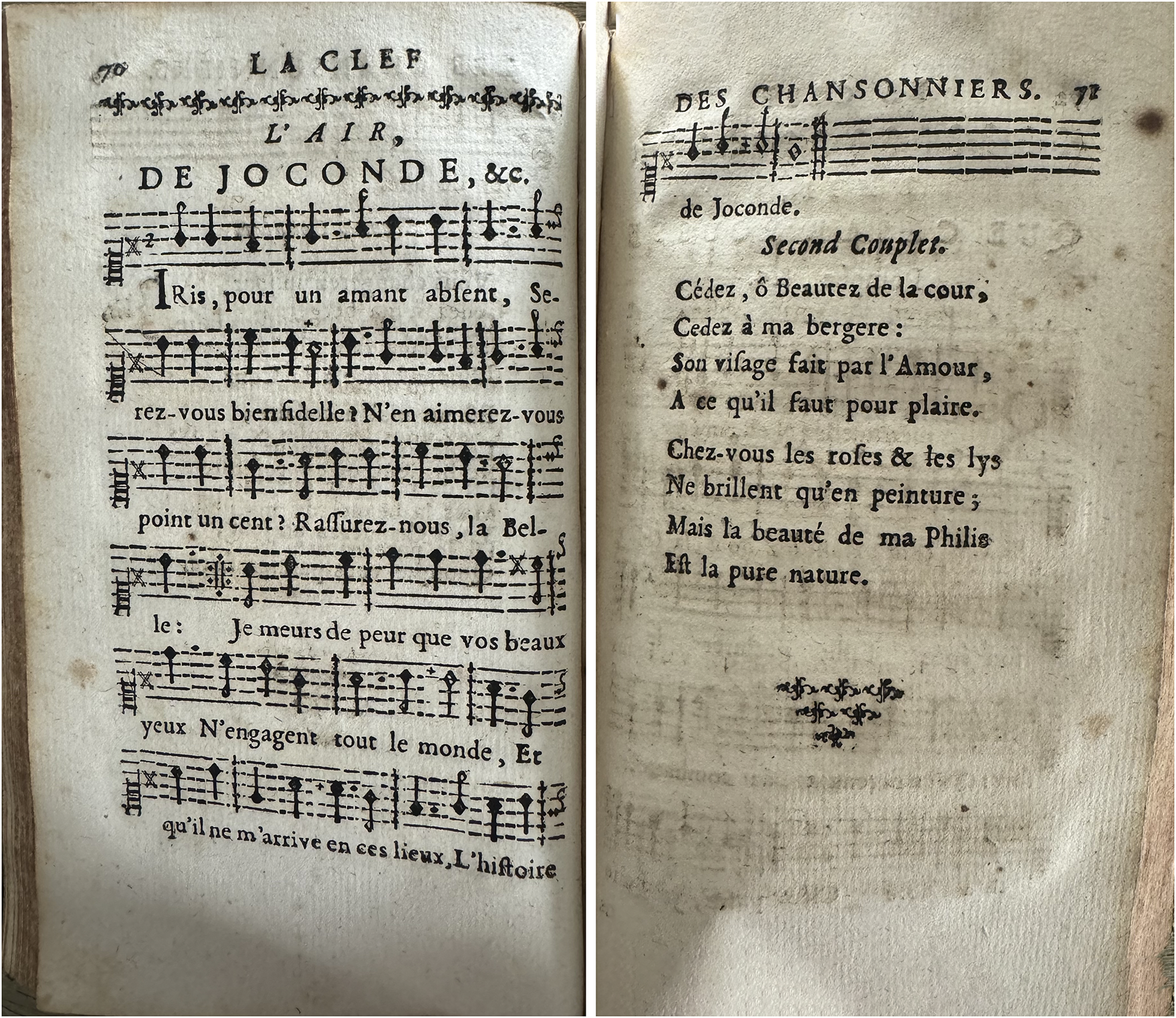
[Sapho, I have long hesitated, but I must sing of the return of your health. This beautiful subject tempts me. When fever makes you suffer, it is just a quarrel. Ah! Can we never die when we are immortal?]
Scudéry responded in kind with a strophe of her own invention sung to the same tune with which Coulanges addressed her:
[You are too flattering! A poor mortal, I know well that in verse when we lie, it is only a trifle. But to hide nothing from you, I would not know how to surrender because it would take the portrait of Alexander to appease me.]
Scudéry was flattered, the intent of Coulanges’s verse, but preferred that he send a portrait of the current pope, Alexander VIII. Coulanges continues this musical dialogue with a third strophe:
[Sapho, he who goes too far is lost. I fear a labyrinth. The path is not open to me to go to Corinth. You ask of me for the Portrait of the Holy Father. To sing of the great Ottoboni, it would take a Homer.]
In other words, he humbly declines to comply with Scudéry’s request, suggesting that the creation of a portrait of Pietro Vito Ottoboni (the birth name of Pope Alexander VIII) would take a great poet like Homer, someone with skills far greater than Coulanges possesses.
Scudéry and Coulanges created a utilitarian musical conversation that incorporated the two building blocks of salon literature. In 1689 Coulanges accompanied his friend and protector, the Duc de Chaulnes, on a diplomatic mission to Rome for the conclave that elected Pope Alexander VIII.Footnote 47 Scudéry was therefore requesting a musical and literary portrait based on Coulanges’s experiential knowledge of the new pope; this musical dialogue unfolded through a series of letters while Coulanges was in Rome and Scudéry was recovering from her illness in Paris. Alexander VIII only lived for sixteen months after ascending to the papacy, and Coulanges remained in Rome for two years following this initial diplomatic mission, long enough to witness the conclave that elected Pope Innocent XII on 12 July 1691. This musical dialogue flattered a friend and prominent Parisian literary figure and functioned as a means of information exchange about French involvement in consequential European political negotiations.
The Recueil de chansons choisies includes at least three other musical dialogues. In the first, Coulanges and François Adhémar de Monteil, the Comte de Grignan and son-in-law of Sévigné, create a musical dialogue using the vaudeville ‘Joconde’.Footnote 48 In the second, Coulanges reports to Elisabeth Le Féron, the Duchesse de Chaulnes, again using the tune ‘Joconde’, about a visit from Catherine Descartes, a poet, daughter of Pierre Descartes and niece of the philosopher René.Footnote 49 The Duchesse de Chaulnes responds using the same tune, and Catherine Descartes, as the third conversationalist, concludes the conversation with her own parodic text. An example of using an operatic air as a vehicle for a musical conversation begins with Coulanges singing a parodic text to ‘Enfin grace au dépit’, an air from Act I scene 5 of Alceste, before an unidentified second conversationalist responds by crafting new verse to the same tune.Footnote 50 These musical conversations chronicle a salon game that showcased a participant’s wit and ability to improvise verse to musical and poetic models.
A manuscript collection of Coulanges’s songs preserves an additional example of a musical salon game, in this instance using the tune known as ‘contrevéritez’. ‘Les contrevéritez de la cour’ or ‘Counter-truths of the Court’ first emerged as a literary genre that circulated as satirical political pamphlets published in 1620 and 1652. The former materialised around a wave of criticism of the power held by Charles de Luynes, Louis XIII’s favourite, just before his assassination, and the latter was printed as a mazarinade during the Fronde.Footnote 51 These pamphlets spawned a series of manuscript versions of the ‘contrevéritez’ genre that circulated in the late 1650s.Footnote 52 In 1680, Richelet defined ‘Contre-véritez’ in his Dictionnaire françois as ‘A fine satire in prose or verse in which one mocks a person by giving that person qualities he or she visibly does not have.’Footnote 53 In the literary genre, participants created satirical anti-portraiture, an inversion of the literary portraits that more commonly served as standard salon fare, of members of the court.Footnote 54
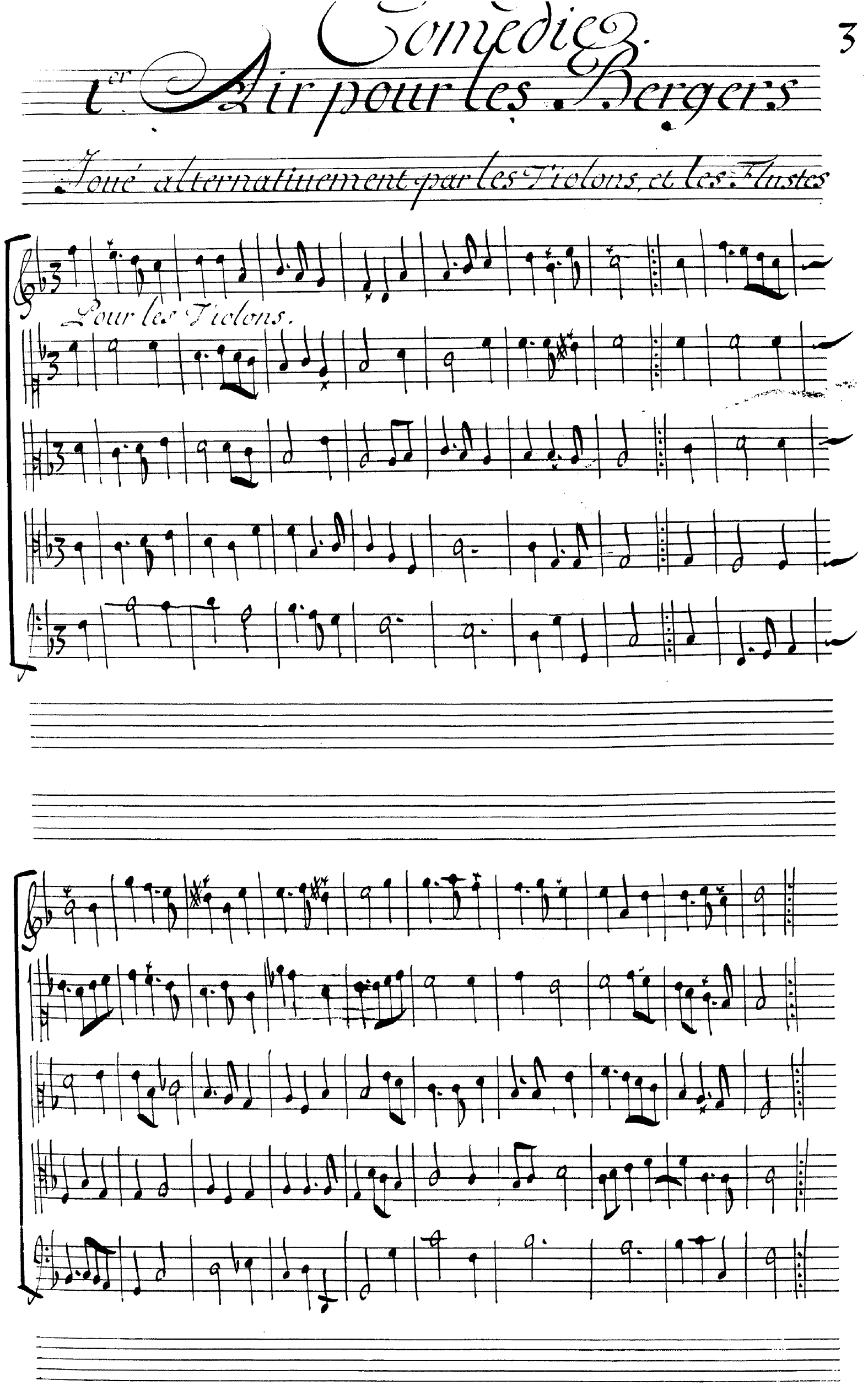
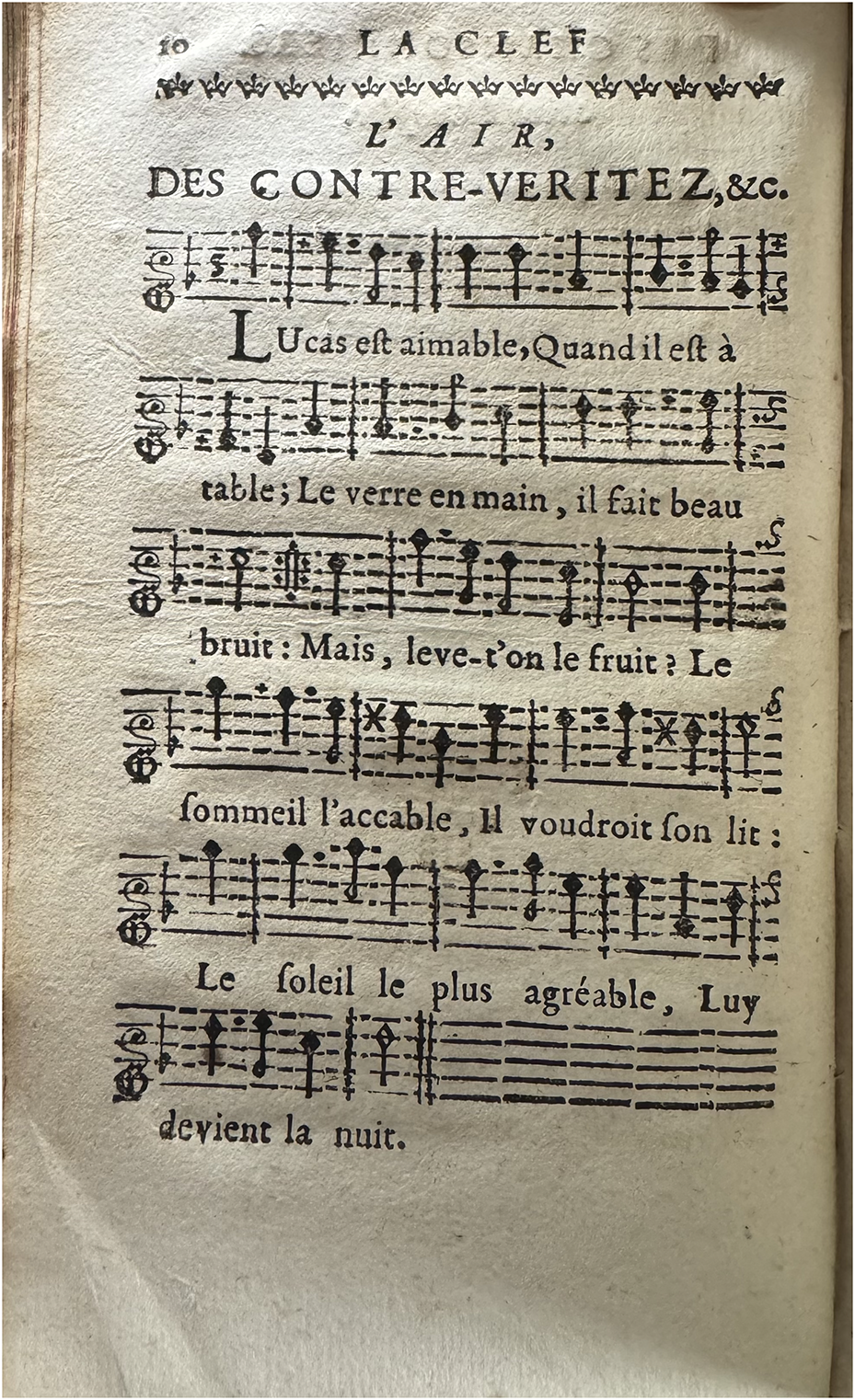
Literary ‘contrevéritez’ evolved into a parodic musical game in which, after 1668, participants sang anti-portraits to the instrumental ‘Air pour les bergers’ (Figure 4) composed by Lully for Le Grand Divertissement Royal at Versailles.Footnote 55 Beginning in 1669 and blossoming in 1670, manuscript chansonniers suggest that ‘contrevéritez’ texts were sung ‘to the tune contrevéritez’.Footnote 56 Eight-line (or ‘octave’) stanzas of paired rhyming couplets emerged as a standard form for the musical genre. Some of these chansonniers notated melodies, and Lully’s dance tune (Figure 5), despite never having received a performance on a public stage in Paris, became known as ‘contrevéritez’ in fashionable society.Footnote 57 The transformation of ‘contrevéritez’ from a literary to a musical game seems to have happened quickly, as there are eight surviving sets from 1669 and another twenty-five from 1670. The popularity of the ‘contrevéritez’ genre is reflected by the fact that these are some of the most widely copied song texts in the chansonniers. One example from 1670, which begins ‘Crußol est trop belle, Brißac naturelle’ is documented in at least twenty-two chansonniers. Footnote 58
Jean-Baptiste Lully’s ‘Airs pour les bergers’ from the first intermède for Le Grand Divertissement Royal (1668). Score produced in 1690 by the Philidor workshop as ‘George Dandin Ou le Grand Divertissement Royal de Versailles Dancé devant sa Majesté le 15e Juillet 1668. Recueilly par Philidor laisnée En 1690’. Courtesy of the Bibliothèque nationale de France.
‘L’air, des contre-veritez, &c.’ in La clef des chansonniers, vol. 1 (Paris, 1717), 10.
In a representative example of the genre from 1669, a single stanza creates satirical counter-truths for six noble ladies by inverting their character traits:
[Crequy is a coquette, and du Flaix is a little crazy. Vibraye has many lovers, and as for Saint Geran, everyone rejects her because she is a hundred years old. Sully has a bit of a rough look. Maré is toothless.]
The Marquise de Vibraye, for example, who is described here as having many lovers, was known as a devout woman. We can imagine ‘contrevéritez’ like this one, freely combined with other stanzas, functioning as a humorous salon game played at an intimate gathering. Individuals could sing ‘contrevéritez’ to each other, improvise new verses and exchange manuscript copies that they collected for their amusement.
Marie-Catherine de Villedieu, in her fictionalised Memoirs of the Life Henriette-Sylvie de Molière, reveals how mondains used ‘contrevéritez’ portraits to spread falsehoods and harm the reputation of a rival. In the novel she recounts a scene in which a spurned lover avenges herself by mocking Sylvie, who is disguised as the prince de Salmes.
The lady, to avenge herself of this cowardly act by a real act of mockery, decided to have sung about me the craziest contre-veritez in the world, which people nonetheless took for the truth. They thought me the most dangerous charmer of the court … Indeed, in but a few days, I was considered a gentleman so dangerous and so expert in flirtation (we must say, however, Madame, that if all those who have this kind of reputation have it with as little justification as I did, it is truly a shame), and people had such a high opinion of me, that beyond the rumours spreading all the way to the parents of the real Prince, I had to respond to a hundred curious beauties to whom my necessary ingratitude made me so many embarrassing enemies.Footnote 60
The rebuffed lover, in an act of revenge, sang ‘contrevéritez’ to inflate the reputation of the narrator as a skilled galant. This anti-portrait, which other courtiers in the novel interpreted as an accurate portrait, caused the raconteur great frustration in future social interactions.
Coulanges embedded a musical dialogue set to the tune ‘contrevéritez’ in a series of letters exchanged between himself, who was writing from Rome during the same trip in which he exchanged songs with Scudéry, and Cardinal Mazarin’s nephew, Philippe Jules Mancini, the Duc de Nevers.Footnote 61 In the second letter, the Duke responds to Coulanges with his own verse set to the same tune, and upon receipt of these verses in Rome, Coulanges responds again with more verses. This dialogue, however, does not participate in the game of creating satirical anti-portraits. The tune is rather used here as a vehicle for information exchange about Coulanges’s travels. Musical and literary elements from spectacles therefore circulated in Parisian networks and the circulation could redefine or transform the conception of the original materials. The tune served as a vehicle for the creation of satirical musical anti-portraits and as a vessel for musical–literary dialogues constructed over time and geographical displacement in a series of letters.
From the surviving examples, we might conclude that Coulanges only created musical dialogues when geographical distance between two conversationalists required an exchange of letters. This hypothesis is unlikely, not only because a similar conversational practice unfolded at salons using the airs sérieux repertoire, but also because the improvisatory nature of musical exchanges inserted into spoken conversations resulted in fewer documented examples. According to Scudéry, letters are ‘conversations between absent persons’.Footnote 62 Letters therefore provide evidence of what was a more widespread oral tradition.
Fashionable Parisians used musical dialogues and portraits to forge social bonds through their collaborative participation in collaborative musical–poetic games. Musical dialogues provided a space for virtuosic literary, intertextual and verbal play. Participants demonstrated their quick wit by improvising verse to the same tune to create a conversation in music. Musical portraits were in contrast often panegyric creations aimed at flattery and functioned as a type of currency and gift exchange. When they were not intended as panegyrical monuments, friends could request musical portraits as a window into the soul of a third party, as in the exchange between Coulanges and Scudéry. Both dialogues and portraits encapsulated a mode of galant discourse aligned with conversational and epistolary trends.
Traveling tunes from Isis
Two melodies from Isis, Lully and Quinault’s fifth tragédie en musique, offer an instructive case study of the ways in which court and public spectacles infused Paris with musical material that circulated in distinct social spaces. The ‘Second air pour les muses’ from scene 3 of the prologue, for example, only seems to have circulated as a vehicle for parodic texts within the social spaces of the salons and the court. In these circles, the melody, which in the opera was an untexted instrumental dance, became known by the first line from a parodic text that commented on a subversive interpretation of the plot of Isis. In contrast, ‘Les trembleurs’, also known as the chorus of the frozen people from Act IV scene 2, was the most widely recycled tune from Isis. Soon after its premiere, it was parodied with an erotic text. It was then parodied numerous times in the salons and in the theatres. The lewd text ‘ran’ through the streets, and the melody transformed into a vaudeville, thereby escaping the confines of the salon.
As is well known, tragédies en musique in seventeenth-century France reflected on or were otherwise intertwined with current political events. Operas produced during the reign of Louis XIV were linked to current politics through their panegyrical prologues, which presented allegories that audiences were adept at deciphering.Footnote 63 Operatic plots further served to aggrandise the crown by depicting heroic characters who represented the Sun King’s constructed image on the opera stage.Footnote 64 Mondains had for decades enjoyed unmasking the identities of living persons who appeared as literary characters depicted using pseudonyms and coded language in romans à clef. Footnote 65 Audiences both at the court and in Paris were primed to decode the real or imagined hidden meanings of operatic plots.
Awareness of contemporary allegorical interpretations of a tragédie en musique is therefore crucial to understanding how audiences perceived a work. Lully and Quinault had previously collaborated on four operas – Cadmus et Hermione (1673), Alceste, ou le triomphe d’Alcide (1675), Thésée (1675) and Atys (1676) – each of which enjoyed approbation at court before receiving eagerly anticipated public premieres in Paris. The reception of Isis at court, however, was tempered by Louis XIV’s displeasure after courtiers interpreted the plot as alluding to a series of improprieties between two mistresses competing for his affections. Some in attendance at the court premiere associated Louis XIV with Jupiter, who as both god of thunder and the king of the gods was a surrogate cultivated by the king’s image-makers. Spectators also identified Louis XIV’s newest love interest, Madame de Ludres, as Io, the mortal name of the character who transforms into the goddess Isis, and Madame de Montespan, the king’s longtime mistress, as Junon. For these spectators, the jealous Junon depicted in the opera reflected Madame de Montespan’s recent actions. As the king’s affection for her waned, Montespan yearned to humiliate her rival Ludres in the presence of the court.Footnote 66
Contemporaries adopted the coded language from the opera to refer to Ludres in their exchange of gossip. Madame de Sévigné, for example, reported: ‘Io went to mass. We have seen her under a cape, but we are unsympathetic to her condition and sadness. She will resume her poor, ordinary life.’Footnote 67 In another letter written eight days later, she referred to Madame de Ludres as ‘the beautiful Isis’ and recounted that she was visiting Madame de Clérambault.Footnote 68 Due to this interpretation that spread through court circles, Isis became a succès de scandale and, regardless of the intentions of Lully and Quinault, courtiers and Parisians alike kept the opera’s music alive in parodic song traditions.Footnote 69
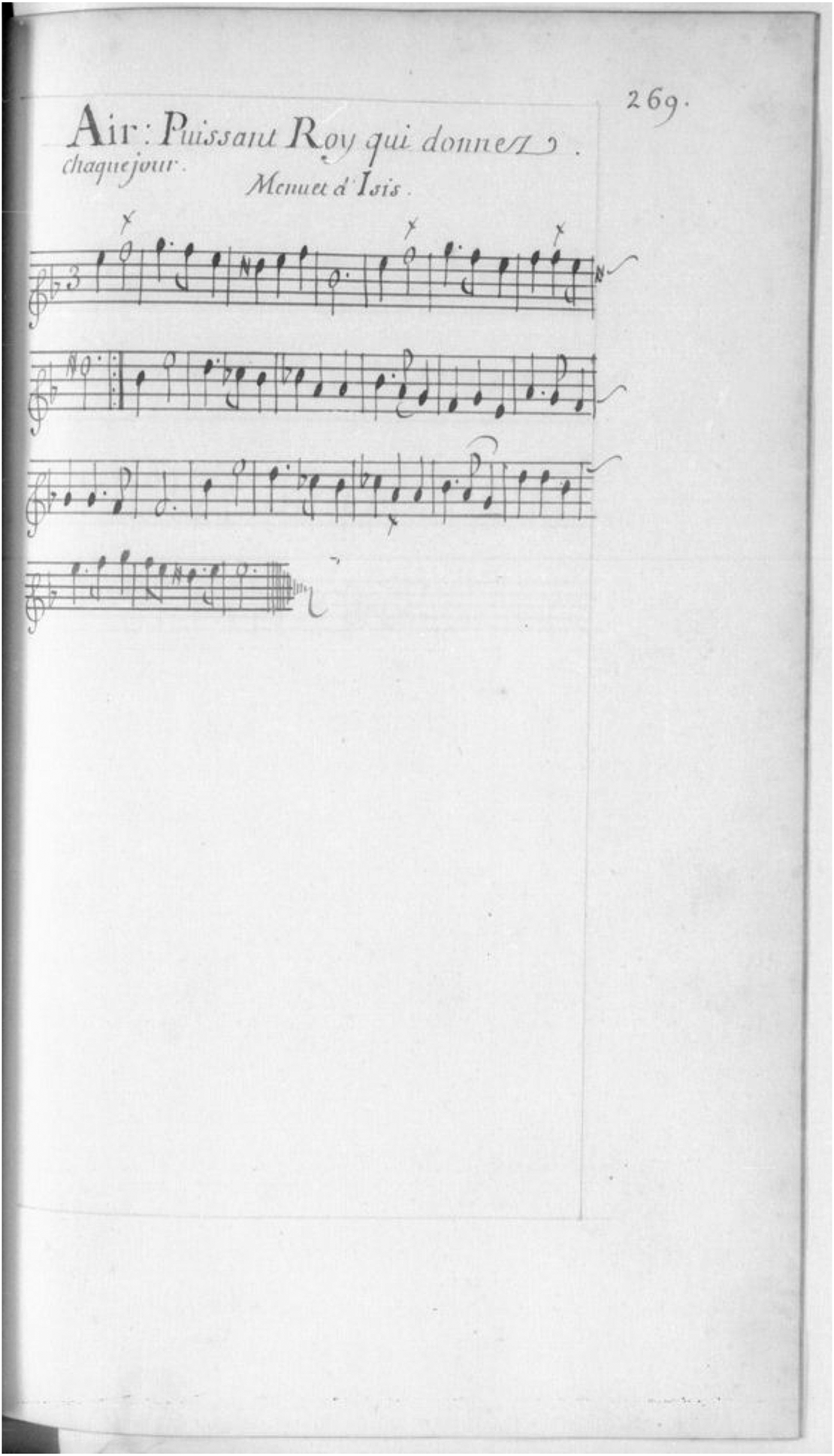
The first parodic text set to the ‘Second air pour les muses’ (Figure 6) from scene 3 of the prologue of Isis reflected on the scandalous interpretation of Isis and on the king’s decision to retain the services of Lully while forcing Quinault to leave court in disgrace:
‘Puissant Roy qui donnez chaque jour’ from scene 3 of the prologue to Isis in the Maurepas Chansonnier, F-Pnm ms. français 12657, 269. Courtesy of the Bibliothèque national de France.
[Powerful King who gives every day new pleasures at your court. If the heavens that always help you, make you settle things as is necessary, in thinking of saving Baptiste take care to remove Quinault.]
Among other places, this verse survives in Tallemant de Réaux’s chansonnier. Footnote 70 From this point forward mondains would refer to the ‘Second air pour les muses’ as ‘Puissant Roy qui donnez chaque jour’, at least in part because the instrumental dance had no text in the opera.
Coulanges himself composed at least four texts to the tune ‘Puissant Roy qui donnez chaque jour’, yet unlike the model parody that lent the tune its name, he never commented on the politics of a court that he rarely attended. Rather, his chansons strengthened his social bonds to other mondains. He composed a text, for example, for Mademoiselle Amelot, likely Catherine, daughter of French diplomat and conseiller d’état Michael Amelot de Gournay. He wrote another text while en route to the countryside chateau of Madame de Louvois, wife of François-Michel le Tellier, Marquis de Louvois, the French Secretary of State for War. The third text is described as ‘For Madame La Maréschale de Rochefort about the end of the first year of mourning for her husband’.Footnote 71 He composed this chanson for Madeleine de Laval in response to the death of her husband Henri Louis d’Aloigny, known as the Maréchal de Rochefort, who died in a battle at Nancy on 22 May 1676.Footnote 72 The song in this instance offered condolences during the customary period of mourning imposed upon a newly widowed woman. The fourth text is described as a ‘Couplet made for Coubert, on a painting in a gallery representing the Maréchal de ***’.Footnote 73 Although the specific Maréchal that was depicted in the painting remains a mystery, Coulanges penned his verse for Samuel Bernard, the powerful financier whom Louis XIV ennobled as the Count of Coubert. Although Coulanges was never a courtier, he gifted chansons to members of an urban social network that included both upwardly mobile bourgeois and nobles, many of whom held positions or were otherwise influential at the court.
Coulanges’s songs functioned as a currency in the same ways in which literary portraits were exchanged between members at salons. Some of these songs Coulanges improvised as contributions to galant conversations. Others he birthed ‘at the table, the glass in hand’, while still others were sent in letters or penned as gifts of gratitude for a host of a social gathering that Coulanges attended.Footnote 74 These chansons commended a host, and those gathered could write down the songs for preservation in their cabinets.
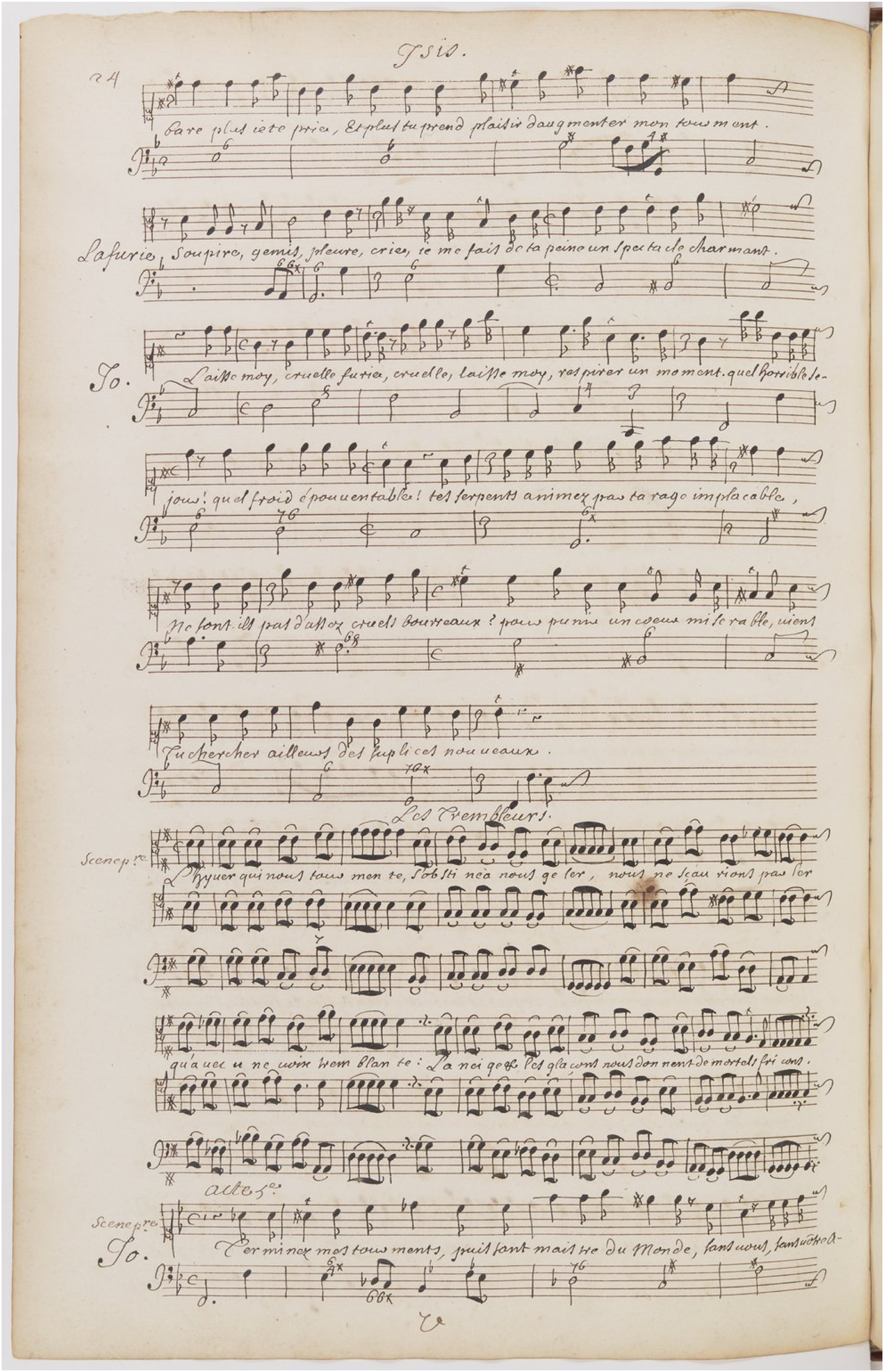
In contrast to the limited circulation of ‘Puissant Roy’, ‘Les trembleurs’ (Figure 7) was by far the most frequently parodied of Lully’s tunes from any spectacle, and after the premiere of Isis the melody transformed from operatic chorus to vaudeville. Footnote 75 Musical portraits account for the most numerous type of surviving text set to ‘Les trembleurs’.Footnote 76 Five song texts survive from 1677, and manuscript chansonniers continue to document new texts throughout the following decade.Footnote 77 One satirical text from the year of the opera’s premiere discusses Louis XIV’s affair with Marie Angélique de Scorailles and describes the king as hoping that the child of his mistress does not bear a striking resemblance to his own visage.Footnote 78 Coulanges contributed at least two parodic texts set to the tune. In the first, he recounts his recent trip to Genoa. In the second, Coulanges transformed the tune into a jovial drinking song that contrasts the enjoyment of sweet wine with the dangers of becoming afflicted with gout.Footnote 79 Given the content of his surviving chansons, it seems that Coulanges would not have directly aided an air from an opera in transitioning into a street song.
‘Les trembleurs’ from Act 4 scene 2 of Isis in L. Augier’s ‘Livre de musique’ F-Pn RES F-768. Courtesy of the Bibliothèque nationale de France.
Two erotic texts, however, also survive for ‘Les trembleurs’, both dated to the year of the opera’s premiere.Footnote 80 One of these texts depicts, in salacious detail, the sexual exploits of Charles Belgique Hollande de la Trémoille, a First Gentleman of the Chambre du Roy and the husband of Madeleine de Créquy (who frequently appeared as a target of the ‘contrevéritez’ anti-portraits):
[‘Oh that the nose tickles me’, say the right thing, Duke de Trémoille. What a pleasure when he makes me wet, and when he does this to me. I love the juice of the testicle and I often dirty myself. A nose does not come out empty-handed. When I get it ah ah ah ah ah! A horny nose is very charming, and whoever says otherwise is lying, lying, lying, lying, lying!]
The erotic nature of this parodic text was perhaps inspired by Quinault’s original verse:
[The winter that torments us persists in freezing us. We can only speak with a trembling voice. The snow and the icicles give us deathly shivers. The wintry weather spreads over our languid bodies; the cold numbs our senses. Even the hardest rocks split.]
Although Quinault’s text does not portray the chorus of trembling singers using sexual language, many of the phrases used to describe freezing – ‘trembling’, ‘deathly shivers’, ‘languid bodies’, ‘numbs our senses’ and ‘even the hardest rocks split’ – are easily transferrable to an erotic paradigm. It seems, then, that ‘Les trembleurs’ could have transitioned into a vaudeville because of the reinterpretation of Quinault’s verse for erotic purposes within the social circles of the salons and the court. Salacious texts circulated more rapidly than elevated verse typical of salon poetry, especially in the streets of Paris where Le Cerf de la Viéville described airs that originate on the Pont-Neuf, or vaudevilles, as ‘absolutely wicked’ (absolument méchans). These wicked airs, he claims, circulated from mouth to mouth by the ‘rabble’ (la canaille) and corrupted public taste.Footnote 81
By 1692, ‘Les trembleurs’ had become a staple of the vaudeville repertoire when it began to make appearances on Paris’s theatrical stages. In this year the tune first appeared on the stage of the Comédie-Italienne as a parody in Charles Dufresny’s L’union des deux opéras. The following year it appeared again in Les aventures des Champs-Élysées, a comedy written by the unidentified author Mr L. C. D. V. In Dufresny’s play, a parody of the plot and music of Isis draws out the subversive interpretation of the opera that circulated fifteen years earlier after its premiere at court. Pasquariel, performing as Mercury, the messenger of the gods, plays ‘Les trembleurs’ on a hurdy-gurdy, an instrument associated with blind beggars who performed in the streets. The hurdy-gurdy also served as a sonic echo of the musettes heard earlier in Isis during a dance for two shepherds in Act III. In contrast, in the final scene of Les aventures des Champs-Élysées, Orpheus responds to Momus, god of satire and mockery, by singing a new text about marriage and cuckoldry to the tune ‘Les trembleurs’. In this play Lully’s chorus is used as a vaudeville and not as part of a theatrical parody of the music, characters and plot from the opera.
In the early eighteenth century the operatic-chorus-turned-vaudeville appeared in the repertoires of two genres of early comic opera developed at the fairground theatres: pièces par écriteaux (a genre of mute protest theatre in which, in response to theatrical restrictions imposed on the fairground troupes by the official theatres, the audience sang new texts displayed on large placards to vaudevilles while the actors resorted to miming their actions) and comédies en vaudevilles (spoken prose interspersed with sung vaudevilles). Only operatic tunes that had been absorbed into the musical vernacular of the lower ranks frequently appeared on the stages of the Comédie-Italienne and the fairground theatres.Footnote 82 The continual appearance of ‘Les trembleurs’ on these stages demonstrates the significant imprint of this operatic melody on the collective memory of Parisians.
The ways in which Parisians used and reused these two airs from Lully’s Isis demonstrates that tunes from spectacles circulated in distinct social spaces and among different social ranks. A similar study of another spectacle would yield similar results. Some tunes only circulated in mondain circles as part of elaborate song games that unfolded across the city and beyond while others penetrated the song cultures of the lower ranks and became vaudevilles. When a Parisian of any social rank repeated an air, with the original verse or a new parodic text, on some level she or he granted it approbation.Footnote 83
Operatic parody and operatic quotation
The contrast between the use of operatic music by Coulanges and by his steadfast confidant Sévigné nuances our understanding of the diverse ways in which mondain spectators interacted with artefacts from operas. The tunes that Coulanges parodied suggests that he operated as an agent in a broader parodic tradition in which his peers also obsessively composed or improvised new texts to the same tunes. In comparison, Sévigné’s letters suggest that although she inhabited the same social circles, she more frequently quoted one or two lines of verse from operas. The ways in which these two cousins employed operatic artefacts in their conversations demonstrates that two traditions flourished in mondain circles: one of song parody and one of operatic quotation.
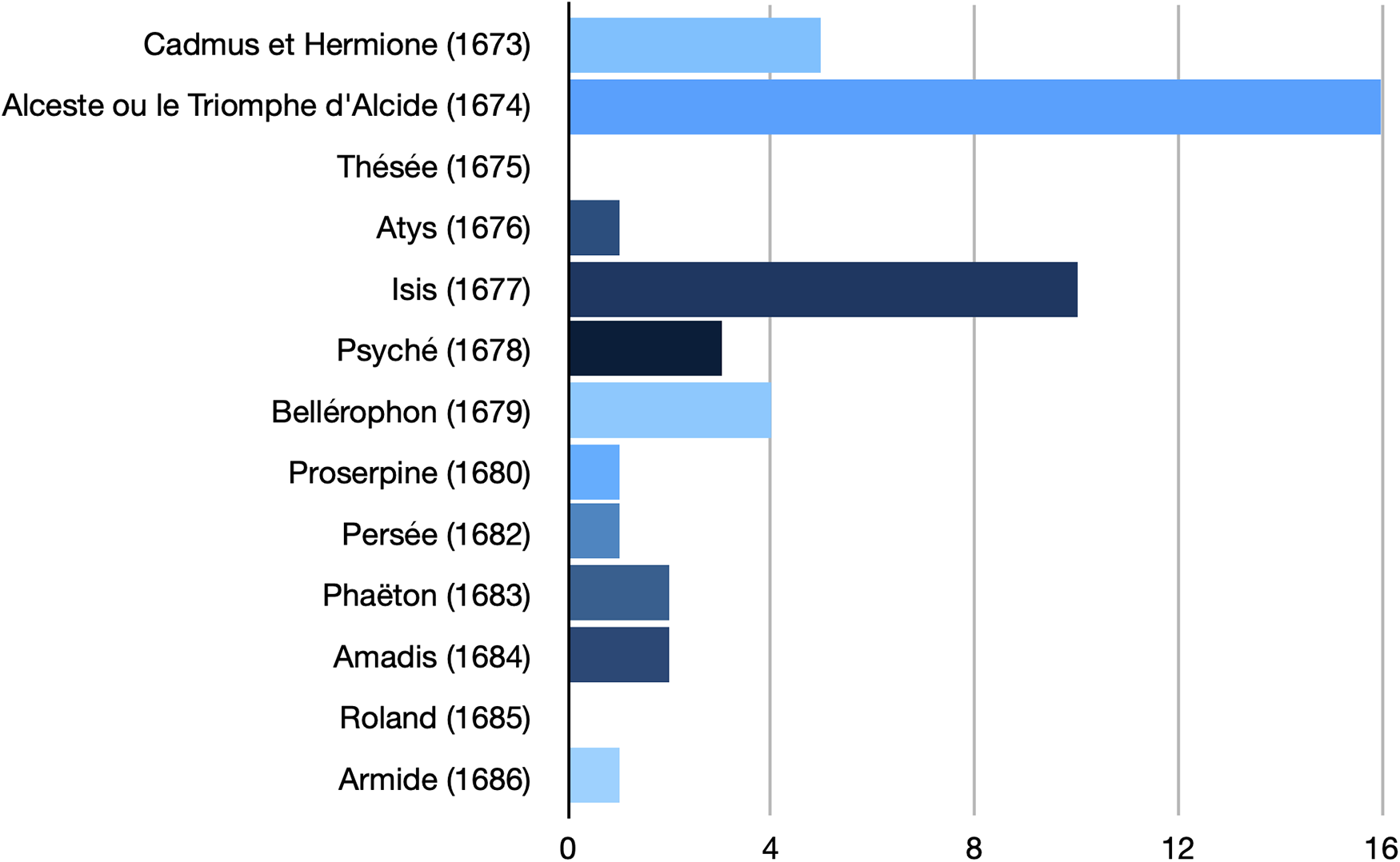
Coulanges parodied tunes from all types of court and public spectacles, including court ballets, comédie-ballets and operas. According to the surviving texts whose operatic origins can be identified, he composed new verses for airs from all of Lully’s operas except for Thésée and Roland (see Figure 8).Footnote 84 Manuscript chansonniers suggest that these two operas never produced tunes onto which mondains grafted new texts with any frequency. Responding to a polemical storm that arose in the wake of Alceste, Lully and Quinault created Thésée in a new mold, one that more closely emulated the model of classical spoken tragedy perfected by Boileau and Racine.Footnote 85 Both Thésée and Roland were sensations with the court and the Parisian public. Although virtuosic conversationalists scavenged both operas for scraps of recitative that they could insert as sung components in their conversations, neither opera produced a tune that served as a vehicle for parodic verse.
Number of different airs per opera that Coulanges parodied.
Sévigné’s letters allow for a reconstruction of parts of Coulanges’s and Sévigné’s shared social network. She addressed her letters to individuals in their network and discussed gossip about shared acquaintances and public figures. Her letters also circulated as manuscripts that were read aloud at salons, thereby expanding the scope of the network. Sévigné often quoted from literature, poetry and plays, a practice cultivated in the art of conversation. She quoted from mondain literary figures, such as Vincent Voiture, Paul Scarron, Mademoiselle de Scudéry, Jean de La Fontaine, Honoré d’Urfé and Madame de La Fayette; from the Bible; from literary texts in Spanish and Italian, like Dom Quixote, Gerusalemme liberata and Orlando furioso; from chivalric romances, like Amadis des Gaules; and from contemporary plays authored by Corneille, Racine and Molière. As a novelty-obsessed mondain, Sévigné also parodied and quoted from recent court productions and from spectacles that still held the boards at the Opéra. Because contemporaries viewed epistolary exchanges as conversations displaced in time, Sévigné’s letters crystallise an otherwise ephemeral tradition of inserting quotations from operas into galant conversations (Table 1). She manipulated material from every new opera that premiered until 1680 except for Psyché (Figure 9).
Quotations and parodies of operas in Sévigné’s lettersa
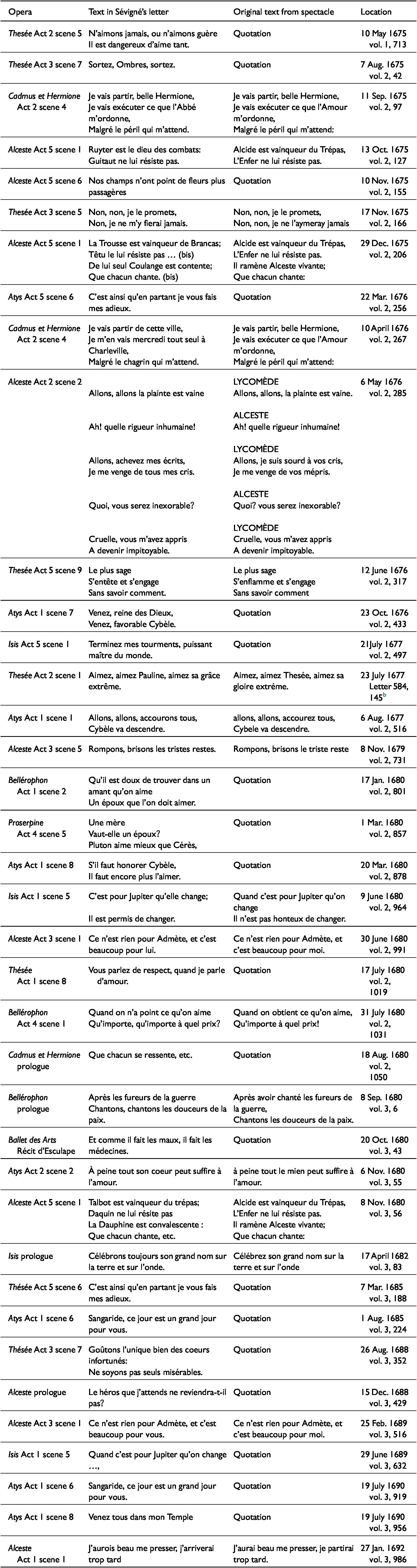
a I am indebted in part to the work of Marcel Vilcosqui (‘Une Mélomane au XVIIe siècle: Madame de Sévigné (1626–1696)’, in ‘Recherches’ sur la Musique française classique, vol. 17, 31-93 [Paris, 1977]), whose work I expand on here.
b This example was not printed in the Bibliothèque de La Pléiade edition, but can be found in Sévigné, Lettres de Madame de Sévigné de sa famille et de ses amis, vol. 5, edited by Louis Jean Nicolas de Monmerqué (Paris, 1820).
Parodies and quotations of operas in Sévigné’s letters.
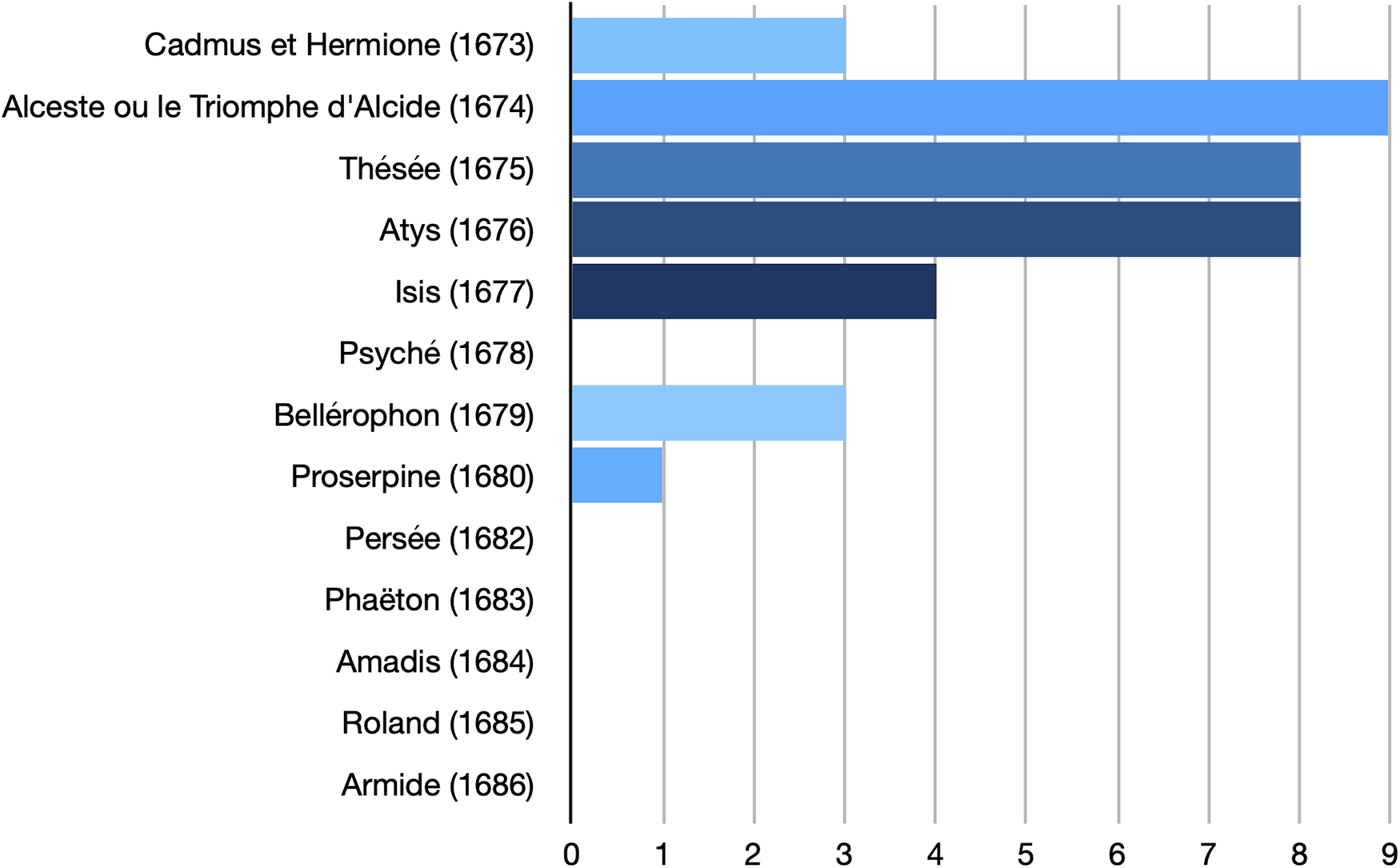
Sévigné abandoned quoting from operas composed after Proserpine, which premiered in 1680. An explanation for this apparent shift in Sévigné’s quotation practices can be found in the state of archival sources and personal circumstances in Sévigné’s life. There is a considerable decrease in the number of her surviving letters for the decade between 1677 and 1687, the year of Lully’s death. Part of this decrease is a result of the Comtesse de Grignan, Sévigné’s daughter and most frequent correspondent, living in the Hôtel de Carnavalet with her mother between November 1677 and September 1679 and again between October 1680 and September 1684. These lulls in Sévigné’s correspondence could explain her silence about Persée (1682) and Phaëton (1683). She might have continued to quote from these operas in oral conversations but had fewer occasions to continue the practice in written form. When she resumes the epistolary exchange with her daughter again in 1684, a letter insinuates that she had received some charming parodic verse from her daughter set to the tune ‘Amour, que veux-tu de moi’, Arcabonne’s air from Act II scene 1 of Amadis (1684).Footnote 86 Although she also never quotes from Roland (1685) or Armide (1686) in her letters, she does make oblique references to their plots.
Like Coulanges, Sévigné never manipulated material from Roland, but unlike Coulanges she quoted from Thésée eight times in letters written between 1675 and 1688. The reason, it seems, that she drew so heavily from Thésée while Coulanges ignored this tragédie en musique for source material stems from the fact that – as noted above – Thésée never produced an air that circulated as a vehicle for parody. Sévigné only quotes (sometimes with slight alterations of a few words) one or two lines of verse in each of her letters, and never refers to the same line(s) from Thésée in two different letters. Most of the quotations are galant phrases that Sévigné repurposed in a new context, such as Médée’s memorable line from Thesée in which she departs in a chariot pulled by flying dragons and exclaims ‘C’est ainsi qu’en partant je vous fais mes adieux’ (Thus, in leaving, I bid you farewell), which she employed as a concluding rhetorical gesture to her letter.Footnote 87 Quotation, then, operated as part of a different game to the parodic tradition, one in which self-fashioning through rhetorical flair or virtuosic recall was prioritised. In parodic song games, mondains coalesced around a selection of songs to which many individuals composed new song texts. In operatic quotation, variety was prized. With such a vast array of verses accessible for quotation, it follows that there would be less repetition of verses.
Some operas contributed multiple airs to which fashionable individuals composed countless new parodic texts. Coulanges and Sévigné borrowed from Alceste with the most frequency (Figure 8). Coulanges, for example, composed five texts for the air ‘Enfin, grâce au dépit, je goûte la douceur’, from Act I scene 5. As examined in the opening anecdote of this article, he also composed verse for ‘Alcide est vainqueur du trépas’, from Act V scene 1. He composed two parodic verses to this air, and Sévigné included two texts for this air in letters from 1675 and 1680.Footnote 88 Similarly, Coulanges composed another four texts for the ‘Air de deux Tritons’ – also known as ‘Malgré tant d’orages’ – from Act I scene 7 of Alceste. Because these three airs became such voguish objects of parody throughout fashionable Paris, Lully and Quinault were assured that the impact of Alceste would endure and reach the ears of individuals who did not themselves attend the Opéra.Footnote 89
As shown in Figure 10, parodic texts set to eleven of the most popular airs from Lully’s ballets and operas create a body of fifty chansons composed by Coulanges alone. Many of the airs that became vehicles for parody in the song games of the mondains shared pertinent musical or dramatic characteristics. A common attribute of many of these airs is that the melodies were repeated multiple times in the opera.Footnote 90 The repetition, which helped listeners to memorise and retain a melody after they exited the confines of the Opéra, could occur through the use of an orchestral entrée, prelude, or ritournelle (such as with ‘Alcide est vainqueur de trépas’, ‘Tranquilles cœurs, préparez vous’, or ‘Amour, que veux-tu de moi’) or a danced air (such as with ‘Sommes nous pas trop heureux’, ‘Les trembleurs’, or ‘Malgré tant d’orages’) in which the same melody is used for both the dance and the subsequent sung air. Many of these numbers, such as ‘Amour, que veux-tu de moi’ and ‘Les trembleurs’, are the first music heard by the audience at the beginning of an act. Others, like ‘Dépêchez, préparez ces lieux’, are part of a concluding intermède. The structural location in the drama of a third of the tunes represented in Figure 10 suggests that audiences might have been more attentive at the beginning and end of an act. Alternatively, Lully could have purposely positioned captivating or memorable melodies at the beginning or end of an act. Other airs reflect evocative moments of mimesis, such as ‘Dépêchez, préparez ces lieux’, which includes a musical representation of the sound of hammers wielded by the Cyclops hitting anvils, and ‘Les trembleurs’, in which the strings and the singers evoke the shivering of the ‘peoples des climats glacez’ (‘peoples of freezing climates’).
Number of parodic texts created by Coulanges for popular airs from ballets and operas.
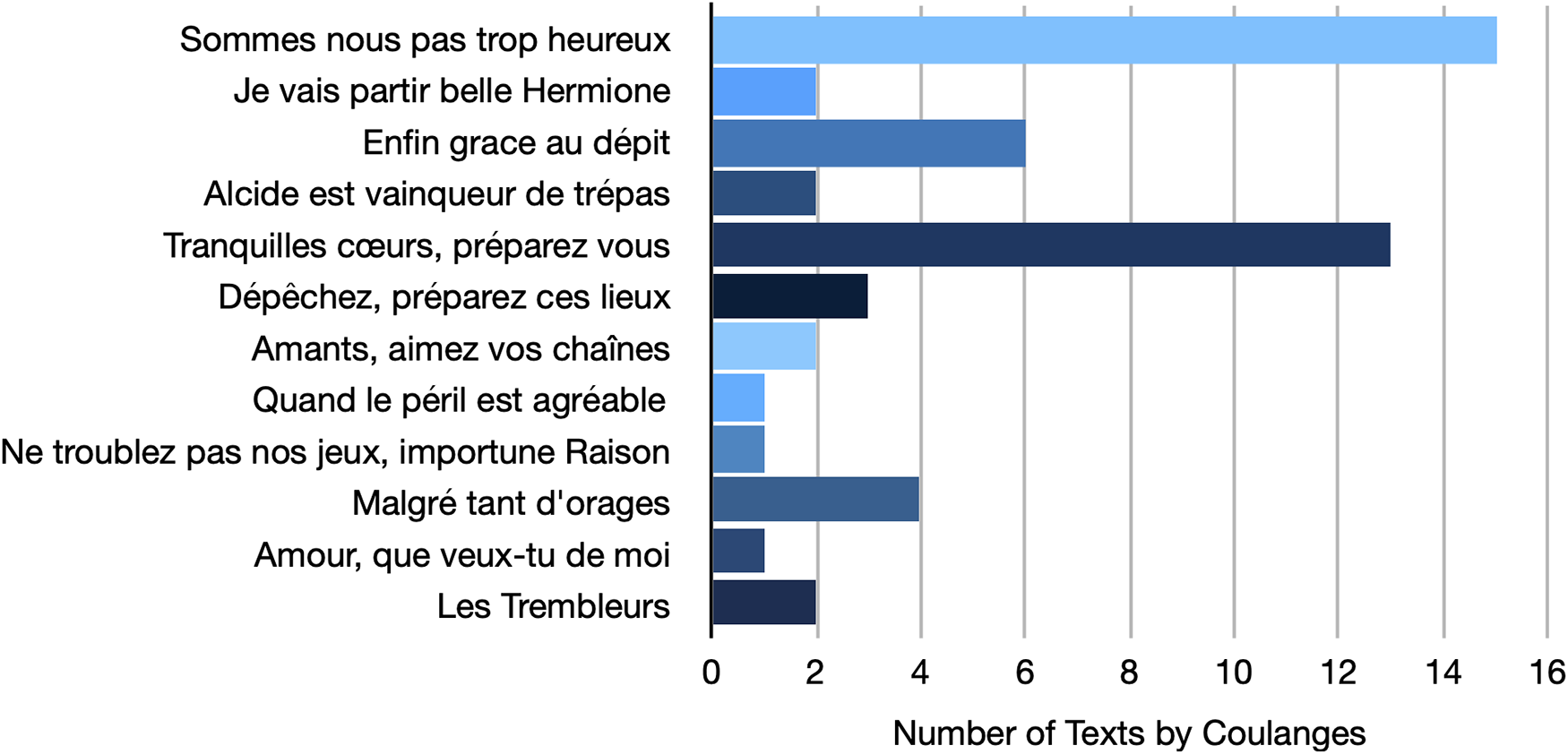
Each of the airs in Figure 10 was parodied not only by Coulanges but countless times by other mondains. Footnote 91 Coulanges only set one verse to ‘Quand le péril est agréable’, from Act I scene 3 of Atys. As with ‘Les trembleurs’, this operatic tune was parodied so frequently that it appeared in numerous guises: street singers performed the tune with new texts on the Pont-Neuf, where it transformed into a vaudeville, and later playwrights regularly employed it as a canvas for new texts in the earliest comic operas. ‘Je vais partir belle Hermione’, the beloved departure scene between the opera’s two title characters in Act II scene 2 of Cadmus et Hermione, was parodied twice by Coulanges and twice by Sévigné in her letters; and several more dialogue parodies of this scene survive in manuscript chansonniers. Footnote 92 Jean Palaprat also quoted the first line of this bit of recitative in Le ballet extravagant, a play that the Comédie-Française premiered in 1690.Footnote 93 An operatic craze had engulfed the city and the theatres mocked what playwrights and social commentators referred to as ‘opera madness’.Footnote 94 Studying the ways in which airs and scraps of recitative from those operas were reused in court and salon spaces can bring us closer to the early modern spectators who witnessed the earliest productions of Lully’s operas, and shed light on the ways that Parisians could have listened to each eagerly anticipated operatic premiere.
Revisiting sources for Lully’s Tragédies en musique
An audience-centred approach to operatic reception history can offer a deeper understanding of how collectors, compilers and consumers engaged with contemporary manuscript and print sources of Lully’s music. A wide variety of surviving musical sources reflect performance traditions in places other than on the operatic stage. For example, Lully never oversaw the publication of a score for Alceste during his lifetime. Baussen produced the first engraved reduced score in 1708, and the Ballard firm would not produce a reduced score until 1727.Footnote 95 The lack of a published score for more than three decades after the premiere, however, does not suggest a limited circulation of the music for Alceste. In his new edition of Alceste in the Œuvres complètes, Herbert Schneider argues that music from Alceste was more sought after by collectors than the music for Cadmus et Hermione, Lully and Quinault’s first tragédie en musique. Footnote 96 My analysis of the parodic and quotation activities of Coulanges (Figure 8) and Sévigné (Figure 9), both of whom engaged with Alceste more frequently than Cadmus, supports Schneider’s assertion. Whereas Alceste produced multiple tunes that were parodied countless times, Cadmus produced fewer, at least after its premiere. More manuscript sources for Alceste were produced in part because spectators sought access to the tunes so they could participate in the musical games unfolding across Paris.
In a letter sent from Sedan to his brother Joseph Bayle, Pierre Bayle offers two solutions for those wishing to sing or play music from the latest opera: borrow music from a singer and pay a copyist, or learn the tunes from someone who knew them by heart.
As for the opera, I told you that it is impossible to purchase the music, and that if one wishes to have it in that form, one must have it expressly written and notated by a musician, which would require one to have acquaintances among the actors or actresses, so that they would lend you their copy, from which a musician could make you a similar one. All this requires a man who solicits and goes ferreting everywhere. There remains only the printed livret, which is not difficult to purchase, since it is advertised publicly on sale and costs only 30 sols. But the livret is such a trifle when deprived of its music, the actual performance of the scene changes, and the actions of the stage machinery that you would spend all your life begrudging the 20 or 30 sols that you spent on the postage. There is nothing more languid than that kind of verse; the incidents and intricacies of the plot are nothing when you see them thus stripped of their flesh. Indeed, hardly anyone buys these livrets, other than those attending a performance, to be able to follow the words sung on stage. Imagine that I sent you some paltry verses that have been set to beautiful airs. If you did not know these airs, is it not true that you would be unable to thank me for making such a gift? Therefore, it would be better to wait until you can learn the airs from someone who can sing them for you. I am very glad that you can sing; it is a talent that is used in conversations.Footnote 97
Bayle’s letter indicates that even individuals who could not attend in person at the Opéra were interested in performing the music from the latest tragédie en musique. He mentions the possibility of finding someone who can sing the airs from memory, the most prominent mode of transmission of Lully’s operatic airs, and claims that singing is a valuable skill in the art of conversation. As discussed in the introduction to this article, Perrault claimed soon after the premiere of Alceste at the Opéra all of Paris learned the airs ‘by heart’.Footnote 98 Even those who resided outside Paris, like Pierre and Joseph Bayle, were clamouring to learn the latest tunes.
Some manuscript sources were compiled for the amateur who desired to participate in musical games that involved performing opera airs but who lacked the required musical training. In a ‘Livre de musique’ compiled between 1688 and 1696, for example, L. Augier begins by informing the reader that his book contains the most beautiful pieces by Lully. ‘Of all these pieces that we refer to by the name Opera and have been composed and performed up until 1686’, he continues, ‘we chose all the most beautiful airs, chansons, récits and other pieces that can be detached and sung separately from the body of these pieces. We have also included whole scenes and parts of scenes.’ Augier produced a collection of airs and scenes from operas that could be performed individually by the owners of such a manuscript. He created an anthology, organised chronologically by opera, of the most fashionable moments from Lully’s operatic œuvre and provided a ‘Table of the most beautiful airs’ at the beginning of each section. Each excerpt from an opera includes a figured basse continue, thereby presenting the music in a format conducive to an accompanied chamber performance (Figure 11 and Figure 7).
‘Alcide est vainqueur du trépas’ Admète’s air from Act 5 scene 1 of Jean-Baptiste Lully’s Alceste in L. Augier’s ‘Livre de musique’ F-Pn RES F-768. Courtesy of the Bibliothèque nationale de France.
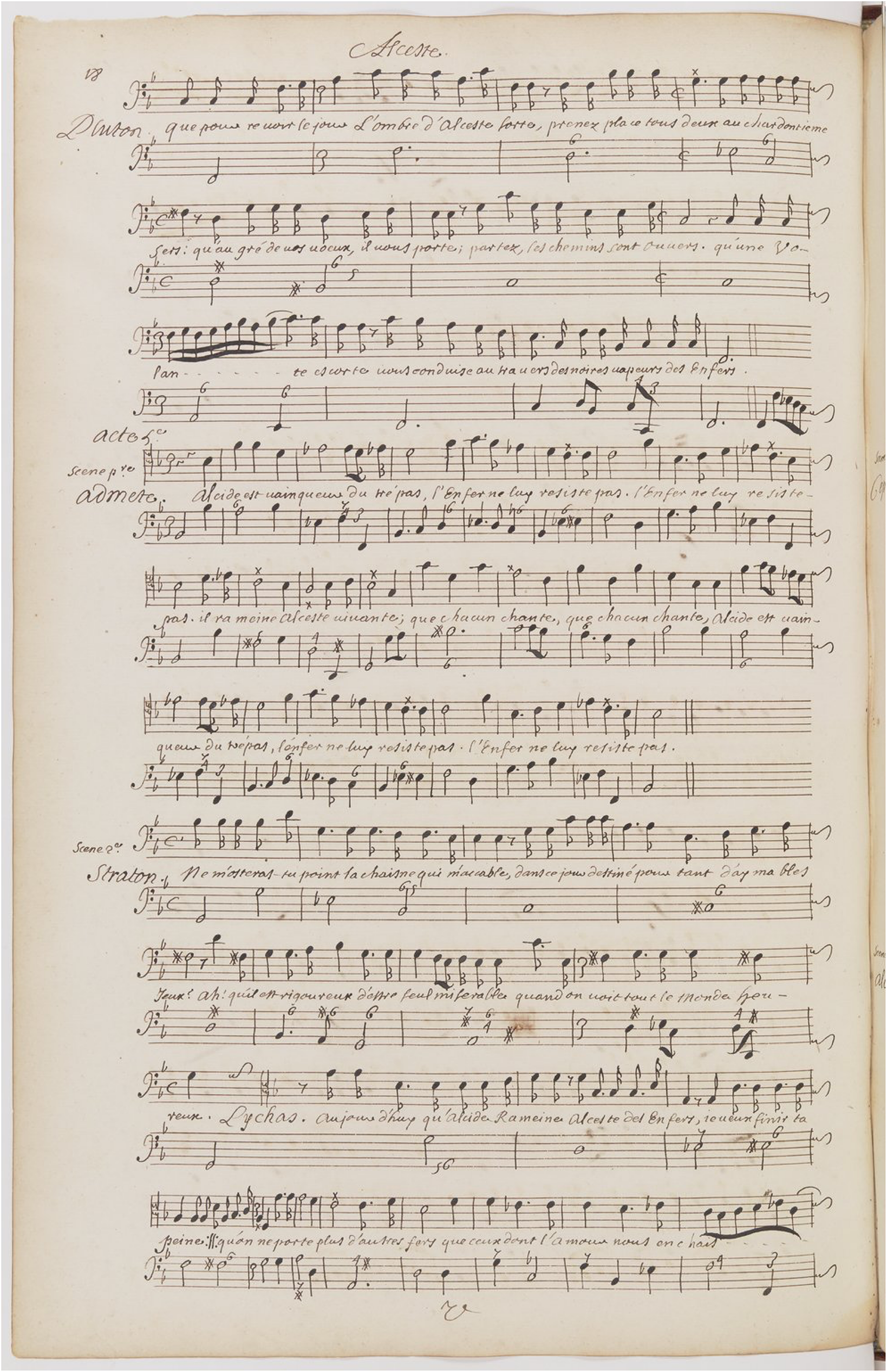
For those lacking musical training, Augier includes at the beginning of the book ‘a very short and easy method, to learn by oneself, without a singing master, how to sing the music’.Footnote 99 Because mondains would have had access to a singing master, the inclusion of this method suggests that compilers like Augier likely intended their anthologies for socially aspirational readers. To ingratiate oneself as a member of fashionable society, one had to learn and perform tunes from the latest operas, with the original or with newly composed verse, in locations geographically removed from the Opéra. Sources like Augier’s ‘Livre de musique’ can inform our understanding of what bits of music early modern audiences valued.
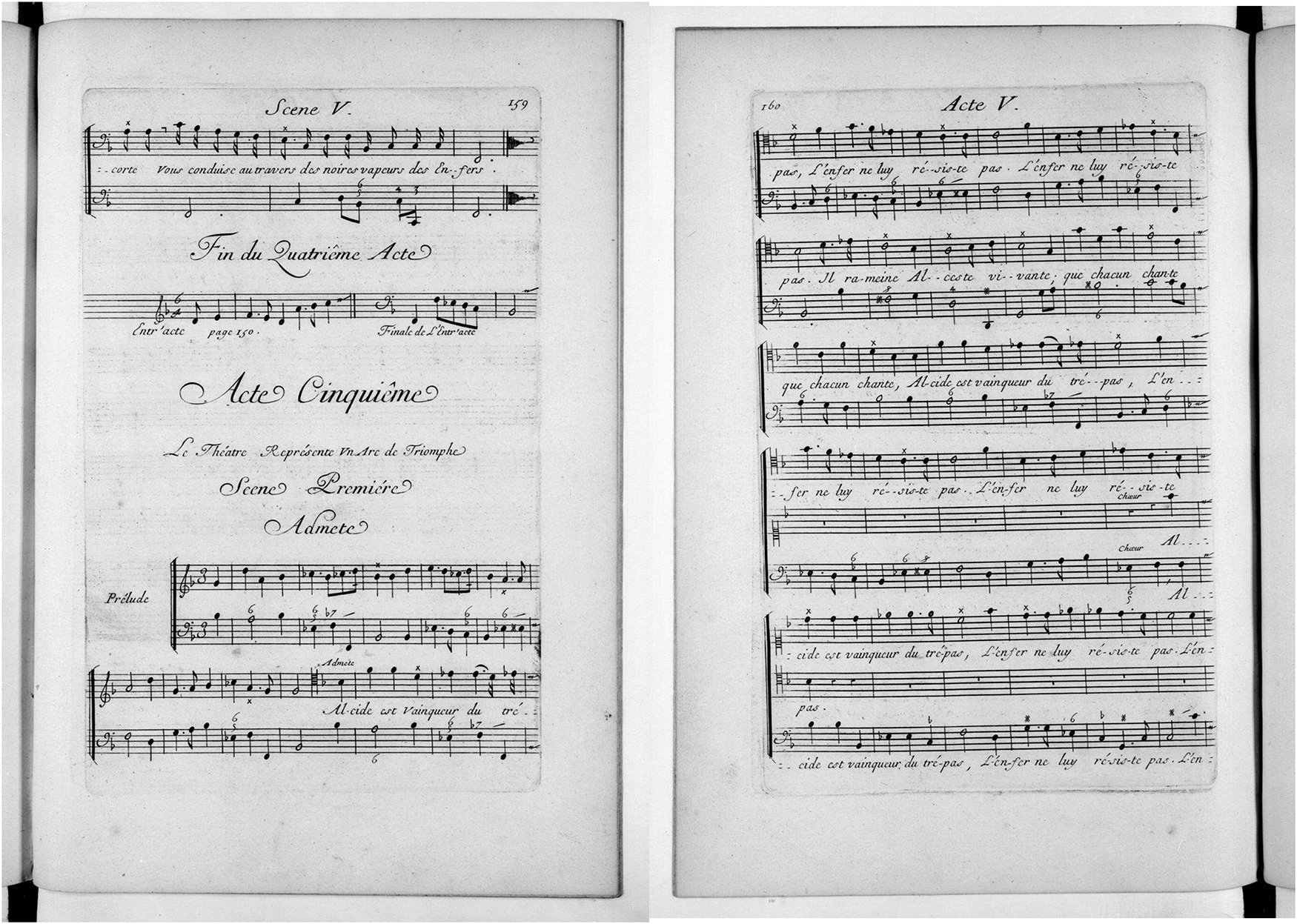
Among the many surviving musical sources for Alceste, full scores are relatively rare. Most of the material evidence of Lully’s tragédies en musique are in the vein of Augier’s songbook or presented as some kind of reduced score, like the engraved editions produced by Baussen in 1708 (Figure 12) and Ballard in 1727 (Figure 2). These editions, like most published editions of Lully’s music, provide a figured basse continue with vocal line(s) and instrumental ritournelle. The published sources present the music in a format calculated to allow a performer to extract excerpts, which could then be performed as chamber works in a setting like at a salon.Footnote 100
‘Alcide est vainqueur du Trépas’ Admète’s air from act 5, scene 1 of Jean-Baptiste Lully’s Alceste. Alceste, tragédie, mise en musique par feu Mr de Lully […] première édition gravée par H. De Baussen (Paris, 1708), 159–60. Courtesy of the Bibliothèque nationale de France.
* * *
Studying Coulanges’s body of chansons unveils the manifold ways in which early modern Parisians from diverse social ranks interacted with music from spectacles. Some operatic tunes, such as ‘Les trembleurs’, transformed into vaudevilles that circulated in the streets and later appeared as canvasses for new texts in theatrical spectacles like early comic operas.Footnote 101 Other tunes, such as ‘Puissant Roy qui donnez chaque jour’ and ‘Contrevéritez’, never seem to have penetrated the lower ranks, remaining vehicles for song games played by upwardly mobile bourgeois and nobles. In mondain circles, two distinct modes of interacting with the latest operas existed simultaneously as components of the art of conversation: quoting segments from operas in galant conversations, and parodying tunes from operas. In the parodic song tradition, in which Coulanges was a recognisable and respected figure, participants across Paris and beyond improvised countless new texts to the same evolving yet coherent body of tunes culled from spectacles. Only texts that poets or collectors found worthy of preservation survive. Countless parodic chansons that were ‘made in conversation, glass in hand’ were never documented for posterity.Footnote 102
Audience members were not passive spectators of Lully’s operas. They purchased livrets and scores published by the Ballard firm, sought prized manuscript copies of the operas before Lully published his scores; copied airs into manuscript songbooks for personal use; memorised their favourite airs and even entire scenes from the latest operas; sang along with airs and choruses at the Opéra; performed transcriptions of tunes from operas for keyboard, lute, guitar and other instruments; used operatic material as a creative form of self-expression and agency at salons and in public spaces like the Pont-Neuf; and collected parodic verse in their manuscript chansonniers. Footnote 103 Coulanges’s chansons, then, represent only one expression of a matrix of ways in which audiences saw operas as interactive experiences. Until now, studies of seventeenth-century French opera have focused on the operatic event, politics and the resulting production of material artefacts, either as performance materials or consumer products. As I have argued here, a richer picture of the cultural impact of a staged spectacle can be gleaned by studying the social structures and practices around the circulation, manipulation and reuse of operatic music. Rather than beginning with the score as the source of study, I suggest that we view most scores in the way that many early modern owners viewed them, as repositories of an evolving repertoire of operatic artefacts for use in their quotidian social experiences.
Acknowledgements
The ideas behind this research first percolated while I was a Fulbright Scholar affiliated with the Centre de musique baroque de Versailles. Further archival research was possible with the support of a Holmes/D’Accone American Musicological Society Travel Grant, a Mellon/ACLS Dissertation Completion Fellowship, and a Herzog August Bibliothek Short-Term Post-Doctoral Fellowship. I benefited from the vibrant discussions after workshopping ideas present in this article at two conferences in 2019: the annual meeting of the American American Musicological Society in Boston, Massachusetts and the Tosc@paris.2019: Transnational Opera Studies Conference in Paris, France. The passionate and probing questions from students in my undergraduate music history survey courses and a course on Women and Musical Salons helped me frame and articulate the importance of this article. Georgia Cowart, Devin Burke and Anne Duggan provided astute feedback on early drafts of this article. I am indebted to the financial support, international institutions, and communities of scholars and friends who have supported my work in all of these various ways.


 Open access

