


1. Introduction
Public policies in all domains can affect the levels and distribution of employment directly or indirectly. They do so directly when they involve either hiring workers to implement or expand government programs or firing them when programs are terminated or scaled back. Government hiring of workers to staff public programs diverts them from alternative activities, such as employment in the private sector. Similarly, workers released from the public sector are likely to find employment in the private sector. Policy measures may also indirectly alter the distribution of employment. For example, private sector employment may be altered through taxing and spending policies or regulations that affect the relative prices or costs of inputs to, or outputs from, production. We explore the economic welfare effects of these policy-induced employment changes.
Recent claims of very high social opportunity costs resulting from employment changes induced by environmental regulations indicate the need for a careful analysis of this issue, and lend salience to our discussion. Masur and Posner (Reference Masur and Posner2012) propose a shadow price for induced unemployment that is more than five times the level of pre-release compensation. By their estimate, the direct cost per released worker with pre-release compensation of $50,000 is $100,000 and the external costs are as much as an additional $160,000, for a total of $260,000. The implications of the implicit Masur–Posner shadow price for the evaluation of public policy are potentially immense. If their shadow price is valid, then fewer environmental regulations would likely pass the net benefit test. Accepting their estimates would suggest that even very expensive policies that avoid the firing of a worker or result in the hiring of an otherwise unemployed worker would have large and positive net benefits. For example, it might show European-style labor market regulations, commonly viewed as distortionary and inefficient, to be efficient instead. Consequently, the Masur–Posner proposed shadow price deserves scrutiny.
We explore the effects of direct and indirect government-induced changes in employment. We begin with a discussion of those policy-induced employment changes that seamlessly reshuffle workers among jobs in an efficient (i.e., full-employment, full-information) economy; generally such changes create few, if any, net changes in economic welfare not captured in changes in wage bills. We then turn to policy-induced employment changes that impose real net social costs or generate real net social benefits beyond changes in the wage bill. We consider the implications of two market distortions: (1) inflexible wages set by law or custom that lead to involuntary unemployment during periods of deficient aggregate demand, and (2) illiquidity resulting from imperfect capital markets that prevent people from borrowing against future earnings. Both of these distortions have important implications for the full opportunity cost of labor, and hence should be taken into account in benefit-cost analysis (BCA).
Additionally, the second distortion, illiquidity resulting from imperfect capital markets, has implications for how we move from a conceptual framework incorporating willingness to pay (WTP) for changes in employment status to a framework that facilitates actual measurement of opportunity cost. Finally, we assess the likely magnitude of the social opportunity cost of labor in the case of involuntary unemployment and imperfect liquidity, and address how the welfare effects of such employment changes should be valued.
2. Controversy over predicting induced employment effects
Estimating the employment effects of a policy change is a daunting task. Ideally, estimates must deal with the net economy-wide employment impacts of a marginal change, taking account of both the job shifts between the private sector (or nonemployment) and the public sector, or between a policy-impacted plant and other plants or firms in the same or different industries, irrespective of location.
This issue has been studied in the context of the overall employment effects of alternative public policies. For example, the U.S. Congressional Budget Office (CBO) recently attempted to summarize the extent of the net employment effects of various policies in the aftermath of the Great Recession.Footnote 1 This effort sought to identify the largest effects on output and employment per dollar of budgetary cost. Only a selected set of policies were analyzed, and the estimates provided were rough, reflecting the judgment of analysts “to encompass most economists’ views about the effects of that type of policy” (p. 23).
In a 2013 report, the U.S. Office of Management and Budget (OMB) studied the costs of regulations; it estimated the annual costs imposed by major regulations adopted during the 2002–2012 period to be in the $60–$80 billion range (2001 dollars). While OMB concluded that the benefits of these regulations exceed the costs, the magnitude of these costs suggests nontrivial employment effects of regulations.
More recent research has concentrated on estimating the employment effects of post-2008 stimulus spending; these studies use a variety of empirical methods ranging from full macro-econometric models to simple application of employment multipliers to alternative policy measures.Footnote 2
Rigorous empirical studies that have addressed this issue are largely in the employment policy and environmental regulation areas. Early research on the employment effects of labor market training and other “active” labor market policies has been reviewed in Heckman, LaLonde and Smith (Reference Heckman, LaLonde, Smith, Ashenfelter and Card1999) and Martin and Grubb (Reference Martin and Grubb2001). There are few recent studies of labor market policies.Footnote 3
Perhaps because of the concern with the potentially negative effects of environmental policy, a number of research studies have attempted to measure the employment effects of incremental environmental regulations; they have reached somewhat inconsistent results.Footnote 4 This is not surprising as economic theory suggests both employment-increasing and employment-decreasing effects of regulations (Morgenstern, Pizer & Shih, Reference Morgenstern, Pizer and Shih2002; Coglianese, Finkel & Carrigan, Reference Coglianese, Finkel and Carrigan2013).
Two of the empirical studies are based on structural models. Berman and Bui (Reference Berman and Bui2001) studied the employment effects of stringent ozone and NO x regulations during the 1980s along the Southern California coast. Imposition of regulations affects labor demand both negatively through the effect on output of the firms subject to the regulation and positively through the direct effect of increased abatement activities (including equipment production). Although the net effect is conceptually ambiguous, their empirical results indicate a de minimis negative impact.
More recently, Morgenstern et al. (Reference Morgenstern, Pizer and Shih2002) have employed a more complete economic framework, reflecting reduced output and labor demand from higher production costs, increased labor demand associated with increased abatement activities, and possible increases or decreases in the labor intensity of post-regulation technologies. Their results are also for the 1980s and indicate that in four heavily regulated industries regulations have very small positive effects on employment.Footnote 5
In addition, there are several reduced-form estimates.Footnote 6 Although the industry coverage and methods of the studies vary, all of them find somewhat reduced employment growth, investment, and new plant openings in regions that are not in compliance with clean air standards. Because these results reflect impacts only in noncompliant regions, they overestimate the economy-wide job losses and social costs of the regulations.Footnote 7
In addition to these studies, which focus on those economic sectors that are directly affected by a policy change, there is another section of literature that attempts to measure the adverse effects of mass layoffs on aggregate employment, wages, and human capital values.Footnote 8 The concept of job loss in the policy-impact studies reflects a concern with plant- and company-based employment effects, thereby recognizing the shift of employees adversely affected by a regulation to other jobs with either the same or alternative employers.
The mass-layoff studies, on the other hand, attempt to estimate the loss in the value of human capital of individual employees who become separated from a long-standing employer by a policy change, and either move to long-term unemployment or (higher or lower paid) employment at another firm. Because these “scarring effect” studies tend to neglect the more prominent intra-firm employee moves in response to the imposition of regulations, they are likely to overstate significantly the costs associated with displacement resulting from environmental regulations.Footnote 9
3. Conceptual framework for assessing the social opportunity cost of labor
Public policy can result in either direct changes in government employment or indirect changes in private sector employment when the policy induces hiring or firing by firms. Table 1 provides a framework for assessing the social costs of these employment changes with and without two important market distortions. One market distortion is wage rigidities that result in unemployment when there is insufficient aggregate demand to result in jobs for all those willing to work at the prevailing wage rate.Footnote 10 The second distortion is incomplete or nonexistent capital markets that prevent people from borrowing against future earnings, a problem of imperfect liquidity. With a constraint on liquidity, people cannot express either their WTP for employment or their willingness to accept (WTA) unemployment based on the wealth they would have in a world with perfect capital markets.Footnote 11
Social costs per worker of hiring and firing: either directly by government or induced by government policy.

Note: h: hours worked, Wf: competitive before-tax wage rate, Wr: reservation wage (narrowly defined as the marginal opportunity cost of time), Bf: hourly before-tax benefit rate, Gr: marginal government costs of recruiting (full employment), Pr: marginal private sector costs of recruiting (full employment), Gu: government costs of recruiting (unemployment), Pu: private sector costs of recruiting (unemployment), Cs: costs of searching for new job (full employment), Cu: costs of searching for new job (unemployment), WTPhg (WTPhp): worker’s own willingness to pay to avoid long-term effects of nonwork time by being hired in a government (private sector) job, WTPfg (WTPfp): worker’s own willingness to pay to avoid the effects of non-work time by being fired from a government (private sector) job, WTPh o: willingness to pay of close associates to avoid the long-term effects of the worker’s nonwork time by being hired, WTPf: worker’s own willingness to pay to avoid long-term effects of nonwork time by being fired, WTPfg o (WTPfp o): willingness to pay of close associates to avoid the long-term effects of the worker’s nonwork time by being released from a government (private sector) job, ΔHCh: change in present value of reduced human capital from being hired, ΔHCf: change in present value of reduced human capital from being fired, WTPh ∗: liquidity constrained worker’s own willingness to pay to avoid long-term effects of nonwork time due to stress or psychological factors by being hired into a job, WTPf ∗: liquidity constrained worker’s own willingness to pay to avoid long-term effects of nonwork time due to stress or psychological factors by being released from a job, WTPh ∗o: liquidity constrained willingness to pay of close associates to avoid the long-term effects of the worker’s nonwork time by being hired in a government (private sector) job, WTPf ∗o: liquidity constrained willingness to pay of close associates to avoid the long-term effects of the worker’s nonwork time by being released from a government (private sector) job, EXpf (EXnf): external costs of firing with perfect (no) liquidity, EXph (EXnh): avoided external costs of hiring with perfect (no) liquidity.
Before discussing the three cases (full employment, unemployment with perfect liquidity, and unemployment with no liquidity) set out in the columns of Table 1, we make and justify a number of assumptions and introduce key concepts. These assumptions and concepts allow us to develop practical guidance for monetizing policy-related changes in employment. That is, they can be applied with the sort of information likely to be available in ex ante BCA.
3.1. Labor as a factor input
We seek to inform the valuation of policy-related labor changes as a cost or benefit within a full BCA that also includes the valuation of the full range of other benefits and real resource costs that the policy creates. Specifically, we assume that we can separate the impacts of the policies accruing through changes in employment from the other impacts of the policy, such as those affecting the levels of private or government production. That is, we treat labor as a factor input and seek to provide guidance for valuing changes in the level of this input.
Consistent with treating labor as an independent factor input, we ignore program financing, which would be taken into account in the overall BCA.Footnote 12 Of necessity, we also ignore any changes in labor demand that result from policy-induced net changes in government revenue; a full BCA would also account for this component of benefits or costs.
3.2. Factor use and market conditions
Aside from wage rigidities and illiquidity, we assume that labor markets are undistorted by monopoly, monopsony, or information asymmetry.Footnote 13 To the extent that such market failures dominate the relevant labor markets, other shadow value adjustments to the benefits or costs of the induced employment changes would be required. We also assume that policy-induced employment changes are sufficiently small that they do not noticeably affect wages.Footnote 14 In the case of full employment, we value direct or induced changes in labor at their opportunity cost whether or not they produce a net change in employment. The opportunity cost of increased hires by the government or firms in response to policy changes involves the diversion of workers from other jobs (implying no net change in total employment), the recruitment of new workers, or the inducement of current workers to work more hours. In the case of no net employment change, the major component of opportunity cost is the forgone product of the diverted workers; in the case of either new workers or increased hours from existing workers, the primary opportunity cost is the value of forgone leisure. From whatever source, the use of labor involves an opportunity cost (Harberger, Reference Harberger1971). Similarly, released workers become available for work elsewhere in the economy.
In contrast, during unemployment, we focus on the net changes in employment because workers are moving out of or into unemployment rather than being diverted from one job to another. Moreover, it is the economy-wide job impacts of the policy that are relevant, rather than only the effects within a single firm or sector.Footnote 15 We assume that we can treat positive net employment effects as reductions in the ranks of the unemployed and negative net employment effects as additions to the ranks of the unemployed.
3.3. Occupation-specific analysis
Our analysis implicitly assumes that there is a single labor market. However, in reality labor markets are specific to particular skill sets (or occupations) so that in any economy there are multiple labor markets, many of which are closely related while some operate independently. For example, the labor markets for physicians and custodians can reasonably be treated as independent. Within the same economy it is thus possible for some labor markets to be operating at full employment while others have unemployment. The valuation of the social costs of employment changes should be thought of as contingent on the particular labor market in question rather than necessarily being uniform across all labor markets within the economy. Consequently, the BCA of a policy that has labor effects across occupations may require different valuation approaches depending on whether their markets have full employment or unemployment.
We also assume that for each occupation there is only a formal market. However, in many developing economies there are dual labor markets in which workers with similar skills choose between formal markets with benefits and informal markets without them (Edwards, Reference Edwards1989; Guillermo-Peon & Harberger, Reference Guillermo-Peon and Harberger2012). Even in a developed economy, there are some occupations in which informal payments are common; such payments are typically not reported as income and valuation of employment effects in such markets is problematic. Extending our analysis to economies with dual labor markets would require assumptions about the relationship between the two markets so that the effects of policy-induced changes in one market that spill over to the other could be taken into account. Similarly, the analysis of policy-induced employment demands in labor markets dominated by informal off-the-books payments would require assumptions regarding the relationship between the recorded costs of hiring (or gains in the case of worker release) and true opportunity costs.
3.4. Treatment of taxes and safety net payments
A key concept in the assessment of the opportunity cost of employment effects is compensation. The rate of compensation is wages and benefits per hour of labor so that the total compensation for any period is the compensation times the number of hours worked. The after-tax rate of compensation is the hourly rate of compensation reduced by any employment-related taxes so that the total after-tax compensation is the after-tax rate of compensation times the hours worked. When labor markets are efficient and the total supply of labor is fixed, the rate of compensation represents the lost value of output resulting from diverting an hour of labor to some other use. When labor markets are efficient and the supply of labor expands, the marginal potential worker has a reservation wage equal to the after-tax rate of compensation. This after-tax compensation reflects the marginal opportunity cost of employment in terms of the value of time lost for leisure and household production. The total compensation rate of these new workers equals the sum of the reservation wage and the taxes paid, the latter being a transfer from workers to the government, which, ignoring marginal excess tax burden, does not have an efficiency effect.
A number of public programs provide a safety net by supplementing the earnings or consumption of unemployed workers. Most importantly, unemployment insurance payments provide cash income. Reduced earnings during unemployment may also increase eligibility for food stamps and other in-kind and earnings-related subsidies. These benefits may have behavioral consequences, but for purposes of assessing the welfare effects of policy-induced employment changes, the impacts can be viewed as operating through the reservation wage. Again the reservation wage reflects changes in the marginal value of the cost of employment in terms of the value of time lost for leisure and household production. However, as with taxes, we treat the benefits themselves as transfers and therefore are not directly relevant to opportunity costs.
3.5. National and subnational labor markets
Our analysis implicitly assumes a single national labor market for each occupation. If there are subnational labor markets, then our results hold in several cases. First, if all subnational labor markets are at full employment, then it is reasonable to assume that changes within one subnational market can be treated independently of all other subnational markets. With all the subnational markets at full employment, there is no reason to believe that the policy-induced labor change will result in any movement of workers beyond those otherwise occurring. Second, if all the policy-induced employment effects accrue within a market with unemployment, and other subnational labor markets are at full employment, then it is also reasonable to limit attention to the directly affected subnational market. Third, if migration between subnational markets is costless, and each market has similar taxes and wages, then policy-induced hiring in a subnational market with full employment should be assessed as if it is occurring in market with unemployment if any of the subnational markets have unemployment. Finally, if the costs of migrating from one subnational labor market to another are high, then it is reasonable to assess small policy-induced employment changes in the subnational markets in which they occur.
In a number of circumstances, the general approach we present for valuing policy-induced employment changes may require modification. One such circumstance is when a policy has effects in multiple subnational labor markets. For example, an infrastructure project like a highway can shift economic activity within and across regions and thus may have employment effects across subnational labor markets (Chandra & Thompson, Reference Chandra and Thompson2000). Or, a regulation may have effects in many different subnational labor markets, requiring different assessments in those markets with and without unemployment. Another such circumstance is when the costs of migration across subnational labor markets with substantially different taxes or wages are low so that the sources and destinations of migration in response to policy-induced labor effects must be taken into account (Jenkins, Kuo & Harberger, Reference Jenkins, Kuo and Harberger2011). In these circumstances, our general guidelines should be viewed as a starting point for further analysis that takes account of differences among subnational labor markets.Footnote 16
3.6. Reservation wage
In an undistorted labor market, the marginal potential worker has a reservation wage equal to the rate of compensation the net of taxes and transfers. This reservation wage reflects the marginal opportunity cost of employment in terms of time lost for leisure and household production, prevailing tax rates imposed on earnings, available government transfers such as unemployment insurance benefits, and time gained from avoided job search. In labor markets distorted by wage rigidities that result in persistent involuntary unemployment, however, private and social opportunity costs beyond the simple interpretation of the reservation wage as the marginal opportunity cost of time are relevant to assessing the social costs and benefits of changes in employment.
3.7. Divergence of reservation wage from the marginal opportunity cost of time
In conventional analyses, the reservation wage is interpreted as the marginal opportunity cost of time. When there is involuntary unemployment, however, the reservation wage may diverge from the opportunity cost of time.Footnote 17 If the purpose of analysis is to predict labor force participation, then the value of the reservation wage is essential. If the purpose is instead taking account of welfare changes attributable to the employment changes resulting from a policy change, then an alternative is to continue to treat the reservation wage as the marginal opportunity cost of time and separately value the other impacts. We follow this latter approach because it facilitates clarity in the categorization of effects. Consequently, throughout the analysis that follows, we adopt the convention of interpreting the reservation wage narrowly as the marginal opportunity cost of time.
There are three main factors that can affect the reservation wage; as noted, we treat these effects as independent of the marginal opportunity cost of time. First, when unemployment is high, workers who are hired or fired may experience changes to the value of their human capital (the discounted present value of the returns from their future expected employment). These effects are often referred to as “scarring” effects associated with being unemployed.Footnote 18 For example, periods of nonwork may reduce a person’s human capital relative to what it would have been if the worker had been employed. This reduction will result in a lower future stream of wages. The present value of this long-term reduction in wages (productivity) is a measure of this scarring cost. While this scarring cost could be reflected in a very broad definition of the reservation wage, it is not included in most definitions of that value and is not included in ours.
In view of the expected loss of income from the scarring effects of becoming unemployed, a policy-induced increase in labor demand may convey welfare gains on those unemployed workers who are rehired. Having experienced the scarring loss, such hired workers gain access to a job chain of upgrading opportunities from increased worker productivity that would not be present were the worker to remain involuntarily unemployed. These expected future gains from a decrease in involuntary unemployment are likely to be reflected in future expected wage increases. These changes are in addition to any increase in immediate wages resulting from moves between involuntary unemployment and employment (see Bartik, Reference Bartik2012; Mortensen, Reference Mortensen, Ashenfelter and Layard1986).
Second, being hired or fired when there is unemployment may affect individuals psychologically through increases or decreases in the stigma cost associated with being unemployed.Footnote 19 Looked at from the position of a newly hired worker, having a job may convey self-esteem that is lacking when the person is unemployed. Conversely, there is a loss of self-esteem associated with moving from employment to unemployment.Footnote 20 Again, although this welfare change could lead to an adjusted reservation wage, we treat it as an independent effect.Footnote 21
Third, changes in physical and mental health, mortality, and life satisfaction may be associated with the hiring of an involuntarily unemployed worker or the release of an employed worker.Footnote 22 Although workers who perceive these effects may take account of them in adjustments to their reservation wage, we assess their welfare implications as independent estimates of the marginal opportunity cost of time in a full BCA.
3.8. Spillover effects not reflected in the reservation wage
In addition to the private market and nonmarket effects associated with hiring and firing when there is unemployment, there may also be third-party (or spillover) welfare effects. For example, if the family or friends (close associates) of a released worker experience an empathy-based loss because of the worker becoming unemployed, it is likely that they will also experience a “warm glow,” empathy-based feeling when the worker gains employment.Footnote 23 Although such close-associate effects are external to the worker, they must also be considered in assessing the full social welfare gains from incremental hiring and firing due to policy changes.Footnote 24 Job loss can also lead to negative outcomes among the children of the unemployed,Footnote 25 and to an increase in crime.Footnote 26 We assume that none of these effects are reflected in the worker’s reservation wage.
4. Assessing opportunity cost
Notation for taking account of the various components of opportunity cost in each of the three market cases follows.
4.1. Worker hiring and release with full employment (and no market distortions)
The first column in Table 1 assumes full employment. We define Wf as the before-tax competitive wage rate and Bf as the before-tax competitive benefit rate. In this case, before-tax hourly compensation – the sum of the competitive market wage and benefits (Wf + Bf) times hours worked (h) – represents the primary component of the opportunity cost of labor both in terms of hiring (cost) and firing (avoided cost).Footnote 27 It implicitly assumes that the total supply of labor is fixed. In addition, there may be transaction costs for employers in finding and hiring appropriate workers and providing them with firm-specific training, and for fired workers in searching for new jobs (Cs); these hiring costs may differ between the government (Gr) and private sector (Pr). As these costs are typically small in an economy with “full employment,” usually thought of as a labor market in which the number of people seeking employment is a small percentage of the number currently employed, they are usually ignored in standard BCA. However, Gr and Pr could be large for government programs or private firms attempting to hire very specialized labor or to attract workers within a small geographic area, and Cs could be large enough to matter for some types of workers who may be relatively unattractive to potential employers.
4.2. Worker hiring and release with unemployment but perfect liquidity
The second column is the case of unemployment but perfect capital market liquidity (as well as full information). We assume that all new hires come from the pool of unemployed and that all layoffs add to the pool of unemployed. The key concept in this case is the marginal opportunity cost of time, Wr. It gives the marginal value that the person places on his or her nonwork time. In standard BCA, it also represents the opportunity cost to society of hiring an unemployed person (Haveman & Krutilla, Reference Haveman and Krutilla1967; Haveman & Farrow, Reference Haveman and Farrow2011). That is, the marginal cost of using otherwise unemployed labor for a public project is not monetized using the full wage (Wf + Bf) but rather at Wr.
A broader perspective takes account of negative consequences of unemployment not captured in the opportunity cost of time. As discussed above, one potentially large consequence is that periods of nonwork may reduce a person’s human capital relevant to employment, resulting in a future stream of lower wages – the so-called scarring effect. Other potential consequences are psychological loss resulting from the stigma of being unemployed and adverse effects on health and life expectancy. Finally, a person’s unemployment may also have spillover effects if members of his or her family or close friends and associates experience a loss of well-being because of the unemployment of the individual.
4.2.1. Hiring by the government or the private sector
Someone who is currently involuntarily unemployed has a reservation wage lower than the prevailing wage rate. This reservation wage, which is generally interpreted as the marginal opportunity cost of time (Wr in our notation), may be lower because of the willingness to pay for avoiding the expected costs of remaining unemployed. In addition, reemployment of the individual would generate WTP values for avoiding future costs associated with remaining unemployed, including longer term losses of human capital from its nonuse while unemployed (including adverse employment and earnings effects and negative health effects) and the potential stigma and psychological costs of unemployment deriving from reduced perceptions of self-worth and increased stress. As noted above, such effects experienced while out of work may also cast shadows into the future; psychological effects may persist even after reemployment. We would expect the person to have a WTP to reduce these effects through gaining immediate employment. These WTP values capture the private benefits to the person of gaining employment, and as such would reflect a social benefit.Footnote 28 If there were no psychological or health costs associated with unemployment – that is, the only costs would be the loss of future potential earnings associated with the erosion of the value of human capital – the WTP for immediate employment would equal the person’s estimate of the difference between the present expected value of future earnings with immediate employment minus the present expected value of future earnings from forgoing immediate employment.Footnote 29 This gain from employment reduces, and perhaps exceeds, the lost value of leisure time and home production available from being unemployed.
The total WTP for immediate employment would be the sum of the WTP to avoid reductions in future earnings associated with the erosion of the value of human capital and the WTP to avoid negative psychological and health effects through immediate employment. We designate this as WTPh. Because this amount depends on the future consequences of immediate employment, it may differ for hiring by government (WTPhg) and hiring by the private sector (WTPhp). For example, if being hired by the government, say in a “make work” program, does not build human capital at the same rate as private sector employment, then the WTP to be hired by the government will be less than the WTP to be hired by a private firm (WTPhg < WTPhp).
There may also be positive effects on family members, friends, or others in the newly hired person’s household if he or she is offered a job. Observing and interacting with an individual who is stressed and upset with being unemployed reduces the well-being of “close associates” of the person, and is hence a cost to them. Assuming that these “close-associate” spillover effects are not internalized,Footnote 30 a second WTP term (WTPh o) is required. A third term, EXph, captures any positive benefits from the hiring of an otherwise unemployed worker that may spill over to the rest of society in the form of avoided external costs. With perfect liquidity, these externalities are likely to be small, resulting primarily from the possible use of increased leisure time associated with being out of work for activities that create negative effects on others.
Column 2 includes these values, labeled WTPh o and EXph. Consequently, the hiring of an unemployed person by either the government or the private sector provides a benefit to others who are “close associates” of the person (and, if internalized, to the unemployed person) and to the rest of society. These benefits reduce the social opportunity cost of the hire captured through the marginal opportunity cost of time.
In sum, the social cost of hiring when there is unemployment equals the value of time of the otherwise unemployed person (Wrh) plus the costs borne by the government and the private sector in hiring (Gu and Pu, respectively) minus the present value of avoided own- and close-associate nonmarket costs, either WTPhg + WTPh o + EXph for a government hire or WTPhp + WTPh o + EXph for a private sector hire.Footnote 31
4.2.2. Firing by the government or the private sector
With no liquidity constraint, the individual would have a WTP to avoid being fired by either the government or the private sector. Analogous to the case of the hiring of an unemployed worker, WTPrg and WTPrp capture the negative own-WTP effects of being released from employment into a labor market with unemployment. Again, these include the negative psychological and health costs associated with being unemployed, as well as the loss in the value of human capital from erosion related to nonuse.Footnote 32
There may also be effects on family members, friends, or other close associates because of the worker being fired by either the private or public sectors. If these external effects are internalized by the worker, then his or her willingness to pay (WTPfg or WTPfp) would include all of these effects. If these close-associate effects are not internalized, then a second WTP term would be required; we label these terms WTPf o. Further, any external effects on the rest of society (EXpf) should be included.
As any fired person will not be reemployed immediately because of the general unemployment, release of an employee results in a social savings monetized with the reservation wage (− Wrh), but costs in terms of lost human capital and own longer term psychological and health losses (WTPrg and WTPrp) and spillovers onto close associates (WTPf o) or to the rest of society (EXpf). We add these costs to the reservation wage benefit (− Wrh) in the bottom rows of the second column.Footnote 33
4.3. Worker hiring and release with unemployment but without liquidity
None but the wealthiest individuals in society enjoy near perfect liquidity – in general, there are large constraints on the ability to borrow against future earnings. Thus, individuals express WTP subject to their current budget constraint rather than to a budget constraint that incorporates the present value of future earnings. This brings us to the third column of Table 1, which breaks down components of social opportunity cost assuming no inter-temporal liquidity. Entries in this column reflect the assumption that it is not possible to borrow against future earnings.
In the case of no liquidity, the same two costs of hiring – the reservation wage (times hours worked) and the costs of hiring (Wrh + Gu) or (Wrh + Pu) – form the base values of the social cost estimate. However, it is only possible for the individual to express a perceived WTP either to gain employment or to avoid losing it that reflects the illiquid human capital market. As in the previous case, we distinguish between two of these WTP values. First, there are the individual psychological and health costs that the individual bears from being unemployed. These costs result from the stigma and health status changes (resulting from increased stress and possibly financial barriers to appropriate medical care) associated with being unemployed. These costs are avoided when the individual is hired by either the government or the private sector; because these avoided costs are the same irrespective of the hiring sector, we designate these as WTPh ∗.
Second, the spell of unemployment may reduce human capital through its erosion related to nonuse, and thus result in lower productivity over the course of the person’s working life. We designate these effects as ΔHCh, a positive effect when hired, and ΔHCf, an additional social cost when released. These impacts are analogous to those described in identifying the increase in WTP in the perfect liquidity case in column 2. Note that changes in human capital would be valued from the social perspective in terms of pre-tax compensation and from the individual’s perspective in terms of after-tax compensation.
Here, as in the perfect liquidity case, there may be effects that spill over to members of the newly hired worker’s household or other close associates. We designate the monetary value of these effects as WTPh ∗o. We also recognize that the person may impose costs on the rest of society. These effects may be larger in the case of no liquidity than in the case of perfect liquidity (shown in column 2) because of the inability to smooth consumption to offset these losses. We designate these effects that spill over beyond close associates and families – such as the increased probability that a worker may engage in illicit behavior if unemployed, such as crime, or impose additional real resource costs through the use of health care – as EXnf (a cost if fired) and EXnh (a reduction in social cost if hired). We expect that costs imposed on the rest of society would likely be much larger in the case of no liquidity than in the case of perfect liquidity (EXnf > EXpf) because of the need to accommodate the illiquidity.
5. The need for shadow prices to assess the welfare impacts of hiring/firing decisions
Textbook discussions of the social costs of hiring and firing generally assume a fully employed and smoothly functioning economy; in this case, the social benefits of hiring (or firing) a worker are reflected in the market wage rate plus the nonwage benefits paid (compensation), the value of which equals the marginal product of the employer and the after-tax value equals the marginal worker’s reservation wage. Hence, the social welfare consequences of a marginal worker hired or fired beyond these values are de minimis. Only a few studies have explored the measurement of these costs in the case of an economy operating at less than full employment; Haveman and Krutilla (Reference Haveman and Krutilla1967), Boardman, Greenberg, Vining and Weimer (Reference Boardman, Greenberg, Vining and Weimer1996), and Haveman and Farrow (Reference Haveman and Farrow2011) are the exceptions. However, studies have not analyzed these costs in an economy without full liquidity.
Table 1 makes it clear that a full analysis of the social welfare impact of a marginal hire or worker release is far more complex than the simple stories presented in textbooks. We have emphasized that numerous and subtle welfare-relevant effects may be generated by the hire or release of a marginal worker that are not considered in these analyses. In this section, we first identify those effects where shadow values are likely required, and then suggest some reasonable rules of thumb for monetizing these impacts.
5.1. Recruiting costs
In Table 1 (column 1), we consider the social costs of direct or induced hiring and firing under an assumed smoothly functioning, competitive and fully employed economy. In addition to the changes in full compensation [(Wf + Bf)h], we identify the employer costs of recruiting (Pr,Gr). In columns 2 and 3, these are designated as Pu and Gu.
Employers must expend resources to find, sign, and train new employees. How large is the cost of these resources? One of the few estimates of these costs for the United States comes from analysis of data from the 1982 Employment Opportunity Pilot Project by Dolfin (Reference Dolfin2006). At that time the average employer spent 13.5 hours of employee time on recruitment and hiring. On average, firms reported devoting 201 hours of the time of the newly hired employee to training along with 146 hours of supervisor and other employee time. It should be noted that the survey was conducted during a recession so that these figures would likely best represent private recruitment costs with unemployment (Pu). These time costs would likely be underestimates for recruiting and training under full employment (Pr). In either case, the time cost of finding and hiring workers is sufficiently small so that in most cases it can reasonably be ignored. Training costs are sufficiently large to be taken into account. The first-year cost of employing a new worker would be approximately 17% (347 hours of training/2000 hours employment per year) of annual compensation. However, it is reasonable to assume that rehires would not incur these costs. A 2009 survey suggests that about a fifth (18%) of the unemployed landing new jobs took them with their former employers.Footnote 34 This suggests using an overall estimate of about 14% of the hired worker’s compensation as an estimate of (Pr,Pu,Gr,Gu).
Civil service rules require procedures that likely result in much higher recruiting costs for governments (Gr and Gu). Although estimates of the length of calendar time it takes to hire a federal employee are available,Footnote 35 we were unable to find any estimates of the real resource costs expended in completing a federal hire. In circumstances in which the hiring would be done outside of civil service rules, analysts would appropriately make a program-specific estimate.
Lacking better information, we suggest multiplying first-year compensation by about 1.14 to reflect the recruitment and training costs for both direct government and induced private sector hires to obtain the full employer cost of hiring. This rule-of-thumb estimate is sufficiently large to warrant additional research, both in terms of more contemporary data and estimates conditional on occupation and sector.
5.2. Unemployment spell
Several components of social cost require estimates of the length of time a fired person will remain unemployed in the absence of a policy intervention. Ideally, we would like an estimate of the mean duration of unemployment spells as a function of the unemployment rate. However, we were not able to estimate econometrically a plausible relationship in U.S. monthly data over the last 24 years.Footnote 36 As an expedient, we use an estimate based on the last two recessions in which the civilian unemployment rate reached 10%. In November 1982, the unemployment rate reached 10.8% and 8 months later the mean duration of unemployment peaked at 20.8 weeks. In October 2009, the unemployment rate reached 10.0% and 38 months later the mean duration of unemployment peaked at 40.7 weeks. For lack of a better method of prediction, we use the approximate average of these two durations, 30 weeks, as a rule of thumb for valuation when the unemployment rate is around 10%.
This simple analysis allows us to move toward our rough estimates of the social costs of hiring and firing. Our estimates could be improved by additional empirical work that provided predictions of unemployment spells conditional on demographic characteristics. For example, an empirical assessment of the costs of Canadian aircraft industry layoffs found that older workers who lost employment suffered larger private losses and inflicted larger social costs on the economy than younger workers (Jenkins & Montmarquette, Reference Jenkins and Montmarquette1979).
5.3. Job search costs
Released workers bear costs associated with searching for a new job (Cs). These costs would likely be contingent on the age, sex, and occupation of the released worker as well as the expected duration of nonemployment. As a rough estimate of job search costs, we begin with the average hours per day spent on job search and interviews by the 2% of the population who engaged in these activities in 2012: 2.4 hours per weekday and 2.1 hours per weekend day (Bureau of Labor Statistics [BLS] 2012, A2) for an average of approximately 16.2 hours per week. As the unemployment rate in 2012 was approximately 8%, we assume that one quarter of the unemployed (2%/8%) engaged in this activity. From these estimates, we conclude that the average unemployed worker spent about 4 hours per week in job search activities (16.2 hours per week $\times$
0.25).
$\times$
0.25).
We assume that in a period of full employment, a fired worker can find a new job in 5 weeks, so that search costs are 20 hours or 1% of compensation. Applying the estimate of 4 hours per week to the estimate of unemployment duration for a 10% unemployment rate yields an estimate of 120 hours of job search activity by the average unemployed worker. This estimate represents about 6% of the annual average number of work hours; we monetize this time expenditure by multiplying it by the implicit compensation rate associated with the average expected annual salary of the unemployed worker. These monetized values provide estimates of the search cost for a newly fired worker (Cs or Cu depending on the assumed unemployment rate). Although the magnitudes of search costs appear relatively small, the heroic assumptions we employed to make them suggest that additional research would be appropriate.
5.4. Changes in human capital
For a released worker, the change in human capital can be monetized as the difference between earnings with continued employment and earnings if released; this estimate is designated as ΔHCf in Table 1. For a worker hired from unemployment, the change in the value of human capital (ΔHCh) is the difference between the level of expected earnings, having become reemployed at some point in the unemployment spell, and the level of earnings if unemployment persisted for the entire spell.
Consider, first, ΔHCf as calculated by the following formula:
 $$\begin{eqnarray}\displaystyle {\rm\Delta}\text{HC}_{\text{f}} & = & \displaystyle \mathop{\sum }_{\text{t}=\text{age}}^{65}\frac{\text{Y}(1+\text{p})^{\text{t}-\text{age}}}{(1+\text{d})^{\text{t}-\text{age}+0.5}}\nonumber\\ \displaystyle & & \displaystyle -\,\left(\frac{(1-\text{s})\text{Y}(1-\text{ud})}{(1+\text{d})^{(\text{ud}+1)/2}}+\mathop{\sum }_{\text{t}=\text{age}+1}^{65}\frac{(1-\text{s})\text{Y}(1+\text{p})^{\text{t}-\text{age}-\text{ud}}}{(1+\text{d})^{\text{t}-\text{age}+0.5}}\right),\nonumber\end{eqnarray}$$
where Y is annual compensation (wages and benefits) at the time of release, p is the rate of growth of real wages, d is the discount rate, s is the percentage of reduction in wages upon rehiring, and ud is the duration of unemployment expressed as a fraction of a year.Footnote 37
As we note below, there is some evidence that the effect of scarring is eliminated after a number of years. This can be accommodated in the above formula by only summing up to age plus the number of years of scarring duration instead of up to the assumed retirement at 65 years.
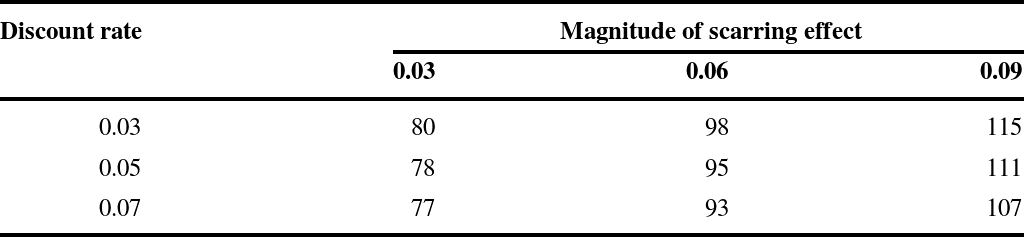
To assess the likely magnitude of this expression, consider a worker who is 42 years old (the median age of U.S. workers in 2012). Assume that this worker experiences an unemployment spell of 0.6 years (the expected duration of unemployment assuming an unemployment rate of 10%). Also assume for purposes of illustration that: (1) the rate of growth in real wages is 0.9% (annualized growth rate in real wages over 2000 to 2011Footnote 38 ), (2) the scarring effect (the percentage of reduction in wage upon rehiring) is 3%Footnote 39 , and (3) the scaring effect persists for 6 years. The resulting value for ΔHCf would be 80, 78, and 77% for discount rates of 3, 5, and 7%, respectively.
The calculation of ΔHCh assumes that scarring has already occurred:
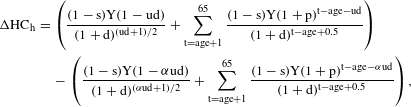 $$\begin{eqnarray}\displaystyle {\rm\Delta}\text{HC}_{\text{h}} & = & \displaystyle \left(\frac{(1-\text{s})\text{Y}(1-\text{ud})}{(1+\text{d})^{(\text{ud}+1)/2}}+\mathop{\sum }_{\text{t}=\text{age}+1}^{65}\frac{(1-\text{s})\text{Y}(1+\text{p})^{\text{t}-\text{age}-\text{ud}}}{(1+\text{d})^{\text{t}-\text{age}+0.5}}\right)\nonumber\\ \displaystyle & & \displaystyle -\,\left(\frac{(1-\text{s})\text{Y}(1-{\it\alpha}\text{ud})}{(1+\text{d})^{({\it\alpha}\text{ud}+1)/2}}+\mathop{\sum }_{\text{t}=\text{age}+1}^{65}\frac{(1-\text{s})\text{Y}(1+\text{p})^{\text{t}-\text{age}-{\it\alpha}\text{ud}}}{(1+\text{d})^{\text{t}-\text{age}+0.5}}\right),\nonumber\end{eqnarray}$$
where ${\it\alpha}$
is the fraction of the unemployment spell remaining when the new hire is made. Using all the previous values and assuming that the hire would be made midway during the expected unemployment spell
${\it\alpha}$
is the fraction of the unemployment spell remaining when the new hire is made. Using all the previous values and assuming that the hire would be made midway during the expected unemployment spell $({\it\alpha}=0.5)$
results in a value for ΔHCh of about 30% of the pre-firing compensation.Footnote
40
$({\it\alpha}=0.5)$
results in a value for ΔHCh of about 30% of the pre-firing compensation.Footnote
40
How do these calculated changes in human capital resulting from release and reemployment compare to estimates in the literature? At the high end of estimates of long-term scarring effects are those of Davis and von Wachter (Reference Davis and von Wachter2011) and von Wachter, Song and Manchester (Reference von Wachter, Song and Manchester2009). These studies focus on long-tenure workers who lose employment during mass-layoff events.Footnote 41 The estimates range from a present value of 1.4 years of pre-displacement earnings if displaced in mass-layoff events that occur when the national unemployment rate is below 6% to 2.8 years of pre-displacement earnings if displaced when the unemployment rate exceeds 8%.Footnote 42 The estimates reflect an annual long-run earnings loss of between 10 and 20%, depending on whether the loss occurs in a recession or an expansion.Footnote 43
For several reasons, these estimates of earnings loss seem higher than appropriate for assessing the human capital losses associated with job loss even during a recession. First, the estimates apply to instances of “mass layoffs” – plant closings or major reductions in workforce (greater than a 30% reduction) at a particular facility. In our view, the regionally concentrated effect of a mass layoff at a single facility will be substantially greater than the wage and earnings loss associated with less concentrated job losses. The mass layoffs effectively produce local unemployment rates that are higher than the national rate. Consequently, we believe that, in view of economic and social factors impeding migration that contribute to the persistence of locally high unemployment rates, the mass-layoff evidence is not a good guide for estimating the impacts of geographically dispersed layoffs.
Second, the mass-layoff estimates of Davis and von Wachter (Reference Davis and von Wachter2011) and von Wachter et al. (Reference von Wachter, Song and Manchester2009) resulting from a facility closure apply to long-tenure workers, and hence will be heavily weighted toward executive and managerial employees and employees with substantial firm-specific human capital rather than lower level workers. Most policy-induced unemployment is likely to be more concentrated among lower skilled workers.
Finally, the estimates of scarring effects in these papers assume that the earnings loss as a percentage of pre-displacement earnings is maintained for 20 years and then a 5% discount rate is applied. This duration of loss persistence is at variance with other estimates in the literature; these indicate that by about 6 years after job loss, most of the loss of pre-displacement earnings has been experienced. See Jacobson, LaLonde and Sullivan (Reference Jacobson, LaLonde and Sullivan1993), Schoeni and Dardia (Reference Schoeni and Dardia1997), and Kletzer and Fairlee (Reference Kletzer and Fairlee2003).
Stevens (Reference Stevens1997, 165) measures the effect of displacement defined as “involuntary termination of a position, with the exception of the ending of an explicitly temporary job.” She finds that the effect of job loss is persistent, with earnings and wages remaining approximately 9% below their expected levels six or more years after displacement. Moreover, she finds that this 9% estimate is largely explained by additional job losses in the years following an initial displacement. She estimates that workers who avoid additional displacements after the initial loss experience earnings and wage losses of between 1% and 4% six or more years after job loss.Footnote 44
Her estimates seem more closely related to the losses experienced during a recession as opposed to releases that are characterized as mass layoffs. The difference between the effects of mass layoffs and more generalized displacement clearly accounts for some of the greater effect of job loss estimated by the Davis and von Wachter (Reference Davis and von Wachter2011) and von Wachter et al. (Reference von Wachter, Song and Manchester2009) studies. Moreover, Stevens’ estimates reflect a cross-section of workers experiencing displacement rather than only long-tenure workers in the latter studies.
We see Stevens’ 9% reduction in wages as an upper bound for estimating the change in human capital resulting from a firing. As a lower bound, we use 3%, which is consistent with our rough calculation based on BLS data and within her range for workers who do not encounter subsequent job displacements. We split the difference between these low and high rates and use 6% as a wage reduction estimate in our calculations. Also, rather than assuming that the reduction tapers out, we assume that the reduction is in full effect for 6 years before it is eliminated. Table 2 displays estimates of the loss of human capital for an unemployment duration of 30 weeks and wage reduction duration of 6 years for discount rates of 3, 5, and 7%.
Human capital loss estimates for firing: assuming mean unemployment spell of 30 weeks and 6-year scarring duration (percentage of prior earnings).
Stigma and Stress Costs of Involuntary Job Loss
In addition to the erosion of human capital reflected in reductions in future earnings, there are likely to be adverse effects of becoming unemployed associated with the potential stigma/psychological costs of unemployment deriving from perceptions of self-worth and stress. In Table 1, we represent the value of these effects as the worker’s WTP to avoid these costs by being hired if unemployed or by being released if employed (in column 3 of Table 1, these effects are labeled WTPh ∗ and WTPf ∗).
That there is such stigma, especially on the demand side of the market, seems indisputable. Ho, Shih, Walters and Pittinsky (Reference Ho, Shih, Walters and Pittinsky2011) document clearly that potential employers fail to treat position applicants who are unemployed as favorably as they do applicants who are working, holding other characteristics constant. This demand-side stigma effect would largely be manifest for workers who have experienced a prolonged period of unemployment; hence, it would be captured by estimates of the earnings loss from unemployment discussed above.
In addition to this employer-based effect, there are the personal feelings of stigma that are felt by the unemployed worker. These effects are real and the unemployed worker’s WTP to avoid them should be reflected in assessing the full costs of involuntary job loss. One approach would be to treat the stigma as a reduction in quality-adjusted life years (QALYs) as done in economic evaluations of medical interventions. It would involve multiplying the unemployment duration measured in QALYs times the person’s income. In the absence of any available estimates of the effect of the unemployment stigma on QALYs, we heroically assume a reduction of 0.3.Footnote
45
Applying this to a duration of 0.6 years assuming all income is from unemployment insurance, which replaces about 41% of prior employment income in 2013,Footnote
46
yields a value of approximately 7% of prior annual compensation for the stigma costs of a firing $(0.3\times 0.6\times 0.41)$
. Again assuming that an unemployed worker is hired halfway through what would otherwise be the unemployment spell leads to a value of about 4% of prior compensation for a hire.
$(0.3\times 0.6\times 0.41)$
. Again assuming that an unemployed worker is hired halfway through what would otherwise be the unemployment spell leads to a value of about 4% of prior compensation for a hire.
We recognize that it may seem counterintuitive that lower income during unemployment would reduce the monetized value of stigma. However, because we seek to assess opportunity cost in terms of standard BCA practice, we monetize in terms of the WTP that an individual would actually be able to pay, which necessarily depends on income. Of course, if liquidity were not constrained, the unemployed individual would likely have a higher WTP because he or she could express higher WTPs by borrowing against future earnings.
These values imply that the stigma cost of job loss is about 7% of prior compensation, WTPf ∗. The reduction in stigma cost due to a hire (WTPh ∗) equals about 4%, leaving a net stigma cost of about 3%.
5.5. Effects on close associates of the individual worker: spillover effects
The available literature on the spillover effect of worker job loss on close associates (WTPf ∗o) focuses primarily on the effects of involuntary job loss on workers’ children. Evidence suggests that in the short run, the loss of employment by a parent reduces schooling achievement of children.Footnote 47 In developing a shadow value for these effects, we first estimate the effect of parental job loss on the expected change in the income of the family. Second, we estimate the effect of the income change on the years of completed schooling of children. Finally, we draw on evidence that links changes in children’s completed years of schooling to their labor market outcomes.
As we have discussed, job loss has a negative effect on parental earnings and income. Again drawing on Stevens (Reference Stevens1997), we assume that the upper bound for the earnings loss from job displacement is about 9% and persists for a period of about 6 years. This is consistent with later estimates by Stevens and Schaller (Reference Stevens and Schaller2011), who find that the effect of job lossFootnote 48 reduces earnings from $209 per month (level estimates) to $284 per month (log estimates), or by about $3,000 per year (in 2004 dollars). For the sample that they use, pre-displacement income among those who ultimately lose their job is about $3,200 per month, implying that the job loss reduces family income from about 7% to 9%.Footnote 49
The second step is to estimate the effect of changes in earnings and income on the years of completed schooling of offspring children. Mayer (Reference Mayer1997) reviews a number of studies of this relationship, and concludes that a 10% increase in parental income is associated with between 0.024 and 0.104 additional years of schooling. When the students’ race and sex, mothers’ education and age, and family size are controlled for, a 10% increase in parental income is associated with an additional 0.055 years of schooling among all students. Other estimates are generally consistent with this estimate, but typically smaller in magnitude.Footnote 50 On the basis of these estimates, we assume that a 10% increase in parental income increases children’s schooling by 0.055 years. If parental job loss reduces family income by about 8%, we estimate that the reduction in the number of years of children’s schooling is about 0.045 years.
Several well-known studies have estimated the earnings returns to completion of additional schooling (Ashenfelter & Krueger, Reference Ashenfelter and Krueger1994; Angrist & Krueger, Reference Angrist and Krueger1991; see Card, Reference Card2001, for a summary of estimates). In these studies, completion of an additional year of schooling is generally found to increase earnings by approximately 10%.
We multiply this 10% earnings return to a 1-year increase in schooling by 2008 median earnings (about $42,000) and in turn multiply the resulting value by the estimated decrease in years of children’s schooling attributable to parental job loss (0.045 years) to obtain the annual value of reduced child earnings attributable to the job loss of about $200.
Assuming constant real earnings, we then calculate the discounted present value of the reduction in children’s earnings over a working lifetime attributable to the reduced years of schooling, in turn attributable to a parental job loss. We assume that the child is 9 years old (midway between an infant and an 18-year old) and works from age 18 to 65. The present value of the reduced earnings is approximately $3,800 at a discount rate of 3%, $2,300 at a discount rate of 5%, and $1,500 at a discount rate of 7%.
The average number of children per family is approximately 1.5. Using these estimates, we calculate the earnings loss to all of the children in the family by multiplying the present value of the reduced earnings due to the decreased years of schooling by 1.5, obtaining estimates of per family of $5,800, $3,500, and $2,200 at discount rates of 3, 5, and 7%, respectively.
In addition to the private monetary costs from reduced children’s educational outcomes attributable to parental job loss, there are a variety of nonmonetary private and public effects of the reduction in children’s schooling. These have been extensively studied,Footnote 51 and a reasonable estimate is that the nonmonetary private and public effects could be as great as the private monetary costs in the form of reduced income. These externality estimates were made for income changes for low-income families, and therefore may be high for a middle-income family. However, as we do not explicitly monetize stigma costs for the children of the unemployed, we believe that these estimates are reasonable overall. Based upon the estimates of externalities, we multiply the range of earnings decreases to all of the children in a family by 1.5, yielding a total cost of parental job loss of $8,700, $5,300, and $3,300 at discount rates of 3, 5, and 7%, respectively.Footnote 52 Again assuming a hire halfway through the unemployment spell would reduce these by one half.
Assuming that the value of prior compensation is $40,000, these values translate into shadow values of 22%, 13%, and 8% for the effect of job loss on the children in a family experiencing a parental job loss for discount rates of 3, 5, and 7%, respectively. Assuming a 5% discount rate suggests multiplying prior compensation by about 1.13 to reflect the impact of job loss on close associates (WTPf ∗o).
5.6. Health costs of involuntary job loss
A substantial literature explores the relationship between “job insecurity” and a variety of health status indicators; this literature includes a number of metastudies.Footnote 53 Many of the studies relate respondents’ statements regarding feeling insecure in their employment to subsequent measures of health status. Serious questions of reverse causality or intervening variables raise questions regarding the findings. Also, “job insecurity” in the studies is often not clearly defined or directly interpretable. In general, the studies appear to find a modest relationship between job insecurity and health. Similarly, there is a large literature on the relationship of unemployment and the risk of mortality.Footnote 54 Nearly all of the studies find a significant positive relationship. Again, the studies vary in quality, often with too few controls to give confidence that a causal effect of unemployment has been estimated.
As a proxy for these various possible health effects, we focus on depression. Further, we assume that the cost of treating depression will be borne by third-party payers so that we treat the costs of depression resulting from worker job loss to be external to the unemployed person.
To estimate the likely magnitude of increased depression, we rely on two meta-analyses. McKee-Ryan, Song, Wanberg and Kinicki (Reference McKee-Ryan, Song, Wanberg and Kinicki2005) report a Cohen’s $d$
for employment versus employment in explaining depression of 0.57, which translates into a relative risk (RR) of 2.42 for a base risk of 0.09, an estimate of the prevalence of depression in the U.S. adult population (CDC, 2010).Footnote
55
Applying the RR to the base risk yields a prevalence rate for the unemployed of 0.22, or an increase of 13 percentage points. Luppa, Heinrich, Angermeyer, König and Riedel-Heller (Reference Luppa, Heinrich, Angermeyer, König and Riedel-Heller2007) report an estimated average annual sum of direct, morbidity, and mortality costs per case of depression between $3,200 and $5,600 (2003 dollars). Taking the midpoint and converting to 2014 dollars gives an estimated cost of depression of $5,700. For a job loss, we multiply this cost by the increase in the RR for depression (0.13), obtaining an estimate of the external social costs of depression resulting from a job loss of $740, or about 2% for a worker with pre-firing income of $40,000. The available estimate of RR is not conditioned on the length of unemployment, so it is not clear how to assess the avoided costs of earlier hiring. As an upper bound, we assume that hiring occurs midway during the unemployment spell and assume that it cuts the probability of depression in half, resulting in an avoided cost of $370 per hire, or about 1% of prior income.
$d$
for employment versus employment in explaining depression of 0.57, which translates into a relative risk (RR) of 2.42 for a base risk of 0.09, an estimate of the prevalence of depression in the U.S. adult population (CDC, 2010).Footnote
55
Applying the RR to the base risk yields a prevalence rate for the unemployed of 0.22, or an increase of 13 percentage points. Luppa, Heinrich, Angermeyer, König and Riedel-Heller (Reference Luppa, Heinrich, Angermeyer, König and Riedel-Heller2007) report an estimated average annual sum of direct, morbidity, and mortality costs per case of depression between $3,200 and $5,600 (2003 dollars). Taking the midpoint and converting to 2014 dollars gives an estimated cost of depression of $5,700. For a job loss, we multiply this cost by the increase in the RR for depression (0.13), obtaining an estimate of the external social costs of depression resulting from a job loss of $740, or about 2% for a worker with pre-firing income of $40,000. The available estimate of RR is not conditioned on the length of unemployment, so it is not clear how to assess the avoided costs of earlier hiring. As an upper bound, we assume that hiring occurs midway during the unemployment spell and assume that it cuts the probability of depression in half, resulting in an avoided cost of $370 per hire, or about 1% of prior income.
5.7. Overview of shadow price estimates
Table 3 summarizes the estimates of policy-induced impacts of job loss during a period of high unemployment. These are stated as the percentage of prior compensation for a worker whose annual compensation prior to firing is $40,000. Note that by far the largest effect is the human capital loss from being released from work – a value equal to 95% of prior compensation.
Possible approaches for assessing shadow prices: assuming 30-week unemployment duration, 5% discount rate, and prior compensation of $40,000.

As an example of the use of these shadow values, we have calculated the annual costs of both hiring an otherwise unemployed worker and firing an employee. We use the rough estimates of shadow values in Table 3. Again, assume that the worker hired/fired has an annual compensation of $40,000. In standard BCA, assuming full employment, the cost of hiring this worker is taken to be the value of annual compensation of the worker – in this case, $40,000. Conversely, and symmetrically, the social cost of firing a worker would be -$40,000.
Consider first, the social costs of hiring an unemployed person during full employment. Relying on the shadow values in columns 1 and 3 of Table 1, the estimated annual social cost of the hire in a period of full employment would equal the value of annual compensation ($40,000) plus the costs of employee recruitment and training ($5,600), for a total cost of $45,600. In a period of high unemployment, estimating the annual social costs of hiring requires summing the values shown in the third column of Table 1. The nonreservation wage component of the social cost of a created job is $(\text{G}_{\text{u}}-{\rm\Delta}\text{HC}_{\text{h}}-\text{WTP}_{\text{h}}^{\ast }-\text{WTP}_{\text{h}}^{\text{*o}}-\text{EX}_{\text{nh}})$
,Footnote
56
which totals about -28% of prior compensation (or -$11,200). If the reservation wage is one half of the annual compensation (an assumption consistent with assuming workers offer labor along a linear supply scheduled from 0 to the full market wage), the resulting $20,000 is to be added to the nonreservation wage estimate of -$11,200, yielding a total social cost of a hiring decision in a period of high unemployment of $8,800. Thus, the social cost of hiring the unemployed worker during the high unemployment is only about 22% of the compensation paid ($8,800/$40,000).
$(\text{G}_{\text{u}}-{\rm\Delta}\text{HC}_{\text{h}}-\text{WTP}_{\text{h}}^{\ast }-\text{WTP}_{\text{h}}^{\text{*o}}-\text{EX}_{\text{nh}})$
,Footnote
56
which totals about -28% of prior compensation (or -$11,200). If the reservation wage is one half of the annual compensation (an assumption consistent with assuming workers offer labor along a linear supply scheduled from 0 to the full market wage), the resulting $20,000 is to be added to the nonreservation wage estimate of -$11,200, yielding a total social cost of a hiring decision in a period of high unemployment of $8,800. Thus, the social cost of hiring the unemployed worker during the high unemployment is only about 22% of the compensation paid ($8,800/$40,000).
Consider next the annual social costs relevant to the release of an existing worker, again relying on the shadow values in columns 1 and 3 of Table 1. In this case, the estimated annual social cost of the release of a worker in a period of full employment would equal the employee costs of searching for a new job (Cs = 1% of prior compensation or $400) minus the value of annual compensation ($40,000), for a total cost of -$39,600. In a period of high unemployment, estimating the annual cost requires summing the impacts relevant to firing in the third column of Table 1. The nonreservation wage component of the social cost of job loss is (Cu +Δ HCf + WTPf ∗ + WTPf ∗o + EXnf) in Table 1,Footnote 57 which totals about 123% of prior compensation (or $49,200). If the reservation wage is one half of the annual compensation, the resulting $20,000 is to be subtracted from the nonreservation wage estimate of $49,200, yielding a total social cost of job loss equal to $29,200.
Table 4 summarizes these estimates of the social opportunity costs of hiring and firing during periods of full employment and unemployment, again for a worker with prior annual compensation of $40,000. As noted above, these estimates assume that the annualized reservation wage equals one half of the annual compensation. As with common benefit-cost practice, the opportunity costs of hiring and firing during full employment are close to the nominal compensation. Inducing a firm to hire a worker paid $40,000 in annual compensation costs society $45,600 for the first year because of the recruitment and training costs. Inducing a firm to fire a worker under full-employment conditions has a social opportunity cost of -$39,600 during the subsequent year. During periods of high unemployment, a policy resulting in the firing of a worker has an opportunity cost of $29,200Footnote 58 during the subsequent year, rather than a social opportunity gain of $40,000, which would be estimated by standard practice.Footnote 59 Hiring an unemployed worker in a high-unemployment period has a social opportunity cost of only $8,800Footnote 60 for the first year, rather than the $40,000 opportunity cost which would be estimated by standard practice.
Annual opportunity cost of hiring and firing a worker with $40,000 prior employment compensation, reservation wage (opportunity cost of time) of $20,000, and discount rate of 5%.

6. Discussion
Our estimates of the social cost of policy-induced hiring and firing required many assumptions, including some that are quite heroic. In our view, such efforts are valuable as they help identify the most important components of social cost and provide at least rough estimates of their magnitudes. Although these estimates should be used with caution, they are at least as plausible as relying only on compensation to assess employment changes during full employment and the reservation wage to assess employment changes during unemployment as is the standard practice. We urge other analysts to undertake the research and analysis necessary to challenge, confirm, or refine our estimates.
As indicated above, we estimate a substantial opportunity cost of $29,200 associated with the firing of an employee during a period of high unemployment, as compared to a gain of $40,000 estimated in standard benefit-cost practice. This reversal of $69,200 results largely from the major component of the opportunity cost – the loss of human capital from scarring – which we estimate to be $38,000. Our intuition is that this estimate is too large for several reasons: we use an expected unemployment spell consistent with an extreme unemployment rate and we assume that scarring remains in full force for 6 years. Shorter employment durations and a tapering of scarring over the 6 years would substantially reduce our estimates.
Our large estimate, however, is substantially smaller than the social cost estimate offered by Masur and Posner (Reference Masur and Posner2012). Their estimate of the cost of scarring, based on the mass-layoff studies, is $100,000 for a worker with pre-job loss compensation of $50,000, or 200% of compensation. This is more than double our estimate of 95% of compensation (see Table 3). As we discussed in the development of our estimate, we see the mass-layoff studies – on which Masur and Posner rest their estimate – as an inappropriate basis for assessing the effects of economy-wide losses in employment or any changes in employment not concentrated in a small geographic area. Masur and Posner’s estimate of as much as an additional $160,000 per worker in social costs is driven primarily by increases in mortality. Again, as we discuss above, we do not believe that the empirical evidence is sufficiently strong to support monetizing a mortality effect, much less suggesting an opportunity cost of this magnitude.
7. Conclusion
Benefit-cost analysis demands a comprehensive assessment of policy impacts. Economists and others have made considerable progress in expanding the conceptual frameworks and empirical methods for meeting these demands and in providing guidance for analysts to make BCA more practical in a wider set of applications. In view of the central concern about unemployment among policy makers, developing protocols for assessing employment impacts of policies should be included in this project to increase comprehensiveness. We set out a framework for guiding this effort and suggested a number of empirical strategies for developing shadow prices that analysts can readily employ to assess employment impacts. We urge others to improve upon our efforts.







