




1 Introduction
Inquisitive logic [Reference Ciardelli6, Reference Ciardelli and Roelofsen8] is a framework that allows us to extend various systems of classical logic with formulae that represent questions. Thus, in the propositional setting, in addition to the formula p representing the statement that p, we also have, e.g., a formula $?p$
representing the question whether p. In the first-order setting, in addition to the formula
$?p$
representing the question whether p. In the first-order setting, in addition to the formula $\forall xPx$
representing the statement that all objects are P, we also have, e.g., a formula
$\forall xPx$
representing the statement that all objects are P, we also have, e.g., a formula $\forall x?Px$
, representing the question which objects are P. Technically, this extension is achieved by using standard models for intensional logic, but interpreting formulae not relative to single possible worlds, but relative to sets of worlds, called information states. As such, inquisitive logics fit within the family of logics based on versions of team semantics, where formulae are evaluated relative to sets of (standard) semantic parameters.Footnote
1
$\forall x?Px$
, representing the question which objects are P. Technically, this extension is achieved by using standard models for intensional logic, but interpreting formulae not relative to single possible worlds, but relative to sets of worlds, called information states. As such, inquisitive logics fit within the family of logics based on versions of team semantics, where formulae are evaluated relative to sets of (standard) semantic parameters.Footnote
1
Inquisitive epistemic logic [Reference Ciardelli, Goré, Kooi and Kurucz3, Reference Ciardelli4, Reference Ciardelli and Roelofsen9, Reference van Gessel14, Reference Punčochář and Sedlár25] is an extension of standard epistemic logic [Reference Hintikka16], which, building on inquisitive logic, allows us to reason not only about the knowledge that agents have, but also about the issues they are interested in. In this logic we can, for instance, embed the question $?p$
under suitable inquisitive modalities, resulting in modal statements which express that a certain agent knows whether p, or that a certain agent wonders whether p. Furthermore, in a dynamic extension of the logic, we can model not only the communicative effect of publicly making statements (as in public announcement logic [Reference Plaza24]), but also the effect of publicly asking questions, describing in particular how both kinds of moves affect the issues agents are interested in.
$?p$
under suitable inquisitive modalities, resulting in modal statements which express that a certain agent knows whether p, or that a certain agent wonders whether p. Furthermore, in a dynamic extension of the logic, we can model not only the communicative effect of publicly making statements (as in public announcement logic [Reference Plaza24]), but also the effect of publicly asking questions, describing in particular how both kinds of moves affect the issues agents are interested in.
From a technical point of view, inquisitive epistemic logic is a special case of inquisitive (multi-)modal logic. As in Kripke semantics, models for this logic assign to each world w and agent a a set $\Sigma _a(w)$
of successors, which inquisitive modalities then quantify over; however, differently from Kripke semantics, these successors are not worlds, but rather information states, i.e., sets of worlds. This means that, in the inquisitive setting, modalities involve a restricted kind of second-order quantification.Footnote
2
Within this general modal setup, inquisitive epistemic logic arises as a special case when we impose
$\Sigma _a(w)$
of successors, which inquisitive modalities then quantify over; however, differently from Kripke semantics, these successors are not worlds, but rather information states, i.e., sets of worlds. This means that, in the inquisitive setting, modalities involve a restricted kind of second-order quantification.Footnote
2
Within this general modal setup, inquisitive epistemic logic arises as a special case when we impose $S5$
-like constraints on the modal frame, motivated as usual by the assumptions of factivity of knowledge and full introspection of agents.
$S5$
-like constraints on the modal frame, motivated as usual by the assumptions of factivity of knowledge and full introspection of agents.
Our topic in this paper is the expressive power of inquisitive epistemic logic, viewed as a language for describing properties of worlds as well as properties of information states in the setting of inquisitive epistemic models. In particular, we are interested in comparing the expressive power of inquisitive epistemic logic with that of classical first-order predicate logic $\mathsf {FO}$
interpreted over (suitable relational encodings of) inquisitive epistemic models.
$\mathsf {FO}$
interpreted over (suitable relational encodings of) inquisitive epistemic models.
A crucial role in this study is played by a notion of bisimilarity for inquisitive modal models, identified in our previous paper [Reference Ciardelli and Otto7]. For inquisitive modal logic interpreted over arbitrary (or arbitrary finite) models, a van Benthem/Rosen characterisation result was proved in [Reference Ciardelli and Otto7].
Theorem 1.1 [Reference Ciardelli and Otto7].
Inquisitive modal logic can be characterised as the bisimulation-invariant fragment of first-order logic $\mathsf {FO}$
over some natural classes of (finite or arbitrary) relational inquisitive models.
$\mathsf {FO}$
over some natural classes of (finite or arbitrary) relational inquisitive models.
In this paper, we will prove an analogous result for the specific setting of inquisitive epistemic logic, where models are required to obey $S5$
-like constrains.
$S5$
-like constrains.
Theorem 1.2 (main theorem).
Inquisitive epistemic logic (in a multi-agent setting) can be characterised as the bisimulation-invariant fragment of $\mathsf {FO}$
over some natural classes of (finite or arbitrary) relational inquisitive epistemic models.
$\mathsf {FO}$
over some natural classes of (finite or arbitrary) relational inquisitive epistemic models.
Extending Theorem 1.1 to the inquisitive epistemic case is a challenging enterprise: the reason is that the proof in [Reference Ciardelli and Otto7] crucially relies on a step in which we unfold a model into a bisimilar locally tree-like model. That step, however, is incompatible with the $S5$
-like requirements on inquisitive epistemic models, which rule out simple tree-like structures. We here show that locally tree-like behaviour can be achieved for relational structures in which suitable bisimilar companions are first-order interpretable. Our analysis of the bisimulation types of epistemic inquisitive models and their relational encodings is then based on an analysis of these representations that supports the central upgrading argument linking finite levels of bisimulation equivalence to levels of elementary equivalence between the interpreted models. Equivalences between the locally tree-like representations are assessed through a combination of classical back-and-forth techniques that capture the expressive power of first-order as well as of restricted forms of monadic second-order logic. In these aspects the current paper technically builds on but also considerably exceeds the treatment in [Reference Ciardelli and Otto7].
$S5$
-like requirements on inquisitive epistemic models, which rule out simple tree-like structures. We here show that locally tree-like behaviour can be achieved for relational structures in which suitable bisimilar companions are first-order interpretable. Our analysis of the bisimulation types of epistemic inquisitive models and their relational encodings is then based on an analysis of these representations that supports the central upgrading argument linking finite levels of bisimulation equivalence to levels of elementary equivalence between the interpreted models. Equivalences between the locally tree-like representations are assessed through a combination of classical back-and-forth techniques that capture the expressive power of first-order as well as of restricted forms of monadic second-order logic. In these aspects the current paper technically builds on but also considerably exceeds the treatment in [Reference Ciardelli and Otto7].
Besides its technical interest, Theorem 1.2 is a significant result from a conceptual point of view. It entails that inquisitive epistemic logic is a natural choice for a language designed to express bisimulation-invariant properties of pointed inquisitive epistemic models. On the one hand, this language allows us to express only properties that are bisimulation invariant; this is desirable if one views bisimilar points as distinct representations of what is essentially the same state of affairs, so that aspects of a model which are not bisimulation invariant are spurious artefacts of the representation that our logical language should be insensitive to. On the other hand, as the theorem states, this language allows us to express all the bisimulation-invariant properties that are expressible in first-order predicate logic, thus enjoying a form of expressive completeness.
The paper is structured as follows: Section 2 introduces all the relevant background for our contribution; Section 3 contains the steps leading up to the proof of Theorem 1.2; Section 4 summarises our results and outlines some directions for further work.
2 Background
In this section we review some background for our contribution. First, we briefly introduce inquisitive epistemic logic [Reference Ciardelli4, Reference Ciardelli and Roelofsen9], as well as the associated notion of bisimulation [Reference Ciardelli and Otto7]. We also show how to encode models of inquisitive epistemic models as relational structures, following [Reference Ciardelli and Otto7], and recall how the expressive power of first-order logic and monadic second-order logic can be characterised by means of Ehrenfeucht–Fraïssé games.
2.1 Inquisitive epistemic models
Let us fix a signature for our logic, consisting of a set $\mathcal {A}$
of agents and a set
$\mathcal {A}$
of agents and a set $\mathcal {P}$
of atomic propositions. Relative to such a signature, the notions of inquisitive epistemic frames and models are defined as follows.
$\mathcal {P}$
of atomic propositions. Relative to such a signature, the notions of inquisitive epistemic frames and models are defined as follows.
Definition 2.1 (inquisitive epistemic models).
An inquisitive epistemic frame is a pair ${\mathbb {F}}=( W,(\Sigma _a)_{a\in \mathcal {A}})$
, where W is a non-empty set whose elements are called worlds, and for each
${\mathbb {F}}=( W,(\Sigma _a)_{a\in \mathcal {A}})$
, where W is a non-empty set whose elements are called worlds, and for each $a\in \mathcal {A}$
, the map
$a\in \mathcal {A}$
, the map $\Sigma _a:W\to \wp \wp (W)$
assigns to each world w a set of sets of worlds
$\Sigma _a:W\to \wp \wp (W)$
assigns to each world w a set of sets of worlds $\Sigma _a(w)$
in accordance with the following constraints, where
$\Sigma _a(w)$
in accordance with the following constraints, where $\sigma _a(w):=\bigcup \Sigma _a(w)$
. For all
$\sigma _a(w):=\bigcup \Sigma _a(w)$
. For all $w,v\in W$
,
$w,v\in W$
, $s,t\subseteq W$
, and
$s,t\subseteq W$
, and $a \in \mathcal {A}$
we must have that:
$a \in \mathcal {A}$
we must have that:
-
– $\Sigma _a(w)$
is non-empty;
$\Sigma _a(w)$
is non-empty; -
– if
$s\in \Sigma _a(w)$
and
$t\subseteq s$
then
$t\in \Sigma _a(w)$
(downward closure); -
–
$w\in \sigma _a(w)$
(factivity); -
– if
$v\in \sigma _a(w) $
then
$\Sigma _a(v)=\Sigma _a(w)$
(full introspection).


An inquisitive epistemic model consists of an inquisitive epistemic frame together with a propositional assignment  .
.
A set of worlds $s\subseteq W$
is referred to as an information state; a non-empty set of information states which is downward closed (i.e., such that whenever it contains an information state s, it contains every subset of s) is called an inquisitive state. Thus, the above definition says that each map
$s\subseteq W$
is referred to as an information state; a non-empty set of information states which is downward closed (i.e., such that whenever it contains an information state s, it contains every subset of s) is called an inquisitive state. Thus, the above definition says that each map $\Sigma _a$
assigns to a world w an inquisitive state
$\Sigma _a$
assigns to a world w an inquisitive state $\Sigma _a(w)$
, in accordance with factivity and introspection.
$\Sigma _a(w)$
, in accordance with factivity and introspection.
In the intended interpretation for inquisitive epistemic models [Reference Ciardelli, Goré, Kooi and Kurucz3, Reference Ciardelli and Roelofsen9], the map $\Sigma _a$
is taken to describe both the knowledge and the issues of agent a. The agent’s knowledge state at w,
$\Sigma _a$
is taken to describe both the knowledge and the issues of agent a. The agent’s knowledge state at w, $\sigma _a(w)=\bigcup \Sigma _a(w)$
, consists of all the worlds that are compatible with what the agent knows. The agent’s inquisitive state at w,
$\sigma _a(w)=\bigcup \Sigma _a(w)$
, consists of all the worlds that are compatible with what the agent knows. The agent’s inquisitive state at w, $\Sigma _a(w)$
, consists of all those information states where the agent’s issues are settled. This interpretation motivates the first two constaints on
$\Sigma _a(w)$
, consists of all those information states where the agent’s issues are settled. This interpretation motivates the first two constaints on $\Sigma _a(w)$
:
$\Sigma _a(w)$
: $\Sigma _a(w)$
should be downward closed, since if the agent’s issues are settled by an information state s, they will also be settled by any stronger information state
$\Sigma _a(w)$
should be downward closed, since if the agent’s issues are settled by an information state s, they will also be settled by any stronger information state $t\subset s$
; furthermore, the agent’s issues will always be trivially settled by the empty information state,
$t\subset s$
; furthermore, the agent’s issues will always be trivially settled by the empty information state, $\emptyset $
, which represents the state of inconsistent information. The factivity constraint amounts, as usual, to the requirement that the agent’s knowledge at a world be truthful. The introspection constraint requires agents to have full knowledge of their own inquisitive state: at each world w, only worlds v where the agent’s state is the same as in w will be compatible with the agent’s knowledge.
$\emptyset $
, which represents the state of inconsistent information. The factivity constraint amounts, as usual, to the requirement that the agent’s knowledge at a world be truthful. The introspection constraint requires agents to have full knowledge of their own inquisitive state: at each world w, only worlds v where the agent’s state is the same as in w will be compatible with the agent’s knowledge.
Note that with an inquisitive epistemic frame ${\mathbb {F}}$
we can always associate a standard Kripke frame
${\mathbb {F}}$
we can always associate a standard Kripke frame ${\mathfrak {K}}({\mathbb {F}})$
having the same set of worlds and accessibility relations defined by
${\mathfrak {K}}({\mathbb {F}})$
having the same set of worlds and accessibility relations defined by $R_a \!:=\! \{ ( v,w) \colon \!v\! \in \! \sigma _a(w) \}$
. Similarly, with an inquisitive epistemic model
$R_a \!:=\! \{ ( v,w) \colon \!v\! \in \! \sigma _a(w) \}$
. Similarly, with an inquisitive epistemic model ${\mathbb {M}}$
we can associate a standard Kripke model
${\mathbb {M}}$
we can associate a standard Kripke model ${\mathfrak {K}}({\mathbb {M}})$
. It is easy to verify that the Kripke frame associated with an inquisitive epistemic frame is always an
${\mathfrak {K}}({\mathbb {M}})$
. It is easy to verify that the Kripke frame associated with an inquisitive epistemic frame is always an $S5$
frame, i.e., all the accessibility relations
$S5$
frame, i.e., all the accessibility relations $R_a$
are equivalence relations on W. We denote as
$R_a$
are equivalence relations on W. We denote as $[w]_a$
the equivalence class of world w w.r.t.
$[w]_a$
the equivalence class of world w w.r.t. $R_a$
, and by
$R_a$
, and by $W/R_a = \{ [w]_a\colon w \in W \}$
the quotient consisting of these equivalence classes, which form a partition of the set W of possible worlds, reflecting the possible knowledge states of agent a. The introspection condition ensures that the map
$W/R_a = \{ [w]_a\colon w \in W \}$
the quotient consisting of these equivalence classes, which form a partition of the set W of possible worlds, reflecting the possible knowledge states of agent a. The introspection condition ensures that the map $\Sigma _a$
takes a constant value on each of these equivalence classes.
$\Sigma _a$
takes a constant value on each of these equivalence classes.
2.2 Inquisitive modal logic
The syntax of inquisitive modal logic  is given by:

where  stands for a basic proposition, and $a \in \mathcal {A}$
is the labelling of inquisitive modalities by agents. Nesting depth w.r.t. the modal operators
$a \in \mathcal {A}$
is the labelling of inquisitive modalities by agents. Nesting depth w.r.t. the modal operators $\square _a$
and
$\square _a$
and $\boxplus _a$
(combined and across all
$\boxplus _a$
(combined and across all $a \in \mathcal {A}$
) is syntactically defined as usual, and for
$a \in \mathcal {A}$
) is syntactically defined as usual, and for $n \in {\mathbb {N}}$
we let
$n \in {\mathbb {N}}$
we let  stand for the restriction to nesting depth up to n. The mono-modal case, which is the focus of [Reference Ciardelli and Otto7], may be regarded as a special case, where the label for a single agent is omitted as irrelevant.
We treat negation and disjunction as defined connectives (syntactic shorthands) according to:

With these abbreviations, the above syntax can be seen as including the syntax of standard modal logic, based on Boolean connectives and the modalities $\Box _a$
. In particular,
$\Box _a$
. In particular,  includes all formulae standard propositional logic.
In addition to standard connectives, the language contains inquisitive disjunction  , which is interpreted as a question-forming (inclusive) disjunction: for instance, whereas the formula $p\lor \neg p$
stands for the (tautological) statement that p is either true or false, the formula
$p\lor \neg p$
stands for the (tautological) statement that p is either true or false, the formula  (abbreviated as $?p$
) stands for the question whether p is true or false. Equally importantly, the language contains two modalities for each agent, which allow us to embed both statements and questions. Both kinds,
$?p$
) stands for the question whether p is true or false. Equally importantly, the language contains two modalities for each agent, which allow us to embed both statements and questions. Both kinds, $\square _a$
and
$\square _a$
and $\boxplus _a$
coincide with a standard Kripke box modality
$\boxplus _a$
coincide with a standard Kripke box modality $\square _a$
when applied to statements, but differ in application to questions.Footnote
3
$\square _a$
when applied to statements, but differ in application to questions.Footnote
3
In line with the inquisitive approach, the semantics for InqML is not given by a recursive definition of truth relative to a possible world, but rather by a recursive definition of a notion of support relative to an information state, i.e., a set of worlds.
Definition 2.2 (semantics of ).
 ).
). Let ${\mathbb {M}}=(W,(\Sigma _a),V)$
be an inquisitive epistemic model,
${\mathbb {M}}=(W,(\Sigma _a),V)$
be an inquisitive epistemic model, $s\subseteq W$
:
$s\subseteq W$
:
-
•
${\mathbb {M}},s\models p\iff s\subseteq V(p)$
-
•
${\mathbb {M}},s\models \bot \iff s=\emptyset $
-
•
-
•
-
•
-
•
-
•


The following two properties hold generally in InqML.
Proposition 2.3.
-
• persistency: if
and
$t\subseteq s$
, then ; -
• empty state property (semantic ex-falso):
for all .
 and
and 
 ;
; for all
  .
. The first item says that support is preserved as information increases, i.e., as we move from a state to an extension of it. The second item says that the inconsistent information state vacuously supports every formula; this can be seen as a semantic counterpart of the ex falso quodlibet principle. These principles imply that the support set  of a formula is downward closed and non-empty, i.e., it is an inquisitive state.
Although the primary notion in InqML is support at an information state, truth at a world is retrieved as a derivative notion.
Definition 2.4 (truth).
 is true at a world w in a model ${\mathbb {M}}$
, denoted
${\mathbb {M}}$
, denoted  , in case
  .
.
Spelling out Definition 2.2 in the special case of singleton states, we see that standard connectives have the usual truth-conditional behaviour. For modal formulae, we find the following truth-conditions:
-
•
-
•


Notice that truth in InqML cannot be given a direct recursive definition, as the truth conditions for modal formulae  and
and  depend on the support conditions for
  — not just on its truth conditions.
For many formulae, support at a state just boils down to truth at each world in the state. We refer to these formulae as truth-conditional.Footnote 4
Definition 2.5 (truth-conditional formulae).
We say that a formula  is truth-conditional if for all models ${\mathbb {M}}$
and information states s:
${\mathbb {M}}$
and information states s:  .
.
Following [Reference Ciardelli4], we view truth-conditional formulae as statements, and non-truth-conditional formulae as questions. It is immediate to verify that atomic formulae, $\bot $
, and all formulae of the form
$\bot $
, and all formulae of the form  and
and  are truth-conditional. Furthermore, the class of truth-conditional formulae is closed under all connectives except for
  . This means that if all occurrences of
  in
in  are within the scope of a modality, then
  is truth-conditional. Using this fact, it is easy to see that all formulae of standard modal logic, i.e., formulae which do not contain occurrences of
  or
or $\boxplus _a$
, receive exactly the same truth-conditions as in standard modal logic.
$\boxplus _a$
, receive exactly the same truth-conditions as in standard modal logic.
Proposition 2.6. If  is a formula not containing
  or
or $\boxplus _a$
, then
$\boxplus _a$
, then  in standard Kripke semantics.
As long as questions are not around, the modality $\boxplus _a$
also coincides with
$\boxplus _a$
also coincides with $\square _a$
, and with the standard box modality. That is, if
$\square _a$
, and with the standard box modality. That is, if  is truth-conditional, then

By contrast, the two modalities come apart when they are applied to questions. Consider, for instance, the formulae $\square _a{?p}$
and
$\square _a{?p}$
and $\boxplus _a{?p}$
. According to the above support definition, the formula
$\boxplus _a{?p}$
. According to the above support definition, the formula $?p$
(i.e.,
$?p$
(i.e.,  ) is supported by an information state s just in case p has the same truth value at all worlds in s—in other words, just in case the information available in s settles the question whether p. Thus, according to the truth conditions for modal formulae, $\square _a{?p}$
is true at a world w iff the knowledge state
$\square _a{?p}$
is true at a world w iff the knowledge state $\sigma _a(w)= [w]_a$
of agent a, settles the question
$\sigma _a(w)= [w]_a$
of agent a, settles the question $?p$
. Thus,
$?p$
. Thus, $\square _a{?p}$
expresses the fact that the agent knows whether p. By contrast,
$\square _a{?p}$
expresses the fact that the agent knows whether p. By contrast, $\boxplus _a{?p}$
is true iff any information state
$\boxplus _a{?p}$
is true iff any information state $t\in \Sigma _a(w)$
(i.e., any state that settles the agent’s issues) also settles
$t\in \Sigma _a(w)$
(i.e., any state that settles the agent’s issues) also settles $?p$
; thus, roughly speaking,
$?p$
; thus, roughly speaking, $\boxplus _a{?p}$
expresses that settling the question whether p is part of the agent’s goals, i.e., the agent is interested in whether p (see [Reference Ciardelli4, Reference Ciardelli and Roelofsen9] for more detailed discussion).
$\boxplus _a{?p}$
expresses that settling the question whether p is part of the agent’s goals, i.e., the agent is interested in whether p (see [Reference Ciardelli4, Reference Ciardelli and Roelofsen9] for more detailed discussion).
Inquisitive modal formulae can be interpreted both relative to information states and (derivatively) relative to worlds. They can thus be seen both as expressing properties of state-pointed models, and as expressing properties of world-pointed models. In general, by a property of world-pointed or state-pointed models we mean a class of such pointed models. A property is definable in  if it is the class of models where some formula
  is true (in the world-pointed case) or supported (in the state-pointed case).Footnote
5
For the case of state-pointed models, Proposition 2.3 implies that any definable property will be an inquisitive property, in the sense of the following definition.
is true (in the world-pointed case) or supported (in the state-pointed case).Footnote
5
For the case of state-pointed models, Proposition 2.3 implies that any definable property will be an inquisitive property, in the sense of the following definition.
Definition 2.7 (inquisitive properties).
A property $\mathcal {K}$
of state-pointed models is said to be inquisitive if it is downward closed with respect to the information state (i.e.,
$\mathcal {K}$
of state-pointed models is said to be inquisitive if it is downward closed with respect to the information state (i.e., $({\mathbb {M}},s) \in \mathcal {K}$
implies
$({\mathbb {M}},s) \in \mathcal {K}$
implies $({\mathbb {M}},t) \in \mathcal {K}$
for all
$({\mathbb {M}},t) \in \mathcal {K}$
for all $t\subseteq s$
) and satisfies the empty state property (i.e.,
$t\subseteq s$
) and satisfies the empty state property (i.e., $({\mathbb {M}},\emptyset ) \in \mathcal {K}$
for all
$({\mathbb {M}},\emptyset ) \in \mathcal {K}$
for all ${\mathbb {M}}$
).
${\mathbb {M}}$
).
In the rest of the paper, when dealing with properties of state-pointed models, we can thus restrict our attention to inquisitive properties. We now turn to the task of giving a precise characterisation of which world-properties and inquisitive state-properties are definable in InqML.
2.3 Inquisitive bisimulation
An inquisitive modal model can be seen as a structure with two closely linked sorts of entities: worlds and information states. Information states s are sets of worlds, determined by their elements; worlds w carry, besides the propositional assignment, inquisitive assignments $\Sigma _a(w)$
, which are sets of of information states. The natural notion of bisimilarity, and its finite approximations of n-bisimilarity for
$\Sigma _a(w)$
, which are sets of of information states. The natural notion of bisimilarity, and its finite approximations of n-bisimilarity for $n \in {\mathbb {N}}$
, capture notions of equivalence based on a step-wise probing of these links. We here focus on a corresponding game-based formulation for levels of bisimulation equivalence in terms of winning strategies in two-player bisimulation games, which highlight the dynamic nature of the“probing” of behavioural equivalence. (The alternative formalisation in terms of back-and-forth systems is easily seen to be equivalent as usual, cf. [Reference Ciardelli and Otto7] for more detail.)
$n \in {\mathbb {N}}$
, capture notions of equivalence based on a step-wise probing of these links. We here focus on a corresponding game-based formulation for levels of bisimulation equivalence in terms of winning strategies in two-player bisimulation games, which highlight the dynamic nature of the“probing” of behavioural equivalence. (The alternative formalisation in terms of back-and-forth systems is easily seen to be equivalent as usual, cf. [Reference Ciardelli and Otto7] for more detail.)
The game is played by two players, I and II, who act as challenger and defender of a similarity claim involving a pair of worlds w and $w'$
or information states s and
$w'$
or information states s and $s'$
over two models
$s'$
over two models ${\mathbb {M}}=( W,(\Sigma _a),V )$
and
${\mathbb {M}}=( W,(\Sigma _a),V )$
and ${\mathbb {M}}'=( W',(\Sigma _a'),V')$
. We distinguish world-positions
${\mathbb {M}}'=( W',(\Sigma _a'),V')$
. We distinguish world-positions $( w,w' ) \in W \times W'$
and state-positions as
$( w,w' ) \in W \times W'$
and state-positions as $( s,s' ) \in \wp (W) \times \wp (W')$
, which match two worlds or two information states, respectively. The game alternates between world-positions and state-positions, reflecting the links between information states and worlds in
$( s,s' ) \in \wp (W) \times \wp (W')$
, which match two worlds or two information states, respectively. The game alternates between world-positions and state-positions, reflecting the links between information states and worlds in ${\mathbb {M}}$
and
${\mathbb {M}}$
and ${\mathbb {M}}'$
, with a view to testing or probing similarities or distinguishing features for the currently matched pairs, as follows. In a world-position
${\mathbb {M}}'$
, with a view to testing or probing similarities or distinguishing features for the currently matched pairs, as follows. In a world-position $( w,w' )$
, I chooses an agent
$( w,w' )$
, I chooses an agent $a \in \mathcal {A}$
and an information state in the inquisitive state associated to one of these worlds, i.e. either some
$a \in \mathcal {A}$
and an information state in the inquisitive state associated to one of these worlds, i.e. either some $s \in \Sigma _a(w)$
or some
$s \in \Sigma _a(w)$
or some $s' \in \Sigma _a'(w')$
, and II must respond by choosing an information state for the same agent a on the opposite side; this exchange results in a state-position
$s' \in \Sigma _a'(w')$
, and II must respond by choosing an information state for the same agent a on the opposite side; this exchange results in a state-position $( s,s' )$
. In a state-position
$( s,s' )$
. In a state-position $( s,s')$
, I chooses a world in either state, i.e. either some
$( s,s')$
, I chooses a world in either state, i.e. either some $w \in s$
or some
$w \in s$
or some $w' \in s'$
, and II must respond likewise on the opposite side; this results in a world-position
$w' \in s'$
, and II must respond likewise on the opposite side; this results in a world-position $( w,w' )$
.
$( w,w' )$
.
A round of the game consists of four moves leading from a world-position to another. In the bounded version of the game, the number of rounds is fixed in advance, while the game is allowed to go on indefinitely in the unbounded version. Either player loses when stuck for a move, which in epistemic models can only happen in state positions involving the empty information state. The game also ends, with a loss for II, in any world-position $( w,w')$
in which w and
$( w,w')$
in which w and $w'$
disagree on the truth of some
$w'$
disagree on the truth of some  . All other plays, and in particular infinite runs of the unbounded game, are won by $\mathbf {{II}}$
. The following definition applies to arbitrary inquisitive modal models (which do not necessarily satisfy factivity and introspection), but here we are specifically interested in its application to the case of inquisitive epistemic models.
$\mathbf {{II}}$
. The following definition applies to arbitrary inquisitive modal models (which do not necessarily satisfy factivity and introspection), but here we are specifically interested in its application to the case of inquisitive epistemic models.
Definition 2.8 (bisimulation equivalence).
Two world-pointed models ${\mathbb {M}},w$
and
${\mathbb {M}},w$
and ${\mathbb {M}}',w'$
are n-bisimilar,
${\mathbb {M}}',w'$
are n-bisimilar, ${\mathbb {M}},w\,{\sim ^n}\, {\mathbb {M}}',w'$
, if II has a winning strategy in the n-round game starting from
${\mathbb {M}},w\,{\sim ^n}\, {\mathbb {M}}',w'$
, if II has a winning strategy in the n-round game starting from $( w,w')$
.
$( w,w')$
. ${\mathbb {M}},w$
and
${\mathbb {M}},w$
and ${\mathbb {M}}',w'$
are bisimilar, denoted
${\mathbb {M}}',w'$
are bisimilar, denoted ${\mathbb {M}},w\sim {\mathbb {M}}',w'$
, if II has a winning strategy in the unbounded game starting from
${\mathbb {M}},w\sim {\mathbb {M}}',w'$
, if II has a winning strategy in the unbounded game starting from $( w,w')$
. Two state-pointed models
$( w,w')$
. Two state-pointed models ${\mathbb {M}},s$
and
${\mathbb {M}},s$
and ${\mathbb {M}}',s'$
are (n-)bisimilar, denoted
${\mathbb {M}}',s'$
are (n-)bisimilar, denoted ${\mathbb {M}},s\!\sim \!{\mathbb {M}}',s'$
(or
${\mathbb {M}},s\!\sim \!{\mathbb {M}}',s'$
(or ${\mathbb {M}},s\,{\sim ^n}\,{\mathbb {M}}',s'$
), if every world in s is (n-)bisimilar to some world in
${\mathbb {M}},s\,{\sim ^n}\,{\mathbb {M}}',s'$
), if every world in s is (n-)bisimilar to some world in $s'$
and vice versa. Two models
$s'$
and vice versa. Two models ${\mathbb {M}}$
and
${\mathbb {M}}$
and ${\mathbb {M}}'$
are globally bisimilar, denoted
${\mathbb {M}}'$
are globally bisimilar, denoted ${\mathbb {M}}\sim {\mathbb {M}}'$
, if every world in
${\mathbb {M}}\sim {\mathbb {M}}'$
, if every world in ${\mathbb {M}}$
is bisimilar to some world in
${\mathbb {M}}$
is bisimilar to some world in ${\mathbb {M}}'$
and vice versa.
${\mathbb {M}}'$
and vice versa.
2.4 An inquisitive modal Ehrenfeucht–Fraïssé theorem
In line with the general situation for back-and-forth games that are modelled on the expressive power of given logics, the finite levels of inquisitive bisimulation equivalence capture levels of indistinguishability in terms of inquisitive modal logic. This is brought out in the corresponding Ehrenfeucht–Fraïssé theorem: for finite sets  of atomic propositions and of agents $\mathcal {A}$
, n-bisimilarity
$\mathcal {A}$
, n-bisimilarity $\sim ^n$
coincides with
$\sim ^n$
coincides with  , which is logical indistinguishability in
  at nesting depth up to n,
  . As an immediate consequence, the semantics of all of
  is preserved under inquisitive bisimulation, which refines all levels $\sim ^n$
(in fact, it even strictly refines their common refinement).
$\sim ^n$
(in fact, it even strictly refines their common refinement).
Theorem 2.9 (Ehrenfeucht–Fraíssé theorem for InqML [Reference Ciardelli and Otto7]).
Over any finite sets of agents $\mathcal {A}$
and atomic propositions
$\mathcal {A}$
and atomic propositions  , and for any $n \in {\mathbb {N}}$
and inquisitive epistemic world- or state-pointed models
$n \in {\mathbb {N}}$
and inquisitive epistemic world- or state-pointed models ${\mathbb {M}},w$
and
${\mathbb {M}},w$
and ${\mathbb {M}}',w'$
or
${\mathbb {M}}',w'$
or ${\mathbb {M}},s$
and
${\mathbb {M}},s$
and ${\mathbb {M}}',s'$
:
${\mathbb {M}}',s'$
:
-
(i)
-
(ii)


The implications from left to right go through (by simple syntactic induction) regardless of the finiteness requirement for $\mathcal {A}$
and
$\mathcal {A}$
and  . The finiteness requirement is necessary, though, for the implications from right to left, which can be based on the provision of characteristic formulae $\chi ^n_{{\mathbb {M}},w}$
and
$\chi ^n_{{\mathbb {M}},w}$
and  that define the $\sim ^n$
-equivalence class of
$\sim ^n$
-equivalence class of ${\mathbb {M}},w$
, and the persistent closure of the
${\mathbb {M}},w$
, and the persistent closure of the $\sim ^n$
-equivalence class of
$\sim ^n$
-equivalence class of ${\mathbb {M}},s$
, respectively;
${\mathbb {M}},s$
, respectively;
 $$\begin{align*}\begin{array}{@{}r@{\;\;\iff\;\;} l@{}} {\mathbb {M}}',w'\models\chi^n_{{\mathbb {M}},w}& {\mathbb {M}}',w'\,{\sim^n}\; {\mathbb {M}},w \\ \rule{0em}{3ex} {\mathbb {M}}',s'\models\chi^n_{{\mathbb {M}},s} & {\mathbb {M}}',s'\,{\sim^n}\; {\mathbb {M}},t \text { for some } t\subseteq s \end{array} \end{align*}$$
For the details of the proof, the reader is referred to [Reference Ciardelli and Otto7].
Making use of the characteristic formulae, it is easy to obtain the following characterisation of the properties definable in InqML.
Corollary 2.10. Over a finite signature (i.e. with finite sets of agents $\mathcal {A}$
, and of propositions
$\mathcal {A}$
, and of propositions  ), a property of world-pointed models is definable in InqML if and only if it is closed under ${\sim ^n}$
for some
${\sim ^n}$
for some $n\in {\mathbb {N}}$
. Similarly for an inquisitive property of state-pointed models.
$n\in {\mathbb {N}}$
. Similarly for an inquisitive property of state-pointed models.
2.5 Relational inquisitive models
The main purpose of this paper lies in the characterisation of inquisitive epistemic logic as a fragment of first-order logic. But the relevant inquisitive models are not directly conceived as relational structures (in the manner that e.g. ordinary Kripke structures can directly be thought of as relational structures for first-order logic). In order to translate the inquisitive setting, which involves a universe of information states over and above the universe of worlds, into a relational structure in which first-order logic similarly gains access to both kinds of entities, we adopt the two-sorted perspective developed in [Reference Ciardelli and Otto7]. In this view, W and $\wp (W)$
contribute domains for two distinct sorts.
$\wp (W)$
contribute domains for two distinct sorts.
Definition 2.11 (relational models).
For a signature with sets $\mathcal {A}$
of agents and
$\mathcal {A}$
of agents and  of atomic propositions, a relational inquisitive epistemic model is a two-sorted relational structure
 $$\begin{align*}{\mathfrak{M}}=(W,S,(E_a)_{a\in\mathcal{A}},\varepsilon,(P_i)_{i\in I}) \end{align*}$$
with disjoint, non-empty universes $W,S$
for the two sorts, with binary relations
$W,S$
for the two sorts, with binary relations $E_a,\varepsilon \subseteq W\times S$
, and, for
$E_a,\varepsilon \subseteq W\times S$
, and, for $i\in I$
, unary
$i\in I$
, unary $P_i\subseteq W$
, satisfying certain conditions listed below. To state these conditions, we introduce the following notation:
$P_i\subseteq W$
, satisfying certain conditions listed below. To state these conditions, we introduce the following notation: $E_a[w]:= \{ s {\kern-1pt}\in{\kern-1pt} S \colon (w,s) {\kern-1pt}\in{\kern-1pt} E_a\}$
for the set of
$E_a[w]:= \{ s {\kern-1pt}\in{\kern-1pt} S \colon (w,s) {\kern-1pt}\in{\kern-1pt} E_a\}$
for the set of $E_a$
-successors of w;
$E_a$
-successors of w; $\underline {s} {\kern-1pt}:={\kern-1pt}\{w{\kern-1pt}\in{\kern-1pt} W {\kern-1pt}\colon{\kern-1pt} (w,s) {\kern-1pt}\in{\kern-1pt} \varepsilon \} {\kern-1pt}\subset{\kern-1pt} W$
for the set of
$\underline {s} {\kern-1pt}:={\kern-1pt}\{w{\kern-1pt}\in{\kern-1pt} W {\kern-1pt}\colon{\kern-1pt} (w,s) {\kern-1pt}\in{\kern-1pt} \varepsilon \} {\kern-1pt}\subset{\kern-1pt} W$
for the set of $\varepsilon $
-predecessors of
$\varepsilon $
-predecessors of $s \in S$
; and
$s \in S$
; and $R_a[w] := \bigcup \{ \underline {s} \colon s \in E_a[w] \}$
for the union of these sets across
$R_a[w] := \bigcup \{ \underline {s} \colon s \in E_a[w] \}$
for the union of these sets across $E_a[w]$
(or, in other words,
$E_a[w]$
(or, in other words, $R_a:=E_a\circ \varepsilon ^{-1}$
). We can then state the relevant conditions as follows:
$R_a:=E_a\circ \varepsilon ^{-1}$
). We can then state the relevant conditions as follows:
-
(i) extensionality: if
$\underline {s}=\underline {s}'$
, then
$s=s'$
. -
(ii) local powerset: if
$s\in S$
and
$t\subseteq \underline {s}$
, there is an
$s'\in S$
such that
$\underline {s}'=t$
.


and for all $a \in \mathcal {A}$
and
$a \in \mathcal {A}$
and $w,w' \in W$
:
$w,w' \in W$
:
-
(iii) non-emptiness:
$E_a[w]\neq \emptyset $
. -
(iv) downward closure: if
$s\in E_a[w]$
, then
$t\in E_a[w]$
for all
$t\in S$
with
$\underline {t}\subseteq \underline {s}$
. -
(v) factivity:
$w \in R_a[w]$
. -
(vi) full introspection: if
$w' \in R_a[w]$
, then
$E_a[w'] = E_a[w]$
.


By extensionality, the second sort S of such a relational model can always be identified with a domain of sets over the first sort, namely, $\{\underline {s} \colon s\in S\} \subset \wp (W)$
. We always assume this identification and view a relational model as a structure
$\{\underline {s} \colon s\in S\} \subset \wp (W)$
. We always assume this identification and view a relational model as a structure ${\mathfrak {M}} =(W,S,(E_a),\in ,(P_i))$
where
${\mathfrak {M}} =(W,S,(E_a),\in ,(P_i))$
where $S\subseteq \wp (W)$
and
$S\subseteq \wp (W)$
and $\in $
is the actual membership relation; this allows us to specify relational models as just
$\in $
is the actual membership relation; this allows us to specify relational models as just ${\mathfrak {M}}=(W, S, (E_a),(P_i))$
.
${\mathfrak {M}}=(W, S, (E_a),(P_i))$
.
With a relational model ${\mathfrak {M}}$
we associate the Kripke structure
${\mathfrak {M}}$
we associate the Kripke structure ${\mathfrak {K}}({\mathfrak {M}})=(W, (R_a),(P_i)_{i\in I})$
, where
${\mathfrak {K}}({\mathfrak {M}})=(W, (R_a),(P_i)_{i\in I})$
, where $R_a$
is the accessibility relation defined by
$R_a$
is the accessibility relation defined by $R_a[w] = \bigcup _{a\in \mathcal {A}} E_a[w]$
(or, equivalently, by
$R_a[w] = \bigcup _{a\in \mathcal {A}} E_a[w]$
(or, equivalently, by $R_a=E_a\circ \ni $
). Note that by virtue of (v) and (vi), each
$R_a=E_a\circ \ni $
). Note that by virtue of (v) and (vi), each $R_a$
is an equivalence relation on W, and so
$R_a$
is an equivalence relation on W, and so ${\mathfrak {K}}({\mathfrak {M}})$
is a (multi-agent)
${\mathfrak {K}}({\mathfrak {M}})$
is a (multi-agent) $S5$
model. The
$S5$
model. The $R_a$
-equivalence class of w is also denoted as
$R_a$
-equivalence class of w is also denoted as $[w]_a \in W/R_a$
.
$[w]_a \in W/R_a$
.
Further natural constraints on a relational model ${\mathfrak {M}}$
impose richness conditions on the second sort
${\mathfrak {M}}$
impose richness conditions on the second sort $S \subset \wp (W)$
. A relational model
$S \subset \wp (W)$
. A relational model ${\mathfrak {M}}=(W,S,(E_a),(P_i))$
is said to be
${\mathfrak {M}}=(W,S,(E_a),(P_i))$
is said to be
-
– full if
$S=\wp (W)$
; -
– locally full if for all
$a\in \mathcal {A}$
and
$w\in W$
,
$\wp ([w]_a) \subseteq S$
.


Any relational model ${\mathfrak {M}}=(W,S,(E_a),(P_i))$
uniquely determines an inquisitive epistemic model
${\mathfrak {M}}=(W,S,(E_a),(P_i))$
uniquely determines an inquisitive epistemic model ${\mathfrak {M}}^\ast =(W,(\Sigma _a),V)$
where
${\mathfrak {M}}^\ast =(W,(\Sigma _a),V)$
where $\Sigma _a(w)=E_a[w]$
and
$\Sigma _a(w)=E_a[w]$
and $V(p_i)=P_i$
. This natural passage from relational models to ordinary models induces semantics for
$V(p_i)=P_i$
. This natural passage from relational models to ordinary models induces semantics for  over relational models and supports related natural notions like bisimulation equivalence over these. But as this passage obliterates the explicit (extensional) account of the second sort S, different relational models ${\mathfrak {M}}$
can determine the same inquisitive model
${\mathfrak {M}}$
can determine the same inquisitive model ${\mathbb {M}}$
. In other words, a given inquisitive epistemic model may come with vastly different relational counterparts or relational encodings. Here a relational encoding of an inquisitive epistemic model
${\mathbb {M}}$
. In other words, a given inquisitive epistemic model may come with vastly different relational counterparts or relational encodings. Here a relational encoding of an inquisitive epistemic model ${\mathbb {M}}$
is any relational model
${\mathbb {M}}$
is any relational model ${\mathfrak {M}}$
such that
${\mathfrak {M}}$
such that ${\mathfrak {M}}^\ast ={\mathbb {M}}$
.
${\mathfrak {M}}^\ast ={\mathbb {M}}$
.
For a given inquisitive epistemic model ${\mathbb {M}}$
, the following three relational encodings are particularly natural choices, with minimal or maximal extension for the second sort
${\mathbb {M}}$
, the following three relational encodings are particularly natural choices, with minimal or maximal extension for the second sort $S \subset \wp (W)$
, and – particularly useful for our purposes – an intermediate version with minimal extension among locally full encodings.
$S \subset \wp (W)$
, and – particularly useful for our purposes – an intermediate version with minimal extension among locally full encodings.
Definition 2.12 (relational encodings).
For an inquisitive epistemic model ${\mathbb {M}}=(W,(\Sigma _a),V)$
, we define the following relational encodings of
${\mathbb {M}}=(W,(\Sigma _a),V)$
, we define the following relational encodings of ${\mathbb {M}}$
, each based on W as the first sort, and always with
${\mathbb {M}}$
, each based on W as the first sort, and always with $wE_a s\Leftrightarrow s\in \Sigma _a(w)$
,
$wE_a s\Leftrightarrow s\in \Sigma _a(w)$
, $w\;\varepsilon \; s\Leftrightarrow w\in s$
and
$w\;\varepsilon \; s\Leftrightarrow w\in s$
and $P_i\! =\! V(p_i)$
:
$P_i\! =\! V(p_i)$
:
-
–
$\mathfrak {M}^{\mathsf {rel}}({\mathbb {M}})$
(minimal) with
$S:= \bigcup _{a\in \mathcal {A}} \mathrm {image}(\Sigma _a)$
; -
–
$\mathfrak {M}^{\mathsf {lf}}({\mathbb {M}})$
(minimal locally full) with
$S:= \bigcup _{a\in \mathcal {A}} \bigcup _{w\in W} \wp ([w]_a)$
; -
–
$\mathfrak {M}^{\mathsf {full}}({\mathbb {M}})$
(full, maximal) with
$S:=\wp (W)$
.


Corresponding encodings of state-pointed models $({\mathbb {M}},s)$
augment the respective S by
$({\mathbb {M}},s)$
augment the respective S by $\wp (s)$
.
$\wp (s)$
.
To illustrate the difference among the three encodings, imagine that a model ${\mathbb {M}}$
has universe
${\mathbb {M}}$
has universe $W=\{w_1,w_2,w_3\}$
and suppose that for each a and each i we have
$W=\{w_1,w_2,w_3\}$
and suppose that for each a and each i we have $\Sigma _a(w_i)=\{\{w_1\},\{w_2\},\emptyset \}$
. Then
$\Sigma _a(w_i)=\{\{w_1\},\{w_2\},\emptyset \}$
. Then
-
• in the minimal relational encoding
$\mathfrak {M}^{\mathsf {rel}}({\mathbb {M}})$
,
$S=\{\{w_1\},\{w_2\},\emptyset \}$
; -
• in the minimal locally full encoding
$\mathfrak {M}^{\mathsf {lf}}({\mathbb {M}})$
,
$S=\wp (\{w_1,w_2\})$
; -
• in the full encoding
$\mathfrak {M}^{\mathsf {full}}({\mathbb {M}})$
,
$S=\wp (\{w_1,w_2,w_3\})$
.


Not surprisingly, the semantics of InqML over world- or state-pointed inquisitive epistemic models translates neatly into first-order logic over their two-sorted relational encodings, uniformly and regardless of the specific choices for the second sort. A systematic standard translation, as specified in the general inquisitive modal setting in [Reference Ciardelli and Otto7], follows the defining clauses in Definition 2.2, reformulated in terms of first-order quantification over the first or second sort of a relational encoding, respectively.Footnote
6
Denoting this standard translation by  (with first-order variable symbol $\texttt w$
for worlds, over the first sort) or
$\texttt w$
for worlds, over the first sort) or  (with first-order variable symbol $\texttt s$
for information states, over the second sort), we find the following.
$\texttt s$
for information states, over the second sort), we find the following.
Observation 2.13. For any inquisitive epistemic model ${\mathbb {M}}$
, any relational encoding
${\mathbb {M}}$
, any relational encoding ${\mathfrak {M}}$
of
${\mathfrak {M}}$
of ${\mathbb {M}}$
, the first-order standard translations
${\mathbb {M}}$
, the first-order standard translations  and
and  of
of  are such that for all worlds $w\in W$
and all states
$w\in W$
and all states $s\in S$
:
$s\in S$
:
-
(i)
-
(ii)


Modulo this natural standard translation,  can be viewed as a syntactic fragment of first-order logic,

over the class of all relational inquisitive models. This situation is similar to what the classical standard translation achieves for modal logic $\mathsf {ML}$
over Kripke structures, which are naturally conceived as relational structures. The crucial difference for the inquisitive setting is that the target class of structures, unlike the class of relational Kripke structures, forms a non-elementary class. The non-elementary nature of any natural class of relational inquisitive encodings stems form the downward closure condition for inquisitive assignments. This requires representation of the full power set of each information state in the image of
$\mathsf {ML}$
over Kripke structures, which are naturally conceived as relational structures. The crucial difference for the inquisitive setting is that the target class of structures, unlike the class of relational Kripke structures, forms a non-elementary class. The non-elementary nature of any natural class of relational inquisitive encodings stems form the downward closure condition for inquisitive assignments. This requires representation of the full power set of each information state in the image of $\Sigma $
in the second sort. That this constraint cannot be captured by
$\Sigma $
in the second sort. That this constraint cannot be captured by $\mathsf {FO}$
conditions, can technically be demonstrated by means of compactness arguments for
$\mathsf {FO}$
conditions, can technically be demonstrated by means of compactness arguments for $\mathsf {FO}$
. We refer to [Reference Ciardelli and Otto7] for related examples, and to [Reference Meissner and Otto19] for a model-theoretic account that relaxes the notion of (relational) models via passage to a wider class of (relational) pseudo-models, which is elementary and, in a precise sense, conservative w.r.t. InqML semantics.
$\mathsf {FO}$
. We refer to [Reference Ciardelli and Otto7] for related examples, and to [Reference Meissner and Otto19] for a model-theoretic account that relaxes the notion of (relational) models via passage to a wider class of (relational) pseudo-models, which is elementary and, in a precise sense, conservative w.r.t. InqML semantics.
As a fragment of first-order logic over relational models, i.e. over relational encodings of the intended models,  displays crucial model-theoretic preservation properties, viz. $\sim $
-invariance and, in the state-pointed case, persistency and the empty state property. In showing that
$\sim $
-invariance and, in the state-pointed case, persistency and the empty state property. In showing that  is expressively complete for all those $\mathsf {FO}$
-properties of worlds or states (in relational inquisitive epistemic models from suitable background classes
$\mathsf {FO}$
-properties of worlds or states (in relational inquisitive epistemic models from suitable background classes $\mathcal {C}$
) that satisfy these semantic constraints, we obtain the desired characterisation result. In other words, we want to show that if a
$\mathcal {C}$
) that satisfy these semantic constraints, we obtain the desired characterisation result. In other words, we want to show that if a $\mathsf {FO}$
-formula
$\mathsf {FO}$
-formula  in a single free variable of the first sort defines a property of worlds which is bisimulation invariant over $\mathcal {C}$
, then it is logically equivalent over
$\mathcal {C}$
, then it is logically equivalent over $\mathcal {C}$
to some formula of
$\mathcal {C}$
to some formula of  (in defining a world property); and similarly, that if a $\mathsf {FO}$
-formula
$\mathsf {FO}$
-formula  in a single free variable of the second sort defines a property of information states which, over $\mathcal {C}$
, is bisimulation invariant and inquisitive (in the sense of Definition 2.7), then it is logically equivalent over
$\mathcal {C}$
, is bisimulation invariant and inquisitive (in the sense of Definition 2.7), then it is logically equivalent over $\mathcal {C}$
to some formula of
$\mathcal {C}$
to some formula of  (in defining a state property). In a nutshell, we seek to establish the semantic equality

over suitable classes $\mathcal {C}$
of relational epistemic models. Each of these equivalences in expressiveness comes in two readings, one for world properties and one for state properties. We shall mostly in the first instance emphasise the simpler world-pointed reading and discuss the state-pointed versions second.
$\mathcal {C}$
of relational epistemic models. Each of these equivalences in expressiveness comes in two readings, one for world properties and one for state properties. We shall mostly in the first instance emphasise the simpler world-pointed reading and discuss the state-pointed versions second.
Such expressive completeness and characterisation results, for world properties in particular, match van Benthem’s classical characterisation of modal logic as the bisimulation-invariant fragment of first-order logic. Versions of this characterisation for basic inquisitive modal logic have been expounded in [Reference Ciardelli and Otto7]; those results establish the desired expressive completeness results over the classes of (i) all relational inquisitive models, (ii) all finite relational inquisitive models (iii) all locally full models, and (iv) all finite locally full models.Footnote 7 A similar expressive completeness result over the class of all full relational inquisitive models can be ruled out by a compactness argument [Reference Ciardelli and Otto7]. Due to the non-elementary nature of the relevant classes of two-sorted relational models, the positive results of [Reference Ciardelli and Otto7] already need to employ non-classical model-theoretic arguments. Our present analysis for the epistemic case, however, requires a more complex route to expressive completeness, due to the additional constraints imposed on inquisitive epistemic frames, viz. factivity and full introspection.
In preparation for those arguments, we review some salient technical background on the model-theoretic analysis of first-order expressiveness over the kind of two-sorted structures involved here. Important tools in this are Ehrenfeucht–Fraïssé techniques for first-order logic $\mathsf {FO}$
as well as for monadic second-order logic
$\mathsf {FO}$
as well as for monadic second-order logic $\mathsf {MSO}$
.
$\mathsf {MSO}$
.
2.6 Classical Ehrenfeucht–Fraïssé techniques
We review the classical Ehrenfeucht–Fraïssé analysis of the expressive power of $\mathsf {FO}$
over relational models. As our relational models are two-sorted, with a second sort
$\mathsf {FO}$
over relational models. As our relational models are two-sorted, with a second sort $S \subset \wp (W)$
that represents subsets of the first sort W, we shall have occasion to look beyond plain first-order expressiveness and to consider also limited forms of monadic second-order expressiveness. The limitations that account for the tame nature of
$S \subset \wp (W)$
that represents subsets of the first sort W, we shall have occasion to look beyond plain first-order expressiveness and to consider also limited forms of monadic second-order expressiveness. The limitations that account for the tame nature of $\mathsf {MSO}$
applications in our analysis stem from their effective restriction to the local subuniverses
$\mathsf {MSO}$
applications in our analysis stem from their effective restriction to the local subuniverses $[w]_a$
. We note that, for locally full relational models, first-order quantification over the second sort can indeed emulate full
$[w]_a$
. We note that, for locally full relational models, first-order quantification over the second sort can indeed emulate full $\mathsf {MSO}$
in restriction to
$\mathsf {MSO}$
in restriction to $[w]_a \subset W$
, since for these models
$[w]_a \subset W$
, since for these models $\wp ([w]_a) \subset S$
.
$\wp ([w]_a) \subset S$
.
Ehrenfeucht–Fraïssé for FO.
We review the classical Ehrenfeucht–Fraïssé analysis of the expressive power of $\mathsf {FO}$
over relational structures. The underlying game, like the bisimulation game, is a two-player game, that serves to probe, in this case, levels of equivalence w.r.t. first-order logic for matched tuples of elements over these two structures. Positions in the game over relational structures
$\mathsf {FO}$
over relational structures. The underlying game, like the bisimulation game, is a two-player game, that serves to probe, in this case, levels of equivalence w.r.t. first-order logic for matched tuples of elements over these two structures. Positions in the game over relational structures ${\mathfrak {A}},{\mathfrak {A}}'$
are pairs
${\mathfrak {A}},{\mathfrak {A}}'$
are pairs $(\mathbf {a};\mathbf {a}')$
with marked tuples
$(\mathbf {a};\mathbf {a}')$
with marked tuples $\mathbf {a}$
of elements in
$\mathbf {a}$
of elements in ${\mathfrak {A}}$
and
${\mathfrak {A}}$
and $\mathbf {a}'$
of elements in
$\mathbf {a}'$
of elements in ${\mathfrak {A}}'$
of the same finite length; we may think of
${\mathfrak {A}}'$
of the same finite length; we may think of $\mathbf {a}$
and
$\mathbf {a}$
and $\mathbf {a}'$
as tuples of elements that are pebbled with pairs of matching pebbles so as to match the components of
$\mathbf {a}'$
as tuples of elements that are pebbled with pairs of matching pebbles so as to match the components of $\mathbf {a}$
to the components of
$\mathbf {a}$
to the components of $\mathbf {a}'$
. In a single round, player I positions one pebble of the next pair of pebbles in either
$\mathbf {a}'$
. In a single round, player I positions one pebble of the next pair of pebbles in either ${\mathfrak {A}}$
or
${\mathfrak {A}}$
or ${\mathfrak {A}}'$
, and player II must position its match in the opposite structure. This takes the game from position
${\mathfrak {A}}'$
, and player II must position its match in the opposite structure. This takes the game from position $(\mathbf {a};\mathbf {a}')$
to some successor position
$(\mathbf {a};\mathbf {a}')$
to some successor position $(\mathbf {a},a;\mathbf {a}',a')$
. Player II loses in position
$(\mathbf {a},a;\mathbf {a}',a')$
. Player II loses in position $(\mathbf {a};\mathbf {a}')$
if
$(\mathbf {a};\mathbf {a}')$
if ${\mathfrak {A}}\!\restriction \! \mathbf {a}, \mathbf {a} \not \simeq {\mathfrak {A}}'\!\restriction \! \mathbf {a}', \mathbf {a}'$
, i.e. if the pebbled match does not define an isomorphism between the induced substructures over these elements. If no such position is reached by the end of the game, II wins. A winning strategy for II in the n-round game starting from position
${\mathfrak {A}}\!\restriction \! \mathbf {a}, \mathbf {a} \not \simeq {\mathfrak {A}}'\!\restriction \! \mathbf {a}', \mathbf {a}'$
, i.e. if the pebbled match does not define an isomorphism between the induced substructures over these elements. If no such position is reached by the end of the game, II wins. A winning strategy for II in the n-round game starting from position $(\mathbf {a};\mathbf {a}')$
over
$(\mathbf {a};\mathbf {a}')$
over ${\mathfrak {A}}$
and
${\mathfrak {A}}$
and ${\mathfrak {A}}'$
guarantees that
${\mathfrak {A}}'$
guarantees that ${\mathfrak {A}},\mathbf {a} \equiv _n {\mathfrak {A}}',\mathbf {a}'$
(n-elementary equivalence), which means that
${\mathfrak {A}},\mathbf {a} \equiv _n {\mathfrak {A}}',\mathbf {a}'$
(n-elementary equivalence), which means that $\mathbf {a}$
in
$\mathbf {a}$
in ${\mathfrak {A}}$
and
${\mathfrak {A}}$
and $\mathbf {a}'$
in
$\mathbf {a}'$
in ${\mathfrak {A}}'$
are indistinguishable by
${\mathfrak {A}}'$
are indistinguishable by $\mathsf {FO}$
-formulae of quantifier rank up to n. Denoting the equivalence relation defined in terms of a winning strategy for II in the n-round game by
$\mathsf {FO}$
-formulae of quantifier rank up to n. Denoting the equivalence relation defined in terms of a winning strategy for II in the n-round game by $\simeq _n$
:
$\simeq _n$
:
 $$ \begin{align} {\mathfrak{A}},\mathbf{a} \simeq_n {\mathfrak{A}}',\mathbf{a}' \quad \Rightarrow \quad {\mathfrak{A}},\mathbf{a} \equiv_n {\mathfrak{A}}',\mathbf{a}'. \end{align} $$
For structures ${\mathfrak {A}}$
and
${\mathfrak {A}}$
and ${\mathfrak {A}}'$
in a finite relational signature, the classical Ehrenfeucht–Fraïssé theorem states that the converse implication also holds, so that (1) becomes an equivalence, which characterises levels of elementary equivalence in terms of the associated back-and-forth game.
${\mathfrak {A}}'$
in a finite relational signature, the classical Ehrenfeucht–Fraïssé theorem states that the converse implication also holds, so that (1) becomes an equivalence, which characterises levels of elementary equivalence in terms of the associated back-and-forth game.
The precise correspondence in the Ehrenfeucht–Fraïssé theorem witnesses how the positioning of a next pebble pair in a round of the game for $\mathsf {FO}$
probes the behaviour of the currently matched tuples w.r.t. a single further
$\mathsf {FO}$
probes the behaviour of the currently matched tuples w.r.t. a single further $\forall /\exists $
-quantification over elements – corresponding to an increase of
$\forall /\exists $
-quantification over elements – corresponding to an increase of $1$
in terms of quantifier rank. The corresponding game for
$1$
in terms of quantifier rank. The corresponding game for $\mathsf {MSO}$
will additionally allow I to probe equivalence w.r.t.
$\mathsf {MSO}$
will additionally allow I to probe equivalence w.r.t. $\forall /\exists $
-quantification over subsets, and game positions correspondingly record a match between elements and subsets. In our specific context we shall exploit parallels beween the
$\forall /\exists $
-quantification over subsets, and game positions correspondingly record a match between elements and subsets. In our specific context we shall exploit parallels beween the $\mathsf {FO}$
-game involving both sorts of our relational models and the
$\mathsf {FO}$
-game involving both sorts of our relational models and the $\mathsf {MSO}$
-game over the first sort.
$\mathsf {MSO}$
-game over the first sort.
Ehrenfeucht–Fraïssé for MSO.
We consider two ordinary structures ${\mathfrak {A}},{\mathfrak {A}}'$
in the same relational signature, with (single-sorted) universes
${\mathfrak {A}},{\mathfrak {A}}'$
in the same relational signature, with (single-sorted) universes $A,A'$
. To capture the expressiveness of
$A,A'$
. To capture the expressiveness of $\mathsf {MSO}$
over these, game positions now consist of pairings
$\mathsf {MSO}$
over these, game positions now consist of pairings $(\mathbf {P},\mathbf {a};\mathbf {P}',\mathbf {a}')$
where
$(\mathbf {P},\mathbf {a};\mathbf {P}',\mathbf {a}')$
where $\mathbf {a}$
and
$\mathbf {a}$
and $\mathbf {a}'$
are tuples of elements of the same finite length from A and
$\mathbf {a}'$
are tuples of elements of the same finite length from A and $A'$
, and
$A'$
, and $\mathbf {P}$
and
$\mathbf {P}$
and $\mathbf {P}'$
are tuples of subsets of A and
$\mathbf {P}'$
are tuples of subsets of A and $A'$
of the same finite length. The condition that II must maintain in order not to lose in position
$A'$
of the same finite length. The condition that II must maintain in order not to lose in position $(\mathbf {P},\mathbf {a};\mathbf {P}',\mathbf {a}')$
over
$(\mathbf {P},\mathbf {a};\mathbf {P}',\mathbf {a}')$
over ${\mathfrak {A}},{\mathfrak {A}}'$
now is
${\mathfrak {A}},{\mathfrak {A}}'$
now is
 $$\begin{align*}({\mathfrak{A}},\mathbf{P})\!\restriction\!\mathbf{a},\mathbf{a} \simeq ({\mathfrak{A}}',\mathbf{P}')\!\restriction\!\mathbf{a}',\mathbf{a}'. \end{align*}$$
This means that the elements matched by the pebble pairs mark out isomorphic induced substructures in the expansions of ${\mathfrak {A}}$
by the unary predicates
${\mathfrak {A}}$
by the unary predicates $\mathbf {P}$
and of
$\mathbf {P}$
and of ${\mathfrak {A}}'$
by
${\mathfrak {A}}'$
by $\mathbf {P}'$
. These expansions may be seen as colourings produced in second-order moves in which
$\mathbf {P}'$
. These expansions may be seen as colourings produced in second-order moves in which $\mathbf {P}$
and
$\mathbf {P}$
and $\mathbf {P}'$
were matched, which are probed (just as in the first-order
$\mathbf {P}'$
were matched, which are probed (just as in the first-order $\mathsf {FO}$
game) by the match in pebbled elements
$\mathsf {FO}$
game) by the match in pebbled elements $\mathbf {a}$
and
$\mathbf {a}$
and $\mathbf {a}'$
produced in first-order moves. In each round, I determines whether to play it in first- or second-order mode, and correspondingly makes a choice of either an element or a subset on the
$\mathbf {a}'$
produced in first-order moves. In each round, I determines whether to play it in first- or second-order mode, and correspondingly makes a choice of either an element or a subset on the ${\mathfrak {A}}$
-side or on the
${\mathfrak {A}}$
-side or on the ${\mathfrak {A}}'$
-side; II must respond likewise on the opposite side. Depending on the mode of this round, it may overall lead from
${\mathfrak {A}}'$
-side; II must respond likewise on the opposite side. Depending on the mode of this round, it may overall lead from $(\mathbf {P},\mathbf {a};\mathbf {P}',\mathbf {a}')$
to
$(\mathbf {P},\mathbf {a};\mathbf {P}',\mathbf {a}')$
to $(\mathbf {P},\mathbf {a},a;\mathbf {P}',\mathbf {a}',a')$
(with a new pair of pebbled elements
$(\mathbf {P},\mathbf {a},a;\mathbf {P}',\mathbf {a}',a')$
(with a new pair of pebbled elements $(a,a')$
for first-order round) or to
$(a,a')$
for first-order round) or to $(\mathbf {P},P,\mathbf {a};\mathbf {P}',P',\mathbf {a}')$
(with a new pair of subsets or a new colour for elements,
$(\mathbf {P},P,\mathbf {a};\mathbf {P}',P',\mathbf {a}')$
(with a new pair of subsets or a new colour for elements, $(P,P')$
for a second-order round).
$(P,P')$
for a second-order round).
A winning strategy for II for n rounds of this game starting from position $(\mathbf {P},\mathbf {a};\mathbf {P}',\mathbf {a}')$
over
$(\mathbf {P},\mathbf {a};\mathbf {P}',\mathbf {a}')$
over ${\mathfrak {A}}$
and
${\mathfrak {A}}$
and ${\mathfrak {A}}'$
now guarantees that
${\mathfrak {A}}'$
now guarantees that ${\mathfrak {A}},\mathbf {P},\mathbf {a} \equiv _n^{\mathsf {MSO}} {\mathfrak {A}}',\mathbf {P}',\mathbf {a}'$
, i.e. indistinguishability by
${\mathfrak {A}},\mathbf {P},\mathbf {a} \equiv _n^{\mathsf {MSO}} {\mathfrak {A}}',\mathbf {P}',\mathbf {a}'$
, i.e. indistinguishability by $\mathsf {MSO}$
-formulae
$\mathsf {MSO}$
-formulae  of quantifier rank up to n.Footnote
8
Denoting the equivalence relation defined in terms of a winning strategy for II in this n-round game for
of quantifier rank up to n.Footnote
8
Denoting the equivalence relation defined in terms of a winning strategy for II in this n-round game for $\mathsf {MSO}$
by
$\mathsf {MSO}$
by $\simeq _n^{\mathsf {MSO}}$
, the general result analogous to (1) above is
$\simeq _n^{\mathsf {MSO}}$
, the general result analogous to (1) above is
 $$ \begin{align} {\mathfrak{M}},\mathbf{m} \simeq_n^{\mathsf{MSO}} {\mathfrak{M}}',\mathbf{m}' \quad \Rightarrow \quad {\mathfrak{M}},\mathbf{m} \equiv_n^{\mathsf{MSO}} {\mathfrak{M}}',\mathbf{m}', \end{align} $$
and, again, the converse implication is also true over finite relational signatures.
3 Expressive completeness for epistemic

3.1 Bisimulation invariance as a semantic constraint
After the introduction of all the relevant notions, our main theorem announced in Section 1 can be stated more precisely as follows.
Theorem 1.2
. Let $\mathcal {C}$
be any one of the following classes of relational models: the class of all inquisitive epistemic models; of all finite inquisitive epistemic models; of all locally full, or of all finite locally full inquisitive epistemic models. Over each of these classes,
$\mathcal {C}$
be any one of the following classes of relational models: the class of all inquisitive epistemic models; of all finite inquisitive epistemic models; of all locally full, or of all finite locally full inquisitive epistemic models. Over each of these classes,

i.e., a property of world-pointed models is definable in InqML over $\mathcal {C}$
if and only if it is both
$\mathcal {C}$
if and only if it is both $\mathsf {FO}$
-definable over
$\mathsf {FO}$
-definable over $\mathcal {C}$
and
$\mathcal {C}$
and $\sim $
-invariant over
$\sim $
-invariant over $\mathcal {C}$
.Footnote
9
Similarly, an inquisitive property of state-pointed models is definable in InqML over
$\mathcal {C}$
.Footnote
9
Similarly, an inquisitive property of state-pointed models is definable in InqML over $\mathcal {C}$
if and only if it is
$\mathcal {C}$
if and only if it is $\mathsf {FO}$
-definable over
$\mathsf {FO}$
-definable over $\mathcal {C}$
and
$\mathcal {C}$
and $\sim $
-invariant over
$\sim $
-invariant over $\mathcal {C}$
.
$\mathcal {C}$
.
The inquisitive Ehrenfeucht–Fraïssé theorem, Theorem 2.9, implies that  and its standard translation into $\mathsf {FO}$
are invariant under bisimulation:
$\mathsf {FO}$
are invariant under bisimulation:  . By Corollary 2.10 it further implies expressive completeness of
  for any ${\sim ^n}$
-invariant property of world-pointed models and any inquisitive
${\sim ^n}$
-invariant property of world-pointed models and any inquisitive ${\sim ^n}$
-invariant property of state-pointed models:
${\sim ^n}$
-invariant property of state-pointed models:  for every $n \in {\mathbb {N}}$
. In order to prove
$n \in {\mathbb {N}}$
. In order to prove $(\dagger )$
in restriction to some particular class
$(\dagger )$
in restriction to some particular class $\mathcal {C}$
of relational inquisitive models in the world-pointed case, it therefore remains to show that, for any formula
$\mathcal {C}$
of relational inquisitive models in the world-pointed case, it therefore remains to show that, for any formula  in a single free variable of the first sort, there is some $n \in {\mathbb {N}}$
such that
$n \in {\mathbb {N}}$
such that $\sim $
-invariance of
$\sim $
-invariance of  over
over $\mathcal {C}$
implies
$\mathcal {C}$
implies ${\sim ^n}$
-invariance over
${\sim ^n}$
-invariance over $\mathcal {C}$
.
$\mathcal {C}$
.

This may be viewed as a non-trivial compactness principle for $\sim $
-invariance of first-order properties, over the non-elementary classes
$\sim $
-invariance of first-order properties, over the non-elementary classes $\mathcal {C}$
of interest.
$\mathcal {C}$
of interest.
Observation 3.1.
-
(a) For any class
$\mathcal {C}$
of relational inquisitive models, the following are equivalent:-
(i)
for world properties over
$\mathcal {C}$
; -
(ii) for
$\mathsf {FO}$
-properties of world-pointed models,
$\sim $
-invariance over
$\mathcal {C}$
implies
${\sim ^n}$
-invariance over
$\mathcal {C}$
for some n.
-
-
(b) Similarly, the following are equivalent:
-
(i)
for inquisitive state properties over
$\mathcal {C}$
; -
(ii) for inquisitive
$\mathsf {FO}$
-properties of state-pointed models,
$\sim $
-invariance over
$\mathcal {C}$
implies
${\sim ^n}$
-invariance over
$\mathcal {C}$
for some n.
-

 for world properties over


 for inquisitive state properties over


As noted above, examples in [Reference Ciardelli and Otto7] illustrate that $\mathsf {FO}$
does not satisfy a compactness theorem over the non-elementary class of relational inquisitive models. Moreover, over the class of full inquisitive relational models, failures of compactness can be exhibited even for the bisimulation-invariant fragment of
$\mathsf {FO}$
does not satisfy a compactness theorem over the non-elementary class of relational inquisitive models. Moreover, over the class of full inquisitive relational models, failures of compactness can be exhibited even for the bisimulation-invariant fragment of $\mathsf {FO}$
, which must therefore be a strict extension of
$\mathsf {FO}$
, which must therefore be a strict extension of  over this class. In other words, an analogue of Theorem 1.2 fails for the class of full models.
To establish $(\dagger )$
over some class
$(\dagger )$
over some class $\mathcal {C}$
of relational models, we aim to show condition
$\mathcal {C}$
of relational models, we aim to show condition $(\ddagger )$
by means of an upgrading of
$(\ddagger )$
by means of an upgrading of ${\sim ^n}$
-equivalence to
${\sim ^n}$
-equivalence to $\equiv _q$
, where q is the quantifier rank of the given formula
$\equiv _q$
, where q is the quantifier rank of the given formula  and
and $n=n(q)$
is a suitable natural number depending on q. If suitable bisimilar partner structures like
$n=n(q)$
is a suitable natural number depending on q. If suitable bisimilar partner structures like $\hat {{\mathfrak {M}}}$
and
$\hat {{\mathfrak {M}}}$
and $\hat {{\mathfrak {M}}}'$
in Figure 1 are available within
$\hat {{\mathfrak {M}}}'$
in Figure 1 are available within $\mathcal {C}$
for any pair of
$\mathcal {C}$
for any pair of ${\sim ^n}$
-equivalent pointed structures
${\sim ^n}$
-equivalent pointed structures ${\mathfrak {M}}$
and
${\mathfrak {M}}$
and ${\mathfrak {M}}'$
from
${\mathfrak {M}}'$
from $\mathcal {C}$
, then the detour through the lower rung in these diagrams shows the semantics of
$\mathcal {C}$
, then the detour through the lower rung in these diagrams shows the semantics of  to be
to be ${\sim ^n}$
-invariant over
${\sim ^n}$
-invariant over $\mathcal {C}$
, hence equivalently expressible in
$\mathcal {C}$
, hence equivalently expressible in  over
over $\mathcal {C}$
due to Observation 3.1.
$\mathcal {C}$
due to Observation 3.1.
Generic upgrading patterns.

This general approach to expressive completeness has been tested in several cognate scenarios that range from a simple and constructive proof in [Reference Goranko, Otto, Blackburn, van Benthem and Wolter15, Reference Otto20] of van Benthem’s characterisation of $\mathsf {ML}$
[Reference van Benthem2] and Rosen’s finite model theory version [Reference Rosen26] to the characterisation of
$\mathsf {ML}$
[Reference van Benthem2] and Rosen’s finite model theory version [Reference Rosen26] to the characterisation of  as the $\sim $
-invariant fragment of
$\sim $
-invariant fragment of $\mathsf {FO}$
over (finite or general, possibly just locally full) relational inquisitive models in the basic rather than the epistemic setting in [Reference Ciardelli and Otto7].
$\mathsf {FO}$
over (finite or general, possibly just locally full) relational inquisitive models in the basic rather than the epistemic setting in [Reference Ciardelli and Otto7].
The upgrading argument needs to apply within $\mathcal {C}$
, where
$\mathcal {C}$
, where $\sim $
-invariance can be assumed for the vertical transfers. At the same time it must overcome, with the choice of
$\sim $
-invariance can be assumed for the vertical transfers. At the same time it must overcome, with the choice of $\hat {{\mathfrak {M}}}$
and
$\hat {{\mathfrak {M}}}$
and $\hat {{\mathfrak {M}}}'$
, obstacles to the desired
$\hat {{\mathfrak {M}}}'$
, obstacles to the desired $\mathsf {FO}$
-indistinguishability that are not governed by n-bisimilarity. Among those features are issues related to distinctions in low-level multiplicities or local cyclic patterns that can be expressed in
$\mathsf {FO}$
-indistinguishability that are not governed by n-bisimilarity. Among those features are issues related to distinctions in low-level multiplicities or local cyclic patterns that can be expressed in $\mathsf {FO}$
at quantifier rank q. So within the classes
$\mathsf {FO}$
at quantifier rank q. So within the classes $\mathcal {C}$
of relational epistemic models that are of interest here, we need to come up with bisimilar partner structures
$\mathcal {C}$
of relational epistemic models that are of interest here, we need to come up with bisimilar partner structures $\hat {{\mathfrak {M}}}$
and
$\hat {{\mathfrak {M}}}$
and $\hat {{\mathfrak {M}}}'$
, for which Ehrenfeucht–Fraïssé arguments can establish
$\hat {{\mathfrak {M}}}'$
, for which Ehrenfeucht–Fraïssé arguments can establish $\equiv _q$
. That task can be further split into two main stages:
$\equiv _q$
. That task can be further split into two main stages:
-
(1) the construction of suitable bisimilar inquisitive epistemic companion models
$\hat {{\mathfrak {M}}}\sim {\mathfrak {M}}$
and
$\hat {{\mathfrak {M}}}' \sim {\mathfrak {M}}'$
, and -
(2) a model-theoretic interpretation of the relevant relational encodings
$\hat {{\mathfrak {M}}}$
and
$\hat {{\mathfrak {M}}}'$
of
$\hat {{\mathbb {M}}}$
and
$\hat {{\mathbb {M}}}'$
in related two-sorted first-order structures
$\mathsf {I}(\hat {{\mathbb {M}}}) = \mathsf {I}(\hat {{\mathfrak {M}}})$
and
$\mathsf {I}(\hat {{\mathbb {M}}}') = \mathsf {I}(\hat {{\mathfrak {M}}}')$
; this yields a neater argument for
$\equiv _q$
involving, among other techniques, locality arguments based on Gaifman’s theorem for
$\mathsf {FO}$
.


We first review and prepare the ground for (2) in Section 3.2 below; then address (1) in Section 3.3; and finally combine these preparatory steps to prove our main characterisation theorem, Theorem 1.2, in Section 3.4. The picture for the intended upgrading arguments can be extended as shown in Figure 2.
Upgrading patterns for relational epistemic models.

3.2 First-order expressiveness over relational models
As pointed out above, the assessment of the expressive power of $\mathsf {FO}$
over relevant non-elementary classes of relational structures cannot use classical compactness arguments. Instead it draws on Ehrenfeucht–Fraïssé arguments. These rely on locality criteria based on Gaifman distance (cf. Definition 3.6) and suitable local tree-like unfoldings in appropriate image structures
$\mathsf {FO}$
over relevant non-elementary classes of relational structures cannot use classical compactness arguments. Instead it draws on Ehrenfeucht–Fraïssé arguments. These rely on locality criteria based on Gaifman distance (cf. Definition 3.6) and suitable local tree-like unfoldings in appropriate image structures $\mathsf {I}({\mathfrak {M}})$
– structural correlates that lend themselves to the localisation of Ehrenfeucht–Fraïssé arguments, as it were, and related to
$\mathsf {I}({\mathfrak {M}})$
– structural correlates that lend themselves to the localisation of Ehrenfeucht–Fraïssé arguments, as it were, and related to ${\mathfrak {M}}$
by mutual
${\mathfrak {M}}$
by mutual $\mathsf {FO}$
-interpretability.
$\mathsf {FO}$
-interpretability.
First-order interpretations in an exploded view.
Consider an epistemic model ${\mathbb {M}} = (W,(\Sigma _a)_{a\in \mathcal {A}},V)$
with locally full two-sorted relational encoding
${\mathbb {M}} = (W,(\Sigma _a)_{a\in \mathcal {A}},V)$
with locally full two-sorted relational encoding ${\mathfrak {M}} := {\mathfrak {M}}^{\mathsf {lf}}({\mathbb {M}}) = (W,S, (E_a)_{a \in \mathcal {A}},(P_i)_{i\in I})$
, where
${\mathfrak {M}} := {\mathfrak {M}}^{\mathsf {lf}}({\mathbb {M}}) = (W,S, (E_a)_{a \in \mathcal {A}},(P_i)_{i\in I})$
, where
 $$\begin{align*}S = \bigcup \bigl\{ \wp([w]_a) \colon w\in W, a\in\mathcal{A} \bigr\}, \end{align*}$$
where $[w]_a = \sigma _a(w) = R_a[w]$
. We also consider the natural restrictions-cum-reducts
$[w]_a = \sigma _a(w) = R_a[w]$
. We also consider the natural restrictions-cum-reducts ${\mathbb {M}}\!\restriction \! [w]_a$
and
${\mathbb {M}}\!\restriction \! [w]_a$
and ${\mathfrak {M}}\!\restriction \![w]_a$
for any combination of
${\mathfrak {M}}\!\restriction \![w]_a$
for any combination of $w \in W$
and
$w \in W$
and $a \in \mathcal {A}$
:
$a \in \mathcal {A}$
:
 $$\begin{align*}{\mathbb {M}}\!\restriction\![w]_a := \bigl( [w]_a, \Sigma_a \!\restriction\![w]_a, V \!\restriction\![w]_a \bigr) \end{align*}$$
will be referred to as an a-local structure or just local structure and is treated as inquisitive model for the single agent a with constant $\Sigma _a$
. The relational encoding
$\Sigma _a$
. The relational encoding
 $$\begin{align*}{\mathfrak{M}}\!\restriction\![w]_a := \bigl( [w]_a, \wp([w]_a), E_a \!\restriction\![w]_a, (P_i \!\restriction\![w]_a) \bigr) \end{align*}$$
of this local structure arises as the induced substructure of the reduct of ${\mathfrak {M}}$
that eliminates all other agents; this restriction is two-sorted and full, as the domain for the second sort, the restriction of S to
${\mathfrak {M}}$
that eliminates all other agents; this restriction is two-sorted and full, as the domain for the second sort, the restriction of S to $\wp ([w]_a)$
comprises all of
$\wp ([w]_a)$
comprises all of $\wp ([w]_a)$
since
$\wp ([w]_a)$
since ${\mathfrak {M}} = {\mathfrak {M}}^{\mathsf {lf}}({\mathbb {M}})$
is locally full. So each
${\mathfrak {M}} = {\mathfrak {M}}^{\mathsf {lf}}({\mathbb {M}})$
is locally full. So each ${\mathfrak {M}}\!\restriction \![w]_a$
is a full relational encoding of the single-agent, single-equivalence-class inquisitive epistemic model
${\mathfrak {M}}\!\restriction \![w]_a$
is a full relational encoding of the single-agent, single-equivalence-class inquisitive epistemic model ${\mathbb {M}}\!\restriction \! [w]_a$
. In order to analyse the expressive power of first-order logic over
${\mathbb {M}}\!\restriction \! [w]_a$
. In order to analyse the expressive power of first-order logic over ${\mathfrak {M}}$
, we look at an “exploded view”
${\mathfrak {M}}$
, we look at an “exploded view” $\mathsf {I}({\mathfrak {M}})$
of
$\mathsf {I}({\mathfrak {M}})$
of ${\mathfrak {M}}$
, which represents
${\mathfrak {M}}$
, which represents ${\mathfrak {M}}$
as the conglomerate of these restrictions
${\mathfrak {M}}$
as the conglomerate of these restrictions ${\mathfrak {M}}\!\restriction \! [w]_a$
, with their interconnections charted in a core structure representing the underlying Kripke frame. The concrete format of such an exploded view would admit quite some variations. What matters for us is first-order interpretability of
${\mathfrak {M}}\!\restriction \! [w]_a$
, with their interconnections charted in a core structure representing the underlying Kripke frame. The concrete format of such an exploded view would admit quite some variations. What matters for us is first-order interpretability of ${\mathfrak {M}}$
itself within
${\mathfrak {M}}$
itself within $\mathsf {I}({\mathfrak {M}})$
: as indicated in Figure 2, we want to apply these representations to suitably prepared models
$\mathsf {I}({\mathfrak {M}})$
: as indicated in Figure 2, we want to apply these representations to suitably prepared models $\hat {{\mathfrak {M}}}$
so as to argue for
$\hat {{\mathfrak {M}}}$
so as to argue for $\equiv _q$
at the level of
$\equiv _q$
at the level of $\hat {{\mathfrak {M}}}/ \hat {{\mathfrak {M}}}'$
on the basis of
$\hat {{\mathfrak {M}}}/ \hat {{\mathfrak {M}}}'$
on the basis of $\equiv _{q+d}$
at the level of the
$\equiv _{q+d}$
at the level of the $\mathsf {I}(\hat {{\mathfrak {M}}})/\mathsf {I}(\hat {{\mathfrak {M}}}')$
for some fixed constant d. We first discuss suitable representations
$\mathsf {I}(\hat {{\mathfrak {M}}})/\mathsf {I}(\hat {{\mathfrak {M}}}')$
for some fixed constant d. We first discuss suitable representations $\mathsf {I}({\mathfrak {M}})$
for arbitrary locally full relational epistemic models of the form
$\mathsf {I}({\mathfrak {M}})$
for arbitrary locally full relational epistemic models of the form ${\mathfrak {M}} = {\mathfrak {M}}^{\mathsf {lf}}({\mathbb {M}})$
but note that they will only be used for specifically prepared bisimilar partner structures as in Figure 2; it is also important to note that the
${\mathfrak {M}} = {\mathfrak {M}}^{\mathsf {lf}}({\mathbb {M}})$
but note that they will only be used for specifically prepared bisimilar partner structures as in Figure 2; it is also important to note that the $\mathsf {I}(\cdot )$
-images are not themselves relational encodings of inquisitive models. Figure 3 illustrates the structural ingredients in the format that we choose for this exploded view
$\mathsf {I}(\cdot )$
-images are not themselves relational encodings of inquisitive models. Figure 3 illustrates the structural ingredients in the format that we choose for this exploded view $\mathsf {I}({\mathfrak {M}})$
of
$\mathsf {I}({\mathfrak {M}})$
of ${\mathfrak {M}}$
. The two-sorted structure
${\mathfrak {M}}$
. The two-sorted structure $\mathsf {I}({\mathfrak {M}})$
, from which
$\mathsf {I}({\mathfrak {M}})$
, from which ${\mathfrak {M}}$
itself can be retrieved by first-order means, involves (see below for details):
${\mathfrak {M}}$
itself can be retrieved by first-order means, involves (see below for details):
-
– a core part within the first sort, which represents the underlying multi-agent
$S5$
Kripke frame on the set of worlds W, with relation symbols
$R_a$
for accessibility w.r.t. agent
$a \in \mathcal {A}$
as in the induced Kripke frame; -
– a halo of attached disjoint external copies of each one of the two-sorted local structures
${\mathfrak {M}}\!\restriction \! [w]_a$
, one for each equivalence class of worlds w.r.t. to agents
$a \in \mathcal {A}$
;
${\mathfrak {M}}\!\restriction \! [w]_a$
carries the natural restrictions of the relations in
${\mathfrak {M}}$
but with inquisitive assignment just for agent a (see above);Figure 3Structural layout of the exploded view
$\mathsf {I}({\mathfrak {M}})$
of
${\mathfrak {M}}$
; selectively displayed are the representations of intersecting local structures
${\mathfrak {M}}\!\restriction \! [w]_a$
,
${\mathfrak {M}}\!\restriction \! [w]_{a'}$
w.r.t. agents a and
$a'$
, with one element each from their (full powerset) second sorts. Here
$\alpha = [w]_a$
and
$\alpha '= [w]_{a'}$
contribute two overlapping local structures, whose disjoint (tagged) representations each contribute the full power set of their first sort to disjoint (tagged) representations in the second sort; displayed as particular elements of the second sort are
$s_\alpha $
for some
$s \subset \alpha $
(as part of the representation of the a-local structure
${\mathfrak {M}}\!\restriction \![w]_a$
) and the full set
$\alpha ' \subset \alpha '$
(as part of the representation of the
$a'$
-local structure
${\mathfrak {M}}\!\restriction \![w]_{a'}$
). -
– with additional unary marker predicates
$P_a$
for the a-local components and a binary relation
$R_I$
for the identification between worlds in the core part and their instances in local component structures in the halo.


The first part of the disjoint union underlying $\mathsf {I}({\mathfrak {M}})$
forms the core (fully in the first sort), the remaining parts (all truly two-sorted) form the halo, with the interpretation of
$\mathsf {I}({\mathfrak {M}})$
forms the core (fully in the first sort), the remaining parts (all truly two-sorted) form the halo, with the interpretation of $R_I$
as the only link between the otherwise disjoint pieces:
$R_I$
as the only link between the otherwise disjoint pieces:
 $$\begin{align*}\mathsf{I}({\mathfrak{M}}) := \displaystyle \bigl( (W, (R_a)_{a \in \mathcal{A}}) \;\oplus \!\! \!\!\!\!\! \!\!\bigoplus_{a\in\mathcal{A},[w]_a \in W/R_a} \!\! \!\! \!\! \!\! \!\! {\mathfrak{M}}\!\restriction\![w]_a\; , (P_a)_{a\in\mathcal{A}}\, ,\, R_I \bigr). \end{align*}$$
We think of the disjoint union of the restrictions ${\mathfrak {M}}\!\restriction \![w]_a$
as realised over a-tagged versions of
${\mathfrak {M}}\!\restriction \![w]_a$
as realised over a-tagged versions of $[w]_a$
with elements
$[w]_a$
with elements $u_a$
for
$u_a$
for $u \in [w]_a$
for the first sort and
$u \in [w]_a$
for the first sort and $[w]_a$
-tagged elements
$[w]_a$
-tagged elements $s_\alpha $
for
$s_\alpha $
for $s \in \wp ([w]_a)$
in the second sort for
$s \in \wp ([w]_a)$
in the second sort for $\alpha = [w]_a \in W/R_a$
. More formally these can be realised over universes
$\alpha = [w]_a \in W/R_a$
. More formally these can be realised over universes $[w_a] \times \{ a \}$
and
$[w_a] \times \{ a \}$
and $\wp ([w]_a) \times \{ \alpha \}$
, but we use notation like
$\wp ([w]_a) \times \{ \alpha \}$
, but we use notation like $u_a$
instead of
$u_a$
instead of $(u,a)$
for better readability.Footnote
10
The interpretations for
$(u,a)$
for better readability.Footnote
10
The interpretations for $E_a$
and the valuation V are just restricted over
$E_a$
and the valuation V are just restricted over $[w]_a$
as indicated above. The core structure
$[w]_a$
as indicated above. The core structure $(W,(R_a))$
in the first-sort of
$(W,(R_a))$
in the first-sort of $\mathsf {I}({\mathfrak {M}})$
is the underlying Kripke frame on the set of worlds W with the modal accessibility relations (representations of the
$\mathsf {I}({\mathfrak {M}})$
is the underlying Kripke frame on the set of worlds W with the modal accessibility relations (representations of the $\sigma _a$
as equivalence relations)
$\sigma _a$
as equivalence relations)
 $$\begin{align*}R_a \;:=\; \{ (w,w') \in W^2 \colon w' \in \sigma_a(w) \}, \end{align*}$$
that make up this $S5$
frame; its domain W also serves to supply the markers to relate any
$S5$
frame; its domain W also serves to supply the markers to relate any $v \in W$
with its multiple copies in the local structures
$v \in W$
with its multiple copies in the local structures ${\mathfrak {M}}\!\restriction \! [w]_a$
through
${\mathfrak {M}}\!\restriction \! [w]_a$
through $R_I$
; the extra unary relation symbols
$R_I$
; the extra unary relation symbols $P_a$
carve out the subset of a-tagged copies
$P_a$
carve out the subset of a-tagged copies $w_a$
of worlds
$w_a$
of worlds $w \in W$
,
$w \in W$
,
 $$\begin{align*}\begin{array}{r@{}l} P_a &:= \{ u_a \colon u \in [w]_a \}, \\ R_I &:= \{ (w,w_a) \colon w \in W, a \in \mathcal{A} \}. \end{array} \end{align*}$$
One may read the index I for “incidence” or “identification” of worlds with their multiple incarnations; the subset W of the first sort of $\mathsf {I}({\mathfrak {M}})$
precisely serves as a set of world labels that relate copies of the corresponding w:
$\mathsf {I}({\mathfrak {M}})$
precisely serves as a set of world labels that relate copies of the corresponding w:

i.e. iff there is some $v \in W$
for which
$v \in W$
for which  , which implies that $v=u=u'$
and that
$v=u=u'$
and that $[w]_a = [v]_a$
and
$[w]_a = [v]_a$
and $[w']_{a'} = [v]_{a'}$
for this
$[w']_{a'} = [v]_{a'}$
for this $v = u = u'$
.
$v = u = u'$
.
The world-pointed model ${\mathfrak {M}},w$
is naturally represented by the world-pointed exploded view,
${\mathfrak {M}},w$
is naturally represented by the world-pointed exploded view, $\mathsf {I}({\mathfrak {M}}),w$
with distinguished world w in the core of
$\mathsf {I}({\mathfrak {M}}),w$
with distinguished world w in the core of $\mathsf {I}({\mathfrak {M}})$
. In the state-pointed
$\mathsf {I}({\mathfrak {M}})$
. In the state-pointed ${\mathfrak {M}},s$
with nonempty state
${\mathfrak {M}},s$
with nonempty state $s \in S$
, s need not be directly represented as an element of the second sort in any local structure, as in general we only require
$s \in S$
, s need not be directly represented as an element of the second sort in any local structure, as in general we only require $\wp (s) \subset S$
(cf. Definition 2.12). But we may reduce this scenario to the world-pointed case by the introduction of an extra (dummy) agent as follows.Footnote
11
For non-trivial
$\wp (s) \subset S$
(cf. Definition 2.12). But we may reduce this scenario to the world-pointed case by the introduction of an extra (dummy) agent as follows.Footnote
11
For non-trivial $s \subset W$
where
$s \subset W$
where $\wp (s) \subset S$
let
$\wp (s) \subset S$
let $\mathcal {A}_s := \mathcal {A} \,\dot {\cup }\, \{ s \}$
and consider the expansion of
$\mathcal {A}_s := \mathcal {A} \,\dot {\cup }\, \{ s \}$
and consider the expansion of ${\mathfrak {M}}$
to
${\mathfrak {M}}$
to ${\mathfrak {M}}_s := ({\mathfrak {M}}, E_s)$
based on the relational encoding of the trivial inquisitive assignment
${\mathfrak {M}}_s := ({\mathfrak {M}}, E_s)$
based on the relational encoding of the trivial inquisitive assignment
 $$\begin{align*}\Sigma_s \colon w \mapsto \left\{ \begin{array}{ll} \wp(s) & \text{ for } w \in s \\ \wp(\{ w\}) & \text{ for } w \not\in s, \end{array}\right. \end{align*}$$
whose induced $\sigma _s$
and
$\sigma _s$
and $R_s$
partition W into singleton equivalence classes
$R_s$
partition W into singleton equivalence classes $[w]_s = \{ w \}$
for
$[w]_s = \{ w \}$
for $w \notin s$
and the single, potentially non-trivial equivalence class
$w \notin s$
and the single, potentially non-trivial equivalence class $[w]_s = s$
, for any
$[w]_s = s$
, for any $w \in s$
. So the exploded view of
$w \in s$
. So the exploded view of ${\mathfrak {M}}_s$
has, for non-trivial s, an extra part for the s-local structure
${\mathfrak {M}}_s$
has, for non-trivial s, an extra part for the s-local structure ${\mathfrak {M}}_s\!\restriction \! [w]_s$
which provides a representation of s, both as a set of worlds in its first sort, and as the
${\mathfrak {M}}_s\!\restriction \! [w]_s$
which provides a representation of s, both as a set of worlds in its first sort, and as the $\subseteq $
-maximal element in its second sort. So s is
$\subseteq $
-maximal element in its second sort. So s is $\mathsf {FO}$
-definably available in
$\mathsf {FO}$
-definably available in $\mathsf {I}({\mathfrak {M}}_s)$
in the s-local structure
$\mathsf {I}({\mathfrak {M}}_s)$
in the s-local structure ${\mathfrak {M}}_s\!\restriction \! [w]_s$
, marked out either by the parameter
${\mathfrak {M}}_s\!\restriction \! [w]_s$
, marked out either by the parameter $s = s_{\alpha _s}$
,
$s = s_{\alpha _s}$
, $\alpha _s := [w]_s$
, of the second sort, or by any choice of a parameter
$\alpha _s := [w]_s$
, of the second sort, or by any choice of a parameter $w_s$
,
$w_s$
, $w \in s$
, in the second sort.
$w \in s$
, in the second sort.
We note that passage to ${\mathfrak {M}}_s$
is safe also w.r.t. bisimulation equivalences for state-pointed models in the sense that
${\mathfrak {M}}_s$
is safe also w.r.t. bisimulation equivalences for state-pointed models in the sense that ${\mathfrak {M}},s \sim {\mathfrak {M}}',s'$
implies that
${\mathfrak {M}},s \sim {\mathfrak {M}}',s'$
implies that  , i.e. that for any $w \in s$
there is some
$w \in s$
there is some $w' \in s'$
such that
$w' \in s'$
such that  and vice versa; and similarly for every level of $\sim ^n$
. So we give the following definition.
$\sim ^n$
. So we give the following definition.
Definition 3.2. The exploded view of a locally full relational epistemic model ${\mathfrak {M}}$
is defined as
${\mathfrak {M}}$
is defined as $\mathsf {I}({\mathfrak {M}})$
according to the above; the analogous representation of an epistemic model
$\mathsf {I}({\mathfrak {M}})$
according to the above; the analogous representation of an epistemic model ${\mathbb {M}}$
is obtained as
${\mathbb {M}}$
is obtained as $\mathsf {I}({\mathbb {M}}) := \mathsf {I}({\mathfrak {M}}^{\mathsf {lf}}({\mathbb {M}}))$
. For world-pointed models we put
$\mathsf {I}({\mathbb {M}}) := \mathsf {I}({\mathfrak {M}}^{\mathsf {lf}}({\mathbb {M}}))$
. For world-pointed models we put $\mathsf {I}({\mathfrak {M}},w) := \mathsf {I}({\mathfrak {M}}),w$
. In the non-trivially state-pointed version we use
$\mathsf {I}({\mathfrak {M}},w) := \mathsf {I}({\mathfrak {M}}),w$
. In the non-trivially state-pointed version we use $\mathsf {I}({\mathfrak {M}},s):= \mathsf {I}({\mathfrak {M}}_s),s$
where
$\mathsf {I}({\mathfrak {M}},s):= \mathsf {I}({\mathfrak {M}}_s),s$
where ${\mathfrak {M}}_s$
is the expansion for a dummy agent s, and s stands for its representation
${\mathfrak {M}}_s$
is the expansion for a dummy agent s, and s stands for its representation $s_{\alpha _s}$
in the second sort of
$s_{\alpha _s}$
in the second sort of ${\mathfrak {M}}\!\restriction \! \alpha _s$
as discussed above.
${\mathfrak {M}}\!\restriction \! \alpha _s$
as discussed above.
The exploded views $\mathsf {I}({\mathfrak {M}},w)$
and
$\mathsf {I}({\mathfrak {M}},w)$
and $\mathsf {I}({\mathfrak {M}},s)$
are such that the evaluation of any
$\mathsf {I}({\mathfrak {M}},s)$
are such that the evaluation of any $\mathsf {FO}$
-formula in a single free first- or second-sort variable over
$\mathsf {FO}$
-formula in a single free first- or second-sort variable over ${\mathfrak {M}},w$
or
${\mathfrak {M}},w$
or ${\mathfrak {M}},s$
translates into the evaluation of a corresponding first-order formula over
${\mathfrak {M}},s$
translates into the evaluation of a corresponding first-order formula over $\mathsf {I}({\mathfrak {M}},w)$
and
$\mathsf {I}({\mathfrak {M}},w)$
and $\mathsf {I}({\mathfrak {M}},s)$
, respectively. Indeed, there is a uniform syntactic translation to this effect, a phenomenon that generally applies for first-order interpretations. In our case, we rely on the uniform
$\mathsf {I}({\mathfrak {M}},s)$
, respectively. Indeed, there is a uniform syntactic translation to this effect, a phenomenon that generally applies for first-order interpretations. In our case, we rely on the uniform $\mathsf {FO}$
interpretability of
$\mathsf {FO}$
interpretability of ${\mathfrak {M}}$
within its exploded view
${\mathfrak {M}}$
within its exploded view $\mathsf {I}({\mathfrak {M}})$
, together with the
$\mathsf {I}({\mathfrak {M}})$
, together with the $\mathsf {FO}$
-definable access to the relevant assignment w or s:
$\mathsf {FO}$
-definable access to the relevant assignment w or s: $w \in W$
is an element of the first sort of
$w \in W$
is an element of the first sort of $\mathsf {I}({\mathfrak {M}},w)$
; and
$\mathsf {I}({\mathfrak {M}},w)$
; and $s \not =\emptyset $
is represented by the maximal element in the second sort of its local component structure.Footnote
12
In fact, for locally full inquisitive relational models
$s \not =\emptyset $
is represented by the maximal element in the second sort of its local component structure.Footnote
12
In fact, for locally full inquisitive relational models ${\mathfrak {M}}$
, the two-sorted structures
${\mathfrak {M}}$
, the two-sorted structures ${\mathfrak {M}}$
and their exploded views
${\mathfrak {M}}$
and their exploded views $\mathsf {I}({\mathfrak {M}})$
are uniformly first-order interpretable within one another (bi-interpretable). The following summarises the use we want to make of interpretability in the context of the upgrading scheme as indicated in Figure 2.
$\mathsf {I}({\mathfrak {M}})$
are uniformly first-order interpretable within one another (bi-interpretable). The following summarises the use we want to make of interpretability in the context of the upgrading scheme as indicated in Figure 2.
Claim 3.3. Due to $\mathsf {FO}$
-interpretability of any locally full relational model
$\mathsf {FO}$
-interpretability of any locally full relational model ${\mathfrak {M}},w$
in
${\mathfrak {M}},w$
in $\mathsf {I}({\mathfrak {M}},w)$
, or of
$\mathsf {I}({\mathfrak {M}},w)$
, or of ${\mathfrak {M}},s$
in
${\mathfrak {M}},s$
in $\mathsf {I}({\mathfrak {M}},s)$
, there is a constant d such that
$\mathsf {I}({\mathfrak {M}},s)$
, there is a constant d such that $(q+d)$
-elementary equivalence between the exploded views of two such models implies q-elementary equivalence between the original relational models. For instance in the world-pointed case, any first-order
$(q+d)$
-elementary equivalence between the exploded views of two such models implies q-elementary equivalence between the original relational models. For instance in the world-pointed case, any first-order  of quantifier rank up to q in a world-variable has a uniform translation
  of quantifier rank at most $q+d$
such that
$q+d$
such that  iff
iff  . It follows that for any pair of world-pointed locally full inquisitive relational models ${\mathfrak {M}},w$
and
${\mathfrak {M}},w$
and ${\mathfrak {M}}',w'$
 $$\begin{align*}\mathsf{I}({\mathfrak{M}},w) \equiv_{q+d} \mathsf{I}({\mathfrak{M}}',w') \quad \Rightarrow \quad {\mathfrak{M}},w \equiv_q {\mathfrak{M}}',w'; \end{align*}$$
and similarly for formulae  in a state variable and state-pointed locally full relational epistemic models.
Proofsketch.
All the relevant structural information about ${\mathfrak {M}}$
is easily imported to the sub-universe W of the first sort in
${\mathfrak {M}}$
is easily imported to the sub-universe W of the first sort in $\mathsf {I}({\mathfrak {M}})$
. This sub-universe itself is
$\mathsf {I}({\mathfrak {M}})$
. This sub-universe itself is $\mathsf {FO}$
definable in
$\mathsf {FO}$
definable in $\mathsf {I}({\mathfrak {M}})$
as the projection of
$\mathsf {I}({\mathfrak {M}})$
as the projection of $R_I$
to its first component; the valuation V at
$R_I$
to its first component; the valuation V at $w \in W$
is imported from any one of the elements in
$w \in W$
is imported from any one of the elements in $R_I[w]$
; the relational encoding
$R_I[w]$
; the relational encoding $E_a[w]$
of the inquisitive assignment
$E_a[w]$
of the inquisitive assignment $\Sigma _a(w)$
is similarly imported through backward translation of
$\Sigma _a(w)$
is similarly imported through backward translation of $E_a(w_a)$
from any one of the
$E_a(w_a)$
from any one of the $w_a \in R_I[w] \cap P_a$
via set-wise passage to
$w_a \in R_I[w] \cap P_a$
via set-wise passage to $R_I$
-predecessors:
$R_I$
-predecessors:
 $$\begin{align*}v \in s \in \Sigma_a(w) \quad\text{ iff }\quad v \in (R_I \circ \in)^{-1}(E_a[w_a]), \end{align*}$$
for $w_a \in R_I[w] \cap P_a$
. Compare Figure 3 to see how especially this relationship between elements and subsets of the core part can be traced in the representation of the a-local structure
$w_a \in R_I[w] \cap P_a$
. Compare Figure 3 to see how especially this relationship between elements and subsets of the core part can be traced in the representation of the a-local structure ${\mathfrak {M}}\!\restriction \![w]_a$
in the halo of
${\mathfrak {M}}\!\restriction \![w]_a$
in the halo of $\mathsf {I}({\mathfrak {M}})$
. All these relations are therefore uniformly first-order definable within the exploded views
$\mathsf {I}({\mathfrak {M}})$
. All these relations are therefore uniformly first-order definable within the exploded views $\mathsf {I}({\mathfrak {M}})$
, and the maximal quantifier rank in corresponding
$\mathsf {I}({\mathfrak {M}})$
, and the maximal quantifier rank in corresponding $\mathsf {FO}$
-formulae can serve as the value d for the transfer claim. For the non-trivially state-pointed case, similarly, the distinguished state s (and its entire powerset) is accessible in the component structure
$\mathsf {FO}$
-formulae can serve as the value d for the transfer claim. For the non-trivially state-pointed case, similarly, the distinguished state s (and its entire powerset) is accessible in the component structure ${\mathfrak {M}}_s\!\restriction \! [w]_s$
for any
${\mathfrak {M}}_s\!\restriction \! [w]_s$
for any $w \in s$
in
$w \in s$
in $\mathsf {I}({\mathfrak {M}},s)$
.
$\mathsf {I}({\mathfrak {M}},s)$
.
For the upgrading argument according to Figure 2 we shall therefore eventually establish $\equiv _q$
-equivalence of, for instance world-pointed inquisitive relational models,
$\equiv _q$
-equivalence of, for instance world-pointed inquisitive relational models,
 $$ \begin{align} {\mathfrak{M}},w \equiv_q {\mathfrak{M}}',w', \end{align} $$
where q is the quantifier rank of the given bisimulation invariant  , based on the assumption that ${\mathfrak {M}},w \sim ^\ell {\mathfrak {M}}',w'$
for suitable
${\mathfrak {M}},w \sim ^\ell {\mathfrak {M}}',w'$
for suitable $\ell = \ell (q)$
. The above preparation allows us to reduce this to showing
$\ell = \ell (q)$
. The above preparation allows us to reduce this to showing
 $$ \begin{align} \mathsf{I}({\mathfrak{M}},w)= \mathsf{I}({\mathfrak{M}}),w \equiv_{q+d} \mathsf{I}({\mathfrak{M}}'),w' = \mathsf{I}({\mathfrak{M}}',w'). \end{align} $$
In fact we also only need to establish (3) or (4) for ${\mathfrak {M}}$
and
${\mathfrak {M}}$
and ${\mathfrak {M}}'$
from some subclass of the class of all epistemic relational models that represents the corresponding class (of all or just all finite such models) up to bisimulation equivalence. E.g. in the finite model theory version for the world-pointed case, it suffices to show that, for any two finite epistemic models
${\mathfrak {M}}'$
from some subclass of the class of all epistemic relational models that represents the corresponding class (of all or just all finite such models) up to bisimulation equivalence. E.g. in the finite model theory version for the world-pointed case, it suffices to show that, for any two finite epistemic models ${\mathbb {M}},w$
and
${\mathbb {M}},w$
and ${\mathbb {M}}',w'$
that are
${\mathbb {M}}',w'$
that are $\ell $
-bisimilar, there are bisimilar companions
$\ell $
-bisimilar, there are bisimilar companions $\hat {{\mathbb {M}}},\hat {w} \sim {\mathbb {M}},w$
and
$\hat {{\mathbb {M}}},\hat {w} \sim {\mathbb {M}},w$
and $\hat {{\mathbb {M}}}',\hat {w}' \sim {\mathbb {M}}',w'$
such that
$\hat {{\mathbb {M}}}',\hat {w}' \sim {\mathbb {M}}',w'$
such that
 $$ \begin{align} \mathsf{I}(\hat{{\mathbb {M}}},\hat{w}) = \mathsf{I}({\mathfrak{M}}^{\mathsf{lf}}(\hat{{\mathbb {M}}})),\hat{w} \equiv_{q+d} \mathsf{I}({\mathfrak{M}}^{\mathsf{lf}}(\hat{{\mathbb {M}}}')),\hat{w}' = \mathsf{I}(\hat{{\mathbb {M}}}',\hat{w}'). \end{align} $$
The remaining work towards this upgrading argument, therefore, focuses on the construction of suitable bisimilar companions. Suitability here means that (5) can be established by Ehrenfeucht–Fraïssé arguments for $\mathsf {FO}$
and – for auxiliary arguments concerning the restrictions
$\mathsf {FO}$
and – for auxiliary arguments concerning the restrictions ${\mathfrak {M}} \!\restriction \! [w]_a$
as main building blocks of the
${\mathfrak {M}} \!\restriction \! [w]_a$
as main building blocks of the $\mathsf {I}({\mathfrak {M}})$
– for
$\mathsf {I}({\mathfrak {M}})$
– for $\mathsf {MSO}$
.
$\mathsf {MSO}$
.
The Ehrenfeucht–Fraïssé argument for suitably prepared epistemic models is facilitated by the observation that $\sim $
-invariance implies invariance under disjoint unions for epistemic models, and that the passage to exploded views is compatible with such disjoint unions. The following definition of disjoint unions is the natural one for inquisitive models.
$\sim $
-invariance implies invariance under disjoint unions for epistemic models, and that the passage to exploded views is compatible with such disjoint unions. The following definition of disjoint unions is the natural one for inquisitive models.
Definition 3.4. The disjoint union of epistemic models ${\mathbb {M}}_1$
,
${\mathbb {M}}_1$
, ${\mathbb {M}}_2$
, denoted as
${\mathbb {M}}_2$
, denoted as ${\mathbb {M}}_1 \oplus {\mathbb {M}}_2$
, is the epistemic model whose set of worlds is the disjoint union of the sets of worlds
${\mathbb {M}}_1 \oplus {\mathbb {M}}_2$
, is the epistemic model whose set of worlds is the disjoint union of the sets of worlds $W_i$
of the
$W_i$
of the ${\mathbb {M}}_i$
, with the obvious transfer of inquisitive and propositional assignments from the
${\mathbb {M}}_i$
, with the obvious transfer of inquisitive and propositional assignments from the ${\mathbb {M}}_i$
to
${\mathbb {M}}_i$
to ${\mathbb {M}}_1 \oplus {\mathbb {M}}_2$
.
${\mathbb {M}}_1 \oplus {\mathbb {M}}_2$
.
Clearly, ${\mathbb {M}},w \sim {\mathbb {M}} \,\oplus \, \mathbb {L},w$
and
${\mathbb {M}},w \sim {\mathbb {M}} \,\oplus \, \mathbb {L},w$
and ${\mathbb {M}},s \sim {\mathbb {M}} \,\oplus \, \mathbb {L},s$
for any world- or state-pointed epistemic models
${\mathbb {M}},s \sim {\mathbb {M}} \,\oplus \, \mathbb {L},s$
for any world- or state-pointed epistemic models ${\mathbb {M}},w$
or
${\mathbb {M}},w$
or ${\mathbb {M}},s$
and plain
${\mathbb {M}},s$
and plain $\mathbb {L}$
. But while the disjoint union of epistemic models or of their relational encodings cannot be strictly disjoint, because of the special rôle of the empty information state
$\mathbb {L}$
. But while the disjoint union of epistemic models or of their relational encodings cannot be strictly disjoint, because of the special rôle of the empty information state $\emptyset $
, this little problem is overcome in their exploded views.
$\emptyset $
, this little problem is overcome in their exploded views.
Observation 3.5. Passage to the exploded view of epistemic models is compatible with disjoint unions in the sense that
 $$\begin{align*}\mathsf{I}({\mathbb {M}}_1 \oplus {\mathbb {M}}_2)= \mathsf{I}({\mathbb {M}}_1) \oplus \mathsf{I}({\mathbb {M}}_2), \end{align*}$$
and similarly with a distinguished world or state parameter from ${\mathbb {M}}_1$
say.
${\mathbb {M}}_1$
say.
FO-equivalence and Gaifman locality.
We review some relevant technical background on Gaifman locality and its use towards establishing levels of first-order equivalence between relational structures, with a view to applying these techniques to show $\mathsf {I}(\hat {{\mathfrak {M}}}, \cdot \, ) \equiv _{q+d} \mathsf {I}(\hat {{\mathfrak {M}}}' , \cdot \, )$
in the situation of Figure 2, for suitably pre-processed models
$\mathsf {I}(\hat {{\mathfrak {M}}}, \cdot \, ) \equiv _{q+d} \mathsf {I}(\hat {{\mathfrak {M}}}' , \cdot \, )$
in the situation of Figure 2, for suitably pre-processed models $\hat {{\mathfrak {M}}}, \cdot \, \,{\sim ^n}\, \hat {{\mathfrak {M}}}' , \cdot \, $
. The relational structures in question interpret just unary and binary relations. Correspondingly, Gaifman distance over their (two-sorted) universes is just ordinary graph distance w.r.t. the symmetrizations of the binary relations. This establishes a natural distance measure between elements, in our case across both sorts, worlds and information states.Footnote
13
For an element b of the relational structure
$\hat {{\mathfrak {M}}}, \cdot \, \,{\sim ^n}\, \hat {{\mathfrak {M}}}' , \cdot \, $
. The relational structures in question interpret just unary and binary relations. Correspondingly, Gaifman distance over their (two-sorted) universes is just ordinary graph distance w.r.t. the symmetrizations of the binary relations. This establishes a natural distance measure between elements, in our case across both sorts, worlds and information states.Footnote
13
For an element b of the relational structure ${\mathfrak {B}}$
and
${\mathfrak {B}}$
and $\ell \in {\mathbb {N}}$
, the set of elements at distance up to
$\ell \in {\mathbb {N}}$
, the set of elements at distance up to $\ell $
from b is the
$\ell $
from b is the $\ell $
-neighbourhood of b, denoted as
$\ell $
-neighbourhood of b, denoted as
 $$\begin{align*}N^\ell(b) = \{ b' \in B \colon d(b,b') \leq \ell \}. \end{align*}$$
A first-order formula  in a single free variable x (of either sort) is $\ell $
-local if its semantics at
$\ell $
-local if its semantics at $b \in {\mathfrak {B}}$
depends just on the induced substructure
$b \in {\mathfrak {B}}$
depends just on the induced substructure ${\mathfrak {B}}\!\restriction \! N^\ell (b)$
on the
${\mathfrak {B}}\!\restriction \! N^\ell (b)$
on the $\ell $
-neighbourhood
$\ell $
-neighbourhood $N^\ell (b)$
. In other words,
$N^\ell (b)$
. In other words,  is
is $\ell $
-local if, and only if, it is logically equivalent to its relativisation to the
$\ell $
-local if, and only if, it is logically equivalent to its relativisation to the $\ell $
-neighbourhood of x, i.e., to the formula
$\ell $
-neighbourhood of x, i.e., to the formula  obtained by explicitly restricting all quantifiers in
  to the $\ell $
-neighbourhood of x (which is possible provided the underlying relational signature is finite). We refer to
$\ell $
-neighbourhood of x (which is possible provided the underlying relational signature is finite). We refer to  as the $\ell $
-localisation of
$\ell $
-localisation of  . A finite set of elements of the relational structure ${\mathfrak {B}}$
is said to be
${\mathfrak {B}}$
is said to be $\ell $
-scattered if the
$\ell $
-scattered if the $\ell $
-neighbourhoods of any two distinct members are disjoint. A basic local sentence is a sentence that asserts, for some formula
$\ell $
-neighbourhoods of any two distinct members are disjoint. A basic local sentence is a sentence that asserts, for some formula  and some $m \geq 1$
, the existence of an
$m \geq 1$
, the existence of an $\ell $
-scattered set of m elements that each satisfy the
$\ell $
-scattered set of m elements that each satisfy the $\ell $
-localisation
$\ell $
-localisation  . Gaifman’s theorem [Reference Ebbinghaus and Flum11, Reference Gaifman and Stern12], in the case that we are interested in, asserts that any first-order formula in a single free variable x is logically equivalent to a boolean combination of $\ell $
-local formulae
$\ell $
-local formulae  for some $\ell $
and some basic local sentences. We shall focus on the following levels of Gaifman equivalence.
$\ell $
and some basic local sentences. We shall focus on the following levels of Gaifman equivalence.
Definition 3.6. Two pointed relational structures ${\mathfrak {B}},b$
and
${\mathfrak {B}},b$
and ${\mathfrak {B}}',b'$
are
${\mathfrak {B}}',b'$
are $\ell $
-locally r-equivalent, denoted
$\ell $
-locally r-equivalent, denoted ${\mathfrak {B}},b \equiv _r^{\scriptscriptstyle (\ell )} {\mathfrak {B}}',b'$
, if b and
${\mathfrak {B}},b \equiv _r^{\scriptscriptstyle (\ell )} {\mathfrak {B}}',b'$
, if b and $b'$
satisfy exactly the same
$b'$
satisfy exactly the same $\ell $
-localisations of formulae
$\ell $
-localisations of formulae  of quantifier rank up to r. ${\mathfrak {B}},b$
and
${\mathfrak {B}},b$
and ${\mathfrak {B}}',b'$
are
${\mathfrak {B}}',b'$
are $(\ell ,r,m)$
-Gaifman-equivalent, denoted
$(\ell ,r,m)$
-Gaifman-equivalent, denoted ${\mathfrak {B}},b \equiv _{r,m}^{\scriptscriptstyle (\ell )} {\mathfrak {B}}',b'$
, if
${\mathfrak {B}},b \equiv _{r,m}^{\scriptscriptstyle (\ell )} {\mathfrak {B}}',b'$
, if ${\mathfrak {B}},b$
and
${\mathfrak {B}},b$
and ${\mathfrak {B}}',b'$
are
${\mathfrak {B}}',b'$
are $\ell $
-locally r-equivalent and
$\ell $
-locally r-equivalent and ${\mathfrak {B}}$
and
${\mathfrak {B}}$
and ${\mathfrak {B}}'$
satisfy exactly the same basic local sentences concerning
${\mathfrak {B}}'$
satisfy exactly the same basic local sentences concerning $\ell '$
-localisations for formulae
$\ell '$
-localisations for formulae  of quantifier rank up to r and $\ell '$
-scattered sets of sizes up to m for any
$\ell '$
-scattered sets of sizes up to m for any $\ell ' \leq \ell $
.
$\ell ' \leq \ell $
.
The following is an immediate corollary of Gaifman’s classical theorem [Reference Ebbinghaus and Flum11, Reference Gaifman and Stern12], also in the case of our two-sorted structures and for distinguished elements of either sort.
Proposition 3.7. The semantics of any first-order formula  in a finite purely relational vocabulary is preserved under Gaifman equivalence $\equiv _{r,m}^{\scriptscriptstyle (\ell )}$
for sufficiently large values of the parameters
$\equiv _{r,m}^{\scriptscriptstyle (\ell )}$
for sufficiently large values of the parameters $\ell , r,m \in {\mathbb {N}}$
. For formulae
$\ell , r,m \in {\mathbb {N}}$
. For formulae  whose semantics is also preserved under disjoint unions of relational structures, preservation under $\equiv _{r,m}^{\scriptscriptstyle (\ell )}$
implies preservation under
$\equiv _{r,m}^{\scriptscriptstyle (\ell )}$
implies preservation under $\equiv _r^{\scriptscriptstyle (\ell )}$
.
$\equiv _r^{\scriptscriptstyle (\ell )}$
.
We can use these results from classical first-order model theory in order to simplify the upgrading task: in effect we may replace the target levels $\equiv _q$
from Figure 1, or
$\equiv _q$
from Figure 1, or $\equiv _{q+d}$
in Figure 2 by
$\equiv _{q+d}$
in Figure 2 by $\equiv _r^{\scriptscriptstyle (\ell )}$
for exploded views, for appropriate
$\equiv _r^{\scriptscriptstyle (\ell )}$
for exploded views, for appropriate $\ell $
and r. Compare Figure 4 for the following argument. On the basis of interpretability,
$\ell $
and r. Compare Figure 4 for the following argument. On the basis of interpretability, $\equiv _q$
over
$\equiv _q$
over $\hat {{\mathfrak {M}}}/\hat {{\mathfrak {M}}}'$
follows from
$\hat {{\mathfrak {M}}}/\hat {{\mathfrak {M}}}'$
follows from $\equiv _{q+d}$
over
$\equiv _{q+d}$
over $\mathsf {I}(\hat {{\mathfrak {M}}})/\mathsf {I}(\hat {{\mathfrak {M}}})'$
as illustrated in Figure 2, which in turn is implied by a suitable level of
$\mathsf {I}(\hat {{\mathfrak {M}}})/\mathsf {I}(\hat {{\mathfrak {M}}})'$
as illustrated in Figure 2, which in turn is implied by a suitable level of $\equiv _{r,m}^{\scriptscriptstyle (\ell )}$
over these. Up to bisimilarity, we may replace models
$\equiv _{r,m}^{\scriptscriptstyle (\ell )}$
over these. Up to bisimilarity, we may replace models $\hat {{\mathfrak {M}}}$
and
$\hat {{\mathfrak {M}}}$
and $\hat {{\mathfrak {M}}}'$
by disjoint sums with a model
$\hat {{\mathfrak {M}}}'$
by disjoint sums with a model
 $$\begin{align*}{\mathfrak{X}} \;:=\; m \!\otimes\! \hat{{\mathfrak{M}}} \;\oplus\; m\!\otimes\!\hat{{\mathfrak{M}}}' \end{align*}$$
consisting of m many disjoint copies of each of $\hat {{\mathfrak {M}}}$
and
$\hat {{\mathfrak {M}}}$
and $\hat {{\mathfrak {M}}}'$
(and similarly, using
$\hat {{\mathfrak {M}}}'$
(and similarly, using $\hat {{\mathfrak {M}}}_{\hat {s}}$
and
$\hat {{\mathfrak {M}}}_{\hat {s}}$
and  in the non-trivially state-pointed case). The purpose of this modification is simply to trivialise the contribution of basic local sentences about scattered sets of size up to m towards $\equiv _{r,m}^{\scriptscriptstyle (\ell )}$
. By compatibility of the exploded view with disjoint sums,
$\equiv _{r,m}^{\scriptscriptstyle (\ell )}$
. By compatibility of the exploded view with disjoint sums, $\equiv _{r,m}^{\scriptscriptstyle (\ell )}$
and
$\equiv _{r,m}^{\scriptscriptstyle (\ell )}$
and $\equiv _{r}^{\scriptscriptstyle (\ell )}$
coincide for the exploded views of these augmented structures, which further reduces the issue to the
$\equiv _{r}^{\scriptscriptstyle (\ell )}$
coincide for the exploded views of these augmented structures, which further reduces the issue to the $\ell $
-local equivalence
$\ell $
-local equivalence
 $$ \begin{align} \mathsf{I}(\hat{{\mathfrak{M}}},\cdot) \;\equiv_{r}^{\scriptscriptstyle (\ell)}\; \mathsf{I}(\hat{{\mathfrak{M}}}',\cdot), \end{align} $$
in both the world-pointed and the state-pointed case, as illustrated in Figure 4.
Upgrading for relational epistemic models, refined by Proposition 3.7.

The following summarises these considerations, which pave the way towards establishing the compactness property which we have seen to be equivalent to our main theorem. We can always assume that the underlying signature is the signature of the given first-order formula, hence finite.
Proposition 3.8. In order to show that any first-order formula in a single free world or state variable that is $\sim $
-invariant over a class
$\sim $
-invariant over a class $\mathcal {C}$
of world- or state-pointed relational epistemic models is even invariant under
$\mathcal {C}$
of world- or state-pointed relational epistemic models is even invariant under ${\sim ^n}$
for some finite level
${\sim ^n}$
for some finite level $n \in {\mathbb {N}}$
, and hence expressible in
$n \in {\mathbb {N}}$
, and hence expressible in  over
over $\mathcal {C}$
, it suffices to show that, for any
$\mathcal {C}$
, it suffices to show that, for any $\ell , r \in {\mathbb {N}}$
there is an
$\ell , r \in {\mathbb {N}}$
there is an $n \in {\mathbb {N}}$
such that any two
$n \in {\mathbb {N}}$
such that any two ${\sim ^n}$
-equivalent models from
${\sim ^n}$
-equivalent models from $\mathcal {C}$
can, up to
$\mathcal {C}$
can, up to $\sim $
, be replaced within
$\sim $
, be replaced within $\mathcal {C}$
by models, whose exploded views are
$\mathcal {C}$
by models, whose exploded views are $\ell $
-locally
$\ell $
-locally $\mathsf {FO}$
-equivalent up to quantifier rank r.
$\mathsf {FO}$
-equivalent up to quantifier rank r.
Towards the criteria in Proposition 3.8, we exploit the representation of the relevant models in their exploded views. These allow us to view an inquisitive epistemic model ${\mathbb {M}}$
as a network of interconnected a-local structures
${\mathbb {M}}$
as a network of interconnected a-local structures ${\mathbb {M}}\!\restriction \! [w]_a$
that are linked through shared worlds. The individual mono-modal a-local structures, where two-sortedness reflects the higher-order nature of the inquisitive assignment, can be managed well in isolation. The interaction between these a-local structures, for different agents a in the global pattern of overlapping a-classes, on the other hand, is essentially reflected in the single-sorted
${\mathbb {M}}\!\restriction \! [w]_a$
that are linked through shared worlds. The individual mono-modal a-local structures, where two-sortedness reflects the higher-order nature of the inquisitive assignment, can be managed well in isolation. The interaction between these a-local structures, for different agents a in the global pattern of overlapping a-classes, on the other hand, is essentially reflected in the single-sorted $S5$
-Kripke structure
$S5$
-Kripke structure ${\mathfrak {K}}({\mathbb {M}})$
that forms the core part of the exploded view
${\mathfrak {K}}({\mathbb {M}})$
that forms the core part of the exploded view $\mathsf {I}({\mathbb {M}})$
in the first sort. The desired upgrading argument for Proposition 3.8 calls for a strategy in the r-round first-order Ehrenfeucht–Fraïssé game over the
$\mathsf {I}({\mathbb {M}})$
in the first sort. The desired upgrading argument for Proposition 3.8 calls for a strategy in the r-round first-order Ehrenfeucht–Fraïssé game over the $\ell $
-neighbourhoods of exploded views of two suitable pre-processed n-bisimilar models. Their nature as conglomerates of interconnected a-local structures allows us to divide concerns strategically as follows:
$\ell $
-neighbourhoods of exploded views of two suitable pre-processed n-bisimilar models. Their nature as conglomerates of interconnected a-local structures allows us to divide concerns strategically as follows:
-
– a-local concerns in suitably regularised local structures: the analysis of the
$\mathsf {FO}$
-game over these two-sorted structures largely reduces to
$\mathsf {MSO}$
-analysis over their first sorts; local pre-processing towards a normalisation of the inquisitive assignments will support that analysis. -
– the actual Ehrenfeucht–Fraïssé game in the
$\ell $
-neighbourhoods, involving the connectivity pattern of links between a-local component structures; for that, global pre-processing towards local acyclicity in the connectivity patterns supports an analysis based on tree-like hypergraphs.


And indeed, the structure of our exploded views is precisely designed for this purpose. Due to suitable global pre-processing the core parts will be locally tree-like, and the general format of the exploded view as illustrated in Figure 3 retains this tree-likeness because local structures are connected only through the core; and the tentacles into the second sort, which each belong to just one local structure, will have been tamed by local pre-processing. Both the local and the global pre-processing need to respect bisimulation equivalence, i.e. rely on the construction of suitable bisimilar companions within the class $\mathcal {C}$
at hand.
$\mathcal {C}$
at hand.
3.3 Suitable bisimilar companions
To deal with various uniform constructions of bisimilar companions we use the notion of (globally bisimilar) coverings as expounded e.g. in [Reference Dawar and Otto10, Reference Otto21, Reference Otto22]. The natural adaptation to the setting of multi-modal inquisitive epistemic models is the following.
Definition 3.9. A bisimilar covering of an inquisitive model ${\mathbb {M}} = (W, (\Sigma _a),V)$
by an inquisitive model
${\mathbb {M}} = (W, (\Sigma _a),V)$
by an inquisitive model $\hat {{\mathbb {M}}} = (\hat {W}, (\hat {\Sigma }_a),\hat {V})$
is a map
$\hat {{\mathbb {M}}} = (\hat {W}, (\hat {\Sigma }_a),\hat {V})$
is a map
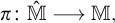
based on a surjection  with natural induced maps
  and
and  , such that
  is compatible with the inquisitive and propositional assignments in the sense that the following diagram commutes
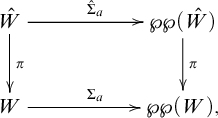
and that  for all
  (i.e.
(i.e.  is a strict homomorphism w.r.t. the valuations). The covering is finite if all its fibres
  are finite.
The definition implies that  induces a global bisimulation between ${\mathbb {M}}$
and
${\mathbb {M}}$
and $\hat {{\mathbb {M}}}$
as
$\hat {{\mathbb {M}}}$
as  for all $\hat {w} \in \hat {W}$
.
$\hat {w} \in \hat {W}$
.
Towards the desired upgrading arguments, a partial unfolding of the global pattern of equivalence classes $[w]_a$
in an inquisitive
$[w]_a$
in an inquisitive $S5$
model can be achieved in finite bisimilar coverings. The eventual covering construction at the global level requires a pre-processing of the local component structures
$S5$
model can be achieved in finite bisimilar coverings. The eventual covering construction at the global level requires a pre-processing of the local component structures ${\mathfrak {M}}\!\restriction \! [w]_a$
of
${\mathfrak {M}}\!\restriction \! [w]_a$
of $\mathsf {I}({\mathfrak {M}})$
as introduced in Section 3.2 above:
$\mathsf {I}({\mathfrak {M}})$
as introduced in Section 3.2 above:
 $$\begin{align*}{\mathfrak{M}}\!\restriction\![w]_a:= \bigl( [w]_a, \wp([w]_a), E_a \!\restriction\![w]_a, (P_i \!\restriction\![w]_a) \bigr), \end{align*}$$
which for a locally full ${\mathfrak {M}}$
is the full relational encoding of the mono-modal, single-component epistemic model
${\mathfrak {M}}$
is the full relational encoding of the mono-modal, single-component epistemic model
 $$\begin{align*}{\mathbb {M}}\!\restriction\![w]_a= ([w]_a, \Sigma_a\!\restriction\! [w]_a, V \!\restriction\! [w]_a), \end{align*}$$
whose epistemic inquisitive assignment $\Sigma _a \colon [w]_a \rightarrow \wp \wp ([w]_a)$
is constant and can be identified with its value
$\Sigma _a \colon [w]_a \rightarrow \wp \wp ([w]_a)$
is constant and can be identified with its value $\Sigma _a(w) \in \wp \wp ([w]_a)$
.
$\Sigma _a(w) \in \wp \wp ([w]_a)$
.
We first explore the extent to which this $\Sigma _a$
-assignment can be locally modified and simplified in companion models that retain bisimilarity in the global context. This local pre-processing in Section 3.3.1 is specific for epistemic
$\Sigma _a$
-assignment can be locally modified and simplified in companion models that retain bisimilarity in the global context. This local pre-processing in Section 3.3.1 is specific for epistemic  and new here; the techniques for the global pre-processing via local unfoldings in globally bisimilar finite covers, in Section 3.3.2, adapts ideas from modal logics in [Reference Dawar and Otto10, Reference Otto21]; both aspects go substantially beyond the treatment of basic
  in [Reference Ciardelli and Otto7].
3.3.1 Local pre-processing.
Since $\Sigma _a$
is constant across the single equivalence class
$\Sigma _a$
is constant across the single equivalence class $[w]_a$
, bisimulation – for this single-agent structure – equivalence collapses to its second level
$[w]_a$
, bisimulation – for this single-agent structure – equivalence collapses to its second level $\sim ^1$
. W.r.t. a fixed set
$\sim ^1$
. W.r.t. a fixed set  of basic propositions each bisimulation type of such a structure is characterised by the collection of propositional types realised overall in its worlds and in the information states in its inquisitive assignment. In particular, multiplicities of these propositional types do not matter at all, neither overall nor in any individual information state: any positive number of realisations is as good as just a single one, so that multiplicities can be uniformly boosted to avoid distinguishing features at the level of $\mathsf {FO}$
.
$\mathsf {FO}$
.
The natural restrictions-cum-reducts ${\mathbb {M}}\!\restriction \![w]_a$
ignore the inquisitive structure induced by agents
${\mathbb {M}}\!\restriction \![w]_a$
ignore the inquisitive structure induced by agents $b \not = a$
, and fall into one of these global
$b \not = a$
, and fall into one of these global $\sim ^1$
-equivalence classes. All the remaining complexity of multi-agent inquisitive
$\sim ^1$
-equivalence classes. All the remaining complexity of multi-agent inquisitive $S5$
structures arises from the overlapping of a-classes for different
$S5$
structures arises from the overlapping of a-classes for different $a \in \mathcal {A}$
, i.e. from the manner in which the various local structures
$a \in \mathcal {A}$
, i.e. from the manner in which the various local structures ${\mathbb {M}}\!\restriction \! [u]_a$
or their relational encodings
${\mathbb {M}}\!\restriction \! [u]_a$
or their relational encodings ${\mathfrak {M}}\!\restriction \! [w]_a$
overlap. In order to freeze the manner in which the local structures on individual a-classes are stitched together, we endow the
${\mathfrak {M}}\!\restriction \! [w]_a$
overlap. In order to freeze the manner in which the local structures on individual a-classes are stitched together, we endow the ${\mathbb {M}}\!\restriction \! [w]_a$
with colourings of their worlds that prescribe their bisimulation types in the global structure
${\mathbb {M}}\!\restriction \! [w]_a$
with colourings of their worlds that prescribe their bisimulation types in the global structure ${\mathbb {M}}$
. For different purposes we use different granularities for this colouring. The finest one of interest is the colouring based on the full bisimulation-type in
${\mathbb {M}}$
. For different purposes we use different granularities for this colouring. The finest one of interest is the colouring based on the full bisimulation-type in ${\mathbb {M}}$
, with colour set
${\mathbb {M}}$
, with colour set $C = W/{\sim }$
, the set of
$C = W/{\sim }$
, the set of $\sim $
-equivalence classes of worlds in
$\sim $
-equivalence classes of worlds in ${\mathbb {M}}$
. This is the colouring that needs to be respected in passage to fully bisimilar partner structures like
${\mathbb {M}}$
. This is the colouring that needs to be respected in passage to fully bisimilar partner structures like $\hat {{\mathfrak {M}}},\hat {w} \sim {\mathfrak {M}},w$
in the vertical axes in Figure 4.
$\hat {{\mathfrak {M}}},\hat {w} \sim {\mathfrak {M}},w$
in the vertical axes in Figure 4.
Coarser colourings are induced by the ${\sim ^m}$
-type, for a fixed finite level m, with colour set
${\sim ^m}$
-type, for a fixed finite level m, with colour set $C = W/{{\sim ^m}}$
. These may also be obtained via the natural projection that identifies all
$C = W/{{\sim ^m}}$
. These may also be obtained via the natural projection that identifies all $\sim $
-types that fall into the same
$\sim $
-types that fall into the same ${\sim ^m}$
-class. Successive coarsenings of this kind will inform the strategy analysis towards establishing levels of
${\sim ^m}$
-class. Successive coarsenings of this kind will inform the strategy analysis towards establishing levels of $\mathsf {FO}$
-indistinguishability like
$\mathsf {FO}$
-indistinguishability like $\hat {{\mathfrak {M}}},\hat {w} \,\oplus {\mathfrak {X}} \; \equiv ^{\scriptscriptstyle (\ell )}_r \hat {{\mathfrak {M}}}',\hat {w}' \,\oplus {\mathfrak {X}}$
on the basis of
$\hat {{\mathfrak {M}}},\hat {w} \,\oplus {\mathfrak {X}} \; \equiv ^{\scriptscriptstyle (\ell )}_r \hat {{\mathfrak {M}}}',\hat {w}' \,\oplus {\mathfrak {X}}$
on the basis of ${\mathfrak {M}},w \sim ^n {\mathfrak {M}}',w'$
across the horizontal axes in Figure 4. Moreover, the relevant granularity m will be dependent on the distance from the distinguished worlds or states, just as control over levels of bisimilarity decreases with the depth of the exploration. But this granularity m will be uniformly bounded by the initial level n of n-bisimilarity in
${\mathfrak {M}},w \sim ^n {\mathfrak {M}}',w'$
across the horizontal axes in Figure 4. Moreover, the relevant granularity m will be dependent on the distance from the distinguished worlds or states, just as control over levels of bisimilarity decreases with the depth of the exploration. But this granularity m will be uniformly bounded by the initial level n of n-bisimilarity in ${\mathfrak {M}},w \sim ^n {\mathfrak {M}}',w'$
or
${\mathfrak {M}},w \sim ^n {\mathfrak {M}}',w'$
or ${\mathfrak {M}},s \sim ^n {\mathfrak {M}}',s'$
.
${\mathfrak {M}},s \sim ^n {\mathfrak {M}}',s'$
.
Formally, a colouring of worlds by any colour set C can be encoded as a propositional assignment, for new atomic propositions $c \in C$
. Unlike propositional assignments in general, these propositions will be mutually exclusive, so as to partition the set of worlds. To reduce conceptual overhead, we encode colourings as functions
$c \in C$
. Unlike propositional assignments in general, these propositions will be mutually exclusive, so as to partition the set of worlds. To reduce conceptual overhead, we encode colourings as functions
 $$\begin{align*}\begin{array}[t]{rcl} \rho \colon W &\rightarrow& C \\ w &\mapsto& \rho(w) \end{array} \quad \text{ instead of } \quad \begin{array}[t]{rcl} V \colon C &\rightarrow& \wp(W) \\ c &\mapsto& V(c) = \{w \colon \rho(w) = c\}, \end{array} \end{align*}$$
and correspondingly write, e.g., $(W, (\Sigma _a)_{a \in \mathcal {A}}, \rho )$
for the inquisitive epistemic model with the colouring
$(W, (\Sigma _a)_{a \in \mathcal {A}}, \rho )$
for the inquisitive epistemic model with the colouring $\rho \colon W \rightarrow C$
that assigns to each world its
$\rho \colon W \rightarrow C$
that assigns to each world its $\sim $
-class:
$\sim $
-class:
 $$\begin{align*}\begin{array}[t]{rcl} \rho \colon \; W &\longrightarrow& C := W/{\sim} \\ \rule{0em}{3ex} w & \longmapsto & [w]_{\sim} = \{ u \in W \colon {\mathbb {M}},u \sim {\mathbb {M}},w \}. \end{array} \end{align*}$$
The coarser colouring based on ${\sim ^m}$
-types is correspondingly formalised in the inquisitive epistemic model
${\sim ^m}$
-types is correspondingly formalised in the inquisitive epistemic model $({\mathbb {M}}, (\Sigma _a)_{a \in \mathcal {A}}, \rho _m)$
, with the colouring
$({\mathbb {M}}, (\Sigma _a)_{a \in \mathcal {A}}, \rho _m)$
, with the colouring $\rho _m \colon W \rightarrow W/{{\sim ^m}}$
. Clearly the
$\rho _m \colon W \rightarrow W/{{\sim ^m}}$
. Clearly the $\sim $
-colouring
$\sim $
-colouring $\rho $
refines the
$\rho $
refines the ${\sim ^m}$
-colouring
${\sim ^m}$
-colouring $\rho _m$
, and
$\rho _m$
, and $\rho _n$
refines
$\rho _n$
refines $\rho _m$
for
$\rho _m$
for $m<n$
. In particular, all levels refine
$m<n$
. In particular, all levels refine $\rho _0$
, which determines each world’s original propositional type as induced by V in
$\rho _0$
, which determines each world’s original propositional type as induced by V in ${\mathbb {M}}$
.
${\mathbb {M}}$
.
Finiteness of the set of colours $W/{\sim }$
for the
$W/{\sim }$
for the $\sim $
-colouring
$\sim $
-colouring $\rho $
is guaranteed over each individual finite model
$\rho $
is guaranteed over each individual finite model ${\mathbb {M}}$
(or across pairs of finite models
${\mathbb {M}}$
(or across pairs of finite models ${\mathbb {M}}$
and
${\mathbb {M}}$
and ${\mathbb {M}}'$
to be compared). But also over possibly infinite models the sets of colurs
${\mathbb {M}}'$
to be compared). But also over possibly infinite models the sets of colurs $W/{{\sim ^m}}$
for the
$W/{{\sim ^m}}$
for the ${\sim ^m}$
-colourings
${\sim ^m}$
-colourings $\rho _m$
are uniformly finitely bounded across all models in a finite signature, for each finite level m.
$\rho _m$
are uniformly finitely bounded across all models in a finite signature, for each finite level m.
Definition 3.10. For an a-class $[w]_a$
in an inquisitive model
$[w]_a$
in an inquisitive model ${\mathbb {M}}$
, let the associated local
${\mathbb {M}}$
, let the associated local $\sim $
-structure be the mono-modal inquisitive
$\sim $
-structure be the mono-modal inquisitive $S5$
structure
$S5$
structure ${\mathbb {M}}\!\restriction \! [w]_a,\rho $
with the propositional assignment induced by
${\mathbb {M}}\!\restriction \! [w]_a,\rho $
with the propositional assignment induced by $\rho $
in
$\rho $
in ${\mathbb {M}}$
, which colours each world in
${\mathbb {M}}$
, which colours each world in $[w]_a$
according to its
$[w]_a$
according to its $\sim $
-type in
$\sim $
-type in ${\mathbb {M}}$
.
${\mathbb {M}}$
.
For $m \in {\mathbb {N}}$
, let
$m \in {\mathbb {N}}$
, let ${\mathbb {M}}\!\restriction \! [w]_a,\rho _m$
be the coarsening of granularity m of that local structure: the local
${\mathbb {M}}\!\restriction \! [w]_a,\rho _m$
be the coarsening of granularity m of that local structure: the local ${\sim ^m}$
-structure with propositional assignment induced by
${\sim ^m}$
-structure with propositional assignment induced by $\rho _m$
, which colours each world in
$\rho _m$
, which colours each world in $[w]_a$
by its
$[w]_a$
by its ${\sim ^m}$
-type in
${\sim ^m}$
-type in ${\mathbb {M}}$
according to the natural projection
${\mathbb {M}}$
according to the natural projection  .
.
Interestingly, a local $\sim $
- or
$\sim $
- or ${\sim ^m}$
-structure can be modified considerably without changing its bisimulation type. We now want to achieve local structures
${\sim ^m}$
-structure can be modified considerably without changing its bisimulation type. We now want to achieve local structures
-
– that realise every bisimulation type of worlds locally with high multiplicity; this leads to the notion of richness in Definition 3.11;
-
– whose inquisitive assignment
$\Sigma _a$
is normalised w.r.t. to the structure of the inquisitive state within
$\wp ([w]_a)$
so as to suppress
$\mathsf {FO}$
-definable distinctions that are not governed by any level of
${\sim ^m}$
; this leads to the notion of regularity in Definition 3.13.

 within


Richness.
The idea for richness is a quantitative one, viz., that all bisimulation types that are realised in any information state in $\Sigma _a(w)$
will be realised with high multiplicity in some superset that is also in
$\Sigma _a(w)$
will be realised with high multiplicity in some superset that is also in $\Sigma _a(w)$
. Any desired finite level of richness can be achieved in finite bisimilar coverings (Lemma 3.12), which essentially just put a fixed number of copies of every world.
$\Sigma _a(w)$
. Any desired finite level of richness can be achieved in finite bisimilar coverings (Lemma 3.12), which essentially just put a fixed number of copies of every world.
Definition 3.11. A local structure ${\mathbb {M}} \!\restriction \! [w]_a$
in
${\mathbb {M}} \!\restriction \! [w]_a$
in ${\mathbb {M}}$
is K-rich for some
${\mathbb {M}}$
is K-rich for some $K \in {\mathbb {N}}$
if, for every information state
$K \in {\mathbb {N}}$
if, for every information state $s \in \Sigma _a(w)$
there is some
$s \in \Sigma _a(w)$
there is some $s'$
,
$s'$
, $s \subset s' \in \Sigma _a(w)$
, such that every
$s \subset s' \in \Sigma _a(w)$
, such that every $\sim $
-type in
$\sim $
-type in $W/{\sim }$
that is realised in s is realised at least K times in
$W/{\sim }$
that is realised in s is realised at least K times in $s'$
. An inquisitive
$s'$
. An inquisitive $S5$
structure
$S5$
structure ${\mathbb {M}} = (W,(\Sigma _a),V)$
is K-rich if each one of its local structures is K-rich, for all
${\mathbb {M}} = (W,(\Sigma _a),V)$
is K-rich if each one of its local structures is K-rich, for all $a \in \mathcal {A}$
.
$a \in \mathcal {A}$
.
Lemma 3.12. For any $K \in {\mathbb {N}}$
, any inquisitive
$K \in {\mathbb {N}}$
, any inquisitive $S5$
structure
$S5$
structure ${\mathbb {M}} = (W, (\Sigma _a),V)$
admits a finite bisimilar covering that is K-rich. If finiteness does not matter, richness can similarly be achieved for any target cardinality.
${\mathbb {M}} = (W, (\Sigma _a),V)$
admits a finite bisimilar covering that is K-rich. If finiteness does not matter, richness can similarly be achieved for any target cardinality.
Proof. It suffices to take the natural product ${\mathbb {M}} \times [K]$
of
${\mathbb {M}} \times [K]$
of ${\mathbb {M}}$
with the standard K-element set
${\mathbb {M}}$
with the standard K-element set $[K] = \{1,\ldots , K \}$
. This results in a model whose set of worlds is
$[K] = \{1,\ldots , K \}$
. This results in a model whose set of worlds is $W \times [K]$
, whose propositional assignment is induced by the projection
$W \times [K]$
, whose propositional assignment is induced by the projection  , and whose inquisitive assignment is
  . It is easily checked that ${\mathbb {M}} \times [K]$
is K-rich and that
${\mathbb {M}} \times [K]$
is K-rich and that  is a bisimilar covering in the sense of Definition 3.9.
Regularity.
Unlike the merely quantitative flavour of richness, regularity imposes qualitative constraints on the structure of the family of information states in $\Sigma _a(w)$
. It requires a modification of the local inquisitive assignment and is not obtained in a covering. The idea is to normalise the downward closed family of information states in
$\Sigma _a(w)$
. It requires a modification of the local inquisitive assignment and is not obtained in a covering. The idea is to normalise the downward closed family of information states in  within the boolean algebra $\wp ([w]_a)$
of subsets of
$\wp ([w]_a)$
of subsets of $[w]_a$
as much as possible. This normalisation needs to preserve the bisimulation type as encoded in the colouring
$[w]_a$
as much as possible. This normalisation needs to preserve the bisimulation type as encoded in the colouring $\rho $
. It must also be geared towards passage to the coarser picture induced by increasingly lower levels of m-bisimulation as encoded in the
$\rho $
. It must also be geared towards passage to the coarser picture induced by increasingly lower levels of m-bisimulation as encoded in the $\rho _m.^{14}$
. Passage to some suitable degree of regularity should be thought of as a local modification of the representation, rather than the epistemic content, of the inquisitive assignment. Indeed, bisimilarity is rather robust under changes in the actual composition of the inquisitive assignment
$\rho _m.^{14}$
. Passage to some suitable degree of regularity should be thought of as a local modification of the representation, rather than the epistemic content, of the inquisitive assignment. Indeed, bisimilarity is rather robust under changes in the actual composition of the inquisitive assignment  in
in ${\mathbb {M}}$
. By the inquisitive epistemic nature of
${\mathbb {M}}$
. By the inquisitive epistemic nature of ${\mathbb {M}}$
,
${\mathbb {M}}$
, $\Sigma _a$
has constant value
$\Sigma _a$
has constant value  on
on $[w]_a$
and
$[w]_a$
and  is a downward closed collection of subsets of $[w]_a$
such that
$[w]_a$
such that  . The only additional invariant imposed on
  up to
up to $\sim $
stems from the associated colouring
$\sim $
stems from the associated colouring $\rho $
of worlds by their
$\rho $
of worlds by their $\sim $
-types in
$\sim $
-types in $C = W/{\sim }$
; for the inquisitive assignment
$C = W/{\sim }$
; for the inquisitive assignment  this invariant concerns the colour combinations in

Note that  is downward closed in $\wp (C)$
. Not only the collection of bisimulation types in the set of worlds
$\wp (C)$
. Not only the collection of bisimulation types in the set of worlds $[w]_a$
, but also in the information states of the inquisitive assignment
$[w]_a$
, but also in the information states of the inquisitive assignment  is fully determined by
  . Up to bisimulation,
  can be replaced by any inquisitive epistemic assignment
  with
with  .
.
Similar remarks apply to finite levels ${\sim ^m}$
relative to the colouring
${\sim ^m}$
relative to the colouring $\rho _m$
with values in
$\rho _m$
with values in $W/{{\sim ^m}}$
, and for analogously defined
$W/{{\sim ^m}}$
, and for analogously defined  . Clearly
  is fully determined by
  , so that
  for all admissible variations
  . But crucially, due to the coarsening, colour combinations $\rho _m(s_i)$
for infomation states
$\rho _m(s_i)$
for infomation states  may coincide even if $\rho (s_1) \not = \rho (s_2)$
. So the constraint that
$\rho (s_1) \not = \rho (s_2)$
. So the constraint that  implies that some colour combinations in
  may have to appear in more than one $\subset $
-maximal element of
$\subset $
-maximal element of  and hence must be realised in at least that many $\subset $
-maximal elements of any admissible
$\subset $
-maximal elements of any admissible  .Footnote
14
.Footnote
14
The assignment  we choose will therefore be obtained from an upper bound $\kappa $
for the possibly unavoidable multiplicity of
$\kappa $
for the possibly unavoidable multiplicity of $\subset $
-maximal elements in
$\subset $
-maximal elements in  . So
. So $\kappa $
is to be adjusted accross the two models to be matched in the upgrading argument of Figure 4; it will always be finite in the context of finite inquisitive models for the finite model theoretic reading of our results, but could necessarily be infinite in the general case of infinite models that might even locally realise infinitely many distinct bisimulation types. Its granularity levels m will be dependent on the distance of the local structures from the distinguished worlds or states in the upgrading scenario of Figure 4. It will always be uniformly bounded by the initial level of n-bisimilarity
$\kappa $
is to be adjusted accross the two models to be matched in the upgrading argument of Figure 4; it will always be finite in the context of finite inquisitive models for the finite model theoretic reading of our results, but could necessarily be infinite in the general case of infinite models that might even locally realise infinitely many distinct bisimulation types. Its granularity levels m will be dependent on the distance of the local structures from the distinguished worlds or states in the upgrading scenario of Figure 4. It will always be uniformly bounded by the initial level of n-bisimilarity $\sim ^n$
between the two pointed models under consideration. So there is a fixed finite bound on the number of
$\sim ^n$
between the two pointed models under consideration. So there is a fixed finite bound on the number of ${\sim ^m}$
-colours that may occur. Such an upper bound can uniformly be chosen as a bound on the number of distinct
${\sim ^m}$
-colours that may occur. Such an upper bound can uniformly be chosen as a bound on the number of distinct $\sim $
-types realised by information states in the inquisitive assignments under consideration.
$\sim $
-types realised by information states in the inquisitive assignments under consideration.
Towards normalised patterns for  we think of decomposing $[w]_a$
into disjoint subsets
$[w]_a$
into disjoint subsets $B_i \subset [w]_a$
, which we call blocks, such that every nonempty information state
$B_i \subset [w]_a$
, which we call blocks, such that every nonempty information state  is contained in one of these, and such that each block $B_i$
is a disjoint union of
$B_i$
is a disjoint union of $\subset $
-maximal information states in
$\subset $
-maximal information states in  , one for each $\rho _m(s)$
,
$\rho _m(s)$
,  . In particular
  will be the union of its restrictions
  to the $\kappa $
many blocks, as illustrated in Figure 5.
$\kappa $
many blocks, as illustrated in Figure 5.
Subdivison of $[w]_a= \sigma _a(w)$
in the local a-structure
$[w]_a= \sigma _a(w)$
in the local a-structure ${\mathbb {M}}\!\restriction \![w]_a$
for an inquisitive assignment
${\mathbb {M}}\!\restriction \![w]_a$
for an inquisitive assignment  that is $\kappa $
-regular at granularity m, where
$\kappa $
-regular at granularity m, where  ,
, $\kappa = \{ 1,2, \ldots \}$
and each one of the contributions
$\kappa = \{ 1,2, \ldots \}$
and each one of the contributions $s(\alpha _j,i)$
in block
$s(\alpha _j,i)$
in block $B_i$
is one
$B_i$
is one $\subset $
-maximal element in
$\subset $
-maximal element in  , so that there are precisley $\kappa $
many such for each available
$\kappa $
many such for each available ${\sim ^m}$
-type of nonempty information states in
${\sim ^m}$
-type of nonempty information states in  .
.

Definition 3.13. The inquisitive assignment  in the local structure ${\mathbb {M}} \!\restriction \! [w]_a$
is
${\mathbb {M}} \!\restriction \! [w]_a$
is $\kappa $
-regular at granularity m if
$\kappa $
-regular at granularity m if $[w]_a = \dot {\bigcup }_{i < \kappa } B_i$
is a disjoint union of precisely
$[w]_a = \dot {\bigcup }_{i < \kappa } B_i$
is a disjoint union of precisely $\kappa $
many blocks
$\kappa $
many blocks $B_i \subset [w]_a$
such that
$B_i \subset [w]_a$
such that  and
and
-
– each of the restrictions
realises every
$\rho _m$
-colour combination
$\alpha = \rho _m(s)$
for in precisely one
$\subset $
-maximal element ; -
– these maximal elements
are disjoint for distinct
$\alpha $
and form a partition of
$B_i$
.
 realises every

 in precisely one
 ;
; are disjoint for distinct

It then follows that  itself is generated by the combination of the downward closures of the family of disjoint maximal elements $s(\alpha ,i)$
across all
$s(\alpha ,i)$
across all $\alpha $
and i, which partition
$\alpha $
and i, which partition $[w]_a = \dot {\bigcup }_{\alpha ,i} s(\alpha ,i)$
.
$[w]_a = \dot {\bigcup }_{\alpha ,i} s(\alpha ,i)$
.
Lemma 3.14. Let ${\mathbb {M}} = (W,(\Sigma _a),V)$
be an inquisitive epistemic model that is sufficiently rich in relation to given parameters
${\mathbb {M}} = (W,(\Sigma _a),V)$
be an inquisitive epistemic model that is sufficiently rich in relation to given parameters $\kappa , K$
and the cardinality of
$\kappa , K$
and the cardinality of $W/{\sim }$
; let
$W/{\sim }$
; let $m \colon W \rightarrow {\mathbb {N}}$
be any uniformly bounded function prescribing finite levels of granularity for the
$m \colon W \rightarrow {\mathbb {N}}$
be any uniformly bounded function prescribing finite levels of granularity for the $\sim ^m$
-local structures
$\sim ^m$
-local structures ${\mathbb {M}}\!\restriction \! [w]_a$
at
${\mathbb {M}}\!\restriction \! [w]_a$
at $w \in W$
. Then there is a globally bisimilar companion
$w \in W$
. Then there is a globally bisimilar companion $\hat {{\mathbb {M}}} = (W,(\hat {\Sigma }_a),V)$
such that
$\hat {{\mathbb {M}}} = (W,(\hat {\Sigma }_a),V)$
such that $\hat {{\mathbb {M}}},w \sim {\mathbb {M}},w$
for all
$\hat {{\mathbb {M}}},w \sim {\mathbb {M}},w$
for all $w \in W$
(so that the
$w \in W$
(so that the $\sim $
-colouring
$\sim $
-colouring $\rho $
on W is unaffected) that is K-rich and in which every local structure
$\rho $
on W is unaffected) that is K-rich and in which every local structure $\hat {{\mathbb {M}}}\!\restriction \! [w]_a$
is
$\hat {{\mathbb {M}}}\!\restriction \! [w]_a$
is $\kappa $
-regular at granularity
$\kappa $
-regular at granularity $m(w)$
.
$m(w)$
.
Proof. It suffices to restructure every  individually into a
  that is $\kappa $
-regular w.r.t.
$\kappa $
-regular w.r.t. $\rho _m$
for
$\rho _m$
for $m = m(w)$
and remains K-rich. Provided that
$m = m(w)$
and remains K-rich. Provided that $[w]_a$
has sufficiently many realisations of every
$[w]_a$
has sufficiently many realisations of every ${\sim ^m}$
-type (as guaranteed by a sufficiently high level of richness in
${\sim ^m}$
-type (as guaranteed by a sufficiently high level of richness in ${\mathbb {M}}$
),
${\mathbb {M}}$
), $[w]_a$
can be split into
$[w]_a$
can be split into $\kappa $
many disjoint blocks each of which is split into disjoint
$\kappa $
many disjoint blocks each of which is split into disjoint $\subset $
-maximal new information states, precisely one for every
$\subset $
-maximal new information states, precisely one for every ${\sim ^m}$
-type
${\sim ^m}$
-type $\alpha = \rho (s)$
for
$\alpha = \rho (s)$
for $s \in \Sigma _a(w)$
, realising every
$s \in \Sigma _a(w)$
, realising every ${\sim ^m}$
-type of its worlds at least K times.
${\sim ^m}$
-type of its worlds at least K times.
Observation 3.15. Every inquisitive epistemic model ${\mathbb {M}}$
admits, for
${\mathbb {M}}$
admits, for $K \in {\mathbb {N}}$
, finite bisimilar coverings
$K \in {\mathbb {N}}$
, finite bisimilar coverings $\hat {{\mathbb {M}}}$
that are K-rich. As a consequence there are, for given
$\hat {{\mathbb {M}}}$
that are K-rich. As a consequence there are, for given $K,M \in {\mathbb {N}}$
, globally bisimilar inquisitive epistemic models
$K,M \in {\mathbb {N}}$
, globally bisimilar inquisitive epistemic models $\hat {{\mathbb {M}}}$
sharing the same induced Kripke model
$\hat {{\mathbb {M}}}$
sharing the same induced Kripke model ${\mathfrak {K}}(\hat {{\mathbb {M}}})$
with variations of just the inquisitive assignments, for every given M-bounded granularity assignment
${\mathfrak {K}}(\hat {{\mathbb {M}}})$
with variations of just the inquisitive assignments, for every given M-bounded granularity assignment $m \colon \hat {W} \rightarrow {\mathbb {N}}$
, that make them both K-rich and
$m \colon \hat {W} \rightarrow {\mathbb {N}}$
, that make them both K-rich and $\kappa $
-regular w.r.t. that granularity assignment m. Such
$\kappa $
-regular w.r.t. that granularity assignment m. Such $\hat {{\mathbb {M}}}$
can be chosen to be finite for finite
$\hat {{\mathbb {M}}}$
can be chosen to be finite for finite ${\mathbb {M}}$
and
${\mathbb {M}}$
and $\kappa $
.
$\kappa $
.
3.3.2 Global pre-processing.
The desired pre-processing needs to unclutter and smooth out the local overlap patterns among local structures ${\mathfrak {M}}\!\restriction \![w]_a$
in
${\mathfrak {M}}\!\restriction \![w]_a$
in $\mathsf {I}({\mathfrak {M}})$
in such a manner that the
$\mathsf {I}({\mathfrak {M}})$
in such a manner that the $\ell $
-bisimulation type determines the first-order behaviour of
$\ell $
-bisimulation type determines the first-order behaviour of $\ell $
-neighbourhoods up to quantifier rank r (cf. Proposition 3.8). This requires a local unfolding of the connectivity in the underlying Kripke structures and uses ideas developed in [Reference Otto21] to eliminate incidental cycles and overlaps in finite bisimilar coverings — ideas which are applied to plain
$\ell $
-neighbourhoods up to quantifier rank r (cf. Proposition 3.8). This requires a local unfolding of the connectivity in the underlying Kripke structures and uses ideas developed in [Reference Otto21] to eliminate incidental cycles and overlaps in finite bisimilar coverings — ideas which are applied to plain $S5$
Kripke structures in [Reference Dawar and Otto10]. Such overlaps, which up to bisimulation equivalence are incidental (i.e. cannot be prescribed by the bisimulation type), occur for instance whenever an a-class and an
$S5$
Kripke structures in [Reference Dawar and Otto10]. Such overlaps, which up to bisimulation equivalence are incidental (i.e. cannot be prescribed by the bisimulation type), occur for instance whenever an a-class and an $a'$
-class for
$a'$
-class for $a \not = a'$
share more than one world. These worlds would be linked by both an
$a \not = a'$
share more than one world. These worlds would be linked by both an $R_a$
-edge and an
$R_a$
-edge and an $R_{a'}$
-edge. A bisimilar companion obtained from a classical tree unfolding (by the appropriate closure operations that turn it into an
$R_{a'}$
-edge. A bisimilar companion obtained from a classical tree unfolding (by the appropriate closure operations that turn it into an $S5$
frame) would separate these two edges. Similarly any cycle formed by a finite sequence of overlapping
$S5$
frame) would separate these two edges. Similarly any cycle formed by a finite sequence of overlapping $a_i$
-classes that returns to its starting point would not be stable under appropriate bisimilar unfoldings.
$a_i$
-classes that returns to its starting point would not be stable under appropriate bisimilar unfoldings.
For a given epistemic model ${\mathbb {M}}$
consider the induced Kripke structure
${\mathbb {M}}$
consider the induced Kripke structure ${\mathfrak {K}} = {\mathfrak {K}} ({\mathbb {M}}) = (W,(R_a)_{a \in \mathcal {A}},V)$
, which is a single-sorted, relational multi-modal
${\mathfrak {K}} = {\mathfrak {K}} ({\mathbb {M}}) = (W,(R_a)_{a \in \mathcal {A}},V)$
, which is a single-sorted, relational multi-modal $S5$
structure with equivalence relations
$S5$
structure with equivalence relations $R_a$
derived from the inquisitive epistemic frame
$R_a$
derived from the inquisitive epistemic frame ${\mathbb {M}}$
, with equivalence classes
${\mathbb {M}}$
, with equivalence classes $[w]_a= \sigma _a(w)$
. Generic constructions from [Reference Otto21], based on products with suitable Cayley groups, yield finite bisimilar coverings
$[w]_a= \sigma _a(w)$
. Generic constructions from [Reference Otto21], based on products with suitable Cayley groups, yield finite bisimilar coverings  by
by $S5$
structures
$S5$
structures $\hat {{\mathfrak {K}}}$
that are N-acyclic in the following sense.
$\hat {{\mathfrak {K}}}$
that are N-acyclic in the following sense.
Definition 3.16. For $N \geq 2$
, an epistemic model
$N \geq 2$
, an epistemic model ${\mathbb {M}}$
is called N-acyclic if the induced
${\mathbb {M}}$
is called N-acyclic if the induced $S5$
Kripke frame
$S5$
Kripke frame $(W,(R_a)_{a \in \mathcal {A}})$
underlying
$(W,(R_a)_{a \in \mathcal {A}})$
underlying ${\mathfrak {K}} = {\mathfrak {K}} ({\mathbb {M}})$
is N-acyclic in the sense that there is no non-trivial cyclic pattern of overlapping
${\mathfrak {K}} = {\mathfrak {K}} ({\mathbb {M}})$
is N-acyclic in the sense that there is no non-trivial cyclic pattern of overlapping $a_i$
-classes of length up to N: for
$a_i$
-classes of length up to N: for $2 \leq n \leq N$
, there is no cyclically indexed family
$2 \leq n \leq N$
, there is no cyclically indexed family $([w_i]_{a_i})_{i \in {\mathbb {Z}}_n}$
such that
$([w_i]_{a_i})_{i \in {\mathbb {Z}}_n}$
such that $[w_i]_{a_i} = [w_{i+1}]_{a_i}$
while
$[w_i]_{a_i} = [w_{i+1}]_{a_i}$
while $w_{i+1} \not = w_i$
and
$w_{i+1} \not = w_i$
and $a_{i+1} \not = a_i$
.
$a_{i+1} \not = a_i$
.
Example of particularly simple unfoldings in bisimilar coverings of $S5$
Kripke frames for agents with wavy, straight, dotted accessibility edges, respectively, and different shades for corresponding equivalence classes; top row: unfolding of a
$S5$
Kripke frames for agents with wavy, straight, dotted accessibility edges, respectively, and different shades for corresponding equivalence classes; top row: unfolding of a $2$
-cycle (overlap of two equivalence classes in two worlds) into a
$2$
-cycle (overlap of two equivalence classes in two worlds) into a $4$
- or
$4$
- or $6$
-cycle; below: unfolding of a
$6$
-cycle; below: unfolding of a $3$
-cycle into a
$3$
-cycle into a $6$
-cycle (just non-trivial equivalence classes indicated and worlds in overlaps and links in induced cycles marked).
$6$
-cycle (just non-trivial equivalence classes indicated and worlds in overlaps and links in induced cycles marked).

This acyclicity condition implies in particular that $a_i$
-classes and
$a_i$
-classes and $a_j$
-classes for agents
$a_j$
-classes for agents $a_i \not = a_j$
overlap in at most a single world: if
$a_i \not = a_j$
overlap in at most a single world: if $[w]_{a_1} \cap [w]_{a_2} \not = \{ w \}$
the two classes would form a non-trivial
$[w]_{a_1} \cap [w]_{a_2} \not = \{ w \}$
the two classes would form a non-trivial $2$
-cycle. For
$2$
-cycle. For $N \geq 2 \ell $
it moreover implies that the overlap pattern between a-local structures is simply tree-like within Gaifman radius
$N \geq 2 \ell $
it moreover implies that the overlap pattern between a-local structures is simply tree-like within Gaifman radius $\ell $
: any two distinct short sequences of such overlaps emanating from the same world cannot meet elsewhere (cf. Figure 6 for the basic intuition).
$\ell $
: any two distinct short sequences of such overlaps emanating from the same world cannot meet elsewhere (cf. Figure 6 for the basic intuition).
By [Reference Otto21], this form of N-acyclicity can be achieved, for any given N, in finite bisimilar coverings in which every a-class is bijectively related to an a-class in the original structure by the projection map of the covering, which induces the bisimulation. We briefly outline the extension of such bisimilar coverings of ${\mathfrak {K}}({\mathbb {M}})$
to bisimilar coverings of the inquisitive epistemic model
${\mathfrak {K}}({\mathbb {M}})$
to bisimilar coverings of the inquisitive epistemic model ${\mathbb {M}}$
. Let
${\mathbb {M}}$
. Let  be such an N-acyclic finite bisimilar covering, which in particular means that the graph of the covering projection
  is a bisimulation relation. Since a-classes in $\hat {{\mathfrak {K}}}$
are
$\hat {{\mathfrak {K}}}$
are  -related isomorphic copies of corresponding a-classes in ${\mathfrak {K}}$
, we may consistently endow them with an inquisitive
${\mathfrak {K}}$
, we may consistently endow them with an inquisitive $\Sigma _a$
-assignment as pulled back from
$\Sigma _a$
-assignment as pulled back from ${\mathbb {M}}$
, to obtain a natural derived finite inquisitive bisimilar covering
${\mathbb {M}}$
, to obtain a natural derived finite inquisitive bisimilar covering

in the sense of Definition 3.9. The inquisitive epistemic model $\hat {{\mathbb {M}}} = (\hat {W},(\hat {\Sigma }_a), \hat {V})$
is built on the basis of the covering
$\hat {{\mathbb {M}}} = (\hat {W},(\hat {\Sigma }_a), \hat {V})$
is built on the basis of the covering $S5$
Kripke structure
$S5$
Kripke structure $\hat {{\mathfrak {K}}}$
so that
$\hat {{\mathfrak {K}}}$
so that ${\mathfrak {K}}(\hat {{\mathbb {M}}}) =\hat {{\mathfrak {K}}}$
. More specifically, for
${\mathfrak {K}}(\hat {{\mathbb {M}}}) =\hat {{\mathfrak {K}}}$
. More specifically, for $\hat {w} \in \hat {W}$
consider its
$\hat {w} \in \hat {W}$
consider its $\hat {R}_a$
-equivalence class
$\hat {R}_a$
-equivalence class $[\hat {w}]_a\subset \hat {W}$
, which is bijectively related by
$[\hat {w}]_a\subset \hat {W}$
, which is bijectively related by  to the $R_a$
-equivalence class of
$R_a$
-equivalence class of  in
in ${\mathfrak {K}}$
,
${\mathfrak {K}}$
, $[w]_a \subset W$
. In restriction to
$[w]_a \subset W$
. In restriction to $[\hat {w}]_a$
we put
$[\hat {w}]_a$
we put

where  refers to the inverse of the local bijection between $[\hat {w}]_a $
and
$[\hat {w}]_a $
and $[w]_a$
induced by
$[w]_a$
induced by  . In other words, we make the following diagram commute and note that the relevant restriction of
  in the right-hand part of the diagram is bijective and part of a bisimulation at the level of the underlying $S5$
Kripke structures, which means in particular that it is compatible with the given propositional assignments:
$S5$
Kripke structures, which means in particular that it is compatible with the given propositional assignments:
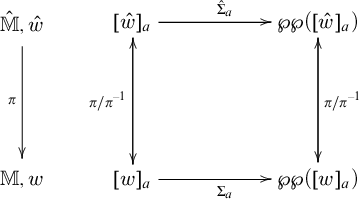
We merely need to check that the resulting model $\hat {{\mathbb {M}}}$
is again an inquisitive epistemic model, and that
$\hat {{\mathbb {M}}}$
is again an inquisitive epistemic model, and that  induces an inquisitive bisimulation, not just a bisimulation at the level of the underlying single-sorted, multi-modal $S5$
-structures
$S5$
-structures $\hat {{\mathfrak {K}}} = {\mathfrak {K}}(\hat {{\mathbb {M}}})$
and
$\hat {{\mathfrak {K}}} = {\mathfrak {K}}(\hat {{\mathbb {M}}})$
and ${\mathfrak {K}} = {\mathfrak {K}}({\mathbb {M}})$
. That
${\mathfrak {K}} = {\mathfrak {K}}({\mathbb {M}})$
. That $\hat {{\mathbb {M}}}$
is an inquisitive epistemic model is straightforward from its construction:
$\hat {{\mathbb {M}}}$
is an inquisitive epistemic model is straightforward from its construction: $\hat {\Sigma }_a$
-values are constant on the a-classes induced by
$\hat {\Sigma }_a$
-values are constant on the a-classes induced by $\hat {R}_a$
just as
$\hat {R}_a$
just as $\Sigma _a$
-values are constant across a-classes induced by
$\Sigma _a$
-values are constant across a-classes induced by $R_a$
; and
$R_a$
; and $\hat {w} \in \hat {\sigma }_a(\hat {w})$
follows from the fact that
$\hat {w} \in \hat {\sigma }_a(\hat {w})$
follows from the fact that $w \in \sigma _a(w) = [w]_a$
.
$w \in \sigma _a(w) = [w]_a$
.
A non-deterministic winning strategy in the unbounded inquisitive bisimulation on $\hat {{\mathbb {M}}},\hat {w}$
and
$\hat {{\mathbb {M}}},\hat {w}$
and  is given by the following bisimulation relation, to be viewed as a set of winning positions for player II in the bisimulation game:

which is the natural lifting of  to information states. It is easily verified that player II can stay in Z in response to any challenges by player I (Z satisfies the usual back&forth conditions). We summarise these findings as follows.
Lemma 3.17. Any inquisitive epistemic model ${\mathbb {M}} = (W, (\Sigma _a),V)$
admits, for every
${\mathbb {M}} = (W, (\Sigma _a),V)$
admits, for every $N \in {\mathbb {N}}$
, a finite bisimilar covering of the form
$N \in {\mathbb {N}}$
, a finite bisimilar covering of the form

by an inquisitive epistemic model $\hat {{\mathbb {M}}}= (\hat {W}, (\hat {\Sigma }_a),\hat {V})$
such that
$\hat {{\mathbb {M}}}= (\hat {W}, (\hat {\Sigma }_a),\hat {V})$
such that
-
(i)
$\hat {{\mathbb {M}}}$
is N-acyclic in the sense of Definition 3.16; -
(ii) the global bisimulation induced by
is an isomorphism in restriction to each local structure
$\hat {{\mathbb {M}}}\!\restriction \! [\hat {w}]_a$
of
$\hat {{\mathbb {M}}}$
, which is isomorphically mapped by onto the local a-structure of
${\mathbb {M}}$
.

 is an isomorphism in restriction to each local structure

 onto the local a-structure
  of
of 
It is noteworthy that condition (ii) guarantees that degrees of regularity and richness are preserved in the covering, simply because they are properties of the local structures ${\mathbb {M}}\!\restriction \![w]_a$
, which up to isomorphism are the same in
${\mathbb {M}}\!\restriction \![w]_a$
, which up to isomorphism are the same in ${\mathbb {M}}$
and in
${\mathbb {M}}$
and in $\hat {{\mathbb {M}}}$
. So, in combination with Observation 3.15, we obtain the following.
$\hat {{\mathbb {M}}}$
. So, in combination with Observation 3.15, we obtain the following.
Proposition 3.18. For any desired values of $K,N \in {\mathbb {N}}$
and (finite or infinite) cardinality
$K,N \in {\mathbb {N}}$
and (finite or infinite) cardinality $\kappa $
, and for any finite bound M on relevant granularities, any world- or state-pointed inquisitive epistemic model
$\kappa $
, and for any finite bound M on relevant granularities, any world- or state-pointed inquisitive epistemic model ${\mathbb {M}}$
admits a globally bisimilar N-acyclic companions
${\mathbb {M}}$
admits a globally bisimilar N-acyclic companions $\hat {{\mathbb {M}}} \sim {\mathbb {M}}$
, all based on the same N-acyclic induced Kripke model
$\hat {{\mathbb {M}}} \sim {\mathbb {M}}$
, all based on the same N-acyclic induced Kripke model ${\mathfrak {K}}(\hat {{\mathbb {M}}})$
, whose epistemic assignments can be chosen K-rich and
${\mathfrak {K}}(\hat {{\mathbb {M}}})$
, whose epistemic assignments can be chosen K-rich and $\kappa $
-regular w.r.t. any given uniformly bounded granularity assignment
$\kappa $
-regular w.r.t. any given uniformly bounded granularity assignment $m \colon \hat {W}\rightarrow {\mathbb {N}}$
. Such
$m \colon \hat {W}\rightarrow {\mathbb {N}}$
. Such $\hat {{\mathbb {M}}}$
can be chosen finite for finite
$\hat {{\mathbb {M}}}$
can be chosen finite for finite ${\mathbb {M}}$
and
${\mathbb {M}}$
and $\kappa $
. In the non-trivially state-pointed case of
$\kappa $
. In the non-trivially state-pointed case of ${\mathbb {M}},s$
, companions
${\mathbb {M}},s$
, companions ${\mathbb {M}}_s$
based on the dummy agent s admit bisimilar companions
${\mathbb {M}}_s$
based on the dummy agent s admit bisimilar companions $\hat {{\mathbb {M}}},\hat {s} \sim {\mathbb {M}}_s, s$
with these same properties.
$\hat {{\mathbb {M}}},\hat {s} \sim {\mathbb {M}}_s, s$
with these same properties.
The non-trivially state-pointed case may deserve further comment. The desired $\hat {{\mathbb {M}}}$
in this case is based on the augmentation
$\hat {{\mathbb {M}}}$
in this case is based on the augmentation ${\mathbb {M}}_s$
with the extra agent s. The local pre-processing produces in particular a rich and
${\mathbb {M}}_s$
with the extra agent s. The local pre-processing produces in particular a rich and $\kappa $
-regular s-local structure over a set of worlds
$\kappa $
-regular s-local structure over a set of worlds $\hat {s}$
; N-acyclicity for
$\hat {s}$
; N-acyclicity for $N> 2\ell $
in the global pre-processing then serves to scatter the worlds in
$N> 2\ell $
in the global pre-processing then serves to scatter the worlds in $\hat {s}$
within
$\hat {s}$
within ${\mathfrak {K}}(\hat {{\mathbb {M}}})$
w.r.t.
${\mathfrak {K}}(\hat {{\mathbb {M}}})$
w.r.t. $\mathcal {A}$
in the sense that no two
$\mathcal {A}$
in the sense that no two $(E_a)_{a \in \mathcal {A}}$
-paths of length up to
$(E_a)_{a \in \mathcal {A}}$
-paths of length up to $\ell $
from distinct worlds in
$\ell $
from distinct worlds in $\hat {s}$
can meet: they are directly
$\hat {s}$
can meet: they are directly $E_s$
-linked and N-cyclic patterns are ruled out.
$E_s$
-linked and N-cyclic patterns are ruled out.
3.4 Proof of the characterisation theorem
In the remainder of this section we complete the proof of our main theorem, Theorem 1.2, the precise statement of which was given in Section 3.1 on page 16.
The proof of this theorem has, through preparations in the preceding sections, already been reduced to the upgrading target in equation (6). For the world-pointed case:
 $$\begin{align*}\mathsf{I}(\hat{{\mathfrak{M}}},\hat{w}) \;\equiv_{r}^{\scriptscriptstyle (\ell)}\; \mathsf{I}(\hat{{\mathfrak{M}}}',\hat{w}'), \end{align*}$$
where we now take $\hat {{\mathfrak {M}}}$
and
$\hat {{\mathfrak {M}}}$
and $\hat {{\mathfrak {M}}}'$
to be locally full relational encodings of bisimilar companions of any given pair of
$\hat {{\mathfrak {M}}}'$
to be locally full relational encodings of bisimilar companions of any given pair of ${\sim ^n}$
-bisimilar pointed models
${\sim ^n}$
-bisimilar pointed models ${\mathbb {M}}({\mathfrak {M}})$
and
${\mathbb {M}}({\mathfrak {M}})$
and ${\mathbb {M}}({\mathfrak {M}}')$
, which are obtained through the detour summarised in Proposition 3.18, for suitable values of the parameters of K and N for richness and acyclicity, and
${\mathbb {M}}({\mathfrak {M}}')$
, which are obtained through the detour summarised in Proposition 3.18, for suitable values of the parameters of K and N for richness and acyclicity, and $\kappa $
and m for regularity. The parameters of the target equivalence,
$\kappa $
and m for regularity. The parameters of the target equivalence, $\ell $
and r, are determined by the quantifier rank of the given
$\ell $
and r, are determined by the quantifier rank of the given $\sim $
-invariant
$\sim $
-invariant  that is to be shown to be ${\sim ^n}$
-invariant, for a value of n still to be determined by the Ehrenfeucht–Fraïssé argument for
${\sim ^n}$
-invariant, for a value of n still to be determined by the Ehrenfeucht–Fraïssé argument for $\equiv ^{\scriptscriptstyle (\ell )}_r$
.
$\equiv ^{\scriptscriptstyle (\ell )}_r$
.
Recall from our preliminary discussion at the end Section 3.2 how the desired upgrading argument for the crucial compactness claim in line with Proposition 3.8, calls for a strategy in the r-round first-order Ehrenfeucht–Fraïssé game over the $\ell $
-neighbourhoods of exploded views of the pre-processed models. Due to the nature of the exploded views as conglomerates of interconnected a-local structures, the desired strategy analysis focuses on a separation between
$\ell $
-neighbourhoods of exploded views of the pre-processed models. Due to the nature of the exploded views as conglomerates of interconnected a-local structures, the desired strategy analysis focuses on a separation between
-
(a) the global analysis of the
$\mathsf {FO}$
-game in the
$\ell $
-neighbourhoods, now involving a tree-like connectivity pattern between a-local component structures in sufficiently acyclic models. -
(b) the a-local concerns, now involving sufficiently rich and suitably regular models, where the
$\mathsf {FO}$
-game over these two-sorted structures can be analysed in terms an
$\mathsf {MSO}$
-analysis over their first sorts, to be treated first, in Section 3.4.1.


The granularity for the regularity requirements in (b) will depend on the distance from the distinguished world or state, since control over finite levels of bisimulation equivalence decreases with this distance from the root in the tree-like core structure. The resulting strategy advice for player II is brought together in Section 3.4.2. We first turn to these a-local component structures.
3.4.1 MSO-equivalence over local structures.
Recall Definition 3.10 of local structures ${\mathbb {M}}\!\restriction \![w]_a$
with colouring
${\mathbb {M}}\!\restriction \![w]_a$
with colouring $\rho _m$
that marks out
$\rho _m$
that marks out ${\sim ^m}$
-types in the surrounding
${\sim ^m}$
-types in the surrounding ${\mathbb {M}}$
or
${\mathbb {M}}$
or ${\mathbb {M}}'$
. In the locally full relational encoding
${\mathbb {M}}'$
. In the locally full relational encoding ${\mathfrak {M}} = {\mathfrak {M}}^{\mathsf {lf}}({\mathbb {M}})$
, we correspondingly consider
${\mathfrak {M}} = {\mathfrak {M}}^{\mathsf {lf}}({\mathbb {M}})$
, we correspondingly consider ${\mathfrak {M}}\!\restriction \![w]_a,\rho _m$
as a mono-modal relational model. We apply Ehrenfeucht–Fraïssé techniques for
${\mathfrak {M}}\!\restriction \![w]_a,\rho _m$
as a mono-modal relational model. We apply Ehrenfeucht–Fraïssé techniques for $\mathsf {MSO}$
in order to obtain guarantees for levels of first-order equivalence
$\mathsf {MSO}$
in order to obtain guarantees for levels of first-order equivalence $\equiv _k$
over these two-sorted local
$\equiv _k$
over these two-sorted local ${\sim ^m}$
-structures, assuming a suitable degree of richness and regularity w.r.t.
${\sim ^m}$
-structures, assuming a suitable degree of richness and regularity w.r.t. $\rho _m$
. Richness matters since
$\rho _m$
. Richness matters since $\mathsf {FO}$
can assess cardinality distinctions between information states in the second sort, but just up to certain finite thresholds. These thresholds are inherited from
$\mathsf {FO}$
can assess cardinality distinctions between information states in the second sort, but just up to certain finite thresholds. These thresholds are inherited from $\mathsf {MSO}$
-definability over plain coloured sets over the first sort.
$\mathsf {MSO}$
-definability over plain coloured sets over the first sort.
To compare the sizes of sets $P,P'$
up to some threshold
$P,P'$
up to some threshold $d \in {\mathbb {N}}$
, we introduce this cardinality equality with cut-off:
$d \in {\mathbb {N}}$
, we introduce this cardinality equality with cut-off:
 $$\begin{align*}|P| =_d |P'| \quad \colon\!\!\Leftrightarrow \quad |P|= |P'| \text{ or } |P|,|P'| \geq d. \end{align*}$$
For the analysis of a set W with any C-colouring $\rho \colon W \rightarrow C$
, we also use its representation as a plain relational structure
$\rho \colon W \rightarrow C$
, we also use its representation as a plain relational structure $(W,(W_c)_{c \in C})$
with colour classes
$(W,(W_c)_{c \in C})$
with colour classes $W_c$
viewed as the interpretations of unary relations (monadic predicates). So we interchangeably think of representations of
$W_c$
viewed as the interpretations of unary relations (monadic predicates). So we interchangeably think of representations of $W,\rho $
as a set with a colouring
$W,\rho $
as a set with a colouring $\rho \colon W \rightarrow C$
or as a relational structure partitioned into these colour classes. In our applications, W will always be the first sort
$\rho \colon W \rightarrow C$
or as a relational structure partitioned into these colour classes. In our applications, W will always be the first sort $[w]_a$
of some local
$[w]_a$
of some local ${\sim ^m}$
-structure, coloured by
${\sim ^m}$
-structure, coloured by $\rho _m$
with the finite colour set for
$\rho _m$
with the finite colour set for ${\sim ^m}$
-types of worlds.
${\sim ^m}$
-types of worlds.
With any subset $P \subset W$
we correspondingly associate the family
$P \subset W$
we correspondingly associate the family
 $$\begin{align*}(P_c)_{c \in C} \;\text{ where }\; P_c := \{ w \in P \colon \rho(w) = c \} = P \cap W_c. \end{align*}$$
For the comparison of $P \subset W$
with
$P \subset W$
with $P' \subset W'$
from two C-coloured sets
$P' \subset W'$
from two C-coloured sets $W,\rho $
and
$W,\rho $
and $W',\rho '$
we define the equivalence relation
$W',\rho '$
we define the equivalence relation $\approx ^C_d$
according to
$\approx ^C_d$
according to
 $$\begin{align*}P \approx^C_d P' \quad\text{ iff }\quad |P_c| =_d |P_c'| \text{ for all } c \in C; \end{align*}$$
and generalise this to k-tuples of subsets $\mathbf {P} \in (\wp (W))^k$
and
$\mathbf {P} \in (\wp (W))^k$
and $\mathbf {P}' \in (\wp (W'))^k$
by putting
$\mathbf {P}' \in (\wp (W'))^k$
by putting
 $$\begin{align*}\mathbf{P} \approx^C_d \mathbf{P}' \quad\text{ iff }\quad \zeta(\mathbf{P}) \approx^C_d \zeta(\mathbf{P}') \text{ for all boolean terms }\zeta(\mathbf{X}). \end{align*}$$
TheFootnote 15 following is folklore, but we indicate the straightforward proof below.
Lemma 3.19. For C-coloured sets $W,W'$
with k-tuples
$W,W'$
with k-tuples $\mathbf {P} \in \wp (W)^k$
and
$\mathbf {P} \in \wp (W)^k$
and $\mathbf {P}' \in \wp (W')^k$
of subsets, and for
$\mathbf {P}' \in \wp (W')^k$
of subsets, and for $d= 2^q$
:
$d= 2^q$
:
 $$\begin{align*}\mathbf{P} \approx^C_d \mathbf{P}' \quad \Rightarrow \quad (W,(W_c)_{c \in C},\mathbf{P}) \equiv^{\mathsf{MSO}}_q (W',(W_c')_{c \in C},\mathbf{P}'). \end{align*}$$
Note that assignments to first-order element variables x are implicit in the form of singleton sets for $\{ x\}$
(which induces but a small constant shift in quantifier rank levels).
$\{ x\}$
(which induces but a small constant shift in quantifier rank levels).
Proofsketch.
The proof is by induction on q, and we first look at the case with trivial colouring (all elements are of the same colour). For the induction step assume that $\mathbf {P} \approx _{2d}^C \mathbf {P}'$
and suppose w.l.o.g. that the first player proposes a subset
$\mathbf {P} \approx _{2d}^C \mathbf {P}'$
and suppose w.l.o.g. that the first player proposes a subset $P \subset W$
so that the second player needs to find a response
$P \subset W$
so that the second player needs to find a response $P' \subset W'$
such that
$P' \subset W'$
such that $\mathbf {P} P \approx ^C_d \mathbf {P}' P'$
. Decompose P and its complement
$\mathbf {P} P \approx ^C_d \mathbf {P}' P'$
. Decompose P and its complement $\bar {P}$
into their intersections with the atoms of the boolean algebra generated by
$\bar {P}$
into their intersections with the atoms of the boolean algebra generated by $\mathbf {P}$
in
$\mathbf {P}$
in $\wp (W)$
. Then each part of these partitions of P and
$\wp (W)$
. Then each part of these partitions of P and $\bar {P}$
can be matched with a subset of the corresponding atoms of the boolean algebra generated by
$\bar {P}$
can be matched with a subset of the corresponding atoms of the boolean algebra generated by $\mathbf {P}'$
in
$\mathbf {P}'$
in $\wp (W')$
in such a manner that corresponding parts match in the sense of
$\wp (W')$
in such a manner that corresponding parts match in the sense of $=_d$
. This just uses the assumption that
$=_d$
. This just uses the assumption that $|\zeta (\mathbf {P})| =_{2d} |\zeta (\mathbf {P}')|$
for each
$|\zeta (\mathbf {P})| =_{2d} |\zeta (\mathbf {P}')|$
for each $\zeta $
. In the case of non-trivial C-colourings, the same argument can be played out within each pair of colour classes
$\zeta $
. In the case of non-trivial C-colourings, the same argument can be played out within each pair of colour classes $W_c$
and
$W_c$
and $W_c'$
after decomposition of P and
$W_c'$
after decomposition of P and $\bar {P}$
into their C-partitions, and recombination of
$\bar {P}$
into their C-partitions, and recombination of $P'$
as the union of the matching
$P'$
as the union of the matching $P_c'$
obtained for the
$P_c'$
obtained for the $P_c$
.
$P_c$
.
We next transfer this $\mathsf {MSO}$
-equivalence between
$\mathsf {MSO}$
-equivalence between $\rho _m$
-coloured first sorts of suitable pre-processed local component structures to
$\rho _m$
-coloured first sorts of suitable pre-processed local component structures to $\mathsf {FO}$
-equivalence between the two-sorted relational encodings of these local
$\mathsf {FO}$
-equivalence between the two-sorted relational encodings of these local ${\sim ^m}$
-structures
${\sim ^m}$
-structures ${\mathfrak {M}}\!\restriction \![w]_a,\rho _m$
and
${\mathfrak {M}}\!\restriction \![w]_a,\rho _m$
and ${\mathfrak {M}}'\!\restriction \![w]_a,\rho _m$
that locally realise the same
${\mathfrak {M}}'\!\restriction \![w]_a,\rho _m$
that locally realise the same ${\sim ^m}$
-types of information states and are
${\sim ^m}$
-types of information states and are $\kappa $
-regular at this granularity m for the same value of
$\kappa $
-regular at this granularity m for the same value of $\kappa $
.
$\kappa $
.
Towards an interpretation of the $2$
-sorted full relational encodings of local
$2$
-sorted full relational encodings of local ${\sim ^m}$
-structures like
${\sim ^m}$
-structures like ${\mathfrak {M}}\!\restriction \![w]_a,\rho _m$
in terms of
${\mathfrak {M}}\!\restriction \![w]_a,\rho _m$
in terms of $\mathsf {MSO}$
-definability over
$\mathsf {MSO}$
-definability over $[w]_a$
, it is necessary to make available the information states in
$[w]_a$
, it is necessary to make available the information states in  . Due to $\kappa $
-regularity at granularity m, this reduces to marking out the
$\kappa $
-regularity at granularity m, this reduces to marking out the $\subset $
-maximal informatiobn states
$\subset $
-maximal informatiobn states $s(\alpha ,i)$
in each block
$s(\alpha ,i)$
in each block $B_i$
, for every one of the finitely many colour combinations
$B_i$
, for every one of the finitely many colour combinations  for non-trivial information states s realised in ${\mathfrak {M}}\!\restriction \![w]_a,\rho _m$
. To this end we look at
${\mathfrak {M}}\!\restriction \![w]_a,\rho _m$
. To this end we look at $\mathsf {MSO}$
-interpretability over derived single-sorted structures over
$\mathsf {MSO}$
-interpretability over derived single-sorted structures over $[w]_a$
. These encode the block decomposition (by an equivalence relation B) and the
$[w]_a$
. These encode the block decomposition (by an equivalence relation B) and the $\subset $
-maximal constituents across the blocks (by finitely many unary predicates
$\subset $
-maximal constituents across the blocks (by finitely many unary predicates $P_\alpha $
):
$P_\alpha $
):
 $$\begin{align*}{\mathfrak{b}}_m([w]_a) \;:=\; \begin{array}[t]{@{}l@{}} ([w]_a,\rho_m, B, (P_\alpha) ) \\ \rule{0em}{3ex} \text{ for } \begin{array}[t]{@{}l@{\;:=\;}l@{}} \; B & \bigcup_{i < \kappa} B_i^2 = \{ (u,v) \in [w]_a^2 \colon u,v \text{ in the same block}\}, \\ \rule{0em}{3ex} P_\alpha & \bigcup_{i < \kappa} s(\alpha,i). \end{array} \end{array} \end{align*}$$
The full relational encoding of a ${\sim ^m}$
-local structure
${\sim ^m}$
-local structure ${\mathfrak {M}}\!\restriction \! [w]_a,\rho _m$
becomes
${\mathfrak {M}}\!\restriction \! [w]_a,\rho _m$
becomes $\mathsf {MSO}$
-interpretable over these
$\mathsf {MSO}$
-interpretable over these ${\mathfrak {b}}_m([w]_a)$
. In particular, for
${\mathfrak {b}}_m([w]_a)$
. In particular, for $s \in \wp ([w]_a)$
we have
$s \in \wp ([w]_a)$
we have $s \in \Sigma _a(w)$
if, and only if
$s \in \Sigma _a(w)$
if, and only if
 $$\begin{align*}\textstyle {\mathfrak{b}}_m([w]_a),s \models \exists X \Bigl( s \subset X \wedge \forall x \forall y \bigl( (Xx \wedge Xy) \rightarrow Bxy \bigr) \wedge \bigvee_\alpha X \subset P_\alpha\Bigr). \end{align*}$$
It follows that, for some fixed set-off c stemming from the underlying interpretation, and tuples $\mathbf {s},\mathbf {s}'$
of set parameters over
$\mathbf {s},\mathbf {s}'$
of set parameters over $[w]_a$
and
$[w]_a$
and $[w']_a$
,
$[w']_a$
,
 $$ \begin{align} {\mathfrak{b}}_m([w]_a), \mathbf{s} \equiv^{\mathsf{MSO}}_{r+c}{\mathfrak{b}}_m([w']_a), \mathbf{s}' \;\; \Rightarrow \;\; {\mathfrak{M}}\!\restriction\! [w]_a,\rho_m, \mathbf{s} \equiv^{\mathsf{FO}}_{r} {\mathfrak{M}}'\!\restriction\! [w']_a,\rho_m,\mathbf{s}' \end{align} $$
In the analysis of $\mathsf {FO}$
-equivalences between local
$\mathsf {FO}$
-equivalences between local ${\sim ^m}$
-structures (as part of the Ehrenfeucht–Fraïssé argument over exploded views as in the upgrading as in Figure 4) we shall encounter choices of elements inside these
${\sim ^m}$
-structures (as part of the Ehrenfeucht–Fraïssé argument over exploded views as in the upgrading as in Figure 4) we shall encounter choices of elements inside these $2$
-sorted structures as parameters. These may be worlds
$2$
-sorted structures as parameters. These may be worlds $v \in [w]_a$
(first sort) or subsets
$v \in [w]_a$
(first sort) or subsets $s \subset [w]_a$
(second sort). Looking at these in the
$s \subset [w]_a$
(second sort). Looking at these in the $\mathsf {MSO}$
-perspective of the above interpretation, we can treat both kinds as monadic second-order parameters by associating
$\mathsf {MSO}$
-perspective of the above interpretation, we can treat both kinds as monadic second-order parameters by associating $v \in [w]_a$
with
$v \in [w]_a$
with $\{ v \} \subset [w]_a$
. In particular, a source world
$\{ v \} \subset [w]_a$
. In particular, a source world $w \in [w]_a$
for the local
$w \in [w]_a$
for the local ${\sim ^m}$
-structure associated with
${\sim ^m}$
-structure associated with $[w]_a$
can be fed as a distinguished world in
$[w]_a$
can be fed as a distinguished world in ${\mathfrak {M}}\!\restriction \! [w]_a,\rho _m$
and as a singleton set parameter
${\mathfrak {M}}\!\restriction \! [w]_a,\rho _m$
and as a singleton set parameter $\{ w\} \subset [w]_a$
in the
$\{ w\} \subset [w]_a$
in the $\mathsf {MSO}$
-analysis of
$\mathsf {MSO}$
-analysis of ${\mathfrak {b}}_m([w]_a)$
.
${\mathfrak {b}}_m([w]_a)$
.
Lemma 3.20. Any pair of m-bisimilar pointed ${\sim ^m}$
-local structures
${\sim ^m}$
-local structures ${\mathbb {M}}\!\restriction \! [w]_a,w$
and
${\mathbb {M}}\!\restriction \! [w]_a,w$
and ${\mathbb {M}}'\!\restriction \! [w']_a,w'$
for
${\mathbb {M}}'\!\restriction \! [w']_a,w'$
for $m \geq 1$
that are both
$m \geq 1$
that are both $\kappa $
-regular for the same (finite or infinite) value of
$\kappa $
-regular for the same (finite or infinite) value of $\kappa $
, realise the same colour combinations
$\kappa $
, realise the same colour combinations $\alpha \subset \rho _m([w]_a) = \rho _m([w']_a$
as nonempty contributions to the partitions of
$\alpha \subset \rho _m([w]_a) = \rho _m([w']_a$
as nonempty contributions to the partitions of $[w]_a = \dot {\bigcup }_\alpha P_\alpha $
and
$[w]_a = \dot {\bigcup }_\alpha P_\alpha $
and $[w']_a = \dot {\bigcup }_\alpha P_\alpha '$
, respectively. Moreover
$[w']_a = \dot {\bigcup }_\alpha P_\alpha '$
, respectively. Moreover
 $$\begin{align*}{\mathfrak{b}}_m([w]_a), \{w\} \equiv^{\mathsf{MSO}}_q {\mathfrak{b}}_m([w']_a), \{w'\}, \end{align*}$$
provided both are sufficiently rich in relation to q.
It then follows from equation 7 that in this situation also
 $$\begin{align*}{\mathfrak{M}}\!\restriction\! [w]_a,\rho_m,w \equiv^{\mathsf{FO}}_k {\mathfrak{M}}'\!\restriction\! [w']_a,\rho_m,w', \end{align*}$$
given the appropriate level of richness for $q = k+c$
(cf. Corollary 3.21 below).
$q = k+c$
(cf. Corollary 3.21 below).
Proof. Note that in the degenerate case of $\kappa =1$
(regularity in a single block, trivial B), the claim follows directly from Lemma 3.19. The extension to finite
$\kappa =1$
(regularity in a single block, trivial B), the claim follows directly from Lemma 3.19. The extension to finite $\kappa $
then follows from compatibility of
$\kappa $
then follows from compatibility of $\equiv ^{\mathsf {MSO}}$
with disjoint unions of structures (in application to matched blocks
$\equiv ^{\mathsf {MSO}}$
with disjoint unions of structures (in application to matched blocks $B_i$
and
$B_i$
and $B_i'$
as marked out by the equivalence relations B and
$B_i'$
as marked out by the equivalence relations B and $B'$
). But also in the general case of possibly infinite
$B'$
). But also in the general case of possibly infinite $\kappa $
, any choice of a bijection between the
$\kappa $
, any choice of a bijection between the $\kappa $
many blocks of either side, starting with the blocks
$\kappa $
many blocks of either side, starting with the blocks $B_0$
and
$B_0$
and $B_0'$
that contain the distinguished worlds w and
$B_0'$
that contain the distinguished worlds w and $w'$
, respectively, allows us to put together a response to a challenge by the first player from responses in the restrictions of the games over matched pairs of blocks, just as in the proof sketch for Lemma 3.19, but w.r.t. a decomposition into a possibly infinite number of non-trivial restrictions to individual blocks.
$w'$
, respectively, allows us to put together a response to a challenge by the first player from responses in the restrictions of the games over matched pairs of blocks, just as in the proof sketch for Lemma 3.19, but w.r.t. a decomposition into a possibly infinite number of non-trivial restrictions to individual blocks.
In the comparisons between $\kappa $
-regular local
$\kappa $
-regular local ${\sim ^m}$
-structures
${\sim ^m}$
-structures ${\mathbb {M}} \!\restriction \! [w]_a, \rho _m$
and
${\mathbb {M}} \!\restriction \! [w]_a, \rho _m$
and ${\mathbb {M}}' \!\restriction \! [w']_a, \rho _m$
it is essential that
${\mathbb {M}}' \!\restriction \! [w']_a, \rho _m$
it is essential that $m \geq 1$
. As remarked in the lemma,
$m \geq 1$
. As remarked in the lemma, $\sim ^1$
between any two distinguished worlds,
$\sim ^1$
between any two distinguished worlds, ${\mathbb {M}} \!\restriction \! [w]_a, \rho _m, w \sim ^1 {\mathbb {M}}' \!\restriction \! [w']_a, \rho _m,w'$
, implies that these two local structures are globally bisimilar and in particular realise the same
${\mathbb {M}} \!\restriction \! [w]_a, \rho _m, w \sim ^1 {\mathbb {M}}' \!\restriction \! [w']_a, \rho _m,w'$
, implies that these two local structures are globally bisimilar and in particular realise the same ${\sim ^m}$
-types both of worlds
${\sim ^m}$
-types both of worlds $v \in [w]_a$
and
$v \in [w]_a$
and $v' \in [w']_a$
and of information states
$v' \in [w']_a$
and of information states  and
and  . The encodings of the block structure and $\subset $
-maximal information states in the
$\subset $
-maximal information states in the $\kappa $
-regular inquisitive assignments
$\kappa $
-regular inquisitive assignments  and
and  were essential for the background $\mathsf {MSO}$
-analysis over the first sorts, but we use these results towards the
$\mathsf {MSO}$
-analysis over the first sorts, but we use these results towards the $\mathsf {FO}$
-analysis over their
$\mathsf {FO}$
-analysis over their $2$
-sorted full relational encodings. In these terms we have established the following.
$2$
-sorted full relational encodings. In these terms we have established the following.
Corollary 3.21. If ${\mathbb {M}}$
and
${\mathbb {M}}$
and ${\mathbb {M}}'$
are both
${\mathbb {M}}'$
are both $\kappa $
-regular (for the same
$\kappa $
-regular (for the same $\kappa $
) at granularity m and sufficiently rich (in relation to
$\kappa $
) at granularity m and sufficiently rich (in relation to $k \in {\mathbb {N}}$
), then the following holds for any two worlds
$k \in {\mathbb {N}}$
), then the following holds for any two worlds $v \in [w]_a$
and
$v \in [w]_a$
and $v' \in [w']_a$
:
$v' \in [w']_a$
:
 $$\begin{align*}\begin{array}{r@{\;\;\Rightarrow\;\;}l} {\mathbb {M}}\!\restriction\![w]_a, \rho_m, v \sim^1 {\mathbb {M}}'\!\restriction\![w']_a,\rho_m,v' & \\ \rule{0em}{3ex} {\mathbb {M}}\!\restriction\![w]_a, \rho_m, v \sim {\mathbb {M}}'\!\restriction\![w']_a,\rho_m,v' & {\mathfrak{M}}\!\restriction\! [w]_a, \rho_m, v \equiv_k {\mathfrak{M}}\!\restriction\! [w']_a, \rho_m ,v'. \end{array} \end{align*}$$
So Observation 3.15 and Proposition 3.18, any two inquisitive epistemic models ${\mathbb {M}}$
and
${\mathbb {M}}$
and ${\mathbb {M}}'$
admit, for any target value
${\mathbb {M}}'$
admit, for any target value $N, k \in {\mathbb {N}}$
, globally bisimilar N-acyclic companions
$N, k \in {\mathbb {N}}$
, globally bisimilar N-acyclic companions $\hat {{\mathbb {M}}} \sim {\mathbb {M}}$
and
$\hat {{\mathbb {M}}} \sim {\mathbb {M}}$
and $\hat {{\mathbb {M}}}' \sim {\mathbb {M}}'$
, finite if
$\hat {{\mathbb {M}}}' \sim {\mathbb {M}}'$
, finite if ${\mathbb {M}}$
and
${\mathbb {M}}$
and ${\mathbb {M}}'$
are finite, whose locally full relational encodings satisfy the above transfer within every one of their local
${\mathbb {M}}'$
are finite, whose locally full relational encodings satisfy the above transfer within every one of their local ${\sim ^m}$
-structures. This conditional guarantee of
${\sim ^m}$
-structures. This conditional guarantee of $\mathsf {FO}$
-indistinguishability is good for any allocation of the granularities
$\mathsf {FO}$
-indistinguishability is good for any allocation of the granularities $m \geq 1$
, which moreover may take different values for different pairs of local structures that are to be matched. It is important that the local analysis reflected in the corollary obviously imports – through
$m \geq 1$
, which moreover may take different values for different pairs of local structures that are to be matched. It is important that the local analysis reflected in the corollary obviously imports – through $\rho _m$
– global information about
$\rho _m$
– global information about ${\sim ^m}$
-types in
${\sim ^m}$
-types in $\hat {{\mathbb {M}}}$
and
$\hat {{\mathbb {M}}}$
and $\hat {{\mathbb {M}}}'$
into the local structures at hand, but that it does not rely on a uniform allocation of granularity across
$\hat {{\mathbb {M}}}'$
into the local structures at hand, but that it does not rely on a uniform allocation of granularity across $\hat {{\mathbb {M}}}$
or
$\hat {{\mathbb {M}}}$
or $\hat {{\mathbb {M}}}'$
.
$\hat {{\mathbb {M}}}'$
.
3.4.2 Local FO-equivalence of exploded views.
Returning to the global view of the underlying models ${\mathbb {M}} = (W,(\Sigma _a)_{a \in \mathcal {A}},V)$
and
${\mathbb {M}} = (W,(\Sigma _a)_{a \in \mathcal {A}},V)$
and ${\mathbb {M}}' = (W',(\Sigma _a')_{a \in \mathcal {A}},V')$
and their exploded views, and assuming
${\mathbb {M}}' = (W',(\Sigma _a')_{a \in \mathcal {A}},V')$
and their exploded views, and assuming ${\mathbb {M}},w \;{\sim ^n}\; {\mathbb {M}}',w'$
, we recall equation (6) and its rôle on the lefthand side of Figure 4 for the world-pointed case. We first cover this basic, world-pointed version. The adaptation to the non-trivially state-pointed variant, involving the dummy agent s, will then be straightforward. For the world-pointed version, we need to lift the
${\mathbb {M}},w \;{\sim ^n}\; {\mathbb {M}}',w'$
, we recall equation (6) and its rôle on the lefthand side of Figure 4 for the world-pointed case. We first cover this basic, world-pointed version. The adaptation to the non-trivially state-pointed variant, involving the dummy agent s, will then be straightforward. For the world-pointed version, we need to lift the $[\,\cdot \,]_a$
-local equivalences (at suitable granularities
$[\,\cdot \,]_a$
-local equivalences (at suitable granularities $1 \leq m\leq n$
) in matching local
$1 \leq m\leq n$
) in matching local ${\sim ^m}$
-structures to the
${\sim ^m}$
-structures to the $\ell $
-local equivalence
$\ell $
-local equivalence
 $$\begin{align*}\mathsf{I}(\hat{{\mathfrak{M}}},\hat{w}) \;\equiv_{r}^{\scriptscriptstyle (\ell)}\; \mathsf{I}(\hat{{\mathfrak{M}}}',\hat{w}') \end{align*}$$
around the distinguished worlds $\hat {w}$
and
$\hat {w}$
and $\hat {w}'$
. We aim to employ the criterion of N-acyclicity from Definition 3.16, more specifically its consequences for connectivity patterns in the exploded views. In order to reduce the notational overhead in the following we assume w.l.o.g. that
$\hat {w}'$
. We aim to employ the criterion of N-acyclicity from Definition 3.16, more specifically its consequences for connectivity patterns in the exploded views. In order to reduce the notational overhead in the following we assume w.l.o.g. that $\hat {{\mathfrak {M}}} = {\mathfrak {M}}$
and
$\hat {{\mathfrak {M}}} = {\mathfrak {M}}$
and $\hat {{\mathfrak {M}}}' = {\mathfrak {M}}'$
, or that
$\hat {{\mathfrak {M}}}' = {\mathfrak {M}}'$
, or that ${\mathbb {M}}$
and
${\mathbb {M}}$
and ${\mathbb {M}}'$
themselves have been pre-processed in the sense of Proposition 3.18. In the exploded view of such N-acyclic
${\mathbb {M}}'$
themselves have been pre-processed in the sense of Proposition 3.18. In the exploded view of such N-acyclic ${\mathbb {M}}$
, any two local structures
${\mathbb {M}}$
, any two local structures ${\mathfrak {M}}\!\restriction \![w_1]_{a_1} \not = {\mathfrak {M}}\!\restriction \![w_2]_{a_2}$
can be linked through at most one element v shared by
${\mathfrak {M}}\!\restriction \![w_1]_{a_1} \not = {\mathfrak {M}}\!\restriction \![w_2]_{a_2}$
can be linked through at most one element v shared by $[w_1]_{a_1}$
and
$[w_1]_{a_1}$
and $[w_2]_{a_2}$
. This follows from Definition 3.16 for any
$[w_2]_{a_2}$
. This follows from Definition 3.16 for any $N \geq 2$
. Such a link, if it exists, relates the copies of v in the two component structures of
$N \geq 2$
. Such a link, if it exists, relates the copies of v in the two component structures of $\mathsf {I}({\mathfrak {M}})$
by a path of length
$\mathsf {I}({\mathfrak {M}})$
by a path of length $2$
, which is formed by two
$2$
, which is formed by two $R_I$
-edges emanating from the node
$R_I$
-edges emanating from the node $v \in W$
in the core part. So this core part
$v \in W$
in the core part. So this core part $(W,(E_a)_{a \in \mathcal {A}})$
, which is the underlying
$(W,(E_a)_{a \in \mathcal {A}})$
, which is the underlying $S5$
frame, provides the only links between individual local constituents
$S5$
frame, provides the only links between individual local constituents ${\mathfrak {M}}\!\restriction \![w_i]_{a_i}$
in the exploded view
${\mathfrak {M}}\!\restriction \![w_i]_{a_i}$
in the exploded view $\mathsf {I}({\mathbb {M}})$
. For N-acyclic
$\mathsf {I}({\mathbb {M}})$
. For N-acyclic ${\mathbb {M}}$
, this core part is N-acyclic, so that there cannot be any non-trivial overlaps between any two distinct threads of lengths up to
${\mathbb {M}}$
, this core part is N-acyclic, so that there cannot be any non-trivial overlaps between any two distinct threads of lengths up to $\ell $
of local constituents
$\ell $
of local constituents ${\mathfrak {M}}\!\restriction \![w_i]_{a_i}$
in the exploded view
${\mathfrak {M}}\!\restriction \![w_i]_{a_i}$
in the exploded view $\mathsf {I}({\mathbb {M}})$
emanating from the same
$\mathsf {I}({\mathbb {M}})$
emanating from the same $v \in W$
, provided
$v \in W$
, provided $N> 2\ell $
.
$N> 2\ell $
.
Lemma 3.22. Let ${\mathbb {M}}$
and
${\mathbb {M}}$
and ${\mathbb {M}}'$
be N-acyclic for
${\mathbb {M}}'$
be N-acyclic for $N> 2\ell $
,
$N> 2\ell $
, $\kappa $
-regular (for the same
$\kappa $
-regular (for the same $\kappa $
) at granularity m (depending on depth in the tree-like exploded views, i.e. on distance from the distinguished worlds
$\kappa $
) at granularity m (depending on depth in the tree-like exploded views, i.e. on distance from the distinguished worlds $w,w'$
) and sufficiently rich to support the claim of Corollary 3.21. Then their exploded views
$w,w'$
) and sufficiently rich to support the claim of Corollary 3.21. Then their exploded views $\mathsf {I}({\mathbb {M}}) = \mathsf {I}({\mathfrak {M}}^{\mathsf {lf}}({\mathbb {M}}))$
and
$\mathsf {I}({\mathbb {M}}) = \mathsf {I}({\mathfrak {M}}^{\mathsf {lf}}({\mathbb {M}}))$
and $\mathsf {I}({\mathbb {M}}') = \mathsf {I}({\mathfrak {M}}^{\mathsf {lf}}({\mathbb {M}}'))$
satisfy the following for any pair of worlds such that
$\mathsf {I}({\mathbb {M}}') = \mathsf {I}({\mathfrak {M}}^{\mathsf {lf}}({\mathbb {M}}'))$
satisfy the following for any pair of worlds such that ${\mathbb {M}},w \sim ^n {\mathbb {M}}',w'$
for
${\mathbb {M}},w \sim ^n {\mathbb {M}}',w'$
for $n \geq \ell +1$
:
$n \geq \ell +1$
:
 $$\begin{align*}\mathsf{I}({\mathbb {M}}),w \equiv_r^{\scriptscriptstyle (\ell)} \mathsf{I}({\mathbb {M}}'),w' \;\text{ i.e.\ }\; \mathsf{I}({\mathbb {M}}) \!\restriction\! N^\ell(w),w \equiv_r \mathsf{I}({\mathbb {M}}') \!\restriction\! N^\ell(w'),w'. \end{align*}$$
The proof of this technical core lemma is given in terms of a winning strategy for player II in the r-round game on the pointed $\ell $
-neighbourhoods of w and
$\ell $
-neighbourhoods of w and $w'$
in
$w'$
in $\mathsf {I}({\mathbb {M}})$
and
$\mathsf {I}({\mathbb {M}})$
and $\mathsf {I}({\mathbb {M}}')$
. As outlined at the start of this section, Section 3.4, such a strategy can be based on a combination of strategies in
$\mathsf {I}({\mathbb {M}}')$
. As outlined at the start of this section, Section 3.4, such a strategy can be based on a combination of strategies in
-
(a) the r-round first-order game on the tree-like underlying
$S5$
Kripke structures on the first sort (worlds) with a-classes for accessibility and a colouring of worlds that reflects sufficient finite approximations to their bisimulation types in
${\mathbb {M}}$
, which in particular suffice to guarantee
$1$
-bisimulation equivalence and hence also
$\equiv _r$
of local component structures of appropriate granularities;Footnote
16
-
(b) local strategies in the r-round games on the relational encodings of the local component structures (with colourings at the appropriate level of granularity) induced by pebbled pairs of worlds or states. These strategies are ultimately based on local
$\mathsf {MSO}$
-games over their first sorts, as discussed in connection with Corollary 3.21.


The requirements w.r.t. $\sim ^m$
-matches will decrease, in terms of the parameter m, with distance from the source worlds w and
$\sim ^m$
-matches will decrease, in terms of the parameter m, with distance from the source worlds w and $w'$
, but keeping
$w'$
, but keeping $m \geq 1$
to uniformly support (a).
$m \geq 1$
to uniformly support (a).
Proof of Lemma 3.22.
Let ${\mathfrak {N}} := \mathsf {I}({\mathbb {M}}) \!\restriction \! N^\ell (w)$
and
${\mathfrak {N}} := \mathsf {I}({\mathbb {M}}) \!\restriction \! N^\ell (w)$
and ${\mathfrak {N}}' := \mathsf {I}({\mathbb {M}}') \!\restriction \! N^\ell (w')$
; for the local component structures we directly refer to the locally full relational encodings
${\mathfrak {N}}' := \mathsf {I}({\mathbb {M}}') \!\restriction \! N^\ell (w')$
; for the local component structures we directly refer to the locally full relational encodings ${\mathfrak {M}} := {\mathfrak {M}}^{\mathsf {lf}}({\mathbb {M}})$
and
${\mathfrak {M}} := {\mathfrak {M}}^{\mathsf {lf}}({\mathbb {M}})$
and ${\mathfrak {M}}' := {\mathfrak {M}}^{\mathsf {lf}}({\mathbb {M}}')$
. Regularity in matching local structures
${\mathfrak {M}}' := {\mathfrak {M}}^{\mathsf {lf}}({\mathbb {M}}')$
. Regularity in matching local structures ${\mathfrak {M}}\!\restriction \![u]_a$
and
${\mathfrak {M}}\!\restriction \![u]_a$
and ${\mathfrak {M}}'\!\restriction \![u']_a$
is imposed at granularity
${\mathfrak {M}}'\!\restriction \![u']_a$
is imposed at granularity $m(u) := \ell - d(w,u) +1 = \ell - d(w',u') = m(u')$
where d is the depth of
$m(u) := \ell - d(w,u) +1 = \ell - d(w',u') = m(u')$
where d is the depth of $u,u'$
in the tree-like core parts of the exploded views, i.e. distance from
$u,u'$
in the tree-like core parts of the exploded views, i.e. distance from $w,w'$
.
$w,w'$
.
It follows that $1 \leq m(u),m(u') \leq \ell + 1 \leq n$
is uniformly bounded by the value n in the initial assumption about
$1 \leq m(u),m(u') \leq \ell + 1 \leq n$
is uniformly bounded by the value n in the initial assumption about ${\mathbb {M}},w \sim ^n {\mathbb {M}}',w'$
.
${\mathbb {M}},w \sim ^n {\mathbb {M}}',w'$
.
The strategy analysis in support of the lemma is provided in three steps:
-
(I) parameterisation of game positions player II may have to deal with;
-
(II) abstraction of an invariant capturing the relevant information in those;
-
(III) showing how player II can maintain this invariant through r rounds.
(I) Parameterisation of game positions.
We consider any position $\mathbf {u};\mathbf {u}'$
in the r-round first-order game on
$\mathbf {u};\mathbf {u}'$
in the r-round first-order game on ${\mathfrak {N}}$
and
${\mathfrak {N}}$
and ${\mathfrak {N}}'$
, starting with pebbles on w and
${\mathfrak {N}}'$
, starting with pebbles on w and $w'$
which are equivalent w.r.t.
$w'$
which are equivalent w.r.t. $\sim ^{\ell +1}$
in
$\sim ^{\ell +1}$
in ${\mathbb {M}}$
and
${\mathbb {M}}$
and ${\mathbb {M}}'$
. It will be of the form
${\mathbb {M}}'$
. It will be of the form $\mathbf {u} = (u_0,\ldots ,u_k)$
and
$\mathbf {u} = (u_0,\ldots ,u_k)$
and  for some $k \leq r$
with
$k \leq r$
with $u_0 = w$
,
$u_0 = w$
,  , and, for $1 \leq i \leq k$
, either
$1 \leq i \leq k$
, either
-
(i)
$u_i= w_i$
and
$u_i'= w_i'$
are elements of the first sort in the core parts that are linked to w and
$w'$
, respectively, by unique paths of overlapping a-classes, or -
(ii)
$u_i= (w_i)_a$
and
$u_i'= (w_i')_a$
are elements of the first sort in local constituents
$[w_i]_a$
and
$[w_i']_a$
, for some
$a = a_i \in \mathcal {A}$
and
$w_i,w_i'$
in the core parts as in (i), or -
(iii)
$u_i = s_i$
and
$u_i'= s_i'$
are of the second sort (information states) in some
$\wp ([w_i]_a)$
, respectively
$\wp ([w_i']_a)$
, for some
$a = a_i \in \mathcal {A}$
and a pair of uniquely determined constituents
$[w_i]_a$
and
$[w_i']_a$
, for
$w_i,w_i'$
otherwise as in (i).


In cases (ii) and (iii) the $a\in \mathcal {A}$
is the same in both structures, or else player
$a\in \mathcal {A}$
is the same in both structures, or else player $\mathbf {{I}}$
would have won. We think of the
$\mathbf {{I}}$
would have won. We think of the $w_i$
and
$w_i$
and $w_i'$
in the core parts as the anchors of actual choices made in corresponding rounds, which may additionally involve an
$w_i'$
in the core parts as the anchors of actual choices made in corresponding rounds, which may additionally involve an $a_i \in \mathcal {A}$
and subsets
$a_i \in \mathcal {A}$
and subsets $s_i$
and
$s_i$
and $s_i'$
from the second sorts. We note that in case (iii) these anchor worlds
$s_i'$
from the second sorts. We note that in case (iii) these anchor worlds $w_i,w_i'$
are not uniquely determined as representatives of their
$w_i,w_i'$
are not uniquely determined as representatives of their $a_i$
-classes; but we shall argue below that matching choices of these anchors can be made. So we describe the game position after k rounds, for
$a_i$
-classes; but we shall argue below that matching choices of these anchors can be made. So we describe the game position after k rounds, for $k \leq r$
, in terms of the associated
$k \leq r$
, in terms of the associated $\mathbf {w} = (w_0,\ldots ,w_k)$
and
$\mathbf {w} = (w_0,\ldots ,w_k)$
and $\mathbf {w}' = (w_0',\ldots ,w_k')$
and (for some i) additional
$\mathbf {w}' = (w_0',\ldots ,w_k')$
and (for some i) additional $a_i$
(as in (ii)) or
$a_i$
(as in (ii)) or $(a_i,s_i)$
and
$(a_i,s_i)$
and $(a_i,s_i')$
(as in (iii)).
$(a_i,s_i')$
(as in (iii)).
We augment the content of the current position further to an invariant that is to be maintained by player $\mathbf {{II}}$
, as follows.
$\mathbf {{II}}$
, as follows.
(II) Abstraction of an invariant.
With the tuple $\mathbf {w}$
of anchor worlds in the core part of
$\mathbf {w}$
of anchor worlds in the core part of ${\mathfrak {N}}$
we associate a tree-like hypergraph structure whose hyperedges represent overlapping a-classes in the underlying basic modal
${\mathfrak {N}}$
we associate a tree-like hypergraph structure whose hyperedges represent overlapping a-classes in the underlying basic modal $S5$
-frame. For this we use a minimal spanning sub-tree containing the worlds listed in
$S5$
-frame. For this we use a minimal spanning sub-tree containing the worlds listed in $\mathbf {w}$
. We write
$\mathbf {w}$
. We write $\mathrm {tree}(\mathbf {w})$
for this tree structure. For its vertices
$\mathrm {tree}(\mathbf {w})$
for this tree structure. For its vertices $\mathrm {tree}(\mathbf {w})$
comprises, for every
$\mathrm {tree}(\mathbf {w})$
comprises, for every $w_i$
in
$w_i$
in $\mathbf {w}$
, the unique sequence of worlds in which those a-classes intersect that make up the shortest connecting path from the root w to
$\mathbf {w}$
, the unique sequence of worlds in which those a-classes intersect that make up the shortest connecting path from the root w to $w_i$
, as well as its end points,
$w_i$
, as well as its end points, $w = w_0$
and
$w = w_0$
and $w_i$
. The hyperedges of
$w_i$
. The hyperedges of $\mathrm {tree}(\mathbf {w})$
are formed by the non-trivial subsets of its vertices that fall within the same a-class, labelled by the corresponding a (any such subset forms a clique w.r.t. the corresponding
$\mathrm {tree}(\mathbf {w})$
are formed by the non-trivial subsets of its vertices that fall within the same a-class, labelled by the corresponding a (any such subset forms a clique w.r.t. the corresponding $R_a$
, for a unique
$R_a$
, for a unique $a \in \mathcal {A}$
due to acyclicity). So far the
$a \in \mathcal {A}$
due to acyclicity). So far the $w_i$
are covered by a unique representation of the overlapping a-classes along these shortest connecting paths to the root. We label each vertex u of this tree structure that stems from a world of
$w_i$
are covered by a unique representation of the overlapping a-classes along these shortest connecting paths to the root. We label each vertex u of this tree structure that stems from a world of ${\mathbb {M}}$
by its
${\mathbb {M}}$
by its $\sim ^{\ell -d +1}$
-type in
$\sim ^{\ell -d +1}$
-type in ${\mathbb {M}}$
, where
${\mathbb {M}}$
, where $d= d(w,u)$
is its distance from the root
$d= d(w,u)$
is its distance from the root $w = w_0$
(its depth in the tree structure); and label its hyperedges by the appropriate agents
$w = w_0$
(its depth in the tree structure); and label its hyperedges by the appropriate agents $a \in \mathcal {A}$
. The tree
$a \in \mathcal {A}$
. The tree $\mathrm {tree}(\mathbf {w}')$
on the side of
$\mathrm {tree}(\mathbf {w}')$
on the side of ${\mathfrak {N}}'$
is similarly defined. After k rounds, each of these trees can have at most
${\mathfrak {N}}'$
is similarly defined. After k rounds, each of these trees can have at most $1+k\ell $
vertices and each individual hyperedge can have at most
$1+k\ell $
vertices and each individual hyperedge can have at most $k+1$
vertices. For worlds u of
$k+1$
vertices. For worlds u of ${\mathbb {M}}$
at distance
${\mathbb {M}}$
at distance $d = d(w,u)$
, agent
$d = d(w,u)$
, agent $a \in \mathcal {A}$
and
$a \in \mathcal {A}$
and $m \in {\mathbb {N}}$
, we now denote as
$m \in {\mathbb {N}}$
, we now denote as ${\mathfrak {M}}\!\restriction \! [u]_a,\rho _{\sim ^m}$
the locally full (i.e. full) relational encoding of the local
${\mathfrak {M}}\!\restriction \! [u]_a,\rho _{\sim ^m}$
the locally full (i.e. full) relational encoding of the local ${\sim ^m}$
-structure
${\sim ^m}$
-structure ${\mathbb {M}} \!\restriction \! [u]_a,\rho _{\sim ^m}$
at granularity
${\mathbb {M}} \!\restriction \! [u]_a,\rho _{\sim ^m}$
at granularity $m = \ell - d +1$
, which has colours for
$m = \ell - d +1$
, which has colours for ${\sim ^m}$
-types in
${\sim ^m}$
-types in ${\mathbb {M}}$
(cf. Definition 3.10); and analogously on the side of
${\mathbb {M}}$
(cf. Definition 3.10); and analogously on the side of ${\mathfrak {N}}'$
. We argue that player II can maintain the following isomorphy conditions in terms of these tree structures
${\mathfrak {N}}'$
. We argue that player II can maintain the following isomorphy conditions in terms of these tree structures $\mathrm {tree}(\mathbf {w})$
and
$\mathrm {tree}(\mathbf {w})$
and $\mathrm {tree}(\mathbf {w}')$
through r rounds, and thus force a win.
$\mathrm {tree}(\mathbf {w}')$
through r rounds, and thus force a win. $\mathsf {Inv}(k)$
after round k:
$\mathsf {Inv}(k)$
after round k:
-
(1) the tree structures
$\mathrm {tree}(\mathbf {w})$
and
$\mathrm {tree}(\mathbf {w}')$
spanned by
$\mathbf {w} = (w_0, \ldots ,w_k)$
and
$\mathbf {w}' = (w_0', \ldots ,w_k')$
are isomorphic (as hyperedge- and vertex-labelled hypergraphs) via an isomorphism
$\zeta $
that maps
$\mathbf {w}$
to
$\mathbf {w}'$
:
$$\begin{align*}\zeta \colon \mathrm{tree}(\mathbf{w}),\mathbf{w} \simeq \mathrm{tree}(\mathbf{w}'),\mathbf{w}' \end{align*}$$
-
(2) for each pair of worlds
$u \in \mathrm {tree}(\mathbf {w})$
and
$u' \in \mathrm {tree}(\mathbf {w}')$
that are linked according to
$u' = \zeta (u)$
in (1) at depth
$d = d(w,u) = d(w',u')$
, and for any label a: where
$$\begin{align*}{\mathfrak{M}}\!\restriction\! [u]_a,\rho_{\sim^m},\mathbf{s} \equiv_{r-z+1} {\mathfrak{M}}'\!\restriction\! [u']_a,\rho_{\sim^m},\mathbf{s}' \quad \text{ for } m =\ell-d +1, \end{align*}$$
$\mathbf {s}$
and
$\mathbf {s}'$
are tuples of size z that coherently list any singleton information states corresponding to the tree vertices incident with that a-hyperedge and any information states
$s_i\subset [u]_a = \sigma _a(u)$
and that may have been chosen in the second sort of the corresponding local component structures during the first k rounds of the game.


 that may have been chosen in the second sort of the corresponding local component structures during the first k rounds of the game.
(III) Maintaining the invariant.
In the form of $\mathsf {Inv}(0)$
these conditions are satisfied at the start of the game: (2) in this case does not add anything beyond (1), which in turn is a consequence of the assumption that
$\mathsf {Inv}(0)$
these conditions are satisfied at the start of the game: (2) in this case does not add anything beyond (1), which in turn is a consequence of the assumption that  . We show how to maintain the invariant (conditions (1) and (2)) through round k, in which player $\mathbf {{I}}$
may either pebble an element of the first sort, i.e. a world in the core part (
$\mathbf {{I}}$
may either pebble an element of the first sort, i.e. a world in the core part ( $w_k$
or
$w_k$
or  ) or in one of the local component structures ( $(w_k)_a$
or
$(w_k)_a$
or  ),
), $a = a_k$
, or an element of the second sort, i.e. an information state (
$a = a_k$
, or an element of the second sort, i.e. an information state ( $s_k$
in some
$s_k$
in some $[w_k]_a$
or
$[w_k]_a$
or $s_k'$
in some
$s_k'$
in some $[w_k']_a$
,
$[w_k']_a$
, $a = a_k$
,). We refer to the position before this round by parameters
$a = a_k$
,). We refer to the position before this round by parameters $\mathbf {w},\mathbf {w}', \mathrm {tree}(\mathbf {w}), \dots $
as described above, but at level
$\mathbf {w},\mathbf {w}', \mathrm {tree}(\mathbf {w}), \dots $
as described above, but at level $k-1$
. Assuming
$k-1$
. Assuming $\mathsf {Inv}(k-1)$
we need to show how player
$\mathsf {Inv}(k-1)$
we need to show how player $\mathbf {{II}}$
can find responses so as to satisfy
$\mathbf {{II}}$
can find responses so as to satisfy $\mathsf {Inv}(k)$
. By symmetry we may assume that
$\mathsf {Inv}(k)$
. By symmetry we may assume that $\mathbf {{I}}$
opens the k-th round by putting the next pebble on the side of
$\mathbf {{I}}$
opens the k-th round by putting the next pebble on the side of ${\mathfrak {N}}$
.
${\mathfrak {N}}$
.
Case 1. A move in the second sort: $\mathbf {{I}}$
chooses an information state
$\mathbf {{I}}$
chooses an information state $s_k$
so that
$s_k$
so that $s_k \subset \wp ([w_k]_a)$
for some uniquely determined local component
$s_k \subset \wp ([w_k]_a)$
for some uniquely determined local component ${\mathfrak {M}}\!\restriction \! [w_k]_a$
,
${\mathfrak {M}}\!\restriction \! [w_k]_a$
, $a = a_k$
.
$a = a_k$
.
Case 1.1: if $[w_k]_a$
=
$[w_k]_a$
= $[u]_a$
for some vertex u in
$[u]_a$
for some vertex u in $\mathrm {tree}(\mathbf {w})$
, u at depth d say, then we look, for
$\mathrm {tree}(\mathbf {w})$
, u at depth d say, then we look, for $u' = \zeta (u)$
, at one round in the game for
$u' = \zeta (u)$
, at one round in the game for
 $$\begin{align*}{\mathfrak{M}}\!\restriction\! [u]_a, \rho_{\sim^m}, \mathbf{s}\;\equiv_{r-z+1} {\mathfrak{M}}'\!\restriction\! [u']_a, \rho_{\sim^m}, \mathbf{s}' \quad \text{ for } m = \ell -d +1 \end{align*}$$
with a move by the first player on $s_k$
, which extends
$s_k$
, which extends $\mathbf {s}$
to
$\mathbf {s}$
to $\mathbf {s} s_k$
; this has an adequate response
$\mathbf {s} s_k$
; this has an adequate response  for the second player, which extends $\mathbf {s}'$
to
$\mathbf {s}'$
to  and guarantees $\equiv _{r-z}$
(this is the appropriate level since the tuples
$\equiv _{r-z}$
(this is the appropriate level since the tuples $\mathbf {s}$
and
$\mathbf {s}$
and $\mathbf {s}'$
have been extended by one component).
$\mathbf {s}'$
have been extended by one component).
Case 1.2: $[w_k]_a$
is “new” and the appropriate
$[w_k]_a$
is “new” and the appropriate  that satisfies conditions (1) and (2) has to be located in a first step that simulates a move on $(w_k)_a$
(treated as Case 3), after which we may proceed as in Case 1.1.
$(w_k)_a$
(treated as Case 3), after which we may proceed as in Case 1.1.
Case 2. Suppose $\mathbf {{I}}$
chooses a world in the core part of
$\mathbf {{I}}$
chooses a world in the core part of ${\mathfrak {N}}$
in the k-th round, say
${\mathfrak {N}}$
in the k-th round, say $w_k$
. The choice of an appropriate match
$w_k$
. The choice of an appropriate match $w_k'$
is treated by induction on the distance that the newly chosen world
$w_k'$
is treated by induction on the distance that the newly chosen world $w_k$
has from
$w_k$
has from $\mathrm {tree}(\mathbf {w})$
. In the base case, distance
$\mathrm {tree}(\mathbf {w})$
. In the base case, distance $0$
from
$0$
from $\mathrm {tree}(\mathbf {w})$
,
$\mathrm {tree}(\mathbf {w})$
, $w_k$
is a vertex of
$w_k$
is a vertex of $\mathrm {tree}(\mathbf {w})$
and nothing needs to be updated: the response is dictated by the existing isomorphism
$\mathrm {tree}(\mathbf {w})$
and nothing needs to be updated: the response is dictated by the existing isomorphism $\zeta $
according to (1). In all other cases,
$\zeta $
according to (1). In all other cases, $\mathrm {tree}(\mathbf {w})$
and
$\mathrm {tree}(\mathbf {w})$
and $\zeta $
need to be extended to encompass the new
$\zeta $
need to be extended to encompass the new $w_k$
. The new world
$w_k$
. The new world $w_k$
can be joined to
$w_k$
can be joined to $\mathrm {tree}(\mathbf {w})$
by a unique shortest path of overlapping a-classes of length greater than
$\mathrm {tree}(\mathbf {w})$
by a unique shortest path of overlapping a-classes of length greater than $0$
that connects it to
$0$
that connects it to $\mathrm {tree}(\mathbf {w})$
. The new branch in
$\mathrm {tree}(\mathbf {w})$
. The new branch in $\mathrm {tree}(\mathbf {w})$
will be joined to
$\mathrm {tree}(\mathbf {w})$
will be joined to $\mathrm {tree}(\mathbf {w})$
either through a new a-hyperedge emanating from an existing vertex u of
$\mathrm {tree}(\mathbf {w})$
either through a new a-hyperedge emanating from an existing vertex u of $\mathrm {tree}(\mathbf {w})$
(treated in Case 2.1) or through a new vertex u that is part of an a-class that already contributes an existing hyperedge of
$\mathrm {tree}(\mathbf {w})$
(treated in Case 2.1) or through a new vertex u that is part of an a-class that already contributes an existing hyperedge of $\mathrm {tree}(\mathbf {w})$
(treated in Case 2.2).
$\mathrm {tree}(\mathbf {w})$
(treated in Case 2.2).
Case 2.1: it is instructive to look at the special case of distance $1$
from
$1$
from $\mathrm {tree}(\mathbf {w})$
and then argue how to iterate for larger distance. So let
$\mathrm {tree}(\mathbf {w})$
and then argue how to iterate for larger distance. So let $w_k$
be at distance
$w_k$
be at distance $1$
from
$1$
from $\mathrm {tree}(\mathbf {w})$
in the sense that
$\mathrm {tree}(\mathbf {w})$
in the sense that $w_k \in R_a[u]$
for some u in
$w_k \in R_a[u]$
for some u in $\mathrm {tree}(\mathbf {w})$
at depth d, but
$\mathrm {tree}(\mathbf {w})$
at depth d, but $w_k$
not incident with an a-hyperedge in
$w_k$
not incident with an a-hyperedge in $\mathrm {tree}(\mathbf {w})$
(else in Case 2.2). Since
$\mathrm {tree}(\mathbf {w})$
(else in Case 2.2). Since ${\mathbb {M}}, u \sim ^{\ell -d+1} {\mathbb {M}}', u'$
for
${\mathbb {M}}, u \sim ^{\ell -d+1} {\mathbb {M}}', u'$
for $u' = \zeta (u)$
and
$u' = \zeta (u)$
and
 $$\begin{align*}{\mathfrak{M}}\!\restriction\! [u]_a, \rho_{\sim^m},u \equiv_{r} {\mathfrak{M}}'\!\restriction\! [u']_a,\rho_{\sim^m}, u' \quad \text{ for } m = \ell -d +1, \end{align*}$$
a suitableFootnote
16
response to the move that pebbles the world $w_k$
(or the singleton information state
$w_k$
(or the singleton information state $\{w_k\}$
) in that game yields a world
$\{w_k\}$
) in that game yields a world $w_k' \in E_a[u']$
such that
$w_k' \in E_a[u']$
such that ${\mathbb {M}}, w_k \sim ^{\ell -d} {\mathbb {M}}', w_k'$
and
${\mathbb {M}}, w_k \sim ^{\ell -d} {\mathbb {M}}', w_k'$
and
 $$\begin{align*}{\mathfrak{M}}\!\restriction\! [u]_a, \rho_{\sim^m}, \{u\}, \{ w_k\} \;\equiv_{r-1} {\mathfrak{M}}'\!\restriction\! [u']_a, \rho_{\sim^m}, \{ u'\},\{ w_k'\} \quad \text{ for } m = \ell -d. \end{align*}$$
These levels of equivalence and granularity are appropriate since the depth of $w_k$
and
$w_k$
and $w_k'$
is
$w_k'$
is $d+1$
, and since one new vertex contributes to the new hyperedge. So we may extend the isomorphism
$d+1$
, and since one new vertex contributes to the new hyperedge. So we may extend the isomorphism $\zeta $
to map
$\zeta $
to map $w_k$
to
$w_k$
to  in keeping with conditions (1) and (2); in particular $w_k \sim ^{\ell - (d+1) +1} w_k'$
. If
$w_k \sim ^{\ell - (d+1) +1} w_k'$
. If $w_k$
is at greater distance from its nearest neighbour u in
$w_k$
is at greater distance from its nearest neighbour u in $\mathrm {tree}(\mathbf {w})$
we can iterate this process of introducing new hyperedges with one new element at a time, degrading the level of inquisitive bisimulation equivalence by
$\mathrm {tree}(\mathbf {w})$
we can iterate this process of introducing new hyperedges with one new element at a time, degrading the level of inquisitive bisimulation equivalence by $1$
in every step that takes us one step further away from the root, but maintaining equivalences
$1$
in every step that takes us one step further away from the root, but maintaining equivalences $\equiv _{r-1}$
between the newly added local a-structures (recall that
$\equiv _{r-1}$
between the newly added local a-structures (recall that $\sim ^1$
supports full bisimilarity of local structures so that this feature does not degrade with distance, while granularity does).
$\sim ^1$
supports full bisimilarity of local structures so that this feature does not degrade with distance, while granularity does).
Case 2.2: this is the case of $w_k \in [u]_a$
for some u in
$w_k \in [u]_a$
for some u in $\mathrm {tree}(\mathbf {w})$
that is already incident with an a-hyperedge of
$\mathrm {tree}(\mathbf {w})$
that is already incident with an a-hyperedge of $\mathrm {tree}(\mathbf {w})$
. By (2) we have
$\mathrm {tree}(\mathbf {w})$
. By (2) we have
 $$\begin{align*}{\mathfrak{M}}\!\restriction\! [u]_a, \rho_{\sim^m}, \mathbf{s} \;\equiv_{r-z+1} {\mathfrak{M}}'\!\restriction\! [u']_a, \rho_{\sim^m}, \mathbf{s}' \quad \text{ for } m = \ell -d +1, \end{align*}$$
where z is the size of the tuples $\mathbf {s}$
and
$\mathbf {s}$
and $\mathbf {s}'$
already incident with these local component structures, and d is the depth of u and
$\mathbf {s}'$
already incident with these local component structures, and d is the depth of u and $u'$
. So we can find a response to a move on
$u'$
. So we can find a response to a move on $\{ w_k\}$
in this game that yields
$\{ w_k\}$
in this game that yields $w_k' \in [u']_a$
such that
$w_k' \in [u']_a$
such that  and
and

The levels of bisimulation equivalence and granularity are appropriate as $m = \ell - (d+1) +1$
, the depth of
$m = \ell - (d+1) +1$
, the depth of $w_k$
and
$w_k$
and $w_k'$
is one greater than that of u and
$w_k'$
is one greater than that of u and $u'$
, and as the length of the tuples
$u'$
, and as the length of the tuples $\mathbf {s}$
and
$\mathbf {s}$
and $\mathbf {s}'$
has been increased by
$\mathbf {s}'$
has been increased by $1$
. So we may extend
$1$
. So we may extend $\zeta $
by matching
$\zeta $
by matching $w_k$
with
$w_k$
with  and extending $\mathrm {tree}(\mathbf {w})$
and
$\mathrm {tree}(\mathbf {w})$
and $\mathrm {tree}(\mathbf {w})'$
by these new vertices and stay consistent with conditions (1) and (2).
$\mathrm {tree}(\mathbf {w})'$
by these new vertices and stay consistent with conditions (1) and (2).
Case 3. If $\mathbf {{I}}$
chooses some
$\mathbf {{I}}$
chooses some $(w_k)_a$
in the first sort of a local constituent
$(w_k)_a$
in the first sort of a local constituent ${\mathfrak {M}}\!\restriction \! [w_k]_a$
of
${\mathfrak {M}}\!\restriction \! [w_k]_a$
of ${\mathfrak {N}}$
, the choice of an appropriate match
${\mathfrak {N}}$
, the choice of an appropriate match $w_k'$
for
$w_k'$
for $w_k$
is carried out as in Case 2 (with a label
$w_k$
is carried out as in Case 2 (with a label $a_k := a$
in the description of the position), and II is to respond with a pebble on
$a_k := a$
in the description of the position), and II is to respond with a pebble on $(w_k')_a$
. This finishes the proof of Lemma 3.22 in its essentially world-oriented formulation.
$(w_k')_a$
. This finishes the proof of Lemma 3.22 in its essentially world-oriented formulation.
The adaptations for the non-trivially state-pointed version are marginal. Recall the illustration of the upgrading target in Figure 4, Equation (6) and Proposition 3.8. By Definition 3.2 we use, for the state-pointed case, $\mathsf {I}({\mathbb {M}},s) = \mathsf {I}({\mathfrak {M}},s) = \mathsf {I}({\mathfrak {M}}_s),s$
, based on the augmentation
$\mathsf {I}({\mathbb {M}},s) = \mathsf {I}({\mathfrak {M}},s) = \mathsf {I}({\mathfrak {M}}_s),s$
, based on the augmentation ${\mathfrak {M}}_s$
of
${\mathfrak {M}}_s$
of ${\mathfrak {M}} = {\mathfrak {M}}^{\mathsf {lf}}({\mathbb {M}})$
by the dummy agent
${\mathfrak {M}} = {\mathfrak {M}}^{\mathsf {lf}}({\mathbb {M}})$
by the dummy agent $s \in \mathcal {A}_s$
and parameter
$s \in \mathcal {A}_s$
and parameter $s = s_{\alpha _s}$
in the second sort. So it suffices to establish
$s = s_{\alpha _s}$
in the second sort. So it suffices to establish
 $$\begin{align*}{\mathfrak{N}},s := \mathsf{I}({\mathfrak{M}}_s)\!\restriction\! N^\ell(s),s \equiv_r^{\scriptscriptstyle(\ell)} \mathsf{I}({\mathfrak{M}}_{s'})\!\restriction\! N^\ell(s'),s' =: {\mathfrak{N}}',s' \end{align*}$$
for suitable $\ell $
and r, where
$\ell $
and r, where  for
for $n \geq \ell +1$
, and both
$n \geq \ell +1$
, and both ${\mathbb {M}}_s$
and
${\mathbb {M}}_s$
and  are N-acyclic, now for $N> 2(\ell +2)$
, sufficiently simple and rich (cf. Proposition 3.18). Here
$N> 2(\ell +2)$
, sufficiently simple and rich (cf. Proposition 3.18). Here ${\mathbb {M}},s \sim ^n {\mathbb {M}}',s'$
implies that for any choice of
${\mathbb {M}},s \sim ^n {\mathbb {M}}',s'$
implies that for any choice of $w \in s$
we can find
$w \in s$
we can find $w' \in s'$
such that
$w' \in s'$
such that ${\mathbb {M}},w \sim ^n {\mathbb {M}}',w'$
. We note that
${\mathbb {M}},w \sim ^n {\mathbb {M}}',w'$
. We note that $N^\ell (s)\subset N^{\ell +2}(w)$
and that
$N^\ell (s)\subset N^{\ell +2}(w)$
and that $s = s_{\alpha _s}$
as well as
$s = s_{\alpha _s}$
as well as $N^\ell (s)$
are
$N^\ell (s)$
are $\mathsf {FO}$
-definable in
$\mathsf {FO}$
-definable in $\mathsf {I}({\mathfrak {M}}_s)\!\restriction \! N^{\ell +1}(w),w$
(and similarly on the side of
$\mathsf {I}({\mathfrak {M}}_s)\!\restriction \! N^{\ell +1}(w),w$
(and similarly on the side of ${\mathbb {M}}'$
). It therefore suffices to establish
${\mathbb {M}}'$
). It therefore suffices to establish $\equiv _{r+t}^{\scriptscriptstyle (\ell +2)}$
between
$\equiv _{r+t}^{\scriptscriptstyle (\ell +2)}$
between ${\mathfrak {N}},w := \mathsf {I}({\mathfrak {M}}_s)\!\restriction \! N^{\ell +2}(w),w$
and its counterpart
${\mathfrak {N}},w := \mathsf {I}({\mathfrak {M}}_s)\!\restriction \! N^{\ell +2}(w),w$
and its counterpart ${\mathfrak {N}}',w' := \mathsf {I}({\mathfrak {M}}_{s'})\!\restriction \! N^{\ell +2}(w'),w'$
(for a constant t depending on just
${\mathfrak {N}}',w' := \mathsf {I}({\mathfrak {M}}_{s'})\!\restriction \! N^{\ell +2}(w'),w'$
(for a constant t depending on just $\ell $
that is large enough to cover the
$\ell $
that is large enough to cover the $\mathsf {FO}$
-definitions of s and
$\mathsf {FO}$
-definitions of s and $N^\ell (s)$
in terms of
$N^\ell (s)$
in terms of $w \in s$
in the exploded views). Modulo these adaptations of the parameters, this case therefore reduces to the world-pointed case treated in Lemma 3.22. The initial condition
$w \in s$
in the exploded views). Modulo these adaptations of the parameters, this case therefore reduces to the world-pointed case treated in Lemma 3.22. The initial condition $\mathsf {Inv}(0)$
now concerns, on the side of
$\mathsf {Inv}(0)$
now concerns, on the side of ${\mathfrak {N}}$
say, the anchor
${\mathfrak {N}}$
say, the anchor $w_0 := w$
in the core, augmented by
$w_0 := w$
in the core, augmented by $a_0 := s \in \mathcal {A}_s$
and
$a_0 := s \in \mathcal {A}_s$
and $s_0 := s_{\alpha _s} = [w]_s$
as induced by the initial pebble on
$s_0 := s_{\alpha _s} = [w]_s$
as induced by the initial pebble on $s_{\alpha _s}$
in the second sort of the s-local component structure
$s_{\alpha _s}$
in the second sort of the s-local component structure ${\mathfrak {M}}_s\!\restriction \! [w]_s$
in the exploded view.
${\mathfrak {M}}_s\!\restriction \! [w]_s$
in the exploded view.
3.4.3 Summary: back to the main theorem.
Returning to the main theorem, Theorem 1.2, we recall how Corollary 2.10 reduces the  -definability claim for $\sim $
-invariant (and for state properties, inquisitive)
$\sim $
-invariant (and for state properties, inquisitive) $\mathsf {FO}$
-defined world- or state-properties over the respective classes of relational inquisitive epistemic models to their
$\mathsf {FO}$
-defined world- or state-properties over the respective classes of relational inquisitive epistemic models to their ${\sim ^n}$
-invariance, for some sufficiently large finite value for n; see Observation 3.1 to this effect. This criterion can be established through an upgrading of a sufficiently high level of
${\sim ^n}$
-invariance, for some sufficiently large finite value for n; see Observation 3.1 to this effect. This criterion can be established through an upgrading of a sufficiently high level of ${\sim ^n}$
-equivalence to indistinguishability by the given
${\sim ^n}$
-equivalence to indistinguishability by the given $\mathsf {FO}$
-formula. Through a chain of
$\mathsf {FO}$
-formula. Through a chain of $\sim $
-preserving model transformations within the class of models under consideration, and by passage to the exploded view of these models, this upgrading eventually boils down to an upgrading of
$\sim $
-preserving model transformations within the class of models under consideration, and by passage to the exploded view of these models, this upgrading eventually boils down to an upgrading of ${\sim ^n}$
to some level of local Gaifman equivalence, as stated in Proposition 3.8. Figure 4 provides an overview over the several translation steps in the two tracks for the world-pointed and the state-pointed version, respectively. And those upgrading tracks have been completed with Lemma 3.22 and its adaptation to the non-trivially state-pointed case.
${\sim ^n}$
to some level of local Gaifman equivalence, as stated in Proposition 3.8. Figure 4 provides an overview over the several translation steps in the two tracks for the world-pointed and the state-pointed version, respectively. And those upgrading tracks have been completed with Lemma 3.22 and its adaptation to the non-trivially state-pointed case.
So this concludes the proof of the main theorem – in the world-pointed and in the state-pointed versions, respectively. In each case the argument is good in the classical as well as in the finite model theory reading since all the intermediate stages in the upgrading argument, within the class of general or locally full relational encodings, also preserve finiteness. Via passage to the exploded views, the upgrading always goes through locally full relational encodings. The difference between the expressive completeness assertions over the class of general versus locally full relational encodings may therefore almost be overlooked; but if, for instance  is only assumed to be $\sim $
-invariant and persistent over the class of locally full relational encodings, it can also only be guaranteed to be
$\sim $
-invariant and persistent over the class of locally full relational encodings, it can also only be guaranteed to be ${\sim ^n}$
-invariant for sufficiently large n over those encodings, and hence equivalently expressible by some
${\sim ^n}$
-invariant for sufficiently large n over those encodings, and hence equivalently expressible by some  over that restricted class of relational encodings; it is the logical equivalence
  that is subject to the restriction; and of course
  remains valid over the class of all relational encodings provided
  is
is $\sim $
-invariant throughout, just as
$\sim $
-invariant throughout, just as  is anyway.
4 Conclusion
In our previous paper [Reference Ciardelli and Otto7] we introduced a notion of bisimulation for inquisitive modal logic and proved a counterpart of the van Benthem–Rosen theorem for inquisitive modal logic over the class of all (finite or arbitrary) relational encodings of inquisitive modal models. In this paper, we have extended those results to the especially interesting, but technically challenging, case of inquisitive epistemic models, which satisfy $S5$
-like constraints. We have compared the expressive power of inquisitive modal logic to that of first-order logic interpreted over relational encodings of such models, showing that a property of world-pointed inquisitive epistemic models is expressible in inquisitive epistemic logic just in case it is expressible in first-order logic and bisimulation invariant; moreover, the same goes for inquisitive properties of state-pointed models, i.e., properties that are preserved in subsets and always contain the empty state. We have seen that the result holds also if we restrict to the class of finite models; moreover, it holds regardless of whether or not we impose a local fullness constraint, which requires the encoding of a model to represent in the second sort the full powerset of each equivalence class in the underlying Kripke frame.
$S5$
-like constraints. We have compared the expressive power of inquisitive modal logic to that of first-order logic interpreted over relational encodings of such models, showing that a property of world-pointed inquisitive epistemic models is expressible in inquisitive epistemic logic just in case it is expressible in first-order logic and bisimulation invariant; moreover, the same goes for inquisitive properties of state-pointed models, i.e., properties that are preserved in subsets and always contain the empty state. We have seen that the result holds also if we restrict to the class of finite models; moreover, it holds regardless of whether or not we impose a local fullness constraint, which requires the encoding of a model to represent in the second sort the full powerset of each equivalence class in the underlying Kripke frame.
Conceptually, as we discussed in the introduction, the result is interesting as it implies that inquisitive modal logic is in a precise sense expressively complete as a language to specify bisimulation-invariant properties of worlds in inquisitive epistemic models (or bisimulation-invariant inquisitive properties of information states). Technically, we deal with first-order definability over non-elementary classes of $2$
-sorted relational structures that give some specifically constrained access to sets of subsets in their second sort. This takes us into explorations of a border area between first-order and monadic second-order expressiveness. As it turns out, the model classes in question are still sufficiently malleable up to bisimulation to allow for suitably adapted locality arguments in a back-and-forth analysis – albeit after having translated the structures in question into a more manageable regime by means of first-order interpretations. In this context an adaptation of well-established classical model-theoretic methods is at the core of our treatment; and the specific combination of these ingredients can here serve rather intricate non-classical ends. It is in this respect that, also technically, the present paper goes substantially beyond [Reference Ciardelli and Otto7].
$2$
-sorted relational structures that give some specifically constrained access to sets of subsets in their second sort. This takes us into explorations of a border area between first-order and monadic second-order expressiveness. As it turns out, the model classes in question are still sufficiently malleable up to bisimulation to allow for suitably adapted locality arguments in a back-and-forth analysis – albeit after having translated the structures in question into a more manageable regime by means of first-order interpretations. In this context an adaptation of well-established classical model-theoretic methods is at the core of our treatment; and the specific combination of these ingredients can here serve rather intricate non-classical ends. It is in this respect that, also technically, the present paper goes substantially beyond [Reference Ciardelli and Otto7].
Several directions for further work naturally suggest themselves. First, we may hope to extend this result to other inquisitive modal logics determined by salient classes of frames; for instance, to the inquisitive counterpart of the modal logics K4 (determined by the condition: if $v\in \sigma _a(w)$
then
$v\in \sigma _a(w)$
then $\Sigma _a(v)\subseteq \Sigma _a(w)$
, which implies the transitivity of the underlying Kripke frame) and S4 (determined by the above condition plus the requirement
$\Sigma _a(v)\subseteq \Sigma _a(w)$
, which implies the transitivity of the underlying Kripke frame) and S4 (determined by the above condition plus the requirement $w\in \sigma _a(w)$
, which amounts to the reflexivity of the underlying Kripke frame). Characterisations of bisimulation-invariant
$w\in \sigma _a(w)$
, which amounts to the reflexivity of the underlying Kripke frame). Characterisations of bisimulation-invariant $\mathsf {FO}$
over related classes of Kripke structures have been obtained in [Reference Dawar and Otto10]; for discussion of the inquisitive counterparts of some standard frame conditions, see §7.4 of [Reference Ciardelli4].
$\mathsf {FO}$
over related classes of Kripke structures have been obtained in [Reference Dawar and Otto10]; for discussion of the inquisitive counterparts of some standard frame conditions, see §7.4 of [Reference Ciardelli4].
Moreover, recent work [Reference Ciardelli, Fernandez-Duque, Palmigiano and Pinchinay5] introduced a generalization of inquisitive modal logic designed to describe models where the set $\Sigma (w)$
of successors of a given world w is not necessarily downward closed. This generalization uses a conditional modality
$\Sigma (w)$
of successors of a given world w is not necessarily downward closed. This generalization uses a conditional modality $\Rrightarrow $
, where a formula
$\Rrightarrow $
, where a formula  is interpreted as claiming that every successor state that supports
  also supports
  . One interesting question is whether an analogue of our main theorem holds for this generalised inquisitive logic relative to the class of all $S5$
-like models, i.e., models where we have
$S5$
-like models, i.e., models where we have $w\in \sigma _a(w)$
for all w, and moreover
$w\in \sigma _a(w)$
for all w, and moreover $v\in \sigma _a(w)$
implies
$v\in \sigma _a(w)$
implies $\Sigma _a(w)=\Sigma _a(v)$
, but where the set of successors
$\Sigma _a(w)=\Sigma _a(v)$
, but where the set of successors $\Sigma (w)$
is not necessarily downward closed.
$\Sigma (w)$
is not necessarily downward closed.
Acknowledgments
We are very grateful to two anonymous reviewers for precious suggestions that led to an improved presentation, and for spotting a problem in one of the proofs.
Funding
Ivano Ciardelli’s research was supported by the German Research Foundation (DFG, Project number 446711878) and the European Research Council (ERC, grant agreement number 101116774); Martin Otto’s research was supported by the German Research Foundation (DFG grant OT 147/6-1: Constructions and Analysis in Hypergraphs of Controlled Acyclicity.


 .
. , works on arbitrary models, but it requires a pre-processing of the formula
  into an equivalent


 of world-pointed models over a class

 with a single free variable of the first sort such that for all
 iff
iff  ; similarly for
  -definability over


 Open access

