


Introduction
The relationship between parties (grouped into party systems) and electoral systems is often perceived as a cyclical connection. In one direction, electoral systems transform votes into seats and determine representation of parties in an assembly (Duverger, Reference Duverger1954; Shugart, Reference Shugart, Gallagher and Mitchell2005). In the other direction, parties may exercise their power over electoral legislation and transform electoral rules with the intention to reach more favourable outcomes (Taagepera, Reference Taagepera2003; Colomer, Reference Colomer2005, Reference Colomer, Herron, Pekkanen and Shugart2018).
However, the latter connection describing the influence of parties over electoral systems is only part of the story. Parties can not only actively adjust the electoral rules to nudge voters into choices that can increase their electoral shares, but they also passively, with no intention, create an environment that has a systematic impact on voters’ behaviour and subsequently influence electoral outcomes (see Figure 1). For example, overcrowded party systems can become a cognitively overwhelming factor which may cause voters to fail to respond to strategic incentives in the way intended by the designers of the electoral rules.
Conceptual distinction between active and passive influence of party systems on electoral outcomes.

This research aims to bring this conceptual addition to the relationship between parties and electoral systems and empirically confirm its influence. The paper examines two integral attributes of party systems – choice set size and degree of ideological polarization – which represent two substantively different approaches describing party systems. While choice set size focuses on an aggregated quantitative description of a party system, ideological polarization aims to do the same, however from the qualitative perspective.
On the side of electoral systems, the research employs the predictive logical models developed by Taagepera (Reference Taagepera2007). His predictive models use only two institutional variables – country’s average district magnitude (M) and its assembly size (S) – to predict the largest party seat share and effective number of legislative parties. These predictions are used as a benchmark for given institutional settings, and the research examines whether the selected attributes of party systems are associated with increasing differences between the real electoral outcomes and their predicted values based on Taagepera’s models.
The passive influence of party systems is tested on data included in several acknowledged datasets: Constituency-Level Elections Archive (CLEA) (Kollman et al., Reference Kollman, Hicken, Caramani, Backer and Lublin2017), the Manifestos Project Database (Lehmann et al., Reference Lehmann, Volkens, Matthieß, Merz, Regel and Weßels2017), Chapel Hill Expert Survey (Bakker et al., Reference Bakker, De Vries, Edwards, Hooghe, Jolly, Marks, Polk, Rovny, Steenbergen and Vachudova2012), and Party System Polarization Index (Dalton, Reference Dalton2008, Reference Dalton2017). Based on the results, this research concludes that the choice set size constitutes a relevant attribute of party systems that is passively influencing the outcomes of electoral systems. The second attribute, degree of ideological polarization, was not confirmed as influential. Nevertheless, the former factor must be taken into account when estimating the outcomes of electoral systems, predicting the impact of electoral reforms, or comparing them across various contexts.
This paper has the following structure: it first reviews the literature related to the two selected attributes of party systems and formulates the expectations about their passive influence on electoral outcomes. The subsequent part presents the data sources and measures used in the research. Lastly, the analytical part presents the results, which are followed by the discussion and conclusions.
Interactions between party systems and electoral systems
The links between party systems and electoral systems have previously been studied from both sides, and parties as well as electoral rules have been perceived as a cause and as a consequence of each other. In one direction, the institutional set-up of an electoral system is expected to have mechanical and psychological effects on voters’ behaviour which in turn influences the shape of the party system (Duverger, Reference Duverger1954). This rather institutionalist approach grew into the ‘Duvergerian agenda’ (Shugart, Reference Shugart, Gallagher and Mitchell2005) and remains very influential in political science today.
However, several authors turned the dependence of party systems on electoral systems upside down. Rokkan (Reference Rokkan, Sills and Merton1968) argued that this casual sequence, which treats electoral systems as cause and party systems as consequence, makes little sense in many cases when party strategists intentionally adjust the electoral legislation when aiming to consolidate the power of their own party. This claim was empirically supported by, for example, Lijphart and Grofman (Reference Lijphart, Grofman, Lijphart and Grofman1984) and Colomer (Reference Colomer2005), with the latter study concluding that ‘it is the number of parties that can explain the choice of electoral systems, rather than the other way around’ (Colomer, Reference Colomer2005: 1). Taagepera (Reference Taagepera2003: 5) also spotted a ‘causality following […] from the number of parties towards electoral rules’ and therefore proposed a cyclical scheme that incorporates the impact of electoral systems and party systems in both directions (Taagepera, Reference Taagepera2007: 3–4).
The black part in Figure 1 represents the mutual dependence of party systems and electoral systems as it is often described in the literature (for review, see Colomer, Reference Colomer, Herron, Pekkanen and Shugart2018); however, the grey dashed arrow has not been included in this theoretical framework so far. The lower part captures the approach based on Duverger’s work, which focuses on voters casting ballots to electoral systems that subsequently influence the shape of the party system.Footnote 1 The upper black part captures the active influence of parties on electoral systems, which is based on the authors who turned Duverger’s law upside down and documented that parties also actively modify electoral law with an intention to influence voters’ behaviour and increase their electoral gains.
This paper claims that the black part of the scheme is not a sufficient description of the relationship between electoral systems and political parties. The reason is that it omits the passive influence included in Figure 1 as a grey dashed line. Passive influence is a tendency of party systems to unintentionally, but systematically, influence voters’ behaviour through some of their characteristics (such as size or ideological polarization). For example, too many options provided to voters can become overwhelming and result in an increasing abstention (e.g., Taagepera et al., Reference Taagepera, Selb and Grofman2014) or decrease in correct voting (Cunow, Reference Cunow2014; Muraoka and Barceló, Reference Muraoka and Barceló2019). The fact is that some findings included in comparative studies of electoral systems indicate that party systems have this kind of passive influence on voters behaviour (Dalton, Reference Dalton2008; Karp and Banducci, Reference Karp and Banducci2008); however, they have not been incorporated into a coherent theoretical framework. That is done by this study. The proposed conceptual framework allows to systematically acknowledge the passive effects that may increase the ability of political science to accurately predict consequences of electoral reforms, which has been so far rather low (Farrell, Reference Farrell2010; Bowler and Donovan, Reference Bowler and Donovan2013).
The concept of passive influence of party systems, as described here, may resemble the indirect effects of electoral systems from the political science literature. However, they both have different theoretical underpinnings. When literature speaks about the indirect effects of electoral systems, it usually sees a linear sequence starting at voters casting a ballot via an electoral system which directly determines sizes of parties and indirectly influences other aspects related to performance of political systems (Norris, Reference Norris2004; Lijphart, Reference Lijphart2012). Alternatively, the studies focus primarily on electoral systems, irrespective of how voters cast their votes, and examine how their institutional set-up influence the number and ideological dispersion of parties (Cox, Reference Cox1997; Taagepera, Reference Taagepera2007). If we stay on the grounds of party systems, the two major topics in both of these streams in the literature are: the impact on ideological positions of parties (e.g., Cox, Reference Cox1990; Dow, Reference Dow2011; Adams, Reference Adams2012; Curini and Hino, Reference Curini and Hino2012) and the quality of representation (e.g., Cox, Reference Cox1997: 225–237; Powell and Vanberg, Reference Powell and Vanberg2000; Ezrow, Reference Ezrow2010; Kim et al., Reference Kim, Powell and Fording2010). However, the list goes on and disperses into numerous other areas of political science. In contrast to that, passive influence firstly recognizes that party systems may acquire a specific set of attributes. These conjointly create a context in which voters’ decision-making takes place. That brings party systems back to voters (see Figure 1). As a result of the passive influence, an identical voter may behave differently in two different contexts imposed by party systems with two different sets of attributes.
The paper examines the passive influence of two substantively different attributes of party systems – their size and ideological range – which are briefly introduced here and further discussed below. This selection includes an aggregated quantitative, and an aggregated qualitative descriptive attribute of party systems which are frequently used in the political science literature. Therefore, this study tackles the broad agenda of studying interactions between parties and electoral systems and suggests the direction for future steps.
The first selected attribute is a quantitative one and it measures the number of options provided to voters on the ballot, also known as a ‘choice set size’ (Cunow, Reference Cunow2014). It builds on classical works by Blondel (Reference Blondel1968, Reference Blondel and Mair1990) and Sartori (Reference Sartori1997), who noticed that party systems consisting of a comparable number of parties also reveal comparable features and could be categorized together. However, when political scientists count parties, they often use the effective number of parties as proposed by Laakso and Taagepera (Reference Laakso and Taagepera1979). Unfortunately, this quantity is non-intuitive and quite distant from a regular voter. Therefore, this study focuses on the number of options directly included on the ballot, which is a quantity directly interacting with voters during an electoral act.
The second attribute is a more qualitative characteristic of party systems and measures their degree of ideological polarization. It is included because a solely quantitative measure does not sufficiently capture the dilemmas faced by voters when making an electoral choice. An increasing number of parties can, but do not have to, increase the ideological polarization of a party system (Cox, Reference Cox1997; Dalton, Reference Dalton2008), which would determine how cognitively difficult it is for voters to distinguish between electoral alternatives (Cunow, Reference Cunow2014: 10). Thus, the degree of polarization may influence voters’ decision-making processes and subsequently their electoral behaviour.
Choice set size: number of options provided to voters
When turnout is discussed, the options provided to voters are perceived as an important determinant of voter participation (Franklin, Reference Franklin2004; Blais, Reference Blais2006; Blais and Aarts, Reference Blais and Aarts2006; Geys, Reference Geys2006). In general, a wide range of options and fewer wasted votes are considered to be the main reasons why elections under proportional representation (PR) electoral systems stimulate voters to higher participation rates (Lijphart, Reference Lijphart1999; Karp, Reference Karp2012). However, this effect works only to a certain degree. When voters are provided with too many options, the need to follow the electoral competition becomes overwhelming and voters’ high levels of confusion results in their abstention from voting (Grofman and Selb, Reference Grofman and Selb2011; Taagepera et al., Reference Taagepera, Selb and Grofman2014; Muraoka and Barceló, Reference Muraoka and Barceló2019).
An analogous situation applies to voting itself. On the one hand, PR systems are perceived as the more permissive ones because they allow more parties to enter a system. Increasing the number of parties is expected to allow representation of a wider array of societal groups and their demands that simultaneously increase representativity of the elected assemblies as well as governments and implemented policies (Powell, Reference Powell2000; Persson and Tabellini, Reference Persson and Tabellini2005; Carey and Hix, Reference Carey and Hix2011). On the other hand, every electoral system expects a certain degree of strategic coordination among voters in response to institutional constrains (Taagepera and Shugart, Reference Taagepera and Shugart1989; Cox, Reference Cox1997). The coordination ensures that voters can effectively utilize their participation in the elections and communicate their preferences to the political system (Bawn, Reference Bawn1999; Cox and Schoppa, Reference Cox and Schoppa2002). However, with too many options available, the electoral environment becomes too complex and cognitively too demanding for an efficient strategic coordination among voters (Cunow, Reference Cunow2014; O’Brien, Reference O’Brien2017). At the end of the day, participating voters may cast their ballots inconsistently with the behaviour expected by the designers of the electoral system and the system may thus fail to deliver expected outcomes.
Research in psychology and in consumer choice suggests that an abundance of options can lead people to select simpler options which are in fact suboptimal choices (Iyengar and Kamenica, Reference Iyengar and Kamenica2010; O’Brien, Reference O’Brien2017). Moreover, large choice sets can result in complete avoidance of the decision-making process, because people aim to avoid possible regret which could result from a suboptimal selection (Iyengar and Lepper, Reference Iyengar and Lepper2000; Schwartz et al., Reference Schwartz, Ward, Monterosso, Lyubomirsky, White and Lehman2002). In line with this logic, elections with too many options ‘may thus lead many voters to avoid participating entirely and may lead others to make voting errors’ (Cunow, Reference Cunow2014: 3).
Given the direct connection between cognitive capacity, electoral systems, and voters’ behaviour, it is surprising that the issue of designing electoral systems with respect to cognitive demands has received only limited attention in political science (Carey and Hix, Reference Carey and Hix2011: 6). A few studies on this topic have discovered that the presence of a third candidate in the American presidential elections increases shares of incorrect voting (Lau and Redlawsk, Reference Lau and Redlawsk1997; Lau et al., Reference Lau, Andersen and Redlawsk2008) and a different number of candidates may change heuristics that people rely on while making their electoral decisions (Lau and Redlawsk, Reference Lau and Redlawsk2001; O’Brien, Reference O’Brien2017).
In addition, several electoral studies have examined the capability of voters to comprehend the more complex electoral mechanisms (i.e., mixed electoral systems) emerging during the 1990s (see e.g., Banducci et al., Reference Banducci, Karp, Vowles and Vowles1998; Bawn, Reference Bawn1999; Gschwend et al., Reference Gschwend, Johnston and Pattie2003; Karp, Reference Karp2006). Their conclusions are mostly in line with Shugart and Wattenberg (Reference Shugart, Wattenberg, Shugart and Wattenberg2003: 592), who claim that ‘mixed-member systems […] are not necessarily more complex than many other frequently employed systems’; however, these studies examined voters’ ability to understand complicated institutional set-up, not voters’ decision-making embedded in a complex electoral environment.
Thus, it remains a question whether increasing choice set size (as a reflection of increasing party system size) operates only on the individual level or whether it may become a force strong enough to systematically alter the outcomes of an electoral system. Therefore, based on the literature discussed, the following expectation is proposed:
Choice set size hypothesis: For a given set of electoral rules, increasing the choice set size (i.e., the number of options provided to voters on the ballot) increases the difference between real party system fragmentation and its expected value.
Polarization of a party system
Choice set size is a good quantitative indicator that captures how many options a voter has to consider before making an electoral decision. However, it does not reveal reliable qualitative information about the demands for arriving at the decision. Therefore, in addition to the number of options, one has to consider the density and range of ideological space occupied by parties (Sartori, Reference Sartori1976; Dalton, Reference Dalton2008). A decreasing number of parties in the same ideological space increases the ideological differences between the parties (Cox, Reference Cox1997; Persson and Tabellini, Reference Persson and Tabellini2005) and makes it easier for a voter to distinguish between alternatives (Cunow, Reference Cunow2014; O’Brien, Reference O’Brien2017). Lau et al. (Reference Lau, Patel, Fahmy and Kaufman2014: 257) examined the levels of correct voting across various contexts and concluded that the ‘greater ideological distinctiveness among the competing parties or candidates [is] associated with higher levels of correct voting.’
Therefore, too many ideologically overlapping parties packed within a narrow ideological space makes it more demanding for a voter to distinguish among candidates included in the choice set and select the closest alternative. This significantly increases the demands for efficient strategic coordination among voters and allows the electoral system to result in fragmentation that deviates from expectations for the given set of electoral rules. The votes could end up being split among ideologically overlapping candidates, which obviously increases the fragmentation of electoral results, even when it is expected that electoral rules keep the fragmentation low.
I follow the findings by Cox (Reference Cox1997) and Persson and Tabellinni (Reference Persson and Tabellini2005), who concluded that the overall degree of polarization already influences the ideological distance between subjects present in a system. Based on this assumption and the literature discussed, the research assumes the following:
Polarization hypothesis: For a given set of electoral rules, increasing ideological polarization of a party system, while keeping the choice set size constant, increases the difference between real party system fragmentation and its expected value.
If at least one of the hypotheses is confirmed, the research may conclude that the passive influence of party systems plays a role in shaping the electoral outcomes. Therefore, the passive influence should be considered when electoral outcomes or consequences of electoral reforms are estimated or compared across various contexts.
Data and methods
The biggest challenge for the methodology of this research is the construction of the dependent variable. Since this paper examines the effects of the two above-mentioned factors on the resulting fragmentation of electoral outcomes, this research needs to compare the actual fragmentation of these outcomes to their expected value. This is accomplished in two steps: first, a suitable conceptual framework needs to be found which can provide a benchmark, that is, an expected value of fragmentation of electoral outcomes for a given set of electoral rules. Second, the research needs to develop an appropriate way to compare this quantitative prediction to the actual electoral (i.e., empirical) outcomes.
Taagepera (Reference Taagepera2007) carried out relevant work in quantifying the expectations we have of electoral systems. His core contribution to electoral studies is the Seat Product. This consists of two main variables – a country’s average district magnitude (M) and its assembly size (S). Based on these two variables, Taagepera (Reference Taagepera2007, Reference Taagepera2018) develops a series of ‘quantitatively predictive logical models’ which estimate the effects of electoral systems to a surprisingly accurate degree. The ability of these models to predict empirical outcomes was successfully documented by Taagepera (Reference Taagepera2007), Li and Shugart (Reference Li and Shugart2016), and Shugart and Taagepera (Reference Shugart and Taagepera2017).
This research uses two models that are directly connected to the party systems – one predicting the largest party seat share, and the second predicting the effective number of legislative parties. The first model predicts the seat share of the largest party elected to the assembly $ ({\widehat {s_1}})$
.Footnote 2 Taagepera (Reference Taagepera2007: 122, 138–139) argues and empirically proves that the best estimation of the largest party seat share is equal to the inverse eighth root of the product of M and S (i.e., Seat Product)Footnote 3:
$ ({\widehat {s_1}})$
.Footnote 2 Taagepera (Reference Taagepera2007: 122, 138–139) argues and empirically proves that the best estimation of the largest party seat share is equal to the inverse eighth root of the product of M and S (i.e., Seat Product)Footnote 3:
 $${\widehat {s_1}} = {1 \over {{{\left( {MS} \right)}^{1/8}}}} = {(MS)^{ - 1/8}}$$
The second model predicts the effective number of parties with legislative representation $ ({\widehat {N_s}})$
.Footnote 4 Taagepera (Reference Taagepera2007: 152) successfully empirically tests the model which states that the best estimation of
${\widehat {N_s}}$
is equal to the sixth root of Seat Product:
$ ({\widehat {N_s}})$
.Footnote 4 Taagepera (Reference Taagepera2007: 152) successfully empirically tests the model which states that the best estimation of
${\widehat {N_s}}$
is equal to the sixth root of Seat Product:
 $${{\widehat {N_s}}} = {(MS)^{1/6}}$$
Even though Taagepera (Reference Taagepera2007: 23–46) originally advised that the logical models work only for simple electoral systems, the later work by Shugart and Taagepera (Reference Shugart and Taagepera2017: 285–307) observed that they also work satisfactorily for single-tier complex systems, just with larger random scatter. Therefore, this research is based on all cases included in the below-specified datasets and treats them as if they were simple systems.Footnote 5 Excluded are only elections in countries with electoral systems for which the average district magnitude (M) cannot be computed unambiguously. This is mostly the case of mixed electoral systems with two overlapping tiers (see Shugart and Wattenberg, Reference Shugart, Wattenberg, Shugart and Wattenberg2003). Depending on the data availability of electoral results and different polarization statistics, individual parts of the analysis examine between 52 elections (available in the Chapel Hill Expert Survey database) and 221 elections (available in the CLEA). The elections were conducted between 1945 and 2016 around the globe (see Online Appendix A for the list of included elections).
It must be noted that Taagepera’s quantitatively predictive logical models serve first and foremost as a benchmark estimating the largest party seat share and the effective number of legislative parties for a given institutional set-up of an electoral system without considering any other forces that could potentially influence electoral outcomes (Shugart and Taagepera, Reference Shugart and Taagepera2017: 113–114; Taagepera, Reference Taagepera2018: 5). That being said, they are not supposed to be perfectly accurate predictions about party system fragmentation, ‘but all others are worse’ (Taagepera, Reference Taagepera2007: 47). Nevertheless, they are sufficiently precise estimations about the expected value of the effective number of parties or the largest party seat share, when very little information about the electoral system is available.
Now, when the benchmark is set, it is time to approach the second step in the development of the dependent variable and find a suitable way to compare real and expected party system fragmentation. This measure would allow to examine whether two selected characteristics of party systems are associated with cases when fragmentation in electoral results is substantively different from the expected value.
I follow the approach presented and successfully empirically tested by Nemčok and Šedo (Reference Nemčok and Šedo2018) who divide real electoral outcome (i.e., largest party seat share or effective number of seat-winning parties) by the theoretical prediction based on one of the logical models (i.e., ${\left( {MS} \right)^{ - 1/8}}$
or
${\left( {MS} \right)^{ - 1/8}}$
or ${\left( {MS} \right)^{1/6}},$
respectively). The reason for using division instead of subtraction is that the largest party seat shares as well as effective number of parties can vary greatly across various systems. If a prediction is off by one party in a five-party system, it is still a decent estimation because it nonetheless deals with a category of multiparty systems. However, in case of a two-party system it would be a much bigger failure, because such a prediction left the grounds of bipartisan systems.
${\left( {MS} \right)^{1/6}},$
respectively). The reason for using division instead of subtraction is that the largest party seat shares as well as effective number of parties can vary greatly across various systems. If a prediction is off by one party in a five-party system, it is still a decent estimation because it nonetheless deals with a category of multiparty systems. However, in case of a two-party system it would be a much bigger failure, because such a prediction left the grounds of bipartisan systems.
Additionally, they apply a logarithm that reflects the non-linear development of the product when M and S are multiplied (as proven on numerous places by Taagepera and Shugart, Reference Taagepera and Shugart1993; Taagepera, Reference Taagepera2007: 115–164; Shugart and Taagepera, Reference Shugart and Taagepera2017: 101–108). The logarithm straightens the trend that makes the values of ${d_{{s_1}}}$
and
${d_{{s_1}}}$
and ${d_{{N_s}}}$
presented below more intuitive for interpretation. Finally, the analysis examines the results in their absolute values; as it aims to identify the influence of party system characteristics on the inability of an electoral system to deliver expected outcomes. Whether a system delivers outcomes which are under or above a prediction is less relevant at this point.Footnote 6
${d_{{N_s}}}$
presented below more intuitive for interpretation. Finally, the analysis examines the results in their absolute values; as it aims to identify the influence of party system characteristics on the inability of an electoral system to deliver expected outcomes. Whether a system delivers outcomes which are under or above a prediction is less relevant at this point.Footnote 6
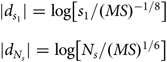 $$|{d_{{s_1}}}| = \log \left[ {{s_1}/{{\left( {MS} \right)}^{ - 1/8}}} \right]$$$$|{d_{{N_s}}}| = \log \left[ {{N_s}/{{\left( {MS} \right)}^{1/6}}} \right]$$
Theoretically, the values of $|{d_{{s_1}}}|$
and
$|{d_{{s_1}}}|$
and $|{d_{{N_s}}}|$
can range from zero to infinity.Footnote 7 However, there are two arbitrary values that can help grasp the meaning of a value generated by the formulas specified above. The first one is zero. As has been already mentioned above, every electoral system expects at least some degree of voters’ strategic coordination in response to the institutional constraints (Taagepera and Shugart, Reference Taagepera and Shugart1989; Cox, Reference Cox1997). Therefore, if voters coordinate successfully, real and predicted values are equal and the result of their division is one. That, after the logarithm is applied, gives zero. Therefore, when
$|{d_{{N_s}}}|$
can range from zero to infinity.Footnote 7 However, there are two arbitrary values that can help grasp the meaning of a value generated by the formulas specified above. The first one is zero. As has been already mentioned above, every electoral system expects at least some degree of voters’ strategic coordination in response to the institutional constraints (Taagepera and Shugart, Reference Taagepera and Shugart1989; Cox, Reference Cox1997). Therefore, if voters coordinate successfully, real and predicted values are equal and the result of their division is one. That, after the logarithm is applied, gives zero. Therefore, when $|{d_{{s_1}}}|$
or
$|{d_{{s_1}}}|$
or $|{d_{{N_s}}}|$
was equal to zero, the voters’ coordination resulted in electoral outcomes (i.e., party system fragmentation and largest party seat share) which perfectly meets the expectations based on the given set of electoral rules.
$|{d_{{N_s}}}|$
was equal to zero, the voters’ coordination resulted in electoral outcomes (i.e., party system fragmentation and largest party seat share) which perfectly meets the expectations based on the given set of electoral rules.
The second value is 0.3. This value signals that the real outcome stays within a factor of two from the prediction.Footnote 8 In other words, the real electoral outcome is half of the expected or twice the expected. If the value of
$|{d_{{s_1}}}|$
or
$|{d_{{N_s}}}|$
reaches 0.3, it indicates that voters elected as few as two or as many as eight parties to a system in which the institutional set-up is expected to accommodate four parties.Footnote 9 Therefore, the voters’ strategies did not properly respond to the incentives imposed by institutional constraints and resulted in a party system which is considerably less or considerably more fragmentated than expected. This value is set with respect to the empirical testing conducted by Taagepera (Reference Taagepera2007: 123, 153), which revealed that most cases included in his dataset fall within this interval.
These values add a substantive meaning to the indices. At zero, they indicate that the real outcomes are perfectly consistent with the predictions. Increasing values of
$|{d_{{s_1}}}|$
and
$|{d_{{N_s}}}|$
indicates growing deviation between real and expected party system fragmentation for the given set of electoral rules. However, the value of 0.3 limits the interval of ‘tolerable’ deviations. If a value of
$|{d_{{s_1}}}|$
or
$|{d_{{N_s}}}|$
exceeds 0.3, it means that the case strongly deviates from theoretical expectations.
Operationalization of party systems’ characteristics
Choice set size is a measure which sums up the number of all parties/candidates receiving at least one vote in a district based on the CLEA (Kollman et al., Reference Kollman, Hicken, Caramani, Backer and Lublin2017).Footnote 10 However, the CLEA provides data on the level of constituencies, while this research operates on the level of individual national elections. Therefore, this research employs the aggregated measure which is a weighted average of the number of parties running in the districts with weights being the district magnitudes.
In response to this, a possible objection could be that the actual national number of parties should be used instead of the weighted average, because it constitutes a more valid measure. That may be true for systems which apply similar district magnitudes across the country. However, the magnitude varies greatly in countries like Denmark (2–20), Spain (1–16), or Switzerland (1–18). In these cases, a national number would overestimate the number of options offered in the districts with low magnitude where smaller parties resign to run. Weighted average reflects this and therefore constitutes a more suitable measure expressing the overall cognitive demands for voters in these elections. At the same time, weighted average produces comparable results to the actual national number of parties running in the elections, if the system applies comparable magnitude across its districts.
Degree of polarization is operationalized in three different ways which altogether utilize three out of four methods known in political science to position parties within a political space (Laver, Reference Laver2014). The first approach takes the position of parties from the Manifesto Project Database (Lehmann et al., Reference Lehmann, Volkens, Matthieß, Merz, Regel and Weßels2017). It places the parties on the left-right dimension based on the saliency of specific issues in the parties’ manifestos, which are analyzed by trained coders who follow a strict methodology (see Budge et al., Reference Budge, Klingemann, Volkens, Bara and Tanenbaum2001; Klingemann et al., Reference Klingemann, Volkens, McDonald, Budge and Bara2006). In this case, the degree of polarization is equal to the distance between the two most remote subjectsFootnote 11 on the left–right (RILE) scale supplied directly by the Manifesto Project team (Budge et al., Reference Budge, Klingemann, Volkens, Bara and Tanenbaum2001: 22). The theoretical range of this measure starts from 0 (i.e., no polarization because the most distant parties occupy the same position) to 200 (i.e., extreme polarization, because the most distant parties occupy opposite edges of the RILE scale).Footnote 12
The second measure captures the position of parties on the general RILE scale as they were coded by experts participating in the Chapel Hill Expert Survey (Hooghe et al., Reference Hooghe, Bakker, Brigevich, De Vries, Edwards, Marks, Rovny, Steenbergen and Vachudova2010; Bakker et al., Reference Bakker, De Vries, Edwards, Hooghe, Jolly, Marks, Polk, Rovny, Steenbergen and Vachudova2012; Polk et al., Reference Polk, Rovny, Bakker, Edwards, Hooghe, Jolly, Koedam, Kostelka, Marks, Schumacher and Steenbergen2017). Given the fact that experts assess individual parties, also in this case the measure represents the distance between the two most remote parties. The theoretical range starts at 0 (i.e., no polarization, because the most distant parties occupy the same position) and goes up to 10 (i.e., extreme polarization, because the most distant parties occupy opposite extremes of the general RILE scale).
The third measure is the Party System Polarization Index proposed by Dalton (Reference Dalton2008, Reference Dalton, Dalton and Anderson2010), which is based on the perception of party positions by voters captured in the Comparative Study of Electoral Systems (Dalton, Reference Dalton2017). Dalton’s formula (Reference Dalton2008) is designed in a way that captures the degree of polarization present in a given system, therefore, no aggregation is needed in this case. Party System Polarization Index can range from 0 (i.e., no polarization) to 10 (i.e., fully polarized system).
Controls
The explanatory variables mentioned above are clearly not exogenous. Therefore, the regressions include a set of factors which control possible confounders.
In political science, district magnitude (i.e., the number of seats distributed in a district) is considered a key variable determining the effects of electoral systems (Rae, Reference Rae1995). The growing number of seats divided among parties increases proportionality and fragmentation of electoral outcomes and changes the incentives for voters to cast their ballot strategically (i.e., for other than their sincere preference) in order to avoid wasting one’s vote (Taagepera and Shugart, Reference Taagepera and Shugart1989; Cox and Shugart, Reference Cox and Shugart1996; Cox, Reference Cox1997). Since the district magnitude may impact voters and subsequently electoral outcomes, the analysis controls for average district magnitude which is the number of assembly seats divided by the number of electoral districts for given elections in a country.
The longer the period spent under the democratic rules, the more learning opportunities voters have to familiarize the democratic institutions and act according to the strategic incentives the institutions generate (see e.g., Kitschelt, Reference Kitschelt1995; Aarts and Thomassen, Reference Aarts and Thomassen2008). This is the reason why the analysis controls for democratic development and length of democratic tradition. Both are based on the index of institutionalized democracy (i.e., ‘e_democ’) included in the V-Dem dataset (Coppedge et al., Reference Coppedge, Gerring, Lindberg, Skaaning, Teorell, Altman, Bernhard, Fish, Glynn, Hicken and Knutsen2018), which ranges from 0 (least democratic) to 10 (most democratic) and reflects the Polity IV data. The democratic development uses the respective value for the election year in a country. The length of democratic tradition counts the number of years before the election during which the index was six or higher.
Several scholars claim that the resulting fragmentation of party systems is conditional on the social cleavages present in a country (Ordeshook and Shvetsova, Reference Ordeshook and Shvetsova1994; Neto and Cox, Reference Neto and Cox1997; Clark and Golder, Reference Clark and Golder2006; Golder and Lloyd, Reference Golder and Lloyd2014). Therefore, the models include the index of ethnic fractionalization developed by Alesina et al. (Reference Alesina, Devleeschauwer, Easterly, Kurlat and Wacziarg2003) who transform the data from the Encyclopædia Britannica into an overall measure for 215 countries which range in theory from 0 (ethnically homogeneous country) to 1 (ethnically heterogeneous country).
Clarke et al. (Reference Clarke, Kornberg, McIntyre, Bauer-Kaase and Kaase1999) and Norris (Reference Norris2004) noticed that the economic situation has an influence over the cleavage voting in countries. The reason is that the level of economic development determines the shift from industrial to post-industrial stage. Therefore, the analysis controls also for the GDP per capita as reported by the Maddison Project Database (Reference Bolt, Inklaar, de Jong and van Zanden2018) included in the V-Dem data (as variable ‘e_migdppc’) (Coppedge et al., Reference Coppedge, Gerring, Lindberg, Skaaning, Teorell, Altman, Bernhard, Fish, Glynn, Hicken and Knutsen2018).
The analysis employs regression with clustered robust standard errors (clusters being the countries), which is supposed to reduce the bias resulting from the fact that the available data often include multiple elections from one country (see Online Appendix A for list of included elections).
Analysis
This analysis first examines the effect of choice set size, that is, the number of options provided to voters during elections. The results presented in Table 1 show that the coefficients for the choice set size are positive and highly statistically significant. These results are robust to the inclusion of the control variables (see models 2 and 4 in Table 1) and their alternative operationalizations (see Tables B1 and B2 in Online Appendix B). This confirms the choice set size hypothesis which expects that an increasing number of options provided to voters causes the fragmentation in electoral outcomes to deviate from theoretical expectations to a greater degree. However, the effect is non-linear. The most suitable function capturing the trend in the data is a natural logarithm, which means that every additional option included on the ballot has a smaller effect when the overall size of the ballot increases. The trendline for
$|{d_{{s_1}}}|$
and
$|{d_{{N_s}}}|$
is visualized in Figure 2.
The effect of increasing choice set size on fragmentation of electoral outcomes

*P < 0.1; **P < 0.05; ***P < 0.01; Regression with clustered robust standard errors in parentheses.
Visualization of the effect of increasing choice set size on fragmentation of electoral outcomes.

These results demonstrate that the choice set size of 10 is already associated with a deviation of roughly 0.1 for both
$|{d_{{s_1}}}|$
and
$|{d_{{N_s}}}|$
. Substantively speaking, this means that in the systems for which the largest party seat share is predicted to be 40%, the largest party tends to get about 32% or 50% seats instead when voters are provided with 10 options. In case of effective number of parties, systems which are supposed to consist of 5 parties tend to include 4 or 6.25 effective parties instead if the choice set size is 10.Footnote 13 Given the natural log transformation of the choice set size, its effect slows down after surpassing the value 10 (see Figure 2). When the choice set size increases and voters are offered 30 options, the deviation expressed by indices
$|{d_{{s_1}}}|$
and
$|{d_{{N_s}}}|$
also increases to about 0.15. This means that if a system is predicted to include the largest party with a seat share of 40%, the choice set size of 30 tends to divert this share to around 28% or 56%. When it comes to the effective number of parties, such a system tends to contain 3.5 or 7 effective parties instead of the predicted value of 5. These interpretations demonstrate that increasing choice set size influences the shape of party systems and contributes to their diversion from theoretically expected outcomes.
This finding is in line with the studies focused on individuals (i.e., on the micro level), which discovered that an increasing choice set size increases cognitive demands for voters and results in a growing confusion (Lau et al., Reference Lau, Andersen and Redlawsk2008; Cunow, Reference Cunow2014; O’Brien, Reference O’Brien2017). The consequences of this confusion could also be observed on the level of the whole system: if voters are offered too many options, their ability to strategically coordinate in line with the expectations of electoral system designers decreases and the fragmentation in electoral outcomes is further away from what a typical outcome is for a given set of electoral rules.
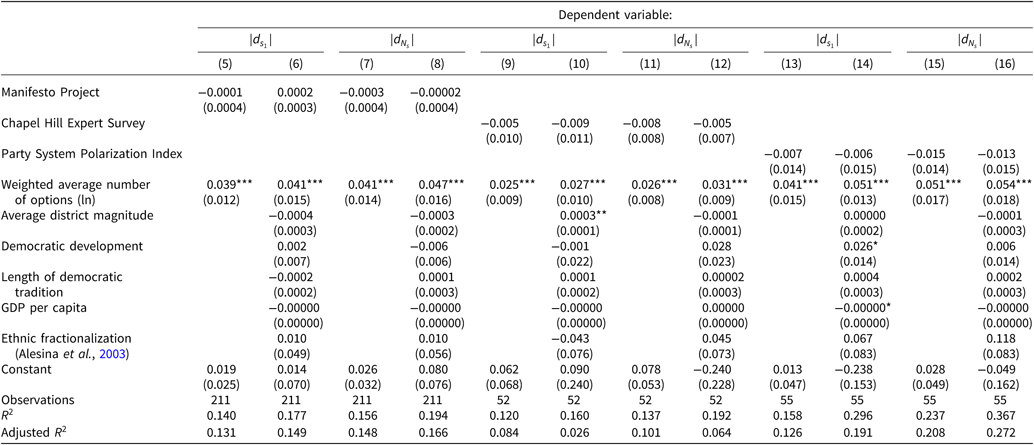
Now, the analysis turns to the second part. It examines the indirect influence of party system polarization on electoral outcomes. As previously noted in the theoretical part, increasing polarization (while keeping the number of parties constant) should expand the ideological differences between candidates, which makes it easier for voters to distinguish candidates taking part in the same political competition (Cox, Reference Cox1997; Persson and Tabellini, Reference Persson and Tabellini2005). Therefore, increasing polarization should reduce the cognitive demands for voter coordination and simplify the competent response to the strategic incentive generated by an electoral system. As mentioned above, the effect of polarization expects that the number of parties is kept constant; therefore, each measure of party system polarization is always included in the regression models 5–16 together with weighted choice set size (see Table 2).
The effect of increasing choice set size on fragmentation of electoral outcomes when polarization is kept constant
*P < 0.1; **P < 0.05; ***P < 0.01; Regression with clustered robust standard errors in parentheses.
The coefficients capturing the effect of polarization are mostly negative, which is in line with the expectations, however, none of them passes the threshold for statistical significance (see Table 2). Therefore, these findings do not support the polarization hypothesis that increasing polarization helps voters to follow the political competition and to more efficiently respond to strategic incentives generated by the electoral system.
It can be argued that political science has several competing concepts of ideological polarization. Indeed, this research employed three out of four methodological approaches to measure ideological polarization (see Laver, Reference Laver2014) and revealed pairwise correlations ranging between r = 0.34 and r = 0.60.Footnote 14 This indicates that all three measures conceptually overlap to only some degree, yet none of them capture any systematic influence of party system polarization on the overall degree of electoral fragmentation on the macro level.
In addition, measures of ideological polarization included in regression models 5–16 allow to examine the effect of choice set size when polarization is kept constant. All coefficients for choice set size are still statistically significant and robust to the inclusion of the control variables (see Table 2).Footnote 15 Moreover, the values as well as the trendlines visualizing the effect of choice set size are comparable to the results obtained through models 1–4 (see Figures 2 and 3). Therefore, the substantive interpretation of the effect of choice set size presented in the previous part of the analysis can be applied here as well.
Visualization of the (limited) effect of polarization on the relationship between choice set size and fragmentation of electoral outcomes.

This indicates that the influence of choice set size is comparable even when the degree of ideological polarization of party systems as well as other possible confounders are held constant. Thus, robustness of the results supporting the choice set size hypothesis allows to conclude that the choice set size constitutes a relevant factor influencing the performance of electoral systems on the macro level.
Discussion and conclusions
This paper confirmed that parties can not only directly adjust the electoral rules to reach more favourable outcomes, but they also create a context that indirectly and systematically influences electoral competition. This conceptual framework constitutes an original theoretical contribution to the relationship between parties and electoral systems. It emphasizes that any expectations of electoral reforms and any comparisons of electoral systems across various contexts must reflect the specific features of the local party system.
This research examined two factors that capture attributes related to party systems – choice set size and degree of ideological polarization. These factors represent two different approaches describing party systems – quantitative and qualitative. Based on a range of acknowledged measures and data from several credible sources, this research reaches two main conclusions.
First, increasing the options provided to voters (i.e., choice set size) increases the cognitive demands on them to comprehend the political competition (Lau et al., Reference Lau, Andersen and Redlawsk2008; Cunow, Reference Cunow2014; O’Brien, Reference O’Brien2017). As a result, systems with too many parties/candidates experience greater fragmentation in electoral outcomes than is expected from the given set of electoral rules.
This conclusion constitutes a relevant finding for the designers of electoral systems. When the outcomes of an electoral reform are estimated, it is also necessary to take into account the costs to enter a political competition. If costs are too low and marginal parties are not effectively restricted from running, the cognitive demands to follow the political competition increase. As a result, a growing number of voters fail to competently respond to strategic incentives generated by electoral rules, and therefore the number of parties receiving the substantial portion of votes will be further away from the theoretically expected value.
Second, none of the three different approaches to measuring the party system polarization revealed that the range of ideological space occupied by parties have a systematic impact on electoral systems and their outcomes. However, it must be emphasized that these results do not challenge the conclusions based on micro-level observations of individuals (Lau and Redlawsk, Reference Lau and Redlawsk1997; Lau et al., Reference Lau, Patel, Fahmy and Kaufman2014; O’Brien, Reference O’Brien2017). Polarization can still represent a relevant force driving an individual’s perception of politics; however, on the macro level, the effect of polarization does not seem to be a factor strong enough to substantively alter the overall fragmentation of electoral results in a country.
Future research should aim to quantify the magnitude of impact of choice set size on resulting electoral fragmentation. Based on that, it should develop a rigorous methodological tool which would allow to take into consideration how choice set size influences the performance of various electoral systems. This instrument will significantly increase the accuracy when impact of electoral reforms is estimated.
Supplementary material
To view supplementary material for this article, please visit https://doi.org/10.1017/S1755773919000250
Acknowledgements
I would like to gratefully acknowledge the comments and suggestions made by three anonymous reviewers, and editors, as well as the comments made by Mikko Mattila, Fernando Casal Bértoa, Petr Kopecký, Mikolaj Cześnik, Andrew Roberts, Karel Kouba, Peter Spáč, and participants of the 1st ECPR-OSCE/ODIHR Winter School on Political Parties and Democracy which all contributed to the resulting quality of this work.
Funding
This article was partially written at Masaryk University with the support of the Specific University Research Grant provided by the Ministry of Education, Youth and Sports of the Czech Republic. In addition, I would like to thankfully acknowledge the support of the Finnish Cultural Foundation (Suomen Kulttuurirahasto).



