





Introduction
Election pledges play an important role in representative democracies and are often argued in mandate theory to be their key linchpin (Naurin, Royed, and Thomson Reference Naurin, Royed and Thomson2019; Thomson, Royed, Naurin et al. Reference Thomson, Royed, Naurin, Artés, Costello, Ennser-Jedenastik and Praprotnik2017). Mandate theory states that voters delegate power to a party on election day based on the party’s election platform, the party pursues its platform after the election, and voters then hold the party accountable for its implementation of the platform at the next election (Ferejohn Reference Ferejohn1986; Klingemann, Hofferbert, and Budge Reference Klingemann, Hofferbert and Budge1994; McDonald and Budge Reference McDonald and Budge2005). Crucially, for this logic to work, voters need to be aware of the pledges a party makes during the election campaign, as this is a precondition for knowing what mandate to assign to the party and later for evaluating the party’s success in pursuing it (sometimes referred to as ‘promissory representation’; see Mansbridge Reference Mansbridge2003).
Decades of research on voter competencies, however, have questioned the electorate’s ability to perform its core duties in a democracy because of limited knowledge about politics and inconsistent political preferences (eg Achen and Bartels Reference Achen and Bartels2017; Campbell, Converse, Miller et al. Reference Campbell, Converse, Miller and Stokes1960; Converse Reference Converse and Apter1964; Delli Carpini and Keeter Reference Delli Carpini and Keeter1996). Voters also tend to be myopic in their political reasoning (eg Fair Reference Fair1978; Healy and Lenz Reference Healy and Lenz2014; Kramer Reference Kramer1971), such that even if they know parties’ positions at the time of voting – a question on which the literature is divided (Adams, Ezrow, and Somer-Topcu Reference Adams, Ezrow and Somer-Topcu2011; Busch Reference Busch2016; Fernandez-Vazquez Reference Fernandez-Vazquez2014; Spoon and Klüver Reference Spoon and Klüver2017) – it is an open question whether the electorate is able to hold parties accountable to their pledges several years later. Perhaps unsurprisingly, then, previous literature has shown that awareness of the fulfillment status of pledges is generally limited, especially among voters with low political sophistication (Naurin and Oscarsson Reference Naurin and Oscarsson2017; Thomson Reference Thomson2011; Thomson and Brandenburg Reference Thomson and Brandenburg2019). Given these shortcomings, how can voters perform the key task of holding parties accountable to their pledges?
In this paper, we develop the theoretical argument that pre-election pledge awareness, an understudied phenomenon in itself, can guide voters after the election as they monitor government parties’ performance (constituting so-called surveillance-policy facts, see Barabas, Jerit, Pollock et al. Reference Barabas, Jerit, Pollock and Rainey2014). A key element of this argument is that learning about specific pledges before an election enables and motivates voters to acquire information about their fulfillment after the election. With respect to the enabling part, pledge knowledge provides an information resource to voters and gives them a mental schema to draw on when following news about progress toward fulfillment (Graber Reference Graber1984; Thomson Reference Thomson2011). By contrast, the motivating part concerns how different groups of voters care about certain issues, which shapes the information they acquire during election campaigns (Ryan and Ehlinger Reference Ryan and Ehlinger2023), including information on election pledges, and may similarly motivate them to learn about the fulfillment status of these pledges after the election. We expect low-interest voters to benefit most from pre-election pledge awareness, as high-interest voters are more likely to get information about fulfillment status regardless.
One reason why these key dynamics have not been examined may be the difficulties in developing a research design that allows for a systematic test. In this study, we use the 2019 Danish national election as a case to implement a sophisticated panel survey study as well as two pooled cross-sectional studies. The panel survey enables us to estimate the importance of pre-election pledge awareness at the individual level by interviewing voters before the election and then re-interviewing them at different time periods after the election (up until a year and a half after the election). The panel survey uses a rolling re-interview design with three representative subgroups interviewed asynchronously (that is, one subgroup interviewed four weeks before the election as well as one week and nine months after the election, a second subgroup interviewed two weeks before the election as well as one month and 12 months after the election, and a third subgroup interviewed one week before the election as well as four months and 18 months after the election). This allows us to track whether voters correctly update their information regarding pledge fulfillment when this occurs, and whether updating depends on their pre-election pledge awareness. The most salient pledges were selected for this study, and voters then had to correctly identify the sponsor of these pledges. We supplement the panel survey with two additional large-scale and representative surveys that are used to estimate voter awareness of the sponsor of all pledges made by the government party (using a crowdsourcing design) and to test our argument at the aggregate level. The panel study and the additional two studies included a total of 10,322 respondents.
Based on the empirical analyses, we show that pre-election pledge awareness plays a significant role in voters’ ability to learn about the fulfillment of a pledge after the election. We show that this finding holds across different measures of pledge awareness. Pledge-specific information thus enables voters to perform a key task in mandate theory, namely to hold parties accountable for their ability to implement their mandate. We also show that this information helps people with low political interest in particular; that is, voters who are typically at risk of being marginalized in the political process. Thus, voters acquire information during election campaigns when overall attention towards politics is higher (Andersen, Tilley, and Heath Reference Andersen, Tilley and Heath2005; Gelman and King Reference Gelman and King1993) and use this knowledge when the intensity of the political debate diminishes after the election. Our paper, in sum, provides a pledge-based test of mandate theory and offers an optimistic perspective on voters as democratic citizens.
The mandate logic and the centrality of pledge awareness
In its simplest form, mandate theory states that political parties offer different policy packages for voters to choose from and that parties pursue these packages after the election based on the mandate they receive (Ferejohn Reference Ferejohn1986; Klingemann, Hofferbert, and Budge Reference Klingemann, Hofferbert and Budge1994; McDonald and Budge Reference McDonald and Budge2005). At the next election, voters can hold the parties accountable by punishing or rewarding them based on their success in implementing their proposed policies (Matthieß Reference Matthieß2020, Reference Matthieß2022; Naurin, Soroka, and Markwat Reference Naurin, Soroka and Markwat2019). This mandate logic can work in different ways, but pledges perform an important role as they help the electorate, first, to make an informed choice before voting, and second, to evaluate parties based on the fulfillment of their pledges (Mansbridge Reference Mansbridge2003).
The centrality of pledge awareness
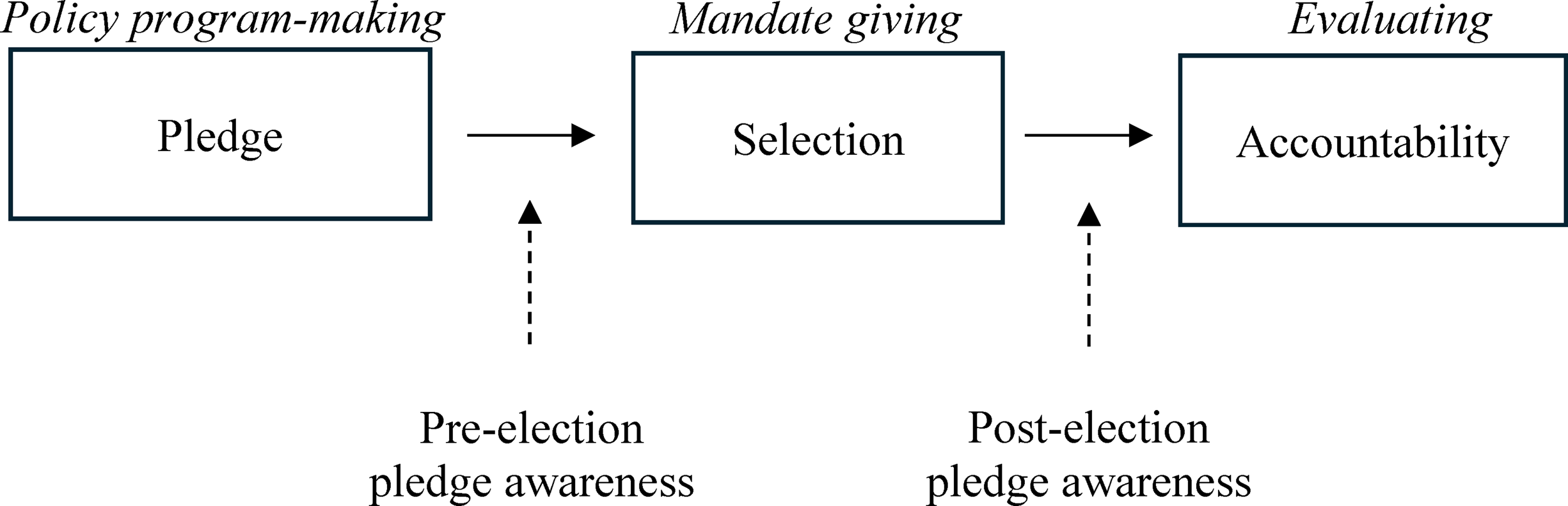
A key precondition for pledge-based voting according to mandate logic is that voters are aware of the pledges parties make before an election and whether or not they have fulfilled them after the election. This is illustrated in Figure 1. Taking the lead from Thomson (Reference Thomson2011), a number of studies have investigated how many pledges voters are able to correctly identify as either kept or broken (eg Naurin and Oscarsson Reference Naurin and Oscarsson2017; Thomson and Brandenburg Reference Thomson and Brandenburg2019). The common approach in these studies on post-election awareness has been to ask respondents at the end of an election cycle (or at the beginning of the next) to recall whether a given pledge was fulfilled or not. The broad conclusion is that there is a positive correlation between actual pledge fulfillment and voters’ beliefs about fulfillment, but that interest in politics generally improves respondents’ ability to correctly evaluate the fulfillment status of pledges.
The centrality of pledge awareness in mandate logic.

Figure 1. Long description
Flowchart illustrating the centrality of pledge awareness in mandate logic. The process begins with policy program-making, where a pledge is made. This leads to mandate giving, where a selection is made. Finally, the process moves to evaluating, where accountability is assessed. Pre-election pledge awareness influences the selection process, while post-election pledge awareness affects accountability. The flowchart highlights the importance of pledge awareness in the democratic process.
Their qualities aside, none of the existing studies explore pledge awareness before the election. Yet we argue that pre-election awareness is essential in the mandate policy chain because this knowledge can help voters keep track of a pledge’s fulfillment status after the election. We define pre-election pledge awareness as voters’ ability to perceive (ie being exposed to and notice), store (ie remember), and retrieve (ie to recognize or recall) election pledges that parties make as part of an election campaign (resembling Zaller’s classic conceptualization of political awareness, see Zaller Reference Zaller1992). Given individuals’ scarce attention and weak learning capacity for complex information (eg Graber Reference Graber2001; Simon Reference Simon1967), pledges do not easily enter a voter’s memory, but instead need to, for instance, receive a great deal of attention in the media, be highly relevant for the individual, or align with the individual’s pre-dispositions (eg partisan identity, see Campbell, Converse, Miller et al. Reference Campbell, Converse, Miller and Stokes1960). Crucially, voters must not only be aware of a pledge but also correctly assign it to the pledge’s sponsor to select a representative in line with the mandate logic (the left part of Figure 1). Yet when a pledge has been picked up by the voter and assigned to the correct sponsor, it can serve as an asset when holding parties accountable after the election (the right part of Figure 1). Specifically, we theorize two mechanisms for how pre-election pledge awareness becomes relevant for post-election pledge awareness.
First, pre-election awareness of a pledge and its sponsor enables post-election awareness because it means voters know what to look for in the post-election news stream (the importance of these so-called surveillance-policy facts has been highlighted by Barabas, Jerit, Pollock et al. Reference Barabas, Jerit, Pollock and Rainey2014). Similar to pre-election pledge awareness, post-election pledge awareness is difficult to achieve (perhaps even more so), as politics in general and pledges in particular receive less media coverage outside election campaigns (De León and Vermeer Reference De León and Vermeer2023; Falasca Reference Falasca2014; Müller Reference Müller2020; Peter and De Swert Reference Peter and De Swert2009). Having previously acquired information about a specific pledge gives voters an informational advantage during these less intense political periods (constituting a significant resource to these voters, for a similar argument, see Thomson Reference Thomson2011). Graber (Reference Graber1984) argues that citizens frequently use previous information (stored as so-called schemas) when they access, process, and store political news in their memories. If voters do not have a mental schema to draw upon when being exposed to a news story, it is less likely for this to be stored in their memory (Bøggild, Aarøe, and Petersen Reference Bøggild, Aarøe and Petersen2021; Graber Reference Graber1984; Aarøe and Petersen Reference Aarøe and Petersen2020). Using this argument, obtaining information about the fulfillment of a pledge should be more difficult when voters have not already stored information about the pledge. This logic becomes clear when the media covers the adoption of a new bill without making a reference to the pre-election pledge from which the policy originated. If the media only reports that ‘Party A implemented Policy B’, the voter needs to connect this policy to a pledge made by the party in the previous campaign to update its fulfillment status. Even when the media explicitly makes this connection, voters may fail to integrate the information into memory if they lack a cognitive schema to which the information can be meaningfully linked (Graber Reference Graber1984).
Second, pre-election awareness motivates post-election awareness if we assume that pre-election awareness reflects the importance that voters assign to a pledge, or at least that they find it noteworthy (on the importance of individual-level saliency and personal relevance for attention to political information, see Ryan and Ehlinger Reference Ryan and Ehlinger2023; Thomson Reference Thomson2011). The personal motivation that drives certain people to acquire information about a given pledge before the election can constitute the same drive that leads people to seek out and be attentive to information about the progress of pledge fulfillment after the election. When voters care about a pledge, they should also follow it more closely after the election. Of course, the media plays a key role as voters receive the most relevant political information from media sources (Norris Reference Norris2000; Strömbäck Reference Strömbäck2008), but voters might also search more actively for the status of a given pledge if they find it personally relevant (eg seeking information directly from party platforms, interest organizations, or friends and family). While the first mechanism emphasizes the importance of pre-election pledge awareness as a cognitive resource, the second mechanism highlights that voters might also be eager to know the fulfillment status of a pledge after having become aware of it during the campaign.
The overall argument presented here follows the same line of thought as Delli Carpini and Keeter (Reference Delli Carpini and Keeter1996), namely that informed voters are better citizens from a democratic perspective. Specifically, we have argued that voters with pledge-specific knowledge should, in short, be more capable of holding parties accountable for their promises at the next election. The problem of information scarcity that prevents people from learning about the fulfillment of a pledge can be reduced by information acquisition during the campaign period, when voters and the media follow politics more closely (Andersen, Tilley, and Heath Reference Andersen, Tilley and Heath2005; Gelman and King Reference Gelman and King1993). In this way, pre-election awareness may be considered a distinct source of post-election awareness above and beyond general interest in politics.
Guiding low-interest voters
We might, however, expect that pre-election awareness is most important for those voters who are not very interested in politics outside the intense period in the run-up to an election. These voters are more likely to experience information scarcity, as they do not monitor politics on a regular basis between elections and are therefore unlikely to know whether a pledge has been fulfilled or not.
Yet during elections, some pledges emerge as very salient or defining of the campaign, such that even voters with limited political interest absorb these messages. Alternatively, voters with a low interest in politics might become aware of specific pledges that relate to aspects of life that are important to them (similar to the argument of issue publics, see, for instance, Rossiter and Harden Reference Rossiter and Harden2025; Ryan and Ehlinger Reference Ryan and Ehlinger2023). For low-interest voters, knowledge about these pledges will be one of the few pieces of relevant political information they bring into the post-election period. The enabling and motivating mechanisms described above should thus be particularly activated for these types of voters, while voters with a high interest in politics are more likely to receive information about the fulfillment statuses of pledges, regardless of whether or not they became aware of the pledges before the election. Awareness of pledges, in short, may make otherwise disinterested citizens ‘participate intelligently in governmental affairs’ (Schudson Reference Schudson1998: 310).
Studying pledge awareness from the mandate perspective
Case selection and pledge collection
We study pledge awareness in the context of the 2019 Danish national election. Denmark is, in many ways, a typical Western European democracy with a proportional representative electoral system, which generates fierce multiparty competition. For the 20 years or so before the 2019 election, the two main contenders for government were the Liberal Party (the incumbent at the time of the election) and the Social Democrats (who ended up winning the election). Together, these two parties normally receive around 50per cent of all votes, implying that they are the natural providers of the prime minister but also that they depend on smaller coalition partners to win a majority. This is typically the situation across Europe, where single-party majorities are rare.
Since the Social Democrats and the Liberal Party have been the only prime minister parties in recent decades, we focused on voter awareness of pledges made by these two parties (previous studies also focus on government pledges when studying fulfillment awareness, see Naurin and Oscarsson Reference Naurin and Oscarsson2017; Thomson Reference Thomson2011; Thomson and Brandenburg Reference Thomson and Brandenburg2019). To identify real pledges made by these two parties in the run-up to the 2019 election, we searched campaign-related information on the parties’ webpages and Facebook profiles (spokespersons from both parties confirmed that these were the two main channels for announcing pledges). We used those political statements that met the conventional scholarly definition of a pledge as ‘a statement committing a party to one specific action or outcome that can be clearly determined to have occurred or not’ (Thomson, Royed, Naurin et al. Reference Thomson, Royed, Naurin, Artés, Costello, Ennser-Jedenastik and Praprotnik2017: 532).
In total, the Liberal Party and the Social Democrats issued 89 and 112 pledges, respectively. This aligns very well with what other parties tend to produce. According to Thomson, Royed, Naurin et al. (Reference Thomson, Royed, Naurin, Artés, Costello, Ennser-Jedenastik and Praprotnik2017), in 12 Western democracies and 57 elections, parties make an average of 105 pledges per election (with a standard deviation of 63). The Social Democrats ultimately won the election in 2019 and formed a single-party government. They kept 72 per cent of their election pledges (at least partially), which is higher than the approximately 60 per cent average pledge fulfillment rate among government parties (based on a study with 12 countries, see Thomson, Royed, Naurin et al. Reference Thomson, Royed, Naurin, Artés, Costello, Ennser-Jedenastik and Praprotnik2017). This difference might reflect that the Social Democrats led a single-party government (ibid.). We discuss this case selection and its influence on our results in the discussion section of the paper.
Three voter studies: pre-election study, panel study, and post-election study
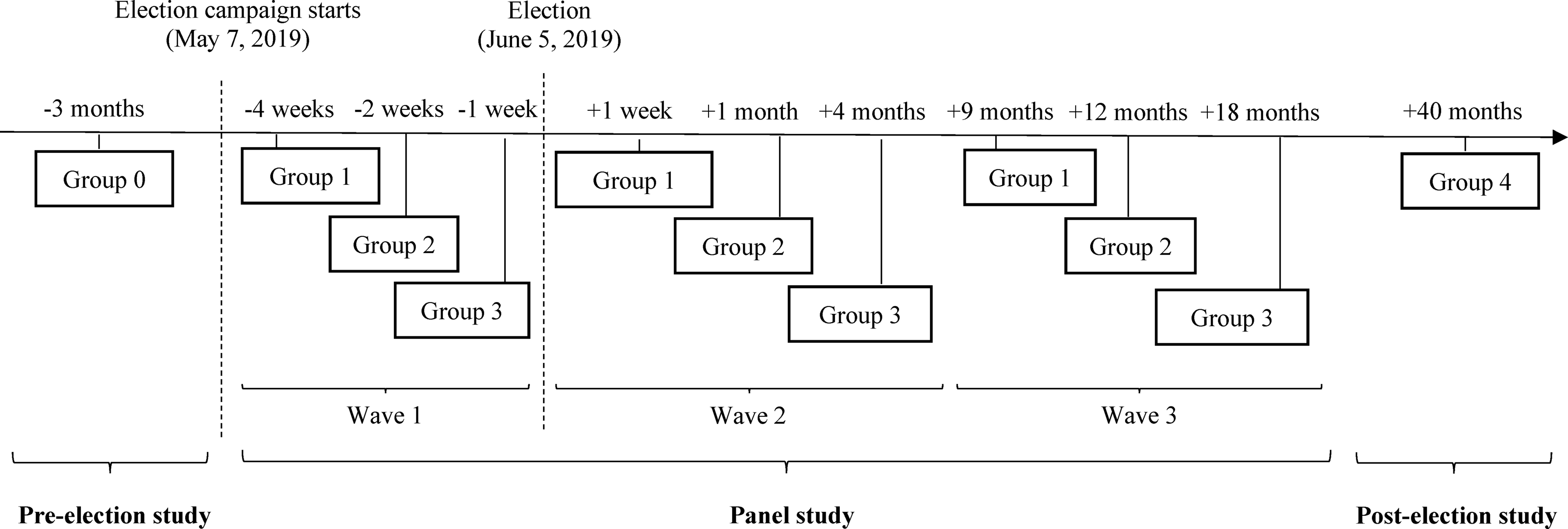
Testing pledge awareness in the full chain of mandate theory is demanding as it requires a design setup that allows for studying voters’ information levels throughout the electoral cycle. To achieve this, our project included three studies: a panel study with three subgroups and two pooled cross-sectional studies (one was conducted pre-election and the other was conducted post-election). Figure 2 provides an overview of these three studies. The two pooled cross-sectional studies were developed to measure voters’ awareness of the full universe of pledges made by the Social Democrats (and the Liberal Party in the pre-election study) and used a crowdsourcing design with a selected number of pledges distributed to each respondent (to avoid survey fatigue). The panel study was developed to capture the individual-level importance of pre-election pledge awareness for post-election fulfillment awareness and focused on the four most central election pledges as identified during the pre-election study.
Overview of the three voter studies.
Notes: In the online Appendix, we show the exact start and end dates of each survey round. The post-election study was conducted just before the subsequent election (November 1, 2022).

Figure 2. Long description
A timeline illustrating the structure of three voter studies conducted around an election. The timeline begins three months before the election campaign starts on May 7, 2019, and extends to forty months after the election held on June 5, 2019. The timeline is divided into three main phases: the pre-election study, the panel study, and the post-election study. The pre-election study includes Group 0 surveyed three months before the campaign starts. The panel study is further divided into Wave 1, Wave 2, and Wave 3. Wave 1 includes Group 1 surveyed four weeks before the election, Group 2 surveyed two weeks before the election, and Group 3 surveyed one week before the election. Wave 2 includes Group 1 surveyed one week after the election, Group 2 surveyed one month after the election, and Group 3 surveyed four months after the election. Wave 3 includes Group 1 surveyed nine months after the election, Group 2 surveyed twelve months after the election, and Group 3 surveyed eighteen months after the election. The post-election study includes Group 4 surveyed forty months after the election.
The panel setup was necessary to measure voter knowledge while the relevant political events were unfolding. Otherwise, we might underestimate voters’ information levels. If we ask voters about a pledge long after the electoral campaign, some voters might not be able to remember it, even though they were aware of it during the campaign (people frequently forget about pledges, as we show in the analysis). Given that many voters do not even recall whom they voted for (eg Belli, Traugott, Young et al. Reference Belli, Traugott, Young and McGonagle1999), this is a real source of error if unaccounted for. In other words, we are not interested in voters’ ability to recall the election campaign and the specific promises made long after the fact; rather, we focus on the level of pledge-specific knowledge when this information was most important to them (namely, right before they were to vote on election day).
Furthermore, establishing a relationship between voters’ ability to link a party to a pledge and their ability to correctly evaluate whether the pledge has been fulfilled might not be very surprising if voters are asked at the same point in time, while it is much less trivial to show that voters can use information that they obtained during an election campaign several months later when the pledge is being fulfilled. Related to this, an ambition of the panel study was also to track whether voters’ evaluations of pledge fulfillment changed relatively soon after a pledge was fulfilled. Here, it would be insufficient to only survey respondents at the end of the following election period, as the fulfillment of the pledge might have occurred at the beginning of the period.
To address these measurement challenges related to voters’ pledge-specific knowledge, we used the panel survey to interview voters before the election and to re-interview them several times after the election, up to one and a half years later (see Wave 1, Wave 2, and Wave 3 in Figure 2). Each wave consisted of three survey samples interviewed at different points in time within each wave (see Group 1, Group 2, and Group 3 in Figure 2). From the outset, each group included approximately 2,000 respondents (total N = 6,233) and was nationally representative of the electorate in terms of gender, age, education, and geographical location.Footnote 1 Our panel setup resembles a so-called rolling re-interview design (Leeper and Slothuus Reference Leeper and Slothuus2016) and enables us to track voters’ knowledge about individual pledges and observe changes when a pledge is fulfilled (if fulfillment occurs during the observation period).
The pre-election and post-election studies included 2,000 and 2,089 respondents, respectively. In both studies, respondents were representative of the entire electorate (again, matching the population on age, gender, education, and geographical location).
Measuring pre-election pledge awareness
In the pre-election stage, our independent variable concerns voters’ awareness of campaign pledges. Based on the definition above, we need a measure that captures whether voters have heard and remembered real pledges made by political parties that they are then able to later recall. Simply asking respondents whether they have heard of a specific pledge might be problematic, as voters can easily respond affirmatively without truly having been aware of the pledge (ie intentionally or unintentionally lying). It would also be insufficient to experimentally treat respondents with information about a given pledge, as this would merely capture pledge exposure, while awareness requires that voters notice and store this information, which likely requires more persistent exposure in the news, for instance (several studies show how respondents rapidly forget about information that they receive in experiments, see Chong and Druckman Reference Chong and Druckman2010; Coppock Reference Coppock2017, Reference Coppock2021; De Vreese Reference De Vreese2004; Gerber, Gimpel, Green et al. Reference Gerber, Gimpel, Green and Shaw2011; Kalla and Broockman Reference Kalla and Broockman2018; Tappin and Hewitt Reference Tappin and Hewitt2023). Instead, our primary measure focuses on voters’ ability to correctly attribute actual pledges to the party that made them. Correctly linking a pledge to its sponsor is necessary in order for voters to base their vote on this pledge on election day. We focused on pledges made by the Social Democrats because they entered government alone after the election, giving them the greatest chance of implementing their pledges (Thomson, Royed, Naurin et al. Reference Thomson, Royed, Naurin, Artés, Costello, Ennser-Jedenastik and Praprotnik2017).Footnote 2 To avoid survey fatigue and the risk of ‘straightlining’ (ie respondents providing identical responses to multiple items), we did not ask each respondent to consider all 112 election pledges made by the Social Democrats (Dillman, Smyth, and Christian Reference Dillman, Smyth and Christian2014; Hillygus and LaChapelle Reference Hillygus and LaChapelle2022). Instead, we selected a subset of promises, using the results of the pre-election study to choose the most salient pledges according to the electorate, as they should also matter most when voters select their party on election day (selecting a subset of pledges based on their saliency is also used by previous studies, see Thomson Reference Thomson2011; Thomson and Brandenburg Reference Thomson and Brandenburg2019).
In the pre-election study, we included all 201 pledges by the Social Democrats and the Liberal Party in a crowdsourcing design, in which each respondent was randomly assigned five pledges and asked different questions for each pledge (we included both parties, as we naturally did not know beforehand who would win the election; see footnote 2). Importantly, we asked respondents the following question: ‘During an election campaign, political parties make many statements. If you heard this particular statement from a party during a campaign, how likely is it that it could influence your vote choice?’ with response categories ranging from 1 (‘Very unlikely’) to 7 (‘Very likely’) as well as a ‘Don’t know’ category. Based on a sample average of this question, we selected four pledges that were among the most salient and that also pertained to four different key issues discussed in the run-up to the election (see the online Appendix for a list of all pledges and a more detailed discussion of this selection). Thus, the four pledges covered four different topics that were all highly salient during the campaign: pensions, immigration, health care, and the environment (see Hansen and Stubager Reference Hansen and Stubager2021). The four pledges were the following:
-
(i) ‘We want to introduce a new right to early retirement’ (pension pledge).
-
(ii) ‘We want to tighten eligibility for immigrants’ reunification in Denmark’ (immigration pledge).
-
(iii) ‘We want to introduce targeted, preventive health care screening to cure cancer and other chronic illnesses in their early stages’ (health care pledge).
-
(iv) ‘We want to reduce CO2 emissions from agriculture. We will establish a council including the agricultural sector to present reasonable goals for reducing CO2 emissions among farmers’ (climate pledge).
These four pledges were rated among the most important by voters and corresponded to the most salient issues during the election (Bøggild and Jensen Reference Bøggild and Jensen2023; Hansen and Stubager Reference Hansen and Stubager2021), and they are thus the most relevant ones for the purpose of studying mandate logic and promissory representation. While the least salient pledges (such as ‘We will increase tax deduction for research and development by 130 percent’) might still serve a purpose for the Social Democrats and be important for a small subgroup of society, these pledges were likely not decisive for the overall election result.
For pledges to work for prospective voting, it is necessary that voters know whether or not a specific party, such as the Social Democrats, has made a particular pledge, especially when it is among the most popular pledges of the election. Thus, for each of these four pledges, we asked respondents which of the 13 parties running in the election had made it (respondents could pick more than one party). Respondents knew that the four pledges were genuine but had to be able to link them to the Social Democrats (other parties might have made similar pledges, but this study is interested in whether voters knew that the Social Democrats, one of the main contenders for prime minister, had made particular pledges). In this way, our measure uses a binary approach to study pre-election pledge awareness. Alternatively, we could have implemented a more continuous measure of pledge awareness (asking respondents to say how certain they are that Party A made Pledge B). Yet we are mainly interested in the distinction between whether a voter is confident enough to select a specific party as the pledge sponsor or not, as we believe that this certainty threshold is the important one for it to matter after the election.
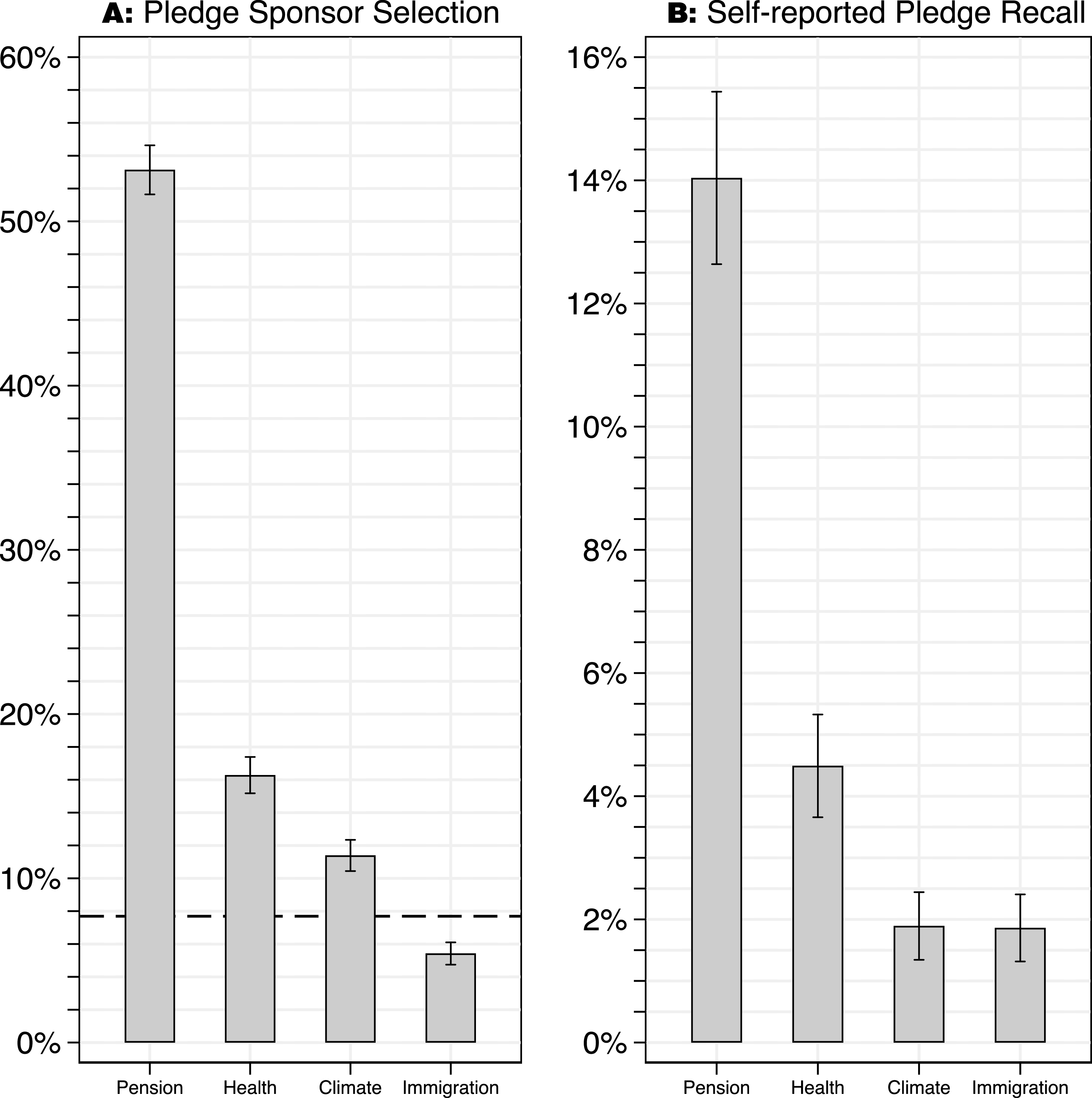
Figure 3 illustrates pre-election awareness of the Social Democrats’ pledges in the electorate at large. As Panel A illustrates, the level of awareness is generally low, especially considering that we focus on the most salient pledges to begin with. One notable exception, however, is the pledge to introduce a new right to early retirement (pension pledge). More than half of the respondents (53.1%) knew that the Social Democrats had made that pledge. In contrast, only around one in twenty (5.4%) knew that the party had made the pledge to tighten eligibility for immigrants’ reunification in Denmark (immigration pledge). For the remaining two pledges, the health care pledge and the climate pledge, awareness is somewhere in between these two poles but towards the lower end, with 16.3 per cent and 11.4 per cent aware that the Social Democrats had made each of these pledges, respectively. Nevertheless, while awareness is low, it is better than chance (marked by the dashed line). Randomly picking the Social Democrats among the 13 parties in total would yield around 7.69 per cent, meaning that the electorate performs better than chance for three of the four most salient pledges from the Social Democrats.
Pension pledge well-known among voters.
Notes: N = 6,233. 95% confidence intervals. Panel A shows the share of voters who knew that the Social Democrats had made each of four salient pledges during the 2019 Danish national election. The dashed horizontal line shows the chance of randomly selecting the Social Democrats among the 13 parties (if only selecting one party and assuming that each party has an equal likelihood of being picked). Panel B shows the share of voters who mentioned a pledge related to each of the four issues and matched this pledge with the Social Democrats.

Figure 3. Long description
The bar graph consists of two panels, A and B. Panel A shows the percentage of pledge sponsor selection for Pension, Health, Climate, and Immigration. Pension has the highest selection rate at approximately fifty-two percentage, followed by Health at around twenty-two percentage, Climate at about fifteen percentage, and Immigration at roughly five percentage. Panel B displays self-reported pledge recall for the same categories. Pension again leads with approximately fourteen percentage, Health follows at around seven percentage, while Climate and Immigration both have recall rates below three percentage. Error bars indicate variability in the data. All values are approximated.
These results clearly suggest that although awareness in general is low, pledges can reach the public consciousness. Among the Liberal Party’s pledges, a similar picture appears, although no pledge receives the same amount of recognition as the pension pledge by the Social Democrats (see the Appendix). Despite the advantages of using this measure of linking pledges to their sponsor, it should be noted that people might respond correctly by making a qualified guess rather than being aware of the pledge according to the definition above (ie people guess that the Social Democrats made the pledge to increase public spending on pensions because this party is more strongly associated with pro-welfare state policies than, say, a liberal party). Voters may also be misled when they rely on heuristics (Colombo and Steenbergen Reference Colombo and Steenbergen2020; Dancey and Sheagley Reference Dancey and Sheagley2013; Lau and Redlawsk Reference Lau and Redlawsk2001), for example, by associating climate-related pledges with green parties and immigration-related pledges with right-oriented parties (these parties usually have issue ownership, see Abou-Chadi Reference Abou-Chadi2016; Petitpas and Sciarini Reference Petitpas and Sciarini2022; Seeberg Reference Seeberg2017). As the use of these heuristics can lead to an overestimation and an underestimation of real pre-election pledge awareness, we do believe that our measure mirrors well the complexity that voters experience in real life.Footnote 3
However, to supplement the measure of pre-election pledge awareness, we also used open-ended questions to ask respondents whether they could name any election pledges from the campaign (they were given the option to write up to ten pledges). These open-ended questions were posed before respondents were shown the selected campaign pledges (for more information about the open-ended measure, see the Appendix). Many voters did not write any pledges (67.1%). While this result seems to support the impression that pledge awareness is, on average, relatively low, it is difficult to say whether the large share of respondents without any pledge mentions reflects a lack of awareness or a lack of willingness to put in the extra effort of writing the pledges (open-ended questions generally require greater cognitive burdens, see Hillygus and LaChapelle Reference Hillygus and LaChapelle2022). Even those who did write a response often used relatively broad single-word answers like ‘Pension’ or ‘Climate’ (this imprecise and expansive understanding of what counts as a pledge has also been shown by Naurin Reference Naurin2011b). To validate the selection-based measure, Panel B in Figure 3 shows the share of respondents who mentioned a pledge related to one of the four issues and linked this self-reported pledge to the Social Democrats. Reassuringly, the distribution of the self-reported measure follows the same pattern as the distribution of the selection-based measure (compare Panel A and Panel B of Figure 3). This reinforces our confidence that the primary measure of pledge sponsor selection reflects actual pre-election pledge awareness (and that this is the most relevant measure to use, as the self-reported measure clearly underestimates real knowledge – compare the share of respondents reporting awareness of the pension pledge in the two panels of Figure 3). We do, however, perform robustness tests in the panel analysis with the self-reported pledge recall measure, finding substantially similar results.
In the Appendix, we use the pre-election study data to show that this relatively low level of pledge awareness is not an artifact of selecting these specific four pledges but corresponds well to overall awareness across all pledges made by the Social Democrats (the average share of correct answers is 15.4%).
Measuring post-election pledge fulfillment awareness
In the post-electoral stage, our primary variable of interest is related to voters’ ability to correctly evaluate whether each of the four pledges chosen for the panel survey has been fulfilled or not (see question wording in the Appendix). Answer options included ‘Fulfilled’, ‘Not fulfilled’, or ‘Don’t know’. One of the pledges (the pension pledge) was fulfilled by the Social Democrats during the post-election panel survey period, meaning that we could track whether voters noticed this change in fulfillment status, and we could also compare evaluations of this pledge with the remaining pledges that were not fulfilled.
Analysis design
Our analytical model exploits our sophisticated research design to enhance the causal validity of our empirical findings. First, our design makes problems of reverse causality implausible since pre-election pledge awareness clearly occurs chronologically prior to post-election fulfillment of pledges. Second, we exploit our rolling re-interview design in the panel survey to capture the ability to correctly update the fulfillment status of the pension pledge (as this pledge was fulfilled within the panel survey period). Furthermore, we also perform additional analyses that study whether pre-election pledge awareness endures from Wave 1 to Wave 2 and then study the change in pledge fulfillment updating from Wave 2 to Wave 3 (holding individual-level factors constant by resembling a difference-in-difference design). Third, we use the selection of multiple pledges to conduct placebo tests to reinforce our confidence in the importance of pre-election awareness of specific pledges as a causal factor. Finally, we use the selection-based measure and the self-reported pledge recall measure in the main analysis (as explained above).
In addition to setting up the design to rule out problems of reverse causality and individual-level confounding variables, we also control for variables that have been highlighted by previous research as important factors. In the main analysis, we use four different models: a baseline model without any controls, a model with demographic variables, a model with political control variables, and a model with demographic and political control variables. Gender, age, and education have all been found to affect political knowledge and might therefore also affect how informed voters are about election pledges (Delli Carpini and Keeter Reference Delli Carpini and Keeter1996; Frazer and Macdonald Reference Frazer and Macdonald2003; Grönlund and Milner Reference Grönlund and Milner2006; Jennings Reference Jennings1996; Lambert, Curtis, Kay et al. Reference Lambert, Curtis, Kay and Brown1988; Mondak and Anderson Reference Mondak and Anderson2004; Rasmussen Reference Rasmussen2016). Like previous studies on respondents’ evaluations of pledge fulfillment (Naurin and Oscarsson Reference Naurin and Oscarsson2017; Thomson and Brandenburg Reference Thomson and Brandenburg2019), we therefore control for these variables. Additionally, we also include region and children under 18 in the household as control variables. These are the five demographic control variables (see operationalization of all five in the Appendix).
For the political control variables, we first include political trust, as this has been found to matter for voters’ pledge evaluations (Thomson and Brandenburg Reference Thomson and Brandenburg2019). Party belonging is another relevant covariate, as it might affect the way voters perceive and interpret the political world (Campbell, Converse, Miller et al. Reference Campbell, Converse, Miller and Stokes1960; Johnston Reference Johnston2006). Respondents might thus be more likely to associate an election promise with a party that they like. After the election, voters might also evaluate the fulfillment status of government pledges more positively if they have stronger ties to the party in government (as argued in the motivated reasoning literature, see Taber and Lodge Reference Taber and Lodge2006). In line with previous pledge research, we therefore also control for party belonging using a vote measure (whether a respondent voted for the Social Democrats in 2015 or not) and sympathy towards the Social Democrats. We also control for ideology and pledge agreement, as voters who like a pledge might be more prone to associate it with parties they like and to later interpret the fulfillment of this pledge in a biased way. Another pledge-specific variable is the salience of the pledge. Thomson (Reference Thomson2011) finds that the personal relevance of a pledge matters for voters’ likelihood of knowing its fulfillment. In a similar vein, finding a pledge important should matter for voters’ ability to correctly identify the sponsor of the pledge and its fulfillment after the election. We measure pledge saliency as the individual importance of a given pledge compared to the other pledges that respondents were asked about. As an alternative measure of saliency, we also include the importance of the issue related to a given pledge as a control variable.
Political interest and news interest are two additional relevant control variables that have also been included in previous research on election pledges (Naurin and Oscarsson Reference Naurin and Oscarsson2017). People following politics closely in the media and elsewhere have a higher chance of hearing about pledges during the campaign and after the election, especially given the mediatization of politics (Strömbäck Reference Strömbäck2008). This should make high-interest voters more likely to know about the sponsor of a pledge before an election and the fulfillment of the pledge afterwards. Voters with high political interest might also be better at guessing, because they are more familiar with the political profiles of the parties and the political context. We also included political efficacy as a control variable, leaving us with ten political control variables in total (see the operationalization of all ten in the Appendix).
Our estimation model relies on OLS regression. We apply standard errors clustered at the individual level in all models. Below, we show the regression equation for our main analyses, ie Figure 5 (Panel A, Model IV) and Figure 7: ${Y_i} = {\beta _0} + {\beta _1}{K_i} + {\rm{B}}_i^ \top \gamma + {\rm{W}}_i^ \top \delta + {\varepsilon _i}$ ${Y_i} = {\beta _0} + {\beta _1}{K_i} + \;{\beta _2}{P_i} + {\beta _3}({K_i} \times {P_i}) + {\rm{B}}_i^ \top \gamma + {\rm{W}}_i^ \top \delta + {\varepsilon _i}$
where i indexes individual respondents in Group 3 of the panel survey. ${Y_i} = 1\;$
if respondent i correctly identifies the pension pledge’s fulfillment status in Wave 2 (not fulfilled) and Wave 3 (fulfilled), and
${Y_i} = 1\;$
if respondent i correctly identifies the pension pledge’s fulfillment status in Wave 2 (not fulfilled) and Wave 3 (fulfilled), and ${Y_i} = 0\;$
otherwise.
${Y_i} = 0\;$
otherwise. ${K_i} = 1$
if respondent i correctly identifies that the Social Democrats made the pension pledge in Wave 1, and
${K_i} = 1$
if respondent i correctly identifies that the Social Democrats made the pension pledge in Wave 1, and ${K_i} = 0\;$
otherwise.
${K_i} = 0\;$
otherwise. ${{\rm{B}}_i}\;$
is the vector of covariates measured pre-Wave 1 (gender, age, education, children under 18, region, news interest).
${{\rm{B}}_i}\;$
is the vector of covariates measured pre-Wave 1 (gender, age, education, children under 18, region, news interest). ${{\rm{W}}_i}$
is the vector of covariates measured at Wave 1 (political trust, ideology, 2015 Social Democrats vote, Social Democrats sympathy, pledge saliency, issue saliency, pledge agreement, political efficacy). In the first equation, political interest,
${{\rm{W}}_i}$
is the vector of covariates measured at Wave 1 (political trust, ideology, 2015 Social Democrats vote, Social Democrats sympathy, pledge saliency, issue saliency, pledge agreement, political efficacy). In the first equation, political interest, ${P_i}$
, is included in
${P_i}$
, is included in ${{\rm{W}}_i}$
, while it is part of the constitutive terms,
${{\rm{W}}_i}$
, while it is part of the constitutive terms, ${\beta _2}{P_i},$
, and the interaction term,
${\beta _2}{P_i},$
, and the interaction term, ${\beta _3}({K_i} \times {P_i})$
, in the second equation.
${\beta _3}({K_i} \times {P_i})$
, in the second equation. ${\beta _0}$
is the intercept, and
${\beta _0}$
is the intercept, and ${\varepsilon _i}\;$
is an idiosyncratic error term.
${\varepsilon _i}\;$
is an idiosyncratic error term.
Results
Panel study analysis: aggregate and individual-level findings
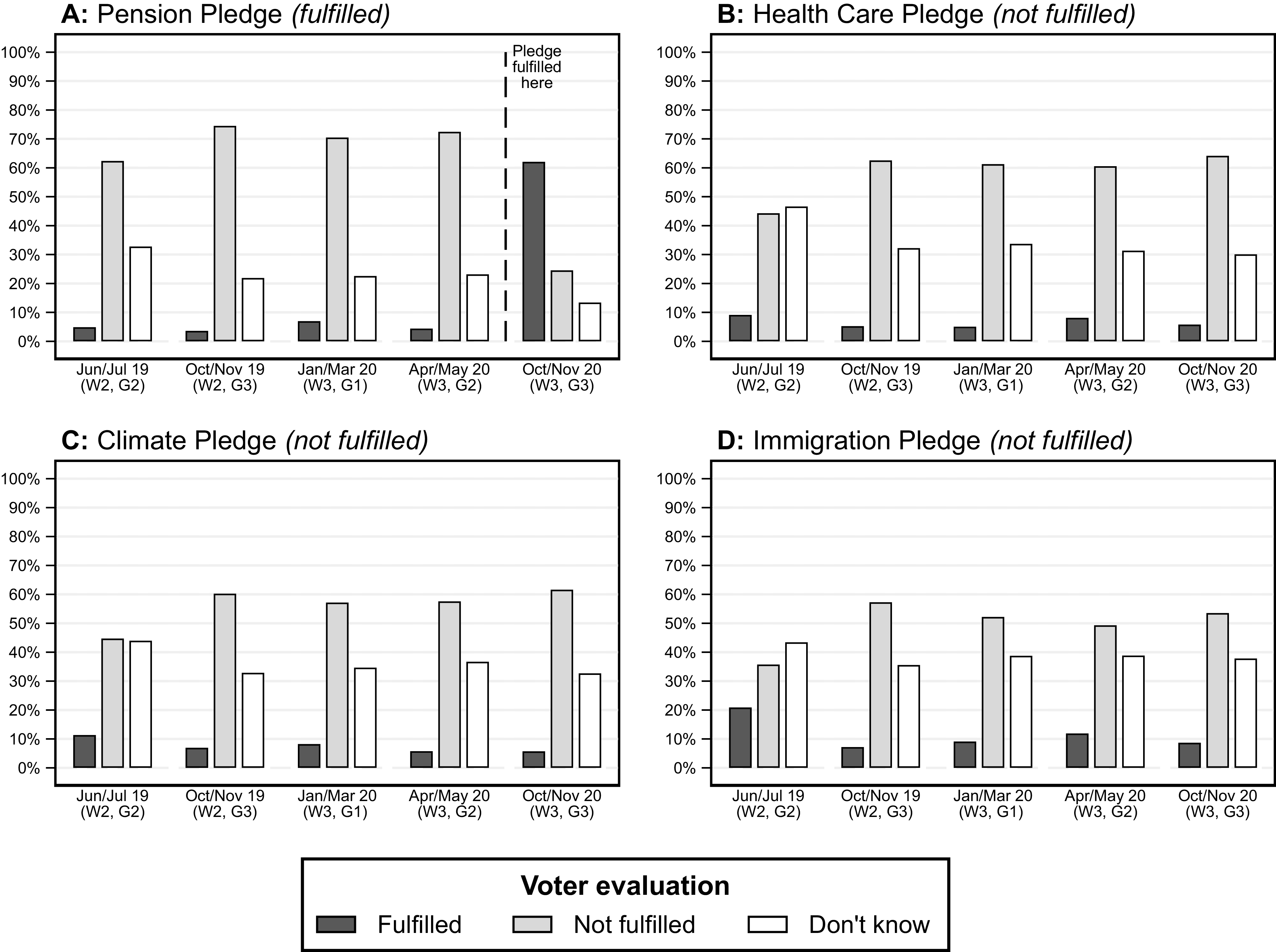
The analysis begins by examining the panel study data at the aggregate level. Do differences in pre-election pledge awareness matter for the electorate’s knowledge of the fulfillment status of pledges after the election? Figure 4 suggests that the answer is yes. This figure shows how voters evaluated the fulfillment status of four pledges made by the Social Democrats in the period after the 2019 election. The top left panel shows voter evaluations of the fulfilled pledge (the pension pledge in Panel A), while the top right and bottom panels show this for the three pledges that were not fulfilled within the period of the panel study (the health care pledge in Panel B, the climate pledge in Panel C, and the immigration pledge in Panel D). The pension pledge was fulfilled between the last two periods in which the panel survey was conducted (between Group 2 and Group 3 in Wave 3).Footnote 4
The electorate’s recognition of the fulfillment status of the pension pledge vs. other pledges.
Notes: Evaluation of fulfillment across Wave 2 (W2) and Wave 3 (W3) as well as the subgroups within these waves (G1, G2, and G3). The pension pledge (Panel A) was fulfilled by the Social Democrats within the period during which the panel surveys were conducted (specifically between the periods in which G2 and G3 in W3 were interviewed), while the health care pledge (Panel B), the climate pledge (Panel C), and the immigration pledge (Panel D) were not. The figure does not include Group 1 in Wave 2, as this group of respondents was surveyed shortly after the election was held.

Figure 4. Long description
The image contains four bar graphs labeled A, B, C, and D, each representing voter evaluations of different pledges over time. Graph A, titled ‘Pension Pledge (fulfilled),’ shows the percentage of voters who believe the pension pledge was fulfilled, not fulfilled, or are unsure across different time periods from June/July 2019 to October/November 2020. Graph B, titled ‘Health Care Pledge (not fulfilled),’ displays similar data for the health care pledge. Graph C, titled ‘Climate Pledge (not fulfilled),’ and Graph D, titled ‘Immigration Pledge (not fulfilled),’ follow the same format for their respective pledges. Each graph uses three different shades to represent ‘Fulfilled,’ ‘Not fulfilled,’ and ‘Don’t know.’ The x-axis of each graph indicates different time periods, while the y-axis shows the percentage of voter evaluations ranging from 0 percent to 100 percent. The graphs collectively illustrate how voter perceptions of pledge fulfillment change over time.
The figure reveals two interesting results. First, voters are more likely to know and be willing to make a guess on the fulfillment status of unfulfilled pledges if the pledge was known during the election campaign. For instance, on average, 69.9 per cent of the respondents in Wave 2 (Group 2 and Group 3) and Wave 3 (Group 1 and Group 2) correctly evaluated the high-profile pension pledge as unfulfilled (excluding Group 3 in Wave 3, since the pledge had been fulfilled by that time), while the average share of voters who correctly evaluated the other pledges as unfulfilled was only 58.6 per cent (health care pledge), 56.3 per cent (climate pledge), and 49.6 per cent (immigration pledge). Note that the level of pledge awareness after the election follows the same pattern as the awareness of pledges before the election. A similar pattern emerges again in the average share of ‘Don’t know’ responses: 25.1 per cent for the pension pledge, 34.8 per cent for the health care pledge, 36.2 per cent for the climate pledge, and 38.9 per cent for the immigration pledge. The lower the share of people who recognized a pledge before the election, the higher the share of ‘Don’t know’ answers on fulfillment status after the election. Second, the figure shows how the electorate clearly recognized the fulfillment of the pension pledge (and as noted above, this pledge was widely known before the election). A total of 62.1 per cent of respondents evaluated the pension pledge as fulfilled in the last survey round (W3/G3), while only between 3.6–6.9 per cent thought that the pledge had been fulfilled when it was not (W2/G2, W2/G3, W3/G1, W3/G2). Thus, the electorate updated their evaluation of the fulfillment of the pension pledge as expected by the pledge-based understanding of mandate theory. These results indicate that pre-election pledge awareness matters substantially for post-election pledge awareness.
In the second part of the analysis, we use the panel setup of the research design to see whether this aggregate pattern holds at the individual level as well. Specifically, we examine whether voters who knew that the Social Democrats had made the pension pledge before the election were also more likely to evaluate the pension pledge correctly in Wave 2 (when it had not yet been fulfilled) and in Wave 3 (when it had been fulfilled). In this way, we exploit the panel setup by examining the effect of pre-election pledge awareness in Wave 1 on voters’ ability to update the fulfillment status of the pledge correctly from Wave 2 to Wave 3.
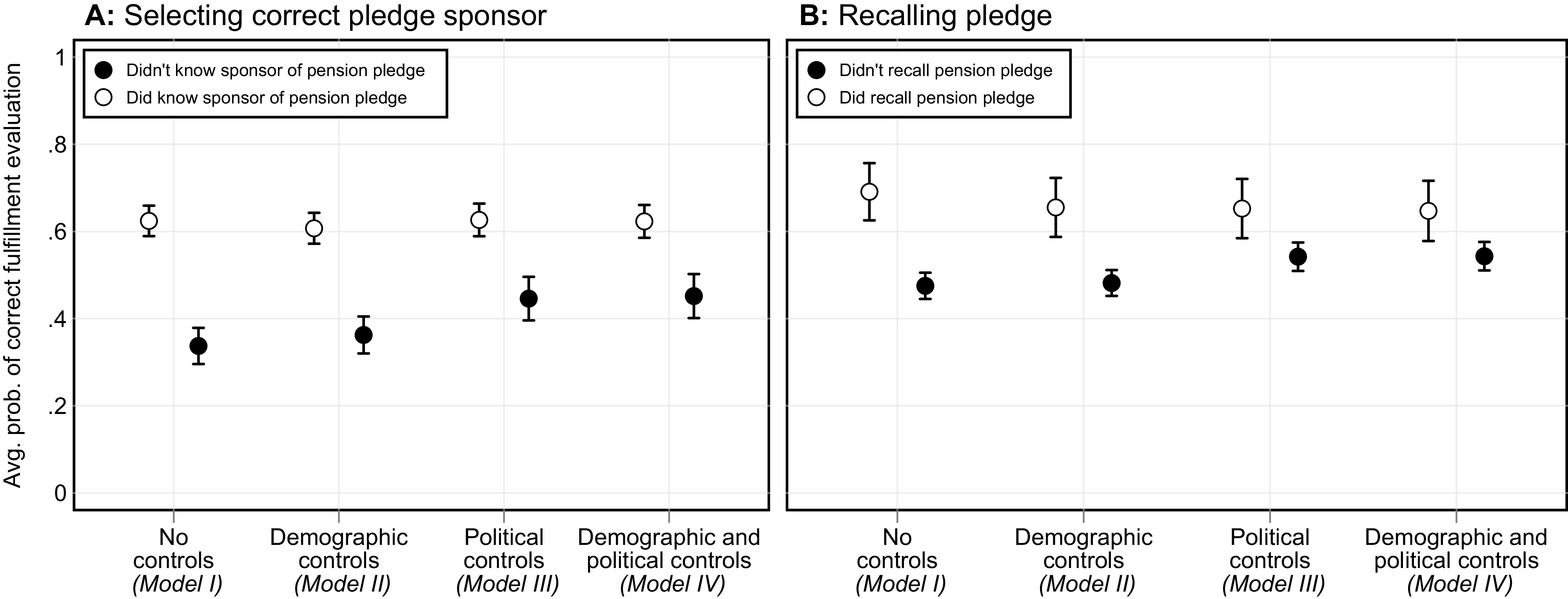
Figure 5 reveals that voters’ ability to correctly update the fulfillment status of the pension pledge in the post-election period depends on whether they knew before the election that the Social Democrats had made the pledge. This effect is present regardless of whether pre-election pledge awareness is measured as a selection-based (Panel A) or a self-reported pledge recall measure (Panel B). Looking at Panel A (Model IV) in the figure, the results show that among those who were not aware of the pledge, only 45.2 per cent were able to correctly evaluate it as fulfilled, while the share is much higher among those who knew that the Social Democrats had made this pledge, with 62.3 per cent of this group making a correct evaluation. Given that this effect size is present in the model that includes the most extensive set of control variables, the difference can be considered substantial and may have contributed to the Social Democrats’ increase in vote share and their return to office in the subsequent 2022 election. As this pledge was highly salient in the 2019 election, many voters might have rewarded the party for fulfilling this pledge at the next election. In this light, it is a substantial finding that 17.1 percentage points more voters got to know the fulfillment of this pension pledge if they knew about it before the election.
Average probability of correctly updating the fulfillment status of the pension pledge (unfulfilled in Wave 2, fulfilled in Wave 3).
Notes: N = 1,241 (Model I and Model II), 1,032 (Model III and Model IV). Respondents are from the panel survey (Group 3). 95% confidence intervals (the two coefficients in all eight models are statistically significantly different from each other, p < 0.01). The figure is based on OLS regression models with standard errors clustered at the individual level. The dependent variable is dichotomous, with the successful outcome being correctly updating the fulfillment status of the pension pledge (Wave 2 = not fulfilled, Wave 3 = fulfilled). Model I includes no control variables, Model II includes five demographic control variables (gender, age, education, children under 18, and region), Model III includes ten political control variables (political trust, ideology, Social Democrats voting, sympathy toward the Social Democrats, pledge saliency, issue saliency, pledge agreement, political efficacy, political interest, and news interest), and Model IV includes all fourteen control variables (demographic and political). Regression tables of Model IV are shown in the Appendix.

Figure 5. Long description
The image contains two side-by-side graphs labeled A and B. Graph A, titled ‘Selecting correct pledge sponsor,’ shows the average probability of correct fulfillment evaluation. It compares two groups: those who did not know the sponsor of the pension pledge and those who did. The data is presented across four models: No controls, Demographic controls, Political controls, and Demographic and political controls. Graph B, titled ‘Recalling pledge,’ shows the average probability of correctly updating the fulfillment status. It compares two groups: those who did not recall the pension pledge and those who did. Similar to Graph A, the data is presented across the same four models. Both graphs use error bars to indicate variability. The circles represent different groups, and the vertical axis measures the average probability of correct fulfillment evaluation.
In the Appendix, we show that when examining all four pledges, including the three that were unfulfilled (the health care pledge, the climate pledge, and the immigration pledge) as well as the pension pledge before it was fulfilled, voters who could correctly identify the sponsor of the pledge were more likely to be correct in their evaluation. This suggests that pre-election pledge awareness not only helps voters to notice when pledge fulfillment happens but also to correctly monitor a pledge’s lack of fulfillment. Even more telling, these voters are also less likely to answer ‘Don’t know’, which suggests that they feel more confident in their evaluation, perhaps because they were both able and motivated to monitor the pledge more carefully. In general, these analyses have shown that voters who have pledge-specific information before the election are better at keeping track of the pledge’s fulfillment in the period after the election (before and after fulfillment has happened), and that they are generally more willing to venture a guess on fulfillment status.
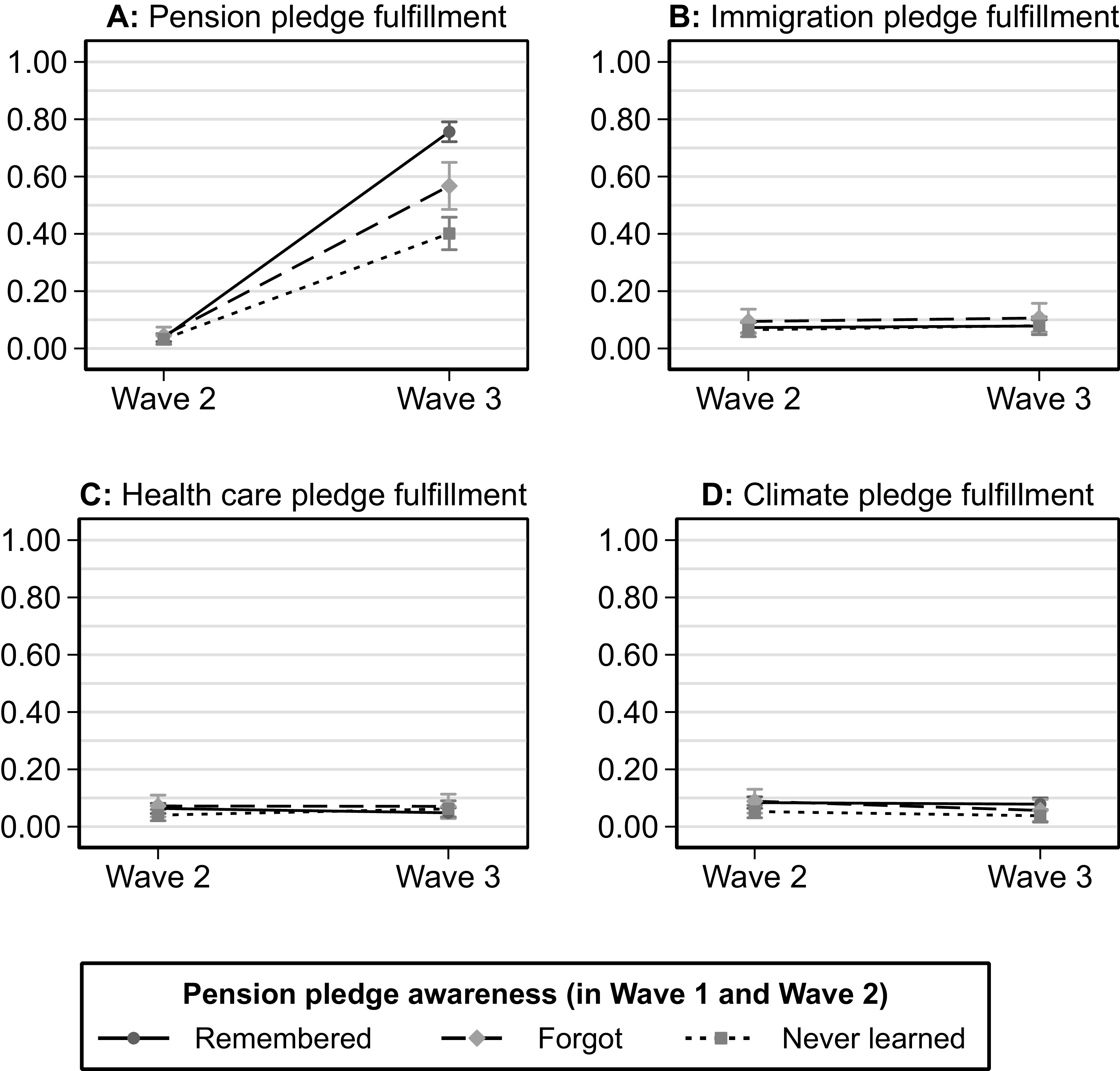
In the next part of the analysis, we exploit the panel data setup further and perform placebo tests to strengthen the causal inference of our claim. First, we use an analytical setup that resembles a difference-in-difference design by examining whether respondents remember the pledge from Wave 1 to Wave 2. Specifically, we distinguish between respondents who remember (ie correctly assign the Social Democrats as the sponsor of the pension pledge in Wave 1 and Wave 2), who forget (ie correctly assign the Social Democrats as the sponsor of the pension pledge in Wave 1 but not in Wave 2), and who never demonstrate awareness of the pension pledge’s sponsorship (ie do not assign the Social Democrats as the sponsor of the pension pledge in either Wave 1 or in Wave 2). The distribution of these categories shows that around 52.3 per cent remembered, 13.1 per cent forgot, and 34.7 per cent never learned. Second, we compare respondents’ updating of the fulfillment status from Wave 2 to Wave 3 across all four pledges to examine whether respondents mainly change evaluation responses on the pension pledge (where updating is correct), or whether respondents also update the status of the other pledges (which would be incorrect). If respondents update across all four pledges, or if updating shows similar patterns across groups with different types of pre-election pledge awareness, it suggests that it is not the pledge-specific knowledge of the pension pledge per se that mattered for the correct updating of its fulfillment status, but some confounding factor.
Panel A in Figure 6 shows that all groups of respondents, on average, update the fulfillment status of the pension pledge, including those who never learned about the pledge. Yet what is more interesting is that those who knew the pledge sponsor before the election and remembered it after the election performed considerably better than those who never learned about the pledge. The difference is 0.35, which is undeniably large on a scale ranging from 0 to 1. Those who learned the pledge before the election but subsequently forgot it also perform better than those who never learned the pledge, but worse than those who consistently remembered the pledge across Wave 1 and Wave 2. As we argued in the theoretical section of the paper, this reflects how pre-election awareness helps voters in accountability processes. Even if voters forget, this latent knowledge is reactivated when parties fulfill a pledge (the media might play a key role, as we discuss in the concluding part of the paper).
Average probability of answering ‘fulfilled’ for each of the four pledges in Wave 2 and Wave 3, for different degrees of pre-election pension pledge awareness.
Notes: N = 1,945 (Panel A), 1,933 (Panel B), 1,966 (Panel C), 1,957 (Panel D). Respondents are from the panel survey (Group 3). 95% confidence intervals. The figure is based on an OLS regression model with standard errors clustered at the individual level. The regression table is shown in the Appendix.

Figure 6. Long description
The image contains four line graphs labeled A, B, C, and D, each representing the average probability of answering fulfilled for different pledges in Wave 2 and Wave 3. Graph A shows pension pledge fulfillment, Graph B shows immigration pledge fulfillment, Graph C shows health care pledge fulfillment, and Graph D shows climate pledge fulfillment. Each graph has three lines representing different degrees of pre-election pension pledge awareness: remembered, forgot, and never learned. The x-axis represents Wave 2 and Wave 3, while the y-axis represents the probability of answering fulfilled, ranging from 0.00 to 1.00. In Graph A, the probability increases significantly from Wave 2 to Wave 3 for all three awareness levels, with the remembered line showing the highest increase. In Graph B, the probability remains relatively low and stable across both waves. In Graphs C and D, the probability remains very low and stable across both waves. All values are approximated.
The placebo tests in Panel B, Panel C, and Panel D of Figure 6 show that respondents with different degrees of awareness of the pension pledge do not differ in the way they evaluate the fulfillment of the other three pledges across Wave 2 and Wave 3. As argued above, this suggests that there are no particular characteristics of respondents with or without pension pledge knowledge that make them update differently on the pension pledge, but rather that it is the pledge-specific knowledge before the election that becomes important after the election when this pledge is fulfilled. In the Appendix, we add the demographic and political control variables and find that the substantial results remain.
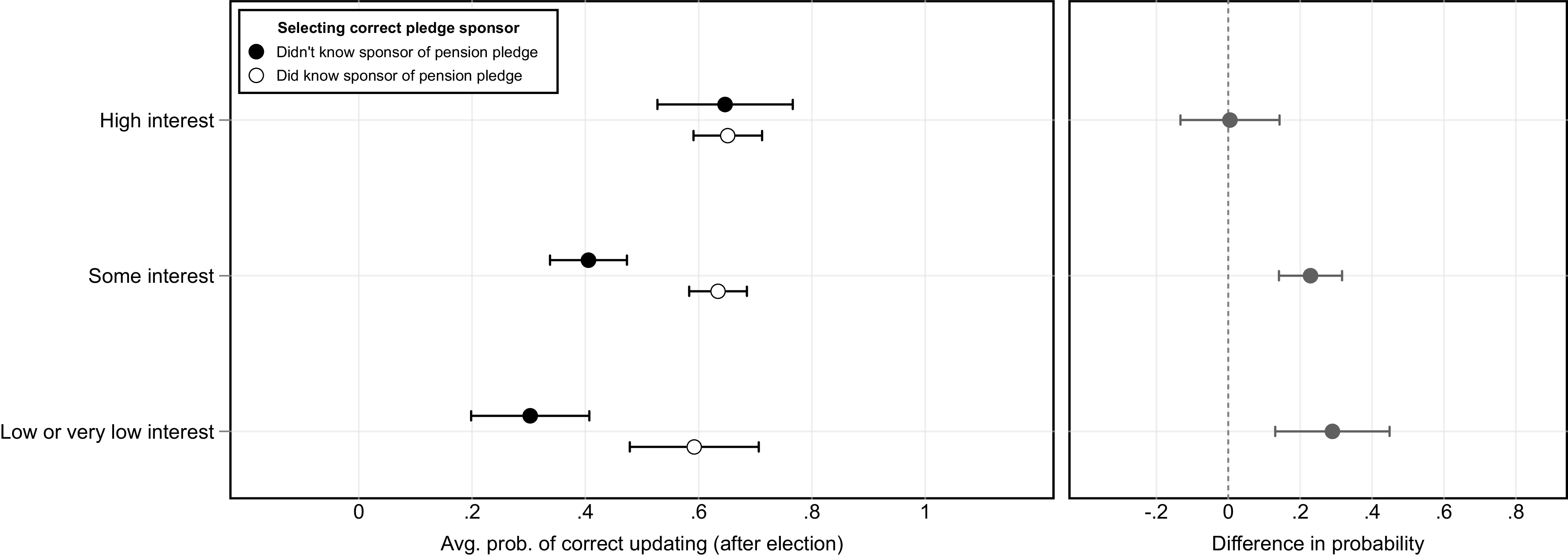
To what extent are these findings merely a reflection of different levels of political interest among voters? Instead of using political interest as a control variable (as in Models III and IV in Figure 5 above), we ran a regression model with political interest as an interaction variable (ie whether the effect of pre-election pledge awareness on post-election fulfillment awareness is moderated by political interest). Figure 7 presents the results of this interaction analysis. The results reveal that the value of knowing the sponsor of the pension pledge increases when shifting from voters with high political interest to lower levels of interest. Among voters with very low, low, or some interest, the average probability of correctly evaluating the pledge as fulfilled is significantly higher for those who knew that the Social Democrats were the sponsor of the pledge before the election compared to those who did not know (see the right panel of Figure 7). Among voters with high interest, there is no significant difference between those with and without this sponsor knowledge. Interestingly, the left panel of Figure 7 reveals that having this pledge-specific information about the sponsor can make up for lower levels of political interest when it comes to awareness of the correct fulfillment status of the pledge. As such, the average probability of correctly evaluating the pledge as fulfilled for voters who knew that the Social Democrats had made the pledge but are less interested in politics (some, low, or very low interest) is not significantly different from that of voters with high interest.
The equalizing effect of knowing the sponsor of a pledge on the ability to correctly evaluate a pledge as fulfilled (for low-interest voters compared to high-interest).
Notes: N = 1,032 (respondents in Group 3). 95% confidence intervals. The figure is based on an OLS regression model with standard errors clustered at the individual level with the same control variables as in Figure 5, Model IV (see figure notes). The dependent variable is dichotomous, with the successful outcome being correctly updating the fulfillment status of the pension pledge (Wave 2 = not fulfilled, Wave 3 = fulfilled). The regression table is shown in the Appendix.

Figure 7. Long description
The image contains two graphs. The left graph shows the average probability of correct updating after an election, categorized by interest level (high, some, low or very low) and knowledge of the pension pledge sponsor (didn’t know and did know). The right graph shows the difference in probability between those who knew the sponsor and those who did not. In the left graph, high-interest individuals have the highest probability of correct updating, followed by those with some interest, and then low or very low interest. The right graph indicates that knowing the sponsor generally increases the probability of correct updating, with the most significant difference observed in the high-interest group. All values are approximated.
Pre-election and post-election study analysis: aggregate findings
In the final analysis, we test the relationship between pre-election pledge awareness and post-election fulfillment awareness using the two pooled cross-sectional studies. This enables us to look at fulfillment evaluations close to the next election and, more importantly, to test the relationship across all pledges by the Social Democrats using aggregate measures. Specifically, we calculate the share of correct sponsor assignments before the election and the share of correct fulfillment evaluations after the election.
Looking first at the four pledges used for the panel survey, we see interesting variation on their final fulfillment status and on pre-election pledge awareness (the climate pledge and the health care pledge were not fulfilled, while the immigration pledge and the pension pledge were fulfilled; and the health care and the pension pledges were more well-known before the election than the climate and immigration pledges). Looking at these specific pledges, the electorate’s correctness in evaluating fulfillment status generally aligns well with our theoretical argument: Pledges with high pre-election pledge awareness result in more correct fulfillment evaluations after the election. The net difference in the share of respondents who correctly identified the health care and climate pledges as not fulfilled is 9.1 percentage points (with more respondents answering correctly for the health care pledge). The net difference in the share of respondents who correctly identified the pension and immigration pledges as fulfilled is 17.1 percentage points (with more respondents correct for the pension pledge).
The analysis now moves from these four pledges to all 109 pledges made by the Social Democrats in the 2019 election (three pledges were excluded as their fulfillment status was not possible to determine; see Appendix). The share of respondents with knowledge about the sponsor of a given pledge before the election is positively associated with the share of respondents who correctly identified the fulfillment status of this pledge at the end of the next election period. The beta coefficient is 0.33 and statistically significant (p < 0.05).Footnote 5 Substantially, this coefficient means that the share of respondents with correct fulfillment evaluations increases by 33 percentage points when moving from a situation where no respondents know a pledge before the election to one in which all respondents know about it (the increase is 4.0 percentage points when only looking at a standard deviation change in the independent variable). In combination with the panel analyses above, this positive relationship suggests that pre-election pledge awareness is an important factor for accountability processes across the full universe of government-sponsored pledges.
Discussion
In this paper, we have shown how awareness develops throughout the life cycle of a pledge, which is one central way of understanding the representation chain as laid out in mandate theory (Klingemann, Hofferbert, and Budge Reference Klingemann, Hofferbert and Budge1994; McDonald and Budge Reference McDonald and Budge2005). At the beginning of this life cycle, our results reveal that some (few) pledges reach the public during the election campaign, while (most) others remain relatively unknown. This low degree of pre-election pledge awareness is found even though we focused on the two main contenders for office and their most salient pledges. Later on in a pledge’s life, the results presented here suggest that the electorate is more likely to notice a pledge’s fulfillment after the election if they were aware of it during the campaign. Given that we know how cynical voters are in their perceptions of politics, especially of parties’ ability to fulfill pledges (Naurin Reference Naurin2011c), this is a non-trivial finding – and positive from the perspective of policy-based representation.
Our results also revealed that voters with low political interest, in particular, benefit from awareness of a pledge before the election. This voter segment is more likely to pay attention to political information during campaigns compared to outside of them – and even then, only to highly politicized issues such as the flagship election pledges of the Social Democrats. Yet when this group does become aware of a pledge, they use this pre-election awareness to keep track of it after the election. In contrast, voters with high political interest do not experience a net effect of pre-election awareness – presumably because they follow the news more extensively. This finding complements previous studies on post-election pledge awareness, which have shown political interest to be important for correctly evaluating the fulfillment status of pledges (eg Naurin and Oscarsson Reference Naurin and Oscarsson2017; Thomson Reference Thomson2011; Thomson and Brandenburg Reference Thomson and Brandenburg2019).
Given the large scope of our research design, encompassing multiple studies, several subgroups, and various rounds of re-interviewing, the case was restricted to one country and one election period (Denmark from 2019–2022). Naturally, the next question is whether our findings can generalize to other contexts. Since we were interested in awareness of the fulfillment of pledges made by the government party, our analysis focused on the Social Democrats. In that sense, our study centered on a rather typical case found across Western democracies: a relatively large, mainstream party that has experienced a changing voter base, increasing competition from far-right parties, and new issues on the agenda (De Vries and Hobolt Reference De Vries and Hobolt2020; Gingrich and Häusermann Reference Gingrich and Häusermann2015; Green-Pedersen Reference Green-Pedersen2007). Compared to the other main contender for office (the Liberal Party), the analysis did not reveal any idiosyncratic patterns of pre-election pledge awareness of the Social Democrats’ pledges. If anything, we believe our case is a hard one for finding our dynamics. First, the high number of parties competing in the election should make it relatively complicated for voters to learn about and use pledges in their political reasoning. Second, the official election campaign was relatively short (four weeks), so voters did not have a long time to learn parties’ pledges compared to other countries with longer campaign periods (eg France or the United States). Third, the default of most voters is to expect pledge breaking (Naurin Reference Naurin2011c), which should make it difficult to find correct updating in our case, where most pledges were fulfilled (72%) – which is more than the average fulfillment rate found in other Western democracies (Thomson, Royed, Naurin et al. Reference Thomson, Royed, Naurin, Artés, Costello, Ennser-Jedenastik and Praprotnik2017). As the media also tend to cover many more broken than fulfilled pledges (Müller Reference Müller2020), voters should generally find it difficult to correctly update fulfillment statuses. Thus, the link between pre-election pledge awareness and post-election fulfillment awareness should be even stronger in other contexts where there are fewer parties and where the media coverage is more aligned with voters’ expectations of pledge breaking. Despite these considerations, we encourage future research to study pre-election pledge awareness and its effect on post-election fulfillment awareness across other institutional contexts (eg in plurality systems or in proportional systems with coalition governments).
Obviously, the media plays a key role in our logic to work (the influence of the media in modern politics is undeniable, as also argued by Norris Reference Norris2000; Strömbäck Reference Strömbäck2008). Yet since the coverage of election pledges is reduced significantly between election campaigns (Müller Reference Müller2020), when pledges are being pursued by the parties and eventually kept or broken, it is an important finding that information acquired during the campaign can help voters outside the campaign. The implication of this insight is that journalists and editors should help voters become aware of election pledges, not only when they are being fulfilled or broken but also when they are announced and discussed during the campaign (the media generally report few of the promises that parties make and mostly from the main contenders, see Kostadinova Reference Kostadinova2017). Studying more closely how and to what extent the media report about specific pledges is important to better understand the interaction between voter knowledge and media influence (eg the media might so extensively cover the breaking or the fulfillment of a pledge that pre-election pledge awareness becomes irrelevant). Furthermore, we also need knowledge about the extent to which the media makes connections between new legislation and pledges made before the last election. Making this connection might be particularly important for those who forget particular promises after a campaign has ended. As we showed in the analysis, those voters were more likely to notice pledge fulfillment than voters who never learned about the pledge. That is, voters who were aware of a pledge before the election but were unable to retrieve this knowledge after the election might be helped by the media to ‘rediscover’ this previously stored information.
From a democratic representation perspective, our findings contribute to previous research by empirically linking the delegation and accountability phases (Mansbridge Reference Mansbridge2003; Strøm, Müller, and Bergman Reference Strøm, Müller and Bergman2003). As such, when voters invest time and energy in learning political parties’ pledges before they delegate power on election day, they can profit from this investment after the election by holding their representatives accountable. Using the language of principal-agent theory, this informational investment helps voters to limit the problem of adverse selection and the problem of moral hazard (Lupia Reference Lupia, Strom, Müller and Bergmann2003; Vestergaard Reference Vestergaard2026). Yet our results also revealed that some voters never learned about the Social Democrats’ pension pledge, either before or after the election (even if this was perhaps the most important pledge in the 2019 election, as our findings as well as the Danish national election study suggest, see Hansen and Stubager Reference Hansen and Stubager2021). While these voters might have cared about other issues and focused on different election pledges, this could also imply that other styles of representation suit these voters better (eg the trustee representative, which is often characterized as the complete opposite of the delegate representative, see Rehfeld Reference Rehfeld2009). These voters might also sanction and reward parties on, for instance, more vague notions of mandate accomplishments (Naurin Reference Naurin and Naurin2011a) or performance measures other than pledge fulfillment (eg the current state of the economy, see Alesina, Londregan, and Rosenthal Reference Alesina, Londregan and Rosenthal1993; Fair Reference Fair1978; Kramer Reference Kramer1971).
Our findings also contribute to scholarly discussions about voters’ competency as democratic citizens. Having so-called general, static knowledge about political institutions and politicians might be beneficial for engaging in politics (Delli Carpini and Keeter Reference Delli Carpini and Keeter1996), but it is not required in order for voters to hold parties accountable. Instead, pre-election information about a pledge, which would constitute surveillance-policy facts (Barabas, Jerit, Pollock et al. Reference Barabas, Jerit, Pollock and Rainey2014), can be sufficient for voters to perform an important part of their duty as democratic citizens, at least from the promissory representation perspective (Mansbridge Reference Mansbridge2003). This aligns with previous arguments in the literature that put emphasis on the relevance of voters knowing recent, rather than older, facts (Graber and Holyk Reference Graber, Holyk, Semetko and Scammell2012; Schudson Reference Schudson1998). Here at least, our results have shown that having pledge-specific information tends to equalize the advantages that highly politically interested voters normally have in the accountability phase of party representation, as those with low interest can use it to keep up with the progress of a pledge’s fulfillment after the election.
Supplementary material
The supplementary material for this article can be found at https://doi.org/10.1017/S147567652610142X
Data availability statement
Data replication sets may be available upon request.
Acknowledgements
The authors would like to thank the editor as well as the five reviewers for critically engaging with this paper. The authors are also grateful for all the useful feedback they got at the Workshop of the Comparative Party Pledge Group in Graz (2024). Finally, they would also like to thank Jannik Fenger and Matias Engdal Christensen for helpful suggestions and advice on the paper.
Funding statement
ERC consolidator grant no. 817855 and Independent Research Fund Denmark (grant number 8019-00025B).
Competing interests
The authors declare no conflict of interest.
Ethical statement
This study raises no ethical concerns with experimental interventions, deception, or unequal treatment of subjects. It complies with national regulations and professional guidelines for studying human subjects and follows data protection regulations. Participants provided informed consent.


 Open access

