


Introduction
Alberto López is a PhD candidate at the Political Science Department of University of Zurich, working in the SNF research project “The Effect of Campaign Events on Electoral Outcomes; Evidence from Prediction Markets”. His main area of research pertains to understanding the effect of campaign communications and candidates’ traits on citizens’ political behaviour.
In 2016, Alexander Nix, chief executive officer of Cambridge Analytica—a political consultancy firm that illegally harvested up to 87 million Facebook profiles—gave a presentation entitled “The Power of Big Data and Psychographics in the Electoral Process”. In his presentation, he explained how his firm allegedly turned Ted Cruz from being one of the less popular candidates in the Republican primaries to being the best competitor of Donald Trump. According to Nix’s words, they collected individuals’ personal data from a range of different sources, like land registries or online shopping data, that allowed them to develop a psychographic profile of each citizen in the US. Allegedly, this knowledge of individuals allowed Cambridge Analytica to send campaign messages to American voters matching their personalities through social media. In the attempt to illustrate their work, Nix showed the audience an interactive map of Iowa where he could select and deselect all citizens according to their partisanship, age, gender, interests, personality and even their address and social media profiles.
Independently of the exact rigor of Cambridge Analytica’s method, what seems clear is that a new 'science' of campaigning has risen with interesting consequences in widely differing areas such as law, technology, marketing and politics. Driven by big data and computational analytics (Nickerson and Rogers Reference Nickerson and Rogers2014; Tufekci 2014), marketers in general, but parties and candidates specifically, have developed improved means to devise their campaign strategies and, arguably, shape voters’ behaviour. From a purely political strategy perspective, the assumption is that parties and candidates can now apply a new technique termed online political microtargeting (OPM) (Borgesius et al. Reference Borgesius, Zuiderveen, Kruikemeier, Fathaigh, Irion, Dobber and Bodo2018). This strategy implies that campaigners have developed a fine-grained knowledge of voters’ online behaviour and interests that allow them to send individually tailored messages. From this standpoint, the ideal scenario is one where campaigners are able to identify—and send—the type of message that would make each voter more attracted to the idea of voting for their candidate or party (or even more importantly, not voting for her opponent). However, the way towards this ideal scenario seems trickier than political consultancy firms like Cambridge Analytica tend to suggest and this is because parties face informational limitations when they implement online political microtargeting (OPM) techniques. These limitations refer to the inevitable fact that it is not always easy and legal to find politically relevant information (such as ideology, turnout intentions or policy positions) in people’s Internet history or offline sources. This typically drives campaigners to conduct two types of action. First, they can run complex inference models that imperfectly predict individuals’ political leanings. Second, they can rely on third-party tools that microtarget the ads for them. One of the most prominent examples of the latter is the Facebook Ads system that allow advertisers—of all types—to segment their messages to Facebook users based on a set of characteristics collected by the social media platform. There is ever-growing evidence showing that parties in both in the US and the UK have started implementing this technique in their campaigns (e.g. Anstead, Reference Anstead2017; Barnard and Kreiss, Reference Barnard and Kreiss2013). However, there is little empirical evidence on how differently campaigners behave when they use OPM as compared to when they run classic campaigns, particularly in Europe.
Besides providing a definition of OPM and exploring the state-of-the-art in four European democracies, this paper develops two hypotheses on how campaigners could be using the OPM technique. First, I hypothesise that campaigners talk about more topics when they perform OPM than in the opposite case. I base this argument on the fact that OPM gives campaigners the opportunity to address more detailed topics when they send individualised messages as compared to broadcasted messages. Second, this paper argues that negative campaigning should be used to a greater degree when campaigners perform OPM. The reason for this is that some of the risks of negative campaigning can be reduced since campaigners can hide their attacks from their opponents or opponents’ supporters at least to a greater degree.
With the objective of testing these hypotheses, this paper relies on an original dataset based on a compilation of Facebook Ads obtained during first order campaigns in four European countries: the German 2017 Federal Elections, Austrian 2017 Legislative Elections, and Italian and Swedish 2018 General Elections. Since this ad library contains messages that are both microtargeted and non-microtargeted, I am able to test how differently campaigners behave in both cases. The analysis relies on text-as-data techniques such as supervised and non-supervised methods. The results show that the penetration of microtargeting is only extensive during the last campaign election, in Sweden. From the analytical perspective, the results confirm that microtargeted ads are thematically more diverse that non-microtargeted ads, but there does not seem to be a significant difference in terms of negativity. I discuss the implications of these results in the context of my data and how future research can expand our knowledge.
Online political microtargeting: a new technique of campaigning
Defining online political microtargeting
Probably because it is a pretty recent phenomenon, there still lacks a clear definition of what (online) political microtargeting means. Some have used the concept without defining it (Hersh and Schaffner Reference Hersh and Schaffner2013; Murray and Scime Reference Murray and Scime2010; Schipper and Woo 2017), while others have provided somewhat vague definitions such as a new way to “reach out to voters with the most appropriate messages” (Barocas, 2012. p. 31). Similarly, Sides et al., (Reference Sides, Shaw, Grossmann and Lipsitz2013) claim that political microtargeting enables campaigns to identify, with great precision, receptive audiences and to appeal to them using targeted appeals. According to Gorton (Reference Gorton2016, p. 62), political microtargeting involves “creating finely honed messages targeted at narrow categories of voters based on data analysis ‘garnered from individuals’ demographic characteristics and consumer and lifestyle” (also supported by Borgesius et al., Reference Borgesius, Zuiderveen, Kruikemeier, Fathaigh, Irion, Dobber and Bodo2018). More thoroughly, some authors claim that microtargeting necessarily relies on predictive models of behaviour (Nickerson and Rogers Reference Nickerson and Rogers2014; Rubinstein 2014) based on perceived partisanship and perceived issue positioning (Endres Reference Endres2016; Endres and Kelly Reference Endres and Kelly2018; Hillygus and Shields Reference Hillygus and Shields2014). Although it has received various names such as “online profiling”, “behavioural targeting” or “online behaviour advertising”, consumer research defines this data-driven online communication as “the practice of monitoring people’s online behaviour and using the collected information to show people individually targeted advertisements” (Boerman et al. Reference Boerman, Kruikemeier, Zuiderveen and Borgesius2017). Building on this, I argue that OPM is the technique of segmenting online communications based on individual data with the intention of obtaining a political outcome.Footnote 1
The data that is used for OPM could consist of search histories, public records, online purchases, information posted on social media or any other individually based data available. Likewise, these communications need to be through the Internet to be differentiated from offline practices such as microtargeted door-to-door canvassing.Footnote 2 But both offline and online microtargeting are different from classical targeting (generally based on geography and media consumption patterns) in the sense that under classical targeting campaigners need to approach a predefined group with heterogenous subjects. This means that classical targeting strategies can hardly allow campaigners to choose which citizens they want to approach. Instead, they can only adapt their message, for example, to the average viewer of a TV program or the attributes of the majority to a crowd in a town. Microtargeting is slightly different in the sense that it gives campaigners the chance to actually customise and shape the audience towards the campaigners they want to direct their messages to. For instance, while classical targeting gives parties the chance to advertise their pension policies in districts with a dominant majority of elderly voters, OPM would allow campaigners to advertise pension policies to all people of more than 65 in any district which is not a predefined audience group.Footnote 3 Finally, this definition focuses on online microtargeted communications that intend to reach a political outcome.Footnote 4
In practice, OPM consists of two parts that are typically temporally separated: the data-collection process and publicationCampaigners, first aggregate all the individual data they have from voters and then, after designing the campaign strategy, campaigners actually propagate their messages. Alternatively, when they use third-party systems (such as the one of Facebook Ads) to microtarget their campaign ideas they are also relying on a data collection and segmentation that another entity has previously made for them. Therefore, although the first steps might rely on aggregate-level data that is publicly available via authorised means, in the last stage of OPM, campaigners will always approach voters individually. This is important for two reasons. First, generally the data is not directly required for the microtargeted citizens or at least not explicitly asked for by the means of OPM before sending each advertisement. Second, regardless of the legal provisions, the chance of specifying that the communication is based on their private data remains somewhat hidden or infra-primed and so the recipient of the ad does not notice the specificities and the extent of OPM.
What we know about online political microtargeting in Europe?
Most models distinguish three eras of political campaigning (Norris Reference Norris2000; Plasser and Plasser Reference Plasser and Plasser2002; Strömbäck and Kiousis 2014). First, in pre-modern campaigns, candidates met voters in local whistle-stops and announced their political proposals in the partisan press, on local posters and radio broadcasts tailoring their political messages to the town’s needs. Then, modern campaigns brought mass communication, and so, the battle to dominate the nightly television news transformed into reality. Parties broadcasted their campaigns through generic newspapers advertisements and through rallies covered on national TV, leaving little room for tailored messages. A third era of campaigning is identified when parties start to combine campaigns at a mass level with a sort of geographical targeting that allow them to strategically allocate their campaign efforts (Issenberg Reference Issenberg2012). To do so, campaigners started using public opinion surveys and the expertise of consultants. Already by 2004, “candidates and national parties spent unprecedented amounts” on ground-war activities (Hillygus and Monson 2009, p.1).
A watershed takes place in post-modern campaigning thanks to technological advancements that transformed target-group centred campaigns (targeting) into individual-centred campaigns, i.e. microtargeting.Footnote 5 Even if campaigners already purchased banner ads on websites like AOL.com in 2000 and engaged in search engine advertising in 2004, Obama’s 2008 campaign was the pioneer in taking advantage of the fact that almost half of the Americans used the Internet to gain political knowledge by using social networks such as Facebook, Twitter or YouTube as campaign sites (Cogburn and Espinoza-Vasquez Reference Cogburn and Espinoza-Vasquez2011). A change in US campaign regulation allowed parties to access national records of registered voters and merge it with citizens’ data gathered by private companies. This is why in the US 2012 Presidential campaign candidates not only sent electoral messages through the social media but also used OPM for the first time (Barnard and Kreiss, Reference Barnard and Kreiss2013).
However, we know little about the development of OPM in Europe. There is evidence that social media campaigning is becoming increasingly mainstream in the UK (Anstead Reference Anstead2017) and in most countries of Europe (Lilleker et al. Reference Lilleker, Koc-Michalska, Negrine, Gibson, Vedel and Strudel2017). In addition, there are recent studies based on interviews suggesting that European parties are drawing lessons from US experience and are making use of similar strategies (Bennett Reference Bennett2018; Kruschinski and Haller 2017; Magin et al. Reference Magin, Podschuweit, Haßler and Russmann2017). Nevertheless, the only studies that empirically analyse OPM are case studies in the US (Hersh Reference Hersh2015; Kim et al. 2018) and the UK (Anstead et al. 2018).
Not only are the empirics lacking but there are also arguments for skepticism about the actual spread of microtargeting in Europe. While the last consumption patterns typically leave a trace on the Internet that helps marketers to know what products to offer, the politically relevant information (i.e. ideology, turnout, past voting behaviour) that would help political campaigners to segment political messages is generally unavailable on people’s Internet history. This is why campaign managers are running increasingly sophisticated inference models based on information such as demographics, consumer behaviour and individualised public records, if available. Although evidence is rather scarce, the accuracy of these models seems low, so far (Endres Reference Endres2016). This could be partly explained by the fact that there is a mismatch between campaigners’ perceptions of voters and voters’ actual interests and traits (Hersh Reference Hersh2015).
Considering that mistargeting (or misinferring) the desired audience might lead campaigners to get penalised by the ‘mistargeted’ voters (Hersh and Schaffner Reference Hersh and Schaffner2013), there are reasons to suspect that the accuracy of OPM heavily depends on the available data, and so, the potential electoral effects. But what if even reaching the desired electorate with particularly tailored messages based on their personal and political interests and positions does not work in terms of boosting electoral results? Indeed, it could be that citizens react negatively to this type of online communication because they perceive it as “creepy” (Smit et al. Reference Smit, Van Noort and Voorveld2014; Ur et al. 2012). In this sense, citizens could also have differing perceptions of campaigners’ use of individualised campaigns and the fact of using them for maximising votes (Boerman et al. Reference Boerman, Kruikemeier, Zuiderveen and Borgesius2017) and, thereby, have heterogenous reactions to OPM. Additionally, the campaign information that voters receive via OPM could be perceived as incongruent when it turns out to be substantially different in any way to what politicians say in the more general mass campaign, even if they do not express inconsistent positions in these two levels of communications. All these arguments might constitute good reasons why candidates in continental Europe might be reluctant to use this campaigning technique. Even more, European legal and campaign budget constraints (namely as compared to the US privacy laxity and millionaire campaigns) could suggest that Europeans are reluctant to use OPM. To shed some light on this issue, this article will try to answer the overarching question: To what extent are political actors using OPM in Europe?
Expected effects of online political microtargeting on campaign messages
Although we have previously mentioned the fact that OPM entails some risks since campaigners cannot actually deliver their microtargeted ads as accurately as they wished, this does not mean that campaigners behave differently when they perform OPM as compared to classic older campaign techniques. Particularly, previous research suggests two types of features that might be linked to OPM: topic diversity and negative campaign.
Topic diversity
In order to understand the strategic potential of OPM and campaigns at the micro-level we first need to understand the implications of campaigning without this technique. In this sense, vote-maximising theories have classically assumed that campaigners cannot be to everyone’s taste. Regardless of whether parties should emphasise an important campaign issue or they should take a strategic issue position, sending univocal messages to an electorate with heterogenous interests comes with a price (Somer-Topcu Reference Somer-Topcu2015). This is because prioritising some issues or holding a certain position irremediably implies pleasing a subset of voters at the expense of alienating voters that likely hold a different set of priorities or a different position.Footnote 6
Proponents of OPM assume that campaigners have the capacity of accurately knowing voters’ priorities and positions and being able to control who is exposed to campaign messages. This is a game changer since it gives campaigners new means to reduce or eliminate the costs of exposing likely voters to opposing ideas or uninteresting issues. I argue, then, that this reduction in costs should lead campaigners not only to talk about topics that please the vast majority of the voters, but also to speak about a rather diverse set of topics that might be liked by smaller portions of the electorate. A recent study tried to contribute to this topic by comparing the type of ads that campaigners air both in the mass media and online, and yet, finding no significant differences (Franz et al. Reference Franz, Fowler, Ridout and Wang2020). Although online ads are more likely to be microtargeted than offline ads, I build on Franz and colleagues’ work by arguing that it is microtargeting and not online ads that should be more thematically diverse.
Hypothesis 1: the topic diversity increases when campaigners microtarget ads as compared to when they do not microtarget them.
Negativity in campaign
Political actors are not always campaigning positively. There is evidence that negative campaigning is being used in online campaigning (e.g. Momoc, 2011; Johnson & Perlmutter, Reference Johnson and Perlmutter2010). Also, research shows that negative campaigning is present in Western Europe although to a lesser extent than in the US (Hansen and Pedersen Reference Hansen and Pedersen2008; Walter Reference Walter2014). Nevertheless, research shows that negative campaigning is a risk sport since it can backfire on a campaigning party if the attacking strategy becomes known by the ‘victim’ or the media. In fact, attackers might end up being presented as weak and desperate because the party sponsored a negative advertisement (Hansen and Pedersen Reference Hansen and Pedersen2008). That is why negative campaigners sometimes choose to hide their identity behind a “stealth group” (Dowling and Wichowsky Reference Dowling and Wichowsky2015). Recent research extends this by showing that not only attacks can lead to poor results but also to negative sentiment (Utych Reference Utych2018). Utych shows that politicians’ use of a negative tone in their speech leads to harsher evaluations towards them. Following this rationale, it might make sense to use a negative affect when the message is microtargeted instead of it being aired to the wider public since the chances that competitors/media might notice and expose it are smaller. There is initial work that would support this idea. Based on a study comparing videos aired both on the Internet and TV during the 2004 and 2008 U.S. presidential campaigns, Roberts found more attacks on web-only ads (Roberts Reference Roberts2013). More specifically on ads, Anstead and colleagues (2018) descriptively show more mentions to opponent parties in Facebook Ads than in mass party publicity during the 2017 general election in the United Kingdom (Anstead et al. 2018). In this article, we extend this intuition by comparing microtargeted and non-microtargeted ads (instead of online/offline) and focusing on the positivity/negativity ratio of messages.
Hypothesis 2: the positivity/negativity ratio of messages increases in microtargeted Facebook Ads as compared to non-microtargeted ones.
Finally, we will test these hypotheses in four countries’ European domestic elections—Germany, Austria, Italy and Sweden.
Research design
Description of the dataset
This paper uses an original dataset based on a compilation of Facebook Ads obtained during first order campaigns in four European countries: the German 2017 Federal Elections, Austrian 2017 Legislative Elections, and Italian and Swedish 2018 General Elections. They have been collected by ProPublica—a US non-profit newsroom—in a consortium with media outlets in each of these countries. The result is ~ 1,000 ads per country and a total of unique political 4,091 ads.
It is important to note that all four countries are multiparty full democracies with competitive elections that generally produce coalition governments. Furthermore, all countries are part of the European Union and under a common strict regulation with regard to online advertisements in the framework of GDPR. The case selection strategy was to cover different key geographic areas of Europe. The four countries encompass three crucial regions of Europe: Italy (Southern Europe), Germany and Austria (Western-Central Europe) and Sweden (Northern Europe).
How is the data collected by ProPublica? Similar to Anstead et al (2018) or Kim et al (2018), media partners asked their readers to download a plug-in that would capture all the Facebook Ads they receive as well as the information reported from ‘Why am I seeing this ad?’.Footnote 7 This includes not only the text and images of each of these ads but also the targeting criteria,Footnote 8 the identity of the advertiser, the publication date and the number of impressions by the plug-in users. The advantage here is that—unlike in the other two studies mentioned above—the collection of political ads lasted at least 20 days before the elections and that it could be added through a plug-in not only in Chrome but also in Firefox. However, as previous studies using the same method have noted, the data presents a challenging feature which is the lack of representivity for all ads, all Facebook users, or all voters. Concretely, the readership of the media partners is very likely biased in terms of political sophistication from the profile of the general public. I argue that this would be a generalisability problem if the study would focus on comparisons between parties, countries, or types of voters/users. Importantly, this study focuses on the comparison between microtargeted and non-microtargeted ads that are sent via Facebook Ads. I argue that this comparison especially valid given than the two types of ads are subject to the ceteris paribus assumption (both are variables and subject to the same biases). As will be discussed in the conclusion, the generalisability will have to be tested in future studies that can rely on more representative data.
Methodological strategy
The dataset has been pre-processed by the data collectors. ProPublica used supervised machine learning to remove ads without political content. To that end, users that downloaded their plug-in had to respond to a survey in which they were asked about the political nature of Facebook Ads. Then, they trained the tagged ads using a Naïve Bayes classifier that automatically rates the untagged ads. The data only includes ads with a probability of being political > = 0.7. Once non-political ads are discarded, I also remove ads that happen after the elections since we are only interested in political ads that are placed during the election campaign. Also, for interpretability reasons I translated all documents to English by using DeepL API.Footnote 9 Next, for accuracy reasons I decided to remove punctuation, numbers and English stop words from the corpuses.
Operationalisation
In our empirical analysis we focus on one independent and two dependent variables. The independent variable is OPM. I measure OPM (this way) as those ads that feature at least one microtargeting criterion (such as age or region). Apart from this dummy classification the analyses are also done in a continuous manner considering different levels of OPM depending of the number of microtargeting criteria used by the campaigners.
The first dependent variable is topic diversity which is calculated based on Latent Dirichlet Allocation (LDA).(Cao et al. Reference Cao, Xia, Li, Zhang and Tang2009) After calculating the LDA model of each of the texts, I run four models that represent the four most common metrics for calculating the ideal number of topics that a text contains (Arun et al. 2010; Deveaud et al. Reference Deveaud, SanJuan and Bellot2014; Griffiths and Steyvers Reference Griffiths and Steyvers2004; Cao et al. Reference Cao, Xia, Li, Zhang and Tang2009).Footnote 10
Negativity is operationalised using a dictionary method of negative sentiment. The sentiment of each word is coded as negative, positive or neutral based on a standard dictionary-based sentiment analysis, Lexicoder Sentiment Dictionary (LSD) (Young and Soroka Reference Young and Soroka2012b) which has been proved to outperform other sentiment dictionaries such as LIWC when coding sentiment in general. Then, the sentiment is aggregated and calculated at the level of each Facebook Ad (Young and Soroka Reference Young and Soroka2012a). Following previous studies, I conceptualise expressed sentiment as the logged ratio of positive to negative terms contained in an advertisement (Lowe et al. Reference Lowe, Benoit, Mikhaylov and Laver2011; Proksch et al. Reference Proksch, Lowe, Wäckerle and Soroka2019):

By using the logged ratio, I assume that what matters is the relative positivity and negativity instead of the absolute numbers.
Results
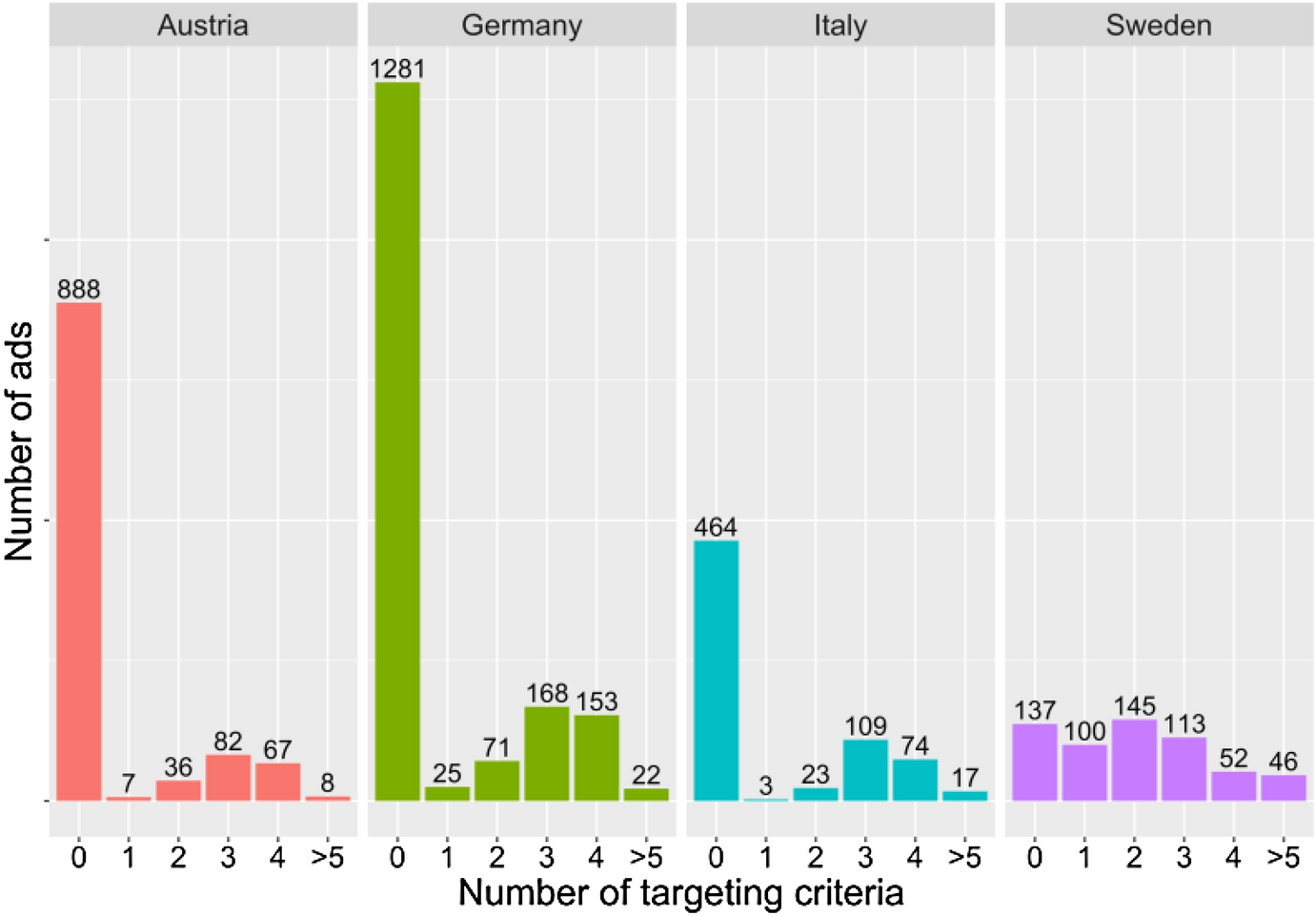
In a previous section we have seen that very little is known about the extent to which OPM is used in European election campaigns. Hence, the first empirical question is to what degree the campaigns under study have been penetrated by OPM. Although results need to be interpreted with some caution due to the unrepresentative nature of the data, Fig. 1 suggests that penetration did not go that far. Campaigners seemed to prefer not to use Facebook Ads for microtargeting in Austria, Germany and Italy since only a minority of the ads were microtargeted. In those cases, advertisers would then typically select 2–3 criteria. A very different dynamic seems to be observed in the Swedish election campaign, in which the majority of the ads were microtargeted. Indeed, here the distribution is quite homogenous across the levels of microtargeting indicating variation in the way advertisers made use of the possibility of microtargeting the Facebook Ads in this country.
Number of ads sorted by level of microtargeting and country

In the next paragraph, first I will present the results of the number of topics for each of the corpuses (targeted and non-targeted ads) and second, I will introduce the results from the sentiment analysis.
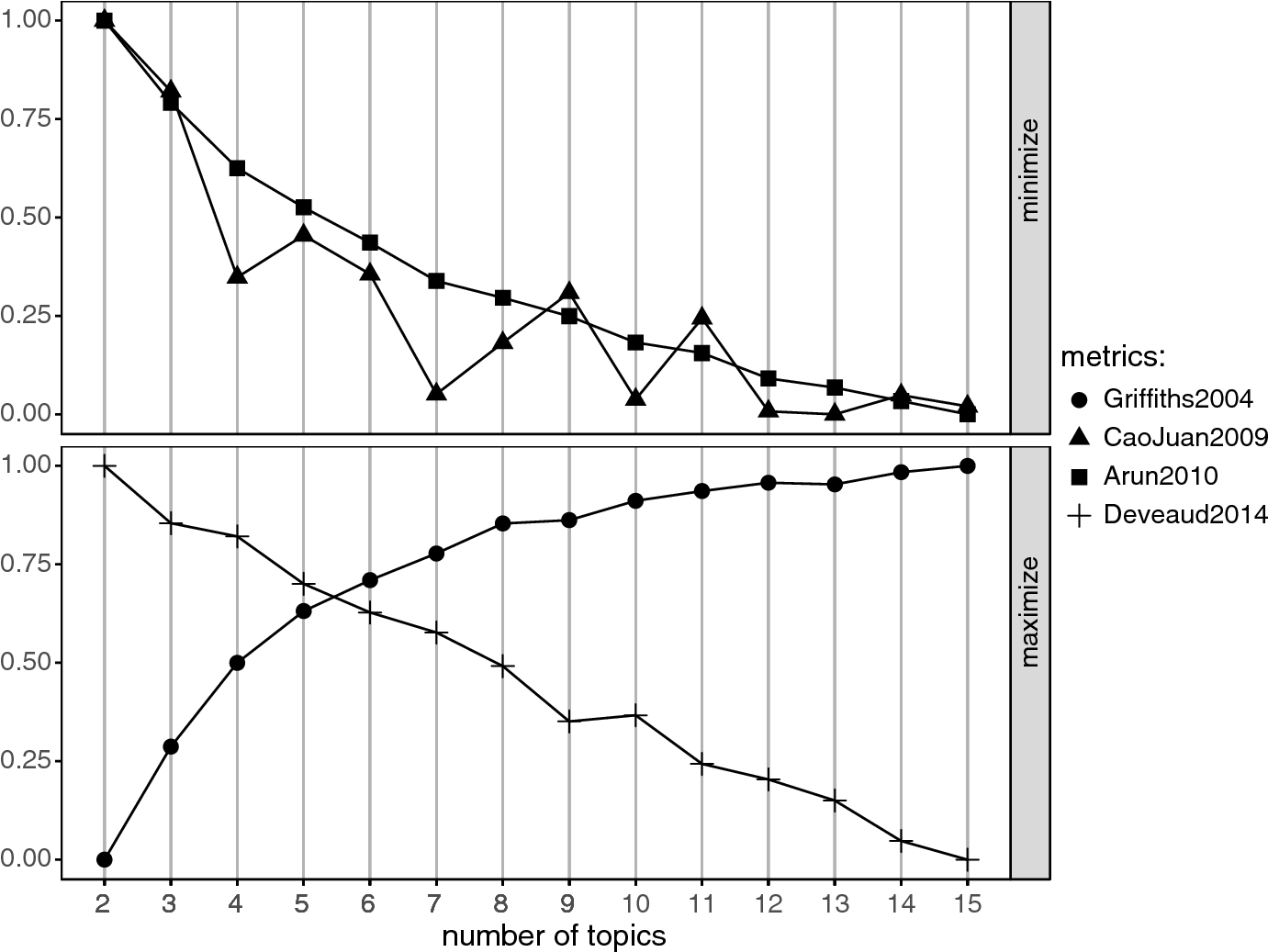
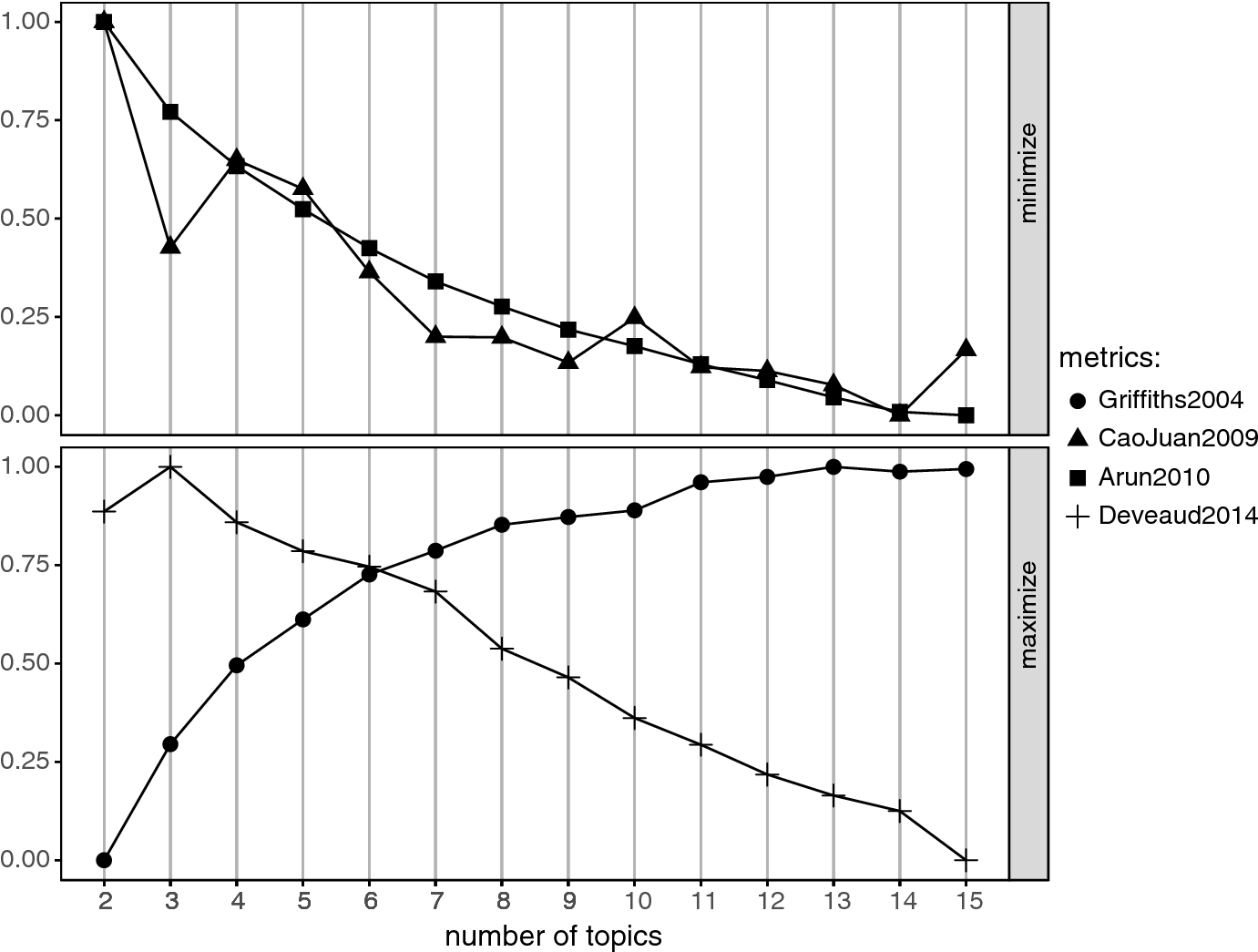
Figure 2 and Fig. 3 show the results of the number-of-topics metrics of each of the text corpuses. While the three first metrics (those of Cao et al. Reference Cao, Xia, Li, Zhang and Tang2009, Arun et al. 2010 and, Deveaud et al. Reference Deveaud, SanJuan and Bellot2014) represent the optimal number of topics with low scores, Griffiths2004’s metric represents the best fit in terms of the number of topics with high estimates. In general, all metrics show that the model benefits from turning to two or more topics, especially in the case of Cao et al. (Reference Cao, Xia, Li, Zhang and Tang2009). This metric shows that the model drops from 0.5 when one considers that non-targeted ads have more than three topics and targeted ads have more than five topics. Instead, Arun et al. (2010) shows very similar estimates for both types of corpuses. The intersection between the estimates of Griffiths and Steyvers (Reference Griffiths and Steyvers2004) and Deveaud et al. (Reference Deveaud, SanJuan and Bellot2014) portray a very similar finding as with Cao et al. (Reference Cao, Xia, Li, Zhang and Tang2009). Although both corpuses react similarly to the metrics, the intersection lies on 5.4 topics in the case of the non-targeted ads while the same point lies on 6 in the case of targeted ads. Furthermore, Deveaud et al. (Reference Deveaud, SanJuan and Bellot2014) suggests 3 as the ideal number of topics in the case of targeted ads, one more topic than the same metric suggests for non-targeted ads. This would indicate that microtargeted ads cover a slightly higher number of topics than non-microtargeted ads.
Metrics to calculate the optimal number of topics for non-targeted Ads

Metrics to calculate the optimal number of topics for targeted Ads

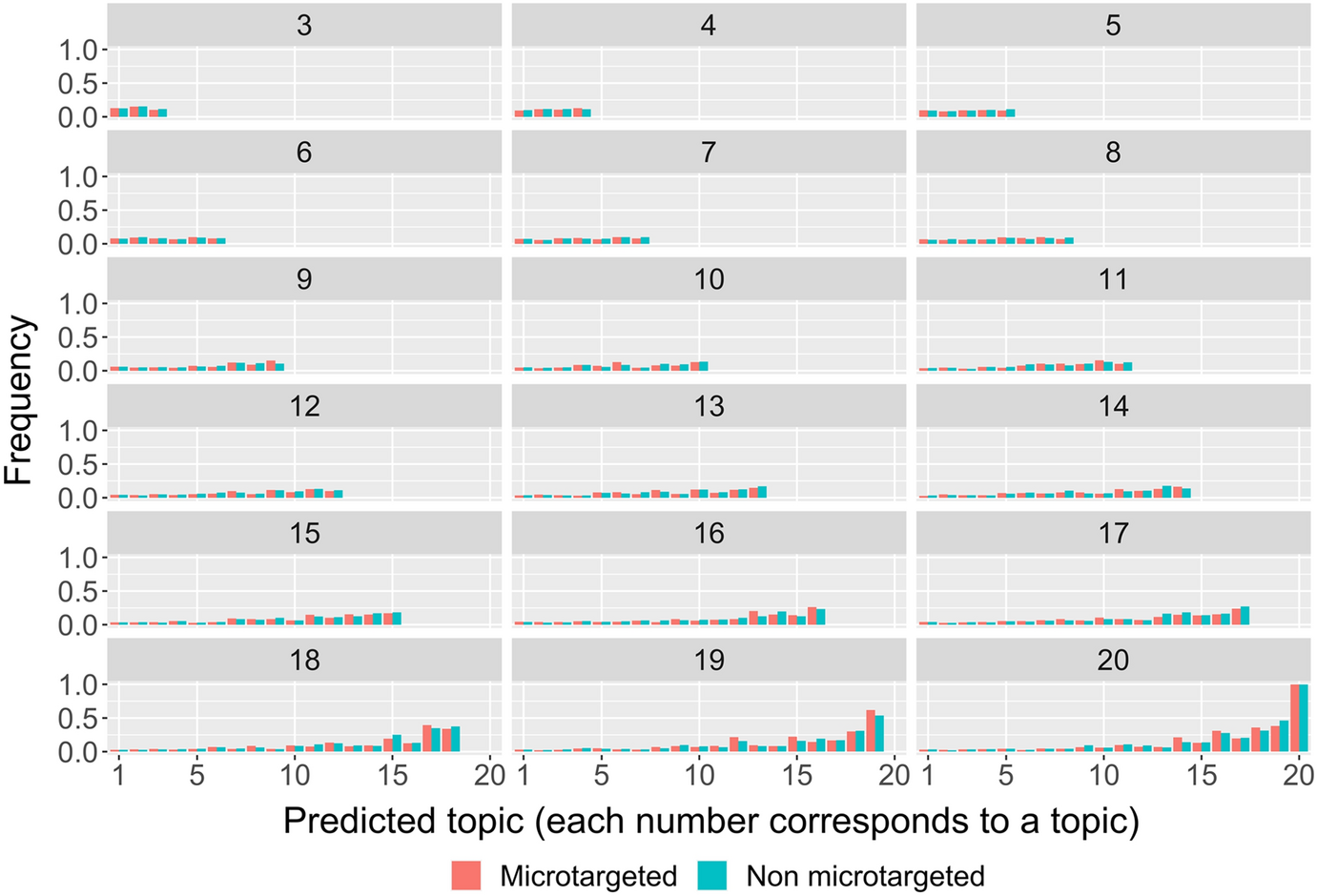
A robustness check is conducted focusing on the distribution of topics. Here I run an LDA on the complete sample, count the relative number of posts of each type for each topic, and check whether microtargeted ads are more evenly distributed across topics than non-microtargeted ads. If the former covers more topics, we want to see them being more spread out across topics, in contrast to non-microtargeted ads which should concentrate on fewer topics. I repeated the analysis with a varying number of topics finding in every case a quite similar pattern in terms of distribution (Appendix 2). These results from the robustness test confirm that while differences in topic diversity between microtargeted and non-microtargeted ads might exist, these are not striking.
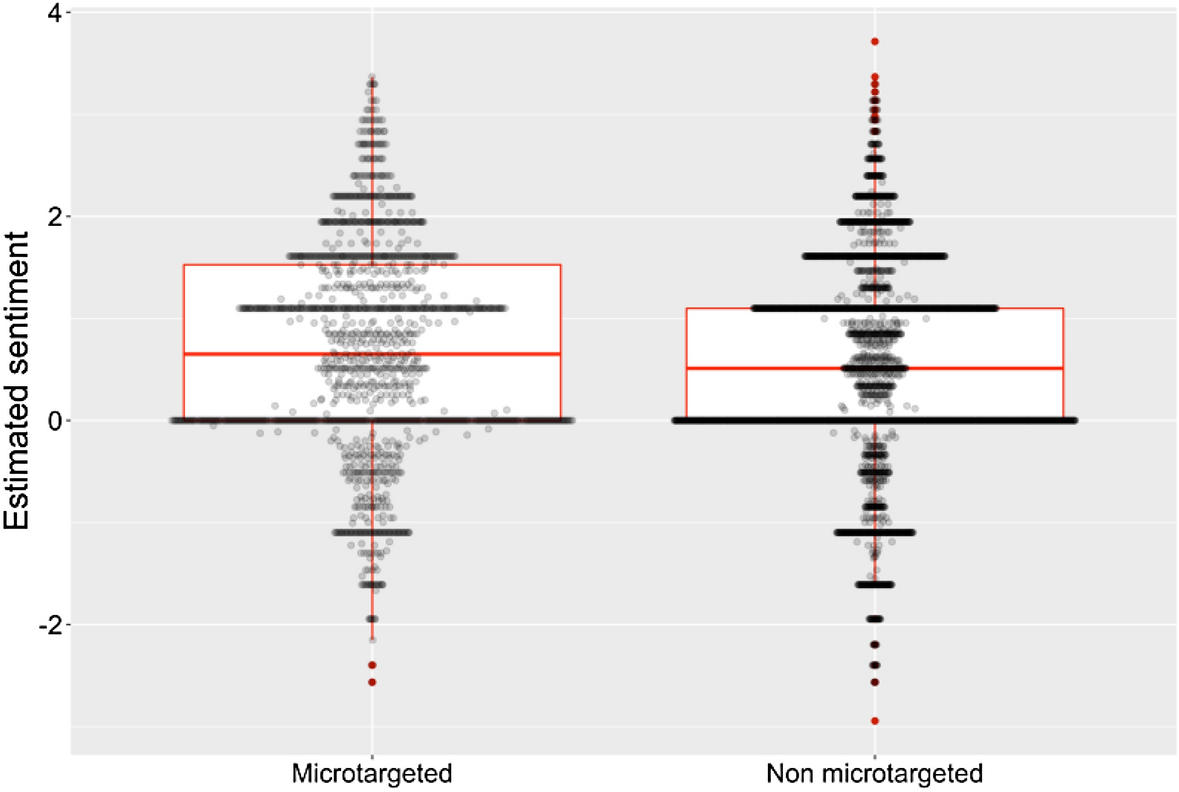
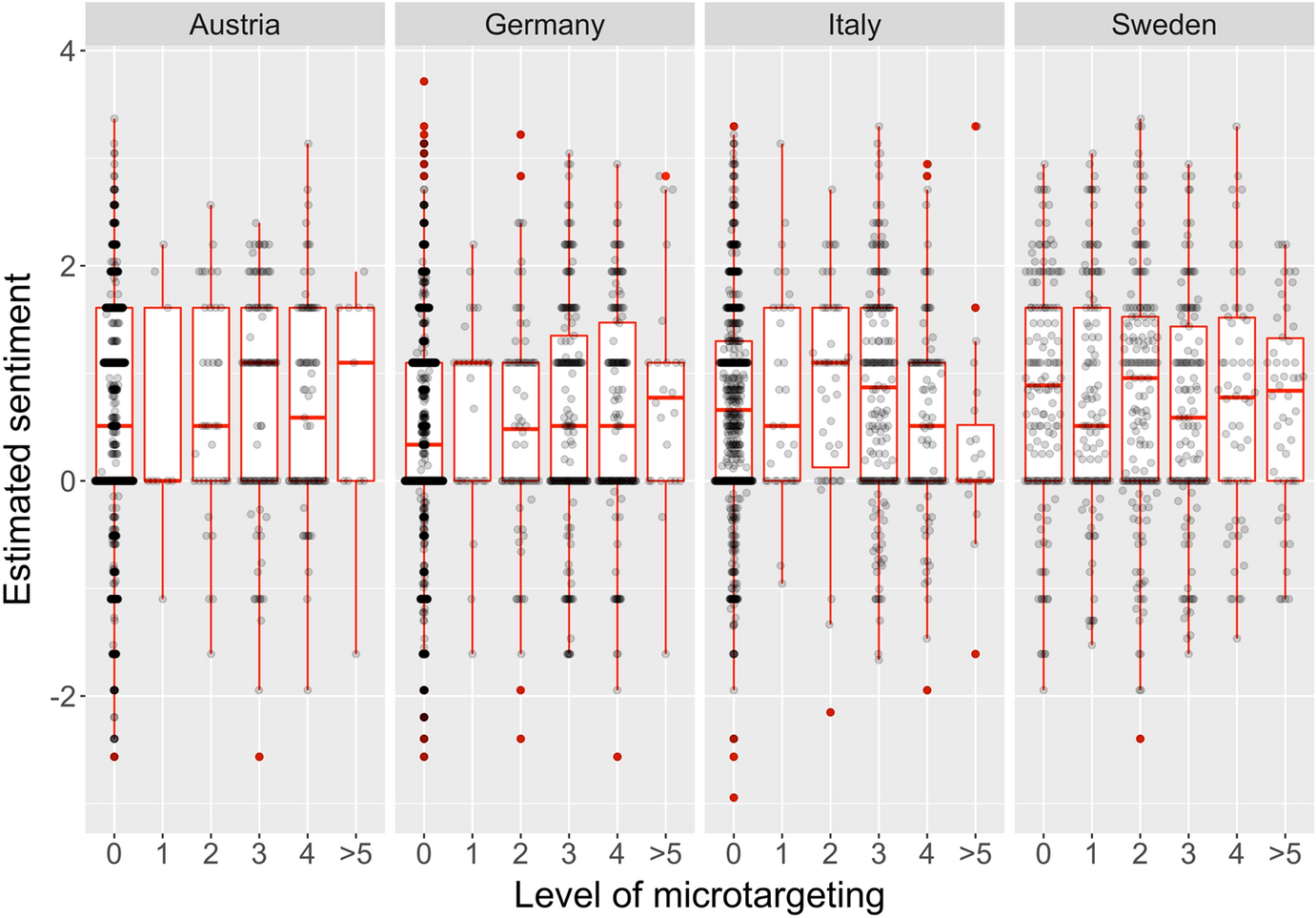
Figure 4 shows the results for the logged ratio of positive to negative terms contained in advertisements (y-axis) divided between targeted and non-targeted ads (x-axis). The overwhelming majority of ads are positive in sentiment. Attacks on opponents are always negative in sentiment. Hence this analysis provides the important finding that OPM does not lead to negative campaigning in the countries under analysis. From a comparative perspective, estimates show that microtargeted ads are more positive than the non-microtargeted ones, the results are not significant at conventional significance levels. When the same analyses are run by country and actual number of targets criteria, similar results are found (Appendix 3).
Logged ratio of positive to negative terms contained in advertisements

Conclusions
This analysis has made three important contributions to the literature. First, it has provided a new definition of OPM. I have defended that OPM is unique in the sense that it allows campaigners to address voters in an individual fashion. Clearly defining OPM is important because the boundaries between OPM and other forms of campaign targeting are less clear-cut than one might think. OPM offers the opportunity to customise not only campaign messages but also the audience of these messages. From a political strategy perspective, OPM entails a broad range of opportunities for campaigners in the sense of tailoring their communications using different topics, positions and tones.
Second, this is one of the first papers that shows the (ir)relevance of OPM in Europe. I have summarised the small literature and have analysed an original dataset of Facebook Ads of four recent European election campaigns. The results show that campaigners were not eager to microtarget their campaign messages in a systematic fashion. This holds true for the elections that were held during 2017 and in early 2018 (i.e. Germany, Austria, Italy). Contrariwise, the Swedish November 2018 elections campaign showed a deeper penetration of microtargeting. Whether this country-wise difference is due to contextual factors or has to do with a time trend is something that should be explored in further research. A reason why OPM might still find it harder to diffuse throughout Europe is due to the political systems. While in the US there is a two-party system with strongly funded campaigns, European parties face financial constraints as well as multi-party constraints.Footnote 11 Though, further research on the transmission of campaigning cultures from the US towards Western European countries would be needed to confirm this idea. Also, I note that comparisons by country in this paper need to be taken cautiously given the sample biases that the partner media outlets from each country might involve.
Third, I have analysed how campaigners use microtargeting. I have expected microtargeted ads to be more diverse in terms of topics and more negative. I have found evidence that ads are more diverse in the terms of topics when they are microtargeted. However, the difference in the estimates is not that high as the robustness check showed. In terms of negativity, microtargeted and non-microtargeted ads did not show any significant difference. Nonetheless, more research on more recent campaigns would be needed in order to generalise these results since it could be that these were just the first inexperienced attempts of microtargeting and, thereby, more refined OPM strategies have followed during the last elections.
The most important limitation of my analysis is that the ads that were examined are not a representative sample of all campaign ads. In line with a large experimental literature I have assumed that the bias in the sample does not impact the mutual relationships between variables. However, as is well known, this assumption can be violated. Recently, important progress has been made in getting access to more representative samples of Facebook Ads. Hence, future research that is able to draw on more representative data might want to replicate the findings from this article, which is that OPM does lead to more topic diversity but not to negative campaigning.
This being said, this research speaks to a highly important normative debate on whether OPM is a threat to democracy or not. On the one hand, one could argue that OPM is indeed a great opportunity for parties to engage with citizens’ real interests. In the same vein, citizens would enjoy the opportunity to learn more directly what the different parties have to offer to people like them. On the other hand, there are legitimate concerns about how OPM might be a source for misinformation, negativity and hyperfragmentation of campaigns and the public sphere. Although solving this debate exceeds the scope of this paper, it has been shown that OPM ads are minimally more diverse and definitely as negative as non-microtargeted ones. This is important because this shows that, as of today, OPM could be the threat that it is sometimes believed to be.
Funding
Open Access funding provided by Universität Zürich.
Appendix 1 Description of LDA models
In general, all the LDA metrics attempt to capture which is the optimal number to divide the information in different groups of topics. The models work therefore try to determine how similar the words are and to what extent these words tend to appear together to create classifications. More specifically, Arun et al (2010) measures symmetric KL-Divergence of salient distributions. Cao Juan et al. (2009) selects the LDA model based on density. Griffiths and Steyvers (Reference Griffiths and Steyvers2004) uses the Gibbs sampling algorithm that evaluate the consequences of changing the number of topics in the corpus. Lastly, Deveaud et al (Reference Deveaud, SanJuan and Bellot2014) estimate the number of latent concepts of a user query by maximising the information divergence between all pairs of LDA’s topics. To measure these metrics I use the package called ldatuning (Nikita and Nikita 2016) while for the calculation of all text parameters I use the text-as-data package quanteda (Benoit et al. Reference Benoit, Watanabe, Wang, Nulty, Obeng, Müller and Matsuo2018).
Appendix 2 Descriptive analyses
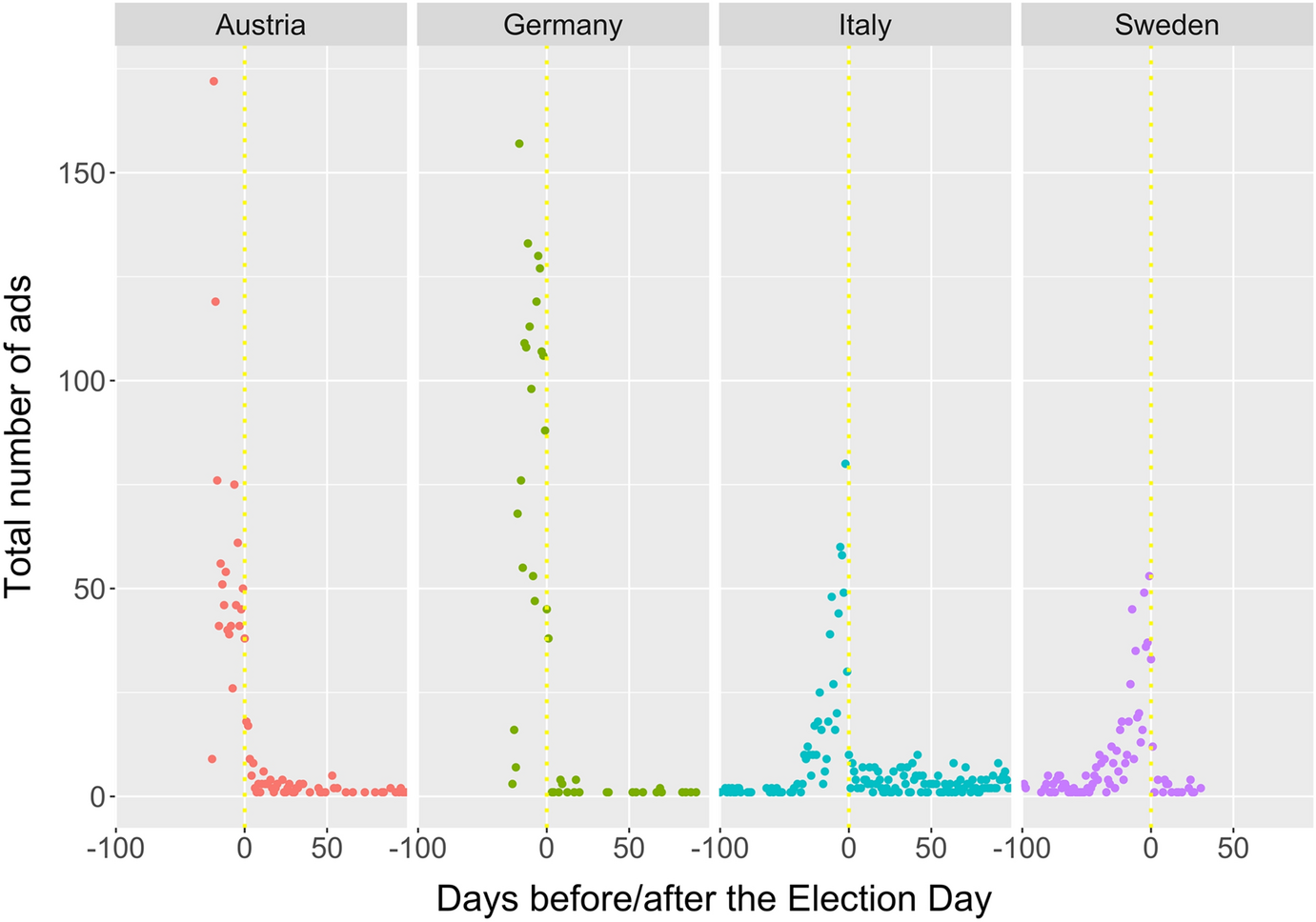
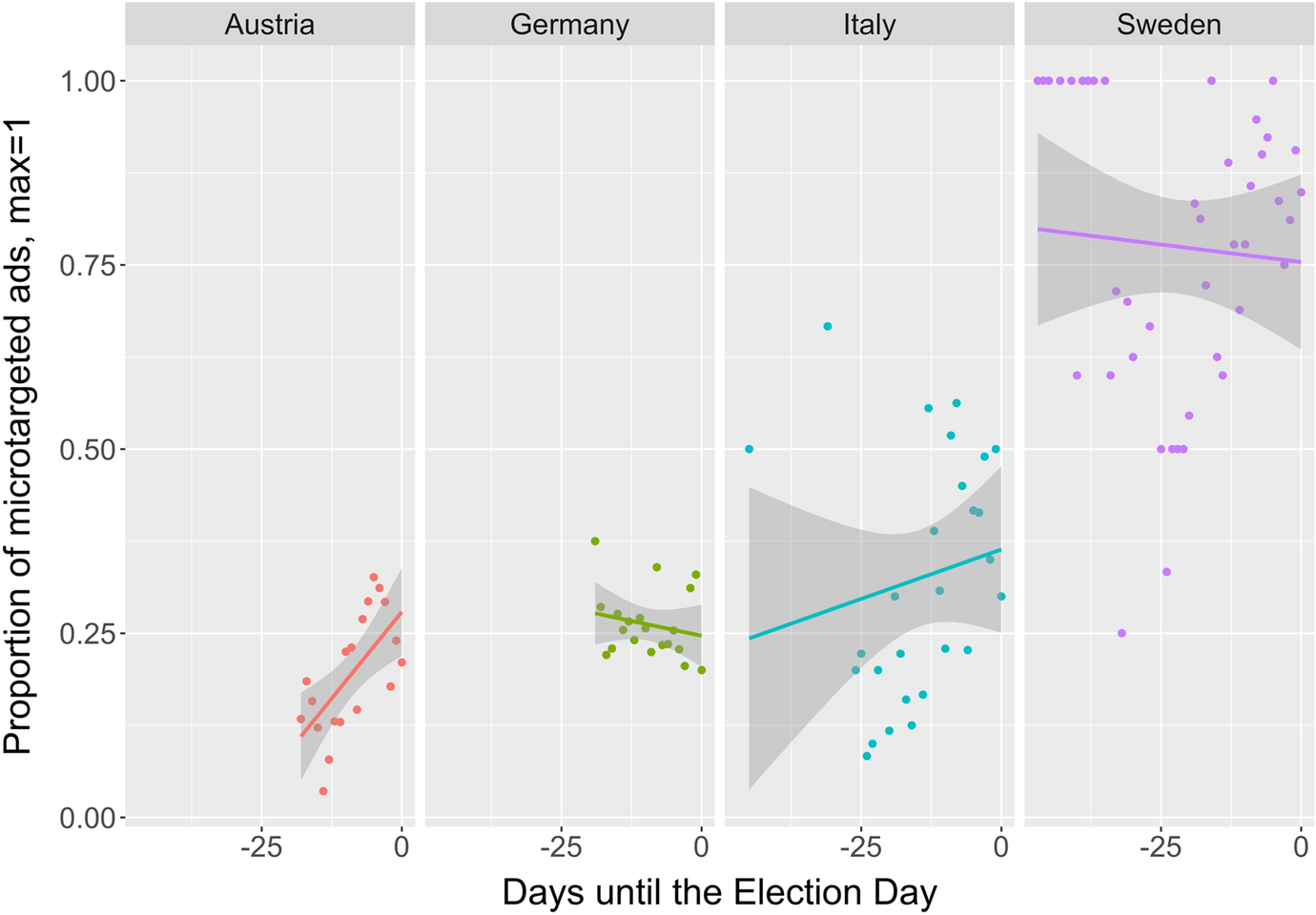
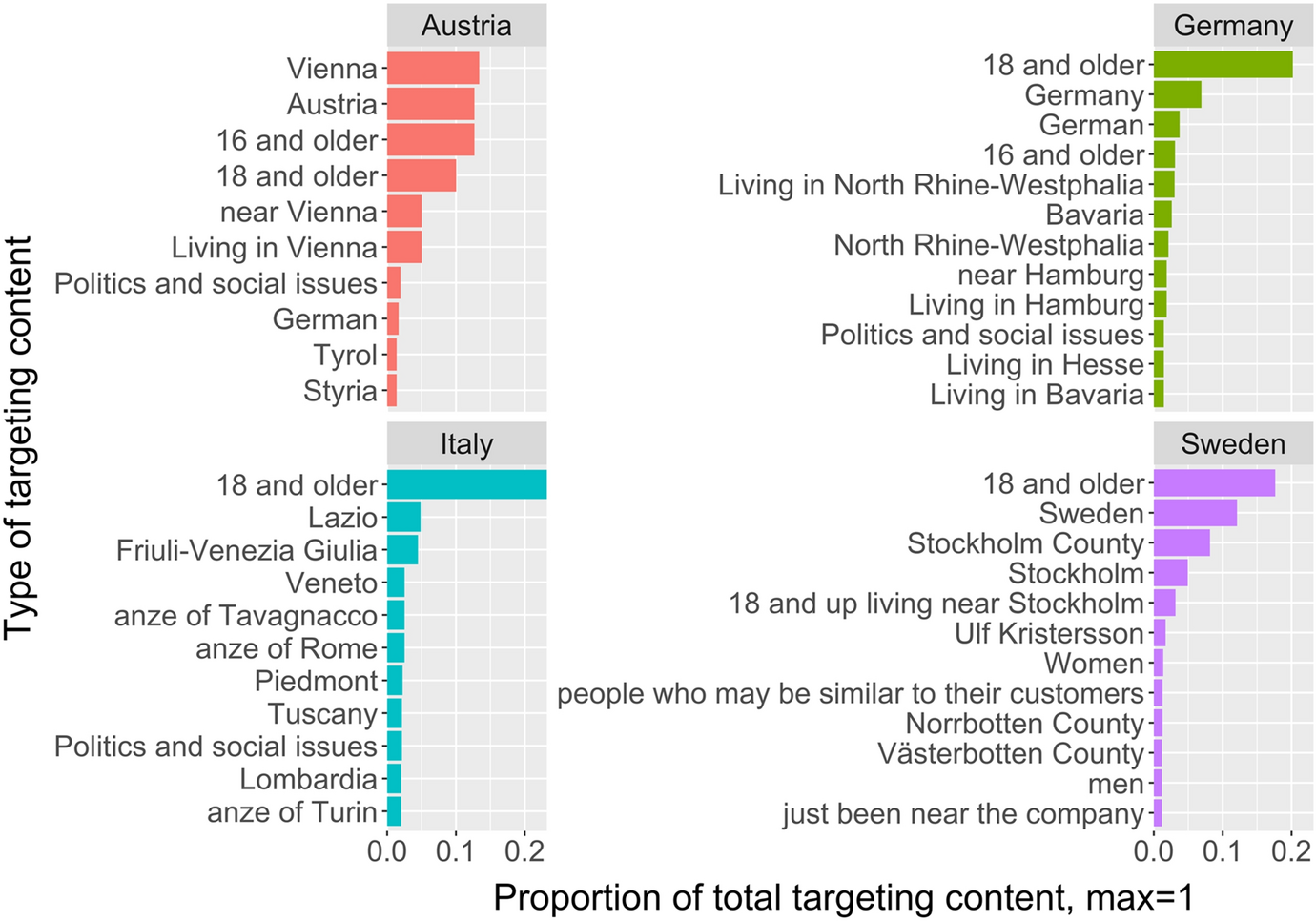
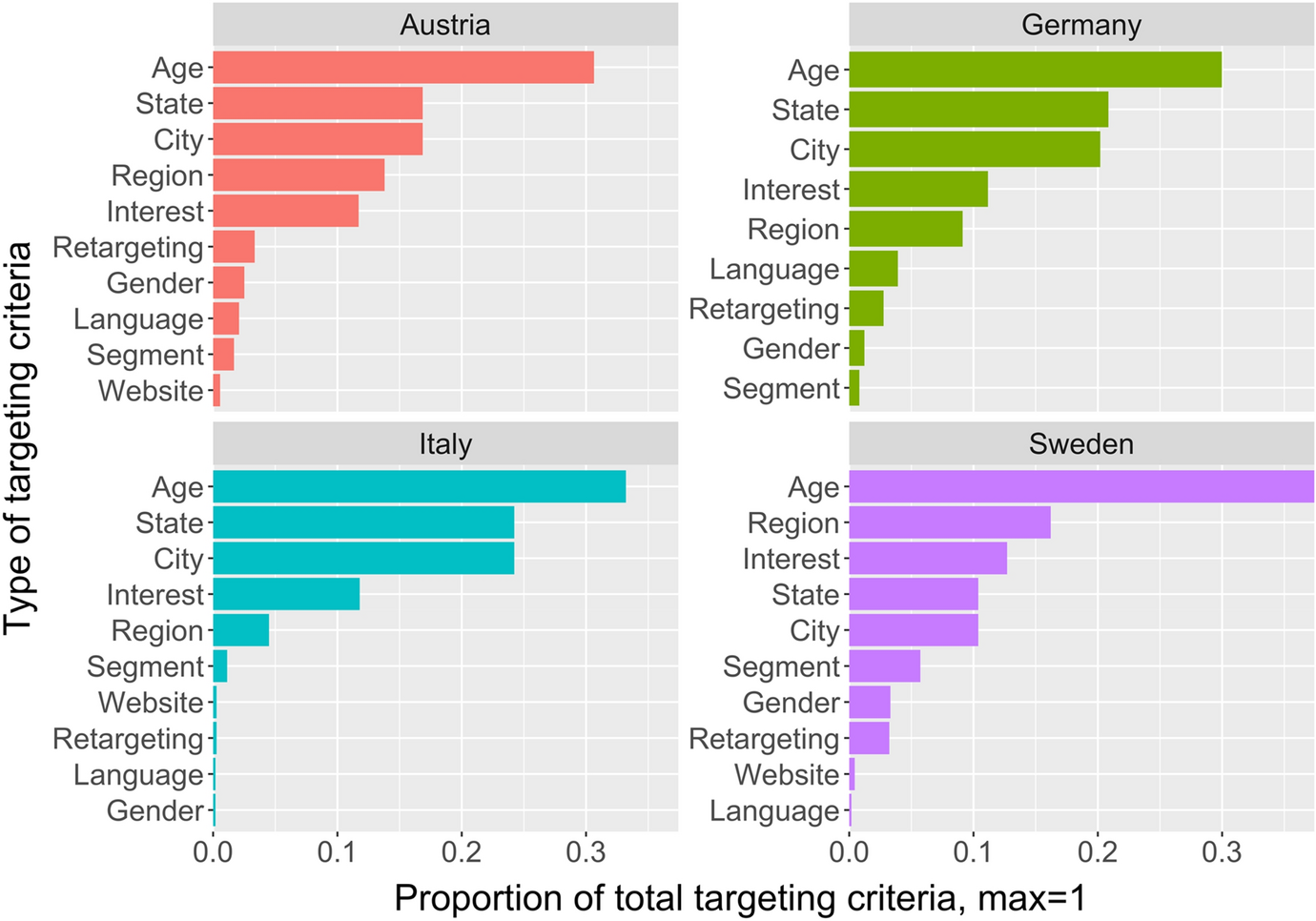
See Figs. 5, 6, 7, 8, 9, 10, and Table 1.
Number of total ads sorted by days before/after the Election Day

Proportion of microtargeted ads sorted by days before/after the Election Day

Proportion of microtargeted ads sorted by type of targeting content

Proportion of microtargeted ads sorted by type of targeting criteria

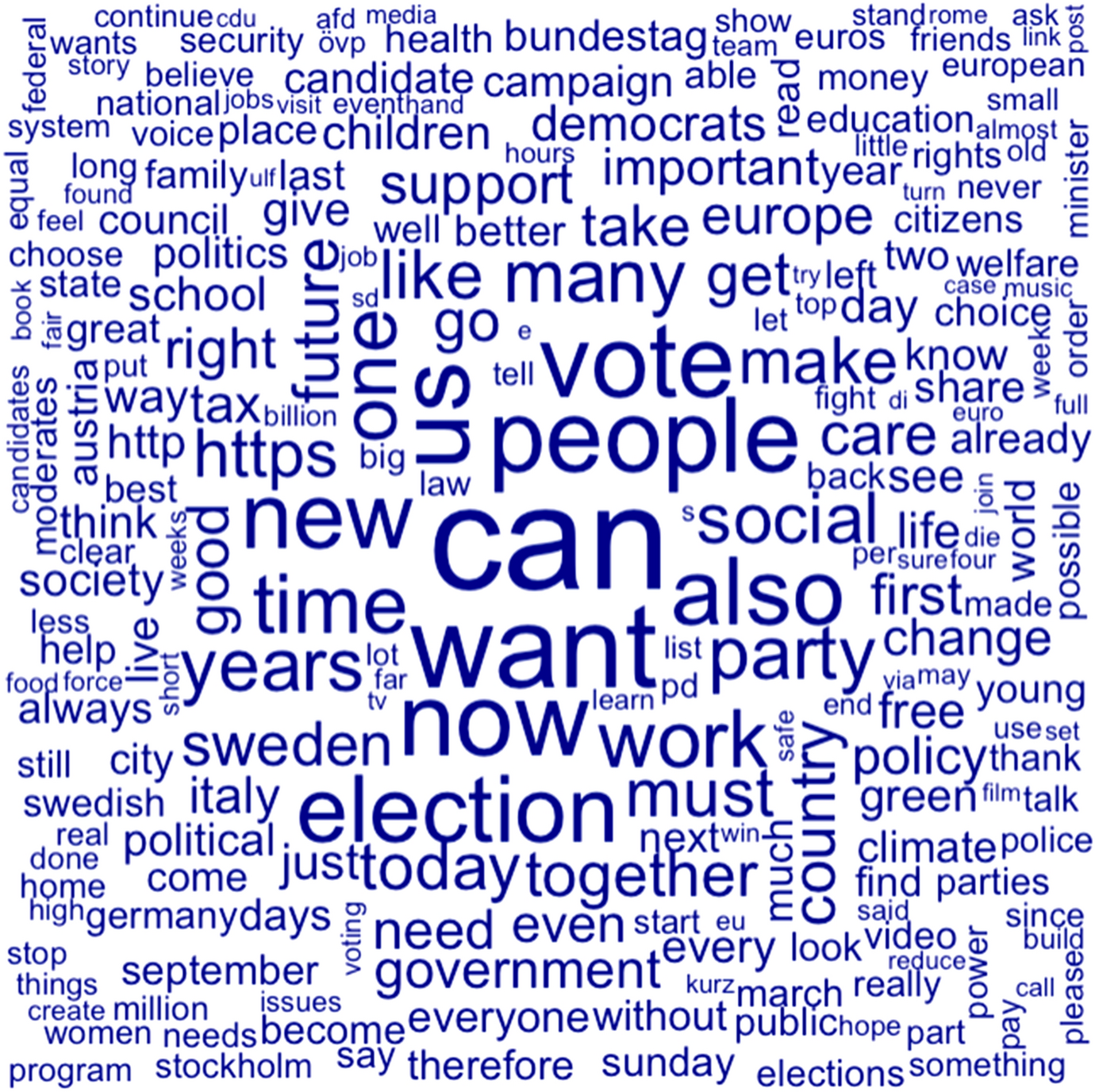
Wordcloud of main words in the dataset

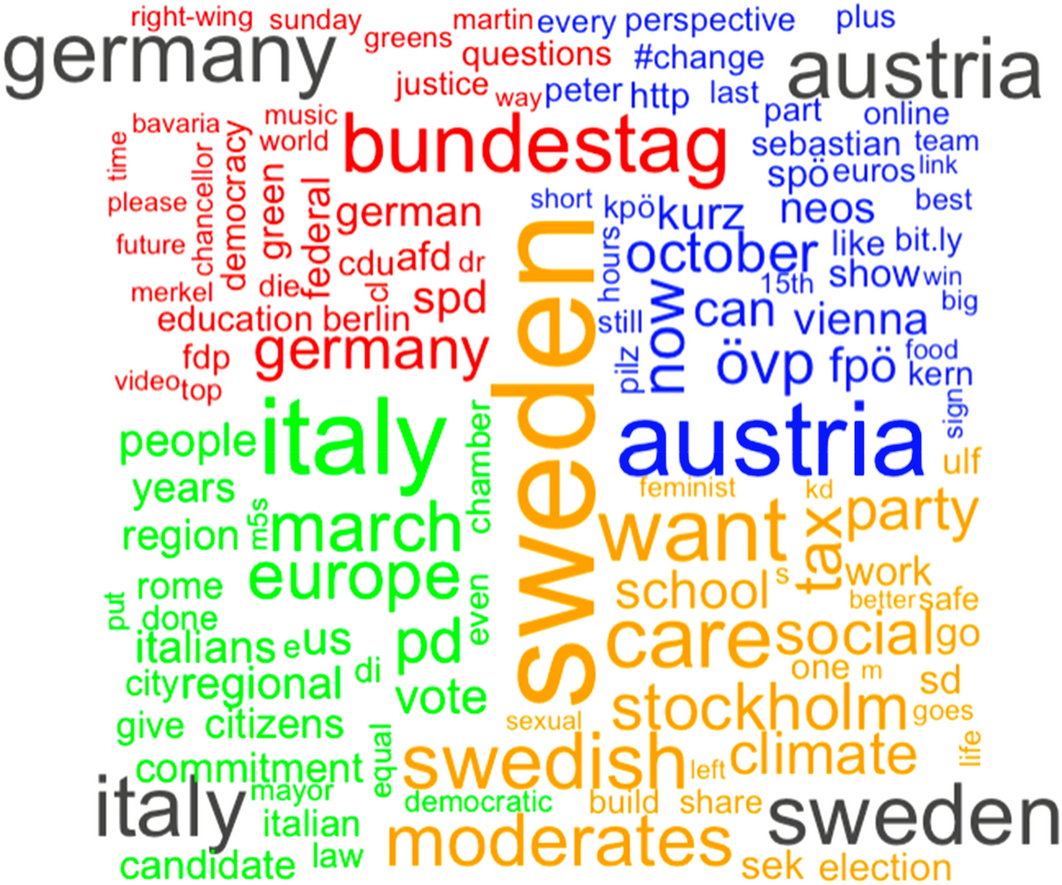
Wordcloud of main words in the dataset by country

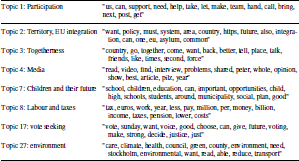
Sample of predicted LDA topics

Appendix 3 Distribution of microtargeted vs. non-microtargeted ads depending on number of topics
See Fig. 11.
Predicted topic distribution sorted by microtargeted/non-microtargeted ads and different choices of number of topics

Appendix 3.1: Estimated sentiment by level of microtargeting and country
See Fig. 12.
Estimated sentiment sorted by microtargeted/non-microtargeted ads and country


 Open access

