

The nexus of my concerns in this chapter is established in a passage from Jacques Lacan’s seminar that points to an antinomy between onomatopoeia and nonsense, while making apparently offhand reference to Lewis Carroll and Edward Lear, and also to Darwin. Citations of Darwin are infrequent in Lacan’s works; he came on the anecdote referred to here (also discussed in an essay published in the 1967 Écrits) in Ernest Jones’s “The Theory of Symbolism,” and it derives not from the naturalist’s published works, but from a passage in George G. Romanes’s Mental Evolution in Man (1888).1 On its original publication, the anecdote was embedded in Victorian debates about the origin of language and about its relation to the utterances of non-human animals. When in the twentieth century it is appropriated by psychoanalysis, this context largely disappears, even though the relation between language and onomatopoeia remains a recurrent topic in psychoanalytic literature.
When Romanes wrote Mental Evolution in Man, onomatopoeia was a key topic in debates on the origin of language. Since many non-human animals, especially birds, are gifted vocal mimics, the idea that human language originates in onomatopoeia was held to animalize it. In his discussion of these issues, Romanes quotes an observation Darwin made of one of his grandchildren:
The child, who was just beginning to speak, called a duck a “quack”; and, by special association, it also called water “quack.” By an appreciation of the resemblance of qualities, it next extended the term “quack” to denote all birds and insects on the one hand, and all fluid substances on the other. Lastly, by a still more delicate apprehension of resemblance, the child eventually called all coins “quack,” because on the back of a French sou it had once seen the representation of an eagle.2
In this part of his work, Romanes is responding to Max Müller’s widely influential Lectures on the Science of Language (1861). There, Müller argues that language is inseparable from cognition, viewing every language as deriving from a small number of “roots,” each of which denotes a concept. Writing immediately after the publication of Darwin’s Origin, Müller argues that the possession of language “is a frontier between man and brute, which can never be removed.”3 In advancing his view of language as distinctively human, Müller rejects earlier theories of language as originally onomatopoeic – arising from the imitation of animal calls and other natural sounds – or as expressive – arising from the instinctive expression of primary affects, such as fear and disgust. These theories he memorably termed respectively the “bow-wow”4 and the “pooh-pooh”5 theories of language, and he rejects them both on the explicit grounds that if either were true, “it would be difficult to understand why brutes should be without language.”6 Of onomatopoeic theory, in particular, he gives the authority of Étienne Bonnot de Condillac for protesting that it would “place man even below the animal” by supposing him “to have taken a lesson from birds and beasts.”7
While Müller maintained that “no process of natural selection could ever distill significant words out of the notes of birds or the cries of beasts,”8 Darwin held that natural selection had in fact evolved human speech from forms of utterance observable in non-human animals, including song, imitations of the voices of other animals, and instinctive cries (Descent 109). In the passage just quoted, Romanes gives Darwin’s authority to support his argument against Müller that “onomatopoeia in all its branches has been the most important of all principles which were concerned in the first genesis of speech.”9
When Lacan cites Darwin as mediated by Romanes and Jones, however, it is not in service of an argument about language’s origin, or, directly, about the similarity or difference between human and animal utterance. The psychoanalytic tradition is clear and explicit in accepting Darwin’s account of species transmutation and in recognizing the kinship of human beings with other animals. In the following chapters, we will trace some vicissitudes in Darwin’s influence on psychoanalysis and in how Freud theorized the human–animal relation. Animals also have pivotal roles in Lacan’s work in its structuralist phase, as Derrida documents in The Animal That Therefore I Am.10 In particular, Lacan’s essay on the “Mirror Stage” explains the formation of the ego in a moment of specular identification with a double or a mirror image with reference to research on the sexual maturation of pigeons.11 Lacan’s writing on the signifier makes repeated reference to non-human animals’ ability to lay and follow tracks and to dissimulate by falsifying their trails.12 Nonetheless, as Derrida shows, Lacan’s theory of language makes no fundamental break with the tradition going back to Descartes and Müller that reserves language uniquely for humans.
Unlike Romanes, who first published it, Lacan discusses Darwin’s anecdote about his grandchild without referring to the role mimicry of an animal played in the child’s acquisition of language. And yet repeated references in his work suggest that such a role exists. In Seminar VI, where Lacan eventually introduces Darwin’s anecdote, he discusses a case history of Ella Sharpe’s where a patient relates his fantasy of barking like a dog. For Lacan, this is a fantasy of being-other (se faire autre). “He makes himself into something other than what he is with the help of … a signifier. Barking is the signifier of what he is not.”13 For Lacan, then, onomatopoeia signifies not identification with a non-human animal, but difference from it: the dog’s bark ceases to be a mere animal cry and is raised to the level of the signifier when it is displaced from its animal origin.
Lacan does not, however, typically represent the transformation of onomatopoeia into a signifier as effected in fantasy. Other examples he discusses, including Darwin’s anecdote of his grandchild, involve children, who transform onomatopoeias into signifiers by making them the names of species. Thus Darwin’s grandson gives a duck the name “quack”; in another story Lacan tells, his friend’s child names the family dog a “bowwow.” In Lacan’s work, the transformation of an onomatopoeia into a signifier is usually treated as belonging to developmental psychology (psychologie génétique). This field, he says, studies “how the dear little ones, who are so dumb, begin to acquire their ideas” – Bruce Fink’s translation “dumb” effaces the break with the animal in the original: “le cher petit, qui est si bête.”14
For Lacan, the primordial act of naming is identified with the figure of metaphor. And throughout his work, metaphor and signification require a break with the animal. In the 1960 essay “The Subversion of the Subject and the Dialectic of Desire,” he writes that entry into language takes place only when the child “by disconnecting the thing [i.e., the animal] from its cry, raises the sign to the function of the signifier.”15 The animal, then, can emit signs; these become signifiers when they are displaced by metaphor. Lacan is writing here of what his editors tell us is a children’s rhyme: “The dog goes meow, the cat goes woof-woof.” He refers to this rhyme also in Seminar VI, writing of it as “primitive metaphor … purely and simply constituted by means of signifying substitutions.”16 As John Powell Ward has pointed out, Lacan dramatizes the entry into language with the same trope we have seen in Wordsworth and Coleridge, where onomatopoeias are mocked by juxtaposition with the wrong animal.17
Lacan’s theory of language relies on an implicit contrast between the seeming automatism of the animal’s stereotyped call and human language, which, disconnecting the call from the animal, transforms it into a signifier. He reads Darwin’s anecdote, in which the child is observed to “detach the ‘quack’ from the duck that made it,” as a parable representing this contrast. In giving the name “quack” first to a bird, then to fluids, then to a coin, Lacan writes, the child does not seek their “meaning [sens] or essence [essence].” Rather, it speaks “nonsense [non-sens]” – a term Lacan goes on to gloss with reference to the English “genre” of nonsense, whose two “eminent examples” he names as Edward Lear and Lewis Carroll.18 In what follows, I will develop Lacan’s implication that English nonsense writing enacts a defunctioning of onomatopoeia that separates the animal from its call, and also explore the use of onomatopoeia and other nonsense words as names. In doing so, I will take Lacan’s use of Darwin as an authority for his claims as license to suggest that the mockery of onomatopoeia and of onomatopoeic species names in nonsense literature was an historical phenomenon, linked to the parody of species lyric we have already seen in nonsense verse, arising from a general crisis in the concept of species.
***
As we have seen, writers of children’s literature began using onomatopoeia to identify animal species in the 1830s. Lewis Carroll’s nonsense books do not use onomatopoeia; indeed their founding premise is that in Wonderland and Looking-glass Land, non-human animals are endowed with speech. But in Carroll’s contemporaries, we can find writers making nonsense out of onomatopoeia in the way Lacan describes. Here is a poem from Christina Rossetti’s Sing Song, published in 1872:
This poem follows the logic I have already discussed, by which the automatism of the birds’ calls are figured by their function as a clock. With its apparent aim of teaching what the cock says, it is atypical of Sing Song as a whole, where animals’ names and calls are typically made the occasion for games with human language. Indeed, even in this poem, Rossetti is less interested in birdsong than she is in scansion. The poem doesn’t teach a single stereotyped call for the cock: It gives two, and its main point is to insist on difference even where there seems to be sameness, as in its two opening syllables: “Kookoo.” The calls are a lesson in quantitative meter: the scansion of the cock’s two cries remains uncertain until the long “kee” in line 3 resolves it into choriambic
( – ˘ ˇ – ), or possibly iambic (˘ – ˘ – ). To read the poem is to learn that one “koo” is not the same as the other, and therefore also to learn scepticism about the mimetic power of onomatopoeia in general.
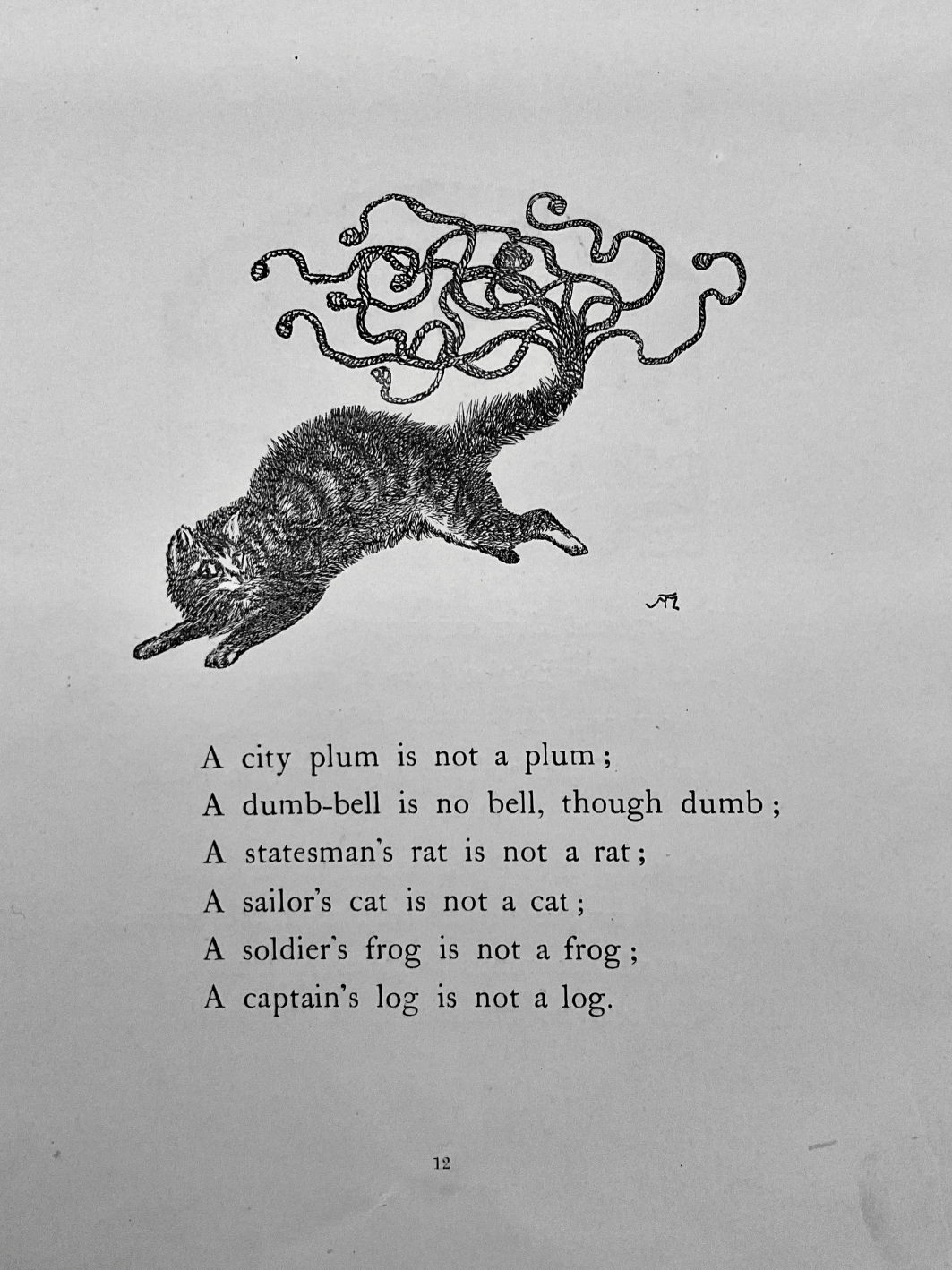
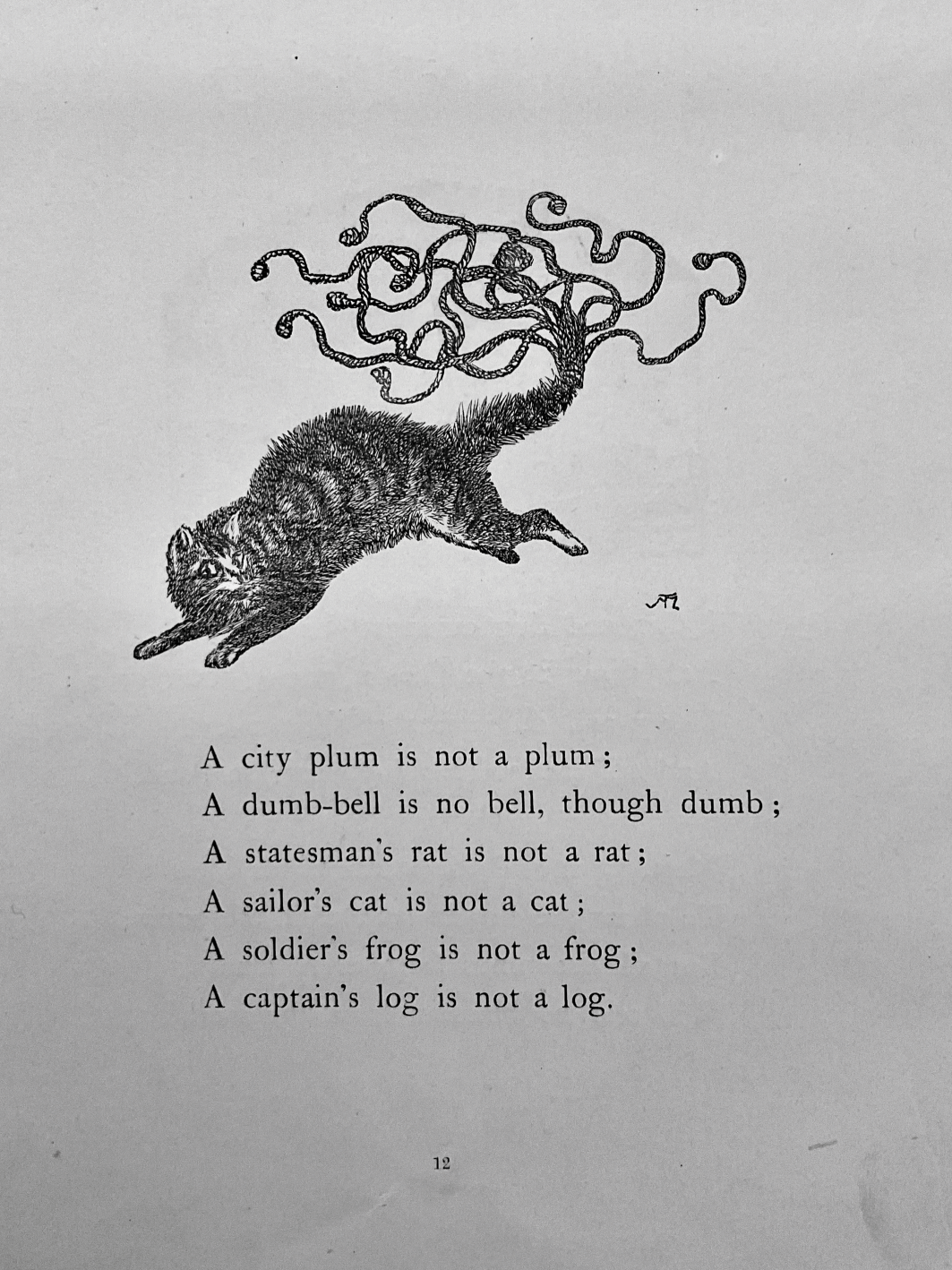
Throughout Sing Song, animal utterance calls not for mimicry but for interpretation: “What does the donkey bray about? / What does the pig grunt through his snout? / What does the goose mean by a hiss? Oh, Nurse, if you can tell me this, / I’ll give you such a kiss” (“What does the donkey bray about,” 1–4). Fully immersed in language, these animals converse in a medium where words are not tethered to a single speaker, context, or meaning. It may be that the cock crows in the poem – but, as the volume reminds us later, “baby crows, without being a cock” (“A pin has a head, but has no hair,” 14). The characteristic form of the poems in Sing Song is the riddle, in which the reader is asked to find the concept represented by a phrase like “The cod-fish has a silent sound” (“The peacock has a score of eyes,” 3). The poems’ plays on words with double meanings in some cases required the illustrator, Arthur Hughes, to abandon verisimilitude and treat images as words. What is in one sense a picture of a cat lashing itself with nine tails that Hughes drew to accompany the line “A sailor’s cat is not a cat” is in another sense a rebus, a picture of the word “cat o’ nine tails,” not a cat at all (Figure 1).
Christina Rossetti, “A city plum is not a plum,” with wood engraving after Arthur Hughes. From Sing-Song (1872).
The transformation into nonsense of animals and their cries is thus one of Sing Song’s principal themes, though Rossetti is not usually considered a writer of nonsense poetry.19 The term was coined as a description of his own work by Edward Lear, who published A Book of Nonsense in 1846. Natural history and species identity are central topics in Lear’s life’s work; as well as authoring nonsense verse and travel literature, he also had a long career as a painter and illustrator, initially with birds and other animals as his primary subjects. While still in his teens, he collaborated on Illustrations of British Ornithology (1821–34), and his first solo publication was Illustrations of the Family Psitacidae, or Parrots (1830–2), for which he carried out the paintings in the gardens of the Zoological Society in London, and which won him election as an associate member of the Linnaean Society in 1830. He probably worked as an illustrator on Darwin’s Voyage of the Beagle20 and was an enthusiastic admirer of its author.21
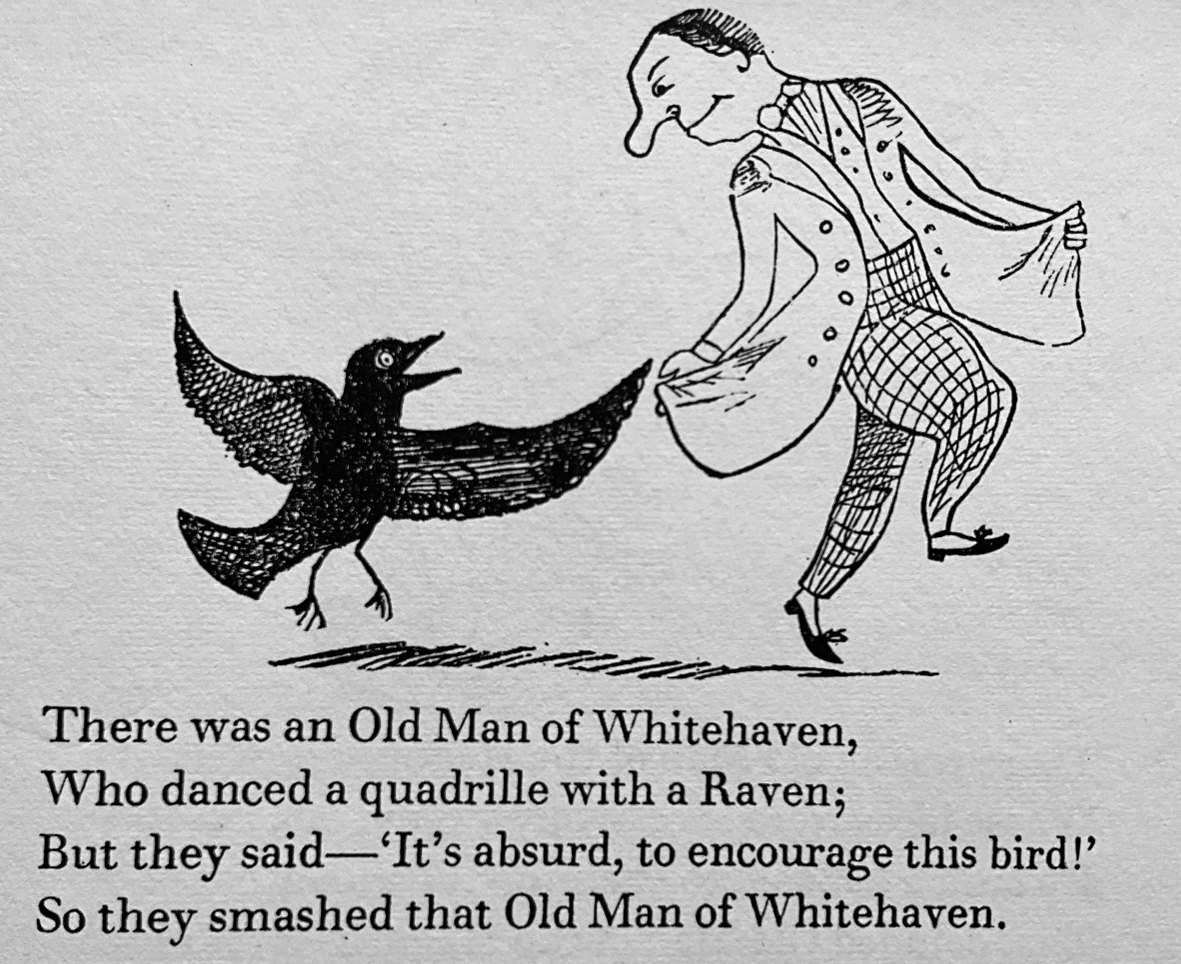
The contents of the first and second editions of A Book of Nonsense were exclusively in the verse form Lear popularized that we now call the limerick. Lear’s limericks are defined by their verse form and by a recurring logical schema, which establishes the genre as having a primary concern with human beings, each of whom is characterized in relation to the entire species by accidental individual traits. Thus: “There was an old man” – or young lady, or young person – and so forth. Next, often, a specification of habitat – for example, “of the Nile.” Finally, the peculiarity of the individual specimen that gives rise to the poem: “There was an old person whose habits / Induced him to feed upon Rabbits.” Often the action of the limerick punishes the protagonist’s eccentricity and narrates her or his reversion to an implied norm: “When he’d eaten eighteen, he turned perfectly green, / Upon which he relinquished those habits” (165). In many cases, the norm is enforced, sometimes violently, by a nameless “they”:
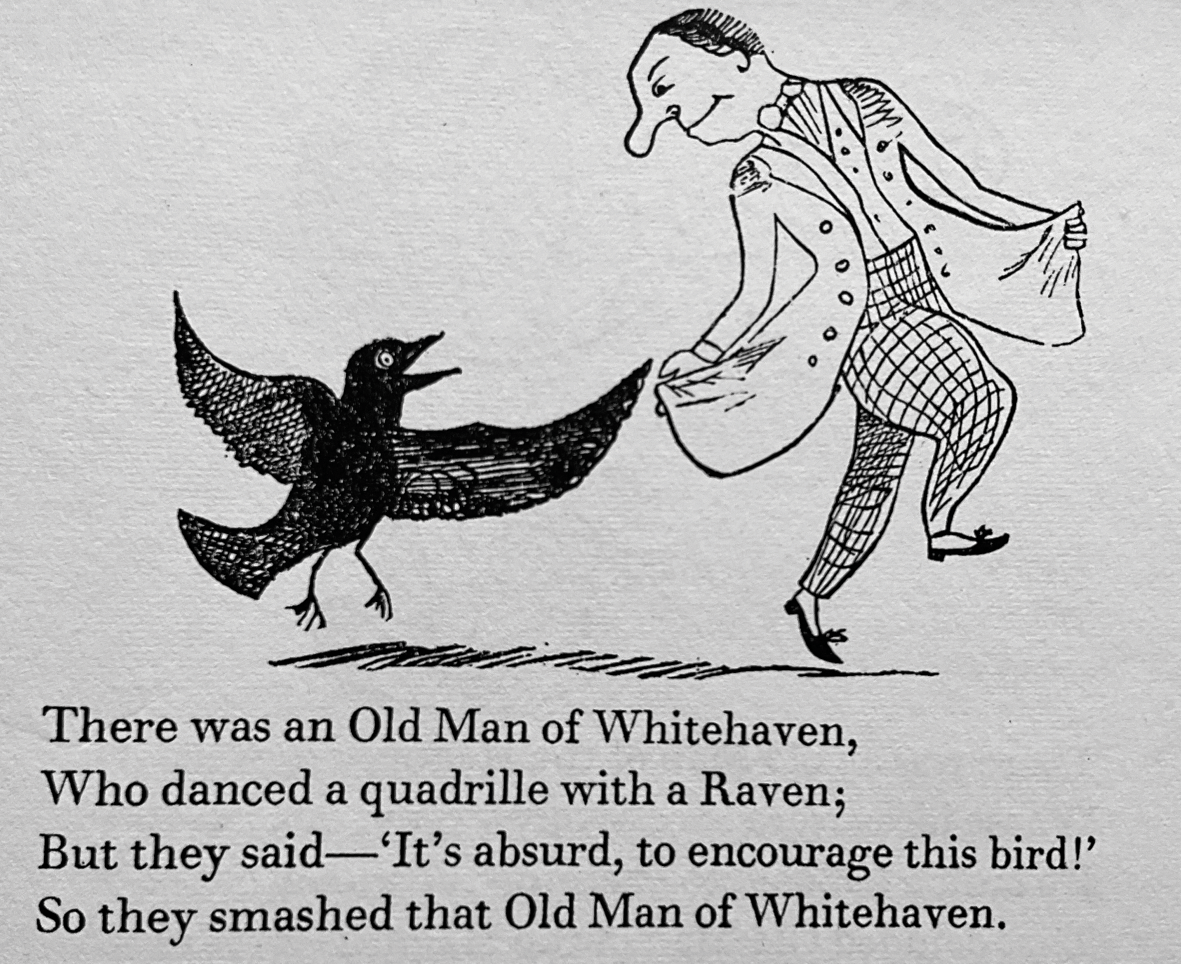
As these poems – both added to Lear’s limericks in 1861 – show, human–animal relations are a topic in Lear’s poetry from the beginning, often eroticized, as in the old man’s dance with the raven. The interspecies romance here includes a crossing of species attributes – as the illustration makes clear (Figure 2), man and raven are doubles, and the word “bird” in line 3, as Matthew Bevis points out, could refer to either of them.22
Edward Lear, “There was an Old Man of Whitehaven” (1861)
The erotics of Lear’s limericks thus cross species and other categories. The limericks also – occasionally – use onomatopoeia:
Beginning with the 1870 publication of Nonsense Songs, Stories, Botany, and Alphabets, though, non-human animals, no longer brutalized, become the major protagonists of Lear’s verse and begin to speak. The change results in part from the influence of Lewis Carroll, whose Alice in Wonderland was published in 1865. While the Alice books imagine worlds in which all kinds of hierarchy – including the fundamental hierarchy that sets human beings above other animals – are temporarily inverted, they don’t challenge or play with species taxonomy. Charles Dodgson, the books’ real-life author, was strongly opposed to Darwin and to the idea of species transmutation. Lear, on the other hand, read The Origin of Species in the mid-1860s with admiration.23 As Matthew Bevis notes, his late work, like Darwin’s Descent of Man, abounds in cross-species desire, non-human animals with aesthetic preferences, and song.24 Lear composed music for several of his narratives of animal courtship, and these narratives themselves, like “The Owl and the Pussycat,” typically represent their characters as singers: they are poems about song and about occasions for song.
The songs are not, however, onomatopoeic. Not that onomatopoeias are absent from the late poetry – but they are as we shall see defunctioned and turned into nonsense. Before turning to the central topic of sound and sense in Lear, though, I want to note how important questions about species are in Lear’s late work. The limericks, as we have seen, have human protagonists, each of whom belongs to a class singled out from the mass of humanity in general: “an Old Person of Leeds.” The late poems typically have non-human protagonists; rather than being identified as particular members of a general species, though, these protagonists are usually described with a definite article that would normally particularize them as in some sense unique, or refer to an entire unique species, as in the poem on “The Wood-Grouse” discussed earlier.25 The characters in “The Owl and the Pussycat” and “The Duck and the Kangaroo,” probably Lear’s two first nonsense songs, are individual members of real animal species; the definite articles that refer to them seem only to single them out as unique within the work where they appear: “The owl who is the subject of this particular story.” But the status of creatures like the Quangle-Wangle is harder to discern. Is there only one Quangle-Wangle – is he a species of one? Before the two works in which the Quangle-Wangle appears (“The Story of Four Little Children Who Went Round the World” and “The Quangle-Wangle’s Hat”), Lear seems to have introduced it under a different spelling as “a Clangle-Wangle” in “The History of the Seven Families of Lake Pipple-Popple.” This Clangle-Wangle is undoubtedly a member of a species, which Lear identifies as “by no means commonly to be met with” and for which he supplies a full description:
They live in the water as well as on land, using their long tail as a sail when in the former element. Their speed is extreme, but their habits of life are domestic and superfluous, and their general demeanour pensive and pellucid. On summer evenings they may sometimes be observed near the Lake Pipple-Popple, standing on their heads and humming their national melodies: they subsist entirely on vegetables, excepting when they eat veal, or mutton, or pork, or beef, or fish, or saltpeter.
The Clangle-Wangle (or Clangel-Wangel, in a further alternate spelling Lear suggests) is then a rare species, but also apparently a universal one, native to both water and land, and both vegetarian and omnivorous.
Whether it is the same creature or not, the Quangle-Wangle who appears in Lear’s subsequent works appears to be sui generis. In the poem Lear wrote in which he is the main player, he appears as a double of the author, hidden behind his own gorgeously ornamented self-presentation:
The poem opens with the Quangle-Wangle’s complaint that “very few people” come to the top of his tree, and that in consequence “life on the whole is far from gay!” But in time there come, first Mr. and Mrs. Canary, and then creatures of a host of other species, all asking to build their houses on the Quangle-Wangle’s hat:
They are joined by creatures of yet other species, such as “The Pobble who has no toes /… / And the Dong with the luminous nose” (38–40), who enter the poem from other works by Lear – and the poem ends with a dance:
The dance figures the harmonious relations among the species in the poem – and, more equivocally, their relations with the figure without a species who makes the space where they assemble. The Quangle-Wangle’s melancholy seems at the end of the poem to have lifted; but when he speaks, it is only “To himself” (47), unlike all of the other creatures in the poem, whose utterances are spoken in chorus and addressed to others.
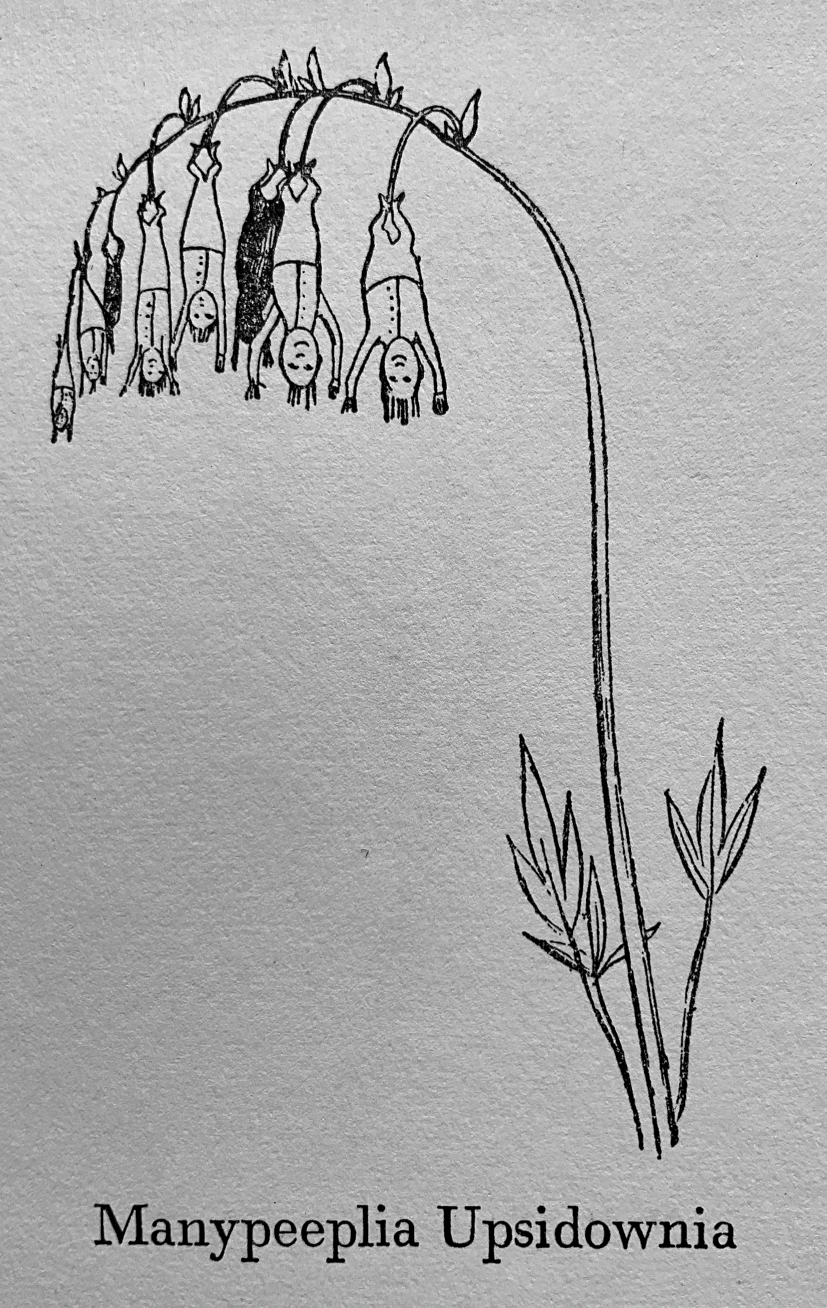
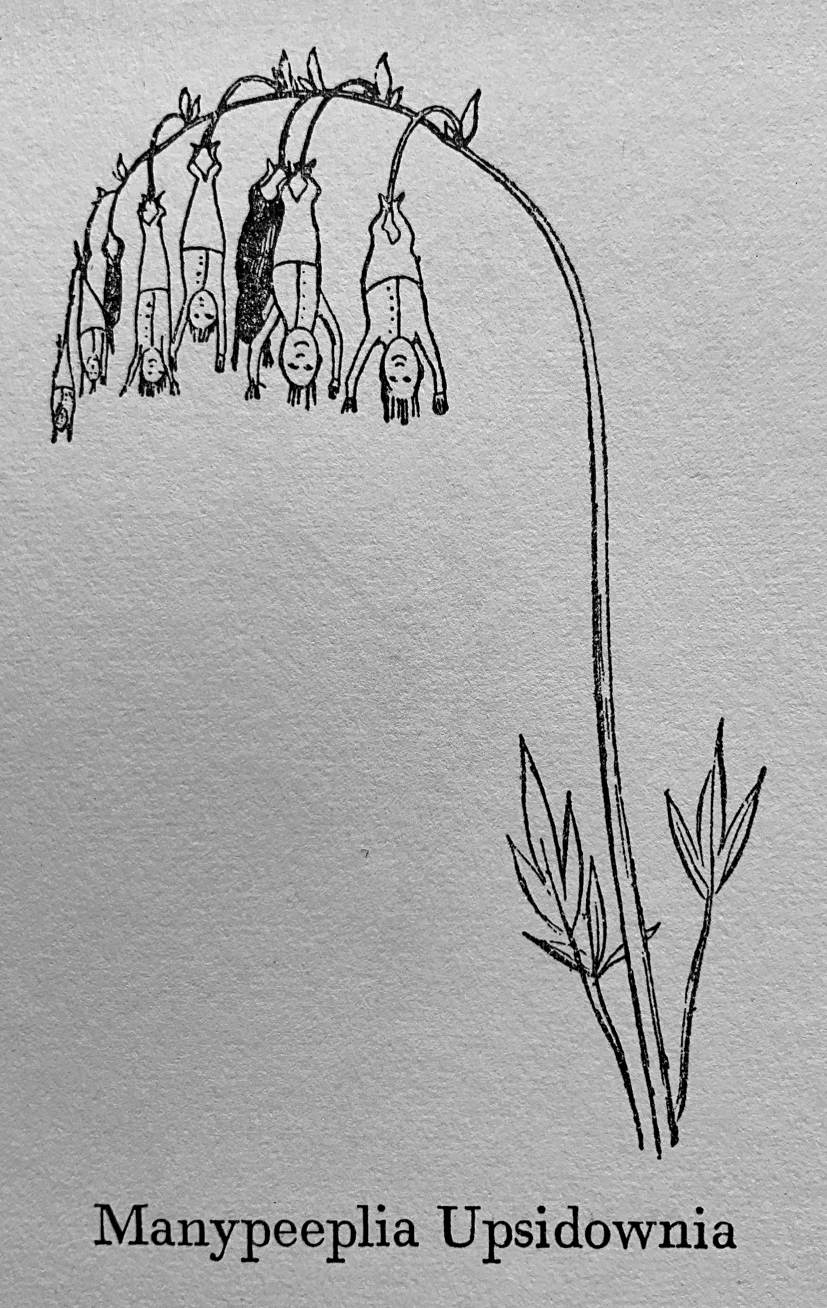
The relations between species, and between species and individuals who appear to be without a species – who are perhaps the last of their species – are indeed the dominant topic of Lear’s late work. All of his courtship narratives, like that of the Owl and the Pussycat, cross species lines.26 Parodies of natural histories of species abound, like the paragraph just quoted on the Clangle-Wangle. Beginning with his 1870 volume, Lear’s publications included nonsense botanies, with illustrations, of imaginary plant species, each with a name spoofing the conventions of Linnaean taxonomy. The supposed species are, however, radically hybrid, cobbled from beings and artifacts from altogether different taxonomic realms grafted onto a stem with leaves (Figure 3). The names Lear gives his invented species are moreover as hybridized as the nonsense plants themselves, typically combining English words with Latin case endings: “Manypeeplia Upsidownia.” Lear’s jokes about natural history are invariably also jokes about language.
Edward Lear, “Manypeeplia Upsidownia” (1871)
Lear’s imaginary creatures have surprisingly few literary antecedents – in a very different mode, these would include Swift’s Houyhnhnms and Yahoos. They belong to the nineteenth century, the era when species become historical agents. But they have many successors, ranging from creatures in Dr. Seuss and Maurice Sendak’s books to alien species in speculative fiction and fantasy. Like Lear’s creatures themselves, these imaginary beings are figures through which the biopolitical topics of species, population, race, adaptation, and ecology undergo literary and cultural mediation. These topics pervade Lear’s own writing. “The Jumblies” is another poem that describes its protagonists with a definite article, though it leaves it unclear what kind of group the Jumblies are – a family, a clan, a species? The poem begins:
Although the Jumblies have “friends,” these disappear in the poem’s odd, melancholy refrain, in which they are defined ethnographically – by their habitat and body markings (are these tattoos?):
Here the Jumblies appear as a population imperilled as much by their restricted habitat as by their unorthodox choice of watercraft.
“The Pobble who has no Toes” (1876) poses similar problems, although in this case the Pobble appears, initially, as an individual:
In the course of the poem, however, the Pobble does, as “they” warn, suffer the loss of his toes during a swim across the Bristol Channel. At its close, his Aunt Jobiska consoles him with “eggs and buttercups fried with fish” and with a piece of folk wisdom perhaps invented for the occasion: “It’s a fact the whole world knows / That Pobbles are happier without their toes” (49–50) – thus suddenly implying that the accident that has befallen her particular Pobble is not singular, but rather defines a type. “The Pobble” of the title would then no longer be an individual but a species, and the poem would read, as Matthew Bevis has put it, as a “just-so story” – a Lamarckian fable of species transmutation.27 Similar confusions are endemic in Lear’s poetry. The failed courtship narratives of the Yonghy-Bonghy-Bó and the Dong both feature characters who appear to belong to classes with one member. The Yonghy-Bonghy-Bó first appears (without the terminal accent) as the letter Y in an alphabet Lear composed in 1870; since alphabetization is a tool for classifying, his presence here along with “The Zigzag Zealous Zebra” (269) further emphasizes the anomaly of his status as the unique member of his own taxon.28
The anomaly of figures like the Yonghy-Bonghy-Bó and the Quangle-Wangle is most fully thematized in “The Scroobious Pip,” which Lear wrote in 1871 and 1872 but left unfinished. The poem resembles “The Quangle-Wangle’s Hat” in having as its protagonist a figure who belongs to no class of animals, but nonetheless mediates them all. In this poem, the form that contains all the animals is the song with which the poem closes, in which they all “roared and sang and whistled and cried” the name of the Scroobious Pip (98). Until this point, however, the poem’s topic is the unanswered question of where the Scroobious Pip fits in the animal kingdom. The question is posed first by the beasts, then by the birds, the fish, and the insects. The poem stages the enigmatic relation between the Scroobious Pip and its interlocutors as a relation between onomatopoeia and the nonsense syllables that mark the Pip’s speech as sui generis. Thus at the poem’s opening, the beasts assemble:
They agree that of them all the fox should
The Scroobious Pip, however, does not wait to be asked – at no point does it allow itself to be directly addressed – but rejects the terms of the question by responding at once “with a rumbling sound – / ‘Chippety Flip – Flippety Chip – / My only name is the Scroobious Pip’” (20–2). In succeeding stanzas, the birds assemble – “The Parrot chattered, the Blackbird sung” – and delegate the owl to ask the Scroobious Pip what it is – upon which it asserts “with a chirpy sound – / ‘Flippety Chip – Chippety Flip – / My only name is the Scroobious Pip.’” Similarly, it addresses the fish “with a liquid sound” and the insects with “whistly” one: “Wizziby wip – wizziby wip – / My only name is the Scroobious Pip” (88–90).
The nominalism of Lear’s poetry is evident in the Pip’s assumption that to ask what order of the animal kingdom it belongs to is to ask its name. In its answers to the animals, the Pip distinguishes itself from all of them, but also, by onomatopoeic echoes, identifies itself as a kind of universal animal. In this respect, the poem humanizes the Pip in accordance with an anthropocentric mythology that we will re-encounter in Rudyard Kipling’s Mowgli stories, where Mowgli becomes the only animal in the jungle who can speak to all the other animals in their own languages.
Neither this logic, nor the nominalism that Lear shares with radical Darwinists of the period, explains why the Pip alone of all the animals speaks nonsense.29 We don’t know who named it, though the name “Pip” shows the influence of Dickens’s Great Expectations, whose protagonist, Pip, begins the novel by naming himself.30 In any case, the Pip’s nonsensical name structures its nonsensical refrains, though which its “ip” sound echoes and rhymes, and where its character as a palindrome, reading the same backwards and forwards, is expanded into the ABBA structure of chiasmus: “Chippety Flip – Flippety Chip.”
Nonsense words enter Lear’s poetry after The Origin of Species, along with talking animals and what I have argued is a pervasive concern with questions of species and taxonomy.31 We have seen that Lacan refers to Lear’s nonsense in developing an account of language as constituted by the severing of the link between the animal and its call – the cat and its meow. But the example of “The Scroobious Pip” suggests that the antithesis between nonsense and onomatopoeia is less stable than Lacan would allow. While we know that the Pip can use onomatopoeia to mimic the voices of all the other animals, do we know that it has no call specific to itself? Its nonsensical name itself seems like an instance of automatism, and it may be that the Pip is only so called because it cannot help saying “pip” – just as the names of birds like the cuckoo and the whippoorwill derive from onomatopoeic representations of their calls.
As we saw in Romantic poetry, making language out of animal sounds involves a degree of violence; so too does the making of nonsense. Before we turn to an example of Lear’s nonsense deriving from onomatopoeia, let us examine some other examples. Among Lear’s quarries for nonsense words, as James Williams notes, were the languages of countries in which he traveled.32 Like his botanical names, words formed in this way can be hybrids, abusively attaching English lexical forms to words and fragments from other languages. “Scroobious,” for instance, was one of Lear’s favourite nonsense words and was the first to appear in print; he used it in a limerick in 1854. Williams has identified its source in an episode from Lear’s travels. While sketching in Albania, at the time a Muslim country, Lear was surrounded by villagers who, apparently scandalized by the forbidden act of visual representation, shouted at him the word “Scroo! Scroo!” In narrating the encounter, Lear gives the meaning of the word as “He writes it down! He writes it down!” Williams identifies “scroo” as deriving from shkrova, to write. Williams asserts that “scroo” for Lear was associated with “feelings of acute and nameless embarrassment.”33 Out of it, he made the adjective “scroobious.”
To make nonsense out of language may be a form of defence, an act of aggressive appropriation, or both.34 Two of Lear’s minor poems appropriate foreign words directly and demonstrate the comic violence involved in so doing. They are similar – one, from Lear’s diary in 1864, begins:
In this poem, the terms appropriated are Arabic (bulbul = nightingale; yashmak = veil); in a later poem, published in Laughable Lyrics in 1877, they are Hindustani:
Both poems inflict a jokey Orientalist violence on their source language, aggravated by the music-hall indecency of arbitrarily using foreign words to mean “bottom.”35
If Lear’s nonsense inflicts a certain campy violence on its materials, I want to close my discussion of his work by suggesting that this is not only its relation to foreign languages, but also to onomatopoeia. Few of Lear’s nonsense words derive from onomatopoeia, so one example will be all I can offer. As we saw in the case of Keats, where incorporating animal sounds into language was figured as an act of violence, sounds and their transcriptions don’t enter language without trouble.
“The Dong with the Luminous Nose” was the final poem composed for Lear’s last volume, Laughable Lyrics, in 1876, and it may be his most troubled published work. In the best reading it has received, James Williams begins by noting that it “is a poem full of sounds. In it, ‘the woods and valleys rang,’ the angry breakers ‘roar,’ the watchers ‘cry,’ the Dong’s pipe ‘squeaks.’”36 Like the Yonghy-Bonghy Bò and other characters we have discussed, the Dong’s name is given a definite article, making it the name of a class of which he seems to be the sole member. Like the Yonghy-Bonghy Bò too, the Dong features in a narrative of failed courtship, which, like the other courtships we have discussed in Lear, crosses natural-historical categories (even if nonsensical ones). Here as elsewhere in Lear’s late poems, moreover, the romance’s failure apparently dooms its protagonist to the existential solitude of being the last of his kind.
For Williams, the poem’s organizing trope is the echo. Besides echoing sounds, it is even more than most of Lear’s poetry full of echoes of other poems, Lear’s own above all: “The Dong” has “The Jumblies” as an intertext; its protagonist falls in love with a “Jumbly girl” who arrives with the other Jumblies in their sieve, and he is left desolate when they leave to continue their travels. The poem incorporates the Jumblies’ chorus in full, as well as echoing others of his works. Lear’s editor, Vivien Noakes, has identified a major source for the poem as Thomas Moore’s “A Ballad: The Lake of the Dismal Swamp” (1806), and also echoes of William Collins’s Persian Eclogues (1724) and Tennyson’s “The Lady of Shalott” (1832). Williams further notes recollections of Tennyson’s “Maud” (1855) and Matthew Arnold’s “Dover Beach” (1867); moreover, the poem is full of phrases like “awful darkness,” “rocky shore,” “midnight hour,” and “plaintive pipe” that had become clichés of sublime (or would-be sublime) poetry in the eighteenth century. The poem is written in the irregular stanzas that Collins and his contemporaries made conventional for the sublime or Pindaric ode.
Another feature of poetry in the sublime mode relevant to the setting of “The Dong” is reference to ancient and foreign place names – for example, from Asia Minor and Arabia. In Paradise Lost, among many others, Milton has Ternate and Tidore (2. 635) and “the barren Plaines / Of Sericana” (3. 437); closer to Lear, Shelley’s “Alastor” includes “the lone Chorasmian shore” as a setting, echoed by Matthew Arnold in “Sohrab and Rustum,” which has “the hush’d Chorasmian waste” (878). Khwarazm is a plain in today’s Uzbekistan and Turkmenistan, but for many of Shelley and Arnold’s readers, surely, the grand-sounding name might as well have been invented – as indeed Lear did invent the metrically similar “great Gromboolian plain” on which the Dong wanders, which reappears here from earlier poems. When he uses these poetic devices, Lear strips them of reference to transform them into nonsense – if not to suggest that they were nonsense already.
As it draws poetic devices into its ambit, then, Lear’s poem remakes or reveals them as nonsense. In this light, we can see it as built around a joke about the defunctioning of an onomatopoeia. “Dong” of course is one half of the conventional transcription of a bell’s sound: “Ding-dong.” As Williams notes, Lear uses “ding dong” and variants like “ding a dong” elsewhere in his poetry.37 Only here, however, does the dong appear without its ding.
Lear appropriates the onomatopoeia for nonsense by making it a name, changing it from a sign with a motivated relation to its referent to a signifier with an arbitrary relation to its signified. This appropriation, like the appropriation of foreign words, involves violence; in this case, the violence is castrative and motivates the comic phallic substitute with which the Dong provides himself in the form of a prosthetic nose:
“The Dong,” then, is a poem that allegorizes nonsense’s coming into being through the defunctioning of onomatopoeia; its protagonist personifies the mutilated figure of speech. As the Dong says in his only spoken words, “what little sense I once possessed / Has quite gone out of my head” (62–3). Alongside the poem’s self-reflexive concern with the genesis of nonsense, “The Dong with the Luminous Nose” also recapitulates concerns with population, exogamy, and migration we have seen to pervade Lear’s writing. As with other nonsense creatures in his work, it is uncertain whether the characters in this poem belong to distinct species, or races, or clans – but the poem nonetheless undoubtedly considers the Dong and the Jumbly Girl not as individuals, but as representatives of distinct populations, of which the poem provides a minimal ethnography. The relation between these two fields of concern, one poetic and the other biopolitical, will be the axis followed in the rest of this book. In Part II, I will focus on the work of Darwin, to carry out a symptomatic reading of the suspended reference his argument requires in key terms. In Part III, I will return to the literary representation of species and interspecies relations, setting these in the context of the histories of blood transfusion and of Victorian anthropology’s theorizing of totemism and blood relationship. The book’s closing sections will focus these concerns with reference to another nocturnal figure who, like Lear’s Dong, bears an ambiguous species identity and suffers the burden of confronting the end of its kind – Bram Stoker’s vampire, Dracula.
***
We have already encountered Thomas Hardy’s implication that the continuous life of species is inherently vampiric. Hardy rarely employs onomatopoeia, preferring to endow his animals with speech. We saw in “The Robin” how the appearance of onomatopoeia in the midst of a bird’s speech marks a moment of species identification that heralds its death. Hardy’s poetry is indeed haunted by an idea of species immortality identified with song, to which it repeatedly recurs, always in order to debunk or demystify it. In “The Selfsame Song,” as Daniel Karlin notes, Hardy recalls an idealizing line from Keats’s “Ode to a Nightingale”:39
Hardy refers to Keats in his 1922 poem, taking aim at Keats’s jump from the sound of a supposedly unchanging song to the idea of immortality:
In a rebuke to the theological basis of much Victorian nature writing, Hardy in “The Rambler” (1909) makes the self-undoing claim that he doesn’t even hear the birds whose calls his poem nonetheless records:
To sing in Hardy’s poetics is not to be immortal, but rather to be a ghost, not even heard until too late.
Rather than immortal voices, Hardy’s onomatopoeias typically record the sounds of inanimate objects. In “We Sat at the Window,” a 1917 poem in which he recalls his first marriage as a “waste” of “two souls in their prime,” he writes of a rainy day in July when “Each gutter and spout / Babbled unchecked in the busy way of witless things” (3–5). Onomatopoeias are the sounds of witless things, just as Lear’s Dong is deprived of sense. The onomatopoeia marks time in a scene from which meaning has either departed, or in which it will not be recognized except belatedly. Meaning does not come from sound; thus, for the two characters in “We Sat at the Window,” though the rain babbles in the gutter, the speaker says
Hardy’s poetry draws out the association between onomatopoeia and automatism that has concerned us throughout this chapter. In “The Clock Winder,” also from 1917, the sound of a clock measures out the empty time between a forgotten past and a longed-for future. The poem concerns a parish clerk who each night ascends the clock tower to wind “the rheumatic clock”:
The poem identifies the clock with its winder, who, it turns out, is also marking time in the dark:
In a late memory poem, “The Second Visit” (1928), onomatopoeias recording the sounds of machinery and of birds rhyme with each other, and equally function as a meaningless ground of unchanging sound, against which the poem at its close measures the change in the scene caused by the absence of a single speaking voice. The poem thus opens with an onomatopoeia for the sound of a mill wheel – “Clack, clack, clack, went the mill-wheel as I came” (1) – and registers the sound’s continuity over the years:
But in the poem’s final stanza, the poem distinguishes between the mechanical sound that remains the same and everything that has changed: it’s not the same woman or the same apples; the quack is the same, but the ducks have changed. Recalling Heraclitus, the poem notes that “it’s not the same drops that dash / Over the wet wheel” (10–11). Above all, the poem ends with quoted speech of the woman now missing from the scene: “‘You know I do!’” (12). The poem thus moves from the onomatopoeia of its first line to quoting an absent woman in its last, organizing itself around the contrast between the absent presence of a living voice and the persistence of the machine.
In this contrast, the duck’s quack is on the side of the machine, and I have argued in this chapter that its sameness is constituted by the poetic technique used to record it. Indeed, Hardy’s identification of onomatopoeia and the species concept that in the nineteenth century it came to underwrite with a machine is of a piece with the suspicion of onomatopoeia that we have traced back to the Romantic era. In the poetry we have read, an aesthetic of the particular is privileged over the representation of types, and this aesthetic drives the twin imperatives to expel onomatopoeia from poetic utterance, or to incorporate it. The classical tropes in which non-human animals behave as automata show a corresponding decline. As is well known, Hardy’s writing shows an exceptional sympathy for animal suffering, and this sympathy is manifest in his poetry’s portrayal of animals as capable of speech. We saw such a portrayal in “The Robin,” where, as in the poems of Minstrelsy, an animal endowed with speech cites its own call. In “The Robin,” this citation of onomatopoeia is a harbinger of death. Hardy poems where non-human animals speak include some that adopt complex verse forms, such as the triolets “The Puzzled Game Birds” and “Winter in Durnover Field” and the villanelle “The Caged Thrush Freed and Home Again,” all published in 1902.40 In all of these poems, the verse form constrains utterance by limiting the number of rhymes and by enforcing the repetition of whole lines. These poems, then, do not only endow birds with speech; they do so in a form that celebrates language’s power to escape arbitrary constraint, a theme literalized in the speaker’s escape from captivity in “The Caged Thrush.” Hardy’s 1928 elegy to Wessex the dog also endows an animal with speech – in this case, Wessex himself, who speaks from the dead to the humans with whom he had shared a home when living. Nothing in the poem suggests that they can hear or understand him; the gift of speech ironically does not enable the dog to communicate.
Earlier in Part I, I linked the trouble onomatopoeia causes in “The Robin” to Hardy’s suspicion of species identity. As we saw in “Sine Prole,” his suspicion of species, race, or family types as embodiments of a single continuous life is so intense that he celebrates his own childlessness as a sort of autogenocide. Particularly given that he contrasts the end of his own line with what he represents as the persistence of the collective racial life of the Jews, Hardy’s self-congratulation here is disquieting. The poem makes clear that for him – as for the imaginary creatures of Edward Lear and Bram Stoker – either rejection or acceptance of affinity with a family, species, or racial type takes place in a fully biopoliticized discursive field, so that the question of whether or not to have a child has become a question about the life or death of a population.

 Open access