




Introduction
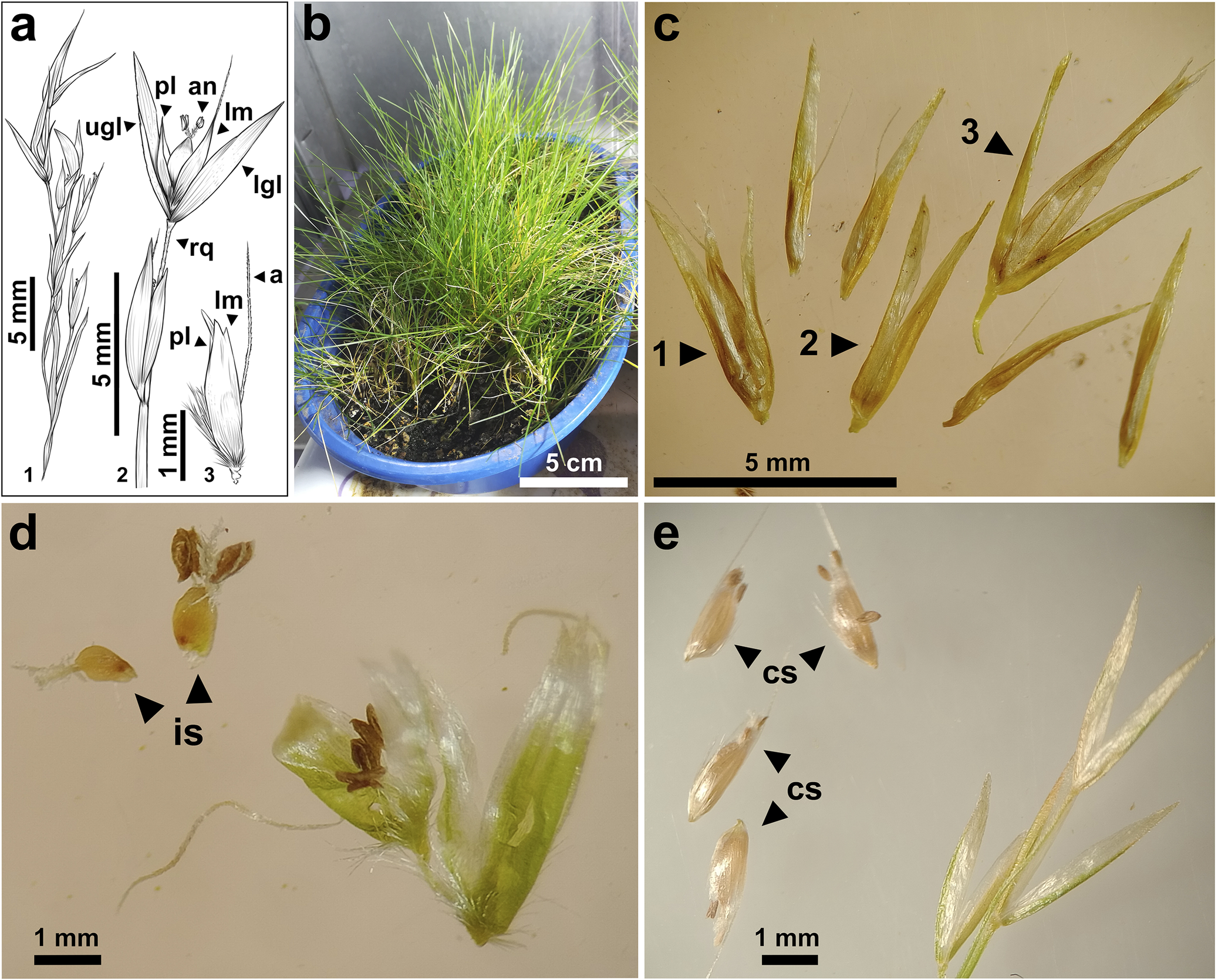
In the extreme conditions of Antarctica two native vascular plants are present, Colobanthus quitensis (Kunth) Bartl. (Caryophyllaceae) and Deschampsia antarctica Desv. (Poaceae), distributed along the western Antarctic Peninsula and the Scotia Arc archipelagos; both also occur in the sub-Antarctic and southern and Andean South America (Convey et al. Reference Convey, Hopkins, Roberts and Tyler2011, Convey & Biersma Reference Convey and Biersma2024). D. antarctica is a primary colonizer of proglacial areas exposed by glacial retreat and is used as a bioindicator of environmental changes (Kozeretska et al. Reference Kozeretska, Parnikoza, Mustafa, Tyschenko, Korsun and Convey2010). It is a perennial plant that reproduces both sexually and asexually, with its flowers grouped into inflorescences composed of spikelets containing one to three flowers (Fig. 1a; Giełwanowska & Kellmann-Sopyla Reference Giełwanowska and Kellmann-sophyla2015). The reproductive process occurs during the summer and is regulated by day length and temperature fluctuations (Holtom & Greene Reference Holtom and Greene1967). The reproductive strategy of D. antarctica relies on a combination of autogamy, including its extreme form cleistogamy, and the production of an excess amount of pollen to facilitate its pollination (Yudakova et al. Reference Yudakova, Tyrnov, Kunakh, Kozeretskaya and Parnikoza2016). Sexual reproduction by D. antarctica under controlled conditions is not a frequent phenomenon, with only one published report (Kunakh et al. Reference Kunakh, Twardovska, Andreev, Drobyk, Navrotska and Nuzhyna2023). In some Poaceae, vivipary can occur, a phenomenon characterized by seeds germinating and developing while still attached to the mother plant. Vivipary is considered an adaptive strategy in plants to ensure the survival of progeny in unfavourable or unpredictable environments (Beetle Reference Beetle1980, Elmqvist & Cox 1996). It has also been documented in sub-Antarctic species such as Acaena magellanica (Lam.), Phleum alpinum L. and Poa flabellata (Smith Reference Smith and Laws1984). Elsewhere, the phenomenon has been associated with photoperiod, temperature and environmental humidity, indicating that it is not a genetic feature (Beetle Reference Beetle1980, Milarska et al. 2021). Vivipary has not been previously reported in natural populations of D. antarctica; here, we report the first evidence of true vivipary in D. antarctica plants collected in Antarctica and maintained ex situ under the conditions of the Laboratorio de Biotecnología y Estudios Ambientales (LABEA) at the Universidad de Concepción. We further consider the factors that might have triggered this phenomenon.
Morphological features of Deschampsia antarctica. a. Diagram of plant and inflorescence. Numbers indicate (1) plant, (2) panicle and (3) floret. Arrowheads indicate parts of the panicle and antecium: arista (a), anther (an), lemma (lm), palea (pl), upper glume (ugl), lower glume (lgl) and rachis (rq). b. Specimens under common-garden conditions. c. Flowers at various stages of opening. Numbers indicate (1) closed flower with seeds, (2) closed flower without seeds and (3) open flower without seeds. d. Spikes with immature green florets and incomplete non-viable seeds (is). e. Spikes with open florets and mature complete seeds (cs).
Materials and methods
Plants of D. antarctica were collected from the South Shetland Islands near the Polish Arctowski Station (Thomas Point, Admiralty Bay, King George Island) in 2015 and 2023, and from Byers Peninsula (Livingston Island) in 2017 and 2023. The plants were maintained at LABEA in a growth chamber at 14 ± 1°C, under a 16/8 h light/dark photoperiod, with manual irrigation every 2 days. In April 2024, sexual reproduction was observed for the first time, including true vivipary. The number of spikelets, flowers per spikelet, total seeds and the percentage of seeds exhibiting vivipary were recorded. Seed viability was first assessed using an in vitro germination test, following the disinfection protocol of Kunakh et al. (Reference Kunakh, Twardovska, Andreev, Drobyk, Navrotska and Nuzhyna2023), on Murashige and Skoog medium (pH 5.7). Petri dishes were maintained in growth chambers at 20 ± 2°C with a 16/8 h light/dark photoperiod for 60 days. Non-germinated seeds were submerged in tetrazolium salts for 24 h at 25°C to evaluate their viability. Viable D. antarctica seeds collected from the field were used as a positive control. Seeds with red-stained embryos were considered viable, whereas unstained seeds were considered non-viable.
Results and discussion
Although LABEA has 14 years’ experience cultivating D. antarctica under ex situ conditions, this study represents the first evidence of its reproduction under controlled conditions and the development of true vivipary (Figs 1b & 2 & Table I). The presence of viviparism in D. antarctica represents the discovery of a new reproductive trait of the species, contributing to the knowledge of its biology within the family Poaceae. During 2023, two factors may have influenced the initiation of reproduction in this species: first, the plants were not pruned during the growth period that year; and second, a malfunction in the chamber caused a gradual temperature increase over 20 h, reaching a peak of 26°C that persisted for 12 h, which may have triggered reproduction in 2024. Reproduction was apparent when spikes were observed in plants from populations originating from both islands, displaying flowers in various stages of development (Fig. 1c) and immature to mature seeds (Fig. 1d,e).
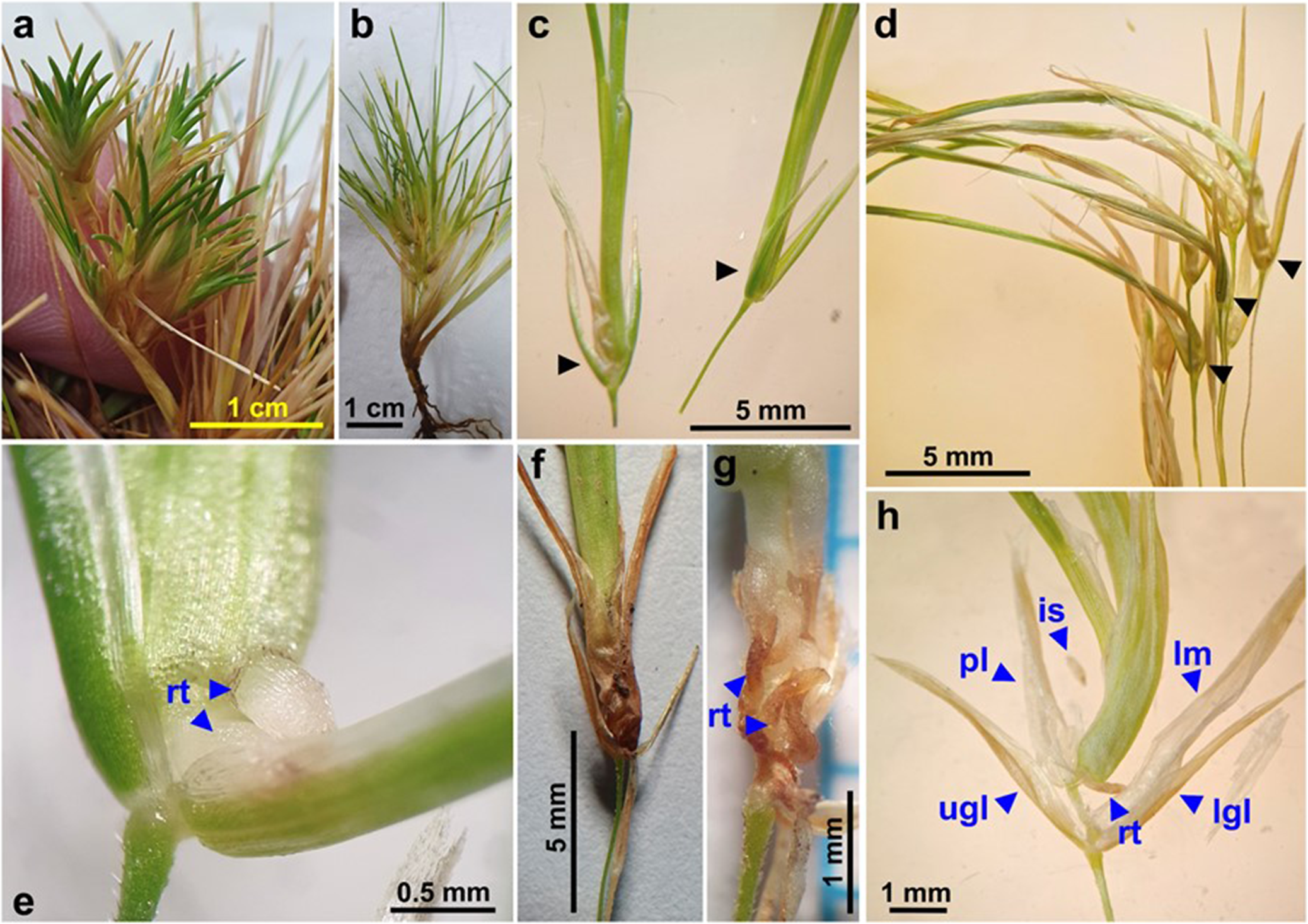
Vivipary in laboratory-grown Antarctic material of Deschampsia antarctica. a.–d. Whole plants or partial spikelets with signs of viviparity; black arrowheads point to the base of the spike where viviparity is observed. e.–h. Root formation in germinated plants attached to the parent plant: root formation (rt), lemma (lm), palea (pl), lower glume (lgl), upper glume (ugl) and incomplete non-viable seed (is).
Numbers of spikes and seeds of Deschampsia antarctica collected from the common-garden cultivation at the Laboratorio de Biotecnología y Estudios Ambientales (LABEA) in May and June 2024.
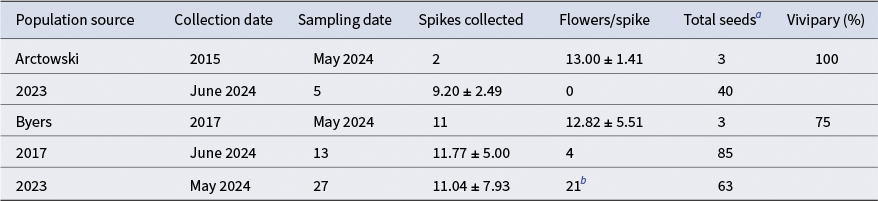
a Total number of seeds collected.
b 18 mature, 3 in formation.
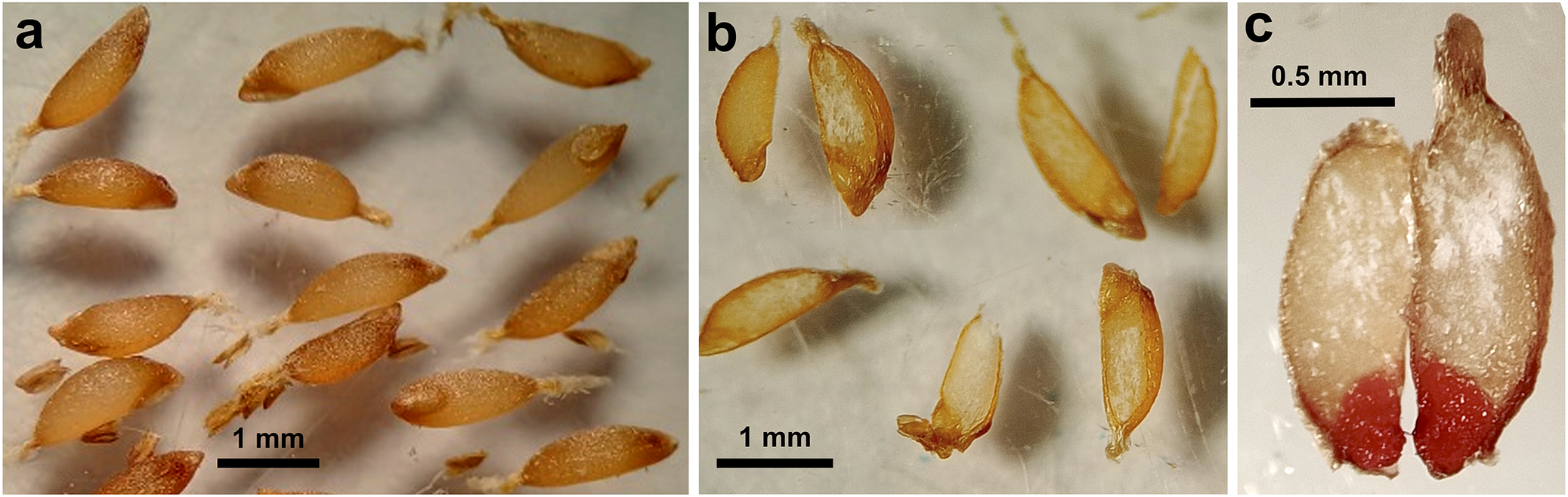
The spikes contained a total of 2–27 flowers, but seeds formed only in the three lowest flowers. The seeds were light amber in colour and averaged 1.4 mm in length (Fig. 3). Germination tests and the tetrazolium test confirmed that all seeds collected were non-viable. However, the presence of vivipary in these same spikes (Fig. 2) indicates that some seeds produced were capable of germinating. Under natural conditions, D. antarctica produces numerous seeds, many of which are either non-viable or dormant (Holtom & Greene Reference Holtom and Greene1967, Kellmann-Sopyła & Giełwanowska Reference Kellmann-sopyła and Giełwanowska2015), requiring cold stratification or gibberellic acid to germinate under temperature ranges of 5–18°C (Giełwanowska & Kellmann-Sopyła 2015, Kunakh et al. Reference Kunakh, Twardovska, Andreev, Drobyk, Navrotska and Nuzhyna2023), and unpublished observations from LABEA report germination at the slightly higher controlled temperature of 20 ± 2°C.
Seeds of Deschampsia antarctica. a. Seeds collected from plants in growth chambers. b. Non-viable seeds after the tetrazolium test, no colouration observed. c. Control seeds of D. antarctica, viable seeds with red colouration.
In the spikes exhibiting vivipary, the glumes remained green. One seed germinated within the spikelet while another remained attached at the base. The viviparous seedlings developed small roots with remnants of the germinated seeds occasionally attached to their base, along with fragments of the lemma and palea from the flower to which they belonged (Fig. 2). Vivipary can be caused by hybridization, polyploidy, malformations or environmental factors such as high humidity (Beetle Reference Beetle1980). This new discovery expands the set of adaptive strategies of D. antarctica, suggesting that the presence of vivipary may contribute to the species’ survival in Antarctica. Vivipary has also been detected in other species adapted to cold climates, such as the native Antarctic plant C. quitensis (Ontivero et al. Reference Ontivero, Cuba-Díaz, Fuentes-Lillo and Convey2024) and the glacier foreland plant Poa alpina (Erschbamer Reference Erschbamer2007), in regions where reproductive success is strongly influenced by extreme environmental conditions. Studying the factors that drive spike formation and vivipary is essential for understanding the reproductive mechanisms of this species and its adaptation to extreme conditions. Additionally, this knowledge could improve propagation strategies and reduce the need for field collection, promoting the use of material grown under controlled laboratory conditions.
Conclusions
Our observations indicate that, under controlled conditions in growth chambers, it is possible to obtain D. antarctica flowering spikes with seeds. Although the germination and tetrazolium test suggested that these seeds were non-viable, the presence of vivipary confirmed that some seeds are capable of germinating. Vivipary occurred in D. antarctica plant populations deriving from natural populations collected on two different islands. Additionally, plants germinating on the mother plant were able to produce their own spikelets with seeds. The factors inducing true vivipary in this species are currently unclear and require further research.
Acknowledgements
The authors thank the Colección Activa de Plantas Vasculares Antárticas at the Universidad de Concepción, campus Los Ángeles 2023000418ESP-VRID. Peter Convey is supported by National Environmental Research Council (NERC) core funding to the British Antarctic Survey’s ‘Biodiversity, Evolution and Adaptation’ Team.
Financial support
This work does not have financial funding.
Competing interests
The authors declare none.
Author contributions
MC, DN-C and MC-D: conception, approach and execution of the experimental findings. MC: design of the flowering scheme (Fig. 1a). MC, YO and DN-C: preparation of figures. MC, YO, DN-C, PC and MC-D: drafting of the initial manuscript and revision of the final article.


 Open access

