


Introduction
Plastic pollution is an overwhelming issue affecting all places on the globe. It is a complex ‘wicked problem’ (Schofield Reference Schofield2024) that requires interdisciplinary work and international collaboration to develop solutions for the series of consequences and threats it poses. Archaeology can contribute to understanding plastic pollution, not least by recording plastics that enter the stratigraphy of sites archaeologists work on (see Praet Reference Praet2024a). The theoretical developments and frameworks of archaeology can also contribute to offering a different approach on this overwhelming material culture. In that perspective, this study used object itineraries (after Joyce Reference Joyce and Shankland2012a, Reference Joyce, Geurds and Van Broekhovenb; Reference Joyce, Joyce and Gillespie2015) to undertake story-writing workshops about marine plastic litter (MPL). The study took place in Galapagos, an archipelago located around 1000 km west of mainland South America and valued worldwide for its unique biodiversity and landscapes at the core of its inscription as UNESCO World Heritage Site since 1978. Despite the remote nature of the archipelago, the global connectivity of Galapagos through time (Hennessy Reference Hennessy2019), along with an increasing population living and visiting the islands, have contributed to a series of anthropic threats to the archipelago (Alava et al. Reference Alava, McMullen and Jones2022) including plastic pollution.
Plastic pollution in Galapagos
The issue of marine plastic pollution in Galapagos is addressed by different disciplines. Oceanography has contributed to identifying potential sources and pathways (van Sebille et al. Reference van Sebille, Delandmeter, Schofield, Hardesty, Jones and Donnelly2019), while marine biology has helped determine the threats to local wildlife (Jones et al. Reference Jones, Porter and Muñoz-Pérez2021; Muñoz-Pérez et al. Reference Muñoz-Pérez, Lewbart and Alarcón-Ruales2023). Several initiatives on the islands contribute to a plastic-free archipelago offering both preventive (i.e. avoiding plastic entering the environment) and reactive (i.e. addressing plastics already in the environment) solutions.
The archipelago receives marine plastic litter (MPL) from mainland South America, regional marine sources and local sources. With Galapagos being at the confluence of several currents, including the Humboldt and Panama currents, the islands are exposed to receiving the MPL which they carry. Computer modelling of floating microplastic on oceanic currents estimated that Galapagos receives MPL from mainland South America, notably Ecuador, Peru and Colombia (van Sebille et al. Reference van Sebille, Delandmeter, Schofield, Hardesty, Jones and Donnelly2019). These models suggest that the plastic's journey from coastal South America lasts a few months and that currents do not carry MPL to Galapagos from farther afield (van Sebille et al. Reference van Sebille, Delandmeter, Schofield, Hardesty, Jones and Donnelly2019). Monitoring of plastic density found that windward shores on Galapagos (Muñoz-Pérez et al. Reference Muñoz-Pérez, Lewbart and Alarcón-Ruales2023; Sánchez-García & Sanz-Lázaro Reference Sánchez-García and Sanz-Lázaro2023) and east-facing beaches exposed to the Humboldt current (Jones et al. Reference Jones, Porter and Muñoz-Pérez2021) received higher macroplastic quantities. But western shores also receive MPL, mostly from local sources within the marine reserve (Ypma et al. Reference Ypma, Bohte, Forryan, Naveria Garabato, Donnelly and van Sebille2022). Hard plastic fragments were the most common objects, followed by fishing-related items and plastic beverage bottles on 20 remote shorelines across the archipelago (Muñoz-Pérez et al. Reference Muñoz-Pérez, Lewbart and Alarcón-Ruales2023). Bottles primarily had labels from Peru, Ecuador and China, branded from the AjeGroup, the Coca Cola Company and Tingy Holding Corporation (Muñoz-Pérez et al. Reference Muñoz-Pérez, Lewbart and Alarcón-Ruales2023). Several studies identified fishing industries, notably Asian, as important contributors to the issue of marine plastic pollution (Muñoz-Pérez et al. Reference Muñoz-Pérez, Lewbart and Alarcón-Ruales2023; Sánchez-García & Sanz-Lázaro Reference Sánchez-García and Sanz-Lázaro2023). The importance of mainland and marine sources coincides with the estimates of minor (land) local input provided by Jones et al. (Reference Jones, Porter and Muñoz-Pérez2021) for San Cristobal. When it comes to microplastic pollution, the levels do not seem to be proportional to macro- and mesoplastic quantities, suggesting that microplastics reach the archipelago already fragmented (Sánchez-García & Sanz-Lázaro Reference Sánchez-García and Sanz-Lázaro2023).
Impacts of MPL constitute one of the main challenges for the archipelago. When it comes to bio-ecological impacts, Galapagos wildlife is threatened by MPL, with 52 marine species identified through Citizen Science monitoring as at risk from ingestion and entanglement with plastic (Muñoz-Pérez et al. Reference Muñoz-Pérez, Lewbart and Alarcón-Ruales2023). Microplastic was found in seven marine invertebrate species, confirming that ingestion of plastics occurs in and around the archipelago (Jones et al. Reference Jones, Porter and Muñoz-Pérez2021). MPL also triggers a series of socio-economic impacts, with Galapagos marine activities being affected by plastic waste at sea. Marine plastic litter can cause collisions with local fishing vessels, damaging the boats and causing economic losses to fishers (Llerena et al. Reference Llerena, Avila-Santamaria, Gabela, Purca, Mena and Cárdenas2025). In Galapagos, Fish Aggregating Devices (FADs) pose a threat to wildlife and to the safety at sea of local fishers (Galapagos Conservation Trust 2024). However, impacts on Galapagos tourism and the livelihoods of local populations remain to be fully considered and studied.
A wide range of solutions are being explored to reduce plastic consumption and pollution in Galapagos. Reactive solutions include transforming plastic waste into art to raise awareness (e.g. a sculpture of cigarette butts by Miguel Andagana), jewellery (e.g. Precious Plastics) and building materials (Plastic Bricks Project by Funcavid). The Galapagos National Park Directorate (GNPD) also leads the Coastal Cleanup Programme in coordination with other organisations such as Conservation International, Frente Insular, EPI/ECOS, the National Navy, the local fishing sector, the Surf Club, TUNACONS, and other local initiatives. The use of virtual models of macroplastic movement is also being explored to identify areas where clean-ups are most needed (Ypma et al. Reference Ypma, Bohte, Forryan, Naveria Garabato, Donnelly and van Sebille2022). Preventive solutions include offering alternatives to avoid plastic use such as implementing water refill stations on the archipelago and offering more sustainable options in local businesses (e.g. Iguana Cups being reusable plastic cups). The projects ‘+Vida – Basura’ [More life, less waste] and ‘Sin plástico sabe mejor’ [Without plastic, it tastes better], both led by the GNPD, also focus on reducing plastic use. Materiom and the University of Exeter are developing biodegradable bioplastics made from locally sourced natural ingredients. Their use will be explored to offer an alternative to the most used plastics in Santa Cruz. Several youth movements (‘Tibu Embajadores’, ‘Molas’, ‘Manitos in Acción/Jóvenes en Acción’, ‘GECO’, among others) try to raise awareness of the issue through educational activities.
Despite this interest in the topic and the existence of programmes to address plastic pollution (Pacific Plastics: Science to Solutions – PPSS; Plastic Free Galapagos Programme – PFGP), several issues remain in identifying major contributors to MPL, more specifically differentiating between marine and mainland sources for domestic items that could come either from continental Ecuador or from stationing marine vessels. In that perspective, archaeology proves particularly helpful as a discipline focusing on re-constructing artefact itineraries (Joyce Reference Joyce, Joyce and Gillespie2015), questioning the origin, pathway and use of these objects. With the global presence of plastic turning the latter into a topic of interest for archaeologists, either as components of drift matter (Pétursdóttir Reference Pétursdóttir2020), as modern material culture (Wooten Reference Wooten2023), or as topics of narratives (Schofield et al. Reference Schofield, Wyles, Doherty, Donnelly, Jones and Porter2020), this study explores the use of an archaeological framework to approach local perceptions of MPL.
Contemporary archaeology, object itineraries and story-writing workshops
Formally established in the 2000s (see Harrison & Schofield Reference Harrison and Schofield2010), contemporary archaeology (successively called ‘archaeologies of the contemporary past’ by Buchli & Lucas Reference Buchli and Lucas2001; ‘contemporary archaeologies’ by Holtorf & Piccini Reference Holtorf and Piccini2009; ‘archaeology of the contemporary world’ by Graves-Brown et al. Reference Graves-Brown, Harrison and Piccini2013, among others) addresses the record of the recent past, and is therefore best placed to consider plastic pollution an object of study (see Praet Reference Praet2024a). The discipline has broken barriers of quantitative research to include, almost systematically, also a consideration of the qualitative nature of the record, particularly when facilitated by this record being entangled in living memory. Approaches of co-creation and the consideration of people's relationships and attitudes towards heritage (e.g. Castell Henllys by Mytum & Meek Reference Mytum and Meek2020), archaeological sites (e.g. archaeology and homelessness in the UK by Kiddey Reference Kiddey2017), modern material culture (e.g. LEGO and PEBE toys by Merrill Reference Merrill, Godin, Pétursdóttir, Praet and Schofield2024) and even waste (e.g. The Garbage Project by Rathje & Murphy Reference Rathje and Murphy2001) have marked the development of the discipline and have been included as a way to inform the sites and objects under study.
Story-writing workshops were developed as archaeological interventions, combining the archaeological concept of object itineraries with a narrative approach common in qualitative research (Savin-Baden & Howell Major Reference Savin-Baden and Howell Major2013). Plastic objects can have their journeys and stories, ones that can be reconstructed through theoretical frameworks such as object itineraries. While object biographies show considerable limitations with the parallel to human life, we here use itineraries as theorized by Joyce (Reference Joyce and Shankland2012a, Reference Joyce, Geurds and Van Broekhovenb; Reference Joyce, Joyce and Gillespie2015). Itineraries can ‘reveal the effects of things in motion without demanding that we reduce things to the status of quasi-human agents’ (Joyce Reference Joyce, Joyce and Gillespie2015, 29) which is particularly important for plastics at the interface of humans and non-humans. We combine this framework with narrative research to study perceptions as ways in which one makes sense of the world (see Praet et al. Reference Praet, Baeza-Álvarez and De Veer2023a). We use qualitative research to analyse stories through a narrative approach, building on social constructivism (as one of the philosophical paradigms for qualitative research in Savin-Baden & Howell Major Reference Savin-Baden and Howell Major2013) and quantitative research through surveys to investigate how young people in Galapagos construct meaning and knowledge about MPL. We were particularly interested to work with young people in Galapagos as their views are barely represented in the literature. Schoolchildren have also proved to be a particularly good audience for story-writing exercises (Aerila et al. Reference Aerila, Rönkkö and Grönman2016; Fanini & Fahd Reference Fanini and Fahd2009) and particularly concerned by the topic of marine litter (Hartley et al. Reference Hartley, Thompson and Pahl2015). This activity acts as a comparison to a study published on the East Pacific Coast (Praet et al. Reference Praet, Baeza-Álvarez and De Veer2023a). In the Pacific study, the story-writing workshops were designed during the Covid-19 pandemic to engage students on the topic of marine litter during lockdowns. While participation was optional and individual, the activity proved to increase PEBs and to be enjoyable for participants to reflect on environmental topics. Perceptions of MPL sources, impacts and solutions were evaluated alongside the surveys, showing a good understanding of local sources, a preoccupation for bio-ecological impacts of MPL and reliance on recycling behaviour as a solution.
In the present study, the archaeological framework, that of object itinerary, proved particularly useful to engage students on the topic of MPL, allowing them to look carefully at the objects and consider the geographical and temporal span of their journey, which particularly fitted the global and ubiquitous nature of MPL in Galapagos. Students explored this idea in the stories they produced, considering the interactions of the object with non-humans, how it contributed to broader landscapes of the archipelago, and the complexity of the itinerary among other elements (see Praet et al. Reference Praet, Guézou, Schofield and Tamoria2023b). Archaeology played an active role in the workshop initial presentation (about five minutes), starting by asking students what they thought archaeology was, and how it could help in understanding marine plastic pollution. While very familiar with biology, participants seemed to have been little exposed to archaeology and were curious about the way it could be used to address contemporary issues. No participant questioned the link between archaeology and plastics, as the transferrable approach to reconstructing an object's itinerary was quickly grasped. Adopting an archaeological framework, this paper offers an analysis of stories’ content and of surveys to address perceptions and the impact of the workshop on participants.
Workshops as archaeological interventions: a method
Recruitment and participation
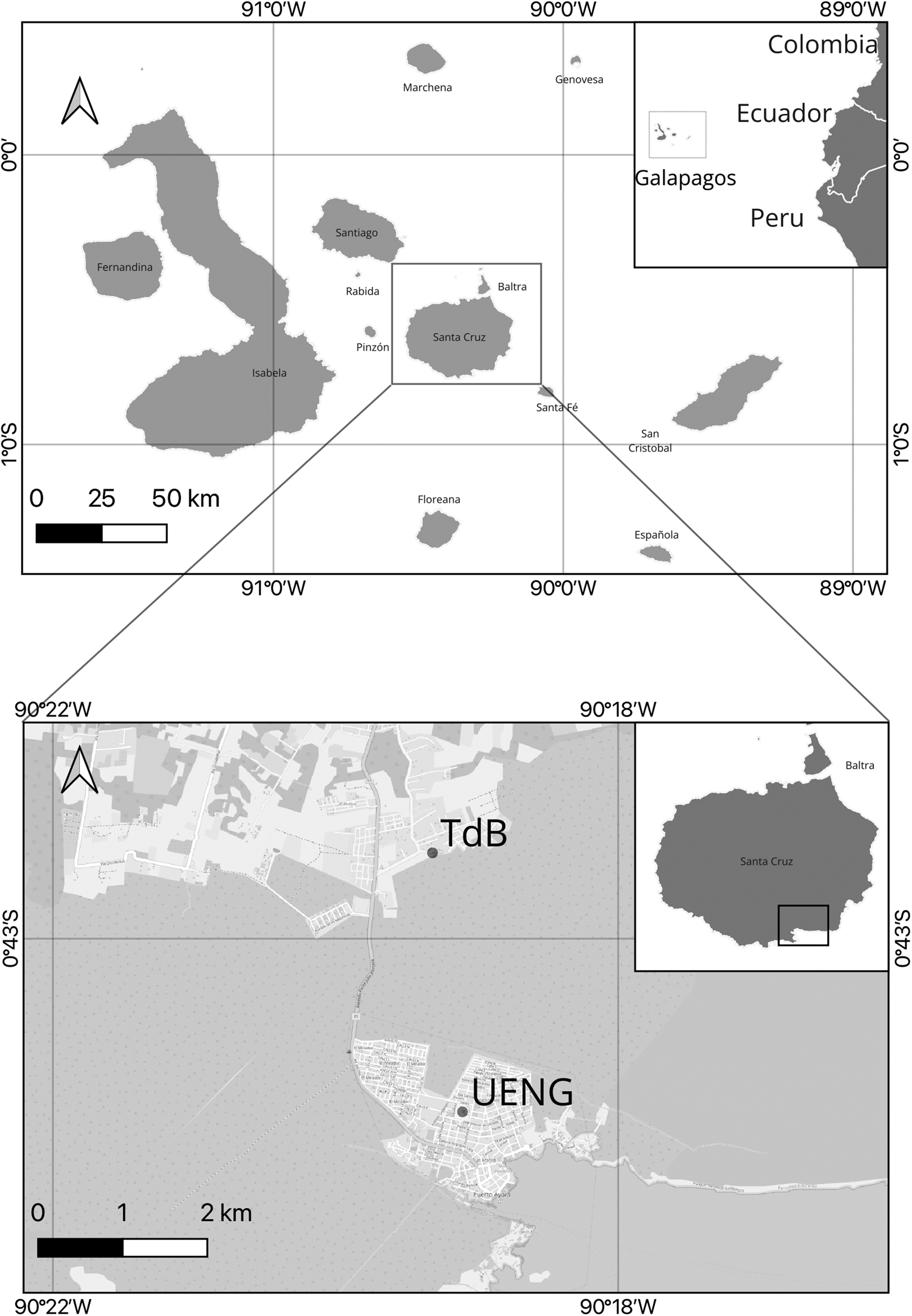
We undertook the activity with two schools, Colegio Tomás de Berlanga (TdB) and Unidad Educativa Nacional Galapagos (UENG) in Puerto Ayora on Santa Cruz Island (Fig. 1). Over 330 students, aged between 12 and 22 years old, participated in the activity.
Map of the two participating schools (Tomas de Berlanga-TdB and Unidad Educativa Nacional Galapagos-UENG) in Puerto Ayora on the island of Santa Cruz.
Activity
The activity was designed and undertaken by both authors, who are aware that their positionality may have influenced data collection and analysis (see Supplementary Appendix 1 for their positionality statements). Workshops were inspired by the online activity of story-writing designed by a collaborative team on the Eastern Pacific during the Covid-19 lockdowns in 2020 (Praet et al. Reference Praet, Baeza-Álvarez and De Veer2023a). In August 2022, we organized two workshops developed using an archaeological framework to understand marine plastic pollution in the archipelago better. After an introduction defining archaeology, we presented a MPL object to the students to get them to think about the journey that this artefact might have taken. Then, they were put into groups and each group/student (depending on the class size) was assigned an object from a series of 11 objects collected in previous coastal clean-ups and representing recurrent and easily identifiable MPL. They were asked to answer a series of questions about it:
1) What is the object?
2) How old is the object?
3) Where is the object from?
4) How was the object used, and by whom?
5) How did the object enter the environment?
6) How did the object interact with the environment?
7) What actions might have prevented the object from entering the environment?
These questions served as a guide to help the students reconstruct the itinerary of the object as a story, illustrated or not, or as a comic. Participants had to observe the object carefully to gather relevant information and were then invited to write a story individually about the object's itinerary and hand it in at the next workshop.
Surveys
A pre- and post-survey aimed at evaluating a) self-assessed knowledge (how much each student knew about marine litter and if they knew how to prevent it); b) perceptions of origins and impacts of MPL (if marine litter comes from domestic activities, distant areas or fishing activities; if marine litter has impacts on beach aesthetics, on wildlife and on human health); c) self-reported pro-environmental behaviours (PEBs) (picking up litter, recycling, reducing plastic use, influencing the community and influencing friends and family); and d) feedback on the activity (how much they liked the activity and how likely they were to recommend it) (see Praet et al. Reference Praet, Baeza-Álvarez and De Veer2024 for a guide to organizing the activity). Answers were proposed on a Likert scale and results between the pre-and post-surveys were compared to evaluate the activity's impact. For a more robust comparison, questions were taken from Praet et al. (Reference Praet, Baeza-Álvarez and De Veer2023a) with questions on the origins and impacts slightly modified to reflect the specificity of the issue in Galapagos.
Analysis
The study gathers two lines of evidence—stories and surveys—as we are convinced that multiple lines of evidence are needed to address perceptions. We gathered 137 stories, including written stories without drawings (N = 100; 73%), illustrated stories (N = 25; 18%) and comics (N = 12; 9%), suitable for analysis (with consent and offering an itinerary of a plastic object presented in the workshop). As most stories contained no drawings, the analysis and report of the results mirrors this trend and does not explore how drawings can contribute to engaging differently on this given topic. In this project, narrative is considered as a research approach as well as a research product, and offers both data to analyse and a way of understanding human experience (Savin-Baden & Howell Major Reference Savin-Baden and Howell Major2013, chapter 15). Yet we recognize the limitations of narrative analysis, especially as creating a story calls for participants’ imagination and reflection on what makes a story more engaging, and may therefore not be a direct representation of their perceptions. It should be noted that archaeology also contains its limits when it comes to reconstructing the MPL itineraries, and we invited participants to explore and postulate what could have happened to the objects during their journey. With this in mind, EP undertook the qualitative analysis in NVivo, using deductive coding strategy, by adapting the codebook used in our previous study (Praet et al. Reference Praet, Baeza-Álvarez and De Veer2023a) for better comparisons between the two projects, the other project involving schools distributed along the East Pacific coast (see Supplementary Appendix 2 for the coding strategy). For a thematic analysis using inductive coding on the topic of object itinerary, see Praet et al. (Reference Praet, Guézou, Schofield and Tamoria2023b). We received 161 surveys with parental and student consent. As the data were non-parametric (Likert scale type data), a Wilcoxon signed rank test for paired samples was conducted for the 21 questions appearing both in the pre- and post-survey. We used a pair-wise approach to clean the data (see Supplementary Appendix 3).
Results
Only the most recurrent codes are reported in our results section (for a full description of the codes, their occurrence, and the percentage of the dataset the occurrence represents, see Supplementary Appendix 4).
Stories
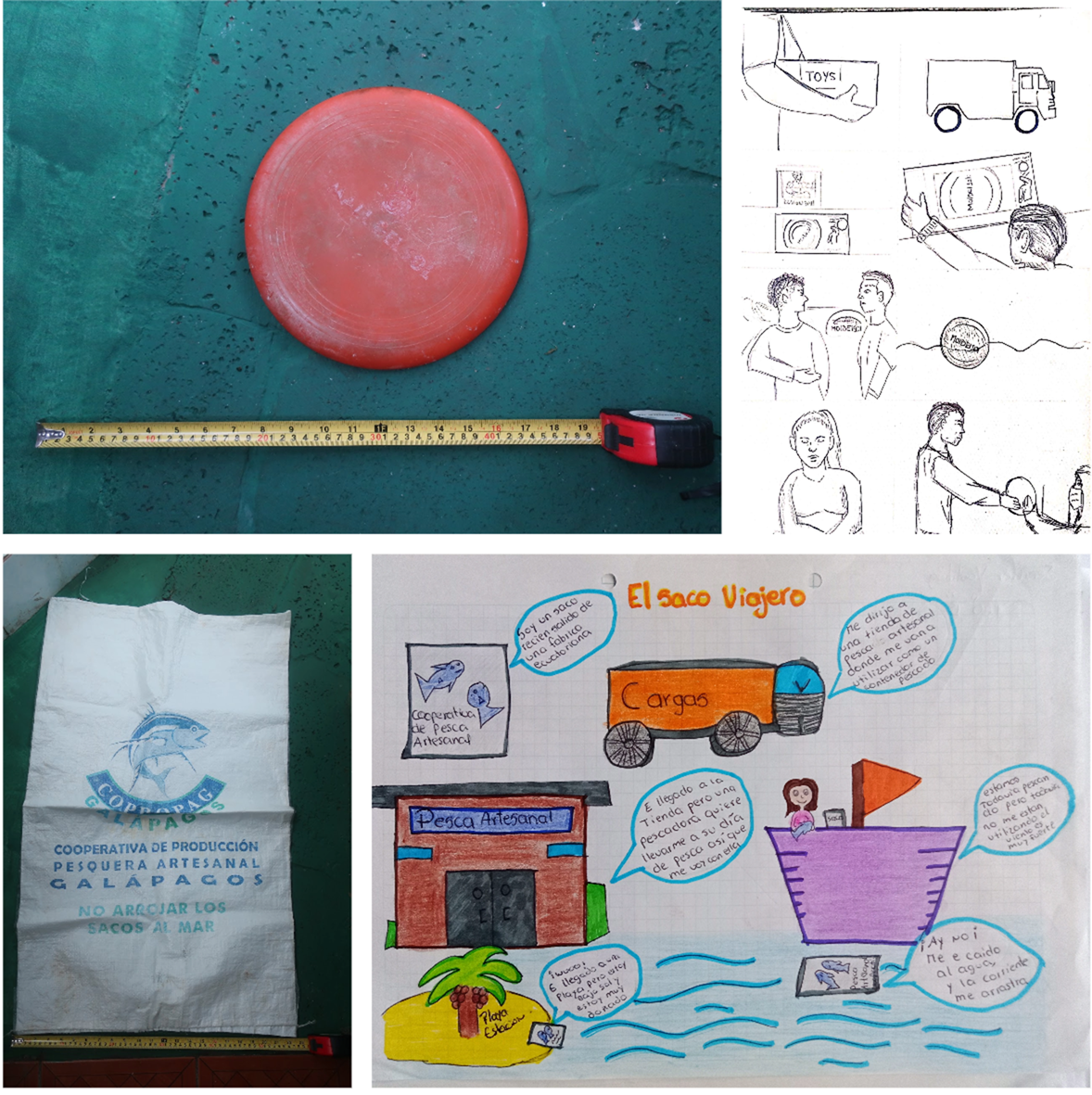
Of the 11 objects presented to the students (see Praet et al. Reference Praet, Guézou, Schofield and Tamoria2023b) five received most attention: the fishing sack with Chinese label, two PET bottles (one from Nongfu Spring and the other from 220V), the Copropag fishing sack and the bucket (Fig. 2). The length of use mentioned in stories varied with objects being used between days and months, less than a day and more than a year. Stories indicated that objects were most often used by adults instead of by children and teenagers. When in use, the object showed equally negative feelings, such as impatience e.g. I can say that it was a bit frustrating to be in a place or shop window waiting to be chosen before being consumed, and positive emotions, such as happiness e.g. Féngbao was happy because it finally finished its reason for living and would go back to wherever all the other bottles came from.
An example of the frisbee (above) and the Copropag fish sack (below) used in the workshop as a basis for comics drawn by local students tracing the object's itinerary.
Sources and pathways
Stories included information regarding the process through which the object becomes waste, contributing sectors and factors, as well as the emotions felt by the object and by the person intentionally or accidentally discarding it.
As stated previously, there are different pathways for an object reaching Galapagos shores. When specified, almost 70% of stories included differing start and end points, confirming that the object had travelled. For stories that had the same start and end location, 15 did not suggest that the object had travelled while two did. As the object's journey was often a global one, participants mentioned different geographical areas in the stories, notably Galapagos in 60% of the stories, mainland Ecuador in 30% and China in almost 25%. When it came to locations, the object as a product was described on a boat in almost half of the stories, followed by in an industry, on a beach and/or in a shop.
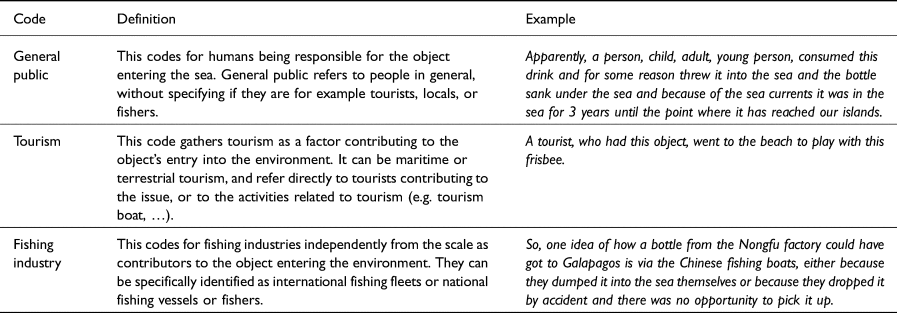
Stories mentioned several sectors contributing to the object's entry into the environment (Table 1). These are, in order of occurrence, fishing industries either national or international, tourism, and the general public. Almost half of the stories described natural factors contributing to the objects becoming waste and their journey, with currents and wind being the most recurrent. Human behaviour leading to object disposal was specified in 119 stories. This behaviour was accidental for almost 60% of the stories: forgetting the object or losing it to strong natural factors, e.g. While the boy was playing with the toy, a very, very big wave appeared and frightened the boy so much that he ran away leaving the toy behind with the waves, but could be intentional, for 33% of the stories, such as purposefully throwing the object away, e.g. After drinking it, he threw the bottle into the sea.
Examples of the three main sectors contributing to the object
Almost 75% of the stories were told from an external perspective, but some took the object's or an individual's perspective. Only 24 stories assigned an emotion to the person disposing of the object, that could be indifference or thoughtlessness (Supplementary Appendix 5). Even fewer stories, only 17, included an emotion associated with the object as waste. These were negative for 16 stories, including sadness—e.g. Bucket and Uma lived together for a long time and when they exchanged stories of their former life, Bucket remembered the times when Antonio used to play with it and became a bit sad—and powerlessness—e.g. I remember spending two months at sea, sad and useless at the same time, but also various animals such as dolphins, boobies and seals playing with me as if I were a ball—among others. Only three stories suggested a positive emotion of the object as waste, e.g. Finally! I was useful again … I am happy to be part of recycling.
Impacts
In the stories, the long journey of the object was marked by interactions with wildlife, often fish and turtles, and with humans. Those interactions, often harmful in the stories, could have a series of consequences for wildlife, for the object itself and for the surrounding environment.
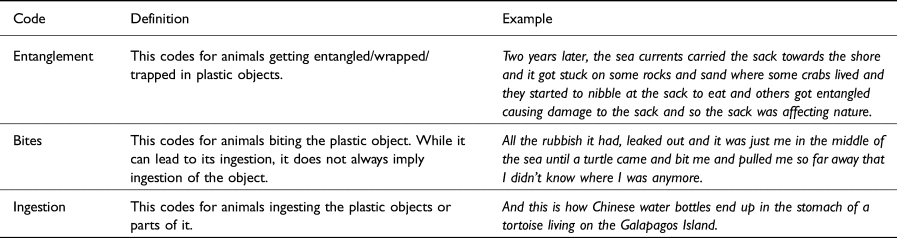
When specified, the journey taken by the object was described as taking more than a year (N = 25; 18.2%), months (N = 17; 12.4%), or days (N = 9; 6.6%). This journey noticed interactions with animals in 52 stories, most often with fish—e.g. The little fish were swimming calmly and feeding when they suddenly observed that some small white pieces begin to fall from the surface, they thought it was food—and turtles—e.g. Well, that was until a sea turtle swam by and I managed to get tangled on one of its frontal fins. Galapagos endemic species were identified in a couple of stories, such as marine iguanas, sea lions and some native bird species such as boobies, pelicans and frigatebirds. Interactions between plastics and animals could be harmful in over 20% of stories (Table 2), such as ingestion, bites and entanglement, and non-harmful (Supplementary Appendix 6), such as overgrowth, use of the object as a shelter, or a dialogue between the object and the animal. Alternatively to describing those interactions, 18 stories recognized the potential impact of MPL's presence on the environment.
Three main harmful interactions identified between plastic and animals
During its journey as waste, the object interacted with humans in 58 stories. Most often, these were participants in litter-picking, professional and Citizen scientists, and students during the workshop. They most often acted and picked up the waste, sometimes studying it. Only three stories depicted individuals indifferent to the waste, noticing its presence without acting. The outcome of the interaction between humans and MPL was only noted in 11 stories when the object was recycled, reused, or disposed of. The object as waste ended up stranded on a beach in almost 60% of the stories, in a school-inspiring activity about plastic pollution, or in an animal's stomach for a handful of stories.
Interactions with plastic could have consequences, notably for the animal, such as its death in more than a tenth of the stories and could reflect the global nature of the issue, noting an abundance of MPL in the environment, e.g. I was surprised to see that I was not the only one on the beach; there were bottles, plastics, glass and litter in the sea. The interaction sometimes highlighted plastic as a source of pollution for the environment. Participants also noted that MPL impacted the aesthetics of the beach—e.g. So if the bottle was on the beach, for the species that live there, they could take it as an object to live or play in, and that would be something that would affect and give a bad image to all the people that would visit certain touristic areas—and human health—e.g. And if we talk about the fact that fishing is practised on the islands, we, the people who eat the fish, could also be affected because we don't know what the fish ate or if perhaps it consumed some plastic. The object itself often showed signs of deterioration in almost 40% of the stories, such as loss of material properties including shape, colour, size and buoyancy, loss of parts and breaking down into microplastics. Factors of deterioration were sometimes specified, including abiotic factors such as exposure to the sun as well as biotic factors such as animal bites (Supplementary Appendix 7).
Solutions
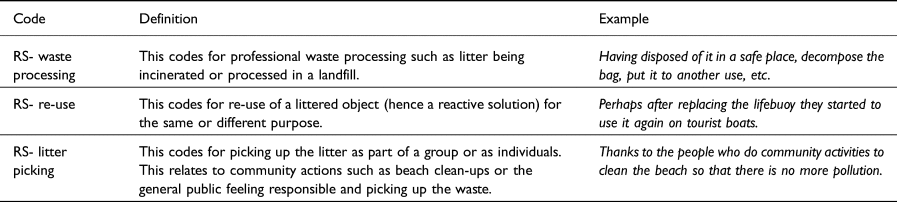
Over a third of stories included solutions, rather preventive than reactive (Table 3). Preventive solutions included a) personal actions (i.e. changes of attitude), such as being more careful, proper disposal and recycling; and b) social actions (i.e. requiring society or group efforts), such as raising awareness, offering alternatives to plastic and stopping plastic production. Individual stories suggested other social actions, as part of preventive solutions: convincing the industry, designing policies and monitoring plastic pollution. Reactive solutions included, for example, litter-picking or reuse of the littered object. As in Praet et al. (Reference Praet, Baeza-Álvarez and De Veer2023a), recycling was used as a code for the use of the word ‘reciclar’ in Spanish. This may hide confusion about what recycling means to participants.
Range of reactive solutions (RS)
Around a third of stories included elements identifying who should take action, such as individuals, e.g. If he or she had taken the drink and recycled or reused it, there would not have been a tragedy, including the protagonist or the reader, or more generally the society, which can be expressed in an inclusive—i.e. everyone including the protagonist, e.g. We should all be aware of the fact that we should not throw too much plastic into the sea, as many species live in the sea and it damages the ecosystem—or exclusive manner (everyone not including the protagonist); e.g. It is important that plastic is no longer produced because it ends up in places like the ocean, on beaches, making it a problem for the environment.
Surveys
Participants were aged between 12 and 22 years old (mean 15.9 ± 1.57), with slightly more male (N = 83; 52%) and a majority of UENG (N = 130; 81%) students. Participants reported going to the beach a few times a year (41.9%) and then every month (32.5%) or every week (18.1%) (Supplementary Appendix 8). Half of participants (N = 80) had already taken part in a beach clean-up or litter picking activity, with the GNPD, their school, family or a local ecology group, and most often on Santa Cruz beaches (Tortuga Bay, Playa La Estación, Playa los Alemanes, Laguna de las Ninfas) and urban areas (harbour, local parks). Only a handful of participants travelled to other islands (e.g. Baltra, San Cristobal) to undertake clean-ups.
Results of the Wilcoxon test indicate that only six of the 21 questions asked in the pre-surveys (S1) and post-surveys (S2) changed significantly over time (see Supplementary Appendix 9 for an overview of the results). Despite Likert scale data considered here as interval data, we still report the mean and standard deviation (SD) for better comparison with values reported in other studies.
Perceptions and self-reported knowledge
Questions evaluated the perceptions of MPL's presence, origins and impacts. Participants were asked to evaluate how much litter they noticed around the school (S1 3.1 ± 1.26; S2 3.41 ± 1.15; scale from 1 = very dirty to 5 = very clean; mean ± standard deviation), in their neighbourhood (S1 3.06 ± 1.39; S2 3.15 ± 1.32) and on the beach they most often visit (S1 3.54 ± 1.28; S2 3.46 ± 1.32). Participants noted the beach as the cleanest place (Supplementary Appendix 10). While views of litter in the neighbourhood and on the beach did not change significantly over time, the perceived cleanliness of the area around the school increased significantly (p-value = 0.02).
Regarding MPL origins (Fig. 3), participants mostly agreed that marine litter came from distant areas of Galapagos (S1 4.15 ± 1.30; S2 4.05 ± 1.26; scale from 1 = I fully disagree to 5 = I fully agree), more than from fishing activities (S1 3.87 ± 1.32; S2 3.91 ± 1.21) and domestic activities in the archipelago (S1 3.55 ± 1.47; S2 3.56 ± 1.35), and these views did not significantly change over time (p-values > 0.05).
Change in perceived impacts and sources of MPL before (pre-survey) and after the activity (post-survey). The standard error is indicated by the error bar and * indicates behaviours with statistically significant change with p-value <0.05.
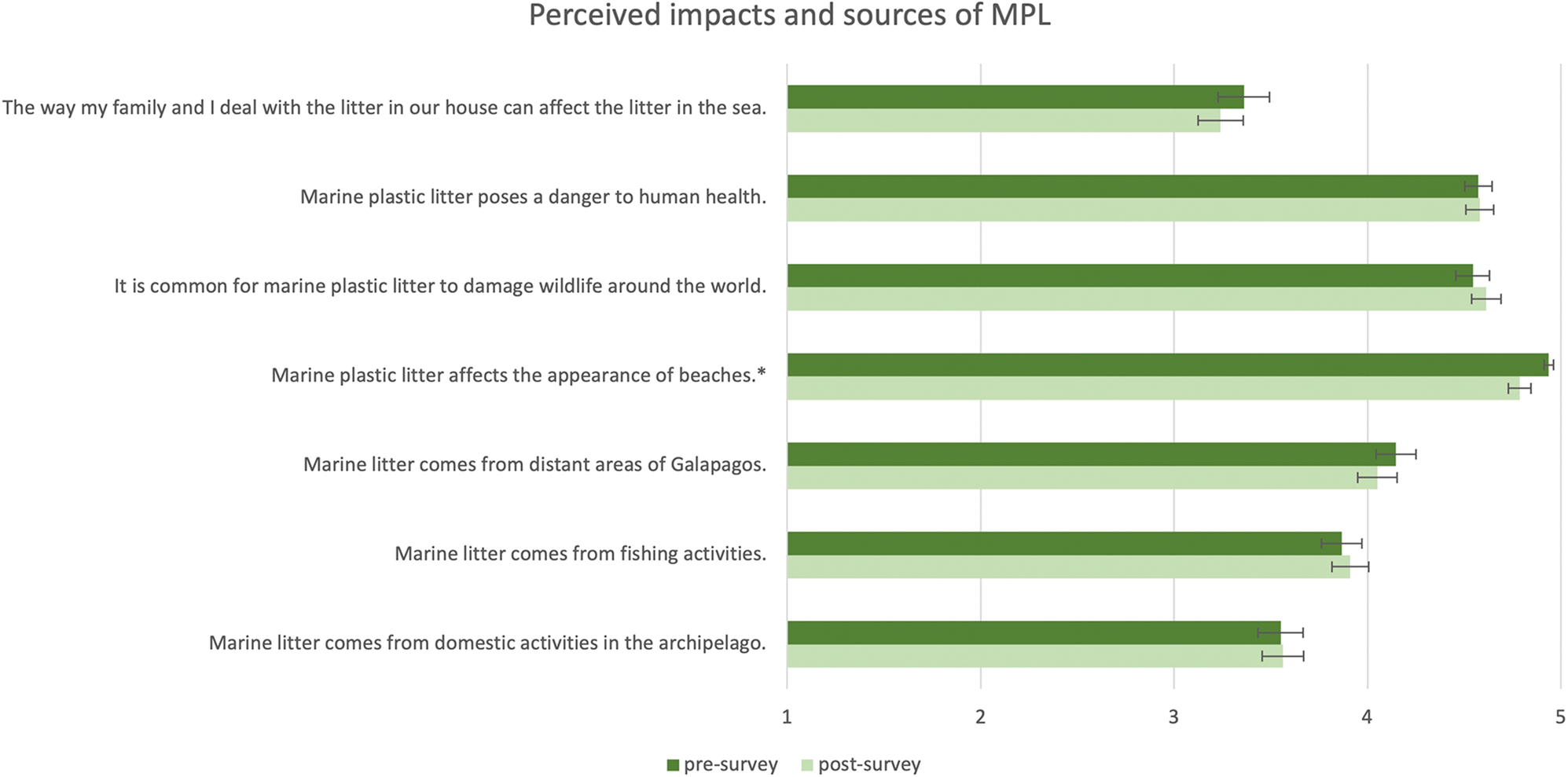
Regarding MPL impacts (Fig. 3), participants agreed with the fact that MPL affects the appearance of beaches (S1 4.94 ± 0.31; S2 4.79 ± 0.74; on a scale where 1 = fully disagree and 5 = fully agree), and their perception of these impacts changed significantly after the activity (p-value = 0.00631). Participants acknowledged the impacts on wildlife around the world (S1 4.54 ± 1.09; S2 4.61 ± 0.94) and on human health (S1 4.57 ± 0.89; S2 4.58 ± 0.90). Participants scored lower when asked if the way their family and themselves handled litter at home affected litter at sea (S1 3.36 ± 1.66; S2 3.24 ± 1.48). None of these views changed significantly over time.
Self-reported knowledge of participants was evaluated. Participants reported having considerable knowledge about marine litter (S1 3.42 ± 0.96; S2 3.55 ± 1.04 where 1 = I know nothing and 5 = I know a lot) and knowing how to reduce marine plastic litter (S1 3.63 ± 1.35; S2 3.71 ± 1.24) (Supplementary Appendix 11). Neither of these views changed significantly over time.
Pro-environmental behaviours
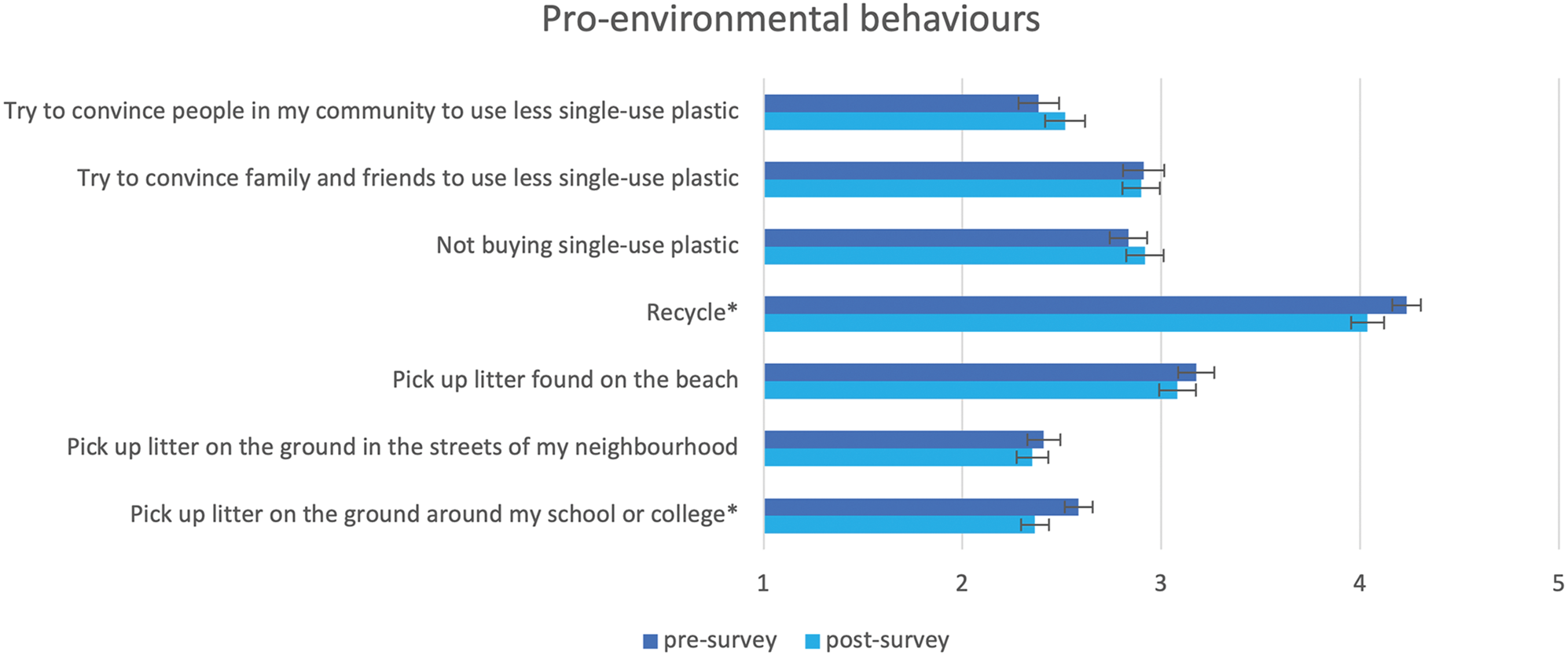
Participants were asked to provide a self-report of a series of PEBs. They stated that they rarely picked up litter on the ground around their school (S1 2.59 ± 0.87; S2 2.36 ± 0.90, on a scale where 1 = never, 2 = rarely, 3 = sometimes, 4 = often, 5 = always) and in their neighbourhood (S1 2.41 ± 1.04; S2 2.35 ± 1), but sometimes on the beach (S1 3.18 ± 1.16; S2 3.08 ± 1.16). Self-reports indicated that participants often recycled (S1 4.23 ± 0.9; S2 4.04 ± 1.04), but only rarely avoided buying single-use plastics (S1 2.83 ± 1.17; S2 2.9 ± 1.2). Trying to convince family and friends to use less single-use plastic is also a behaviour that participants reported to do rarely (S1 2.91 ± 1.3; S2 2.9 ± 1.2), and even less when it is the wider community they must convince (S1 2.38 ± 1.28; S2 2.52 ± 1.27). Only two behaviours decreased significantly over time: picking up litter around the school (p-value = 0.000888) and recycling (p-value = 0.00399) (Fig. 4).
Change in PEBs before (pre-survey) and after the activity (post-survey). The standard error is indicated and * indicates behaviours with statistically significant change with p-value <0.05.
In the pre-survey, participants were asked to name one thing they could do to prevent MPL reaching the ocean. Participants mostly suggested recycle (16%); avoid using plastic (13.6%); and raise awareness (12.3%) (Supplementary Appendix 12). Before the activity, over 95% of participants self-reported recycling behaviour. When providing an example in the survey, only over 50% of participants specified that they were separating and classifying litter in their respective bins. For more than 20% of respondents, recycling equated re-use, often for craft activities (Supplementary Appendix 13).
Evaluation of the activity
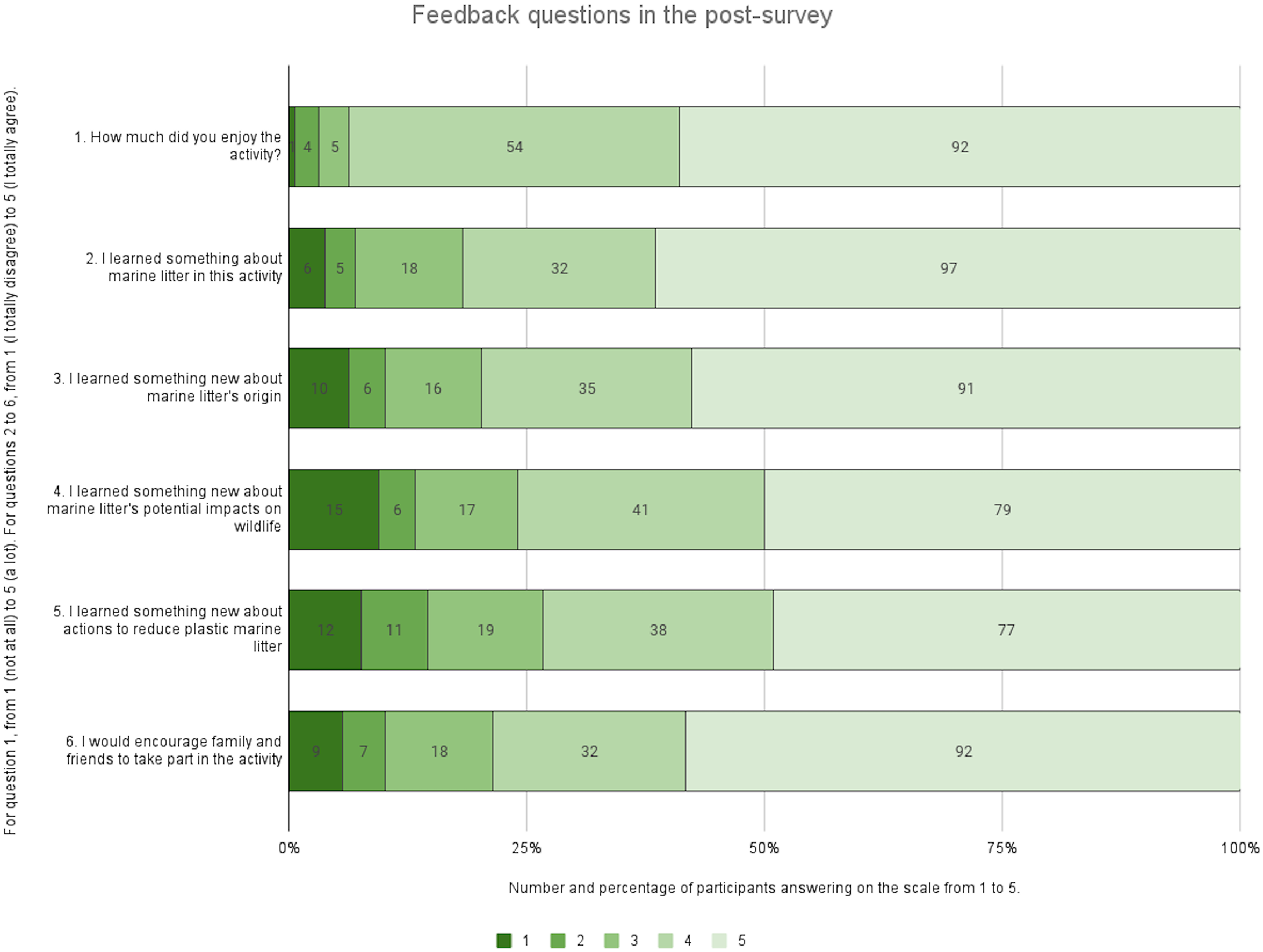
Feedback from participants was very positive to all statements (Fig. 5). Participants enjoyed the activity (4.49 ± 0.74, on a scale where 1 = totally disagree and 5 = totally agree). The activity boosted their self-reported learning, mostly about marine litter (4.33 ± 1.05) and its origins (4.21 ± 1.17). They seem to have learnt slightly less about marine litter's impacts (4.03 ± 1.27) and actions to reduce marine litter (4 ± 1.26). Overall, they seemed keen to encourage their family and friends to participate in the activity (4.2 ± 1.17). They were interested in learning more about MPL (S1 4.52 ± 0.91; S2 4.42 ± 0.92; p-value = 0.0431; where 1 = not interested to 5 = very interested) and found it important to reduce MPL (S1 4.73 ± 0.61; S2 4.61 ± 0.78; p-value = 0.0267; 1 = not important at all to 5 = very important), with responses to the last two questions changing significantly after the activity (Supplementary Appendix 9).
Distribution of answers to the feedback questions.
Discussion
Our results show an awareness of sources and impacts by local students in Santa Cruz. While the specificity of Galapagos is considered in identifying marine and mainland sources, the presence of fishing-related waste is associated with accidental behaviours. Bio-ecological impacts, mostly on fish and turtles, are described and concern for beach aesthetics and human health are evident in the surveys. When it comes to presenting solutions, however, stories are less expansive and surveys indicate high levels of recycling self-reports as well as relying on this behaviour to avoid MPL reaching the ocean. Those results are compared with our study on the East Pacific Coast that highlighted a perception of land and local pollution as contributors to MPL; a concern for bio-ecological impacts, notably landscape and wildlife; a diversity of solutions in stories but an omnipresent suggestion of recycling in surveys; improvement in PEBs and increased self-assessed knowledge after the activity.
Sources and pathways
The most common objects in the stories were fishing sacks and plastic bottles, the latter being the most chosen item in our previous study (Praet et al. Reference Praet, Baeza-Álvarez and De Veer2023a). The time of use, when specified, mostly lasted between days and months, contrasting with the short use-life (less than a day) assigned to objects on the Pacific coast (Praet et al. Reference Praet, Baeza-Álvarez and De Veer2023a). Stories written by Galapagos students emphasized that adults were interacting with the object, which contrasts with the results from the Pacific coast, where children and teens were the ones mostly interacting with the objects, potentially fostering self-reflection. This difference may be linked to the presence of fishing-related plastics in this study, objects that are more difficult for students to relate to, eventually offering more scenarios where adults interact with objects. The use of fishing-related plastics may influence the nature of the object's disposal. Here the pathway of MPL is mostly associated with accidental behaviours, often forgetting or losing the object. This contrasts with the more nuanced results from our study along the Pacific coast, where the most recurrent behaviour was intentional. Interestingly, the lack of intention in the behaviour associated with fishing litter was noted by Wyles et al. (Reference Wyles, Pahl, Thomas and Thomson2016), while intentional behaviours were associated with public littering.
The concept of object itineraries offered students the possibility to reflect about the geographical scope of the object's journey before reaching Galapagos. The global nature of MPL's journeys was recognized with most objects travelling extensively, often in the regions mostly mentioned, those being Galapagos, mainland Ecuador and China. As the objects were all found locally, stories were often anchored in Galapagos, whereas mainland Ecuador could be associated with the object being produced and/or disposed of there, and carried by currents as shown by van Sebille et al. (Reference van Sebille, Delandmeter, Schofield, Hardesty, Jones and Donnelly2019). Similarly, China was associated with industrial manufacturing or with the flag under which an international fishing fleet was operating, which was also identified as an important contributor to the issue (Muñoz-Pérez et al. Reference Muñoz-Pérez, Lewbart and Alarcón-Ruales2023). Almost half of the stories took the scenario of an object used on a boat, indicating that marine activities, notably fishing, tourism and a few mentions of cargo ships, are an important aspect of daily life and contribute to the issue of MPL.
Fishing industries and tourism were identified as the major contributing sectors to MPL in stories, while surveys emphasized the highest agreement with litter coming from remote areas, and then from fishing activities. This tendency may be related to both the importance of fishing for the subsistence and livelihoods of people on the islands (Viteri Mejía et al. Reference Viteri Mejía, Rodríguez and Tanner2022) and the awareness of international fishing fleets’ presence around the GMR, with some stories evoking illegal shark-finning practices (Alava & Paladines Reference Alava and Paladines2017). The latter reflects an awareness of known cases of illegal fishing that seem to have impacted residents of Galapagos including participants of the study, and a familiarity of students finding artefacts with Chinese characters on local beaches. The choice of fishing-related MPL may have influenced the sectors identified as contributors to the issue.
Plastic pollution represents a consequence of increasing tourism and a threat to remaining an attractive destination for tourists as detailed by Praet (Reference Praet2024b) and summarized here. The role that tourism plays as a contributor to plastic pollution is incontestable. While island-based tourism (i.e. tourists staying on the islands and making a few excursions) adds pressure to the local waste management system, cruise-based tourism contributes to polluting the environment if waste is mismanaged aboard. The issue is worsened by increasing levels of tourism, requiring larger infrastructure and daily imports of foods and drinks, and the change of the tourism model from floating hotels and cruise tourism to island-based visitation (Hunt Reference Hunt, Honey and Frenkiel2021). As tap water is not suitable for consumption in the archipelago, more imports of bottled drinks are necessary to comply with tourists’ needs. Plastic pollution therefore represents a direct threat to the perception of Galapagos as an Eden, which is key to the local economy. This impact was explored by students in the story-writing workshops. Plastic pollution is a threat for islands and heritage sites globally, particularly when these rely on tourism but are impacted by its consequences. For these places relying on tourism, the issue threatens the aesthetics of the landscape (e.g. Seychelles, in Dunlop et al. Reference Dunlop, Dunlop and Brown2020; Rapa Nui, Chile, in Thiel et al. Reference Thiel, Lorca, Bravo, Hinojosa and Meneses2021; Amantani, Peru, in Gascón Reference Gascón2022).
When natural factors are considered, oceanic currents are the most recurrently mentioned as contributing to the arrival of the object to the archipelago. This corresponds to results from the latest studies highlighting that marine currents can carry MPL from mainland South America to the shores of Galapagos (van Sebille et al. Reference van Sebille, Delandmeter, Schofield, Hardesty, Jones and Donnelly2019). There was a bias in certain stories that traced the MPL itinerary via currents only from mainland China, an impossible journey according to oceanographical modelling. The importance of currents and origin from remote areas and fishing activities contrast with the East Pacific coast, where local terrestrial sources, such as beach littering, were mostly identified (Praet et al. Reference Praet, Baeza-Álvarez and De Veer2023a). This difference may reflect the specificity of the MPL issue on oceanic islands particularly vulnerable to receiving MPL from marine activities and currents even when not inhabited (Lavers & Bond Reference Lavers and Bond2017). For example, perceptions of MPL in the islands of Madeira and Porto Santo emphasized mainland and ocean sources, while direct release on the coast is the least mentioned source (Bettencourt et al. Reference Bettencourt, Nuno Freitas, Costa and Caeiro2023). This specificity of the island suggests a potential lack of sense of responsibility, as surveys indicated that participants agreed the least with a domestic origin of MPL and did not see how their own waste management could be related to the issue of MPL.
Impacts
Stories seem to focus on bio-ecological impacts of MPL, exactly as in our previous study (Praet et al. Reference Praet, Baeza-Álvarez and De Veer2023a). For example, several stories discussed harmful interactions, most commonly ingestion of plastic, with potential deadly consequences. This is linked to a general awareness of plastic-related risks and impacts by students and children that have been noted in studies worldwide (e.g. Heidbreder et al. Reference Heidbreder, Bablok, Drews and Menzel2019; Oturai et al. Reference Oturai, Pahl and Syberg2022). Yet our surveys ranked highest the impact on the aspect of the beach (as in Praet et al. Reference Praet, Baeza-Álvarez and De Veer2023a), which can be seen as a threat to the unique biodiversity of Galapagos (Praet et al. Reference Praet, Guézou, Schofield and Tamoria2023b) and associated with a loss of tourism and hence revenues. The impacts of plastic, particularly as waste, on the aesthetics of the natural environment, notably beaches, are evident in the stories as nature is key for tourism on the islands, and probably for shaping Galapagos identity (Praet Reference Praet2024b). Plastic pollution, then, represents a threat to WHS and their status. While WHS status often boosts tourism, visitors’ behaviour can become a source of pollution on both cultural (e.g. Castell Henllys: Mytum & Meek Reference Mytum and Meek2020) and natural heritage sites (e.g. microplastics in caves: Balestra & Bellopede Reference Balestra and Bellopede2023). This may threaten the status of these sites, the same status that contributed to boosting tourism in the first place. The archipelago of Galapagos was added to the list of WHS in danger in 2007 for the scale of anthropic threats and concern for tourism (UNESCO 2007) and removed from it in 2010 (UNESCO 2010). The latest report in 2023 emphasized the concern for increasing levels of tourism and its impacts on the islands, recommending a zero-growth tourism model (UNESCO 2023). The UNESCO Committee also encouraged Galapagos to ensure compliance of the fishing fleets around the Galapagos Marine Reserve (UNESCO 2023). Participants in the activity in Galapagos shared their concern for the impacts of plastics on tourism, health and wildlife, particularly for Galapagos species.
In Galapagos, participants strongly agreed with the impacts of MPL on human health, reflecting a concern suggested in Praet et al. (Reference Praet, Baeza-Álvarez and De Veer2023a) with plastics entering the food chain. Furthermore, a couple of stories explicitly stated their concern over ingestion of microplastics. For fishing-dependent islands, the awareness of impacts may be higher due to a closer relationship with ocean resources. In Cape Verde, for example, the awareness of the issue is linked, at least for fishers, to finding plastics inside some fish species and noticing damage to equipment caused by marine litter (Ferreira et al. Reference Ferreira, Monteiro, Vasconcelos, Duarte, Ferreira and Santos2021). Overall, participants were aware of the diversity of impacts and considered MPL as a global issue, one that pollutes the environment. The impact of the journey on the object was noted through signs of deterioration in more than a third of stories. While plastic deterioration rates raise a lot of questions among scientists, the impact of both biotic and abiotic factors is clear (Chamas et al. Reference Chamas, Moon and Zheng2020) and was identified by participants along with their contribution to an object's eventual transformation into microplastics.
The journey length was often described as taking over a year, which contrasts with estimates from oceanographic models (a few months) in the region. This may evidence a perception of objects staying in the environment longer, which is likely to happen especially on non-inhabited islands of the archipelago. More than a third of stories considered interaction between animals and plastic while the object was in the environment. The most common animals mentioned were fish and turtles, which corresponds to our findings on the East Pacific Coast. The emphasis on fish may be linked to the importance of small-scale fisheries for the livelihoods of Galapagos residents, a positive role that was reinforced during the pandemic (Viteri Mejía et al. Reference Viteri Mejía, Rodríguez and Tanner2022). The emphasis on turtles may be related to their emblematic nature in the fight against plastic pollution (Geary Reference Geary2019) and to their presence in Galapagos, easily spotted in the harbour of Puerto Ayora, on Santa Cruz. The recurrent mention of Galapagos species may reflect a specific concern of local students for certain species present in Galapagos. Proximity with wildlife visible in Santa Cruz and with the issue of MPL may create better knowledge and awareness of participants. When humans interacted with the waste, they were often described as picking it up or participating in clean-ups. This emphasis on clean-ups may be related to the importance of those activities locally, with almost half of respondents indicating that they had already taken part in a clean-up.
Solutions
Contrasting with our study on the Pacific coast, where more than 75% of stories included potential solutions, less than a third of Galapagos participants included solutions in their stories. Those which did focused on preventive solutions, mostly personal behavioural change. The most common solutions were being more careful and disposing of litter properly, the latter being the most recurrent solution in Praet et al. (Reference Praet, Baeza-Álvarez and De Veer2023a). While we are aware that the activity focused on the itinerary, we hoped that participants would think about solutions when considering how the situation could have been prevented (Question 7).
In 27 stories, society as a whole was encouraged to take action, potentially reflecting an awareness of global dynamics affecting Galapagos and inferring a shared responsibility. The general public was also identified by Bettencourt et al. (Reference Bettencourt, Nuno Freitas, Costa and Caeiro2023) as the sector having responsibility for the issue in Madeira. While further research is needed, this may show that islanders know that society-wide actions are needed to tackle waste from marine activities and waste carried by oceanic currents from mainland sources, beside local input of litter. As local inputs constitute only a small percentage of the waste washing on Galapagos shores, this may lead to a lack of relatedness between one's own waste management and the issue of MPL. The presence of MPL may discourage people from adopting pro-environmental behaviours locally, especially as the problem is perceived as coming from elsewhere.
Almost all participants reported recycling in the survey, confirming a trend of high levels of self-reported recycling behaviour (Kiessling et al. Reference Kiessling, Salas, Mutafoglu and Thiel2017), particularly in young individuals (Salazar et al. Reference Salazar, Jaime, Leiva and González2022) who sometimes overestimate this PEB (Chao et al. Reference Chao, Yu and Yu2023). This may be linked to the importance of recycling as a solution against plastic pollution in regional communication campaigns (e.g. the 3 and then 4 Rs: refuse, reduce, reuse, recycle) and the enforcement of litter classification rules by the municipality of Santa Cruz. In pre-surveys, recycling was the most suggested action before avoiding plastic use. This tendency to suggest recycling had already been identified in Praet et al. (Reference Praet, Baeza-Álvarez and De Veer2023a). Here, participants may give an expected answer, maybe even more when recycling is mandatory in their neighbourhood. While recycling is a popular self-reported PEB and suggested solution, there is a confusion about what recycling is, notably differentiating between litter classification and reuse. As this confusion about the term ‘recycle’ is a global issue (Alexander et al. Reference Alexander, Smaje, Timlett and Williams2009), future educational activities in Galapagos could make this difference clearer and encourage a reduction of plastic consumption. Other studies have shown that solutions aim at making the waste not visible across the landscape instead of reducing plastic use and waste (Gascón Reference Gascón2022, 7), particularly for islands relying on tourism. While this is evident in surveys where the PEB ‘not buying single-use plastic’ is one of the most rarely adopted, 13.7% participants still suggested avoiding plastic use to prevent waste entering the ocean.
Picking up the waste on the beach was also a PEB ranked higher than picking it up in the respondent's school and neighbourhood. This confirms the concern for MPL's impact on the beach appearance evident in surveys and a general concern for the natural environment which can be enhanced by beach clean-up participation (Wyles et al. Reference Wyles, Pahl, Holland and Thomson2017), an activity particularly popular in Galapagos. MPL is considered ‘out of place’ (after Douglas Reference Douglas2002) in those natural settings, contrasting with litter blindness in urban settings (De Veer et al. Reference De Veer, Drouin and Fischer2022). This tendency may be even more important in a place like Galapagos, where the environment is praised for its uniqueness and its value is deeply associated with the economy of the islands depending on tourism.
Evaluation of the activity and usefulness of the framework
The activity received very positive feedback with participants interested in the topic and reporting learning about MPL. These similar results to Praet et al. (Reference Praet, Baeza-Álvarez and De Veer2023a) show that the activity can be organized successfully online and in person. However, the impact of the activity is not as clear as in our previous study, with little differences before and after the activity. Using the object itinerary framework proved useful to engage students on the topic, especially to make the issue less overwhelming and more relatable by focusing on macroplastics. Yet the framework may have incited them to focus on the object's journey and less on solutions.
Almost a third of the questions’ answers changed significantly between the pre- and post-survey. Participants’ perceptions of MPL origin did not change significantly over time, nor did their self-reported knowledge of the issue. The perceived impacts of MPL on the appearance of beaches, however, decreased significantly, maybe influenced by a reflection about the diversity of impacts a plastic object can provoke during its journey.
The activity provoked a significant decrease of two PEBs: recycling and picking up litter on the ground around the school or college. While this outcome was not expected, it may be related to gaining awareness that the issue of MPL needs different solutions (as evident in the stories) and to a better differentiation between reuse and recycling. We can observe a slight (non-significant) increase in two behaviours related to plastic use and consumption: not buying single-use plastic and trying to convince family and friends to use less single-use plastic. Further studies are needed to confirm those trends and understand potential consequences of increased knowledge on the topic of plastic pollution. Understanding the complexity of the issue may lead students to have more distributed answers, and consider an array of complementary solutions.
While our study did not provoke a significant increase in all PEBs, nor a significant change in self-reported knowledge, more research is needed to understand how/if the activity was beneficial and how it can be improved. The demographics could be explored to identify factors (e.g. age, gender, familiarity with environment and visit to local beaches) that influence the impact of the workshop, the answers to surveys and the focus of stories. The results may differ from our online activity, where self-reflection at home was encouraged during the repetitive lockdowns (Praet et al. Reference Praet, Baeza-Álvarez and De Veer2023a). This difference could be understood by the nature of the activity: voluntary along the East Pacific Coast, whereas UENG participants’ attendance and participation was requested. Answers in surveys can also be influenced by a series of factors, including social desirability (Miller Reference Miller2011) and central tendency bias particularly in Likert scale survey (Akbari et al. Reference Akbari, Eigruber and Vetschera2024), among others. The varying amount of time between the pre-survey and the post-survey may also have impacted the answers, along with the time spent writing the story, with some students finishing it during the workshops while others finished it at home. These results were unexpected and can contribute to improving the activity, recognizing that it is a good engagement tool but that the impact on PEBs and knowledge is limited. While the impact of the activity may not be obvious from the Wilcoxon tests, the excellent feedback indicates that participants enjoyed the activity and learnt a lot from it.
Conclusion
The analysis of surveys and stories offered insights into perceptions that participants have of the issue of MPL in Galapagos, recognizing that our small sample size may not represent the overall perception of MPL in Galapagos. There was an awareness of global pathways, notably through currents, and sources of plastic pollution across stories and surveys, with the fishing sector being identified as an important contributor. In that perspective, the prevalence of accidental behaviours leading to MPL disposal reinforces a trend of fishing litter perceived more positively than domestic litter. The prevalence of bio-ecological impacts, with a concern for aesthetics of the landscape, human health and wildlife, may be related to the specificity of Galapagos, an archipelago relying on tourism for its income and on fishing as a major food source locally. The concern for how the landscape looks and for the potential impacts of plastic pollution on its biodiversity may reflect an awareness of the uniqueness of Galapagos as a WHS and the value of such landscape, notably for tourism. While this study suggests an awareness of origin and sources of MPL in Galapagos, the diversity of solutions remains overlooked. The prevalence of recycling in surveys suggests expected answers and PEBs, while stories seem to encourage careful behaviour. A problem emerging from our data is that solutions were not often included in stories, reinforcing the need for targeted actions to raise awareness and improve knowledge of potential solutions. For example, educational activities could focus on offering more clarity regarding the meaning of recycling, and how this behaviour alone is insufficient to address plastic pollution, especially on islands. This would contribute to communicating that the issue of plastic pollution needs a variety of solutions (Lau et al. Reference Lau, Shiran and Bailey2020).
The story-writing workshops proved to be successful engagement tools using an archaeological framework adapted to marine plastic litter. The workshops offered a way to engage youth from Galapagos. Story-writing with an archaeological lens offered a distinct activity that enabled us to access and explore perceptions of MPL. The excellent feedback suggests that archaeology made the workshop an enjoyable and engaging experience, despite its impacts on PEBs and changes in perceptions being limited. While the results do not demonstrate a significant impact on PEBs and perceptions, an archaeological lens also contributes to seeing failures (Joyce Reference Joyce, Bille and Sørensen2016) as well as successes in our own practice. Participants do not seem to have changed thinking, at least from a quantitative aspect. The impact of those stories and the activity may not be quantitatively significant, but the framework definitely generated interesting questions and approaches from participants and researchers alike. The question of plastic pollution, its impacts and solutions may be better grasped through stories reconstructing itineraries of those flexible, overwhelming, and global materials that plastics have become.
Supplementary information
For this paper, supplementary information can be accessed at https://doi.org/10.1017/S0959774325000095
The raw data (demographics, survey answers and codebook) are accessible via Zenodo (https://zenodo.org/records/13354143), except for the stories themselves that remain the property of participants in Galapagos and are only shared in exhibition or as anonymized quotes in publication.
Acknowledgements
The organization of the workshop was possible thanks to authorization from the Ministry of Education (Republic of Ecuador) (MINEDUC-CZ5-20D01-UDAC-2022-0936-E) and ethical clearance from the University of York. Parental and student consent were obtained to analyse stories and surveys, and clear information was provided to the students regarding their data use. This work was supported by the Arts & Humanities Research Council (grant number AH/R012733/1) through the White Rose College of the Arts & Humanities and by the Galapagos Conservation Trust. The role of Juan Pablo Benítez Pérez (UENG) and Mar Espinosa (TdB) was key to organizing the workshops. The authors would like to thank all the participants who made the research possible for their enthusiasm and the time spent drawing and/or writing the itineraries of plastic objects.


 Open access

